Front matter (continued 2)
Reading edition
In service, meals are quickly over, and no loitering is allowed at tables, especially on inspection day. Richard, having finished his rations with all the gusto of a healthy boy, strolled from the mess hall back to his squad room. The apprentices were supposed to have their quarters in proper "police" by mess call in the morning, and while they were engaged in filling their stomachs, the N.C.O. in charge, Gunnery Sergeant Miller, usually made his unofficial morning inspection in order to discover and correct any violations of requirements before the regular function by the O.D., or on Saturdays the Commanding Officer.
"Old Grumpy" knew boys from "A to Izzard," and though they were ever attempting to play all sorts of pranks on him it was seldom they succeeded. Tall, lean, gruff, the boys soon found he possessed a heart under the weather-beaten exterior, and honestly admired and respected him. He was never unjust, he gave them no work not necessary to their welfare. He heard their complaints, settled their disputes; or, if he believed these could be settled only by a fistic encounter, he arranged the match, and acted as referee, timekeeper and general adviser.
He also took charge of their scholastic career, so sadly neglected in many cases. It was called "Grammar" school, but its curriculum was little more than the "three R's." Besides being the drill instructor, Gunnery Sergeant Miller strove at all times to teach his young charges the manly virtues of honesty, courage, self-control, obedience, industry and clean living.
When Dick entered the squad room he thought at first it must have been occupied during his absence at breakfast by a menagerie of wild beasts. At the far end, where there happened to be a few empty bunks, a regular free-for-all fight seemed to be in progress. Shoes were flying about the room in all directions, boys wrestling on the floor, pulling at one another, yelling, laughing, punching, crawling. During "Old Grumpy's" inspection, while they were at mess, he had found several pairs of shoes unblackened, others not aligned, and still others poked away in improper places. So he gathered all the shoes in the room in a heap and left them for their owners to disentangle and set aright. It was not an easy job to find one's shoes when mixed up in a jumbled mass of over sixty pairs, and by the time the owners secured their rightful property, get them again cleaned (for the scrimmage had effectually destroyed any previous gloss), and aligned under the bunks, brass work of drum and bugle polished, leggins khaki-blancoed, clothing and equipment brushed and adjusted, guard mounting was over and first call for inspection sounded from the area of barracks.
At the sounding of assembly the lads formed in two ranks on their allotted parade ground, while the companies under arms and the band marched to their assigned places.
This was the first Saturday inspection for some of the apprentices recently arrived, so Gunnery Sergeant Miller took occasion to give them a few last cautions regarding their duties, and ended by addressing them as follows:
"I want to tell you boys that every time in the future I don't find your shoes properly policed at early inspection they all go into a pile as they did this morning. That means more work for all hands. I can't stop to pick out the few that are all right when so many are all wrong. Take the hint and all of you coöperate and save yourselves extra and useless work. That's all! At Ease!"
The strains of the band were now heard and the apprentices watched the movements of the companies as they went through the ceremony of inspection and review.
The United States Marine Corps band is one of the most famous organizations of its kind in the world. It is stationed at the Marine Barracks in Washington, D.C., and plays during all parades, guard mountings, and other like ceremonies. Once John Philip Sousa was its leader, and the band has always rendered his well-known march music to perfection. At this moment following the sounding of "Adjutant's Call," the space between the barrack buildings was filled with marching men forming in one long line with the band on its right, swords flashing, guns glinting in the sun, and the red, white and blue of the silken flag fluttering. It was indeed a martial and inspiring sight. Later, as the armed men passed in review before Colonel Waverly to the sound of the Marines' own march by Sousa--"Semper Fidelis"--every step and movement was in perfect unison.
"Any man whose feet don't just naturally keep in time to that music never will be a soldier if he lives to be as old as Methuselah," remarked Gunnery Sergeant Miller to the latest recruit near whom he was standing, "and when you get to blow the bugle like those musics in rear of the band, then you're a field music and no mistake."
Behind the band twelve boys, all recent graduates from the school, among them Richard Comstock and Henry Cabell, were adding volume to the music during certain parts of the march. It was then that the whole enclosure fairly vibrated with the soul-stirring strains.
The review ended: the extra musics fell out and joined their fellows under Miller, and the inspection of the troops began. During this function the band rendered various selections much to the delectation of many curious sightseers who had been admitted at the Main Gate to the barracks. Many of these people were music lovers and could be found seated on the same benches day after day, listening to the band.
"Do you see that pretty girl across the parade, Dick?" asked Henry. "No, not where you are looking, but the one standing near the bench under the trees--the girl looking this way."
Dick's eyes following the directions of his friend soon spied the girl referred to. How familiar she looked! She reminded him of--yes,--it was,--Ursula, his sister, and by her side stood his mother and father.
Forgetting he was no longer a free agent, Dick gave a wild "whoop" and started from the ranks. Just in the nick of time Henry caught him by the coat-tails and jerked him backward to his place in line.
"Watch yourself, Dick," muttered Henry between his teeth, "here comes the 'Old Man!'" His prompt action probably saved Dick a severe reprimand, if nothing worse.
Gunnery Sergeant Miller had whirled about on hearing the unaccustomed war whoop but he was not swift enough to catch the culprit. So he was forced to postpone further investigation of the untoward circumstance until another time, for Colonel Waverly was now but a few yards away, coming to inspect the apprentices.
"Attention! Prepare for inspection; Open--Ranks; March!"
The apprentices became a stiff line of human ramrods and at the command of execution--"March,"--the rear rank took three paces backward and halted, while in both lines heads and eyes were turned smartly to the right. Having verified the alignment of both ranks the Gunnery Sergeant stepped to the front and commanded:
"Front!"
Each head snapped to the front. The N.C.O. in charge then saluted the Commanding Officer by bringing the sword he carried up to a position in front of the center of his body, the right hand grasping the hilt a few inches from his chin, with the blade slanting upward and slightly outward. This part of the ceremony being over Colonel Waverly carefully inspected every boy in line. He examined their shoes, the fit of their clothing, their equipment, the cut of their hair and even, if truth must be told, their necks, to see if soap and water had been recently and properly applied.
All this time Dick was nearly bursting with impatience. He began to believe the Colonel never would finish. At last the ordeal was over and immediately on being dismissed he requested and received of "Old Grumpy" permission to speak to the Commanding Officer. Approaching him, Dick rendered his most military salute.
"What do you wish, Music?" questioned Colonel Waverly.
"Drummer Comstock would thank the Commanding Officer for permission to go to the visitors' benches and speak with his mother, father and sister. They have just arrived, and are over near the gate, sir."
"Granted, young man, and you are excused for the rest of the day."
Dick Comstock cannot recollect whether or not he saluted his colonel after a fervent "Thank you, sir," but he still remembers the feeling of those motherly arms about him and the sweet kisses on his lips as Mrs. Comstock gathered her stalwart drummer boy to her bosom,--drum, drumsticks and all.
CHAPTER VI
A QUEER CONVERSATION
"We were here all the time, Dick," said Ursula soon after the first outburst of joyful greeting had subsided, "and we all tried our level best to catch your eye but, goodness--you were so military you would look neither to the right nor left," and she straightened her back and puffed out her cheeks in comic imitation of her brother on parade.
"It is quite as well I didn't see you, for if I had, I'd have forgotten every bit of military discipline I've absorbed since being here," responded Dick, smiling good-naturedly at his sister's mockery; "as it was I came near making a break when Hank Cabell pointed you out to me; but fortunately he grabbed me and saved my reputation as a marine."
"Is 'Hank,' as you call him, the boy about whom you wrote to us--the Southerner?" inquired Dick's father.
"Yes, Dad, and I want you to meet him. He's a dandy chap and comes from a good family, though I believe they are very poor, and likewise very proud."
"Sometimes that combination isn't all that could be desired as an asset," drily remarked Mr. Comstock.
"But he is all right, Dad," said Dick, quickly coming to the defense of his friend against any possible insinuation. "There he is now. I'll get him to come over here."
Suiting actions to his words Richard presently returned with Henry, and the formality of introductions over, Mr. Comstock invited his son's friend to join them at luncheon and for the day. Henry's rather sombre face lighted up with pleasure.
"I should be very glad to go, sir, providing I can secure early liberty," he said.
"How about you, Dick, are you in the same boat as your friend Henry?" inquired his father.
"No, Dad; you see, when I told Colonel Waverly you were here he excused me for the rest of the day," replied Richard, and turning to Henry he said, "Suppose you hurry up and get permission, Hank, while I go and put away my implements of warfare."
"Implements of war, indeed!" laughed Ursula, pointing banteringly at the drum slung over her brother's shoulder, "and are your weapons as dangerous as my brother's?" asked she, turning her questioning eyes on Henry.
"Mine consists of a brass trumpet," replied the boy with a smile, "but it has one advantage over the drum as a weapon, for it makes a handy bludgeon in time of need."
"Run along, boys," cautioned Mrs. Comstock, "it is nearly noon and I for one am famished."
"I reckon it would be better for us to get permission to wear cits; it might be less embarrassing for you all," and Henry looked inquiringly at Richard's parents.
"Not for me," interposed Dick, with some emphasis; "I'm in uniform, and I'm proud of it, and so are my people."
"I didn't mean it in that light," Henry replied, flushing at the suggested rebuke. "I was merely thinking of your mother and sister and the possibility of saving them embarrassment. You may not know this, but enlisted men in uniform are not greeted cordially everywhere, even here in Washington."
"Excuse me, Henry, for being so hasty; I had not thought of that side of the question," said Dick frankly, and he turned red himself because of his readiness to find fault with his chum's remark.
"Yes, Henry was quite right in what he said," stated Mr. Comstock. "I read of many such incidents in the papers; but there are laws now which slowly but nevertheless surely are making people understand that the enlisted man in uniform may no longer be treated with disrespect. A better class of men seem to be joining the colors these days, and they are calling their defamers to a strict accounting. But this is not getting something to satisfy our appetites. You boys hurry up now and get yourselves ready."
After a bountiful luncheon at one of the best hotels in the city a tour of the capital was proposed and an enjoyable afternoon of sightseeing followed. In Dick's spare moments during his stay in Washington he had visited nearly every one of the public buildings and he took great pleasure in showing his sister about. The three young people even climbed the thousand steps of Washington Monument, scorning the slow-moving elevator which carried their elders up the five hundred feet which still left them fifty-five feet beneath the apex of the wonderful shaft.
Ursula was enchanted with this superb view of the "magic city," as she was pleased to call it, and for a long time they all enjoyed the panorama of land and water, field and forest, country and city, spread before them to the distant horizons.
After this they walked back to their hotel, and while Mrs. Comstock enjoyed a little rest before dinner and Mr. Comstock departed on a business engagement the trio of young people occupied themselves in animated conversation in one of the ornate reception rooms.
Feeling that Ursula and Richard might appreciate being alone together for a while, Henry excused himself, promising to return in time for the evening programme, which would not end until after the roof garden supper following the theatre.
After his departure Ursula and Dick strolled over to one of the low windows and pushing aside the long curtains which reached to the floor they stepped into the vacant space of a small narrow balconied window ledge and stood looking at the passing traffic. A group of palms, the half-closed blinds and the long curtains effectually concealed them from the view of people inside the room.
The mere fact of being together was happiness in itself for these two devoted young people and gradually a silence fell upon them as they stood absorbed in the scenes outside.
A subdued murmur of voices came from the room behind them, and Dick heard someone say:
"Here is a quiet place where we may talk freely."
Glancing over his shoulder the boy saw three men seating themselves and deliberately placing their chairs near the window where he and his sister were standing. He was wondering why they took such care with the chairs, when again the same voice gave him the reason.
"We can see from here whomever comes into the room, gentlemen, and it is well to observe caution while discussing this question."
"Shall we speak in German, Señor?" brusquely inquired a heavily built man whose blond hair stood up in short stiff bristles on his head.
"Si, Señor," deferentially replied the third member of the party, a slender, black-haired man whose dark skin announced him a resident of some Latin-American country, and from then on they spoke in the tongue agreed upon, and so quietly that Dick could not overhear. Knowing that he was an unintentional eavesdropper he turned back again to the street feeling it was unnecessary to move from the window, for unless he made an especial attempt the words of the speakers were inaudible to his ears. A little time passed in this way, when suddenly Dick placed his hand over Ursula's mouth, for she had turned, meaning to address him. At the same moment he motioned her to be silent.
To both Richard and Ursula Comstock the German spoken language was an open book, for Mrs. Comstock had employed German nursemaids to attend them when they were little tots, and until Ursula was twelve years of age she had had a German governess. Even the cook, a family retainer for years, was a native of Cologne. In consequence the loud remark which Dick heard from the room behind was as significant as if spoken in English. He knew that the big foreigner from across the ocean had uttered it. There was no mistaking the deep, abrupt, explosive voice.
"The United States can do nothing! Germany can whip her any day! Germany can whip the whole world; and some day she will!"
The speaker had risen and the others now pushed their chairs back and stood beside him. Their voices came distinctly to the ears of the boy and girl tensely listening in the shadow of the blind.
"Well, I should not go so far as that, you know!" protested the tall man who had led them to the window for their talk and whom Dick decided was an Englishman.
"Maybe you wouldn't, but it's so," reiterated the German, using his words as a ruffian would a cudgel. "Now, Señor, I must have your decision regarding this canal business at once, or it will be too late to be of any use to us. If your revolution in Nicaragua is a success, will the man you put in the presidential chair grant Germany the canal right-of-way or not?"
"I cannot tell you, Señor. It is a question which must be placed before the committee. I am only empowered to offer you the things already mentioned in return for financing our uprising. The United States has a concession, I believe--had it as far back as eighteen eighty-two. They would not permit us to agree to your proposal."
"I tell you that you are wrong. The United States never made any treaty with Nicaragua. Your government granted a concession to a private corporation in 1897 to build a canal, and they bluffed for a while at digging it on the Atlantic side. The United States also sent a commission down to Nicaragua several times, but nothing came of it. Then they forced Panama into revolt against the Colombian Government, and made her give them the present location. Therefore if you want our money and our secret aid your candidate must agree to Germany's terms."
"Suppose we give Señor Cabanas a few days to consult with his committee," suggested the Englishman in his mild voice.
"The committee knows it already," exclaimed the exasperated Teuton. "The subject was thrashed out in Leon while I was there six months ago. I tell you it is subterfuge, pure and simple. They know what we want, and they should have deputized their man to grant our demands."
"Pardon me again, Señor," came the suave voice of the little man, yet his eyes must have flashed ominously at the brutal pounding of the German's heavy voice, "I assure you that this is absolute news to me."
"It shouldn't be! Your committeemen are a set of vacillating fools; that is all, and the best I can say of them. Go back to them and arrange it; but I warn you--not a mark,--not a single mark, unless----"
"Be careful, Mein Herr, here comes the house detective--they are all secret service men in Washington. We had best postpone this and meet again."
It was the Englishman who gave the warning, and with the words the three conspirators moved towards the door leading to the hotel lobby.
Behind the curtains Richard and Ursula still stood, hardly daring to breathe for fear of disclosing their presence. Every word uttered by the plotters since Dick placed his hand over Ursula's lips had been distinctly heard and understood by both, and they realized the import of the information they had obtained so unintentionally.
Barely had the three men disappeared when Dick, exclaiming, "Wait for me here!" was running towards the door in pursuit.
Henry Cabell, returning from his self-imposed absence, came around the corner of the entrance at that identical moment, and the lads collided forcibly. The delay caused thereby was sufficient to enable the quarry to efface themselves and though Dick made a careful search his efforts were futile.
Returning, he found Ursula excitedly relating their experience to Henry. They both looked up expectantly at Dick's entrance.
"Did you catch them, Dick?" his sister inquired breathlessly. "Did you have them arrested?"
"No, I lost them," announced Dick in a disgusted tone; "I couldn't have them arrested anyway on the little we know; this is a free country. But I sure would have liked to see their faces. All the time they had their backs towards us, and I merely glanced at them when they first came in. I do wish I'd been more observing."
"What would you have done had you caught them?" asked Ursula.
"I'm sure I don't know; only I'd have pointed them out to that house detective, for one thing."
"Could you identify any of them if you saw them again?" asked Henry.
"I'd know that big brute of a German by his back, in a million, but I'm not sure of the others,--yes, I believe I could tell the Englishman too."
"I should know him if I ever saw him again," said Ursula. "I never should forget that peculiar suit of clothes he wore, nor----"
Both the boys broke into a shout of laughter at this remark and Dick said:
"That's like a woman; noticing the dress first of all."
"Oh, you need not laugh, Dickie dear; I do not doubt that he has other clothes, but the chief thing I should recognize him by was a peculiar patch of white hair on the right side of his head behind his ear, and also half the middle finger of his left hand was missing."
"We apologize most humbly for our premature expression of opinion regarding your powers of observation," said Dick, bowing low to Ursula with mock deference, "but now the question is,--what shall we do with this information we have acquired?"
"Here is Father; let us ask him," and Ursula ran to greet Mr. Comstock who at that moment approached them.
After hearing of the episode, Mr. Comstock advised Dick to write out all the details as he and Ursula remembered them, and he, Mr. Comstock, would see that the report was placed in proper hands.
"I believe you have discovered a very pretty plot, which would seriously damage us if carried to an ultimate conclusion," said Dick's father. "We all know that Germany is expanding her trade lines enormously and making greater strides in systematic foreign commercialism than any other nation, but I can hardly conceive she would dare to finance such a risky venture with the canal right-of-way as her only payment."
"Would Uncle Sam permit Germany or any other country to build a canal across Nicaragua now that the Panama Canal is almost completed?" asked Henry.
"I doubt it so much that I feel perfectly safe in saying, most emphatically,--No!"
"The United States would never allow any country to acquire territory in the Western Hemisphere--it would be contrary to the provisions of the Monroe Doctrine," said Dick. He leaned over and picked his campaign hat from the floor, then pointing to the small metal object thereon, he continued:
"This little insignia of the marines tells its own story; this is the Western Hemisphere; across it the anchor and above the eagle with spreading wings, holding a ribbon on which is inscribed the motto of our Corps. It is our part to look out for these little countries, and according to history the marines have been doing it mighty effectually since the United States became a nation. And I guess we can keep up the good work."
"With the able assistance of one Drummer Richard Comstock, U.S.M.C.!" slyly interposed Ursula, and Dick joined in the laughter which followed her remark.
"The thing I can't figure out," said Henry, "is what the Englishman is mixed up in it for! Do you reckon England is joining hands with Germany?"
"No, I doubt anything of that nature," answered Mr. Comstock. "The interests of England and the United States are too closely allied for her to risk rupturing them by any such hazardous undertaking."
"I would not trust an Englishman as far as I could see him! I cannot bear them!" exclaimed Ursula, vehemently.
"Why do you feel so bitter against our mother country?" asked Henry, who was surprised at her outburst. "Is that the general feeling up North? For I am quite certain it is not in the South."
"Ursula's feeling is largely due to local influences," answered her father. "In our home town the English have never been popular since the day during the Revolutionary War one of their officers, a major, after having received the surrender of our brave Colonel Ledyard at the Battle of Groton Heights, took that officer's proffered sword and ran him through the heart and then commanded his troops to massacre the surviving gallant defenders of the fort, who were drawn up, unarmed, in one of the bastions. That same day our city was burned to the ground by the traitor, Benedict Arnold."
"The brute! Why! I'd rather be Benedict Arnold than that Englishman," and Ursula's pretty face looked very stern and her hands clenched in anger.
"It was fortunate you both understood German," said Henry a little later in the evening. "I never could bear the study of languages, though I did struggle along for a year or two with Latin at school."
"We neither of us have studied German, merely picked it up as children, and we always use it talking to the cook. But I like French and had it three years at school, but really no practise in it," said Dick.
They were at the theatre and Dick sat next to his father, which afforded the two many opportunities to converse during the vaudeville acts.
"I am glad, Dick, that you keep writing to your mother regularly," said Mr. Comstock; "it is a fine habit to form and to stick to. If every boy wrote home at least once a week, I believe the world would be a better place. So many boys grow careless and after a while lose touch with the home ties and associations. Then, too, besides being a good thing for you personally, you have no idea what those letters mean to your mother."
"I like to get letters, and unless I wrote them on my part my mail would be pretty slim," replied Dick. "I have seen already how the men welcome the sight of the mail orderly, and some who never get mail envy those who do. Some of our boys never receive home news, and they must be homesick and heart-sick at times the way they sort of hang around and listen when some fellow happens to read out a few of the things that happen back in the home town. I know I'd be, were I in their place."
"You will never regret being thoughtful when it comes to giving your mother a little line or two of written happiness. But in your letters I have noticed an absence of complaints. Is it because you have none to make or that you didn't want us to feel bad by recounting them?"
"I haven't a single kick coming, Dad, for we are treated splendidly. Good food and well cooked, good clothes, fine beds and healthy work. I only wish it was more strenuous than it is. I spend a lot of time in the gym and playing ball. I did hope we musics would get more military drill than we do, but outside of a little marching and physical drills and a 'hike' across the river into Maryland, we do nothing of real soldiering. One of the privates has taught me the manual of arms and bayonet exercises, so I'm not wasting my opportunities. I think that in a year more I can get my rank changed to a private, then I shall be in line for promotion to corporal."
"Time enough, my boy. It is better to make haste slowly and thoroughly, for I don't doubt you will have to be very thorough if you are to succeed. Have you any idea what books you will require?"
"Well, I'm studying the U.S. Army Guard Manual, which the marines have adopted, and there is a book called 'Landing Force and Small Arms Instruction' for the Navy which is just filled with meat and will take some time to digest. I shall have no difficulty in getting the books as I need them, and my high school education was along the lines that would have helped me most at Annapolis--physics, chemistry, astronomy, surveying and so forth. All these are sure to be valuable, to say nothing of the mathematics up to trig."
"It pleases me to hear you like the life," said Dick's father. "That is more than half the battle always,--the interest and liking we have for the task at hand. No man ever became successful without being in perfect harmony with his work and his environments, no matter what his walk in life."
Richard's mother was more solicitous regarding her son's creature comforts, and the following day she insisted on making a visit to the barracks and seeing with her own eyes exactly how and where her boy lived. The manner of her request so enchanted Colonel Waverly when she asked to be taken around the post that he volunteered to act as her escort, nor was her New England sense of cleanliness and order once outraged with what she saw.
They visited the living quarters, offices, mess hall, auditorium, storerooms and galley, and she even tasted with approval the food in preparation for the noonday meal. A youthful Lieutenant of Marines, accompanying the party, insisted on presenting Ursula with several pairs of N.C.O. dress chevrons and trumpet cords from the Quartermaster's stores, with which she might decorate a sofa pillow, and not to be outdone in gallantry, Henry Cabell, on seeing these evidences of the officer's regard for the charming sister of his friend, made a dash for the post canteen before its closing hour and purchased for her a dainty little gold and silver pin, a miniature of the Marine Corps emblem, for which he required her to give him a copper in payment.
Dick and Henry had not been included in the inspection tour but they later accompanied their visitors to the train which carried them away that beautiful Sunday afternoon back to New England.
"These two days have been, sure enough, the happiest days I have spent since leaving home," remarked Henry as the boys retraced their way to the barracks. "I didn't half thank your folks for the great pleasure they have given me."
"It was fine, wasn't it?" said Dick simply, for his mind still dwelt on the last proud look his father had given him; the suspicion of tears bravely suppressed in Ursula's eyes and voice; and the never-to-be-forgotten good-bye kiss from his mother's trembling lips.
Yes, it was fine indeed!
And how fortunate this visit was, for two weeks later came orders sending aboard the cruiser Denver a detail of marines to replace men whose tour of sea-duty had expired, and with that detail went Richard Comstock and Henry Cabell, Drummer and Trumpeter.
CHAPTER VII
OFF FOR TREASURE ISLAND
The little detachment for the Denver were ordered to go on board fully equipped. This necessitated packing all personal belongings in the khaki-colored canvas knapsacks and haversacks.
Gunnery Sergeant Miller happening through the squad room found Dick and Henry thus engaged soon after they had been notified to be ready for departure in two hours' time.
"Want some help?" he questioned, stopping near their bunks.
And indeed they did want help, for though they had been taught how to make up their packs, they had never before been required to stow away every blessed thing they owned in one of the infernal things--this being about the way they expressed themselves in answer to his query.
"To begin with, you won't be allowed to have any cit clothing on shipboard," said the Sergeant. "The best thing to do, if you don't want to send them home, is to sell them to Ikie Cohen across the street, or if you choose, you can pack them up with the things you won't need and turn them over to the Police Sergeant for storage; then when you transfer to shore duty again have them sent to your new station."
Following this sound advice the boys proceeded to divide their possessions into two lots. Even then it did not seem possible to carry along everything laid out for their taking.
"Now dump the whole outfit on your bunk," directed Miller, "and first fold your blankets and clothing in the way you have been taught. The detachment will travel in blues, so before doing anything else run down to the Post Tailor and tell him to press them in a hurry and send them up. Here, Cabell, you take both uniforms with you and Comstock will help you on your return."
Henry picked up the new blue uniforms, which the boys had not worn as yet, and hurried to the Post Tailor. Then proceeding under his able instructor, Dick first packed his knapsack to its limit. Two blankets, three suits of khaki, two O.D. shirts, three suits of summer underwear, one pair of tan shoes, six pairs of socks, a towel or two, and his toilet articles, one by one disappeared into the enchanted bag. His overcoat, recently issued him, was rolled and tied in straps to the top of the pack after fastening down the flaps by means of the rawhide thongs. In the meantime Henry had returned.
"Put that extra pair of tan shoes in your haversack with all the rest of your odds and ends," advised their instructor. "You will wear leggins and campaign hats, though personally I think it a poor combination with blues, and you can hook your blue cap to the pack after you get it on."
"Sergeant, didn't you tell me that marines used to have dress coats with long skirts, black spiked helmets, white helmets and white uniforms?" asked Dick, while he stowed away a little pocket edition of the New Testament in his haversack as the final act of his work in hand.
"Yes, that's right," answered Miller.
"Well, for the love of Mike, how did you ever travel with all that junk and still always be the first to get there when there was trouble brewing?"
"Indeed it was a question in the old days," said Miller reminiscently, "but you must understand that when hurry-up orders came along we took what was needed for the work in hand and no extra stuff at all. When we made a permanent change of station then we hauled along our whole equipment, and what we could not carry on our backs was shipped to us by the Quartermaster."
"About how much do you reckon this knapsack weighs, Sergeant?" asked Henry.
"I should say at least sixty pounds--that means all your equipment, and it is about the weight you would carry on a regular hike, counting arms and ammunition and all that. Now when you boys come to leave ship and go to a shore station, you will be surprised to find how much more junk you will have to send ashore than you took on board. It's always the way. Things accumulate, and you never seem to know where they all come from. Many a souvenir and trinket I've left behind or lost in my time which I'd like to have right now. If you are able to, take my advice and send all your little keepsakes back to your home people. The day will come when you will have a heap of fun looking them over and living again the pleasure you experienced in acquiring them."
Word having been passed for the detachment to "fall in" for the O.D.'s final inspection, Dick and Henry struggled into their harness. Canteens and haversacks were slung by their leather straps over opposite shoulders and the galling heavy knapsacks adjusted as comfortably as possible. Besides these impedimenta each boy was armed with a web belt from which hung a forty-five calibre Colt's revolver in a fair leather holster, tightly strapped to the right leg to prevent swinging. Dick was also loaded down with his drum and sticks, and Henry carried his trumpet with the red trumpet cord attached. The other men of the detachment carried their Springfields--among the best military rifles in the world--and bayonets in leather scabbards.
The trip to Philadelphia and its Navy Yard, where the Denver was lying, occupied a little over three hours, so that the men from the Washington Barracks reported on board their future home in time for evening mess call.
First Sergeant Stephen Douglass, commanding the Marine Detachment of the U.S.S. Denver, a gray-haired, clean-shaven, wiry little man, was known throughout the service as a "sea-going marine." Never, if he could prevent it, would he serve at a barracks, and his length of service and known ability generally secured a respect for his wishes from his superiors. The meal having been quickly disposed of by the new arrivals, he called them to his tiny office to assign them their stations.
"Here is where we begin our web-footed existence," whispered Dick to Henry as they stood waiting their turn outside the door.
"It is a little bit of a boat, isn't it?" irrelevantly answered Henry.
"Don't say 'boat,'" cautioned Dick, "for in the Navy everything big enough to fly a commissioned officer's pennant is dignified by being called a ship."
"What is a 'commissioned officer's pennant'?" inquired Henry.
"It is a long narrow flag tapering to a point, with the wide part near the hoist, where it is attached, you know--blue with thirteen white stars in the field, and the rest is divided in half lengthwise with a red and a white stripe. Vessels commanded by a commissioned officer of the Navy only are entitled to fly it at the truck of the mainmast."
"Thanks, Dick; I reckon I am pretty green, but what's a 'truck'? It sounds like a wagon of some sort!"
"That is the name given to the very top of a mast or flagstaff. You'll soon pick up these little points," said Dick generously. "I just happen to know some of them because of being brought up in an old whaling port and having seen and known about ships all my life; but I've a lot to learn myself."
First Sergeant Douglass now called the boys in to interview them.
"Your first duty, eh?" he said after adjusting his glasses and glancing over the enlistment record which accompanies every marine in his travels. "Either of you know anything about a ship?" and he looked up at the two youngsters with an approving gaze.
Dick said nothing, but Henry spoke for him:
"Drummer Comstock does; he has been making me acquainted with some of the many things I never knew before."
"To-morrow morning I'll have Corporal Dorlan take all the new arrivals over the ship, and I want you two musics to become acquainted with every nook and corner of her. You will have to act as messengers for the Officer of the Deck and must be ready to go to any place and find any person without hesitation. If you shouldn't happen to know where the place or person or thing is located then you must be prepared to know how and where to find out about 'em in the most expeditious manner. The Officer of the Deck can't be bothered with questions, so it's up to the messenger to know."
"Is Corporal Dorlan any relation to a Sergeant Michael Dorlan who was on the Nantucket?" asked Richard.
"Couldn't be closer related," answered the First Sergeant; "he is one and the same person. Do you know him?"
"I should say I do," beamed Dick; "he saved the life of a boy friend of mine this past summer; but I thought he was a sergeant."
"He was a sergeant, but unfortunately an enemy of Dorlan's got the best of him, and he was reduced to the rank of corporal by sentence of a court-martial."
"My, I'm sorry to hear that," returned Dick, honestly grieved over the misfortune of his brave acquaintance.
"Yes, boys, everyone who knows Mike Dorlan is sorry, and I hope neither of you will ever have an enemy like his, nor a 'court' against your record, nor any other kind of an offense, for that matter. Your slate is clean now; keep it so, and when you've finished your enlistment you'll be wearing one of these,--and proud of it too, I'll warrant."
* * * * * * * * *
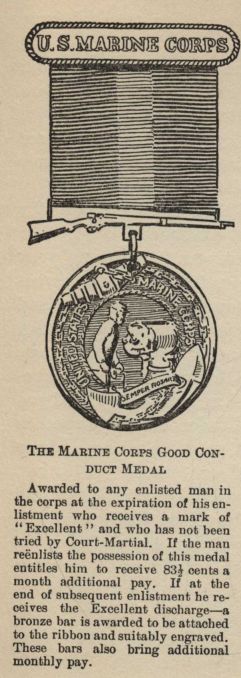
The Marine Corps Good Conduct Medal
THE MARINE CORPS GOOD CONDUCT MEDAL
Awarded to any enlisted man in the corps at the expiration of his enlistment who receives a mark of "Excellent" and who has not been tried by Court-Martial. If the man reënlists the possession of this medal entitles him to receive 83-½ cents a month additional pay. If at the end of subsequent enlistment he receives the Excellent discharge--a bronze bar is awarded to be attached to the ribbon and suitably engraved. These bars also bring additional monthly pay.
* * * * * * * * *
The old sergeant opened a little drawer of his desk and took from it a bronze medal suspended from a bar of like metal by a bright red silk ribbon through the center of which ran a narrow band of deep blue. Across the ribbon, almost covering it, were other narrow bronze bands fastened.
"This here is a Marine Corps Good Conduct Medal, and each of the smaller bands of bronze means a renewal of the medal's original significance for a whole enlistment. But to earn one of these you must 'mind your p's and q's' and be 'Johnnie on the spot' if it is your duty to be there at all."
After the boys finished their examination of the trophy, the First Sergeant continued:
"Now to return to business. Comstock, your pay number is six, your watch number is seven-twenty-one, your locker number, twenty-three, and you are in the port watch; your station at 'Abandon Ship' is in the sailing launch. Yours, Cabell, are, pay number, seven; watch number, seven-three-naught-seven; locker number, twenty-four, and you are in the steamer for 'Abandon Ship.' Report to the Police Sergeant, get your locker keys, draw your hammicks and find out where you swing. You will find plenty of work to keep you busy from now till 'taps.' Remember, I am always ready to listen to your complaints if you have any and will right them if able, but I also expect you to do your duty up to the handle. And just a word more before you go. The marines of this detachment are proud of their reputation of being the best looking, cleanest, smartest division on this ship. You are now responsible that that standard isn't lowered in the slightest degree. You will find a copy of the ship's routine on the Bulletin Board in our compartment. That's all."
The sergeant rose as he finished his talk and both boys had unconsciously straightened up to the position of attention. At their dismissal they simultaneously rendered the old veteran a military salute, but First Sergeant Stephen Douglass was too much the proper and precise marine to accept an honor to which he was not entitled.
"Wait!" he commanded as they turned to leave the office, "you salute only commissioned or warrant officers in our service, never non-commissioned or petty-officers, except at certain prescribed times during drill or ceremonies. Run along."
"I knew better than to salute him," said Henry while they were waiting for Police Sergeant Bruckner to return from some duty he was at the time engaged in, "but somehow it seemed to be the only proper thing to do, he was so fine."
"Glad to hear you talk like that, Hank, old boy! I told you that the N.C.O.'s were a pretty fine lot when you get to know them," and Dick was very well pleased that his friend was beginning to come to his own way of thinking.
Outside the office were the rest of the men who had journeyed with them, all waiting to draw hammocks. None of these men had served at sea before this, consequently their conception of a "hammock" was formed from those artistic things of net, made up in gay colors which decorated the piazzas and lawns ashore. It was quite a different article that Police Sergeant Bruckner dealt out to each of them. It consisted of a white piece of canvas, six feet long by three and one-half feet wide. Across either end eyelets were worked, through which passed the small lines called "nettles," and these in turn were fastened to a galvanized iron ring. These last two articles combined were called the hammock "clews." In addition to these, a manila rope lanyard was spliced to one of the rings to facilitate swinging the hammock between hooks fixed rigidly, in almost every conceivable corner, to the overhead beams of the ship. Each man's hammock had a small piece of canvas sewed to it about eighteen inches from the head upon which was his watch number in stencil. These watch numbers corresponded to the numbers over the hooks where their hammock berths or sleeping places were located. Every man on shipboard who swings in a hammock has two issued to him; one of them is in constant use and the other kept below in the sail-room, each division stowing their own hammocks separately in large canvas bags made for the purpose.
Mattresses made of "kapok"[#] and mattress covers were also given each man, and with these articles under their arms the new arrivals returned to the marines' compartment where, after receiving the keys to their lockers, they proceeded to "stow away their gear."
[#] Kapok is the product of a tropical American tree which was introduced into the Island of Java and there extensively cultivated. The tree has numerous uses. It puts forth a pod somewhat similar to a milkweed pod, filled with seeds to which a cottony substance is attached. This fibre is impervious to water and consequently being buoyant has been found to be better than cork for use in life-preservers. Of late years our navy has utilized great quantities of kapok in making sea mattresses, which in emergency could be used as life rafts,--also jacket life preservers. Kapok is very inflammable.
"This is like having the 'makings' for a cigarette and not being able to roll one," remarked Henry, as he gazed ruefully at the heavy canvas, the rings, strings and rope, his mattress and blankets, lying on the deck at his feet.
"The only difference being we don't smoke, while we do sleep," sagely added Dick. "Perhaps some of these other fellows will initiate us into the mysteries of this folding bed. Let's ask them."
With the help of willing hands the clews were soon tied in place, mattress and blankets rolled inside the canvas, and the lashings properly made. Then their long sausage-like beds were stowed away in the hammock nettings to remain until the proper time came for reissuing them to their owners, which was regulated by routine calls and schedule.
"I've learned another sea-going expression," said Henry as the two boys finally completed their work, "and that is, never call a 'hammock' anything but a 'hammick,' or they will know you are a rookie."
At taps the boys found it to be quite an athletic feat to get into those swinging contraptions, but having once succeeded they settled down for a well earned sleep. But who ever heard of rookies coming on board ship for the first night who escaped at least one tumble to the hard deck below, sent there by the sharp knife blade drawn across the taut foot rope, in the hand of the omnipresent practical joker? And the experience of the two music boys this first night on board the Denver was in no way different from hundreds of others before them.
Richard and Henry found the daily routine on board ship very pleasant. At first Henry was inclined to feel peeved because there was not a commissioned officer in command of the marine detachment which was honored by his presence. But he admired First Sergeant Douglass, and daily he was losing his snobbish ideas regarding his messmates. Shipboard life is a much closer relationship than life in the barracks, and he was beginning to find that manhood did not necessarily go hand in hand with riches, polished manners and a finely branched family tree. At the first opportunity, Richard had made himself known to Corporal Dorlan, and that worthy individual acted much in the status of guide and mentor to the two boys, nor could they have had a better, for though Michael was his own worst enemy, where others were concerned, he was constantly preaching against the "Demon Rum," as he dubbed the agent of his misfortune.
"'Twould be far better for me," said he sadly, "if the powers that be never would promote me. For whinever I git to be a sergeant, then begorra, I always have to celebrate, and it's all off with old Mike."
Having taken the necessary stores aboard for her cruise, the gunboat quietly slipped from her berth one brisk morning in November and was soon on her way down the broad reaches of the Delaware River. At the Delaware Breakwater the pilot was dropped. Many of the crew took advantage of this opportunity to send ashore last messages and letters, for the Denver was bound for the West Indies; her first port of entry would be Culebra Island, and her first landfall Porto Rico, a six days' voyage.
It is a peculiar fact of ocean travel that whenever a ship is about to put to sea the general topic of conversation seems to hover around one point--seasickness. Everywhere one turned that beautiful morning the fatal word pursued one.
"Ever been seasick, Jack?"
"Well, only onct in a big typhoon coming across from Formosa," or:
"Nuh, this is the first time I've been to sea, but I've struck her some rough in the lakes, and I guess I can stand it," or:
"Son, if you get sick and want a quick cure, take a nice piece of fat pork, tie a string to it and----" but why go into further detail, when the men who never before had seen blue water were half sick before they left the wharf, so vivid their imagination, and thoroughly sick when finally the Denver began digging her nose in the short seas they encountered on leaving the protection of the inland waterways!
Henry Cabell had fully determined he would not be seasick, but the sight of so many in that predicament placed his resolutions in the realm of other broken vows, and he was soon hors de combat. Dick, on the contrary, never felt the slightest discomfort, over which good fortune he was highly elated. He did not do as many others did, namely, gloat over the misery of the less fortunate ones.
The evening of the second day out found nearly all the sick men on the upper decks, albeit many were "green in the gills" from their unpleasant experience.
"You feel as if you didn't care whether you died or not," said Henry, while he and Dick stood at the bow of the ship holding to the life-lines that encompassed the entire main deck, "but I don't reckon I'll be sick again. I feel nearly all right now, and even this sudden dipping and stomach-dropping rising hardly gives me a squirm."
Dick did not answer. He was hanging over the rail looking down at the slight lines of phosphorescence spreading out in quivering angles from the bows with each plunge of the ship. He was enjoying every moment of this new life. No longer did he regret his inability to get the appointment to Annapolis, for already the spell of the Marine Corps was clutching at every fibre of his being, claiming him body and soul for its service. In the crew's library he had found a copy of Collum's History of the Corps and for the first time he was reveling in its illustrious deeds from the day of its inception, which antedated the regular Navy and even the Declaration of Independence,--November 11, 1775, up to and including the part they took in the relief of Pekin in July, 1900. As they stood there, Corporal Dorlan, making the round of sentinels, stopped for a moment's converse.
"How goes it, me lad?" he inquired of Henry, and without waiting for a reply, he continued, "To-morrow we'll be findin' of ourselves in the waters of the Gulf Stream, and ye will believe that ye never saw such blue water in yer livin' born days. And ye will keep on believin' that till ye see the waters of the Caribbean and then ye will be changin' the moind of ye, like as not."
"I'd rather see some good brown earth and a little green grass at this present moment," said Henry, wistfully.
"And there'll be a-plenty of both on this cruise, I'm thinkin'," said Mike cheerfully. "But do you know where we're goin'? If ye don't then I'll tell ye. We're bound for Treasure Island, and a foine place it is to roam around in for a bit. Ye can't git lost and ye can't git into trubble unless ye look for it, and that's more'n ye can say for most places. Its right name is Culebra, which is the Spanish for 'shnake,' but some feller wrote a wonderful story about it under the name I've just mentioned to ye, so like as not if ye look in the right spot ye may yet find some of the old pirates' buried gold. Heigho!--I'd better be on me way, for it's about time to make me report of lights to the bridge. Good-night, me lads," and off he tramped.
"And as a better man than I just said," remarked Dick a few moments later, "'Heigho! I'd better be on me way'; let us get to bed."
"I second the motion," said Henry, "for I'm getting sick of this motion, and the 'hammick' sounds good to me. Maybe by to-morrow I won't be bluer than the Gulf Stream, after a good night's rest."
CHAPTER VIII
AN ADVENTURE ASHORE
Saturday afternoon! Under the azure dome of the tropic sky the verdured hills of "Treasure Island" sparkled with emerald brilliancy. Stretches of glittering-white, sandy beaches connected abrupt, green-clad headlands in the semblance of Nature's own rosary. Coral reefs everywhere, with varying depths of water over their treacherous beauty, afforded so many wonderful shades of blue and green that the cleverest artist would despair of reproducing their tantalizing colors on his canvas.
In the deep but sheltered waters of Target Bay, close anchored to the beach, swung the Denver, her graceful outlines reflected with startling perfection in the mirror-like depths. Under her white spread awnings, members of the crew dozed, conversed or played games as their fancy dictated. On the bridge, the ever alert Quartermaster attended the duties of his watch; while pacing the quarter-deck, the Commanding Officer of the ship, Commander Bentley, and his Executive Officer, Lieutenant-Commander Ogden, were earnestly conversing. Near by, the Officer of the Deck, with a telescope, the insignia of his office, tucked beneath his arm, was trying to catch the drift of his superiors' conversation without appearing to be too inquisitive.
"It is apparent, Mr. Ogden, that someone ashore is furnishing liquor to our men. The reports at the mast[#] for the last few days show it clearly. In spite of all the 'Alcalde' at Dewey may say, the men are getting the stuff somewhere."
[#] The "mast"--A fixed place on deck, often not near a real mast, where complaints against the conduct of enlisted men are heard by an officer, and judgment passed on them.
"I agree with you, Captain, and I wish we could get a clue sufficient to convict the guilty party. By your order the men are not allowed in the towns of Dewey or Roosevelt, and every day that liberty parties are ashore I have had patrols along the trails to stop men going in that direction. Furthermore, we maintain a patrol in town, each ship taking a turn at it, to arrest any of the men seen inside the restricted district. The revenue officer on the island has assured me that not a store or shack this end of the place has a license to sell alcohol."
"It beats the Dutch," remarked Captain Bentley, after a short silence, "how enlisted men will go out of their way to get into trouble. A lot of youngsters think it smart to be tough and rough, imagining they are then real sailors. They haven't the brains to see that the navy man is revolutionizing his habits and trying to live down the idea of him which years ago was so prevalent. The desire to 'spend their money like a drunken sailor' still holds an attraction for some of these brainless idiots. Our older men have been through the mill, and the worst element among them is weeded out. They have sense enough to keep out of harm's way, but---- Oh, well, the fact still remains, they are getting liquor, and bringing it on board too."
"I have had a talk with the officers and they in turn with their C.P.O.'s, and also I have put Sergeant Douglass on the trail, so I hope of getting some results soon."
"Keep at it, Mr. Ogden, and for the sake of all hands I hope we can run the parties to earth; nothing is worse for the discipline of a ship," and with that parting remark Commander Bentley turned and descended to his cabin.
For over a month the cruiser had been in and around the waters of Culebra Island, generally anchoring for the night in Target Bay, but during the day, excepting Saturdays and Sundays, joining with three other ships of her class in division drills and maneuvers while at the same time preparing for target practise.
The Denver's marines, having only two six-pounders in their charge, did not take as great an interest in the gunnery work as marines generally do on board the battleships and dreadnaughts, where they have guns assigned them of larger calibre. During this time they were mostly occupied with work pertaining to their profession on board, or with boat drills, and hikes on shore. For this latter drill they were landed twice a week and worked in coöperation with the detachments from the other vessels. Later on when the Fleet arrived combined maneuvers ashore on a grand scale would be carried on.
Liberty was granted, to those whose duties did not intrude, on Saturday and Sunday afternoons. On this particular Saturday, Drummer Comstock and Trumpeter Cabell went ashore in the first liberty boat to leave the ship. Dick, already having made a name for himself as an oarsman, was a member of the marines' dinghy racing crew, and this afternoon he and Henry helped pull the big cutter ashore and well up on the coral beach in Firewood Bay.
From this spot it was about a two-mile walk over the hills, down into the valley past Laguna de Flamingo to the perfect, crescent-shaped, smooth, level sands of Flamingo Bay, where the mighty rollers swept in with unrestricted grandeur from the blue Atlantic, stretching northward farther than the eye could reach. Here, in spite of the wonderfully high surf there was little or no undertow and the bathing was considered safe, and free from venturesome sharks.
According to their habit, the two boys undressed at Firewood Bay and leaving their clothes in the cutter, wearing only rubber-soled sneakers and bathing trunks, they were soon dog-trotting over the narrow trail leading to a group of shacks on the saddle of the ridge they had to cross. With their swifter pace they soon passed the others of the party. After breasting the summit of the ridge they followed the torturous downward trail to the Lake of the Flamingos. The trail led past an unused hut half-way down the hillside, at one end of which it abruptly turned to the left.
Dick, well in the lead, having turned the corner of the hut, saw a man dashing towards him, mounted on a fiery little West Indian pony. There was plenty of room for the rider to turn aside so as to avoid the boy, while ordinary politeness would have led him to do so, therefore Dick continued at his slow trot in the center of the path. Nearer came the rider, and the boy now saw he was reeling in his saddle and lashing his horse viciously as he came tearing up the hill. Still the boy did not change his course. The next moment the pony had of its own volition jumped out of the trail to avoid collision.
At the moment he passed the native rider cut Dick a fearful lash across the shoulders with his leather quirt, yelling loudly some vile expletive in Spanish. For the fraction of a second Dick did not comprehend what had happened. The blow across his bare back nearly brought him to his knees and, missing his footing, he fell headlong. In an instant he was up again holding a rough, jagged piece of rotten-rock in either hand and running back after the reckless horseman.
Never before in his life had Dick been thoroughly angry--never before had he felt that insane rage within him that knew no other impulse than the desire to inflict bodily harm on another human being.
The horseman must have disappeared behind the deserted shack, for he was nowhere in sight. By this time Henry came swinging along the trail, and he was surprised to see his chum coming towards him like a raving maniac.
"Did you see him?" yelled Dick furiously.
"See whom?" questioned Henry.
"That black drunken scoundrel on horseback."
"What are you talking about, Dick? I've seen no horseman."
"Didn't a native just pass you on the trail, riding a pony like mad and lashing the poor brute with a rawhide quirt?"
"Nope,--I reckon you must have been seeing things, Dick," and Henry started to laugh.
"'Seeing things,' nothing! Look at that red welt across my back, if you think I've been 'seeing things'!" shouted Dick, and he turned while Henry examined with amazement the angry looking ridge across the broad, sun-browned shoulders.
"I see it, right enough, Dick, but--you say a man on horseback did it?"
"Yes, and if he didn't pass you on the trail then he turned by this hut and went off into the bush, and I'm going to get him and thrash him before this day is over," said Dick, and having delivered his outburst he rushed off towards the clump of bushes, tall grass and cabbage palms, clustering close to the far corner of the hut.
"Hold on, Dick," called Henry, "we can't get through that jungle without our clothes. You stay here on watch while I go back and fetch them. The rest of the liberty party will be along any time now and they will lend us a hand."
"I don't need any help to thrash that cowardly Spig,"[#] muttered Dick, but seeing the wisdom of Henry's suggestion he consented to wait.
[#] "Spig" or "Spiggoty"--A generic term for all inhabitants of Latin-American countries and of the Philippines and Guam, given by sailors, soldiers and marines only since the Spanish War of 1898.
Left to his own devices, he began a systematic scouting of the ground in the vicinity. The trail, baked hard by the sun, showed no signs, but across the ground in front of the palm-thatched hut he found distinct traces of recent hoof prints. Following them he came to a newly broken trail through the long grass leading to the thicker undergrowth beyond. Returning to the hut he pushed open the dilapidated door and entered the musty interior. The place was bare of furniture or utensils, a few bits of rubbish littered the floor and in one corner were several bottles and flasks, all empty. Picking up one and extracting the cork he found a strong smell of whisky. Evidently this was the rendezvous of those men from the ships recently found under the influence of liquor while on shore. Presently he heard the sound of footsteps coming down the trail. Probably members of the liberty party with whom he came ashore, thought Dick.
"Say, Joe," he heard a voice question, "where do you suppose that marine was hot-footing it to?"
"I dunno," answered the one addressed, "when he ducked past me he yelled something, but I didn't get it, did you?"
"Nuh! Glad he's out of the way, 'cause him and the kid he runs with think they are some class. They'd put a crimp in our game if they got next to it."
"Any of the others in sight?" Joe now asked as the two stopped beside the corner of the shack.
"No; get a hustle on," and with that Dick heard the two speakers run past the front of his refuge and dash into the woods near the spot he had just been investigating.
"The plot thickens!" mused Dick, looking at the empty bottle he still held.
Again the sound of footsteps, but this time the men passed the shack without stopping. These men were bound for the beach at Flamingo Bay.
At first the boy thought of calling them back, but on second consideration he decided not to. He preferred working out this affair with only Henry's assistance.
That very morning First Sergeant Douglass had given the marines a talk about the liquor traffic and asked them to try and trace it. He had said it would be a feather in their caps could they succeed in finding the guilty parties. For that reason, all the more honor if he and Henry carried it through by themselves.
It seemed an interminable while before the soft patter apprised him of his companion's return. As Henry reached the corner of the hut, Dick's warning hiss attracted his attention to the open door.
"Come in here, Hank," he called, and Henry entered, breathing hard from the grind of his strenuous race up-hill.
While he dressed, Dick explained more fully about the drunken native and of what had transpired during Henry's absence. The young trumpeter was equally enthusiastic over the prospect of an exciting adventure ahead of them and thoroughly agreed they alone could manage the business.
"I reckon we are on the right track for sure," said Henry, struggling into his O.D. shirt. "That fellow Joe Choiniski is one of the tough nuts who joined us from San Juan in the last draft right after we came here. He's been on some 'spit-kit'[#] stationed down in these waters for a long time and speaks the native lingo. The man with him is a bad egg too, though he has never been caught so far."
[#] "Spit-kit"--Really "spit-kid," a small wooden cask set about the deck for spit-boxes. Spitting upon decks is an unpardonable sin. The name is slangily applied to the smaller vessels of the Navy.
"What is his name?" asked Richard, preparing to open the door.
"Never did hear his right name; the men on board call him 'Slugger.'"
"I know now," said Dick, "they say he used to be a prize-fighter and he's all the time bragging how he can mix it up with the gloves, but no one ever saw him put them on since he came on board. He's husky enough, but all out of training."
"That's the fellow,--a tough customer, I reckon."
The boys, finding the coast clear, emerged from the hut and were soon following the trail which the two men and horseman before them had presumably travelled. For a while the way led through a veritable tangle of briers, weeds, bamboo and underbrush, but after a quarter of a mile with no break on either side the path joined into a wider and well worn trail through a piece of timberland leading almost due north and south. In the shade of the tall hardwood trees the ground was softer and the spoor of the horse was distinctly shown turning to the right. This fortunate discovery saved the boys any possibility of going wrong.
The island at this point was sparsely settled, as in 1906 the Navy Department had required all squatters to move off the government reservations. The trail was now nearing the boundaries of the northern tract. For another quarter of a mile they went on, each moment hoping to discover some evidence to substantiate their deductions, but the silence of the wilderness was about them, only broken occasionally by the cooing of the blue doves high up in the tree-tops.
Here and there the woods gave place to clearings covered with waving grass or untended banana patches, affording long vistas of land and water but not a house nor animal nor human being rewarded their sharp searching. To their left was South West Cay, separated from the larger island they were on by a narrow dangerous channel. To their right they caught occasional glimpses of Flamingo Bay or the distant top of Mount Resaca.
During one of their halts before emerging into plain view on the hog-back trail, Henry caught Dick by the shoulder and pulled him down in the shelter of the long grass which carpeted a steep slope on their left, down to the very edge of the water.
"Look, there is your horseman!" he whispered excitedly, forgetting his voice would not reach half the distance to the object at which he was pointing.
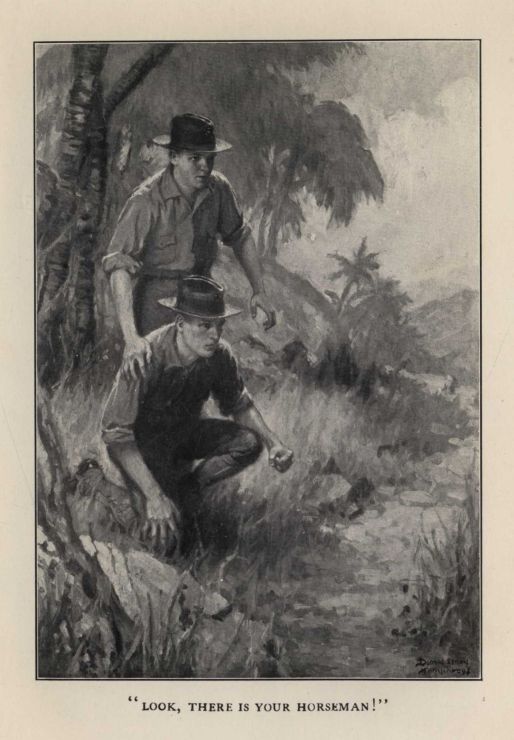
LOOK, THERE IS YOUR HORSEMAN!
"I see him," said Dick grimly, "coming up from that shack at the foot of the hill."
"Yes, and see those two sailors going down to the beach; they're toting sacks or something over their shoulders. They can go around to Firewood Bay that way. We've got 'em, all right," exclaimed Henry joyfully. "What do you reckon we'd better do now?"
"I 'reckon' there's going to be one native of this 'Treasure Island' who's going to get the beating of his life in just about five minutes," answered Dick, taking an extra tug to his belt. "That fellow is coming right up the hill to this trail, and I'm going to be right at the top to welcome him. Come along, Hank, but lie low and leave him to me."
Stooping low, both lads ran across the open space till they came to the edge of the farther wood, where they found an entrance to the trail up which the lone horseman could be seen spurring and lashing his worn-out steed. The animal was too far gone to respond to the cruel treatment, and plodded slowly and wearily upward.
"Hank, you go to the other side in case he should happen to turn that way," directed Dick. "That brute won't escape us; and let me tell you something, I'm not going to beat him up for lashing me, alone, I'm going to try and even up some of the debt for that poor dumb animal he's torturing."
Henry scuttled to the north side of the trail, while Dick waited impatiently where he first had hidden.
The labored breathing of the horse came to his ears, and then, preceded by a volley of oaths, rider and horse reached the ridge trail. The native, a dark, swarthy, pock-marked man, about thirty-five years of age, with black, bloodshot eyes and long, yellow teeth, was broad shouldered, and though slender, was well knit. On reaching the crest of the hill the horse's head was turned southward and again the rider raised the heavy quirt to bring it down on the bleeding, swollen flanks. That blow never fell, for with the quick spring of a tiger Dick grabbed the rider around the waist and tore him from the saddle, throwing him to the ground. At the same time he snatched the quirt from the surprised man's hand and began belaboring him as he groveled at the boy's feet. The startled horse meanwhile had turned down the slope and was stumbling towards the foot of the hill.
"How do you like that, you yellow cur?" questioned Dick coolly, giving the coward a final blow across the legs. "Do you think you want to try any more tricks on me?"
"No! No! Señor! Pardon, Señor! Por Dios, no mas!" cried the man as he saw Dick's arm rise again and the lash snap ominously.
"Get up and vamoose," ordered Dick, pointing along the trail they had followed. "Never mind your horse; you can get him when I get through with you."
Never taking his eyes from the man, Dick made him march in front of them. The native limped along protestingly, but every time he stopped to argue Dick applied the lash with good effect.
On reaching the trail leading down to Firewood Bay, Dick pointed towards the town of Dewey.
"You savvy Dewey?" he inquired.
"Si, Señor," came the surly response, and the shifty black eyes glared for a moment at the boy.
"Well, beat it--pronto," ordered Dick, and with the words he gave the man a push in the right direction, while both boys, as if performing a military drill, simultaneously aided him with a persuading kick.
"Just to help you along a bit," called Henry and then he turned to Dick. "Shake, Dick; that was a job well and nobly done."
As he spoke five bullets whistled past them, one dusting the ground at their feet and ricochetting with a shrill "Z-z-z-i-i-n-n-g."
Instantly the startled boys dropped to the grass beside the trail and, keeping under cover until a fold in the ground effectually protected them, they ran for the boat landing.
"Wonder why he didn't use that shooting iron before?" questioned Dick, looking back over the trail.
"Reckon he was too plumb scared to remember he owned a gun," said Henry, still beaming with joy over the adventure. "Do you believe he'll take any more pot shots at us?"
"No, we are out of pistol range down here, and he can't come down the hill without being seen. Those shots were too close for comfort to suit me, and yet I hated to have to run away as we did. Still it would have been worse than foolhardy to tempt Fortune by hanging around up there with that rascal in hiding. How do you like being under fire?"
"Can't say I've any hankering for it, but it didn't scare me as I thought it would," said Henry.
The men from Flamingo Bay were now coming over the brow of the hill and soon reached the boat. They had not seen the native on the other side of the hill, but all had heard the five shots. The boys did not enlighten them as to the cause, having decided to report the whole matter to First Sergeant Douglass on their return to the Denver.
While they were shoving the heavy cutter into the water the two men, Joe Choiniski and "Slugger" Williams, came from around the point and joined the group. Both men wore rubber boots, and Dick remembered that they had taken them ashore that afternoon under their arms, whereas now they carried their shoes, from the tops of which were sticking some finely branched pieces of unbleached coral. Dick also noticed how carefully they got into the boat when all was ready to shove off for the ship.
"Wonder where they hid their booze," said Henry, "for I'd bet a month's pay they have it somewhere."
"I guess I know, and you watch Corporal Dorlan frisk them when they go up on deck," answered Dick with a knowing wink.
Arriving at the port gangway, the liberty party went aboard and fell in on the quarter-deck for inspection before being dismissed. Corporal Dorlan, standing at the top of the gangway, was surprised to hear Dick whisper as he passed, "Search the rubber boots, Corporal," but he was not slow of comprehension, and as soon as the men were all in line he went directly up to Joe and "Slugger" and feeling down their boot legs brought forth several flat flasks carefully wrapped in dry seaweed.
"What is this?" said Mr. Thorp, the Officer of the Deck.
And Corporal Dorlan merely answered:
"'Wilson--that's all,' sir."
"That is fine work, Corporal. I congratulate you," said a hearty voice behind the line of men who had witnessed this little scene, and turning Dorlan found Commander Bentley standing near him.
"It's not me what discovered it, sir. All the credit belongs to Drummer Comstock. He's the lad what put me wise, sir."
"We will hold 'mast' and investigate this matter at once, Mr. Thorp; have Comstock report here immediately."
Dick, having heard his name called, approached.
"Now, young man, tell me all you know of this business," ordered the Captain, and having heard the entire story of the exciting afternoon ashore he ordered Dick to go to the Executive Officer's office and dictate a full report to the Yeoman.
"A man like the one you describe has no business to be at large," he said. "I will communicate with the authorities ashore and have him locked up. In the meantime, Mr. Thorp, send a detail of marines ashore under arms to search and destroy the shack these two boys discovered. It's on the government reservation and has no business there. Trumpeter Cabell will go ashore and act as guide."
Then turning to the two culprits, Commander Bentley said:
"I'll keep you men in close confinement until a court-martial can dispose of your case. Have these two men taken to the brig[#] at once, Mr. Thorp."
[#] Brig--Cell for confinement of men under punishment.
"Aye, aye, sir!" and Ensign Thorp gave the Master-at-Arms the necessary orders.
CHAPTER IX
HISTORIC BATTLEFIELDS
"Speaking of that report against our horse beater," remarked Henry a few days later, "reminds me, Dick, that I never thought to inquire if you ever heard from the report you wrote out in Washington against those plotters."
"No," answered Dick, looking up from the signal card he was studying, "I wrote it the following Monday and sent it to Dad, but never heard anything from it."
"We heard from your last report," said Henry. "That Spig was a wise hombre, right enough. The revenue officer found out all about him, but 'Mexican Pete' was too quick. He left for parts unknown that same day, and all the authorities in Porto Rico are on the lookout for him. He's a famous smuggler down in these regions and a regular bad man in the bargain. It's said he has served jail sentences in nearly every town from here to Vera Cruz. He's a Mexican by birth, a bad man by nature and a wanderer most of the time by necessity."
"That is all true, Hank, but it is not getting down this Morse code," replied Dick. "We've learned the semaphore, wigwag and Ardois, and I think we can give the signal boys on the bridge a run for their money; but I can't seem to get these sound signals. Guess my ear isn't attuned properly!"
"I don't see why you want to bother with it, anyway. You don't have to learn it."
"Never can tell when such knowledge will come in handy; besides, Hank, it helps pass the time when we've nothing else to do. It proved pretty useful last week when we were having that scouting drill ashore and by knocking two rocks together I was able to tell you to go to the left of that clump of bamboo. If you'd gone the other way the enemy would have captured you and your message, which would have meant the capture of our whole detachment."
"Yes, I'd forgotten that, Dick, and seeing that we both hope to be made privates some day the extra pay we will pull down as first class signalmen is not to be sneezed at. Well, here goes; see if you can get this!"
Thereupon Henry began a quick tap-tap with a pencil against the rim of the brass bugle he held on his knees.
For an hour the two boys practised at their self-appointed task, never using a spoken word in the meantime, but often smiling at each other over the messages they sent back and forth.
Richard Comstock was not wasting his time in the service. He had enlisted with one stated purpose in view, and all his work was to him a means to an end. Every new bit of knowledge acquired connected with his profession was just one more step in the ladder he meant to climb, until his hopes and ambitions were realized.
The friendship existing between Henry Cabell and himself was of great help to both boys. They often had their differences of opinion, but petty quarrels and bickerings never entered in their discussions. Both lads were high spirited, quick to take offense but as quick to acknowledge their errors in the light of reasoning. Day by day, Henry was losing his attitude of snobbishness. His association with Richard, who tried to find something worthy in every person with whom he came in contact and to see the bright side to every cloud, was the best thing which could have happened for the hot-headed Southerner.
Their duties on board ship were not particularly arduous. They stood four-hour watches as messengers for the Officer of the Deck, dividing this duty with the ship's sailor-buglers; assisted in the work of keeping their part of the ship clean, accompanied the marines on their drills ashore and participated in the routine drills of shipboard life. Sometimes the musics on the larger vessels are members of the secondary battery gun's crews or have other battle stations at "general quarters,"[#] but not so on the Denver, which was only a third-class cruiser of a little over three thousand tons. Also on shipboard the marine drummer has but little use for his drum and sticks, which are generally put away in the storeroom and a bugle issued in lieu thereof, as all calls are given by means of the trumpet or the piping of the boatswain's whistles. Therefore, in so far as their duties were concerned, the boys did identically the same work on the Denver, and except when their watches interfered they were generally to be found together.
[#] When the ship is ready to go into action. The drill for this preparation is called General Quarters.
One day they were conversing about the former achievements of the marines, and Dick, who by now had read Collum's history from beginning to end, said:
"I wonder if when they put those new dreadnaughts in commission they will reverse the time-honored custom and move the marine detachments up forward!"
"I don't reckon I know what you mean, Dick; why shouldn't they put the marines wherever they want to on the ships?"
"These days there is no real reason why they shouldn't," said Dick. "But you know what the relation of the marines was originally as regards the ship's crew, don't you?"
"Y-e-e-s; at least I think I do. They were the policemen on the ship, weren't they?"
"Oh, Hank, you simply must read the history of this organization before you go any further. It will be the best thing to make you get the right kind of ginger into your work. It will make you proud of your job and proud to be a U.S. Marine; it is one of the chief things you need:--esprit de corps--it's what has kept this outfit up to snuff, and without it no organized body of men could make a name for themselves any more than you can 'make a silk purse of a sow's ear.'"
"All right, if you say it takes esprit to make that purse, Dick, I'll take your word for it, but don't get started preaching. Now tell me why should or should not the marines be moved, and if not, why not, or whatever it was you began on when you lost yourself on Pulpit Street. Go ahead, I'm listening!"
"To begin with, the sailors in the early days were a mighty tough lot of customers, picked up from nearly every nation under the sun. They were employed to work the ship; whereas the marines were organized to do the fighting and were picked men. Because of the mixed and unruly element in the crew the sailors often became mutinous. In those days all weapons, and firearms particularly, were stored in the after part of the ship where the officers had their quarters and having this advantage, they were able to keep the crews under subjection. But there were only a few officers as compared to the crew, consequently the trustworthy marines were given that part of the ship to berth in between the officers and the sailors, who generally were berthed in the forecastle. I don't know just when this was made the fashion, but I do know that it has been handed down to the present day and you will always find marines in a compartment next the ward-room. Now do you see what I mean?"
"I understand what you have said, Dick, but what has it to do with the new battleships?"
"Why, I was wondering if another old Navy custom is going out of vogue, that's all. For in these new ships the officers are going to change places with the crew--their living space is going to be the forecastle instead of the stern. Question: What will they do with the marines?"
"When did you say that custom started, Dick?"
"Oh, I don't know, Hank; way back in the days of bi-remes and tri-remes, I guess."
"Then all I have to say is that it's high time a change was made; allow the officers a chance to take care of themselves--we marines have nursed them altogether too long," said Henry, and they were yet laughing at the remark when Police Sergeant Bruckner came along the deck seeking them.
"The 'Top'[#] says you boys should go with me to the storeroom and draw rifles, so come right along and get 'em."
[#] "Top"--Top sergeant--first sergeant, or also applied to the highest ranking sergeant at a post.
"Get rifles?" questioned Dick. "What are we going to do with rifles, I'd like to know?"
"Ask the Top; don't bother me with your questions;" and Bruckner led the way below.
"They're brand new shooting irons, and you will have some job getting off the cosmoline, so I adwise you to get busy before you report to the First Sergeant," cautioned Bruckner, whose German origin accounted for the manner in which he pronounced his letter "V" on occasions. He had come to the United States as a lad of fifteen years and after ten years spoke, with this exception, almost like a native-born citizen. Six of these ten years he had spent in the Marines.
After noting the number of each rifle in order to enter them on the public property card of the musics, they all repaired to the upper deck and the work of cleaning the new rifles was soon under way.
"You musics will fall in for aiming and sighting drill each morning," called out Sergeant Douglass, who saw them at their labors. "Although you aren't required to handle a gun you are required to know how to shoot straight. Come to my office when you get through with that work, and I'll give you each a score book which one of our Marine Officers got up and it will give you all the best dope on rifle shooting."
It was not long before the boys were applying for the promised books.
"When shall we have a chance to fire on the range?" asked Dick.
"From the 'galley yarns'[#] flying about the ship, it would not surprise me if we were on our way to Guantanamo in a day or two, and when we get there I'm going to try my best to have the guard put through the regular Marine Corps practice as well as the Navy course, and I want to keep our high showing up to standard."
[#] In some mysterious way stories get started on shipboard, generally founded on guess or rumor and turn out to be true; all are supposed to start in the "galley," hence the name.
"Do we get a medal or anything like that out of it?" asked Henry.
"Yes, you have an opportunity to get a number of things out of it. The marines shoot the same course for qualification as that prescribed for the army. There are three grades which pay you well for trying to do your best. The highest is that of expert rifleman. If you qualify, you get five dollars more pay per month from the date of qualification to the end of your enlistment and also a silver badge,--crossed rifles with a wreath around them. Sharpshooter pays you three dollars per month till you next shoot for record the following year and a badge consisting of a silver Maltese cross, while a marksman's qualification pays two dollars and you get only a silver bar with 'Marksman' on it. But you will find out all about it in those books. Run along now and don't bother me any more with your questions. By the way, Cabell, to-morrow morning you will report to Ensign Gardiner as orderly for the summary court-martial at ten-o'clock, in the ward-room. Mr. Gardiner is the recorder of the court."
"What is the recorder of a court?" asked Henry, who was as full of questions at times as a hive is of bees.
"He is to a summary court what the judge advocate is to a general court, and the prosecuting attorney to a civil court," answered the First Sergeant patiently, "and I hope your acquaintance with all of these gentlemen may be that of an orderly or a witness only. And, Comstock, speaking of witnesses, reminds me you had better stand by for a call, as both Williams and Choiniski are to be tried to-morrow for smuggling liquor on board ship."
Promptly at ten o'clock the next morning the "musics" were in attendance at the meeting of the court-martial, but no testimony was required, as the accused sailors both pleaded "guilty" to the specifications[#] preferred against them, and merely put in a plea for clemency.
[#] The written statement of specific acts for which the accused person is being tried.
Richard was standing outside the ward-room door when Chief Master-at-Arms Fitch brought the two prisoners aft for their trial.
"I'll get you for this, you fresh Leatherneck, and I give you fair warning to keep out of my way when I get out of the brig," muttered Choiniski, glaring malignantly at the drummer.
"Shut up and don't talk so much or I'll see that you get hung," snapped Fitch on hearing the remark. "After you two birds get out of your cage you'd better be looking round for friends, not enemies, I'm thinking."
And two days after the trial with the entire crew of the Denver mustered aft on the quarter-deck, the sentences were published to the two offenders.
"Whew! You'll never catch me smuggling any liquor on a man-o'-war," said Dick to his friend, Corporal Dorlan, as they sat talking in the marines' compartment soon after the crew had been dismissed.
"No, it's bad business no matter how ye bring it on board, inside or outside," said Mike, dolefully, "and it's meself who should know, bad 'cess to the stuff."
"Have those two men got to stay in those hot little cells up forward with nothing but bread and water to eat for thirty days, and lose three months' pay, and in addition, do three months' extra police duties with no liberty meanwhile?"
"Not quite that bad, me lad; they'll be after gittin' a full ration on every fifth day, so as to show them what they're missin' in the way of good chow,[#] and accordin' to my way of thinkin' it will do them both a world of good. Until they came to this packet 'twas the happy ship; but the likes of them are always makin' trouble."
[#] A Chinese term generally used by men in the service for food.
"Did you hear that we are going to Guantanamo Bay before the fleet arrives here, Mike?" questioned Richard.
"Well, it won't be the first time Michael Dorlan has been in that place, and well I remember the time we showed the Spaniards they couldn't fool with Uncle Sam's Marines and git away with it."
"Were you in a fight there during the Spanish War, Corporal?"
* * * * * * * * *
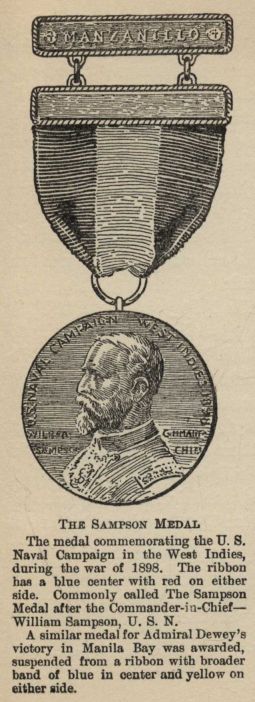
The Sampson Medal
THE SAMPSON MEDAL
The medal commemorating the U.S. Naval Campaign in the West Indies, during the war of 1898. The ribbon has a blue center with red on either side. Commonly called The Sampson Medal after the Commander-in-Chief--William Sampson, U.S.N.
A similar medal for Admiral Dewey's victory in Manila Bay was awarded, suspended from a ribbon with broader band of blue in center and yellow on either side.
* * * * * * * * *
"Right ye are, me lad, and 'twas no slouch of a scrimmage, at all, at all. The Navy wanted a good sheltered harbor as a base for their ships close to Santiago, where that foine old Spanish Admiral, Cervera, was bottled up. So Guantanamo Bay, being the foinest kind of a place, they decided to go in there, dhrive away the enemy and hold it. Well, the ships shelled the beach before we landed and then us marines was sent ashore under Colonel Harrington; and a hot reception we got, I'd like ye to know."
"How many marines were there in the fight?"
"About four hundred altogether, and out in the bosky[#] there were over three thousand Spaniards pouring the lead into us at every opportunity. We took the beach with a rush and charged up the hill back of our landin' place, and then havin' got a toe-hold we dug in and we stayed dug in, with the Dagoes a-takin' pot shots at us every time we showed a hat."
[#] Really the word "Bosque"--Spanish word meaning wood, and pronounced--boskay.
Henry, having joined the little group surrounding Dorlan and Richard, as usual asked a question at this point in the recital:
"Did the army come to help you, Corporal?"
"Army nothin'. They was busy gettin' ready to take Santiago, and didn't bother about us. We marines was the first to land and the first to fight, but unless we drove those Dagoes out of the woods it wasn't goin' to be a very healthy place to stay put."
"And did you drive them away?" inquired Dick. He had read all about the fight, but to get first hand news from one who had participated in the actual fighting was much better than reading it from a book.
"Of course we did. You see, the Colonel learned from friendly Cubans that the Spaniards in that region depended for all their water on a well a few miles away over the hills--Cusco Well, it was called. So if we took that well then they'd have to git out of the country. It was up to us to destroy the well. We made all the arrangements, and one of the ships was told to shell the locality where the well was located. Finally we started off dhriving the Dagoes ahead of us, when suddenly the shells from the ship began droppin' all about us instead of into the ranks of the enemy. Every minute they kept comin' hotter and faster and there was little chanct of us bein' successful as things were goin'. Then I saw one of the nerviest jobs pulled off that mornin'--one of the things ye often read about and believe is fiction. Right behind us in plain view was a high bare hill and on the top of that there hill, his back to the Spaniards and facin' the flashin' guns of the ship, was a marine sendin' wigwag messages to the ship and tellin' them where to shoot. Begorra, the bullets was a-flyin' around him like hail. Kickin' up little spats of dust at his feet, cuttin' down the cactus on either side of him, singin' through the little flag he was a-wavin', but did he stop? Not onct--and before long the shell fire lifted and began fallin' among them Dagoes and off they went with us marines after them, chargin' and yellin', sweatin' and swearin'. Yes, we found the well and destroyed it and went back to our own lines carryin' our dead and wounded with us. And onct again the good old Corps had scored, for Sergeant Major John Quick, the feller what did the signalin', won the first medal of honor in the War of 1898."