Group III. GOLD IN CALIFORNIA, AND WHAT IT LED TO.
Reading edition
"There is nothing in the world so sound as American society."—Goldwin Smith.
I. THE GREAT EMIGRATION.
EL DORADO FOUND AT LAST. "It is always the unexpected that happens."
What El Dorado[1] had been to the active imaginings of De Soto's Spaniards, was now to become a reality that would startle the world from its long forgetfulness. The world believed they had been chasing a phantom which lured them to their death. One seeks in vain to know why Nature at last revealed the secret she had so long kept hid from those who had sought but not found, to disclose it to others who had found without seeking.
The war was scarcely ended[2] which gave us California, when a scene took place there of far-reaching moment to mankind. Words can hardly describe it. For a time it seemed the overturning of all laws governing the acquisition and distribution of wealth, if it were not to put the common laborer on a level with the millionaire, and so revolutionize society itself. When we consider what has followed in its train, the story itself seems tame indeed.
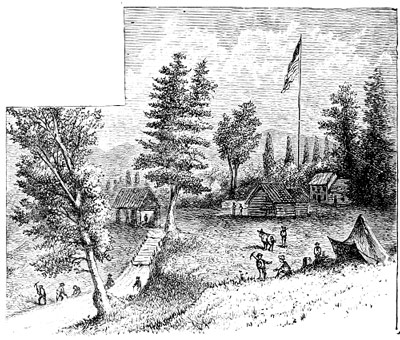
SUTTER'S MILL.
Captain Sutter had been having a saw-mill built for him fifty miles above his fort, on the south fork of the American River, which is here a swift mountain stream. One evening, when all within the fort wore its usual quiet, a horseman rode up in hot haste, and asked to see Sutter alone. This was James W. Marshall, one of Sutter's men, who had charge of the mill above. Seeing by his manner that something unusual was the matter, Sutter led the way into his private room, and turned the key in the lock. With much show of mystery, Marshall then handed his employer a packet, which being opened, was found to contain a handful of yellow metal, in flakes or kernels, which he said he had taken from the mill-race, and asserted to be gold. By the light of a candle the two men bent over the little heap of shining particles in eager scrutiny. Sutter would not believe it was gold. Marshall was sure it could be nothing else. Aquafortis was then tried without effect. The metal was next weighed with silver, in water. All doubt was removed. It was indeed gold, yellow gold, that Marshall had found.
His story, briefly told, was to this effect. They had started the mill, when the tail-race was found too small to carry off the water. In order to deepen it the whole head of water was then let into the race, thus washing it out to the required depth. It was while looking at the work the water had done, that Marshall saw many shining particles lodged in crevices of the rocks, or among the dirt the water had carried down before it. All at once it flashed upon him that this might be gold. Gathering up what he could without risk of detection, he had started off for the fort without making his discovery known to any one.
Sutter saw his happy pastoral life of the past on the point of vanishing. He made an idle effort to keep the discovery secret, at least till he could set his house in order. It was soon known in the household and at the mill. From this little mountain nook it was borne on the wings of the wind to the sea-coast, and from the sea-coast to the four quarters of the globe.
Captain Sutter's men[3] deserted him in a body. The American settlers and Indians of the neighborhood next caught the infection. Gold was quickly found at a point midway between Sutter's Fort and Mill, called the Mormon Diggings,[4] on Feather River, and in the gulches above the mill site. From these districts the first miners began to straggle down to San Francisco with pouches of gold-dust in their possession. Men who had hardly known what it was to have a dollar of their own suddenly lived
"Like an emperor in their expense."
The effect was magical. Within a short three months most of the houses in San Francisco and Monterey were shut up. Blacksmiths left their anvils, carpenters their benches, sailors their ships. Soldiers were every day deserting from the garrisons of San Francisco, Sonoma, and Monterey. The two newspapers[5] then printed in the country suspended their issue indefinitely. Everybody was off for the mines, and nothing else was talked of but gold.
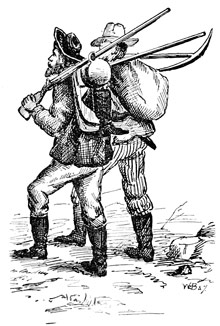
TWO MINERS.
Consul Larkin thus describes the scene at the Mormon Diggings in June, 1848: "At my camping-place I found forty or fifty tents, mostly occupied by Americans, strewn about the hillsides next the river. I spent two nights in company with eight Americans, two of whom were sailors, two carpenters, one a clerk, and three common laborers. With two machines called cradles, these men made fifty dollars each per day. Another miner had washed out, with a common tin pan, gold to the value of eighty-two dollars in a single day."
Mr. Larkin thought there were then about one thousand people, mostly foreigners, actually working in the mines, whose daily gains would amount to at least ten thousand dollars. And he even ventured to hint that at this rate gold enough would be produced in a single year to repay what California had cost the nation.
Colonel Mason, the military governor, adds what he saw while making a tour of inspection to the new placers: "Along the whole route mills were lying idle, fields of wheat were open to cattle and horses, houses vacant, and farms going to waste. At Sutter's there was more life and business. Launches were discharging their cargoes at the river, and carts were hauling goods to the fort, where were already established several stores, a hotel, etc. Captain Sutter had only two mechanics in his employ, whom he was then paying ten dollars a day. Merchants pay him a monthly rent of one hundred dollars per room; and while I was there a two-story house in the fort was rented as a hotel for five hundred dollars a month."
FOOTNOTES
SWARMING THROUGH THE GOLDEN GATE.[1]
Meanwhile the area of the gold-fields was being rapidly enlarged on all sides by new discoveries. Each day had its story of the finding of some richer placer for which a general rush was made. As time wore on, gold was found in all the streams which cut their way through the foothills of the great Sierra.[2] By midsummer four thousand people, half of whom were Indians, were washing for gold as if it had been the only employment of their lives.
By this time too the first guarded statements made about the extent and richness of the gold-fields gave place to predictions as bold as they were hard to believe. For instance, Governor Mason, who had been over-cautious at first, soon had no hesitation in saying that there was more gold in the country than would pay the cost of the war a hundred times over.
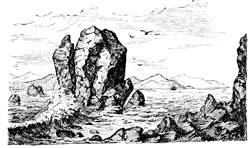
THE GOLDEN GATE.
It is true that flour was worth fifty dollars a barrel, at the mines, and a common spade ten dollars, but when even the poor and degraded Indians of the rancherias[3] could afford the luxuries of life, the cost of necessaries was of little account to men who thought four golden ounces only a fair return for a day's labor.
This is the story of only a few short months,—the preface, as one might say, to the larger history. It was yet too soon for the discovery to be known in the United States, but the time was drawing near when it would be the one all-engrossing topic in every hamlet from Maine to Florida. Meanwhile it spread to all the shores and isles of the Pacific. Dark-visaged Kanakas from the Sandwich Islands, swarthy Peruvians and Chilenos, added their thousands to the already composite character of the population of the land of gold. From the Russian Possessions in the north, from the Sandwich Islands in the midst of the Pacific, the wondrous tale was speeding on to China and the Australian Isles. Then with the autumnal rains the first chapter of this history of marvels was closed for a brief season.
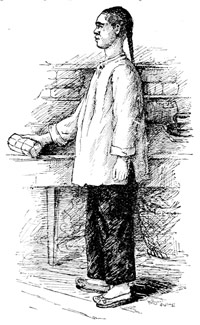
CHINESE LAUNDRYMAN.
Authentic reports of the gold discovery first appeared in the public prints of the Atlantic States in the autumn. In December, President Polk gave Governor Mason's and Consul Larkin's reports to the country. From these sources the story was taken up and multiplied through the myriad channels of public and private intelligence, until the name of California became a household word throughout all the length and breadth of the land. Talismanic word! It was soon to entice a million men from their homes to seek their fortunes among the gulches of the wild Sierra.
Rarely in the history of the world has society been so deeply stirred to its centre. It was like an electric shock that is felt throughout the whole social organization. First there was the numbness of wonder, then the fever of unwonted excitement. How to get to this land of gold, was now the one absorbing question of the hour. Near a thousand leagues of barren plains and desert mountains lay between it and the settled frontier. These could only be crossed after grass had grown in the spring. A still longer ocean journey must be made by crossing the Isthmus of Darien, over the trail struck out by the viceroys when Spain held the keys of the East; or, if the voyage were to be made round Cape Horn, the distance would be more than quadrupled. But the thought of these vast distances to be traversed seemed only to add to the general impatience to surmount them. The temper of the public mind was such that it would bear any thing but delay. Soon ships were fitting out in every port[4] of the Union for Tampico or Vera Cruz, for Chagres, and for the long voyage round Cape Horn. In the seaports nothing was heard but the note of preparation. On the frontier caravans were everywhere forming to go forward with the appearance of the first blade of grass above ground. "Ho for California!" was the cry borne on every breeze that wafted ship after ship out over the wide ocean with her little colony of gold-seekers. "Ho for California!" was the watchword of those who were braving the perils of a winter journey across the Sierras. And "California!" was still the answer of other bands that were wending their way across the Cordilleras, in paths first traced by Cortez and his comrades, to Acapulco, San Blas or Mazatlan on the Pacific. All roads seemed leading to the Golden Gate. El Dorado was found at last.
FOOTNOTES
THE CALIFORNIA PIONEERS.
Although we have seen much doing there in the previous year, and the earliest comers were the true pioneers, the great rush to the gold region took place in 1849, upon the first news being spread throughout the States. It is therefore from that year that the history of the gold fever is usually dated.
So great was the demand for shipping, that even old whale-ships were fitted up to carry three or four hundred passengers round Cape Horn. Even these were quickly crowded with emigrants. But ere long the demand for vessels that would show greater speed gave rise to new models in ship-building; and to this cause we owe the fast clipper ships which sometimes sailed from New York to San Francisco in eighty-seven days.
At first it was much the fashion for men to go in companies formed in their own neighborhoods. Those who could not go themselves would club together and send a substitute, as men may own shares in a ship or a machine, the substitute being allowed to keep a certain share of the profits of his own labor.
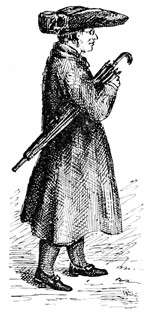
A FATHER.
Then, again, a novel appearance was given to the streets of our seaport towns by the daily presence in them of men dressed in red woollen shirts, slouch hats, and cowhide boots,—men wearing pistols and dirks, or carrying rifles,—whom it was not easy to know for peaceful citizens just turned out of their farms or workshops or counting-houses. Nor was the emigration confined to the bone and sinew of society only. Men of every walk in life were drawn into it. A scholar might have a day-laborer for his companion. Larkin has told us how this worked in the mines. The one purpose to dig for gold quickly put all on an equal footing, for in making labor the sole means of wealth, as in the beginning it was, the common laborer had become the peer of the most learned scholar in the land. Hence every ship and every caravan carried its little republic of equality. And hence society seemed going back into its original elements, as if gold were the magnet attracting all else to itself.
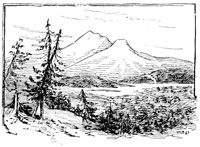
MOUNT SHASTA.
The sailing of many ships, full freighted with eager gold-seekers, was followed in the early spring by the march of thousands across the plains. Like colonies of migratory ants the long line of wagons crept along the roads leading to the South Pass and Rio Grande. At Salt Lake City, which we have just seen founded, the weary emigrants tarried a while to recruit their failing animals for the dreaded passage of the desert; then to the road again to struggle ever on through the parched valleys, where their gaunt beasts died of thirst, or up the granite sides of the Sierras, where they dropped from exhaustion, till the Sacramento Valley was reached at last, and Shasta Peak burst on their enraptured sight. Hundreds perished by the way, and long after the march for gold in 1849 might be traced by the abandoned wagons or dead animals that strewed its path.
Many reached Panama by way of the Chagres River, whose course led up to the mountain chain dividing the waters of the Atlantic from those of the Pacific. Day by day a motley fleet of dug-out canoes might have been seen toiling with pole and oar against the swift current of this mountain stream. At the head of boat navigation, in an open spot, under the high mountains, a few cocoanut palms lifted tufts of graceful foliage above a clump of miserable huts, whose owners were of mixed Spanish and Indian blood. This was on the route the Spaniards had discovered in 1513. This was Gorgona.
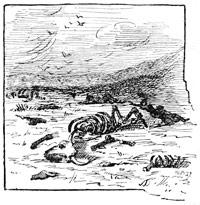
ON THE OREGON TRAIL.
Taking mules at Gorgona the emigrants crossed the mountains to the Pacific, which they here closely approach. At the ancient city of Panama, interesting only as a specimen of that older civilization which had run its course, several thousand Americans[1] were soon waiting for vessels to take them on to California. Every crazy hulk that would float had been taken up by earlier comers. So these people had to stay at Panama through the sickly season, though the deadly fever of the country was daily thinning their ranks of the bravest and best. Thus months of weary waiting must pass before these people could set foot in the land of gold.
When they did reach it[2] they found San Francisco[3] a city of tents and shanties scattered about a group of barren, wind-swept sand-hills. In the basin below, formed by the curving shore, a fleet of deserted ships rode at anchor. Farther off rose the little island of Yerba Buena,[4] and still farther, beyond the leagues of glittering water, the rugged wall of the Coast Range grandly enclosed the bay in its encircling arm.
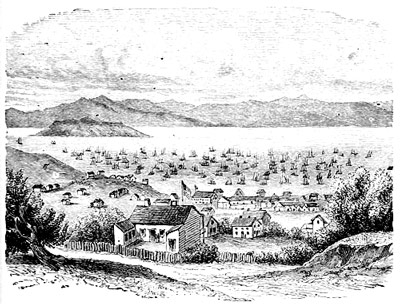
SAN FRANCISCO IN 1849.
To this picture now add the hurry and confusion which the beach showed at all hours of the day, and we shall get a rapid glimpse at the humble beginnings of the destined mart of the Pacific. Those tents on the beach were the warehouses of the future metropolis; those on the hills were the abodes of its wealthiest citizens.
Should we follow the swarm of boats seen every hour pushing off from the beach for the mines, they would lead us to the two great inland waterways of the country. On the spot where Sutter had made his landing-place another city had sprung into being. This was Sacramento. On the San Joaquin, where Weber had made a home in 1844, Stockton was growing up. These were the two great depots for the mines north and south.
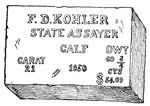
EARLY COIN.
By the beginning of the new year (1849) the population of California had run up to twenty-five thousand. The winter months, or, as we should say of this region, the rainy season, everywhere brought great suffering to the badly-housed and ill-fed emigrants, many of whom reached the mines in a state of destitution. There were many things even gold could not buy or wealth command. Men who had both were glad to get acorns to live on. Many died this first winter. With the coming of spring the depleted ranks were more than filled by new arrivals, and when January came round again the pioneers of 1849 were a hundred thousand.
FOOTNOTES
CALIFORNIA A FREE STATE.
The United States did not set up a Territorial government in California at once, but put military governors over it, who continued the old laws of Mexico in force. What these were, only the native people could know. They had not yet been translated into English. Many, indeed, derided the idea of being governed by laws made for Spaniards. Instead, then, of being clothed with power to enact laws suited to the new and strange conditions growing out of the gold discovery, with society unformed, or breaking to pieces about them, the people of California found themselves living almost without law, except such as imperative need compelled them to make and enforce for themselves. This state of things could have but one result among a people hastily thrown together from all parts of the earth, most of whom were law-abiding, but many the outcasts of society. It led to confusion, lawlessness, and crime. In the annals of the State it is usually called the interregnum, from the Latin word signifying a suspension of the regular functions of government.
Therefore, as the actual laws remained either mostly unknown, or were held in little esteem, the people conformed to them only so far as to give the officers or courts they chose among themselves Spanish names. They everywhere took the law into their own hands, establishing such local laws, or usages having the force of laws, as their situation would seem to give warrant for.
Thus, the miners determined for themselves how much room each man should have to dig in; and they established in their camps rude codes of justice by which the worst crimes usually met with prompt punishment. If, for instance, a man committed murder, he would be tried on the spot by a miners' court, hastily summoned for the purpose. Trials of this sort were generally conducted in an orderly manner, and seldom failed of doing justice, but they were always felt to be a departure from the usages of civilized people, and in so far a going-back toward barbarism.
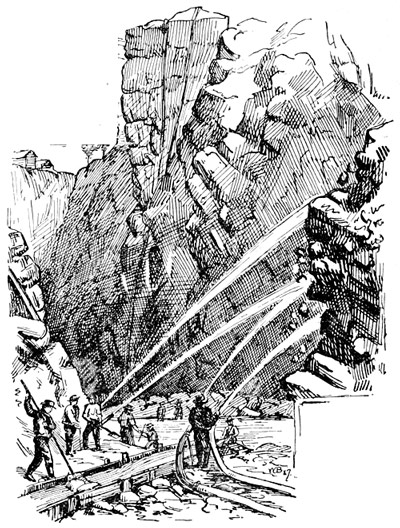
HYDRAULIC MINING.
Much disorder brings with it much order. Informed of all the evils to which this state of affairs gave rise, Governor Riley, in 1849, called the people to meet in convention for the forming of a State government. The delegates accordingly assembled in September at Monterey. They framed a constitution, on the plan of the free States, prohibiting slavery; for as labor was to be the corner-stone of the State, the men of 1849 would not degrade free labor by competition with slave-labor. In November the constitution was ratified by the people; and in December the officers elected under it met at San José to fully organize the State government.
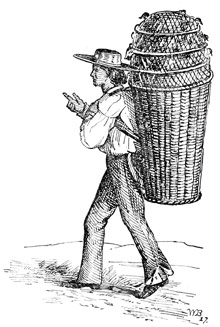
CHICKEN-VENDER.
The petition of California to be a free State was strongly resisted by the Southern men in Congress, who had hoped it would come in as a slave State. Once again it brought up the whole subject of slavery extension. Eventually the struggle gave rise to another compromise by which California came in as a free State (1850), the slave-trade was abolished in the District of Columbia, and the Fugitive Slave Law passed, mainly by the efforts of Henry Clay. The execution of the last-named law roused the indignation of the North as nothing had ever yet done. Resistance to slavery extension was now become the dominant question there in politics, in literature, and in the pulpit. The doctrine that the people of a territory alone should have the right to decide whether they would have slavery or not had been urged with much force by Senator Douglas in the case of California; and thus popular sovereignty, as it was called, now first brought together the moderate partisans of slavery, those indifferent to its extension, and those who believed such a settlement as Mr. Douglas proposed would lift the question out of party agitation, and so put a stop to the threats of secession, which was the bugbear of all who loved the Union.
ARIZONA.
A dispute having arisen with Mexico about the boundary the war had established, President Pierce settled it by buying the territory in question (1853) for ten millions of dollars. General James Gadsden negotiated its transfer, and for him it was called the Gadsden Purchase. The United States thus acquired the strip of country lying between the Gila River and the present southern boundary of Arizona. Prior to its purchase it had formed part of the Mexican State of Sonora. Mr. Gadsden exerted himself to secure with it the port of Guaymas on the Gulf of California, but was not sustained by Congress in his effort to do so.
At the period of its cession to us Arizona was practically unknown except to hunters and trappers or to the few who had read the accounts of the early Spanish explorers. Mr. Gadsden was ridiculed for making the purchase, and Congress censured for squandering the people's money upon an arid waste destitute of sufficient wood and water to sustain a population of civilized beings. The failure of the Spaniards to found any considerable settlements was dwelt upon. Stories of mines of fabulous wealth that Arizona held locked up in her mountains had indeed come down from a remote time, and were more or less current abroad, but few believed in them, or could see any compensating advantage to accrue to us for the millions Congress had spent. Government, however, caused the territory immediately to be surveyed with the view of settling the question whether we had or had not been cheated in making the purchase.
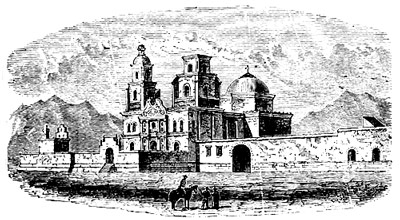
MISSION SAN XAVIER DEL BAC, NEAR TUCSON.
II. THE CONTEST FOR FREE SOIL.
THE KANSAS-NEBRASKA STRUGGLE.
At the period now reached by our story the political sense of the people, in all things touching the national life, was represented by the Whig and Democratic parties. There was yet another body formed to prevent the coming in of any more slave States, and therefore called the Free-Soil party. This last party had only come into being since the war with Mexico, and was not yet strong enough to successfully cope with the older ones for control in national affairs; but it was growing stronger every day.
Neither of the two great parties was divided by geographical lines. Both called themselves national parties, but since the extension of slavery was become the vital question of the hour, the Whig party was losing ground to the Free-Soil party, which indeed mostly grew up from the defection of those Whigs who determined henceforth to stand with the opponents of slavery until that question should be settled forever. So while the Whig party was strongest in the free States, it was beginning to go to pieces because it no longer represented the growing feeling against slavery in those States, though it was still led by able statesmen like Daniel Webster, whom the country had always looked to in the past for safe counsel and guidance through all the perils of party strife.
The Democratic party, on the contrary, being most numerous in the slaveholding States, was more firmly united than ever by the agitation about slavery, which their great leader, Calhoun, had told them could only be maintained by being extended, and could only be extended by becoming aggressive.
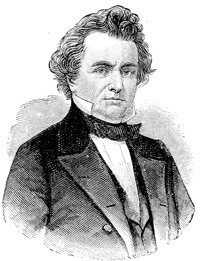
STEPHEN A. DOUGLAS.
Here, then, we have the political situation after the admission of California, in a nutshell. In the South the Democratic party stood solid and defiant in support of slavery extension; in the North it favored popular sovereignty, as defined by Mr. Douglas. The Free-Soil party declared its purpose to oppose the making of any more slave States, and under the lead of Sumner of Massachusetts, Chase of Ohio, and Seward of New York, prepared to make head against its formidable opponents. The Whigs were now looked upon as the party of vacillation, weakness, and compromise. Though in nominal opposition to the Democrats, its leadership was no longer trusted, because it was felt to have surrendered the one principle[1] on which the coming struggle inevitably would turn.
The Democratic party succeeded in electing Franklin Pierce[2] to the Presidency, for the term running from 1853 to 1857.
His administration is chiefly memorable for the passage of the Kansas-Nebraska Act, by which two new Territories were formed of the Louisiana Purchase, and thrown open to settlement. In framing this Act its authors left it to the people to choose for themselves whether they would have slavery or not, as Douglas urged they should; and in order that they might do so, the compromise of 1820 was set aside. This measure was largely the work of Mr. Douglas, who, arguing that the people are sovereigns, viewed a reference of the slavery question back to them, as the only true way of settling the agitation about it. It had a certain fair-play look that won many to its support in the North. In this form Congress passed the Act, May 30, 1854.
To repeal the Missouri Compromise, was held by many at the North and some at the South,[3] to be a violation of the pledge so sacredly made to the whole people, not to admit slavery north of 36° 30´. We shall see what it led to.
Let us look first at the new Territories as the organic Act found them. From the Missouri on the east, they reached to the Rocky Mountains on the west. They contained the most fertile lands of the public domain. The great thoroughfares to Oregon, California, and New Mexico, traversed them in their whole length, so making it clear, even at this early day, that the great movement of the people from east to west must be along the lines of these thoroughfares, strewing its pathway with populous cities and towns as it went.
Already we have led the explorers through this magnificent land. Through them much knowledge had been gained of its natural features, its fine climate, and of the unequalled fecundity of its soil. The West was its neighbor and knew most about it. The East knew it only through the accounts of Pike, Long, and Fremont, from the reports of emigrants, or in the stories of travel written by Irving, Latrobe and others, all of which gave it a kind of romantic interest with their readers.
Upon the virgin soil of Kansas the fragments of many of the one-time powerful red nations of the East had been colonized. Here, at last, we meet again the Wyandots of Lake Huron,[4] the Delawares of Pennsylvania, the Sacs and Foxes, Ottawas, Pottawatomies, Shawnees, Kickapoos, Piankeshaws and other warlike peoples whose race as nations had been run. To this point they had at length been rolled back by the ever-advancing tide of white emigration. They probably far outnumbered the original owners of the soil,—the Missouris, Kansas, Otoes, Pawnees, Osages,—and all maintained their tribal organization unimpaired within the limits Government had set for them. Here these wrecks of once powerful peoples peacefully lived on the bounty of the nation which had told them Kansas was to be their permanent home.
Among most of these tribes missions and schools had been planted by various religious denominations. One of the richest and seemingly most prosperous ones was that founded by the Methodists[5] among the Shawnees, who were half-civilized, and also held a few slaves.
To protect its emigrants who were constantly passing over the great routes toward the Pacific, Government had established the military posts of Fort Leavenworth[6] on the Missouri, Fort Riley at the junction of the two chief branches of the Kansas, and Fort Kearney on the Platte. Fort Scott was also founded in the south, on the road leading to the Indian Territory.
Set against these new Territories were two States,—one slave and the other free. It was thought that Kansas would mostly take her settlers from Missouri, and so easily be a slave State, while Nebraska in a like manner would become a free State through the influence of Iowa, its neighbor. Moreover the soil and climate of Kansas were thought favorable to the employment of slave labor, while Nebraska was considered to lie north of the line beyond which such labor could be made profitable. Hence it was to Kansas that the efforts of those favoring slavery were turned; and as the best part of it was occupied by Indians, their removal or restricting within smaller tracts was provided for, so making way for the coming settlement.
FOOTNOTES
KANSAS THE BATTLE-GROUND.
When Congress decreed that freedom and slavery should compete for control in Kansas, the decision reminds us of the judgement given by the wise king of history, who, having to decide which of two mothers a child belonged to, ordered one of his guards to cut it in two with his sword, and give the half to each claimant.
In this contest Congress and the President stood with the South. The law-making power had first removed every restriction to making Kansas a slave State, and now the executive branch was to appoint governors[1] over the people who should go there to live, and give orders to the military commanders to aid them when called upon to do so.
There was another very potent means working to the same end, which in the hands of lawless men proved a serious obstacle to the peaceful going-in of settlers from the free States. The great avenue of travel into the disputed territory was the Missouri River, whose banks were already lined with a population holding many slaves, and therefore easily aroused to active enmity by the fear that the planting of a free State next their border would cause their negroes to run away, and so deprive them of their property. Moreover, as we have already said, the Missourians had confidently looked upon Kansas as theirs whenever it should be opened to settlement, and could not bear the thought of having it snatched from them by a people whose politics they detested, and whose presence they feared.
Under these conditions the movement of settlers into Kansas began at the North and South. It was no peaceful march of peaceful citizens under the protecting hand of the nation, but was turned by sectional rivalry into a political crusade. Public meetings were held all over the North and South to encourage the going of the adventurous young men of both sections, as in time of war. Sectional passions were aroused and inflamed. Large sums were raised in the churches to arm these emigrants for the conflict which it was clear must take place sooner or later. So the war of the sections that so long had threatened the national peace was begun at last. Congress had left the question to the people to settle, less in the spirit of statesmanship than as a way out of the difficulty; and the people, seeing that its peaceful settlement was impossible, were getting ready to fight it out, not with the ballot as Douglas believed they would, but as men who are convinced that force, and force only, can decide the justice of their cause.
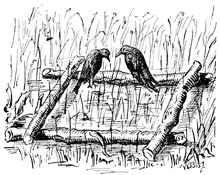
A SQUATTER'S IMPROVEMENTS.
Missourians began the settlement of Kansas. June, 1854, Leavenworth[2] was laid out two miles below the fort of that name. Another town was also begun twenty-five miles farther up the Missouri, and named for Senator Atchison[3] of Missouri. These two, with St. Joseph on the north and Kansas City on the south, not only controlled all the river-front of Kansas, but the roads leading into it as well, as St. Joseph and Kansas City were the established starting-points for crossing the plains, from which the great overland routes diverged. Missouri settlers also shortly began a third town, in the Kansas Valley, to which they gave the name of Lecompton,[4] and soon made it the capital of the Territory.
Thus the North entered the conflict to obtain control of Kansas under every disadvantage which remoteness, prior occupation, or unyielding determination to exclude all who did not favor slavery, could bring into it.
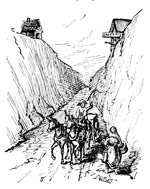
STREET, KANSAS CITY, 1857.
New England was the focus of anti-slavery thought and action, to which the rest of the North undoubtedly looked for leadership. It was, therefore, in New England that active steps for throwing free-State settlers into Kansas first originated. This was effected through an association known as the New-England Emigrant Aid Company,[5] which was the parent or forerunner of many similar ones subsequently organized throughout the free States. The New-England Company acted with much method. It formed little colonies which were put under competent leaders, were furnished with farming-tools, and even took out saw-mills for the making of new settlements. Some colonists took their families along with them, but most of the first comers were single men whom the desire to see Kansas a free State, rather than a thoughtless spirit of adventure, took from the orderly communities of the Far East. To this work they confidently went forth accompanied by the prayers and good wishes of their friends and neighbors, though as little used to the rude encounter with border men and border life as the two kinds of civilization each presented in itself were removed one from the other.
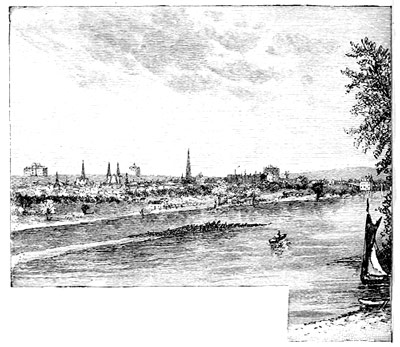
LAWRENCE, KANSAS.
These emigrants made a lodgement in the Kansas Valley, where they founded Lawrence[6] (August, 1854), Topeka, Manhattan, and Wabaunsee. Later settlements were begun along the Osage waters, of which Osawatomie was the chief, and most famous in the annals of Kansas.
The directing head of this free-State movement on the spot was Charles Robinson, than whom no more fitting representative of the spirit of his mission, or one possessed of the ability to make head against the multiplied difficulties of time and place, could well have been chosen.
FOOTNOTES
THE BATTLE FOUGHT AND WON.
It was the doom of slavery that it should require the destruction of every thing that stood in its way. This being conceded, a resort to lawlessness—more especially on the part of a rude population like that of the Missouri border—was sure to follow the attempt to set up a free commonwealth in Kansas.
From the moment the organic Act became law, the future of Kansas was ever and foremost a national question. The Southern leaders had told the Missourians, if they would not see political power wrested from the South, they must secure Kansas to slavery at any cost. The North had met the challenge in the words of Senator Seward, who said, "Come on, then, gentlemen of the slave States! Since there is no escaping your challenge, I accept it in behalf of freedom. We will engage in competition for the virgin soil of Kansas, and God give the victory to the side that is stronger in numbers, as it is in the right."
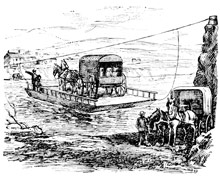
THE FERRY, LAWRENCE, KANSAS.
The people of Western Missouri, of whom glimpses have been given in former chapters, were typical American borderers, rude of manner and speech, scarcely touched by the refining influences of the older East, open-handed and hospitable to a fault, but capable of committing brutal excesses when their passions were aroused, as they now were by the overwrought appeals of their most trusted leaders to make an end of abolitionism, if they would not see it become a menace to their domestic peace,—an incitement to insurrection or ceaseless turbulence along their border. Their character may be guessed from the name which in a spirit of bravado they took from their opponents' mouths,—that of border ruffians. They were expert with the rifle, daring riders, accustomed to out-of-door life from infancy, and hardened by experiences drawn from the vicissitudes of frontier life, into the bone of a self-asserting Americanism of the Davy Crockett school. Then, inasmuch as public opinion justified the settlement of private quarrels with the pistol or bowie-knife, the taking of life was held cheaply as compared with communities where the enforcement of law is the safeguard of the citizen. Add to this the frontiersman's habitual scorn for those reared in cities, or who shunned a resort to violence in support of their principles, and we have the measure of those adversaries whom the free-State men of the North were to face on their own ground, and with their own weapons in their hands.
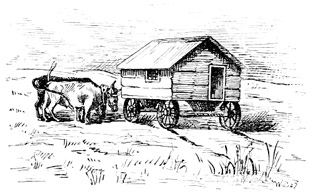
A SQUATTER MOVING HIS CLAIM.
The events flowing from this state of things may be briefly summed up.
While the free-State movement was steadily gaining ground by the coming-in of actual settlers, the Missourians made determined efforts to stay it, first by seizing upon the government of the Territory, and next by intimidating or driving out all who opposed their lawless acts. Thus an election for members of the Territorial Legislature (March, 1855) was controlled by Missourians who, in the most open manner, came into the voting precincts with arms, cast their ballots unchallenged, and then went home again to Missouri, so returning a law-making body by unlawful votes. This Legislature enacted laws establishing slavery. The free-State men refused to recognize it or its laws. They proceeded to form a constitution[1] prohibiting slavery, with which they asked admission into the Union. They also elected State officers, and a legislature which they meant to put in operation if worst came to worst. Meantime they organized themselves to repel force with force if necessary. All those who were opposed to making Kansas a slave State, now came together as the free-State party.
This party, which had just elected Charles Robinson governor, refused to pay taxes, obey writs, or in any way abide by the acts of the so-called bogus legislature. The pro-slavery party declared this treason. Congress rejected the Topeka Constitution, the House voting for its admission, the Senate against it.
In consequence of the rescue of a free-State man from the hands of the sheriff, Lawrence was soon besieged by a large force of Missourians, assembled under color of law, but in reality invaders of the Territory. The people of Lawrence prepared to make a sturdy defence by building earth-forts at all the approaches to the town, in which men armed with Sharpe's rifles were constantly stationed. Seeing them determined to fight, the Missourians left without venturing to attack them.
Finding the free-State men thus firm, the other party next invoked the judicial power to aid them in breaking up the combination made against the enforcement of illegal laws. Governor Robinson and many other free-State leaders were indicted for treason[2] by a grand jury, acting upon instruction of the chief justice, who defined the acts of the free-State men as levying war against the Federal Government. Robinson and others were arrested and imprisoned. Some of the leaders escaped out of the Territory.
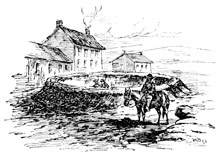
MUD FORT, LAWRENCE.
Bills of indictment had also been found against the two newspapers printed at Lawrence, as well as the hotel in which the free-State men were in the habit of holding their meetings. These were declared public nuisances. Under the color of law, an armed posse proceeded to Lawrence, threw the presses into the river, gutted the hotel, and burned Governor Robinson's house to the ground. This took place May 20, 1856.
The next act of the actual government was the calling-in of United States troops to disperse the free-State legislature, which met at Topeka, July 4. All these proceedings had aroused the keenest interest throughout the Union, and while in Kansas opposition to oppression was momentarily quelled, it was acquiring greater strength[3] in all the free States.
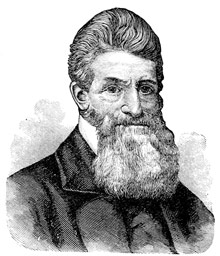
JOHN BROWN.
Among the free-State men were some who believed such acts as had been committed at Lawrence called for reprisals in kind. Of these, James H. Lane[4] obtained a wide notoriety; but the animating spirit was undoubtedly John Brown of Osawatomie,[5] who held that the policy of submission was all wrong, and that the pro-slavery men too must be made to fear for their own safety before peace could be had. He avowed himself in favor of giving blow for blow. This idea found much favor with the fighting portion of the free-State men. On the question of slavery, Brown's mind was surely unsettled by the all-engrossing idea that slavery was a thing of violence which must die a violent death. To bring this about was now the one purpose of his life, and in pursuit of it he was as inexorable as fate. For its accomplishment he possessed certain qualities that make either the hero or martyr according as the purpose is weighed by history. An iron will, religious fervor amounting to fanaticism, were joined to a calm but resolute courage which no danger could daunt or turn from its purpose. He was a seventeenth-century Puritan of the Cromwellian stamp—a man of iron belonging to an iron age.
Brown soon had the border in terror of his deeds. The blows he struck were swift, secret and deadly. It was now the pro-slavery men who were driven out or assassinated, or had their homes fired at dead of night. Men sent to take him were themselves taken and held as prisoners. These acts led to retaliation, retaliation to fresh outrages, and for a time Kansas was given over to violence.
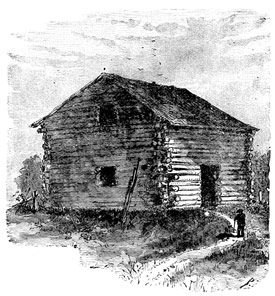
BROWN'S LOG HOUSE.
Believing Congress would admit them to the Union, the slavery party also formed a State Constitution at Lecompton, the capital. But an election for a new legislature had overwhelmingly defeated them, thus giving control of the Territorial body to the free-State men at last. So the Lecompton men now saw no hope for themselves except in their State Constitution. As they refused to submit the whole instrument to the people, the free-State men refrained from voting for or against the single proposition of "slavery" or "no slavery," seeing they must get the detested Constitution in any event. The returns showed the old determination still strong to fasten slavery on the people against their will. A large majority was obtained for the Constitution by stuffing the ballot-boxes with fraudulent votes. Of six thousand and odd votes (6,226), nearly half (2,720) were illegally cast. The Lecompton Constitution was, however, sent to Congress by President Buchanan with his approval. In Congress it provoked a stormy debate, was sent back to the people of Kansas for final ratification, and by them decisively rejected at the polls, August, 1858.
Though Kansas was kept out of the Union three years longer, her attitude in respect to slavery was now so little doubtful that the pro-slavery men gave up the contest in despair.
To maintain their cause with the country at large, and make it one on which the opponents of slavery could unite, the free-State men of Kansas lived for a time nearly in chaos rather than forfeit the name of law-abiding people. In this they showed admirable self-restraint. To maintain themselves in Kansas they were forced to adopt the tactics of their assailants at last, and deal blow for blow. Cultured people were roughened by this sort of life. It made them reckless. It weakened respect for law, even with the law-abiding. It brought material progress to a standstill, and engendered lifelong enmities among men who were to live together as neighbors. Social improvement was put back years. The very existence of a conflict had the tendency to bring bad men to the front, whose influence proved a hinderance to the settling of order in the State. The contest in Kansas proved Douglas wrong and John Brown right, in so far as the question of peaceful competition for the soil was involved in it. In a national sense it was therefore but the prelude to the great Civil War of the century.
FOOTNOTES
TWO FREE STATES ADMITTED.
Minnesota came into the Union in 1858, and Oregon in 1859, thus strengthening it by the addition of two young and sturdy commonwealths, both of which were primeval wildernesses within the memory of men now living.
III. THE CROWN OF THE CONTINENT.
GOLD IN COLORADO, AND THE RUSH THERE.
It had long been predicted by those most familiar with the general characteristics of the Rocky Mountains, that eventually they would be found rich in mineral wealth. One of the earliest and most sanguine advocates of this idea was Colonel William Gilpin of Missouri, whose predictions, when viewed in the light of later knowledge, seem like the gift of prophecy. Reports were indeed more or less current at Salt Lake of the finding of gold among the mountain streams of the Great Basin, as far back as 1848, but all search for it was discouraged by the Mormon leaders as tending to bring upon them a swarm of adventurers whose presence would inevitably work the ruin of their isolated republic, and so render all previous toil and hardship of no avail. We have seen that such reports had reached the Mormons in California, who were preparing to go to Salt Lake in consequence of them.
Then, the existence of rich silver-mines among the mountains of New Mexico, which the Spaniards had been working for an unknown period of time, in the rudest possible way, was a thing of common knowledge from the time of La Salle, though the secrecy observed in regard to them effectually shut out inquiry as to whether the business were profitable or not. But California was so long the goal of all seekers after gold, that it was not until her gold-fields began to give out, and people began to ask "What next?" that the great backbone of the continent, over which the emigration had rushed so long and heedlessly, suddenly stopped them with the question, as one might say, "Why not search me?"
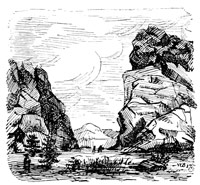
GATE, GARDEN OF THE GODS.
The first report of the finding of gold at the eastern base of the Rocky Mountains reached the Missouri River in July, 1858, but did not gain much credit till several months later. By October, however, the fever was at its height on the frontier, and had made some progress toward the east. Though several parties started out from the border towns of Kansas and Missouri, the lateness of the season prevented many from going at this time. Meanwhile, however, reports continued to come in, each seemingly well authenticated and more conclusive, as to the main fact that gold existed in paying quantity not far from the foot of Pike's Peak. The region where report located the discoveries therefore took to itself the name of this magnificent mountain, whose sides were vaguely supposed to be veined with the precious metal found in the sands of the Platte.
After much prospecting, the ground along Cherry Creek, a small tributary of the South Platte, was fixed upon as one promising the best results to the miner. It accordingly became a base for future operations which were to be pushed up into the heart of the mountains. First known simply as Cherry Creek, the camp of the earliest comers soon took to itself the name of Denver City,[1] from James W. Denver, governor of Kansas, of which this gold region then formed part.
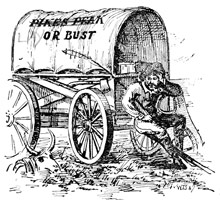
HUMORS OF THE ROAD.
With the coming of spring, and opening of navigation on the Missouri, emigrants began to pour into the various points of departure for the new gold region. From Omaha to Independence unprecedented bustle prevailed all along the border. Many started off on a journey of seven hundred miles on foot. Some put their worldly goods in hand-carts to which they harnessed themselves. One man is said to have trundled a wheelbarrow from Kansas City to Cherry Creek. Most emigrants, however, went in wagons over the now well-marked roads of the pioneers, and by night the prairies were lighted up far and near with their camp-fires.
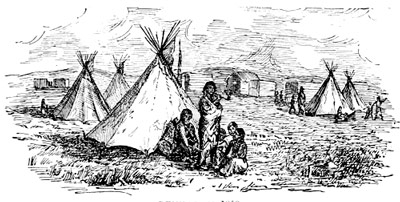
DENVER IN 1859.
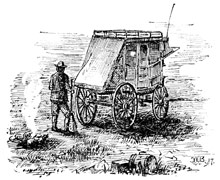
OVERLAND STAGE.—IN CAMP.
In view of the rush to Pike's Peak, the firm of Russell, Majors & Waddell, which had for years transported supplies to the military posts of Kansas, Utah, and New Mexico, now put on a line of daily coaches from Leavenworth to Denver, which were run up the Republican, and thence to the Platte. Thus, after the Indian pony, the trapper's caravan, the explorers' and emigrants' cavalcade, comes at last the modern stage-coach with its promise of greater things to follow in its track. On the 21st of May the first coach reached Leavenworth on its return from the mountains, bringing only a few thousand dollars in dust; but in that month John H. Gregory, an old Georgia miner, found rich deposits of gold in the mountains among the headwaters of Clear Creek. This discovery established the value of Colorado as a gold-bearing region.
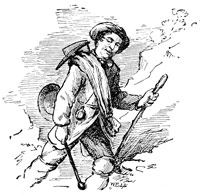
GOING IN.
When visited in 1859 the Gregory Diggings were found in a gulch along which log cabins, tents and camps, hastily covered in with boards or pine boughs, were scattered for miles. There were then five thousand people in them, and more were coming in every day.
Here the experiences of California life were repeated. Some men were taking out two hundred dollars a day; others who worked equally hard did not get five dollars a day for their labor. It resulted that a stream of confident and cheerful ones were constantly going in, while not a few who had failed to find fortune in the diggings were as constantly coming out, crestfallen and in rags.
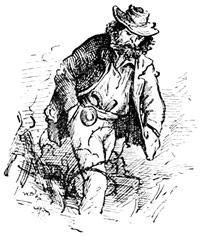
COMING OUT.
In 1859 Denver had about one thousand people, who lived in three hundred rough-hewn log houses. Very few of them had glass windows, or doors, or other floors than the bare ground. Hearths and fireplaces would be built of adobe, as in New Mexico, and chimneys of sticks laid crosswise one on the other, with the interstices filled with mud, as the New-Englanders of 1630 were accustomed to make theirs. As no rain falls except during the summer months, life in the open air caused little discomfort to people who, being obliged to make the most of every thing, easily learned to do without what are called luxuries.
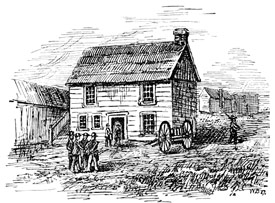
OFFICE OF "ROCKY-MOUNTAIN NEWS," DENVER.
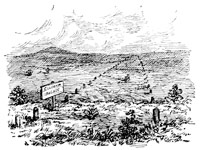
Picturesquely set up among these homely dwellings of the whites, one saw many skin lodges. These belonged to a band of Arapaho Indians, who had thus pitched their camp in the heart of the growing city. Golden City in the north and Colorado City in the south were soon founded. The first was an intermediate point on the route to the Gregory Diggings; the second was started at the foot of Pike's Peak, near to the famous Fontaine qui bouille,[2] or Boiling Spring, and on the route to Santa Fé.
COLORADO CITY, 1859.
In a few months more Denver had grown to a city of brick and frame buildings, with two theatres, a mint coining the gold of its own mines, and rival daily newspapers. It had quite reached the second stage of development of frontier cities.
QUARTZ STAMPING-MILL.
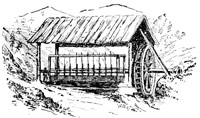
The surface, or placer, diggings of Colorado were soon exhausted, but in their place belts of gold mixed with quartz were struck all the way from Pike's Peak in the south to Long's Peak in the north. Above this gold belt, rich silver ores were sometimes found on the very summits of the mountains. These discoveries soon changed mining from a pursuit in which every one could engage, and which had drawn such numbers into Colorado in the beginning, to the larger operations of capital, with all the appliances modern science brings to its aid.
FOOTNOTES
THE PACIFIC RAILROAD. In time of war prepare for peace.
In about half a century we have seen the great body of the nation moving more than five hundred miles westward. It has moved forward like an army taking the field, planting its outlying settlements before it at all strategic points, the possession of which was essential to the success of its peaceful mission. This army has marched at the rate of ten miles a year, mostly along the thirty-ninth parallel, to which the advantage of soil and climate was its infallible guide. Its destination was the Pacific Ocean.
QUAKER GUN AT STAGE STATION.
We have also witnessed the occupation of the Pacific coast, the rise of two great States there whose people were already stretching their hands out toward the East as if to hasten its coming. The genius of civilization hovered over and directed this grand march, which never halted but to re-form its lines and go forward again with stately tread.
We have further seen a third body firmly plant itself among the fastnesses of the Rocky Mountains, whose mission was to extend its own civilization both to the East and West, as the pebble which is dropped into a pool sends out its ever-broadening circle upon the surface of the waters. Thus the people of New Mexico, Colorado, and Utah, were already throwing out little colonies into the later Territories of Nevada, Arizona, Idaho, and Montana. Thus these Territories were the heralds of the coming East. And in this manner the vigorous West had secured in advance the strongholds which, in a physical sense, impeded the march toward the Pacific.
As it went forward, the East brought all the appliances of civilization with it, and set them working all along the line. In 1859[1] the locomotive and telegraph reached the eastern frontier of Kansas. There was now a gap of two thousand miles remaining to be closed up between the Missouri and the Pacific. How to bridge this over, and by so doing bring widely separated sections together, was a question now assuming national importance in men's minds.
The West demanded it should be done without more delay; the older sections responded in the spirit of national progress.
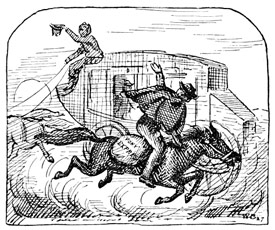
Private enterprise had already accomplished something toward the desired object. In the summer of 1859 the same energetic firm that had sent the first stage-coach across the wastes of Western Kansas to Denver, put on a pony express[2] to run between the Missouri River and the Pacific. Stations were established twenty-five miles apart on the open prairie, where fresh animals and riders were kept ready saddled and equipped for the road. Mounted on his hardy little Indian pony, the courier rode with whip and spur to the next station, where, whether by night or day, he stopped only long enough to snatch a mouthful, mount a fresh pony, and secure his letter-pouch behind him. He then dashed on again at the top of his speed. Though one of the oldest known methods of carrying news, the difficulties were here such as seldom have been overcome. By dint of hard riding, despatches were sometimes delivered in Denver in less than three days, and in Sacramento in eight days, from the time of setting out.
The Butterfield Overland Stage Company[3] established between St. Louis and San Francisco (1859) was a more serious undertaking. It ran coaches every day in the year, over the longest stage-route in the world, traversing a distance of near three thousand miles from end to end.
PONY EXPRESS AND OVERLAND STAGE.
Even such achievements as these were regarded as make-shifts which the coming railway should set aside. That and that only would solve the problem how permanently to unite and hold together such remote sections of the Union. In the East the country has always been settled before railways were built: in the West railways are expected to bring settlement with them, or even to go before it in a case like the present one. But without a country to support it, the proposed Pacific Railway[4] was something too vast for private enterprise to grapple with. From the time it was first talked of, the enterprise, therefore, assumed a national character and importance.
But the slavery question had now brought on a national crisis. Too long it had hung over the land like a storm-cloud that is to overwhelm it with ruin. The election of Abraham Lincoln to the Presidency (1860) was followed by the secession of most of the slave-holding States (1861), secession by civil war, and civil war by the abolition of slavery in the land. All the resources of the country being needed to carry on the war, it would seem, at first sight, no time could be worse chosen for pressing the claims of the Pacific Railway than when men so doubted and feared for the nation itself.
The people, however, thought otherwise, and they were to rule. Indeed, at the moment the Union was most seriously threatened with dissolution, the idea of binding the Great West more firmly to it seemed dictated by a wise forecast, since, if remoteness were to be an element of weakness to the nation, then the sooner that remoteness were done away with, the better for its security.
Congress made liberal offers of moneys and lands, and work began both in California (1862) and Nebraska[5] (1863). The route from the Missouri first begun followed the old emigrant trail up the Platte Valley, thence crossing the mountains into the Utah Basin, where the road from the west was expected to join it. As the Platte Valley is nearly a dead level from the Missouri to the mountains, the work went on rapidly over this part of the line. Twelve thousand men were employed on it. In front gangs of laborers shovelled up the loose earth to form the embankment; after these came the tie-layers and track-layers; who were again closely followed by the locomotive, with the cars in which the workmen slept and ate since leaving the settlements behind them.
When the track neared the Black Hills, the Indians tried to stop its farther progress. They looked upon its coming as destined to drive away the buffalo from their old feeding-grounds, and so starve them out of their country. In this belief they attacked the laborers, tore up the tracks, and so harassed the builders that the work could only go on under the protection of United States soldiers. Some well-meaning people thought it wrong thus to invade the Indians' hunting-grounds for any purpose whatsoever, and Wendell Phillips rejoiced that they had risen in defence of them. Said he, "All hail and farewell to the Pacific Railroad! Haunt that road with such dangers that none will dare use it!"
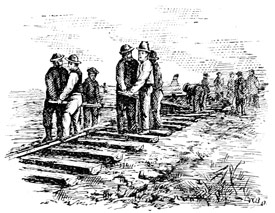
TRACK-LAYING, PACIFIC RAILROAD.
The work, however, steadily went on. On the 10th of May, 1869, the two ends came together at Promontory Point, Utah, and with impressive ceremonies the Pacific Railway was opened to the traffic of the world. The way to the Indies had been found. Senator Benton's prophecy was fulfilled.
FOOTNOTES
KANSAS, NEVADA, NEBRASKA AND COLORADO ADMITTED.
Kansas came into the Union (1861) as the seceding States went out. Though peaceful progress was arrested by the war, which kept most of her able-bodied men in the field, she, the youngest State, did her part bravely and well in that memorable conflict of arms, by the side of the older ones. She kept the name of the nation which had dwelt along her great river before the coming of the white men. With the cessation of civil strife began an era of prosperity, hardly paralleled in the history of the nation, and owing, chiefly, to the fertility of her soil, which has raised her to the front rank of agricultural States.
Nevada[1] may be said to have sprung from the side of California, though originally forming part of Utah. For a time it was known only as Washoe, from the Indians living about the east foot of the great Sierra.
A little surface gold was found here as early as 1850 by emigrants who carried the news to California. Their report brought a number of eager gold-seekers into the gulches around what has since grown up to be Virginia City, and it was while searching for gold that rich silver ores were discovered early in 1859, on Mount Davidson. Here on the eastern slope of this mountain, near the newly discovered silver lode, the town of Virginia began with a few log huts. In sixteen years it had a population of twenty-five thousand. In 1864 Nevada was admitted to the Union.
Nebraska[2] in soil and climate is quite like Kansas, though somewhat less fertile. Though opened to settlement at the same time Kansas was, emigration was mostly directed to the latter State by the slavery excitement. In 1861 the area of Nebraska was much reduced by the forming of Dakota, though it is still larger than all New England. Omaha,[3] Plattsmouth, and Nebraska City grew up as outfitting points for the commerce of the plains. All were villages in 1857. As the railway system of Iowa unerringly directed itself toward the Platte, Omaha, the capital, grew in importance; but when the terminus of the Pacific Railway was fixed there, its future was assured. From this time onward the progress of Nebraska was marked. In 1867 it came into the sisterhood of States.
Colorado was named for the great river which rises among its mountains. It was formed (1861) of portions taken from New Mexico, Utah and Kansas. Besides its mineral wealth, the raising of sheep and cattle has grown to be a great industry. In 1876 Colorado was admitted to the Union.
FOOTNOTES
THE RECENT STATES.
It is at least worthy of notice, in following out the law governing the movement of our people from east to west, that the great block of wilderness country which Lewis and Clarke first explored should be the last settled. The course their explorations took passes through Dakota, Montana, Idaho and Washington to the Pacific Ocean.
The reason for this long pause between the first and last acts in the story of the Great West is found in the fact that later exploration soon determined in favor of the Platte Valley, as the one affording by far the shortest way through the centre of the continent.
Therefore the new States, just named, are mostly an outgrowth of the more central region in which the great body of emigration has first settled. It may be further remarked, that in those Territories where gold and silver occur, settlement was nearly simultaneous.
Idaho,[1] like Nevada, grew up from the discovery of gold and silver in her borders. The finding of these precious metals goes no farther back than the summer of 1862. These were placer deposits. A year later quartz lodes, rivalling in richness those of Colorado, were brought to light. Soon the old Hudson's Bay post of Fort Boisé[2] was turned into a thrifty town. The mineral find rapidly extended along the Salmon, Boisé, and Clearwater Rivers. In the south, Idaho City sprung up on the Boisé; in the north, Lewiston on the Clearwater was settled. In 1860 Idaho scarcely had any white people: in 1863 they were sufficiently numerous to entitle them to have a Territorial government.
Washington[3] is another rib taken from the side of the older Oregon, whose boundaries so fortunately gave us the magnificent harbors embraced by Puget Sound. Here therefore is the natural terminus of the Northern Pacific Railway,[4] which comes from Duluth and St. Paul, crosses the tier of States now under consideration, and reaches Tacoma by way of the Lower Columbia. Washington was made a State in 1889.
Montana.[5] About all known of this Territory in 1860 was that it contained two important military posts: Fort Benton at the head of navigation on the Missouri, and Fort Union near the mouth of the Yellowstone. But in 1861 gold was found in a gulch lying at the head of the Jefferson Fork of the Missouri. Population rushed in. Here Bannack City was founded. As with Colorado and Nevada, so here the surface diggings were quickly worked out. In 1862 Virginia City was founded as the successor of Bannack; and in 1863 Helena as the successor of Virginia, and supply-point for the mines of the Blackfeet country. Montana was organized as a Territory in 1864. A year later there were but four post-offices, at which tri-weekly mails were received, while but one newspaper was printed in the Territory. Yet even at this early day, when mining engrossed the attention of nine-tenths of the population, it was seen that the agricultural resources of Montana were very great, and since the building of the Northern Pacific Railway along the Yellowstone, that valley has become to Montana what the Willamette is to Oregon. Montana was admitted to the Union in 1889.
Dakota has signally demonstrated its capacity for supporting large populations, either by raising grain crops or live stock, for which the wild grasses of the plains furnish abundant pasturage. Divided by the Missouri in the centre, and bounded on the east by the Red River of the North, Dakota has come to be a great wheat-producing region in its eastern half, and a cattle-growing one in its western. Made a Territory in 1861, Dakota came into the Union as two States (North Dakota and South Dakota) in 1889.
Wyoming contains in its north-western corner the wonderful Yellowstone Park, which Congress with wise forecast has set apart for the benefit and instruction of mankind. At no distant day this remarkable and picturesque region bids fair to become the chosen playground of the nation.
Thus the Great American Desert, which only to have crossed was once thought a feat worthy of being handed down to posterity, whose length and breadth were vividly portrayed as never meant to be inhabited by man, is now everywhere supporting large and prosperous populations.
It is but just to add that the Mormons first disproved this popular fallacy by making their homes in the heart of the desert, which imperfect knowledge first led them to choose, and necessity afterward forced to make trial of. These people have therefore done a work as remarkable in its way as that performed by the early New-England colonists.
It should further be added, that the occupation of these Territories, notably Montana and Dakota, was productive of serious conflicts with the Indians, who fought to the death for the preservation of their last hunting-grounds. The Sioux war of 1876 was caused by the rush of gold-seekers into the Black Hills, which the Sioux had reserved to themselves. They attacked the whites, to whose aid soldiers were sent. One band led by General Custer perished to a man on the Little Big-Horn, in battle with confederate Indians, led by Sitting Bull, a Sioux chief.
FOOTNOTES
THE WORK OF EIGHTY YEARS.
Our story closes with the national domain completed within limits grander than even the sagacious Jefferson had hoped for. Though "peace hath her victories," peaceful development, such as has followed the settlement of grave political questions, affords fewer materials for history than the stirring records of war, or the annals of political strife.
The West shared with the East in the drain made upon its resources by the Secession War. Its recovery from the effects of that war has, however, been so marked that to-day all traces of it are nearly effaced from its outward and inward life. National unity is no longer a thing of territorial expansion, as with the statesmen of Jefferson's and Benton's time, but now means a perfect union of the whole people in the cause of progress, and for the welfare of mankind. In that peaceful conflict the once hostile sections are now engaged with a praiseworthy emulation.
The child who was born when Lewis and Clarke set out for the Pacific, may now be the living witness to what we have called the marvel of the nineteenth century. It is true, much of the rapid progress of the Great West is due to the development of its extraordinary mineral wealth, by which masses of population have been suddenly moved upon particular points, so forcing settlement beyond its legitimate growth.
There have been, however, other potent agencies at work to the same end. Foremost among these, always keeping in mind the constantly improving facilities for moving emigrants into the West, come the great improvements made in mechanical arts. And first of all we should class the reaping-machine, invented by Cyrus H. McCormick, which is thought to have advanced the line of civilization westward many miles each year. Without this invention, what was an uninhabited and unproductive region forty years ago would hardly have been converted into the granary of the continent, with its millions of people, its marvellous productiveness, and its growing weight in the nation. In the East small farms are the rule; in the West, the exception. The difference, at least, seems to be largely owing to the grass-mower, and grain-reaping machines that were unknown to agriculturists of a former generation, though allowance must be made for the better conditions of soil, which more generally adapt it for cultivation. Great bodies of fertile lands, such as exist in the States of Kansas and Nebraska, are unknown in the East.
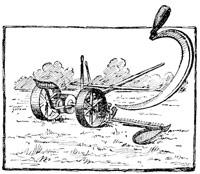
REAPING-MACHINE.
Then the building of the Pacific railways has contributed greatly to the rise of the West. Munificently endowed by Government with moneys and lands, the sale of the latter to settlers became an instant and potent means to the building-up of the unoccupied country. In its pre-emption and homestead laws the Government has also offered unusual privileges to all who wished to settle on the vacant public domain; thus putting within the reach of men of small means, the most valuable and productive farming lands in the world. In this respect no government has done so much for its middle-class population as ours. And no population has more quickly returned to the giver the benefits it has received.
One other active means to the making of the Great West should not be overlooked. Passing by the explorers, whose names are familiar, we come to a class of men whose work was no less important in its way. Trained journalists like Horace Greeley, Samuel Bowles, Albert D. Richardson, Henry Villard, Thomas W. Knox, and William Phillips, did much to make the West known to the East in all its aspects, whether political, social, or economical, so depicting its inside and outside life to a multitude of readers, many of whom became actual emigrants in consequence.
These combined agencies, all working together in harmony, have produced extraordinary results. For instance, at the time we bought it all Louisiana, counting from New Orleans to the Missouri, had only about forty-five thousand people. In 1880, under not quite eighty years of American rule, it had over eleven millions, or more than twice as many as all the States had when Louisiana was ceded to us. The whole population of French and Spanish Louisiana did not equal that of Minneapolis, St. Paul, or Kansas City at the present time, neither of which had a single settler at the date of cession.
Spain thought to control the continent with a few soldiers and missionaries. Her civilization, barbaric in its origin, is mediæval rather than modern. In America it could rise no higher than its source. Mexico and Cuba, two of its earliest conquests, show what it has been able to do in the New World in three hundred and fifty years of rule.
France frittered away her opportunities in schemes too vast for the time or the means appointed for their accomplishment. It is the story of force without forecast. Her explorers overran the country, but left few substantial footmarks behind them. One reads French names everywhere, but sees no cities founded. The policy of France, like that of Spain, looked more to getting a revenue from America than colonizing it. Hence every avenue of individual effort was made to lead back to the royal exchequer.
Now let the man who is not yet fifty years old take down the geography he studied when a schoolboy, and put his finger in the middle of the State of Iowa. He will have touched the border of that Great American Desert whose story we have been telling him.