Group II. BIRTH OF THE AMERICAN IDEA. (continued 2)
Reading edition
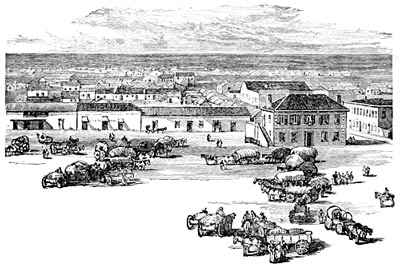
SAN ANTONIO.
To induce settlers to come into Texas, they were offered exemption from all taxes for the space of ten years.
Among the first to avail themselves of these offers was Stephen F. Austin, of Durham, Conn. Acting under a grant of lands made by the Mexican authorities to his father, Austin began a settlement on the Brazos in 1821, which later became the capital of the State, of which he was the foremost founder.
Emigration poured in from the Lower Mississippi Valley,—from Louisiana, Arkansas, and Mississippi,—and even the older States contributed to swell the tide. The law forbade slavery, but many brought negroes with them and held them in spite of it. Many were adventurers who held law in little estimation, or found in Texas a convenient asylum from the pursuit of their creditors. Others were poor people whom the liberal offers of the Mexican Government lured from their homes in the hope of bettering their condition. Though sound at the heart, in no long time Texas had won for itself an unenviable name throughout the Union as the chosen home of lawless men, through its worst elements rising to the top.
Our Government had long coveted Texas, and had made two unsuccessful attempts to buy it of Mexico, considering it as an integral part of Old Louisiana, to which we had a sort of right by the prior discovery of La Salle.
Texas, which the Spaniards had weakly settled and feebly governed, declared herself independent of Mexico in 1835. When this revolt took place there were more Americans than people of Spanish blood in Texas, so bringing over to the Texan cause the warm sympathy and active aid of a large part of the American people.
The conflict was short and bloody. After meeting reverses at Goliad and the Alamo,[2] the Texans won their independence by defeating the Mexican army at San Jacinto,[3] in 1836. General Samuel Houston, the Texan leader, was subsequently made president of the Republic of Texas, which then set up for itself upon the model of the United States.
In no long time Texas applied for admission to the Union. Too weak to maintain herself as an independent power, her interests were now at one with the South. Her soil, climate, and productions were much the same. Her population was largely derived from that source, and owned to like feelings and prejudices with their brethren of that section. The South, therefore, favored the admission of Texas, not only for these general reasons, but because it would add a slave State to the Union, as, since Missouri and Arkansas had come in, there was no more territory, except Florida, open to slavery under the interdicted line of 36° 30´.
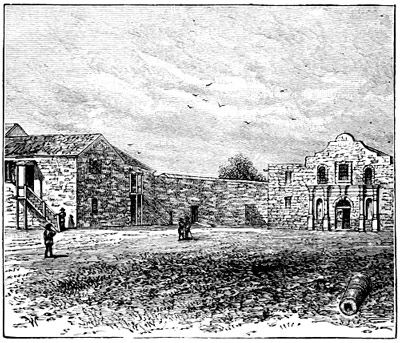
THE ALAMO.
For this very reason the growing anti-slavery sentiment of the North strongly opposed the admission of Texas. It was further opposed on the ground that as Mexico had not yet acknowledged the independence of Texas, so unfriendly an act toward Mexico would lead to war. Moreover, Texas was of such vast extent, compared with other States, that the bill for its admission allowed the making of four more new States out of it, so opening the door of the Union not to one, but several slave States in the future.
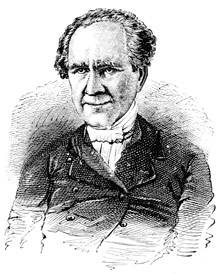
SAMUEL HOUSTON.
But the North and South did not separate themselves into two distinct political factions, or their citizens stand wholly together, on this Texas question. With many it was simply a question of national policy or expediency. It was championed by the Democratic party, which believed in the "manifest destiny" of the Union to control the whole continent, while the Whig party was conservative, and its opposition was based on the grounds already given, which many thought equivalent to national dishonor. Southern men were in both parties, and Northern men in both. Each party nominated a Southern man for President upon this issue. This question was carried to the people in the next national election (1844), when Clay, the Whig candidate, and opponent of annexation, was defeated, and Polk,[4] the Democratic candidate and its advocate, elected. The Congress therefore admitted Texas to the Union, Dec. 29, 1845.
FOOTNOTES
INTERLUDE.—NEW POLITICAL IDEAS.
"Truth crushed to earth will rise again."—Bryant.
As yet any direct attack upon slavery was unpopular in the North. The two antagonistic ideas of limiting or extending it were now running a neck-and-neck race for controlling power; but attachment for the Union itself was stronger at the North than at the South, whose people had been taught to consider it a compact to be kept only during the pleasure of the several States, or so long as their interests were promoted by it. This doctrine was never taught in the North. The prevailing sentiment there was attachment for the Union, "one and indivisible;" while the South, under different teachings, was weighing its worth in the balance with slavery.
One new and potent element, however, had come into the controversy. At the North a little band of men pledged to work for the immediate emancipation of the slave, and deeply in earnest, had begun a warfare that ere long was to shake the Union to its foundations. Though few in numbers, they were both hated and feared. At the North they were called fanatics, at the South abolitionists. At the North they were mobbed, at the South a reward offered for their heads. The North apologized for them, the South demanded they should be put down. But though they were thus held up to public detestation, as enemies of the Union, by both sections, these men felt that they stood for a great and holy principle, which surely must triumph in the end. It made them strong. It made them respected. They were led by William Lloyd Garrison of Massachusetts, whose name is now spoken in the land with as much honor as it once was with bitter scorn and hatred.
Slavery was to be openly attacked through the printing-press, the platform, and the right of petition. The two first agencies would reach the people, and the last their representatives in Congress. Garrison declared in his paper "The Liberator," that he would be heard; and he was heard, though not till he had been dragged through the streets of Boston with a halter round his neck. In Congress, as the outcome of this agitation, John Quincy Adams presented many petitions, praying for the abolition of slavery and the slave-trade in the nation's capital, the District of Columbia. He was assailed with a storm of indignation. Congress would not receive the petitions. They continued to come in by the hundred, some bearing thousands of names. All were refused a hearing. The venerable Adams,—"the Old Man Eloquent,"—then in his sixty-fifth year, was declared an incendiary unworthy of a seat in the Capitol, and a resolution to expel him was even introduced; but his brave stand for the right of petition made a hundred friends for the anti-slavery cause where one had been before.
IOWA ADMITTED.
Iowa was the first free State to be formed out of the Louisiana purchase. She had been admitted with Florida in 1845, but her people, being dissatisfied with the boundaries Congress had prescribed, refused to ratify the Act, so delaying her admission until the next year 1846.
THE WAR WITH MEXICO. "You can do any thing with a bayonet but sit on it."
Those who said war would follow the annexation of Texas were right. It was soon seen that Mexico would not sit down quietly under her loss of territory, or lightly pass over the affront to her national honor. They who reckoned on her doing so forgot that if the Spanish race is indolent, it is also brave.
When nations are resolved on war a pretext is soon found for it.
Texas had brought with her into the Union a dispute with Mexico about her western boundary. She claimed to the Rio Grande, while Mexico claimed to the Nueces,[1] thus leaving in question a tract one hundred miles wide, extending between these rivers.
It is true the tract itself was worth little to either party, it being mostly barren prairie land, but in a military view the Rio Grande offered much the strongest line of defence, and for this reason Texas wanted her boundary fixed on it.
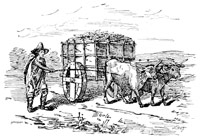
MEXICAN CART.
A Spanish proverb says, "Force without forecast is little worth." Mexico was quietly massing troops along the Rio Grande, in the disputed territory, to be ready to fight, while sounding England to see if she would not help her against the United States. England was too wise to do so openly, but stood ready to take advantage of whatever the chance of war might throw in her way. As Mexico owed England money it was thought England would take California as soon as fighting began, both as security for the debt, and to get possession of a Pacific port, which we were preventing her from doing in Oregon, and would prevent in California. On the other hand, if war broke out, our Government had determined to take California itself and at once. So something more than a question of boundary was depending on war with Mexico.
If now Mexico had chosen to give up the boundary in dispute, without a fight, there is no telling how the decision might have affected the future of the United States. The question is perhaps, itself, the best apology we can find for the war.
The quarrel having thus become ours, troops were sent to the Lower Rio Grande to hold possession. The Mexicans brought forces to oppose them, and fighting began. After driving back the Mexicans at Palo Alto, and Resaca de la Palma, our forces crossed the Rio Grande into Mexican territory. General Zachary Taylor commanded on this line.
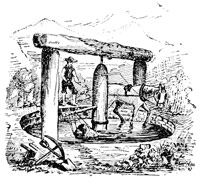
MEXICAN ARASTRA, FOR GRINDING ORES.
War being thus begun, steps were taken to push it by assembling an army of fifty thousand volunteers, and plans laid to invade Mexico at different points. In Generals Scott, Taylor, and Wool, we had able leaders, but the men they had under them were mostly new to war, being hastily levied and sent off into the field before they could be properly trained in the use of arms.
In the North the war was unpopular.[2] Its coming was foreboded and its consequences viewed with alarm. That section therefore looked on with indifference until the actual fighting roused the national spirit. Then the people, in general, heartily desired the success of our arms, though they still deprecated the war itself.
On the other hand, in the South, and particularly the South-west, the war was hailed with enthusiasm. The people there did not stop to inquire whether its aims were such as should control the acts of one powerful nation toward its weaker neighbor, but gave it unstinted support from the first. In Texas the war spirit was fully aroused by the promise of meeting her old enemy on more equal terms.
The war soon developed the larger issues we have pointed out. So though sometimes called "a little war," it is seen that the contest with Mexico was being waged for a large stake.
FOOTNOTES
CONQUEST OF NEW MEXICO.
While the heaviest fighting was going on in Old Mexico, the Government easily took possession of New Mexico and California, by means of expeditions organized on the remote frontiers.
New Mexico was wanted for the emigration to the Pacific. If we were to have California we must also have the right of way to it. In the hands of the Spaniards, New Mexico barred access to the Pacific so completely that the oldest travelled route was scarcely known to Americans at all, and but little used by the Spaniards themselves.
If now we consult a map of the United States it is seen that the thirty-fourth parallel crosses the Mississippi at the mouth of the Arkansas, cuts New Mexico in the middle, and reaches the Pacific near Los Angeles. It was long the belief of statesmen that the great tide of emigration must set along this line, because it had the most temperate climate, was shorter, and would be found freer from hardship than the route by way of the South Pass. This view had set on foot the exploration of the Arkansas and Red rivers. But if we except the little that Pike and Long had gathered, almost nothing was known about it. Yet the prevailing belief gave New Mexico, as related to California, an exceptional importance.
These considerations weighed for more than acquisition of territory, though the notion that New Mexico contained very rich silver-mines undoubtedly had force in determining its conquest. Otherwise it was held to be a poor country, with little arable land, mostly mountainous, and scarcely fertile in the valleys, while in consequence of its great elevation the winters were severe.
Thus New Mexico seemed placed by Nature as a half-way house may stand alone at the summit of a mountain pass with deserts upon either side. It offered a place for the refreshment of the nation's travellers. At best it was only a thin wedge of semi-civilization driven north into barbarism as far as Spanish power could send it, but this force had spent itself long ago, and New Mexico now lay a stumbling-block in the path of progress, in contented isolation. Our Government determined to remove the obstruction.
With this object General Kearney marched from Fort Leavenworth in June, 1846, for Santa Fé, at the head of a force[1] of which a battalion of Mormons formed part. After subduing New Mexico, Kearney was to go on to California, and with the help of naval forces already sent there, for the purpose, conquer that country also.
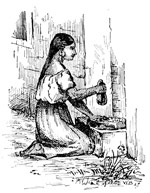
PUEBLO WOMAN GRINDING CORN.
It is worth while to dwell a moment upon one feature of this expedition, if only for its singularity. The Mormons were to be paid off in California, were to turn the sword into a ploughshare and settle in the country, and had therefore been allowed to take their families and property with them. They were seen when setting out on the march by Mr. Parkman, who thus describes them: "There was something very striking in the half-military, half-patriarchal appearance of these armed fanatics, thus on their way with their wives and children to found, it might be, a Mormon empire in California.
"In the morning the country was covered with mist. We were always early risers, but before we were ready the voices of men driving in the cattle sounded all around us. As we passed above their camp, we saw through the obscurity that the tents were falling, and the ranks rapidly forming; and, mingled with the cries of women and children, the rolling of the Mormon drums and the clear blast of their trumpets sounded through the mist.
"From that time to the journey's end, we met almost every day long trains of government wagons, laden with stores for the troops, crawling at a snail's pace towards Santa Fé."
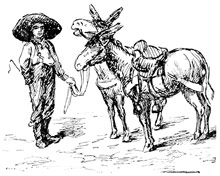
BOY AND DONKEYS.
General Kearney marched by the Upper Arkansas, to Bent's Fort,[2] and from Bent's Fort over the old trail through El Moro and Las Vegas, San Miguel and Old Pecos, without meeting the opposition he expected, or at any time seeing any considerable body of the enemy. On the 18th of August, as the sun was setting, the stars and stripes were unfurled over the palace of Santa Fé, and New Mexico was declared annexed[3] to the United States. Either the home government thought New Mexico quite safe from attack, or, having decided to reserve all its strength for the main conflict, had left this province to its fate.
After organizing a civil government, and appointing Charles Bent of Bent's Fort, governor, General Kearney broke up his camp at Santa Fé, Sept. 25. His force was now divided. One part, under Colonel Doniphan, was ordered to join General Wool in Chihuahua. A second detachment was left to garrison Santa Fé, while Kearney went on to California with the rest of the troops. The people everywhere seemed disposed to submit quietly, and as most of the pueblos soon proffered their allegiance to the United States Government, little fear of an outbreak[4] was felt.
Before leaving the valley, a courier was met bearing the news that California also had submitted to us without striking a blow. This information decided General Kearney to send back most of his remaining force, while with a few soldiers only he continued his march through what is now Arizona for the Pacific.
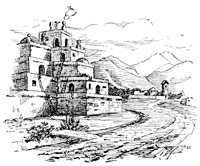
PUEBLO OF TAOS.
Near his point of departure from the Rio Grande, a deputation of the Apaches came to have a talk with the general. These hereditary foes of the Spaniards were lost in wonder at seeing the order and celerity with which our cavalry obeyed the bugle-call of "boots and saddles,"—the order to mount for the march. The pent-up wrath of three hundred years broke forth among them in hot words. "You have taken New Mexico, and will soon take California," they said. "Go, then, and take Chihuahua, Durango, and Sonora. You fight for land. We care nothing for land. We fight for the laws of Montezuma and for food. The Mexicans are rascals, and we will kill them all!"
Leaving this force to make its slow way down the Gila, and across the sandy desert of Lower California, we will now inquire what had happened to wrest California from Spanish rule without bloodshed.
FOOTNOTES
THE TAKING OF CALIFORNIA.
The courier who had been stopped by General Kearney was Kit Carson, Fremont's old guide. Carson[1] was on his way to Washington with despatches from Commodore Stockton and Captain Fremont.
A few words will explain how Fremont came to be in California at so critical a time. While trying to make his way back to the States, through the Sierras, he had been forced to recross their snows into the Sacramento Valley, and had descended this valley, which was found uninhabited, save by Indians, to Sutter's Fort,[2] where means were furnished him to continue his journey homeward.
Delighted with the country, he had made so favorable a report of it that he was again sent out (1845) for the purpose of finding the shortest route for a railroad to the Pacific, and especially to the neighborhood of San Francisco Bay.
When Fremont set out, war with Mexico was thought to be near at hand. Our Government coveted California for several reasons. For one thing, our whale-fishery in the Pacific had grown to be a great business, in which twenty thousand sailors and two hundred thousand tons of shipping were employed. This interest therefore wanted California, because the port of San Francisco was the only one in the North Pacific not blocked up by a sand-bar, like that which renders the mouth of the Columbia so difficult of access.
Moreover, a considerable emigration[3] had already found its way into California, whose fine climate and fertile soil these people praised so much to their friends at home, that many were already on the road, and more preparing to follow them. Unknown to themselves they were to be the founders of a new commonwealth. And even at this early day Government and people were talking of a Pacific railroad, as a thing of coming necessity, and the more sanguine believers in "manifest destiny" thought as many as fifteen thousand Americans would be settled in Oregon and California during their lifetime. Thus we had important commercial views touching California, and we were throwing into it what might be considered in the light of the vanguard of an army of occupation. We had won Texas in this way, and would win Oregon too.
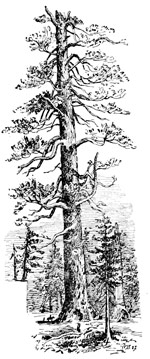
BIG TREE.
It became a prime object with President Polk to secure California, peaceably if we could, forcibly if we must. Mexico was first asked to sell it, but refused. Our Government then began a secret negotiation through the American consul[4] at Monterey, which aimed to bring about the voluntary secession of California from the Mexican Republic altogether, and the setting-up instead of an independent government there under our protection. But if this plan failed—and it did not succeed—every thing was made ready to take California by force of arms.
There was also fear lest England might try to obtain in California what she was about to lose in Oregon, namely, a Pacific seaport. Her ships were in those waters. Mexico owed England money, as we have said. How far this fear was well founded, is not clear; but that it was felt there can be no doubt, for we find Mr. Buchanan, our Secretary of State, instructing our consul at Monterey that "the United States would vigorously interpose to prevent California becoming a British or French colony."
In furtherance of these views our squadron in the Pacific had orders to take possession of the chief ports of the country, so soon as war should begin.
Fremont therefore started on his third expedition across the continent well informed of the general policy of the Government toward California. For the rest, his work was to be done wholly on Mexican ground, which, being taken with the other elements of the case, of itself seems plainly foreshadowing the views of the Government.
On this journey, Fremont crossed from the head of the Arkansas into Utah, and from the Utah Desert to the Humboldt Mountains and River, both of which he named at this time for the great German scientist. From here he again struck the Sierra Nevada, which he crossed, as before, into the Sacramento Valley.
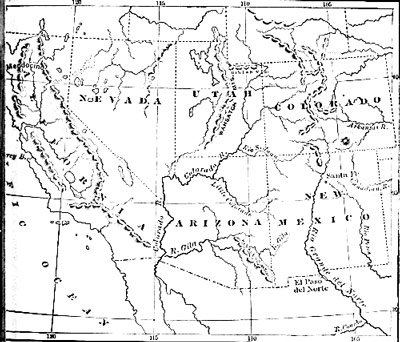
STATES AND TERRITORIES ACQUIRED FROM MEXICO.
Upon reaching the vicinity of Monterey, Fremont was ordered out of the country by the Mexican authorities. Intrenching himself on a hill, back of Monterey, he hoisted the American flag, and bade defiance to the order. Finding the Mexicans would not attack him, he marched northward up the Sacramento Valley as far as Klamath Lake unmolested, save by Indians with whom he had several combats.
At this place, Fremont was overtaken by a messenger who had come across Mexico with despatches from the Government. It is thought Fremont was unofficially advised to make the most of any opportunity that should present itself. At any rate, he seems to have thought the time was come for him to drop his character of explorer and turn his presence in California to account. He therefore set out at once for Sutter's Fort, where he could be near the American settlers, who were living in the lower part of the valley or about the Bay of San Francisco. Fremont thus became the rallying-point for his countrymen in California, and their protector.
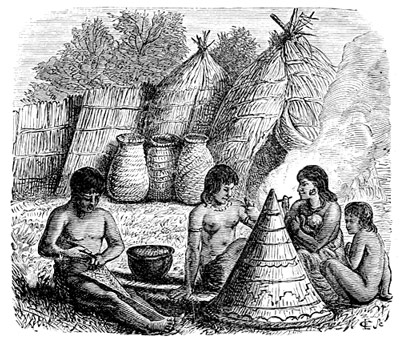
CALIFORNIA INDIANS AND TULE HUTS, SACRAMENTO VALLEY.
This was in June, 1846. Rumors of war were now flying thick and fast. The Californians were quarrelling among themselves over questions then dividing the Mexican nation. The American settlers were thrown into more or less alarm by the threats made to drive them from the country. We had ships-of-war at San Francisco and Monterey, but their commanders hesitated to act until it was known the two nations were at war. The settlers put an end to all indecision by raising the flag of revolt themselves. On the 14th these settlers seized Sonoma, a military post lying to the north of San Pablo Bay. They immediately proclaimed California an independent republic. Upon this Fremont put himself at their head. He marched first to Sonoma, and next to the Presidio of San Francisco, whose garrison fled at his approach. By these prompt acts all the country lying north of the Bay of San Francisco fell into the hands of the insurgents.
These events were followed by the raising of an American flag over Monterey, July 7, by Commodore Sloat. The same thing was done by his order at Yerba Buena and Sonoma. As soon as he heard of it, Fremont also hoisted the flag at Sutter's Fort. He then marched for Monterey, where the ships Savannah, Congress, Cyane, and Levant were lying with their guns commanding the town. An English line-of-battle ship was also anchored in the basin of Monterey, and another at Yerba Buena. With whatever intentions they had come, they had arrived just too late.
In this manner what is known as the Bear Flag Revolution, from the settlers' having borne a bear on their standard, began and ended with Fremont for its central figure. Without him it would never have been possible. But for him the conquest would not have come when it did, but it would have come.
Commodore Stockton, an energetic officer who succeeded Sloat, now took active steps for putting down all armed resistance to the United States. Fremont's battalion,[5] now mustered into the service of the United States, but until then acting independently, was sent to San Diego on board the Cyane. No resistance was met with at San Diego. Fremont then marched on Los Angeles, the actual capital, which he entered in company with a force led by Commodore Stockton from San Pedro, on the coast. The Californians nowhere made a stand, but fled to the mountains rising behind Monterey.
California having thus fallen so easily into our hands, steps were at once taken to quiet it. Civil officers were appointed to administer the government. The inhabitants were promised protection so long as they kept peace, while, as if to clinch what had been done already, numbers of emigrants were coming down into the Sacramento Valley from the north, and coming to stay.
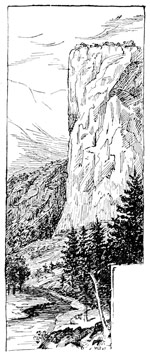
EL CAPITAN, YOSEMITE.
An insurrection in the south put an end to this state of things. In a little time the interior country was again overrun. While it was in progress, General Kearney was heard from. After making one of the longest marches on record, he had arrived near San Pasqual, where the insurgents were found in some strength. A fight took place in which Kearney's overmatched force was roughly handled, and for a time hemmed in by foes. The Californians were themselves in turn defeated at San Gabriel and the Mesa, and meeting Fremont coming to attack them from Santa Barbara, gave themselves up to him.
The war on the Pacific coast was thus ended, while that on the Atlantic was still in progress. General Taylor had taken Monterey, and later fought the battle of Buena Vista, which was obstinately contested. A second army under General Scott landed at Vera Cruz, and, with the aid of the fleet, took the castle of San Juan de Ulloa. This army then began its victorious march for the City of Mexico, winning battles at Cerro Gordo, Churubusco, Molino del Rey, and Chapultepec. Having overcome all opposition, the capital was entered, and the war ended Sept. 14, 1847.
By the treaty of peace, which followed (Feb. 2, 1848), the United States acquired New Mexico and California, for which fifteen millions were paid. Mexico also gave up her claim to the territory east of the Rio Grande. That river on the east, and the Gila on the west, now formed the southern boundary of the United States, from the Gulf of Mexico to the junction of the Gila with the Colorado. From thence a straight line extended it to the Pacific, so as to include the port of San Diego.
FOOTNOTES
THE MORMONS IN UTAH.
The Mormons, or Latter Day Saints[1] as they prefer to call themselves, have been mentioned in a former chapter. They are a religious community whose teachings differ widely from those of any other Christian body in the land. For one thing, they allow polygamy,[2] which is not only repugnant to the moral sense of the great body of Christian people, but to the laws as well.
Driven from Missouri (1838), and from Illinois ten years later, their leaders cast about for some place of refuge, so remote that persecution could not reach them, and where they might practise their religious forms freely. Like most religious sects the Mormons seemed to thrive upon persecution, for their numbers were constantly increasing under it.
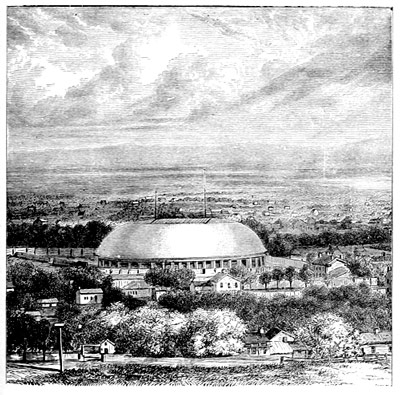
SALT LAKE CITY AND TABERNACLE.
It was at this time that Fremont's description of the region about the Great Salt Lake arrested the attention of Brigham Young, the Mormon patriarch. Fremont had said the valley of Bear River, a tributary of this lake, made "a natural resting and recruiting station for travellers." Its bottoms were extensive, water excellent, timber sufficient, and soil well adapted to the grains and grasses suited to so elevated a region. The great lake would furnish exhaustless supplies of salt. And he gave it as his opinion, that cattle and horses would thrive where grass and salt were so abundantly provided by nature. With these advantages he recommended it for civilized settlement.
Upon this, the Mormons, who were farmers and graziers, decided to form themselves in one great caravan, and travel to this Great Salt Lake. They started out with one hundred and forty-seven people and seventy-three wagons. On the 24th of July, 1847, as the caravan slowly wound down the Wasatch Mountains, the exiles saw the plain of their New Jerusalem stretching out before them, but when they reached it they found nothing growing upon it but sage-bushes.
They however laid out their city[3] at the foot of the hills, on a river which, as it runs from Utah Lake to Salt Lake, intercepts the streams coming down the eastern hills. The Mormons called this river the Jordan, because of some fancied resemblance to the river of Palestine.
Finding all so barren about them, these people took counsel of the experience of their neighbors, the Pueblo Indians, who for want of wood build their houses of adobe, and for want of rain raise crops by watering them artificially. Thus Salt Lake soon grew out of an arid plain to be a city of gardens and running streams.
In setting forth the advantages of the Utah Basin, Fremont had described a portion of the neighbor republic of Mexico, with which we were then at peace, and in making it their home the Mormons had been moved by a desire to go outside the limits of the United States, but were strangely brought back within them again when California was ceded to us.
Though shut out from the world, this strange colony steadily grew in strength and numbers. The Mormon Church had sent out its missionaries to make converts in other lands, for in the Union its doctrines were detested, and the community itself looked upon as little better than outcasts. So the increase was mostly from this source. Hence it was natural that the Mormon body should have in it less of the spirit of national feeling than other communities, and grow more and more away from the Union by reason of its isolation and the teachings of its rulers.
These teachings were embodied in a hierarchy, or, in other words, Church and State were one with the Church above the civil authority. The bishops, chief priests, and elders were the actual rulers, who both made and gave the law, and each member of the society gave a tenth of his living to the support of the Church. All who did not conform to the Mormon faith were denied any share in civil affairs. Thus the Mormons had set up in Utah[4] a little republic of their own, which, in effect, excluded other citizens of the Union from a full share in its privileges. Though a republic in name it was a despotism at the root. In short, the Mormons had gone to Utah to found a society for themselves alone, in which none but their own people should find a welcome.
It followed that the Mormon state was looked upon as an element of danger, rather than strength, to the Union, for the place where it was founded was a natural stronghold from which the authority of the nation might be set at defiance, as soon happened.
Flourishing only by reason of their isolation, the Mormons looked with little favor upon the passing emigration, though they drew much benefit from it. They could sell their cattle, grain, horses and other supplies to the emigrants at high prices, but the steady march of these people toward the west threatened the security they wished to enjoy apart from the world. Though always hostile to the great westward movement, and sometimes resorting to violence to stay it, the Mormons have been made to contribute to its success, not indeed as free agents, but as instruments in the hands of destiny. Formidable only in their seclusion, they have presented the anomaly of a handful of people throwing themselves before the wheels of progress. Though no longer formidable, they have done a notable work in making productive what was before considered an uninhabitable desert.