VI Angels and Ministers of Grace
Reading edition

The veneration of angels and the attribution to them of especial days or months, as well as the idea that they were guardians of those born on those days or during those months, was the result of many factors. The belief in the existence of angels is present in all parts of the Bible, but in the earlier portions they are not individualized in any way. The angel of God, or of the Lord (malach Elohim or malach Yahveh) was simply a messenger of God, employed to communicate his will or else to accomplish some act of divine justice.
It is quite possible that the greater prominence given to angels among the Jews after the Babylonian Captivity was not solely dependent upon Babylonian or Persian influence. We learn from the historical and prophetical books of the Old Testament that the Jews had, from the earliest times, worshipped other gods besides the God of Israel, and were ever ready to assimilate the religious superstitions of the heathen world. Several of the divinities that were worshipped in Babylonia and Assyria were also objects of adoration in Israel, not indeed by the chosen spirits of the nation from whom we receive our records, but by the masses of the people. This very fact, however, served in a certain sense to maintain the purity of the national religion. As the superstitious inclinations of the populace were so fully satisfied from without, there was no necessity to develop or distort the national religion in this direction. The Babylonian Captivity changed all this. It was the élite of the 242Jewish nation that was deported, and the sufferings and humiliations to which they were subjected in a foreign land only served to strengthen their faith in Yahveh and in his Law. Hence it is, that when this tried and purified remnant returned to Judæa, rebuilt the fallen temple and reorganized the state, the latter became a theocracy in a much stricter sense than ever before, and from this time we can really speak of Judaism as the religion of the whole people.
But the inevitable tendency to split up the unity of the divine force, a tendency that makes itself felt in all religions and among all peoples, soon asserted itself anew and in a different direction. As the people were no longer allowed, we may even say were no longer inclined, to go after foreign gods, they proceeded to develop the idea of divine messengers or intermediaries which had always formed part of the national faith, but had never been fully evolved. While Isaiah and Ezekiel both knew of a division of the angels into certain categories as, for example, cherubim, seraphim, hayyot (living creatures), ofanim (wheels) and arelim, there is no attempt at individualization, and the first mention of an angel’s name occurs in the Book of Daniel, which later critics are disposed to assign to the second century B.C. It is most natural to suppose that such names were known and were familiar to the people long before that time. When we read in the Book of Daniel, xii, 1: “And at that time shall Michael stand up, the great prince which standeth for the children of Israel,” it is easy to see that the idea that certain special qualities were attributed to this angel was deeply rooted in the popular mind. In a previous verse, x, 13, we read: “Michael, one of the chief princes, came to help me,”—a conclusive proof that a hierarchy of angels had already been thought out.
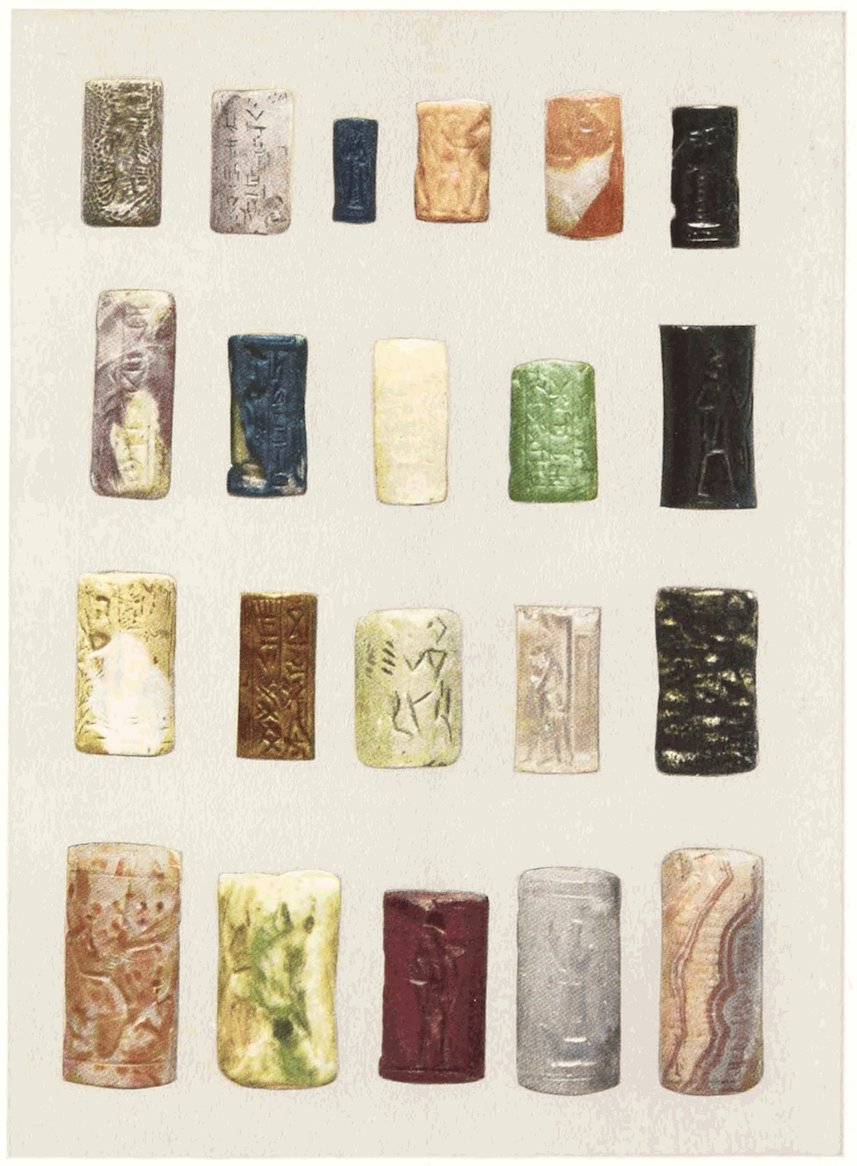
Fossil Coral of the Devonian Period 1000 B.C. Amethystine Quartz About 2500 B.C. Lapis Lazuli About 2000 B.C. Anhydrite About 2500 B.C. Banded Agate About 2800 B.C. Hematite About 2000 B.C.
Amethystine Quartz Probably Assyrian of 700 B.C. Lapis Lazuli 2000 B.C. or earlier Aragonite-banded 3000 B.C. Amazon Stone About 1500 B.C. Black Serpentine, hard and compact. Seals of this type are generally as old as 2500 B.C.
Marble, discolored by fire About 2500 B.C. Jaspery Agate As late as 800 B.C. Aragonite Probably as old as 3000 B.C. Rock-Crystal About 1200 B.C. Serpentine (banded) Probably as early as 2500 B.C.
Ferruginous Agate About 800 B.C. Shell 3000 B.C. or earlier Jasper, banded red and black About 1200 B.C. Chalcedony, Blue Saphirine About 700 B.C. Agate (banded) Assyrian of about 700 B.C.
ILLUSTRATIONS OF ACTUAL PRECIOUS STONES AND MINERALS USED FOR SEALS IN ANCIENT ASSYRIA AND BABYLONIA
Mostly from the collection in the American Museum of Natural History, New York City.
243The great source of information in regard to angelology is the Rabbinical literature which had its rise about the first century B.C. and culminated in the Talmuds of Babylon and Jerusalem in the fifth century A.D. As these compilations, although nominally commentaries on the books of the Old Testament, are almost encyclopedic in their character, they throw much light on this subject. In a monograph of Kohut, entitled “Jüdische Angelologie,”[480] many extracts, belonging to an early period, are given. Seven princes of heaven were recognized and among these four were especially favored. They occupied a place near to the Throne of Light and were bathed in its radiance. We are told that “God surrounded his Throne of Light with four angels: Michael, ‘Who is like God?’ at the right; Gabriel, ‘Might of God,’ at the left; Uriel, ‘Splendor of God,’ before it; and Raphael, ‘Salvation of God,’ at the west” (Numeri Rabba, c. 2).[481] They represented various attributes of the divine: Michael, goodness and mercy; Gabriel, punitive justice; Uriel, the majesty of God, and Raphael, his providence. Michael and Gabriel are particularly prominent and are called Royal Angels (מלכיהון דמלאכיא); they have especial care of Israel. As we have seen, Michael was singled out by Daniel and he was commonly regarded as chief prince. Gabriel was looked upon as the avenger and the executor of divine judgments and occupied the next place, while Uriel and Raphael are less frequently alluded to, although the latter appears prominently in the Book of Tobit.
In the New Testament, also, Michael and Gabriel are evidently regarded as the chief angels, and Revelation places Michael at the head of the hosts of the good angels in their conflict with Satan and his followers. We can see in the Gospels how widespread was the belief in demoniacal possession, and in the existence of evil spirits; it was almost inevitable that the aid of good spirits should be invoked to 244counteract them, and although both Christianity and Judaism sternly rebuked any direct worship of angels, they were regarded as ministering spirits, and it was only natural that the masses should be led to use their names on amulets and talismans, and little by little to arrive at the belief that a particular angel was entrusted with the welfare of each individual. The same tendencies were at work in both religions, but a new development was initiated for the Christian church by the growing veneration of the early martyrs and of their relics. When this became more pronounced, the saints to a great extent took the place of the angels; a passage from the writings of St. Ambrose composed in 377 A.D. shows us that this transformation of belief had already begun to make itself felt at that time. St. Ambrose writes: “We should address our supplications to the angels who are appointed to guard us; we should also address them to the martyrs, whose patronage seems assured to us by a physical pledge” (their relics).
The danger that the worshipping of angels might lead Christians away from the Church into magic practices and beliefs was clearly recognized in the early centuries, and at the Council of Laodicea, in 363 A.D., it was proclaimed that Christians should not render worship to angels outside the church, or in private assemblies or associations. Whoever was found guilty of such practices (of such idolatry, as it was called) was pronounced anathema, as he was considered to have turned away from the Lord Jesus Christ and worshipped idols. The first Council of Rome, held in 492 A.D., expressly forbids the wearing of talismans inscribed with the names “not of angels as they pretend, but rather with those of demons.” Indeed, there is abundant evidence that in this age, and even earlier, those addicted to angelolatry were not satisfied with the few angels named in the Holy Scriptures, but addressed their petitions to a multitude of 245angels evolved from the fervid imagination of the superstitious among the Jews. Of these angels not recognized by the Church, the following prayer of a certain Aldebert, condemned by the second Council of Rome, 745 A.D., gives us a few names: “I pray and supplicate the angel Uriel, angel Raguel, angel Michael, angel Adimis, angel Tubuas, angel Sabaoth and angel Simihel.” In the judgment of the Church fathers, all these names, with the exception of Michael, designated demons.[482]
A manuscript of the ninth or tenth century in the Library of Cologne gives the following “nomina angelorum”, and instructs the reader as to their special virtues:
If when it thunders you think of the Archangel Gabriel, no harm will befall you. If on awakening you think of Michael you will have a happy day. Have Orihel (Uriel) in mind against your adversary and you will prevail. When eating and drinking think of Raphael and abundance will be yours. On a journey think of Raguhel and everything will prosper. Should you have to lay your case before a judge, think of Barachahel and all will be explained. When you take part in a banquet, think of Pantasaron and all the guests will delight in you.[483]
On some medieval gems appear angel figures, one very curious specimen of this class being an onyx, engraved in intaglio. On this gem, which is in the British Museum, the engraver depicts the Annunciation, but the figure of the Angel Gabriel is precisely that of a nude Cupid; hand and foot are raised as though the little god (or angel) were dancing. It has been conjectured that this strange attempt at adapting a classic form is due to the fact that the gem was cut in Constantinople during one of the violent iconoclastic persecutions, and that the engraver thus sought to veil the true significance of his work. In this case, however, 246we must believe that the accompanying inscription was added at a later date, for it expressly names the Annunciation, the Angel Gabriel, and the Virgin (“Mother of God”).[484]
Another interesting gem, from about the same period, is a square amethyst, measuring about 3 cm. in each direction. This bears, engraved in intaglio, a standing figure of Christ, without a halo; behind his head is the monogram , and in his left hand he holds a scroll with the words (in Greek): “In the beginning was the Word”; his right hand is stretched forth in benediction, and alongside the figure are the following angels’ names in Greek characters: Raphaêl, Penel, Ouriêl, Ichthys, Michaêl, Gabriêl, Azaêl. The fourth and middle name, Ichthys (fish) is the well-known anagram of the Greek words signifying “Jesus Christ, the Son of God, the Saviour,” and the use of this as the name of an angel is thought to have been suggested by a passage in Isaiah (ix, 6).[485]

A “prime émeraude” among the Gorlæus gems is engraved with a design showing two souls brought before God by the two guardian angels.[486] Somewhat the same belief in the guiding or conducting of souls after death is found in Plato’s “Phædon,” where it is said that the daimon which had guided a person during life led his spirit to the place in Hades where judgment was to be rendered.
The following list from Lodge’s “Wit’s Miserie,” printed in 1596, gives the seven good angels and sets over against them the seven bad angels, each of whom represents one of the seven deadly sins:
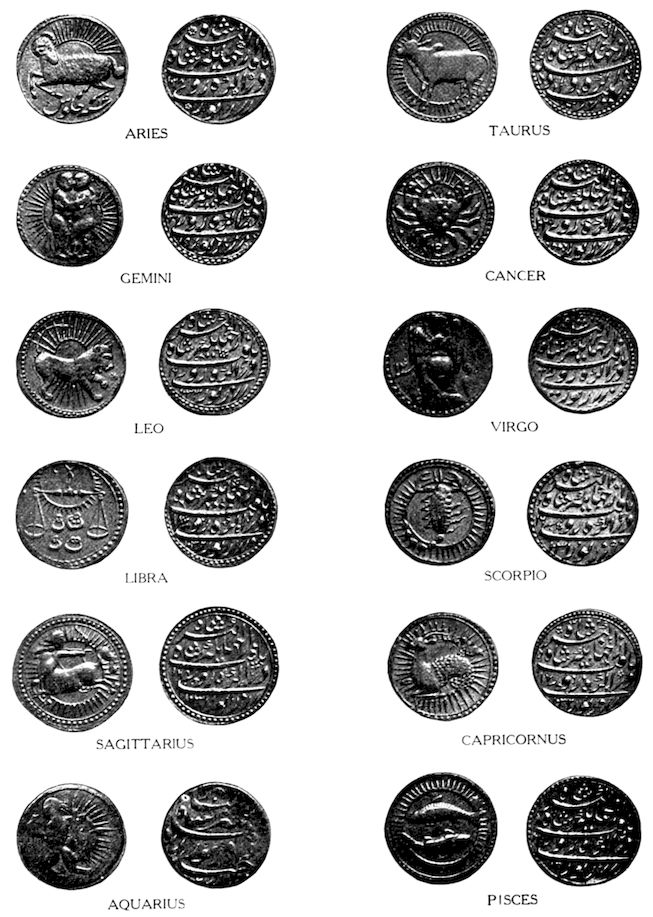
By courtesy of the American Numismatic Society, New York. ZODIAC MOHURS, COINED BY THE MOGUL SOVEREIGN SHAH JEHAN, ABOUT 1628.
247
Good Angels Bad Angels
Michael Leviathan, pride
Gabriel Mammon, avarice
Raphael Asmodeus, lechery
Uriel Beelzebub, envy
Euchudiel Baalberith, ire
Barchiel Belphagor, gluttony
Salathiel Ashtaroth, sloth
The curious book called in Hebrew “Sepher de-Adam Kadmah” and attributed to the angel Raziel, is supposed to belong to the twelfth or the thirteenth century, or at the earliest to the eleventh century,[487] although the redactor may have used some earlier materials. Legend states that it was engraved upon a sapphire and was given by the angel Raziel to Adam when the latter was driven from Paradise. Handed down from generation to generation, it finally came into the possession of Solomon. The name Raziel signifies “secret of God,” in allusion to the revelations contained in the book, which was supposed to protect the house wherein it was from all danger of fire.
In this book there is an interesting list of angels, denominated the twelve princes, set over the twelve months of the year. The text of the first printed edition appears to be corrupt in some places, but the names may be transliterated as follows:[488]
Sh’efiel, “Balm of God” Presiding over Nisan (April)
Ragael, “Balance of God” Presiding over Ayyar (May)
Didanor, “Our Light” Presiding over Sivan (June)
Ta’anbanu, “Answer for us” Presiding over Tammuz (July)
Tohargar, “Whirlwind” Presiding over Ab (August)
248Morael, “Fear of God” Presiding over Elul (September)
Hahedan, “The Brilliant” Presiding over Tishri (October)
Uleranen, “To chant, celebrate” Presiding over Marchesvan (November)
Anatganor, “Thou art the Guardian” Presiding over Kislev (December)
Mephniel, “Before God” Presiding over Tebah (January)
Tashnadernis, “Saturnus” Presiding over Shebat (February)
Abarchiel, “Fire of God” Presiding over Adar (March)
The following list, while probably of later date than the one we have just given, is more frequently cited as authoritative:[489]
Orders Angels Tribes Signs
Seraphim Malchidiel Dan Aries
Cherubim Asmodel Reuben Taurus
Thrones Ambriel Judah Gemini
Dominations Muriel Manasseh Cancer
Powers Verchiel Asher Leo
Virtues Hamaliel Simeon Virgo
Principalities Zuriel Issachar Libra
Archangels Barbiel Benjamin Scorpio
Angels Adnachiel Naphtali Sagittarius
Innocents Hanael Gad Capricornus
Martyrs Gabriel Zabulun Aquarius
Confessors Borichiel Ephraim Pisces
In Rabbinical writings we are told that if a man fulfilled one of the commandments, one angel was bestowed upon him; if he fulfilled two commandments, he received two angels; if, however, he fulfilled all the commandments, many angels were given him. This was a literal construction of the text Ps. xci, 11: “For he shall give his angels charge over thee.” These angels were believed to shield the believer from the attacks of evil spirits.[490]
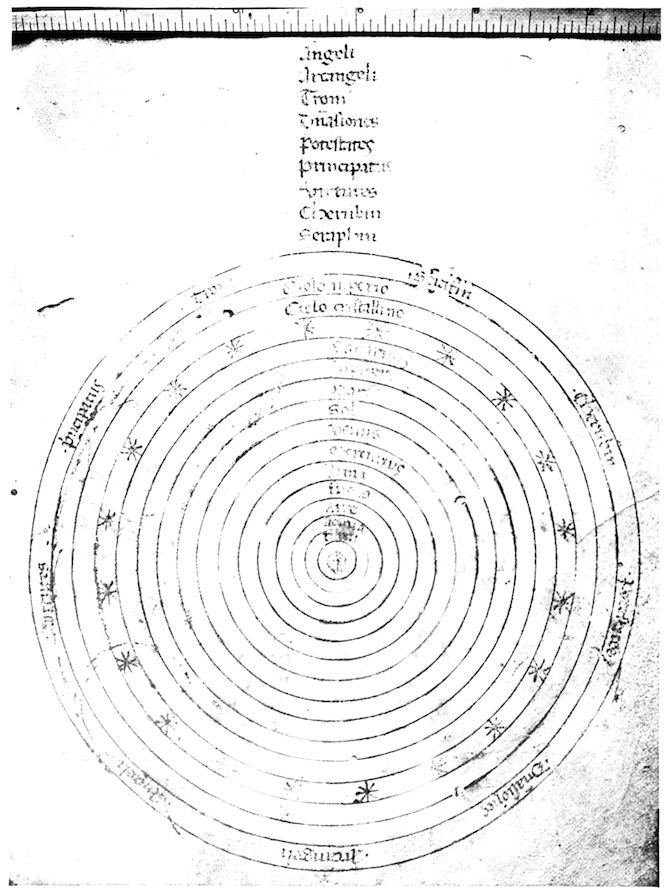
The medieval conception of the cosmos, the successive spheres of the planets, including the sun, and beyond these the crystalline heaven and the empyrean. In an outermost circle are named the great celestial powers, as recapitulated above the spheres. From a XIV century Italian MS. in the author’s library.
249The Mohammedan Atlas, the angel appointed by God to bear the earth on his shoulders, was given a rock of ruby to stand upon. Beneath this ruby-rock, were, successively a huge bull, an immense fish, a mass of water, and lastly darkness.[491] Thus the grand vision of “the face of the deep” over which hovered the Spirit of God, before the creative words were spoken, giving form to the earth, is not altogether lost sight of in this Mohammedan fancy.
Luther was a firm believer in the existence of guardian angels, and he even goes so far as to assert that the angels assigned to men differed in rank and ability as did the men themselves. Of this he says:
Just as among men, one is large and another small, and one is strong and another weak, so one angel is larger, stronger, and wiser than another. Therefore, a prince has a much larger and stronger angel, one who is also shrewder and wiser, than that of a count, and the angel of a count is larger and stronger than that of a common man. The higher the rank and the more important the vocation of a man, the larger and stronger is the angel who guards him and holds the Devil aloof.[492]
Our idea of a guardian angel is so spiritual and so pure that it is difficult for us to understand the curious results this belief has occasionally produced among the primitive peoples. A weird tale is told of a Congo negro who killed his mother so as to gain an especially powerful guardian spirit.[493] The dreadful deed was perpetrated in the full conviction that the mother’s love would remain unshaken, while her power for good would be increased. Such ferocious egoism does not find an exact parallel among civilized peoples, but the underlying principle is unfortunately too often illustrated in our midst at the present day.
The belief in guardian angels has the best of Scripture warrant as offered by the text Matthew, chapter xviii, v. 10, 250where Christ speaking of little children says: “Their angels do always behold the face of my Father who is in Heaven.” Another New Testament passage testifying distinctly to the existence of this belief in the Apostolic Age, is in the Acts of the Apostles (xii, 15), where we read that after the miraculous rescue of Peter from his imprisonment, his friends could not believe the report that he had been seen standing at the door of their dwelling, and exclaimed: “It is his angel.”
That not only individuals but nations also had special guardian angels was, as we have already noted, a belief held to a certain extent among the Jews after the Babylonian Captivity. To the trace of this in the tenth chapter of Daniel (vs. 13, 21), where Michael stands for Israel, may be added the evidence afforded by the Greek Septuagint version of Deuteronomy xxxii, 8, part of the “Song of Moses.” Here the Revised version based on our Hebrew text reads:
He set the bounds of the peoples,
According to the number of the children of Israel.
The Septuagint translators, however, must have had a slightly different text before them for they render the last words: “According to the number of God’s angels.” It therefore seems probable that they read in Hebrew benê Elohim instead of benê Yisrael. Of the benê Elohim or “Sons of God” we read in Genesis, chapter vi, verse 2, that they wedded with the “Daughters of Men.” This has been given a poetic form by Thomas Moore in his “Loves of the Angels.” The Book of Job also, in its Prologue in Heaven (i, 6–12), introduces the “Sons of God” among whom appeared Satan, the “Adversary.” Of angel names, as has been noted, there is Biblical warrant only for Gabriel, Michael, and Raphael, the last-mentioned, in the Apocryphal Book of Tobit; to these IV Esdras (not a canonical book) adds Jeremiel and Uriel, names not admitted by the Church.
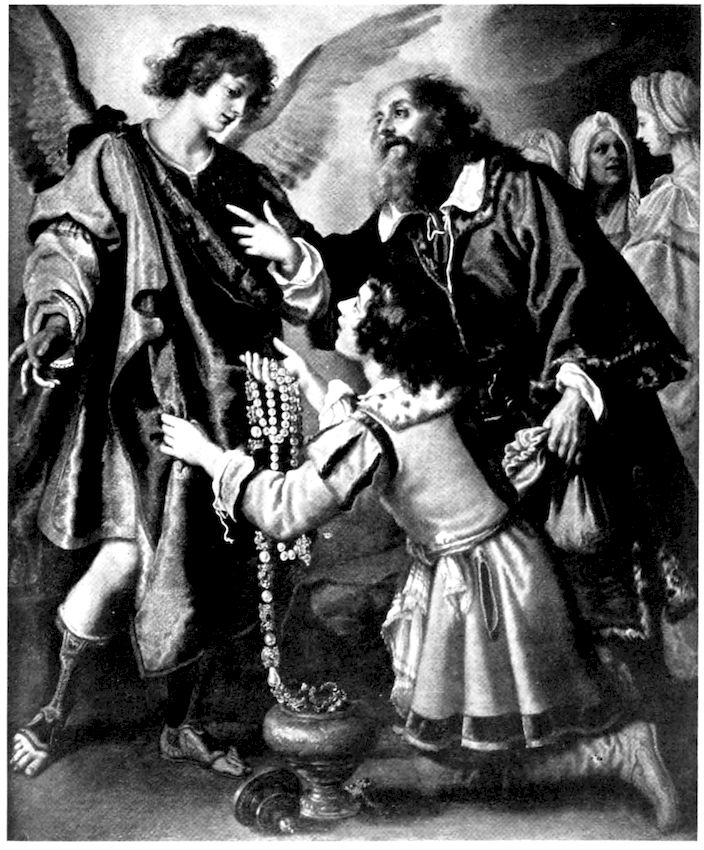
THE ANGEL RAPHAEL REFUSING THE GIFTS OFFERED BY TOBIT By Giovanni Biliverti. Pitti Palace, Florence.
251There has been preserved for us a most interesting calendar for the city of Rome, written by Furius Dionysius Filocalus in 354 A.D., and containing a series of drawings by his hand showing the symbolical figures of the months of the year. Though the original manuscript is lost, several apparently faithful copies exist, one of which is in the Imperial Library in Vienna. Much of this work deals with matters referring to the Roman calendar, but perhaps its most valuable part is a list of the early Christian saints and martyrs. As this is the earliest list of the kind, of even earlier date than the rest of the work, we give it here unabridged, as a most interesting documentary proof of the veneration in which the saints were held in the fourth, or, we should probably say, in the third century.
ITEM DEPOSITIO MARTIRUM[494]
VIII kal.
Jan. natus Christum in Betleem Judeæ. mense Januario.
XIII kal.
Feb. Fabiani in Callisti et Sebastiani in Catacumbas.
XII kal.
Feb. Agnetis in Nomentana. mense Februario.
VIII kal.
Martias natale Petri de cathedra. mense Martio. non. Martias. Perpetuæ et Felicitatis, Africæ. mense Maio.
XIIII kal.
Jun. Partheni et Caloceri in Callisti, Diocletiano VIIII et Maximiano VIII [304]. mense Junio. 252
III kal.
Jul. Petri in Catacumbas et Pauli Ostense, Tusco et Basso cons. [258]. mense Julio.
VI idus
Felicis et Filippi in Priscillæ et in Jordanorum, Martialis Vitalis Alexandri et in Maximi Silani. hunc Silanum martirem Nouati furati sunt. et in Praetextatæ, Januari.
III kal.
Aug. Abdos et Semnes in Pontiani, quod est ad ursum piliatum. mense Augusto.
VIII idus
Aug. Xysti in Callisti et in Praetextati Agapiti et Felicissimi.
VI idus
Aug. Secundi Carpofori Victorini, et Seueriani Albano. et Ostense VII ballisteria Cyriaci Largi Crescentiani Memmiæ Julianetis et Ixmaracdi.
IIII idus
Aug. Laurenti in Tiburtina.
idus
Aug. Ypoliti in Tiburtina. et Pontiani in Callisti.
XI kal.
Septemb. Timotei, Ostense
V kal.
Sept. Hermetis in Basillæ Salaria uetere. mense Septembre.
non.
Sept. Aconti, in Porto, et Nonni et Herculani et Taurini.
V idus
Sept. Gorgoni in Lauicana.
III idus
Sept. Proti et Jacinti, in Basillæ.
XVIII kal.
Octob. Cypriani, Africæ. Romæ celebratur in Callisti.
X kal.
Octob. Basillæ, Salaria uetere, Diocletiano IX et Maximiano VIII consul. (304) mense Octobre.
pri. idus
Octob. Callisti in via Aurelia. miliario III. mense Nouembre.
V idus
Nou. Clementis Semproniani Claui Nicostrati in comitatum.
III kal.
Dec. Saturnini in Trasonis. mense Decembre.
idus
Decem. Ariston in pontum.
This list, which begins with the great Christian festival of Christmas, enumerates the days on which Roman martyrs 253died and were buried. The months are given in their order and below their names appears a very brief record, giving the day and place of burial and the name of each of the martyrs. The first entry, for instance, reads: “January 20, interment of Fabianus in the cemetery of Callistus.” The earliest martyrs mentioned are SS. Perpetua and Felicitas who died in 202 A.D.; thus all definite memory of the many martyrs of the first and second centuries seems to have been lost. Even heretics do not appear to have been excluded, for as it is stated that the Novatians carried away the body of Silanus, it seems more than probable that he himself belonged to this heretical sect. As martyrs, all are regarded as equally entitled to the highest veneration, regardless of what they may have passed through on earth. Other communities than the Roman one possessed similar lists, as is clearly indicated by the words of Cyprian, in his thirty-ninth epistle, where he says: “As you remember, we offered the sacrifice for them, just as we celebrated a commemoration of the sufferings of the martyrs and of their anniversary days.”
To many of the saints curative powers are attributed, and these powers are usually specialized so that each of these saints is invoked for aid against a different disease or defect. With very few exceptions it will be found that some circumstance in the history or legend of the saint is the origin of these beliefs. An exception may perhaps be made in the case of the two saints to whom recourse is most frequent at the present day, namely, St. Anthony of Padua (June 13) and St. Anne, the mother of the Virgin Mary (July 26). Relics of the latter saint, preserved in many parts of Europe and also in America, are regarded as endowed with wonderful therapeutic powers. Recently, in New York City, at the church of St. Jean Baptiste, a relic of St. Anne was shown to many thousands of the faithful, and 254some wonderful cures are said to have been accomplished by its aid. Sceptics will be inclined to attribute such cures to the influence of suggestion, while Catholics will see in them a proof of the power of the saint’s intercession on behalf of those who repose their trust in her. St. Anthony is usually appealed to for success in difficult enterprises, and more particularly for the discovery of lost articles. Here the belief in the successful intervention of the respective saints is more generalized and appears to have grown up independently of any event chronicled in the legends, but these instances are quite exceptional.
An exceedingly beautiful jewelled medallion said to have been given by Pope Paul V, in 1614, to the Archbishop of Lisbon, Don Miguel de Castro, shows in the centre the figures of the Virgin and Child, surrounded by a setting of old Indian, table-cut diamonds. The archbishop donated this to the Church of St. Antonia da Se, sometimes called the “Royal House of St. Antonio,” for this church was built on the site of the house in which dwelt the parents of St. Anthony, Don Martin de Bulhoes and Dona Teresa de Azavedo, and in which the saint was born on February 6, 1195. At his baptism he was given the name Fernando, but later he changed this to Antonio. The great Lisbon earthquake of 1755 completely wrecked this church, but the high altar wherein the medallion had been placed escaped comparatively unharmed, and the jewel was found by some peasants, who later sold it to the family of Machados e Silvas, in whose private chapel it reposed until within a few years.
The shrine of St. Anne de Beaupré may be seen in the Basilica of Beaupré, about 20 miles distant from Quebec. It stands on the site of a small wooden sanctuary erected about the middle of the seventeenth century by some Breton mariners who, when in imminent danger of shipwreck while navigating the St. Lawrence, made a vow to build a chapel to 255St. Anne, the dearly-loved patron saint of their native province, at the spot where they should first come to land. St. Anne was regarded in French Canada as the patroness of seafarers and hence a large number of those who frequented her shrine were seafaring people. However, even more were attracted by the report of the marvellous cures of all kinds of diseases which were said to have taken place there. Pilgrimages to this shrine continue to be made at the present time; indeed, the number of those who thus testify to their belief in the power of the saint has increased rapidly during the past thirty years. In 1880 the pilgrims numbered 36,000; in 1900 the record showed 135,000, and in 1910 the number had increased to 188,266, a proof that the devotees are more and more convinced that St. Anne’s relics are the sources of great healing virtue.
All of the numerous relics of St. Anne exhibited in Canada and elsewhere are said to have come originally from the town of Apt in France, where, according to Catholic tradition, her body was found by the Emperor Charlemagne in 792, and it is related that when the reliquary covering the holy body was opened a fragrance as of balsam emanated from the interior. How the body was transferred to Apt from its resting place in Palestine is a mystery not solved even in tradition, although some believe that it was brought thither by St. Auspicius, known as the Apostle of Apt. The Basilica of Beaupré contains five of these precious relics; one of them was brought to Canada from the Cathedral of Carcasonne, in France, about the year 1662, at the instance of Monseigneur de Laval, first bishop of Quebec, and founder of Laval University. This is the first joint of the middle finger of the saint. The devotees at the shrine first saw this precious gift March 12, 1670; it is adorned with two intersecting rows of pearls, forming a cross. Another relic of peculiar importance is that given in 1892 by the 256late Cardinal Taschereau. This is a bone from St. Anne’s wrist measuring four inches in length. It is enclosed in a reliquary made of massive gold and studded with precious stones, the gifts of those whose prayers to the saint had been answered. In the ornamentation appear eight diamonds, four amethysts, a fire opal, etc. At the bottom of the reliquary there is a gold plate with the inscription: “Ex brachio S. Annae,” and a gold ring set with twenty-eight diamonds. This jealously-guarded treasure is exhibited in the shrine but once a year, from July 26 to August 2, a period comprising St. Anne’s Day and the week following it; at other times the reliquary is kept in the Sacristy, but may be seen on special request.
A remarkable jewel in the treasury of the Basilica is the seal of Santa Anna, elected president of Mexico in 1832. A golden eagle, with eyes formed of two rubies, stands on a rock of lapis lazuli and bears the stamp of the seal; resting on his spread wings is a sphere of lapis lazuli in which the words “Diaz, Mexico,” are inlaid in letters of gold. The seal is engraved with the initials of the president’s name, surrounded by a design embodying the insignia of his office.
At the feast of St. Blaise, Bishop of Sebaste, in Armenia (d. circa 316), which occurs on February 3d in the Roman Church, the wick of a candle is sometimes dipped in a vessel containing consecrated oil, the throats of the faithful being then touched with this wick, to preserve them from diseases of the throat. At other times the ceremony is performed in a different way. The priest holds two candles, adjusted so as to form a cross, above the heads of those who come to seek the saint’s aid, and the following prayer is recited: “Through the intercession of St. Blaise may God free thee from diseases of the throat, and from every other disease. (Per intercessionem S. Blasii liberet te Deus a malo gutteris et a quovis alio malo.)”
257It is related that this saint in his travels, once meeting a poor woman whose only child had swallowed a fish-bone, relieved the child of its trouble by offering up a prayer and laying his hand upon its throat. In the prayer he adjures all who may suffer from a like trouble to seek his intercession with God.
St. Apollonia of Alexandria (February 9) is said to cure toothache and all diseases of the teeth, the reason for this being that at her martyrdom all her beautiful teeth were pulled out. In a similar way St. Agatha, of Catania or Palermo, in Sicily, is endowed with the power to cure diseases of the breast, because it is related that before her martyrdom her breasts were cruelly torn and mutilated.
To recite the formula of St. Apollonia was considered by the Spaniards of three centuries ago to be a cure for toothache. This fact is brought out by a passage in Don Quixote, when the knight’s housekeeper is urged to recite it for her master’s benefit when he is ailing. To this request the woman quickly answers: “That might do something if my master’s distemper lay in his teeth, but, alas! it lies in his brain.” This formula was probably used before the age of Cervantes, and has persisted to our own time. It is in verse and has been literally translated into English as follows:[495]
Apollonia was at the gate of Heaven and the Virgin Mary passed that way. “Say, Apollonia, what are you about?” “My Lady, I neither sleep nor watch, I am dying with a pain in my teeth.” “By the star of Venus and the setting sun, by the Most Holy Sacrament, which I bore in my womb, may no pain in your tooth, neither front nor back, afflict you from this time henceforward.”
Of Santa Lucia (December 13), born in Syracuse on the island of Sicily, a strange legend is told. A young man fell 258passionately in love with her, and wrote to her that her wonderful eyes pursued him even in his dreams. Moved by the Scripture text, “If thine eye offend thee, pluck it out,” and longing to save the youth from sensual passion, Lucia cut out her beautiful eyes, placed them on a dish, and sent them to her lover with the following message: “Here thou hast what thou so ardently desirest; I beseech thee leave me in peace.” Very naturally, this saint is believed to cure all diseases of the eye.
For protection against highway robbers and thieves, St. Nicholas (December 6), Bishop of Myra, in Lycia, was invoked. Legend relates of this saint that he restored to life three boys who had been murdered at an inn by the wicked innkeeper, a wretch who was in the habit of making away with his guests and then utilizing their bodies to enrich his menu. This tale accounts for the fact that, under the familiar name of Santa Claus, St. Nicholas is the patron saint of children.
St. Barbara (December 4), born in Heliopolis, is appealed to for protection against lightning and injury by firearms. For this reason the gun-room on a ship is called in French the sainte-barbe. The legend, as usual, gives us the origin of the belief in the saint’s special powers, for her heathen father is said to have been killed by a stroke of lightning, because of his having denounced his daughter, as a Christian, to the Roman authorities, and then executed judgment upon her with his own hands. Of St. Barbara the legend says: “She was a fair fruit from an evil tree.”[496]
Beneath portraits or images of St. Christopher (July 25) there often appears a Latin verse to the effect that whoever gazes on the image will not suffer from faintness or exhaustion on that day. As the saint is said to have been of great size and strength, the worshipper at his shrine was believed to acquire some of his physical power.
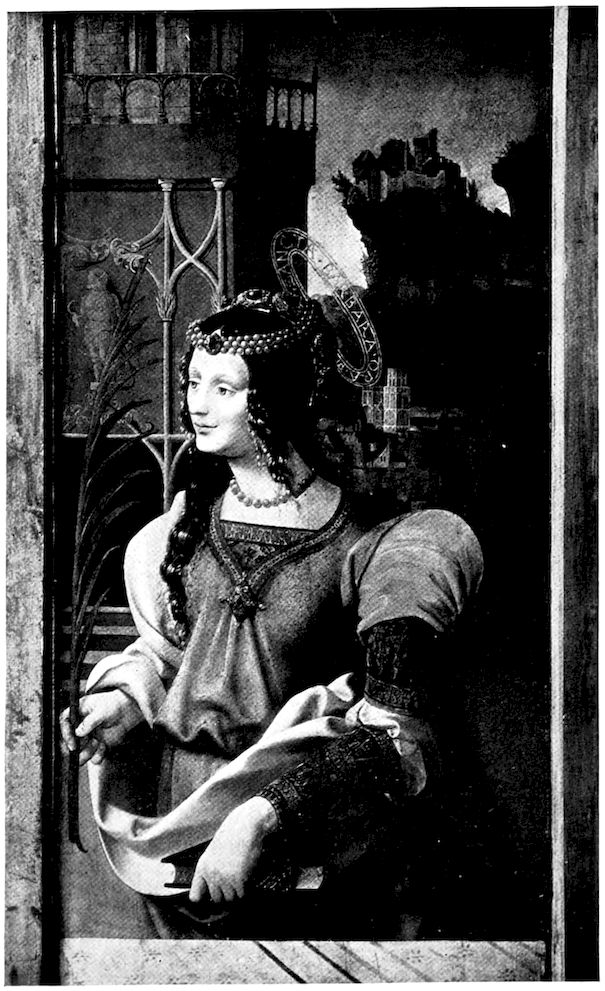
SANTA BARBARA French school, 1520. Leaf of a triptych in the Museum of Budapest.
259The cure of diseases of the tongue was the province of St. Catherine of Alexandria (November 25), who was famed for her eloquence as well as for her devotion to the study of the Scriptures.
St. Roch, who was born in Montpelier toward the end of the thirteenth century (d. August 16, 1327), is regarded as the special guardian of those afflicted with plague or pestilence. In his lifetime he went from place to place ministering to those who suffered from the plague until finally he himself succumbed to this malady. So great was the repute of St. Roch’s curative powers that the Venetians are said to have stolen his body from Montpelier, where it was interred, and transported it to Venice, that they might have ever-present help in the numerous pestilences from which this city suffered, because of the constant commercial intercourse with the East.
Another saint who was invoked for help in plague and pestilence was St. Sebastian (January 20), born in Narbonne in Gaul. In this case the story of the saint’s martyrdom gave rise to the belief in his curative powers, for the legend tells us that he was transfixed with arrows, and these missiles were regarded as symbols of the plague. We have an illustration of this old belief in the first book of Homer’s Iliad, where the pestilence that visited the army of the Greeks is represented as due to the shafts sped from Apollo’s silver bow.
Although no curative powers are attributed to them, no one of English speech should forget SS. Crispin and Crispian, on whose day the battle of Agincourt was fought, in 1415. The old feud between France and England has been long forgotten, the rivalry between these nations has given place to a close friendship, and there is no trace of animosity 260in the glow that warms an Englishman’s heart when he reads the ringing words put by Shakespeare into the mouth of Henry V:
And Crispin Crispian shall ne’er go by
From this day to the ending of the world,
But we in it shall be remembered.
It is related by Metaphrastus that when St. George was condemned to death by burning, his executioners (fearing that the flames of the pyre might be extinguished because of his virtue) covered his body with a garment of amiantos (asbestos); for it was believed that when this material began to burn the flame could not be extinguished. But all precautions were vain, for as soon as the saint was placed in the flames the fire went out, contrary to the laws of nature, and not a hair of his head was injured. This tale illustrates a curious but not unnatural misunderstanding of the name asbestos, which really signifies inextinguishable, but was intended to mean that the substance would not burn, and hence that no flame could be extinguished in it.[497]
In an unpublished manuscript written by Aubrey are quoted the following curious lines on the legend of St. George and the Dragon:[498]
To save a mayd, St. George the Dragon slew,
A pretty tale if all is told be true;
Most say there are no Dragons, and ’tis sayd,
There was no George; pray God there was a mayd.
The St. George thalers, coined by the counts of Mansfeld (Thüringen), enjoyed in bygone times a reputation as amulets for soldiers. This belief is said to have originated from the actual preservation of a soldier’s life by one of these coins, which he had sewed up in the lining of his coat just 261over his heart for safe-keeping. A bullet which struck him here and would otherwise have killed him, was diverted by coming in contact with the thaler. Hungarian St. George thalers were regarded as amulets for sailors as well as soldiers. These coins derived their name from bearing the design of St. George and the Dragon.
Among the wonder-working saints none enjoyed greater repute in medieval times than Sainte Foy, the virgin martyr whose remains were taken from Agen to the abbey-church at Conques, a village on the hills of Aveyron. Pilgrims came from far and near to the shrine of Sainte Foy, for she worked marvellous cures upon those who appealed to her for help, even giving sight to the blind. Her grace appears to have been bestowed upon animals as well as upon human beings, a fantastic legend relating that she had raised donkeys from the grave! Naturally the pilgrims must bring rich gifts, as otherwise the saint might turn a deaf ear to their prayers.
Many of these treasures may still be seen in this out-of-the-way church, wherein no one would suspect the existence of the rich specimens of early goldsmiths’ work that are carefully preserved in the treasury. The most interesting of these treasures is a statuette supposed to represent the saint. This is a seated figure, about 33 inches high and encrusted with an immense number of precious stones, uncut emeralds, sapphires and amethysts, as well as with many cameos and pearls; all these having been offered at various times to the saint.
The figure—probably the representation of some ecclesiastic—is seated on an elaborate chair, originally surmounted by two golden doves. The saint is said to have appeared in a vision to the Bishop of Beaulieu and expressly directed this adornment; these doves have disappeared and have been replaced by crystal balls. The execution of the statuette—constructed 262of wood covered with gold plates—is stiff and conventional, but it is not unimpressive and gives evidence of considerable skill on the part of the artist. Nevertheless, it certainly has nothing of the youthful grace we would associate with a virgin martyr.[499]
The offering of precious stones to attract the favor of gods or saints is really a talismanic use of such gems and is intimately connected with the wearing of gems for their talismanic or therapeutic effect. The gift established a sort of relation between the being whose help was desired and the petitioner, and the gem was the medium through which the favor was bestowed.
The legend of the royal princess who was canonized by the Church as St. Enimie (d. 628 or 630 A.D.) contains an account of a miraculous spring and also enshrines the popular view of the cause of the strange outlines of an extensive mass of heaped-up boulders. This saint was a daughter of the French king Clotaire II (d. 628). Her most ardent wish was to devote herself exclusively to the service of Christ, but her royal parent insisted upon a marriage with one of the great nobles. The princess, who was the fairest of the fair, put up an earnest prayer that the Lord would destroy her beauty, even at the expense of some dreadful malady, so that she might cease to be an object of desire for men. Her prayer was heard and she was stricken with leprosy which entirely blotted out her charms. Not long after this an angel appeared to her in a dream and directed her to bathe in the Fountain of Boule, in the region of Gévaudan. On doing so she was immediately cured of her leprosy, but as soon as she went away from the spring to return to the royal residence, the malady returned. A second attempt had the same favorable and unfavorable results, and she 263now recognized that she must remain near the spring. So after bathing there a third time and being again completely cured, she erected a monastery on the spot and became the prioress. The institution flourished, but a few years later the saintly prioress was horrified to see that the Devil was busy with her nuns. Once more she sought for divine aid, and she was given authority to imprison the Evil One should she catch him in the monastery. This she did, but the Devil was crafty enough to make his escape. Near the spot where the monastery stood was a mass of heaped-up boulders, through which led a way called the Chasm Road which led to a rocky aperture of unknown depth. This was fabled to afford egress and ingress to the Devil in his passage out of and back to the infernal regions. Along this road he fled when he escaped from the monastery; St. Enimie fearlessly pursued, but the agile demon was on the point of slipping back again into his own realm, when the saint made a supreme appeal and called upon the rocks to help her. As she raised her arms in supplication, one of the largest boulders, called “La Sourde,” moved of its own accord and fell upon the Devil, pinning him fast to the ground beneath its ponderous weight. In his rage and despair he made frantic efforts to free himself and his bloody claws left an imprint on the rock. This mark, still observable a half-century ago, though it has now disappeared, was prosaically explained by scientists as a stain of iron-oxide. The other boulders were in motion to assist in the good work, but when the Devil had been caught they stopped short in their downward course, and this is supposed to account for the strange angles at which they stand.[500] It would be pleasant to fancy that His Satanic Majesty eventually failed 264to make his escape, but unfortunately the ever-recurring instances of his activity from the age of St. Enimie down to our own time preclude this belief.
An heirloom in the family of Dom Pedro of Brazil is said to have been loaned to one of the pioneer aviators, Santos-Dumont, by Dom Pedro’s daughter, the Comtesse d’Eu. This was a medal of St. Benedict and had been long regarded as a powerful talisman in the Braganza family. One of its princely members had a striking proof of this virtue in 1705, when, after having worn the medal but two weeks, he was saved from deadly peril by the timely discovery and consequent defeat of a plot. Santos-Dumont had just experienced a terrible fall while experimenting with his new airship in the Rothschild park near Paris, and this it was that induced the Comtesse d’Eu to loan him the talismanic medal, with the injunction that he should always wear it on his person, and the assurance that if he did so no further harm could befall him. The talisman seemed to do its work well, for although the aviator had many narrow escapes, he was always saved from serious injury. Unfortunately, however, a thief picked it from the pocket of his coat while he was busily engaged in work on an airship in a Paris machine-shop.[501]
While it was customary to close the shops of the goldsmiths on Sundays and feast-days, a special exception permitted the “Confrérie de St. Eloi,” the goldsmiths’ guild, to open a single shop (not always the same one) on each Sunday and feast-day, the profits of the sales being devoted to providing a dinner on Easter Day for the poor of the Hôtel Dieu.[502] This combination of commercialism and philanthropy has illustrations in our own day, and, whatever 265may be the ulterior motives, some good results are certainly attained.
The Well of St. Cuthbert, near Cranstock, Newquay, England, long enjoyed the repute of miraculously curing the ailments of infants. Not only were curative powers attributed to the waters of the well, but also to a perforated stone alongside of it. As recently as 1868 a puny infant is said to have been passed through the orifice of this stone with the firm expectation that this act would strengthen the infant and bring good luck to it.[503]
In the region of the Abruzzi, in Italy, more especially in the province of Teramo, wonderful virtues are attributed to the intercession of St. Donato. So great is thought to be his power to cure those afflicted with epilepsy that in this region the disease is called the malady of St. Donato. This saint, however, is credited with much more extensive powers, for he is believed to cure hydrophobia, to prevent the ill effects of the Evil Eye, and in general to bring to naught the enchantments of witches. Such being his powers, it is not surprising that his image was added to many amulets, those figuring the lunar crescent being frequently surmounted with the bust of the saint. This type of amulet owes its supposed efficacy to the horn-like shape of the crescent, horns or substances having a likeness to a horn, like certain branches of coral, being regarded as a sure protection against the Evil Eye. A curious amulet bears the bust of St. Donato surmounting a crescent moon within which is the dreaded number thirteen. This fateful number is considered to be a source of misfortune for those who do not wear it inscribed on an amulet; but it becomes a source of good fortune and a happy life for those who possess such an amulet.[504]
266A notable instance of the use of a saint’s name to facilitate the perpetration of a crime is afforded in the case of the poison known as Aqua Tofana. This appears to have been a preparation of arsenic and was concocted by a woman named Tofana, a native of Palermo, in Sicily, who eventually took up her abode in Naples and devoted herself to the preparation and sale of her poison in Naples, Rome and elsewhere. To divert suspicion she used vials marked “Manna of St. Nicholas of Bari,” and bearing the image of this saint. Most of her clients are said to have been women who were anxious to rid themselves of their husbands, and she must have had a large practice in this specialty, for so many husbands died in Rome in a mysterious manner that in 1659 the authorities finally took cognizance of the matter and instituted a searching investigation. This revealed the fact that there existed in Rome a secret society entirely composed of women who wished to “remove” their husbands by poison. The leader of this society and many of the members were duly executed, but Tofana does not seem to have been molested.
Many strange superstitions as to the saints prevail among the Spanish-speaking inhabitants of New Mexico. If a saint whose aid has been invoked fails to respond to the appeal, his image is shut up in some receptacle until he vouchsafes to render the service desired. On the other hand, if the image of a saint falls to the ground, this is interpreted as a sign that the saint has performed a miracle. One means of forcing a saint to perform a miracle was to hang the image head downward; this was especially recommended in the case of St. Anthony. All strangers who presented themselves on St. Anthony’s day or St. Joseph’s day were to be hospitably received and entertained, for one of them might be the saint himself. Those who wished to read the future were instructed to put the white of an egg in a glass of water on the eve of St. John’s day; on examining the contents of the glass the next morning they would see written in black characters on the white background a prophecy of what was to happen. On this saint’s day women were assured that if they cut the tip of their hair with an axe, or merely washed it, they would be blessed with an abundant growth of hair.
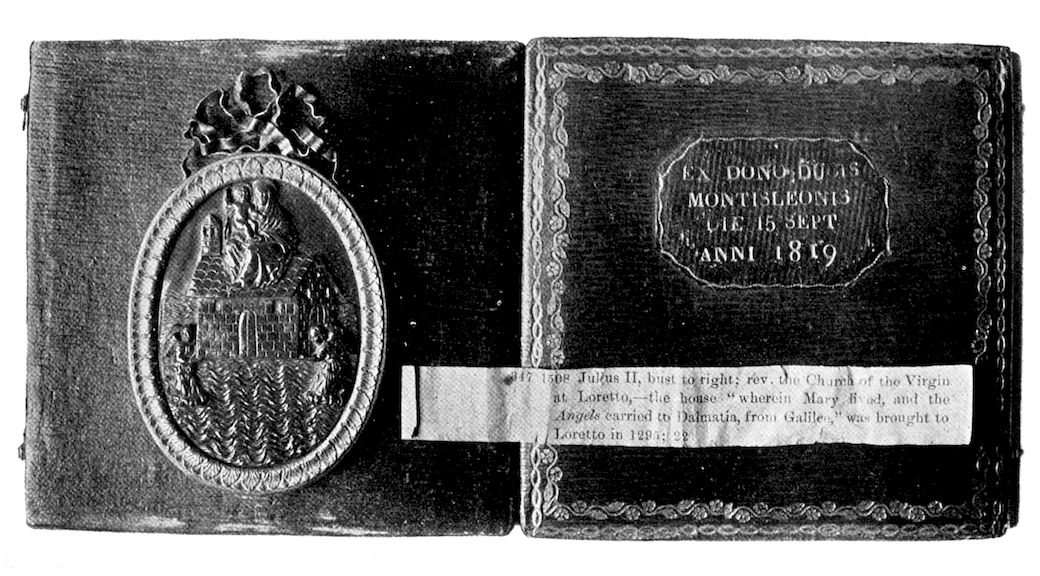
BLOODSTONE MEDALLION, SHOWING THE SANTA CASA OF LORETO CARRIED BY ANGELS TO DALMATIA FROM GALILEE
267A strange legend of angelic activity is that touching the miraculous transportation through the air (from Galilee to Dalmatia) of the “Santa Casa,” the house wherein the Virgin Mary dwelt. This event is placed in 1295, and the reverse of an Italian medallion engraved in 1508, during the pontificate of Julius II, gives a representation of the journey to Dalmatia, two angels sufficing to bear the little edifice. The sea, over which the house is being borne, is conventionally indicated by waves, but the fact that the medallist has seen fit to show a relatively large figure of the Virgin seated on the roof of the little structure and holding the Infant Jesus in her arms, scarcely adds to the realism of the effect.
Quite naturally Catholicism could not be satisfied with the pagan idea that the constellations held sway over the different parts of the human body, and the saints were substituted for the stars.
The saints of the Romanists have usurped the place of the zodiacal constellations in their government of the parts of man’s body, and so for every limbe they have a saint. Thus, St. Otilia keepes the head instead of Aries; St. Blasius is appointed to govern the necke instead of Taurus; St. Lawrence keepes the backe and shoulders instead of Gemini, Cancer and Leo; St. Erasmus rules the belly with the entrayls, in the place of Libra and Scorpius; in the stead of Sagittarius, Capricornus, Aquarius and Pisces, the holy church of Rome hath elected St. Burgarde, St. Rochus, St. Quirinius, St. John, and many others, which govern the thighes, feet, shinnes and knees.[505]
268When we consider how many beautiful and symbolic rites and observances have marked the celebration of saint’s days and holidays in the Old World, and how few of these have been preserved by the inhabitants of our own country, we must find this most regrettable. Of late years there has been a marked tendency to increase the number of holidays, and in a few cases to revive the celebration of old holidays, but the popular idea of the best way to celebrate these occasions seems to be confined to making them carnivals of noise and disorder. This is largely owing to a lack of intelligent guidance, for it is too much to expect that any people, above all those so practical as our American people, can spontaneously evolve, at short notice, an emblematic expression of the idea underlying the festival. If, however, a beautiful and adequate symbolism were presented in a concrete form, the masses of the people would grasp its significance quickly enough, and would thus gain a higher and better conception of the historic anniversary or the time-honored festival they were called upon to celebrate.
The saint’s days on which the summer and winter solstices fell were memorized by distichs. For instance:
St. Barnaby bright! St. Barnaby bright!
The longest day and the shortest night.
St. Thomas gray! St. Thomas gray!
The longest night and the shortest day.
The former of the verses is probably the earlier, as St. Barnabas’ Day is June 11, the day on which the summer solstice fell in England for some time before the reform of the “Old Style” calendar, in 1752, replaced this date; while St. Thomas’ Day is December 21, the date of the winter solstice in our modern calendar.[506]
Writing of the origin of the rural superstitions in regard 269to the weather on certain saint’s days, Wehrenfels quotes the distich:
If Paul’s Day be fair and clear
It foreshows an happy Year.
and continues:
The contrary has happened a thousand Times, but however this cannot destroy the Rule. It once happened; certainly, say they, these Rules of the Husbandmen are not to be despised; see how exactly they are made good by Experience. Thus a great Part of Mankind reasons; which if one consider, he will neither depend much upon the Content of the common People in these Things, nor wonder at so great a Number of most silly Opinions.[507]
VERSES ON SAINTS’ DAYS AT VARIOUS SEASONS OF THE YEAR.[508]
January 25. Saint Paul’s Day:
If the clouds make dark the sky,
Great store of people then will die;
If there be either snow or rain,
Then will be dear all kinds of grain.
(Robin Forby, “Vocabulary of East Anglia,” London, 1830.)
Somewhat different in a Latin form:
Clara dies Pauli multas segetes nitant amni,
Si fuerint nebulæ, aut venti, erunt proelia genti.
February 2. Candlemas Day:
If Candlemas day be fair and bright,
Winter will have another flight;
If on Candlemas day it be shower and rain,
Winter is gone and will not come again.
(John Ray, “A Collection of English Proverbs,” 2d ed., Cambridge, 1678.)
February 12. St. Eulalia’s Day:
If the sun shines on St. Eulalie’s day,
It is good for apples and cider they say.
270February 14. St. Valentine’s Day:
On St. Valentine’s day
Cast beans in clay
But on St. Chad
Sow good or bad.
(Seed time of this Lenten crop limited between February 14 and March 2.)
February 24. St. Matthias’ Day:
Saint Matthew (Sept. 21)
Get candlesticks new;
St. Mattheg
Lay candlesticks by.
March 1. St. David’s Day:
Quoth Saint David, “I’ll have a flood.”
Saith our Lady [Mch. 25] “I’ll have as good.”
(Referring to spring tides in Wales, from Poor Robin’s Almanack, 1684.)
June 15. St. Vitus’ Day:
If Saint Vitus’ day be rainy weather,
It will rain for thirty days together.
(M. A. Denham, “Proverbs and Popular Sayings Relating to the Seasons,” Percy Soc., 1846.)
July 15. St. Swithin’s Day:
St. Swithin’s day, if thou dost rain,
For forty days it will remain;
St. Swithin’s day, if thou be fair,
For forty days t’will rain nae mair.
(M. A. Denham, “Proverbs and Popular Sayings Relating to the Seasons,” Percy Soc., 1846.)
July 15: All the tears that St. Swithin can cry
Aug. 24: Saint Bartholomew’s dusty mantle wipes dry.
(R. Inwards, “Weather Lore,” London, 1893.)
July 20. St. Margaret’s Day:
“Margaret’s floods” (heavy rains).
271July 25. St. James’ Day:
“Whoever eats oysters on St. James’ day will never want money.”
(M. A. Denham, “Proverbs and Popular Sayings Relating to the Seasons,” Percy Soc., 1846.)
August 24. St. Bartholomew’s Day:
St. Bartholomew
Brings cold dew.
(John Ray, “A Collection of English Proverbs,” 2d ed., Cambridge, 1678.)
October 28. St. Simon and St. Jude:
Simon and Jude
All the ships on the sea home they do crowd.
Dost thou know her then?
Trap. As well as I know ’twill rain upon
Simon and Jude’s day next.
(Middleton, “The Roaring Girl,” Act 5, Sc. 1.)
Now a continual Simon and Jude’s rain beat all your feathers as flat down as pancakes!
(Idem, Act II, Sc. 1.)
November 11. St. Martin’s Day:
Expect St. Martin’s summer, halcyon days.
(Shakespeare, “I Henry VI,” Act 1, Sc. 2.)
December 13. St. Lucy’s Day:
Lucy [bright] light
The shortest day and the longest night
(For a long time, before the change of the calendar, St. Lucy’s Day corresponded to our 21st of December.)
December 21. St. Thomas’ Day:
St. Thomas gray, St. Thomas gray
The longest night and the shortest day.
December 27. St. John the Evangelist’s Day:
Never rued the man
That lead in his fuel before St. John.
(Robin Forby, “Vocabulary of East Anglia,” London, 1830.)
272Additional verses on Candlemas Day (Purification of the Blessed Virgin):
If the sun shines bright on Candlemas Day,
The half of the winter’s not yet away.
In Latin:
Si sol splendescat Maria purificante,
Major erit glacies post festum quam ante.
SAINTS’ DAYS
Adrian. September 8. As also of his wife, Natalia. Anniversary of translation of his relics to Rome; anciently his festival on day of his martyrdom, March 4, 306. Patron of soldiers in Flanders, Germany, and northern France; also against the plague. Relics in Abbey of St. Adrian, Gearsburg, Belgium; and elsewhere.
Afra. August 5. Especially celebrated in Augsburg, of which city (her native one) she is patroness. Martyred Aug. 7, 304.
Agatha. February 5. Patroness of Malta, and Catania, Sicily. Died February 5, 251.
Agnes. January 21. Supposed anniversary of martyrdom in 304.
Alban. June 22. First English saint and martyr, died June 22, 303. Present town of St. Albans upon site of martyrdom.
Amable. June 11. Patron of Riom, France. Died 475.
Ambrose. December 7. Patron of Milan. Died April 4, 397. Founder of church, now Sant’ Ambrogio basilica Maggiore, Milan, in 387. One of four Latin Fathers.
Andrew. November 30. Apostle, patron of Scotland and Russia.
Anne. July 26. Supposed anniversary of her death. Mother of the Virgin Mary. Patroness of Canada.
Anselm. April 21. Archbishop of Canterbury (1033–1109).
Anthony. January 17. Hermit (251–356).
Anthony of Padua. June 13. Died June 13, 1231.
Apollonia. February 9. Martyred February 9, 250. Patroness of those suffering from toothache.
Athanasius. May 2. One of four Greek Fathers. Died May 2, 373.
Augustine. August 28. Died 430. Patron of theologians and learning. Bishop of Hippo in Africa. One of four Latin Fathers.
Augustine. May 26. Apostle to England in 596. Died May 26, 604.
Babylas. September 1 (14) in Eastern Church; January 24 in Western Church (237–250). Bishop of Antioch. Relics said to have silenced the revived oracle of Apollo at Delphi, during reign of Julian the Apostate.
273Barbara. December 4. Patroness of Ferrara, Mantua and Guastalla, Italy, and of armourers and gunsmiths. Died December 4, 235 (?).
Barnabas. June 11. His birthday. One of the patrons of Milan. Apostle.
Bartholomew. August 24. Apostle.
Basil the Great. January 1, Eastern Church; June 14, Western Church (328–380).
Bathilda. January 30 in France; January 26 in Roman Martyrology (died ca. 680).
Bayo or Bavon. October 1. Patron of Ghent (589–653).
Benedict. March 21. Founder of Benedictine Order (480–543).
Bernard of Clairvaux. August 20. Founder of Abbey of Clairvaux, one of the Fathers of the Church (1091–1153).
Bernard of Menthon. June 15. Founder of hospices in the Alps, “Great St. Bernard” and “Little St. Bernard” (923–1008?).
Blaise. February 3. Patron of Ragusa, and of those afflicted with throat diseases. Bishop of Sebaste, Cappadocia (died 316).
Boniface. June 5. Apostle of Germany (680–755).
Bridget or Bride. February 1. Patroness of Ireland (450–521).
Bruno. October 6. Founder of Carthusian Order (1035–1101).
Catherine. November 25. Patroness of Venice and appealed to against diseases of the tongue.
Catherine of Siena. Patroness of Siena; lived in fourteenth century.
Cecilia. November 22. Patroness of sacred music (died 100).
Clement. November 23. Patron of farriers and blacksmiths (died 100).
Columban. November 21. Irish saint (543–615).
Crispin and Crispinian. October 25. Patrons of shoemakers (died 284).
Cuthbert. March 20. Patron saint of Durham, England (died 687).
David. March 1. Patron saint of Wales (446–549).
Declan. July 24. First bishop of Ardmore, Ireland.
Denis. October 9. Patron of France. Living in 250.
Domenic. August 4. Founder of Dominican Order (1170–1221).
Edmund. November 20. King of East Anglia and martyr (died 870).
Edward. March 18. King of England and martyr (962–978).
Edward the Confessor. October 13. King of England (1004–1066).
Elizabeth of Hungary. November 19. Daughter of Alexander II, King of Hungary (1207–1231).
Elmo (Erasmus). June 2 (died 304).
Eloy (Eligius). December 1. Patron of goldsmiths (588–659).
Emeric. November 4. Eldest son of St. Stephen of Hungary.
Engracia.
274Eric (or Henry). May 18. Patron of Sweden (died 1151).
Ethelreda (Audrey). October 17. Princess of East Anglia (died 679).
Euphemia. September 16. Patroness of Chalcedon (died ca. 307).
Felicitas. November 23. Patroness of male heirs (died 173).
Fillan. January 9. Scotch saint (died ca. 649).
Filomena (Filumina, Philomena). August 10. Supposititious saint.
Francis of Assisi. October 4. Founder of Franciscan Order (1182–1226).
Francis Xavier. December 3. Patron and Apostle of India (1506–1552).
Frideswide. October 19. Patroness of city and university of Oxford, daughter of Sidan, Prince of Oxford (died ca. 740).
Genevieve. January 3. Patroness of Paris.
George. April 23. Patron of England, of Germany and Venice, of soldiers and armourers (born third century).
Giles. September 1. Patron of Edinburgh (ca. 640–).
Gregory the Great. March 12 (born 540).
Gudula. January 8. Patron of Brussels (born middle of seventh century).
Helena. August 18. Wife of Constantius, mother of Constantine the Great (died 328).
Henry of Bavaria. July 15. Patron of Bavaria. Emperor (Henry II) of Germany (972–1024).
Hilary. January 14 (died 368).
Honoratus. Bishop of Arles. Died January 6, 429.
Honoratus (Honoré). May 16. Patron of bakers. Bishop of Amiens. (Died 690.)
Hubert of Liege. November 3. Patron of the chase and of dogs (died 727).
Ignatius Loyola. July 3. Founder of Jesuit Order (1491–1556).
Isidore the Ploughman (Isidro el Labrador). May 15. Patron of Madrid and of farmers (born ca. 1110–1170).
James the Great. July 25. Apostle; patron of Spain and of pilgrims to Jerusalem (died 42).
Januarius. September 19. Patron of Naples (died 305).
Jerome. September 30. Patron of scholars. One of the four Latin Fathers (342–420).
John the Baptist. June 24, or Midsummer Day.
John the Evangelist. December 27 (died 101).
Joseph. March 19.
Julian Hospitator. January 9. Patron of hospitals (died 313).
275Justina of Padua. October 7. One of the patrons of Padua and Venice (died 303).
Kenelm. December 13 and July 17. Son of Kenulph, King of Murcia (812–820).
Keyne (Keyna). Cornish saint (died 689).
Kilian. July 8. Irish saint (died 689).
Lawrence. August 10. Patron of Nuremberg, Genoa, and of the Escorial.
Leonhardt. November 6. Patron of prisoners and slaves; in Bavaria, of cattle (died ca. 560).
Lucy (Lucia). December 13. Patron of Syracuse, and against eye-diseases.
Ludmilla. September 16. Patron of Bohemia. Queen of that country (died ca. 920).
Luke. October 18. Patron of painters.
Macaire the Elder. January 15. (Fourth century.)
Macaire the Younger. January 2. (Fourth century.)
Malo (Maclou). November 15. Patron of St. Malo, France (died 627).
Margaret. July 20. One of the patrons of Cremona and of women in childbirth (died fourth century).
Mark. April 25. Evangelist (died 68).
Martha of Bethany. July 29. Patroness of cooks and housewives (died 84).
Martin of Tours. November 11, Martinmas. Patron of Tours and of beggars, tavern-keepers and wine-growers (316–397).
Mary Magdalene. July 22. Patroness of Provence and of Marseilles as well as of penitent fallen women.
Matthias. February 24.
Maurice. September 22. Patron of Austria, Savoy, Mantua, and of foot-soldiers (fourth century).
Michael. September 29. Archangel.
Nicholas. December 6. Archbishop of Myra in Lycia, patron of Russia, and especially of serfs and serfdom (died 342).
Olaf. July 29. Patron of Norway. Not canonized but informally accepted.
Ouen (Ouine). August 24. Patron of Rouen (595–683).
Pantaleone. June 27. Patron of physicians (fourth century).
Patrick. March 17. Patron of Ireland (born ca. 386).
Paul. June 29 (with St. Peter), and January 25.
276Peter. June 29; also August 1, St. Peter’s Chains, and January 18, Chair of St. Peter.
Philip. May 1. Patron of Brabant and Luxemburg.
Philip Neri. May 26. Founder of Oratorian Order (1515–1595).
Polycarp. January 26. Bishop of Smyrna (died 167).
Quietus. (No day.) Bones in church of Our Lady of Grau, Hoboken, enshrined June 1, 1856, Archbishop Bailey officiating.
Roche (Roch, Roque). August 16. Patron of prisoners and the sick, especially the plague-stricken (born ca. 1280–1327).
Romain. October 23. Patron of Rouen (died 639).
Romuald. February 7 (956–1027).
Rosalia. September 4. Patroness of Palermo (died 1160).
Rumald (Rumbald). November 3. Patron of Brackley and Buckingham, England. Son of King of Northumbria.
Scholastica. February 10. Sister of St. Benedict (died ca. 543).
Sebald. Son of a Danish king (eighth century).
Sebastian. January 20. Patron of Chiemsee, Mannheim, Oetting, Palma, Rome, Soissons, and of archers (fourth century).
Secundus. March 30. Patron of Asti (died 119).
Stephen. December 26. Patron of horses.
Swithin (Swithun). July 15. Patron of Winchester (died 862).
Symphorosa. July 18. Only in Greek Church. A Jewish martyr, the mother of the Maccabees (second century B.C.).
Theresa. October 15. Patron of Spain (1515–1582).
Thomas à Becket. July 7 (1117–1170).
Thomas Didymus. December 21. Apostle, patron of Portugal and Palma.
Urban. May 25. Pope and martyr (died 236).
Ursula. October 21. Patroness of young girls, and of educational institutions (died 383).
Valentine. February 14 (first century).
Veronica. Shrove Tuesday (first century).
Victor. Patron of Marseilles (fourth century).
Vincent. January 22. Patron of Lisbon, Valencia, Saragossa, Milan, and Châlons.
Vincent de Paul. July 19. Founder of Order of the Sisters of Charity.
Vitus. June 15. Patron of Bohemia, Saxony, Sicily, and of dancers and actors (third century).
Walburga. February 25 (died ca. 778).
William. January 10. Patron of Bruges (died 1209).
Winifred. November 3. British maiden of seventh century.
277