III Stones of Healing
Reading edition

In his commentary on Theophrastus, Sir John Hill touches upon the question of the medicinal virtues of precious stones. His researches regarding the causes and conditions determining color in stones, led him to the conjecture that the active principle, if it really existed, was to be sought in the coloring matter. As the opinion of a very clever student in his day, his words will bear quotation:[224]
The greatest part of these [medicinal virtues] cannot but be seen at first view to be altogether imaginary; and as to the virtues of the Gems in general, it is now the reigning Opinion, that they are nearly all so, their greatest Friends allowing them no other than those of the common alkaline Absorbents. However, whether the metalline Particles, to which they owe their Colours, are, in either Quantity or Quality, in Condition to have any effect in the Body, is a Matter worthy of a strict and regular Tryal; and that would at once decide the Question between us and the Antients, and shew whether we have been too rash, or they too superstitious.
The so-called “doctrine of signatures” treated of the marks set by nature upon certain objects to denote their usefulness in the cure of diseases affecting different parts of the body, or their power to neutralize the effects of the bites of certain animals or reptiles. Of this theory Martius says that the “signatures” are not to be sought in a fanciful resemblance to the form of the objects with the diseased parts of the human body, but rather in the color, odor, taste, composition, etc., of the objects.[225]
119Medieval medical literature has no more interesting example than the treatise entitled “Thesaurus Pauperum,” or the “Poor-man’s Treasury,” written by Petrus Hispanus, who later reigned for a brief period as pope under the name of John XXI (1276–1277). The birthplace of the author was Lisbon in Portugal, and he studied for some time at the University of Paris, where his learning earned him high praise. Prior to his election as pope, he served for a time as first physician to Pope Gregory X (1271–1276). Most of the remedies prescribed in this little treatise are naturally such as had long been popular among the peasantry, and the ingredients of which could easily be secured; vegetable growths, plants, herbs and flowers, and certain parts of the more common animals, served here, as in Pliny’s day and earlier still, as those most highly favored. Of the comparatively few mineral substances whose use is recommended may be noted the red variety of chelidonius or “swallow-stone,” for the cure of epilepsy; the powder of the “iris” (probably an iridescent variety of quartz) was also a cure for epileptics. Then we find, strange to say, a recommendation of such costly remedial agencies as emerald and sapphire, either of which if touched on the eye would heal diseases of that organ. Cold stones placed on the temples and tightly bound on were said to arrest bleeding from the nose, and coral was a great help in syncope. For stone in the bladder two mineral substances, “humus” and “songie,” are warmly recommended (the former can scarcely be held to signify mere “soil”), as are also “stones found in the gizzards of cocks” (the alectorius) and those from the bladders of hogs. All these were to be reduced to powder, dissolved in liquid, and taken in the form of potions. The use of stones and coral rather as amulets or talismans than as remedies is occasionally mentioned. Thus the loadstone, if worn, is said to remove discord between man and woman; 120coral, if kept in the house, destroyed all evil influences, and if a woman wore touching her skin a concretion taken from the stomach of a she-goat that had not had young, this woman would never bear a child.[226]
The curious old medical treatise in verse called the “Schola Salernitana,” was translated into English by Sir James Harington in 1607. The following lines give advice that is as appropriate to the conditions of our own age as to those of any other:[227]
Use three physitians still, first doctor Quiet,
Next doctor Merry-man and doctor Dyet.
Whether with or without intention, the translator has omitted to render the qualification given in the original: “Si tibi deficiant medici” (if other doctors are lacking).
The terrible plague known as the Black Death is said to have claimed 13,000,000 victims in Europe in the years 1347 and 1348. A contemporary, Olivier de la Haye, in a poem describing this fearful visitation, gives a number of recipes used, or to be used as remedies. In one of these there appear as ingredients pearls, jargoons, emeralds and coral, one-sixth of a drachm of each of these materials entering into the composition of the prescription.[228] The symptoms of this form of the plague, as described by the old writers, are said to resemble closely those of the disease that was prevalent not long ago in some parts of Asia, especially in northern China and Manchuria.
A famous class of medical remedies used in medieval 121times bore the generic name theriaca, or theriac, this designation being derived from the Greek therion, signifying a beast, more specifically a poisonous animal and hence also a serpent. These preparations were primarily antidotes for poison, but were also freely administered for any form of “blood-poisoning,” for malarial infection, malignant fevers and the like. Principal ingredients were the “Armenian stone” (a friable, blue carbonate of copper), pearls, charred stag’s-horn, and coral. The Veronese physician, Francesco India, confidently affirms that this remedy not only cured the plague, but also protected those who had partaken of it from contracting the disease; this was said to be more especially true of the theriaca Andromachi, or Venice treacle as it was popularly called, which purported to be the invention of a Roman or Greek physician, Andromachus, who composed some medical poems dedicated to Cæsar.[229]
In medieval Bohemia the knowledge of precious stones and their employment for curative purposes is well attested. There exists a Bohemian manuscript list of precious stones dated in 1391, in which no less than 55 different gems are noted. Their medicinal use in Bohemia at this time is vouched for by the Synonima Apothecariorum where precious stones are listed among the materials of the apothecaries’ art.[230]
In the testaments of royal and princely personages, medical stones are often bestowed as precious legacies. Thus in the will of the Hessian prince, Henry VIII of Fürstenberg, the following stones are mentioned as especially costly objects: a “crabstone” (Krebstein), a bloodstone, and a gravel-stone, the latter being a piece of jade or nephrite.[231] The crabstone, sometimes called crab’s-eye, is a chalky concretion which forms on either side of the stomach 122of a crab or other crustacean during the moulting period, and this was and is still used as an eye-stone for the removing of foreign bodies that have entered the eye, the eye-stone being introduced under the eyelid. This results in a rapid flow from the tear-ducts which often washes away the foreign bodies, the passage of the stone across the eyeball occasionally aiding in the work by rubbing off the body.
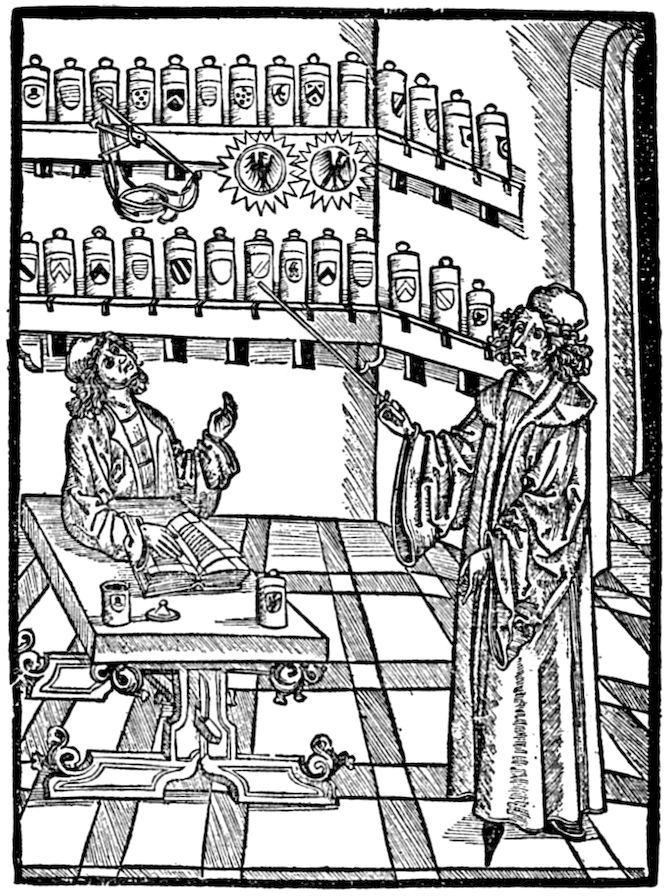
Interior of fifteenth century pharmacy. From Johannis de Cuba’s “Ortus Sanitatis”, Strassburg, 1483.
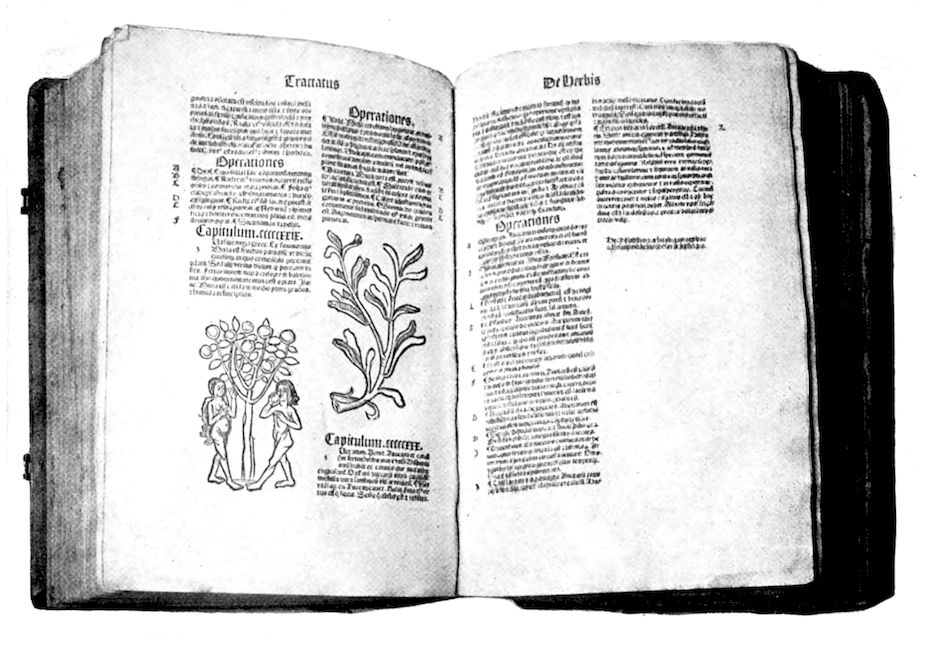
THE “ORTUS SANITATIS” OF JOHANNIS DE CUBA, PUBLISHED AT STRASSBURG IN 1483. The woodcut depicts Adam and Eve beneath the “Tree of Knowledge.”
123In the sixteenth century sapphires, emeralds, rubies, garnets, jacinths, coral and sardonyxes were used in all tonics prescribed to protect the heart against the effects of poison and of the plague. As it was noted that these remedies were frequently ineffectual, an explanation was sought in the fact that spurious stones were often used, the apothecaries either not having the knowledge to recognize the genuine stones, or being moved by a desire to profit by the substitution of some inferior substance. Hence physicians were warned to be on their guard against such deceptions, and only to employ thoroughly trustworthy apothecaries for the compounding of their prescriptions. A substitution frequently made was that of the so-called yellow chrysoprase (cerogate), a stained chalcedony, for the jacinth, although the true jacinth of the ancients was of the color of the amethyst. The grinding of coral in a brass mortar, instead of in one of marble, was also regarded as a very dangerous proceeding, which would have the worst possible results for the unlucky patient who took the powder, for some particles of the brass might be rubbed away and mix with the coral. This was said to have often produced very serious illness.[232]
In a price-list of a firm of German druggists, printed in 1757, all the precious stones still appear. Here the cost of a pound of rock-crystal is six groschen ($.18); the same quantity of emerald was priced at eight groschen ($.25), while the pound of sapphire was quoted at sixteen groschen ($.50), of ruby at one thaler ($.75), and of lapis lazuli at five thalers ($3.75). This indicates quite clearly the quality of the emerald, sapphire and ruby offered for sale. A pound of Oriental bezoar commanded the highest price, sixteen thalers ($12).[233]
124Regarding the length of time during which various preparations retained their strength, Braunfels[234] states that, according to the opinion of the Arabian physicians, the solution of lapis Armenus lasted for ten years, while that of lapis lazuli could be preserved only about three years. A list of the indispensable materials which should be in every good pharmacy included the following precious stones:
Jacinth
Sapphire
Emerald
Topaz
Margaritha (pearl)
Magnes
Coral
Hematite
Ætites
Jasper
The supposed medicinal properties of precious stones are subjected to a searching criticism by the Veronese physician, Francesco India, writing in 1593.[235] After establishing the distinction between alimentary and medicinal substances, he proceeds to exclude from the latter category the jacinth, emerald, sapphire, etc., because although they could be reduced to a powder, they could not be dissolved, so that when taken in a potion they could be absorbed in the human system.[236] Hence no such effects could properly be ascribed to them as were to be expected from the regular and normal medicinal agencies. This writer ascribes the original use of such stones as remedies for malignant fevers and other dangerous diseases to the Arabs, adding that “had they not made this mistake and thus led many physicians into error, they would have been better worthy of praise.”[234] In fact he does not hesitate to pronounce the emphatic opinion that these stones are not remedial agents fit to be 125administered or used by any rational physician.[237] That powdered hematite (red oxide of iron) possesses an astringent quality and may really be looked upon as a medicine, he fully recognizes, more particularly its efficacy for the cure of diseases of the eye, but neither these nor similar qualities can be credited to sapphires, emeralds, or jacinths. At the same time he is not disposed to deny that these stones may have some subtle effect upon the body when worn, or when held in the mouth for a time. Thus he agrees with Avicenna (Ben Sina) that a jacinth worn over the heart may strengthen that organ, for he knows of the power inherent in jasper to check a hemorrhage. In a word his argument is principally directed against the internal use of powders made from these hard and unassimilable stones.[238]
Robert Boyle, writing in 1663, attempts to show that the theory of the therapeutic action of precious stones is not incompatible with observed facts. In this connection he says:[239]
I am not altogether of their mind, that absolutely reject the internal use of Leaf-Gold, Rubies, Saphyrs, Emeralds, and other Gems, as things that are unconquerable by the heat of the stomach. For as there are rich Patients that may, without much inconvenience, goe to the price of the dearest Medicines; so I think the Stomach acts not on Medicines barely upon the account of its heat, but is endowed with a subtle dissolvent (whence never it hath it) by which it may perform divers things not to be done by so languid a heat. And I have, with Liquors of differing sorts, easily drawn from Vegetable Substances, and perhaps unrectified, sometimes dissolved, and sometimes drawn Tinctures from Gems, and that in the cold.... But that which I chiefly consider on this occasion is, that ’tis one thing to make it probable, that is, possible, Gold, Rubies, Saphyrs, etc., may be wrought upon by humane Stomach; and another thing to shew both that they are wont to be so, and that they are actually endowed with those particular 126and specifick Virtues that are ascribed to them; nay and (over and above) that these Virtues are such and so eminent, that they considerably surpass those of cheaper Simples. And I think, that in Prescriptions made for the poorer sort of Patients, a Physician may well substitute cheaper Ingredients in the place of these precious ones, whose Virtues are no half so unquestionable as their Dearnesse.
Whether the somewhat mysterious illness and death of the popes Leo IV and Paul II could have been caused by the great quantity of pearls and precious stones they were in the habit of wearing was a question seriously discussed by Johann Wolff, the supposed lethal effect being attributed to the coldness of such objects.[240] Indeed, the frigidity of precious stones was adduced by certain writers as one of the chief reasons for their remedial use in fevers.[241]
Not only to King Frederick III of Denmark himself, to whom on his death-bed in 1670, a dose of pulverized bezoar was administered, but to his queen and their children such remedies were given, there being record that on September 19, 1663, a prescription containing red coral and pearl-powder was compounded by the Court Pharmacy for the queen, while a few years earlier the inevitable bezoar and also a tonic pearl-milk were administered to some of the royal offspring.[242]
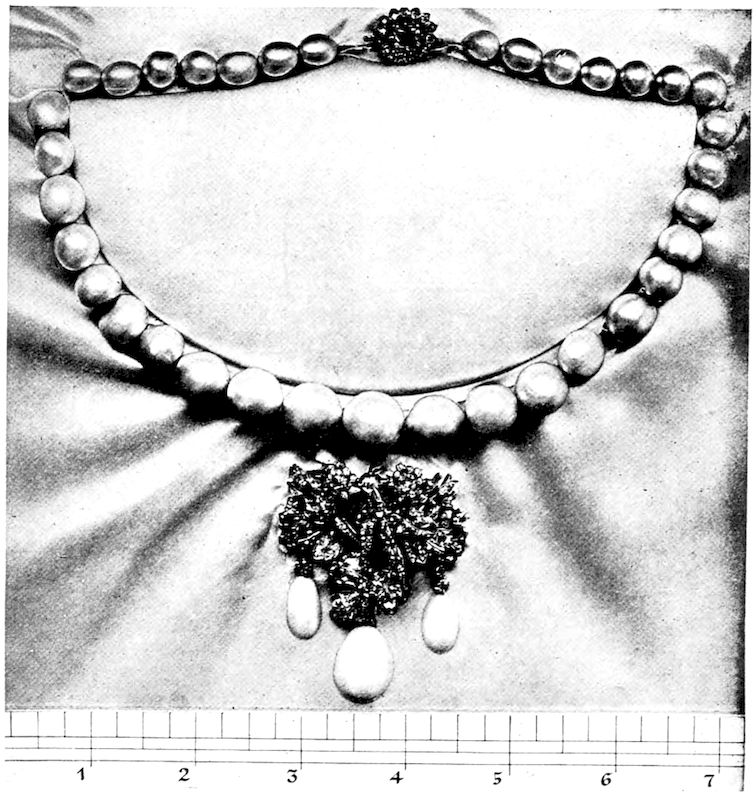
FAMOUS PEARL NECKLACE OF THE UNFORTUNATE EMPRESS CARLOTTA, WIDOW OF EMPEROR MAXIMILIAN OF MEXICO.
127Some interesting details as to the use of precious stone remedies for the cure of illness appear in the manuscript notes of lectures given at the Leyden Hospital by the seventeenth century physician, Lucas Schacht, in 1674 and 1675.[243] This shows that these remedial agents were there and at that time only used as a last resort, when the patient’s condition had become desperate, and the physician is usually obliged to record the fact that death ensued shortly afterwards. Thus we are told of the case of a certain Ludovicus Carels who was suffering from difficulty of breathing and purulent expectoration; his body was so distended that he could scarcely move his limbs, and he also had a severe diarrhœa. This was his condition on November 12, 1674, and the symptoms steadily grew worse under a treatment of herb decoctions, until a few days later, on November 21, it is noted that “he only thinks of death.” Still the doctors waited until November 24 before they decided to administer a compound remedy consisting in part of the elixirs of jacinth and pearl; three days later the patient died. In general the chief symptoms which justified the use of such remedies were those of high fever or great weakness.
Although by the middle of the eighteenth century the belief in the special curative powers of precious-stone material had almost entirely disappeared, giving place to a more scientific conception of the chemical composition of these bodies, still, we find, even in so capable a writer as the German mineralogist, U. F. B. Brückmann, a lingering trace of the old idea, for while he declares that all intelligent physicians have abandoned their use, he adds, “if, however, any stone of this kind has more effect than an ordinary earthy substance, it is the lapis lazuli, but we have a hundred other remedies equally efficacious and much cheaper.” He also testifies to the fact that very little genuine material was to be had from the apothecaries, he himself having often seen a yellow feldspar offered instead of a jacinth, and poor garnets as substitutes for rubies.[244]
Toward the end of the eighteenth century, a famous cordial medicine, called “Gascoign’s Powder,” after the 128physician who compounded it, had an immense vogue in England. This man is said to have got more than £50,000 ($250,000) from the sale of this single remedy. It is stated to have contained Oriental bezoar (the most important ingredient), white amber, red coral, crab’s eyes, powdered hartshorn, pearl and black crab’s claws; certainly a most incongruous mixture and one well calculated to test the resisting powers of the person to whom it was administered.[245]
A modern writer finds in the homeopathic theory of medicine an explanation of the apparent therapeutic effects of precious stones.[246] For if the smaller the dose the greater the effect, then such super-subtle emanations as are thought to proceed from precious stones must have effects still more powerful than those of the most highly diluted tinctures administered by homeopathists of the old school. Christian Science, however, with its bold denial of the existence of disease, and with its purely spiritual treatment of the “mental error” that is supposed to be at the root of all morbid symptoms, could even more easily account for the apparent cures wrought by merely wearing precious stones. The belief in their remedial virtue would serve to remove the morbid impression, and would restore the mind to its normal and healthy state.
An instance from our own day of the application of a mineral substance externally for the cure of disease, appears in the use of the uranium pitchblende occurring in Joachimsthal, Bohemia. This is enclosed in leather bags and applied to the head for the cure of headache. The most violent pains are said to be relieved in a short time by this treatment, 129the effect being produced by the radium contained in the pitchblende.[247]
Agate
Treating of the medicinal virtues of agates, Pliny distinguishes between the Indian agates, which were a remedy for diseases of the eyes, and those from Egypt and Crete, which were especially adapted for curing the bites of spiders or scorpions.[248] This latter quality was probably attributed to the agate because it was believed to have a cooling influence upon the body. Damigeron directs that when used to cure the bites of venomous creatures the stone should be reduced to a powder, which was to be strewn over the wound; sometimes, however, this powder was dissolved in wine and administered internally.[249] As an agate, if held in the mouth, was supposed to quench thirst, it was recommended at an early period for the cure of fevers and inflammatory diseases.[250]
In Byzantine times the use of agate for inflamed eyes and for headaches is still advised by Psellus (eleventh century), who adds that it checks menstruation and prevents the accumulation of water in cases of dropsy. This he attributes to the wonderful absorbent power of the stone.[251] It seems most probable that here some kind of hydrophane has been confounded with the agate. The other use, that of checking hemorrhages, presupposes the use of a red variety of agate.
130
Beryl
Thomas de Cantimpré[252] tells us that the beryl cures quinsy and swollen glands in the neck if the affected part be rubbed with the stone. It is also useful as a remedy for diseases of the eye, and if water in which it has been steeped be given to anyone suffering from an attack of hiccoughs, relief will be afforded.
The beryl was warmly recommended as a cure for injuries to the eyeball, even of the most serious kind. For use in such cases the stone was to be pulverized in a mortar, and this powder then passed through a fine sieve. Of the minute particles thus secured, a small quantity was to be introduced each morning into the injured eye, the patient being in a recumbent posture. He was then to keep properly quiet with his eyes shut for a considerable length of time after this operation. Although it was not indeed claimed that where the power of sight had been destroyed it could thus be restored, still even in case of such severe injury the eyeball was healed sooner and assumed a better appearance. In less serious cases a cure was considered to be assured.[253]
Carbuncle
Many virtues are attributed to carbuncles. It is related that those who wear them can resist poisons and are preserved from the pest. They dissipate sadness, control incontinence, avert evil thoughts and dreams, exhilarate the soul and foretell misfortunes to man by losing their native splendor.[254]
131
Chalcedony
Perforated, spherical beads of milky white chalcedony are worn at the present day by Italian peasant women to increase the supply of milk. Hence the Italian name for such a bead, pietra lattea. Perforated beads of white steatite, belonging to the early Iron Age, have been found near Perugia, where the chalcedony beads are worn, and it is believed that these steatite beads were borne for the same purpose.[255]
Coral
Coral and safran, if wrapped in the skin of a cat, were believed to have marvellous powers; and when emeralds were added to the coral the talisman would drive off a mortal fever. To have the proper effect, however, it must be attached to the neck of the patient.[256] As a cure for hydrophobia, dog-collars set with flint and Maltese coral were recommended in Roman times; “sacred shells” and herbs over which magic incantations had been pronounced were also attached to, or enclosed in these collars. The use of coral in this case appears to have been due to the belief in its power to dissolve the spell cast by the Evil Eye, for Gratius, who flourished in the first century A.D. and was a contemporary of the poet Ovid, asserts that if such collars were put on dogs suffering from hydrophobia, the gods were appeased, and the charm cast by “an envious eye” was broken.[257]
The Hindu physicians found that coral tasted both sweet and sour, and they asserted that its principal action was 132on the secretions of the mucous membrane, on the bile and on certain morbid secretions.[258] Although the chemical constituents of coral have but slight medicinal value, it is quite possible that some effects upon the secretions may have been observed experimentally after the administration of a dose of powdered coral.
An old pharmacopœia gives elaborate directions for the preparation of the “Tincture of Coral.” A branch of very red coral was to be buried in melted wax, and allowed to remain over a fire for the space of two days, “after which time you will see that the coral has become white, while the wax has assumed a red hue.” A fresh branch of coral is then to be put into the partially colored wax, and the above operation repeated; the wax will then be “redder than before.” It is now to be broken into crusts, which are to be steeped in alcohol until the liquid has extracted the coloring matter from the wax and has become reddish. In this way, after the removal of the wax by filtration, etc., a tincture was obtained which is represented to have been an excellent tonic, and to have had the power to expel “bad humors,” by inducing perspiration, or by its diuretic action.[259] We strongly suspect that in this, as in many modern “tonics,” the contents of spirit was the active principle.
An apparent confirmation of the widespread belief of former centuries that red coral changed its hue in sympathy with the state of the wearer’s health, caused perhaps by the exudations or sweats arising from fevers or other ailments, is given from personal experience by the German physician, Johann Wittich. Writing toward the end of the sixteenth century, this author relates that he was called in to attend a youth named Bernard Erasmus, son of the burgomaster of 133Arnstadt. As the youth sickened unto death a red coral which he was wearing turned first whitish, then of a dirty yellow, and finally became covered with black spots. To the anxious questions of the youth’s sister, Wittich could only give a mournful answer, telling her to take away the coral, for death was surely approaching, and this prognostication proved to be only too true, as in a few hours young Erasmus was dead.[260]
A rosary of coral beads was sometimes called in France a pater de sang, or “blood-rosary,” since it was believed to check hemorrhages. An anonymous author of an eighteenth century treatise on superstitions, assuming that this effect could be produced only by thickening the blood, asserts that such a rosary might do more harm than good, for if it possessed this power at one time, it must possess it constantly, and its action would be very injurious.[261] Pearls and corals were still freely used as therapeutic agents in the last half of the seventeenth century, for we are told that Louis XIV (1638–1715), in 1655, took tablets containing gold and pearls, which had been prescribed for him by his physician Vallot, and, in 1664, a remedy composed of pearls and corals was recommended by the same authority.[262]
Corundum
A stone, which from the description seems to have been an almost colorless variety of corundum with a faint reddish tint, is recommended in the Syrian Aristotle for the alleviation of diseases of the breast. To have the proper effect 134this stone was to be worn on the region affected by the malady.[263]
Diamond
The Hindu physicians claimed that they had found that the diamond had six flavors; it was sweet, sour, salty, pungent, bitter, and acrid. Since the stone united all these apparently contradictory qualities, we have no reason to be surprised that it should be supposed to cure all diseases and lessen all ills. An elixir of great potency, stimulating and strengthening all the bodily functions, was made from the diamond.[264]
The author of the Jawâhir-nâmeh (Book of Jewels), written about a century ago, gives some of the prevalent Hindu ideas regarding the diamond. He asserts that the similarity of this stone and rock-crystal led to the belief that the latter was only an incomplete or “unripe” form of the diamond. For this reason rock-crystal was called kacha, “unripe,” and the diamond, pakka, “ripe.” The same writer, after noting the general belief that if a diamond were put in the mouth it caused the teeth to fall out, states that some were not disposed to admit this, as diamond dust had been used as a tooth-powder without any bad effects.[265] It might certainly serve to whiten the teeth, but any one who trusted to this very drastic dentifrice would soon be sadly in need of the dentist’s help.
As a proof that the diamond was not much prized as an ornamental stone in the Middle Ages, although some of 135the praise bestowed upon it by Pliny and other classical writers was copied and recopied in a more or less perfunctory way, we may cite the few lines devoted to the stone by Psellus, who lived in Constantinople in the eleventh century A.D. This writer simply remarks of the diamond that it is hard and difficult to pierce, adding, as its chief virtue, that it would quench the heat of the “semi-tertian” fever.[266] The belief in this cooling quality of the diamond was suggested by its lack of color coupled with its extreme hardness, the latter quality being thought to augment the refrigerant power supposed to be inherent in colorless crystals which resembled ice.
Emerald
The emerald is especially commended for amulets to be suspended from the necks of children; it is believed to preserve them from epileptic convulsions and to prevent the falling sickness; but if the violence of the disease is such that it cannot be overcome by the stone, the latter breaks up. Bound to a woman’s thigh it is said to hasten parturition; hanging from the neck it drives off vain fears and evil spirits. It strengthens the memory, restores the sight, reveals adultery and gives a knowledge of the future, produces eloquence and increases wealth.[267]
Besides the usual designation marakata which Garbe believes to be derived from the Greek σμάραγδος, the Sanskrit has several distinguishing names for the emerald. One of these, açmagarbhaja, signifies “sprung from the rock,” and well describes the emerald in its matrix. Another name is garalari, “enemy of poison,” indicating the great repute enjoyed by this stone in India as an antidote for all animal, 136mineral and vegetable poisons.[268] In Mexico the emerald[269] bore the name Quetzalitzli, “stone of the quetzal,” because its color resembled the brilliant green of the plumes of the bird called in the Mexican tongue quetzal. These plumes were worn as insignia of royalty by the sovereigns of Mexico and Central America, and hence the emerald was regarded as an essentially regal gem, although its use was not confined to royalty.
The tincture of emerald is recommended by the Arab physician Abenzoar as an internal remedy for the cure of dysentery, the dose prescribed being six grains. He also claims to have cured one of his patients suffering from this disease by making him wear an emerald.[270] This illustrates the use of the stone in Moorish Spain in the early part of the eleventh century, the period of the highest development of Moorish civilization, for Abenzoar, or Abû Meruân, as he is sometimes called, was born in Seville about 1091 A.D. and died in 1161 or 1162.
Hematite
The curative properties of the hematite were generally recognized by the early writers, and in this case they were not so much at fault, as this substance possesses considerable astringent properties. Galen recommends its use for inflamed eyelids, following in this the teachings of the Egyptian schools of medicine. If there were tumors on the eyelids, the hematite was to be dissolved in white of egg, and if the tumors were very large it was to be boiled with fenugreek (fœnum græcum); if, however, there were no tumors, but simply a general inflammation of the eyelids, a 137solution in water sufficed. At the outset a few drops of a weak solution were to be poured into the eye through a glass tube; should this treatment not prove effective, the solution was to be made thicker and thicker, until at last it had to be dipped out on the point of the tube. If ground to a fine powder in a mortar, hematite cured spitting of blood and all ulcers. Galen advises great care in judging of the quality and strength of the powder, which was to be poured on or spread over the sore, but in his own case he admits that he trusted to his sense of taste to determine its quality.[271]
Sotacus as quoted by Pliny distinguishes five kinds of hematite, each one of which possessed special medicinal virtues. The best was the Ethiopic, which was a valuable ingredient in lotions for the eyes, and for burns. The second kind was called androdamus and came from Africa; this was very black, and was exceedingly hard and heavy, whence its name “conqueror of man”; it was reputed to attract silver, brass and iron. If rubbed with a moistened whetstone it gave forth a red juice, and was considered to be a specific for bilious disorders. The third kind was brought by the Arabs; this gave scarcely any juice when rubbed with the whetstone, but occasionally a little of a yellowish hue, and was useful for burns and for all bilious disorders. The fourth kind was called elatite in its natural state and melitite when burned; and the fifth appears to have contained an admixture of schist. These shared in the general virtues of the hematite, three grains of whose powder, when taken in oil, would cure all blood diseases.[272]
That the cause of the friendship between Hector and Dolon was the latter’s ownership of a hematite is asserted in the Greek Orphic poem “Lithica.” This statement must 138be derived from some annotation to the Iliad made in the Alexandrine schools, for Homer himself knows nothing of it. In the fateful encounter of Hector with Achilles, the form and aspect of Dolon are assumed by Athena to deceive Hector into the belief that his friend was at his side to aid him in the unequal struggle. The blood of Uranus when wounded by Kronos is stated in “Lithica” as the generating cause of hematite, and the stone is recommended as a cure for eye-diseases.[273]
Jacinth
A peculiarly stimulant and tonic effect exercised by the jacinth was noted by Ben Sina (Avicenna), and to this is attributed its value as an antidote for poisons. Not, however, to the material composition of the stone was this effect to be attributed, for it proceeded from the mass in the same way as did the virtue of the magnet. Hence Ben Sina is opposed to the theory that the natural warmth of the body acted upon the jacinth, when taken internally, producing a transmutation, dissolution and mingling of its substance with the volatile spiritual essence.[274]
In Constantinople, at a time when the plague was exceptionally prevalent, the citizens used to wear jacinths, because of the special virtues these stones were supposed to possess as guardians against the plague. That jacinth amulets intended for therapeutic use were occasionally to be found in pharmacies, is attested by Ambrosianus, who states that a jacinth the size of a human nail, and set in silver, was kept in a “pharmacy in Poland.” This stone, if held to a wound, was said to prevent mortification.[275]
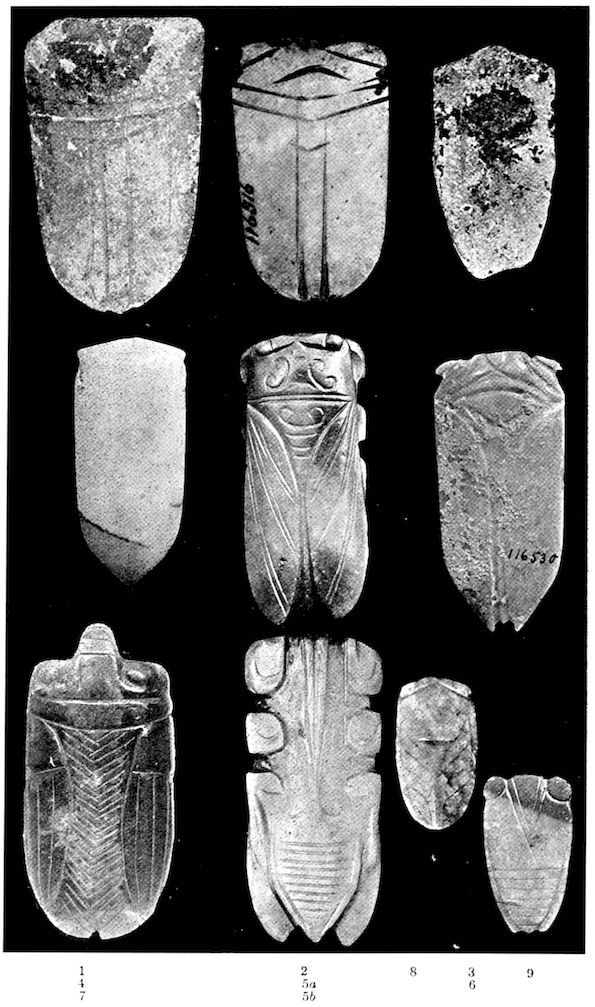
JADE TONGUE AMULETS FOR THE DEAD. CHINESE Figs. 1–4, plain types; Fig. 5, carved in shape of realistic cicada (a. upper, b. lower face); Figs. 6–9, conventionalized forms of cicada. From “Jade,” by Berthold Laufer. By courtesy of the author and Field Museum of National History, Chicago.
139
Jade
The first mention of this material is made by Monardes, who says:[276]
The so-called nephritic stone is a species of stone, the finest of which resemble the emerald crystal, and are green with a milky hue. It is worn in various forms, made in ancient times, such as the Indians had; some like fish, some like the heads of birds, others like the beaks of parrots and others again round as balls; all, however, are perforated, since the Indians used to wear them attached for nephritic or gastric pains, for they had marvellous efficacy in both these infirmities. Their principal virtue regards the nephritic pain, and the passing of gravel and stone, in such sort that a gentleman who owns one, the best I have ever seen, wearing it bound on his arm, passed so much gravel that he often takes it off, thinking that it may be injurious for him to pass such a quantity; and, indeed, when he removes the stone he passes much less.... This stone has an occult property, by means of which it exercises a wonderful prophylactic effect, preventing the occurrence of nephritic pain, and should it nevertheless ensue, removing or alleviating it. The duchess my lady, having suffered three attacks of this malady during a short period, had one of these stones set in a bracelet and wore it on her arm, and from the time she put it on, she has never felt any pain, although ten years have past. In the same way it has served many, who have realized the same benefit. Therefore, it is highly prized and it cannot now be worn so easily as in former times, as only caciques and noblemen own it, and rightly, since it has such wonderful effects.
The Chinese Taoist adept T’ao Hung Ching, who flourished A.D. 500, directs that when powdered jade is prescribed by a physician, carved jade must not be used, nor unwrought jade that has been buried in tombs. While sometimes a very fine powder was recommended, the usual plan was to reduce the jade by pounding it into pieces the size of small pulse. When administered in this form the Chinese physicians asserted that the powder passed unchanged through the system, but that the essential principle, the innate virtue, was absorbed by the patient. It relieved heart-burn and 140asthma and stilled thirst. Taken regularly for a long period it acted as a powerful general tonic, and had the special effects of strengthening the voice and rendering the hair glossy; but all these good effects could only be secured by the use of unwrought jade.[277]
The lapis nephriticus (jade) was held to be a remedy for œdematous affections of the feet. As this stone was so highly in favor in Europe for a century or two after it had first been brought from America by the Spaniards, many were of the opinion that it should be constantly worn to exert its full curative power. There were some, however, who argued that with this as with other remedies, constant and unremitting use weakened the effect, so that when the wearer was suddenly attacked by some disorder for which jade was a cure, his system would have become so habituated to its action that it would no longer work as a remedy.[278]
Of the lapis nephriticus the old Danish writer, Caspar Bertholin, relates in 1628 that four prominent citizens of Copenhagen, whom he had recommended to wear it to break up the calculi with which they were afflicted, could testify to its worth, adding, somewhat naïvely, “at least two of them can, for the two others are dead—but not of the stone.” He himself, however, although he had sent for specimens at great expense, to Venice, Nuremberg and Batavia, could not gain any relief from his trouble, but nevertheless, firm in his conviction of the special curative power of jade, he asserts that the calculi which tormented him must have been exceptionally hard and flint-like, so that they could not be broken up. The vogue enjoyed by this supposed remedy in the Denmark of the time is illustrated in the case of the reigning sovereign, Christian IV, who wore on his person a green nephrite until the day of his death. This stone is still preserved in the Rosenborg Museum collection among the relics of this king.[279]
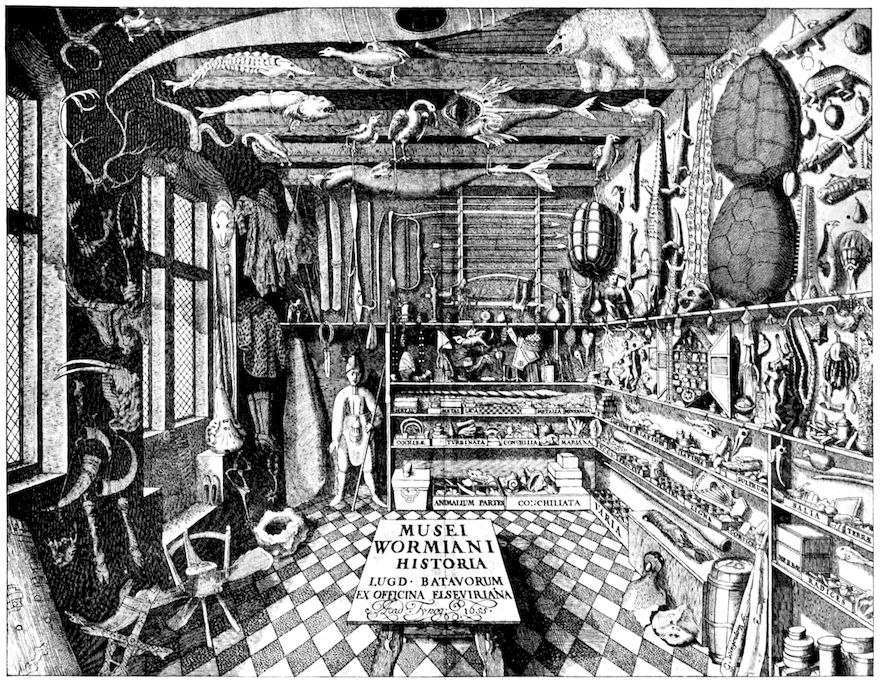
FRONTISPIECE OF MUSEUM WORMIANUM Printed in Leyden in 1655, showing a part of the remarkable collection of specimens illustrating natural history owned by Olaus Wormius of Copenhagen.
141Johannes de Laet was much impressed with the virtues of the lapis nephriticus as were most of his learned contemporaries, since he assures his readers that an oblong, smooth, moderately thick stone in his possession, having the color of honey and a very oily surface, had given his wife great relief from the severe pains caused by renal calculus, when the stone was bound upon her wrist. This particular specimen he sent a few years later to his Danish friend, Ole Worms, for the latter’s cabinet of natural history. De Laet writes that all the virtues claimed for nephrite by Monardes in 1574, were observable in his specimen.[280]
As late as 1726, there were some who retained faith in the curative power of jade, for a record of that date informs us that the traveller Paul Lucas had just come back to Paris from the Orient, and had brought with him a specimen of the lapis nephriticus which he intended to have cut up into thin slabs to bestow upon such of his friends as were suffering from gravel or calculus, or similar troubles.[281]
After relating that a specimen of American jadeite had been sent to him prior to 1602, Cleandro Arnobio states that when he showed it to a Signor Michele Mercato, “a man well versed in medicine and in the knowledge of minerals and herbs,” the latter immediately recognized it and called it “nephite,” from its virtues, saying also that he had found it useful in aiding parturition. A pharmacist, to whom it 142was shown in turn, declared that he had used the stone in this way but did not know its name. This is perhaps the earliest use of the name nephrite, the form occurring in the Italian text being either due to a typographical error, or to Arnobio’s ignorance of the correct spelling.
Proceeding to dilate upon the many virtues of this stone, Cleandro quotes Aldobrando, “a physician, physicist and philosopher of Bologna,” who described it as having usually a purple shade, almost like porphyry, with various figures of herbs, flowers, knots and Arabic characters in a yellow color. There were, however, according to the same authority, some of a darker hue, with protuberances and bands of yellow and also black spots, as though the stone were a section of the spleen. This kind was recommended and used in diseases of the spleen. In another variety, in the midst of the purple color might be seen a yellow stain with pittings and hollows; this was thought to figure a section of the liver, spattered with bile, and such stones were employed with good effect to cure those suffering from bilious disorders. To discharge the bile a dose of four grains was administered, the powdered stone being thoroughly dissolved in wine. Still another kind, of a reddish hue, “like coagulated blood,” full of pittings and veinings, was thought to be more especially valuable as a remedy for disorders of the blood and for checking hemorrhages.[282]
The learned Ko Kei asserts that the body of a man who had taken nearly five pounds of jade did not change color after his death and states that the body having been exhumed several years later did not show the slightest alteration. Besides this, it was observed that there were gold and jade around the tomb. Since then (in China), in the Kan period, the custom was followed of embalming the dead bodies of the emperors, and of preserving them in a garment ornamented with pearls and enclosed in a case of jade.[283]
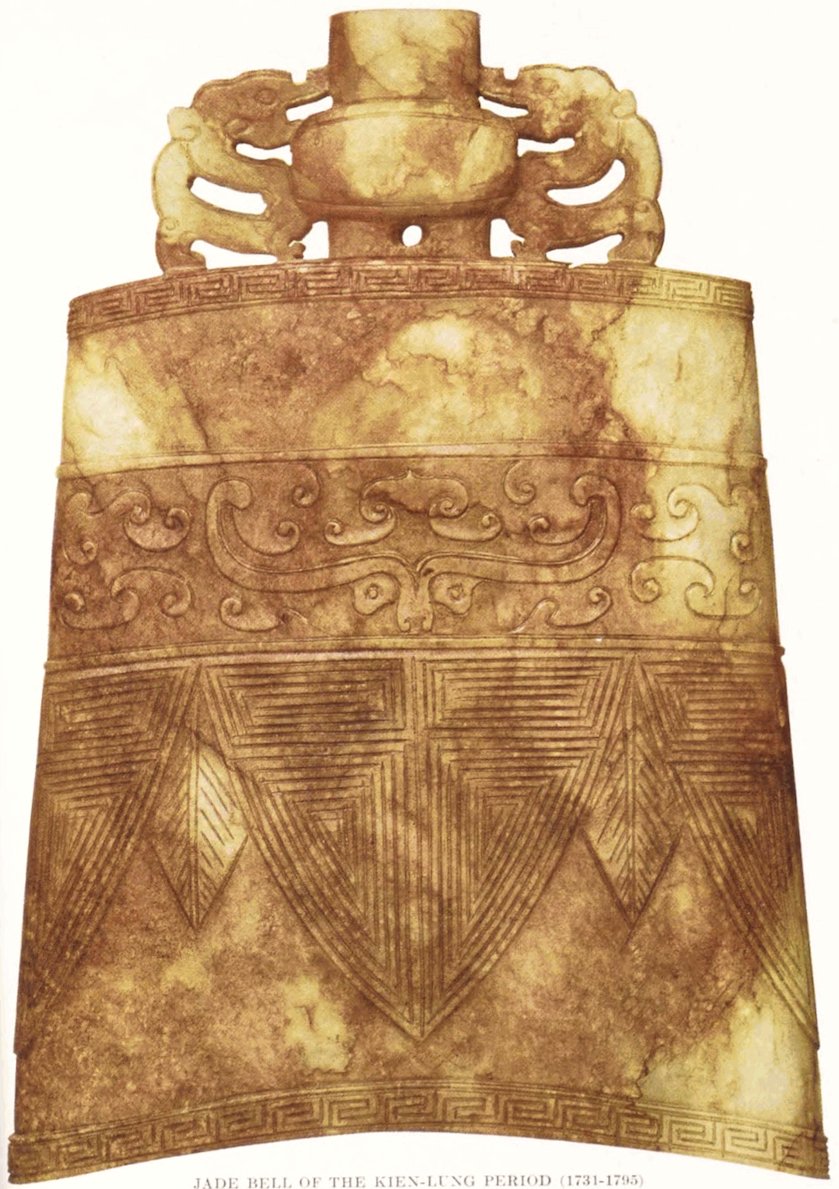
JADE BELL OF THE KIEN-LUNG PERIOD: 1731–1795. Carved out of a single piece of jade. Dimensions: height, 20 cm.; width 14.6 cm.; thickness, from 1 cm. to 3.8 cm. From Berthold Lauter, “Jade, a Study in Chinese Archæology and Religion,” Chicago, 1912. By courtesy of the author and Field Museum of Natural History, Chicago.
143The Indians of Brazil prize the so-called Amazon stones (jade) more highly than any other of the ornaments they wear. This is not chiefly because of their ornamental quality, but rather because these ita ybymbae (green stones) have in many cases been handed down from generation to generation for many centuries. They are of cylindrical, tabular or other regular form and polished, and are believed to be amulets affording protection against many diseases as well as against snake bites. They are worn suspended from the neck and are regarded as valuable aids in difficult parturition. Because of their remedial virtues they are sometimes called ita poçanga, or “medicine stones.” They are also found with the natives of the Caribbean islands and are there called “the smooth stones from the far-off continent.”[284]
As in all superstitions, so in those concerning jade in China, the fact that ill luck instead of good luck fortuitously resulted from the use of the material was explained in a way that did not do violence to the fundamental idea. We are told that on the road near Kneha, in Turkestan, there lies a block of jade from the quarries of Raskam-Darya, in Eastern Turkestan. This block was on its way to Peking, when orders came from the imperial court not to forward any more jade from this quarry. The reason was that the heir apparent had been taken ill after having slept on a couch made of Raskam jade.[285]
144
Jasper
In the collection of the Biblioteca di Ravenna there is a red jasper amulet engraved with a device representing Hercules strangling the Nemæan Lion. Amulets of this type are recommended for the cure of the colic by the Greek physician Alexander Trallianus, who flourished in the first half of the sixth century A.D. He directs that this design be engraved on a “Median stone,” which is then to be set in a gold ring and worn by the patient.[286] The fact that the constellation Leo was believed to rule over the stomach, and possibly over the liver also, probably determined the selection of the design. On the reverse of the Ravenna amulet are inscribed the letters K K K, which are believed to stand for Κωλική, “colic.”[287]
After noting the power of the jasper (probably the red variety) to check hemorrhages from any part, and its general effect upon the circulation of the blood in reducing the pulse, thus calming desire and quieting the restless mind, Cardano turns to another of the reputed virtues of this stone, that of rendering the wearer victorious in battle. The true reason for this he finds in the stone’s tendency to diminish passion, and hence to render the wearer timid and cautious, for “the timid usually conquer, since they avoid a doubtful contest if possible.” Gesner states that he saw “in the possession of a writer of Lausanne,” a green jasper, bearing the image of a dragon with rays, similar to the gem described by Galen.[288]
Of the jasper, De Boot relates,[289] from his own experience, that for checking hemorrhages the red variety is the most effective, and, in this connection, he describes the case of a young woman in Prague, who had suffered for six 145years from hemorrhages. Many different remedies had been tried without avail, and when De Boot was called in to attend the case, he advised the woman to wear a red jasper. As soon as this stone was attached to her person the hemorrhage ceased. After wearing the jasper for some time, the woman thought she could safely lay it aside, but whenever she did so the hemorrhage returned after a longer or shorter interval, while it always ceased immediately she resumed wearing the stone. This seemed to prove conclusively that it checked the flow of blood. Eventually the woman was so effectively cured that she was able to give up wearing the stone. Green jasper, if worn attached to the neck so as to touch the gastric region, was, according to De Boot, a cure for all diseases of the stomach. The same writer alludes to the belief that the virtue of this stone was enhanced if it were engraved with the image of a scorpion while the sun was entering the constellation Scorpio, but he rejects this belief as entirely superstitious and futile, while admitting that, to obtain the best results, the jasper should always be set in silver.
Pear-shaped pieces of red jasper seem to have been more especially favored for use as amulets. Italian amulets of to-day show this, and Bellucci finds that the form is chosen as representing a drop of blood, and thus aiding, by sympathetic magic, in the cure of hemorrhages or wounds, and preventing the infliction of the latter. Sometimes such amulets of red jasper are attached to the bed-post by a red ribbon. In the case of a particularly valued amulet of this type, Bellucci was informed by the peasant owner that it owed its great virtue to having been blessed by the parish priest. Thus the traditional power of a pagan amulet received the sanction of the church and the object was associated with purely Christian amulets.[290]
146
Jet
Jet, the gagates of the ancients, was said to have been first found in the river Gagates in Lycia, whence its name was derived. Galen, the greatest physician of ancient times, reports, however, that he searched in vain for this river, although he sailed in a small vessel along the whole coast of Lycia, so that he might closely observe it. Still, he did not give up his search for the material, even when he failed to find its reputed source, and in Cælo-Syria, on a hill on the eastern shore of the Dead Sea, he came across certain black, crustaceous stones, which emitted a slender flame when placed in the fire. These must have been small masses of bitumen, and, according to Galen, they were used for chronic swellings of the knee-joint “which are difficult to cure.”[291]
The fumes of jet are mentioned as a remedy for the pest in one of the earliest Greek medical treatises, written by Nicander, who flourished in the second century B.C. He declares that the most virulent pestilence could be driven away if the bedrooms were fumigated with the smoke of the slow-burning jet.[292] The plague was called the black plague and naturally the aid of a black substance was sought to cure it.
For Pliny, jet was endowed with many medicinal virtues. Its fumes were a cure for hysteria and were said to reveal the presence of a latent tendency to epilepsy; connected with this in some way was the curious belief, repeated by later authors with certain variations, that these fumes could also be used as a test of virginity. When powdered and mixed with wine, jet relieved the pains of those suffering from toothache, and if the powder were combined with wax, 147a salve was produced that gave very beneficial results in cases of scrofula.[293] Even as a toilet preparation jet was recommended for use, and a most excellent dentifrice is said to have been made from it. In this connection jet was credited with tonic as well as cleansing properties, as is shown by the words of Bartholomæus Anglicus, who declares that this material was especially beneficial for “feeble teeth and waggyng,” since it strengthened them and made them firm.[294]
The delusions and hallucinations of melancholic subjects were believed to be put to flight by the power of jet, either in its solid form or when reduced to a solution. The fact that this material was often used for the beads of rosaries was thought to have some connection with its supposed virtues, since the bad dreams or dreadful hallucinations sometimes accompanying melancholia were designated as “demons,” and thus the prayers counted off on jet beads might be supposed to have the greater power to banish the devil and his black angels. The old writer who cites these particulars about jet, adds that there was to be found in the river Nile a black stone the size of a bean, at sight of which dogs would stop barking, and which also drove away evil spirits. Here we have another among many instances of the curious blending of the doctrines of sympathy and antipathy, the black stone repelling the imps of darkness and nullifying the spells of the Black Art.[295]
Lapis Armenus
The lapis Armenus was well known to the Arabs under the name hajer Armeny, and their medical writers describe it quite accurately and distinguish it from the somewhat 148similar lapis lazuli, with which it was often confused in ancient times. Ibn Beithar states that if properly prepared it would not provoke nausea, as was otherwise the case. It was said to cause a very abundant evacuation of bile and must have been regarded as an efficient remedy for the bilious disorders so general in warm climates.[296]
A “blue amulet” against vertigo, melancholia and epilepsy could be made up of the following ingredients: shavings from an elk’s horn and from a human skull, to be reduced to a fine powder, the excrement of a peacock, white agate, lapis lazuli or lapis Armenus, of which enough was to be used to give the required sky-blue tint. The whole mass was then to be softened by the addition of gum tragacanth, and formed into heart-shaped tablets, which were to be dried out in the air, and then smoothed on a turning-lathe. These amulets were to be worn attached to the neck or the arm, sometimes they were enclosed in a little receptacle of silver or of red sandal-wood and suspended from the neck.[297]
Lapis Lazuli
In Papyrus 3027 of the Berlin Museum, a record that dates from about the fifteenth century B.C., and appears to be contemporaneous with the celebrated Papyrus Ebers, we have directions for the curative use of three stones as amulets; namely, lapis lazuli, malachite (Amazon stone?) and, probably, red jasper. The interpretation of the text offers considerable difficulty, but it seems that the stones were worked into the form of beads and then strung on a cord and suspended from a sick child’s neck. Thereupon a formula was recited, calling upon the disease to pass 149through the beads and disperse itself through water and air, or, more literally, to attach itself to the denizens of water and air. The translation of Dr. Adolph Erman is as follows:[298]
[A red bead? of lapis lazuli thereon.]
... a green bead? of malachite is thereon.
a red bead of jasper? is thereon
O, ye beads! fall upon the haunches [of the ...] in the flood; on the scales? of the fish in the stream; on the feathers of the birds in the heavens. Hasten forth! nšw, fall upon the earth
Let this text be recited over the beads?, one of lapis lazuli, the other of jasper?, the other malachite, which are drawn on a string of ... and hung upon the neck of a child.
Erman does not venture to translate the name of the disease (nšw), but says that another word derived from the same root signifies a discharge from the nose. Possibly we have to do with croup or some similar disease of the respiratory organs.
A curious prescription for the cure of cataract is given in the Ebers Papyrus,[299] dating from about 1600 B.C. The six ingredients are as follows: genuine lapis lazuli, verdigris salve, a resinous substance perhaps similar to what is to-day called tabasheer, milk, stibium, and “crocodile-earth,” the slime of the Nile. It is possible that the word chesbet, which usually signifies lapis lazuli, was understood in this case as indicating some other stone, such as that known by the name of lapis Armenus—this latter is a carbonate of copper and really possesses astringent properties.
For remedial use a lapis lazuli (cyanus) of deep hue is 150recommended by Dioscorides. This stone was to be burned thoroughly and the resultant powder moistened so that a kind of paste was obtained. This was claimed to have an astringent and caustic effect, and was freely used as a counter-irritant.[300] Probably here as in other cases a sulphate of copper has been confused with the lapis lazuli. The ancients did not favor the administration of lapis lazuli internally, and Braunfels[301] therefore regarded the free use of pills of lapis lazuli which was common in his time as a source of grave danger. The lapis Armenus, however, if well prepared and properly washed, was less to be feared; but, unfortunately, the genuine stone was rarely to be found in the apothecaries’ shops.
Malachite
Many medicinal virtues were ascribed to malachite. Worn as an amulet, it averted attacks of faintness, prevented hernia, and saved the wearer from danger in falling. In this latter respect similar powers seem to have been admitted in the case of the green malachite as were attributed to the light blue or greenish-blue turquoise. If malachite were reduced to a powder, dissolved in milk and taken as a potion, it cured cardiac pains and colic; mixed with honey, and applied with a linen cloth to a wound, it stanched the flow of blood, and cramps were relieved if this solution were applied to the affected part; lastly, if mixed with wine, it was a cure for virulent ulcers.[302]
Powdered malachite was sometimes administered medicinally, with what results we have little definite information; certainly, if not very carefully used, the effect would 151have been anything but favorable. A friend of De Boot once told the latter that a dose of six grains of powdered malachite acted as a purgative, but the wary doctor confesses that he never ventured to test the efficacy of this prescription.[303] In Bavaria, at the present time, mothers and midwives are fond of wearing pieces of malachite set in rings or strung for use as necklaces. These are believed to help the dentition of children and are also thought to bring more clients to the midwives. Amulets of this and other kinds were sold in Bavaria, in the seventeenth century, by wandering students and by gypsies.[304]
Median Stone
Of the so-called Median stone we read, in Konrad von Megenberg’s “Buch der Natur,”[305] that it had powers of good and evil; “for when dissolved in the milk of a woman who has borne a son, it restores sight to the blind.” It also cured gout and insanity. If, however, anyone were so ill-advised as to dissolve the stone in water and partake of the solution, he would die of hasty consumption; or if he simply bathed his forehead with the liquid, he would be robbed of his sight.
Onyx
A famous medicinal stone was at one time in the Abbey of St. Alban, founded in 793 A.D. by Offa, King of Mercia, in honor of the British protomartyr. In 1010, under Abbot Geoffrey de Gorham, a sumptuous shrine was erected to receive St. Alban’s body; this shrine was principally of silver, and was richly adorned with precious stones, chosen 152from among those in the treasury of the monastery. The records state that one of these stones “was so large that a man could not grasp it in his hand.” It was believed to give great help to women in childbirth. Hence, it was not set in the shrine, but was left free, so that it might be taken from house to house as required. The size of this stone and the fact that it was not used for ornamentation might have induced the belief that it was one of the singular “eagle-stones,” so celebrated in ancient and medieval times, but it is expressly described as an onyx-gem, the gift of King Ethelred II (968–1016) to the monastery. From the description we learn that on one side of this onyx was cut an image of Esculapius, the god of healing, and on the other that of “a boy bearing a buckler.” As the art of gem-cutting was practically unknown in Europe in the tenth century, this must have been an antique gem, and may have served as a pagan amulet many centuries before it was placed upon the shrine of a Christian saint and used as a Christian amulet.[306]
An old manuscript of Matthew Paris[307] gives a sketch of the gem from this author’s own hand. As the special power exerted by this talisman was to aid women in their confinements, it was loaned out from time to time to such as were considered worthy of the honor. In one case, however, it came into untrustworthy hands, for the favored lady failed to return the gem when her immediate need of its help had passed, retaining it in her possession until her death, when she bequeathed it to her daughter. During her lifetime the latter appears to have had no prickings of conscience, but on her death-bed, possibly through the exhortations of her confessor, she made provision that the long-lost sardonyx 153should be returned to the Abbey. It is said to have borne the name Kaadman, which Mr. Thomas Wright regarded as a corruption of cadmeus or cameus, early forms of our “cameo.”[308]
Pyrite
In Geneva and in the neighboring regions great virtues are ascribed to a cut and facetted iron (pyrite), very hard, susceptible of a high polish and of resplendent lustre. This is cut to resemble the rose or brilliant form of diamond, and is set in rings, buckles, and other ornaments. In appearance it resembles polished steel and is called pierre de santé, or “health-stone,” for it is believed to grow pale when the health of the wearer is about to fail.[309] This substance is known as marcasite and is a bisulphide of iron. In the time of Louis XVI it was largely used for ornamental purposes; at present steel has almost entirely taken its place, although it is still utilized to a limited extent. Many believe that this is the material to which Victor Hugo alludes in his great romance, “Les Miserables,” as having been manufactured by Jean Valjean.
Rock-crystal
Medical men in Rome, in the first century, attested that no better cautery for the human body could be used than a crystal ball acted upon by the sun’s rays,[310] and this use of the material seems to have been very general at that time.
In his commentary on Andrea Bacci’s gem-treatise, Wolfgang Gabelchover, the German translator, says that a German name of rock-crystal in his time, the early sixteenth century, was Schwindelstein (“vertigo-stone”), because 154it was believed to preserve the wearer from attacks of dizziness. Other remedial or physical effects of rock-crystal are also noted. Taken as a powder in dry wine, it was a cure for dysentery, and the physician, Christopher Barzizius, taught that if its powder were mixed with honey and administered to mothers, they would be the better able to nurse their offspring.[311]
The following lines by Robert Wilson (d. 1600), a popular sixteenth-century comedy writer, credit amber and rock-crystal with qualities not commonly ascribed to them, although the fancied growth of rock-crystal from a piece of ice probably explains its supposed styptic virtue:[312]
Lucre: And if they demand wherefore your
wares and merchandise agree,
You must say, jet will take up a straw;
amber will make one fat;
Coral will look pale when you be sick,
and crystal stanch blood.
That a remedial tincture of rock-crystal could be made was firmly believed by the Danish chemist, Ole Borch (Olaus Borrichius, 1626–1690), and in his chemical lectures he gives the following directions as to the processes to be employed. A rock-crystal was to be heated to a high temperature and then cast, while still warm, into cold water; it would thereupon break up into small fragments. By heating these particles together with tartaric salts, the whole mass would be reduced to a liquid solution. Half of the quantity, after cooling off, was to be put into a distilling glass with the best “spirit of wine” and was to be digested in a bath of lukewarm water. It would then be seen that the solution became red. This process is repeated several times, and finally the tincture is concentrated by distilling off the spirit of wine, leaving the pure rock-crystal tincture. Its remedial quality is stated to have been applicable to dropsy, scrofula, or hypochondriac melancholia, if it were taken in doses up to forty drops in a proper medium.[313]
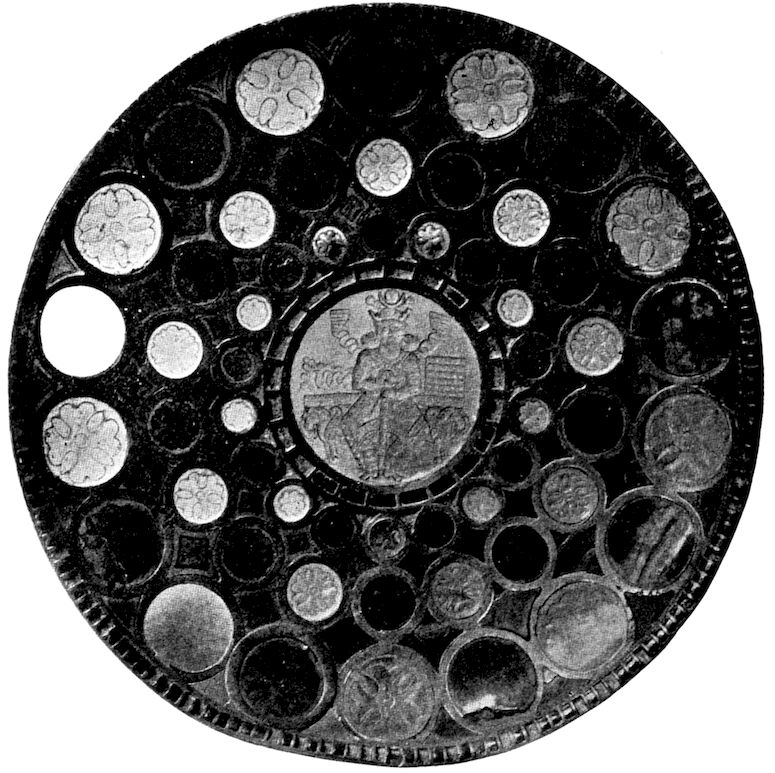
ANCIENT PERSIAN RELIC KNOWN AS THE “CUP OF CHOSROES” The engraved rock-crystal medallion in the centre depicts Khusrau II, Parwiz (A. D. 591–628), in the peculiar and characteristic garb of the Sassanian monarchs. The strange wing-like adornments rising from each shoulder, and the moon crescent and sun-disk above the head, are especially noteworthy. In the Royal Museum, Bucharest, Roumania.
155To make the magisterium of rock-crystal, a pound of the substance was to be heated to a high temperature and then dipped into spirits of vitriol. After this operation had been repeated ten times, the rock-crystal was to be ground, on a marble slab, to a very fine powder, which was a sure remedy for gout and for calculi formed in any of the bodily organs. The spirits of vitriol in which the rock-crystal had been dipped was sometimes filtered through blotting-paper and sold as crystal spirits of vitriol; this was asserted to be a powerful diuretic, from seven to ten drops being given at a dose in a cup of meat broth.[314]
As late as the last half of the eighteenth century a Dr. Bourgeois recommended the use of rock-crystal, calcined and ground, as a very excellent astringent in the most obstinate cases of diarrhœa. In reporting this, Valmont de Bomare (1731–1807) adds that it would be desirable to know the nature of the acid in rock-crystal and its state of combination.[315] Here, as in all cases where some of the constituents of precious stones may really possess certain curative powers, a better result can be attained by using these constituents in other forms or combinations.
The wonderful therapeutic virtues of a Scotch lake named Loch-mo-naire are explained by a local legend as 156having arisen from certain magic crystals which had been cast into its waters. These crystals, if placed in water, rendered the liquid a potion of great curative power. They were the property of a woman who had gained by their possession a great reputation as a healer, but her success attracted the envy of a neighbor who determined to secure for himself the woman’s wonder-working stones. In pursuance of this design he came to her, feigning illness. She saw through his deception and sought safety in flight, but he pursued her and was gaining rapidly on her, when she threw the stones into the waters of the lake, crying out the Gaelic word noire, “shame,” and uttering the wish that its waters should be rendered powerful to cure the sick, all except those of the clan Gordon to which the would-be thief belonged. As the correct translation of the name of the lake is said to be not “Lake of Shame” but “Serpent Lake,” the legend appears to have no good foundation, but is perhaps as true as any of the popular tales purporting to explain the origin of the virtues of healing springs or waters.[316]
To many stones was attributed the power of transmitting a certain remedial virtue to water or other liquid in which they were immersed. This, as we have related, was the case with the white stone that St. Columba sent to King Brude at Inverness when the king’s druid priest Broichan was suffering from disease. A peculiarity of this stone was that if it were required in the case of a person about to die, it would disappear from view. Thus its remedial powers could never be put to test unless success were assured.[317]
There can be no reasonable doubt that some remarkable cures have been effected by means of relics, or by drinking the waters of a spring believed to have been pointed out by some divine vision. From a purely scientific standpoint 157this can be explained as the result of an extraordinary stimulation of the nerve-centres, caused by the rapt enthusiasm of religious faith. The relics, or the pure water, simply serve as an object about which this faith crystallizes, so to speak, and gains a concrete and external form, which in turn reacts upon the mind of the believer. It is a well-known fact that a great shock, or imminent peril, has sometimes suddenly restored the power of motion to those who have long been paralyzed. This view does not, however, necessarily exclude a religious interpretation of these phenomena when they are produced by religious impressions, for the divine will manifests itself by natural means, and a true understanding of the regular and normal working of these means should give us a deeper, truer, and purer faith.
Sapphire
As a substance for medicinal use, the Hindus declared the sapphire to be bitter to the taste and lukewarm. It had a remedial action against phlegm, bile and flatulence.[318] A similar action is ascribed to several other precious stones, the medicinal qualities attributed to them being less differentiated among the Hindus than they were with the Greeks and Romans, or in medieval times.
To drink of a potion made from the sapphire was said to be helpful for those who had been bitten by a scorpion, and for those suffering from intestinal ulcerations, or from growths in the eye; it also prevented boils and pustules, and healed ruptured membranes.[319] Here we see that the sapphire shared with the emerald the power of strengthening the sight, and one authority asserts that if anyone looked long and intently at a sapphire, his eyes would be protected 158from all injury, and nothing harmful could befall them.[320]
A medieval test of the antitoxin quality of the sapphire was to place a spider in a vessel to whose mouth a sapphire was so suspended that it would swing backwards and forwards just above the spider. The supposedly venomous insect was not long able to resist the power of the stone and fell a victim to its virtues. Wolfgang Gabelchover gravely asserts that this experiment had often been successful.[321]
The removal of particles of sand or dust from the eye was said to be successfully accomplished by “warming” a sapphire over the eye, the virtue of the stone thus passing into the eye and giving the organ the strength necessary for the ejection of the troublesome foreign body.[322] This attribution of a chemical action to the sapphire in eye-trouble may be added to the many statements of its general curative powers in eye-diseases.
Topaz
The thirteenth century Hindu physician Naharari states that the topaz tastes sour and is cold. It is a remedy for flatulence and is a most excellent appetizer. Any man who wears this stone will be assured of long life, beauty and intelligence.[323] Many a curious legend has been woven about the old belief that the topaz quenched thirst. However, popular fancy does not endow any and every topaz with this power. One of these thirst-removing topazes is said to have been in the possession of a celebrated Hindu necromancer, whose services had been sought by one of the petty rajahs of India on the day of a decisive battle. Either this necromancer’s art must have failed him at the critical moment, or else a more powerful enchanter guided the fortunes of the enemy, for the latter prevailed and the owner of the potent topaz was left dying upon the field of battle. Alongside him was a poor wounded soldier who was clamoring for a drop of water to quench his burning thirst. Hearkening to this prayer, the dying necromancer threw his topaz to the soldier, telling him to place it upon his heart. No sooner did he do so than his thirst passed away, and we must suppose that his wounds were also healed, for we are told that on the morrow he sought everywhere on the battle-field for the corpse of his benefactor but could find no trace of it.
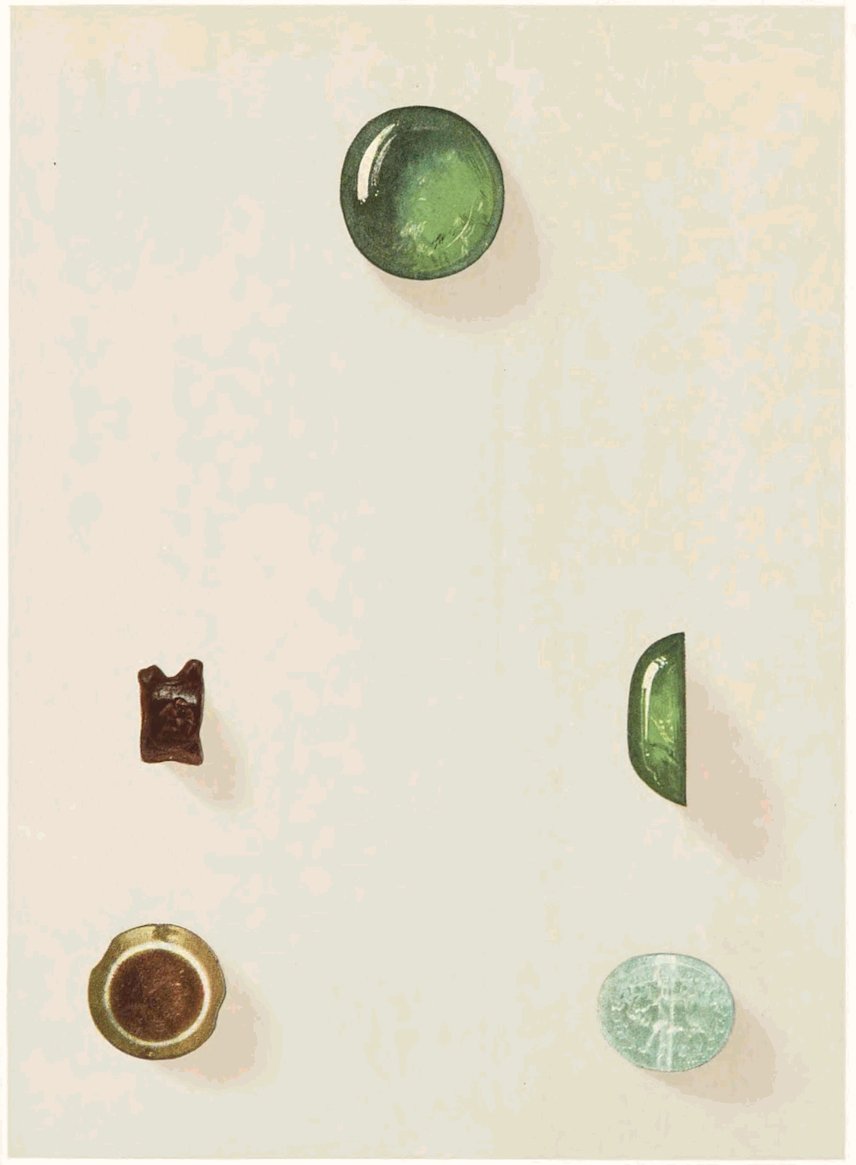
1. Emerald that belonged to the deposed Sultan of Turkey, Abdul Hamid; weight 45.33 carats. Auctioned December 11, 1911, Paris. 1½. Side view of the emerald. 2. Almandite garnet (transparent) fashioned into a knuckle bone; on the upper surface is engraved an eagle with outspread wings, above which are the Greek characters κακγ. Charm seal of some early knuckle-bone player. 3. Sardonyx idol-eye of a Babylonian bull, pierced for suspension. Engraved at a later period with the head of a Parthian king. 4. Aquamarine seal (transparent). Sassanian Pahlavi. Found in ruins of Babylonia.
159Tavernier, the great French Seventeenth Century jeweler-traveler, the first European to visit the ruby mines, took with him a number of emeralds, generally large. These were often cut from the top of the crystal, usually darker in color, and simply domed off, preserving the original hexagonal shape. Remarkable specimens are in the Indian Museum and the South Kensington Museum, part of the jewels of Thebaud, King of Burma. The finest emeralds of this type belonged to the late Sultan of Turkey; one of the finest, a remarkable gem, cut rounded en cabochon, was with the Bijoux du Sultan, S. M. Abd-Ul-Hamid II, sold at the Galerie Georges Petit, November 28, 1914. It weighed 44³⁄₁₆ carats (old system) or 45.29 carats (metric system). (See color plate.)
A remarkable charm is a hemispherical, transparent aquamarine, with figure of hump bull, found in ancient Babylonia. (See color plate.)
A quaint, ancient amulet is carved out of fine knuckle bone, an eagle with spread wings engraved on one side; portrait of a Parthian King. (See color plate.)
A Babylonian idol’s eye, of sardonyx, was pierced and worn as charm against the Evil Eye; later engraved with portrait of a Parthian King. (See color plate.)
160