IV On the Virtues of Fabulous Stones, Concretions and Fossils
Reading edition
Not only precious or semi-precious stones were used as charms or talismans and for curative purposes; a large number of animal concretions also were and are still somewhat in favor. These concretions, variously composed but usually containing a quantity of carbonate of lime, are found in different parts of animals’ bodies, and they were believed to contain a sort of quintessence of the nature of the animal in which they occurred. For this reason the alectorius, from the body of the cock, one of the most widely known of the animal stones in ancient times, was thought to confer valor upon the wearer, and is said to have been worn by athletes in their contests.
In the case of venomous, or supposedly venomous, creatures, such as the toad and certain snakes, the stone was used as an antidote for poisons. This virtue was thought to be notably present in the so-called bezoar stone, taken from the stomach of a species of goat, as well as from some other animals. As we shall see, legend sought to account for the peculiar qualities of the bezoar by the tale that the animals in whose bodies the stones were formed had been bitten by serpents. Indeed, it seems not unlikely that the belief in the curative properties of the bezoar stone originally owed its existence to the finding of some such concretion in the body of an animal that had died from the effects of snake-bite.
As is well known, certain pathological conditions induce the formation of stones of various kinds and shapes in the 161human body also. Here the tendency has been to use these stones to counteract the disease which produced them. Renal or vesical calculi, for instance, were recommended for diseases of the kidneys and bladder, a treatment quite in accord with the popular idea of the homeopathic theory.
Another class of animal substances, namely, the fossil teeth of the shark, enjoyed a tremendous vogue at one time, and were known by the name of glossopetræ. These were usually regarded as stones, and because of their peculiar form were frequently assimilated to the belemnites and even to the flint arrow-heads and other prehistoric flint instruments, which were dug up in many places. All these flint artefacts were believed to have been precipitated to the earth by the discharge of electricity during a thunder-storm; in other words, they were “thunderbolts.”[324] The same idea was frequently held as to the origin of the glossopetræ, and those found on the island of Malta were brought into connection with an incident of St. Paul’s visit to that island.
In many different countries, especially in the north of Europe, these flint arrow-heads and the fossil remains of similar form, were called fairy-darts or elf-shots, and were believed to be the enchanted weapons of the elves and fairies, who, in the old folk-lore, are represented as beings of a very different quality from the fairies and elves of the tales of our childhood. In some parts of Europe at the present day, for example in Ireland, the peasantry talk with bated breath of the doings of the “good people,” for they shrink from using the word “fairy” lest it might offend these mysterious and generally malevolent beings. The designation “good people” is therefore used to placate and flatter them.
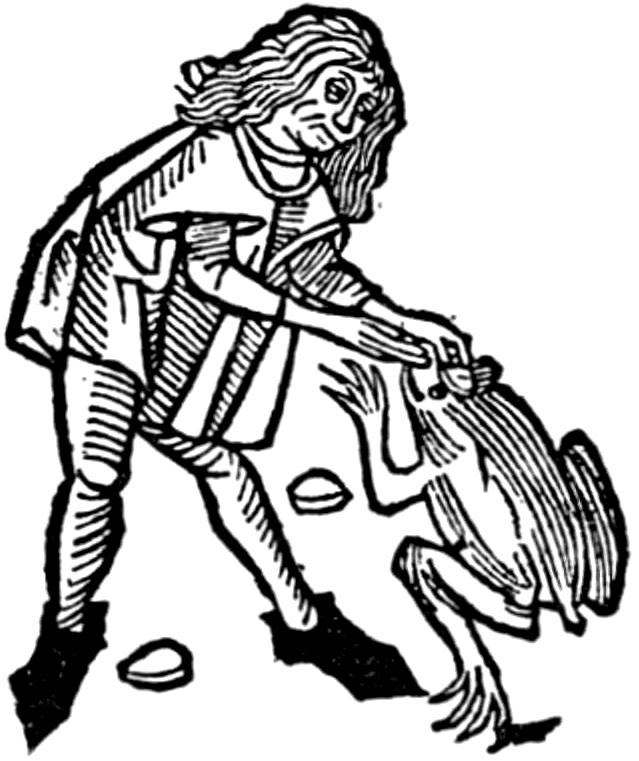
Extracting toad-stone. From Johannis de Cuba’s “Ortus Sanitatis,” Strassburg, 1483.
Various shell fossils were also used as talismans. Here the form generally determined the virtues they were supposed to possess. Some of these strange forms lent themselves 162to an interpretation in line with the primitive adoration of the life-giving forces of nature, and suggested the use of such fossils to cure certain special diseases. Other of these petrifactions retaining the form of the enclosing shell, especially those of circular shape, and with concentric rings, were believed to be of meteoric origin and to have fallen during thunder or rain; hence the names of brontia and ombria. A certain class of these fossils, with convolutions on the surface resembling the form of a snake, were called snake-eggs (ova anguina), and, very naturally, enjoyed the repute of preserving the wearer from poisons. All these varieties will be described in this and the following chapters.
While some believed that the toad-stone was vomited by the animal, others held that it constituted a part of the toad’s head. That this was the popular belief in Shakespeare’s time is shown by the well-known lines in his “As You Like It” (Act II, sc. 1):
Which like the toad, ugly and venomous,
Wears yet a precious jewel in his head.
De Boot, whose treatise was published about the time that Shakespeare wrote these lines, gives the following account of the result of his efforts to obtain a toad-stone according to the prescribed method:[325]
I remember that, when a boy, I took an old toad and set it upon a red cloth that I might secure a toad-stone; for they say that it will not give up its stone unless it sits upon a red cloth. However, although I watched the 163toad for a whole night, it did not eject anything, and from this time I became convinced all the tales concerning this stone were merely fond imaginings.
A stone called simply the “Indian Stone,” and said to be light and porous, is noted by pseudo-Aristotle, and to it is attributed the power to relieve those suffering from dropsy, by drawing the water to itself. If weighed after having been applied to the patient, the stone was found to have increased in weight in proportion to the amount of water absorbed, and when it was placed in the sun, water of a yellowish hue exuded, until, finally, the stone resumed its original appearance and weight.[326] Another and perhaps earlier authority gives the name “toad-stone” to this material.[327]
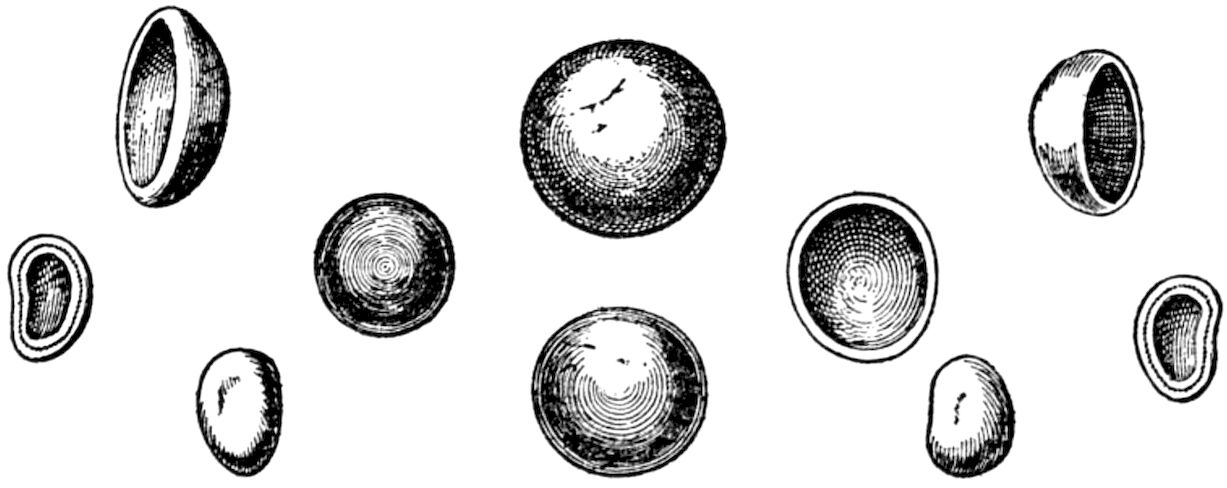
BVFONITES Toad-stones. Natural concretions of claystone and limonite. From Mercati’s “Metallotheca Vaticana,” Romæ, 1719.
The toad-stone was not only an antidote for poisons, but was also thought to give warning of their presence by becoming very hot. To fully profit by this strange quality, the wearer of such a stone was advised to have it so set in a ring that it would touch the skin; in this way he would be 164sure to have timely notice, if any poisoned food or drink were offered to him.[328] The writer who mentions this adds the following tale of the discovery of a toad-stone:
A clerk once found a toad which had a round knob on its head, wherefore he thought that there must be a toad-stone. So he took up the toad and tied it firmly in the sleeve of his coat. When he returned from the fields and searched for the toad he found it not, although the sleeve of his coat was tightly bound below and he could not discover any opening through which the creature could have passed. This shows us that it is a great help to prisoners in jail.
Another early authority, Thomas de Cantimpré, says of the toad-stone:
If one take the stone from a living and still quivering toad a little eye can be seen in the substance; but if it be taken from a toad that has been some time dead, the poison of the creature will have already destroyed this little eye and spoiled the stone.
If the toad-stone be swallowed at meal-time it passes through the system and carries off all impurities.[329] Here the substance may have been one of many concretionary materials,—bauxite, impure pearls, concretionary limestone, stalagmite, or even the eye-stones from the crawfish; indeed, any material, white or gray, that had a semblance to a toad color, and was then sold by the vendor of charm stones as coming from a toad’s head.
The great Erasmus (1465–1536) made a pilgrimage to the famous shrine of the Virgin in the church at Walsingham, in Kent. In his description of what he saw there he expressly notes a wonderful toad-stone:
At the feet of the Virgin is a gem for which there is as yet no Latin or Greek name. The French have named it after the toad [crapaudine], because it represents so perfectly the figure of a toad that no art could do this 165so well. The miracle is all the greater that the stone is so small, and that the exterior surface has not the form of a toad, the image showing through it as though inclosed within.[330]
As we see, the stone of Erasmus contained the form or image of a toad. This was not usually the case with the concretions that bore this name, and it appears probable that the “crapaudine” of the shrine at Walsingham owed its peculiarity rather to art than to nature. A rather far-fetched explanation of the origin of these substances is given by Ambrosianus, who relates that, in order to investigate the quality and character of toad-stones, he killed a number of toads and took out their brains. Although these were not hard when extracted, they became, in time, as hard as stones.[331]
A toad-stone which appeared to represent the form of this animal was preserved as an heirloom in the Lemnian family. It exceeded the size of a walnut and was often seen to dissipate the swelling caused by the bite of a venomous creature in any part of the body, if it were rubbed quickly over the swelling. It, therefore, seemed to possess the same quality as was attributed to the animal from which it was taken, namely, to draw out and annul all poisons. If any neighbor of the Lemnian family were bitten by a mouse, a spider, a dormouse, a wasp, a beetle, or any such creature, he soon sought the aid of this stone.[332]
We have noted De Boot’s unsuccessful attempt to secure a toad-stone, but he does not seem to have used the orthodox method for obtaining it. According to one authority,[333] the creature should be placed in a cage covered with a red cloth 166and then set in the hot sunshine for several days, until thirst forced the poor toad to eject his precious stone, which was to be removed as soon as possible lest it should be swallowed again. Another method proposed is so cruel that it is a comfort to know that the whole matter is little more than a fanciful conceit. In this case, the toad was to be enclosed in a pot with many perforations, and the vessel with its unlucky inmate was then to be placed in an ant-hill and left there until nothing remained of the toad except his bones and the coveted stone. It is quite probable that any stone found in an ant-hill after this procedure would be termed a “toad-stone,” since the toad was put away in order to find one. In some instances they may have been bony concretions from the head of the toad, or even pebbles that the toad had swallowed.
While it is quite possible that some of the so-called toad-stones may really have been concretions found in the head of the toad, by far the greater part were probably small pebbles sold as “toad-stones” to those who believed in the magic virtues of such a stone and were ready to pay a good price for one. Where there is a demand there will always be a supply, and the rarer the genuine article is, the greater is the incentive to imitation or substitution. In the case of some of these “toad-stones” set in rings to serve as amulets, the material has been found to be the fossil palatal tooth of the ray, a species of fish.[334]
The small share of material prosperity that fell to the lot of wits and literary men in the England of the sixteenth century, even in the age of Elizabeth, induced Thomas Nash (1567–1601) to liken the fate of the wit to that of the toad-stone, or, as he writes, of “the pearl,” which was said to be in the head of the toad, this “being of exceeding virtue, is enclosed with poison; the other, of no less value, compassed 167about with poverty.”[335] A writer of the same period affirms that if the toad-stone were touched to any part, “envenomed, hurt, or stung with rat, spider, wasp, or any other venomous beast,” the swelling and pain were diminished.[336]
The bones of the lizard were supposed to have medicinal virtues similar to those attributed to various “stones” found in animals. The following directions are given by Encelius for securing these bones: “Put a green lizard, while still alive, in a closed vessel filled with the best quality of salt. In a few days the salt will have consumed the flesh and the intestines, and you can easily gather up the bones.”[337] These were used as remedies for epilepsy and were considered to be as efficacious as the hoofs of the elk, a recommendation which seems to have been regarded as sufficient to convince the most sceptical of the remedial virtues of the lizard’s bones.
The crab furnished the stone called the crab’s-eye, because in form it resembled an eye. Like almost all the animal concretions, it was principally used as a remedy for those suffering from vesical calculi, and no other concretion was believed to be so efficacious in breaking up or dissolving the calculi in the case of those who had long been afflicted with them. Those referred to by Encelius were from the crawfish and are often used as eye-stones.[338]
In the last joint of a crab’s claw was sometimes found a small concretion closely resembling in size and appearance a grain of millet-seed; it was in no wise like the “lapillus” found in crab’s eyes. We have the testimony of Cardanus that he had preserved two such concretions, one of which he had himself come across, while the other had been found 168by a colleague. They were smooth and light, and of a reddish-white color. Because they were very rarely met with, the circumstance was regarded as of good augury for the finder.[339]
A round concretion (a calculus) from the liver of the ox is described by Ibn Al-Beithar as being of a yellowish color and composed of successive superimposed layers. If secured at the time of the full moon it was believed to promote embonpoint, and was much prized by the Egyptian women for this virtue. The effect was to be attained by taking two grains of the pulverized concretion, either with the bath or directly after bathing, and thereupon a “fat hen” was to be eaten.[340] The latter prescription, if regularly and frequently administered, might be thought to suffice without the powdered calculus.
From the second stomach of heifers was sometimes obtained a dark brown or blackish concretion of very light weight and as round as a ball. This was credited with great remedial virtues provided it had not fallen to the ground.[341] There seems to have been a belief that the curative or talismanic properties of animal concretions, or of the teeth of animals, were weakened, or destroyed, if these objects came in contact with the earth. This belief was perhaps due to the idea that the mysterious power of the substance was originally derived from earth currents, or emanations, and that the active principle would return to the earth if the object came in contact with it.
The lapis carpionis or carp-stone, a triangular mass, was taken from the jaws of the carp. It was smaller or larger according to the size of the fish. The principal remedial use was against calculi, or for the cure of bilious diseases 169and colic.[342] These are bony plates from the upper part of the mouth of the carp. Such so-called “stones” were also said to check bleeding of the nose, a quality they owed to their astringent properties, quite noticeable if anyone tasted the powder made from them.[343]
The cinædias, a white and oblong concretion, had in Pliny’s time the reputation of possessing extraordinary powers, announcing beforehand whether the sea would be clear or stormy.[344] In what way this weather prediction was manifested we are not told; perhaps the surface of the concretion may have become dull or grayish when there was much humidity in the air. The cinædia were said to be found in pairs in the fish of that name; one pair being taken from the head of the fish and another pair from the two dorsal fins. Power to cure diseases of the eye was conferred upon these concretions by putting nine of them, duly numbered, in an earthen jar together with a green lizard. Each day one of the “stones” was taken from the vessel in the numerical order, and on the ninth day the lizard was liberated. Evidently it was thought that to kill the animal would interfere with the transmission of its virtue to the concretions.[345]
The eye of the hyena was supposed to furnish a stone called hyænia and Pliny writes that these animals were hunted to secure possession of it. Like rock-crystal and many other decorative stones, this hyænia was thought to give the power to foretell the future, if it were placed beneath the tongue.[346] Because of the hyena’s uncanny habit of feeding on carrion, and unearthing dead bodies from 170graves, it has often been associated with necromancy and with evil spirits.
The lacrima cervi, or “stag’s tear,” is not to be confounded with the bezoar stone according to Scaliger, who maintains that it was a bony concretion that formed in the corner of a stag’s eye only after the animal had passed its hundredth year; as the stag never attains this age he might as well have said that the existence of this “tear” was a fable. However, he describes it as though he had carefully inspected a specimen, saying that it was so smooth and light that it would almost slip through the fingers of anyone who held it in his hand. It had similar powers to those of the bezoar, being a powerful antidote to poisons and a cure for the plague if powdered and given with wine; these good effects resulting from the excessively profuse perspiration that followed the administration of the dose.[347]
These fabled stag’s tears, though often praised as substitutes for the bezoar, were not believed in by all the early writers, one of them, Rollenhagen, giving expression to a caustic opinion that might do credit to a writer of our own day. Alluding to the many reports of the existence of such “tears,” shed by the animals because of the pains they suffered after indulging in a diet of serpents, he notes that all those who make these statements are careful to place the habitat of these eccentric stags as far away from their own land as possible, always “somewhere in the Orient,” probably at “Nowheretown,” as he adds.[348]
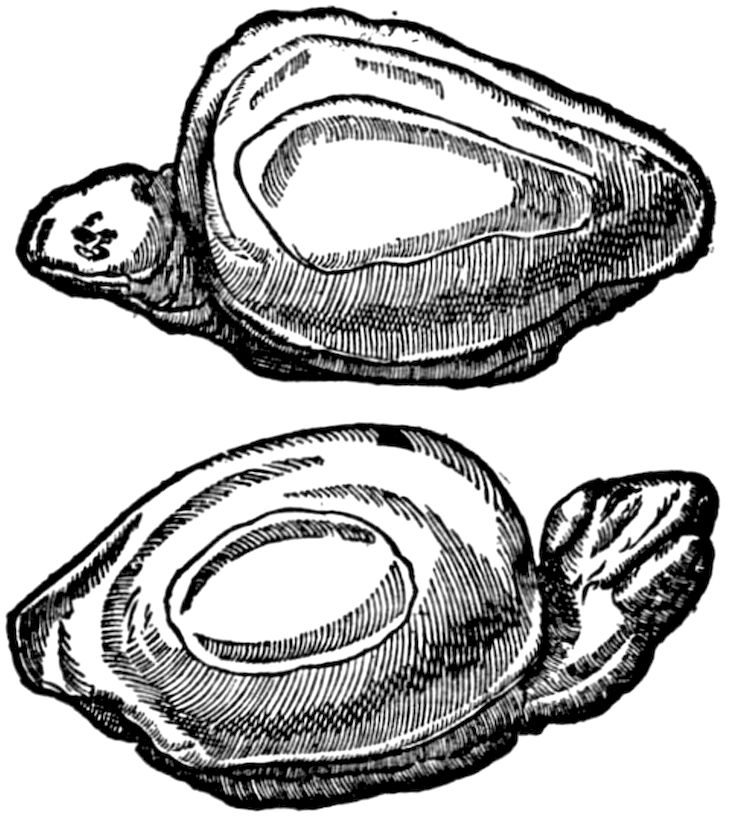
Types of cheloniæ (tortoise-stones). Natural concretions. From Aldrovandi’s “Museum metallicum,” Bononiæ, 1648.
The chelonia is said by Pliny to have been the eye of the Indian tortoise. The magicians asserted that this was the most marvellous of all “stones”; for if bathed in honey and then placed in the mouth, when the moon was either full 171or new, it conferred the power of divination, and this power lasted for one entire day.[349] This virtue was not, however, altogether peculiar to the chelonia, for it was shared by several other substances; in each case the stone was to be placed in the mouth, thus coming into more immediate contact with the organs of speech, and stimulating to prophetic utterance. A later writer states that it was the uterine stone from the tortoise that gave the gift of prophecy. That from the head cured headaches and averted lightning, while the stone taken from the liver, if administered in solution, was a remedy for ague.[350]
The wild ass was another of the animals that furnished concretions prized for their talismanic and medicinal powers. That taken from the animal’s head cured headache and epilepsy; that from the jaw made the owner indefatigable, so that he yielded to none in battle. It was also a remedy for ague and for the bites of venomous creatures, as well as a marvellously efficacious vermifuge for children.[351] Very likely the story of Samson, who wrought such slaughter 172among the Philistines when armed with the jawbone of an ass, may have suggested the fancy that the concretion from the ass’s jaw would give victory to the wearer.
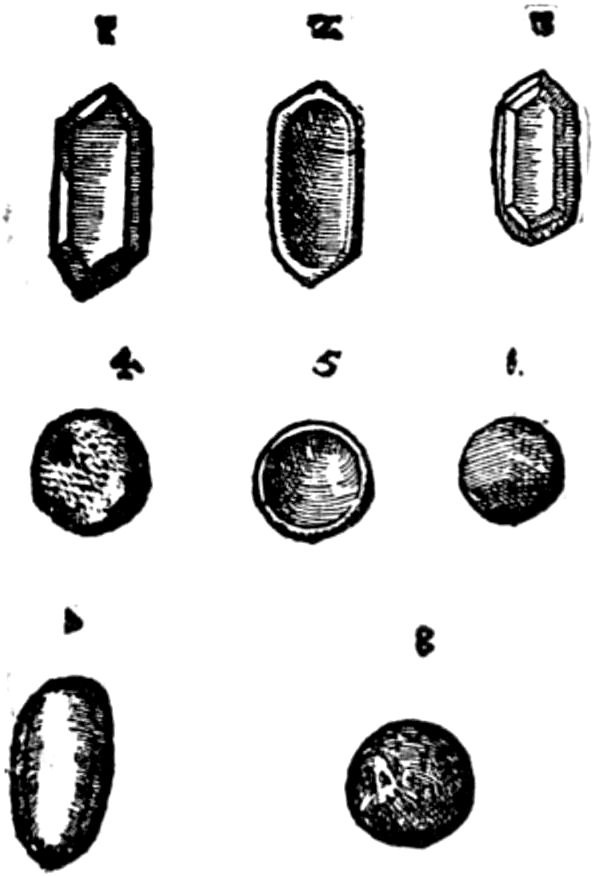
Chelidonius, or “Swallow-stones.” From “Museum Wormianum,” Lugduni Batavorum, 1655.
Pliny notes the opinion that a stone taken from the body of a young swallow, if worn attached to the human body, helps to strengthen the brain, and he adds that the stone is said to be found in the young bird even when it has just broken the shell.[352] According to Thomas de Cantimpré the swallow-stone is a talisman for merchants and tradesmen.[353] The merits of the chelidonius, as this stone was called, were fully recognized in Saxon England and are given due prominence in an Anglo-Saxon medical treatise, dating from the first half of the tenth century. When these “swallow-stones” had been obtained they were to be carefully protected from contact with water, earth, or other stones. To secure the best results three of them were to be applied to the person who stood in need of their remedial effects. Not only did they cure headache and eye-smart, but they banished the dreaded nightmare, rendered futile the wiles of goblin visitors, and dissolved all fascinations and enchantments. The seekers after these wonderful stones are stoutly assured that they can only be found in “big nestlings.”[354]
173The ætites (eagle-stone) is first mentioned by Pliny who states that it was found in the nests of eagles of a certain species, and adds that some called this stone gangites. Fire had no power over it and it was a useful remedy for many diseases. Its special virtue, however, was to prevent abortion, this use being suggested by the character of the stone itself, which “was as though pregnant, for when it was shaken another stone rattled within it, as though in a womb.” The curative virtues of the ætites, like that of the swallow-stone, only existed when the stone was taken from the bird’s nest. This was probably a story told by the vendors of such geodes to enhance the value of their wares, although there may have been some foundation for it in folk-lore.
They are really hollow concretions of an iron stone, containing a piece of loose iron or hardened sand, or a concretion of some kind that rattles, and is called by the Italians bambino or “babe.” Such concretions are found at many places on every continent, many fine ones having been found in Delaware. They vary in size from one to six inches across. The small ones of a hard, smooth exterior that have become polished from wear, are especially valued as charms.[355]
A passage in the treatise on stones by Theophrastus, pupil of Aristotle, might seem to indicate that the ætites was already known in the third century B.C. The words he employs are as follows: “The most astounding and greatest power of stones (if indeed this be true) is that of bearing progeny.” As both Pliny and Dioscorides name this stone or geode and fully describe its character, laying especial stress upon the loose, rattling material enclosed in its hollow interior, this fact giving rise in later time to the half-poetic 174name of “the pregnant stone,” there is every reason to believe that it was already known of three or four, or even more centuries before their time.[356]
Marbodus of Rennes calls this stone “the guardian and defender of nests.”[357] Enclosing as it did one or more smaller stones, it was thought to be symbolically designated as an aid to parturition. According as it was attached to the left arm or to the left thigh, it either retarded or accelerated the natural processes. This, however, by no means exhausted the virtues of the stone, for when worn on the left arm of man or woman, it conferred sobriety, increased riches, and moved the wearer to love; it also brought victory and popularity, and preserved children from harm. In addition to all its other powers this stone seems to have possessed a certain detective quality, to judge from the following words of Ætius, who wrote in the sixth century A.D.:[358]
The ætites serves to discover thieves, if anyone places it in the bread which they eat; for whoever has committed a theft is unable to consume the bread. It has also been stated that, if cooked with any kind of food, the ætites unmasks thieves, since they cannot eat such food. If taken with wax from Cyprus, with fresh olive oil, or with any other calefacient, this stone greatly helps those suffering from rheumatism and paralysis.
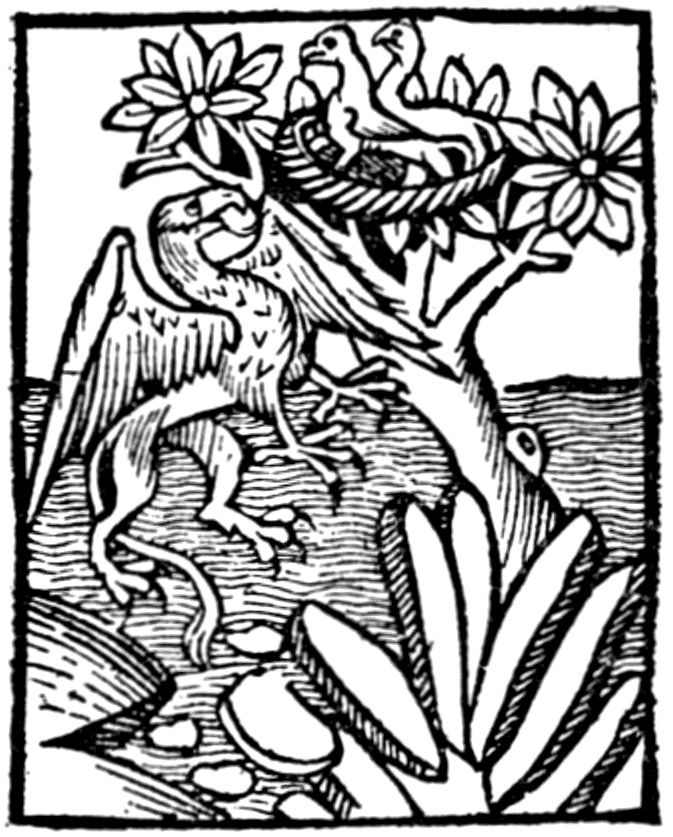
Ætites. From Johannis de Cuba’s “Ortus Sanitatis,” Strassburg, 1483.
The loose, enclosed concretion was named in Latin callimus, and we have a detailed description from the sixteenth century of one of these, which belonged to Georgius Fabricius. Because of its curious markings he had it set on a pivot in a ring, so that both sides of the stone could be easily seen. The material was in part as clear as a rock-crystal, evidently a very translucent chalcedony, but the 175chief interest centred in the images or figures traced by nature upon the stone. These showed what seemed to be two forms, one of a cowled monk, and the other that of a tall, beardless man; there was also a third, showing an undefined form. On the under side of this callimus was marked the outline of a crescent moon.[359]
A seventeenth century writer, not otherwise uncritical, does not hesitate to declare that he had himself witnessed, in the case of a fig-tree, an instance of the special power exercised by the ætites. One of these stones having been attached to this tree, all the fruit dropped off in, the space of ten hours, although tree had apparently lost nothing of its vigor, its foliage remaining as luxuriant as before.[360]
An old treatise on the ætites gives the following names as applied to it in various languages:[361]
Italian: Aquilina, pietra d’aquila, pietra aquilina, ethite.
French: Pierre de l’aigle.
Spanish: Piedra de l’aguila.
Polish: Orlovi Kamyen.
Swedish: Oernarsteen.
English: Eagle-stone.
German: Adlerstein.
Flemish: Adelersteen, arensteen.
Arabic: Hager achtamach.
176Syriac: Abno dneshre.
Chaldaic: Abno dineshar, or abno denishra.
Hebrew: ’Eben ha-nosher.
Some said that this stone might be found not only in the eagle’s nest, but also in that of the stork. This idea was, however, entirely erroneous in Bausch’s opinion, for though he had caused diligent search to be made by all those who encountered such nests, no “eagle-stone” could ever be found. To the supposed “stork-stones” had been given the name lychnites, as they were believed to be luminous, their light serving to frighten off any snakes which might be seeking the new-laid eggs.[362]
Bausch enumerates and rejects a number of explanations to account for the supposed presence of the ætites in the nests of eagles. One theory was that these stones served to give stability to the nest, and enabled it better to resist the assaults of the wind; others asserted that the coolness of the stones lowered the unduly high temperature of the eggs and of the parent bird’s body; others again were inclined to attribute to them a mysterious formative and vivifying power exerted on the eggs, or else a talismanic power protecting these from injury. While rejecting all these notions, as we have stated, and indeed denying the truth of the assertion that such stones were ever found in eagles’ nests, Bausch cites the authority of St. Jerome, in his commentary on Isaiah, chap. lxvi, that the amethyst had been found with the young of the eagle, being placed with them in the nest to protect them from venomous creatures.[363]
That the “eagle-stones” were not always hollow is shown by a specimen owned in the eighteenth century by the English family Postlethwayte. This was solid, and had been cut into the shape of a heart, a hole being pierced at the 177upper end so that the stone could be worn suspended. In a curious letter written April 25, 1742, by Martha Postlethwayte, sister of Sir Thomas Gooch, who successively presided over the episcopal sees of Bristol, Norwich and Ely, to her daughter Barbara Kerrick, the writer advises her correspondent, in order to avoid a repetition of former misadventures, to “wear the eagle-stone and take Mrs. Stone’s receit,” and adds: “I hope it may have good effect and make me a good grandmother.” The result was favorable, and must naturally have affirmed the faith in the powers of the stone.[364]
An inventory of the furniture, plate, jewels, etc., of Charles V of France, made in 1379,[365] describes two stones preserved in a case of cypress-wood which the king always carried about with him. One of these was called the “holy stone” and aided women in childbirth. This was probably an “eagle-stone.” It was set in gold and the setting was adorned with four pearls, six emeralds and two balas-rubies. The other stone, which cured the gout, was an engraved gem bearing the figure of a king and an inscription in Hebrew characters. This description suggests one of the Gnostic gems so common in the early Christian centuries. The gem was suspended from a silver cord, so that it could be worn on the neck, or perhaps attached to some other part of the body. We find in the comptes royaux of 1420 an electuary composed of powdered precious stones, for the cure of the infirmities of Isabel of Bavaria, who was fifty years old and had been for several years obese and a valetudinarian.[366]
In some parts of the Orient the superstitious notion exists that the ætites occasionally emits a wailing sound during the night, and this is said to be either an expression of the 178birth-pangs of the mother stone, or else the cry of its new-born offspring, the small stones enclosed within the geode, for the story goes that each night some of these are generated.[367]
These “eagle-stones” still retain their repute in Italy, where they are called pietre gravide, or “pregnant stones,” and are considered by many of the peasants as almost indispensable aids to parturition. They are in such demand that the lucky owners rent them for the nine months during which they are worn. As soon as one case has been happily concluded, the amulet is passed on to some other woman who is in need of it. A fee of five lire, or one dollar, is paid in each case, and a pledge worth a hundred lire ($20) is required before the stone is handed over. Some amulets of this class bear Christian symbols.[368]
Geodes of this description consisting of limonite are to be found in many places. Some of them are of relatively recent formation, and one of these shows curiously enough that in addition to its other virtues the ætites can on occasion perform the functions of a savings-bank. This strange specimen was found in 1846, at Périgueux, department Dordogne, France. On opening the geode there appeared within some 200 silver coins dated in the fifteenth and sixteenth centuries; all of these were encrusted with the material forming the enclosing mass.[369]
Long, white, rough stones, calcareous shell growths, were sometimes taken from snails and cockles. These were believed to have a marked diuretic action, and were therefore strongly recommended for certain diseases of the kidneys and the bladder. They were also believed to be helpful in 179cases of difficult parturition. Although no details are given, it seems most probable that the stones were reduced to a powder from which some sort of potion was concocted,[370] this having no more action than so much ground shell or marble dust.
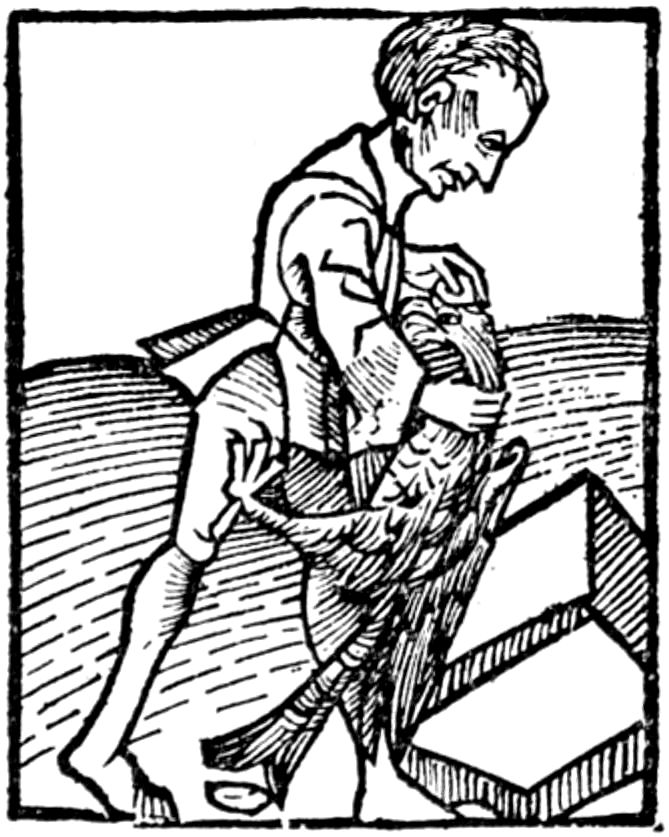
Extracting an alectorius. From Johannis de Cuba’s “Ortus Sanitatis,” Strassburg, 1483.
The alectorius or “cock-stone” is one of the most famous of those real or supposed animal concretions that were known in ancient times. From the age of Pliny—and unquestionably long before his time—there was a popular belief that this stone was only to be found in the gizzard of a cock which had been caponed when three years old, and had lived seven years longer. This was believed to allow the substance to acquire its boasted virtue, for the longer it remained in the body of the capon, the greater its power. Such a “cock-stone” never exceeded the size of a bean. From its association with the pugnacious fowl, the alectorius became a favorite stone with wrestlers, and the great and invincible Milo of Croton is said to have owed many of his victories to the possession of one, for if held in the mouth, it quenched the thirst and thus refreshed the combatant.
Many other virtues of this stone are recorded; it rendered wives agreeable to their husbands, dissolved enchantments, brought new honors and powers in addition to those already enjoyed, and helped kings to acquire new dominions. How persistent was the faith in the virtue of the alectorius is shown by the fact that the great astronomer Tycho Brahe 180greatly valued a stone of this kind, not larger than a bean, and believed that it brought him luck in gambling and in love. Thomas de Cantimpré[371] says that the name signifies an allurer or enticer, because the stone excites the love of husbands for their wives.[372] In order to secure the due effect it should be held in the mouth, possibly because this would render the wife less eloquent.

ALECTORIVS Alectorius. From Mercati’s “Metallotheca Vaticana,” Romæ, 1719.
A specimen of the alectorius is listed in the inventories of Jean Duc de Berry (1401–1416). It is called there a “capon-stone” and is described as having red and white spots. Several other objects to which talismanic virtues were ascribed are also noted, such, for instance, as the “molar of a giant,” set in leather; probably the tooth of a hippopotamus, or the fossil tooth of some antediluvian creature. There is also what is termed a “tester,” composed of several “serpent’s teeth” (glossopetræ?), horns of the “unicorn” (narwhal’s teeth) and stones regarded as antidotes to poison. These were all suspended by golden chains, and were valued at seventy-five livres tournois.[373]
As a companion piece to the “cock-stone,” the hen furnished a concretion possessing special virtues. This came from the fowl’s gizzard and was of a sky-blue color; its 181Arabic name was hajar al-ḥattaf. If it were worn by an epileptic, the attacks of his malady would cease; it favored procreation and also nullified the effects of the Evil Eye, and it kept children from having bad dreams if placed beneath their heads when they were sleeping. Thus the effects it was fancied to produce differed from those ascribed to the alectorius.[374]
In medieval times bunches of dried “serpent’s tongues” were sometimes hung around salt-cellars or attached to spits; but frequently, for royal or princely use, such tongues, or the jawbones of snakes, were set with valuable precious stones and constituted a peculiar jewel termed in old French a languier, or épreuve (tester); for these utensils, often very rich and tasteful specimens of the goldsmith’s art, were believed to show in some way the presence of the much-dreaded poison in any viands with which they were brought in contact.[375]
The Indians and Spaniards in South America made remedial use of a stone said to be obtained from the cayman or alligator, at Nombre de Dios, Cartagena, etc. This was employed as a cure for various intermittent fevers. Monardes writes that he applied two of these lapides caymanum to the temples of a young girl suffering from an attack of fever, and found that the fever was alleviated thereby; but he doubts that fevers could be entirely cured by this treatment.[376]
From New Spain was also brought the lapis manati, taken from the manatee, or sea-cow. This does not appear 182to have been a stone, but rather the cochleæ of the animal, the small bones in the head which transmit the auditory vibrations to the sensorium. They were highly valued by the Indians for their remedial action in cramps and colic, and the Spaniards collected them and brought them to Spain to enrich their very miscellaneous pharmacopœia. Sometimes they were taken internally, but often they were set in rings or worn suspended from the neck as amulets. This stone, or bone, is described as oval in shape and of a hue resembling that of ivory. When pulverized and dissolved, the solution was odorless and tasteless. They are in size often as large as a woman’s clinched fist.[377]
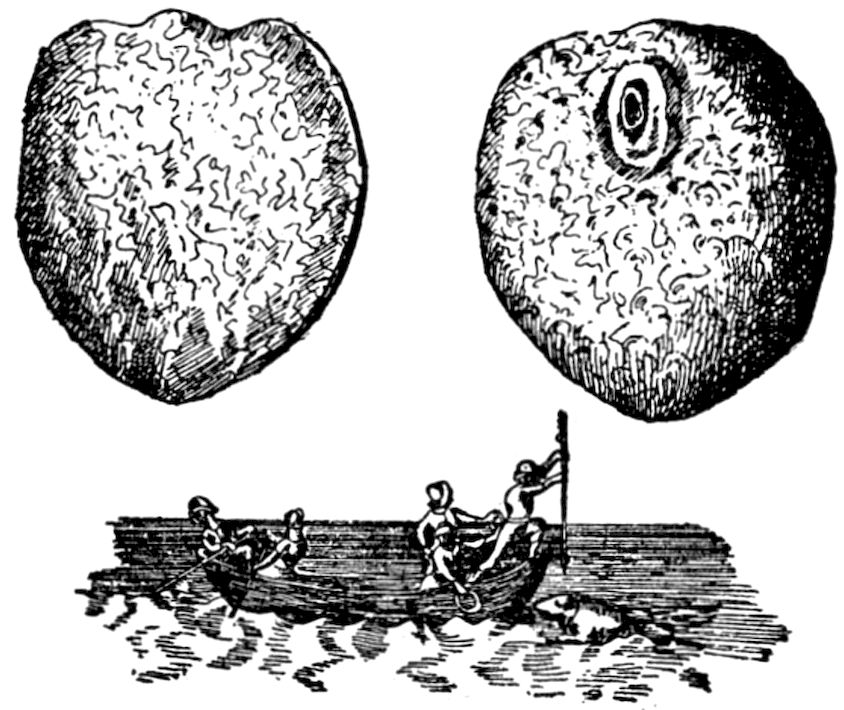
Lapis manati. From Valentini’s “Museum Museorum, oder Vollständige Schau-Bühne,” Frankfurt am Main, 1714.
The ear-bones of fish, almost invariably in pairs, are still used as amulets in Spain and Italy. One of their chief virtues is to protect children from the Evil Eye, as well as 183from accidents of any kind. They are also believed to preserve the wearer from deafness or diseases of the ear.[378] This is quite in accord with the primitive fancy that the different parts of the animal body had prophylactic or curative powers in relation to any disease of that portion of the human body.

Lapis malacensis, stone of the hedgehog or porcupine. From Mercati’s “Metallotheca Vaticana,” Romæ, 1719.
Even the spider was supposed to produce a stone having remedial power, especially that variety called by the Germans Kreuzspinne (“cross-spider”). The belief was general in Germany, in the sixteenth century, that it was very unlucky to injure one of these spiders; indeed, Encelius writes that although he had never seen a “spider-stone,” he had never dared to dissect one of the spiders to seek for the stone. He also remarks that it was in no wise strange this should have such power, since spider-webs were used as remedies for many diseases. Naturally enough the “spider-stone” was an antidote against poisons, and a belief was current that in a year when the plague was raging no Kreuzspinne was to be seen.[379]
An attempt to induce one of these spiders to secrete or produce its stone or calculus is told by Simon Paulli. On his return from France in 1630, he stopped for the summer with his revered master, Sennart, at Wittenberg, in order to pursue his studies. One day they found by chance that an enormous spider had wandered into the rain-water holder, and the extraordinary size of the creature—it was as big as a muscat nut—suggested the idea of making it the subject of experiment. It was therefore put into a glass jar 184with a quantity of powdered valerian root, this material (or salt) being reputed to have a favorable influence in the production of the stone. However, the experimenters were doomed to disappointment, for the poor spider was unable to live up to its reputation. Tired of waiting for nothing, recourse was finally had to the drastic measure of dissection, but no stone of any kind could be found. This convinced the observers that all the talk about spiders’ stones was mere foolishness or deception. In a note in the Miscellanea Curiosa, under date of 1686, the statement is made that such stones could indeed be found, but only in the autumn season and in no other part of the year.[380]
A small golden amulet, having the form of a heart and set with various stones, was strongly recommended to ward off the plague by Oswald Croll, a writer of the early part of the seventeenth century. On the upper side of the heart-amulet should be set a fair blue sapphire; above, beneath, and at either side of this should be put a toad-stone, or a “spider-stone,” so as to give a cross effect. The “spider-stones” were asserted to be powerful enemies of the plague. On the under side of the heart a good-sized jacinth was to be set, the jacinth also being credited with great virtue against plague or pestilence. The gold heart was to be hollow within. To give a finishing touch to the efficacy of the amulet it was necessary to take a living toad and keep the creature suspended by its hind-legs until it died and dried up so that the body could be reduced to a powder. This powder was then to be kneaded into a sort of paste with a little very sharp vinegar and introduced into the hollow interior of the gold heart.[381]
The “fretful porcupine” also contributed its stone to the 185series of concretions; this was usually found in the animal’s head, and was considered to be even superior to the bezoar as an antidote against poison. If steeped in water for a quarter of an hour, the water became so bitter that “there was nothing in the world more bitter.” Another stone supposed to be found in the animal’s entrails possessed like properties, but was said to lose none of its weight when placed in water, while the first-mentioned stone became lighter. Tavernier bought three of these stones, paying as much as five hundred crowns for one of them.[382]
A jewel made of ambergris, in the J. Pierpont Morgan collection, is said to be the only specimen of its kind that has been preserved for us from medieval times. The perfumed material has been skilfully carved into the symbolic figures of a woman and three children. At one time believed to symbolize Charity, the later theory is that these figures have a less pure significance and rather denote the reproductive energies, for ornaments of this material were credited with aphrodisiac powers; however, they were also believed to cure stomachic disorders. The delicate perfume they exhaled was one of their chief titles to admiration, and after the lapse of more than three centuries, this particular jewel still emits a fragrant aromatic odor when it has been held for some time in a warm hand. The style of the workmanship indicates that this is a piece of cinquecento Italian work. It was at one time in the Wencke Collection, in Hamburg, and later formed part of the Spitzer Collection, until the sale of the latter in 1893.[383]
While many of the reports of the finding of immense masses of ambergris (in one the weight of the mass is given as three thousand pounds) may be classed as at least highly 186improbable, still there is abundant unmistakable evidence that very large pieces have really occasionally been found. In Rome and in the Santa Casa of Loreto costly and artistically shaped pieces of ambergris were to be seen, which clearly indicated that the weight of the original unworked mass must have greatly exceeded that of the ornamental object. There can be no doubt of the authenticity of the details regarding a great piece of ambergris weighing 182 pounds bought in the year 1693 from King Fidori by the Dutch East India Company for 11,000 rigsdalers or nearly $12,000 at the current valuation of the coin of that time. In form it resembled a tortoise-shell, was 5 feet 8 inches thick, and 2 feet 2 inches long. After being long kept in Amsterdam as a curiosity, and having been viewed there by thousands of persons, it was finally broken up and sold at auction.[384] A lump extracted from a whale in the Windward Islands weighed 130 pounds and was sold for $3500, or nearly $27 a pound.
The livers of certain animals provided concretions called haraczi by the Arabs; these were much used as remedies for epilepsy. The Turkish butchers, when slaughtering animals, always examined the livers carefully so as to secure these stones. As the Jews were said to suffer much from melancholia and epileptic disorders they valued the liver-stones very highly.[385]
The use of fossils as talismans and for the cure of diseases was mainly due to their strange and various forms. As color played the most important part in the case of precious stones, each color being looked upon as possessing a certain symbolic significance fitting the stone for some special use or uses, so in the case of fossils the form was 187the determining factor. Sometimes it was as the form of some creature held by the superstitious to be particularly endowed with mysterious qualities beneficial to mankind, at other times the fossil form suggested some part of the human body, and was therefore believed to afford protection to this part, or to cure any disease affecting it. This will be made clearer by a brief notice of some of the principal fossils which were favored in ancient and medieval times, either by popular superstition or by those who from interested motives made use of these superstitions for the purpose of gain, although they may have only half believed in the real virtue of the objects they sold.
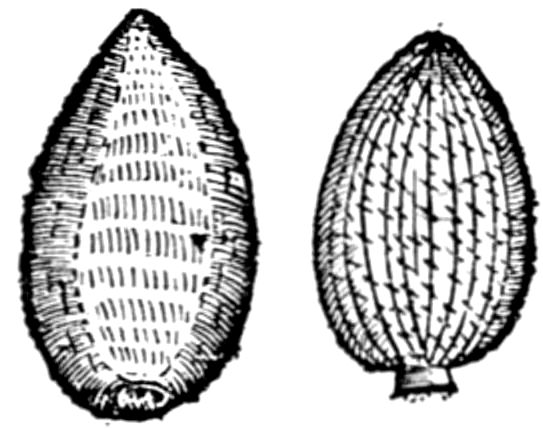
Lapis Judaicus. Pentremite heads. From “Museum Wormianum,” Lugduni Batavorum, 1655.
The remedial quality of fossils, which were believed to have been formed from shells and marine animals deposited during the deluge, is ascribed by Mentzel to the fact that they had been produced by the action of fire, and hence had the same quality as though prepared and calcined by the chemist’s art. They were therefore believed to have great medicinal virtues in the cure of diseases.[386]
The lapis Judaicus[387] is described as of oval form, in shape like an olive, and sometimes provided with a stem at the upper part as though it had grown on a tree. The stone was soft and friable and in color either white or grayish. The “male” variety had several rows of equidistant spines, while the “female” was quite smooth. The description and the figured representations of the lapis Judaicus show that it was a form of pentremite—that is, a form of crinoid. This fossil, which was said to come from Syria and Palestine, was taken in solution as a remedy for calculus. The larger, male 188stones, were regarded as the better for renal calculus and the smaller, female stones, for vesical calculus. Hence this fossil was sometimes called tecolithos, from τήκειν, to dissolve, and λίθος, stone.[388] Pliny also states that this name was applied to certain concretions found in sponges and supposed to possess similar virtues.[389] Of the remedial use of this stone, or fossil, Galen states that when prescribed for vesical calculi, it was pulverized in a mortar, and the powder being mixed with water, three glasses of the solution were given. He adds, however: “I must say that as far as I have seen they have no effect, but they are efficient in the case of renal calculi.”[390]
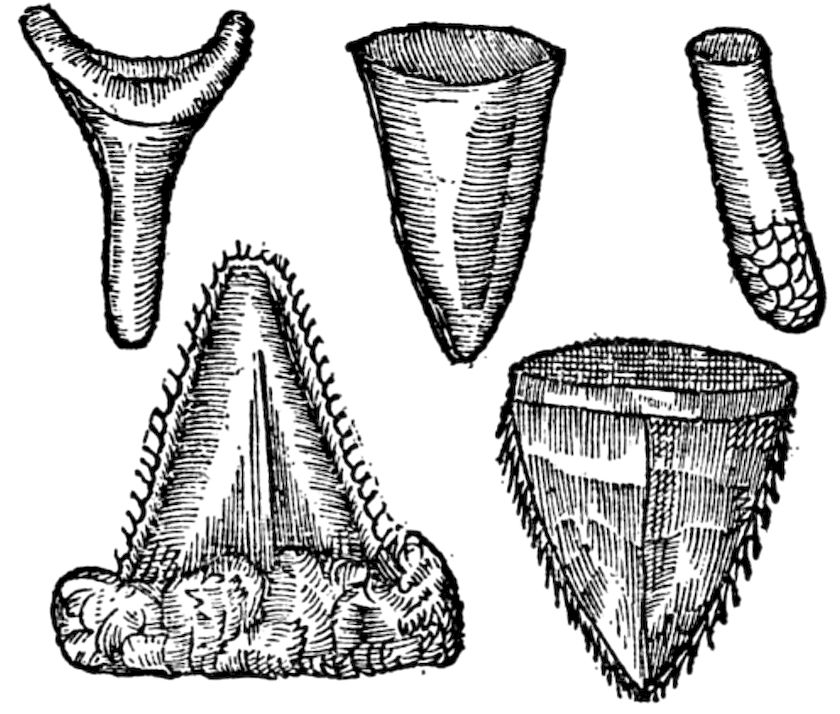
Glossopetræ. Fossil shark’s teeth. From “Museum Wormianum,” Lugduni Batavorum, 1655.
No fossils were more prized than the so-called glossopetræ or “tongue-stones.” Although these were really the fossilized or petrified teeth of a species of shark, Pliny and 189his sources believed them to be meteorites, which “fell from the sky when the moon was waning.” This was, indeed, a prevalent fancy regarding all dart-shaped, pointed or sharpened fossils, or flints. Because of this celestial origin, the glossopetræ were said to control the winds and even to affect the motions of the moon. At a later time the chief source of supply for these petrified teeth was the island of Malta, and they were therefore sometimes called lingues Melitenses, or Maltese tongues; the Germans named them Steinzungen, or “stone-tongues.” According to popular belief these so-called Maltese tongues were petrified snakes’ tongues and they were brought into connection with the miraculous adventure of St. Paul on the island of Malta, when he shook off a viper that had fastened on his hand, and sustained no injury from the bite (Acts, xxviii, 3–5). This was taken to signify that the poison had been taken from all the snakes on the island.[391]
The material called “St. Paul’s Earth,” said to be derived from “St. Paul’s Cave,” in the island of Malta, was reduced to a fine powder and made into tablets. These were stamped with the Maltese cross; sometimes on the opposite side some other figure was impressed. As there was temptation to sell other material for the genuine, the purchaser was warned to be on his guard. The virtues of this powder—which was dissolved in wine or water—were numerous, and were the same as those ascribed to the “tongues” (glossopetræ) and to the “eyes”; for it was believed to be an antidote for poisons, cured the bites of venomous creatures, and remedied many other ills. The “eyes” were set in rings so that the material touched the wearer’s skin; the “tongues” were worn attached to the arm or suspended from the neck. Sometimes vessels were made from the earth. These were 190filled with wine or water, the liquid being allowed to stand until it had absorbed the virtues of the earth; it was then taken as a potion with good effects. The “tongues” and “eyes” were often dipped in wine or water and were supposed to transmit their curative powers to the liquid.[392]
In the fifteenth and sixteenth centuries a strange belief was prevalent among the ignorant to the effect that the fossil sharks’-teeth, the “tongue-stones,” were the teeth of witches who sucked the blood of infants; these “vampires” were called lamiæ in ancient times.[393] Probably the fact that a certain species of shark bore the name lamiæ gave rise to this idea, which was therefore merely due to a confusion of names. Nevertheless we can easily understand that this popular belief added to the repute of the glossopetræ, for the more dreaded the object the greater the power it was credited with possessing. In the seventeenth century De Laet (d. 1649), the Dutch naturalist and geographer, received in Leyden certain glossopetræ sent him by a friend in Bordeaux, who wrote that they would cure any one suffering from soreness of the mouth, whether this were the result of having eaten impure food, or were produced by some derangement of the secretions. The “tongues” were to be dipped in spring water and would cause bubbles to form therein; as soon as these disappeared, the water was to be used as a gargle, and the mouth was to be washed with it two or three times. De Laet’s friend assured him that this treatment would cure the disorder in twenty-four hours.[394]
A seventeenth century amulet of a fossil shark’s tooth, mounted in silver and found in an excavation at Salzburg, Austria, was among the objects exhibited by the writer for the New York branch of the American Folk-Lore Society, in 191the Department of Ethnology of the Columbian Exposition held in Chicago, in 1893. They are frequently found at Lake Constance but are from the ancient fossiliferous formations and not from the lake. They are often sold as amulets.
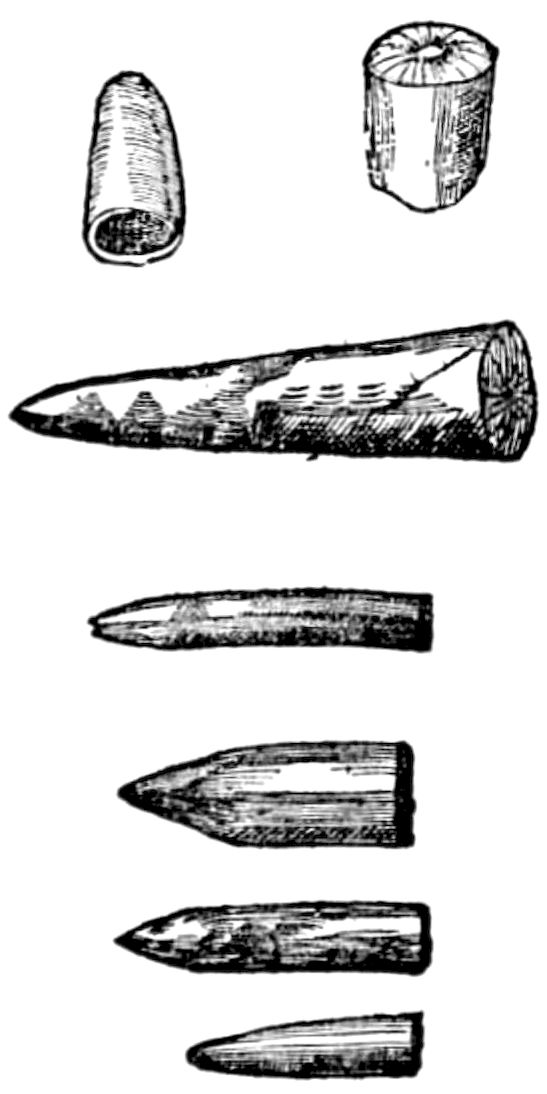
Belemnites. Fossilized bony end of extinct cuttlefish. From Aldrovandi’s “Museum metallicum,” Bononiæ, 1648.
Fossils whose form suggested that of a more or less acutely pointed shaft, were thought to possess special powers, sometimes offensive as against enemies, and again defensive for the protection of the wearer. Thus the belemnites,[395] considered to represent the form of a dart, when dissolved and taken as a potion, were said to prevent nightmare and to guard against enchantments. They are often either ash-colored or whitish, and sometimes reddish-black. All these varieties were frequently found during the sixteenth century in Hildesheim, and in the marble grotto near the castle of Marienburg, called the “Dwarf’s Grotto.”[396]
The umbilicus marinus, a fossil shell, which in form bore a great likeness to the human navel, was called “sea-bean” by sailors. Usually of a pale saffron hue, some specimens have a reddish or blackish tinge. In the sixteenth century it was believed to have astringent properties. We are also told that women used it as one of the ingredients of a cosmetic for whitening the complexion.[397]
192Certain echinites (fossil sea-urchins) found on the Baltic coast are called by the peasants Adlersteine and Krallensteine (“eagle-stones” and “claw-stones”), since they believe that while the substance was soft eagles had seized them with their talons, thus producing the peculiar forms and markings. Whoever had a fossil of this description on his table while a thunder-storm was raging ran no risk of being struck by lightning.[398]
Reich describes another variety of echinite, which was popularly known as a “toad-stone,” the specimen he figures having been given him by a certain Johannis Krauss. In this appeared some large cavities, whose presence Reich found it very difficult to explain, until Krauss informed him that they had been made by a former owner of the fossil who had scraped out a few grains of the substance each year for medicinal use. He was persuaded that his long life—he attained the age of eighty—was entirely owing to his employment of this remedy.[399]
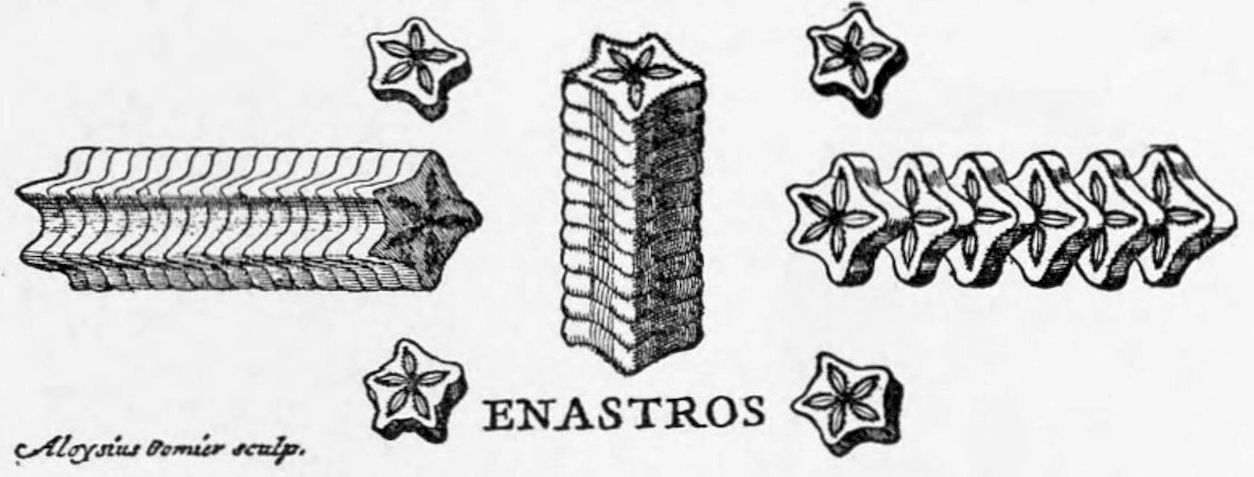
The trochites and entrochus, named Räderstein, or “wheel-stone,” by the Germans, are other fossils to which remedial or talismanic virtue was accorded in popular fancy. These “wheel-stones,” while detachable, fitted as closely together in the original formation as though they had been skilfully adjusted by a clever artisan.[400] De Laet states that when immersed in oil they gave forth bubbles and moved about spontaneously. Still another of these fossils believed to be amulets was the enastros, which De Boot terms the asteria vera, or genuine asteria, since it not merely showed a star-shaped marking as did the fossil coral bearing the name 193astroites, but was shaped like a five-pointed star. As with the trochites, chains of these little stars were found, closely joined together but separable from one another. Some called them “star-seals,” because the stellar imprint was sharp and clearly defined as though the work of an engraver or gem-cutter.[401] These fossils are types of encrinites.
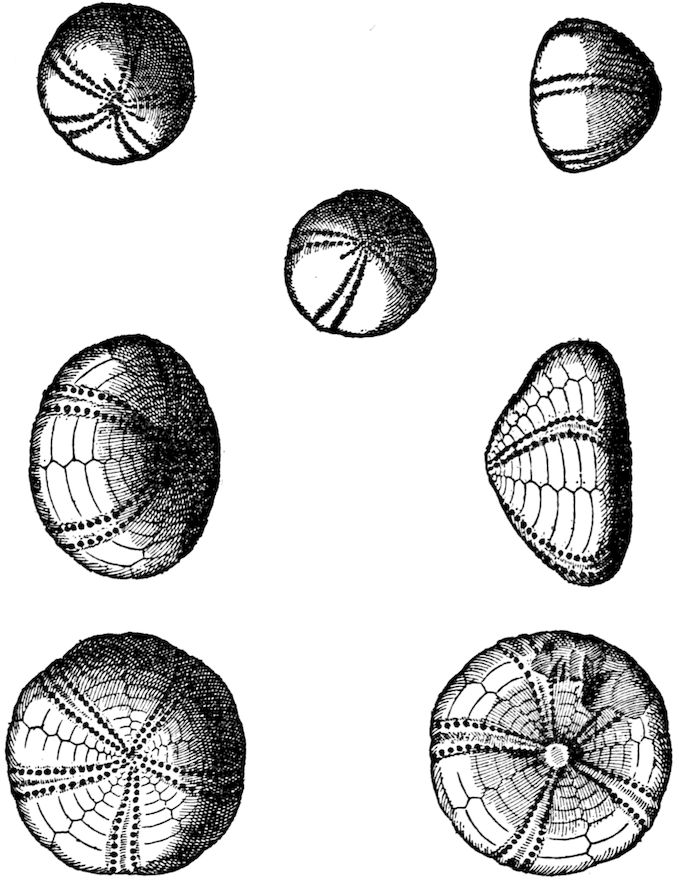
Brontia. Fossil sea-urchins. From Mercati’s “Metallotheca Vaticana,” Romæ, 1719.
194
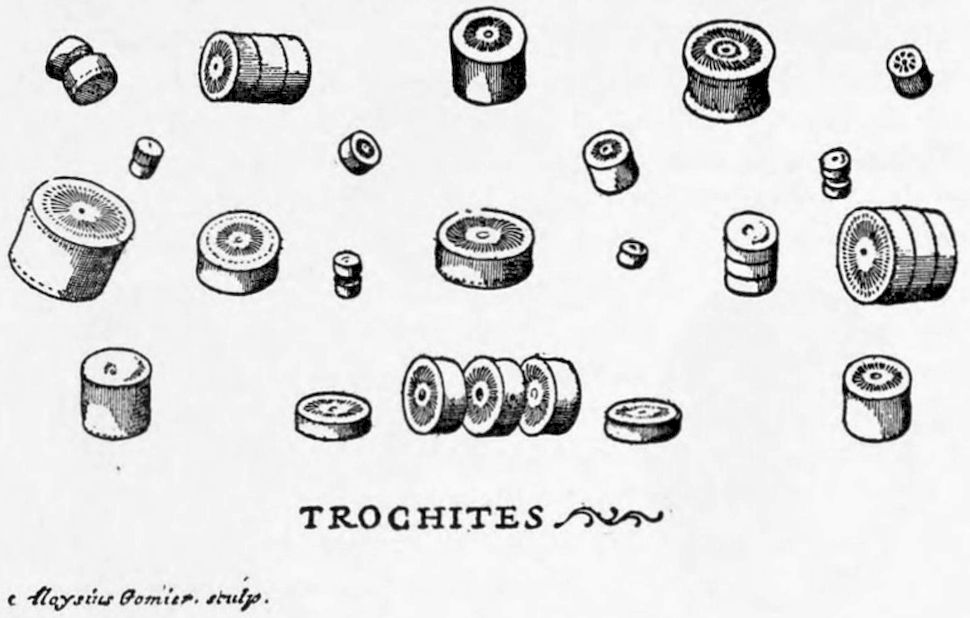
Trochites Fossil
Crinoid From Mercati, “Metallotheca Vaticana,” Romæ, 1719.
Enastros Stems.
The sections of the stem-like fossils called entrochus by the older writers have been named St. Cuthbert’s beads in later times, while the fossil called lapis Judaicus has borne the name of “stone-lily,” because in form it resembles the lily. Ages ago the stem and flower-like head united constituted 195a crinoid (a marine zoophyte). These aquatic creatures—half-plant and half-animal—usually twine their roots about some shell in the depths of the waters, but sometimes they become detached and then, moving their delicate tentacles, they creep along the bottom of the sea.
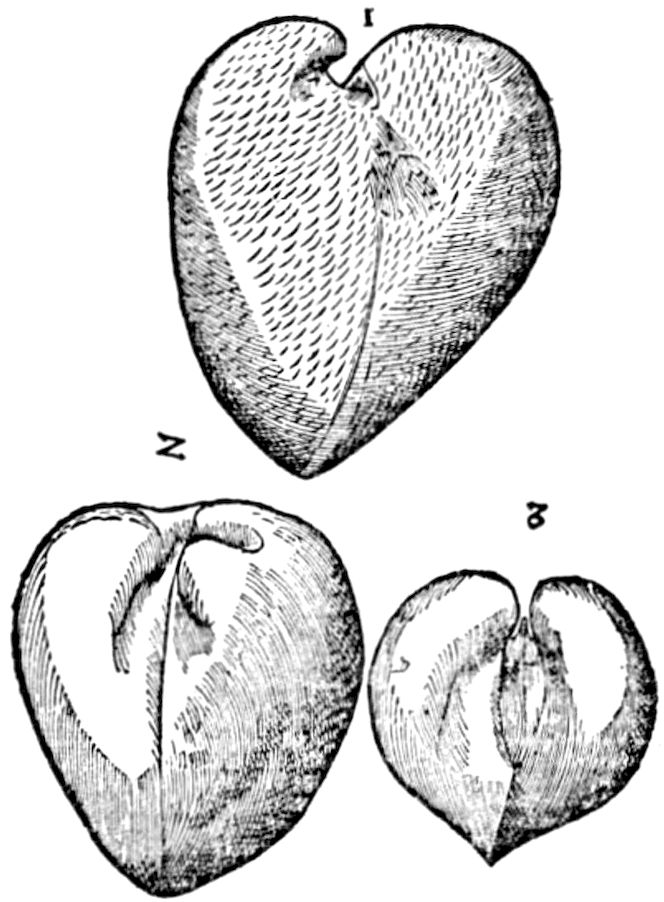
Bucardites triplex. From Aldrovandi’s “Museum metallicum,” Bononiæ, 1648.
In olden times parts, or segments, of an animal were worn as a protection against harm from that particular creature, or else to endow the wearer with some of its real or fancied qualities. In modern times this tendency finds expression in the wearing of jewels of animal form, wherein precious stones are grouped and arranged so as to constitute different parts of the creature’s body. Such jewels are often looked upon as “mascots.”
A peculiar fossil was known to the Germans by the name of Mutterstein, and is called hysterolithus in the Latin treatises of Agricola, De Boot, etc., a word of Greek derivation signifying the resemblance of the object to an organ of the body. These fossils are formed from the contents of certain shells, and retain the shape of the enclosing shell, which has broken away. Some of these formations were called enorchi from a fancied resemblance to another organ and were regarded as phallic emblems, while others were thought to figure the heart, especially large specimens being named bucardites, 196or “ox-hearts.” This name is already employed by Pliny. The hysterolithus was used to cure various female diseases, and to the bucardites was accorded among other virtues that of increasing the wearer’s courage.[402] The hysterolithus is believed to be the same as the autoglyphus mentioned by pseudo-Plutarch as having been found in the river Sagaris, in Asia Minor. Its peculiar shape was regarded as symbolizing Cybele, the mother of the gods, and the story ran that if one of the unfortunate male victims of Eastern jealousy should obtain a stone of this kind he would become reconciled to his sad lot and would cease to regret his lost manhood.
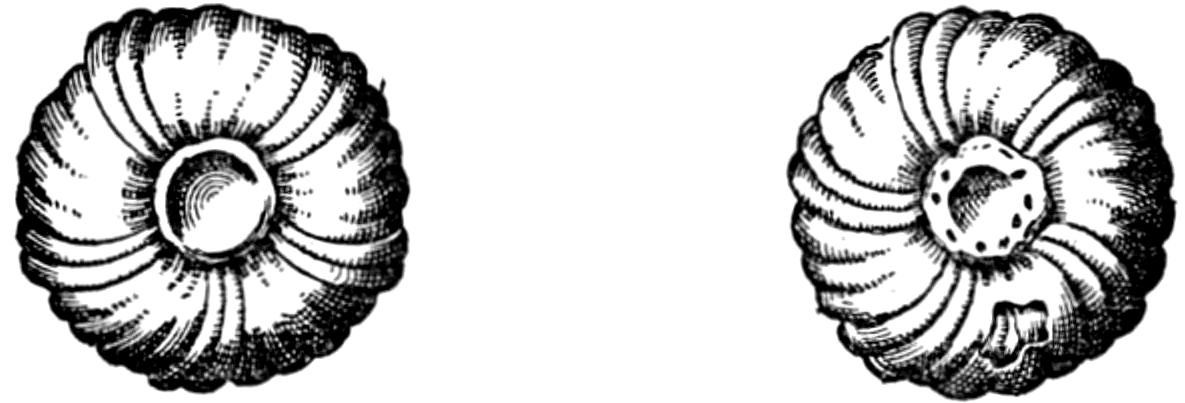
Types of Ombria (Fossil Sea Urchins). From Mercati’s “Metallotheca Vaticana,” Romæ, 1719.
If we were inclined to accord the title of precious stones to stones greatly esteemed for their talismanic virtues, a high place in this category would be assigned to the sâlagrâma-stone of the Hindus.[403] Among the aboriginal inhabitants of India this was regarded as a symbol of the female principle in nature, and of its representative the goddess Prakrti, and in the later Hindu belief the stone was looked upon as the special emblem of the god Vishnu, the “Preserver,” the second personage of the Hindu Trimurti. It is therefore ardently revered by those who are more especially 197devoted to the worship of Vishnu. These stones are fossil formations, either of ammonites or univalve mollusks of a spiral order, and consist of a number of spirals surrounding a circular, central perforation. They are generally the hardened filling of the shell itself, which has entirely weathered away. For the stone to be an effectual talisman, the diameter of the perforation should not exceed one-eighth of the total diameter of the sâlagrâma. The best specimens are said to be found in Nepal, on the upper course of the Gandakî, which flows into the Ganges from the north, and is called the Salagrama River, because the sacred stone is found in it.
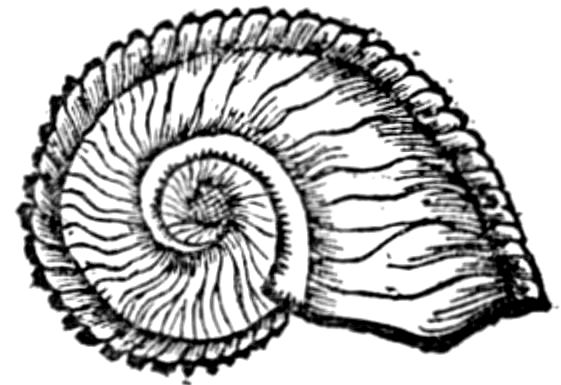
Cornu ammonis (Fossil Nautilus.) From “Museum Wormianum,” Lugduni Batavorum, 1655.
There can be little doubt that we have here a substance similar to the fossils described by Pliny and his successors under the names brontia, ombria, ovum anguinum, and cornu ammonis, and it is most probable that in India, as in Europe, these fossils were believed to have fallen from heaven, and were associated with the thunderbolt. Hence they would be regarded by the Hindus as more especially sacred to Vishnu, who was originally a divinity representing the various forms of light, one of his manifestations being the lightning.
The sâlagrâmas must be carefully chosen, for not all of them are luck-bringing, some being bearers of ill-fortune. A black sâlagrâma brings fame to the owner, and a red one, a crown; but one with an unduly large perforation would cause dissension and strife in a family, one with irregularly formed spirals portends misfortune, and a brown one would bring to pass the death of its owner’s wife. Each faithful worshipper of Vishnu has one of these stones, but two may not be in the same house. To give away a sâlagrâma would 198be equivalent to casting away every prospect of good fortune. However, only one who belongs to the three highest castes is entitled to become an owner of the sacred stone, in which the very spirit of Vishnu is supposed to dwell; neither a Sudra nor a Pariah enjoys this privilege, which is also denied to women.
The sâlagrâma is carefully wrapped in linen cloths, and must be often washed and perfumed. The water with which it has been washed becomes a consecrated drink. The master of the house must adore the stone once each day, either in the morning or in the evening. As the sâlagrâma not only brings happiness in this world but also insures felicity in the future world, it is held over the dying Hindu while water is allowed to trickle through the orifice. This ceremony appears to have a certain analogy to the rite of extreme unction administered in the Catholic Church.
It is stated by Finn Magnusen that in Iceland, toward the beginning of the last century, he saw superstitious peasants carefully guard small stones of peculiar appearance in pretty bags filled with fine flour. They treated these stones with great reverence and either wore them on their persons or placed them in their beds or other furniture.[404]
The fossils known as brontiæ, ombriæ and chelonites were all believed to be antidotes for poison and also to make the wearer victorious over his enemies. Hence they were sometimes set in the pommels of swords. That these objects were equally potent in peace, is shown by the fact that Danish peasant women placed them in their milk pails to ward off the effects of any spell that might have been cast over the cow’s milk by a malevolent witch.[405]
199David Reich notes the four kinds of astroites, or “victory stones,” given by De Boot; the first, marked with small stars; the second, with rose-like figures; the third, with wavy lines, like the convolutions of a worm; the fourth, with obscure and indefinite markings. To these varieties Reich adds a fifth, the convex side of which was marked with black crosses, while the other, flat side, showed larger crosses surrounded by circles; all these markings were so perfect that an artist could scarcely imitate them; this specimen he had set, with other precious gems, in a silver cross, the flat side of the fossil, at the back of the cross, being covered by a heart-shaped topaz.[406] These were all specimens of fossil coral.
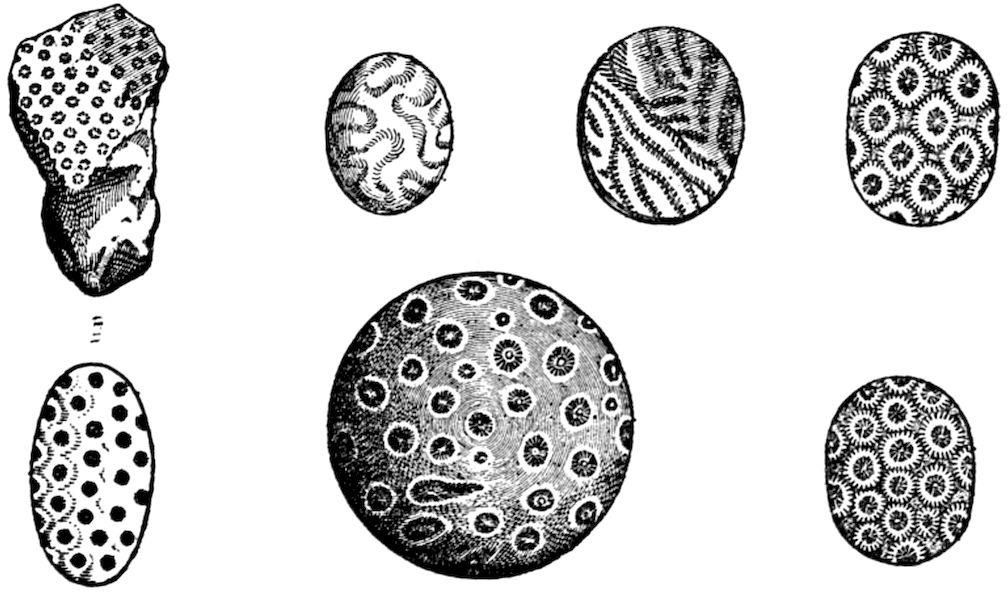
.ASTROITES. Specimens of Astroites (asteria), or fossil coral. From Mercati’s “Metallotheca Vaticana,” Romæ, 1719.
The saga of Dietrich of Bern relates of King Nidung that 200on the eve of a battle in which his forces were much inferior to those of the enemy, he was filled with despair to find that he had left his “victory stone” in his castle, miles away from where he had pitched his tent. Overmastered by his desire to regain possession of his stone at this critical time, Nidung offered a large sum of money and his daughter’s hand to anyone who would bring it to him before the battle began. The distance was so great and the time so short that the task seemed utterly impossible, and a young esquire, Velint by name, was the only one willing to risk the enterprise. He was favored in his quest by having a horse of wonderful strength and endurance, by whose help he barely succeeded in making the long journey to the castle and returning in time. King Nidung, wearing his invincible stone, was the victor in the battle, and he did not fail to carry out his rather rash promise.[407]
Amulets of fossil coral are freely used in Italy, especially in the province of Aquila, and are called “witch-stones” (pietre stregonie). These are similar to one type of the “asterias” worn as amulets in ancient and medieval times. Many of the Italian amulets are incised or engraved with Christian subjects, one figured by Bellucci bearing the head of Christ on the obverse, and Christ on the cross on the reverse side; on others appears the image of the Virgin Mary.[408]
Crystalline quartz will sometimes show a star either at base or apex, if cut en cabochon. This is due to the presence of acicular crystals of rutile or to air spaces. Those specimens from Albany, Maine and other places present this phenomenon, and Starolite and Astrolite or “star stone” has been suggested as an appropriate name for this variety.
201