I Magic Stones and Electric Gems
Reading edition

While the precious and semi-precious stones were often worn as amulets or talismans, the belief in the magic quality of mineral substances was not confined to them, but was also held in regard to large stone masses of peculiar form, or having strange markings or indentations; moreover, many small stones, possessing neither worth nor beauty, were thought to exert a certain magical influence upon natural phenomena. An occult power of this sort was also attributed by tradition to some mythical stones, the origin of this fancy being frequently explicable by the quality really inherent in some known mineral bearing a designation closely similar to that bestowed upon the imaginary stone.
To certain stones has been attributed the power to produce musical tones, the most famous example being the so-called “Vocal Memnon” of Thebes. This colossal statue was said to emit a melodious sound when the sun rose, and according to Greek legend this sound was a greeting given by Memnon to his mother, the Dawn. It appears, however, that the statue was a respecter of persons, for when the Emperor Hadrian presented himself before it, he is said to have heard the sound three times, whereas common mortals heard it but once, or at most twice, while occasionally the statue withheld its greeting altogether. A modern traveller relates a personal experience that may cast a side-light upon 2this matter. His visit to Thebes was made in the evening, but a fellah who was standing near the statue asked him whether he wished to hear the musical sound. Of course the reply was in the affirmative. Thereupon the man climbed up the side of the colossal figure and hid himself behind the elbow. In a moment sharp metallic sounds became audible; not a single sound, but several in succession. Knowing from their quality that they could not proceed from the stone, the traveller asked his donkey-boy for an explanation and was told that the man was striking an iron bar. In ancient times the priests probably performed this or a similar trick in a much more skilful way than did the poor fellah, so that the mystery of the statue was carefully guarded.[1]
The river Hydaspes was said to furnish a “musical stone.” When the moon was waxing, this stone gave forth a melodious sound.[2] This should be understood in the sense that when the stone was struck at that season the sound was different from what it was at other times—a fanciful idea based on some supposed sympathy between the stone and the moon. As moonstones are rarely larger than a silver dollar, they would not emit a sound upon being struck, and it is probably a rock known as “chinkstone” (phonolite) that is referred to, an igneous rock, very hard and resonant, that has been found in elongated and flat pebbles of large size; they ring with the resonance of bells when struck. A sonorous stone at Megara is reported by Pausanias[3]; when struck, it emitted the sound of the chord of a lyre. This was explained by the tale that, while helping Alcathous to build 3the walls of his city, the god Apollo had rested his lyre on the stone.
The term sarcophagus is to us so clear and precise in its significance, that we do not stop to think that its etymology reveals it as literally meaning body-devourer. Tradition taught that a stone of this type was to be found near Assos in Lycia, Asia Minor, and also in some parts of the Orient. If attached to the body of a living person it would eat away the flesh. Another type, already noted by Theophrastus in the third century B.C., had the power of petrifying any object placed within receptacles made from it. If a dead person were buried in a “sarcophagus” of this material the body would not be consumed, but would, on the contrary, be turned to stone, even the shoes of the corpse and any utensils buried with it, would undergo a like wonderful change. Possibly actual observations of changes in the bodies of those long buried, their partial disintegration in some cases, and their hardening in others, may have given rise to the fancy that the stone receptacle in which they had reposed was directly the cause of this, whether it implied destruction or petrifaction.[4]
Of the substance named galactite, Pliny gives some details. He states that it came from the Nile, was of the color and had the odor of milk, and when moistened and scraped produced a juice resembling milk. The liquid derived from the galactite when taken as a potion by nurses was said to increase the flow of milk. If a galactite were bound to a child’s arm the effect was to promote the secretion of saliva. To these favorable effects must be added an unfavorable one, namely, loss of memory, which was said to befall occasionally those who wore the stone. A kind of “emerald with white veinings” was sometimes called galactite, and 4another variety had alternate red and white stripes or veins.[5] Perhaps this “emerald” was a variety of jade, or a banded jasper.
This so-called galactite, which enjoyed such an extraordinary reputation in ancient and medieval times, is not, properly speaking, a stone, but a nitrate of lime. The strange and famous relics of the Virgin preserved in many old churches and called “the Virgin’s milk,” were merely solutions of this nitrate. Possibly pieces of this so-called galactite were sometimes found by pilgrims in the grotto of Bethlehem, and were supposed to be petrified milk.[6] As everything in this sacred spot was regarded as connected in some way with the miraculous birth of Christ, it is easy to understand why the devout pilgrims came to believe that the milky-hued substance represented the milk of the Virgin, which had been preserved for future ages in this extraordinary way.
A kind of galactite, evidently a finely deposited form of carbonate of lime and perhaps absorbent, is mentioned by Conrad Gesner.[7] This was found on the Pilatus Mountain, Lake Lucerne, and is described by Gesner as being a “fungous and friable” substance, white and exceedingly light in weight. The natives called it Mondmilch (moonmilk) and it was sold in the pharmacies of Lucerne. The powder was used by physicians in the treatment of ulcers, and, like all the other galactites, it was supposed to increase the flow of milk and to develop the breasts. Besides this it was credited with somniferous virtues.
An old Mohammedan tradition, cited by Ibn Kadho Shobah in his Tarik al-Jafthi, relates that Noah, after the deluge, on setting out with the members of his family to 5settle and populate the regions to the eastward and northward of Mt. Ararat, confided to their care a miraculous stone known to the Turks as jiude-tash, to the Persians as senkideh and to the Arabs as hajer al-mathar, or the “rain-stone.” On it was impressed the word Aadhem or Aazem, the great name of God, by virtue of which whosoever possessed this stone could cause rain to fall whenever he pleased. In the long lapse of time this particular “precious” stone was lost, but some of the Turks were said to have certain stones endowed with a like power, and the more superstitious among these Turks solemnly asseverated that their “rain-stones” could beget progeny by a mysterious kind of generation.[8]
Among the many stones or concretions endowed by medieval belief with wonderful powers, may be reckoned the “rain-making” stones. Some of these were to be found in Karmania, south of Khorassan. The miraculous effect was produced by rubbing one against another. The Arabic author who reports this declares that this rain-making power was a well-known fact. He adds that similar stones might be secured from near Toledo in Spain and also in the “land of Kimar,” inhabited by Turkish tribes.[9]
The Oriental rain-stones noted by pseudo-Aristotle and by many other Arabic writers of medieval times, can be paralleled by similar rain-making or rain-inducing stones in many other parts of the world and among many primitive peoples even in modern times. The rain-makers of the African tribe of Wahumas, dwelling in the region bordering on the great Albert Nyanza Lake in Central Africa, use a black stone in the course of their magic rites. This is put 6into a vessel and water poured over it; the pulverized roots of certain herbs and some blood drawn from the veins of a black goat are then mixed with the water, and the resulting liquid mixture is thrown up into the air by the rain-maker.[10] The sorcerers among the Dieri in Central Australia place such trust in the efficacy of these conjurations as to believe that all rainfalls are produced thereby, generally through the intermediate action of ancestral spirits. If rain falls in a locality where no proceedings of the kind have taken place, then it is supposed that they have been initiated in some contiguous territory, a merely spontaneous and natural rainfall being out of the question. The clouds indeed generate the rain, but it will not be brought to the earth except by magic art. In the complicated magic ceremonies of these Dieri rain-makers, two large stones are employed; after a ceremonial, in the course of which the blood drawn from the two chief sorcerers is smeared over the bodies of the others, the stones are borne away by these two sorcerers for a distance of about twenty miles, and there put far up on the highest tree that can be found, the object evidently being to bring them as near to the clouds as possible.[11]
Rock-crystal as a rain-compeller finds honor among the wizards of the Ta-ta-thi tribe in New South Wales, Australia. To bring down rain from the sky one of them will break off a fragment from a crystal and cast it heavenward, enwrapping the rest of the crystal in feathers. After immersing these with their enclosure in water, and leaving them to soak for a while, the whole is removed and buried 7in the earth, or hidden away in some safe place.[12] The widely spread fancy that rock-crystal is simply congealed water may have something to do with the choosing of this stone as a rain-maker.
Sumatrans of Kota Gadanz use a stone whose form roughly resembles that of a cat in their invocations of rain, a live black cat being supposed in some parts of this island to have certain rain-producing virtues.[13] Perhaps the electric fur of the animal may have suggested a connection with thunder-storms. Stones of this type, indeed a great many of those to which magic properties are attributed, are in many cases smeared with the blood of fowls, or have incense offered to them, this treatment of such stones being observed by the peasants in Scandinavia and other parts of Europe as well as in the Far East.
Stone crosses have sometimes been utilized as rain-bringers, as in the case of one belonging to St. Mary’s Church in the Island of Uist, one of the outer Hebrides, off the Scottish coast. When drought prevailed here the peasants would set up this cross which usually lay flat on the ground, in the confident belief that rain would ensue. Of course, sooner or later, it was sure to come, and then the cross, having done its duty, was quietly replaced in its former horizontal position.[14]
A mysterious stone mentioned in Rabbinical legend is called the shamir. This word occurs three times in the Old Testament (Jer. xvii, 1; Ezek. iii, 9; Zech. vii, 12), and in each signifies a material noted for its hardness. In the first 8of these passages there is express indication that the shamir was a pointed object used for engraving, and the word is translated “diamond” in our Bible; in the two other cases it is rendered “adamant” and “adamantine stone,” respectively, thus leaving the determination of the substance an open question. However, as it is almost certain that the Hebrews were not familiar with the diamond, shamir most probably signifies one of the varieties of corundum, the next hardest mineral to the diamond, and extensively used in classic times for engraving on softer stones.
In the luxuriant growth of legend that sprang up in Rabbinical times, the shamir is not forgotten. It is said to have been the seventh of the ten marvels created at the end of the sixth day of creation. In size, it is described as being not larger than a barley-corn, but it had the power to split up the hardest substances, if brought in contact with them, or even in their neighborhood. Some of the legends ascribe to it even more wonderful magic powers, so that, like Aladdin’s lamp, great buildings could be constructed by its help, Solomon having used it in the erection of the temple and other buildings. The etymology of the word indicates a pointed object, similar to our diamond-point, but in legend it is almost invariably described as a small worm, probably because of a fancied connection between this word and another designating a species of worm. Many have associated the Hebrew shamir with the Greek σμίρις, or emery.
The Hebrew shamir and the Greek ἀδάμας were both used metaphorically of hardness of heart and implacability. The Hebrew prophet Zechariah (vii, 12) says of the disobedient Jews that “they made their hearts as an adamant stone” (shamir), and the Greek poet Theocritus (fl. 228 B.C.) calls Pluto, the god of the infernal regions, “the adamas in Hades.” This clearly shows that invincible hardness was the common characteristic of the material designated by 9these words. However, it appears probable that while shamir signifies a form of corundum, the word adamas, as used by the early Greek writers, denoted a hard, metallic substance. Possibly, when iron first became known to the Greeks, the adjective ἀδαμάντινος, “indomitable,” was applied to it, and later the noun adamas was formed from this adjective and was used by the poets to signify an imaginary substance even harder than iron; hence, when the diamond became known in Greek lands, its extreme hardness suggested the application to it of this name.[15]
An Arab legend concerning the fabled shamir stone is related by Cazwini in his cosmography. When King Solomon set about building the temple in Jerusalem, he commanded Satan to dress the stones that were to be used, but the work was performed with such demoniac energy that the people round about complained bitterly of the dreadful noise. To remedy this trouble, Solomon sought the council of the leading scribes and also that of the evil spirits known as Ifrites and Jinns. None of them, however, was able to help him in this difficulty, but one of them advised him to question an apostate named Sahr, who sometimes had special knowledge of such things. When called upon for his opinion, Sahr declared that he knew of a stone that would do the work required, but did not know where it could be found; nevertheless he believed that, by a stratagem, he could secure possession of it. He thereupon ordered that an eagle’s nest with its eggs should be brought to him, and also a bottle-shaped vessel made of very strong glass. Into this he slipped the eggs, put them back into the nest, and had nest and eggs replaced where they had been found. When the 10eagle returned to the nest it encountered this obstacle. In vain it struck at the vessel with claws and beak; after repeated efforts it flew away, but came back on the second day holding a piece of stone in its beak, which it let fall upon the vessel, breaking the latter into two halves without producing any sound. Upon this, Solomon, who knew the language of beasts and birds, asked the eagle where it had secured the stone. The bird answered: “O Prophet of God, in a mountain in the West called the Samur Mountain.” This was indication enough to the wise king who, summoning the Jinns to his aid, soon had in Jerusalem a plentiful supply of these samûr, or shamir stones, with which the work of shaping and polishing the blocks for the temple was noiselessly performed.[16]
Full and precise directions are given by the old authorities as to the proper way to secure possession of the stone called corvia. On the Calends, or first day of April, eggs are to be taken out of a crow’s nest and boiled until they are quite hard; they are then to be allowed to cool off and are replaced in the nest. The female bird notes that the eggs have been tampered with and flies away in search of the corvia-stone. When she has found it, she bears it to the nest, and as soon as it touches the eggs they become fresh and fertile again. This is the auspicious moment for securing the stone, which must be quickly taken from the nest else it would lose its virtue.[17] The lucky owner of the stone is promised increase of wealth and honors, and the power to read the future.
The fabled gem-bearing dragons of India were said to have sometimes fallen victims to the enchanter’s art. Certain 11mystic characters were woven in thread of gold upon a scarlet cloth, and this cloth was spread by the hunters before the dragon’s den. When the creature emerged, his eyes were fascinated by the strange letters in which the enchanter had infused a wonderful soporific power. Hypnotized by the sight, the dragon would fall into a deep slumber and the hunters would rush upon him and sever his head from his body. Within the head were found gems of brilliant hue, some of these possessing the power of rendering the wearer invisible.[18]
The “Gem of Sovranty,” or the “Gem of the King of Kings,” may have been a purely poetic Hindu fancy, or possibly may have been the diamond. Its surpassing quality is emphasized by the declaration that though the earth produced the sapphire, the cat’s-eye, the topaz, the ruby, and the two mystic gems, the favorite of the sun, and the favorite of the moon, the Gem of the King of Kings was acknowledged to be the chief of all “for the sheen of that jewel spreads round about for a league on every side.” To King Milinda the following question was put: “Suppose that on the disappearance of a sovran overlord, the mystic Gem of Sovranty lay concealed in a cleft on the mountain peak, and that on another sovran overlord arriving at the supreme dignity it should appear to him, would you say, O King, that the gem was produced by him?” “Certainly not, sir,” replied the monarch, “the gem would be in its original condition. But it had received, as it were, a new birth through him.”[19]
The Arabian author, Ibn Al-Beithar (b. ca. 1197 A.D.), describes a stone called in Arabic hajer al-kelb, or “dog-stone.” These stones had such attraction for dogs of a 12certain breed that when cast before them they would snap them up, bite them, and hold them in their jaws. The magicians saw in this a proof that the stones would produce enmity and ill-will among men. Having selected seven such stones they marked them with the names of any persons between whom they wished to stir up strife. The seven stones were then thrown one by one before a dog of the requisite species, and, after he had bitten them, two were chosen and were placed in water of which the persons who were to be set at variance were sure to drink. We are assured that the experiment had the desired evil result.[20]
In ancient times there was found in the river Meander a stone satirically named sophron, “temperate.” If it were placed upon the breast of any one, he immediately became enraged and killed one of his parents; however, after having appeased the Mother of the Gods, he was cured of his temporary madness.[21]
A most singular stone is described by Thomas de Cantimpré under the name of “piropholos.” This substance, according to Konrad von Megenberg’s version, was taken from the heart of a man who had been poisoned, “because the heart of such a man cannot be burned in fire.” If the heart were kept for nine years in fire this wonderful stone was produced. It gave protection from lightning, but its principal virtue was to guard the wearer from sudden death; indeed, we are told that a man could not die so long as he held this stone in his hand. However, it did not preserve him from disease, but only prolonged his life. The stone was said to be of a light and bright red color.[22]
13After enumerating all the well-known precious stones, Volmar, in his “Steinbuch,” proceeds to relate that there is one which produces blindness, another that enables the wearer to understand the language of birds, still another that saves people from drowning, and, finally, one of such sovereign power that it brings back the dead to life. However, we are told that because of the miraculous virtues of these stones God hides them so well that no man can obtain them.[23] About a century earlier Saint Hildegard of Bingen wrote that “just as a poisonous herb placed on a man’s skin will produce ulceration,” by an analogous though contrary effect “certain precious stones will, if placed on the skin, confer health and sanity by their virtue.”[24]
Persian records tell of a “royal stone” found in the head of the ouren bad, a kind of eagle; this preserved the wearer from the attacks of venomous reptiles. If a deadly poison had been administered to a person, he would be immediately cured by taking one drachm’s weight of the stone. It thus appears that its virtues were those of the far-famed bezoar.[25] Persia evidently had good store of “wonderworkers” of this kind, for the Persian romance entitled “Hatim Tai and the Benevolent Lady,” written about the beginning of the eighteenth century, recites the marvellous virtue of a stone called the Shah-muhra. If this were fastened on the arm the wearer became endowed with miraculous vision and all the gold and precious stones beneath the earth’s surface were revealed to him.[26]
For ten centuries or more, countless thousands, although feeling assured of spiritual immortality, were none the less eager to have eternal youth and vigor and the power to peer 14into the future. Hence Ponce de Leon’s quest for the “Fountain of Youth” in our Florida. But in addition to this, there has ever been an intense desire to find something by means of which gold could be made out of the baser metals, for youth and vigor, if coupled with poverty, are only half-blessings. The search for the “Philosopher’s Stone” appears to have been a more or less aimless pursuit of this end; but there can be no doubt that this search led to the discovery of many new substances and reactions, and helped to lay the foundation of our modern chemistry. Whether the conscious aim of the alchemist was the discovery of an actual stone, or merely the discovery of some process for turning a valueless substance into one of great value, is not clearly ascertainable from the purposely vague and obscure treatises on alchemy.
The “Philosopher’s Stone,” the fond dream of so many who delved into nature’s mysteries in the past, does not seem so improbable to-day as it did twenty years ago. The recent discovery of the element radium, which is produced from the element uranium, and the story of the strange and protean changes of radium into helium, neon and argon, according to the environment in which it is placed, have given the death-blow to the old idea of the immutability of the elements. Still, while we have been allowed this peep into the storehouse of nature’s secrets, and are growing to believe that in eons of time the various different elements may have been evolved, successively, from one another, the power to provoke this change at will and in a brief space of time is as yet withheld from us, and may never be given to us, just as little as the power to send messages to the distant spheres, whose bulk, density and composition we can estimate with a considerable degree of accuracy.
Numerous specimens still exist of what is alleged to be artificial gold made by the alchemists of a past age. Of 15all these the most striking is a large medallion, bearing in relief the heads of Emperor Leopold and his ancestors of the House of Hapsburg. It is related that on the name day of the emperor in 1677, this medallion, originally of silver and weighing 7250 grains, was transmuted into gold by Wenzel Seiler, a noted alchemist of that time. This wonder was performed in full view of the emperor and his courtiers, by dipping the medallion in a solution. As there are four notches on the edge, it has been conjectured that these were made to secure material for testing the quality of the transformed metal. However, the simple test of specific gravity shows that the metal cannot be gold, for according to Bauer’s calculation made in 1883, the medallion has a specific gravity of 12.67, between that of silver (10.5) and that of gold (19.27). This might indicate that in some unexplained way the alchemist had succeeded in precipitating a coating of gold upon the face of the object. It seems probable that the deception was soon discovered, for Seiler, who had been knighted on September 16, 1676, was exiled by order of Emperor Leopold, not long after the date on which the supposed transmutation is said to have taken place.
An exceedingly rare medal, and one of great interest to students of alchemy, was struck in 1647 by order of Emperor Ferdinand III from gold produced in his presence by Johann Peter Hofmann, a master of the alchemical art. A specimen of this medal is in the Imperial Cabinet of Coins in Vienna.[27] On the obverse, around two shields, one bearing eight fleurs-de-lis and the other the figure of a lion, are two hermetic inscriptions: Lilia Cum Niveo Copulantur Fulva Leone (yellow lilies lie down with the snow-white lion), and Sic Leo Mansuescet Sic Lilia Fulva Virescent 16(thus will the lion be tamed and thus will the yellow lilies flourish). Around a crown surmounting the two shields appear the initial letters I. P. H. V. N. F., indicating Latin words the sense of which is “Johannes Petrus Hofmann a Nurembergian subject made it,” and also the letters T G V L, intended to signify tinturæ guttæ v. libram, or “five drops of the tincture [transmuted] a pound.” The reverse has Latin words denoting that iron was the base of this tincture, the symbols used for lead, tin, copper, mercury, silver and gold being each accompanied by a cryptic declaration that Mars (iron) had controlled the respective metal.[28]
Besides the “Philosopher’s Stone,” the chief object of their quest, the alchemists believed that several other stones possessing magic virtues could be produced. Among these was the “angelical stone,” which gave power to see the angels in dreams and visions, and also the “mineral stone,” a substance by means of which common flints could be transmuted into diamonds, rubies, sapphires, emeralds, etc.[29] Possibly some alchemists were glass-makers, and fused the quartz with various mineral salts into imitations of the gems, having the colors, but not the hardness or other properties.
One of the strangest fancies as to the medicinal efficacy of stones is that held by the native Australians, who believe that “crystals” are embedded in the bodies of their medicine-men. This belief is encouraged by the medicine-men themselves; indeed, they are supposed only to retain their power so long as these atnongara or ultunda stones remain in their bodies, and a share of their might can be transmitted by transferring certain of the stones from their 17own bodies to that of another. The ceremony proceeds as follows:[30]
The Nung-gara [medicine-men] then withdrew from their bodies a number of small clear crystals called Ultunda which were placed one by one, as they were extracted, in the hollow of a spear-thrower. When a sufficient number had been withdrawn, the Nung-gara directed the man who had come with them to clasp the candidate from behind and to hold him tightly. Then each of them picked up some crystals, and taking hold of a leg, gripped the stones firmly and pressed them slowly and strongly along the front of the leg and then up the body as high as the breast-bone. This was repeated three times, the skin being scored at intervals with scratches, from which blood flowed. By this means the magic crystals are supposed to be forced into the body of the man.... After which each of them pressed a crystal on the head of the novice and struck it hard, the idea being to drive it into the skull, the scalp being made to bleed during the process....
One of the Nung-gara then withdrew from his skull just behind his ear (that is, he told the novice that he kept it there) a thin and sharp Ultunda, and taking up some dust from the ground, dried the man’s tongue with it, and then, pulling it out as far as possible, he made with the stone an incision almost half an inch in length.
The mesticas of the Malays represent a class of stones differing in important respects from the various types of bezoars. A principal distinction is that the mesticas are not supposed to owe their origin to pathological conditions in the organism wherein they occur, but rather to a superabundance of the normal and healthy constituents of the animal or plant. It is probably due to this that the virtues of these particular concretions are rather talismanic than therapeutic, and that they are believed to endow the finder, or one who receives them by gift, with courage, immunity from injury, and also with cunning and shrewdness in the affairs of life. Especially by warriors are these stones highly valued, for they are supposed to protect the wearer from wounds; indeed, this belief sometimes went so far as 18to lead the Malays to think that absolute invulnerability was conferred on one who carried several of them bound so closely to the skin that in some cases they even penetrated the flesh. The typical mestica is described as a hard stone, brilliant but seldom transparent; it is found in the flesh or fat, in the heart or on the legs of animals, and also sometimes in plants.[31]
Rumphius declares that many extraordinary cases were related of warriors who could not be injured by any weapons until the mestica had been cut out of their flesh, wherein it had become embedded. Indeed, he states that Dutch officers of proved veracity had confidently asserted that they had encountered such men among their native antagonists. While Rumphius feels himself therefore forced to admit the truth of the invulnerability of these men, he hastens to add that such powers could not be inherent in any piece of stone, but must owe their origin to diabolical agencies.[32] The fact that the Mohammedans had their mesticas blessed by the priests of their faith, and burned incense beneath them on Fridays, the Mohammedan equivalent of the Christian Sunday, did not probably shake the belief of Rumphius that the Devil had something to do with these substances.
The medicine-men of the Kainugá Indians of Paraguay mutter incantations over the bodies of the sick, and then, after many struggles and contortions, proceed to extract stones from their mouths, claiming that they have taken the patient’s disease into their own bodies, the stones being regarded as the seat of the ailment. In one case, the medicine-man produced five of these stones before the patient admitted that his pain was relieved. After the cure was completed the sorcerer was clever enough to feign extreme exhaustion, as though his vital forces had been subjected to a tremendous strain.[33]
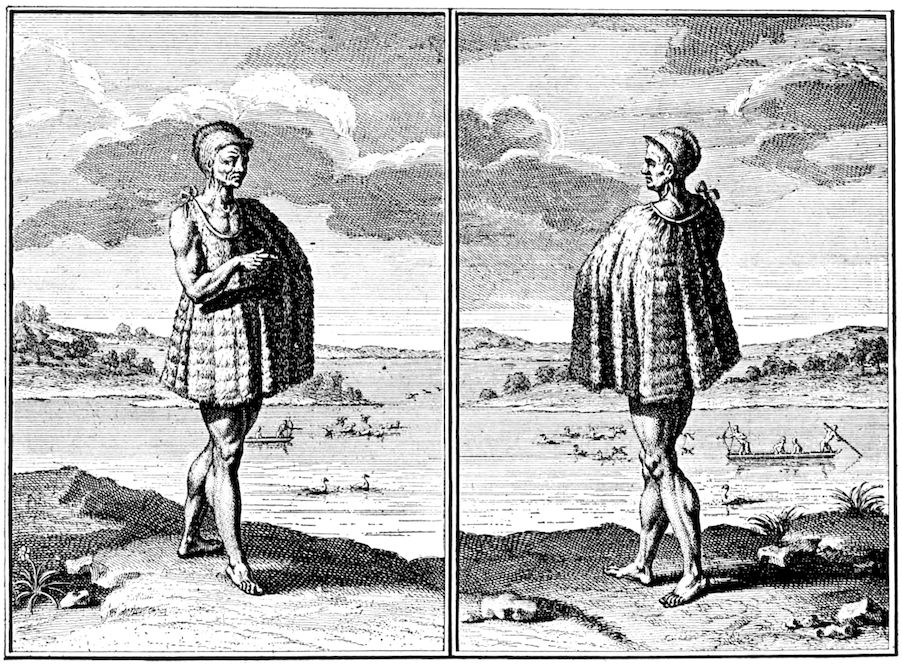
INDIAN MEDICINE-MEN From “Histoire Générale des Cérémonies Religieuses de tous les Peuples du Monde,” by Abbé Banier and Abbé Mascrier, Paris, 1741.
19In British New Guinea similar tactics are resorted to by the native doctors. A native who was suffering from lumbago fully believed the tale that his disease was caused by a stone embedded in his flesh. When the sorcerer made passes over this man’s back and then exhibited a stone which he pretended to have taken thence, the sufferer was convinced that the disease had left his body, and he began to feel relief. When examined, his back showed some superficial cuts at the spot where the stone was said to have been extracted. In another case, however, when a child was to be operated upon in a like way, the child’s father became suspicious and seized the operator’s hands before they came into contact with the little one’s body; the result being that the disease-laden stone was found concealed in the operator’s hand.[34]
Pebble-mania or lithomania is an inherent trait in all mankind. From the most primitive man to the most modern, especially those of optimistic and investigating tendencies, this trait is present in a greater or lesser degree. That is, curious people would collect pebbles for their bright colors, or markings, for their transparency or translucence, and those of an investigating turn of mind, under the impression that the find was perhaps a diamond or a gem of some kind. In modern times this kind of collecting has developed into a regular industry, pebbles found on the shores of the United States and which are either pure white, transparent or translucent quartz, being cut and offered for sale. These pebbles 20are gathered, and are valuable to those who make a business of selling them, because the white opaque pebbles become translucent after cutting, or rather, during the process of cutting, and they are then passed off for moonstones, which are worth from one-third to one-half more than the cost of cutting the quartz pebbles, the purchaser being led to believe that he is getting a moonstone, although this could not be possible, since moonstones have never been found on either the eastern or the western coast of the United States. As for the cut moonstones which are brought back by the tourist, under the impression that he is getting native material and workmanship, these all come from Europe.
Pebble-mania is not confined to mankind alone. Birds and animals possess it. The magpie picks up and hides away bright objects, including odd pebbles, or carries them to its nest. The stones known as ætites were said to be found in eagles’ nests, although they may have been swallowed by the birds for digestive purposes, just as the hen’s crop is full of stones, many of them being transparent, a proof that the fowl had been attracted by them, and had swallowed these in preference to other, duller ones. Notable instances of transparent pebbles are the alectorii, or “cock-stones.”
The great Italian goldsmith and sculptor, Benvenuto Cellini (1500–1574), relates that when a youth he often shot cranes with his arquebuse, and that in several instances he found in their entrails not only fine turquoises, but also fragments of the so-called plasma-emerald and even occasionally small pearls. This serves to indicate that the pretty exterior of such objects exerted an influence upon these birds in some degree analogous to the impressions aroused in mankind on viewing them.[35]
21In seventeenth century Denmark there seems to have been no lack of “magic stones,” for it is related that one day as King Christian II was strolling along the beach, he picked up a shining pebble by the aid of which he could render himself invisible at will. Similar power was said to exist in stones that could be found in ant-hills if hot water were thrown onto them on St. Walpurgis Day, or St. Hans’ Day. The Danes of the time also shared in the belief that the stone from the lapwing preserved from illness and sorrow as did the “swallow’s-stone” as well.[36]
It has frequently been maintained that the source of pebbles could be broadly determined by their form and surface; for example, well-rounded specimens of fairly uniform size would be classed as marine pebbles, while river-pebbles would be subangular and usually flat; pebbles of glacial origin, on the other hand, would have faceted, rounded edges, their surfaces being polished and striated. However, although these rules might hold good in many cases, careful observation has demonstrated that pebbles of all these supposedly distinct types can be found among those of marine, fluviatile, or lacustrine origin. This is explicable by the fact that while the constant, unhindered action of sea or river would probably produce pebbles of distinct type, the local conditions often interfere with this. For instance, on a low sea-coast, with weak wave-action, pebbles frequently became buried in the sands, thus retaining their form practically unchanged, and even where the waves are stronger, so that the pebbles are more or less constantly exposed to their force, it must be borne in mind that some of these coast pebbles have been swept down by rivers, or have already been affected by glacial action. In these cases the force of 22the waves will indeed modify the form, but along the lines of that already produced by the earlier agencies. Broadly stated, those that were round or oval would generally remain so, rectangular fragments might have their angles worn away and become elliptical, while flat fragments would not exhibit any notable change in shape.[37]
When a group of pebbles have been long exposed to attrition by the waters of a powerful stream, especially where the current is intermittent, and where a large quantity of sand has been worked or blown into the stream by freshet or wind storm, they may become rounded by the erosive action of the water or by the abrasive power of the sand, as well as by the attrition consequent upon their sharp contact with one another. This is exemplified in the case of boulders in a river bed, it having been noted in certain streams on the Navajo Reservation that while the upstream sides of the boulders were polished and rounded, and even sometimes faceted and etched, but little change was observable on the downstream sides. This has been tested experimentally, holes an inch in depth having been drilled in opposite sides of sandstone boulders, and on examination five years later in five different localities where this had been done, the deepest hole remaining on the upstream sides measured but four-tenths of an inch, while in one locality the holes had entirely disappeared, and yet so trifling was the effect of the water on the downstream side that a blue-pencil mark had not been washed away. Of course, the erosion of quartzite and limestone boulders tested in this way proved to be a much slower process, amounting to less than one-hundredth of an inch annually. Another important consideration in the shaping of pebbles by river-water is the swiftness of the current, 23it having been noted, for instance, that those which have been washed down the steep slopes of the Navajo Mountain and the edge of the Black Mesa are somewhat better rounded than those that have been borne along for a much greater distance by less swift-flowing water.
That striated, faceted, or polished pebbles are always of glacial origin, or that those of glacial origin usually offer these characteristics is far from the fact; indeed, it may rather be said that they are generally missing. The fluvio-glacial drift is much more widespread than ground moraine, and the pebbles found in the former rarely present these aspects; indeed, it has been noted that in an hour’s search through the glacial drift of Connecticut, only a single such specimen may be met with. On the other hand, many pebbles of this type have been found under conditions plainly showing that the striation was due to other causes, in some instances, as with those occurring in conglomerates, to pressure and differential movement.[38]
The burying of white stones or lumps of quartz with the dead was not infrequent in early times in Ireland. The peasants of the north of Ireland call these Godstones. A cist found at Barnasraghy, County Sligo, was nearly filled with quartz pebbles, and not long since a white stone was found in a primitive burial place near Larne, County Antrim. That this was a usage confined to the earlier period of Irish history is generally admitted, and the discovery of such white stones in a grave is accepted as an indication that it belongs to an early date.[39]
It has been suggested that these white stones were used for burials because of the symbolic meaning of the color, 24which to the minds of many primitive peoples was that of purity, as indeed it is still among most modern peoples, although the symbolism may not always be consciously accepted. White marble seems to most of us the most appropriate and beautiful stone for monuments, and if to a very considerable degree granite is now used as a substitute, this is principally because of its greater resistance to the deteriorating effect of atmospheric changes. Already in prehistoric times, the cave-dwellers showed a fondness for gathering quartz crystals and fragments, and specimens of those taken from the Auvergne Mountains have been found in the cave-dwellings of Les Eyzies; they may have been used as amulets or talismans.[40]
A legend of the great Irish saint, Columba, gives an instance of the curative use of white pebbles. After this saint had vainly entreated Broichan the Druid to free a Christian bond-maiden, as a last resort he menaced the druid with approaching death. The prediction or curse was speedily on the way to fulfilment, Broichan sickened unto death, and in his terror consented to free the maiden. Hereupon St. Columba went to the river Ness and picked up out of its shallows several white pebbles, announcing that they would, by the Lord’s power, work the cure of heathen people. One of the stones was blessed by the saint and placed in a vessel filled with water, on the surface of which it floated, and as soon as Broichan had taken a draught of the liquid he was restored to perfect health.[41]
A famous Scotch amulet was a polished globular mass of white quartz, an inch and three-quarters in diameter, owned by the chiefs of Clan Donnachaidh and known as the 25“Stone of the Banner.” It had been accidentally found by a chief of this clan, who, on his way to join Robert Bruce in 1315, before the battle of Bannockburn, noted a glittering stone embedded in a clod of earth that had become attached to his flagstaff. It was looked upon as a powerful talisman in battle, and water in which it had been dipped was said to cure diseases. Tradition asserted that this white stone of Clan Donnachaidh was identical with that used long before by St. Columba.[42] As such white stones were often deposited in graves, sometimes even being placed in the mouth of a deceased person, it has been suggested that perhaps the sparks emitted by the quartz on percussion were believed to shed some faint gleams along the dark pathway of the departed in his journey to the underworld. In Christian times there can be little doubt in regard to the influence exercised by the text in Revelation: “To him that overcometh ... I will give a white stone, and in the stone a new name written, which no man knoweth save he that receiveth it.”[43]
Crystal balls are not only valued for the visions to be seen, or supposed to be seen in them, but are sometimes worn as amulets against illness. In some parts of Japan they are thought to ward off dropsy, and their wear is also recommended to guard from all wasting diseases.[44] The likeness of rock-crystal to congealed water may well be credited, in the doctrine of sympathy, with its putative power of preventing the watery infiltration from which a dropsical patient suffers. As the Japanese make many choice crystal balls, these objects are generally more or less familiar in that land 26and have thus appealed as well to those who were superstitious as to those who appreciated things beautiful in themselves.
In Yucatan quartz crystals were not only used for divining, but also to ensure the success of the crops. The fact that such crystals have been found in the Indian mounds of Arkansas, North Carolina, and elsewhere, may warrant the supposition that they had been worn as talismans and then interred with the deceased persons as a most intimate part of their property. The writer’s personal observation in Garland and Montgomery counties, Arkansas, demonstrated that quartz crystals were to be found in mounds together with chipped arrow-points of chalcedony, although the crystals did not appear to have been worked in any way. The region about Hot Springs, Arkansas, has furnished some of the finest rock-crystal found in the United States. From North Carolina also have come many remarkable specimens, the largest of which, found in 1886, was unluckily broken up by the person who discovered it. In its crystal state it must have weighed about 300 pounds, and if cut would have furnished a crystal ball 4½ or 5 inches in diameter. This splendid crystal came from Phœnix Mountain, Chestnut Hill township, in Ashe County, North Carolina, and from the largest fragment recovered, weighing 51 pounds, several slabs 8 inches square and from half inch to one inch in thickness were cut. Nearby a crystal weighing 285 pounds was found, and another weighing 188 pounds. Some of the crystals from this locality had on one side a green coating of chlorite, and when this was not removed, the effect was as though one saw a green moss growing beneath a pool of water. The rock-crystal slabs have an advantage over glass when used for mirrors, as they more truly reflect the tints of a fine complexion. Brilliant crystals from Lake George and its neighborhood have been called “Lake George 27Diamonds.” In marked contrast with the large examples we have noted, many crystals of quartz are so small that 200,000 would have an aggregate weight of but one ounce and yet many are perfect crystals and doubly terminated.
The presence of white quartz pebbles in some graves of the Indian Moundbuilders, appears to be indicated to a satisfactory extent in the case of certain specimens from the Etowah Mound in Georgia; these pebbles, which form part of the Steiner collections in the United States National Museum, were not, however, worked or polished in any way, nor are there any traces of use for ornament or decoration. On the other hand, white quartz pebbles from the Pueblo region of the Southwest offer undeniable signs of having been long used and are of frequent occurrence; some of these have been found in graves. In connection with the probable reasons determining their presence the designations “fire stones” or “charms” have been given them; some specimens of this worked quartz had evidently been worn as pendants, while others had probably been regarded as fetishes.[45]
It is most interesting to note that the superstitious use of these objects in burials was so widespread as to prove that it must have been due to some inherent property or properties in white stones, and especially in pebbles of white quartz, which appealed very strongly to the mind of primitive man. That, as has been noted above, the conception of purity should be associated with whiteness, in its contrast to any obscure color, is natural enough, and rests upon the association of spotless cleanliness with moral purity, and very probably the sparkles of light emitted by a bright piece of quartz, normally or on percussion, brought this material into some connection with the worship of fire, or of fire-gods. 28To another possible conception along the same lines we have already alluded.
An instance is reported where a very curious quartz pebble, one-half white and the other black, was found within the hand bones of the skeleton of an Indian; the finder carried it about with him for many years as a “lucky stone,” but it appears that his personal experience of its effects, if these can be judged from what happened to the bearer of such a talisman, has been of a kind to shatter the most robust faith in the protective power of his Indian charm. Possibly the strange relic may have symbolized night and day for the Indians, and thus have been believed to guard the wearer or the person with whom it was buried, at all times and seasons. That pebbles of this sort were sometimes buried in the ground, disposed in circles and squares, is vouched for by some who claim to have unearthed them in ploughing, but our informant was not able to confirm these statements, as the arrangements had always been effectually disturbed before he reached the spot.[46]
In many graves of the primitive Red-paint People of Maine, small pebbles have been found. As they were not large enough to have served as paint-grinders, and as but one such pebble occurs in any single grave, the presumption is quite strong that they were considered as talismans for the dead. The fact that the practical laborers of our day who dug out these graves instinctively named the pebbles “lucky stones” goes to prove that this supposition is not too far-fetched, although there is no positive evidence to support it. The pebbles were yellow, bright red, or gray in color, the graves explored being at Orland, Maine, as well as at the outlet of Lake Alamoosook, on the south side of this lake and at Passadumkeag; indeed such graves have been 29met with all the way from the Kennebec Valley eastward to Bar Harbor.[47]
The respective symbolic meanings of white and black are illustrated in the designations “white magic” and “black magic,” the latter denoting conjurations or spells in which the aid of the powers of darkness, of the Devil and his demons, was sought by the sorcerer, while “white magic” was to be performed by harmless and innocent means, sometimes even by religious rites. In this way it sometimes so closely approached the domain of religious miracle, that it becomes difficult to distinguish between these two conceptions of supernatural action in the material world.
Quartz of a different type with needle-like inclusions is called “Thetis’s hair stone.” This is a transparent or translucent quartz, but so completely filled with acicular crystals of green actinolite, or occasionally altered actinolite of a yellow-brown or brown color, as to appear almost opaque; seals and charms have been made to a small extent of this variety. Of other inclusions in quartz we may note those of a very brilliant stibnite projecting in all directions, some of the intruded crystals being very curiously bent. Exceedingly beautiful gems have been cut from this material.[48] When this quartz is cut en cabochon across the ravalette inclusions, a cat’s-eye effect is produced. The yellow quartz cat’s-eye of Ceylon and the green of Haff, Bavaria, are of this type. So densely set were the green actinolite inclusions in the case of a specimen found at Gibsonville, North Carolina, that it was believed by the finder to be an emerald.
An extremely beautiful effect in quartz is produced by enclosed, acicular crystals, or hair-like particles of some 30other mineral, such as rutile, for instance, and sometimes even of gold. To specimens of this latter type may be referred the Greek name “chrysothrix,” used in the Orphic poem “Lithica” and signifying literally “golden hair”; of this the verses tell us there were two varieties, that which may be identified with quartz, having a resemblance to “crystal,” while the other, said to have the appearance of chrysoberyl, may have been a yellower variety. To the quartz traversed by filaments of rutile, or the red oxide of titanium, has been given the taking name of “Venus’s hair stone”; a pretty French name is Flèches d’Amour or “Cupid’s Arrows.”[49]
The California beaches have furnished some of the most interesting ornamental pebbles, the greater number being of chalcedony or agate weathered from an amygdaloidal rock, while a few are of jasper or fossil coral. Their variegated color-markings made them very attractive ornamental objects in themselves, and there is reason to believe that centuries ago the Indians of this region valued them as talismans or amulets. At present the finest specimens are gathered from Pescadero Beach in San Mateo County, about twenty-four miles west of San José, Redondo Beach, fifteen miles south of Los Angeles, and also from Crescent City Beach, in the northern part of California. On Moonstone Beach, Santa Catalina Island, many beautiful quartz and chalcedony nodules have been picked up, which have weathered out of ryolite rock of sanidine feldspar and quartz. It has been quite a custom for guests of the hotels to go down to Redondo Beach and gather these pebbles, and some of those collected by enterprising natives are placed in a bottle of water to bring out the beauty of their colors. Sometimes they are drilled and strung on flexible wire to form long chains or necklaces. Several pebbles presumably from Redondo Beach were found, in 1901, in an Indian grave, where they were probably placed as amulets for the dead.[50]
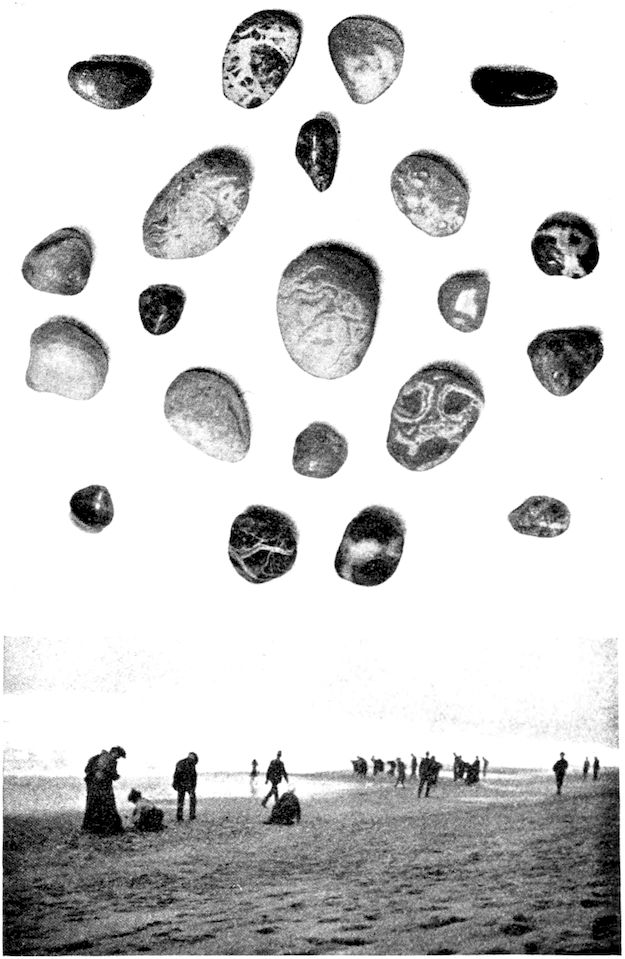
By courtesy of California State Mining Bureau. 1. Chalcedony and agate pebbles from Pescadero Beach, San Mateo County, California. 2. Pebble Beach, Redondo, Los Angeles County, California. From George Frederick Kunz’s “Semi-precious Stones of California,” Sacramento, 1905. Bulletin No. 37 of the State Mining Bureau.
31The occurrence of fluid cavities in quartz, chalcedony, sapphire, and other minerals, is due at times to cavernous structures formed during the growth of these minerals, when the crystalline substances, for some reason, instead of filling these up solid, will avoid the caverns and enclose the liquid of crystallization. In agate inclusions this is found with silicious content, possibly due to the fact that it is to an extent carbonic acid gas, or water containing salt or some other foreign substance. In agate chalcedony, whether in pebbles as minute as a pinhead, or in amygdules several feet across, the liquid is enclosed because the walls of the gas-pores in the rock, which are frequently almond-shaped, are gradually becoming smaller, or rather the walls thicken by the deposition of the silica forming agate, chalcedony, or any impenetrable layers, or else an impenetrable form of quartz; then again, frequently toward the centre or when the liquid forms less rapidly, or through some change, the quartz becomes crystalline, either colorless, smoky, or amethystine, and this is due to various inclusions. This gradual thickening of the walls means that the aperture into which the liquid penetrates becomes smaller and smaller until at last it is entirely sealed, so that it becomes enclosed in a kind of nature’s water-bottle, these being sometimes as large as in the chalcedony specimens from Uruguay; this is also the case with the hydrolites and the enhydros, when they can be shaken and the water rattles as in a bottle.
An occasional small Redondo Beach, California, or Medford, Oregon pebble contains a moving bubble of air in liquid.
32Most wonderful specimens of rutilated quartz are the great, rich brown, possibly titanium-colored masses in the Morgan Collection at the American Museum of Natural History, that in the Vaux Collection at the Philadelphia Academy of Natural Sciences, and a smaller mass in the British Museum; these were all obtained near Middlesex, Vermont. The rutile is a rich transparent or translucent red, varying in thinness from that of an ordinary needle to that of a knitting-needle, and even to that of a thin lead-pencil. Wonderful specimens are also found in the Alps of St. Gotthard, in Madagascar, and in Alexander County, North Carolina, where they are found in quantity as minute crystals of a rich red or golden yellow.
Other curious and interesting rock-crystals with inclusions are those showing enclosed drops of water, the kind termed enhydros by Pliny[51] and many old writers; in some of the rarer specimens the enclosed water is present in considerable quantity. Quartz with inclusions of this type was highly appreciated in the Greco-Roman world, and one of the best poets of the Decadence, Claudian (fl. about 400 A.D.), composed a series of poetic epigrams upon them, seven of these being in Latin and two in Greek. An example of the best in each tongue, the first in the former and the second in the latter, must be of interest, although the literal prose version cannot have the charm of the original verse.[52]
The Alpine ice, already precious in its frigidity, acquires an intense hardness through the action of the solar rays, but unable to transform itself entirely into a gem, it betrays its original source by the water that still remains within it. This adds at once to the beauty of this liquid stone and to its value.
In its changeful aspect, this crystal born from snow and fashioned by the hand of man is an image of the world, of the heavens enclosing cruel ocean in their wide embrace.
33An old superstition among the Laplanders of Sweden is that in order to avert or cure disease which may be or has been caused by sleeping in the open air on the exposed moorland, three pebbles should be gathered, one from the water, one out of the earth, and the third from the surface of the ground or “from the air.” These are placed on a fire until they become red-hot, and are then thrown into water; the stone which sizzles most is that belonging to the element which has caused the illness. The whole body, or sometimes only the afflicted part, is to be moistened with the water in which the pebbles have been immersed, and each separate stone is to be carefully returned to the spot whence it was taken.[53]
Near Middleville, in Herkimer County, New York, in a calciferous limestone, gray and brownish-gray in color, there are numerous cavities varying in size from that of a pinhead to that of a man’s head. In these cavities are found carbonaceous substances such as asphaltum and other hard, black hydrocarbons. These cavities also frequently show mud or sand adhering to the sides, or mud and sand mixed with the petroleum, in which are often found brilliant and transparent rock-crystals, the purest of any found in the world. They are unusually perfect hexagonal prisms with both sets of six pyramid faces; that is, with same slight modification, eighteen brilliantly polished faces. These are especially sought after on account of their great purity, and because it is considered that he who wears one will have fair weather and secure the blessing of fair sailing on the sea of life. Some of these crystals are so small, though of absolute perfection, that it would require 250,000 of them to weigh an ounce; others again are sometimes as large as from one to 34two inches in length. When not entirely transparent they frequently contain inclusions of black asphaltum or other hydrocarbons and also contain hollow cavities which are filled with fluid, sometimes salt water and sometimes liquid carbonic acid gas. In these are moving bubbles and occasionally a heavy hydrocarbon; that is, a bubble will ascend and the hydrocarbon will sink; or else the bubble will rise and take with it a small speck of hydrocarbon, and another will sink. In a wonderful specimen now at the American Museum of Natural History there is an object like a small spider of hydrocarbon which sinks while a minute water-bubble rises. They are called fair-weather stones.
Tasmanian rain-makers use white stones in their magical rites; however, the stone by itself is not considered an effective talisman, for it must be dipped in the blood of a young girl to give it added power. After a number of white pebbles have been steeped for a time in this blood, the rain-maker ties them up in strips of bark and sinks them in some deep water-hole in which a diabolical spirit is supposed to dwell. The natives confidently assert that this ceremony is soon followed by the desired rainfall. As the belief prevails here as elsewhere, that these white stones or pebbles to retain their power must not be looked upon by a woman, it seems a little strange that the rain-bringing stone is dipped in a young girl’s blood.[54]
However, white stones have not always and everywhere been regarded as lucky, for it is stated that among the fishermen of the Isle of Man the presence of a white stone in a fishing-smack is confidently believed to portend poor fishing. Indeed it has been reported by a Scotchman, who went out in a fishing boat for several consecutive days with a party of 35Manx fishermen, that after a succession of days marked by poor fishing they began to nickname him “White Stone.”[55]
An oath taken on sacred stones was regarded by the ancient Scandinavians as peculiarly binding upon him who took such an oath; in the old Norse annals it is stated that Gudrun Gjukesdatter offered King Atle that he would take an oath on the “pure white stone.” The hero Duthmaruno is said to have sworn by “Loda’s Stone of Power,” which represented the almighty divinity of the Norsemen.[56]
A sacred well on the north side of Lough Neagh, Ireland, lends peculiar sanctity to the yellow crystals found in great quantity near by. The belief in their miraculous quality finds expression in the legend that they grow up out of the ground on Midsummer Night, and whosoever wishes to possess them as talismans must pronounce certain magic rhymes in the act of collecting them. They then become luck-bringers of potent virtue and ensure the prosperity of the household in which they are guarded.[57]
The stone, or rather rock, named catlinite, and popularly known as “pipe-stone,” was regarded by certain tribes as one of their most valuable materials,[58] and was extensively used for pipe-bowls. In color it ranges from a deep red to an ashy tint; the chief quarry is situated some three hundred miles west of the Falls of St. Anthony, on the dividing ridge between the Saint Peter’s and Missouri rivers. This region was visited in 1836 by George Catlin, to whom we are indebted for the preservation of so much regarding Indian folk-lore and customs, and after whom the substance 36is named. While it is impossible to determine with any degree of certainty for how long a time the Indians were familiar with this material, there are those who believe that the quarries were worked and the material used for pipe-bowls by native sculptors long before the earliest notice we have to that effect.[59] Great skill and patience were displayed by the Indians in the making of these pipe-bowls, which were sometimes carved with various symbolical figures. We have an early record of such pipes from the pen of Jacques Marquette, a Jesuit missionary to the Indians, who saw one when visiting the Illinois Indians in 1673. He reports it as being of polished red stone, like marble, so pierced that one orifice served to hold the tobacco, while the other was fastened on the stem, which was a stick two feet long, as thick as a common cane and pierced in the middle. The whole was covered with large feathers of red, green, and other colors.
Catlin states that at the time of his visit the “pipe-stone” quarry was guarded with a certain religious reverence from the visit of the white man, the Indians declaring that this red stone was “a part of their flesh,” and that to take it from them would be to tear out their flesh and spill their blood. This highly poetic language may or may not have signified a superstitious reverence for the substance; indeed, it may simply have voiced the fear of these Indians that they might be despoiled of what for them was an especially valuable material, which they asserted had been bestowed upon them by the Great Spirit for the making of pipes exclusively. In our day an old Ojibway Indian, especially skilled in the work, has a name signifying “he who makes pipes,” and carved pipe-bowls of catlinite are usually sold for from $1 to $10 apiece; as much as $20, however, is occasionally paid for a particularly large and finely carved specimen. This substance is also worked up into charms and other small ornaments which are sold to tourists, the annual sales of all descriptions amounting to some $10,000 annually. Catlinite takes a fine polish and is easily worked; a peculiarly attractive variety is red with white and gray spots.
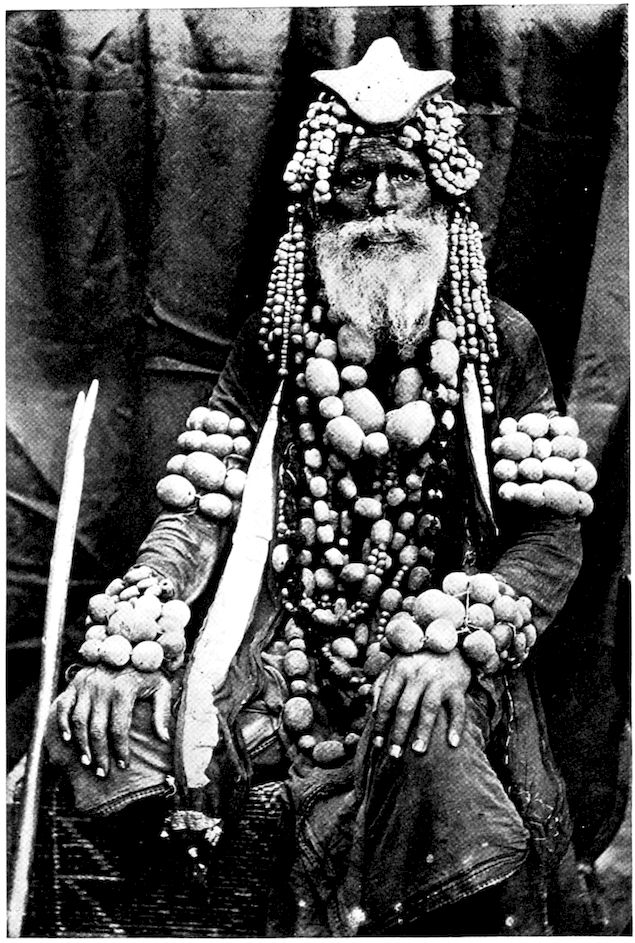
HINDU WEARING A COLLECTION OF ANCESTRAL PEBBLES AS AMULETS
37The popular fancy for the “Fairy Stones” from a peak of the Blue Ridge Mountains, Patrick County, Virginia, is said to be directly traceable to the tale, “Trail of the Lonesome Pine,” by John Fox, Jr., who makes one of these pretty staurolite crystals exercise an important influence over the destinies of his hero and heroine. This was cleverly utilized by the manager of a New York theatre, when he gave a souvenir performance of a dramatized version of the story, by presenting one of these “Fairy Stones” to each lady in the audience, a gift not only in perfect rapport with the play, but one highly appreciated by the recipients, few of whom were not unconsciously influenced by the symbolic half-religious, half-mythical quality ascribed to this attractive little gem.
Collections of stones and pebbles, often of little or no intrinsic value but supposed to possess occult powers, are handed down from father to son in many Hindu families of the poorer class. The accompanying illustration shows an aged Hindu, as he appeared to a recent traveller, decorated with such stones to the number of about three hundred on a ceremonial occasion. In this case they were all pierced and threaded on cords, so as to be attached to the person, and the old man proudly declared that, thousands of years ago, one of his ancestors was a playmate of the god Krishna, who had bestowed the stones upon him as a special mark of divine favor.
The presence of erratic boulders was accounted for by 38popular legend in a variety of ways. Sometimes it was declared that the Virgin or a saint, while bearing an enormous stone through the air to be used in the construction of a church, had learned on the way that the church was completed and the stone no longer needed, and immediately let it drop to the earth.[60]
A stone having the rude form of a chair or seat, and known as Canna’s Stone, enjoyed repute in Wales for its curative powers. It was in a field in close proximity to the church of Llangan, Carmarthenshire, which owed its foundation to St. Canna. Near this stone is a well called Flynon Canna, the waters of which were believed to be a cure for ague. To make the cure effective, however, the patient, after imbibing the sacred water, had to sit for a time in Canna’s Stone, and if he dozed while sitting there this was considered to promise a speedy recovery. The combined treatment by well and stone was often repeated for several successive days and was occasionally prolonged for two or three weeks.[61]
That a child could be cured of disease by being passed through an aperture in one of the sacred stones that had formed part of a dolmen is shown in the case of a stone of this kind preserved in the church of Villers-Saint-Sépulcre, dept. Oise, France. There is another such stone in the same department, at Trie, used in a like way for the cure of feeble children or those suffering from rachitis. This reveals in a striking way the persistence of superstitious beliefs which were already condemned in 567 A.D. by the council of Tours, which prescribed that the eucharist should be refused to those who venerated these so-called sacred stones, and at a 39still earlier date, in 443 A.D., a council decree pronounced those bishops guilty of sacrilege who permitted the making of vows over these stones or the deposition of offerings thereon.[62]
Some of the stones of the druidic dolmens were called by the French peasants of a later age pierres tourniresses, or “whirling stones,” for it was solemnly asseverated that at midnight on Christmas Eve these stones gyrated on their base. A still stranger fancy was that some other stones of this class became fearfully thirsty at times, once every hundred days, or perhaps only once in a century, and then rolled off to the nearest stream to slake their thirst. Under others, again, it was believed that a hidden treasure reposed, watchfully guarded by a terrible dragon. However, on one night in the year, while the clock was striking twelve, he snatched a moment’s sleep, and whoever was clever enough and quick enough to make use of this chance could acquire untold riches.[63]
A strange belief prevails in and about Dourges (dept. Aube), France. On the top of a hill near this place is a chapel built in honor of St. Estapin, and in close proximity to this chapel are rocks with many irregular hollows of such varying shapes and forms that almost any part of the human body can be thrust into the openings. On the 6th of August in each year, those from the neighborhood suffering from illness or disability of any kind come hither, and, after having made their way as best they can nine times around the chapel, proceed to the platform whereon are the wonder-working stones, and introduce the afflicted part of their body into the appropriate opening in one of the rocks. The result 40is said to be an immediate cure of the trouble, however serious this may be, one experiment being sufficient.[64]
Stones of peculiar shape or marked color are those to which popular fancy has most often attributed a certain sanctity or power. Instances of this may be found in the Scottish isles. Thus, on the island of Arran in the Firth of Clyde, a green stone of approximately spherical form had acquired great repute for its healing virtue, especially for those having pains in the side. When this stone was laid upon the seat of the trouble, the pain would disappear. This, however, was not the only use to which it was put, for oaths were taken upon it, proving the presence of a certain animistic belief in the islanders’ minds, as though some spirit dwelt in or animated the stone and would take vengeance on a perjuror. A still better proof of this was the idea that the green stone of Arran would bring victory to a leader if he bore it with him and cast it into the enemies’ ranks at the decisive moment of a conflict, as is said to have been done by the Lord of the Isles. Alongside of this green stone may be placed a blue stone credited in the Scotch island of Fladda with the possession of like healing power, and on which also oaths were taken.[65]
A large, flat stone in St. Andrew’s on the isle of Guernsey is stated to have borne a somewhat humorously misleading French inscription. This ran: “Celui qui me tournera, Son temps point ne perdra,” which has been freely rendered:
To him who turns me up I say
His labor won’t be thrown away.
This tempting promise, interpreted as a sign that some buried treasure was hidden in the ground beneath the stone, 41finally induced some one to devote much toil and time to the difficult task of turning the stone over. What, however, was his chagrin and disgust when the under side presented the words: “Tourner je voulais, Car lassée j’étais” (I longed to turn, because I was so tired). Whether the practical joker who originated the inscription was present to enjoy the success of his joke is not revealed.[66]
To a mass of quartz at Jerbourg, Guernsey Island, local fancy has attached a wild legend, which finds expression in the strange designation of the stone as “The Devil’s Claw.” The old Chronique de Normandie, which, although written much earlier, was first printed in 1576 at Rouen, recounts under date of 797 A.D. that Duke Richard, when on his way from one of his strongholds to a manor where dwelt a damsel of surpassing beauty, was assailed by the Evil One; but, like a second St. Michael, Duke Richard overcame his dangerous antagonist. Seeing that he could not prevail by force, the Devil had recourse to one of his most perilous wiles, and changed himself into a beautiful, richly attired maiden. In this disguise he lured Duke Richard to the seashore and induced him to enter a boat and put out to sea. He thus spirited the duke away to the lonely isle of Guernsey, and at the landing spot, where the Devil finally seized his too-confiding prey, stands this mass of quartz, a deep black splash running right across, indicating in popular fancy the mark left by the devil’s claws.[67]
A solitary boulder standing on a heath in North Germany is the subject of a curious legend illustrating the superstitious reverence inspired by the thunder. Once upon a time a bridal procession was traversing the heath when a violent thunder-storm broke out. Taking no heed of this, the musicians who accompanied the procession continued to 42play their gay and festive music, and as a punishment for this lack of respect the God of Thunder changed the whole party into an immense rock.[68]
An erratic boulder lying in midstream in the River Ferse, in West Prussia, at a bend it makes between Peplin and Eichwald, is known in legend as the Teuffelsstein (Devil’s Stone). It can only be reached by swimming to it, the part above the surface of the water measuring 26¼ feet in circumference, the height from the bed of the stream being 8¼ feet. A thick growth of alders on the banks of the Ferse at this point casts strange and sharp shadows over the gleaming surface of the block which is a biotitic gneiss. Legend tells that the Devil once tried to wreck the tower of the church at Peplin by hurling this mass of rock at it, but just as he had it poised in the air and was about to cast it forth the church bells began to ring the call for early mass, and he was forced to let the boulder drop. Another version is that he really threw it, but that it fell short of its mark.[69]
Near Hasselager in Denmark there is an immense boulder about 150 feet in circumference and 32 feet in height. Of this stone legend tells that a witch became so enraged at the fact that the steeple of the church at Svinninge was used by sailors as a landmark, that she picked up the stone and hurled it at the church, but missed her aim. As the boulder is estimated to weigh 1000 tons, this “witch” must have been regarded as a superhuman personality. The legend seems to indicate that she profited by the shipwrecks which were only too frequent on this rocky coast, and grudged the poor sailors the good service rendered them by the prominent steeple.
43A rock in Ardmore Bay, Ireland, is known as the St. Declan Stone, after the first bishop of Ardmore, who came to Ireland even before the arrival of the great St. Patrick. This rock is believed by the peasants to be endowed with great and occult powers, and the legend tells that it was carried through the air from Rome to its present resting place in the bay, at the time St. Declan was erecting his church at Ardmore. The fact that the stone rests upon a number of smaller ones renders it possible for people to squeeze their way under it at low tide, and those who pass beneath it three times are believed to have earned the special favor of St. Declan.[70]
A mass of calcareous stone in a village called Piada de Roland, situated in the commune of Toufailles (dept. Tarn et Garonne), France, shares with some other similar stones in this region the curious name of Roland’s Foot (Piada de Roland). The one preserved in Toufailles measures 70 cm. × 47 cm. × 50 cm., and bears a natural imprint having the form of a foot. Legend accounts for this by the tale that the hero Roland once jumped from this stone to another at Sept Albres and in taking this tremendous leap thrust his foot down so strongly upon its support as to leave an imprint on the solid rock. For a time the “Piada de Roland” was kept in a cow-house—not a remarkably honorable place of deposit—but after the death of one of the cows a sorcerer advised the stone should be broken and removed, as a precautionary measure; this is said to have happened but thirty years ago, showing how deeply rooted such superstitious ideas are among the peasantry in out-of-the-way parts of France.[71]
Another rock-imprint, this time simulating that made 44by the hoof of a horse, is to be seen toward the edge of the abyss of Padirac (dept. Lot). Here again a local legend has been evolved to explain the imprint. We are told that the attention of both Satan and St. Martin had been powerfully attracted to the region, each strenuously seeking to gain possession of the souls of those who died, Satan of course wishing to bear them off with him to the depths of the infernal regions, while St. Martin cherished the fond hope of bringing them to Heaven. Unhappily the sins of the inhabitants of the region so much outweighed their merits that the Devil was almost invariably successful. Once upon a time, when he was riding off to his lurid realm, bearing with him a sackful of lost souls, he met St. Martin, who was full of grief at the fact that he himself had not a single soul to carry heavenward. Knowing, however, that Satan was passionately fond of gaming, he proposed that they should play a game the stake of which should be the sackful of souls. Satan consented, trusting to his powers of trickery, but all his deceptions proved vain, and the precious souls became the property of the saint. Enraged at losing the stakes, the Devil stamped on the ground, and an immense abyss opened up, threatening to engulf St. Martin; however, the latter put up a prayer to God, and spurred on his steed to a supreme and successful effort at escape, but one of the hoofs struck the rock with such force that it made an indentation therein figuring the clear outlines of a horse’s hoof.[72]
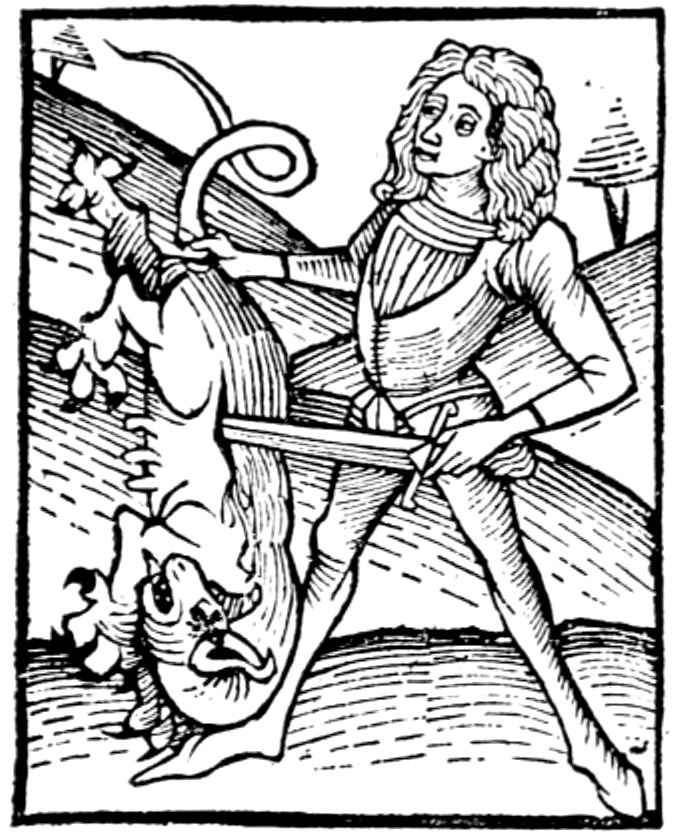
KILLING A DRAGON TO EXTRACT ITS PRECIOUS STONE From Johannis de Cuba’s “Ortus Sanitatis,” Strassburg, 1483. See page 16.
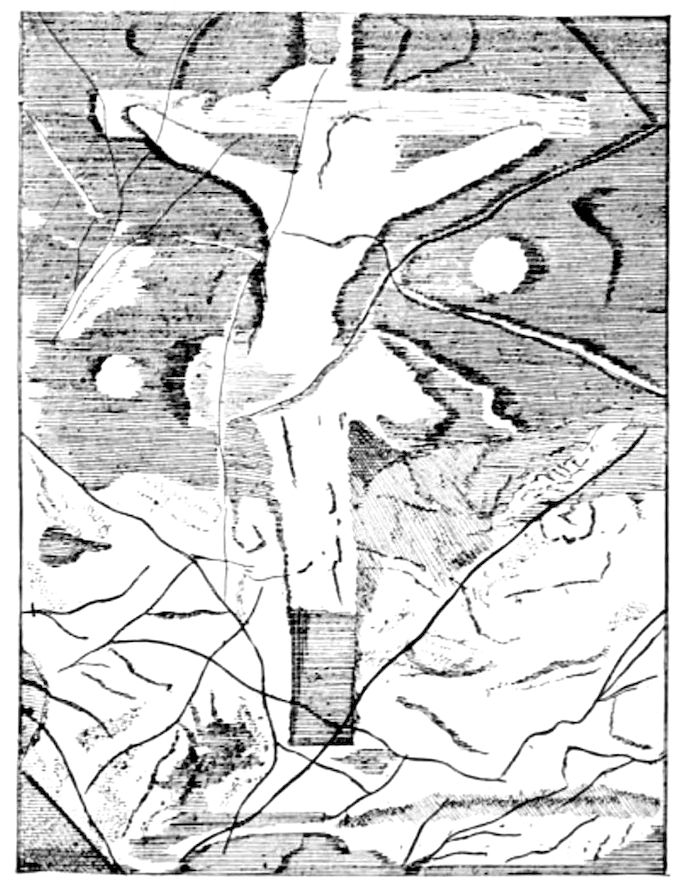
NATURALLY MARKED STONE From Valentini, “Museum museorum,” Frankfurt am Mayn, 1714. Collection of James I, of England; now in Copenhagen. See page 45.
45The Kiowa have a sacred stone whose form suggests the head and bust of a man. This image, called taimé, has long been considered a kind of palladium of the tribe. It is preserved in a box made of stiff dressed rawhide (parflèche) and was only shown once a year, at the annual Sun Dance. As this sacred dance has not been performed since 1887, the taimé of the Kiowa has not been viewed by mortal eye since that time, not even the custodian of the treasure having the privilege of opening the box, except on the occasion of the ceremonial dance above mentioned.[73] Whether this stone has been rudely fashioned into its present shape, or whether its natural form suggested its use as a simulacrum of some deity, has not been determined; it is evidently not of meteoric origin as were many of the curiously shaped stones venerated as images of the gods in ancient times, in both Europe and Asia.
In the rock of St. Gowan’s chapel in Wales was a natural cavity upon which the name of the Expanding Stone was bestowed by popular tradition, because the strange fancy prevailed that this stone automatically adapted itself to the size of anyone who entered the cavity. The legend ran that once, during the Pagan persecutions, when a fugitive Christian, hotly pursued, reached this rock it opened up of its own accord so that he could slip into it, and then closed about him so as to hide him effectually from his enemies. This Expanding Stone was believed to manifest its magic power by bringing to pass the wish expressed by anyone who entered it, provided he did not change his wish while he turned around within it.[74]
The natives of the French colony of New Caledonia in the southern Pacific, attach special importance to the fortuitous shape of stones in using them for talismans or amulets. According to their form such stones are considered to procure favorable effects against famine, madness, or death; to induce sunshine or rain, or else to bring good luck in fishing or in sailing, each special use being suggested 46by some different form, the color also being in some cases a determining factor. For the purpose of securing a better yield from fruit-trees a stone having the approximate shape of the fruit or with markings similar to those on fruit or tree is the one indicated by nature as the appropriate talisman, as in the case of the cocoanut palm, where a stone marked with black lines is the one chosen. Sometimes two different talismanic stones are used in this practice, a smaller one figuring the unripe fruit; when the tree begins to bear, the small stone is buried at its foot, and as soon as the fruit begins to mature, the small stone is removed and the larger one, representing the ripe fruit, is buried in its place.[75]
The Scotch of a century or more ago are said to have considered that an isolated stone or boulder, firmly fixed in the earth, possessed powers of a peculiar sort, and some such stones were used to cure bruises and strains and reduce swellings.[76] As it was also thought that a blow from a stone of this type was especially hurtful, this would be another case of homœopathic treatment of which so many and various examples are afforded by the superstitious use of stones and gems, as well as of other objects to which certain advantageous qualities were attributed.
Small stone boulders have been made use of by ejected peasants in Fermanagh, Ireland, in a magical incantation designed to draw down a curse upon a merciless landlord. For this purpose the peasant would collect a number of such stones, pile them up on his hearth as he would have piled turf sods, and then put up a petition that all manner of bad luck and misfortune might befall the landlord and his descendants to remote generations. Hereupon he would gather up the stones again, and, carrying them off, would 47scatter them about in bog-holes, pools or streams, so that they should never be brought together again.[77] This was evidently done in the belief that the curse could only be raised if a counter-invocation were pronounced over the same collection of stones. An allusion to a custom of turning stones about while reciting a formula of malediction is contained in the following lines by Dr. Samuel Ferguson:
They hurled their curse against the King,
They cursed him in his flesh and bones,
And even in the mystic ring,
They turn’d the malediction stones.
Of all “magic stones” none seem better to deserve this designation than those mysterious and fascinating mineral specimens, veritable lusus Naturæ, bearing imprinted upon them by nature’s hand some likeness of the human face or form. The grandeur and the overwhelming power of the material world are probably as much or even more felt in our prosaic age than they were in the earliest times, but this sentiment is sometimes coupled with a sense of distrust—happily neither general nor permanent—as to the presence in this tremendous and inspiring aggregate of forces of any distinct and definite evidence of the working of an intelligence closely similar to our own. It seems not unlikely that to this half-distrust is in great part due the fascination exercised by these naturally designed stones. We know, indeed, that when examined critically by the mineralogist, their strange markings become explicable as the results of fortuitous stratifications and juxtapositions, but to our instinctive appreciation they offer so close and startling an analogy to the artistic reproductions consciously made by the hand of man, guided by his experience 48and intelligence, that we are almost invariably impressed with a keener sense of our kinship with nature.
Some very characteristic and interesting specimens of these natural designs were at one time in the possession of Queen Victoria, many of them having been formerly among the treasures in the valuable and extensive collection of pearls and precious stones carefully gathered together by the famous banker and connoisseur, Henry Philip Hope. Quite recently (April 20, 21, 1914) these objects, which had passed into the J. E. Hodgkin Collection, were sold at Christie’s in London. Perhaps the most remarkable is thus described by B. Hertz in the Hope Catalogue:[78]
No. 62. A very beautiful lusus, in white and brown agate, representing a miniature face and neck, with light brown hair and white chaplet, surrounded by a dark brown ground colour.
So singularly natural and artistic is this strange gem, that it is difficult to banish the conviction that we are not gazing upon a fine example of a miniature done by an impressionist.[79] Another interesting, though somewhat less notable example, was a polished flint, of a brownish-gray hue, bearing a half-front miniature of an aged head and face marked in a light brownish-white;[80] still another offered the representation of a human head, the face half turned away; this was also a flint, the groundwork of a light horn-color, the design being of a still lighter shade of the same color.[81]
While nearly all these natural designs are in the flat, occasional examples of relief or intaglio are recorded. As 49an instance may be noted a remarkable double gem or medallion said to have been revealed on splitting open a clump of copper ore from the Bottendorf copper mines. On each of the two halves was marked the image of a male human head, dressed with a peruke, but while on one side the representation was in relief, on the opposite half it was in intaglio.[82]
A remarkable find of three of these naturally marked stones is stated to have been made in the river Theiss, near the town of Winterhut, in 1556, “on a Monday after the festival of St. Gall.” On one of these flint pebbles was depicted a cross, a sword and a rod; the two others bore respectively a cross and the Burgundian arms, all being as clearly defined as though the work of the human hand.[83]
These smaller natural pictures were, however, greatly surpassed in effectiveness by some most extraordinary representations on slabs of stone, frequently on marble slabs, the strange arrangement of the veinings constituting veritable pictures of considerable extent and marvellously deceptive quality. Thus in the church of San Lorenzo in Florence was to be seen a natural marble on which were depicted two men bearing a bunch of grapes on a rod.[84] Another marble slab, preserved in the Danish Collection in Copenhagen and originally owned by James I of England, presented in most beautiful colors an image of a crucifix.[85]
To the natural image found in a specimen of copper ore may be added a much more remarkable picture discovered in a piece of iron ore. This was found on October 8, 1669, 50by a miner of the Innesberg mines. The clump of ore weighed about two pounds and when the miner split it open with a blow of his hammer, he was startled to see on the upper half a strange and marvellous design. Calling up a companion, he exclaimed: “Look here! Here is the Blessed Virgin on this stone!” On examining the other half, the same design appeared there also. This remarkable find is said to have been recorded in the book of the mine, the stone itself having been delivered to the German imperial inspectors.[86]
It is well to bear in mind that the number of these lusus naturæ seemed very much larger in the eyes of writers of a few centuries ago than to us to-day, for the numerous petrifactions, showing a great variety of animal and vegetable forms, were for a long period included in the same category with the stones bearing curiously deceptive markings or veinings. Much ingenuity was expended by early observers in the attempt to explain the cause of these phenomena. The learned Jesuit, Athanasius Kircher, for example, after having proved experimentally that designs treated with certain chemical agents could be made to impress figures upon stones, took refuge in the strange hypothesis that pictures made on wood or some soft material by primitive miners had been left in the mine and with the lapse of time had slipped down into crevices in the rock, and, becoming tightly wedged in, had impressed the design on the contact-rock; or else he suggested that the original material on which the design had been made might in process of time have, by some unknown means, been converted into marble.[87] As a striking example of a picture of this class, Kircher notes and figures an image naturally designed 51on a stone slab in St. Peter’s in Rome and bearing a remarkable likeness to the Blessed Virgin of Loreto.[88]
The electric or magnetic gems, tourmaline, amber, and loadstone, possess not only great scientific interest, but demonstrate the fact that a certain energy really does proceed from some of these fair, ornamental objects, an energy that produces a positive action from without upon the human body. This may well serve to make us less resolutely sceptical as to the possible presence in gem-stones of some other forms of emanation not as yet susceptible of scientific determination.
The supersensitiveness of the innocent child-soul to the most delicate impressions, and hence to the radiations or emanations from precious stones, is well brought out in the pretty tale by Saxe Holme (Helen Hunt Jackson), entitled “My Tourmaline.”[89] The particular specimen here immortalized was one of the finest from the famous Mount Mica deposits in the State of Maine. One day, while on a country ramble, the little heroine’s eye is caught by the color and sparkle of a brilliant crystal lodged in the gnarled roots of an old tree. In springing forward to secure this pretty treasure the girl trips on the outstanding roots, falls, and sprains her leg very seriously, so that she is laid up for six weeks. However, the beautiful crystal is her great consolation through the long, dreary weeks, and, strange to say, she comes to feel that it has a kind of life in it. This is manifested to her and also to some others, on touching the stone, by a pricking or tingling sensation in the hand; but to the child the sensations excited by the wonderful crystal, as perfectly formed as though cut by a lapidary, red at one end, green at the other, with a separating band of white, are much more pronounced. When it is placed in the little silken bag that has been made to hold it, and 52is laid against her cheek, her feverish restlessness gradually disappears and gives place to tranquil sleep. More than this, she is aware of a species of subconscious sympathy with the tourmaline. So intense is this sympathy that although the child consented to part with her crystal that it might be offered as a unique specimen to a foreign museum, and was heart-broken to learn that through some carelessness it had been lost while being taken thither, she recognized its presence long years after, when, travelling in Europe as a young bride, she entered the cabinet of an enthusiastic collector to view his specimens, and was in no wise surprised when she really found her “Stonie” there among his prized tourmalines.
In connection with this pretty recital it is interesting to note that the first chance observation of the attractive qualities of tourmalines is said to have been made in Amsterdam by a group of Dutch children whose attention had been attracted by a number of tourmaline crystals brought from the Orient, and who were puzzled to see bits of ash and straw attracted to the stones. This came to the knowledge of some Dutch lapidaries, who for a time called the stone Aschentrekker, or “Ash-Attractor.”[90] Our name tourmaline is derived from turmali, the name given the stone by the natives of Ceylon.
There seems some little likelihood that certain examples of the gem called lychnis and noted by Pliny may have been varieties of the tourmaline. As the first tourmalines brought to modern Europe came to Holland from Ceylon, we might conjecture that those kinds of lychnis said by Pliny to have been brought from India had a like origin. Of these Indian specimens, the finest examples of this gem, one kind resembled the carbuncle or ruby, while another bore the designation Ionia because its color was like that of the violet 53(in Greek ion). The most striking peculiarity of the lychnis was its power to attract straws or bits of paper, when it had been heated by the sun’s rays or by hand-friction.[91]
Such is the confusion in the statements made by the early Greek and Latin writers as to the emerald, under which generic name they seem to have included almost all green stones of any ornamental or other value, that we cannot absolutely reject the conjecture[92] that Theophrastus (third century B.C.), the earliest of these writers on precious stones, might have referred to specimens of green tourmaline, when he states that the true emerald appeared to have been produced from jasper, as one of the Cyprian specimens was said to have consisted of one-half jasper and the other half emerald, the metamorphosis as yet being incomplete.[93] We admit that if Theophrastus uses the word jasper here to signify the reddish variety, we would have the combination of green and red zones in a single crystal sometimes observable in tourmaline. How this can be reconciled with the previous statement of the same author that the Cyprian “emeralds” which came from the copper mines of that island were chiefly used for soldering gold, and hence seem to have been of the class of mineral called chrysocolla by ancient writers, is, however, not easy to suggest.[94]
The so-called Brazilian emeralds mentioned by the Dutch mineralogist, Johann de Laet, as having been found shortly before 1647 in mines near Spiritus Sanctus, may perhaps have been green tourmalines. These crystals were described 54by Gesner as of cylindrical form, striated, and of a vitreous lustre; their color was like that of the prase and they were transparent. Although De Laet adds the assertion that the Oriental emerald (green corundum) was as hard as the sapphire, the Brazilian emeralds approached more closely to the Oriental in point of hardness than did emeralds from any other source of supply;[95] and green sapphires have never been found in Brazil, while green tourmalines have been.