Front matter
Reading edition
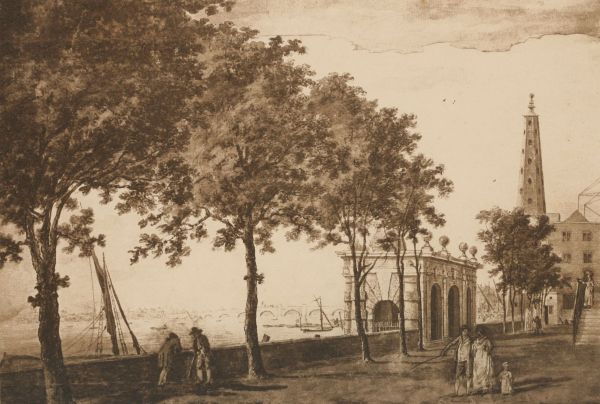
The Terrace. York Buildings. 1796. From a water colour by J. Richards R.A.
THE LITERARY HISTORY OF THE ADELPHI AND ITS NEIGHBOURHOOD
By AUSTIN BRERETON
WITH A NEW INTRODUCTION
NEW YORK:
DUFFIELD & COMPANY
36-38 WEST 37th STREET
1909
First Edition 1907 Second Edition 1908 (All rights reserved.)
Note
This book is intended for the general reader, as well as for the antiquarian and the lover of London. To this end, the history of the Adelphi and its immediate neighbourhood to the west and on the south side of the Strand has been related in—as far as possible—narrative form. At the same time, it need hardly be said, every care has been taken to present the multitude of details correctly and as a truthful picture of one of the most interesting parts of the great metropolis. I should be ungrateful if I did not take this opportunity of again—as in the case of my chronicle of the Lyceum and Henry Irving—thanking Mr. E. Gardner for so courteously placing at my disposal his unique and invaluable collection of London records and engravings. The majority of the illustrations were kindly lent by him; others were copied from prints in the British Museum. I have also to thank the officials of St. Martin's Library for their ready help in enabling me to consult, at my leisure, some scarce books connected with the literature of historical London.
A.B.
INTRODUCTION
"The Literary History of the Adelphi" has journeyed from one side of the neighbourhood to the other, from west to east. That is to say, its publication has been acquired by Mr. Fisher Unwin, hence the removal of the book from York Buildings to Adelphi—originally called "Royal," and still so marked on the old plans—Terrace. This peregrination gives me the opportunity of supplementing the original work with some interesting particulars which have just come into my possession. Who would think that within a short distance of the Strand, if not actually within the proverbial stone's throw, there are "cottages," and cottages, too, with trees and flowers and lawns, and a mighty river, for prospect? Yet such is the case, although it is no wonder that the rate collector who is new to this part of London has much ado to find "Adelphi cottages." They belong to that mysterious region which lies underneath the Strand level of the Adelphi and is vaguely known as the "arches." If the reader will glance at the illustration which faces page 32—"The Buildings called the Adelphi"—he will see, at the top of the arches and under the terrace, some fifteen semi-circular recesses. These are really capacious rooms, and from the windows thereof the view of the Embankment Gardens and the Thames is considerable compensation for the tediousness and deviousness of the approach. The "cottages" were originally attached to the houses on the terrace above, and, until recent years, they were inhabited. Now, however, the majority of them are let separately and are used as stores or workshops. One of them, however, is still occupied as a dwelling-place, and, whatever else it may be, this habitation is certainly unique.
Underneath the "Adelphi cottages," and extending below the houses of the terrace, and John, Robert, and Adam Streets, are the famous arches, which few people, either Londoners, who know nothing of their own city, or Americans, who are versed in the lore of our ancient streets, have ever visited. Truth to tell, the expedition to the Adelphi arches is not to be undertaken with too light a heart. The gloomy recesses do not conduce to joy, and, although the foot-pad has scant opportunity for indulging in his nefarious practices, he would be a venturesome person, a stranger to these parts, who would wander alone in this underground world after the sun, which never enters these passages, had ceased to illumine the earth above. This very darkness and dismalness has its advantages at times. When Messrs. Coutts, for instance, moved from their old premises in the Strand, there was much speculation as to the manner in which they transferred their immense stock of securities, deeds, and other valuables from one side of the road to the other. There was great talk at the time of armies of detectives and the use of the early hours of Sundays, and other vague suggestions were allowed to be promulgated. It was assumed that the transference would take place from one side of the road to the other, and it was thought that there might be some audacious attempts at robbery. In reality, the matter was quite simple and there was not the slightest danger of any attack upon the priceless possessions. Far removed from the noisy Strand—in regard to atmosphere and surroundings—there is an arch, dark indeed, and shut off from the outer world by huge gates, which are some distance away. Here, many feet below the surface of the streets, is a secret entrance to the premises of the old bank. And here, in absolute security, never dreamt of by the enterprising thief, the carts were loaded with their treasures.
The actual removal of these valuables was effected with great ease. The carts wended their innocent way through the dreary arches, in front of the "cottages," and passed out by a "right of way" underneath the Hotel Cecil, towards Blackfriars. Thus, the would-be thief was deluded of his prey. This "right of way" marks the bottom of Ivy Lane, which is still in existence. It runs from the Strand and denotes the boundary of the Duchy of Lancaster and the City of Westminster. Formerly, it was an open thoroughfare, but there is now, at the Strand entrance as well as at the bottom, a gate. At the river end, there was, in olden times, a bridge, or pier, called Ivy Bridge. But I think that there must have been, not only a bridge in the Strand, but that there was a stream which ran hence into the Thames. John Stow, in his "Survey of London," first published in 1598, speaks of "Ivy Bridge, in the High Street, which had a way under it leading to the Thames, the like as sometime had the Strand Bridge." Now, the Strand Bridge was over the stream of St. Clement's Well, and Strand Lane, like Ivy Lane, ran down to the river, and, like it, there was a pier at the end. I am the more certain that there must have been a river of sorts at the junction of Ivy Lane and the Strand, because to this day, as I found in the course of a recent investigation, a stream trickles under John Street and renders useless a large cellar. Nothing can stop it. It percolates now, just as it has done ever since the excavations made by the Brothers Adam in 1768. It is drained away, but it is just sufficient to create a damp atmosphere which is detrimental to the storing of wine.
Hundreds of thousands of bottles of wine—chiefly port, claret, and burgundy—are in bins here, and a most admirable place for the purpose it is. The underground Adelphi is absolutely dry—save for the one spot mentioned—and the temperature does not vary five degrees in the course of a year. Here, also, are many hundreds of cases of champagne, and here the jaded Londoner—if he be sufficiently favoured—might come and feast his eyes on some few dozens of bottles of "white port"—a wine which is not in fashion in these degenerate days, but which, I rejoiced to learn, is still sent hence to a certain royal household. Strange as it may seem, there is a strong air of royalty about these dimly-lit vaults. What between the secret entrance to the old premises of the great bankers—Messrs. Coutts are the bankers for his Majesty and for the Queen[1]—and the "white port" which gives its benefit to illustrious persons of royal lineage, there is a distinct feeling that one is moving on an exalted plane when, paradoxical as it may seem, we are in this subterranean place. The distinctly regal air which pervades these caves of silence may have given rise to a certain statement that hereabouts—half a dozen yards from the royal stock of "white port"—Lady Jane Grey was cast into a dungeon deep and carried thence to the dreaded Tower, there to be beheaded. But the "Nine Days' Queen" knew only her gardens and her flowers when she lived in Durham House—the predecessor of the Adelphi. Here, in May, 1553, the Duke of Northumberland married his son, Lord Guildford Dudley, to Lady Jane, in pursuance of his design for altering the succession from the Tudor to the Dudley family. The unfortunate girl of scarce seventeen summers certainly left Durham House for the Tower—but it was with great pomp and circumstance, in order to be proclaimed Queen. Her execution followed hard upon, but she knew not imprisonment in what is now the Adelphi. On the other hand, the haunt of a wretched woman is still to be seen in this gloomy spot. "Jenny's Holes" figure on the plan to this day, and are not likely to be obliterated therefrom. Into one or other of these places—recesses by the main arches—the outcast came to sleep and, finally, to die; some say, indeed, that she was murdered here. "Jenny" has no history, but the vague tradition of her misery still haunts these "dark arches." Nor is the story at all improbable. The "dark arches" are forbidding enough now, and, even in the day-time, the sparse gas jets only serve to make darkness visible. So recently as the early seventies, when Mr. George Drummond came into the property, cows were kept in the underground passages of the Adelphi.
Adelphi Terrace, Adam Street to the east, and John Street, which is parallel with the terrace and the Strand, and in between, still retain much of their old-world appearance. But at the western side of the Adelphi changes are afoot. There is a new building, facing the river, but stunted and barred from its proper height by that bugbear of the modern builder, "ancient lights." Then, again, the Caledonian Hotel, in Robert Street, has taken to itself a new storey, and has been transmogrified into modern flats with—oh, shade of Adam!—bath-rooms. The searcher after the picturesque in London architecture might do worse than descend from the Strand, past the Tivoli. He will then be on the site of one of the gateways of Old Durham House, and, turning to the right, he will see a bridge of beautiful design. It was built, in order to connect the Strand and Adelphi premises of the bank, by Thomas Coutts, who procured a special Act of Parliament for the purpose.
The entire Adelphi estate occupies a little over three acres and a quarter, divided as follows:—
Superficial feet.
Houses (only) 78,400
Roadways, terrace, and areas 45,400
Foreground 19,200
————
143,000
The names of two more noted inhabitants of the Adelphi have to be included in this "History." The learned Vicesimus Knox (1752-1821), who is best known to fame as the compiler of "Elegant Extracts" (1789), lived at No. 1, Adam Street. The first floor of the same house was the place of retirement, for a score of years, of George Blamire, barrister-at-law, "of very eccentric habits, but sound mind." John Timbs, in his "Curiosities of London," states that "no person was allowed to enter his chamber, his meals and all communications being left by his housekeeper at the door of his ante-room. He was found dead in an arm-chair, in which he had been accustomed to sleep for twenty years. He died of exhaustion, from low fever and neglect; at which time his rooms were filled with furniture, books, plate, paintings, and other valuable property." The eccentric habits are evident; but the "sound mind" is a little doubtful.
Finally, I may state that I have followed the fortunes of my book, and, after a brief excursion into the noisy part of the world on the other side of Charing Cross, have returned to the quiet and comparative solitude of the Adelphi, where tubes do not trouble and motor buses do not annoy. "Sir," said Dr. Johnson, "when a man is tired of London, he is tired of life." And I think that there is no part of London of which a man can be in less apprehension of tiring than the Adelphi. It is of London, yet away from it; in the heart of the world, yet secluded. To know it is to love it.
Austin Brereton.
September, 1908.
FOOTNOTES:
Contents
CHAPTER I PAGES
Anthony Bek, Bishop of Durham—The Papal Legate and the Oxford Clergy—Henry III. and the Earl of Leicester—Prince Henry—The Author of Philobiblon—Edward III.—Thomas Hatfield—Henry VIII.—Cuthbert Tunstall—Cranmer at Durham House—Anne Boleyn—Henry VIII. and Anne of Cleves feast at Durham House—Dudley, Duke of Northumberland—Lady Jane Grey—Queen Mary—Queen Elizabeth—Philip Sidney—Sir Walter Raleigh—Elizabeth Throgmorton—Glanville v. Courtney—Thomas Egerton—Fire at Durham House—Raleigh and his Pipe 1-20
CHAPTER II
The New Exchange—The Earl of Salisbury proprietor—Opened by James I.—Popular Allusions—The First Edition of Othello published Here—Samuel Pepys a Frequent Visitor—Henry Herringman—Otway —Etherege—Wycherley—Dryden—Addison—Durham House Decay—Acquired by the Earl of Pembroke—Various Public Offices in Durham Yard—Charles II. helps to extinguish a Fire Here—Archbishop Le Tellier—Godfrey Kneller—David Garrick, wine merchant—Dr Johnson—Voltaire—Murder in the New Exchange 21-48
CHAPTER III
The Romantic Story of the White Milliner, otherwise the Beautiful Frances Jennings, Duchess of Tyrconnel—Her Youthful Escapade—Her Connection with the New Exchange the subject of a Play by Douglas Jerrold—Its Failure and the Author's Disappointment—"Nan" Clarges, afterwards Duchess of Albemarle, sells Wash-balls in the New Exchange—Her Burial in Westminster Abbey—Sir William Read, the Quack, cures "Wry Necks" in Durham Yard—Demolition of the New Exchange—A Noted Book-shop—Ambassadors reside Here 49-74
CHAPTER IV
Enter the Brothers Adam—Their Marvellous Transformation of the Ruins of Durham House and Yard into the Present Adelphi—The Magnitude of the Project—Opposition of the City—Defeated by Special Act of Parliament—The Adelphi Buildings only completed by Aid of a Lottery—The Adams explain their Position—Robert Adam: His History—His Death—James Adam—Some Poor Wit, includin Walpole's, at the Expense of the Architects 75-99
CHAPTER V
The Society of Arts—Its Foundation—Its Removal to the Adelphi in 1774—James Barry and his Famous Paintings—Visited in John Street by Burke and Johnson—The Latter's opinion of his Genius—Description of his Pictures for the Society—The Work of the Society—"Spot" Ward, the Inventor of "Friar's Balsam"—Johnson speaks in the Great Room—Forsaken by his "Flowers of Oratory" 100-122
CHAPTER VI
David Garrick—His Residence in the Adelphi—Founds the Drury Lane Fund—His Last Appearance on the Stage—Honoured by Parliament—The Friendship of Mr and Mrs Garrick for Hannah More—Their Correspondence—Garrick helps the Production of Percy—Presents his Buckles to Hannah More—The Production of Percy—Garrick's Prologue gives Offence—Garrick brings Hannah More's Dinner from the Adelphi to the "Turk's Head"—The Literary Club—His Last Illness and Death 123-144
CHAPTER VII
Garrick's Funeral from the Adelphi—Johnson's Opinion of Garrick: "A Liberal Man"—His Death "Eclipsed the Gaiety of Nations"—Topham Beauclerk and Johnson—Mrs Garrick's famous Dinner Party—Johnson and other Celebrities Present—Described by Hannah More and Boswell—Johnson's Morning Visit to Adelphi Terrace—Hannah More's Life Here—Another Dinner Party—Death of Mrs Garrick—Shakespeare's Gloves sent to Mrs Siddons from the Adelphi—Goldsmith writes from a Sponging-House to Garrick in the Adelphi—Becket, the Bookseller 145-171
CHAPTER VIII
The celebrated Quack, Dr Graham—His Temple of Health in the Adelphi—Satirised by Colman and Bannister—"Vestina, the Rosy Goddess of Health"—Emma Lyon, Lady Hamilton—Osborn's Hotel—The King and Queen of the Sandwich Islands—Their Death in the Adelphi—Isaac d'Israeli—The Earl of Beaconsfield—Thomas Hill, the Original of Paul Pry—Thomas Hood and Charles Dickens—David Copperfield and Pickwick—Ivy Lane—The Fox-under-the-Hill—The Adelphi "Dark Arches" 172-191
CHAPTER IX
The First Bankers—Middleton & Campbell, predecessors of Coutts & Co., "at The Three Crowns in the Strand"—Patrick and John Coutts—Patrick and Thomas Coutts in London—Death of James Coutts—Enter Thomas Coutts—Letter by Him—His Stern Character—Married to Harriot Mellon—Susan Starkie and "The Three Graces"—Sir Francis Burdett—Angela Georgina Burdett—The Duchess of St Albans—Anecdotes of Thomas Coutts—His Personal Appearance—Interior of the Bank—The Chinese Wall-Paper—The Adelphi Chapel—Illustrious Customers of Messrs Coutts—Partners in the Firm—The Wills of Thomas Coutts and the Duchess of St Albans—The Savage Club—Thomas Hardy—E.L. Blanchard 192-217
CHAPTER X
York House—Francis Bacon—The Great Seal taken from Him—Lord Keeper Egerton—The Duke of Buckingham, King James' "Steenie"—Magnificence of his Entertainments—Contemporary Descriptions—Bishop Goodman's Praise—The Second Duke—Dryden's Revenge—The "Superstitious Pictures" of York House—Buckingham's Marriage—Spanish, Russian, and French Ambassadors Here—Visits by Pepys and Evelyn—Duke of Buckingham sells York House—His Curious Condition of Sale—The Duke's Litany 218-234
CHAPTER XI
The York Water-Gate—Inigo Jones' Beautiful Work—Built for the Duke of Buckingham—The Proposal for its Removal—Satires on the Subject—The Gate Neglected—Its Restoration—The Water Tower—The West-end supplied with Water from Here—The Steam Engine—Samuel Pepys resides in Buckingham Street—William Etty and Clarkson Stanfield—Peter the Great Lodges Here—His Love of Strong Drink—The Witty Earl of Dorset—David Hume and Jean Jacques Rousseau—Moore writes to his Publisher Here—The Father of Modern Geology—A Great Actor dies Here—The Original of Smollett's Hugh Strap—David Copperfield's Chambers—Evelyn lives in Villiers Street—Sir Richard Steele—Zara acted Here—Mrs Cibber—Misstatement by "Anthony Pasquin" 235-248
CHAPTER XII
The Strand in 1353—St Mary Rounceval—Northampton House—Earl of Surrey, the Poet—Suffolk House—Suckling's Ballade upon a Wedding—Algernon Percy, Earl of Northumberland—The Restoration planned at Northumberland House—Lady Elizabeth Percy—Her Romantic Marriages—Murder of "Tom of Ten Thousand"—The "Proud" Duke of Somerset—Edwin and Angelina—Goldsmith at Northumberland House—Fire Here—Dr Percy's Library saved—The Famous Lion—Demolition of the House—The Duke's Lament—Northumberland Avenue—Craven Street—Benjamin Franklin—Sir Joshua Reynolds—Heinrich Heine—The Author of Rejecte Addresses—J.S. Clarke 249-272
APPENDIX
Samuel Pepys and the Adelphi 273-284
Hannah More and Garrick's Funeral 284-285
INDEX 286-294
List of Illustrations
The Terrace, York Buildings, Adelphi Frontispiece The Adelphi (Durham Yard and the New Exchange) and Charing Cross in 1755 Durham House. Salisbury House. Worcester House The New Exchange, Strand "The Buildings called the Adelphi," 1777 The Society of Arts, John Street, Adelphi Garrick's House, 5 Adelphi Terrace Adam Street, Adelphi Adelphi Terrace in Garrick's Time The Thames, from the Water Works, York Buildings, Adelphi York Stairs and the Water Tower The Society of Arts distributing its Awards The Strand Entrance to Durham Yard Ivy Lane, Strand (the boundary of the Duchy of Lancaster and the City of Westminster) Entrance to the Adelphi Arches The Fox-under-the-Hill York House, York Stairs, and Durham House York Stairs and Water Works Pepys' Library, Buckingham Street, Adelphi St Mary Rounceval, the Original Site of Northumberland House Suffolk (subsequently Northumberland) House The Strand Front of Northumberland House in 1752 Northumberland House, from the Gardens The Ball-room, Northumberland House The Drawing-room, Northumberland House Charing Cross, before the building of Northumberland Avenue The Lion, Northumberland House
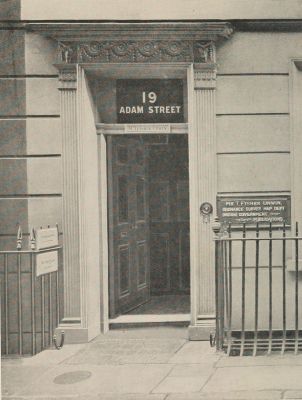
AN ADAM DOOR.
The Literary History of the Adelphi and its Neighbourhood
CHAPTER I
Anthony Bek, Bishop of Durham—The Papal Legate and the Oxford Clergy—Henry III. and the Earl of Leicester—Prince Henry—The Author of Philobiblon—Edward III.—Thomas Hatfield—Henry VIII.—Cuthbert Tunstall—Cranmer at Durham House—Anne Boleyn—Henry VIII. and Anne of Cleves feast at Durham House—Dudley, Duke of Northumberland—Lady Jane Grey—Queen Mary—Queen Elizabeth—Philip Sidney—Sir Walter Raleigh—Elizabeth Throgmorton—Glanville v. Courtney—Thomas Egerton—Fire at Durham House—Raleigh and his Pipe.
It is my pleasant duty to relate in these pages the romantic story of kings and queens, of prelates and princes, of book-writers and book-sellers, of artists, architects, and actors, and of other players on life's fitful stage who, for six centuries and a half, have contributed to one of the most interesting chapters in the history of London. Within that small space which has been known as the Adelphi since 1772, a district so confined that it is contained within five hundred square yards, came, in its earlier years, several bishops and other clerical dignitaries, then that prince who was afterwards the fifth King Henry of England, anon, amid much pomp and pageantry, King Henry VIII. Queen Mary and Queen Elizabeth were familiar with it, and here lived, for twenty years, Sir Walter Raleigh, who inhabited one of the towers which is seen in Hollar's engraving of Durham House. Lady Jane Grey went hence to the Tower and thence to the scaffold. Dryden alluded to it in one of his plays. Voltaire drank wine here, and its memory is hallowed by Dr Johnson, Oliver Goldsmith, Sir Joshua Reynolds, and a host of other celebrities. Here David Garrick began his career, and here, curiously enough, he ended it, the funeral procession of the "poor player" reaching from the Adelphi to Westminster Abbey, those who followed him to the grave numbering many men of rank and genius, including Johnson, and a large concourse of the general public who grieved for the loss of the great actor.
The history of the world-famous banking firm of Coutts & Co. is indelibly associated with the Adelphi. Dickens, when a boy, prowled about its dark arches—until lately, one of the most degraded spots in London—and last, though not least, the brothers Adam, to whom London owes several architectural triumphs, in addition to the Adelphi, claim our attention. It is said that at a public dinner, at the beginning of the last century, a worthy alderman whose knowledge of Greek was very vague, was much struck by the toast, in reference to two royal brothers—George IV. and the Duke of York—of "the Adelphi."[2] When it came to the alderman's turn to speak, he said that, as they were on the subject of streets, he would "beg leave to propose 'Finsbury Square.'" In somewhat similar manner, before we get to the Adelphi, we must go back to its origin, and this takes us to the thirteenth century.
Durham House, which, with its grounds, formerly occupied the entire site of the Adelphi, was the town residence of Anthony Bek (otherwise Anthony de Beck or Bec), Bishop of Durham in the reign of Edward I. So it is affirmed by Pennant, and there is no reason to doubt the assertion. Some mistakes have arisen on this point, in consequence, as it appears to me, of there having been two men of the same name, both of whom were bishops. Their ancestor, Walter Bek, came to England with William the Conqueror, and from his three sons sprang three great Lincolnshire families: Bek of Eresby, Bek of Luceby, and Bek of Botheby. Now, Bishop Antony Bek the second (1279-1343), son of Walter Bek of Luceby, constable of Lincoln Castle, was at one time Bishop of Lincoln, and, in 1337, Bishop of Norwich. But Antony Bek, son of Walter Bek, baron of Eresby, was appointed to the see of Durham in 1283. He was intimately associated with Edward I., being one of his chief advisers during the negotiations regarding Baliol, and of great assistance to him in his Scottish expeditions of 1296 and 1298. Owing to a dispute with the prior of the convent of Durham, he was deprived of certain of his rights by the king (but regained them on application to the Pope). As this, however, occurred in the year 1300, it may safely be assumed that Antony Bek had occupied Durham House before that event.
But there was a Durham House even earlier than this of Antony Bek's, if we are to credit an account given by Thomas Fuller. Here, in 1238, the papal legate, Otho, was staying, and hither he summoned the English bishops in order to debate as to what "further steps should be taken respecting the churches and schools of Oxford, which he had laid under interdict on account of the scholars having, when the legate was staying at Oseney, killed his brother and clerk of the kitchen in an affray,"[3] the legate himself being obliged to fly from the city. At the intercession of the bishops, the legate assented to pardon the university on condition of the clergy and scholars making their "solemn submission" to him. As a result, the offenders "went from St Paul's in London to Durham House in the Strand, no short Italian, but an English long, mile, all on foot; the bishops of England, for the more state of the business, accompanying them, as partly accessory to their fault, for pleading on their behalf. When they came to the Bishop of Carlisle's house, the scholars went the rest of the way barefoot, sine capis et mantulis, which some understand, 'without capes or cloaks.' And thus the great legate at last was really reconciled to them."[4]
Some of these old chronicles are not always to be relied upon in the matter of dates: "This howse called Durham, or Dunelme Howse, was buylded in the time of Henry 3, by one Antonye Becke, B. of Durham. It is a howse of 300 years antiquitie; the hall whereof is statelie and high, supported with lofty marble pillars. It standeth on the Thamise veriye pleasantlie." So wrote one historian in 1593. But Henry III. died in 1272, eleven years before Bek was made Bishop of Durham. That there was a Durham House of sorts before Bek's time is pretty certain, although it was not the one that is attributed to that bishop. The story has often been told of Henry III., in 1258, being caught in a thunderstorm on his way down the Thames on his barge. At that time, the Earl of Leicester was the head of the barons who were opposed to the king, and it is said that he was then in occupation of Durham House (we have already seen that the papal legate was installed there twenty years earlier). Be this as it may, the king sought shelter from the storm, and, as the royal barge approached the shore, the Earl of Leicester went forth and endeavoured to allay any fears that the king might have felt, saying, "Your Majesty need not be afraid, for the tempest is nearly over." But the king, being moved to wrath, fiercely exclaimed, "Above measure, I dread thunder and lightning, but, by the head of God, I am more in terror of thee than of all the thunder and lightning in the world." Though this story may be doubted, one early royal memory of Durham House is that of Prince Henry (Henry V.), who, in 1411, "lay at the bysshoppes inne of Darham for the seid day of his comming to towne unto the Moneday nest after the feste of Septem fratum."[5]
That most correct of London historians, John Stow, sets down the fourteenth century as the date of Durham House. "On the south side of which street" (meaning the Strand, which had no name in Stow's time), he says, "in the liberties of Westminster (beginning at Ivy Bridge), first is Durham House, built by Thomas Hatfield, Bishop of Durham, who was made bishop of that see in 1345, and sat bishop there thirty-six years." But we have already seen from Fuller, whose Church History of Britain—from which the quotation in regard to the papal legate, Otho, is taken—was written in 1655, fifty years after Stow's death, that there was a Durham House in 1238.
And this brings me to a curious point. Thomas Pennant, whose Account of London affords much entertaining reading, has an amusing disquisition on the word "palace." He writes: "That the word is only applicable to the habitations of princes, or princely persons, and that it is with all the impropriety of vanity bestowed on the houses of those who have luckily acquired money enough to pile on one another a greater quantity of stones and bricks than their neighbours. How many imaginary Parks have been formed within precincts where deer were never seen! and how many houses misnamed Halls which never had attached to them the privilege of a manor!" Leigh Hunt took the "lively Pennant," as he dubs him, to task on this point: "Unless the words palazzo and piazza are traceable to the same root, palatium (as perhaps they are), place does not of necessity mean palace; and palace certainly does not mean exclusively the habitation of princes and princely persons (that is to say, supposing princeliness to exclude riches), for in Italy, whence it comes, any large mansion may be called a palace; and many old palaces there were built by merchants."[6] But the disquisition does not really alter the fact that the proper name, that is to say, the original one, should be Durham House; we have the excellent authority of Stow and Fuller on this head. The residences in London of the bishops were almost invariably called "House"—certainly not "palace." Thus, Worcester House, which is now marked by the Savoy, originally belonged to the see of Carlisle, and is "the Bishop of Carlisle's House" which is alluded to in the extract from Fuller. York House, which stood to the west of Durham House, was originally the town inn or residence of the Bishop of Norwich, and, subsequently, in Queen Mary's reign, of Heath, Archbishop of York. In the Aggas map of London in 1563, which is the frontispiece to Pennant's "Account," Duresme Place and York Place are given, but that the name in its earlier years was Durham House there is no doubt. The London County Council has lately (1906) perpetuated the name by changing Durham Street to Durham House Street.
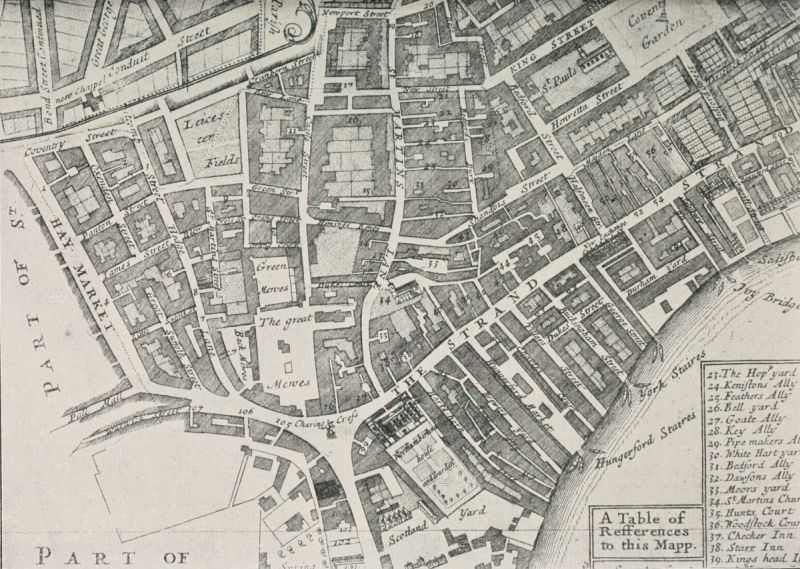
THE ADELPHI (DURHAM YARD AND THE NEW EXCHANGE) AND CHARING CROSS, IN 1755.
One of the earliest of the literary inhabitants of Durham House was the learned Richard de Bury (1281-1345), son of Sir Richard Aungerville. He was tutor to Edward III., when Prince of Wales, and, subsequently, was of the king's household. He was Dean of Wells and Bishop of Durham in 1333, lord chancellor from September 1334 to July 1335, and lord high treasurer in 1337. He was employed by the king in Paris and in Hainault in 1336, and, in 1337 and 1342, in Scotland. It is pleasant to think that he wrote his Philobiblon during his residence by the Thames. At any rate, we may be sure that so learned and so useful a man, one who had the confidence of the king for so long, was visited here by Edward III.
Another name of note associated with Durham House is that of Thomas Hatfield, already alluded to by Stow as having built that structure. He probably added to it, or he may have rebuilt it. He was a great prelate, and, in addition to the bishopric of Durham, which he held from 1345 until his death in 1381, he was made keeper of the Privy Seal in 1343, and, in 1346 and 1355, he accompanied Edward III. to France. In Durham, he built part of the south side of the cathedral choir and the hall of the castle, hence, possibly, the credit given to him by Stow of building the Thames-side Durham House. His learned Survey of Durham was edited by the Rev. William Greenwell in 1856.
It is a far cry from the joyous days of Prince Henry to the turbulent times of Henry VIII., but the old chronicles do not contain any mention of Durham House during that lengthy period. In the reign of the latter king, the then Bishop of Durham "conveyed the house to the King in fee"; in other words, the noble Henry appropriated the property to his own uses. He had the saving grace, however, to give to the see of Durham, in exchange, some houses in Cold Harbour (now marked by Upper Thames Street), and elsewhere. The exact date of the transfer is unknown. The history of this bishop, who was made to surrender Durham House to King Henry, is curious. Cuthbert Tunstall, or Tonstall, was Master of the Rolls, and bishop successively of London and Durham. Extolled by Erasmus, and the friend of Sir Thomas More, he was learned in Greek, Hebrew, mathematics, and civil law. Harrow-on-the-Hill had him for rector in 1511, he was prebendary of Lincoln in 1514, archdeacon of Chester in the year following, ambassador to the Prince of Castile at Brussels, 1515-1516, Master of the Rolls in 1516, prebendary of York in 1519, and ambassador to Charles V. in 1519, and again in 1525. He was Bishop of London from 1522-1530, keeper of the privy seal in 1523, and Bishop of Durham in 1530. It must have been after the latter year that he transferred Durham House to Henry VIII. Accused of inciting to rebellion, 1550, he was deprived of his bishopric of Durham by Edward VI., in 1552. Queen Mary, however, restored him immediately on her accession, and he remained in possession of Durham House—which Mary had also restored to the see—until, in the year of his death, 1559, he was again deprived by Queen Elizabeth, to whom he had refused the oath of supremacy.
A very interesting chapter in the history of Durham House came into existence, thanks to its acquisition by Henry VIII., who granted it to the Earl of Wiltshire (1477-1539), Thomas Boleyn, father of Queen Anne Boleyn. It is not impossible that the Earl of Wiltshire was in occupation of Durham House during the childhood of his daughter: at any rate, it is certain that Anne's daughter, the Princess Elizabeth, afterwards Queen, resided here.
Through Henry VIII. we get a glimpse of Cranmer at Durham House, for that worthy wrote to the Earl of Wiltshire bidding him "let Doctor Cranmer have entertainment in your house at Durham Place for a time, to the intent he may bee there quiet to accomplish my request, and let him lack neither bookes, ne anything requisite for his studies."[7] Cranmer attended the Earl of Wiltshire as ambassador to Charles V. in 1530, and it is probable that he lodged in Durham House in 1533, for in that year he returned to England, gave formal sentence of the invalidity of the king's marriage with Catharine of Aragon, and pronounced King Henry's marriage with Anne Boleyn to be lawful. So that it is easy to imagine that the king's "request" occupied Cranmer's thoughts at Durham House, and that Henry came here in order to confer with him.
That Henry VIII. was familiar with Durham House there is no room for doubt, for, as the pious chronicler, Stow, quaintly puts it, "in the year of Christ 1540," that being the thirty-second year of Henry's reign, "on May-day, a great and triumphant jousting was holden at Westminster, which had been formerly proclaimed in France, Flanders, Scotland, and Spain, for all comers that would undertake the challengers of England; which were, Sir John Dudley, Sir Thomas Seymour, Sir Thomas Ponings, and Sir George Carew, knights, and Anthony Kingston and Richard Cromwell, esquires; all which came into the lists that day richly apparelled, and their horses trapped all in white velvet. There came against them the said day forty-six defendants or undertakers—viz., the Earl of Surrey, foremost, Lord William Howard, Lord Clinton, and Lord Cromwell, son and heir to Thomas Cromwell, Earl of Essex, and chamberlain of England, with other; and that day, after the jousts performed, the challengers rode unto this Durham House, where they kept open household, and feasted the King and Queen, with her ladies, and all the court. The second day Anthony Kingston and Richard Cromwell were made knights there. The third day of May the said challengers did tourney on horseback with swords, and against them came forty-nine defendants—Sir John Dudley and the Earl of Surrey running first, which at the first course lost their gauntlets; and that day Sir Richard Cromwell overthrew Master Palmer and his horse in the field, to the great honour of the challengers. The fifth of May the challengers fought on foot at the barriers, and against them came fifty defendants, which fought valiantly; but Sir Richard Cromwell overthrew that day at the barriers Master Culpepper in the field; and the sixth day the challengers brake up their household. In this time of their housekeeping they had not only feasted the king, queen, ladies, and all the court, as it is afore showed, but also they cheered all the knights and burgesses of the common house in the parliament, and entertained the Mayor of London, with the aldermen and their wives, at a dinner, etc. The king gave to every of the said challengers and their heirs for ever, in reward of their valiant activity, one hundred marks and a house to dwell in, of yearly revenue, out of the lands pertaining to the hospital of St John of Jerusalem, which he had confiscated."
From the merry-makings of "bluff King Hal" we turn to the more sober employment of Durham House. Here, in 1550, were lodged the French ambassador to Edward VI., Mons de Chastillon, and his colleagues, the house being "furnished with hangings of the kings for the nonce." In this year, also, Edward VI. granted Durham House for life, or until she was otherwise advanced, to the Lady Elizabeth, afterwards Queen Elizabeth; but, "in some way, it passed from the Princess to Dudley, Duke of Northumberland, and was the principal London house when Edward VI. died." I do not think that it is very difficult to account for the transition. During the short reign of Edward VI., we find it stated in Pennant that "the mint was established in this house, under the management of Sir William Sharrington, and the influence of the aspiring Thomas Seymour, lord admiral. Here he proposed to have money enough coined to accomplish his designs on the throne. His practices were detected, and he suffered death. His tool was also condemned; but, sacrificing his master to his own safety, received a pardon, and was again employed under the administration of John Dudley, Earl of Northumberland."
This, I must confess, is a trifle vague. Sir William Sharington, or Sherington—Pennant's Sharrington—vice-treasurer of the mint at Bristol, assisted in the plots of Thomas Seymour, baron Seymour of Sudeley, and was arrested and attainted, but subsequently pardoned. He was sheriff of Wiltshire in 1552, and he died in 1553. Seymour was found guilty of treason and executed in 1549, the second year of King Edward VI. Is it not possible that the Duke of Northumberland received Durham House in reward for his discovery there of the illegal mint? Be this as it may, it certainly was the residence of John Dudley in May, 1553—the year of Edward's death. To quote once more from Pennant: the Duke of Northumberland, in the month mentioned, "in this palace, caused to be solemnised, with great magnificence, three marriages—his son, Lord Guildford Dudley, with the amiable Lady Jane Grey; Lord Herbert, heir to the Earl of Pembroke, with Catherine, younger sister of Lady Jane; and Lord Hastings, heir to the Earl of Huntingdon, with his youngest daughter, Lady Catherine Dudley. From hence he dragged the reluctant victim, his daughter-in-law, to the Tower, there to be invested with regal dignity. In eight short months his ambition led the sweet innocent to the nuptial bed, the throne, and the scaffold." It is, indeed, sad to think of the marriage rejoicings of Durham House turned so speedily and so sadly into the sojourn in the dreaded Tower and the execution of the bride-queen of seventeen summers.
On the accession of Mary, Durham House was restored to Bishop Tunstall, but Queen Elizabeth acquired it in 1559, the year of Tunstall's death. "The queen," said Bishop Goodman (1583-1656), in his Court of James I., "did not spare Cuthbert Tunstal, Bishop of Durham, though some will not stick to say that he was her god-father; which, if he were not, it is most certain that he was then present and did officiate at her christening. But I think he was her god-father, because I am certain he gave her Durham House in the Strand to dwell in, which she kept during her life, and did not restore it to his successors, but suffered Sir Walter Raleigh to live there. I remember when the Bishop of Durham in the queen's time came up to Parliament, he was fain to hire my schoolmaster's house" (Camden's) "in Westminster to lodge in." It is a pity that we cannot agree with Goodman on this point, but, at the time of Elizabeth's christening, 1533, Tunstall was faithful to the Catholic dogma. It is also to be noted that Shakespeare makes the Archbishop of Canterbury, Cranmer, pronounce the blessing on the infant Elizabeth in King Henry VIII.
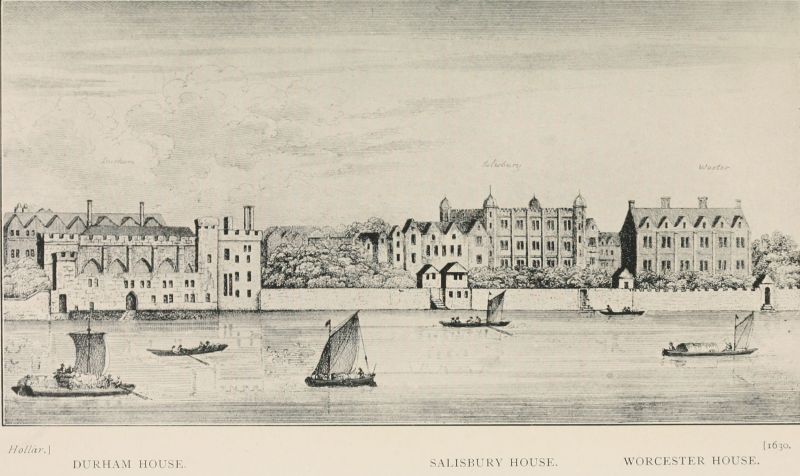
DURHAM HOUSE. SALISBURY HOUSE. WORCESTER HOUSE.
From Queen Elizabeth we obtain a picture of two of the most distinguished of the literary occupants of Durham House—Philip Sidney and Walter Raleigh. In March, 1567-1568, Sir Henry Sidney writes from it to Archbishop Parker for permission to eat meat in Lent for "my boy Philip Sidney, who is somewhat subject to sickness." The future soldier, statesman, and poet was then but a child of thirteen, and his presence there is one of the treasured memories of Durham House.
Sir Walter Raleigh was given the use of Durham House in 1583, and he held it until his fall from favour in 1603. A picturesque glimpse of him is afforded by Aubrey, the antiquary, who, although he was not born until eight years after Raleigh's death, knew the Durham House of that period. It was "a noble palace," he says. "After he" (Raleigh) "came to his greatness, he lived there, or in some apartment of it. I well remember his study, which was on a little turret that looked into and over the Thames, and had the prospect which is as pleasant perhaps as any in the world."[8] Many a time and oft did the young favourite of the queen set out from Durham House, by water, for the court of Elizabeth, and it is not inconceivable that Elizabeth, in her royal barge, should have journeyed on more than one occasion from her palace at Westminster to Raleigh's residence on the Thames. For, during his early years here, Raleigh was in high favour. Then there came the influence of the new favourite, Essex, Raleigh's intrigue with Elizabeth Throgmorton, the queen's jealousy, and his commitment to the Tower. He then settled at Sherbonne, and in 1595, 1596, and 1597, he was abroad on various expeditions. But he appears to have retained possession of Durham House until the end of Elizabeth's reign—1603. In that year Tobias Mathew, the then Bishop of Durham, set forth the claim of his see to the place, and Raleigh, in a letter of remonstrance, states that he had been in possession of the house for about twenty years, and that he had expended some two thousand pounds upon it, out of his own purse. But James I. and the Council, on May 25 of that year, recognised the right of the see of Durham, and restored the house to the successors of Bishop Hatfield.
Raleigh's letter, directed "to the Right Honorabell my verie good Lords, the Lorde Keeper of the Great Seale and my Lorde Chiefe Justice of Ingland, and to my verie good friende, His Majesties Atturney Generall," is as follows:—"I received a warrant from your lordships, my Lorde Keeper and my Lorde Chiefe Justice, and signed also by Mr Atturney Generall, requiringe me to deliver the possession of Deram House to the Byshoppe of Deram or to his Atturney before the xxiiiith day of June next insuing, and that the stabells and gardens should be presentlie putt into his hands.... This letter seemeth to me verie strange, seeinge I have had the possession of the house almost xx yeares, and have bestowed well neare 2000 L. uppon the same out of myne owne purse. I am of opinion that if the King's Majestye had recovered this house, or the like, from the meanest gentleman and sarvannt hee had in Inglande, that His Majestye would have geven six monenths tyme for the avoydance, and I doo not know but the poorest artificer in London hath a quarter's warninge geven him by his landlord. I have made provision for 40 persons in the springe ... and now to cast out my hay and oates into the streates att an hour's warninge, and to remove my famyly and staff in 14 dayes after, is such a seveare expulsion as hath not bynn offered to any man before this daye."
It is more than likely that Raleigh wrote several of his poems in Durham House. His Report of the Truth of the Fight about the Isles of the Azores (1591), and his Discovery of the Empire of Guiana (1596), were published during his tenure of Durham House. Raleigh was Lord Warden of the Stannaries, and, as such, many cases were brought before him here, the most celebrated of them being that of Glanville v. Courtney, which was heard at divers stages in 1591 and subsequent years, Thomas Egerton (afterwards Baron Ellesmere), and Viscount Brackley, lord chancellor, being counsel on one occasion. In 1600, when Raleigh was away in Jersey, where he had been appointed governor, some of the out-buildings of Durham House were destroyed by fire, and this was the beginning of the end of the magnificence which had for so long attended this palace on Thames-side.
Oldys, in his Life of Raleigh, has described the "stalwart, sour-faced" statesman during his residence at Durham House, as attired in a suit of clothes surmounted by jewels to the value of six thousand six hundred gold pieces. The well-known story of Raleigh's first pipe applies—if there is any truth in the legend—to the time when he resided here. In 1586, Drake brought tobacco to England from Virginia. It is said that one day Raleigh's servant, carrying a tankard of spiced ale to Raleigh in his study in the turret, found his master on fire, as he thought, and, dropping the vessel, rushed for assistance, shouting that his master "would be burnt to ashes if they did not run to his assistance." Another version is that the clown dashed the ale over his master's head. Be this as it may, the early use of tobacco is intimately associated with Durham House, for, as is well known, Raleigh smoked as he worked.
FOOTNOTES:
CHAPTER II
The New Exchange—The Earl of Salisbury proprietor—Opened by James I.—Popular Allusions—The First Edition of Othello published Here—Samuel Pepys a Frequent Visitor—Henry Herringman—Otway—Etherege—Wycherley—Dryden—Addison—Durham House in Decay—Acquired by the Earl of Pembroke—Various Public Offices in Durham Yard—Charles II. helps to extinguish a Fire Here—Archbishop Le Tellier—Godfrey Kneller—David Garrick, wine merchant—Dr Johnson—Voltaire—Murder in the New Exchange.
Leaving for a moment Sir Walter Raleigh in his vain endeavour to uphold his claim to Durham House, let us glance at the Strand portion of the establishment. It teems with romance and literary interest. The stabling, which looked upon the Strand, had fallen into decay, and, early in the reign of James I., it was converted by Robert, Lord Salisbury, into the New Exchange. Its frontage extended from the present George Court to Durham House Street. The foundation stone was laid on June 10, 1608, and, in the following July, as we find from the State Papers, "The New Burse proceeds apace."
The allusion in the State Papers was due to a letter which the Lord Mayor had written, on June 30, to the Lord Treasurer, enclosing a petition from the shopkeepers of the Royal Exchange "concerning a building in course of erection at Durham House in the Strand," which they considered was meant to be employed as "a Pawne or Exchange for the sale of things usually uttered in the Royal Exchange, and which, being situated near to Whitehall and in the highway, would be injurious not only to the shopkeepers and citizens at large," but would tend to the destruction of trade. Another authority says: "The new Bourse at Durham House goes up apace, where the Citizens, and especially the Exchange men, begin to grumble ... and thereupon have made a petition to the Lord Mayor to provide ne quid detrimenti republica capiet."[9] Scant notice, if any, was taken of this petition from the City, and the building of Britain's Burse proceeded without hindrance. The Exchange consisted of four separate places: the Outward Walk below Stairs; the Inner Walk below Stairs; the Outward Walk above Stairs; and the Inner Walk above Stairs. Its opening, on April 11, 1609, was graced by the presence of James I. and his queen, "when," according to Anthony Munday, the poet and playwright and literary executor of Stow, whose Survey he produced in 1618, "it pleased his most excellent Majesty, because the work wanted a name, to entitle it Britain's Burse."
Stow also says: "Now to speak somewhat of later time concerning this Durham House, it was well knowne and observed, for how many yeers I know not, that the outward part belonging thereto, and standing North from the houses, was but a low row of Stables, old, ruinous, ready to fall, and very unsightly, in so public a passage to the Court at Westminster. Upon which consideration, or some more especial respect in the mind of the right honourable Robert, Earl of Salisbury, Lord High Treasurer of England: it pleased him to take such order in the matter, that (at his owne cost and charges), that deformed row of Stabling was quite altered, by the erection of a very goodly and beautiful building instead thereof, and in the very same place. Some shape of the modelling, though not in all respects alike, was after the fashion of the Royall Exchange in London, with Sellers underneath, a walk fairly paved above it, and Rowes of Shops above, as also one beneath answerable in manner to the other and intended for the like trades and mysteries.
"The work was not long in the taking down, nor in the erection againe: for the first stone was laid on the 10. day of June, 1608, and also was fully finished in the next ensuing November after. Also, on Tuesday, being the 10. day of April following, divers of the upper shops were adorned in rich and beautiful manner, with wares most curious to please the eye; so ordered against his Majesties comming thither, to give a name to so good a building. On the day following, it pleased his highnesse, with the Queene, prince, the Duke of Yorke, and the Lady Elizabeth to come thither, attended on by many great Lords and choise Ladies. Concerning their entertainment there, though I was no eye-witnesse thereof, yet I know the ingenuity and mind of the Nobleman to be such, as nothing should want to welcome so great an expectation. And therefore, what variety of devices, pleasing speeches, rich gifts and presents as then flew bountifully abroad, I will rather referre to your imagination, than any way come short of, by an imperfect narration. Only this I adde, that it then pleased his most excellent Majestie, because the worke wanted a name before, to entitle it Britaines Bursse, or Busse."[10]
A most interesting description of the Royal visit, on the occasion of the opening of the Exchange, was given by Marc' Antonio Correr, the Venetian Ambassador in England, in a letter of May 6, 1609, to the Doge and Senate of Venice. The original document is preserved in the Venetian archives, and the following is a translation: "Hard by the Court, the Earl of Salisbury has built two great galleries, decorated, especially outside, with much carving and sculpture. Inside each of these galleries, on either hand, are rows of shops for the sale of all kinds of goods. These will bring in an immense revenue. Last month, he took the King, the Queen, and the Princes to see them. He has fitted up one of the shops very beautifully, and over it ran the motto: 'All other places give for money, here all is given for love.' To the King he gave a Cabinet, to the Queen a silver plaque of the Annunciation, worth, they say, four thousand crowns. To the Prince, he gave a horse's trappings of great value, nor was there any one of the Suite who did not receive at the very least a gold ring."
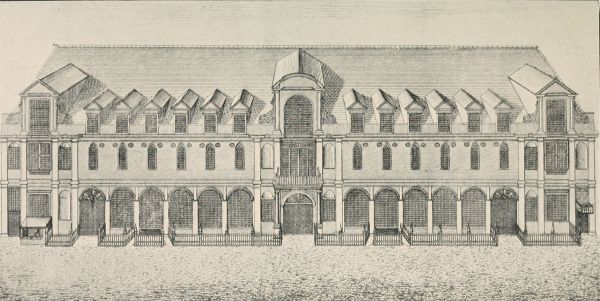
THE NEW EXCHANGE, STRAND.
The Exchange is thus described by Strype: "In the place where certain old stables stood belonging to this house is the New Exchange, being furnished with shops on both sides the walls, both below and above stairs, for milleners, sempstresses, and other trades, that furnish dresses; and is a place of great resort and trade for the nobility and gentry, and such as have occasion for such commodities."[11]
The connection of the Earl of Salisbury with the New Exchange, and, incidentally, with the Durham House property, is somewhat curious. As already observed, there had been a fire in part of the buildings, in 1600, and, as Salisbury House was adjacent, the neighbouring ruins must have been an unpleasant prospect for the "crook-backed" and thrifty earl. So he bought the Strand part of the ground from Sir Tobie Matthew (1577-1655), who had secured from his father, Bishop Matthew, "an interest in certain outlying portions of Durham House and its purlieus, which was valuable enough to be purchased by Robert Cecil, in the year following the Bishop's translation to York, for the sum of 1200 L." This was in 1607, and, in 1609, he obtained a lease of the courtyard of Durham House, the rest of the property remaining in the possession of the see of Durham until 1630. Cecil, who had been created Earl of Salisbury by James I. in 1605, was in high favour with the King at this period, so that he was able to reply to the petition of the citizens against his building of the Exchange "that Westminster being the place where he was born and of his abode, he sees not but that he may seek to benefit and beautify it" (J. Chamberlain to Dudley Carleton). At the same time, he seems to have behaved fairly enough in another matter, for on September 25, 1609, the then Bishop of Durham, William James, wrote to Thomas Wilson, Lord Salisbury's steward, thanking the Earl for causing stables to be built for him at Durham House, and requesting the delivery of the key to his servant "in order that hay and straw may be provided there, against his coming up to Parliament."
The New Exchange was never a great rival of the old—the Royal—Exchange, and, in 1623, only fourteen years after its opening, there were rumours that it was to be converted into dwelling-houses. "Lady Hatton," it was stated, "is said to have bought Britain's Burse for £6000, and means to make the upper part her dwelling-house; the lower part lets for £320 a year." The rumour was wrong, however, for the place, although it fell into disrepute, existed until nearly the middle of the seventeenth century—until, as a matter of fact, 1737. Its most flourishing period was during the Restoration, when London had doubled in population as compared with the reign of James I., and Covent Garden was the fashionable quarter. There is hardly a dramatist of Charles II.'s time whose works do not contain some reference to it, while one of the playwrights, Thomas Duffet, had been a milliner in this very place before he took to burlesquing Dryden, D'Avenant, and the contemporary writers. The Grand Duke Cosmo gives an accurate picture of the place as it was in Charles II.'s time: "We went to see the New Exchange, which is not far from the place of the Common Garden, in the great street called the Strand. The building has a façade of stone, built after the Gothic style, which has lost its colour from age and become blackish. It contains two long and double galleries, one above the other, in which are distributed, in several rows, great numbers of very rich shops of drapers and mercers filled with goods of every kind, and with manufactures of the most beautiful description. These are for the most part under the care of well-dressed women, who are busily employed in work, although many are served by young men called apprentices."[12]
The stage has a great claim upon the history of the Adelphi, not only by reason of Garrick's residence here, but because the first edition of Othello was published within its precincts. This was in 1622, six years after Shakespeare's death, and a year before the issue of the first folio. The title-page of this quarto is as follows:
The Tragœdy of Othello, the Moore of Venice. As it hath beene diverse times acted at the Globe, and at the Black Friers, by His Maiesties Servants Written by William Shakespeare London, Printed by N.O. for Thomas Walkley, and are to be sold at his shop at the Eagle and Child, in Brittans Bursse. 1622.
A player and publisher of plays, Will Cademan, lived at the Pope's Head, in the Lower Walk. Samuel Pepys was a visitor to the New Exchange on several occasions. On June 22, 1668, the diarist went to the King's playhouse and saw "an act or two" of Dryden's comedy, An Evening's Love, or the Mock Astrologer, but "liked it not. Calling this day at Herringman's, he tells me Dryden do himself call it but a fifth-rate play." Henry Herringman, who was the principal publisher in London before Jacob Tonson, had his shop "At the Sign of the Blue Anchor" in the Lower Walk of the New Exchange. Here, in 1679, was published Horace's Art of Poetry, "made English" by the Right Hon. the Earl of Roscommon. Otway, in the character of Mrs Furnish, in The Atheist, or the Soldier's Fortune, first acted in 1682, gives a good idea of the cries in the Upper Walk of the New Exchange: "Gloves or ribands, sir? Very good gloves or ribands. Choice of fine essences." The Strand houses near the Exchange were let to "country gentlewomen newly come to town, who loved to lodge in the very centre of fashion." Pert, in Sir George Etherege's comedy, The Man of Mode (1676), says: "That place is never without a nest of 'em. They are always, as one goes by, glaring in balconies or staring out of windows." In another play by the same author, She Would if She Could (1668), and The Country Wife (1675) of Wycherley, scenes are laid in the New Exchange. Dryden, who was well acquainted with the place, makes Mrs Brainsick escape from her husband by pretending to call at her tailor's here "to try her stays for a new gown."
Such a place, in such an age, was bound to deteriorate. In Addison's day, the gallants of the town spent much of their time in lounging about the stalls and indulging in ribald talk. "I have long letters," he says in the Spectator, "both from the Royal and New Exchange on the" subject of the indecent licenses taken in discourse. "They tell me that a young Fop cannot buy a Pair of Gloves, but he is at the same time straining for some Ingenious Ribaldry to say to the young Woman who helps them on. It is no small Addition to the Calamity, that the Rogues buy as hard as the plainest and modestest Customers they have; besides which, they loll upon their Counters half an Hour longer than they need, to drive away other Customers, who are to share their Impertinencies with the Milliner, or go to another Shop."[13]
The rules for the conduct of the New Exchange are very curious. Under the heading of Orders for ye Burse, and dated November, 1609, they are printed in the State Papers.[14] They are as follows:—"Imprimis no shop to be lett within ye said new building to any art, trade, science, or mistery, other than these following or such as shal bee noe annoyance to ye rest of ye shopkeepers ther, and allowed by writting under ye hand of the right honble the Erle of Salisbury lord Treasurer of England, that is to say, Haberdashers of hatts, Haberdashers of smale wares, stockinsellers, Linen-drapers, Seamsters, Goldsmiths or Juellers but not to worke with hammer, such as sell china wares, Milliners, Perfumers, Si(l)ck-mercers, Tyremakers or Hoodmakers stationers Booksellers Confectioners, such as sell picktures, mapps or prints, Girdelers &c.
"Item no shopkeeper to open shop on Christenmas day the Purification of the blessed virgin Easter hollidaies Whitson-hollidaies The nativity of St Jo. Baptist the feast day of All saints nor upon any sabboth day throughe out ye whole yeare.
"Item from ye 25 day of March till ye 29 of September the dores & windowes to bee opened by 6 in ye morning & to bee shut by 8 att night: & from ye 29 of September till ye 25 of March, ye dores to bee open by seven in ye morning and shutt by seaven att night. These houres to bee duly kept except it bee upon some speciall occasion agreed on by the shopkeepers, or ye greater part of them.
"Item my lord to mentione one sufficient man of honest & good report to bee housekeeper to make cleane & sweepe the house as often as shal be needfull & to watch or keepe some to watch in ye nights & to see to the opening and shutting of ye dores, every shopkeeper in ye house allowing him 2s by ye yeare.
"Item all ye dores saving one to bee made fast on ye Inner syde & that one to have 3 locks and 3 keyes whereof the howskeeper to have one & the other 2 to bee kept by 2 of the Tenants quarterly & they to see ye shutting in of ye house themselves or in theyr absence to appoint some other.
"These 2 men to be chosen by ye shopkeepers & they to collect ye forfeitures herafter imposed and mentioned.
"Item a bell to bee kept & maintained within the said new building by the said Erle & the same to bee rong by the howskeeper att xj of ye clock before dinner and half an howre before ye shopkeepers are to shutt up their shops att night & att ye ringing thereof in ye evening every one to sweepe forth his shop & then ye houskeeper to sweepe & make cleane ye whole house, upon payne of every one that shall make default to forfait 4d for every default which shal be imployed to ye use of ye pore, where and when ye Tenants of ye house shall think fitt.
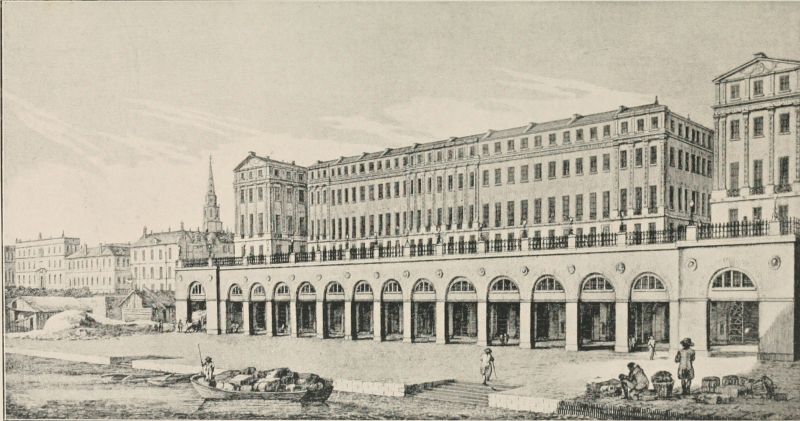
"THE BUILDINGS, CALLED THE ADELPHI," 1777.
"Item a paire of stocks or some other publique punishment for such as shal be taken pilfering or stealing to be mayntained by the said Erle.
"Item no man to forstall his neighbour eyther by hanging forth any thing or setting forth in his stalle upon payne of forfeiture of 5s for every default to bee levyd to ye use aforesaid.
"Item no man to call any man that is buying or selling from an other mans stall, or to pull or hale any man as he cometh by to buy or sell as hee is going along by his stall upon payne to forfait for every offence 15d which shal be likewise levyd & employed to ye use of ye poore.
"Item if any strife or contention shal hapen betwixt any of the Tenants ye same to bee referred to 4 or 6 of ye rest to bee ended & both parties to stand to their award, hee that refuseth to pay for a forfeiture 40s which shal be likewise employed to ye use afforesaid.
"Item no signe that shal be hanged out to hang furder out into ye walk then another.
"Item wheras many Maisters are not resident there, by means wherof there is great disorder by servants & apprentizes viz. hunting of doggs with greate noise & howling, playing att foyles & cudgles stricking ye balle (which breaketh ye windowes) buffitting & fighting one with another, to ye greate reproache of ye place & hinderance of traders there, bee it therfore by consent of my lord & every one of us confirmed that if herafter any servant or apprentize in any of the ranges wher shopps bee do comitt any such disorders that then the Mr of such person or personnes so offending shall uppon complaint made by ye 2 houskeepers for the tyme being in some private roome in the Burse appointed for the said purpose correct or beate their said servantes, in ye presence of ye said 2 houskeepers, or ells to pay presently for every offender 12 to the use afforesaide.
"Item if any shopkeepers eyther Maisters of (or?) Mrs do braule scould or rayle on one an other with reproachfull words or speeches, to the ill example of their servants, amazment of passengers & to the greate disgrace of themselves & thier nieghbors than then both & so many personnes so offending shall pay for every defalt 2s 6d ells to have their theyr (sic) signe taken downe by the 2 howskeepers for one weeke that such scould or scoulds may not be noted nor the Burse disgraced.
"Item that if any do throw or powre out into the walk or range or outt att any of the windowes any noysome thing &c. that then that person so offending shall pay for every default xijd if it bee a servant then to have correction as afforesaid or theyr Mr or Mrs to pay 6d for theyr default.
"Item that all and every shopkeeper shall subscrib to these orders that for the good of the house they may be performed without partiallity, and that some course may bee to force the breakers of them to pay theyr fynes wee humbly entreate may be taken.
"Item if any sell or offer to sell any ware in the howse except it bee to a shopkeeper the same party so offending to bee sett in the stockes for 2 howres and to have his wares taken from him to bee kept for a tyme to ye discretion of ye house or to be delivered to ye party offending as they shall thinke good.
"Item my lord to find lights for the stairs and walkes his Executors and assignes.
"Item whosever of the Tenants shall keepe ye key of ye dores if the key bee not there ready by 6 a clock in ye morning they shall forfeit for every default viijd to bee employed to ye use afforesaid.
"Those things which ye keeper of ye Burse must have care of appointed by my lord att the errection thereof.
"To suffer none to fetch watter by ye staires or walks or carry coals or other carying by ye watter gate to any of ye neghbours in ye streete but only for the shopkeepers howses save Mr Wilsons.
"To be obeydient to Mr Wilson's command in all things concerning ye said buisines."
Returning to Durham House, we recall that, on the death of Queen Elizabeth, the property was restored to the see of Durham and that Lord Salisbury had become possessed of the Strand portion. The history shortly after this period is not particularly clear, for, although on February 16, 1612, we find that the aforesaid William James, Bishop of Durham, wrote to Lord Salisbury thanking him for his "honourable dealings in the purchase of Durham House," on the other hand, John Howson, who was Bishop of Durham from 1628 to the year of his death, 1632, was residing here two years prior to his decease. The "honourable dealings," of course, related to that part of the grounds and stabling of Durham House which had been transferred to Lord Salisbury in 1607 and 1609. Durham House itself fell into decay in the middle of the seventeenth century. It—or a portion of it—was inhabited by Lord-Keeper Coventry, who died here in 1640.
Part of the ground was acquired by Philip Herbert, Earl of Pembroke and Montgomery, in consideration of his payment to the see of Durham of £200 per annum, the grant being confirmed by Act of Parliament in 1640. And, according to Strype, "It was by his son built into tenements or houses, as now they are standing, being a handsome street descending down out of the Strand." This was Durham Yard, which ran down to the river, and is now covered by the buildings on the west side of the Adelphi. In 1667-1668, the office of Commissioners for Accounts was in Durham Yard, and we get an interesting word-picture of it from the pages of Samuel Pepys. On January 31, "Up," he recorded, "by coach, with W. Griffin with me, and our Contract-books, to Durham Yard, to the Commissioners for Accounts; the first time I ever was there; and staid awhile before I was admitted to them. I did observe a great many people attending about complaints of seamen concerning tickets, and among others Mr Carcasse, and Mr Martin, my purser. And I observe a fellow, one Collins, is there, who is employed by these Commissioners particularly to hold an office in Bishopsgate Street, or somewhere thereabouts, to receive complaints of all people about tickets; and I believe he will have work enough. Presently I was called in, where I found the whole number of Commissioners, and was there received with great respect and kindness; and did give them great satisfaction, making it my endeavour to inform them what it was they were to expect from me, and what was the duty of other people; this being my only way to preserve myself, after all my pains and trouble. They did ask many questions, and demanded other books of me, which I did give them very ready and acceptable answers to; and, upon the whole, I do observe they do go about their business like men resolved to go through with it, and in a very good method, like men of understanding. They have Mr Jessop, their secretary; and it is pretty to see that they are fain to find out an old-fashioned man of Cromwell's to do their business for them, as well as the Parliament to pitch upon such for the most part in the lowest of people that were brought into the House for Commissioners. I went away giving and receiving great satisfaction." Various other public offices were in Durham Yard at this period. In 1664, the Coal Meter's Office was here, and, in 1675, His Majesty's Office for granting wine licenses.
On April 26, 1669, Pepys records: "A great fire happened in Durham Yard last night, burning the house of one Lady Hungerford, who was to come to town to it this night; and so the house is burned, new furnished, by carelessness of the girl sent to take off a candle from a bunch of candles, which she did by burning it off, and left the rest, as it is supposed, on fire. The King and Court were here, it seems, and stopped the fire by blowing up the next house." The Merry Monarch, having stopped the fire in Durham Yard, was up betimes next morning and off to Newmarket.
Several other side-lights on the subject are furnished by Pepys. Thus, on February 1, 1663-1664, he notes that, "I hear how two men last night, justling for the wall about the New Exchange, did kill one another, each thrusting the other through; one of them of the King's Chapel, one Cave, and the other a retayner of my Lord Generall Middleton's." In the year of the Great Fire, 1666, he is "up by five o'clock" on September 7, "and, blessed be God! find all well; and by water to Pane's Wharfe. Walked thence, and saw all the towne burned, and a miserable sight of Paul's church, with all the roofs fallen, and the body of the quire fallen into St Fayth's; Paul's school also, Ludgate, and Fleet Street. My father's house, and the church, and a good part of the Temple the like. So to Creed's lodging, near the New Exchange, and there find him laid down upon a bed; the house all unfurnished, there being fears of the fire's coming to them. There borrowed a shirt of him, and washed. To Sir W. Coventry, at St James's, who lay without curtains, having removed all his goods; as the King at White Hall, and everybody had done, and was doing." Three months later, the "very good newes is just come of our four ships from Smyrna, come safe without convoy even into the Downes, without seeing any enemy; which is the best, and, indeed, only considerable good news to our Exchange since the burning of the City; and it is strange to see how it do cheer up men's hearts. Here I saw shops now come to be in this Exchange; and met little Batelier who sits here but at 3 L. per annum, whereas he sat at the other at 100 L.; which he says he believes will prove as good account to him now as the other did at that rent."
Dean Crofts of Norwich and various others of some standing were living in Durham Yard in 1675, and in that year some waterworks, which are not to be confused with those of the York Buildings company, were established by Sir Robert Vyner and others. In 1677, Durham Yard had gone to ruin, and was notorious as a place of ill repute. In April of that year Le Tellier, Archbishop and Duke of Rheims, crossed the Channel in order to "treat about a marriage with the Lady Mary, daughter of the Duke of York, with the Dauphin." In some ribald verses by the libellous Anthony Wood (or, as he dubbed himself, Anthony à Wood, 1632-1695) we read that:
"The Bishop who from France came slowly o'er Did go to Betty Beaulie's"—
this Betty being a person of notorious character who lived in Durham Yard. Dryden, in his 1667 comedy, Sir Martin Marrall, makes Lady Dupe refer to Durham Yard as the customary landing-place for Covent Garden. And The Tatler of June 7, 1709, alludes to "a certain lady who left her coach at the New Exchange door in the Strand, and whipt down Durham Yard into a boat with a young gentleman for Fox Hall."
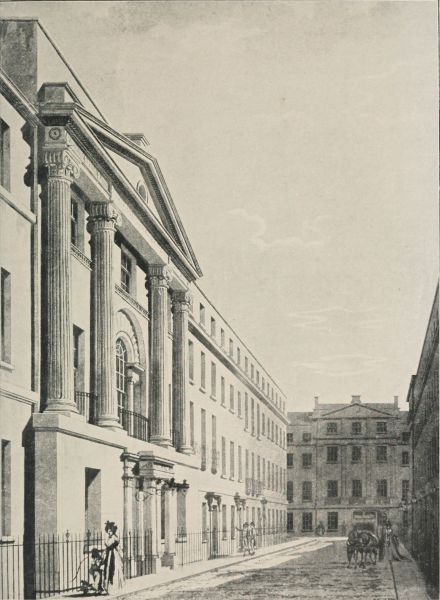
THE SOCIETY OF ARTS, JOHN STREET, ADELPHI.
Durham Yard was the first residence in London (1675) of Godfrey Kneller. David Garrick and Samuel Johnson are closely connected with the place. It was here that the volatile Garrick, at the age of twenty-three, was in partnership with his brother, Peter, as a wine-merchant. I do not think that he lived here, but, certainly, the brothers had their wine vaults in Durham Yard. But the union did not last long. "Peter was calm, sedate, and methodical; David was gay, volatile, and impetuous, and, perhaps, not so confined to regularity as his partner could have wished." Therefore, as Garrick's biographer, Thomas Davies, puts it, "to prevent the continuance of fruitless and daily altercation," friends intervened, and the partnership was dissolved amicably. Another most interesting memory of Durham Yard is associated with Garrick's friend, Samuel Johnson, who, at the time of the wine partnership, was living (March, 1741) "at the Black Boy over against Durham Yard"—this is not to be confused with Johnson's "garret," which was in Exeter Street, Strand. Samuel Foote, in his ill-natured way, used to say that he remembered "Davy" in Durham Yard "with three quarts of vinegar in the cellar, calling himself a wine merchant." Thanks to wine, we have another notable association with Durham Yard. Here was a wine merchant named Brisden, whose shop was frequented by Voltaire. On his return to France, Voltaire wrote to "Dear John," wishing him "good health and a quick sale to your Burgundy." He knew this neighbourhood well, for, during his abode in England, 1726-1729, he constantly visited his friend Congreve, the dramatist, in Surrey Street, Strand. Voltaire lodged in Maiden Lane, a few yards from the Adelphi, over a French barber's shop, which was distinguished by the sign of the White Peruke. He was thoroughly familiar with English, and, on one occasion, a mob of roughs assailed him and twitted him for being—his appearance left no doubt as to his nationality—a "Frenchy." Voltaire nimbly "mounted an adjacent doorstep and addressed the crowd in good English, extolling the liberty of England and the people. His speech was a success. The mob took on at once, and cheered him; eventually they mounted him on the shoulders of a couple of stout fellows and carried him in triumph to his lodgings. Never after that was he molested in his walks."[15]
Leigh Hunt, in The Town, describing Voltaire's visit to England, says that he wrote to Swift from Maiden Lane, in English, but that the language "seems a little too perfect." There is a second letter to Swift "which looks more authentic. But there is no doubt that Voltaire, while in England, made himself such a master of the language as to be able to write in it with a singular correctness for a foreigner. He was then young. He had been imprisoned in the Bastille for a libel, came over here on his release; procured many subscriptions for the Henriade; published in English an essay on epic poetry, and remained some years, during which he became acquainted with the principal men of letters—Pope, Congreve, and Young. He is said to have talked so indecently at Pope's table (probably no more than was thought decent by the belles in France) that the good old lady, the poet's mother, was obliged to retire. Objecting, at Lord Chesterfield's table, to the allegories of Milton, Young is said to have accosted him in the well-known couplet:
'Thou art so witty, profligate, and thin, Thou seem'st a Milton, with his Death and Sin.'
But this story has been doubted. Young, though not so thin, was as witty and profligate in his way as Voltaire; for, even when affecting a hermit-like sense of religion, he was a servile flatterer and preferment-hunter. The secret of the gloomy tone in his Night-Thoughts was his not having too much, and his missing a bishopric. This is the reason why the Night-Thoughts are overdone, and have not stood their ground. Voltaire left England with such a mass of subscriptions for his Henriade as laid the foundation of his fortunes, and with great admiration of English talent and genius, particularly that of Newton and Locke, which, with all his insinuations against our poetry, he took warm pains to extend and never gave up. He was fond to the last of showing he had not forgotten his English. Somebody telling him that Johnson had spoken well of his talents, he said, in English, 'He is a clever fellow'; but the gentleman observing that the doctor did not think well of his religion, he added, 'A superstitious dog.'"
An affair which had a tragic ending occurred in the New Exchange in 1653. The circumstances are fully related in the State Papers. In the winter of that year there came to England an ambassador from the King of Portugal, with a very splendid equipage; and in his retinue his brother, Don Pantaleon de Sa, a Knight of Malta, and "a gentleman of a haughty and imperious nature." One day in November, Don Pantaleon was walking with two friends in the Exchange, when a quarrel arose between them and a young English gentleman, named Gerard, who accused the Portuguese of speaking in French disparagingly of England. One of the Portuguese gave Mr Gerard the lie, and then began to jostle him; swords were drawn, and all three fell upon Gerard, and one of them stabbed him with his dagger in the shoulder. A few unarmed Englishmen interfered, separated the combatants, and got the Portuguese out of the Exchange, one of them with a cut upon his cheek.
On the next evening, Don Pantaleon came to take his revenge, accompanied by fifty followers; "two Knights of Malta led on by a Portuguese Captain in buff; all having generally double arms, swords and pistols, and coats of mail; two or three coaches brought ammunition, hand-grenades, and bottles, and little barrels of powder and bullets; and boats were provided ready at the water-side. They had resolved to fall upon every Englishman they should find in or about the Exchange. They entered all with drawn swords; the people fled for shelter into the shops; there were few Englishmen present, but of these four were severely wounded by the Portuguese." A Mr Greenaway, of Lincoln's Inn, was walking with his sister and a lady whom he was to have married. These he placed for safety in a shop; he then went to see what was the matter, when the Portuguese, mistaking Greenaway for Gerard, gave the word, and he was killed by a pistol shot through the head. The crowd grew enraged, and Don Pantaleon and the Portuguese retreated to the house of embassy, caused the gates to be shut, and put all the servants in arms to defend it. Meanwhile the Horse Guard on duty had apprehended some of the Portuguese, and Cromwell sent Colonel Whaley in command, who pursued others to the ambassador's house with his horse, and there demanded that the rest should be given up. The Ambassador insisted upon his privilege, and that by the law of nations his house was a sanctuary for all his countrymen; but finding the officer resolute, and that he was not strong enough for the encounter, desired time to send to the Lord General Cromwell, which was granted, and he complained of the injury, and desired an audience. Cromwell sent a messenger in reply, to state that a gentleman had been murdered, and several other persons wounded, and that if the criminals were not given up, the soldiers would be withdrawn, and "the people would pull down the house, and execute justice themselves." Under this threat, Don Pantaleon, three of his retainers, and an English boy, the Don's servant, were given up; they were confined in the guard-house for the night, and next day sent prisoners to Newgate, whence, in about three weeks, the Don made his escape, but was retaken.
By the intercession of the Portuguese merchants, the trial was delayed till the 6th of July in the following year, when the prisoners were arraigned for the crime of murder. Don Pantaleon at first refused to plead, as he held a commission to act as Ambassador in the event of his brother's death or absence from England. He was then threatened with "the press," that horrible form of torture, pressing to death, or peine forte et dure, whereupon he pleaded not guilty.[16] A jury of English and foreigners brought in a verdict of guilty, and the five prisoners were sentenced to be hanged. Every effort was made to save Don Pantaleon's life; but Cromwell's reply was: "Blood has been shed, and justice must be satisfied." The only mercy shown was a respite of two days, and a reprieve from the disgraceful death of hanging; the Ambassador having craved permission to kill his brother with his own sword, rather than he should be hanged.
A remarkable coincidence concluded this strange story. While Don Pantaleon lay in Newgate, awaiting his trial, Gerard, with whom the quarrel in the Exchange had arisen, got entangled in a plot to assassinate Cromwell, was tried and condemned to be hanged, which, as in the Don's case, was changed to beheading. Both suffered on the same day, on Tower Hill. Don Pantaleon, attended by a number of his brother's suite, was conveyed in a mourning-coach with six horses, from Newgate to Tower Hill, to the same scaffold whereon Gerard had just suffered. The Don, after his devotions, gave his confessor his beads and crucifix, laid his head on the block, and it was chopped off at two blows. On the same day, the English boy-servant was hanged at Tyburn. The three retainers were pardoned. Pennant says that Gerard died "with intrepid dignity; the Portuguese with all the pusillanimity of an assassin." Cromwell's stern and haughty justice, and the perfect retribution exacted on this occasion, have been much extolled. His decision tended to render his Government still more respected abroad; and it settled a knotty point as to "the inviolability of ambassadors."[17]
FOOTNOTES:
CHAPTER III
The Romantic Story of the White Milliner, otherwise the Beautiful Frances Jennings, Duchess of Tyrconnel—Her Youthful Escapade—Her Connection with the New Exchange the subject of a Play by Douglas Jerrold—Its Failure and the Author's Disappointment—"Nan" Clarges, afterwards Duchess of Albemarle, sells Wash-balls in the New Exchange—Her Burial in Westminster Abbey—Sir William Read, the Quack, cures "Wry Necks" in Durham Yard—Demolition of the New Exchange—A Noted Book-shop—Ambassadors reside Here.
The romantic story of the White Widow, or the White Milliner, otherwise Frances Jennings, Duchess of Tyrconnel, wife of Richard Talbot, Lord Deputy of Ireland in the reign of James II., plays a large part in the history of the Adelphi. In the Revolution of 1688 the duchess sold small articles of haberdashery for a few days in the New Exchange. According to Horace Walpole, "She wore a white dress wrapping her whole person, and a white mask, which she never removed, and excited much interest and curiosity." Her case becoming known, "she was provided for." The association of Richard Talbot's widow with the Adelphi is very curious. This lady, Frances Jennings, was sister to the celebrated Duchess of Marlborough. By her first husband, George, Count Hamilton, a member of the Abercorn family, and a maréchal de camp in the French service, she had three daughters: Elizabeth, afterwards the wife of Viscount Ross; Frances, wife of Viscount Dillon; and Mary, wife of Viscount Kingsland. On the death of Count Hamilton, she married Colonel Richard Talbot, Baron of Talbot's Town, Viscount of Baltinglass, and Earl of Tyrconnel. On March 20, 1688, James II. created him Marquess and Duke of Tyrconnel. On his death, in 1691, his widow was left with two daughters, one of whom became Princess of Vintimiglia.[18] Walpole states that the duchess, on her arrival in England in 1688, was reduced to absolute want, and, being unable to procure safe access to her family, she adopted the disguise of the White Milliner as a temporary means of livelihood. Be this as it may, the duchess must have had money in her widowhood, for shortly after the death of her husband, and despite the penal laws against the Roman Catholics, she established a convent for Poor Clares in King Street, Dublin, and in this city, at the ripe old age of ninety-two, she died, according to Horace Walpole, "in consequence of falling out of bed upon the floor on a winter's night. Being too feeble to rise or call for aid, she was found in the morning so numbed by the cold that she lived only a few hours." She was buried in St Patrick's Cathedral on March 9, 1730. Walpole describes her as "Of very low stature, extremely thin, and without the least trace of in her features of ever having been a beauty."
Whatever she may have been in her old age, she was pretty and graceful in her youth when at the court of Charles II. Count de Grammont states that she was proof against all the wiles of the Merry Monarch, yet her spirits were such that on one occasion she attired herself as an orange-wench in order to have her fortune told in the neighbourhood of St James's.
While the beauty and unusual propriety of the new-comer were still attracting the attention of the Court, the giddy girl was indiscreet enough to embark in a wild frolic, which very nearly had the effect of ruining her hitherto stainless reputation. The adventure in question, which has been chronicled by more than one contemporary writer, is thus recorded by Pepys: "What mad freaks," he says, "the Mayds of Honour at Court have! That Mrs Jennings, one of the Dutchesse's maids, the other day dressed herself like an orange wench, and went up and down and cried oranges; till, falling down, or by some accident, her fine shoes were discovered, and she put to a great deal of shame." The particulars of the adventure are so interesting that they may be related in these pages.
"Lord Rochester, at this time in disgrace at Court, happened to be consoling himself for the King's displeasure by performing, in an obscure corner of the city, the character of a German empiric and fortune-teller. The success of his celebrated frolic is well known. His fame, which at first had been merely local, had gradually spread itself abroad till at last it reached the ears of the Court. Rochester was of course equally as well acquainted with the scandal of the day as with the persons and characters of those who figured in the licentious Court of his royal master. Accordingly, having recognised one or two of the female attendants of the maids of honour, who had eagerly flocked to consult him, he sent them back so amazed by his superhuman powers as to excite the curiosity of their mistresses. The result fully answered Rochester's expectations. Under the protection of the then fashionable mask, there was more than one giddy maid of honour who made up her mind to dive into the secrets of futurity by means of the German mountebank. Who, indeed, could gravely blame them, when even the Queen herself had set the example of risking her reputation, by indulging in similar masquerading frolics?
"Among those whose curiosity was thus excited were Miss Jennings and Miss Price, the latter, a young lady of indifferent reputation, who had formerly been a maid of honour to the Duchess of York. Miss Jennings, young and indiscreet, believing that as long as she preserved her virtue it mattered little how she obtained amusement, easily enlisted her friend in her mad schemes. Accordingly, having provided themselves with the dresses of orange-girls (a garb usually worn by the least reputable members of society), they issued from St James's Palace, and, crossing the park on foot, entered a hackney-coach at Whitehall.
"They had nearly reached the theatre, where they knew the Duchess to be in person, when Miss Price had the imprudence to propose their joining the real orange-girls and selling their fruit in the face of the Court. As they entered the theatre, they encountered 'the handsome Sydney,' who was just alighting from his carriage. Miss Price offered him her basket; but the dandy, either lost in the contemplation of his own charms, or of those of his mistress, the Duchess of York, took no notice of the masqueraders. Their next adventure was with Killegrew, to whom Miss Jennings timidly held out her basket, while the other, in the cant language of the place, requested him to buy 'her fine oranges.' The challenge was met by the libertine in the kind of manner that might have been expected. He even gave proof of his admiration of Miss Jennings by so rude an homage as to bring the blush to her cheek and the fire to her eye. Leaving Killegrew to enjoy a hearty laugh at the preposterous notion of the existence of a virtuous orange-girl, Miss Price hastily dragged away her friend, whom terror and indignation had rendered nearly powerless.
"Their fright, however, was insufficient to prevent their pursuing the original frolic of the evening. Having entered another hackney-coach, they were on the point of alighting within a few doors of the fortune-teller's, when, to their consternation, they encountered a far more dangerous person than Killegrew. This was no other than the immoral and licentious Brouncker, who, having been dining with a merchant in the neighbourhood, was on his way homewards, when the novelty of seeing two orange-girls in a hackney-coach attracted his attention. Perceiving themselves to be objects of curiosity to so dangerous a libertine, they desired their coachman to drive on, and to put them down in another part of the street. Brouncker, however, stealthily followed them; nor was his astonishment diminished, when he perceived that the shoes and stockings, that covered the pretty feet and ankles which alighted from the vehicle, were of a quality strangely at variance with the rest of the costume. Having contrived to obtain a glimpse of their faces, which they vainly endeavoured to conceal from him, he at once recognised the beautiful maid of honour, on whose motives for disguise he naturally put the worst possible construction. Believing that an assignation on the part of the chaste Miss Jennings was at the bottom of the frolic, and delighted with the tale of scandal with which he had it in his power to amuse the Court, he continued to tease the frightened girls for a short time, without betraying that he had recognised them, and then laughingly wished them good-night.
"Unfortunately the disagreeable adventures of the night were not yet at an end. During the time that the two maids of honour had been enduring the impertinences and libertine proposals of Brouncker, a crowd of blackguard boys, not contented with collecting round their coach, had made a violent attack on their orange baskets. The coachman had taken the part of his fare; and, in consequence of his gallantly resisting the attempts of the depredators, a fight had ensued and the street was in an uproar. The fruit, of course, was only too gladly relinquished to the mob, from whom, notwithstanding, the presumed orange-girls received a volley of abuse and ridicule. Finally, though with some difficulty, they contrived to re-enter their coach, and at last arrived, completely frightened and dispirited, at St James's."[20]
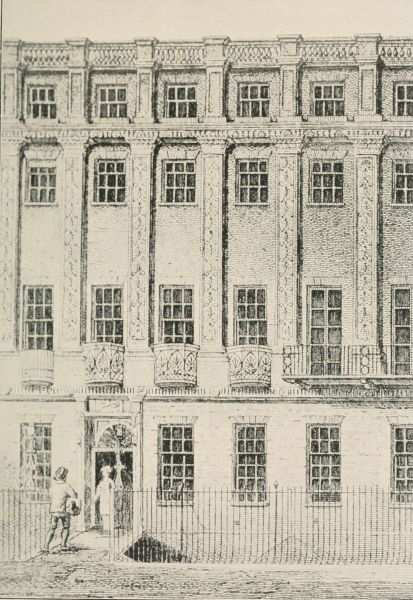
GARRICK'S HOUSE, 5 ADELPHI TERRACE.
It was to the Duchess of Tyrconnel, as she then was, that James II. had to relate the melancholy story of his defeat at the battle of the Boyne: "Soon after sunset, James, escorted by two hundred cavalry, rode into the Castle [Dublin]. At the threshold he was met by the wife of Tyrconnel, once the gay and beautiful Fanny Jennings, the loveliest coquette in the brilliant Whitehall of the Restoration. To her the vanquished King had to relate the ruin of her fortunes and of his own."[21] Jesse regards the connection of the Duchess of Tyrconnel with the New Exchange as "apocryphal." But we have the authority of Walpole and Pennant for the anecdote, and I see no reason to doubt its accuracy.
The romance of the White Milliner of the Adelphi afforded Douglas Jerrold material for a two-act comedy, which Madame Vestris produced at Covent Garden on February 9, 1841. The author of Black-eyed Susan was apparently suffering from some slight at the hands of the critics, for he takes them to task soundly in his Preface to The White Milliner, as his play was called. Having related the incident which gave rise to the piece, he goes on to say: "In our day, the dramatist who keeps aloof from a small faction—which almost avowedly adopts for its motto the dogma of Molière,—
'Nul n'aura de l'esprit, Hors nous et nos amis,'—
may look for the most unrelenting opposition from two or three stalwart critics, or, rather, literary vassals. Fortunately, however, the despicable partisanship of these people is now too well known to be hurtful. Whether they chronicle their injustice in bold falsehood, or with an affectation of candour, examine a drama to find in it nothing but what is contemptible, the disinterested motive is equally manifest. However, the abuse of these folks, like certain poisons long exposed to light, does not destroy—it only nauseates."
The cast of The White Milliner was remarkably strong. It contained, in addition to Madame Vestris, who played the heroine, Albina, Charles Mathews, James Vining, Robert Keeley, and William Farren. The opening scene is the "Exterior of England's Burse." The last scene of the first act is laid in the interior of the New Exchange. A crowd of milliners, with Doddles, the Beadle of the Burse, in the centre, fill the stage:
"Doddles. Silence! Silence!
Betty. Hear the Beadle!
1st Milliner. Attention for Doddles!
2nd Milliner. Does it concern us all?