Front matter (continued 2)
Reading edition
Doddles. All: maids, wives, widows, and young women. Silence!
Betty. Now, then; we're still as mice.
Doddles. Yes—when the cat's dead. Silence! and no winking.
Betty. La! Make haste.
Doddles. Manners, Betty Furbelow, manners! When I was in the army——
Betty. We've heard all about that.
Doddles. Before sleeping in wet blankets, I gloriously lost my voice in the defence of my country——
Betty. I'm sure your country ought to be much obliged to you. But the rules! the rules!
Milliners. The rules!
Doddles. Silence! Attention! Rear rank, take close order. Stand off! Baggages, do you call smothering a man taking close order? Hear the rules!
Milliners. Silence! the rules!
Doddles. 'Rules for the better regulation of England's Burse. Whereas'——
Betty. Oh, skip that!
Doddles. Skip it!
Betty. Yes. I hate everything with a whereas. Come to the rules.
Doddles. Well, the 'whereas' is long, and—the fortune of war—I've lost my voice. But it means that these new rules are not only for the morals of the Burse, but, above all, for the better transaction of business.
Betty. Now for it! Attention, ladies, this is business.
Doddles (reads). 'Rule the first. Any milliner who shall deal in smuggled goods shall forfeit her stall for ever.'
Milliners. Shame! Shame!
Betty. Are the articles specified? No! Ladies, here's oppression of the fair sex: for mayn't the most innocent of us smuggle a little, and never know it? And then to forfeit, and for ever!
Doddles. Not only eternally, but for ever. 'Rule second. No milliner shall talk'——
Milliners. Ha! ha! ha!
Doddles. 'Or laugh'——
Milliners. Ha! ha! ha!
Doddles. 'Talk or laugh, under pain of—of'——
Betty. Opening her mouth.
Doddles. Silence! Talk or laugh, under—under—my breath!—'under'—somebody read it—somebody—(Albina comes down the Burse.)
Betty. Here comes our white friend, she'll read it. Here—(giving Albina paper)—read—read: they're new rules made to keep us in order. To put down smuggling and—ha! ha!—talking and laughing, and—ha! ha!—for all I know, all our other little privileges. Read, for Doddles, having lost his voice, they made him beadle. Here: read rule third, for the second's nonsense.
Albina (reads). 'Rule third. No milliner shall be allowed to whisper to her customers, or titter, or blush.'
Betty. That's a hit at you, Sally Sly.
1st Milliner. What do you mean, ma'am? I whisper—I titter—I blush! I scorn you, ma'am!
Doddles. Silence!
Albina (reads). 'And whereas, divers sober people, purchasers of gloves, have complained of certain pinching of the fingers by certain persons, it is ordered that such unseemly practice be discontinued.'
Betty. And very proper too. I don't sell gloves.
Albina. 'Rule fourth. All strong waters, or other intoxicating cordials'——
Betty. Attention, ladies! This may be important.
Albina. 'Are rigorously prohibited.'
Betty. You see, Miss Bitters, I warned you what 'twould come to.
2nd Milliner. I! I! I defy you, ma'am! What do you mean?
Betty. My meaning's plain, ma'am: that everybody's to suffer for one person, ma'am.
2nd Milliner. Do you insinuate? Mr Doddles, does she dare——
Betty. I insinuate nothing; but this I will say: bottles are not so dear that people should use tea-cups.
Doddles. Silence! A very proper rule: not that I see any harm in folks having comforts, but then they ought to be corked. Silence!
Albina. Rule fifth. 'Henceforth no milliner shall presume to—to—to'——
Doddles (reads). 'Wear a mask.'
2nd Milliner. A very excellent and moral regulation Now we shall see who's who.
1st Milliner. If some people never wore anything else, their faces wouldn't be the losers.
Betty. A mask, ma'am, may be good at a pinch—at a pinch, ma'am; but as I've said, ma'am, I don't sell gloves, ma'am.
1st Milliner. Why, you scandalising, wicked——
Doddles. Silence! Silence!
3rd Milliner. Company! Company! To your stalls, ladies. (All the Milliners station themselves at their stalls. Albina retires among them.)
Visitors come down the Burse from c. Enter Lord and Lady Ortolan, she masked.
Lord O. My dear Lady Ortolan, you know I have the worst taste. I am a very Vandal—a Hottentot. I know no more about gowns and petticoats than an ancient Briton.
Lady O. Oh, my lord, I will not have you libel your capacity; for, certainly, no one has studied the subject with greater perseverance. I must have your judgment on a satin.
Lord O. (aside). She has dragged me here. I had as lieve made a journey on a hurdle. One comfort is, I don't see my enigma in white.
Lady O. (aside). She is not here: yet I'll not stir till I confront them.
Doddles (bringing down Albina). Here 'tis; rule fifth: no masks. So you must conform: therefore, uncover your face and——
Lady O. She's here!
Lord O. Confusion!
Doddles. Rule the fifth, which forbids masks, and—and——
Lady O. Nay, poor girl, I'll answer for't she has good reason for her mystery. Eh, my liege lord? a modest, excellent, worthy maid, no doubt?
Lord O. (aside). When women do praise women, what kind creatures!
Albina (aside). Surely there stands my tormentor. Her liege lord! So, so, now for my revenge.
Lady O. Come, we would see your merchandise. His lordship has forced me here to buy a dress.
Albina. And his lordship is such a judge of satin.
Lady O. Indeed?
Albina. Oh, yes, and so good to his mother.
Lord O. (aside). Would I were hanged, now, in a skein of silk!
Albina. Twenty gowns for his honoured parent.
Lord O. Nay, the girl mistakes me for some other customer. She—she——
Lady O. This insult, my lord, passes endurance. (Unmasking herself) Tell me, woman——
Albina (aside). Heavens! Olivia! You, you his wife!
Lady O. You see Lady Ortolan.
Albina. Happy chance; I have much, indeed, to tell you—much to reveal.
Lord O. (aside). Was ever poor married rogue in such a plight?"
In commenting on the failure of The White Milliner, Jerrold's son, Blanchard Jerrold, wrote that the "author was bitterly disappointed that its pointed and tender dialogue, and its brisk action, failed to achieve success; more,—as may be gathered from his own words,—that personal enmity, carried dishonestly into public criticism, sought to put it aside as a thing in all respects worthless." It was not long, however, before Mrs Caudle's Curtain Lectures gave Jerrold a foremost place as a wit and removed him far beyond the petty spite which had helped towards the failure of The White Milliner.
Another personage of greater note, although of lower birth, than the Duchess of Tyrconnel, connected with the history of the New Exchange, is "Nan" Clarges, subsequently Duchess of Albemarle. This remarkable woman was the daughter of John Clarges, a blacksmith and farrier, who lived in Drury Lane, at the Strand end, a spot now obliterated. Her mother was one of five women-barbers of notorious disrepute. A contemporary ballad has the refrain:
"Did you ever hear the like, Or ever hear the fame, Of five women barbers Who lived in Drury Lane?"
In the Lives and Adventures of Whitney, John Cottington alias Mul-Sack, and Thomas Waters (1753), there is a reference to these women: "They were five noted amazons in Drury Lane, who were called women-shavers, and whose actions were then talked of much about town; till being apprehended for a riot, and one or two of them severely punished, the rest fled to Barbadoes." Such an origin was not very promising; but Anne Clarges, when she was married to General Monk, upheld her position despite her personal disadvantages, for she was ill-favoured in appearance and by no means cleanly in her habits.
Anne Clarges was married, in 1632, to one Thomas Ratford, son to a farrier who resided in the Royal Mews at Bloomsbury. She had a daughter, who was born in 1634, and died four years later. She had been instructed in the trade of a milliner, and this led to her taking up her abode, after her marriage, at the Three Spanish Gipsies, in the New Exchange. Here she sold wash-balls, powder, gloves, and similar articles, and gave lessons to girls in plain needlework. In 1647, being then sempstress to Colonel Monk, she was in the habit of carrying his linen to him. This was the beginning of her intimacy with the famous soldier. Her parents died in 1648, and, in the following year, she quarrelled with her husband, who apparently left her. At any rate, from that date nothing more was heard of him. When Monk was a prisoner in the Tower—1644-1646—Anne Ratford became his mistress, and had a child of which he was the father—hence, no doubt, the reason of her separation from her husband.
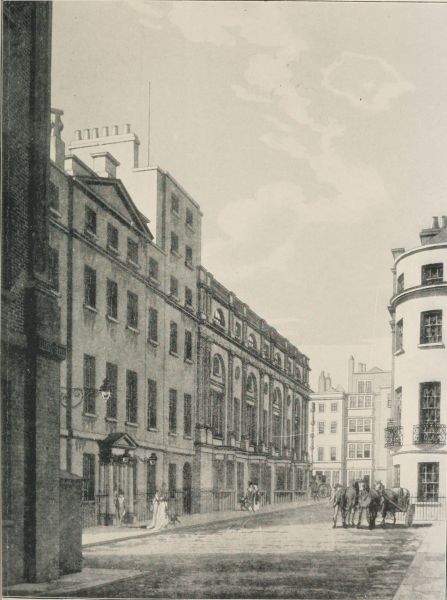
ADAM STREET, ADELPHI.
In an action for trespass, tried in the Court of King's Bench, on November 15, 1700, William Sherwin being the plaintiff and Sir William Clarges, Bart., being the chief defendant, it was proved that Anne Clarges, or Ratford, was, in 1652, married in the Church of St George, Southwark, to General George Monk, and further, that in the course of the following year she was delivered of a son (afterwards the second Duke of Ablemarle), who was suckled by one Honour Mills, a vendor of apples, herbs, and oysters. The point of issue was the right and title to the manor of Sutton in Yorkshire, and other lands—the plaintiff claiming them as heir-at-law and representative to Thomas Monk, elder brother to the first duke of Albemarle, and the defendant as devisee under the will of Christopher, the second duke. The only material point to be decided was, whether Ratford was actually deceased at the period of the marriage of his supposed widow with Monk. On the side of the plaintiff it was sworn by one witness that he had seen Ratford alive about the month of July, 1660, as many as eight years after the second marriage. Another witness affirmed that he had seen him as late as the year 1665, and a second time after the Duke and Duchess of Albemarle were both dead; and thirdly, a woman swore that she had seen him on the very day that his wife (then called Duchess of Albemarle) was placed in her coffin. On the part of the defendant, and in opposition to this evidence, were alleged the material facts that during the lives of the Duke of Albemarle and his son the matter had never been questioned, and, moreover, that the defendant had already thrice obtained verdicts in his favour in the Court of King's Bench. Some other presumptive evidence was adduced, but of less weight. In summing up, the Lord Chief-Justice told the Jury: "If you are certain that Duke Christopher was born while Thomas Ratford was living, you must find for the plaintiff. If you believe he was born after Ratford was dead, or that nothing appears what became of him after Duke George married his wife, you must find for the defendant." The verdict was in favour of the latter.[22]
According to contemporary evidence, the Duchess of Albemarle was a low, foul-mouthed creature, of exceedingly coarse habits. "Monk," says Lord Clarendon in his History, "was cursed, after a long familiarity, to marry a woman of the lowest extraction, the least wit, and less beauty. She was a woman nihil muliebris præter corpus gerens," one who had nothing feminine but her form. In the opinion of Bishop Burnet, she was a "ravenous, mean, and contemptible creature, who thought of nothing but getting and spending." Pepys could not endure her. On March 8, 1661, he met her in "high company," and put her down as "even a plain, homely dowdy." On December 9, 1665, Pepys and "my Lord Brouncker" dined with the Duke of Albemarle. "At table the duchess, a very ill-looked woman, complaining of her lord's going to sea the next year, said these cursed words: 'If my Lord had been a coward he had gone to sea no more: it may be then he might have been excused, and made an embassador' (meaning my Lord Sandwich). This made me mad, and I believed she perceived my countenance change, and blushed herself very much. I was in hopes others had not minded it, but my Lord Brouncker, after we were come away, took notice of the words to me with displeasure." In the following year, on November 4, he alludes to the duke as "a drunken sot," who "drinks with nobody but Troutbecke, whom nobody else will keep company with. Of whom he told me this story; that once the Duke of Albemarle in his drink, taking notice as of a wonder that Nan Hide should ever come to be Duchess of York: 'Nay,' says Troutbecke, 'ne'er wonder at that; for if you will give me another bottle of wine, I will tell you as great, if not greater, a miracle.' And what was that, but that our dirty Besse (meaning his duchesse) should come to be Duchesse of Albemarle?" Monk, it was said, was more in fear of his wife than of an army, and it was reported that she did not hesitate to thrash him at times, but the latter statement is probably an exaggeration. There is no doubt about her loyalty to the Royalist cause; she exerted great influence over Monk, and urged him immensely in his efforts in bringing about the Restoration. In his Curiosities of Literature, D'Israeli cites a passage from a manuscript of Sir Thomas Browne which throws a strange light on Monk's conduct in regard to the Restoration and the part played in it by the blacksmith's daughter: "Monk gave fair promises to the Rump; but at last agreed with the French ambassador to take the government on himself; by whom he had promise from Mazarin of assistance from France. This bargain was struck late at night; but not so secretly but that Monk's wife, who had posted herself conveniently behind the hangings, finding what was resolved upon, sent her brother Clarges away immediately with notice of it to Sir A. She had promised to watch her husband, and inform Sir A. how matters stood. Sir A. caused the Council of State, whereof he was a member, to be summoned, and charged Monk that he was playing false. The General insisted that he was true to his principles, and firm to what he had promised, and that he was ready to give them all satisfaction. Sir A. told him if he were sincere he would remove all scruples, and would instantly take away their commissions from such and such men in the army, and appoint others, and that before he left the room. Monk consented: a great part of the commissions of his officers were changed; and Sir Edward Harley, a member of the Council, and then present, was made Governor of Dunkirk, in the room of Sir William Lockhart: the army ceased to be at Monk's devotion: the ambassador was recalled, and broke his heart."
Another authority, Dr Price, one of Monk's chaplains, speaking on the same subject, says: "His wife had in some degree prepared him to appear, when the first opportunity should be offered. For her custom was (when the General's and her own work and the day were ended) to come into the dining-room in her treason-gown, as I called it, I telling him that when she had that gown on he should allow her to say anything. And, indeed, her tongue was her own then, and she would not spare it; insomuch that I, who still chose to give my attendance at those hours, have often shut the dining-room doors, and charged the servants to stand without till they were called in." The same writer also relates a remarkable dream, in which the Duchess of Albemarle foresaw the return of royalty to England. "She saw," says Dr Price, "a great crown of gold on the top of a dunghill, which a numerous company of brave men encompassed, but for a great while none would break the ring. At last there came a tall black man up to the dunghill, took up the crown, and put it upon his head. Upon the relating of this, she asked what manner of man the King was. I told her, that when I was an Eton scholar, I saw at Windsor, sometimes, the Prince of Wales, at the head of a company of boys; that himself was a very lovely black boy, and that I heard that, since, he was grown very tall." Fantastic as this dream story may appear, it is "not impossible," says Jesse, "that England owes the restoration of royalty to this and other similarly trifling circumstances connected with the influence which Anne Clarges exercised over the mind of her uxorious lord. Nothing, indeed, appears more natural, than that an ignorant and uneducated woman should have attached an undue degree of importance to an idle dream. The duchess, moreover, is known to have been a zealous adherent of the House of Stuart; and lastly, it is certain that she exerted all her influence to induce him to restore Charles the Second to the throne."
The Duke of Albemarle died on January 3, 1670, in his sixty-second year. His body, after it had lain in state at Somerset House for several weeks, was interred, with great pomp and ceremony, in Westminster Abbey, on the north side of Henry the Seventh's chapel. His wife survived him only a few days, and was buried by his side. Their only surviving son—Christopher, who was born in 1653—succeeded to his father's titles and enormous wealth. He died in Jamaica, where he was Governor, in 1688, without issue.
But to return to the New Exchange. In Gay's Trivia; or the Art of Walking the Streets of London (1716), there is an allusion to it:—
"The sempstress speeds to 'Change with red-tipt nose; The Belgian stove beneath her footstool glows; In half-whipt muslin needles useless lie, And shuttle-cocks across the counter fly."[23]
The place was on its downward path at this time. Quack doctors and other charlatans flourished, and the most degraded of women frequented its walks. If one may judge from contemporary advertisements, "Sir William Read, Her Majesty's oculist in Durham Yard in the Strand," did a large trade in the years 1709 and 1710. Thanks to his "long practice and great experience, he has lately found out a medicine that clarifies the eyes from suffusions and cures cataracts." He also professed to "cure hair lips and wry necks, tho' never so deformed." Lady Read took in hand the female customers. Their establishment was in "New Exchange Row, near Durham Yard." This William Read was originally a tailor. He became an itinerant quack, and, in 1705, was knighted for "curing" blind sailors and soldiers without charge. Thanks to his appointment as oculist to Queen Anne, he acquired a fortune. This empiric died in 1715. By 1737, the New Exchange had become so disreputable that it was taken down, and a number of dwelling-houses and shops—the site of which is indicated by the existing buildings between George Court and Durham House Street—facing the Strand, were erected.
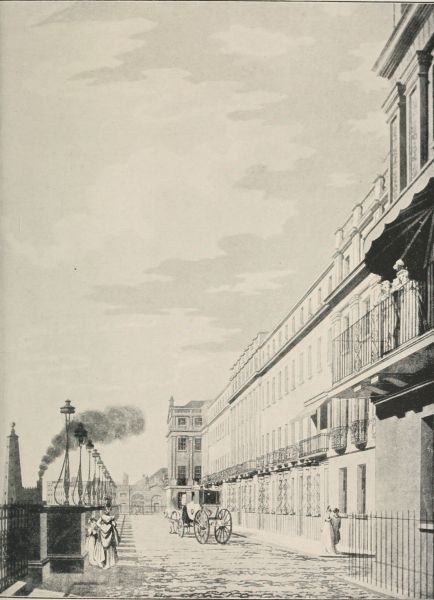
ADELPHI TERRACE IN GARRICK'S TIME.
Before leaving this part of the neighbourhood, it should be observed that at Durham Rents, which was at the back of Durham House, there was a book-shop early in the sixteenth century, as we see by the following announcement:—"The Myrroure of Owre Lady, Fynyshed and Imprynted in the Suburbes of the Famous Citye of London, without Temple Barre, by me Richard Fawkes, dwellynge in Durresme Rents, or else in Powles Church Yard, at the Synge of the A.B.C., 1530." On December 9, 1614, Thomas Wilson, traveller, author, and statesman, granted a lease to James Bovy, Serjeant of the Cellar, of "the Sill House, in the Strand, near Durham House." And, on October 1, 1618, there was recorded an indenture of sale from "Sir Thomas Wilson, of Hertford, now residing in St Martin-in-the-Fields, London, of a dwelling-house, garden, etc., in St Martin's-in-the-Fields, between Durham House, Britain's Burse, York House, and the River, to Wm. Roo, of London, for £374." Wilson, who was knighted in this year, was employed in obtaining admissions, that were sufficient to condemn him, from Sir Walter Raleigh, then a prisoner in the Tower. Twenty-eight days after the date of the indenture of sale of Wilson's property, near Durham House, Raleigh was executed. A year later, Sir Thomas Wilson, in a letter to the Chancellor of the Exchequer, writes from "my house in Duresme Yard," and sends a list of ambassadors and other people residing there. Wilson, who was a man of considerable learning, and a traveller, translated from the Spanish the Diana of George de Montemayor (the Portugese poet and romance writer, 1520-1562), the source to which Shakespeare went for several of the incidents in The Two Gentlemen of Verona. He entered the service of Robert Cecil in 1605. He was the keeper of the records at Whitehall from 1606 to the year of his death, 1629. He is the Wilson referred as "ye keeper of ye burse," quoted in the rules for the New Exchange in the preceding chapter.
The overcrowding of the New Exchange was a source of much annoyance to the inhabitants of Durham Yard, who made formal complaint of their grievances. As a result, an Order in Council, dated May 4, 1638, was made by the Inner Star Chamber, as follows:—"The Lords being made acquainted that, over the New Exchange, called Britain's Burse, there are divers families inhabiting as inmates, and that adjoining the wall of the Court of Durham House, there are sheds employed as eating rooms and for other uses, to the great annoyance of the inhabitants, and danger of infection. It was ordered that the Lord Privy Seal and Lord Newburgh, Chancellor of the Duchy, should call before them the inhabitants of the said places, and take order for their removal, and if they find any of the said persons obstinate should certify their names."
FOOTNOTES:
CHAPTER IV
Enter the Brothers Adam—Their Marvellous Transformation of the Ruins of Durham House and Yard into the Present Adelphi—The Magnitude of the Project—Opposition of the City—Defeated by Special Act of Parliament—The Adelphi Buildings only completed by Aid of a Lottery—The Adams explain their Position—Robert Adam: His History—His Death—James Adam—Some Poor Wit, including Walpole's, at the Expense of the Architects.
On a certain night in September, in the year 1768, "the Queen's Head Alehouse, near Durham Yard in the Strand, fell down, but the family being alarmed, happily no lives were lost." To such a neglected state had Durham Yard and its surroundings become when, most opportunely, two Scotch architects, the brothers Adam, arrived on the scene of decay. All that was left of the former grandeur of Durham House consisted of "a number of small low-lying houses, coal-sheds and lay-stalls, washed by the muddy deposits of the Thames." The property was then in the possession of the Duke of St Albans, from whom the brothers Adam obtained a ninety-nine years' lease, dating from Lady-day, 1768. The Duke, it seems, was in a parlous condition when he parted with this property, for the small sum, be it said, of £1200 a year. For, in a public print of January 13, 1770, it is stated that "the Duke of St Albans, who is now confined for debt at Brussels, disposed some time ago of the ground in Durham Yard in which the new square is now building; but, before the money was remitted him, he created so many fresh debts, that it is imagined he will remain there for life."
The architects effected a marvellous change over the district. By allowing the wharves to remain, and throwing a series of arches over the entire declivity, they "connected the river with the Strand by a spacious archway, and over these extensive vaultings erected a series of well-built streets, a noble terrace towards the river, and a house with a convenient suite of rooms for the then recently established Society of Arts." So said Peter Cunningham. Older authorities were even more enthusiastic. That fine architectural draughtsman, Thomas Malton, the younger (1748-1804), who was an eye-witness of the vast change effected, praised the brothers highly, in his Picturesque Tour through London and Westminster, in 1792: "To their researches among the vestiges of antiquity," he says, "we are indebted for many improvements in ornamental architecture, and for a style of decoration unrivalled for elegance and gaiety, which, in spite of innovations of fashion, will prevail as long as good taste prevails in the nation. This judgment of the Messrs Adam, in the management of their plans, and their care in conducting the executive part, deserves great praise; and it must be mentioned to their honour, that no accident happened in the progress of the work, nor has any failure been since observed—an instance of good fortune which few architects have experienced when struggling with similar difficulties. This remark will make a very little impression on the careless observer who rattles along the streets in his carriage, unconscious that below him are the streets, in which carts and drays, and other vehicles of business, are constantly employed in conveying coals, and various kinds of merchandise, from the river to the consumer, or to the warehouses and avenues inaccessible to the light of day; but he who will take the trouble to explore these depths will feel its force; and when he perceives that all the buildings which compose the Adelphi are in front but one building, and that the upper streets are no more than open passages, connecting the different parts of the superstructure, he will acknowledge that the architects are entitled to more than common praise.
"The terrace is happily situated in the heart of the Metropolis, upon a bend of the river, which presents to the right and left every eminent object which characterises and adorns the cities of London and Westminster; while its elevation lifts the eye above the wharfs and warehouses on the opposite side of the river, and charms it with a prospect of the adjacent country. Each of these views is so grand, so rich, and so various, that it is difficult to determine which deserves the preference.
"The manner of decorating the fronts of the shops and houses in Adam Street is equally singular and beautiful. It may be proper here to remark, what some future writer may dwell on with pleasure, that in the streets of the Adelphi the brothers have contrived to preserve their respective Christian names as well as their family name; while by giving the general appellation of The Adelphi to this assemblage of streets and buildings, they have converted the whole into a lasting memorial of their friendship and fraternal co-operation.
"The building of the Adelphi was a project of such magnitude, and attracted so much attention, that it must have been a period of the utmost importance in the lives of the architects. In this work they displayed to the public eye that practical knowledge and skill, and that ingenuity and taste, which till then had been in a great measure confined to private edifices, and known only by the voice of fame to the majority of those who feel an interest in the art of building. The extreme depth of the foundations, the massy piers of brickwork, and the spacious subterraneous vaults and arcades, excited the wonder of the ignorant and the applause of the skilful; while the regularity of the streets in the superstruction, and the elegance and novelty of the decorations, equally astonished and delighted all sorts and conditions of people." The brothers had to contend with many difficulties ere they accomplished their great work. In order to embank the river, it was necessary to obtain a special Act of Parliament (12 Geo. III., c. 34, 1771). But, the Court and the City being then at variance, the authorities of the latter vented their spite by opposing the bill, the Lord Mayor, as conservator of the Thames, claiming the right to the soil of the river on behalf of the citizens. The opposition was very strong, but it was finally defeated, thanks, in large measure, so Walpole states, to the influence of the Crown. Much acrimony was displayed, and the newspaper press contained many arguments, mostly in favour of the project. A curious and interesting letter on the subject appeared in the Morning Advertiser in May 1771:—
"Sir," it said, "I never was more astonished than upon reading in your Paper the Petition of the City of London to His Majesty against his giving the Royal Assent to the Bill for embanking the River Thames at Durham-Yard, that there was not one Word in this dull Performance against the Propriety or Utility of the Embankment. This was the only Ground on which the City had any Title to interfere in this Business by Virtue of their Right of Conservancy: But I find that though this was what they originally let out upon in their Opposition. The Proof turned out so strong against them, and the public Utility of the Embankment, as well as of the Wharfs at that Part of the Town, was so clearly demonstrated both to the Lords and Commons, that the City in this last Stage of their Opposition think proper to pass over this very material Circumstance in Silence, and are drove to rest their Complaints upon two Circumstances totally new and different from what they originally opposed it upon.
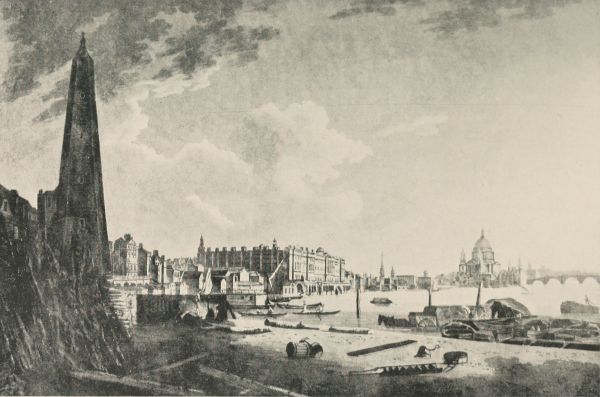
THE THAMES, FROM THE WATER WORKS, YORK BUILDINGS, ADELPHI.
"First, They allege that this Bill appears to be destructive of the ancient and valuable Rights and Properties of the City of London, enjoyed without Interruption through a Succession of many Ages; insinuating at the same Time that they are denied an Appeal to that Law which knows no Partialities, but strictly gives to every Man his Due.
"Now, Sir, this Representation, if I were inclined to use as gross and as harsh Epithets as the City of London do, might with very great Truth be termed extremely false; for I myself heard Mr Lee the Council for the City of London, fairly acknowledge at the Bar of the House of Lords that the City knew nothing of their Right to the Soil of the River till within these three Weeks; for this amazing Discovery was fallen upon after this Bill had made a considerable Progress in the House of Commons; and this valuable Property had passed unnoticed by all the Magistrates of the City, as well as their Lawyers since the Age of Henry VII. though now asserted to be enjoyed by them without interruption since that Period: A very bold Assertion indeed after so direct and so satisfactory a Proof of the contrary had been within these few Days laid before the House of Lords: Yet this Assertion is not more extraordinary than the Insinuation mentioned above; for all the World may be convinced how groundless the latter is by having Recourse to the Bill, in which they will find an express Clause, reserving to the City a Liberty to try their Right at Law, and the Value to be ascertained by a Jury: So very tender have Parliament been in paying Attention to their Claim of Right, however frivolous and weak it might appear to them.
"A few Words in the saving Clause is the Foundation of the second weighty Complaint in the City's Petition to the King, it being there asserted that the City insist that the Persons who apply for Liberty to embank ought to make Satisfaction for the same; and this Allegation is stigmatised with the severe Terms of groundless, false and contradictory to the City public Declarations in both Houses of Parliament. Whether the City have not been rash in making these bold Assertions, we leave the candid Public to decide, after reading the following Extracts:—
"Extract from the Report of the New Bridge Committee, to whom the Petition for Leave to embank Durham-Yard, &c., was refer'd; which Report is signed by Sir Robert Ladbroke, and many others of the most respectable Citizens of London, who, reported in Favour thereof, provided that a Clause be obtained, 'subjecting the Ground taken out of the River with the yearly Payment of a Farthing, a Square superficial Foot, redeemable on Payment of twenty years Purchase, and for appropriating the Quit Rent and Purchase Money to the Fund created by Parliament for repairing, lighting, and watching the Bridge.'
"Extract from the Case of the City of London printed by them, and handed about to the Members of the House of Commons. At the second reading of the Embanking Bill, which concludes thus: 'However a Bill is now brought in to embank the River, and to vest in the Owners of the adjoining Houses the Soil to be embanked not only against the Representation of the City of London, the Conservators of the River, but without any Regard to their Claim or Right to the Soil to be embanked, and a Property of immense Value to be taken from the Public without any Consideration': And this was the general Language held by the few Advocates for the City in the House of Commons, until a new Doctrine was broached by Mr Dunning, who discovered that this valuable Property could not be estimated by any Jury at above Five Shillings Value; and to this last Doctrine the Party have since adhered; for Lord Camden, in his Speech to the Lords, declared, that no Jury could value the Soil embanked at one Farthing; and these great Lawyers are entirely right; for by the Usage of the River, the Proprietor of every Wharf has an exclusive Right of Frontage or Water-way to Low-water Mark. Therefore whether the King or the City are the Proprietors of the Soil, neither the one or the other could have embanked to the Exclusion of the Proprietors of the adjoining Wharfs; for in this Event no Wharf upon the River Thames would be of the smallest Value; consequently no Persons whatever could have made any advantage of this Embankment but the Parties to the Bill. If this requires any Confirmation, the Bill obtained by the City for the Embankment at Blackfriars establishes it beyond a Doubt, for that Bill vests the Ground obtained off the River in the Proprietors of the adjoining Wharfs and Houses.
"When this is thoroughly understood, how ridiculous must the City appear, and how much do they degrade themselves, by carrying a Petition to the Throne, after having squandered their Treasure in an Opposition, the Object of which is to acquire a Property not worth one Farthing to them; setting up an ostentatious Parade of an Infringement of that Property which they knew they have no Right to, and if they had ought undoubtedly to be given a public Use, upon having a proper Compensation allowed them for it, which is done every Day in Cases of Roads, Navigations, and other Improvements of public Utility, even where private Individuals are to be the principal Benefactors.
"A great City ought not to act the Part of the Dog in the Manger, but should encourage every Scheme of public Advantage. These formerly have been the Sentiments of the City of London, when that City was under the Guidance of grave, respectable and wise Magistrates, not heated by Party, or misguided by violent or factious Views." The storm raised by the projected building drew from Granville Sharp, the philanthropist, a curious, but extremely dry, pamphlet entitled Remarks Concerning the Encroachments of the River Thames near Durham Yard. It was dated from the Old Jewry, August 10, 1771, but it was too late to be of any service, for the Act allowing the embankment of the river had been passed.
Even then misfortune dogged the footsteps of the courageous brothers, for they became involved in financial difficulties, and eventually had to complete their buildings by raising money by means of a public lottery. Some of these difficulties were alluded to by sympathetic friends in the press. "The Adelphi buildings," one of them hears, "were mortgaged for a loan of £70,000 previous to the late unhappy failures of the banks, and it is said that the Messrs Adam had laid out as much more upon them; so that, in the course of five years, these gentlemen expended £140,000 to raise palaces upon an offensive heap of mud, and circulated an immense sum to make a palpable nuisance a principal ornament to the metropolis." Another defender wrote in a similar strain: "Within a space of time, incredibly short for so magnificent an undertaking, they have raised a pile of elegant buildings, noble, convenient, and splendid, on a spot which was, two or three years since, a mere dunghill, a receptacle for filth, obscenity, and wretchedness, a scandal to a well-governed city and a disgrace to one of the noblest rivers in Europe."
Thanks, perhaps, to the publicity thus afforded them in the public press, the brothers Adam obtained the necessary Act of Parliament (13 Geo. III., cap. 75, 1773) for the disposal of the property by lottery. It was as follows:—"An Act for enabling John, Robert, James and William Adam to dispose of several houses and buildings in the parishes of St Martin-in-the-Fields and St Mary-le-Bow, in the county of Middlesex, and other their effects by way of chance in such manner as may be most for the benefit of themselves and creditors."
There were 4370 tickets at £50, making £218,500. The prizes numbered 108, and were thus arranged:—
1 £50,080
1 39,950
1 29,980
1 19,980
1 9,960
1 4,960
100 of different values from £100 to £760 33,500
The first drawn ticket was entitled to 5,000
The last drawn to 25,090
————
£218,500
The above facts are taken from a rare pamphlet, entitled Particulars composing the Prizes in the Adelphi Lottery, published by the Adams on January 18, 1774, in which it is stated that, "as the Messrs Adam engaged in this undertaking, more from an enthusiasm of their own art than from a view of profit; at the same time being eager to point out a way to public utility, though even at an extraordinary expence; they will be perfectly satisfied if they should only draw, from this lottery, the money laid out by them on a work which, they readily confess, they have found to be too great for their private fortunes.... The Messrs Adam have thought it unnecessary to give so particular a description of the houses in the Adelphi as they have done of the houses in Queen Anne Street and Mansfield Street, as these buildings are so generally known by persons who reside in town; but for the information of those who live in the country, it may be satisfactory to say, that they are remarkably strong and substantial and finished in the most elegant and complete manner, much beyond the common stile of London houses: they have all a double tier of offices, which gives an uncommon convenience for the servants of the family.... The inhabitants of the Adelphi buildings express the greatest satisfaction, not only with regard to their houses, but with their situation, which is remarkably dry, healthy and well-aired.
"The principal houses in the Adelphi possess not only a superior degree of convenience, in water laid in, from the top to the bottom of each house, but the whole buildings have also an additional safety against fire, much beyond any other houses in London. For, besides the use of fire engines, which they have in common with other houses, there is a water tower erected by the Messrs Adam, which communicates with the river Thames; and the pipes are so constructed, that upon a minute's notice, three engines, constantly supplied with water, can be played upon any house in the buildings."
In addition to the house property enumerated, pictures and drawings by Teniers, P. Veronese, and Guercino, together with several statues, were enumerated in the lottery paper, so that it appears that the Adams had been compelled to put nearly everything they possessed into the fund for the building of the Adelphi. Fortunately they were in such favour at Court that they were able to obtain the necessary permission for the lottery, otherwise they would have been ruined financially over the speculation.
On Thursday, March 3, 1774, the drawing up of the lottery began at the great room, formerly Jonathan's Coffee House, in Exchange Alley, when No. 3599 was drawn a blank, but being the first drawn ticket it was entitled to £5000. Nine other prizes were drawn on Friday, and at this rate the drawing continued for some time. The newspapers of the period were full of information and advertisements respecting the lottery; and the art of advertising appears to have been very thoroughly mastered at that time. Tickets were sold in all parts of the town, as well as at the Messrs Adams' office in Robert Street; intending purchasers were told that there was a great demand and that early application was necessary— in fact, that the demand began to be prodigious. Then they were informed that "Messrs Adam propose to keep their office in the Adelphi open till twelve o'clock on Wednesday night next (March 9) for the sale of tickets at £50 each, after which the price of the small quantity remaining in the market must be considerably raised, on account of the consumption of tickets by the wheel." Portions of tickets were sold at the various lottery offices thus—a half cost £25, 5s.; a thirty-second, £1, 13s.; and a sixty-fourth, 17s. Then there are little bits of gossip in the papers, intended to whet the appetite of the public. Thus we are told that No. 3599, the first drawn ticket, entitled to an estate of the value of £5000, was sold by Messrs Richardson and Goodenough not half an hour before the lottery began drawing, and, what is very remarkable, was the only ticket they had left unsold. Soon afterwards, the winner of this ticket disposed of it by auction.
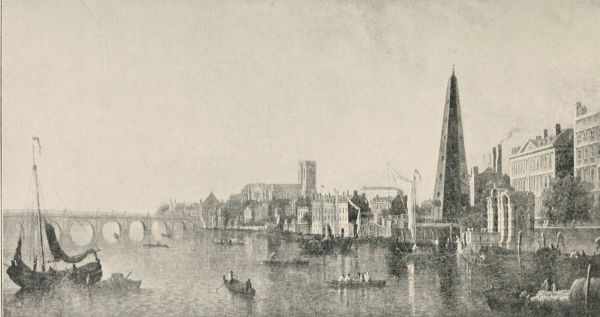
YORK STAIRS AND THE WATER TOWER.
It is to be noted that the prizes were not instantly realizable, for the buildings were to be divided among the prize-holders, and the houses were not yet finished. Those who could not wait for their money sold their prizes by auction, and it may be presumed that in course of time the tickets got into a few hands.[24] The following is the explanation by the Adams of their action:—
"The Messrs Adam having received a letter signed A.B.C., which the writer says is sent to be inserted in the public papers, requiring to know the state of the mortgages on the buildings which constitute the Adelphi lottery, and also what security the public have for their completing the unfinished buildings? In answer to these questions, the Messrs Adam, desirous to satisfy the adventurers in the lottery, and the public in all reasonable demands, think it necessary to inform them that the mortgagees have already been paid one half of their money, but as it is requisite that they should join in assigning the prizes to the fortunate adventurers, they defer paying the other half till such assignments are completed. The Messrs Adam, ever since the obtaining of the Act for their lottery, have proceeded with an amazing rapidity in finishing their houses, in the same substantial manner with those formerly finished and sold in the Adelphi; they are happy to think the whole will be completed, and ready to be assigned, by the time they have ascertained in their scheme and allotment, as no attention and no expense shall be spared for that purpose."
Before proceeding further with the history of the Adelphi, the indomitable brothers themselves call for notice. Robert Adam (1728-1792) was the most noted of the four brothers—John, Robert, James, and William. Their father, William Adam, of Maryburgh, N.B. (died June 24, 1748), was the architect of Hopetoun House, and the Royal Infirmary, Edinburgh, in which city he held the appointment of King's Mason. Robert, the second son, was born at Kirkcaldy, and educated at Edinburgh University. Here he became on friendly terms with several fellow students who also attained fame, including David Hume, Dr William Robertson (the historian), Adam Smith (the political economist), and Adam Ferguson (the philosopher). In his twenty-sixth year Robert Adam visited Italy in the company of Clérisseau, a French architect, and made a minute study of the ruins of the Emperor Diocletian's palace at Spalatro, in Venetian Dalmatia. The journal of his tour was printed in the Library of the Fine Arts, and, in 1764, he published a folio volume with numerous engravings by Bartolozzi and others, from his drawings of the palace. In this important work he states that his object in selecting this ruin for special examination was its residential character, as the knowledge of classical architecture in England was derived exclusively from the remains of public buildings. During his absence on the Continent, he was elected F.R.S. and F.S.A. Soon after his return, he was appointed architect to George III. This office he was obliged to resign in 1768, when he was elected to Parliament as member for Kinross-shire.
The date of Robert Adam's return to England is generally understood to be 1762, but the architect himself makes mention of some work "done since my return to England in 1758." The mistake has probably arisen from the fact that James Adam did not leave his architectural studies in Italy until the former year. Robert, it is certain, is solely responsible for the screen of the Admiralty buildings in Whitehall, built in 1760. "The Admiralty," says Horace Walpole, "is a most ugly device, and deservedly veiled by Mr Adam's handsome screen." About this time there was a pacific invasion of England by the Scots, art being represented by William Chambers, Allan Ramsay—son of the poet—who, in Walpole's opinion, excelled Reynolds as a painter of women, Robert Strange, and the Adam brothers, Robert and James. Mr Clouston doubts the statement that Clérisseau accompanied Robert Adam to Italy. The young French architect was famous at the time of Adam's visit to the Continent, "and one of his pupils, Sir W. Chambers, was making a name in England. It is not altogether evident, therefore, how, a year later, he should have accompanied Adam to Spalatro in the subordinate position of assistant. Still, if any man had the capability of turning a master into a pupil through sheer force of character and magnetic presence, it must be admitted that that man was Robert Adam. His belief in himself was so colossal as probably to approach conceit. The very fact that, as a young man of twenty-nine, who had already had a most expensive education, he spent a considerable amount of his patrimony in a costly expedition, with the view of publishing a book which could not be expected to pay, is enough to show us something of the character of the man.
"He had made up his mind that he was to take the world by storm, and he proceeded to do so with the most absolute confidence, in spite of disadvantages of which he must have been, at least partially, aware.
"In his day in Scotland, and, indeed, for long after, the speech of even the most educated was as a foreign language to English ears. Anything 'Englishy' in accent was ridiculed. So much was this the case that when, towards the end of the century, certain Scottish advocates, who found their accent a serious drawback when arguing before the House of Lords, employed an 'English master,' the movement was laughed out of existence.
"Adam may have been able to speak fairly fluently in both French and Italian: but if his ordinary mode of speech was, as it must have been, broad Fifeshire with a top-dressing of Midlothian, it could not have constituted the best introduction to London society. Yet from the first he was both a social and a professional success, and his immediate reception, despite his Scotch speech and his new gospel, says more for the immense power and personality of the man than any number of words. Other men, even greater than he, have had both reverses and doubts about themselves. Adam had neither. He was born to succeed, and he knew it. Even his book on the Palace at Spalatro, instead of being an expensive way of bringing him before the public, was a great commercial success."[25]
Thanks to their building of Lansdowne House for the Earl of Bute, and Caen Wood House, Hampstead, for Lord Mansfield, as well as to the fame which they obtained by the Adelphi, Robert and James Adam acquired a great reputation as classical architects, and they enjoyed the patronage of the aristocracy. Amongst the most important of their other works were Luton House in Bedfordshire; Osterley House, near Brentford; Keddlestone, Derbyshire; Compton Verney, Warwickshire; the screen fronting the high road, and extensive internal alterations of Sion or Syon House, Middlesex, the seat of the Duke of Northumberland; the infirmary of Glasgow; the parish church at Mistley, Essex; the Register House, Edinburgh; and the Admiralty screen. The number and importance of their buildings in the metropolis materially influenced and much improved the street architecture of London. They originated the idea of giving to a number of unimportant private edifices the appearance of one imposing structure. Portland, Stratford, and Hamilton Places, and the south and east sides of Fitzroy Square, are instances of the manner in which they carried this principle into effect. "An innovation of more doubtful service," according to the Dictionary of National Biography, "was their use of stucco in facing brick houses. Their right to the exclusive use of a composition patented by Liardet, a Frenchman, was the subject of two law-suits, which they gained."
James Fergusson, in his History of Architecture, places their knowledge of classical art below that of Sir William Chambers. He adds: "Their great merit—if merit it be—is that they stamped their works with a certain amount of originality, which, had it been of a better quality, might have done something to emancipate art from its trammels. The principal characteristic of their style was the introduction of very large windows, generally without dressings. These they frequently attempted to group, three or more together, by a great glazed arch over them, so as to try and make the whole side of a house look like one room." Mr Fergusson thinks the college at Edinburgh the best of their works, and says: "We possess few public buildings presenting so truthful and well-balanced a design as this."
Whatever were the architectural defects of their works, the brothers formed a style, which was marked especially in their interiors by a fine sense of proportion, and a very elegant taste in the selection and disposition of niches, lunettes, reliefs, festoons, and other classical ornaments. It was their custom to design furniture in character with their apartments, and their works of this kind are still greatly prized. Amongst them may be specially mentioned their side-boards with elegant urn-shaped knife-boxes, but they also designed bookcases and brackets, pedestals and cabinets, clock-cases and candelabra, mirror frames and console tables, of singular and original merit, adapting classical forms to modern uses with a success unrivalled by any other designers of furniture in England. They designed, also, carriages and plate, and a sedan chair for Queen Charlotte. Of their decorative work generally it may be said that it was rich but neat, refined but not effeminate, chaste but not severe, and that it will probably have quite as lasting and beneficial effect upon English taste as their architectural structures.
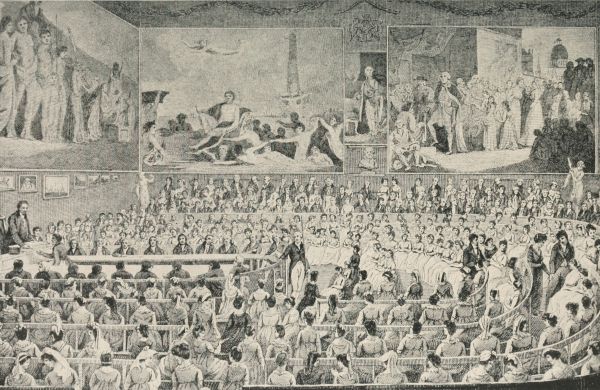
THE SOCIETY OF ARTS DISTRIBUTING ITS AWARDS.
In 1773, the brothers Robert and James commenced the publication of their Works on Architecture, in folio parts, which was continued at intervals till 1778, and reached the end of the second volume. In 1822, the work was completed by the posthumous publication of a third volume, but the three bound up together do not make a thick book.[26]
Robert Adam also obtained some reputation as a landscape painter. As an architect, he was extensively employed to the last. In the year preceding his death he designed no less than eight public works and twenty-five private buildings. He died at his house in Albemarle Street, from the bursting of a blood-vessel in his stomach, on March 3, 1792. Of the social position he attained, and the estimation in which he was held, no greater proof can be afforded than the record of his funeral in Westminster Abbey. His pall-bearers were the Duke of Buccleuch, the Earl of Coventry, the Earl of Lauderdale, Viscount Stormont, Lord Frederick Campbell, and Richard Pulteney (the botanist).
His younger brother, James, died in the same street, on October 20, two years later, from apoplexy. His work was so closely connected with that of Robert as to be practically undistinguishable. It is thought, by many, that he was solely responsible for the design of Portland Place. At one time he was architect to George III., and was master mason to the Board of Ordnance in North Britain. He published Practical Essays on Architecture, and, at the time of his death, he was engaged on a history of architecture. The eldest brother, John, inherited the business of the father, and remained in Scotland. William Adam is said to have died in 1748, in which case he could hardly have "assisted his brother Robert in building the Adelphi" (Dict. of Nat. Biography).
And Walpole, writing to Mason on July 29, 1773, says: "What are the Adelphi Buildings? Warehouses, laced down the seams, like a soldier's frill in a regimental old coat." Yet the author of The Castle of Otranto did not disdain from asking Robert Adam to design a room for him.
Apart from their financial troubles in building the Adelphi, the Adams brothers had to stand much banter. It was said, with what truth I know not, that they obtained their workmen, "with true patriotism," from Scotland, and that the labours of the artisans were stimulated by countless bagpipes; "but the canny men, finding the bagpipes played their tunes rather too quick, threw up the work, and Irishmen were then employed." In the Foundling Hospital for Wit,[27] the nationality of the architects is rudely assailed:—
"Four Scotchmen, by the name of Adams, Who keep their coaches and their madams, Quoth John, in sulky mood, to Thomas, Have stole the very river from us! O Scotland, long has it been said, Thy teeth are sharp for English bread; What! seize our bread and water too, And use us worse than jailors do: 'Tis true, 'tis hard; 'tis hard, 'tis true. Ye friends of George, and friends of James, Envy us not our River Thames; Thy Princess, fond of raw-boned faces, May give you all our posts and places; Take all to gratify your pride, But dip your oatmeal in the Clyde."
FOOTNOTES:
CHAPTER V
The Society of Arts—Its Foundation—Its Removal to the Adelphi in 1774—James Barry and his Famous Paintings—Visited in John Street by Burke and Johnson—The Latter's opinion of his Genius—Description of his Pictures for the Society—The Work of the Society—"Spot" Ward, the Inventor of "Friar's Balsam"—Johnson speaks in the Great Room—Forsaken by his "Flowers of Oratory."
Inseparably connected with the romance of the Adelphi, and very interesting on its own account, is the history of the Society of Arts, with its memories, not only of painters, but of Johnson and other celebrities. The Society owes its origin to William Shipley (1714-1803), a drawing-master of Northampton, and brother of Jonathan Shipley, Bishop of St Asaph, the friend of Benjamin Franklin. It was established at a meeting held on March 22, 1754, at Rawthmell's Coffee-house, in Henrietta Street, Covent Garden. Its first president was Jacob, Lord Viscount Folkestone. Its complete designation is "The Society for the Encouragement of Arts, Manufactures and Commerce." Smollett, in his History of England (1757), says, somewhat grandiloquently: "The Society is so numerous, the contributions so considerable, the plan so judiciously laid, and executed with such discretion and spirit as to promise much more effectual and extensive advantage to the public than ever accrued from all the boasted academies of Christendom." The Society had various homes prior to settling in the Adelphi. Its first meetings were held over a circulating library in Crane's Court, Fleet Street. A move was made westward to Craig's Court, Charing Cross, and from there the Society went to the Strand, in rooms opposite the New Exchange, and, in 1759, to apartments in Beaufort Buildings, Savoy.
In 1771, the brothers Adam entered into an agreement with the Society for the erection of "a proper building in the Adelphi for the use of the Society and the accommodation of its officers." The first stone was laid by Lord Romney, on March 28, 1772, and the building was opened in 1774. The Great Room, in which are the six famous pictures painted by James Barry, R.A. (1741-1806), between the years 1777 and 1783, is 44 feet in width, 60 feet in depth, and 48 feet in height. The painting of these celebrated pictures is one of the most extraordinary episodes in the history of art. In 1774, the Society of Arts suggested to certain members of the Royal Academy—then newly instituted—that they should paint the interior of the Great Room, and that they should be reimbursed by the public exhibition of the completed works. This proposition was rejected by the academicians, at whose head was Sir Joshua Reynolds, and Barry, as a member, refused the offer. Three years later, however, Barry, having but sixteen shillings in his pocket, applied for permission to execute the work, unaided, and without remuneration. The Society's housekeeper told Benjamin Haydon, the historical painter (1786-1846), that she remembered Barry at work on his frescoes. His violence, she said, was dreadful, his oaths were horrid, and his temper was like insanity. In summer, he started painting at five o'clock, worked until dark, and then etched by lamp-light until eleven at night. Burke and Johnson called once. But no artist dared to brave his wrath. He had his tea boiled in a quart pot, dined on porridge, and drank milk for supper. So poor was the painter that he applied, but in vain, to the Society for a little money, and "an insolent secretary even objected to his charge for colours and models." Subsequently, the Society relented and advanced the artist a hundred pounds. The Society "afterwards indulged him with two exhibitions of his paintings, in 1783 and 1784, which brought him £503, 12s., the Society paying the cost of the exhibitions, which amounted to £174." He was also "rewarded" by the Society with a gold medal. But he had other, and, perhaps, more pleasing recognitions of his talent. That sturdy traveller and philanthropist, Jonas Hanway (1712-1786), came to one of the exhibitions, and the pioneer of the umbrella was so pleased that he insisted upon leaving a guinea instead of the customary shilling. The Prince of Wales gave Barry sittings, and Lord Aldborough declared that the painter had "surpassed Raphael." Lord Romney gave him a hundred guineas for a copy of the heads, and Dr Johnson thought highly of Barry's imaginative powers. "Whatever the hand may have done," he said to Boswell, "the mind has done its part. There is a grasp of mind there which you find nowhere else." Poor, neglected, and half-mad, Barry died at the age of sixty-five. His body lay in state in the Great Room on March 7. He was buried in St Paul's.
Some sixty years ago, said a writer towards the middle of the last century, there might have been seen daily passing in a direction between Oxford Street and the Adelphi, for years together, and through all kinds of weather, one whose appearance told, to even the most casual observer, he looked upon a remarkable man. Referring to himself, in one of his letters to a friend, Barry had once said, "Though the body and the soul of a picture will discover themselves on the slightest glance, yet you know it could not be the same with such a pock-fretted, hard-featured little fellow as I am also"; but neither these personal characteristics, nor the mean garb in which he usually appeared, could conceal the earnestness stamped upon his grave, saturnine countenance, or the air of entire absorption in some mental pursuit, having little in common with the bustle of the everyday business of the world around him. He was a man to make or to keep few friends, and to shun all acquaintances; it was not often, therefore, that, in these passages to and fro, he had any companion; but the event was noticeable when he had, from the striking change in his demeanour. He became full of animation, and of a kind of sparkling cheerfulness; his conversation was at once frank, weighty, and elevating, and even the oaths, with which he made somewhat free, could not spoil the delight of the most fastidious censor of words, whilst borne along on the full and free current of the painter's thoughts. No one but himself at such times would have called his countenance "hard-featured"; its smile was inexpressibly sweet, its look of scorn or anger, when roused, such as few men could have met unmoved. But what was the employment that thus determined for so long a period his daily movements? The answer will require a brief review of his past career. Whilst a young student at Rome, Barry, annoyed by the absurd taunts of foreigners as to the ungenial character of the British soil for the growth of art, was often seduced into answering them in such a manner as suited rather his fiery temper and indomitable will than the cause which he so impatiently espoused. But a better result was his own quiet determination to devote his life to the disproof of the theory. He began admirably, by a strict analysis of his own powers, and by inquiring how they were best to be developed. Here is the result: "If I should chance to have genius, or anything else," he observes, in a letter to a friend, "it is so much the better; but my hopes are grounded upon an unwearied, intense application, of which I am not sparing. At present I have little to show that I value; my work is all underground digging and laying foundations, which, with God's assistance, I may hereafter find the use of. I every day centre more and more upon the art; I give myself totally to it; and except honour and conscience, am determined to renounce everything else." But the writer was without a shilling in the world to call his own; and although he had friends, the best of friends, as they were—one of them at least, Burke, the best of men—he had already received from them the entire means of subsistence while he had been studying so long at Rome, and was determined, therefore, to be no longer a burden to them or to others; but how should he, renouncing all ordinary blandishments of a young painter's career, the "face-painting" and other methods by which genius condescends to become fashionable, or, in other words, to lay down its immortality for the pleasure of being acknowledged immortal—how was he to subsist? It was whilst this question remained, we may suppose, not decisively answered, that the painter thus wrote to another friend:—"O, I could be happy, in my going home, to find some corner where I could sit down in the middle of my studies, books, and casts after the antique, to paint this work and others, where I might have models of nature, when necessary, bread and soup, and a coat to cover me! I should care not what became of my work when it was done; but I reflect with horror upon such a fellow as I am, and with such a kind of art in London, with house-rent to pay, duns to follow me, and employers to look for. Had I studied art in a manner more accommodated to the nation, there would be no dread of this." But from this state of despondency and dissatisfaction he was soon to rise triumphant. Again and again he asked himself how he was to subsist while the great things he meditated should be accomplished, and the answer came: the conclusion was anything but attractive or cheering, but he saw it was the conclusion: no cross, no crown; and he accepted it ungrudgingly. It was not long before he could say, "I have taken great pains to fashion myself to this kind of Quixotism; to this end I have contracted and simplified my cravings and wants, and brought them into a very narrow compass." There are few, we think, of those who may have smiled with pity or contempt at the painter's mean garb, who would not have honoured it while they reverenced him, had they known this. The first apparent opportunity of achieving the object indicated was in connection with the proposed decoration of St Paul's.[28] But this fell through, and it was not until the Society of Arts accepted his offer that he was able to bring himself into line with his own convictions.
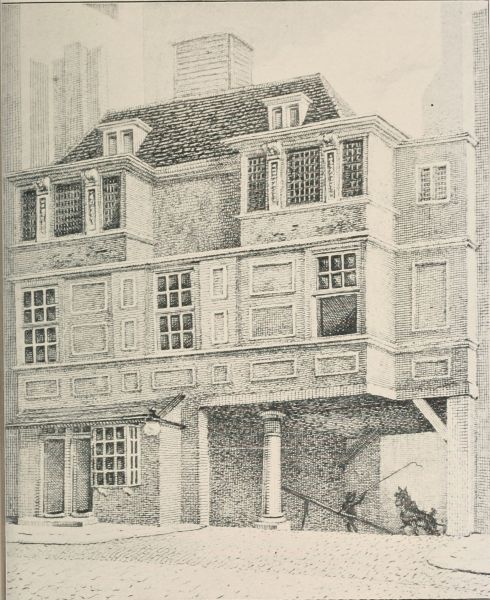
THE STRAND ENTRANCE TO DURHAM YARD.
"Let us now ascend the stairs to the first floor, passing through the little ante-room where the alto-relievos of Bacon and Nollekens are mounted high upon the walls, and beneath the portrait of the founder of the Society, which appropriately hangs over the door of the great room, where the painter's works are to be found. The first glance shows us in one way the magnitude of the undertaking; the upper portion of the walls of the whole of the noble room, or hall, as it should rather be called, is covered by the six paintings of which the series consists; as we step from one to another, we perceive that these large spaces have been wrought upon in a large spirit; and a still closer examination opens to our view, pictures of surpassing beauty and grandeur, and scarcely less remarkable as a whole for the successful manner in which they have been executed than for the daring originality of their conception."
Barry's six pictures for the Society of Arts were designed on dignified and important subjects, so connected as to illustrate this great maxim of moral truth: "That the attainment of happiness, individual as well as public, depends on the development, proper cultivation, and perfection of the human faculties, physical and moral, which are as well calculated to lead human nature to its true rank and the glorious designation assigned for it by Providence." To illustrate this doctrine, the first picture exhibits mankind in a savage state, exposed to all the inconvenience and misery of neglected culture; the second represents a Harvest Home, or thanksgiving, to Ceres and Bacchus; the third, the victors at Olympia; the fourth, Navigation, or the Triumph of the Thames; the fifth, the Distribution of Rewards by the Society; and the sixth, Elysium, or the state of final Retribution. Three of these subjects are truly poetical, the others historical. The pictures are all of the same height, viz., eleven feet ten inches; and the first, second, fourth, and fifth are fifteen feet two inches long; the third and sixth, which occupy the whole breadth of the room, at the north and south ends, are each forty-two feet long.
The Thames.—Personified and represented, of a venerable, majestic and gracious aspect, sitting on the waters in a triumphal car, steering himself with one hand, and holding in the other the mariner's compass. The car is borne along by our great navigators, Sir Francis Drake, Sir Walter Raleigh, Sebastian Cabot, and the late Captain Cook. In the front of the car, and apparently in the action of meeting it, are four figures, representing Europe, Asia, Africa, and America, ready to lay their several productions in the lap of the Thames. The supplicating action of the poor negro slave—or, more properly, of enslaved Africa—the cord round his neck, the tear on his cheek, the iron manacles and attached heavy chain on his wrists, with his hands clasped and stretched out for mercy, denote the agonies of his soul, and the feelings of the artist thus expressed, before the abolition of slavery became the subject of public investigation. Overhead is Mercury, the emblem of commerce, summoning the nations all together; and following the car are Nereids carrying several articles of the principal manufactures of Great Britain. In this scene of triumph and joy the artist has introduced music, and, for this reason, placed among the sea-nymphs his friend, Dr Burney. In the distance is a view of the chalky cliffs on the English coast, with ships sailing, highly characteristic of the commerce of this country, which the picture is intended to record. In the end of this picture, next the chimney, there is a naval pillar, mausoleum, observatory, light-house, or all of these, they being all comprehended in the same structure.
In this important object, so ingeniously produced by the sea-gods, we have at last obtained the happy concurrence and union of so many important desiderata in that opportunity of convenient inspection of all the sculptured communications, the want of which had been so deeply regretted by all who had seen the Trajan and Antonine columns, and other celebrated remains of antiquity.
The Society.—This picture represents the distribution of the Rewards of the Society. Not far advanced from the left side of the picture stands the late Lord Romney, then president of the Society, habited in the robes of his dignity: near the president stands His Royal Highness the Prince of Wales; and sitting at the corner of the picture, holding in his hand the instrument of the institution, is Mr William Shipley, "whose public spirit gave rise to this Society." One of the farmers, who are producing specimens of grain to the president, is Arthur Young, Esq. Near him Mr More, the late secretary. On the right hand of the late Lord Romney stands the present Earl of Romney, then V.P., and on the left the late Owen Salusbury Brereton, Esq., V.P.[29] Towards the centre of the picture is seen that distinguished example of female excellence, Mrs Montague, who long honoured the Society with her name and subscription. She appears recommending the ingenuity and industry of a young female, whose work she is producing. Near her are placed the late Duchess of Northumberland; the present Duke of Northumberland, V.P.; the late Joshua Steele, Esq., V.P.; Dr Hurd, Bishop of Worcester; Soame Jennings and James Harris, Esqrs.; and the two duchesses of Rutland and Devonshire. Between these ladies, the late Dr Samuel Johnson seems pointing out the example of Mrs Montague to their Graces' attention and imitation. Further advanced is His Grace the late Duke of Richmond, V.P., and the late Edmund Burke, Esq. Still nearer the right-hand side of the picture is the late Edward Hooper, Esq., V.P., and the late Keane Fitzgerald, Esqrs., V.P.; His Grace the late Duke of Northumberland, V.P.; the Earl of Radnor, V.P., William Lock, Esq., and Dr William Hunter are examining some drawings by a youth, to whom a premium has been adjudged: behind him is another youth, in whose countenance the dejection he feels at being disappointed in his expectation of a reward is finely expressed. Near the right side of the piece are seen the late Lord Viscount Folkestone, first president of this Society; his son, the late Earl Radnor, V.P.; and Dr Stephen Hales, V.P. In the background appear part of the water-front of Somerset House, St Paul's, and other objects in the vicinity and view of this Society, as instituted at London. And as a very large part of the rewards bestowed by the Society have been distributed to promote the polite arts of painting and sculpture, the artist has also most judiciously introduced a picture and statue. The subject of the picture is the Fall of Lucifer, designed by Mr Barry, when the Royal Academy had selected six of the members to paint pictures for St Paul's Cathedral; the statue is that of the Grecian mother dying, and in those moments attentive only to the safety of her child. In the corners of the picture are represented many articles which have been invented or improved by the encouragement of this Society. In the lower corner of this picture, next the chimney, are introduced two large models intended by Mr Barry as improvements of medals and coins.
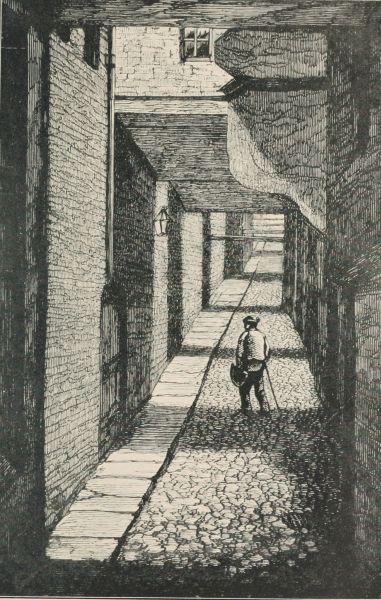
IVY LANE, STRAND (THE BOUNDARY OF THE DUCHY OF LANCASTER AND THE CITY OF WESTMINSTER).
Elysium, or the State of Final Retribution.—In this sublime picture, which occupies the whole length of the room, the artist has, with wonderful sagacity, and without any of those anachronisms which tarnish the lustre of other very celebrated performances, brought together those great and good men of all ages and nations, who have acted as the cultivators and benefactors of mankind. This picture is separated from that of the Society distributing its rewards by palm trees; near which, on a pedestal, sits a pelican, feeding its young with its own blood, a happy type of those personages represented in the picture, who had worn themselves out in the service of mankind. Behind the palms, near the top of the picture, are indistinctly seen, as immersed and lost in a great blaze of light, cherubims veiled with their wings, in the act of adoration, and offering incense to that invisible and incomprehensible Power which is above them, and out of the picture, from whence the light and glory proceed and are diffused over the whole piece. By thus introducing the idea of the Divine essence, by effect rather than by form, the absurdity committed by many painters is happily avoided, and the mind of every intelligent spectator is filled with awe and reverence.
The groups of female figures, which appear at a further distance absorbed in glory, are those characters of female excellence, whose social conduct, benevolence, affectionate friendship, and regular discharge of domestic duties, soften the cares of human life, and diffuse happiness around them. In the more advanced part, just bordering on the blaze of light (where the female figures are almost absorbed) is introduced a group of poor native West Indian females, in the act of adoration, preceded by angels, burning incense, and followed by their good bishop, his face partly concealed by that energetic hand which holds his crozier, or pastoral staff—who may, notwithstanding the word Chiapa, inscribed on the front of his mitre, be identified with the glorious friar Bartolomeo de las Casas, bishop of that place. This matter of friendly intercourse, continued beyond life, is pushed still further in the more advanced part of the same group by the male adoring Americans and some Dominican friars, where the very graceful incident occurs of one of these Dominicans directing the attention of an astonished Caribb to some circumstance of beatitude, the enjoyment of which he had promised to his Caribb friend. The group below on the left hand in this picture consists of Roger Bacon, Archimedes, Descartes, and Thales; behind them stand Sir Francis Bacon, Copernicus, Galileo, and Sir Isaac Newton, regarding with awe and admiration a solar system, which two angels are unveiling and explaining to them. Near the inferior angel, who is holding the veil, is Columbus, with a chart of his voyage; and close to him Epaminondas, with his shield; Socrates, Cato the younger, the elder Brutus, and Sir Thomas More; a sextumbriate to which, Swift says, all ages have not been able to add a seventh. Behind Marcus Brutus is William Molyneux, holding his book of the case of Ireland; near Columbus is Lord Shaftesbury, John Locke, Zeno, Aristotle, and Plato; and, in the opening between this group and the next, are Sir William Harvey, the discoverer of the circulation of the blood, and the honourable Robert Boyle.
The next group are legislators, where King Alfred the Great is leaning on the shoulder of William Penn, who is showing his tolerant, pacific code of equal laws to Lycurgus. Standing around them are Minos, Trajan, Antoninus, Peter the Great of Russia, Edward the Black Prince, Henry the Fourth of France, and Andrea Doria of Genoa. Here, too, are introduced those patrons of genius, Lorenzo de Medici, Louis the Fourteenth, Alexander the Great, Charles the First, Colbert, Leo the Tenth, Francis the First, the Earl of Arundel, and the illustrious monk Cassiodorus, no less admirable and exemplary as the secretary of state than as the friar in his convent at Viviers, the plan of which he holds in his hand. Just before this group, on the rocks which separate Elysium from the infernal regions, are placed the Angelic Guards; and in the most advanced part an archangel, weighing attentively the virtues and vices of mankind, whose raised hand and expressive countenance denote great concern at the preponderancy of evil. Behind this figure is another angel, explaining to Pascal and Bishop Butler the analogy between Nature and revealed Religion. The figure behind Pascal and Butler, with his arms stretched out, and advancing with so much energy, is that ornament of our latter age, the graceful, the sublime Bossuet, Bishop of Meux. The uniting tendency of the paper he holds in that hand, resting on the shoulder of Origen, would well comport with those pacific views of the amiable Grotius, for healing those discordant evils which are sapping the foundations of Christianity amongst the nations of Europe, where in other respects it would be, and even is, so happily and so well established.
Behind Francis the First and Lord Arundel are Hugo Grotius, Father Paul, and Pope Adrian. Towards the top of the picture, and near the centre, sits Homer; on his right hand, Milton; next him, Shakespeare, Spenser, Chaucer, and Sappho. Behind Sappho sits Alcæus, who is talking with Ossian; near him are Menander, Molière, Congreve, Bruma, Confucius, Mango Capac, etc. etc. Next Homer, on the other side, is Archbishop Fenelon, with Virgil leaning on his shoulder; and near them are Tasso, Ariosto, and Dante. Behind Dante, Petrarca, Laura, Giovanni, and Boccaccio.
In the second range of figures, over Edward the Black Prince and Peter the Great, are Swift, Erasmus, Cervantes; near them Pope, Dryden, Addison, Richardson, Moses Mendelssohn, and Hogarth. Behind Dryden and Pope are Sterne, Gray, Goldsmith, Thomson, and Fielding; and near Richardson, Inigo Jones, Sir Christopher Wren, Sir Joshua Reynolds, and Vandyke. Next Vandyke is Rubens, with his hand on the shoulders of Le Sœur, and behind him is Le Brun: next to these are Julio Romano, Dominichino, and Annibal Caracci, who are in conversation with Phidias; behind whom is Giles Hussey. Nicholas Poussin and the Sicyonian maid are near them, with Callimachus and Pamphilius; near Appelles is Corregio; behind Raphaello stand Michael Angelo and Leonardo da Vinci, and behind them, Ghiberti, Donatello, Massachio, Brunaleschi, Albert Dürer, Giotto, and Cimabue.
In the top of this part of the picture the painter has happily glanced at what is called by astronomers the System of Systems, where the fixed stars, considered as so many suns, each with his several planets, are revolving round the Great Cause of all things; and representing everything as affected by intelligence, has shown each system carried along in its revolution by an angel. Though only a small portion of this article can be seen, yet enough is shown to manifest the sublimity of the idea.
In the other corner of the picture the artist has represented Tartarus, where, among cataracts of fire and clouds of smoke, two large hands are seen, one of them holding a fire-fork, the other pulling down a number of figures bound together by serpenting War, Gluttony, Extravagance, Detraction, Parsimony, and Ambition: and floating down the fiery gulf are Tyranny, Hypocrisy, and Cruelty, with their proper attributes; the whole of this excellent picture proving, in the most forcible manner, the truth of that maxim which cannot be too often inculcated: "That the attainment of man's true rank in the creation, and his present and future happiness, individual as well as public, depended on the cultivation and proper direction of the human faculties."[30]
In addition to the Barry pictures, there are, in the Council Room, full-length portraits of the first president by Gainsborough, and of the second president of the Society, Lord Romney, by Reynolds, together with a portrait of Barry. Here, also, are portraits of the Prince Consort (who was president from 1843 until his death in 1861), painted by Horsley, and of the late Queen Victoria and the royal children, painted by Cope. One of the first prizes of the Society was adjudged to Richard Cosway, then a boy of twelve, and afterwards so eminent as a portrait painter in oil and miniatures. But this was before the Society had removed to the Adelphi. John Bacon, Joseph Nollekens, and William Woollett, George Romney, John Flexman, J.M.W. Turner, Edwin Landseer, William Mulready, J.E. Millais, and many other distinguished artists were awarded premiums by the Society, which, says Mr Wheatley, "has been active in promoting commercial and technical education by means of examinations. Out of the technological examinations has grown the wide-spreading action of the City and Guilds of London Technical Institute. A large number of the chief questions of the day, such as the amendment of the Patent Laws; the cheapening of letter, book, and parcel postage; the improvement of musical education, etc., have been dealt with by the Society in the form of discussion and by addresses to the Government. Several conferences have also been held on sanitary matters and on water supply.
The ordinary meetings are held on Wednesday evenings at 8 p.m., from November to May, when papers are read and discussed on subjects relating to arts, manufactures and commerce. There are also connected with the Society three sections: 1. Indian; 2. Foreign and Colonial; 3. Applied Art. These hold meetings for the reading and discussion of papers on their respective subjects on other days of the week. Courses of lectures on popular subjects connected with arts and manufactures are delivered on Monday evenings, and are styled Cantor Lectures, by reason that they owe their origin to a bequest of the late Dr Cantor. The Albert Medal, founded in honour of the Prince Consort, is awarded annually to some eminent man who has distinguished himself by promoting arts, manufactures, or commerce. The first award was to Sir Rowland Hill in 1864, and the list of recipients forms a noble roll of great men."[31] Her late Majesty, Queen Victoria, was awarded the Society's medal in her jubilee year, 1887.
The notorious quack doctor Joshua Ward (1685-1761), who was caricatured by Hogarth, allowed the Italian sculptor, Agostino Carlini, £100 a year, so that he should work on his statue for life. The impudent inventor of "Friar's Balsam" left this statue to the Society of Arts. This quack, who was nicknamed "Spot" Ward, from a birth-mark on his cheek, was the son of a London dry-salter. His skill was so extolled by General Churchill and Lord Chief Baron Reynolds, that he was called in to prescribe for George II. Despite his "remedies"—his famous "drop and pill" was a dangerous compound of antimony—the King recovered, and "Spot" Ward was solemnly voted the thanks of a credulous House of Parliament and allowed the privilege of driving his carriage through St James's Park. He tried to enter Parliament by fraud in 1717, and fled to St Germain, where he maintained himself by his "universal remedies." Pardoned in 1733, he had a wonderful career in London, and amassed a fortune.
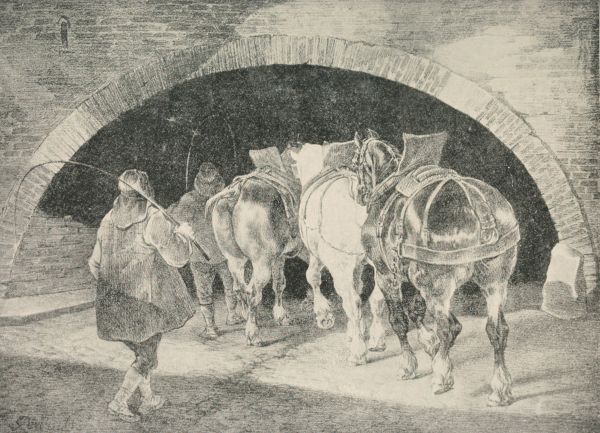
ENTRANCE TO THE ADELPHI ARCHES.
One of the most interesting of the literary associations of the Adelphi is connected, in tradition, with Oliver Goldsmith, and, as a matter of fact, with Samuel Johnson, both of whom appeared before the Society of Arts. "The great room of the Society now mentioned," says Andrew Kippis, the Nonconformist divine and biographer, at the close of his memoir of Gilbert Cooper, in the Biographia Britannica,[32] "was for several years the place where many people chose to try, or to display, their oratorical abilities. Dr Goldsmith, I remember, made an attempt at a speech, but was obliged to sit down in confusion. I once heard Doctor Johnson speak there, upon a subject relating to Mechanics, with a propriety, perspicuity, and energy which excited general admiration." On the other hand, we have the testimony of Boswell that Johnson did not distinguish himself as a speaker in the Adelphi. "I remember that it was observed by Mr Flood, that Johnson, having been long used to sententious brevity and the short flights of conversation, might have failed in that continued and expanded kind of argument which is requisite in stating complicated matters in public speaking; and, as a proof of this, he mentioned the supposed speeches in Parliament, written by him for the magazine, none of which, in his opinion, were at all like real debates. The opinion of one who was himself so eminent an orator must be allowed to have great weight. It was confirmed by Sir William Scott [Baron Stowell, the great Admiralty lawyer], who mentioned that Johnson had told him that he had several times tried to speak in the Society of Arts and Manufactures, but 'had found he could not get on.' From Mr William Gerard Hamilton, I have heard that Johnson, when observing to him that it was prudent for a man who had not been accustomed to speak in public to begin his speech in as simple a manner as possible, acknowledged that he rose in that Society to deliver a speech which he had prepared; 'but,' said he, 'all my flowers of oratory forsook me.'"
I am sorry to destroy a long-cherished illusion, but the worthy Dr Kippis is in error in "remembering" Goldsmith attempting to make a speech in "the great room" of the Society of Arts. This room was not opened until 1774, and on April 4th of that year, Goldsmith—unfortunately for the Kippis tradition—with a mind ill at ease, departed life.
FOOTNOTES:
CHAPTER VI
David Garrick—His Residence in the Adelphi—Founds the Drury Lane Fund—His Last Appearance on the Stage—Honoured by Parliament—The Friendship of Mr and Mrs Garrick for Hannah More—Their Correspondence—Garrick helps the Production of Percy—Presents his Buckles to Hannah More—The Production of Percy—Garrick's Prologue gives Offence—Garrick brings Hannah More's Dinner from the Adelphi to the "Turk's Head"—The Literary Club—His Last Illness and Death.
The shades of David Garrick and Dr Johnson must haunt the Adelphi. Johnson was a constant visitor here. The Adelphi buildings are very much as they were in his lifetime, whereas most of his Fleet Street habitations are either swept away or sadly marred. But, although the Embankment and the Gardens below Adelphi Terrace have taken the place of the unsightly wharves and the muddy river of Johnson's day, the house occupied by David Garrick for some six or seven years before his death, and wherein he died, is still standing. The great actor purchased the property, and, consequently, we may look in vain for any mention of it in the Particulars of the Adelphi Lottery, to which I have already made reference. During these last few years of his life, Garrick—who spent the summer at his country residence at Hampton—busied himself in the foundation of a great charitable bequest for his fellow-players. At his suggestion, and upon his advice, the Drury Lane Fund was established, a special Act of Parliament, for which he provided all the necessary expenses, being obtained for the sanction and support of the institution, in January, 1776. He also gave to it all the money which he received on the occasion of his taking leave of the stage. "It is computed that by the product of his labours, in acting annually capital parts, and by donations of one kind or another, he bestowed for this beneficial institution a capital of near 4,500 L."
It was from his house in the Adelphi—No. 5, the centre house of the Terrace—which, by the way, was then known as Royal Terrace—that the great actor set out on the eventful 10th of June, 1776, for the stage of Drury Lane Theatre, whereon he then made his last appearance. He acted Don Felix, in Mrs Centlivre's comedy, The Wonder, a Woman keeps a Secret. He had previously disposed of his interest in the patent, for the sum of £35,000, to Richard Brinsley Sheridan and Richard Ford. Before his actual farewell, he gave the public an opportunity of seeing him in several of his other favourite characters, including Hamlet, Richard III., and King Lear. He only acted Richard once during his farewell season, and that was by command of George III. "His Majesty," we are told, "was much surprised to see him, in an age so advanced" (he was just then sixty years old) "run about the field of battle with so much fire, force, and agility." On the conclusion of his performance of Don Felix, Garrick approached the footlights, "with much palpitation of mind, and visible emotion in his countenance. No premeditation could prepare him for this affecting scene. He bowed—he paused—the spectators were all attention. After a short struggle of nature, he recovered from the shock," and thus addressed the audience:—"Ladies and gentlemen, it has been customary with persons under my circumstances to address you in a farewell epilogue. I had the same intention, and turned my thoughts that way; but indeed I found myself then as incapable of writing such an epilogue as I should be now of speaking it. The jingle of rhyme and the language of fiction would but ill suit my present feelings. This is to me a very awful moment; it is no less than parting for ever with those from whom I have received the greatest kindness and favours, and upon the spot where that kindness and those favours were received." (Here he was unable to proceed till he was relieved by a shower of tears.) "Whatever may be the changes of my future life, the deepest impression of your kindness will always remain here" (putting his hand on his breast), "fixed and unalterable. I will very readily agree to my successors having more skill and ability for their station than I have; but I defy them all to take more sincere and more uninterrupted pains for your favour, or to be more truly sensible of it than is your humble servant." The crowded and brilliant audience rewarded the actor with renewed acclamations and many tears; and, making a "profound obeisance," he left the stage.
Garrick, despite his retirement from the theatre, still took great interest in it. He read and approved the tragedy of Percy, which had been written by Hannah More, the religious writer (1745-1833), and was instrumental in its production, at Covent Garden, in 1777. He also wrote the prologue and the epilogue to the play. He frequently attended the debates in the House of Commons. In the spring of 1777, he unwittingly provoked a marked compliment to his splendid position in the great world of artistic and literary London. Happening to be present in the Strangers' Gallery during a certain motion which produced some bickering between two right honourable gentlemen, "which proceeded to such a degree of warmth that the Speaker had to interfere," an unhappy member for Shropshire, observing that Garrick was seated in the Gallery, thereupon moved a resolution for the clearing of the House. "Roscius," however, managed to withdraw himself from further observation, and thus avoided the consequences of the ungenerous suggestion. The same unfortunate member, on the following day, essayed to address the House on the impropriety of suffering players to hear the debates, whereupon no less a person than Edmund Burke arose, and, appealing to the honourable assembly, asked whether "it could possibly be consistent with the rules of decency and liberality to exclude from the hearing of their debates a man to whom they were all obliged, one who was the great master of eloquence, in whose school they had all imbibed the art of speaking and been taught the elements of rhetoric. For his part, he owned that he had been greatly indebted to his instructions. Much more he said in commendation of Mr Garrick, and was warmly seconded by Mr Fox and Mr T. Townshend, who very copiously displayed the great merit of their old preceptor, as they termed him; they reprobated the motion of the gentleman with great warmth and indignation."[33] The House, with almost complete unanimity, concurred in this eulogium, and the actor, returning to the Adelphi, wrote the following lines on the subject:—
"Squire B——n rose with deep intent, And notify'd to Parliament That I, it was a shame and sin, When others were shut out, got in; Asserting in his wise oration, I glory'd in my situation. I own my features might betray Peculiar joy I felt that day. I glory when my mind is feasted With dainties it has seldom tasted; When reason chooses Fox's tongue, To be more rapid, clear, and strong; When from his classic urn Burke pours A copious stream through banks of flowers; When Barré stern, with accents deep, Calls up Lord North, and murders sleep; And if his Lordship rise to speak, Then wit and argument awake: When Rigby speaks, and all may hear him, Who can withstand, ridendo verum? When Thurlow's words attention bind, The spell's of a superior mind. Now, whether I were Whig or Tory, This was a time for me to glory; My glory farther still extends, For most of these I call my friends: But if, Squire B——n, you were hurt, To see me, as you thought, so pert, You might have punish'd my transgression, And damp'd the ardour of expression. A brute there is whose voice confounds, And frights all others with strange sounds; Had you, your matchless pow'rs displaying, Like him, Squire B——n, set a-braying, I should have lost all exultation, Nor gloried in my situation."
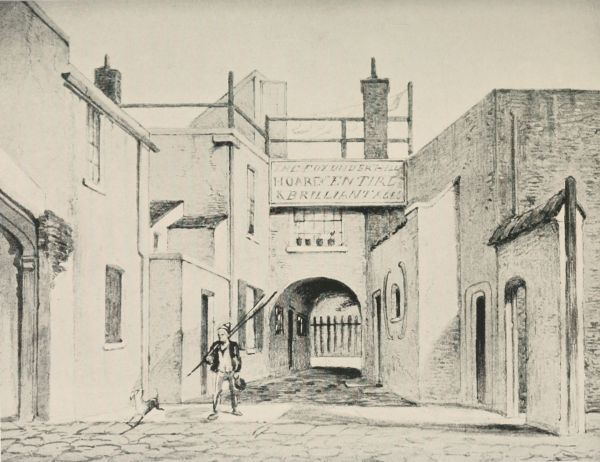
THE FOX-UNDER-THE-HILL.
The strong bond of friendship which existed between Hannah More and Mr and Mrs Garrick is one of the most remarkable events in the history of literature and the stage. On the one side, there was unbounded admiration for the great actor; on the other, Garrick and his wife evidently held the young writer in the highest esteem. The letters written, and received by, Hannah More, from the time of her first meeting with Garrick, until the death of his widow, form a charming note in the lives of these three people. They bridge over the years 1776 to 1822. In the former year, it should be borne in mind, the actor was nearly sixty years old, his wife a little younger, while Hannah More was but thirty-one years of age. The affection of the elderly couple for their young protégée is remarkable, and, curiously enough, the career of the latter began with Garrick's leaving the stage. On June 10, 1776, Hannah More writes to David Garrick: "I think, by the time this reaches you, I may congratulate you on the end of your labours and the completion of your fame—a fame which has had no parallel, and will have no end. Yet whatever reputation the world may ascribe to you, I, who have had the happy privilege of knowing you intimately, shall always think you derived your greatest glory from the temperance with which you enjoyed it and the true greatness of mind with which you lay it down. Surely, to have suppressed your talents in the moment of your highest capacity for exercising them, does as much honour to your heart as the exertion itself did to your dramatic character; but I cannot trust myself with this subject, because I am writing to the man himself; yet I ought to be indulged, for is not the recollection of my pleasures all that is left me of them? Have I not seen in one season that man act seven-and-twenty times, and rise each time in excellence, and shall I be silent? Have I not spent three months under the roof of that man and his dear charming lady, and received from them favours that would take me another three months to tell over, and shall I be silent?