Front matter (continued 3)
Reading edition
"But highly as I enjoy your glory (for I do enjoy it most heartily, and seem to partake it too, as I think a ray of it falls on all your friends), yet I tremble for your health. It is impossible you can do so much mischief to the nerves of other people without hurting your own,—in Richard especially, where your murders are by no means confined to the Tower: but you assassinate your whole audience who have hearts. I say, I tremble lest you should suffer for all this; but it is now over, as I hope are the bad effects of it upon yourself. You may break your wand at the end of your trial, when you lay down the office of haut intendant of the passions; but the enchantment it raised you can never break, while the memories and feelings remain of those who were ever admitted into the magic circle.
"This letter is already of a good impudent length, and to the person, of all others, who has the least time to read nonsense. I will not prolong my impertinence, but to beg and conjure that I may hear a little bit about your finishing night. The least scrap—printed or manuscript—paragraph or advertisement—merry or serious—verse or prose, will be thankfully received, and hung up in the temple of reliques.
"Pray tell my sweet Mrs Garrick I live on the hope of hearing from her. And tell her further that she and you have performed a miracle, for you have loaded one person with obligations, and have not made an ingrate."
A few months later Hannah More beseeches Garrick to write her a prologue to Percy. Garrick received her letter just as he was about to leave the Adelphi for a trip on the river. But he replied immediately, in the following characteristic way: "Write you an epilogue! Give you a pinch of snuff! By the greatest good luck in the world, I received your letter when I was surrounded with ladies and gentlemen, setting out upon a party to go up the Thames. Our expedition will take us seven or eight days upon the most limited calculations. They would hardly allow me a moment to write this scrawl: I snatched up the first piece of paper (and a bad one it is) to tell you how unhappy I am that I cannot confer upon you so small a favour directly. If you will let me know immediately, by a line directed to me at the Adelphi, for whom you intend the epilogue, and what are her or his strong marks of character in the play (for my copy is in town, or with Miss Young), I will do my best on my return. I must desire you not to rely upon me this time, on account of my present situation; I could as soon sleep in a whirlwind as write among these ladies, and I shall be so fatigued with talking myself, and hearing them talk, or I could sit up all night to obey your commands."
Garrick complied with the request, and Hannah More writes, on June 16, 1777, to thank him: "I beg to return you my hearty thanks for your goodness in sending me your delightful prologue. That you should think me not unworthy to possess so great a treasure flatters more than my vanity. And that you should send it me so soon makes it doubly gratifying. I have read and re-read it with all the malice of a friend, and pronounce that I never read a sweeter or more beautiful thing.... Many thanks, dear sir, for your good and wholesome advice about my play. I do nothing, except regret my own idleness. I tremble for my fifth act; but I am afraid I shall never make others tremble at it. My love and duty to my sweet Mrs Garrick, and my thankful compliments to the young lady to whose transcription I am so much obliged; she is astonishingly correct, not the smallest error."
Hannah More was then invited to visit the Garricks. "As soon as I got to London," she writes to her sister, "I drove straight to the Adelphi, where, to my astonishment, I found a coach waiting for me to carry me to Hampton. Upon my arrival here, I was immediately put in possession of my old chamber. Garrick is all good humour, vivacity, and wit. While I think of it, I must treat you with a little distich which Mrs Barbauld wrote extempore, on my showing my Felix Buckles (the elegant buckles which Garrick wore the last time he ever acted, and with which he presented me as a relic):
'Thy buckles, O Garrick, thy friend may now use, But no mortal hereafter shall tread in thy shoes?'"
Where, I wonder, are those "Felix Buckles" now, with their double association of David Garrick and Hannah More! During this visit to the Garricks, the company who "did honour" to the actor and his wife included Dr Burney, Sheridan, Lord Palmerston, and others of note. "Roscius" was in the best of spirits and "literally kept the table in a roar for four hours. He told his famous story of 'Jack Pocklington' in a manner so entirely new, and so infinitely witty, that the company have done nothing but talk of it ever since. I have often heard this story: it is of a person who came to offer himself for the stage, with an impediment in his speech. He gives the character, too, in as strong a manner as Fielding could have done."
Hannah More was brought into very close relationship with the Garricks in the autumn of 1777, through the play in which Garrick had interested himself. On October 17, he sends a letter to her from the Adelphi: "Shame! shame! shame! You may well say so, my dear madam; but indeed I have been so disagreeably entertained with the gout running all about me, from head to heel, that I have been unfit for the duties of friendship; and very often for those which a good husband, and a good friend, should never fail performing. I must gallop over this small piece of paper; it was the first I snatched up, to tell you that my wife has your letter, and thinks it a fine one and a sweet one.
"I was at court to-day, and such work they made with me, from the Archbishop of Canterbury to the Page of the Back Stairs, that I have been suffocated with compliments. We have wanted you at some of our private hours. Where's the Nine? We want the Nine![34] Silent was every muse!
"Cambridge said yesterday, in a large company at the Bishop of Durham's, where I dined, that your ode to my house-dog was a very witty production; and he thought there was nothing to be altered or amended except in the last stanza, which he thought the only weak one. I am afraid that you asked me to do something for you about the parliament, which in my multitude of matters was overlooked; pray, if it is of consequence, let me know it again, and you may be assured of the intelligence you want.
"The last new tragedy, Semiramis,[35] has, though a bare translation, met with great success. The prologue is a bad one, as you may read in the papers, by the author: the epilogue is grave, but a sweet pretty elegant morsel, by Mr Sheridan; it had deservedly great success. Mr Mason's Caractacus[36] is not crowded, but the men of taste, and classical men, admire it much. Mrs Garrick sends a large parcel of love to you all. I send mine in the same bundle. Pray write soon, and forgive me all my delinquencies." Writing to her sister in November, on the eve of the production of Percy, Hannah More says: "It is impossible to tell you of all the kindness and friendship of the Garricks; he thinks of nothing, talks of nothing, writes of nothing but Percy. He is too sanguine; it will have a fall, and so I tell him. When Garrick had finished his prologue and epilogue (which are excellent) he desired I would pay him. Dryden, he said, used to have five guineas a piece, but as he was a richer man he would be content if I would treat him with a handsome supper and a bottle of claret. We haggled sadly about the price, I insisting that I could only afford to give him a beefsteak and a pot of porter; and at about twelve we sat down to some toast and honey, with which the temperate bard contented himself. Several very great ones made interest to hear Garrick read the play, which he peremptorily refused. I supped on Wednesday night at Sir Joshua's, spent yesterday morning at the Chancellor's, and the evening at Mrs Boscawen's, Lady Bathurst being of the party."
Then comes another note, from Mr Garrick's study, Adelphi, ten at night: "He himself puts the pen into my hand, and bids me say that all is just as it should be. Nothing was ever more warmly received. I went with Mr and Mrs Garrick; sat in Mr Harris's box, in a snug dark corner, and behaved very well, that is, very quietly. The prologue and epilogue were received with bursts of applause; so indeed was the whole; as much beyond my expectation as my deserts! Mr Garrick's kindness has been unceasing."
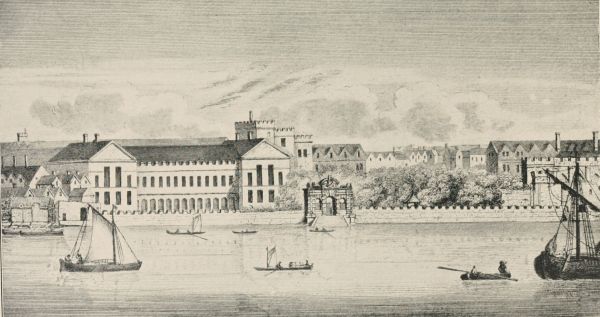
YORK HOUSE. YORK STAIRS. DURHAM HOUSE.
Percy, it may be observed, was Hannah More's most important play. The author had previously published a pastoral drama, The Search after Happiness, for the edification of school children, and her tragedy, The Inflexible Captive, was acted on one occasion in Bath. Her fourth play, The Fatal Falsehood, failed, at Covent Garden, in 1779. The success of Percy was largely due to Garrick's friendly help. Wroughton, "Gentleman" Lewis, and Mrs Crawford played the principal parts. Garrick wrote the epilogue, as well as the prologue, and, by the following lines from the latter, gave great offence to a French lady, Mlle. D'Eon, a reputed natural daughter of Louis XV., who had a "violent passion" for the military dress of an officer in preference to the gown and petticoat of her own sex:
"To rule the man our sex dame Nature teaches; Mount the high horse we can, and make long speeches; Nay, and with dignity, some wear the breeches. And why not wear them?— Did not a lady-knight, late chevalier, A brave smart soldier in your eyes appear? Hey! presto? pass! His sword becomes a fan; A comely woman rising from a man! The French their Amazonian maid invite; She goes—alike well skill'd to talk or write, Dance, ride, negotiate, scold, coquet, or fight. If she should set her heart upon a rover, And he prove false, she'd kick her faithless lover."
In January, 1778, Hannah More, flushed with the success of her tragedy, was paying a round of visits in London. On one night she dined with Mrs Delany, Mrs Boscawen, and the Duchess of Portland: on the next, "at the Garricks with the sour crout party"—a weekly dinner in the Adelphi of learned men (sour crout being one of the dishes), to which Hannah More was always invited. She was taken ill during this month, and Mrs Garrick tried to induce her to stay with her, an invitation which was not accepted. Mrs Garrick "would have gone herself to fetch me a physician, and insisted upon sending me my dinner, which I refused; but at six this evening, when Garrick came to the Turk's Head to dine, there accompanied him, in the coach, a minced chicken in the stew-pan, hot, a canister of her fine tea, and a pot of cream. Were there ever such people! Tell it not in Epic, or in Lyric, that the great Roscius rode with a stew-pan of minced meat with him in the coach for my dinner." The Turk's Head, by the way, was "a noted rendezvous of painters" and the home of the Artists' Club before, in the year 1764, Johnson and Sir Joshua Reynolds founded the famous "Literary Club," the members of which met weekly for supper and conversation. Garrick had been a member for three years when he brought the invalid's repast from the Adelphi to the Turk's Head—which was in Gerrard Street, at the corner of Greek Street and Compton Street. The actor was also kind enough to invest the profit on Percy, on the best security and at five per cent., so that it made a considerable addition to the income of the young writer.
On a certain memorable Thursday, in 1778, Hannah More dined with the Garricks in the Adelphi, and, in the evening, Garrick accompanied his guest to a reception given by Sir Joshua Reynolds; the party included Gibbon, Johnson, Hermes Harris, Burney, Chambers, Ramsey, the Bishop of St Asaph, Boswell, and Langton; "and scarce an expletive man or woman among them. Garrick put Johnson into such good spirits that I never knew him so entertaining or more instructive. He was as brilliant as himself, and as good-humoured as any one else."
The end of a great career was, unhappily, now approaching. Mr and Mrs Garrick had been invited to spend the Christmas of 1778 at the country seat of Earl Spencer, where they were honoured guests. In the midst of the festivities, Garrick was seized with a return of an old disorder—an affection of the kidneys. Early in January, however, he had so far recovered that he was able to travel to London. He arrived at his house in the Adelphi on January 15, and several physicians were called in. One of them, seeing that the illness was serious, and knowing that its course was certain, thought it necessary to tell the actor that, if he had any worldly affairs to settle, "it would be prudent to dispatch them as soon as possible." But Garrick made answer that nothing of that sort lay on his mind, that he was not afraid to die. About two days before his death, he was visited by an old friend, who was persuaded to stay and dine with Mrs Garrick, who was greatly fatigued by her long and constant attendance upon her husband, a duty to which she invariably attended. While she was talking to the friend, the dying actor came into the room; "but, oh! how changed! divested of that vivacity and sprightliness which used to accompany everything he said and everything he did! His countenance was sallow and wan, his movements slow and solemn. He was wrapped in a rich night-gown, not unlike that which he always wore in Lusignan, the venerable old king of Jerusalem [in Zara]; he presented himself to the imagination of his friend as if he was just ready to act that character. He sat down; and during the space of an hour, the time he remained in the room, he did not utter a word. He rose, and withdrew to his chamber. Mrs Garrick and the Gentleman dined." What a sad dinner that must have been!
Just before his death, Garrick confided to a friend that he did not regret being childless, for he knew that the quickness of his feelings was so great that, in case it had been his misfortune to have disobedient children, he could not have borne such an affliction. On seeing a number of gentlemen in his apartment a few hours before the end, he enquired who they were, and, on being told that they were physicians who sought to do him service, he shook his head, and repeated the following lines from Nicholas Rowe's Fair Penitent:—
"Another, and another, still succeeds; And the last fool is welcome as the former."
He died, with great composure, at eight o'clock on the morning of January 20, 1779. On Monday, February 1, the body was conveyed from the Adelphi to Westminster Abbey, and interred in Poet's Corner, a spot made still further memorable in the annals of the stage by the burial here—and close by the graves of David Garrick and Samuel Johnson—of the remains of Henry Irving.
Before describing the magnificent funeral procession of David Garrick from the Adelphi, let me glance for a moment at the widow of the great actor and her deportment on this sad occasion. Thanks to Hannah More—who had risen from a sick-bed, in Bristol, and had travelled post-haste to London, at the express desire of her friend—we get a most interesting account of Mrs Garrick at the time of her husband's death:—
"She was prepared for meeting me; she ran into my arms, and we both remained silent for some minutes; at last she whispered—'I have this moment embraced his coffin, and you come next.' She soon recovered herself, and said with great composure, 'The goodness of God to me is inexpressible; I desired to die, but it is His will that I should live, and He has convinced me He will not let my life be quite miserable, for He gives astonishing strength to my body and grace to my heart!—neither do I deserve; but I am thankful for both!' She thanked me a thousand times for such a real act of friendship, and bade me be comforted, for it was God's will. She told me they had just returned from Althorp, Lord Spencer's, where he had been reluctantly dragged, for he had felt unwell for some time; but during his visit he was often in such fine spirits that they could not believe he was ill. On his return home he appointed Dr Cadogan to meet him, who ordered him an emetic, the warm bath, and the usual remedies, but with very little effect. On the Sunday he was in good spirits and free from pain; but as the suppression still continued, Dr Cadogan became extremely alarmed, and sent for Pott, Heberden, and Schomberg, who gave him up the moment they saw him. Poor Garrick stared to see his room full of doctors, not being conscious of his real state. No change happened till the Tuesday evening, when the surgeon who was sent for to blister and bleed him made light of his illness, assuring Mrs Garrick that he would be well in a day or two, and insisted on her going to lie down. Towards morning she desired to be called if there was the least change. Every time that she administered the draughts to him in the night, he always squeezed her hand in a particular manner, and spoke to her with the greatest tenderness and affection. Immediately after he had taken his last medicine, he softly said, "Oh! dear," and yielded up his spirit without a groan, in his perfect senses. His behaviour during the night was all gentleness and patience, and he frequently made apologies to those about him for the trouble he gave them.
"I paid a melancholy visit to his coffin yesterday, where I found food for meditation, till the mind 'burst with thinking.' His new house is not so pleasant as Hampton, nor so splendid as the Adelphi, but it is commodious enough for all the wants of its inhabitant; and besides, it is so quiet that he will never be disturbed till the eternal morning, and never till then will a sweeter voice than his own be heard. May he then find mercy! They are preparing to hang the house with black, for he is to lie in state until Monday. I dislike this pageantry, and cannot help thinking that the disembodied spirit must look with contempt upon the farce that is played over its miserable relics. But a splendid funeral could not be avoided, as he is to be laid in the Abbey with such illustrious dust, and so many are desirous of testifying their respect by attending."
While the preparations were being made for the funeral, Mrs Garrick stayed at the house of a friend. But after the funeral she returned to the Adelphi. Hannah More, who came back with her, writes: "On Wednesday night we came to the Adelphi—to this house! She bore it with great tranquillity; but what was my surprise to see her go alone into the chamber and bed in which he had died that day fortnight. She had a delight in it beyond expression. I asked her the next day how she went through it? She told me, 'Very well'; that she first prayed with great composure, then went and kissed the dear bed, and got into it with a sad pleasure." In reference to Garrick's death, the same writer also says: "I can never cease to remember with affection and gratitude, so warm, steady, and disinterested a friend; and I can most truly bear this testimony to his memory, that I never witnessed, in any family, more decorum, propriety, and regularity than in his: where I never saw a card, or even met (except in one instance) a person of his own profession at his table: of which Mrs Garrick, by her elegance of taste, her correctness of manners, and very original turn of humour, was the brightest ornament. All his pursuits and tastes were so decidedly intellectual, that it made the society, and the conversation which was always to be found in his circle, interesting and delightful."
FOOTNOTES:
CHAPTER VII
Garrick's Funeral from the Adelphi—Johnson's Opinion of Garrick: "A Liberal Man"—His Death "Eclipsed the Gaiety of Nations"—Topham Beauclerk and Johnson—Mrs Garrick's famous Dinner Party—Johnson and other Celebrities Present—Described by Hannah More and Boswell—Johnson's Morning Visit to Adelphi Terrace—Hannah More's Life Here—Another Dinner Party—Death of Mrs Garrick—Shakespeare's Gloves sent to Mrs Siddons from the Adelphi—Goldsmith writes from a Sponging-House to Garrick in the Adelphi—Becket, the Bookseller.
The funeral procession which wended its way from the Adelphi Terrace, through Adam Street to the Strand and thence by way of Whitehall to Westminster Abbey, on that winter's morning in February, 1779, was a lengthy and imposing one, though nowadays we should consider such pomp and circumstance very lugubrious. First of all, came four porters on horseback, their staffs, or wands of office, covered with black silk and scarves. Then came six other men, with mourning cloaks, followed by another official bearing a heavily-draped pennon. Then came other six men carrying a surcoat of arms, a helmet with crest, wreath, and mantlet. A state lid of black ostrich feathers, surrounded by escutcheons, immediately preceded the hearse, which was 'full-dressed'—that is to say, it bore at each corner and on the sides waving black ostrich plumes. A state coach, empty, and with a page on each side, was followed by a mourning coach containing the clergy from St Martin's-in-the-Fields. Then came six more mourning coaches "with the pall-bearers, two in each coach, six pages on each side. A ditto, with the chief mourners, a page on each side. A ditto, with three family ditto. A ditto, with three physicians. A ditto, with surgeon and apothecaries, a page on each side. A ditto, with Messrs Sheridan and Harris, a page on each side. Three ditto, with a deputation of twelve gentlemen, performers from Drury-Lane theatre, three pages on each side. Two men in mourning, on horseback, with cloaks, etc. Three ditto, with a deputation of twelve gentlemen, performers from Covent-garden theatre, three pages on each side. Two men in mourning, on horseback, with cloaks, etc. Four mourning coaches, with the members of the literary club, four pages on each side. Two men in mourning, on horseback, with cloaks. Seven coaches with intimate friends of the deceased, seven pages on each side. Mr Garrick's coach, empty. All the gentlemen's family coaches, empty."[37] The body was received at the great west door of the Abbey, about three o'clock, by the Bishop of Rochester, Dean of Westminster, who, attended by the clergy and choir, preceded the corpse up the centre aisle, during which time Purcell's funeral music was played and sung.[38]
Among those who followed the mournful procession from the Adelphi were Lord Camden, the Lord Chancellor; the Earl of Ossory; the Duke of Devonshire; Earl Spencer; the Right Hon. Richard Rigby, and Viscount Palmerston, who, with others, were the pall-bearers. The mourning coaches also contained Dr Johnson; George Colman, the elder, the dramatist; John Dunning, afterwards Baron Ashburton, whose Inquiry into the Doctrines lately promulgated concerning Juries, Libels, etc., was pronounced by Horace Walpole "the finest piece ... written for liberty since Lord Somers"; Edmund Burke; Colonel Isaac Barré, the Irish soldier and politician; the Hon. Charles Fox; Lord Charles Spencer; the deputy usher of the black rod; and many other distinguished men. The committee from Drury Lane consisted of Richard Yates, Tom King, Vernon, William Parsons, James Dodd—an actor who, according to Charles Lamb, "was a man of reading, and left at his death a choice collection of old English literature"—Aickin, John Palmer—an incomparable Joseph Surface—W. Bensley—the great Malvolio of his day—William Brereton, John Moody, and Robert Baddeley. From Covent Garden, there came "Gentleman" Lewis, Lee Lewes, John Quick—George III.'s favourite comedian—and some nine other players of good repute. It was said at the time that a greater concourse of people attended than was ever known on a similar occasion.
Johnson, as all students of the stage are aware, had a sincere admiration for Garrick, a fact that is proved by several references in the pages of Boswell. A few months before the death of the player, Johnson and Boswell dined with William Scott, in his chambers in the Temple. The conversation turned upon fame, and Boswell "slily introduced" the name of David Garrick, "and his assuming the airs of a great man. Johnson: 'Sir, it is wonderful how little Garrick assumes. No, Sir, Garrick fortunam reverenter habet. Consider, Sir,—celebrated men such as you have mentioned have had their applause at a distance; but Garrick had it dashed in his face, sounded in his ears, and went home every night with the plaudits of a thousand in his cranium. Then, Sir, Garrick did not find, but made his way to the tables, the levees, and almost the bedchambers of the great. Then, Sir, Garrick had under him a numerous body of people; who, from fears of his power and hopes of his favour, and admiration of his talents, were constantly submissive to him. And here is a man who has advanced the dignity of his profession. Garrick has made a player a higher character.' Scott: 'And he is a very sprightly writer too.' Johnson: 'Yes, Sir; and all this supported by great wealth of his own acquisition. If all this had happened to me, I should have had a couple of fellows with long poles walking before me, to knock down everybody that stood in the way. Consider, if all this had happened to Cibber or to Quin, they'd have jumped over the moon. Yet Garrick speaks to us' (smiling). Boswell: 'And Garrick is a very good man, a charitable man.' Johnson: 'Sir, a liberal man. He has given away more money than any man in England. There may be a little vanity mixed; but he has shown that money is not his first object.' Boswell: 'Yet Foote used to say of him, that he walked out with the intention to do a generous action, but turning the corner of a street, he met the ghost of a halfpenny, which frightened him.' Johnson: 'Why, Sir, that is very true, too; for I never knew a man of whom it could be said with less certainty to-day what he will do to-morrow, than Garrick; it depends so much on his humour at the time.' Scott: 'I am glad to hear of his liberality. He has been represented as very saving.' Johnson: 'With his domestic saving we have nothing to do. I remember drinking tea with him long ago, when Peg Woffington made it, and he grumbled at her for making it too strong. He had begun to feel money in his purse, and did not know when he should have enough of it!'"
Shortly after Garrick's death, Johnson accorded the actor praise that was even greater. The occasion was a dinner party, on April 24, 1779, at Topham Beauclerk's, at which Sir Joshua Reynolds, as well as Johnson and Boswell, was present. Boswell mentioned that John Wilkes had spoken of Garrick as a man who had no friend, a contention which Johnson allowed to be right. "'He had friends, but no friend,' he said. 'Garrick was so diffused, he had no man to whom he wished to unbosom himself. He found people always ready to applaud him, and that always for the same thing; so he saw life with great uniformity.'" Whereupon, Boswell, taking upon himself "for once, to fight with Goliath's weapons, and play the sophist," said: "'Garrick did not need a friend, as he got from everybody all that he wanted. What is a friend? One who supports and comforts you, while others do not. Friendship, you know, Sir, is the cordial drop "to make the nauseous draught of life go down"; but if the draught be not nauseous, if it be all sweet, there is no occasion for that drop.' Johnson: 'Many men would not be content to live so. I hope I should not. They would wish to have an intimate friend, with whom they might compare minds and cherish private virtues.'" One of the company mentioned Lord Chesterfield as a man who had no friend. "Johnson: 'There were more materials to make friendship in Garrick, had he not been so diffused.' Boswell: 'Garrick was pure gold, but beat out to thin leaf. Lord Chesterfield was tinsel.' Johnson: 'Garrick was a very good man, the most cheerful man of his age; a decent liver in a profession which is supposed to give indulgence to licentiousness; and a man who gave away, freely, money acquired by himself. He began the world with a great hunger for money; the son of a half-pay officer, bred in a family whose study was to make fourpence do as much as others made fourpence halfpenny do. But when he had got money he was very liberal.' I presumed to animadvert on his eulogy on Garrick, in his Lives of the Poets. 'You say, Sir, his death eclipsed the gaiety of nations.' Johnson: 'I could not have said more or less. It is the truth: eclipsed, not extinguished; and his death did eclipse; it was like a storm.' Boswell: 'But why nations? Did his gaiety extend farther than his own nation?' Johnson: 'Why, sir, some exaggeration must be allowed. Besides, nations may be said—if we allow the Scotch to be a nation—to have gaiety—which they have not. You are an exception, though. Come, gentlemen, let us candidly admit that there is one Scotchman who is cheerful.' Beauclerk: 'But he is a very unnatural Scotchman.' I, however, continued to think the compliment to Garrick hyperbolically untrue. His acting had ceased some time before his death; at any rate he had acted in Ireland but a short time, at an early period of his life, and never in Scotland. I objected also to what appears an anti-climax of praise, when contrasted with the preceding panegyric, 'and diminished the public stock of harmless pleasure!' 'Is not harmless pleasure very tame?' Johnson: 'Nay, Sir, harmless pleasure is the highest praise. Pleasure is a word of dubious import; pleasure is, in general, dangerous, and pernicious to virtue; to be able, therefore, to furnish pleasure that is harmless, pleasure pure and unalloyed, is as great a power as man can possess.'"
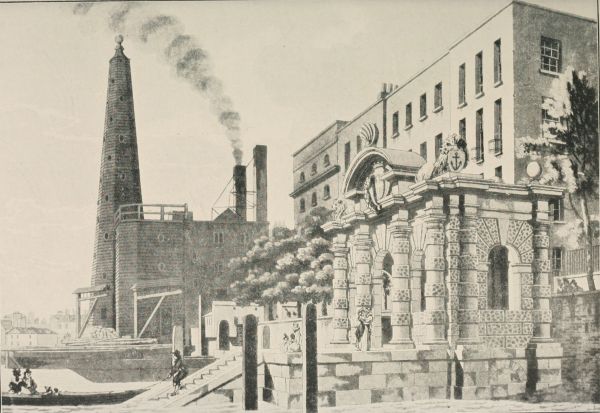
YORK STAIRS AND WATER WORKS.
Johnson was a frequent visitor to Adelphi Terrace, for not only was he on intimate terms with Mr and Mrs Garrick, but another of his friends, Topham Beauclerk, lived there at one time. From 1757 to 1780, there are frequent and most kindly allusions to him in the pages of Boswell. In the former year, he matriculated at Oxford. Here he met another of Johnson's friends—"High, shy, and dry" Bennet Langton, the eminent Greek scholar. Beauclerk was a man of culture and of great knowledge of the world. And he had the good fortune to win the affectionate regard of Dr Johnson. On March 10, 1768, Lady Diana Spencer, eldest daughter of the second Duke of Marlborough, was divorced from her husband, Lord St John and Bolingbroke, and, two days later, she was married to Beauclerk, to whom "she made an excellent wife." Beauclerk died, in Great Russell Street, Bloomsbury, on March 11, 1780. His extensive library, which was particularly rich in English plays, history, travel, and science, was dispersed by auction in 1781.
On Friday, April 20, 1781, there was a memorable dinner party in Adelphi Terrace, the first of the kind given by Mrs Garrick since the death of her husband. "We begin now," records Hannah More, who was staying with Mrs Garrick at the time, "to be a little cheerful at home, and to have our small parties. One such we have just had, and the day and evening turned out very pleasant. Johnson was in full song, and I quarrelled with him sadly. I accused him of not having done justice to the Allegro and Penseroso. He spoke disparagingly of both. I praised Lycidas, which he absolutely abused, adding, 'If Milton had not written the Paradise Lost, he would have only ranked among the minor poets: he was a Phidias that could cut a Colossus out of a rock, but could not cut heads out of cherry-stones.
"Boswell brought to my mind the whole of a very mirthful conversation at dear Mrs Garrick's, and my being made by Sir William Forbes the umpire in a trial of skill between Garrick and Boswell, which could most nearly imitate Dr Johnson's manner. I remember I gave it for Boswell in familiar conversation, and for Garrick in reciting poetry. Mrs Boscawen shone with her usual mild lustre."
Boswell, in recording this auspicious event in the history of the Adelphi, says that it was "one of the happiest days that I remember to have enjoyed in the whole course of my life. Mrs Garrick, whose grief for the loss of her husband was, I believe, as sincere as wounded affection and admiration could produce, had this day, for the first time since his death, a select party of his friends to dine with her. The company was, Miss Hannah More, who lived with her, and whom she called her chaplain; Mrs Boscawen, Mrs Elizabeth Carter, Sir Joshua Reynolds, Dr Burney, Dr Johnson, and myself. We found ourselves very elegantly entertained at her house in the Adelphi, where I have passed many a pleasing hour with him who gladdened life. She looked well, talked of her husband with complacency, and while she cast her eyes on his portrait, which hung over the chimney-piece, said, that 'death was now the most agreeable object to her.' The very semblance of David Garrick was cheering. Mr Beauclerk, with happy propriety, inscribed under that fine portrait of him, which by Lady Diana's kindness is now the property of my friend, Mr Langton, the following passage from his beloved Shakespeare:—
'A merrier man, Within the limit of becoming mirth, I never spent an hour's talk withal. His eye begets occasion for his wit; For every object that the one doth catch, The other turns to a mirth-moving jest; Which his fair tongue (Conceit's expositor) Delivers in such apt and gracious words, That aged ears play truant at his tales, And younger hearings are quite ravished; So sweet and voluble is his discourse.'
"We were all in fine spirits; and I whispered to Mrs Boscawen, 'I believe this is as much as can be made of life.' In addition to a splendid entertainment, we were regaled with Lichfield ale, which had a peculiar appropriate value. Sir Joshua, and Dr Burney, and I, drank cordially of it to Dr Johnson's health; and though he would not join us, he as cordially answered, 'Gentlemen, I wish you all as well as you do me.'
"The general effect of this day dwells upon my mind in fond remembrance: but I do not find much conversation recorded. What I have preserved shall be faithfully given.
"One of the company mentioned Mr Thomas Hollis, the strenuous Whig, who used to send over Europe, presents of democratical books, with their boards stamped with daggers and caps of liberty. Mrs Carter said, 'he was a bad man: he used to talk uncharitably.' Johnson: 'Poh! poh! Madam; who is the worse for being talked of uncharitably? Besides, he was a dull poor creature as ever lived: and I believe he would not have done harm to a man whom he knew to be of very opposite principles to his own. I remember once at the Society of Arts, when an advertisement was to be drawn up, he pointed me out as the man who could do it best. This, you will observe, was kindness to me. I, however, slipped away, and escaped it.'
"Mrs Carter having said of the same person, 'I doubt he was an atheist.' Johnson: 'I don't know that. He might perhaps have become one, if he had time to ripen (smiling). He might have exuberated into an atheist.'
"Sir Joshua Reynolds praised Mudge's Sermons. Johnson: 'Mudge's Sermons are good but not practical. He grasps more corn than he can make into meal; he opens a wide prospect, but it is so distant, it is indistinct. I love Blair's Sermons. Though the dog is a Scotchman, and a Presbyterian, and everything he should not be, I was the first to praise them. Such was my candour' (smiling). Mrs Boscawen: 'Such his great merit, to get the better of all your prejudices.' Johnson: 'Why, Madam, let us compound the matter; let us ascribe it to my candour and his merit.'
"In the evening we had a large company in the drawing-room; several ladies, the Bishop of Killaloe, Dr Percy, Mr Chamberlayne of the Treasury, &c., &c. Somebody said, the life of a mere literary man could not be very entertaining. Johnson: 'But it certainly may. This is a remark which has been made, and repeated without justice; why should the life of a literary man be less entertaining than the life of any other man? Are there not as interesting varieties in such a life? As a literary life it may be very entertaining.' Boswell: 'But it must be better surely, when it is diversified with a little active variety—such as his having gone to Jamaica; or—his having gone to the Hebrides.' Johnson was not displeased at this.
"Talking of a very respectable author, he told us a curious circumstance in his life, which was, that he had married a printer's devil. Reynolds: 'A printer's devil, Sir! Why, I thought a printer's devil was a creature with a black face and in rags.' Johnson: 'Yes, Sir. But I suppose he had her face washed, and put clean clothes on her. (Then looking very serious and very earnest.) And she did not disgrace him;—the woman had a bottom of good sense.' The word bottom, thus introduced, was so ludicrous, when contrasted with his gravity, that most of us could not forbear tittering and laughing; though I recollect that the Bishop of Killaloe kept his countenance with perfect steadiness, while Miss Hannah More slily hid her face behind a lady's back who sat on the same settee with her. His pride could not bear that any expression of his should excite ridicule, when he did not intend it; he therefore resolved to assume and exercise despotic power, glanced sternly around, and called out, in a strong tone, 'Where's the merriment?' Then collecting himself, and looking awful, to make us feel how he could impose restraint, and as it were searching his mind for a still more ludicrous word, he slowly pronounced, 'I say the woman was fundamentally sensible'; as if he had said, hear this now, and laugh if you dare. We all sat composed as at a funeral.
"He and I walked away together; we stopped a little while by the rails of the Adelphi, looking on the Thames, and I said to him, with some emotion, that I was now thinking of two friends we had lost, who once lived in the buildings behind us, Beauclerk and Garrick. 'Ay, Sir,' said he tenderly, 'and two such friends as cannot be supplied.'"
Hannah More spent many months with Mrs Garrick—the winter at Hampton, the spring in the Adelphi—after the death of the celebrated player, and from her letters written in the Adelphi, we obtain several passages of note, apart from that of the famous dinner party of April 20, 1781. Thus, early in 1779, soon after Garrick's decease, we find that the widow and her friend were visited by various ladies: "Mrs Montague and Mrs Vesey have spent one afternoon with us; and these with Ladies Bathurst, Edgecombe, and Spencer, are all we have seen." She then goes on to describe her way of life as being "very different" from what it used to be in Garrick's time. "After breakfast, I go to my own apartment for several hours, where I read, write, and work; very seldom letting anybody in, though I have a room for separate visitors, but I almost look on a morning visit as an immorality. At four we dine. We have the same elegant table as usual, but I generally confine myself to one single dish of meat. I have taken to drink half a glass of wine. At six we have coffee; at eight tea, when we have, sometimes, a dowager or two of quality. At ten we have sallad and fruits. Each has her book, which we read without any restraint, as if we were alone, without apologies or speech-making." During this visit, her play, The Fatal Falsehood, was produced at Covent Garden, but, as already recorded, was not a success. It lacked the guiding hand of her old friend. "We have stolen away for a few days to town," she writes in 1781, "but I am now so habituated to quiet, that I have scarcely the heart to go out, though I am come here on purpose. As to poor Mrs Garrick, she keeps herself as secret as a piece of smuggled goods, and neither stirs out herself, or lets any body in. The calm of Hampton is such fixed repose, that an old woman crying fish, or the postman ringing at the door, is an event which excites attention."
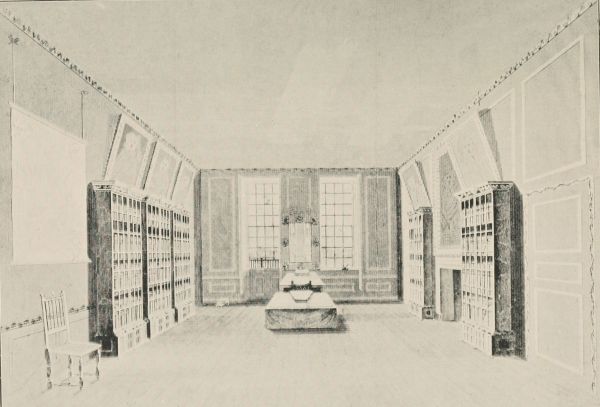
PEPYS' LIBRARY, BUCKINGHAM STREET, ADELPHI.
A little later on, Mrs Garrick and Hannah More were invited to an assembly at Mrs Thrale's. "Just as my hair was dressed, came a servant to forbid our coming, for that Mr Thrale was dead. A very few hours later, and he would have died in this assembly. What an awful event. He was in the prime of life, but had the misfortune to be too rich, and to keep too sumptuous a table, at which he indulged too freely. He was a sensible and respectable man. I am glad the poor lady has, in her distress, such a friend as Dr Johnson; he will suggest the best motives of consolation." A few days after this event, "we were a small and very choice party at Bishop Shipley's. Lord and Lady Spencer, Lord and Lady Althorpe, Sir Joshua, Langton, Boswell, Gibbon, and, to my agreeable surprise, Dr Johnson, were there." This was the first meeting between Johnson and Mrs Garrick since the latter's bereavement, and, on the next morning, Johnson paid a lengthy visit to the ladies at No. 5 Adelphi Terrace. "On Mrs Garrick's telling him she was always more at her ease with persons who had suffered the same loss with herself, he said that was a comfort she could seldom have, considering the superiority of his [Garrick's] merit, and cordiality of their union. He bore his strong testimony to the liberality of Garrick. He reproved me with pretended sharpness for reading Les Pensées de Pascal, or any of the Port Royal authors; alleging that, as a good Protestant, I ought to abstain from books written by Catholics. I was beginning to stand upon my defence, when he took me with both hands, and with a tear running down his cheeks, 'Child,' said he, with the most affecting earnestness, 'I am heartily glad that you read pious books, by whomsoever they may be written.'" Then came the famous dinner party which Dr Johnson attended, and that was his last visit to the Adelphi, for, during Hannah More's visits to town in the subsequent years, prior to Johnson's death in 1784, the Doctor was ailing. So, with this picture in the mind's eye of the worthy Doctor, in sentimental mood, now lecturing Hannah More, anon entertaining Mrs Garrick and her friends, and, finally, looking across the Adelphi railings at the Thames, as he thought tenderly of his dead friends, we take leave of Samuel Johnson.
Mrs Garrick, who was a Catholic, be it said, was by no means prejudiced, and she gave way to Hannah More's religious scruples: "It is very considerate in Mrs Garrick, to decline asking company on Sunday on my account; so that I enjoy the whole day to myself. I swallow no small portion of theology of different descriptions, as I always read, when visiting, such books as I do not possess at home. After my more select reading I have attacked South, Atterbury, and Warburton. In these great geniuses, and original thinkers, I see many passages of scripture presented in a striking and strong light. I think it right to mix their learned labours with the devout effusions of more spiritual writers, Baxter, Doddridge, Hall, Hopkins, Jeremy Taylor (the Shakespeare of divinity), and the profound Barrow in turn. I devour much, but, I fear, digest little. In the evening, I read a sermon and prayers to the family, which Mrs G. much likes." She frequently went from the Adelphi to the Church of St Clement Dane's, in the Strand. It gave her "peculiar pleasure to think" that she "there partook of the holy sacrament with Johnson the last time he ever received it in public."
On a certain Wednesday in 1785, "we had a great dinner at home"—in the Adelphi—"for the first time this year, Mrs Garrick disliking company more and more. The party consisted of the Smelts, the Montagus, the Boyles, the Walsinghams, Mrs Carter, Mr Walpole, and Miss Hamilton. Though I like them every one separately, yet it was impossible to enjoy them altogether; and I never desire to sit down with more than six, or eight at the outside, to dinner." In 1786, she records, with a certain amount of ingenuousness: "I am this day in the full enjoyment of a most complete holiday—Mrs Garrick is gone to Hampton. I have refused all invitations, and have ordered that nobody should be let in, that I may have the luxury of one quiet uninterrupted day. I woke with great delight in the very anticipation of it."
It is a long jump from 1786 to 1814, but Hannah More had many occupations during this period, and, apparently, but little time for writing to her old friend, for, in December of the latter year, Mrs Garrick sends to her, begging for some news of the world. Her letter is addressed to "My dearest friend," and runs thus: "If you could imagine how much pleasure a letter from you gives me, you would oftener favour me with one. As writing is no trouble to you, you might now and then bestow a moment upon me, to tell me what passes in London; for I am quite unacquainted with the world of folly. I almost thanked God for my illness, during all the time that every person ran mad to see for six weeks together the same thing. Now, if I could have seen the royal strangers with ease, I should have been glad to have seen them; but as that was out of my power (if I had been in health), as I have almost out-lived my London friends, I have seen nothing, so I must trust to what I am told.
"Indeed, my beloved friend, I have been very near parting for ever from this world; but the great care taken of me set me up again upon my feet, but not so high as my knees, for they are as yet very doddering. But when you consider that I am six months past ninety, you would say that I am a wonder still if you were to see me. I do not often shew my teeth, as there is but one and a quarter left. God bless you all! and love me, as I do you all, from my very soul." The death of Mrs Garrick occurred on October 16, 1822—over forty-three years after the death of her husband. She had been invited by Robert William Elliston to a private view of Drury Lane Theatre, which he had just redecorated, and, while preparing to leave her house in the Adelphi, a servant handed her a cup of tea. She had hardly raised it to her lips when she fell back in her chair, and passed away peacefully, in her ninety-ninth year. She was interred in Westminster Abbey, close by the remains of her husband, on October 25. The news of her death reached Hannah More on October 20, and is thus alluded to by her: "I was much affected yesterday with a report of the death of my ancient and valued friend, Mrs Garrick. She was in her hundredth year! I spent above twenty winters under her roof, and gratefully remember not only their personal kindness, but my first introduction, through them, into a society remarkable for rank, literature, and talents. Whatever was most distinguished in either, was to be found at their table. He was the very soul of conversation." David Garrick, it may be recorded, died in the back-room of the first floor of his house, his widow in the front drawing-room.
Mrs Garrick was a native of Vienna, where, in her youth, she acquired much celebrity as a dancer. Her maiden name was Eva Maria Violetta. She was remarkably beautiful in her face and person, and it is said that she retained, until the day of her death, that erect deportment which she had acquired as a dancer. She was married to Garrick in June, 1749, first at a Protestant, then at a Roman Catholic Chapel. After the testimony already given in these pages, it is almost superfluous to say that the actor and his wife were a very happy couple. "It is remarkable," said a public journal at the time of her death, "that during the whole period of their marriage"—thirty years—"whatever invitations they received, or excursions they took, they never once slept asunder." On August 15, 1755, Walpole writes: "I dined to-day at Garrick's; there were the Duke of Grafton, Lord and Lady Rochford, Lady Holdernesse, the crooked Mostyn, and Dabreu, the Spanish minister; two regents, of which one is Lord Chamberlain, the other Groom of the Stole, and the wife of a Secretary of State. This being sur un assez bon ton for a player. Don't you want to ask me how I liked him? I like her exceedingly; her behaviour is all sense, and all sweetness, too." In 1770, Mrs Delany, Queen Charlotte's friend, visited Garrick's house at Hampton, and recorded her appreciation of its hostess: "As to Mrs Garrick, the more one sees her, the better one must like her; she seems never to depart from a perfect propriety of behaviour, accompanied with good sense and gentleness of manners." In her widowhood, she twice refused the hand in marriage of Lord Monboddo, the Scottish judge, and author of The Origin of Language. Dr Doran says that Mrs Garrick held her own at the Bishop of London's table, "against the clever men and women who held controversy under Porteus's roof."
This gentle lady, by a codicil to her will, dated August 15, in the year of her death, made a most interesting bequest: "I give to Mrs Siddons a pair of gloves which were Shakespeare's, and were presented by one of his family to my late dear husband, during the jubilee at Stratford-upon-Avon." Information of this bequest was conveyed to the great actress, with this note from Mrs Garrick's executors:—
"5 Adelphi Terrace, Oct. 30, 1822.
"Madam,—We beg leave to transmit to you the above extract from a codicil to Mrs Garrick's will, and to acquaint you that we will have the honour of waiting on you, for the purpose of delivering the relic therein mentioned, whenever you may be so good as to inform us that it may be convenient to you to receive our visit.—We remain, with much respect, Madam, Your most obedient humble servants,
"Thos. Rackett, G.F. Belty, Executors."
This connecting link between Shakespeare, Garrick, and Sarah Siddons is one of the most interesting incidents in connection with the Adelphi. Garrick is also responsible for a side-light on the life of Oliver Goldsmith. Forster, in his Life and Times of Goldsmith, says that the alteration of his first comedy for Garrick, even upon Garrick's own conditions, seems to have suddenly occurred to the impecunious author as a means of raising money. Goldsmith's two letters on the subject by chance survived and were transcribed by Forster, who, in regard to the first one, says that: "As well in the manner as in the matter of it, the writer's distress is very painfully visible. It has every appearance, even to the wafer hastily thrust into it, of having been the sudden suggestion of necessity; it is addressed without date[39] or place to the Adelphi; nor is it unlikely to have been delivered there by the messenger of a sponging-house.
"'My Dear Sir,—Your saying you would play my Good-Natured Man makes me wish it. The money you advanced me upon Newbery's note I have the mortification to find is not yet paid, but he says he will in two or three days. What I mean by this letter is to lend me sixty pound, for which I will give you Newbery's note, so that the whole of my debt will be an hundred, for which you shall have Newbery's note as a security. This may be paid either from my alteration if my benefit should come to so much, but at any rate I will take care you shall not be a loser. I will give you a new character in my comedy and knock out Lofty, which does not do, and will make such other alterations as you direct.—I am yours,
"'Oliver Goldsmith.
"'I beg an answer.'
"This letter is indorsed in Garrick's handwriting as 'Goldsmith's parlaver.' But though it would thus appear to have inspired but little sympathy or confidence, and the sacrifice of Lofty had come too late and been too reluctant, Garrick's answer, begged so earnestly, was not unfavourable. He evaded the altered comedy; spoke of the new one already mentioned between them; and offered the money required on Goldsmith's own acceptance.... The second note exhibits such manifest improvement in the writing as a sudden removal of a sore anxiety might occasion; but the writer's usual epistolary neatness is still absent. It is hastily folded up in three-cornered shape, is also sealed with wafer, and also indorsed by Garrick, 'Goldsmith's parlaver.'
"'My Dear Friend, I thank you! I wish I could do something to serve you. I shall have a comedy for you in a season or two at furthest, that I believe will be worth your acceptance, for I fancy I will make it a fine thing. You shall have the refusal. I wish you would not take up Newbery's note, but let Waller' [probably a mistake for Wallis, Garrick's solicitor] 'tease him, without, however, coming to extremities; let him haggle after him and he will get it. He owes it and will pay it. I'm sorry you are ill. I will draw upon you one month after date for sixty pound, and your acceptance will be ready money, part of which I want to go down to Barton with. May God preserve my honest little man, for he has my heart.—Ever,
"'Oliver Goldsmith.'"
A final reminiscence of Garrick and this neighbourhood shows the actor soliciting the Adam brothers on behalf of Andrew Becket, who, when the Adelphi was being erected, had a bookseller's shop in the Strand. He was the son of Thomas Becket, the Pall Mall bookseller, whose establishment was frequented by Garrick. He must have been a precocious youth, for, at the age of fourteen, he had written a comedy founded on Rousseau's Emile, and a poem entitled Theodosius and Constantia. Born in 1749, he died in 1843. He was a frequent contributor to the chief magazines of his day. He had a great grievance against Ralph Griffiths, the proprietor of the Monthly Review, for having given him only forty-five pounds for nearly five years' work—280 articles, the result of reading and condensing 590 volumes. In Shakespeare Himself Again, Andrew Becket "released the original text from much muddy nonsense of commentators."[40]
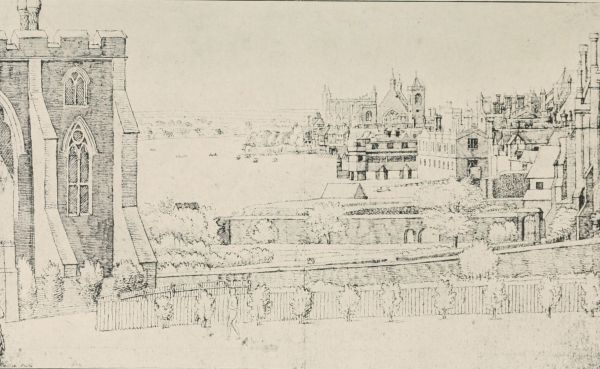
ST MARY ROUNCEVAL (THE ORIGINAL SITE OF NORTHUMBERLAND HOUSE).
Garrick besought the corner house of Adam Street for his friend, a request that was granted. He asked for this "corner blessing," and addressed the architects as his "dear Adelphi." The house was No. 73 Strand, at the north-east corner of Adam Street. It was destroyed by fire on June 28, 1822, but rebuilt according to the original plan. Garrick, in the course of his letter to the Adams, said: "Pray, my dear and very good friends, think a little of this matter, and if you can make us happy, by suiting all our conveniences, we shall make his shop, as old Jacob Tonson's was formerly, the rendezvous of the first people in England. I have a little selfishness in this request—I never go to a coffee-house, seldom to taverns, and should constantly (if this action takes place) be at Becket's at one at noon and six at night." Garrick, no doubt, meant what he said, but there is no trace of his having visited Andrew Becket in this "corner blessing." The shop is now occupied by a firm of silversmiths.
Samuel Foote, who hated Garrick, is said to have related a story in which I have little faith. But, as it concerns the great actor and the Adelphi, I give it for what it is worth. "Garrick," said Foote, "lately invited Hurd to dine with him in the Adelphi, and after dinner, the evening being very warm, they walked up and down in front of the house. As they passed and repassed the dining-room windows, Garrick was in a perfect agony, for he saw that there was a thief in one of the candles which was burning on one of the tables; and yet Hurd was a person of such consequence that he could not run away from him to prevent the waste of his tallow." This story was put into print by Samuel Rogers, who was a boy of sixteen at the time of Garrick's death. Foote died in 1777, when Richard Hurd was Bishop of Lichfield and Coventry.
FOOTNOTES:
CHAPTER VIII
The celebrated Quack, Dr Graham—His Temple of Health in the Adelphi—Satirised by Colman and Bannister—"Vestina, the Rosy Goddess of Health"—Emma Lyon, Lady Hamilton—Osborn's Hotel—The King and Queen of the Sandwich Islands—Their Death in the Adelphi—Isaac D'Israeli—The Earl of Beaconsfield—Thomas Hill, the Original of Paul Pry—Thomas Hood and Charles Dickens—David Copperfield and Pickwick—Ivy Lane—The Fox-under-the-Hill—The Adelphi "Dark Arches."
The Adelphi has had its share of quacks, the most impudent of them all being Dr Graham, a Scotchman, who flourished here from the summer of 1780 until the May following, when he migrated to Pall Mall. He occupied the middle house in Adelphi Terrace, and in this place Emma Lyon—afterwards Lady Hamilton—posed as the Goddess of Health. James Graham was then approaching the end of his extraordinary career, for, born in the Cowgate, Edinburgh, on June 23, 1745, he died in 1794. Although he studied medicine in the University of Edinburgh, it is not certain that he took his degree, for, so late as 1783, he is described as "the person calling himself Dr Graham." He passed his earlier life in Pontrefact, being married there in 1770. Subsequently, he travelled in America, as an oculist and aurist. Returning to England in 1774, he practised at Bristol and Bath, and, a year later, established himself in Pall Mall, nearly opposite St James's Palace. At Bath, in 1777, he met Catherine Macaulay, who, a few months later, married his younger brother, William. Through his treatment of her, he declared, he made his first real start in life. Be this as it may, he gained the ear of the public about this time, although he was denounced as a quack by the medical profession. After a visit to the continent, during which he received many testimonials from people in the first rank of society, he came to the Adelphi in 1779. His house and apparatus, it was stated, cost him £10,000. The entrance hall was adorned with crutches which had been discarded by his "patients," and, in the rooms above, were large, gaudily-decorated electrical machines, glass globes, marble statues, and figures of dragons; the windows were of stained glass, and the air was laden with the perfume of incense. The door was guarded by huge footmen. One apartment was devoted to Apollo, and contained "a magnificent temple, sacred to health." He lectured at enormous prices and obtained fabulous sums for his quack remedies. For a night in the "celestial bed," which ensured a beautiful progeny, his fee was £100; his "elixir of life" brought him a fee of one thousand pounds, but his "earth-bath" was only a modest guinea, while a magneto-electric bed could be slept in for £50 a night.
In August, 1780, Horace Walpole visited "The Temple of Health" in the Adelphi, and pronounced it "the most impudent puppet-show of imposition I ever saw, and the mountebank himself the dullest of his profession, except that he makes spectators pay a crown apiece for admission only." The place acquired notoriety so rapidly that, on September 2, George Colman, the elder, produced at the Haymarket Theatre a skit entitled The Genius of Nonsense, in which John Bannister, in the character of the Emperor of Quacks, mimicked Graham. "His satin sofas on glass legs, his celestial bed, his two porters in long, tawdry greatcoats and immense gold-laced cocked hats, distributing handbills at the door, while his goddess of health was dying of a sore throat from squalling songs at the top of the staircase, were all hit off by a speaking harlequin, who also caricatured the doctor's sliding walk and bobbing bows."[41] The impostor was prevented from buying the "bill of the play," a burlesque on his own handbill, so that he could not bring an action for libel.
The following is an exact copy of one of Graham's advertisements:—
Temple of Health, Adelphi. To their Excellencies the Foreign Ambassadors, To the Nobility, Gentry and to Persons of Learning and Taste, This Evening exactly at Eight o'Clock, The Celestial Brilliancy of the Medico-electrical Apparatus, in all the Apartments of the TEMPLE, Will be exhibited by Dr Graham himself,
Who will have the honour of explaining the true Nature and effects of Electricity, Air, Music, and Magnetism, when applied to the human body.
In the introductory Oration, the whole art of enjoying health and vigour, of body and of mind, and of preserving and exalting personal Beauty and Loveliness; or, in other words, of living with health, honour, and happiness in this world, for at least a hundred years, is pointed out and warmly inculcated.
Previous to the display of the electrical Fire, the Doctor will delicately touch upon the Celestial Beds, which are soon to be opened in the Temple of Hymen, in Pall-mall, for the propagation of Beings rational, and far stronger and more beautiful in mental as well as in bodily endowments—than the present puny, feeble, and nonsensical race of probationary immortals, which crawl and fret, and politely play at cutting one another's throats for nothing at all, on most parts of this terraqueous globe.
This apparatus, which visibly displays, as it were, the various faculties of the material soul of universal and eternal Nature, is acknowledged by all who have seen it, to be by far the largest, most useful, and most magnificent that now is, or that ever was, in the world; and it may be inspected every day, from Ten o'clock in the Morning till four in the Afternoon. Admittance at night, 5s.; in the day, 2s. 6d.
In another announcement he stated that "Vestina, the Rosy Goddess of Health, presides at the evening lectures at the Temple of Health, Adelphi, assisting at the display of the Celestial Meteors, and of that sacred Vital Fire over which she watches, and whose application in the Cure of Diseases she daily has the honour of directing." Graham's "Rosy Goddess of Health" was Emma Lyon, who, in the winter of 1780, when she posed in the Adelphi, was barely twenty years of age. Young as she was, she had lived a strange life, even then. The daughter of a Cheshire blacksmith, she was quite a child when, in the capacity of nurse-maid, she entered the service of Mrs Thomas, wife of a surgeon practising at Hawarden; and she can hardly have been more than fifteen or sixteen years of age when she first came to London. "Here, for a short time, she is said to have been in service: first, with Mrs Linley, of Drury Lane Theatre; secondly, with Dr Budd, one of the physicians of St Bartholomew's Hospital; and finally at a fruiterer's in St James's Market. One of the customers at this shop, 'a lady of fashion,' attracted by the girl's manner, her beautiful face, and her wonderful auburn hair, engaged her in the capacity of companion. But, fortunate as the change at this time may have appeared to her, it speedily put an end to her opportunities of earning an honest living. No long time after, we hear of her as living for a time with Captain (afterwards Admiral) John Willett Payne, who is by some surmised to be the father of a girl to whom she gave birth about the end of 1779 or the beginning of 1780. However this may be, it is certain that, before she had completed her seventeenth year, she did give birth to a child, and that, as soon as possible, it was transferred to the care of her old grandmother at Hawarden."[42] Her poverty drove her to the quack doctor of the Adelphi. Soon after her appearance here, she "kept house," in extravagant fashion, for Sir Harry Fetherstonshaugh, "a dissolute baronet," at Up Park, Sussex, and became "a daring and accomplished horse-woman." At this time she called herself Emma Hart, but on her marriage, in 1791, to Sir William Hamilton, she signed the register as Amy Lyon. The subsequent career of Nelson's Lady Hamilton is too well known for repetition.
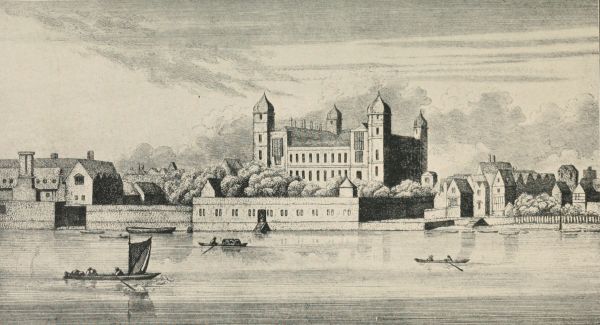
SUFFOLK (SUBSEQUENTLY NORTHUMBERLAND) HOUSE.
In the spring of 1781, Graham removed from the comparative quiet of the Adelphi to more aristocratic quarters in Schomberg House—part of the existing War Office—in Pall Mall. His charges were slightly lower than in the Adelphi, the use of his "celestial bed" costing but fifty pounds. In November, 1782, his property was seized for debt, and was advertised for sale on December 20, and the following days. He made his misfortunes an opportunity for advertisement, bought in most of his goods, and threatened one publication with an action for libel for having published "an incorrect, mutilated, and nonsensical farrago, which they impudently and falsely call Dr Graham's celebrated lecture on generation." In March, 1783, he announced that the "High Priestess of his Temple delivered lectures to ladies, and that the rosy, athletic, and truly Gigantic Goddess of Health and of Hymen, on the Celestial Throne," took part in the lectures. Graham's London career practically ceased in 1783. Ten years later he described himself, in a book on earth-bathing, as "formerly sole institutor, proprietor, and director of the Temple of Health in the Adelphi and in Pall Mall." His earth-bathing consisted of remaining without clothing in the earth six hours at a time, for eight days in succession, and for twelve hours on the ninth day. In 1791, Graham and a young woman, at Newcastle, "stripped into their first suits," and "were each interred up to the chin, their heads beautifully dressed and powdered, appearing not unlike two fine full-grown cauliflowers."
Graham subsequently became a religious enthusiast, took to opium, and was confined in his own house in Edinburgh as a lunatic. A few months before his death, he made an affidavit, in which he stated that from the last day of December 1792, to January 15, 1793, he neither ate, drank, nor took anything but cold water, sustaining life by wearing cut-up turfs against his naked body, and by rubbing his limbs with his own nervous æthereal balsam. He died suddenly at his house, opposite the Archers' Hall, Edinburgh, on June 23, 1794. Graham, though a quack, and possibly a madman, was not without some knowledge. He was against flesh-eating and excess in alcohol, and believed in cold bathing, open windows, sleeping on mattresses, and other points of severe hygiene; at one time, he stated, he never ate more than the worth of four or six pence a day. He asserted that all diseases were caused by wearing too much clothing, and he wore no woollen clothes. Southey saw this "half knave, half enthusiast" thrice, once in his mud-bath. He says that latterly Graham "would madden himself with opium, rush into the streets, and strip himself to clothe the first beggar he met." [43]
At Osborn's Hotel, which still exists, under the name of the Adelphi Hotel, at the corner of John and Adam Streets, the King and Queen of the Sandwich Islands died, from small-pox, in 1824. Rhio-Rhio was the son and successor of the first king, Tamehameha, who placed the Islands under British protection. The Queen died on July 8. "The King," said a contemporary print, "in the midst of this deep sorrow manifests a firmness of mind which has penetrated everybody about him with a feeling of respect. Though very anxious to express his grief in the manner of his country, and to show the marks of deference which are usually paid to the dead there, he submits, with good sense and patience, to every suggestion which our habits dictate." The King died, at the same place, on September 14. The visit of King Tamehameha and his consort to England gave rise to the popular song, "The King of the Cannibal Islands." This hotel was originally called "The Adelphi New Tavern and Coffee-House," and was opened in October, 1777, "being completely fitted up in the most elegant and convenient manner for the entertainment of noblemen and gentlemen." Gibbon, writing to Lord Sheffield on August 8, 1787, from the Adelphi Hotel, imparts a piece of "Intelligence extraordinary. This day (August the seventh) the celebrated E.G. arrived with a numerous retinue (one servant). We hear that he has brought over from Lausanne the remainder of his History for immediate publication." In 1813, George Crabbe, the poet, and his wife stayed in the Adelphi during a visit to London. Dr Thomas Munro, Turner's patron, resided here, and on April 22, 1827, Thomas Rowlandson, the famous caricaturist, died here. Isaac D'Israeli, the author of Curiosities of Literature, and father of the Earl of Beaconsfield, stayed at Osborn's Hotel after his wedding tour, in 1802.
It is generally supposed that Benjamin Disraeli was born in the Adelphi. The authority for this statement is Lord Barrington, who, during the Earl of Beaconsfield's last illness, questioned him on the point. "I was born in the Adelphi," was the reply, "and I may say in a library. My father was not rich when he married. He took a suite of apartments in the Adelphi, and he possessed a large collection of books; all the rooms were covered with them, including that in which I was born." Mr Wheatley, however, says that "careful investigation has left little doubt that this was not the case, as Isaac D'Israeli had left the Adelphi"—where he had a lease of the first floor of No. 2 James Street—"for King's Road (now Theobald's Road) before the birth of Benjamin."
In James Street, on the second floor of No. 1, there lived and died a celebrated character, Thomas Hill (1760-1840), the book-collector and patron of Bloomfield and Kirke White. He was the fussy, good-natured Hull of Theodore Hook's novel, Gilbert Gurney (1836). More notable still, he was the original of Paul Pry, in Poole's comedy (1825). Paul Pry is an idle, inquisitive, meddle-some fellow who, without any occupation of his own, is for ever thrusting himself upon other people with the apology, "I hope I don't intrude." John Liston (1776-1846) was the first stage representative of the character, and the part was frequently acted by the late John Lawrence Toole. "Tommy" Hill, as he was familiarly called, always boasted that he had whatever was wanted: "Cards, sir? Pooh! pooh! Nonsense! thousands of packs in the house." Planché says of him: "His spécialité was the accurate information he could impart on all the petty details of the domestic economy of his friends, the contents of their wardrobes, their pantries, the number of pots of preserve in their store-closets, and of the table-napkins in their linen-presses, the dates of their births and marriages, the amounts of their tradesmen's bills, and whether paid weekly or quarterly. He had been on the press, and was connected with the Morning Chronicle. He used to drive Mathews crazy by ferreting out his whereabouts when he left London, and popping the information in some paper."
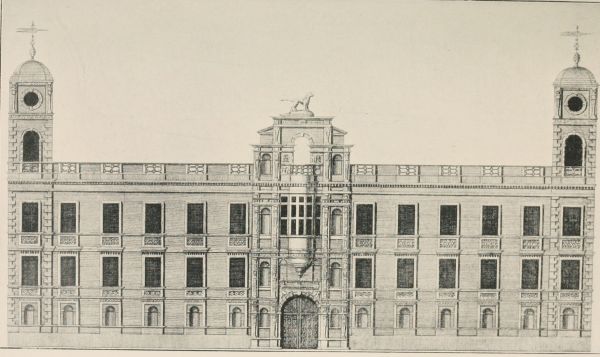
THE STRAND FRONT OF NORTHUMBERLAND HOUSE.
Two of the most celebrated literary names connected with the Adelphi are Thomas Hood and Charles Dickens. Hood, soon after his marriage in 1824, lived in chambers at No. 2 Robert Street, his acquaintanceship at that time including Charles Lamb, Hazlitt, and De Quincey. His association with the Adelphi continued until the end of his career, for his Magazine, established in 1844—the year before his death—was published from No. 1 Adam Street. Dickens knew the Adelphi well. As a boy he frequented its underground passages, and, later on, he used Osborn's Hotel (the Adelphi Hotel) for a scene in Pickwick.[44] He is recording his own experiences when, in David Copperfield, he says: "I was fond of wandering about the Adelphi, because it was a mysterious place, with those dark arches. I see myself emerging one evening from some of these arches, on a little public-house close to the river, with an open space before it, where some coal-heavers were dancing; to look at whom, I sat down upon a bench. I wonder what they thought of me!" This was also the scene of the meeting of the Micawbers and Copperfield prior to the departure of the impecunious Wilkins for Australia: "The Micawber family were lodged in a little, dirty, tumble-down public-house, which in those days was close to the stairs, and where protruding wooden rooms over-hung the river. The family, as emigrants, being objects of some interest in and about Hungerford, attracted so many beholders, that we were glad to take refuge in their room. It was one of the wooden chambers upstairs, with the tide flowing underneath.... I went down again next morning to see that they were away. They had departed, in a boat, as early as five o'clock. It was a wonderful instance to me of the gap such partings make, that although my association of them with the tumble-down public-house and the wooden stairs dated only from last night, both seemed dreary and deserted, now that they were gone." [45]
This "little, dirty, tumble-down public-house" of Dickens was the "Fox-under-the-Hill." It stood at the bottom of Ivy Lane. The ram-shackle building disappeared with the formation of the Victoria Embankment and Gardens, but the passage in question still remains, and, although it is not noticed by the thousands of people who walk by it daily, Ivy Lane is one of the most interesting bits of old London. Stow, in his Survey, alludes to it thus: "Ivy Bridge, in the High Street, which had a way under it leading to the Thames, the like as sometime had the Strand Bridge, is now taken down, but the lane remaineth as afore; or better, and parteth the liberty of the Duchy (of Lancaster) and the city of Westminster on that south-side." Strype adds that the lane was "very bad and almost impassable." As it was very narrow, and the descent was steep, its inconvenience is easily understood. The passage is still here, but, at the river end, it is enclosed by gates. Ivy Bridge, or Pier, was the landing-place for the halfpenny steamboats which plied between the Strand and London Bridge. Here a lamentable explosion, by which many people were killed, occurred in August, 1847, on the Cricket, and, soon afterwards, the "Fox" landing-stage was disused.
From the "Fox-under-the-Hill" it is an easy transition to the "dark arches" which made such an impression on the mind of Charles Dickens. They form a small town in themselves, and although tenanted by wine-merchants, and other law-abiding people, they are still "mysterious" enough to strike one with wonderment that such a dreary spot can exist within hail of the busy Strand. "The Adelphi arches, many of which are used for cellars and coal-wharves," wrote John Timbs, half a century ago, "remind us, in their grim vastness, of the Etruscan cloaca of ancient Rome. Beneath the 'dark arches,' as they were (and are) called, the most abandoned characters used to lurk; outcasts and vagrants came there to sleep; and many a street-thief escaped from his pursuers, before the introduction of gas-lights and a vigilant police. Even now tramps prowl in a ghastly manner down the dim-lit passages." The condition of things has not changed much during these fifty years, and a stranger would be well-advised in not venturing on a voyage of discovery through this strange region, alone. Augustus Egg placed the scene of one of his most tragic pictures on the banks of the river by the Adelphi arches. In these caverns a battery of guns was held in readiness in connection with the great Chartist meeting, on Kennington Common, on April 10, 1848. The piers on which the arches rest having shown signs of insecurity, the entire structure was underpinned, and strengthened in other ways, in the years 1872-4.
The Adelphi arches were a source of wonderment to Londoners in the middle of the last century. Thomas Miller, the poet and novelist, writing in 1850, gives a vivid description of them: "Thousands who pass along the Strand never dream of the shadowy region which lies between them and the river—the black-browed arches that span right and left, before and behind, covering many a rood of ground on which the rain never beats, nor the sunbeam sleeps, and at the entrance of which the wind only seems to howl and whine, as if afraid of venturing further into the darkness. Many of our readers will, no doubt, conclude that such a dreary place as this must be deserted and tenantless: such is not the case. Here many of those strong horses, which the countryman who visits London looks upon with wonder and envy, are stabled—strong, broad-chested steeds, such as may be seen dragging the heavily-laden coal-waggons up those steep passages which lead into the Strand, and which seem 'to the manner born.'
"Cows are also kept here, which, rumour says, never saw any other light beyond that of the gas which gleams through their prison-bars, or, by way of change, the cheering rays from a lantern, when they are milked or fed; that here many of them were calved, and have lived on, giving milk to a good old age—buried like the main-pipe that supplies us with water and finds its way into our houses without our once enquiring how. We have often pitied the London cows, which we have seen driven up one street and down another, and have fancied that what little milk they had must have been churned into indifferent butter, as they ran on, to escape the stones thrown after them by boys, while mongrels were ever sallying out, and either biting or barking at their heels; but we had not seen those which are doomed to dwell in the unbroken darkness of the Adelphi arches, without ever breathing any other than the sepulchral air which stagnates this murky purgatory. Assuredly they ought to be taken out for a little fresh air now and then, and be led by the horns to
'Fresh fields and pastures new';
for we can readily conceive how pleased and patiently they would go 'blinking' along, compared to those horned blackguards who come with a butt and a 'boo' at us as they return from Smithfield, and, before we have time to say 'Now, stupid!' pitch us over the battlements of one of the bridges, and leave us to sink or swim.
"The Adelphi arches form a little subterranean city; there is nothing like it in England: in some places you catch a glimpse of the river, a small loop-hole that lets in the light like the end of a railway tunnel, yet seeming to diminish more than these tunnels, on account of the steep descent, until one of the steamers, in passing, appears to fill up the opening like a half-closed door. Beside these arches there are narrow passages which go dipping down to the water-side, where on either hand houses stand looking at one another in the openings between the darkness. There is a dismal and solitary look about these tall imprisoned houses; you cannot conceive how they are entered, for there appears to be no way to them, and you conclude that they are empty. Or, if they are inhabited, you wonder if the people ever look out of those dim, dirt-ditched windows at the dead-looking walls opposite. We have turned back, and hunted up and down looking from below, but nowhere could we obtain a view of the entrance to those murderous-looking houses. We once saw a butterfly which had lost its way, and got into the little light which had stolen out to look at the entrance of these arches: it went up and down, and hither and thither, seeming to become feebler every moment, as if it had given up all hope of ever swinging with folded wings, like a pea-bloom, on the flowers again, and we doubted not but that it found a grave amid the green decay of some rotten water-butt." The cows have disappeared, and the muddy wharves have been replaced by pleasant gardens and the busy hum of workshops, but the "subterranean city" is likely to exist in its present form for many years to come. The embankment, the construction of which involved the abolition of the Adelphi wharves, was opened in 1870 by the Prince of Wales (Edward VII.), as the representative of Queen Victoria. This magnificent example of engineering was begun in 1862, and the cost was about £2,000,000.
FOOTNOTES:
CHAPTER IX
The First Bankers—Middleton & Campbell, predecessors of Coutts & Co., "at The Three Crowns in the Strand"—Patrick and John Coutts—Patrick and Thomas Coutts in London—Death of James Coutts—Enter, Thomas Coutts—Letter by Him—His Stern Character—Married to Harriot Mellon—Susan Starkie and "The Three Graces"—Sir Francis Burdett—Angela Georgina Burdett—The Duchess of St Albans—Anecdotes of Thomas Coutts—His Personal Appearance—Interior of the Bank—The Chinese Wall-Paper—The Adelphi Chapel—Illustrious Customers of Messrs Coutts—Partners in the Firm—The Wills of Thomas Coutts and the Duchess of St Albans—The Savage Club—Thomas Hardy—E.L. Blanchard.
Queen Elizabeth "was particularly kind to the citizens, and borrowed money of them on all occasions." At first sight this may not seem a compliment, since monarchs have not always been too particular in the matter of the repayment of their loans. Queen Elizabeth, however, was a good borrower, and the Goldsmiths Company—employed by her in these transactions—drank annual libations to her memory, out of a silver cup which she had presented to them, for many years after her decease. But "the business of goldsmiths," as Pennant has pointed out, "was confined to the buying and selling of plate, and foreign coins of gold and silver, melting them, and coining others at the mint. The banking was accidental, and foreign to their institution. Regular banking by private people resulted, in 1643, from the calamity of the time, when the seditious spirit was incited by the arts of the parliamentary leaders. The merchants and tradesmen, who before trusted their cash to their servants and apprentices, found that no longer safe; neither did they dare to leave it in the mint at the Tower, by reason of the distress of Majesty itself, which before was a place of public deposit." In the year 1645, the goldsmiths added banking to their business. The first regular banker was Thomas Child, goldsmith, of Fleet Street, who began in this way soon after the Restoration. "He was the father of the profession, a person of large fortune and most respectable character."[46]
The shops of the goldsmiths and bankers were, of course, situated in the city of London until, in 1692, the firm of Middleton & Campbell was established in St Martin's Lane. George Middleton and John Campbell were the predecessors of the great banking firm known as Coutts & Co., whose premises in the Strand occupied part of the New Exchange and the Adelphi for one hundred and sixty odd years. Campbell, who died in 1712, and was buried in the churchyard of St Paul's, Covent Garden, left his "faithful and honest partner" as executor to his four children until the coming of age of his eldest son, William. In 1729, the youngest son of John Campbell became a partner. Until 1737, the business was carried on in St Martin's Lane, then the centre of the artistic world of London. In that year Messrs Middleton & Campbell occupied the middle house of a row of eleven which had been built on the site of "Britain's Burse." The firm did not become "bankers" until 1740, although it had transacted the usual banking business, together with an army and commission agency, for many years previously. In 1712-13 Middleton & Campbell had acted as agents for Queen Anne's 4th Troop of Guards. The name of the firm was changed to that of Coutts in 1760, and it is by this honoured name that it is likely to be known so long as it exists—and that will be so long as banking flourishes as an institution in this country. The original sign of the house, three crowns, is still used on the cheques, surrounded by the words: "At the Three Crowns in the Strand, next door to the Globe Tavern, A.D. 1692."
The story of the change in the name of the firm is curious and interesting. This history being more particularly concerned with Thomas Coutts, and his establishment in the Strand, it is not necessary to go further into his genealogy than to state that the great banker was a descendant of William Coutts and his wife, Janet Ochiltree, of Montrose.
One Patrick Coutts, desirous of making a name for himself, left Montrose and went to Edinburgh, where he traded as a general merchant, importing and exporting goods, in 1696. He died in 1704, a man of probity and wealth. He left his great fortune to his son John, who also flourished in Edinburgh as a merchant. "The business initiated by John Coutts was a combination of general dealing and the negotiation of foreign bills of exchange. He also imported and sold corn, either on his own account or as a commission agent. But in proportion as he advanced in business and acquired spare capital, as well as the confidence of persons who deposited with him money at interest, he appears to have laid himself out chiefly as a negotiator of bills, a species of traffic which as yet had not been appropriated by banks, and demanded much knowledge and shrewdness. Whether from family connections or otherwise, he became acquainted with people of good social standing, through whom he widened his base of operations. For some time he had for a partner Thomas Haliburton, of Newmains (who through a daughter became the great-grandfather of Sir Walter Scott); next we find him taking as partner Archibald Trotter, son of Trotter, of Castleshiel; then by another change of firm he was associated with his cousin, Robert Ramsay, brother of Sir Alexander, of Balmain. As further marking the esteem in which he was held by the aristocratic circles of Edinburgh, he formed an intimacy with Sir John Stuart, of Allanbank, whose sister he married."[47]
John Coutts, who was Provost of Edinburgh in 1742-43, died in 1751, leaving four sons, Patrick, John, James, and Thomas, who inherited his business and great wealth. Thomas Coutts, with whom we are more directly concerned, was born on September 7, 1735. Patrick and Thomas Coutts, and their cousin, Thomas Stephen, opened a branch establishment in London, in Jeffrey's Square, St Mary Axe, under the name of Coutts, Stephen, Coutts, & Co.; John and James Coutts, remaining in the North, acted as the correspondents of the London firm, and bought and sold goods on commission. In his Memoirs of a Banking House, Sir William Forbes says: "Some years they made large profits, which they as often lost in others, owing to the fluctuation of the markets and the bankruptcy of many of those with whom they dealt. Indeed, I have often thought it not a little singular that a banking house, which of all branches of business seems peculiarly to require caution, and which ought, as much as possible, to be kept clear of hazard or speculation, should have chosen to embark so largely in the corn trade, which is perhaps the most liable to sudden fluctuation, and in which no human prudence or insurance can guard the adventures from frequent loss."
The house in the Strand was carried on under the style of Campbell & Bruce, under the sole control of George Campbell from 1751 to July, 1755. James Coutts, the third son of Lord Provost John Coutts, having become acquainted with George Campbell during one of his visits to London—for his main business was with the Edinburgh house—married, in 1754, Campbell's niece, Mary Peagrim, and was taken into partnership by the Strand banker, whereupon he withdrew from his old firm, and Campbell & Coutts came into existence at No. 59 Strand. On the death of his partner, in 1761, James Coutts took his brother, Thomas, into the firm. James Coutts died in 1778, leaving Thomas in full control of the business, and his only daughter inherited his fortune of £70,000.
Thomas Coutts, who ultimately became known as "the richest man in London," was a great character. He had received an excellent training at the High School in Edinburgh, and this, together with his vast experience in correspondence, "enabled him to appreciate literary composition, and to express himself with accuracy." He survived all his brothers, and became the first banker in London. His munificence, no less than his wealth, admitted him to the highest circles. Together with Sir Walter Scott, his friend, and kinsman, through the Stuarts of Allanbank, he received the freedom of the city of Edinburgh. Although he was always ready to lend a hand to genuine distress, he was very keen in money matters, and sternly resented any attempt at what he considered imposition. The following letter, written in his eightieth year, is characteristic of his attitude when replying to those who besought unwarranted favours. It was addressed to John Pinkerton, the Scottish antiquary and historian, who had asked the banker to recommend him as a travelling companion, and to forego the interest on a bond:—
"Strand, January 31, 1815.
"I have received the favour of your letter, asking me to withdraw the claim for interest on the sum I lent on the security of a house; but the footing upon which you have put the request is one I have uniformly, at all times, thought to be such as I ought to reject, and have rejected accordingly. The bankers in Scotland and the county banks in England are on a different plan from those of London. They circulate their own notes and make payments in them. We give out no notes of our own, and if we were to give interest at even one per cent. per annum, we should be losers by our business.
"We do not consider ourselves as being obliged to any one person who places his money in our hands, however considerable. It is to the aggregate and general mass of society that we owe our situation, and to the credit our prudence and attention has obtained for us; and people deposit their money in our hands for their own advantage and convenience, not from favour to us, nor do we desire to have it on any other terms. Probably you may not understand the explanation I have spent time in making, which I can very ill spare, and it may therefore answer no purpose, but it satisfies myself, and I wish to show equal attention to all my employers, whether they have large or small sums in my hands, which indeed hardly ever occupies my attention.
"My attention is fully engrossed in doing business with honour and regularity, leaving the rest to the common chance and course of things. It surprises me that, though it every day appears that there is very little truth published in the newspapers, yet people will still believe what they read, especially abuse, or what they think is against the character or prudence of the person treated of. I saw some paragraphs, and heard of more, of what I had done for Mr Kean, in all which there was not a word of truth; though I see no reason why I might not, without offence to any one, have given Mr Kean anything I pleased. In doing any little matter in my power for an individual, I must add, I never had any view to celebrity, with the present age or with posterity.
"If I should know of any gentleman wanting a travelling companion abroad, I shall mention you to him, but it seldom happens that I am applied to in such matters."
The Mr Kean alluded to in this letter is, of course, the great actor. But, as Edmund Kean was at the zenith of his power and success in 1814-15, we may indeed readily believe that "there was not a word of truth" in the rumour that "Mrs Coutts visited Kean and made him a gift of fifty pounds," which was circulated at the time. Moreover, it was not until March 2, 1815, that the marriage of Thomas Coutts to Harriot Mellon was announced. Miss Mellon was the second wife of the banker, and her marriage was a romantic one. Before dealing with it, however, it is necessary to refer to the first Mrs Coutts, about whom a good deal of mystery has been made. The simple truth is that she came of "poor but honest parents" in Lancashire. Her name was Susan Starkie, and we have it on the authority of the Earl of Dundonald (1775-1860) that she was "a most respectable, modest, handsome young woman." Another writer says that, even near the day of her death, although she was then an old woman, with grown-up grandchildren, "she exhibited traces of having possessed some personal advantages in her youth, her large black eyes retaining their brightness, although rather stern and wild in their expression." She is interesting, as far as this story is concerned, inasmuch as Thomas Coutts met her in the house in the Strand, where she was in charge of his brother's daughter. After the marriage, Mr and Mrs Thomas Coutts resided in St Martin's Lane, and there "my brother and myself have frequently called to visit" them, wrote the Earl of Dundonald, who added that "her good sense, amiable disposition, and exemplary good conduct endeared her to all her husband's family, and commanded the respect of everyone who knew her." Of this union there were three daughters, who were known as "the Three Graces." The first, Susan, married the third Earl of Guildford; the second, Frances, was the second wife of John, first Marquis of Bute; while Sophia was married to Sir Francis Burdett, Bart., M.P., the well-known politician, and hero of reform. Sir Francis and Lady Burdett had six children, a son and five daughters, the youngest of whom, Angela Georgina, born on April 21, 1814, became the Baroness Burdett-Coutts, whose death, on December 30, 1906, has been so greatly deplored. This lady received, on the death of the Duchess of St Albans—Harriot Mellon, the second wife of Thomas Coutts—the entire estate which the banker had, by his will, placed at the disposal of the Duchess.