Front matter (continued 4)
Reading edition
The Duchess of St Albans, who, as Mrs Coutts, must have been a frequent visitor at No. 59 Strand, made her first appearance on the stage as Lydia Languish in The Rivals, on January 31, 1795, at Covent Garden, she being then twenty years of age. Her first husband died on February 24, 1822, and was buried at Wroxton Abbey, Oxfordshire, "his funeral being attended by many of the nobility and gentry of the district, while the carriages of their royal highnesses the Dukes of York, Clarence, and Sussex accompanied the procession." She was then importuned by William Aubrey de Vere, the ninth Duke of St Albans, to whom she was married on June 16, 1827. The story of this courtship has been told by Sir Walter Scott: "Mrs Coutts, with the Duke of St Albans and Lady Charlotte Beauclerk, called to take leave of us. When at Abbotsford his suit throve but coldly. She made me, I believe, a confidant in sincerity. She had refused him twice, and decidedly: he was merely on the footing of friendship. I urged it was akin to love. She allowed she might marry the Duke, only she had at present not the least intention that way. It is the fashion to attend Mrs Coutts' parties, and to abuse her. I have always found her a kind, friendly woman, without either affectation or insolence in the display of her wealth; most willing to do good if the means be shown her. She can be very entertaining too, and she speaks without scruple of her stage life. So much wealth can hardly be enjoyed without ostentation." In Lockhart's Life of Scott there is a long account of a visit paid to Sir Walter by Mrs Coutts, who arrived at Abbotsford with a train of three carriages each drawn by four horses. Her retinue consisted of her future lord, the Duke of St Albans, one of his grace's sisters, a sort of lady-in-waiting, two physicians, and besides other menials of every grade, two bed-chamber women for Mrs Coutts' own person—she requiring to have this article also in duplicate, because in her widowed condition she was fearful of ghosts. There were already assembled at Abbotsford several ladies of high rank, who, witnessing this ostentation on the part of an actress who, when a girl, had been chased from her home by a vulgar virago of a mother, took it into their heads to snub her. "The good-natured Sir Walter, pained at the conduct of his noble guests, took the youngest and prettiest of them aside, and lectured her on her manners. The beautiful peeress thanked him for treating her as his daughter; and one by one the other ladies being made to run the gauntlet of Sir Walter's rebukes, Mrs Coutts was speedily set at ease. The narrative is curious as a typical illustration of the sentiments with which the society to which Harriet Mellon claimed to belong regarded her."[48]
The anecdotes which have been related of Thomas Coutts are innumerable and—unreliable. One of the most extraordinary of them is the following:—"In the early part of his career, Mr Coutts, anxious to secure the cordial co-operation of the heads of the various banking-houses in London, was in the habit of frequently inviting them to dinner. On one of these occasions the manager of a City bank, in retailing the news of the day, accidentally remarked that a certain nobleman had applied to his firm for the loan of £30,000, and had been refused. Mr Coutts listened, and said nothing; but the moment his guests had retired, about ten o'clock in the evening, he started off to the house of the nobleman mentioned, and requested the honour of an interview with his lordship next day. On the following morning, the nobleman called at the bank. Mr Coutts received him with the greatest politeness, and taking thirty one-thousand pound notes from a drawer, presented them to his lordship. The latter, very agreeably surprised, exclaimed, 'But what security am I to give you?' 'I shall be satisfied with your lordship's note of hand,' was the reply. The 'I.O.U.' was instantly given, with the remark, 'I find I shall only require for the present £10,000; I therefore return you £20,000, with which you will be pleased to open an account in my name.' This generous, or, as it may more truly be called, exceedingly well-calculated, act of Mr Coutts was not lost upon the nobleman, who, in addition to paying in within a few months £200,000 to his account, the produce of the sale of an estate, recommended several high personages to patronise the bank in the Strand. Among new clients who opened accounts there was King George III."
This absurd story had its origin in the financial adventures of one Alexander Trotter, Paymaster of the Navy, who, despite the facts that his salary was a mere five hundred a year and that he had no other means, passed some fifteen million pounds through Coutts' Bank and speculated hugely on the Stock Exchange, his transactions amounting in one day to £300,000. In giving evidence in the trial of Lord Melville, the treasurer of the Navy, in 1806, he said: "I certainly made use of that part which was not likely to be claimed for my own benefit, generally by lending it at interest, and at times by investing it in Exchequer or Navy Bills, or other Government securities. The whole profit and emolument derived from that mode of laying out the money were entirely my own." He gave as his reason for passing the money through his private account, instead of through the Bank of England, that, after the removal of the Navy Office from Broad Street to Somerset Place, it was "safer and more convenient to give orders on a bank in the Strand." He also affirmed that he never drew for a million of money but once in his life, "And that money went into the hands of Coutts, for I drew a draft, as usual, upon the Bank of England, but instead of giving the draft to Coutts, I gave it to a clerk, who carried it to the bank, and, the notes being divided into a great number of small notes, he took them to Coutts"—a very singular proceeding. Lord Melville stated that, to the best of his recollection, "He never authorised the application of any of the Navy money for his own benefit or advantage, but that, owing to the way in which the pay-master had blended his own money and the public money, it was impossible to ascertain with precision whether the advances he had made to the treasurer were from one source or the other." An important point in the trial turned upon the disposal of a certain sum of £30,000, and it could not be determined as to whether the money came from the Navy, or, as a loan, from Messrs Coutts. Hence arose the apocryphal story of the staid banker, to whom caution was second nature, wishing to lend this large amount on the frail security of an I.O.U.
As for the stories about people who are supposed to have given Thomas Coutts a guinea, as a consequence of his shabby appearance, they are too numerous for repetition. The most circumstantial is the following:—"Mr Coutts used to make periodical visits to a town in the vicinity of the country seat of one of his married daughters. On one of these occasions he had attracted the attention of a benevolent old gentleman, who, noticing the neat but somewhat worn apparel of the eminent banker, imagined that he had most probably seen better days, but that his actual financial condition was not very flourishing. The last time they met was Christmas time; and the benevolent old gentleman, no doubt warmed up with the prospects of the festivities of the season, dropped a guinea into the hand of Mr Coutts as he passed quickly by him, bidding him get a good dinner. Having discovered the name of his benefactor, Mr Coutts soon after invited him to his house, where he made himself known to him, and related the anecdote to his guests, letting them know how he had the guinea given to him, and saying he intended keeping it." This story of the guinea gathered strength with the years, one of the versions being that when the banker was in Brighton, visiting the Prince Regent, to whom he occasionally acted as financial adviser, he was sitting on the front when a lady, observing "his dejected appearance and shabby apparel, gave him a crown with which to get some breakfast, and promised to get her friends to help to buy him a dinner. The crown, of course, proved to be a crown token piece issued from the Coutts' Bank at the sign of 'The Three Crowns in the Strand,' but when the lady returned with her friends, and was just about to give the poor man his dinner money, the Prince Regent ran out from the pavilion, and slapping him on the back, called out, 'Tom Coutts, my boy, we have fined you a bottle for leaving your glass!'"
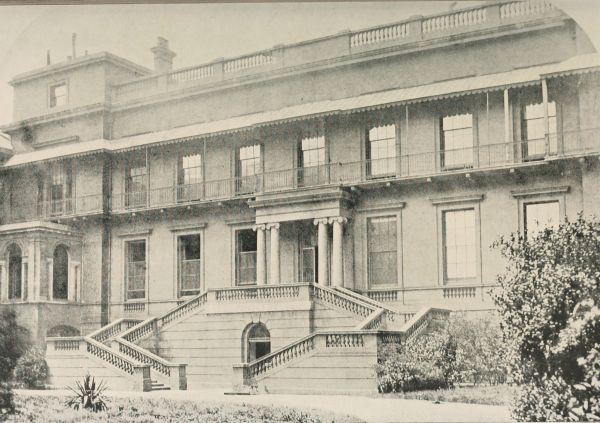
NORTHUMBERLAND HOUSE, FROM THE GARDENS.
According to Mrs Cornwall Baron-Wilson, Thomas Coutts was "a tall, thin, spare figure, and his clothes, always ill-fitting, bore that appearance of being rubbed at the seams, which reveals the 'business coat' of an office. He was often mistaken for an indigent person, and used to enjoy the mistake of all things." There is probably some little exaggeration in this, but the banker, most certainly, was not extravagant in his dress. Even if the following anecdote is not strictly accurate, there is, no doubt, some truth in it:—"Mr Coutts, from his too strict attention to the bank, felt his appetite diminished; and, in order to afford him a little exercise, his physician ordered him to walk daily after the bank closed to a chemist's, who resided at some distance from the Strand, to have some tonic preparation made up. So quiet and unassuming was he in his manners, that he always made way for everyone who came while he was at the shop, so that they might be served before him; and, with his fair, delicate countenance, spare frame, and very simple dress, no strangers guessed that they were pushing aside the opulent Mr Coutts. A kind-hearted, liberal man, a merchant—who used to quit his counting-house about the same time that Mr Coutts left the bank, and who had chanced to be in the chemist's shop two or three times at the hour when the latter came there—had remarked him, and from his retiring, gentle appearance and actions, concluded he was a reduced gentleman whose mind was superior to his means. Accordingly, this charitable merchant resolved to administer to the necessities of the shrinking, modest individual; and, one day, having sealed up a sum of money for the purpose, he went to the chemist's shop, where he remained a length of time, waiting anxiously for the appearance of the latter, who, however, on that day did not come for the tonic, being probably too much engaged in distributing thousands. The stranger, being at length tired of waiting, and feeling ashamed of occupying a place in the shop so long, told the chemist how the absence of the pale, indigent, elderly gentleman had prevented his intended donation. The chemist, in amazement, said: 'And you really meant to offer pecuniary aid to that person, sir? Have you no idea who he is?' 'None,' said the other, 'but I conclude he is some gentlemanly man in distressed, or, at least, reduced circumstances.' 'You shall judge, sir, as to his circumstances—that unassuming, quiet individual is Thomas Coutts!'"[49]
Part of the premises of the bank has been occupied since the removal of Messrs Coutts—in 1904, to No. 440 Strand—by the London County Council. The number is 59, and the upper part is much the same as it was in 1768, when it was erected by the brothers Adam. The house then contained "some good marble chimney-pieces of the Cipriani and Bacon school. The dining-room is hung with Chinese subjects on paper, sent to Coutts by Lord Macartney, while on his embassy to China in 1792-95. In another room is a collection of portraits of the early friends of the wealthy banker, including the portrait of Dr Armstrong, the poet, by Sir Joshua Reynolds. The strong rooms, or vaults of the house—'which alone cost £10,000'—will repay an endeavour to obtain a sight of them. Here, in a succession of cloister-like avenues, are stored in boxes of all shapes, sizes, and colours, patents, title-deeds, plate, etc., of many of the nobility and gentry of Great Britain."[50] The Adams mantel-pieces and some of their doors were transferred to No. 440 Strand; and here the board-room—an apartment of drawing-room appearance which is in strange contrast to the busy thoroughfare below—is hung with the Chinese wall-paper which, despite its hundred and more years of age, looks perfectly new. During the building of the Adelphi, Coutts, in order to prevent the interruption of the view from the back part of the premises, made a stipulation with the Adams that Robert Street should be so planned as to form a kind of framework for the fine view of the hills beyond the Thames. The land beyond John and William streets was then occupied by the strong-rooms, "connected underground with the office, and built only to the level of the Strand. When it became necessary to enlarge" the premises, Coutts "procured a special Act of Parliament for throwing an arch over William Street. It was recognised as a good omen that, on the day of opening these improvements, Nelson sent to Mr Coutts for security the diamond aigrette which had been presented to him by the Sultan."[51] In James Street—now covered, with William Street, in the general name of Durham House Street, stretching from the Strand to John Street—was the Adelphi Chapel, built by a congregation of Particular Baptists about 1777, and subsequently sold by them to the Calvinistic Baptists. Later on, an Independent congregation occupied the building until it became absorbed in the banking-house, and, until the removal of Messrs Coutts, it was called "the chapel."
Many names, famous in all ranks of life, are registered in the accounts of the customers of Messrs Coutts. Taking them at random, they include Pitt, Lord Londonderry, Sir Thomas Lawrence, Sir Walter Scott, the Duke of Wellington, Nelson, Lord Bute, Dr Johnson, C.J. Fox, Lord Grenville, Lord Macartney, Pope, Benjamin West, Lord George Gordon, Dr Armstrong, Mrs FitzHerbert, Charles Dickens, Livingstone, Alfred Tennyson, and Henry Irving. Kings George III. and IV., and William IV., banked here, as did Queen Victoria. Messrs Coutts are also the bankers of King Edward VII.—who also kept an account at No. 59 when he was Prince of Wales—of Queen Alexandra, of the Queen of Spain, and of the King of Portugal.
The partners in the bank are, with the exception of the Hon. W.F.D. Smith, of Scottish descent. On February 23, 1906, the capital was registered as £600,000, distributed as follows:—
William Rolle Malcolm, Lord A. Campbell, G.J. Marjoribanks, and the Earl of Harrowby, as trustees for the persons interested under the will of Harriot, Duchess of St Albans £223,600
Ronald Malcolm and G.J. Marjoribanks (jointly) 82,900
Archibald Dudley Ryder, Edward Dudley Ryder, and the Earl of Harrowby 82,700
William Rolle Malcolm 53,000
The Earl of Harrowby 36,500
George John Marjoribanks 40,000
Lord Archibald Campbell 31,700
The Baroness Burdett-Coutts 21,100
The Hon. F.W.D. Smith 10,000
Ronald Malcolm 10,000
Archibald Dudley Ryder 4,250
The Hon. Edward Dudley Ryder 4,250
————
£600,000
Thomas Coutts left all his property to his wife. His personal estate was valued at just under £600,000, but "as his own personal stocks and shares and his interest in the stocks and shares held by the bank were mingled, and it would be difficult for others than his partners to distinguish which was the bank's property and which was his own, he named as special trustees of such stocks and shares his partners, Sir Edmund Antrobus, Mr Coutts Trotter, Mr Edward Marjoribanks, and Mr Edmund Antrobus, and he appointed them executors, together with William Adam the younger, of Lincoln's Inn, Andrew Dickie, of the Strand, and Thomas Atkinson and John Parkinson, both of Lincoln's Inn Fields." Harriot, Duchess of St Albans, widow of Thomas Coutts, made her will on March 14, 1837, six months before her decease, her executors being Sir Coutts Trotter, Edward Marjoribanks, Sir Edmund Antrobus, and William Matthew Coulthurst, all of the Strand, with William George Adam, Accountant-General of the High Court of Chancery, and John Parkinson, of Lincoln's Inn Fields. She bequeathed to her husband the use and enjoyment during his life of Holly Lodge, Highgate (which Mr Coutts had bought for her at a cost of £25,000), the use and enjoyment of rooms in the Strand, a legacy of £10,000 for furniture, a selection of plate, not exceeding in value £2000, and an annuity of £10,000; but the annuity and the use and enjoyment of Holly Lodge were to cease if he should permit his uncle, Lord Amilius Beauclerk, or his brothers, Frederick or Charles Beauclerk, to reside in these quarters for one week or more in any one year. She left her jewellery to Angela Georgina Burdett—subsequently the Baroness Burdett-Coutts—and she also gave, devised, and bequeathed all her real and personal estate, including her shares and interest of and in the banking-house and business in the Strand, in trust to pay the income thereof to the said Angela Georgina Burdett until she should marry or die, which should first happen, and after such marriage to pay the same to her for her own sole and separate use and benefit during the then residue of her life.
At the southern end of Robert Street, through which Thomas Coutts looked at the Surrey hills, there was, in modern times, the Caledonian Hotel, which, with its hideous plaster front, was a blot upon the surrounding architecture. This, in the late seventies of the last century, was the meeting-place of the Savage Club. The "Savages" then migrated to Lancaster House, Savoy, but in 1889 they returned to the Adelphi, having taken the lease of their present premises, Nos. 6 and 7 Adelphi Terrace. Excepting that the beautiful ceiling of their principal room is covered with whitewash, the rooms still contain much of the Adams imprint. Next door, however, Garrick's house is little changed; the ceiling in his drawing-room was painted by Antonio Zucchi, A.R.A., Angelica Kauffmann's second husband, and it is in a splendid state of preservation, as is the magnificent marble chimney-piece, which is said to have cost £300—the rooms in which Mr and Mrs Garrick died are now in the occupation of the Institution of Naval Architects. King Edward VII. was an honorary life member of the Savage Club from 1882 until his Accession in 1901. Honorary life members of the present year of grace include the Prince of Wales, Earl Roberts, Lord Kitchener, Mr Whitelaw Reid, and Mr Samuel L. Clemens (Mark Twain). The treasurer and secretary—both of which posts are honorary—are Sir James D. Linton, R.I., and Mr Edwin E. Peacock respectively. The club is limited to five hundred town and one hundred country members.
One of the most notable residents of the Adelphi in modern times was Mr Thomas Hardy, who, happily still with us, lived at No. 8 Adelphi Terrace in the years 1863-67. During that time, "I sat there drawing," he wrote to a friend, who has kindly given me the privilege of reproducing his words, "inside the eastern-most window of the front room on the first floor above the ground floor, occasionally varying the experience by idling on the balcony. I saw from there the Embankment and Charing Cross Bridge built, and, of course, used to think of Garrick and Johnson." Mr Hardy, who was born in 1840, was then practising architecture under Sir A. Blomfield, A.R.A. The room in which the future author of Far from the Madding Crowd and Tess of the D'Urbervilles worked "contained at that date a fine Adams mantel-piece in white marble, on which we used to sketch caricatures in pencil."
The coming of the Savage Club to Adelphi Terrace occasioned much sorrow to one of the kindest-hearted men who ever lived—E.L. Blanchard, who had rooms in No. 6 from April 1876 until March 1889, a few months before his death. Edward Litt Laman Blanchard—son of William Blanchard (1769-1835), an actor who was celebrated for his Bob Acres, Sir Hugh Evans, Fluellen, Menenius, and Polonius—was born on December 11, 1820. He was a prolific writer, and for many years was the dramatic critic and theatrical chronicler of The Daily Telegraph. He wrote the Drury Lane pantomime for thirty-seven years—a marvellous record. On December 11, 1888, he writes in his Diary: "Am reminded, to my amazement, that I am sixty-eight this day. Thank God for the many unexpected blessings I have had." On the following day he hears "with inexpressible regret that the Savage Club signed yesterday an agreement to take these premises, and the adjoining house, No. 7." On the 15th he writes: "Receive formal notice to give up possession of Adelphi Terrace on Lady Day next, which troubles me greatly." His death occurred on September 4, 1889. Among the many shadows of the past which rise up before me as I bring to a close this history of the Adelphi of the Brothers Adam, there is none for which I have a greater reverence, or greater affection, than that of gentle, sweet-natured E.L. Blanchard.
FOOTNOTES:
CHAPTER X
York House—Francis Bacon—The Great Seal taken from Him—Lord Keeper Egerton—The Duke of Buckingham, King James' "Steenie"—Magnificence of his Entertainments—Contemporary Descriptions—Bishop Goodman's Praise—The Second Duke—Dryden's Revenge—The "Superstitious Pictures" of York House—Buckingham's Marriage—Spanish, Russian, and French Ambassadors Here—Visits by Pepys and Evelyn—Duke of Buckingham sells York House—His Curious Condition of Sale—The Duke's Litany.
Leaving the Adelphi proper, but still within its precincts, we come to the history of York House, the site of which is indicated by Villiers Street, Buckingham Street, and York Buildings, Adelphi. "Next beyond this Durham House," wrote John Stow, in 1598, "is another great house, sometime belonging to the Bishop of Norwich, and was his London lodging, which now pertaineth to the Archbishop of York by this occasion. In the year 1529, when Cardinal Wolsey, Archbishop of York, was indicted in the Premunire, whereby King Henry VIII. was entitled to his goods and possessions, he also seized into his hands the said archbishop's house, commonly called York Place, and changed the name thereof into Whitehall; whereby the archbishops of York, being dispossessed, and having no house of repair about London, Queen Mary gave unto Nicholas Heath, then Archbishop of York, and to his successors, Suffolk House in Southwark, lately built by Charles Brandon, Duke of Suffolk, as I have showed. This house the said archbishop sold, and bought the aforesaid house of old time belonging to the bishops of Norwich, which of this last purchase is now called York House. The lord chancellors or lord keepers of the Great Seal of England have been lately there lodged." Our other great chronicler, Strype, records that Archbishop Heath, on August 6, 1557, "obtained a license for the alienation of this capital messuage of Suffolk Place; and to apply the price thereof for the buying of other houses called also Suffolk Place, lying near Charing Cross; as appears from a register belonging to the Dean and Chapter of York." Archbishop Heath did not occupy York House for long, and his successors appear to have let it to the Lord Keepers of the Great Seal.
Lord Chancellor Bacon, the son of Nicholas Bacon, Lord Keeper, was born here in 1561, and here his father died in 1579. One of the most interesting of literary associations is that of Francis Bacon with York House. He built an aviary here at a cost of £300, and here Aubrey laid the scene of his jesting with the fishermen, although Bacon himself placed it at Chelsea: "His Lordship (Bacon) being in Yorke House garden looking on Fishers, as they were throwing their nett, asked them what they would take for their draught; they answered so much: his Lop would offer them no more but so much. They drew up their nett, and it were only 2 or 3 little fishes; his Lop then told them, it had been better for them to have taken his offer. They replied, they hoped to have had a better draught; but said his Lop, 'Hope is a good breakfast, but an ill supper.'"[52] When the Duke of Lennox wished to buy, or exchange, York House,[53] Bacon replied: "For this you will pardon me: York House is the house where my father died, and where I first breathed, and there will I yield my last breath, if so please God and the King." In 1621, however, Bacon, charged before the House of Commons with bribery, confessed that he was guilty of "corruption and neglect," and, on May 21 of that year, the Great Seal was "fetched from" the keeping of Lord Bacon of York House. A little later, Bacon had "leave to repair to York House for a fortnight, but remained so long that he had warning to repair to Gorhambury." Another keeper of the Great Seal was Sir John Puckering, who died at York House in 1596. Lord Chancellor Egerton also died here, in 1617. The commission of enquiry into the death, in 1613, of Sir Thomas Overbury, was held at York House, and resulted in the hanging of four of the agents of Lady Essex. The Orders of October 17, 1615, to Somerset "to keep his chamber near the Cockpit," and to his countess "to keep her chamber at the Blackfriars, or at Lord Knollys's house near the Tilt yard," are dated from York House. An attempt made, in 1588, to obtain the property from Queen Elizabeth, has been attributed to the Earl of Essex, to whom the custody of the house was subsequently committed. Edwin Sandys, when Archbishop of York, wrote a "secret letter" to Lord Burghley entreating his lordship to use his influence with the Queen for the refusal of the request of the Earl of Essex, who, curiously enough, was under surveillance at York House during the time—October 6, 1599, to March 20, 1600—that he was in the charge of Lord Keeper Egerton.
In some manner, which is not very clear, York House passed to George, the first Duke of Buckingham of the Villiers family. He "borrowed" it from Archbishop Mathew till such time as he could persuade him "to accept as good a seat as that was in lieu of the same, which could not be so soon compassed, as the Duke of Buckingham had occasion to make use of rooms for the entertainment of foreign princes." On "Whitson-Eve," 1624, as recorded in Archbishop Laud's Diary, "the Bill passed in Parliament for the King to have York House in exchange for other lands. This was for the Lord Duke of Buckingham." The old structure was destroyed, and a large, but temporary, building, erected in its place, great mirrors covering many of the walls. Nothing remains of this house; but the water-gate, at the foot of Buckingham Street, still marks the stately approach to the York House of Buckingham's time. "I am confident there are some that live," wrote Sir Balthazar Gerbier, who was the keeper of York House and collector of pictures for Buckingham, "who will not deny that they have heard the King of blessed memory, graciously pleased to avouch he had seen in Anno 1628, close to the Gate of York House, in a roome not above 35 feet square, as much as could be represented as Sceans, in the great Banqueting Room of Whitehall." The "sceans" were the pictures with which York House was filled by Buckingham, who paid Rubens a hundred thousand florins for an art collection "'more like that of a prince than a private gentleman' with which the great painter of Antwerp had enriched his own dwelling. Among the pictures were no fewer than 19 by Titian; 21 by Bassano; 13 by Paul Veronese; 17 by Tintoretto; 3 by Raphael; 3 by Leonardo da Vinci; and 13 by Rubens himself."[54] Buckingham did not live at York House: he only used it on state occasions. He was assassinated, at Portsmouth, by John Felton, on August 23, 1628.
The entertainments given by Buckingham at York House were unrivalled in their magnificence. A contemporary account of one of them is furnished by the great courtier, François de Bassompiere (1579-1646), Marshal of France, in his Embassy to England,[55] an account of his sojourn here in 1626. "The King," he says, "supped at one table with the Queen and me, which was served by a complete ballet at each course with sundry representations—changes of scenery, tables, and music: the Duke waited on the King at table, the Earl of Carlisle on the Queen, and the Earl of Holland on me. After supper the King and we were led into another room, where the assembly was, and one entered it by a kind of turnstile, as in convents, without any confusion, where there was a magnificent ballet, in which the Duke danced, and afterwards we set to, and danced country dances till four in the morning; thence we were shown into vaulted apartments, where there were five different collations." D'Israeli extracted an account of the same entertainment from the Sloane MSS.: "Last Sunday at night, the Duke's grace entertained their Majesties and the French Ambassador at York House with great feasting and show, where all things came down in clouds; amongst which, one rare device was a representation of the French King and the two Queens, with their chiefest attendants, and so to the life that the Queen's Majesty could name them. It was four o'clock in the morning before they parted, and then the King and Queen, together with the French Ambassador, lodged there. Some estimate this entertainment at five or six thousand pounds."[56] Sir Balthazar Gerbier, writing to Buckingham on February 8, 1625, says: "Sometimes, when I am contemplating the treasure of rarities which your Excellency has in so short a time amassed, I cannot but feel astonishment in the midst of my joy. For out of all the amateurs, and princes, and kings, there is not one who has collected in forty years as many pictures as your Excellency has collected in five. Let enemies and people ignorant of paintings say what they will, they cannot deny that pictures are noble ornaments, a delightful amusement, and histories that one may read without fatigue. Our pictures, if they were to be sold a century after our death, would sell for good cash, and for three times more than they have cost. I wish I could only live a century, if they were sold, to be able to laugh at those facetious folk, who say it is money cast away for baubles and shadows: I know they will be pictures still, when those ignorants will be less than shadows."
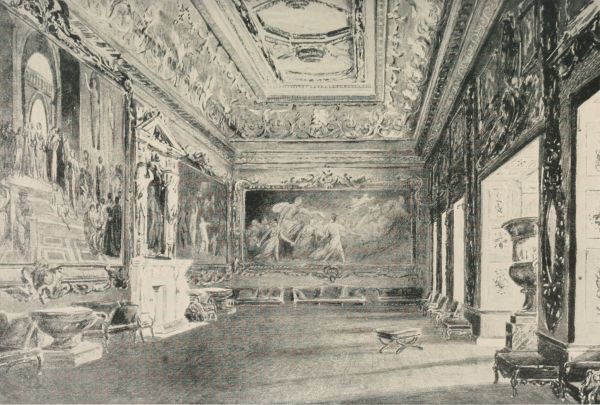
THE BALL-ROOM, NORTHUMBERLAND HOUSE.
Buckingham, as is well known, was the "Steenie" of King James, who quoted the passage (Acts vi. 15), in which it is said of St Stephen: "All that sat in the council, looking steadfastly on him, saw his face as it had been the face of an angel." So the King called his favourite Stephen, and the appellation became corrupted into Steenie. Buckingham, undoubtedly, was a man of great personal attraction. Godfrey Goodman, Bishop of Gloucester, who knew him well, says that, "Of all others he was most active; he had a very lovely complexion; he was the handsomest bodied man of England; his limbs so well compacted, and his conversation so pleasing, and of so sweet a disposition. And truly his intellectuals were very great; he had a sound judgment, and was of a quick apprehension, insomuch that I have heard it from two men, and very great men (neither of them had gotten so little as £3600 per annum by the Court), whom of all men in the world Buckingham had most wronged—yet I heard both those men say and give him this testimony, that he was as inwardly beautiful as he was outwardly, and that the world had not a more ingenious gentleman, or words to that effect."[57]
His son, George, the second Duke of Buckingham, was born in Wallingford House, which stood on the site of the Admiralty buildings, Whitehall, the house having been purchased by his father from Lord Wallingford, in 1621-22. At Wallingford House, "and at York House in the Strand," says Leigh Hunt, "he turned night into day, and pursued his intrigues, his concerts, his dabblings in chemistry and the philosopher's stone, and his designs on the crown; for Charles's character, and the devices of Buckingham's fellow quacks and astrologers, persuaded him that he had a chance of being king. When a youth, he compounded with Cromwell, and married Fairfax's daughter;—he was afterwards all for the king, when he was not 'all for rhyming' or ousting him;—when an old man, or near it (for these prodigious possessors of animal spirits have a trick of lasting a long while), he was still a youth in improvidence and dissipation, and his whole life was a dream of uneasy pleasure".[58] Apart from his Court intrigues and his disordered life, he is interesting to lovers of literature and the stage by reason of his various satires and verses, and, particularly, for The Rehearsal, brought out in 1671, in which he ridiculed contemporary dramatists, including Dryden. But Dryden had his revenge, for, ten years later, he made Buckingham the Zimri of his Absalom and Achitophel:—
"Some of the chiefs were princes in the land: In the first rank of these did Zimri stand, A man so various, that he seemed to be, Not one, but all mankind's epitomê; Stiff in opinions, always in the wrong, Was everything by starts, and nothing long; But in the course of one revolving moon, Was chemist, fiddler, statesman, and buffoon; Then all for women, painting, rhyming, drinking, Besides ten thousand freaks that died in thinking. Blest madman! who could every hour employ With something new to wish or to enjoy. Railing and praising were his usual themes; And both to show his judgment, in extremes; So very violent, or over civil, That every man with him was God or devil. In squandering wealth was his peculiar art; Nothing went unrewarded but desert. Beggar'd by fools, whom still he found too late, He had his jest, and they had his estate. He laugh'd himself from court; then sought relief By forming parties, but could ne'er be chief; For spite of him, the weight of business fell On Absalom, or wise Achitophel; Thus wicked but in will, of means bereft, He left not faction, but of that was left."
Buckingham, whose estates had been confiscated by Cromwell in 1648, regained control of York House in a curious manner—by marriage with the daughter of General Fairfax. Cromwell had bestowed this property on Fairfax at the time of the Civil Wars. "Every chamber," says Brian Fairfax in his Memoirs of Buckingham, "was adorned with the arms of Villiers and Manners, lions and peacocks. He (Lord Fairfax) was descended from the same ancestors, Earls of Rutland." We have the same authority for the statement that the "superstitious pictures in York House" were ordered to be sold on August 20, 1645, but not before one John Trayleman, an "old trusty servant," had smuggled some of the treasures over to Holland, where they found a purchaser in the Archduke Leopold. For one of these pictures, the Ecce Homo, by Titian, the first Duke of Buckingham had been offered £7000, either in money or land, by Lord Arundel. In this painting, likenesses of the Pope, Charles V., and Solyman the Magnificent were introduced. The Duke returned to England in 1657, and obtained an introduction to General Fairfax, who gave a willing ear to the marriage proposition. The lady, we are told, could not resist the fascination of "the most graceful and beautiful person that any court in Europe saw," and the marriage took place at Nun Appleton, near York—a seat of Lord Fairfax—on September 7, 1657. According to Jesse, Cromwell, "who was supposed to have intended Buckingham for one of his own daughters, was greatly enraged when he heard of the match, and immediately committed Buckingham to the Tower. Fairfax demanded his release, which, being angrily and obstinately refused by the Protector, a quarrel was the consequence." After the death of Cromwell, Buckingham was permitted to remove to Windsor Castle. At the Restoration he was restored to his property, and became "the most reckless, unprincipled, and irregular character" at the Court of Charles II.
York House fell from its high estate on coming into the possession of General Fairfax. On November 27, 1655, Evelyn "went to see York House and gardens, belonging to the former greate Buckingham, but now much ruin'd thro' neglect." In 1661, Baron de Batteville, the Spanish Ambassador, was lodged there, a fact which affords us, through the pages of Samuel Pepys, a curious peep into the past. On May 19, 1661 (Lord's Day), this delightful chronicler walked in the morning towards Westminster, and, seeing many people at York House, he went down from the Strand "and found them at masse, it being the Spanish Ambassador's; and so I got into one of the galleries, and there heard two masses done, I think not in so much state as I have seen them heretofore. After that, into the garden, and walked an hour or two, but found it not so fine a place as I took it for by the outside." In September of the same year, Pepys witnessed a strange encounter between the retainers of the ambassadors of Spain and France, which terminated at York House: "This morning, up by moonshine, at five o'clock, to Whitehall, to meet Mr More at the Privy Seale, and ther I heard of a fray between the two embassadors of Spaine and France, and that this day being the day of the entrance of an embassador from Sweeden, they intended to fight for the precedence. Our king, I heard, ordered that no Englishman should meddle in the business, but let them do what they would. And to that end, all the soldiers in town were in arms all the day long, and some of the train bands in the city, and a great bustle through the city all the day. Then we took coach (which was the business I came for) to Chelsey, to my Lord Privy Seale, and there got him to seal the business. Here I saw by daylight two very fine pictures in the gallery, that a little while ago I saw by night; and did also go all over the house, and found it to be the prettiest contrived house that I ever saw in my life. So back again; and Whitehall light, and saw the soldiers and people running up and down the streets. So I went to the Spanish embassadors and the French, and there saw great preparations on both sides; but the French made the most noise and ranted most, but the other made no stir almost at all; so that I was afraid the other would have too great a conquest over them. Then to the wardrobe and dined there; and then abroad, and in Cheapside hear, that the Spanish hath got the best of it, and killed three of the French coachhorses and several men, and is gone through the city next to our King's coach: at which it is strange to see how all the city did rejoice. And, indeed, we do naturally all love the Spanish and hate the French. But I, as I am in all things curious, presently got to the water-side, and there took oars to Westminster Palace, and ran after them through all the dirt, and the streets full of people; till at last, in the Mews [Charing Cross], I saw the Spanish coach go with fifty drawn swords at least to guard it, and our soldiers shouting for joy. And so I followed the coach, and then met it at Yorke House, where the embassador lies; and there it went in with great state. So then I went to the French house, where I observe still, that there is no men in the world of a more insolent spirit where they do well, nor before they begin a matter, and more abject if they do miscarry, than these people are; for they all look like dead men, and not a word among them, but shake their heads. The truth is, the Spaniards were not only observed to fight more desperately, but also they did outwitt them; first in lining their own harnesse with chains of iron that they could not be cut, then in setting their coach in the most advantageous place, and to appoint men to guard every one of their horses, and others for to guard the coach, and others the coachman. And, above all, in setting upon the French horses and killing them, for by that means the French were not able to stir. There were several men slaine of the French, and one or two of the Spaniards, and one Englishman by a bullet. Which is very observable, the French were at least four to one in number, and had near one hundred cases of pistols among them, and the Spaniards had not one gun among them, which is for their honour for ever, and the others' disgrace. So having been very much daubed with dirt, I got a coach and home; where I vexed my wife in telling her of this story, and pleading for the Spaniards against the French."
But the whirligig of time brings in its own revenges, and, in 1672, the French Ambassador was installed at York House. On April 4, Evelyn "went to see the fopperies of the Papists at Somerset House and York House, where now the French Ambassador had caus'd to be represented our Blessed Saviour at the Paschal Supper with his disciples, in figures and puppets made as big as the life, of wax-work, curiously clad and sitting round a large table, the roome nobly hung, and shining with innumerable lamps and candles; this was expos'd to all the world, all the Citty came to see it: such liberty had the Roman Catholicks at this time obtain'd." In 1663, the Russian Ambassador was in occupation. On June 6, of that year, Pepys journeyed "To York House, where the Russian Embassador do lie; and there I saw his people go up and down losing themselves: they are all in a great hurry, being to be gone the beginning of next week. But that that pleased me best, was the remains of the noble soul of the late Duke of Buckingham appearing in his house, in every place, in the door-cases and the windows. Sir John Hebden, the Russian Resident, did tell me how he is vexed to see things at Court ordered as they are by nobody that attends to business, but every man himself or his pleasures. He cries up my Lord Ashley to be almost the only man that he sees to look after business; and with the ease and mastery, that he wonders at him. He cries out against the King's dealing so much with goldsmiths, and suffering himself to have his purse kept and commanded by them."
How the French Ambassador came to be in residence at York House in April, 1672—as most certainly he was—is somewhat curious. For, by a deed dated January 1, of that year, the Duke sold the house and gardens in order to obtain money for his extravagances. The purchasers were Roger Higgs, of St Margaret's, Westminster, Esq.; Emery Hill, of Westminster, gentleman; Nicholas Eddyn, of Westminster, woodmonger; and John Green, of Westminster, brewer; and the price of the property was £30,000. In 1668, the rental of "York House and tenements, in the Strand," had been fixed at £1359, 10s. The Duke made it a condition of the sale that his name should be commemorated in the new buildings to be erected on the site of York House; hence we have York Buildings, Buckingham Street, Villiers Street, and Duke Street, at the present day. There was even an "Of" Lane, but this has been converted into George Court. It is said that, with part of the money thus obtained, the Duke purchased land in Dowgate. Be this as it may, the nomenclature of the York House estate caused much derision at the time, and brought forth The Litany of the Duke of Buckingham, a merry satire containing the following exhortation:—
"From damning whatever we don't understand, From purchasing at Dowgate, and selling in the Strand, Calling streets by our name when we have sold the land, Libera nos Domine!"
FOOTNOTES:
CHAPTER XI
The York Water-Gate—Inigo Jones' Beautiful Work—Built for the Duke of Buckingham—The Proposal for its Removal—Satires on the Subject—The Gate Neglected—Its Restoration—The Water Tower—The West-end supplied with Water from Here—The Steam Engine—Samuel Pepys resides in Buckingham Street—William Etty and Clarkson Stanfield—Peter the Great Lodges Here—His Love of Strong Drink—The Witty Earl of Dorset—David Hume and Jean Jacques Rousseau—Moore writes to his Publisher Here—The Father of Modern Geology—A Great Actor dies Here—The Original of Smollett's Hugh Strap—David Copperfield's Chambers—Evelyn lives in Villiers Street—Sir Richard Steele—Zara acted Here—Mrs Cibber—Misstatement by "Anthony Pasquin."
Although every trace of York House itself has been long ago obliterated, there still remains the water-gate, one of the most interesting historical relics in London. Peter the Great's house, which formerly overlooked it, has given place only this year to a new building, but the "stairs" which were erected for the first Duke of Buckingham are still here to remind us of many celebrities who came to this hallowed spot from the days of "Steenie" until the beginning of the last century. The architect of this charming piece of work was Inigo Jones (1573-1652), and the date of its erection can safely be attributed to the year 1625. One Nicholas Stone (1586-1647) has been wrongly credited with the design. In his Account Book of Workes, which is in the library of Sir John Soane's Museum, it is said: "The Water-gate at York House hee dessined and built; and ye right hand lion hee did, fronting ye Thames. Mr Kearne, a Jarman, his brother by marrying, did ye Shee lion." But Stone—whose best work was in tombs, those of Bodley at Oxford and Donne in St Paul's being his most celebrated—carried out many of the designs of Inigo Jones, and, from this cause, I fancy, came his claim to the York water-gate. These "stairs," as they were commonly called, have been described as "unquestionably the most perfect piece of building that does honour to the name of Inigo Jones—planned in so exquisite a taste, formed of such equal and harmonious parts, and adorned with such proper and elegant decorations, that nothing can be censured or added. It is at once happy in its situation, beyond comparison, and fancied in a style exactly suited to that situation. The rock-work, or rustic, can never be better introduced than in buildings by the side of water; and, indeed, it is a great question whether it ought to be made use of any where else." The arms of the Villiers family—now the worse for wear, but still visible—appear on the side facing the Thames, and, on the reverse, is to be seen their motto: Fidei Coticula Crux—the Cross is the Touch-stone of Faith. The terrace on this side was planted with lime-trees, and, less than a century ago, was "supported by a rate raised upon the houses in the neighbouring streets; and, being enclosed from the public, forms an agreeable promenade for the inhabitants."
This famous water-gate has had its vicissitudes. In 1767, there was a proposal for its removal, but, fortunately, this act of vandalism was not allowed to take place. The suggestion gave rise to various protests, one of which took the following form:—
"Sacred to the Memory and Reputation of INIGO JONES. Let no Hand attempt to remove me: A Mind improved by Taste Will consider me as a bulwark To controul the Waves, Repel the Flood, And buffet the Western Blasts that annoy The Inhabitant. I am the only perfect Building of the Kind In England; An search Europe thro', none excell me. Who Seek to destroy me, Repentance shall o'er-take. Genius shall hunt them from Society, Contempt shall mark them for her own."
Whether the sinful souls who had thought to execute their fell purpose ever repented or were hunted "from Society," is not recorded. Another satire was in more lively strain:—
"A strange hubble bubble Confusion and trouble Has been about York Buildings Gate; And some gentlemen swear It shall not stand there, It's a thing, above all, that they hate. Tho' 'twas Inigo Jones Plan'd the piling these stones, And superb is the architecture; But alas! some so say It does stand in the way Of one that's a Terras director. Must this building at length Render up all its strength, That's withstood the tempestuous billows; Even rain, storms of hail, Stood secure from each gale, To please some testy old fellows. Last Wedn'sday at night With all malice and spite Poor Inigo's fame they did sully; Till a member arose And opposed his foes Verbatim he spoke like a Tully. Some the cause did maintain, That it should there remain, Or where can we go helter-skelter? At a time when it rains, Without trouble or pains The ladies go there for a shelter. And from Phœbus's Rays, In hot, sultry days, To be free from intenseness of heat; Such a prospect it gains O'er the river of Thames, There's not a more pleasing retreat. T.B."
The gate had become so neglected in 1823 that it was necessary to repair the roof and stone-work and to renew the iron-work. This was done at a cost of £300, defrayed by a rate levied on the occupants of York Buildings. Thirteen years later, however, I find a complaint that the gate had been allowed "from neglect, to be almost smothered in river mud." Again, in 1854, it was said to be "in a ruinous state"—a view of the case which is somewhat exaggerated, for the gate is still in wonderful preservation, considering its age and the destructive nature of the London climate. The gate, and the terrace behind, are now under the control of the London County Council. It is a pity that the "stairs" are so hidden in the hollow of the gardens, but this cannot be avoided. The terrace, which leads from Villiers Street to York Buildings, with an entrance from Buckingham Street, is well-kept, and, very properly, it is only open during the day.
In the frontispiece to this volume, and in some of the other illustrations, there is to be seen, to the left of the water-gate, a strange-looking "octangular structure, about seventy feet high, with small round loopholes as windows." This is the tower of some works which were made in the twenty-seventh year of King Charles II. for the supply of water from the silvery Thames to the inhabitants of the west end. Many of the wooden pipes through which the water was conveyed have been excavated from time to time in Brook Street, Grosvenor Square, and other places. In 1688, there were forty-eight shares in the company. After the Scotch rebellion in 1715, the company invested large sums in purchasing forfeited estates, which no Scot would buy. Bankruptcy followed, and, in 1783, the Scotch estates were sold for £102,537.[59] A curious description of the works is given in the Foreigner's Guide to London for 1720: "Here you see a high wooden tower and a water-engine of a new invention, that draws out of the Thames above three tons of water in one minute, by means of the steam arising from water boiling in a great copper, a continual fire being kept to that purpose; the steam being compressed and condensed, moves, by its evaporation, and strikes a counterpoise, which counterpoise striking another, at last moves a great beam, which, by its motion of going up and down, draws water from the river which mounts through great iron pipes to the height of the tower, discharging itself there into a deep leaden cistern; and thence falling through other large iron pipes, fills them that are laid along the streets, and so continuing to run through wooden pipes as far as Mar-bone fields, falls there into a large pond or reservoir, from whence the new buildings near Hanover Square, and many thousand houses, are supplied with water. This machine is certainly a great curiosity, and though it be not so large as that of Marly in France, yet, considering its smallness in comparison with that, and the little charge it was built and kept with, and the quantity of water it draws, its use and benefit is much beyond that." This steam-engine was not in use after 1731, but it was shown for some years later as a curiosity. The cost of working the machine, "and some other reasons concurring, made its proprietors, the York Buildings Waterworks Company, lay aside the design; and no doubt but the inhabitants of this neighbourhood are very glad of it, for its working, which was by sea-coal, was attended with so much smoke, that it not only must pollute the air thereabouts, but spoil the furniture."[60]
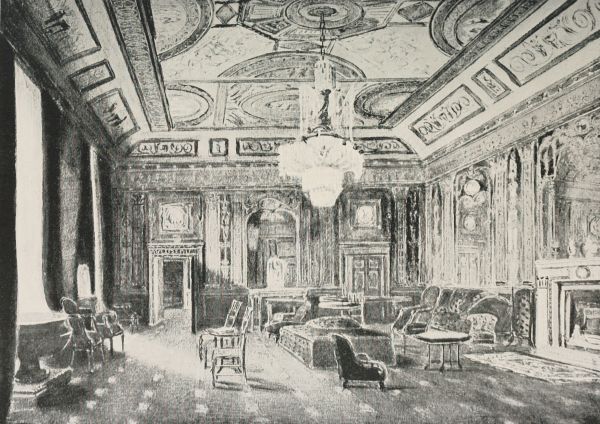
THE DRAWING-ROOM, NORTHUMBERLAND HOUSE.
Buckingham Street is hallowed by the memory of many celebrities. Here, at the last house on the west facing the river (since rebuilt, and now numbered 14), Samuel Pepys lived from 1684 to 1700. Pepys, unfortunately, had finished his Diary in 1669, or we should have had some quaint observations from him in reference to his residence here. The house had been occupied previously by his great friend, William Hewer, at whose residence in Clapham the genial gossip died in 1703. No. 14 was the home of William Etty, R.A., from the summer of 1824 until shortly before his death in 1849. He first occupied the ground floor, but he moved to the top rooms, as he loved to watch the sunsets over the Thames. The ebb and flow of the river, he declared, was like life, and "the view from Lambeth to the Abbey not unlike Venice. Here he invited Thomas Stothard, the famous painter, to breakfast at nine o'clock, when there is a good light to see my Venetian studies of colour, which are all hung round the room where I breakfast." In these rooms, "the artists of two generations have assembled—Fuseli, Flaxman, Holland, Constable, and Hilton—then Turner, Maclise, Dyce, Herbert, and all the younger race."[61] Clarkson Stanfield, the landscape painter, who designed some beautiful scenery for Drury Lane and painted a drop-scene for Dickens, occupied the lower rooms for some years.
"Should my reader's boat ever stop at York Water Gate," wrote J.T. Smith, in his Book for a Rainy Day, "let me request him to look up at the three upper balconied windows of that mass of building at the south-west corner of Buckingham Street. Those, and the two adjoining Westminster, give light to chambers occupied by that truly epic historical painter, and most excellent man, Etty, the Royal Academician, who has fitted up the balconied room with engravings after pictures of the three great masters, Raphael, Nicholas Poussin, and Rubens. The other two windows illuminate his painting room, in which his mind and colours resplendently shine, even in the face of one of the grandest scenes in Nature, our River Thames and City edifices, with a most luxuriant and extensive face of a distant country, the beauties of which he most liberally delights in showing to his friends from the leads of his apartments.... The rooms immediately below Mr Etty's are occupied by Mr Lloyd, a gentleman whose general knowledge in the graphic art I and many more look up to with the profoundest respect. The chambers beneath Mr Lloyd's are inhabited by Mr Stanfield, the landscape painter."
In the house on the opposite corner—now demolished, as already stated, but to be seen in the "view of Westminster from the Thames, 1750"—lived, for three months, in 1698, Peter the Great. Here he returned from his work at Deptford, spending his evenings with his cicerone, Lord Carmarthen, drinking a pint of hot brandy, further warmed by the addition of cayenne pepper, after he had consumed numberless draughts of wine. It is said that on one occasion he drank a pint of brandy, a bottle of sherry, and eight flasks of sack, after which he went to the theatre. While in Buckingham Street he "was so annoyed with the vulgar curiosity of intrusive citizens, that he would sometimes rise from his dinner and leave the room in a rage. Here the Quakers forced themselves upon him, and presented him with Barclay's Apology, after which the Czar attended their meeting in Gracechurch Street. He once asked them of what use they were to any kingdom, since they would not bear arms. On taking his farewell of King William, Peter drew a rough ruby, valued at £10,000, from his waistcoat pocket, and presented it to him screwed up in brown paper. He went back just in time to crush the Strelitzes, imprison his sister Sophia, and wage war on Charles XII. The great reformer was only twenty-six years old when he visited England."
Other famous inhabitants of Buckingham Street include, in 1681, Charles Sackville, the sixth Earl of Dorset, the poet and wit; in 1706, Robert Harley (afterwards Earl of Oxford), who received such high praise from Pope and Swift; and, in 1727, James Wellwood, physician and author. A very interesting literary association is that of David Hume and Jean Jacques Rousseau, who, in 1766, were made welcome at his house in this street by Hume's friend, John Stewart. Subsequently they "removed into lodgings a few doors off. In one or other of these houses Rousseau laid the scene of all the imaginary insults heaped upon him by his brother philosopher, the crowning injury being inflicted at their parting in Buckingham Street, which Rousseau describes with such comic vehemence. Whilst here, Rousseau was the object of much curiosity."[62] Mr Wheatley also states that No. 22 was the house of Power, the publisher of the Irish Melodies, to whom Moore wrote so frequently, and that "Strata" Smith, "the father of modern geology," lived in this street, his young nephew, John Phillips (afterwards the Oxford professor), being with him. One of the most noted representatives of Hamlet and Falstaff died at his house in Buckingham Street in 1785. This was John Henderson, who, although without many personal advantages, achieved a great position. He was "the soul of feeling and intelligence."
In the lodge of the terrace at the foot of Buckingham Street lived, for several years before his death in 1809, Hugh Hewson, the original of Smollett's Hugh Strap in Roderick Random, the simple, generous adherent whose generosity and fidelity met with such a base return from the heartless libertine. Another memory of this small street brings us once more to Dickens and David Copperfield. For it was here that Copperfield lodged when he was undergoing his month's probation with Spenlow and Jorkins. Betsy Trotwood announced to her nephew: "'There's a furnished little set of chambers to be let in the Adelphi, Trot, which ought to suit you to a marvel.'
"With this brief introduction, she produced from her pocket an advertisement, carefully cut out of a newspaper, setting forth that in Buckingham Street in the Adelphi there was to be let furnished, with a view of the river, a singularly desirable and compact set of chambers, forming a genteel residence for a young gentleman, a member of one of the Inns of Court, or otherwise, with immediate possession. Terms moderate, and could be taken for a month only, if required.
"'Why, this is the very thing, aunt!' said I, flushed with the possible dignity of living in chambers.
"'Then come,' replied my aunt, immediately resuming the bonnet she had a minute before laid aside. 'We'll go and look at 'em.'
"Away we went. The advertisement directed us to apply to Mrs Crupp on the premises, and we rang the area bell, which we supposed to communicate with Mrs Crupp. It was not until we had rung three or four times that we could prevail on Mrs Crupp to communicate with us, but at last she appeared, being a stout lady with a flounce of flannel petticoat below a nankeen gown."[63] For a further description of Copperfield's life in Buckingham Street, I must refer my readers to the pages of Dickens.
The earliest mention that we have of Villiers Street is found in the diary of the pious and amiable John Evelyn, who, on November 17, 1683, sets down: "I took a house in Villiers Street, York Buildings, for the winter, having many important concerns to dispatch, and for the education of my daughters." Addison's friend, Sir Richard Steele, lived here after the death of his wife, the jealous "Prue," in 1721, until 1724. While he was here, his last comedy, The Conscious Lovers, was produced at Drury Lane, in 1722. There was a celebrated music room in this street. The building, erected in 1680, was popular for half a century, and was pulled down in 1758. It contained a beautiful ceiling, painted by Verrio, which had been incorporated from York House, and, as it could not be removed, it was, perforce, destroyed. The Fair Penitent, Jane Shore, The Beggar's Opera, and other well-known pieces were performed here. In the Miscellanies of the dramatist, Aaron Hill (1685-1750), is "A Prologue for the third night of Zara"—which Hill had translated from Voltaire—"when first played at the Great Musick Room, in Villars Street, York Buildings," in 1735. The representative of Lusignan—one of Garrick's best parts—a gentleman named Bond, expired on the stage. At the first representation of the piece, a young gentleman, a relation of the author's, attempted the character of Osman, but without success, despite the great pains taken at rehearsal by the adapter. Zara was still more remarkable for the appearance in it, at the age of twenty-five, of Mrs Cibber, who subsequently achieved such great fame on the stage. Zara was her first attempt in tragedy. On the sole authority of that wicked libeller and scurrilous writer, "Anthony Pasquin," otherwise John Williams, "one of the dirtiest and most disreputable fellows that ever disgraced the literary profession," it has been related that Garrick, three years before he appeared for the first time on the London stage, had acted in the Duke's Theatre, and that "the ladies who were present were so fascinated by Mr Garrick's powers that they offered him their trinkets and their purses from the boxes." This is not so. Garrick did not play before the public in London until October 19, 1741.
FOOTNOTES:
CHAPTER XII
The Strand in 1353—St Mary Rounceval—Northampton House—Earl of Surrey, the Poet—Suffolk House—Suckling's Ballade upon a Wedding—Algernon Percy, Earl of Northumberland—The Restoration planned at Northumberland House—Lady Elizabeth Percy—Her Romantic Marriages—Murder of "Tom of Ten Thousand"—The "Proud" Duke of Somerset—Edwin and Angelina—Goldsmith at Northumberland House—Fire Here—Dr Percy's Library saved—the Famous Lion—Demolition of the House—The Duke's Lament—Northumberland Avenue—Craven Street—Benjamin Franklin—Sir Joshua Reynolds—Heinrich Heine—The Author of Rejected Addresses—J.S. Clarke.
The last of the great mansions of the Strand, Northumberland House, which was swept away so recently as 1874, was a landmark of great antiquity. For it terminated the palaces of the nobles which existed for centuries on the north bank of the Thames from Blackfriars to Charing Cross. It may be observed that in 1353 the Strand was an open highway, with here and there a great man's house where gardens stretched to the water's edge. It was then so impassable that Edward III. directed the levying of a tax upon wool, leather, wine, and "all goods" carried to Westminster from Temple Bar to the Abbey, for the repair of the road; and he further ordered that all owners of houses adjacent to the highway should repair as much as lay before their doors. "There was no continued street here," says Pennant, "till about 1533: before that time it entirely cut off Westminster from London, and nothing intervened except a few scattered houses, and a village which afterwards gave name to the whole. St Martin's stood literally in the fields. But about the year 1560 a street was formed, loosely built; for all the houses on the south side had great gardens to the river, were called by their owners' names, and in aftertimes gave name to the several streets that succeeded them, pointing down to the Thames; each of them had stairs for the conveniency of taking boat.... The north side was a mere line of houses from Charing Cross to Temple Bar; all beyond was country. The gardens which occupied part of the site of Covent Garden were bounded by fields, and St Giles's was a distant country village."
The site of Northumberland House was that which had been previously occupied by the "hospital" or chapel of St Mary Rounceval. "Then," says Stow, "there was an hospital of St Marie Rouncivall by Charing Cross (a cell to the priory and convent of Roncesvalles in Navarre, in Pamplona diocese), where a fraternity was founded in the 15th year of Edward IV., but now the same is suppressed and turned into tenements." On the other hand, Pennant gives it a still greater antiquity, for he states that the chapel was founded, by William, Earl of Pembroke, in the reign of Henry III., repressed by Henry V. among the alien priories, and rebuilt by Edward IV., "who fixed a fraternity in it." Dissolved by Henry VIII., the property was granted by Edward VI. to Sir Thomas Cawarden, a private individual who did not attain to fame. From him it passed to Sir Robert Brett, and thence, by purchase, to Henry Howard, Earl of Northampton, who, in the reign of James I., built the immediate predecessor of Northumberland House. This Henry Howard, the first Earl of Northampton (1540-1614) was the second son of Henry Howard, Earl of Surrey, the poet. He was the most learned nobleman of his day. He may have had some religious sentiment in purchasing the original site of the chapel of St Mary, for he lived and died a Roman Catholic.
In the building of his "sumptuous palace," which he called Northampton House, he had for his architects Bernard Jansen, who was more a stonemason than an architect, and another maker of funeral monuments, Gerrard Christmas (Garret Christmas). The latter carved for himself the initials C. Æ. (Christmas Ædificavit), in large capitals over the old stone gateway, which was replaced by a new front towards the Strand in the reign of George II. At that time the house consisted of three sides of a quadrangle, the centre facing the Strand, and, of course, with gardens down to the river. The Earl of Northampton died here in 1614, and by his will bequeathed the house and garden to his nephew, Thomas Howard, first Earl of Suffolk, the second son of Thomas Howard the third, fourth Duke of Norfolk. As Lord Thomas Howard he distinguished himself against the Armada in 1588. He completed the quadrangle of Northampton House by building the front towards the Thames, and he changed the name to Suffolk House. The Earl of Suffolk died here in 1626, and his son, Theophilus, inherited the property. On his death, in 1640, James, the third Earl of Suffolk (1619-1688), inherited it. His sister, the Lady Elizabeth Howard, was married, in 1642, to Algernon Percy, Earl of Northumberland. By an indenture dated a few days before the marriage, the property was conveyed by the Earl of Suffolk to the Earl of Northumberland, a change which led also to the nomenclature of the house, which has had such a long career, and the destruction of which many Londoners still lament.
Before coming to the history of Northumberland House as it appeared from the middle of the seventeenth century—when great changes were made in its structure—until its demolition in 1874, it is interesting to note that one of the quaintest, and, in some respects, most charming of the old English poems had its origin in the marriage of Roger Boyle, Lord Broghill, the first Earl of Orrery, to Lady Margaret Howard, daughter of the first Earl of Suffolk, the builder of Northampton House. This is the event which called forth, in 1637, Sir John Suckling's Ballade upon a Wedding, in which one of the prettiest conceits in the English language occurs. The verses are too long to quote in extenso, but some extracts may be given, as they are germane to the matter of this particular history. The wedding is supposed to be described by a rustic, writing to his friend in the country:—
"I tell thee, Dick, where I have been, Where I the rarest things have seen.
At Charing-Crosse, hard by the way Where we (thou know'st) do sell our hay, There is a house with stairs; And there did I see comming down Such folk as are not in our town, Vorty, at least, in pairs.
Her finger was so small, the ring Would not stay on which they did bring, It was too wide a peck. And to say truth, for out it must, It looked like the great collar, just, About our young colt's neck. Her feet beneath her petticoat, Like little mice stole in and out, As if they feared the light. But oh! she dances such a way, No sun upon an Easter day Is half so fine a sight.
Her cheeks so rare a white was on, No daisy makes comparison, Who sees them is undone; For streaks of red were mingled there, Such as are on a Katherine pear, The side that's next the sun. Her lips were red, and one was thin; Compared to that was next her chin, Some bee had stung it newly; But Dick, her eyes so guard her face, I durst no more upon them gaze, Than on the sun in July. Her mouth so small when she does speak, Thoud'st swear her teeth her words did break, That they might passage get; But she so handled still the matter, They came as good as ours or better, And are not spent a whit."
Algernon Percy, the tenth Earl of Northumberland, who was called by Lord Clarendon "the proudest man alive," became guardian of the two youngest children of Charles I. in 1645, and was one of the commissioners appointed to negotiate with the King at Newport in 1648. He took no part in public affairs during the Commonwealth and Protectorate. In the spring of 1660, George Monk—afterwards the Duke of Albemarle, and the husband of "Nan" Clarges—was invited, with the Earl of Manchester, Sir William Waller, and others to Northumberland House, and here, "in secret confidence with them," says Clarendon, "some of those measures were concerted which led to the speedy restoration of the Monarchy." Algernon Percy, who was a privy councillor after the Restoration, died in 1668. His son and successor, Josceline Percy, dying in 1670, without male issue, the property passed to his daughter, the Lady Elizabeth Percy (1667-1722). This lady had a strange matrimonial career. At the age of twelve she was "married" to Henry Cavendish, Earl of Ogle (son and heir of Henry, Duke of Newcastle), but he died in his youth. Two years later—that is to say, in 1681—she espoused Thomas Thynne, of Longleat, Wilts.
Thynne, who was nicknamed "Tom of Ten Thousand," in consequence of his great wealth, was the Issachar of Absalom and Achitophel. Lady Elizabeth, soon after the death of Lord Ogle, had been given in marriage by her grandmother to Thynne, who, however, had agreed, on account of the youth of his bride, that the marriage should not be consummated until a year had elapsed. The lady, however, took such a dislike to Thynne that she fled for protection to Lady Temple at the Hague. "In the meantime, the famous Count Königsmark—noted for his beauty and intrigues in most of the Courts of Europe—had accidentally met Lady Ogle in public, and had either fallen in love with her person, or with the vast fortune of which she was the mistress. That the feeling was reciprocal there is not the least reason to suppose. Königsmark, however, equally daring and unprincipled, determined by foul, if not by fair means, to make her his wife, and, as the first step, projected the assassination of the unfortunate Thynne. The persons whom he hired to commit the crime were three foreigners—one Captain Vratz, a German; a Lieutenant Stern, a Swede; and one George Borotski, a Pole. The two former seem to have been as daring and reckless adventurers as any age could produce. Borotski, on the other hand, was a quiet, uneducated man, who appears to have acted entirely from a feeling of retainership, without any thought of the gold which had induced his accomplices to undertake to commit the crime. The night of Sunday, the 12th of February 1682, was fixed upon for the perpetration of the foul deed. Accordingly, having had their several parts assigned to them, between seven and eight o'clock the three assassins, mounted on horseback, posted themselves in a part of Pall Mall, nearly opposite to the present Opera Colonnade, through which they had ascertained the equipage of Thynne was likely to pass. As soon as the coach appeared in sight, they all three rode up to the window, and, by their imposing attitude, compelled the coachman to halt. One shot only was fired, which was from a musketoon, carried by Borotski. So true, however, was the aim, that as many as five bullets entered the body of his victim. Thynne was forthwith carried to his own residence, where he lingered till about six o'clock the following morning, when he expired."[64] Königsmark attempted to escape, but he was arrested at Gravesend at the very moment that he was about to set foot on a foreign vessel. He was immediately brought to trial, and, after some delay, acquitted. His accomplices were condemned to death, and, on March 10, executed in Pall Mall, on the spot where they had committed the atrocious crime. Thynne was buried in Westminster Abbey, and a monument in white marble, representing the tragedy in bas-relief, was erected to his memory.
Thus, in the language of Lawrence Echard, the historian, Lady Elizabeth Percy had been a "virgin widow" twice ere, on May 30, 1682—at the age of fifteen—she became a wife. Her third husband was Charles Seymour (1662-1748), the sixth Duke of Somerset, commonly called "the proud duke." By an arrangement made before the marriage, he assumed the surname and arms of Percy, "but from that stipulation he was released when her grace attained her majority." The duke and duchess lived "in great state and magnificence" at Northumberland House. The duchess died in 1722, and the duke, dying in 1748, was succeeded by his eldest son, Algernon, Earl of Hertford and seventh Duke of Somerset, who, in 1749, was created Baron Warkworth of Warkworth Castle, Northumberland, and Earl of Northumberland, with remainder, in default of male issue, to Sir Hugh Smithson, Bart., a country gentleman of Stanwick, in Yorkshire, who had married his only daughter, the Lady Elizabeth Seymour. Sir Hugh Smithson was raised to the dukedom of Northumberland in 1766, and the title remains with his descendants at the present day. Algernon Seymour greatly improved the Strand front of Northumberland House, and built the gallery, or great room, which formed the western wing of the south side. In the cornice, or balustrading, on the top of the south front he had inserted the letters and date: A.S.P.N. (Algernon Seymour Princeps Northumbriæ), A.D. 1749.
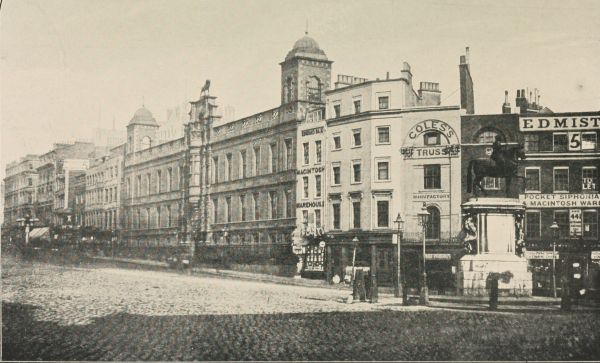
CHARING CROSS, BEFORE THE BUILDING OF NORTHUMBERLAND AVENUE.
Goldsmith is connected with Northumberland House through his poem, Edwin and Angelina. It was suggested in the course of discussions on ballads with Dr Percy (1729-1811), editor of the famous Reliques of Ancient English Poetry, first published in 1765. Percy, who had rooms in Northumberland House, was visited here by Goldsmith, and one result of this acquaintanceship was the poem in question, which was privately "Printed for the amusement of the Countess of Northumberland." Copies of this edition are extremely rare, and, apart from their scarcity, they possess an independent value inasmuch as they show Goldsmith's painstaking care in the preparation of his verse. By comparing this edition with subsequent issues, "we perceive that even the gentle opening line has been an after-thought; that four stanzas have been re-written; and that the two which originally stood last have been removed altogether. These, for their simple beauty of expression, it is worth while here to preserve. The action of the poem having closed without them, they were, on better consideration, rejected; and young writers should study and make profit of such lessons. Posterity has always too much upon its hands to attend to what is irrelevant or needless; and no one so well as Goldsmith seems to have known that the writer who would hope to live must live by the perfection of his style, and by the cherished and careful beauty of unsuperfluous writing.[65]
"'Here amidst sylvan bowers we'll rove, From lawn to woodland stray; Blest as the songsters of the grove, And innocent as they. To all that want, and all that wail, Our pity shall be given; And when this life of love shall fail, We'll love again in heaven.'"
Goldsmith's own account of the blunder which he made on the occasion of one of his visits to this old mansion is as follows:—"I dressed myself in the best manner I could, and, after studying some compliments I thought necessary on such an occasion, proceeded to Northumberland House, and acquainted the servants that I had particular business with the duke. They showed me into an antechamber, where, after waiting some time, a gentleman, very elegantly dressed, made his appearance. Taking him for the duke, I delivered all the fine things I had composed, in order to compliment him on the honour he had done me; when to my fear and astonishment, he told me I had mistaken him for his master, who would see me immediately. At that instant the duke came into the apartment, and I was so confounded on the occasion that I wanted words barely sufficient to express the sense I entertained of the duke's politeness, and went away exceedingly chagrined at the blunder I had committed."
To Sir John Hawkins, the Middlesex magistrate, who drew up Johnson's will, and, in 1787-89, published Johnson's Life and Works, we are indebted for a description of another meeting with the Duke of Northumberland. "Having one day," he says, "a call to wait on the late Duke, then Earl of Northumberland, I found Goldsmith waiting for an audience in an outer room; I asked him what had brought him there: he told me, an invitation from his lordship. I made my business as short as I could, and, as a reason, mentioned that Dr Goldsmith was waiting without. The earl asked me if I was acquainted with him. I told him I was, adding what I thought likely to recommend him. I retired, and staid in the outer room to take him home. Upon his coming out, I asked him the result of his conversation. 'His lordship,' says he, 'told me he had red (sic) my poem,' meaning the Traveller, and was much delighted with it; that he was going lord-lieutenant of Ireland, and that, hearing that I was a native of that country, he should be glad to do me any kindness.' 'And what did you answer, asked I, to this gracious offer?' 'Why,' said he, 'I could say nothing but that I had a brother there, a clergyman, that stood in need of help: as for myself'" (this was added for the benefit of Hawkins), "'I have no dependence on the promises of great men: I look to the book-sellers for support; they are my best friends, and I am not inclined to forsake them for others.' Thus, adds the teller of the anecdote, did this idiot in the affairs of the world trifle with his fortunes, and put back the hand that was held out to assist him! Other offers of a like kind he either rejected or failed to improve, contenting himself with the patronage of one nobleman, whose mansion afforded him the delights of a splendid table, and a retreat for a few days from the metropolis."
The incident thus related, says Forster, "may excuse the comment attached to it. Indeed, the charge of idiotcy in the affairs of the Hawkins-world may even add to the pleasure with which we contemplate that older-world picture beside it, of frank simplicity and brotherly affection. This poor poet, who, incomprehensibly to the Middlesex magistrate, would thus gently have turned aside to the assistance of his poorer brother the hand held out to assist himself, had only a few days before been obliged to borrow fifteen shillings and six-pence 'in Fleet Street,' of one of those 'best friends' with whose support he is now fain to be contented." The duke of these anecdotes was Sir Hugh Smithson (1715-1786), the first Duke of Northumberland of the third creation. He married, in 1774, Elizabeth Seymour, the heiress of the Percy property.
The front of Northumberland House was 162 feet in length, the court being 81 feet square. The coping along the Strand front "was a border of capital letters," and, at the funeral of Queen Anne of Denmark, in May 1619, a young man in the crowd was killed by the letter "S," which had been pushed off by the too eager spectators on the roof. There were many famous pictures at Northumberland House. On June 9, 1658, Evelyn records: "I went to see the Earl of Northumberland's pictures, whereof that of the Venetian Senators was one of the best of Titian's, and another of Andrea del Sarto, viz., a Madona, Christ, St John, and an Old Woman, etc., a St Catherine of Da Vinci, with divers portraits of Van Dyke; a Nativity of Georgioni; the last of our blessed Kings (Charles I.) and the Duke of York, by Lely; a roserie by the famous Jesuits of Bruxelles, and severall more. This was in Suffolk House: the new front towards the gardens is tollerable, were it not drown'd by a too massie and clomsie pair of stayres of stone, without any neate invention."
Fire threatened to destroy the house on more than one occasion. In March, 1780, an outbreak occurred about five o'clock in the morning, "and raged till eight, in which time it burnt from the east end, where it began, to the west. Among the apartments consumed are those of Dr Percy, Bishop of Carlisle. We are happy to inform our readers that the greatest part of the doctor's invaluable library is fortunately preserved." The famous lion which delighted Londoners for a century and a quarter was placed in his proud position in 1752. It was cast in lead, from a model by Carter, and was twelve feet in length. There is a pleasant fiction to the effect that the noble brute, when first placed upon his pedestal, had his head towards Carlton House and St James's Palace, but afterwards upon some rebuff experienced by one of the dukes of Northumberland turned his face towards the city of London. The lion was subsequently removed to Syon House, Isleworth, the Middlesex seat of the Northumberlands. "The vestibule of the interior was eighty-two feet long, and more than twelve feet in breadth, ornamented with Doric columns. Each end communicated with a staircase, leading to the principal apartments facing the garden and the Thames. They consisted of several spacious rooms fitted up in the most elegant manner, embellished with paintings, among which might be found the well-known 'Cornaro Family,' by Titian, a work well worthy of its reputation, and for which Algernon, Earl of Northumberland, is stated to have given Vandyck 1000 guineas, and a wonderful vase, which now has a story of its own; 'St Sebastian Bound,' by Guercino; 'The Adoration of the Shepherds,' by Bassano; and others by well-known masters. The great feature of the house was the ball-room, or grand gallery, upwards of 100 feet in length, in which were placed large and very fine copies by Mengs, after Raphael's 'School of Athens,' in the Vatican, of the size of the originals; also the 'Assembly of the Gods,' and the 'Marriage of Cupid and Psyche,' in the Farnesina; the 'Triumph of Bacchus and Ariadne,' from Caracci's picture in the Farnese Palace; and 'Apollo driving the Chariot of the Sun,' from Reni's fresco in the Villa Rospigliosi, at Rome. These celebrated works, and the decoration of the noble apartment, constituted it one of the landmarks of high art in the metropolis. The grand staircase consisted of a centre flight of thirteen moulded vein marble steps, and two flights of sixteen steps, with centre landing twenty-two feet by six feet, two circular plinths, and a handsome and richly-gilt ormolu scroll balustrade, with moulded Spanish mahogany hand-rail. The mansion contained nearly 150 rooms for the private use of the family."[66]
The destruction of Northumberland House was due to the necessity of a direct thoroughfare from Charing Cross to the Embankment. As early as 1866, the Metropolitan Board of Works—the predecessor of the London County Council—had perceived the need, and had suggested a new street through the site of Northumberland House and its grounds. "The Duke of Northumberland of that day, however, set his face determinedly against any interference with his ancestral mansion, and his opposition received much support from members of both Houses of Parliament, and from those who looked with disfavour on a proposal to destroy the last of the palaces of the English nobles which three centuries ago stood on the south side of the Strand now occupied by the streets leading from it to the river. The Metropolitan Board was forced to yield to the resistance which then and for several years after was offered to every attempt to get power to take Northumberland House. Eventually the necessities of the case were so strongly pressed that further resistance was abandoned, and the Board having, in 1872, learned that the present Duke of Northumberland was willing to sell his property, an agreement was in the year 1873 concluded and ratified by Parliament, under which the Board acquired his Grace's property upon payment of £500,000, the Board at the same time obtaining power to make the new street."[67] The opposition of the owner of Northumberland House to the destruction of this historical property was natural enough, and many otherwise uninterested persons lamented the proposed demolition. The Duke of Northumberland—the sixth duke of his creation—writing in 1866, said: "The Duke of Northumberland is naturally desirous that this great historical house, commenced by a Howard, continued by a Percy, and completed by a Seymour, which has been the residence of his ancestors for two centuries and a half, should continue to be the residence of his descendants; but the Metropolitan Board of Works are desirous that this house, which, with its garden, is one of the landmarks of London, and is probably the oldest residential house in the metropolis, should be destroyed."
The sale was concluded in June, 1874, and, in September and October of that year, "the fine old mansion underwent its final stage of degradation." Its materials were sold by auction. The lots consisted of 3,000,000 bricks, the grand marble staircase, the elaborate ornamentation of the various apartments and corridors, and lead to the weight of 400 tons. The sale realised but £6500, and of this sum the great staircase—subsequently removed to No. 49 Prince's Gate—brought £360. Some of the pictures had been removed to Alnwick Castle, Northumberland, others to the ducal town residence, No. 2 Grosvenor Place. "The progress of wealth and luxury," said a writer in the Standard at the time of the projected demolition, "has long since dimmed the splendours of what was once the proudest of the London houses of the English nobility. The march of fashion westward had left it isolated amidst an uncongenial neighbourhood of small shops. Commerce had overtaken and overwhelmed it, so that it stood somewhat abruptly in the full stream of London life, making it too violent a contrast with the surrounding houses, and destroying whatever of felicity there might have been in the situation. In the days when the Strand was but a road between London and Westminster, lined with private houses of the great and noble on either side, and with gardens going down to the river, it might have been an abode fit even for the proud Earls of Northumberland, to whom it descended. But with the Thames Embankment on one side, and Trafalgar Square on the other, with omnibuses perpetually passing its front door, Northumberland House was a standing anachronism, if not an impediment, which was destined to succumb to the influence of time and the Metropolitan Board of Works." It may be added that during the Great Exhibition of 1851, the public were admitted by ticket to view the house at the rate of ten thousand a week.
Northumberland Avenue was opened in March, 1876. It is 950 feet long and 84 feet wide, the width between the pavements being 60 feet. The Strand portion of the house is marked by the Grand Hotel, the opening of which, in 1880, was considered of so much importance that its initiation was attended by the Lord Mayor of the City of London, who was accompanied by the sheriffs. Two other of the Gordon hotels in this Avenue, the Métropole and Victoria, opened in 1885 and 1887 respectively, indicate the site of the extensive gardens of Northumberland House. The handsome building of the Constitutional Club, the offices of the Royal Colonial Institute, and the headquarters of the Society for Promoting Christian Knowledge, are also in Northumberland Avenue.
Craven Street, which still retains much of its old-world air, is chiefly notable for the fact that Benjamin Franklin lived here, at No. 7, at the house of Mrs Margaret Stevenson, during the entire period of his visits to London as agent for the House of Assembly, Philadelphia, and "other provinces." Leigh Hunt, speaking of this circumstance, says: "What a change along the shores of the Thames in a few years (for two centuries are less than two years in the lapse of time), from the residence of a set of haughty nobles, who never dreamt that a tradesman could be anything but a tradesman, to that of a yeoman's son, and a printer, who was one of the founders of a great state!" He was visited here in February, 1755, by William Pitt (the first Earl of Chatham, 1708-1788), and, wrote Franklin, "He stayed with me near two hours, his equipage waiting at the door." The house, which is marked by a tablet, is now a private hotel.
Mark Akenside, the poet and physician, was visited in this street, on January 22, 1761—at which time he was physician to Queen Charlotte—by Sir Joshua Reynolds. Heinrich Heine, during his stay in England, April 23 to August 8, 1827, lodged at No. 32 Craven Street. A notorious resident of this street was James Hackman (1752-1779), incumbent of Wiveton, Norfolk. He fell in love with Martha Ray, who was the mother of nine children, of whom Lord Sandwich was the father. His passion was so great that, as the lady would not marry him, he shot her dead on the night of April 7, 1779, in the piazza of Covent Garden Theatre. He turned the pistol upon himself, but without fatal effect. He was hanged at Tyburn twelve days later.
A more interesting resident was James Smith, one of the authors of the Rejected Addresses, who lived for many years at No. 27, where he died on December 24, 1839. This remarkable literary character, the son of a solicitor to the Ordnance, was born in 1775. At the age of twenty-seven he had made his mark in Fleet Street, and, from 1807 to 1817, the articles to the Monthly Mirror entitled "Horace in London" were written by him. In 1812, with his younger brother, Horatio, he published the Rejected Addresses, in which Wordsworth, Southey, Coleridge, Lord Byron, Sir Walter Scott, and other writers were parodied with admirable felicity. He wrote many of the "Entertainments" for Charles Mathews the Elder, including Country Cousins in 1820, and the Trip to France and the Trip to America in the two succeeding years. For the last two sketches he received a thousand pounds. "A thousand pounds!" he used to exclaim, with a shrug of the shoulders, "and all for nonsense."[68] He was lucky enough to obtain a legacy of £300 for a complimentary epigram on Mr Strachan, the King's printer. Being patted on the head when a boy by Chief-Justice Mansfield, in Highgate churchyard, and once seeing Horace Walpole on his lawn at Twickenham, were the two chief historical events of Mr Smith's quiet life. The four reasons that kept so clever a man employed on mere amateur trifling were these—an indolent disinclination to sustained work, a fear of failure, a dislike to risk a well-earned fame, and a foreboding that literary success might injure his practice as a lawyer. His favourite visits were to Lord Mulgrave's, Mr Croker's, Lord Abinger's, Lady Blessington's, and Lord Harrington's. Pretty Lady Blessington used to say of him, that "James Smith, if he had not been a witty man, must have been a great man. He died in his house in Craven Street, with the calmness of a philosopher, on the 24th of December, 1839, in the sixty-fifth year of his age."[69] It was on his own street that he wrote the well-known epigram:
"In Craven Street, Strand, ten attorneys find place, And ten dark coal-barges are moor'd at its base; Fly, Honesty, fly! seek some safer retreat, For there's craft in the river, and craft in the street."[70]
This satire led to a retort by Sir George Rose, the judge and well-known legal writer, in extemporaneous lines written at a dinner:
"Why should Honesty fly to some safer retreat, From attorneys and barges?—'od rot 'em!— For the lawyers are just at the top of the street, And the barges are just at the bottom."
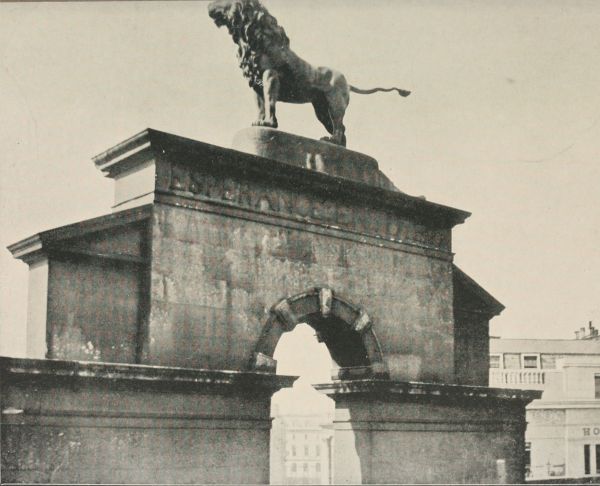
THE LION, NORTHUMBERLAND HOUSE.
Lawyers still have their offices in Craven Street, but the coal-barges vanished in 1876. A few doors from James Smith's, in the house on the left-hand side from the Strand, there lodged, in 1885, the celebrated American comedian, John Sleeper Clarke (1834-1899). His rooms overlooked the back of what was then the Avenue Theatre. This house, opened on March 11, 1882, was rebuilt by Mr Cyril Maude, and, on the eve of its re-opening, December 5, 1905, it was destroyed by the fall of the roof of Charing Cross Station. Again rebuilt by Mr Maude, it was opened, on January 28, 1907, as the Playhouse. The theatrical associations of this part of London are, indeed, like Mr Weller's knowledge of London, "extensive and peculiar."