VII
Gregory Yarros translation
I
MY new life so graciously granted to me by the czar soon began. I was summoned to the office, and the governor asked me to sign a paper which stated that my death sentence had been commuted to penal servitude for life. Then he announced to me that I should be put in fetters. The solemn face with which he made this announcement appeared ridiculous to me. What meaning could fetters have to me now?
The doctor, for form’s sake, examined me and said that I was “well fit.” Nearly all the handcuffs and leg-fetters there could be found in the enormous prison were brought into the office and tried on me, but all proved too large and fell off. They were made for men, and feminine wrists and ankles did not measure up to their standard. Finally the governor found a way out of this exasperating difficulty. A blacksmith was called, my wrists and ankles were measured, and on the following morning new 167fetters were ready. Whether by mistake or intentionally, I don’t know, but they were made so tight that on the second day my hands began to swell. This caused me excruciating pain. I tried my best to conceal this circumstance from the governor, as I was sure that the fetters had been put on me at his personal wish, and my suffering would only gladden him.
On January 27th I was taken to the railroad station and put on a train for Moscow. On the road the soldiers of the convoy—there were four of them—risking their own liberty, took off my handcuffs. In the same car, in a separate compartment, sat the officer in charge: he could come in any minute and see that my handcuffs were off. I asked the soldiers to put them back on me, but they would not hear of it. And only a short distance from Moscow they handcuffed me again.
When I was brought into the office of the Moscow forwarding prison, Butírki, the governor was greatly surprised to see me in fetters. He exchanged significant glances with the secretary, and whispered something to him. He ordered to place me in a solitary cell. Three days later the fetters were taken off, after seventeen days of pain and humiliation.
168Soon after my arrival there were brought to Butírki five other young women revolutionists: Aleksandra Izmailovitch, the daughter of a general who had not yet returned from the battlefields of Manchuria. She had attempted the life of the Minsk chief of police during the Jewish pogróm in that city. For this she was sentenced to death, which was commuted to a life term at hard labor.[22] Anastasia Bitzenko, a school teacher, who shot General Sakharov at Saratov, one of the five generals personally sent by the czar to suppress the peasant revolt. She was sentenced to death, which was commuted to a life term at hard labor.[23] Lydia Yezerskaya, the wife of the Mayor of the city of Mohilev, who attempted the life of the Mohilev Governor Klingenberg for his active part in the Jewish pogróm in that city. She was sentenced to thirteen years at hard labor. Revecca Fialka, a dressmaker, who was arrested at Odessa in charge of a bomb factory and sentenced to ten 169years at hard labor. And lastly Marie Spiridonova, a school teacher, who shot Governor Luzhenovski of Tambov when he was returning with his Cossacks from a punitive expedition to the villages. She was sentenced to death, which was commuted to a life-term at hard labor.
The forwarding prison was terribly congested. In cells which were built for twenty-five were seventy-five and even a hundred people. Every day 200 or 300 politicals were sent away to different parts of Siberia, but as many, if not more, were daily brought to Butírki. It seemed as if all Russia were being exiled. But notwithstanding that the revolution was crushed, the prisoners so deeply believed in the speedy liberation of Russia that they went to hard labor and exile with a light heart.
“You may laugh at your life sentence,” comrades shouted to us through the window bars. “You will not have stayed there long when a free nation will carry you in their arms back to free Russia.”
In the middle of June, at night, the governor of the prison came into my cell and told me to get ready for the journey. A few minutes later I learned, through the window, that all the six of us women hard-labor convicts were to be 170transported somewhere. About twelve o’clock we were led to the office and told that we should be sent to Akatúi. There, in this office, I first met Marie Spiridonova. She looked so young and frail,—she was only twenty—and her beautiful face was so pale that I thought she would not live long. She tried to smile to us, but her eyes remained sad.
All the six of us were conveyed to the railroad station in a closed carriage, and put in a separate car attached to the Siberian express. Accompanied by twelve soldiers and an officer, we left Moscow for the distant prison of Akatúi.
II
When we were sent to Siberia the revolutionary movement there had not yet been crushed by the government. The Krasnoyarsk “republic,” which had lasted about forty days, was still fresh in the memory of the people. The revolutionary committees in the various cities we had to pass learned in some way about our coming and organized demonstrations in our honor. A particularly striking demonstration occurred at Omsk. The Omsk workingmen knew from their railroad comrades the day and hour of our arrival there, and impatiently waited for us at the 171station. When this reached the ears of the local authorities they met our train at some distance from the city, uncoupled our car, and put it on a side track, evidently hoping to take us through Omsk at night. But some one on the train divulged their trick to the people at the station. A number of workingmen seized a locomotive and started out to look for us, followed by a crowd of several thousand people on foot.
Our car was sidetracked about five o’clock in the morning, and at noon the workingmen located us. When the officer in charge of our convoy saw the crowd approaching he showed us a paper he received at our departure from Moscow. It instructed him to shoot us at the least attempt to escape or to be released by a mob. The soldiers were in a state of terror. They had become our friends during the long journey from Moscow, and did not feel capable of executing such an order.
“We will rather die ourselves than shoot you,” they said to us.
The workingmen seized our car, fastened it to their locomotive, and brought us to Omsk. Thousands of people met our approach with shouts of delight. Rich women took off their jewelry and threw it in our windows. All 172loudly demanded our appearance on the platform. For a moment the situation was rather critical. The people were getting more and more insistent, and threatened to take us out by force. In the meantime Cossacks and soldiers were surrounding the crowd. The inevitable tragedy with all its dreadful consequences rose before us. We began to implore the officer to let us out on the platform for just a second, that we might induce the crowd to disperse. Fortunately the officer, seeing that the affair was assuming a very serious aspect, permitted us to go out and address the crowd. As soon as we appeared on the platform all became quiet. We asked the people not to attempt our release as we did not wish to witness any bloodshed; we told them we did not believe we should stay long at hard labor, and they finally consented to let us proceed on our way.
For many miles the crowd followed after our train, waving red flags and singing revolutionary songs. Peasants left their work in the field and ran to see the unusual sight. They threw flowers at us, and soon our car was covered with them.
It was late in the evening when the last shouts of farewell died away in the distance. 173Similar demonstrations were repeated at Krasnoyarsk, Irkutsk, and other places.
At last we reached Stretinsk. From there we had to proceed by étape. It took us nine days to cover the distance of 130 miles, and in the middle of July, 1906, we reached our destination.
III
The Akatúi prison is located in the little village of Akatúi, in the Trans-Baikal, near the Mongolian border. It is famous in the history of the revolutionary movement in Russia. Yet the Decembrists[24] were confined in it. Chained to wheelbarrows they worked in the mines guarded by soldiers with fixed bayonets. One of them, Lunin, died there a hard-labor convict, and his lonely grave is the only evidence of generations of political prisoners who were slowly tortured there to death by the Russian czars. The Polish insurgents of 1863 were sent there. The prison had been abandoned, but again rebuilt in 1889 and has since held within its dreary walls a great number of political offenders.
When we were brought to Akatúi the régime 174there was not very strict. The wave of reaction which swept Russia soon after the October manifesto had not yet reached this God-forsaken place, and the local administration still believed that a new political era had dawned in Russia. We were treated fairly well: we were permitted to wear our own clothing, to receive books, and enjoyed similar little privileges. When out for the daily walk we freely conversed with other prisoners, and argued about affairs in far-away Russia. But month passed after month, and news from there reached us less and less frequently, and what did reach us was far from hopeful. The country was being crushed by the triumphant reaction, and the chains of autocracy were becoming heavier and heavier. Our prison régime grew worse and worse, until, by the end of 1906, we were deprived of all the privileges and treated like ordinary hard-labor convicts.
Our position in this living grave was intolerable. We were young, and the fire of struggle was still burning in our breasts. We no longer hoped for the speedy liberation of Russia, and could not reconcile ourselves to a life of idleness and degradation. And we began to cast about for a way to escape. A group of comrades commenced 175to dig a tunnel. The digging had continued for over a month and the outer wall had already been reached when the authorities discovered it. Within several months five tunnels were begun, and each time it was discovered when near completion. In the end we had to give up the thought of gaining freedom in this way. Seeing that escape in a body was impossible, the group of Socialist-Revolutionists headed by Grigóri Gershuni[25] decided to find a way to escape singly. Gershuni, as the more useful and capable member of our party, was chosen to go first.
For many years it was the custom among the prisoners at Akatúi to make sauerkraut for the winter. The cabbage was brought into the prison, the convicts cleaned and cut it, after which it was put in a barrel and taken to the cellar, outside the prison gate. It occurred to Gershuni to escape in this barrel, and we set about executing the plan. We punched two little holes in the bottom, and inserted long 176pieces of thin rubber pipe: these Gershuni was to hold in his mouth, and they were his only source of air. He sat down in the barrel, bending almost double, as it was not large enough for such a tall, stout man. On his head we laid a metallic plate to protect it from the bayonet of the sentry at the gate who always thrust it into the barrel to ascertain that no contraband was being taken out of the prison. We stretched a cloth over him and nailed it to the walls of the barrel. On the top we threw cabbage, and fastened the cover.
At eleven o’clock in the morning everything was ready. The comrades who had to cart the barrel to the cellar announced to the head-keeper that the cabbage was done, and he gave the order to open the gate. Breathless we stood and watched how the sentry stuck his bayonet into the barrel in which our most respected and beloved comrade lay. At last it was without the gate, and the comrades with the help of the soldiers lowered it into the cellar. A tunnel leading into an open field had already been dug from there, and horses were waiting in the forest near by.
To conceal his absence for a day or two and thus give him an opportunity of getting away 177as far as possible from Akatúi, we made a dummy, dressed in Gershuni’s clothes, and put it on his cot. Its head was made of Holland cheese specially imported from Chitá and painted by one of our comrades, an artist. When the keepers came in the evening to count the prisoners a comrade spoke to the dummy, and they went away satisfied that Gershuni was in his place.
When the keepers came into our cell and we saw their calm faces we knew that everything was well. Our joy was indescribable. We already pictured to ourselves the triumph of the Party, and warmly discussed the question where Gershuni would be by the morning count. But scarcely an hour had passed when we heard a noise in the yard. A number of keepers ran excitedly into our cell and began to look under the beds. We understood that some of the prisoners must have reported Gershuni’s absence, as the authorities could not have found it out themselves before the morning count.
In great trepidation we awaited Gershuni’s capture. But as the days passed our fears were set at rest. We knew that if he had not been caught on the first day of his escape the authorities had small chances of getting him. He possessed 178wit and courage, and had money enough to pay his way to the nearest seaport and cross to Japan.
Gershuni’s escape led to still further restrictions. But as it was impossible to maintain a severe discipline in the overcrowded prison—it was built for 80, but there were 150—the authorities transferred 50 prisoners to Gorni Zerentúi, about 128 miles away.
We were the only women in Akatúi. We were sent here because in the whole Nertchinsk mining district there was not a decent prison for women. But in order to subject us to the full rigors of the hard-labor régime the higher administration decided to remove us from Akatúi. The government again felt its power over the bleeding country, and the first on whom it avenged itself were its political captives.
In February, 1907, the chief of kátorga,[26] Mehtus, telegraphed to the governor of the Akatúi prison, Zubkovski, that the women politicals must be immediately transferred to the Maltzev prison, about 130 miles from Akatúi. Marie Spiridonova, who had not yet recovered from the effects of the tortures to which she was subjected at the time of her arrest, was not well. 179I, too, was sick, having contracted inflammation of the lungs. For us to undertake a midwinter journey over the frozen mountains of Akatúi was to court death. The étapes which were built in the thirties of last century were in ruins, and to spend a night in them was just like sleeping in the street. We knew it all, but it was utterly useless to struggle against the decision. There, within the walls of the dreary prison, thousands of miles away from Russia, they could do with us whatever they chose. It must be noted here that had the authorities waited another month our lives would not have been put to such a risk: in March the frosts are not so severe, and there happens even warm days.
When the comrades learned the intention of the administration to transfer us immediately their indignation knew no bounds. Even the governor and the prison doctor were unwilling to send us. Zubkovski telegraphed to Mehtus that the two of us were sick and that the doctor thought our lives would be endangered if we should have to travel by étape at this time of the year. Several days later, on February 12th, the governor ordered four of us, Bitzenko, Izmailovitch, Yezerskaya, and Fialka, to get ready. 180With a heavy heart we bade them good-by. It was a sad parting, as we did not expect to see them any more.
Alone in our deserted cell we lay thinking of our friends. It was late at night, but we did not sleep. Spiridonova felt very bad after the day’s excitement. Soon she began to toss about and talk in a delirium, and I went over to her cot. With great difficulty I succeeded in rousing her.
“Dear, dear, look at me! There is nobody here but myself.”
She sat up on her cot, and embraced me.
“Do not sleep, my dear, do not sleep,” I begged her, fearing that the terrible fit would again seize her if she should fall asleep.
In a close embrace, clinging to each other, we sat in silence, seized with the consciousness of our utter loneliness and defenselessness. The prison clock struck two.
“Oh, how long it is yet till dawn!” sighed Marie. Suddenly she began to listen.
“Do you hear?” she asked me.
“No, I don’t hear anything. It is the wind roaring in the mountains,” I tried to quiet her.
But soon footsteps were heard outside, and our gate was opened.
181“Oh, they are coming!” I cried involuntarily.
We heard the door of our corridor open. We covered ourselves with our blankets, embraced each other still closer, and waited. Heavy footsteps filled the corridor. They kept coming and coming, and it seemed there would be no end to them. Several people approached our door. We held our breath. The door was violently opened, and an officer with a paper in his hand stood near our bed.
“I am the governor of Algatchí prison, Borodulin. Have been sent here by the chief of kátorga, Mehtus, to transfer you immediately to the Maltzev prison. I will do that even if I have to take you naked and to shoot down the whole prison. At the least resistance on your part I will employ force,” and he pointed in the direction of the corridor where armed soldiers stood in readiness.
I looked at his ferocious face, at his white gloves, and a tremor passed through my whole body. Marie closed her eyes, and I thought that she would again become delirious.
“Very well,” I said to Borodulin. “Let us dress ourselves, and when we are dressed you will be able to do your business.”
Borodulin turned to the wall.
182“Dress yourself.”
“No,” I answered, “this is absolutely impossible. We cannot dress when you are in our room.”
He thought for a moment, and went out, closing the door after him. We dressed hastily, and opened the door. Borodulin entered.
“Are you ready? I will not wait any longer.”
At this moment there came a knock on the wall. Our comrades had heard Borodulin’s loud voice, and were uneasy. The whole prison was awake. The knock was repeated.
“Wait!” I knocked to them.
“Listen,” Marie suddenly turned to Borodulin, “they will not let us go, and you will have to shoot down the whole prison. But if you will permit us to explain to them the situation they will agree for our sake.”
“This is against the law, and I cannot do it,” Borodulin answered.
“Then call our governor,” I suggested.
Zubkovski, who was in the yard at that time, was called in.
“What can I do for you?” he asked. He knew what a tragedy would inevitably follow Borodulin’s attempt to take us by force.
“Induce Borodulin to allow us an interview 183with Sazonov and Karpovitch.[27] They are the only people here who can prevail upon the comrades not to raise a riot.”
Borodulin stood right there when I spoke to Zubkovski and calmly examined his white gloves.
“Come,” said Zubkovski to him, and they went out. A few minutes later Sazonov and Karpovitch were led into our cell. Sazonov was pale as a ghost, and could not utter a word. He seized Marie’s hands, and held them, looking at the soldiers all the time. Karpovitch was all in a tremble.
“You shall not go, you shall not go,” he repeated, grinding his teeth and shaking his powerful fists. His eyes were bloodshot, his face assumed a bluish hue, and his whole body trembled with excitement. For a moment I thought that he would attack Borodulin who retreated a few steps, seeing him in such a terrible state.
“Leave them for a minute,” said Zubkovski to Borodulin, and they went into the corridor.
When we were left alone Marie said to them:
184“You must let us go, otherwise we shall not live it through. We shall not be able to bear the thought that you will perish and that we shall be the cause of it. What will be with us if the whole prison will be shot down?”
They remained silent. Borodulin and Zubkovski entered, and Borodulin announced to us in much milder tones that he would take a féldsher[28] along and that we would not stop in the étapes. Zubkovski looked questioningly at our comrades.
“We are ready,” said Spiridonova. Sazonov took Karpovitch by the arm, and they went towards the door. Before going out they turned back and looked at us, evidently still unwilling to leave us in the hands of the heartless Borodulin.
It was about four o’clock when we, dressed in heavy sheepskin coats and supported by the soldiers, went out into the prison yard. The frost was so severe that we could hardly catch our breath. Sleighs were standing at the gate, and we started, accompanied by Borodulin, a féldsher, and several soldiers.
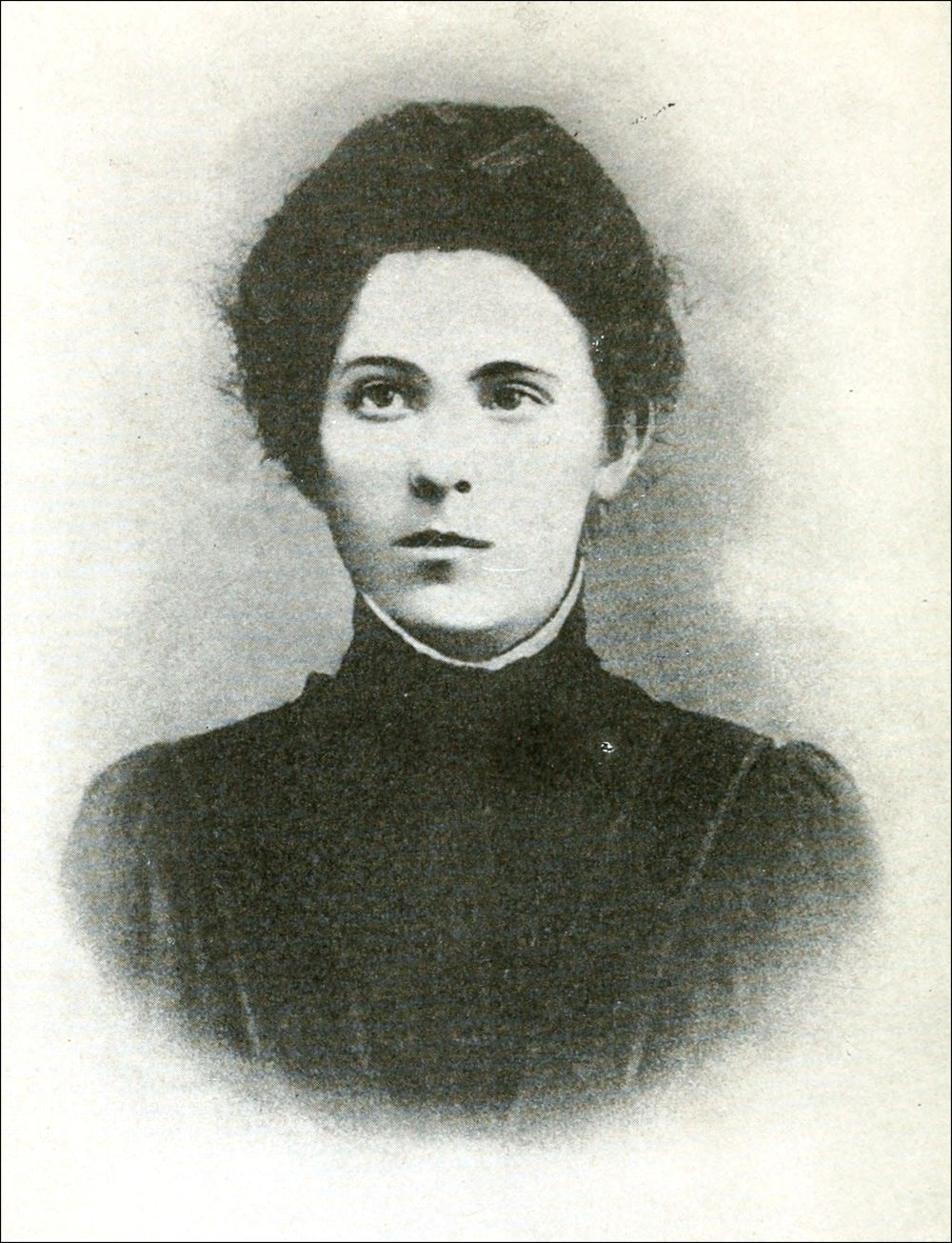
MARIE SPIRIDONOVA Assassinated General Minn, the famous torturer of revolutionists
It was twelve miles to the first étape, the Aleksándrovski Zavód.[29] Borodulin stopped a 187couple of times on the road, came over to our sleigh, and asked ironically:
“Well, are you not yet frozen?”
Early in the morning we arrived at the Aleksándrovski prison. In the semi-dark barrack where we were led in lay our friends, muffled up in their khaláts. A look of terror came into their eyes when they saw us. They were sure that we had been spared this dreadful journey. In a few words we related to them the events of the previous night, and told them that Borodulin had come with us.
We passed the whole day in this cold, unheated barrack without seeing any one of the authorities. During the evening roll-call the governor of the prison announced to us that Borodulin had gone back to Akatúi and that he had left orders to send us early in the morning by the regular étape. All protests were of no avail. At six o’clock in the morning we started out, accompanied by twelve soldiers. The féldsher did not go with us.
We traveled seven days, stopping for the night in the hideous holes called Siberian étapes. Marie Spiridonova was so weak that she had to be carried to and from the sleigh. Although the cracks in the walls admitted air freely the atmosphere 188in them was unspeakably foul, poisoned by the filth and the parásha which had evidently not been washed for years. When we at last reached the Maltzev prison we were more dead than alive....
IV
The old Maltzev prison was built exclusively for women, and had a capacity of fifty. But in reality the number of prisoners there was never less than 100, and sometimes reached 120. We were the first politicals sent there.
The six of us were put in one cell. It was about fifteen feet long and ten feet wide. Six beds covered with coarse, gray blankets, a long table, and two benches on the sides were all its contents. It had two windows, from which we could see the stone wall.
The cold, the dampness in our cell, and the food which consisted of black bread, balandá,[30] and tea without sugar, were not conducive to good health, and Spiridonova felt worse and worse. There was no hospital in the prison, and we prevailed upon the governor to summon the doctor from Gorni Zerentúi, about four 189miles away. He came, and only looked at us sorrowfully.
“What can I do?” he said. “Everything depends upon the chief of kátorga, Mehtus. Send for him, and ask him to transfer the sick to solitary cells: they are warmer and drier.”
We immediately sent a petition to Mehtus, who lived in Gorni Zerentúi. A couple of weeks later he arrived. He entered our cell without a greeting, and stood without looking at us. In answer to our request to transfer Spiridonova to a solitary cell he made a curt and coarse reply, and went out. After this we never asked him for anything.[31]
Time passed slowly in the Maltzev prison. Days, months, years stretched into one long and weary monotony. At first we were only six politicals there, but gradually our number increased 190by new arrivals from all parts of Russia, and soon we were forty. Their arrival was the only break in the monotony of our existence. But the news which they brought and their own spirits soon faded in the atmosphere of the prison, and they, in turn, waited for others to come and revive their dying hopes.
The first few years after the revolution Russia yet remembered her sons and daughters who were immured in the prisons of remote Siberia. But the constant persecution and misfortunes at home made them forget the living corpses who were buried in the frozen wilderness. Communications and financial assistance came less and less frequently, and finally ceased altogether.
Those who were sentenced for a term of years counted the days and months. They knew that if only they should be able to serve out their sentence they would see a glimpse of freedom—as much as one can see in Siberian exile.[32] But what awaited us, sent here for life?
The belief in the speedy liberation of Russia was being slowly crushed by the overwhelming grief which filled our souls. “How many such 191years will pass, one as dreary as the other?” I often asked myself. Whether I circled aimlessly our small prison yard on our daily walk or tossed about on the hard bed in the long sleepless nights, these thoughts tormented me unceasingly. Lying awake of nights I often heard the whispered conversation of my comrades in the corners of the semi-dark cell. They could not bear the oppressive silence of the prison, and would begin to speak of their past life, of their dreams and wishes. But to me it seemed that what they were dreaming about would never return, that all was lost in this abyss of misery and degradation.
Bad as our position was, that of the common-law convicts was still worse. The Siberian administration is to a certain extent afraid to do to the politicals what they do to these unfortunate women. There was a barrack just outside the prison wall in which women ex-convicts lived. Half of this barrack was occupied by soldiers, who, following the example of their superiors, perpetrated most atrocious acts of violence upon these defenseless women. During the last year of my stay there two died almost simultaneously from the effects of such mistreatment. There were cases when women were 192killed when they resisted. A young Tartar woman with a two-year-old child was strangled on the first night after her release from prison.
I do not know of a single instance when the administration or the soldiers were punished for these crimes. We reported these cases to the governor, but he never investigated, and I am sure that our reports never left his office. These horrors made our life there a perpetual torment, and we lived under their constant impression.
The most trying time we experienced when the higher administration came to inspect our kátorga. Their inspection did us no good, and only added to our suffering. To show that discipline was strictly enforced in his prison our governor used to put us in chains—those of us who were sentenced for life—and keep us thus for weeks. The only advantage we derived from their occasional visits was that for a few days previous to their arrival our food was somewhat better than ordinarily, as the local authorities were then afraid to appropriate the money which the government allowed for the maintenance of the prison. The robbing of the convicts in Siberian prisons has become a tradition, and is practised on a large scale. 193The governor of the Maltzev prison, Pokrovski, sold not only cloth and linen which the convicts were supposed to wear, but even foodstuffs and firewood. Large sums of money were sent from St. Petersburg to repair the building, but we continued to freeze because the governor preferred to pocket the money than use it for repairs.
There was only one bright spot in our dark and cheerless life, and this was our warm friendship for one another. This friendship fed our sorrowing hearts, and sustained us in the hours of trial and affliction.
V
In the summer of 1910 I fell sick. The doctor from Gorni Zerentúi was summoned, and he found that I suffered with appendicitis. My comrades began to send petition after petition to the chief of kátorga, asking him to do something for me, but received no reply. My condition seemed hopeless. I could not eat the coarse food, and a slow death from starvation threatened me. Just then the chief prison inspector, Semenkovski, came from St. Petersburg to inspect our prison. When he asked my comrades if they had any requests to make they all answered 194that the only thing they asked for was that I should be transferred to a hospital. Several days later the governor announced to us that Semenkovski had ordered to transfer me to Gorni Zerentúi. We could hardly believe it. During the three and one-half years of our stay in the Maltzev prison there were many cases of sickness, but we never succeeded in having the patients removed to a hospital.
Four soldiers came in, and laid me on a stretcher. My comrades stood around me in a circle, and each one of them tried to say a few words of encouragement. But their eyes and faces were sad, and told me something different. They bade me good-by, hardly able to restrain their tears.
The gate opened, and the soldiers carried me out. Yet for a long time I could see the group of comrades who stood in the prison yard and waved their handkerchiefs to me.
The soldiers walked briskly, and soon we came to Gorni Zerentúi. I was placed in a narrow, half-dark, solitary cell—this was the hospital. I lay there for several weeks. The prison doctor, who was drunk most of the time, could not help me. After a great deal of official correspondence the authorities at last summoned another 195doctor from Algatchí, and the two decided to perform an operation. For two days they cleaned some cell which was supposed to be the operating-room. Then the doctor went to the Nertchinsk Zavód to get the necessary instruments. But when everything was ready, and they were preparing to take me to the operating-room, our drunken doctor refused to operate upon me.
For two and one-half months I was kept in Gorni Zerentúi. I do not know what would have become of me if not for Comrade Sazonov.[33] He prevailed upon the governor to get for me permission to summon a private doctor from Chitá or Irkutsk. Money for this purpose he had received from his parents. When this request was telegraphed to the governor of Chitá he ordered to transfer me to the Irkutsk prison.
It was the beginning of October, and the cold weather had already set in. I was exhausted with constant fever and hunger. To travel to Irkutsk in my condition seemed altogether impossible. But I welcomed this decision of the 196higher authorities, considering it the best way out of my misery.
“Now the end will come sooner,” I thought to myself. “And it will not be so hard for my comrades when I shall be far away from them.”
On the 22d of October, early in the morning, I was carried out of my cell and put in a sleigh. Two soldiers, a matron, and a féldsher accompanied me. The farther I went from the prison the greater my desire to live grew. I breathed the clear, frosty air of the mountains, I enjoyed the sights of nature, and my strength gradually returned to me. I felt better every day. I passed ten happy days, and on the eleventh I came to Irkutsk, and the heavy gates of the prison again closed upon me. But without these gates there were neither the black forests of Akatúi nor the bare mountains of Maltzev: I heard the bustle of city life outside, and the possibility of escape from here gave me new hope.
For eight months I struggled with my illness. The prison hospital was filthy and had no facilities for an operation. The doctor could not perform it alone, and private physicians refused to operate under such unsatisfactory conditions. The authorities were already contemplating 197sending me back when a happy idea occurred to me. I wrote secretly to an Irkutsk doctor asking him to perform the operation. I told him in my letter that it would be easier for me to die at once than meet a slow and lingering death from starvation. He understood my position. He came with two of his colleagues, bringing instruments and everything else necessary. I went to the operation firmly believing that I would get well and escape.
198