III
Gregory Yarros translation
I
ON the night of February 8, 1902, all the four of us were awakened by thunderous knocks on the door. Then we heard the words, “In the name of the law: open!” But before the old man had time to unlatch it, there was a crash, and the door flew wide open. The room filled with gendarmes and police. Without saying a word to us, they looked about the house,—there were two rooms and a kitchen—and began a long and careful search. Everything in the house was turned upside down. They cut pillows and mattresses, they tore the lining of old hats, they even examined the backs of pictures on the wall. But nothing suspicious was to be found: there were not even any books in the house. The disappointed gendarmes were on the point of departing, when one of them picked up my dress which lay on a chair. He fumbled in its pocket, and drew forth a few pieces of type. These were capital letters which 58I had borrowed from a type-setter, an acquaintance of mine, intending to add to my supply, but had forgotten to put them in my suit-case. The faces of the gendarmes instantly changed. Each of them closely examined the unfortunate letters. They handled them with as much care as though they were not mere metal type, but dynamite bombs.
The gendarme officer sat down and began to write a protocol.[6] He only asked me:
“Does this dress belong to you?”
“Yes.”
“You are arrested. Dress yourself.”
Much to my terror, he turned to the old man with the same words. The old woman and the little girl began to cry. In great agitation I tried to explain to the officer that the old man knew nothing about the type found in my pocket, but he rudely interrupted me:
“No use of talking. This question will be settled later. It is not our business to decide who is right and who is wrong.”
At the officer’s command the gendarmes closed around us in a circle and we were led out of the house. The old woman wept. The little granddaughter, who ran crying after her grandfather, 59was roughly pushed aside. I had only time to call out to my hostess, “Forgive me!” when the door slammed behind us.
The night was dark and cold. Surrounded on all sides by police and gendarmes, we walked in the middle of the road, with our heads lowered. The old man was silent, and his silence was terrible to me. I could not see clearly what was my guilt before him, but the feeling grew in my heart.
“O God, this is how I have repaid these good old people for their kindness,” I thought as I walked along.
I absolutely forgot that I was being marched to prison. The sight of that gray head bowed before the gendarmes had made me oblivious of my own plight.
At last we arrived, and the heavy gates of the prison swung open before us. We were led to the office. There we were searched. The governor at the prison wrote down our names, and ordered one of the guards to put us in cells. I dared not look at the old man, but he extended me his hand and said:
“Be brave. Don’t be afraid.”
A lump rose in my throat, and I could not utter a word. Afterward I could not forgive 60myself that I had not asked this good old man’s pardon.
Occupied with these thoughts, I did not even notice where I was being led. I only remember climbing a narrow staircase. The guard stopped in a long, dimly-lit corridor and opened one of the doors. I entered, and he immediately closed the door after me and turned the key in the lock. I remained standing near the door, listening to his retreating steps.
Through a little hole in the door I could see the hanging lamp in the corridor. This lamp also lighted my cell. I looked about me. The cell was about nine feet by six. It contained a small table, a stool, and a wooden cot. A narrow window, with double iron bars, was high in the wall.
I stood in this dark cage, having no desire to move. The only thought in my mind was that the door was locked, and that I could not go out of that place.
Suddenly footsteps were heard. My heart began to beat with hope: Maybe they are going to release me! But the guard came, put out the lamp in the corridor, peeped into the door-hole, and calmly walked away.
The feeble light of the approaching day penetrated 61the double bars, and I could see the bare stone walls of my cell which were painted black half-way from the floor. The light seemed to have roused my energies.
My first thought was to look out of the window. I approached it, but it was high above my head. I dragged the stool over and climbed upon it. Opposite me, at a distance of about twenty paces, I saw a row of narrow iron-barred windows. The gray stone wall which surrounded the prison did not seem high from my point of observation.
“I will escape from here,” I decided immediately. “I can’t remain in this hole.” But days, weeks, months passed, and I still sat within those walls.
II
In the morning a guard entered my cell and brought me black bread and hot water.
“Tell me,” I asked him, “how long do you think I shall be kept here?”
The guard looked at me in surprise.
“And how are we to know?” he answered, and went out.
A few days later I was called to the examination. It was necessary to cross the prison yard to get to the office.
62“Comrade!” I heard several voices issuing from somewhere. I raised my head and saw hands with white handkerchiefs, which fluttered in the wind, thrust out between the window bars. They greeted me.
“Good-morning!” I shouted cheerfully. But the heavy arm of the guard was on my shoulder.
“You must not speak to them, otherwise I will put you in the kartzer.”[7]
But it was too late: I already knew that I was not alone there.
The gendarme colonel met me very cordially. His broad face was smiling, and his little gray eyes looked at me insinuatingly.
“Be seated.” He pointed to a chair near his table. “What is your Christian name? Surname? What is your age?”
I told him.
“Well, how do you like to be in prison?” he asked me in a free manner.
“Oh, it’s terrible!” I said.
“Well, you see, you are too young yet to be in prison, and I shall be glad to release you. It all depends on you, though.”
“How?” I asked, surprised.
63“You have only to tell—” here the colonel took from the table drawer the unfortunate pieces of type which were found in my pocket, “who gave you this, then I will immediately release you.”
“I cannot tell,” I said.
“It would be very imprudent on your part not to tell. You will fare badly, and regret it.”
“But if I should name the person who gave me these letters you will arrest him. How can I do such a thing?”
“Oh, he is already in prison, anyway, and we know who he is.”
“Then why do you ask me to name him?”
“That is only a little formality which the law requires for your release. Sign this paper, and I will let you free.”
He shoved a paper over to me. I looked at the paper upon which my release depended, and doubt rose in my mind. Is it really so? Does he not fool me? And suddenly I remembered a little book I had read in Odessa, entitled: “Comrades, decline to give evidence!” In this booklet, published by the Socialist-Revolutionists’ Party, it was explained that the gendarmes took advantage of the inexperience of young political prisoners and obtained from them incriminating 64evidence by false promises of release, etc.
“I decline to give evidence,” I said.
The colonel took from the table drawer a little book and handed it to me.
“Have you read this book?” he asked.
It turned out to be the very same booklet.
“Yes.”
“Where did you get it?”
I was silent.
“Don’t be afraid,” the colonel went on. “I ask this as a private person, not as the gendarme colonel. I am simply curious to know who could have given you this booklet.”
The colonel’s tone was so simple and so sincere, and in general he was not as I had pictured to myself a gendarme colonel ought to be. I hesitated. The colonel, evidently guessing my thoughts, put his plump hand on mine and said:
“We are not such bad people.”
“Then why do you keep this old man B——?” I asked. “If you are a nice man, you must release him, because you know that he is not guilty of anything.”
“That does not depend upon me,” the colonel answered.
“Then I don’t believe you,” I cried. “You 65merely want to get a confession from me, so that you might arrest several more innocent people.”
“The worse for you,” the colonel said, changing his tone sharply. He got up, opened the door, and summoned the guard.
“The examination is over. Take the prisoner to the secret division.”
I was led out by another passage, and soon found myself in a low, circular cell. A heavy smell of dampness filled the air, as in a grave. The tiny window was on a level with the ground. Only the lower part of the prison wall could be seen from it; not a bit of sky or anything which might cheer the prisoner’s eye.
But I did not think of comforts then. A feeling of gladness that I had not fallen into the gendarme’s trap filled me. The thought that they had not discovered the house where I kept the type was a great relief to me. And the knowledge that I was not alone in prison, that all around me were comrades who were also fighting for liberty and justice, raised my spirits still more.
“If they only should let the old man out,” I thought.
I paced my half-dark cell, not knowing how to give vent to my feelings.
66“It is impossible they should keep me long here,” I thought to myself.
I was then not quite seventeen. Life was just beginning to unfold before me. It was still shrouded in mystery. Everything in the world seemed so beautiful and attractive. Suddenly the stone walls of the prison had shut out everything from my view.
For many days I could not believe that I was there to stay. From morning till night I dreamed how my door would open and the guard would say: “You are free!”
Three times a day he came to my cell bringing me food, and every time I heard his footsteps near the door my heart filled with hope that he would utter those magic words: “You are free!” But days, weeks, months passed, and the guard, instead of freedom, brought me bread and kasha.
My dreams faded, and the thought that they had forgotten me in this grave occurred to me more and more frequently.
“Why am I not called to the examination?” I asked the governor, who sometimes came to the evening roll-call.
“That is not our affair,” was his invariable reply. “Write a petition.”
67The darkness and dampness of my cell began to have their effect upon me. I began to suffer with insomnia. The twenty-minutes’ daily walk in the prison-yard became a torture to me. The sun shone so brightly without the prison walls, and here I was shut up, deprived of its rays, deprived of my freedom, without which I felt I could not live.
III
Easter came, my second one in prison. Easter had been my favorite holiday in the village, but here it made me still more sad. The church bells which toll so solemnly and joyfully outside, in liberty, here in the prison, sounded like the ringing of bells at a funeral.
There is no holiday for the prisoner. On such days he feels still more keenly that he is not free and is deprived of the possibility of being with those dear to him. The longing for my folks at home and the desire to know something about them almost drove me insane. My enforced solitude on those days became unbearable.
On the second day unusual sounds reached my ear; now loud, now subdued, they seemed to crowd into my cell from all sides. Guards ran past my door more and more frequently. I became 68uneasy. What can it mean? In alarm I paced my cell, like a caged animal, seeking to escape from those sounds which filled me with a strange foreboding. I knocked on the door, and the guard came.
“What is going on?” I asked him. He only motioned with his hand, and went away. But I felt that those sounds would drive me mad. I knocked again, and the same guard came.
“I cannot stand it any longer,” I began, greatly agitated. “I shall go mad if you don’t tell what are these cries. For God’s sake, only one word!” I implored him.
The guard looked at me for a few seconds, and said in a whisper:
“It was ordered to kill the Jews, that’s what it is.”
All my blood rushed into my head at these words. I remained standing near the door, unable to take a step.
An hour or so later the door of my cell opened, and the governor entered.
“Collect your things. You are transferred to another cell.”
His words made no impression upon me. It was all the same to me whether I was to remain in this hole or go to a better cell, or even be released. 69I heard nothing, I was conscious of nothing but the cries of the Jews who were being killed.
A strange sight greeted my eyes when I was led out of my cell. The whole prison yard was covered with feathers which the wind brought from town. These were from the Jewish pillows and feather-beds torn by the rioters.
Soon the prison filled with Jews who sought protection within its walls, but this did not enter into the plans of the authorities, and an order was issued not to let any more Jews into the prison.
For two days and two nights the massacre of the Jews continued, and their agonizing cries were heard in our prison. Only on the third day they began to arrest the rioters, who were so drunk that they could not walk, and the police carried them into the cells.
Several days after the pogróm I was called to the examination. The procureur and the same gendarme colonel met me with very solemn faces. The procureur said to me:
“You are accused of belonging to a secret society which has for its object the overthrow of the existing form of government, and of conspiring against the sacred person of his Imperial 70Majesty. With this aim in view you took part in the establishment of a secret printing-office and the distribution of forbidden proclamations which instigated a pogróm in the city of Kishinev. Are you guilty of the criminal offenses?”
I was dumfounded.
“How is that?” I protested when I had regained my power of speech. “I have been in prison since February 8, 1902, so how can I be accused of instigating the pogróm which took place only a few days ago?”
“The point is,” said the procureur, “that the letters which were found in the pocket of your dress are of the same identical type with which the forbidden leaflets were printed. As to your plotting to overthrow the existing form of government, this can be seen from your letters to Nicholai Shpeizman. In one of them you say: ‘I shall not rest until I shed the blood of the vampire.’ Do you admit that these letters—” here he took out of a portfolio a bundle of my letters to Comrade Nicholai, who was serving in the army,—“found on Private Shpeizman, and which are written in Yiddish, are yours?”
“Yes,” I replied, “but these letters were written a year ago, and I do not remember having used the expression you attribute to me.”
71“This will be the business of experts to determine,” he said. “And now, the preliminary inquest in your case has been terminated, and by order of his Excellency, the Minister of the Interior, Plehve, you will be put on trial.”
The examination was over, and I was led back to my cell. After this examination it became clear to me that I would not be released so soon. The letters which were found on Comrade Nicholai were ample evidence against me, as I spoke in them, in no uncertain tones, about the tyranny of the government. The thought that my comrade must have been arrested and, being a soldier, would surely be court-martialed, darkened my existence still more.
In the meantime the prison was being filled with politicals and anti-Jewish rioters. The latter were being arrested because they declared that they had been ordered to “kill the Jews.” Small cells built for one now sheltered two or three people.
One night a woman carrying a little baby in her arms was brought into my cell. She was arrested, together with her husband and servant. Her husband, one Alexander Orloff, was one of the leading spirits of the Social-Democratic Party, and at his house was found a secret printing-office 72where the first issues of the well-known, forbidden journal Iskra (The Spark) had been printed.
The presence of the woman and her nine-months-old baby completely changed my prison life. My own sufferings seemed to me as nothing compared to those of the mother and child. This child later played a great part in my life.
A few weeks after their arrest, Mrs. Orloff chanced to see her husband through the window, and called out to him, “Good-morning!” Just at that moment the governor of the prison was crossing the yard. He immediately ordered to put her in the kartzer. When the guard came to take her she refused to go, saying that she could not leave the baby. Then the governor ordered that she be taken by force. Hearing this, I shouted to Mr. Orloff: “Your wife is being taken to the kartzer.” He began to knock on the door of his cell, calling for the governor. Several guards came into his cell, gave him a terrible beating, and tied him hand and foot. On learning of it, all the politicals began to make a terrific noise, knocking on the doors with their feet, throwing the furniture on the floor, and shouting for the governor to come. He came, but with a company of soldiers. He lined them 75up in the yard, and himself with several soldiers came into our cell. Mrs. Orloff held the baby in her arms, pressing it close to her breast.
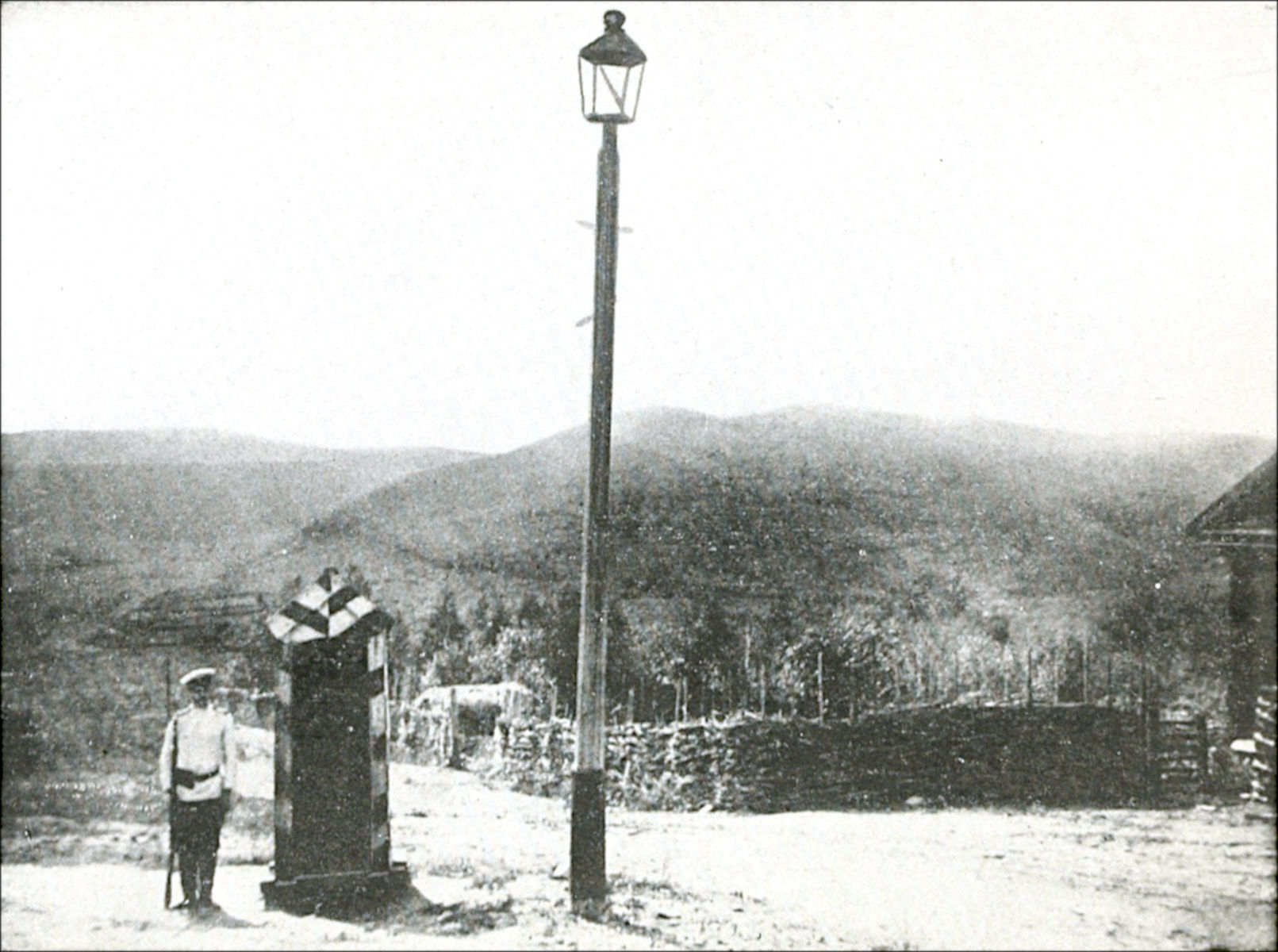
GUARDING THE ROAD TO THE AKATÚI PRISON
“Soldiers,” she addressed herself to them, “is it possible that you will have the heart to tear me away from my little baby?”
She cried and the baby, frightened by the sight of strange men, screamed at the top of its voice. The soldiers were taken aback, and did not dare come near her. Then the governor himself approached her, seized her by the arms, and began to squeeze them above the elbows. After a struggle which lasted a few minutes the arms of the mother relaxed, and the baby fell to the floor. A pitiful moan filled the cell.
“Take him,” shouted the governor to the soldiers, “and get him out of here.”
I seized a log and threw it at the governor’s head, but he jumped aside. He ordered to take me also to the kartzer.
When Mrs. Orloff and I were led to the kartzer the whole prison was in an uproar. The noise of falling furniture, knocking, and shouting was deafening. The common-law criminals had seen the soldiers carrying somewhere a half-naked child and joined the politicals in the protest.
76Soon the procureur arrived. He visited every cell and assured the prisoners that the child had been restored to its mother, and that the mother had been released from the kartzer. The common-law criminals quieted down, but the politicals, knowing from past experience that his word could not be trusted, continued the noise. Then they were all tied, and lay helplessly on their cots.
In the meantime Mrs. Orloff, locked in the dark cell, was frantic with anxiety over her child’s condition. After several hours we were let out from the kartzer, and the baby was brought to the mother. Happily it was not injured; only bruised in some parts of the body.
As we learned later, Mr. Orloff, on hearing that the soldiers forced their way into his wife’s cell, decided to commit suicide. He managed to break a window, and with a piece of glass began to cut an artery in his arm. A guard happened to open his door at that time and frustrated the attempt. When this had been reported to the governor, he ordered to release us from the kartzer.
IV
Because of the crowded condition of our prison it was impossible to maintain a régime of 77strict isolation. The politicals who had relatives in town were allowed interviews with them. Notwithstanding that these interviews took place in the presence of gendarmes, they succeeded in sending verbal messages to friends outside, and also found out what was going on without the prison walls. The news that the Orloffs, their servant, and I would be put on trial reached the outside world.
In those years politicals had not been tried in any court. Since the seventies they had been exiled in the “administrative order,” which means that any one suspected of “political unreliability” was sent, after a more or less protracted stay in prison, to some remote northern province, or to Siberia, for as many years as the Minister of the Interior, the chief of the gendarmes, or any gendarme general, or colonel saw fit. This was a new move against the politicals by the all-powerful Plehve. The advantage it offered was the possibility of sending them to hard labor, whereas under the old order they were “only” exiled.
This departure from the time-honored “system” aroused great interest in the liberal circles of Russian society, particularly among the members of the legal profession. Several prominent 78St. Petersburg lawyers, Maklakoff, Pereverzeff, Kalmanovitch, and others, wrote to the procureur offering their services to us free of charge.
At last copies of the indictment were delivered to us. The crime with which I was charged was punishable by from eight to twelve years’ hard labor. The main evidence against me were my letters, of which the strongest passages were quoted in the indictment.
The trial was set for October 15, 1903. A few days before the trial I was called to the prison office. Instead of the gendarmes I had expected to meet, I saw two gentlemen in civilian clothes. The guard told them my name and went out, leaving me alone with them. This was the first time since my imprisonment that I was alone with free people, without the company of gendarmes.
The two gentlemen regarded me for some time in surprise, and then one of them said:
“I am Maklakoff, attorney-at-law, and this is my colleague, Mr. Ratner. We came to defend you. Are you really the author of the letters which are quoted in the indictment?” he asked, again looking me over in surprise.
“Yes, of course,” I replied.
79“How old were you when you wrote those letters?” asked Mr. Ratner.
“Sixteen.”
They laughed heartily, and shook my hands.
“That’s clever, very clever!” exclaimed Maklakoff. “Eight years’ hard labor for letters written at sixteen! Fine!”
He began to pace up and down the room, somewhat agitated. Suddenly he stopped, as if remembering my presence, and said:
“But you needn’t worry. We will see that you are acquitted.”
“No,” I said, “it will hardly be possible to acquit me. You know when I wrote those letters, I really had no serious intentions. But after they have kept me in these stone walls for over nineteen months, my mind is made up, and nothing, nothing can ever change it. I hate this despotic government with all the fibers of my soul, and I will fight it to the last drop of blood in me. And I intend to tell this openly to the czar’s court.”
They remained silent for some time.
“We understand you,” they said, “and this makes us wish still more to be of help to you.”
They bade me good-by in a very friendly manner and went away, having promised to see me 80again before the trial. After this interview a beautiful bouquet was brought to me every morning, together with my bread and water. I learned later that these bouquets were sent by my lawyers, who had obtained special permission from the procureur.
At last the long-awaited day of the trial arrived. On the fifteenth of October, early in the morning, I was led out of the prison gate. The autumn sun greeted me from a cloudless sky. The air was cool and fragrant. My eyes, which for many months had seen nothing but gray walls, bathed in the green grass. The open space before the prison fascinated me.
“To escape,” an inner voice whispered to me.
A carriage was waiting near the gate. I entered it, and two gendarmes with drawn sabers took their seats on each side of me. The carriage rolled fast over deserted streets, and after a short ride stopped in front of a massive brown-brick structure. It was the court-house.
“Here we are!” said one of the gendarmes. They led me into the prisoners’ room and locked me in there. But soon the door opened, and the lawyers, counsel for the defense, came in one by one, six of them. They were more agitated than I, because they already knew the verdict which 81had been ordered by Plehve in advance, and felt the futility of their efforts to save us.
At ten o’clock two gendarmes in brand-new uniforms, with drawn sabers, took me to the court-room. The immense hall was empty. Only in a corner, opposite a long table covered with a green cloth, sat my comrades. Gendarmes, with drawn sabers, stood in front and back of them, but before I reached their bench I noticed, amid a sea of vacant chairs, the bent figure of an old man. He sat with his head bowed low. “Father!” The thought struck me like an electric shock. Instantly I ran to him, and before the gendarmes had time to recover from their surprise, I was near him. “Father, dear!” I had time to say. The trembling arms of my father were torn from my neck, and the gendarmes led me to the prisoners’ bench, holding me fast with their free hands.
“The Court enters! Rise!” called out the court príestav in loud tones.
The judges entered, took their seats, and the farce of a trial began. The secretary read the indictment. All of us were charged with having established a secret printing-office and published the forbidden journal Iskra. I, in addition, was charged with having uttered threats against the 82czar’s life. The usual questions were asked. In answer to the presiding justice’s question:
“Do you acknowledge yourself guilty?” I replied:
“No. From the letters it will become clear to you that I had no connection with the publication of the Iskra, which is a Social Democratic organ. I say this, not because I want to clear myself, but because I am a convinced Socialist-Revolutionist, and as such have been and always will be an enemy of the existing form of government. I do not expect mercy from anybody.”
The witnesses gave favorable testimony, with the exception of the official translator of my Yiddish letters. He maintained that one of my expressions was, “I shall not rest until I shed the blood of the vampire,” while another translator, not official, said that the sentence read: “I shall not rest until the blood of the vampires is shed.” While admitting that my Jewish was poor and ungrammatical, he asserted that this particular sentence was written clearly and correctly, and that he had translated it exactly. May heaven forgive him! He was simply afraid of the gendarmes.
On the second day the speeches of the prosecution and the defense were made. The procureur 83demanded the maximum sentence of twelve years’ hard labor, saying there was no question of my guilt, as I had acknowledged in my speech that I was a Social Democrat. My counsel, Mr. Ratner, said in his speech:[8]
“Private letters cannot serve as evidence before any court, particularly in a case which concerns general idealistic convictions. Such letters always bear the stamp of a subjective mood and therefore cannot have the value of exact evidence. But if letters are to be believed, how is it possible to pick out one at will and to discard the other? to believe one and not to believe the other? We must believe Miss Sukloff that she is a Socialist-Revolutionist, and the repeated statement of the procureur that she is a Social Democrat is utterly incomprehensible. Between the Socialist-Revolutionists and the Social Democrats there is a great difference.... The labor organ which Miss Sukloff says in her letters she wants to publish can by no means be the Iskra. Everybody knows perfectly well that this organ is published abroad, and was being issued long before Miss Sukloff wrote her letters, consequently she could not have in 84view the Iskra when she wrote about the intention of herself and her friends to issue a paper....
“As regards the word ‘vampire,’ to consider it, particularly in view of the doubtful conscientiousness of the translator, a deliberate intention to commit a definite terrorist act, is juridically impossible. It is simply a poetical expression of the terrorist mood which agitates now, by force of circumstances, not one young heart in Russia. Whether it was written ‘vampire’ or ‘vampires’ is, after all, of no import to us, because in the letter is expressed only an abstract intention, and to punish for such intentions no court has ever attempted.... The substance of the accusation is that the accused had definite opinions, convictions, and general intentions, and all this is quite comprehensible, if one will be more attentive to her manner of life. A worker since fifteen, vivid and bright, she ponders over the strange contrast between her own and her chums’ position on the one hand, and that of, let us say, their customers, while her own mental superiority to those bedecked ladies could be no secret to her. Reasoning logically, not hampered by prejudices which did not fasten upon her, her thought came to 85certain conclusions. Meeting with people of greater mental development, she, under their influence, adopted at first the Social Democratic teachings; but her mind, being of wider scope, did not stop there, and thanks to her militant temperament, she, having become acquainted with the views of the Socialist-Revolutionists, joined them.... We ourselves in her place would undoubtedly thirst as much as she for emancipation and the possibility of a better life for herself and others. It must be noted that, notwithstanding the specifically Jewish persecution she was subjected to, the accused did not engage in a narrow-nationalistic struggle. She had a broader outlook, and the interests of all humanity are dearer to her. This is a talented nature, responsive to all good; in some other country she might have been happy, but here, among us—alas! This is not possible. The court may, of course, convict her, but it will hardly be a triumph of justice; it will be another ill-considered, unjust verdict, of which history knows not few.”
After two days of anxious waiting the verdict was announced: We were sentenced “to be deprived of all rights and exiled to Eastern Siberia for life.”
86