IV
Gregory Yarros translation
I
THE thought that I would be exiled to Siberia did not frighten me in the least. The desire to escape from those odious walls was so great that I would have been glad to be led not only into exile, but even to the gallows. But day after day, month after month went by, and I still sat in the Odessa prison, whither my comrades and I were transferred several days after the trial, impatiently waiting to be transported to Siberia. To all my protests and insistent requests to send me there the prison authorities made one reply:
“We are awaiting special instructions from St. Petersburg with regard to you and your comrades.”
“What more can they do to me?” I frequently asked myself. A feeling of rage filled my heart more and more often as the months passed. I could no longer speak calmly with the authorities. At their very sight my blood began to boil.
87“How much longer will you torture me within these walls?” I cried whenever the prison governor appeared.
Conflicting rumors about the war with Japan penetrated into our cells, but they could not hide from us that Russia was being defeated by the Japanese. With every Japanese victory the prison authorities relaxed the severe discipline more and more. This relaxation of the prison régime, bought at the price of thousands of Russian people slain in battle, made our life a little easier. The hope that the Japanese might help us free ourselves from the despotic government gave us new strength to bear and wait.
In July, 1904, the minister of the interior, Plehve, that pillar of reaction who had boasted that he would “wipe out the revolution in Russia,” was killed by a bomb thrown at his carriage by Yegor Sazonov, a member of the “Fighting League” of the Socialist-Revolutionists’ Party. This happy news was brought to us by the prison authorities themselves who were greatly elated at the death of their chief. Plehve was cordially hated not only by the people, but even by his own subordinates. The appointment of Prince Svyatopolk-Mirski as minister of the interior put an 88end, for a short time at least, to the sufferings and hardships, which political prisoners were forced to endure.
Soon after the assassination of Plehve, my comrades and I were unexpectedly included in a party of convicts who were being exiled to Eastern Siberia. Before leaving the prison we learned what it meant to be “deprived of all rights and exiled to Siberia for life.” We were summoned to the office and told to put on convict garb. The dress of a female convict consists of a coarse gray linen shirt, a skirt made of the same material, a pair of black kotí, or slippers, with square linen foot-wrappers in lieu of stockings, a long gray khalát[9] with a yellow diamond-shaped patch in the back between the shoulders, and a gray kerchief. This dress changes a person beyond recognition. When we were led back to our cells our comrades did not recognize us. I was frightened by my own reflection in the mirror when I saw myself in this garb for the first time. There is something terribly degrading in it.
“What have I done? what have I done?” I repeated in great agitation. I paced my cell, with difficulty dragging my feet dressed in enormous, 89ugly kotí. And the feeling of hatred toward my oppressors grew in my heart and I could not overcome it.
On the next morning my comrades and I were lined up with a party of convicts who were being transported to Siberia for robbery and murder. Our wrists were chained to theirs, and in this fashion we were marched four abreast, in the middle of the dusty road, to the railroad station.
For the last time I looked at the big city to which I had come in quest of knowledge and happiness.
“Oh God!” I thought to myself, “I left my father and mother, sisters and brothers; I left my native fields, and came to this great city to find the key to a better life: and this is what I found!”
“Farewell, farewell, my native land ...” began the prisoners in a chorus when the train started. Their plaintive tones accompanied by the jingling of the chains made an indelible impression upon me.
The convict car was filthy and crowded to its utmost capacity. The prisoners were making themselves comfortable, and their familiarity with the surroundings suggested to me that they 90were not making this dreadful journey for the first time.
The stárosta, or head-man, elected by the convicts figured out with the help of the under-officer of the convoy the amount of kormovíye[10] for the party. Ten kopecks was the sum a convict received for his daily subsistence. For this money one could buy on the road one and one-half pounds of bread. But peasant women meet the trains, especially in Siberia, and give alms to the hungry, unfortunate convicts—bread, milk, pies, and other eatables.
After an agonizing ride which lasted about two days, we arrived in Kief. There we were placed in the forwarding prison. A forwarding prison differs from a regular one in that the former is, in most cases, wholly unfurnished, and the only article a cell contains is a large wooden tub called parásha. We slept on the dirty floor with nothing under us but our overcoats.
For two days we were kept there, and were not even let out for the daily walk. There were fifty people in our kámera,[11] twenty-five women and as many children. Some of the children became sick, and their unhappy parents lived in 93constant fear that they would die from lack of pure air. Mrs. Orloff begged the prison governor to permit her to take her sick child out in the yard for a few minutes, but his only answer to the distracted mother was:
“Peresýlni[12] are not supposed to be let out for a walk in the forwarding prison. To-morrow you will leave here.”
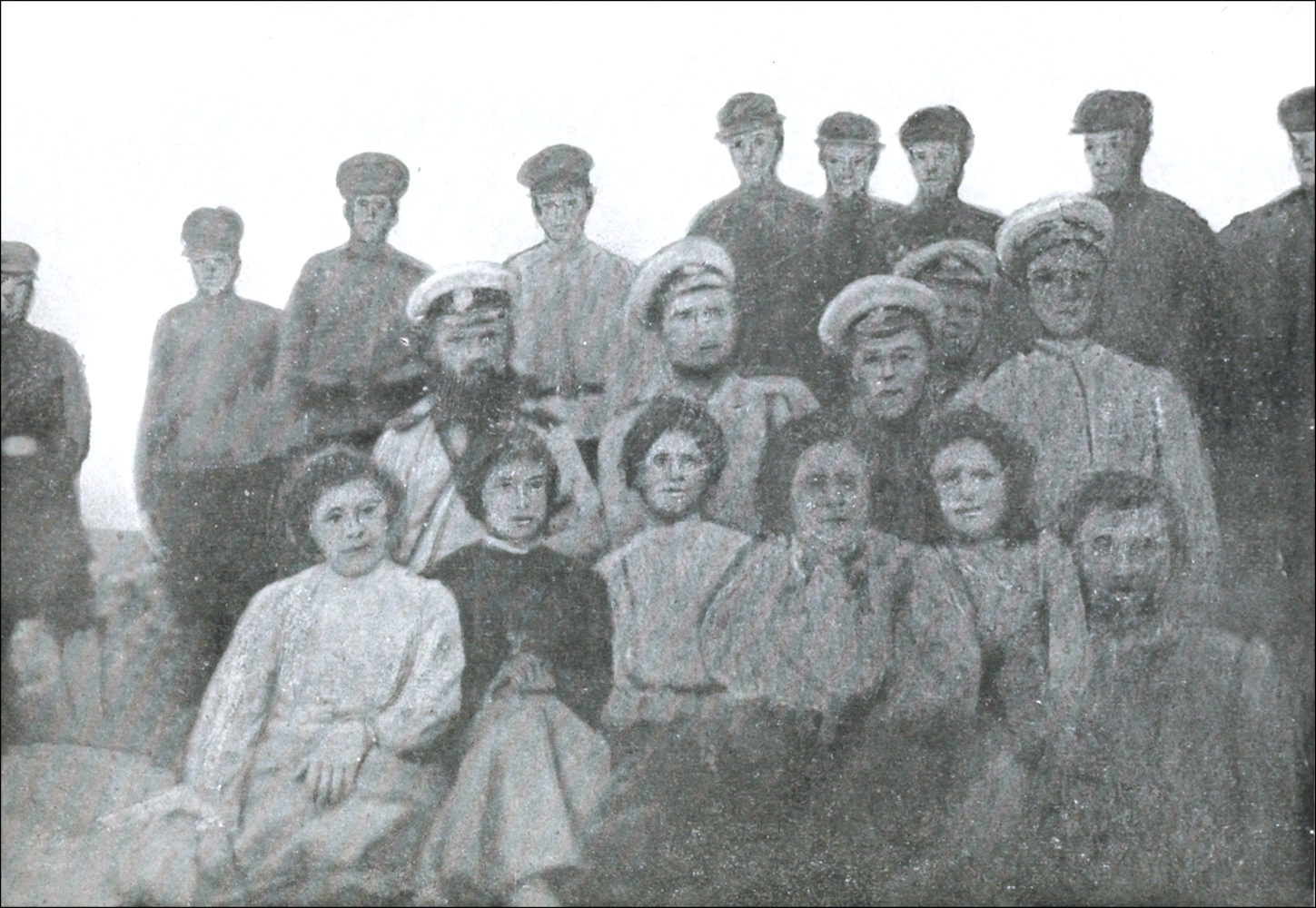
SIX POLITICAL PRISONERS AND THEIR GUARDS Resting at the étape in their march to Akatúi. Miss Sukloff is second from the left
From Kief we were taken to Kursk, and after spending two days in the forwarding prison went on to Voronezh. And thus changing from the crowded convict car to the forwarding prison and from the forwarding prison to the convict car, and stopping in every large city, we finally crossed the Urals and reached the town of Tyumén, in Siberia, after three weeks’ travel. The Tyumén forwarding prison is located at a great distance from the city, and the muddy road over which we were marched came near becoming a grave-yard for some of us.
George Kennan, the well-known American writer, describes this prison in these words:[13]
“I looked around the cell. There was practically no ventilation whatever, and the air was so poisoned and foul that I could hardly force 94myself to breathe it. We visited successively in the yard six kámeras, or cells, essentially like the first, and found in every one of them three or four times the number of prisoners for which it was intended, and five or six times the number for which it had adequate air space. In most of the cells there was not room enough on the sleeping-platforms for all the convicts, and scores of men slept every night on the foul, muddy floors, under the nari,[14] and in the gangways between them and the walls....”
In these germ-infested barracks we were kept for three long months. Typhus fever and other epidemic diseases carried off two or three people every day, and we escaped death only through some miracle.
Winter had already set in when we started out again. In a blinding snow-storm we were lined up by the soldiers of the convoy, and began our journey to Krasnoyarsk. The convict car was even more filthy and crowded than in European Russia. The severe Siberian frosts did not add to our comforts. There were the usual stops for a day or two in a forwarding prison, and marching to and fro, in half-torn shoes, over roads covered with ice and snow.
95Tormented with hunger and cold, exhausted by the hardships of Siberian travel in winter, and extremely fatigued we dragged ourselves into the forwarding prison at Krasnoyarsk after sixteen days of travel. Here at last we learned to which places we were to be banished.
One morning the prison governor brought in a bundle of official papers. These contained our several destinations. To my inexpressible terror I was to be sent alone to the village of Aleksandrovskoye, in the province of Yeniseisk, about three thousand miles from my native province of Vilna. I stood before the governor, listened to his words, but could not believe that I was to be parted from my friends, taken to a remote, lonely village, and left there to pass my days alone.
“How is that? how is that?” I kept repeating the meaningless words, knowing perfectly well that the governor had nothing to do with designating the place of exile and could not change anything.
From Krasnoyarsk we were taken to Kansk. The Kansk forwarding prison, which was the last étape of our memorable journey together, almost became the grave of the whole party. We came to the prison in the evening. The barrack 96in which we were placed had evidently not been heated for a long time, as ice and snow lay on the floor all along the walls. We asked the head-keeper for some wood, and made a fire in the stove. After the fire had burned out, we closed the chimney and went to sleep. At night a child began to cry. Some of us heard his cries, but could not move from our places. Attracted by the child’s cries, a keeper came and called to us, but seeing that we did not respond, opened the door. Then he understood the cause of our silence. The cell was filled with fumes of charcoal, and we all lay in a stupor. He immediately summoned a number of soldiers who carried us out on the snow and rendered first aid. As soon as we had fully recovered we were taken to our respective destinations. The Orloffs were sent to the village of Ribinskoye, in the province of Yeniseisk, about thirty miles from Aleksandrovskoye. They went first. Then two guards came and took me.
From Kansk we had to travel on foot. Before starting the exiles on their march the prison doctor examines them, and if any are found to be weak or infirm telyégas[15] are provided for them to ride in. To my great luck the doctor decided 99that I was too sick to walk, and I was allowed to ride in a cart.
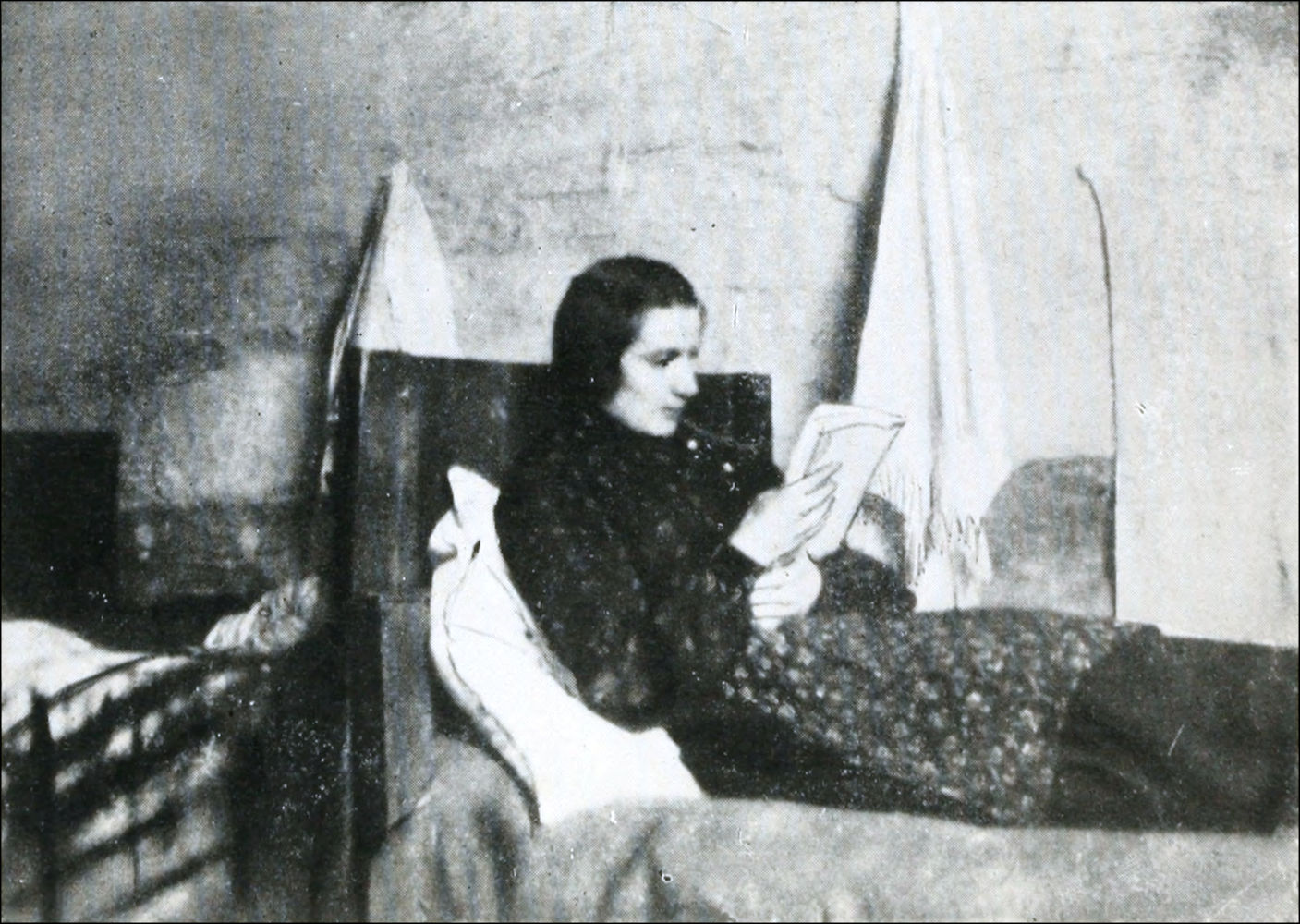
MISS SUKLOFF READING IN HER CELL
Two guards escorted me to the first étape and delivered me under signature to the uryádnik.[16] The uryádnik summoned the head-man of the village and ordered him to procure a horse. After a long dispute the peasants found an old nag, and I, under the escort of the village constable, proceeded to Aleksandrovskoye. In every settlement which we passed on the way the peasants, and particularly the women, regarded me very curiously. On learning that I was an exile they fed me, and in one village the women even gave me a pair of high felt boots, as I suffered terribly from the extreme and continuous cold.
Finally we arrived at the vólost, or rural district, to which Aleksandrovskoye belonged. Here the uryádnik and the vólost scribe opened the papers which the constable had carried all the time in a sealed envelope.
“There are special instructions with reference to you,” said the scribe to me.
“What are those special instructions?” I asked.
“It is stated here that you are a political offender 100and must be guarded very closely,” he replied.
I slept that night at the scribe’s house, and on the next day he took me to the village of Aleksandrovskoye, which was about eighteen miles from the vólost. The village consisted of perhaps thirty huts, and was inhabited mostly by Russian colonists. At the house of the stárosta,[17] to which I was first taken by the scribe, women and peasants gathered and began to consider what should be done with me. The women, folding their arms on their breasts, stood shaking their heads compassionately and saying in melancholy tones:
“Poor girl, poor girl! Your parents must have shed bitter tears when you were taken from them in such tender years.”
Some of them offered to take me to their homes. One old peasant who stood thoughtfully stroking his long, white beard thus settled his doubts:
“It means, then, that she was sent to us for life and we may do with her whatever we want. Did I understand you rightly?” He turned to the scribe who was explaining to the peasants how to treat me.
101At last, after a long discussion, it was decided that I would stay at the house of the church watchman. The uryádnik ordered the constable to come every morning to my house to see if I was still there. At parting he warned the peasants:
“Remember that you are all responsible for her.”
The peasants made the sign of the cross, and in a body led me to the house of the church watchman.
Yet for a long while the women continued their expressions of sympathy and shed tears, repeating, “You poor, unfortunate orphan,” before I was finally left alone. When they cried and called me “orphan” I really felt that I was alone, alone in this whole great world. I sat helplessly looking about myself, and a feeling of pity for myself filled my heart. But the immediate environment did not give these feelings a chance to grow. The people would not let me rest for a minute.
My host, an old man white as snow, soon came in and asked me:
“Can you read?”
After receiving an affirmative reply, he extracted a letter from his pocket. It was from his son, a soldier in the Manchurian army.
102The news that I could read traveled fast. All the peasants gathered all printed and written matter they could find in the village and brought me to read to them. They surrounded me on all sides and listened to me with respectful attention. The desire to know about the war with Japan was not mere curiosity on the part of the illiterate peasants. They had a blood interest in it, as nearly every one of them had a son, a husband or a brother on the battlefield, from whom they had not received word for months, and despaired of ever hearing from them.
On the morrow the women came to me carrying bowls of milk, plates of butter, and various other gifts, and begged me to write to their sons and husbands. Listening to the tales of woe of these old mothers and young wives, who desperately clung to the last hope that their loved ones had not been killed, but only wounded and crippled for life; looking at the little orphans who already knew that they were to see their fathers no more, I forgot my own grief and thought only of what I should do to lighten their terrible burden. But to my great sorrow I had no means of being useful to them, and all I could do was to write letters to people whom I believed to be dead.
103A few days after my arrival the village priest came to see me. He was a robust man of a very cheerful disposition and liked to drink a great deal. He spoke to me in a fatherly manner.
“Only do not get discouraged. There is nothing eternal in this world,” he said in answer to my statement that I had been sent there, not for a term of years, but for life. “My daughter is going to be married,” he continued, “and there is no one here to make dresses for her, so you had better come to live with us and help her with the sewing.”
I consented, as I was very glad to do something to earn my bread.
II
I was no longer in prison, I saw no more the prison walls, but I did not feel myself free. The purposeless life in a remote Siberian village seemed to me worse than a prison. The peasants, together with the priest, drank for two or three days during the week. They spent all their money at the Government liquor shop, and when they had no ready cash they pawned anything they could conveniently carry out of the house. It seemed that only the vódka gave them the possibility of forgetting the miseries of their 104wretched existence. In those “drunken” days I hid myself in some corner that no one might see me, and sat looking at the heaps of snow which separated me from the rest of the living.
“You must escape, you must escape from here,” an inner voice grew more and more insistent within me.
The scribe, the uryádnik, and the constable were the only people supposed to keep watch over me, and they seemed neglectful of their responsibility. They may have supposed that the dense forest which surrounded the village was the best guard.
“To escape, to escape,” I repeated to myself in the long, sleepless nights, staring into the darkness and making plans, each one more fantastic than the other.
In the meantime the news of the “Bloody Sunday” reached our village. With trembling hands I held the paper and read to the peasants how the working-men of St. Petersburg, led by Father Gapon, had gone to petition their Czar to better their conditions of life; how they had marched with their wives and children, carrying icons and the portrait of the Emperor, and singing patriotic hymns; how they had suddenly, without warning, been shot down, trampled by 105Cossack horses, and beaten with sabers and nagáikas;[18] how the streets of St. Petersburg had been turned into a battlefield where hundreds of dead and dying lay.... Here the peasants stopped me.
“Is it possible,” they asked, “that the czar, in whom we believe, could do that? Is it possible that he it is who takes our children and sends them to the Japanese to be killed? Is it possible that he does all this, and not his ministers?”
They took the paper from me, turned it in their hands, and made me read it all over again, from the beginning. On that day their faith in the czar was shattered, and they openly showed their sympathy with me, a direct victim of his despotic rule.
To me the fact that the St. Petersburg working-men had gone to petition the czar for a better life had another significance. I saw in it the awakening of the toiling masses, and regarded it as the fore-runner of that great revolution which was to shake the throne from its foundation.
“It can not be that the blood of the innocent children slain in the streets of St. Petersburg on 106the ninth of January should remain unavenged,” I thought. I saw that the Russian people could no longer suffer the yoke of czarism, that Russia must be free, and I firmly decided to escape and join, weapon in hand, in the great struggle towards liberty and justice for my oppressed and down-trodden country.
III
The vólost scribe was an intelligent and kind man, and he openly showed his sympathy with me. I made up my mind to ask him to get from the uryádnik permission for me to go to Kansk. I hoped to find there comrades who would help me with money and a passport.
“Yes,” said the scribe in answer to my request, “I can get for you the desired permission. But if you should run away the responsibility would fall upon me, because I am sure the uryádnik will prove in some way or other that I conspired with you. You know that I am the father of four children,” he went on, “but if you give me your word of honor that you will return, I will persuade the uryádnik to let you go to Kansk for a few days.”
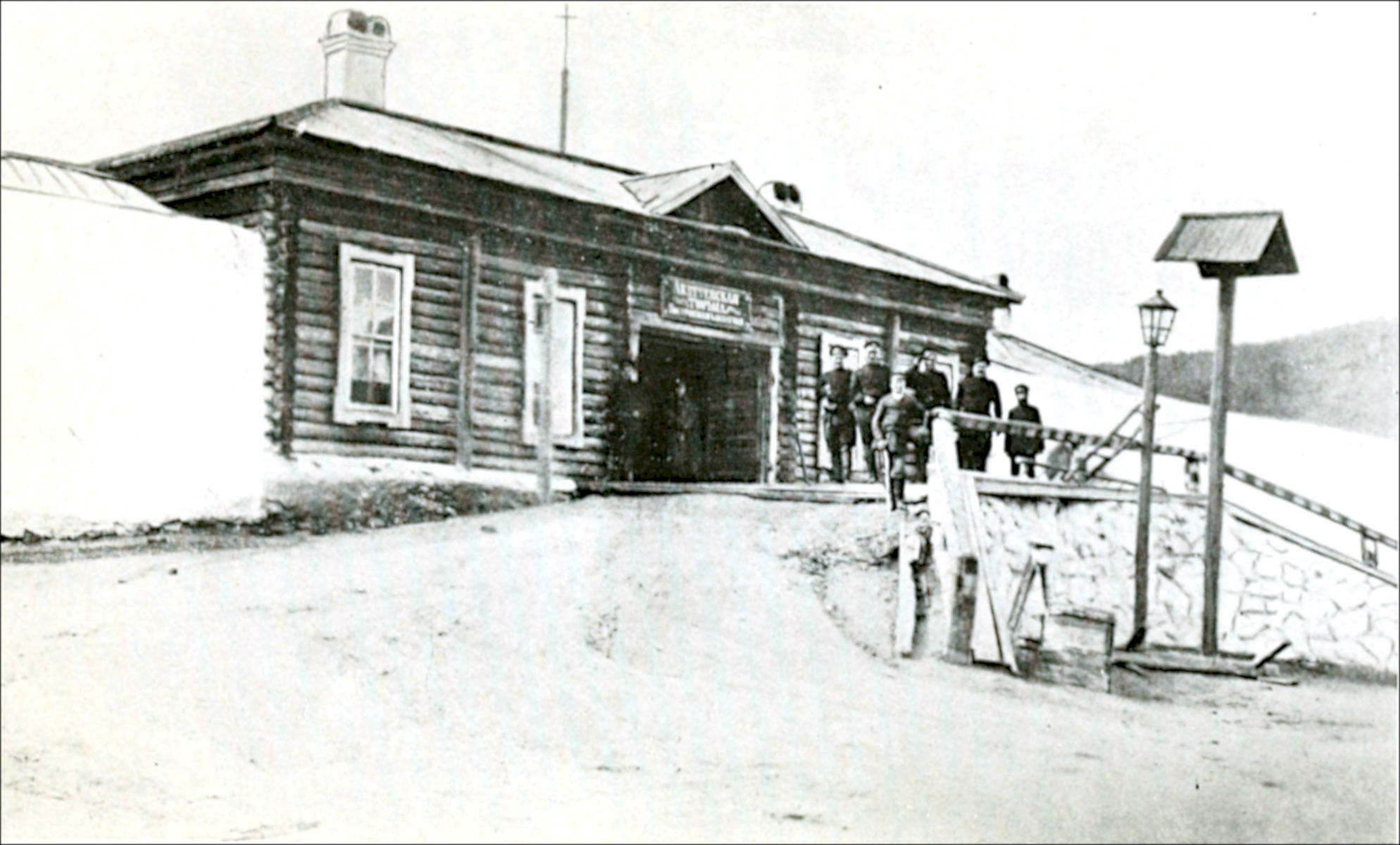
THE ENTRANCE TO THE AKATÚI PRISON
His proposal was difficult for me to accept. If I should give him my word of honor I would 109have to return, and my only aim in asking for leave was to escape. For two days I went about trying to find a way out of the difficulty, but finally decided to agree to his condition. It was absolutely necessary to go to Kansk and procure money and a passport, without which I could not even think of escaping.
We went to the uryádnik, and after considerable questioning he consented to let me go to Kansk for a few days.
On the first of February, 1905, I left the village, riding in the cart of a peasant who was going to town on business. I had no addresses, and did not even know if there were any political exiles in Kansk. The peasants of Aleksandrovskoye had assured me that there were many “nobles” there. As I found later, the politicals were known there as “nobles.”
After two days’ travel we reached Kansk. For the sum of two kopecks a ragged boy drove me to the blacksmith’s shop. A tall man in a blue blouse, his hands and face covered with soot, greeted me with a cordial smile. I told him my name, and he led me to his house. There I was met by a pale, frail-looking young woman who held a sickly baby wrapped in rags. Having overcome the feeling of embarrassment I experienced 110at the sight of their wretched poverty, I told them the object of my visit.
“I am very sorry,” said Mr. M——, the blacksmith, “but I don’t think you will get anything in this town. There are only six politicals here, and they are all starving. The only thing we can do for you is to give you letters of recommendation to our Irkutsk people. There are a great many of them there, and they will surely help you.”
A few hours later the whole exile colony of Kansk gathered at the house of Mr. M——. They held a consultation and decided that I must go directly to Irkutsk. They bought me a railroad ticket to that city out of their last money, and that very evening I boarded a train, carrying in my pocket a letter of recommendation. As I was dressed in a mixture of civil and convict garb, the passengers stared at me, and I did not feel quite at ease.
After two days’ travel I came to Irkutsk. When the cab stopped in front of a rich house on the main street of the city I hesitated for a few seconds. “What if they will not let me in?” I rang the bell. A beautiful young girl opened the door. I handed her the letter of recommendation, and she invited me to sit in the 111waiting-room. Directly an old man of short stature entered. He asked me who I was and what I wanted. Having convinced himself that I really was the person I claimed to be, he shook my hand and invited me to meet his wife and children.
This man, Mr. K——, was an old revolutionist, exiled to Irkutsk many years before. But notwithstanding his “past” he now held a high Government position. That same day he handed me a hundred rubles and a passport on which he wrote in his own hand that I was a “merchant’s daughter.” Such a passport was as good as a real one in Siberia, because the príestavs and the uryádniks who endorse them are so ignorant that they can hardly read Russian. Mrs. K—— helped me put on her daughter’s clothes, and presented a watch to me. In short, I was made unrecognizable.
It was necessary to return to Aleksandrovskoye. I knew that the scribe would feel uneasy about my long absence. I did not want to think how I would escape after my return: the difficulties seemed insurmountable, but I had given my word of honor, and had to return.
With sorrow in my heart I bade good-by to 112those kind people. One of Mr. K——’s sons went with me to Kansk, as they were afraid that I might be arrested on the road.
In the railway compartment—we traveled in the second-class—were two army officers. They made friends with my companion and treated him to vódka and cigars. There was nothing in their appearance to arouse our suspicions.
When night came I lay down on my cot. I could not sleep. The thought that I was going back to that lonely village would not let me rest. Suddenly I felt that somebody was tugging at the chain which supported my watch. I opened my eyes, and to my great terror saw the same officer who had been so amiable with me several hours before. In one hand he held my bag which contained the hundred rubles and the passport. I emitted a terrible shriek. The officer seized me by the throat, and began to choke me. I became unconscious....
When I had regained consciousness my first thought was that the money and passport were gone. I heard people talking near me, but had no desire to look at them.
“Why didn’t they let me die?” I thought. “What will I do without the money and the passport?”
113I could not move my head, and the fingers still seemed to be choking me.
At the first station I was carried into the gendarme office. The two officers were already there. They turned out to be escaped Sakhalien convicts masquerading as army officers.
“Why did you want to kill me?” I asked my assailant. “Didn’t you see that I am not rich?”
“Why did you cry out?” was his reply. “I had to save myself. After all I did not choke you to death.”
The bag with the money and the passport was returned to me. I owed my life to Mr. K——’s son, who was the first to reach my side when the robber choked me.
After an absence of ten days I returned to Aleksandrovskoye. The scribe and the uryádnik were delighted to see me.
“And we already thought that you would not come back,” said the uryádnik, smiling.
IV
The question how to escape did not leave me for a moment. The only people from whom I hoped to get the necessary information were the Orloffs, who lived in the village of Ribinskoye, 114the nearest to ours, and I decided to make my way in that direction. I was afraid to ask the peasants for aid, notwithstanding their sympathetic attitude. Besides, I knew that if the authorities found out that somebody had driven me to Ribinskoye the poor peasants would be held responsible for my escape. There was one way left to me, and that was to walk the distance of twenty-eight miles which separated the two villages. The road to Ribinskoye I knew well enough.
On the second day after my return from Irkutsk I got up at daybreak, dressed as warmly as I could, and with a few pieces of bread tied in a handkerchief set out in the direction of Ribinskoye. The whole village was fast asleep, but the very huts seemed to watch my steps. Every sound made my heart beat faster, and I looked around expecting to see somebody running in pursuit. Soon I came to the end of the village. The smooth, silvery road stretched before me. I straightened up, drew a full breath of clear, frosty air, and quickened my pace. My fear had disappeared. Calmly I looked at the snow-covered forest which stood on both sides of the road, and I walked faster and faster, dreaming of freedom for myself and my country.
115I don’t know how long I walked thus. I only remember that a sharp pang of hunger interrupted my dreams, and I began to consume one piece of bread after another, without slackening my pace. Suddenly I heard the clatter of horse’s hoofs behind me. Without stopping to think for a second, I turned to the forest, but the sleigh was near me before I had time to get under the cover of the trees.
“Where are you going?” a voice called to me. I turned around. It was a peasant who lived in a neighboring village. He knew me well.
“I am going to Ribinskoye,” I replied indifferently, “and have no money to hire a sleigh.”
“Get in,” he said. “I am going there, too, and will give you a lift.”
A few hours later I was at the house of the Orloffs. The tiny arms of their child embraced me.
“I won’t let you go away from us no more,” he said, patting my cheek.
The cold in the house was fearful. The wretched poverty in which the Orloffs lived astonished even me. A rickety table, two broken chairs, and an ancient wooden bed which squeaked and lurched every time one sat down on it made up all their possessions.
116When I told them that I had decided to escape they were glad for me.
“I don’t see how we can live here,” said Mrs. Orloff. “The child is growing; he will soon be three years old. We can not earn anything here. The money which I get from home is hardly sufficient to pay rent and buy fire-wood.”
She looked haggard and worn, and it seemed to me that tuberculosis had already laid its stamp on her beautiful face.
Mr. Orloff hastened to change the conversation.
“Yes,” he said, “now, after the ‘Bloody Sunday,’ we must give up the delusion that we can bring about better conditions by peaceful propaganda. We must fight tyranny with its own weapons. Such outrages of the Government can be responded to only by bombs and bullets. Eh, if we could only get out of here!”
He paced the room, hardly able to control his emotion.
“How can you escape with the child?” I said. “You will be recognized immediately.”
“Yes, this is the only thing which keeps us back,” answered Orloff dejectedly.
I looked sorrowfully at these young people who were deprived of everything in life and 117whose only child hindered them from making an attempt to regain their freedom. A slow death from hunger and cold awaited them. I looked at the innocent little child who was slowly wasting away before the very eyes of his parents, and a happy thought struck me.
“Listen,” I turned to the Orloffs. “I will take your child with me, and you will escape later. The police will look for me alone and for you with a child, and this change of parts will save us all.”
For a moment their sad faces brightened with hope.
“Bória,” I said to the boy, “do you want to go to Grandma with me?”
“Yes, I do,” he replied with a determined look. “I shall go, and Mamma shall go, and Papa shall go. I don’t want to be here; it’s cold here.”
In a few hours the affair was settled. I was to take the child to its grandparents in Vilna, and the Orloffs were to escape after receiving word from me that everything was “all right.”
In the evening Mr. Orloff found a peasant who agreed to drive me to the next village, a distance of forty miles, for three rubles. The following day we spent in making warm clothes 118for the child and preparing for the long journey. As soon as it grew dark the driver came to call me.
The mother embraced her child and me for the last time.
“I entrust him to you,” she said, weeping bitterly. “He is all I have in this life.”
“Mámotchka, don’t cry. I don’t want you to cry. Better come with me to Grandma. I don’t want to leave you here.”
He brought his mother’s coat and tried to put it on her.
“Hurry up, hurry up,” urged the driver. Mr. Orloff took the child in his arms, kissed his weeping wife, and we went out. The night was still and cold. Heaps of snow covered the ground. We walked rapidly, and the frost squeaked under our feet. At the end of the village stood our sleigh. The horses impatiently dug the snow with their hoofs. I sat down, Mr. Orloff put the child in my lap, kissed him once more, gave my hand a tight squeeze, and we started.
The sleigh glided swiftly over the smooth road. The horses ran, and the driver hummed a tune. I pressed the child in my bosom, and listened to his regular breathing. Soon the driver got out of the sleigh and ran alongside the horses 119trying to warm himself. I did not move, being afraid to disturb the child, who was sound asleep.
At four o’clock in the morning we arrived in the village, and knocked on the door of a peasant hut. We were admitted. To all questions where I came from and where I was going, I replied in a plaintive voice that the child had been left an orphan and I was taking him to his grandparents in Russia.
After an hour’s stay in the hut, during which I warmed my frozen limbs and fed the child, I decided to go farther. My plan was to drive as far as Krasnoyarsk, to hide in that city so long as it was necessary for the hue and cry caused by my escape to subside, and then proceed to Vilna by railroad. My host readily consented to take me to the next village.
“Give three rubles, and I’ll drive fast,” he said.
At six o’clock I sat again with the child in my lap, and we renewed our journey over the endless road which ran through the Siberian taigá.[19] In the afternoon we came to the village. From there an old peasant drove me farther. He charged me only one ruble, saying that I was going far and needed the money.
120For two days and three nights we rode thus, stopping only to warm ourselves and change horses. I hardly slept all this time. Sitting in the sleigh and listening to the roar of the wind in the taigá I wondered if we would ever reach Krasnoyarsk alive.
In the morning of the third day the child became sick. He cried, and complained of pain in his body. The severe cold, lack of warm food, and constant sitting in the sleigh had proved too much for him. I had to stop for a whole day. My anxiety knew no bounds. To the worry over the child’s sickness was added the fear that the police might overtake me. Toward evening the child felt better, and we set out again.
At last there remained only about ten miles to Krasnoyarsk. I was beginning to think myself out of danger, when in the middle of the day, on the road to Krasnoyarsk, I heard behind me the voice of our uryádnik. “Stop, stop! Whom are you driving?” he shouted to my driver. My blood grew cold. Instinctively I hid my face behind the child’s back. I heard the footsteps of people near me, but saw nothing.
“A woman with a child,” said one of them. “Go ahead!”
121I hugged and kissed the child who had saved me from certain arrest. I promised the driver na vódku[20] and he let the horses go at full gallop.
Finally we arrived in Krasnoyarsk, and stopped at a hotel. I felt sick. All my body was aching from the long ride. The child had grown terribly thin, and his dear little face showed traces of hunger and cold. Both of us needed a good rest, but I had spent more money than I had intended, and owing to lack of funds, I could not stop at Krasnoyarsk for long. Having paid all the money I had for a second-class railroad ticket to Vilna, I left the city after a twenty-four hours’ stay at the hotel.
The long journey from Krasnoyarsk to Vilna passed without any serious incidents. The child proved the best protection from the searching eyes of the police and gendarmes. The spies who swarmed at every big station did not pay the least attention to me. They evidently could not think of such a combination. When we came to Chelyabinsk—the border line between Siberia and European Russia—and had to change trains, our car was suddenly locked, and the passengers were let out singly and their passports 122examined. I held the child in my arms, and the gendarmes passed me without a question.
On the fifth of March I came to Vilna, and delivered the child to its grandparents. I sent a telegraphic message to the Orloffs telling them that their child was safe. Being only a short distance from my home, I decided to see my parents. I ran a terrible risk, as my parents must have been shadowed by the secret police, but my love for them proved stronger than all considerations of prudence and safety. That very day I despatched a comrade with a letter to my parents, and in the evening they came to me. The joy of our meeting seemed to make us forget all the past sorrows and sufferings.
“I will not give you any more to them,” mother repeated over and again, without even attempting to dry the tears which ran in streams down her face.
Father took out fifty rubles and said to me:
“This money I borrowed. Take it and go abroad. There you will be safe from all the horrors which you have lived through.”
“Father, I can not do that. The thing which was done to me and thousands of others can not go unpunished. I can not let it go.”
123My father took my head in his hands and looked with his soft eyes straight into mine.
“O, God! what have they made of you? You do not even cry, and there is so much hatred in your eyes, even at the sight of your old parents.”
“I can not, I can not,” I kept saying. The hands of my father tenderly pressed me closer and closer to his breast.
“Look,” he said with tears in his voice, “how gray the three years of your imprisonment have made me. What will become of us if you are imprisoned again?”
“Father, dear Father, listen to me. It is beyond my strength to endure the suffering and persecution to which you and millions like you are subjected. I can not bear it. And to put an end to it we must be strong, and must fight. I will go and kill the murderers and tyrants, and hundreds will follow my example. And if I die....”
My father drew back, and stood staring at me in speechless terror. My mother ceased crying. Unable to stand the ordeal any longer, I threw myself on the bed, hid my face in a pillow, and wept for a long, long time, sobbing like a child.
On the next day Father and Mother went to 124the railroad station to see me off. I boarded a train for Minsk. From there a Jewish contrabandist directed me to the Austrian border. After hiding for three days in a small frontier town, I safely crossed the border into Brody.
125