THE PARIS BOOK CLUB, 11, RUE DE CHATEAUDUN (continued 7)
Reading edition
Never did he let his blessed hand fall on a woman, nor on one of his slaves. Quoth Anas, who was seven years in his service: "'He never scolded me; he never even asked me: 'Hast done this?' or: 'Why didst thou not do that'" Abu Dharr heard the Prophet declare: 'These servants are your brothers, placed under your authority by Allah. Whoso is master over his brother must give him the same food as he eateth and the same apparel as he weareth.'
An Arab who bore arms at the battle of Hunain, tells the following story: "My feet were shod with heavy sandals and in the thick of the fight, I accidentally trod on the Prophet's foot. He struck me with the whip he held in his hand and cried out: 'By Allah! thou hast hurt me!' And all night long, I reproached myself for having inflicted pain on Allah's Messenger. Next day, early in the morning, he sent for me. I went into his presence. I was trembling with fright. 'Thou art the man,' said he, 'who crushed my foot yesterday under thy thick sole and whom I lashed with my whip? Well then, here are eighty lambs. I give them to thee. Take them away.' And ever since that incident, the Prophet's patience got the best of his anger."
Of a loving disposition, he suffered at having been deprived at an early age of maternal affection, which led him always to busy himself about the way mothers and children got on together. His ideas in this connection were summed up in this sentence: 'A son gains Paradise at his mother's feet.' While saying prayers, if he heard a child cry, he would hasten to conclude, so as to allow the mother to go and console her offspring, for he knew how mothers suffer when they hear their children cry.
His marvellous insight into mortals' souls and the depths of all things, causing him to be the most prodigious psychologist ever known, did not prevent him from consulting his companions for the least thing. Ayishah tells us: 'I never knew anybody ask for advice and listen to different opinions so carefully as the Prophet.'
If feelings of kindly dignity prevented Mohammad from resorting to vulgar mockery or making use of cutting remarks, his mood was nevertheless playful. He was fond of joking, which is not reproved by Allah, if the sally contains a grain of truth. One day, for amusement, he told Safiyah, his aunt on his father's side, that 'old women were not allowed to enter Paradise.' The noble dame, well advanced in years, burst into tears. So he went on: 'But all women will be resuscitated with the aspect of females thirty-three years of age, just as if they had all been born on the same day.'
The three things he loved best in this world were prayer, perfumes, and women.
He was so fond of praying that his feet used to swell in consequence of standing for too long a time whilst at his devotions; but he considered that the right to pray so often was one of the prerogatives of his position as a Prophet. Still he would not admit that his example should be followed. This he proved when upraiding Abdullah ibn Amir: 'Have I heard aright when they tell me thou dost pass the night in prayer, upstanding; and then fast next day? If thou shouldst keep on at this, thou wilt endanger thy sight and wear out thy body. Thy duty, that thou owest to thyself and thy people, is to fast and break thy fast; to rise in the night and also to sleep.'
Next to prayer, Mohammad preferred women, for which his detractors have blamed him severely. He was certainly an ardent lover; a male, in every respect, morally and physically, but endowed with that chastity which fits in well with healthy voluptuousness. Following his example, even nowadays, the Arabs are remarkable for their extreme decency, although devoid of all affectation and having nothing in common with the hypocritical mock-modesty of Puritans.
Mohammad had twenty-three wives, but he only had intercourse with twelve of them; his other marriages taking place for political reasons. All the tribes were eager to be allied to him through one of their daughters and he was beseiged by matrimonial offers. One of these women, Azza, sister to Dihya al-Kalbi, died of joy when she heard that the Prophet accepted her as spouse.
His love of women caused him to be brimful of kindness to them, and he sought to better their lot whenever he could. To begin with, he abolished the monstrous custom of burying girls alive, "Wa'du'l-Binat," of which we have already spoken. He then regulated polygamy, limiting the number of legitimate helpmates to four, which did not prevent him from urging the Faithful to give heed to this verse of the Qur'an: "If ye fear that ye shall not act equitably, then marry but one woman only." (IV, 3.)
Then, after declaring that: 'among all things which are licit, divorce is the most displeasing to Allah,' he allowed a wife to ask for release if the husband neglected the duties of marriage.
Finally, thanks to his ruling, a virgin could no longer be taken in marriage against her will; the dower, formerly given by the husband to the father of the affianced maiden, was ordered to be handed over to her. Such is the wise custom of the dower which the enemies of Islam call the purchase of a wife. Doubtless, they know nothing about the terrible retort of Moslems when they notice that in certain Western countries the dowry is paid to the bridegroom by the bride's father! Over and above the dower, the Mussulman husband has to defray household expenses without touching his wife's fortune to which he has no right.
The Prophet also ordained that a wife is always entitled to some part of an inheritance. If it is only half a share, that is because the compensation found by the spouse in the dowry and the household upkeep is taken into account.
The Prophet was fond of perfumes; for they completed the process of purification by ablutions. The man who has a sweet smell will be worthier and better able to safeguard his honour than he whose bodily odour is disgusting. Mohammad scented himself with musk and he liked sandal-wood, camphor and ambergris to be burnt. He used pomade for his hair, and four plaits hung down over his ears, two on each side. He clipped beard and moustache with scissors, keeping all in order by means of an ivory, or tortoise-shell comb. He blackened his eyelids with "Kuhl," which brightens the eye and strengthens the lashes. He took care of his teeth by rubbing them often with the "Miswak," (fragment of soft "Araq" wood), of which the fibre, when the end is chewed, has the same effect as a brush.
His apparel consisted generally of a tunic of cotton cloth, short-sleeved, and not too long; together with a cloak, four cubits long and two wide, woven in the Uman region. He also had a Yamanite mantle, six cubits long and three wide, which he wore on Fridays and holydays. Then, last of all, came his green mantle, inherited by the Caliphs; and a turban known as "As-Sahab," bequeathed to his son-in-law, Ali.
The Prophet took the greatest care of his personal appearance and reached as far as simple, although very refined elegance. He was wont to look at himself in a mirror, or if that was lacking, in a jar full of water, to comb his hair, or adjust the folds of his turban, letting one end hang down behind his back. He used to say: 'By attending to our exterior, we please Him of whom we are the servants.'
To make amends, he severely condemned extravagance in clothing; particularly the use of silk, which for rich people furnishes an opportunity for a display of pride belittling the needy; but he permitted it for those to whom it was necessary for reasons of bodily health.
His love of justice and charity extended to animals. It was he who told how "a man saw a dog so thirsty that it lapped up mud. Taking off one of his slippers, the man filled it with water which he offered to the dog; keeping on in the same way until the animal had quenched its thirst. Allah was pleased at what the man did and welcomed him to Paradise."
This kindness and the mysterious radiation emanating from Mohammad's personality made an impression on animals; and even on inanimate objects, as well as on human beings. When he went up the steps of a pulpit newly constructed in the Mosque of Al-Madinah, the humble palm-tree trunk on which he habitually stood when preaching, began to groan and was only quieted when he laid his blessed fingers on it.
The Prophet worked with his own hands. He milked his ewes, cobbled his shoes, mended his clothes, fed his camels, pitched his tent, etc., without accepting the assistance of anyone. He carried home his own purchases from the market, and replied to one of the Faithful who wished to do so for him: 'It is incumbent on the buyer to take away what he buyeth.' Thus, by his example, he condemned the practice of wealthy people who bought largely, and without troubling about the weight of their purchases, forced their servants to carry the goods.
His disdain for the riches of this world reached to the highest pitch. According to Ayishah, this is what he said on this head:
"Allah offered to change all the pebbles round Makkah, into pure gold for me and I answered: 'O Allah! all I ask is to be hungry one day and satisfied the next. The day I am hungry, I will implore Thee and the day I am satisfied, I will thank Thee.' What have I to do with worldly wealth? I am like the traveller who lieth down in the shade of a tree; the sun, as it turneth, beateth down upon him and he goeth away from that tree never to return. O Allah! let me die poor and resuscitate me in the ranks of the poor!"
The Prophet's sobriety was extreme; he never would have several kinds of food served at the same repast. If he ate meat, he went without dates; and if he ate dates, he deprived himself of meat. He showed a predilection for milk which appeases thirst and hunger at one and the same time.
Many months often passed without a fire being kindled in any of the Prophet's houses for baking bread or preparing other kinds of food. All this time, he and his family lived on dried dates only and his sole beverage was plain water. When hunger-pains gnawed his entrails too cruelly, he placed a stone on his belly and bound it there with a girdle. He departed this life without having a surfeit of any sort of victuals, not even of barley cake.
He never troubled about his body, so far as comfort went, although he kept it in a state of perfect purity by dint of continual ablutions. He frequently slept on a rugged mat, the rough bristles deeply marking his flesh. His pillow was made of palm-fibre and his bed was a mantle folded in two. One night, when Ayishah had folded it in four, the Prophet lost his temper, found his couch too soft and ordered it to be restored to its usual state.
Before dying, he freed all his slaves and distributed the small amount of property he still possessed. He deemed it unseemly to appear before the Lord with gold in his possession. In his dwelling, but thirty measures of barley were found; and to buy them, he had been forced to leave his breastplate at a usurer's as security for a loan.

There is no God but Allah, and Mohammad is the Prophet of Allah.
Ornamental page - CHAPTER THE TENTH
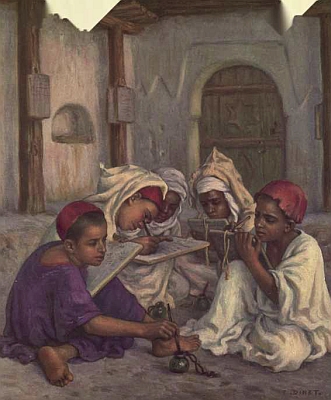
A Writing-lesson at a village school devoted to the Teaching of the Qur'an.

Say: O my people! Act as ye best can: I verily will act my part, and hereafter shall ye know!
CHAPTER THE TENTH

THE MARCH OF ISLAM
t the very moment when fate had deprived Islam of its genial founder, the organisation of this new religion was definitively and meticulously arranged even in its most humble practices.

The soldiers of Allah had already conquered the whole of Arabia and the attack on the colossal empire of the Cæsars in Syria was begun. A short period of unrest, inevitable after the disappearance of the inspired guide, caused a few rebellions; but Islam was so strongly constituted, overflowing with such enthusiasm that it was about to astonish the world by its impressive forward march, unique perhaps in the annals of history.
For the first time, rushing forth from their country forsaken by Nature, the proud Arabs, stirred by the miracle of Faith, were about to become masters in less than a century of the best part of the old civilised world from India to Andalusia, and that despite their extreme numerical inferiority.
This marvellous épopée engrossed the mind of the most wonderful man of our time, Napoleon, who always manifested the most sympathetic interest in favour of Islam. During the Egyptian compaign, he declared that he was: "Muslimun Muwahhidun," i.e. Unitarian Mussulman. (Bonaparte el l'Islam, by Ch. Cherfils.) Towards the end of his life, he returned to the subject: 'He thought that apart from fortuitous circumstances, giving rise to miracles, there must have been something more than we know in the establishing of Islam; that the Christian world had been so remarkably cut into by the results of some first cause still hidden; that these peoples, perhaps, suddenly emerging from the desert depths, had endured long periods of civil war in their midst, during which great characters and talents had been formed, as well as irresistible impulses, or some other cause of the same kind.' (Las Casas, Mémorial de Sainte-Hélène, iii, p. 183.)
Guessing, therefore, that beneath the slumber of Islam in decadence, there were incomparable reserves of energy, he tried, not once but often, to win it over by an alliance. If he succeeded, he deemed himself capable of awakening it and, by its aid, changing the face of the world.
Napoleon was not mistaken; civil wars had indeed exalted the heroic qualities of the Arabs, but they had made all organisation and progress impossible. Had it not been for the advent of Mohammad, these intrepid soldiers would have remained eternally in their deserts, solely absorbed by the obsession of hereditary feuds.
When Islam, abolishing pride of caste, birth, or race, made all Believers really brothers and endowed them with religious and poetical souls, based on equality, there was no exploit that these fiery-minded men, their hearts untamable, were incapable of performing. These treasures of combative energy, accumulated during centuries of civil war, were not the only means by which they overthrew so many peoples, all different and superior to them in culture at that epoch. The Arabs, likewise, had stored dream-treasures in their deserts, and these visions of an unpolished, though young people were about to be imposed on those peoples who, although educated, were old and worn-out.
We advise all those who may have doubts about the genius of the Arabs to look through a collection of photographs showing the edifices erected in every part of the countries they held in subjection. There is nothing more striking than the unity of type distinguishing these monuments from all other monuments in the world; and these buildings, with their remarkable family likeness, were set up in India, Turkestan, Persia, Syria, Turkey, Egypt, Barbary, Spain, etc., all countries essentially different and so peculiar, by reason of their characteristic genius, that the genius of Greece or Rome was never able to be grafted successfully.
The Arabs borrowed largely from those they conquered, often utilising their talent and even their muscles in order to build palaces and mosques; but Arabic dreams were thus always realised.
The exceptional originality of the Arab style resided in the fact that it was always imperiously guided by an art that was born at the same time as Islam. This art had no predecessors and offers us, as it were, the materialness of the Arabs' ideal. It is the art of calligraphic decoration, applied to the glorification of the word of Allah, otherwise the verses of the Qur'an.
Even reduced to its own resources, this art of Arabic calligraphy is one of the most marvellous forms of decorative skill that has ever sprung from human imagination. It is perhaps the only science of ornament of which it may be said without exaggeration that it possesses a soul, for like the voice, it expresses thought. Owing nothing even to the most cultured parts of the outer world, its independence resembles that of music and seems like the stenography of the innermost beatings of the heart.
Look at the letters which spring swiftly and horizontally from right to left as if acting under the impulse of inward life. Then they whirl on their own axis in discreet or impassioned curves, and are next erect, coming to a sudden halt, fixed in perpendicular pride.... They soon start off again in their frenzied gallop, unrolling their flourishes, bestriding each other in delicious fantasy and causing the imagination to soar in wild dreams.
To follow the impulses of the reed-pen having traced these letters; and in order to enjoy the pure eminence of their form or the intense emotion of their curve, one need not be a past master of Arabic, or a subtile graphologist; any artistic mind can penetrate without any effort the secrets of their soul.
After having expressed the ideal of his nation with such perfection, the Arab calligrapher bent beneath his yoke—almost religious—everything that was destined to support or enframe it: architecture and other systems of embellishment, forcing them to yield to the sway of his shaping skill. Under this yoke, the heavy, hemispherical dome of Byzantium was improved by adopting the pure outline of the Saracen helmet. The curves of the commonplace arcade became those of the graceful ogive, or of the proud, far-extending arch. The vulgar towers were metamorphosed into elegant minarets, leaping towards the peaks of ecstasy.
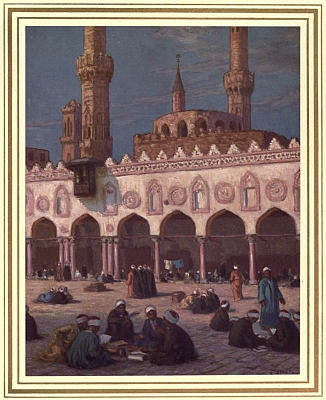
Theological Students, in the Courtyard of Al-Azhar, the great Cairo Moslem University.
In short, the only system of decoration which, with the exception of Calligraphy, borrows nothing from Nature: geometrical ornament—from which the Greek and Latin races merely derived poor and frigid effects—became endowed with real life. Henceforward this decoration was significantly labelled as Arabesque and, following the example of its model, it tried skilfully to astonish the mind by straying in the midst of the most inextricable entanglements and unexpected transformations....
How precious are the creations of Moslem art! European amateurs nowadays outbid each other in golden offers for its vestiges, hoping through them to introduce into their homes a few gleams of the mirages that inspired their authors. Radiant stained-glass, variegated glassware, stuffs worked with gold or silver wire, sparkling silks, damaskeened, inlaid bronzes, exquisite miniatures in the dwellings of the West, do they not all sing the glory of Islam? Among all these treasures, connoisseurs already begin to prefer those of Calligraphy which animates the transcription of the divine verses by the delicate colouring of copies of the Qur'an, or of the thick enamel of earthware. By so doing, the buyers of Europe follow the example of Mussulman princes of the best epoch who, to possess a page of calligraphy by a celebrated artist, lavished madly as much money as is given in our time for masterpieces of painters. May not these sacred inscriptions, causing their new possessors to be thrilled with admiration by reason of the refined elegance of their form, reveal one day to their purchasers the sublime beauty of the Islamic soul lurking in these writings?
INFLUENCE OF MOSLEM CIVILISATION IN EUROPE DURING THE MIDDLE AGES AND THE RENAISSANCE
Even at a period when Europe was not inimically inclined towards Islam, it was dazzled by all its marvels and borrowed largely from the decorative and architectural genius of the Arabs. Deep research would soon prove that it owes much more to it than to Greek or Latin antiquity. Such a study would take us too far from our subject. We may, however, point out as a curious fact that, according to the historian Dulaure, Arab architects were employed in the work of building the Parisian cathedral of Notre Dame.
In the domain of science, the influence of the Moslems was just as fertile. To give an idea thereof, we cannot do better than summarise the opinion vouchsafed by Doctor Gustave Le Bon, in his remarkable work: La Civilisation des Arabes. (The Civilisation of the Arabs.)
"First of all, it must be acknowledged that it is to the Arabs that we owe entirely the idea of experiment and observation, the basis of modern scientific methods, overriding the authority of a master. This substitution is therefore not the work of Bacon, to whom it is generally attributed.
"After having established that the highest degree of science consists in giving rise to phenomena oneself and at will, the celebrated scientist Humboldt adds: "The Arabs reached to this height, which was almost unknown to the ancients."
"The study of mathematics enjoyed overspread favour among the Arabs, and the progress accomplished in algebra metamorphosed that science to such an extent that its invention has been attributed to them. To them also are due the first application of algebra to geometry, and the introduction of tangents into trigonometry.
"Astronomy was passionately studied in their schools of Bagdad, Damascus, Samarcand, Cairo, Fez, Toledo, Cordova, etc., and their discoveries may be summed up in the following enumeration: introduction of tangents into astronomical calculation; construction of tables of planetary movement; strict determination of the obliquity of the ecliptic and of its gradual diminution; exact estimation of the procession of the equinoxes; and the first precise determination of the year's duration. To them also we owe the ascertainment of the irregularities of the greatest latitude of the moon, and the discovery of the third lunar inequality, now called variation.
"In geography, the contribution of these bold travellers is most remarkable from a scientific viewpoint. They made those exact astronomical determinations which form the first foundation of cartography, and rectified the enormous errors of position committed by the Greeks.
"From the standpoint of exploration, they published accounts of travel which caused different parts of the world, scarcely suspected before them, to be known, and where no European had ever set foot. The sources of the Nile, running through the great equatorial lakes, are exactly set out on a map by Al-Idrisi, dating from the year 1160, and which were only discovered by Europeans during the second half of the nineteenth century.
"In physical sciences, the sum total of their discoveries is still more considerable. The following enumeration proves their importance: high attainment of knowledge in theoretical physics, especially in optics and in the creation of the most ingenious mechanical apparatus; discovery of the most fundamental bodies of chemistry, such as alcohol, nitric acid, sulphuric acid; and the most essential operation, such as distillation; application of chemistry to pharmacy and commerce, especially as regards the extraction of metals, the manufacturing of paper from rags, which they caused to take the place of parchment, papyrus, or Chinese silk-paper.
"They were probably the first to use the compass in navigation; at any rate, they certainly introduced this fundamental invention to Europe.
"To conclude: the discovery of firearms. In 1205, the Emir Yaqub resorted already to artillery at the siege of Mahdiyya; in 1273, the Sultan Abu Yusuf used cannons at the siege of Sijilmasa. In 1342, two Englishmen, Lord Derby and Lord Salisbury, were present at the siege of Algeciras, defended by the Arabs in the same way. These travellers, having witnessed the effect of gunpowder, took this discovery back to their country. It was through them that the English made use of it, four years later, at Cressy.
"In medical science, the Moslems followed Greek writers, and afterwards made most important progress. Nearly all the medical knowledge of Europe, at the epoch of the Renaissance, was borrowed from them. The remarkable progress they made in medicine, was in surgery; the description of maladies; materia medica; and pharmacy. They found out a quantity of methods, of which many—the use of cold water in typhoid fever, for instance—crop up again in modern times, after having been forgotten for centuries.
"Materia medica owes them numerous medicines, such as: cassia, senna, rhubarb, tamarinds, camphor, alcohol, ammonia, etc. They were the true creators of pharmacy. Most of the preparations still in use nowadays are due to them: syrups, emulsions, pomades, ointments, distilled water, etc.
"Surgery also owes fundamental progress to the Arabs. Their work served as a basis for the teaching of Faculties of Medecine until quite recently. In the eleventh century of our era, they knew the treatment of cataract by the lowering or the extraction of the crystalline; lithotrity; the treatment of hemorrhage by irrigations of cold water; the use of caustics; setons; and cauterization by fire. Anesthesia, of which the principal discovery is supposed to be modern, seems to have been known to them. As a matter of fact, they speak favourably of the use of tare before undertaking painful operations, so that the patient may be put to sleep until "loss of consciousness and feeling" supervenes.
"They had, likewise, implicit confidence in hygiene in medical treatment, and placed great reliance on the resources of Nature. Expectant medecine, which, at the present time, seems the last word of modern science, reasons exactly in the same way." (Dr. G. Le Bon, La Civilisation des Arabes.)
In the domain of ideas, the influence of the Moslems had perhaps still more valuable consequences. Jesus preached equality and fraternity, but Mohammad was lucky enough to realise both among the Believers during his lifetime.
It would be absurd to maintain that his direct example served to guide the French Revolution which was not inspired by much of his levelling works. Nevertheless, the first attempts of this enfranchisement of ideas and the organisation of modern society on a new basis—and of this there is ample proof—resulted logically from his doctrines. Honour is due to a Mussulman philosopher, Ibn Rushd, or Averroes, who lived in Spain from 1120 to 1198, for being the first to introduce freethought—not to be confused with atheism—into Europe.
Averroes opposed the pure deism of Islam to mythological pantheism and Christian anthromorphism, and his 'Commentaries of Aristotle,' although vividly coloured with Mussulman tints, impassioned all independent minds in medieval Europe. Averroism, born of this enthusiasm, may be justly considered not only the precursor of Reform, but also the father of modern Rationalism.
The influence exercised by Mussulman customs over those of Europe was equally healthful. The Arabs joined most chivalrous manners to extreme religious tolerance.
"It was among the Arabs of Spain that the knightly spirit arose, and which was afterwards appropriated by the warriors of the North, as if it was a quality inherent in Christian nations," declares the celebrated Spanish writer Blasco Ibanez, in his novel: Dans L'Ombre de la Cathédrale. (In the Shadow Of the Cathedral.)
In this connection, we can again quote Dr. Le Bon:
"Like Christian chivalry, which came later, Arab chivalry had a code of its own. No man was worthy to be a knight unless he possessed the following qualities: kindness, valour, amability, poetical talent, eloquence, bodily strength, skill in horsemanship, and cleverness in handling spear, sword and bow....
"In 1139, the Wali of Cordova having laid siege to Toledo, belonging to the Christians, Queen Berengaria, shut up in the city, sent him a herald to bid him take notice that it was unworthy of a brave, gallant and generous knight to attack a woman. The Arab general retired forthwith, asking as sole favour, to be allowed the honour of saluting the Queen....
"The Arab chronicles of Spain are full of stories of the same kind, proving how wide-spread were these knight-errant-like qualities; and a very religious learned man, Barthélemy St. Hilaire, admits most loyally how greatly European customs are indebted to them. In his book on the Qur'an, he says: "Through having intercourse with the Arabs and copying them, the boorish barons of the Middle Ages toned down their rough habits; and the knights, without lessening their bravery, became cognisant of more delicate, noble and humane sentiments. It is doubtful whether Christianism alone, despite its benevolence, would have inspired them with these feelings."
"The reader may perhaps ask why, under these conditions, the influence of the Arabs is so unappreciated in our day by learned men who, by their intellect, seem far above all religious prejudice. That is because independence of opinion is more apparent than real, and we are not at all free to think as we like about certain subjects. The hereditary prejudices professed by us against Islamism and its disciples have accumulated during too many centuries not to have become part and parcel of our organism....
"If we join thereto other prejudices also hereditary, and increased in each generation by our detestable classic education: that all sciences and literature of the past spring solely from Greeks and Romans, we can easily understand that the great influence of the Arabs in the history of European civilisation is generally slighted.
"In certain minds, it will always seem humiliating that it is owing to the Moslems that Christian Europe shook off barbarism...." (Dr. Gustave Le Bon, La Civilisation des Arabes.)
What caused Islam to fall so rapidly, after having, during the eight centuries of its domination in Spain, placed that country not only at the head of occidental civilisation, but also causing it to shine quite as brilliantly from Delhi and Bokhara, as far as Constantinople and Fez?
The first cause may be found in the non-observance of the strictly levelling principles that the Prophet had so much trouble to establish while he lived, and which were the motives of his successes and of those of the first Caliphs. One example will serve to show how rigorously these principles were applied in the beginning: "A rich, powerful, and proud monarch, Jabala, newly converted, struck violent blows in the face of a poor Bedouin, who had accidentally pushed against him while he was performing his devotions round the Ka'bah. Without bringing into account the rank of the delinquent, or the danger of estranging such an important personage, the Caliph Umar thought that, for the honour of the future of Islam, equality in the eyes of law and justice should override all other considerations, and he condemned King Jabala to undergo, at the hands of the humble Bedouin, the same chastisement as had been inflicted on him."
With such strict principles, no one could possibly be proud of anything but his personal merit; and emulation gave birth to miracles for the greater good of Islam. No men were chosen as chieftains except those who deserved that honour, and once elected, they were blindly obeyed because they were sincerely admired and respected.
Unfortunately, the complete observance of this master-thought of the Prophet turned out to be ephemeral, and already under the rule of Usman, the third Caliph, aristocratic prejudices began to regain their evil influence. In vain Mohammad had said to his beloved daughter, Fatimah-tuz-Zahra: 'Work, and reckon not that it sufficeth for thee to be the Prophet's daughter;' the sons of most unimportant people despised their Mussulman brothers of more lowly origin, and thought that their social rank exempted them from making those efforts without which no progress can be realised. Moreover, rivalry between folks more proud of their forbears than of their own works, gave rise again to fractricidal struggles, as ruthless as in the past; and with them, the disorganisation and general anarchy which had paralysed the Arabs of pre-Islamic times. Having lost all taste for study; separated and exhausted by incessant civil wars, the Moslems were only able to offer puny resistance to the Christians, who dreamt of revenge and had profited by these dissensions to organise themselves.
In the past as in the present, Islam might have avoided the greater part of its misfortunes if it always remembered this last adjuration of the Prophet in his sermon of the Valedictory Pilgrimage: 'Never forget that each Mussulman should be a true brother to every other Mussulman!'
The second cause of its decline arose from one of the primordial qualities of Islam. The conformity of its dogma, almost entirely devoid of supernaturalism, to the exigencies of reason, was at first inestimably advantageous for science which remained free from the hindrances of superstition. This suffices to explain the rapid rise of its civilisation. But the Moslem mind had gradually been lulled, being satisfied with the magnificent results attained by the enthusiasm reigning in the first centuries of the Hegira. Henceforth, it was at the mercy of animal passions and fetishism, in certain newly-conquered countries. The cult of Saints and Intercessors, "Awliya," or "Murabitun," borrowed from the Christians and so strictly forbidden by the Qur'an, took the place of the cult of Science and, by its gross superstitions, barred all progress. Philosophers like Averroes, tried to struggle, but it was too late; the evil was too deeply rooted among the masses who called these enlightened men ungodly, and demanded that they should be put out of favour....
These two causes of decay are ancient, and contradict the real doctrine of the Qur'an. On the other hand, there is one, dating from the nineteenth century only, and which seems to be in accordance, if not with the spirit, at least with the letter of the Holy Book. It is that which results from the prohibition of any interest whatsoever being received for money lent.
"They who swallow down usury, shall arise in the Resurrection only as he ariseth whom Satan hath infected by his touch. This, for that they say, 'Selling is only the like of usury': and yet Allah hath allowed selling, and forbidden usury." (The Qur'an, ii, 276.)
The excellence of this principle is unquestionable, and, until the last century, the slight inconveniences which might have troubled the Moslems in consequence of usury practised among them by Jews and Christians, were not to be compared with the advantages of this precept of the Qur'an. But at the present time, when credit is indispensable to all great undertakings and when bankers have become the real masters of the world, Islam, by adhering with exaggerated rigidity to the text of these verses, is momentarily reduced to financial and political ruin.
THE FUTURE OF ISLAM
Such, we think, rapidly summarised, are the three leading causes of the decline of Islam. Is there no remedy for this state of decay? Are the three hundred millions of Moslems spread over the surface of the globe, to be condemned to remain eternally in the sad situation established for them beyond the pale of modern civilisation? We think not.
For the two first causes, the remedy is simple: it consists in returning to the principles instituted by the Prophet. The remedy for the third is to be found perhaps in a less strict interpretation of the letter, but certainly in accordance with the spirit of the Sacred Text. Enlightened Moslems are fully aware of this and henceforward, they will take care not to confuse banking operations with the sordid usury condemned by the Prophet.
The wounds inflicted on Islam during the last century have at last awakened it from its lethargy. Its very defeats have shown the necessity of adopting the scientific method of its conquerors. Islam recalls to mind the words of the Prophet: "Go, seek for Science everywhere, even in far China. The benefits of Science are superior to the benefits of devotion. On the Day of Resurrection, the ink used by learned men and the blood poured out by martyrdom will be measured: neither shall be preferred."
Renovators, men of genius, such as the celebrated Shaykh Abduh, have pointed out the right road to Islam, proving to Moslems that the teaching of Mohammad agrees with that of modern civilisation. Thereupon, myriads of young men have gone through courses of European study and show wonderful facility, without losing any part of their native originality; and, very soon, innumerable Moslems will take their places in the modern world without fear of any disparaging comparisons.
Does this mean that the empire of Islam, following the example of Japan, will regain its rank among great political Powers? Considering that the future of nations depends on the will of Allah, it is always presumptuous to predict it. Besides, political might is the most ephemeral of all; a few months are enough to overthrow the most formidable empires. Such power proves nothing as regards the vitality of a religion, and is not absolutely necessary for the subject we treat.
There are, indeed, conquests differing from those of armies. The imperialism of the Israelites, which disappeared centuries ago, has never given the slightest sign of a return movement and yet few peoples possess at present the power of the Jews. Persecution was for them the great educator, and nowadays, in all the nations of Europe and America, the Jews, thanks to their activity and intelligence, occupy the front rank. Why does not the same effect, due to the same cause—persecution—take place among the Moslems, who, for the most part, are first, cousins to the Israelites and who possess the advantage of numbers?
Objections are against the possibility of such a revival: Fatalism, Fanaticism, Polygamy. Let us examine them.
Can Mussulman fatalism fit in with a real effort on the road to progress?
If some criticisms are justified by the way in which fatalism is understood by certain followers of the Murabitun, it has never possessed the importance ascribed to it. Islam is not more fatalist than determinism, and it is still less than Christianism which adheres strictly to the letter of the following precepts of the Gospel: 'Therefore I say unto you, Take no thought for your life, what ye shall eat, or what ye shall drink; nor yet for your body, what ye shall put on.' (St. Matthew, vi, 25.)
Why then accuse fatalism of having paralysed all effects among the Moslems, when the Prophet was one of the most active, persevering and energetic men that the world has ever known; and when Islam is the only religion which, no sooner founded, was followed immediately by such a marvellous épopée and such splendid civilisation? The word "Islam" signifies "resignation to the decrees of Allah," that is to say: to that which looks as if it could be mastered by energy and courage. "Say: O my people! Act as ye best can." (The Qur'an, iv, 135.) Far from being the cause of weakness, such resignation becomes the source of incomparable moral strength for the Believer, fortifying him during the ordeals of adversity.
In their intercourse with civilised beings belonging to other religions, will not Moslems be stopped by the implacable and irreducible fanaticism of which they are accused? The main object is to see if this fanaticism is not one of the countless legends inimically invented during the Middle Ages. In order to permit the reader to form an opinion, here are some extracts chosen among thousands of the same kind.
According to Ibn Abbas, Ibn Jari said: "A man of the Banu Salim ibn Awf, named Al-Husayn, father of two sons who were Christians, whilst he was a Mussulman, asked the Prophet: "Ought I not force my children to embrace Islamism? They will have no other religion than the Christian religion!" Allah (may He be glorified!) thereupon revealed for this man the following verse: "Let there be no compulsion in Religion." (The Qur'an, ii, 257.)
When the Christian ambassadors of the Hijr territory came to see the Prophet at Al-Madinah, he offered them half of his Mosque so that they might say their prayers therein. He rose to his feet one day, as a funeral procession went by, and when he was told that it was only a Jew's burial, he replied: 'Is it not a soul?' He also said: 'He who ill-treateth a Jew or a Christian will find me his accuser on the Day of Judgment. With ungodliness an empire may last; but never with injustice.'
Notwithstanding all legends, never, beyond the Hijaz, which means the sacred territory and its vicinity, did Moslems use force to obtain conversions. The Spanish Christians were never molested on account of their belief during the eight centuries of Mussulman domination. Many of them, indeed, occupied the highest posts at the Court of the Caliphs of Cordova. On the other hand, these same Christians, as soon as they became conquerors, immediately exterminated all Moslems without exception. The Jews, who had lived in peace under Arab rule, were treated in the same way.
In his Voyage Religieux en Orient, the Abbé Michon pays homage to truth by this exclamation: 'It is a sad thing for Christian nations that religious tolerance, the great law of charity between the peoples, should have been taught by Mussulmans.' (Quoted by Comte de Castries, in his book on Islam.)
What about the Armenian massacres? will be alleged against us. Our answer is that every time they have not been provoked by rebellions and conspiracies, they are condemned by all true Moslems just in the same way as the massacre of all the Moslems in Spain is condemned nowadays by true Christians.
But the Armenian massacres were never the outcome of religious causes, for never have the disciples of Mohammad thought of imitating the followers of Torquemada by forcing the Armenians to choose between conversion and death at the stake. Besides, Moslems do not lean towards proselytism. Strictly speaking, they have no missionaries, and if their religion, at the present day, is the one that causes the most conversions in Africa and Asia, it is, as A. Burdo justly remarks: 'by a kind of moral endosmose.' (Les Arabes dans l'Afrique Centrale.)
A good example, free from any proselytizing attempts, produces in religious souls a much more powerful impression than the importunities of cathechists. Despite his hostility to Islam and his partiality, the "savant" Dozy is obliged to acknowledge that In Spain, formerly: 'it is a positive fact that many Christians became converted to Islam out of conviction.'
The rule of conduct of a Mussulman towards the followers of other religions is fixed by these words of the Qur'an: "To you your religions; and to me my religion." (cix, 6.)
How can a Mussulman be intolerant, when he venerates alike the Prophets honoured by Jew and Christian? For him, Moses, who spoke with Allah; and Jesus, inspired by Allah, deserve the same veneration as Mohammad, the friend of Allah. "We make no distinction between any of His Apostles." (The Qur'an, ii, 285.)
Never does any Mussulman dare to utter the slightest insult towards Jesus; never would he allow any to be uttered in his presence, even coming from the lips of people of Christian origin who consider Jesus to be responsible for sacerdotal errors. To insult Jesus would be to insult the Qur'an which orders Him to be revered. We were privileged once to witness the uncommon sight of a Mussulman condemned by a Christian judge for having struck a Jew who, in the presence of this disciple of Mohammad, had made outrageous remarks on the birth of Jesus.
Let us now compare the respectful attitude of the Moslems as far as Jesus is concerned, with the manner in which Europeans behave when Mohammad's name is mentioned. In the Middle Ages, monks and troubadours represented him to be either some monstrous idol, or an incorrigible drunkard, fallen on a dung-heap and devoured by hogs. Hence, they pointed out, the repugnance of his disciples for swine-flesh. We should never be done if we tried to quote all that in former times sprung from the fertile imagination of Mohammad's enemies.
The first Orientalists were no kinder. In the eighteenth century, Gagnier, a most learned man, after blaming the Abbé Maracci and Doctor Prideaux for their impassioned insults, speaks in his turn of Mohammad as 'the most villanous of all men; the most deadly of Allah's enemies; the idiotic Prophet,' etc., whilst claiming to speak in guarded terms!
The companions of the Prophet have likewise not been spared from the earliest times. So that the barbarity with which Cardinal Ximenes burnt the marvellous libraries of the Moslems of Spain should be forgotten, many calumniators invented the famous legend of the conflagration of the libraries of Alexandria, by order of the Caliph Umar, thus fully showing the slanderers' great disdain for chronology. These collections of books had not been in existence for several centuries when Islam was revealed to the world. The first library, that of Bruchium, containing four hundred thousand volumes, was destroyed by fire during the war of Cæsar against the Alexandrians; and the second, that of Serapeum, comprising two hundred thousand volumes, bequeathed by Antony, was completely pillaged in the reign of Theodosius.
These ridiculous legends are dying out gradually at the present day; and yet we prefer their candid fanaticism to the malicious calumny with which certain writers, still impregnated with medieval passionate partiality, try from behind a screen of Oriental science, to belittle one of the men who do the most honour, not only to history, but to the history of humanity.
After having adopted the modern civilisation of Christians, may not the Moslems conclude by adopting their religion as well? To answer this question, we need only quote the opinion of an author who, although a fervent Christian, acknowledges facts most loyally. In the course of a remarkable study of Islam, he writes:
"Islam is the only religion which has no recreants—It is very difficult, if not impossible, to form an exact idea of the spiritual state of a Moslem evangelized by a Christian. We can only imagine something very near it, by trying to realise in our minds the feelings of an enlightened Christian whom an idolater might be trying to convert to his gross, superstitious cult." (L'Islam, by Comte Henry de Castries.)
Islam, in spite of its irreducibleness, offers Christians many proofs of its feelings of veneration towards Jesus. Therefore, whence comes the hatred with which the followers of Christ pursue Mohammad even in our present century of tolerance—not to say religious indifference?
Is it because of its Asiatic origin? Was not Christianism essentially Asiatic, before Saint Paul had stripped it of Jewish trappings? Jesus declared: 'I am not sent but unto the lost sheep of the house of Israel.' (St. Matthew, xv, 24.) Is it because of its doctrine? The doctrine of Islam is almost the same as that of certain Protestant sects. Is it because of the remembrance of the Crusades? Despite the years that are past, this remembrance has still disastrous influence over many ignorant minds, but if that was all, it would not suffice to explain away the ostracism shown in Europe to Islam.
We must seek therefore some other cause, and we find it furnished by the example of the only religion really reviled and persecuted in the same way.
There exists a Protestant sect, the Mormons. After prodigies of will-power, labour and intelligence, they have transformed one of the saddest regions, a mere salt desert, into a thriving country. Europe and America ought to have applauded this work of civilisation, unanimously and enthusiastically. Far from so doing, every sect of Christianity forgot their own disagreements and united themselves against the Mormons with the same feeling of reprobation.
Of what crime were they guilty? They practised polygamy like the Moslems. Such is the true explanation of the mystery: Islam is warned that it will never be granted recognition unless it renounces polygamy.
We shall not risk trying to defend a custom thus violently condemned, but content ourselves with making a few observations. As a matter of fact, polygamy is universal and will last out the world, despite all present or future legislation. This is denied by none. The only question is to know if it is preferable to let it be avowed and limited, or let it flourish hypocritically and boundlessly.
All travellers, Gérard de Nerval and Lady Morgan to wit, have noted that among polygamous Moslems, polygamy is generally less widespread than among so-called monogamous Christians. What can be more natural? For Catholics and Protestants, does not polygamy possess the allurement of forbidden fruit?
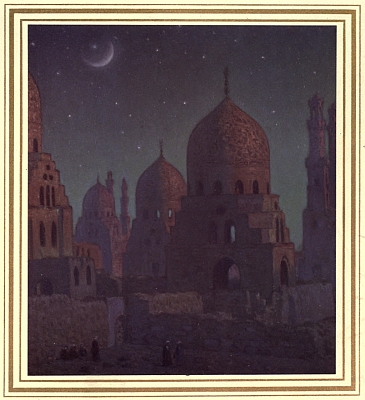
Tombs of the Khaliphs. Under their rule, Moslem civilisation enlightened the World.
By troubling about polygamy, shall we not be set down as old-fashioned? Without taking other things into consideration, the needs of modern life render it impraticable in large cities. It will have died out before long, among civilised Moslems. If the principle survives, it will only be applied in the desert depths where it is an imperious necessity.
Will morality improve by the disappearance of polygamy? That remains doubtful. Prostitution, so rare in most Mussulman lands, will extend its ravages. A plague, now totally unknown, will break out: that of the celibacy of women, which causes desolation in monogamous countries—where, above all, following great wars, it attains disastrous proportions.
In a study on the future of the French colonies, Charles Dumas, writing about the Moslems, states: 'No race can gain freedom when it condemns the half of itself (i.e. its women) to eternal bondage.'
Is it true that Mussulman women are reduced to such a lamentable situation? It is certain that in the eyes of European women enjoying untrammelled freedom, the wearing of a veil and semi-claustration as well, to which the women of Islam are subjected, must seem to be tokens of the most unbearable slavery. But if these ladies of Europe heard the reflexions of these same Mussulman women, objects of monogamists' wives' heartfelt commiseration, they would be surprised to learn that they, in their turn, are not envied, but charitably pitied. Besides, the wearing of the veil and claustration are in no wise religious obligations. The Verses of the Qur'an (xxxiii, 53, 55) by which these questions are supported, are solely aimed at the Prophet's wives and not at those of all Believers, as might be deduced from the inexact translation of verse 55, by Kasimirski.
These practices, put in force many years after Mohammad's death, are therefore fiercely attacked by numerous champions of the feminine cause. Among them, we note Qasim Bey Amin, with his book: "Tahriru'l-Mirat" ("Woman's Emancipation"); and Es Zahawi, the poet of Bagdad, who wrote a celebrated letter on the veil, and says: 'Woman is the remedy of youth, the beauty of nature and the splendour of life. Without women, man is a sterile syllogism—he does not conclude!' And then, relying on this verse: "And it is for the women to act as the husbands act towards them with all fairness." (The Qur'an, ii, 228), he claims complete female freedom.
We will conclude by quoting the words of one of the fair sex, al-Sitti Malika who, with the consent of her father, Hifni Bey Nasif, formerly professor at the University of Al Azhar, published a Qasida, terminating with this verse: 'To unveil, if one is chaste, is no harm; and if one is not chaste, veils in excess offer no protection.'
At the same times as European queens of fashion have tried to acclimatise the Turkish veil in the West, perhaps at some future period, near or distant, the custom of wearing the veil may die out in the East. In that case, the flower of Mussulman beauty will have been stripped of its graceful calyx. Will not the woman of the East regret the mysterious charm she owed to her filmy mask? Will she be compensated by the advantages accruing to her in consequence of budding forth in the strong light of civilisation? The example of the great misery reigning among her sisters of the West, struggling for life in opposition to men, may perhaps frighten the woman of the East when, with dazzled eyes, scarcely awakened from harem dreams, she plunges into the vortex of modern existence. The question is too delicate. We dare not come to a conclusion. After all, the interest and possibility of such reforms vary too completely, from one country to another, so that no general rule can be fixed.
But if we hesitate about passing judgment on the reforms we have just set forth, we acknowledge unreservedly, to make amends, that the education of woman is an imperious necessity for the future of Islam.
Education has nothing to do with the above-mentioned customs. It is in agreement with all the principles of the religion, and during the period of Islamic splendour, was lavished on Mussulman femininity whose culture was superior to that of European women in those days.
In the East, education has never disappeared as completely as in some regions of the Maghrib. During a certain number of years, many Mussulman women passed their leisure harem hours in educating themselves, and their new intellectual birth began to be generalised. From education alone the evolution of manners and customs will proceed wherever it will be necessary in the sense and proportions creating the least amount of trouble in the bosom of families.
CONCLUSION
The knots relating to polygamy and the emancipation of woman (the only questions that give a shadow of right to inimical critics of Islam) once cut, Islam will appear to be what it really is: a religion essentially in conformity with the most modern needs and ideas, so much so that an Englishman, Oswald Wirth, was able to write: 'I discovered, one fine day, that I was a Mussulman, without knowing it, like Monsieur Jourdain with his prose.' In like fashion, Goethe, after having studied the principles of the Qur'an, declared: 'If that is Islam, do we not all live in Islam?'
Very soon, no one will venture to give credence to the childish legends perpetuated since the Crusades, and Islam will at last claim to take its place in the van of modern civilisation....
We were writing the concluding lines when suddenly the most formidable conflict ever know in history broke out in Europe, and thousands of Moslem soldiers, descendants of the warriors of Poitiers, immediately invaded the whole of France.
This time, they came not as conquerors, but as friends; as brothers-in-arms, summoned by the Allies to take part in this gigantic struggle on which depends the fate of civilisation. Their traditional heroism has been admired by all. The French soil is riddled by thousands of their graves, thereby they have implanted Islam for ever in the heart of Europe, in the most glorious way; and a strong contingent of the Prophet's disciples is now in European territory.
After such services rendered, it will be churlish to refuse them the freedom of the city, so to speak, that we have already claimed on their behalf. We go further and ask if it is admissible to think that their example, dealing the last blow at the imputations of the past, may give some Europeans food for fresh reflexion?
Undeceived by the failure of integral rationalism, many anxious minds seek new paths. "The modern system of intuition, towards which they hurry, following Bergson, its celebrated defender, represents decided reaction against rationalism, or to be more exact, against the powerlessness of rationalism....
"In the hearts of men hungering after faith, this eminent thinker has caused the aspirations they seem to have lost definitively to be born anew. He allows them to hope for the survival of the soul; he tells them that this world is not a great mass of machinery driven by blind forces and that intelligence is not the only formula of our senses....
"In affirming all this, the illustrious philosopher is perhaps confining himself to the task of reviving ancient illusions; but he has awakened them so that we may hear; and at a moment when they may serve to prepare the elements of a new religion, needed by many men." (La Vie des Vérités, by Dr. Gustave Le Bon.)
Such a movement is irresistible, especially after the sanguinary ordeals we have undergone. We are therefore about to witness the efforts of new and old religions, trying to monopolize these manifestations and turn them to account. Rationalism, however, although defeated, has nevertheless been fruitful, and it will oppose an insuperable barrier to the dogmas that run counter to reason much too violently.
On the other hand, must not mystic, pathetic and poetical aspirations be reckoned with? Are they not the essential final causes of all religions? To sum up, are not the most needful conditions of a modern religion those of advanced Protestantism: "Unitarism," clothed in a glorious cloak of poetry?
Islam, freed from all the dross which it accumulated in its course, has precisely these conditions, and already small communities of European converts to Islam have been founded in England and America. One of them, having Mr. Quilliam at his head, exists for several years past at Liverpool, and is remarkable for the fact that the majority of its proselytes belong to the weaker sex.
The conversion of Lord Headley, an English peer, followed by that of other well-known leading Londoners, created a great sensation. The Mussulman commonwealth, founded by this eminent man, publishes a monthly magazine, "The Islamic Review," from which we take the following significant passage:
"Why have Englishmen and other Europeans become Mussulmans? In the first place, because they sought for some simple, logical, essentially practical creed; (for we English flatter ourselves that we are the most practical people under the sun) a creed fitting in with the conditions, customs, and occupations of every people; a divine, true creed, where the Creator and Man are face to face, without any intermediary." (Sheldrake.)
That is what practical minds have found in Islam which, having no sacrements or worship of saints, needs no priest and could, at a pinch, do without a temple. As Allah's presence fills the universe, is not the whole of the earth one immense Mosque?
Moreover, several modern desists, generally finding it difficult to express the aspiration of their souls, will find in the pure deism of true Islam, the most admirable ritual movements and words of prayer that an artistic mind could dream of. In short, for more than one, 'Islam realises the maximum of altruism with a minimum of metaphysics.' (Christian Cherfils.)
Other isolated conversions have taken place in France and in different countries of Europe, Africa and Asia. Perhaps, in this way, we may witness the realisation of this "Hadis" of the Prophet: 'Assuredly Allah will make this religion (Islam) all-powerful by means of men who were strangers thereto!' of the principal characteristic of Islam is that it is wonderfully fitted to all races of creation. Among his first disciples, Mohammad counted not only Arabs of the most different tribes, but also Persians, such as Salman al-Farsi; Christians, such as Waraqa; Abyssinians, such as Bilal; Jews, such as Mukhayriq, Abdullah ibn Sallam, etc. As it is said in the Qur'an: "We have not sent thee otherwise than to mankind at large." (xxxiv, 27.)
Even during Mohammad's life, and in the very beginning, his doctrine asserted its stamp of universality. If suitable to all races, it is equally suitable to all intellects and to all degrees of civilisation. Of supreme simplicity, as in Mu'tazilitcism; desperately esoteric, as in Sufiism, bringing guidance and consolation to the European "savant"—leaving thought absolutely free and untrammelled—as well as to the negro of the Soudan, thereby delivered from the superstition of his fetishism. It exalts the soul of a practical English merchant, for whom 'time is money,' quite as much as that of a mystical philosopher; of a contemplative Oriental; or of a man of the West loving art and poetry. It will even allure a modern medical man, by the logic of its repeated ablutions and the rhythm of its bowing and prostration, just as salutary for physical well-being as for the health of the soul itself.
It is therefore not too foolhardy to think that when the fearful storm has passed and the respect due to all nationalities, as well as to all religions, shall have been enforced, Islam will be able to look upon a future brimming with real hope.
Thanks to the great share it has taken in the events causing the upheaval of European civilisation, it has entered therein and will appear at last in its true light. The different nations will vie with each other in seeking to be allied to it, for they will have put its value to the test and have recognised the inexhaustible resources it possesses.
The disciples of the Prophet, awakened from their momentary lethargy, will take their brilliant place in the world.
—"Insha'llah!"—If Allah be willing!

Allah will perhaps establish goodwill between yourselves and those of them with whom ye are at enmity, and Allah is Powerful: and Allah is Gracious, Merciful.
This book was finished at Bou-Sâada, on the Twenty-seventh day of the month of Ramadhan; in the Year 1334 of the Hegira—the 28th of July, A.D. 1916.
O Allah! be indulgent towards its authors; excuse the extravagant audacity that urged them on in their hope of doing good, to affront such a vast subject, despite the scantiness of their knowledge.
O Thou, the Omniscient! pardon them the errors which, through ignorance, they may have committed in such a sublime history as that of Thy Messenger, Our Lord Mohammad, the Seal of the Prophets.
May Allah pour out for him His Blessings and His Favours! Likewise on his Relatives, And on his Companions! Amin.
Étienne DINET.
Sliman ben IBRAHIM.
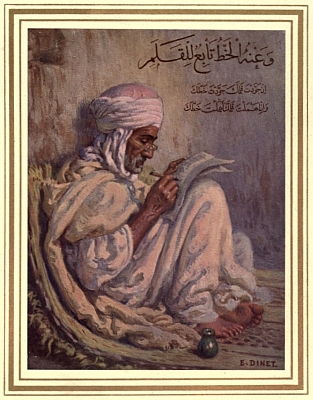
A traditional old Scribe of the Desert. Calligraphy: One's pen should be ennobled; that is, by treating of worthy matters.
THE BOOK WAS FINISHED IN THE YEAR 1335 OF THE HEGIRA
BIBLIOGRAPHY
Fearing to enlarge this work too much, we prefer to publish the notes, which we deem necessary for its justification, under the title: "L'Orient vu de l'Occident," (The East Seen from the West), forming a pamphlet to be issued later on.
Nevertheless, we give as follows a list of those works which we have specially consulted.
WORKS IN ARABIC
"Al-Qur'an wa huwa'l-Huda wa'l-Furqan."—"Tafsir Anwaru't Tanzil wa Asraru't Tawil," by Al-Baydawi, (Commonly referred to as "The Commentary of Al-Baydawi.")—"Tafsiru'l Qur'ani'l Karim," by the Shaykh Mohammad Abduh. ("The Commentary of the Shaykh Mohammad Abduh.")—"Siratu'n-Rasul," by Ibn Hisham. (Ibn Hisham's "Life of the Prophet.")—"Kitabu't Tabaqat," by Ibn Sad. (The "Tabaqat" of Ibn Sad.)—"Insanu'l-'Uyun fi sirati'l-Amiri'l-Mamun," by Ali ibn Burhanu'd-Dini'l-Halabi.—"Nuru'l yaqin fi sirati Sayyidi'l-Marsulin," by Mohammad Al-Khudri.—"Kitabu's-Sahih," by Al-Bukhari. (The "Sahih" of Al-Bukhari.)—"Rihlat," by Abi'l Husayn ibn Jubayr. (The "Travels of Ibn Jubayr.")—"Ar-Rihlatu'l Hijaziyya," by Mohammad Al-Batanuni.—"Al-Bourdate," by the Shaykh Al-Busiri. (The "Burda," or "Mantle Poem of Al-Busiri.")—"Ummu'l Qura," by Al-Kawakibi.
ISLAMIC WORKS, IN ENGLISH
"The spirit of Islam", by Ameer Ali Syied.—"Islamic Review," edited by Khwaja Kamal-ud-Din, B.A., L.L.B.
WORKS IN FRENCH, OR TRANSLATED INTO FRENCH
Le Coran, traduction de Savary.—Le Coran, traduction de Kasimirski.—Le Coran, analysé par J. La Baume.—Le Coran, sa poésie, ses lois, par Stanley Lane Pole.—L'Esprit libéral du Coran, par Benâttar, El Hadi Sebâï et Abdelâziz Ettsalbi.—Encyclopédie de l'Islam, dirigée par le Professeur Houtsma.—Les Traditions islamiques d'El Bokhari, traduction de Houdas.—L'Islam, par le Comte Henry de Castries.—L'Islamisme, par Houdas.—"Oumm el Quora", (la mère des Cités) de El Kaouakibi, compte-rendu littéral, d'après la version d'Omar Bouderba, par Christian Cherfils (en préparation).—L'Islamisme au point de vue social, textes d'Auguste Comte, publiés par Christian Cherfils.—Bonaparte et l'Islam, par Christian Cherfils.—Vie de Mahomet, par J. Gagnier.—Essai sur l'histoire des Arabes, par Caussin de Perceval.—Histoire des Arabes, de Sédillot.—Histoire des Arabes, de Huart.—"La Civilisation des Arabes", par le Dr. Gustave Le Bon.—Essai sur l'histoire de l'Islamisme, par Dozy.—Histoire des Musulmans d'Espagne, par Dozy.—Le présent de l'homme lettre, pour réfuter les partisans de la Croix, par Abd Allah Le Drogman.—De l'état présent et de l'avenir de l'Islam, par E. Montet.—Les Héros (Mahomet, le héros comme Prophète), par Carlyle.—Averrhoës et l'Averrhoïsme, par E. Renan.—Les Musulmans français de l'Afrique du Nord, par Ismaïl Hamet.—Les vieux Arabes, par P. Radiot.—Voyage en Arabie, par Hubert.—Mon voyage à la Mecque, par G. Courtellement.—"Mohammed et la fin du Monde", par P. Casanova.—L'enseignement de l'Arabe au Collège de France, par P. Casanova.—Revue du Monde Musulman, dirigée par A. Le Chatelier.—"L'Orient vu de l'Occident", par E. Dinet et Sliman ben Ibrahim.
TRANSLATION OF THE ARABIC CALLIGRAPHY
TITLE PAGE opening: There is no God but Allah, and Mohammad is the Prophet of Allah.
CHAPTER THE FIRST opening: In the name of Allah, the Compassionate, the Merciful.
closing: Then when ye have ended the prayer, make mention of Allah, standing, and sitting, and reclining. (The Qur'an, iv, 104.)
CHAPTER THE SECOND opening: Have We not opened thy breast for thee? * And taken off from thee thy burden? (The Qur'an, xciv, 1-2.)
closing: And provide for your journey; but the best provision is the fear of Allah. (The Qur'an, ii, 193.)
CHAPTER THE THIRD opening: Verily, we have caused It (the Qur'an) to descend on the night of Power. (The Qur'an, xcvii, 1.)
closing: O thou enwrapped in thy mantle! * Arise and warn! * And thy Lord—magnify Him! (The Qur'an, lxxiv, 1-3.)
CHAPTER THE FOURTH opening: Ye shall assuredly be tried in your possessions and in yourselves. (The Qur'an, iii, 183.)
closing: And before them have We set a barrier and behind them a barrier, and We have shrouded them in a veil, so that they shall not see. (The Qur'an, xxxvi, 8.)
CHAPTER THE FIFTH opening: And fight for the cause of Allah against those who fight against you. (The Qur'an, ii, 186.)
closing: Believers! when ye confront a troop, stand firm and make frequent mention of the name of Allah; haply it shall fare well with you. (The Qur'an, viii, 47.)
CHAPTER THE SIXTH opening: And be not faint-hearted, and be not sorrowful; For ye shall gain the upper hand if ye be believers. (The Qur'an, iii, 133.)
closing: Nay rather Allah is your liege lord, and He is the best of helpers. (The Qur'an, iii, 143.)
CHAPTER THE SEVENTH opening: Verily, We have won for thee an undoubted victory. (The Qur'an, xlviii, 1.)
closing: Now hath Allah helped you in many battle-fields, and, on the day of Hunain, when ye prided yourselves on your numbers; but it availed you nothing. (The Qur'an, ix, 25.)
CHAPTER THE EIGHTH opening: Accomplish the Pilgrimage and the Visitation of the Holy Places in honour of Allah. (The Qur'an, ii, 192.)
closing: Say: Go through the earth, and see how He hath brought forth created beings. (The Qur'an, xxix, 19.)
CHAPTER THE NINTH opening: Thou truly art mortal, O Mohammad, and they truly are mortals. (The Qur'an, xxxix, 31.)
closing: Mohammad is no more than an apostle; other apostles have already passed away before him; if then he die, or be slain, will ye turn upon your heels? (The Qur'an, iii, 138.)
THE PROPHET'S PORTRAIT opening: O my supreme Master, lavish thy Blessings and thy Favours for ever and ever on Thy Friend (Mohammad), the best of all created beings. (Al-Bourdate. Poem by the Shaykh Al-Busiri, in honour of the Prophet.)
closing: There is no God but Allah, and Mohammad is the Prophet of Allah.
CHAPTER THE TENTH opening: Say: O my people! Act as ye best can: I verily will act my part, and hereafter shall ye know! (The Qur'an, vi, 135.)
closing: Allah will perhaps establish goodwill between yourselves and those of them with whom ye are at enmity, and Allah is Powerful: and Allah is Gracious, Merciful. (The Qur'an, lx, 7.)
FINAL ENGRAVING One's pen should be ennobled; that is, by treating of worthy matters.
COVER Upon him, Mohammad, Salvation
BACK PAGE Mohammad's Seal. [Transcriber's note: seal not found.]
LIST OF ILLUSTRATIONS
FRONTISPIECE.—Ornamental page
CHAPTER THE FIRST.—Ornamental page Praying round the Sacred Temple of the Ka'bah of Makkah
CHAPTER THE SECOND.—Ornamental page The Night of the "Maulid," the Prophet's Birthday. Moslems leaving a village Mosque. SCENES OF THE BADYA, OR NOMADIC LIFE. Watching over camels grazing The Flocks 1 2
CHAPTER THE THIRD.—Ornamental page "At Takbir," or the Glorification SCENES OF THE BADYA, OR NOMADIC LIFE. The Encampment 1 2 Moslem woman praying on the terrace-roof of her dwelling
CHAPTER THE FOURTH.—Ornamental page "Ar Ruku," or the Inclination The Friday Visit of Moslems to the Cemetery SCENES OF THE BADYA, OR NOMADIC LIFE. The Departure 1 2
CHAPTER THE FIFTH.—Ornamental page Interior of a Mosque.—"Al Mihrab," the niche marking the direction of Makkah The Mu'azzin's Call Believers perceiving the New Moon of the Month of Ramadhan
CHAPTER THE SIXTH.—Ornamental page "As Sidjah," or Prostration Setting out for the "Jihad," or Holy War 1 2 "Al Fitr," the Prayer on the breaking of the Ramadhan fast 1 2
CHAPTER THE SEVENTH.—Ornamental page An Arab horseman of the Desert "Among all trees, one is blessed like the Mussulman; 'tis the Palm," said the Prophet 1 2 Bird's-eye view of Makkah, the Most Sacred City, as seen from the Jabal Abi-Qubais 1 2
CHAPTER THE EIGHTH.—Ornamental page "Ad Dawah," or the Invocation The Pilgrims of Mount Arafa, on the Ninth day of the Month of Zu'l Hijjah 1 2
CHAPTER THE NINTH.—Ornamental page Al-Madinah, the city of the Prophet. The Dome of Mohammad's Tomb
PORTRAIT OF THE PROPHET.—Imam leading the Prayer
CHAPTER THE TENTH.—Ornamental page A writing lesson at a village school devoted to the teaching of the Qur'an Theological Students in the courtyard of Al-Azhar, the great Cairo Moslem University Tombs of the Kaliphs. Under their rule, Moslem civilisation enlightened the world A traditional old scribe of the Desert Final ornamental page
INDEX
PREFACE
CHAPTER THE FIRST.—The Moslem Prayer.—Description of Makkah. —The Temple of the Ka'bah and the Black Stone.—The Marriage of Abdullah, Father of the Prophet.
CHAPTER THE SECOND.—The Birth of Mohammad.—Mohammad's Childhood with the Banu Sad Tribe in their Badya-Land.—Mohammad and the two Angels.—Aminah's Death.—Mohammad's first Journey to Syria.—How Mohammad met the Monk Bahira.—The second Syrian voyage.—The Marriage of Mohammad and Khadijah.—How the Temple of the Ka'bah was rebuilt.
CHAPTER THE THIRD.—Desert Retirement.—The Revelation.—The First Moslems.—The Announcement of the Hour.—The First Hostilities.—The Incident of the Blind Man.—How Hamzah was converted.—Utbah's proposals.—The Miracle of the Qur'an.—How it was forbidden to listen to the Qur'an.
CHAPTER THE FOURTH.—Persecution.—The Emigration to Abyssinia.—The Conversion of Umar, son of Al Khattab.—The Exile of the Banu Hasham.—The Decree of Expulsion destroyed by a Worm.—The Death of Abu Talib and Khadijah.—The Journey to Taif.—The Nocturnal Journey and Ascension.—How six Inhabitants of Yasrib were converted.—The two Oaths of the Aqabah.—The Plot against the Prophet.
CHAPTER THE FIFTH.—The Hegira, or the Migration of the Prophet to Al-Madinah.—Suraqa's Mishap.—The Prophet's Arrival at Quba. —The Era of the Hegira.—Arrival of the Prophet at Yasrib. —How the Mosque of Al-Madinah was built.—The Qiblah of Makkah. —Institution of the Azan, or Call of the Mu'azzin.—The Fast of Ramadhan.—Property bestowed in Alms, and the prohibition of fermented liquors.—Ayishah in the House of the Prophet. —Hostility of the Jews and the Munafiqun.—Al-Jihad (the Holy War), and how it was instituted.—The Gazwah of Badr.—The Sojourn at Badr and the Return to Al-Madinah.
CHAPTER THE SIXTH.—Ali's Marriage.—The Prophet's Marriage with Hafsah and Ummu'l Masakin.—The Battle of Uhud.—The Marriage of Mohammad and Zainab.—The Ghazwah, or Expedition of Zat-ir-Riqua.—The Ghazwah, or Expedition of the Banu Mustaliq.—The Tayammum, or the Ceremony of Ablution performed with Sand.—The Battle of the Ditch.—The Treaty of Al-Hudaibiyah.
CHAPTER THE SEVENTH.—Expedition against the Qaynuqa Jews. —Expedition against the Jews of the Banu Nadir.—Expedition against the Jews of the Banu Quraizah.—Expedition against the Jews of Khaibar.—Importance of Horse-breeding according to the Prophet.—The Poisoned Lamb.—Amratu'l-Qada, or the Pious Visitation.—The Prophet sends Ambassadors to the Principal Monarchs of the World.—The Expedition of Mutah.—The Taking of Makkah.—Entry of the Prophet into Makkah.—The Prophet at Safa.—Ghazwah, or Expedition of Hunain.
CHAPTER THE EIGHTH.—Ayishah slandered.—The Birth and Death of Ibrahim.—Ghazwah, or expedition of Tabuk.—The Thamud Country. —Arrival and Sojourn of the Prophet at Tabuk. The Prophet goes back to Al-Madinah.—The Valedictory Pilgrimage.
CHAPTER THE NINTH.—Illness and Death of the Prophet.—Abu-Bakr elected.—The Prophet's Burial.
THE PROPHETS PORTRAIT.
CHAPTER THE TENTH.—The March of Islam.—Influence of Moslem Civilisation in Europe during the Middle Ages and the Renaissance. —The Future of Islam.—Conclusion.
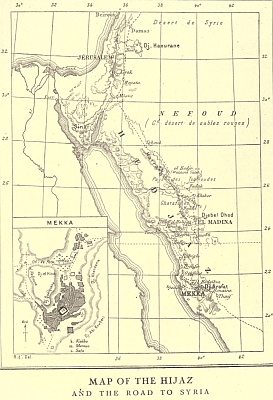
MAP OF THE HIJAZ AND THE ROAD TO SYRIA.
BIBLIOGRAPHY.
INDEX OF THE ARABIC CALLIGRAPHY.
LIST OF ILLUSTRATIONS.