THE PARIS BOOK CLUB, 11, RUE DE CHATEAUDUN (continued 2)
Reading edition
Mohammad felt his body relieved from a weighty burden by the purification, and his soul brightened by the benefits of these prayers. Then it was that, thrilling with the faith of belief, Mohammad was about to return home to his wife when Jibra'il appearing once more, said to him: 'Teach Khadijah salvation by Islam!' That is to say, by voluntary resignation to all the Creator's commands. He obeyed and spoke thus: 'O Khadijah! Jibra'il ordereth me to teach thee salvation by Islam.' And Khadijah answered: 'Allah is Salvation; from Him cometh Salvation, and let Salvation be on Jibra'il.'
Thus it came about that, of all living beings, Khadijah was Islam's first convert. The Prophet took her at once to the miraculous spring, where he taught her what he had just learnt. Copying her husband, she purified herself by the ablutions and recited the prayers. Ever since that day, Allah made use of this admirable woman to mitigate the sorrows and pains of His Prophet in all the ordeals he had to undergo. Khadijah's devotion endowed Mohammad with deep contempt for mortals' wickedness, and his wife's firm faith served to comfort him when he was looked upon as an impostor.
One of the first of the Prophet's companions to believe in his mission was Ali, son of Abu Talib, only about ten years old just then, and who Mohammad had adopted during a period of famine, so as to relieve his uncle, at the head of a very large family.
Noticing that Mohammad and Khadijah kept aloof and became absorbed in prayer, he marvelled greatly at seeing no object of worship set up in front of them and he put this question to the Prophet: 'What rites were ye both performing just now?'—'We were saying the prayers of the pure religion that Allah hath just chosen for Himself and for which He hath chosen me to be the Prophet,' he replied. 'O Ali! I do invite thee to join with me. I invite thee to worship the Only Allah that hath no partners and I call upon thee to renounce the idols Lat and Uzza who can neither benefit nor harm their worshippers.'
'Say then: "He is one Allah: * Allah the everlasting! * If He begetteth not, and He is not begotten; * And there is none like unto him. * He is Allah beside whom there is no god. He knoweth things visible and invisible. He is the Compassionate, the Merciful! * And when He decreeth a thing, He only saith to it, 'Be,' and it is. * There is no Allah but He; the Living, the Self-subsisting. Neither slumber seizeth Him, nor sleep. * No vision taketh in Him, but He taketh in all vision: and He is the Subtile, the All-informed! It is He who causeth to laugh and to weep * He causeth to die and maketh alive * He bringeth forth the living out of the dead and the dead out of the living: He quickeneth the earth after its death; thus it is that ye too shall be brought forth. * The East and the West is Allah's: therefore, whichever way ye turn, there is the Face of Allah: truly Allah is Omnipresent and Omniscient ... * This is Allah, your Lord. All power is His, But gods whom ye call on beside Him have no power over the husk of a date-stone!" (The Qur'an, cxii, 1, 4. lix, 22. ii, iii, 256. vi, 103. liii, 44, 45. xxx, 18. ii, 109. xxxv, 14.)
'Never until this day,' Ali replied, 'have I hearkened unto such words and I wish to consult Abu Talib, my father.'—'Do nothing of the sort!' the Prophet hastened to tell him, for Mohammad feared lest the news of his Mission should be noised abroad before the hour arrived to divulge it in open day. 'If thou dost come to Islam, O Ali! thou must keep the secret.'
Greatly troubled in his mind by all he had just heard, Ali passed a sleepless night, but Allah (Glory be to Him!) guided him on the Road to Salvation. Early in the morning, he went to Mohammad and professed the religion of Islam with all his heart. From that day onwards, when came the hour of prayer, Ali followed Mohammad to the ravine to pray with him, unbeknown to the boy's father and uncles.
But one day, when they were both praying at the place called, "Nakhlat-al-Mahal," Abu Talib caught them unawares and questioned the Prophet, saying: 'O son of my brother, what is this religion of which thou dost follow the rites in thy prayers?'—'It is the religion of Allah, of his Angels and His Prophets—the religion of our ancestor Ibrahim. Allah hath sent me to preach it to all men; and thou, the most worthy and the nearest of my relatives, I invite thee to tread the Road to Salvation.'—'I cannot give up the religion and the tradition of my fathers,' Abu Talib declared; 'and yet I hold thee to be so sincere that I believe in the truth of what thou sayest. Continue, however, to fufill thy Mission without anxiety, for no harm shall come to thee so long as I live.' Turning towards his son, he added: 'Thou mayest hearken to Mohammad, and follow him as obediently as thou canst, for he will never guide thy footsteps except in the path of righteousness.'
Zayd ibn Harith, a captive, freed and adopted by Mohammad, and who had so much affection for his liberator that he refused to go away with his father when he came to pay the ransom, soon followed All's example and became a convert to Islam. Next followed one of the most noted men of Makkah, Abdul-Ka'bah, son of Abu Quhafah, whom we shall call henceforward Abu Bakr, being the name he assumed later and caused to become celebrated.
He happened one day to be at the house of Hakim ibn Hazam, when a slave of the household came and spoke to his master as follow: 'Khadijah, thy aunt, maintaineth that her husband is a Prophet sent by the Most High, like Moses!' Hearing this, Abu Bakr, who had great faith in Mohammad's sincerity, and had heard some of Waraqah's predictions, jumped up hurriedly, much moved; and sought out the Prophet to interrogate him. No sooner had Abu Bakr hearkened to Mohammad's utterances giving details of the Revelation, than he was overtaken by enthusiasm and cried out: 'By my father and my mother and by all the friends of truth, I believe what thou hast told me and I bear witness that there is no God but Allah and that thou art His Prophet!' Hearing his speech, Khadijah, draped in a crimson veil, came out of a near-by room and said to Abu Bakr: 'Praised be Allah who hath guided thee, O son of Abu Quhafah!'
This conversion was a source of great joy for the Prophet. Abu Bakr held high rank in the city. He was very rich; remarkably well favoured, with fine features and aristocratic bearing; conversant with the sciences of genealogy and the meanings of dreams. Truthful in his speech; affable in neighbourly intercourse, he had been chosen by his fellow-citizens for the extremely delicate post of the umpire whose duty it was to judge cases of homicide and fix the amount of the "Qisas," or money compensation for wilful murder.
A fervent Believer, Abu Bakr's entire efforts were now devoted to leading his friends and the people of his party to the Prophet, so that he might invite them to Islam. Abu Bakr's activities were successful; the confidence he inspired induced his partisans to hearken with favour to Mohammad's discourse. The enunciation of this religion, so simple and withal so great; in such conformity with the inward longings of the soul of mortals, led them gradually to look with horror upon the state of gross idolatry in which they had hitherto wallowed. Besides, this religion was that of Abraham, their ancestor, and as his creed was still dormant in their hearts, despite themselves, it was easy for them to acknowledge it. Last of all, the superhuman accents of the man who preached this new belief and his radiant, expressive looks, stirred their whole being and they hastened to be converted by him.
About fifteen of the leading men of the Quraish tribe came to the Prophet in the same way and became ennobled by Islam. We may mention Usman ibn Affan, Abd ar Ralman ibn Auf, Sad ibn Abi Waqqs, Zubayr ibn al-Auwam, Talha Ubaydullah, Ubayda ibn Harith, Jafar ibn Abdul Muttalib, and many others.
At the same time as these conversions, so important by reason of the proselytes ranking highly, we must not forget one more humble, but most touching: that of Mohammad's nurse. As soon as the call of her foster-son came to her ears, good Halimah, who had always believed that the boy she had reared would make his mark in life, hastened with Haris, her husband, to be counted among the Faithful. Every person, too, belonging to Mohammad's household, had become a convert from the onset, and among them, his daughters, still very young; without forgetting a negress, Umm al Ayman. This little group of Believers now led a life filled with ever-changing emotion. What could be more charming than their secret meetings when they prayed and adored Allah in perfect union? But they had to take unheard-of precautions so as not to awaken the hostile suspicions of idolaters. Even in his own house, the Prophet was forced to beware of his neighbours, and when he proclaimed the "Takbir," he spoke into a pitcher buried in the ground, so as to deaden the sound of his voice. In these circumstances, only clandestine propaganda was possible, and during the first three years, the progress of Islam was excessively slow and timid.
On the other hand, Revelation had suddenly stopped; and Mohammad, no longer feeling himself upheld by the inspiration of the Almighty, began to doubt and despair.
He was wandering to and fro, anxious and alone, in a wild valley, when he heard a celestial voice causing him to look up. In the vivid brightness of great light, he recognised the Angel that had appeared to him at Hira. He could not support the brilliancy of this formidable apparition and, blinded, rushed to his dwelling where he had himself wrapped up in his mantle, so as to calm the tremor of his frame and shade his dazzled eyes. It was then that Allah sent down the following verses: "O thou enwrapped in thy mantle! * Arise and warn! * Warn thy relatives of nearer kin * And lower Thy wing over the Faithful who follow Thee. * And if they disobey thee, then say: 'I verily am clear of your doings' * And put thy trust in the Mighty, the Merciful." (The Qur'an, lxxiv, 1, 2. xxvi, 214-220).
The Prophet rose up, his eyes sparkling with sublime energy. Until that day, he had never dared to proclaim his Mission publicly, for he foresaw the hatred it would foment among his idolatrous fellow-citizens. But having been ordered by his Supreme Master to preach the doctrines of Islam, which was Mohammad's most earnest wish, he threw off the restraint that crushed him, and resolved to have recourse to strong measures. He ordered Ali to prepare a meal composed of a leg of lamb, hot corn and a jar of milk. He then invited his relatives to partake of it.
Not one refused, and there came forty persons all told; among them his uncles on his father's side: Abu Talib, Hamzah, Abbas and Abu Lahab. When the guests had eaten their fill, much to their great surprise, for this modest repast could have been easily swallowed up by any one man among them, Mohammad made as if to address the meeting. But Abu Lahab, having some suspicions respecting his nephew's ideas which did not meet with his approval, took the words out of his mouth. 'What kind of spell does our host seek to cast over us?' he cried. In superstitious fear of being bewitched, the proof of such a dire fate being furnished by the fact that their hunger had been appeased by a most meagre banquet, the guests scattered away in great haste.
Affronted by their lack of courtesy, the Prophet said to Ali: 'Didst thou give heed to my uncle when he cared not how impolitely he behaved in preventing me from speaking? But no matter! Get another meal ready for to-morrow, and go round and invite all the same people.'
Next day, in the presence of the guests once more gathered together, Mohammad hastened to make himself heard and succeeded in so doing. 'No one living hath ever brought to the Arabs what I bring,' he declared; 'that is to say, glorious good fortune in this world and supreme felicity in the next. Allah the Most High hath commanded me to summon all men to Him. Who among ye wisheth to share my work and help me to accomplish my mission? Such a man shall be my proxy and my lieutenant—nay, my brother!'
At this unexpected declaration, all the people present stared at each other in stupefaction; and knowing not what to reply, their features betrayed naught else but fierce enmity and showed what their answer would have been. Faithful Ali, expecting an outburst of joy, at such great, good news, coupled with ardent competition in hopes of the honour of becoming Mohammad's henchman, forgot that his youth demanded his silence in the midst of such a gathering of noble folks; and standing up erect, carried away by his enthusiasm, he cried out: 'O Prophet of Allah! I will be thy lieutenant!'
Instead of smiling at the pretensions of the lad, the Prophet patted Ali's neck affectionately while proclaiming: 'Here is my proxy and my lieutenant! Here standeth my brother! Listen to him and obey!'
By this time the stupefaction of the guests was boundless, but they suppressed their rage and received the declaration with great bursts of merriment. Abu Lahab turned to Abu Talib and shouted ironically: 'Hast heard thy nephew's speech? He ordereth thee to listen to his son and obey him!'
With the exception of Abu Talib, saddened by this scandalous scene, all went away, jeering sarcastily and exasperated.
It is certain that this utter defeat grieved the Prophet, without discouraging him in the least, for, from that day, the Revelation gave him support, instruction and guidance unceasingly.
THE ANNOUNCEMENT OF THE HOUR
And Mohammad began to preach. He was hurried along by the Revelations which came to him quickly, one after the other, all terrible; and announcing "The Frightful Blow," being the End of the World and the Day of Judgment.
"The Blow! what is the Blow? * And what shall teach thee what the Blow is? * The Day when men shall be like scattered moths, * And the mountains shall be like flock of carded wool." (The Qur'an, ci, 1, 4.)
Mohammad thought this disaster, destined to punish mankind for its perversity, was imminent. So he increased his reproofs among his fellow-men, in order to deliver them from the sway of their passions and guide them into the Path of Salvation before the Blow fell. But they answered him, saying: "The Hour will not come upon us!" (The Qur'an, xxxiv, 3.)
Obeying the orders of Allah, he reiterated his adjurations: "Verily, the Hour will surely arrive: there no doubt with regard to it. * O Men, fear your Lord! Verily, the earthquake of the Hour will be a tremendous thing! * When the Earth is shaken with its shaking, * And when the Earth hath cast forth her burdens of buried dead, * And man shall say: What aileth her? * On that day shall she tell out her tidings, * Because thy Lord hath inspired her. * On that day shall men come forward in bands to behold their works, * And whosoever shall have wrought an atom's weight of good shall behold it, * And whosoever shall have wrought an atom's weight of evil shall behold it." (The Qur'an, xl, 61. xxii, 1. xcix, 1-6.)
As a result of these gruesome prophecies, given out with accents of firm conviction, unbelievers felt a shudder of anguish convulsing their being; but as they saw nothing take place as time went on, not even precursory signs, they soon regained their equanimity and fell back again into their erring ways.
The Prophet could not tell for what time the hour was fixed: The knowledge of it is only with my Lord. (The Qur'an, vii, 186.) But Mohammad knew punishment was inevitable in this world or the next, and he was in despair at having to think that his infidel fellow-men would meet with a fate even sadder than that of the peoples of Thamud and Ad.
THE FIRST HOSTILITIES
Following the Prophet's first sermons, the Faithful sought no longer to hide their belief; but, to avoid useless disputes, they held clandestine meetings in a desert ravine where they said their prayers.
A group of idolaters dogged their footsteps and having succeeded in discovering their retreat, lavished foul epithets on them. The Believers, unable to put up with the insults offered to their religion, grew furious and a fight took place, during which Sad ibn Abi Waqqs picked up the jawbone of a camel's skeleton in the sand and dashed it violently in the face of one of the Associates, causing the vital fluid to flow. These were the first drops of blood shed in the struggle now beginning between Islam and idolatry.
Wishing to prevent a renewal of these incidents, the Prophet resolved to retreat to pray in peace with his disciples in the house of Arqam, situated on the Sufah hill. Nevertheless, fury increased among the idol-worshippers. So long as Mohammad had gone no further than to summon them to salvation, even blaming them and threatening them with the punishment of divine wrath, his adversaries merely shrugged their shoulders and laughed at him; but when he retaliated by turning their wooden or stone images into ridicule, pointing out that they were dumb, deaf, blind and powerless, the rage of the idolaters was unbounded. Not only did he sting them to the quick through attacking their beliefs, but he did them great harm commercially, for in the hands of leading citizens, the idols were a source of considerable revenue, and constituted efficacious means of domination over the superstitious common people.
Alone, among the men of his party who had refused to embrace the Islamic faith, his uncle, Abu Talib, still gave him proofs of affection, thus greatly scandalising the other members of the Quraish tribe, who sent him a deputation of the most influential among them: Utbah ibn Rabiyah, Abu Sufyan ibn Harib, Abu Jahal and several chieftains of equal note.
'O Abu Talib!' said these delegates, 'your brother's son insulteth our gods and our beliefs. He mocketh at the religion and traditions of our forefathers. Shall we not rid ourselves of him? Or wilt thou not remain neutral and thus let us be free to act towards him as we think fit? For we know that thou dost not share his convictions any more than we do.' Abu Talib dismissed them with a polite and conciliatory reply.
Mohammad, as may well be surmised, continued his sermons with unfailing ardour. The enmity of the Quraish tribesmen assumed a more serious aspect; their representatives returning to see Abu Talib, to make the following declaration: 'We have the greatest respect for thine age, nobility and rank, but we asked thee to rid us of thy brother's son and thou didst not do so. Now, we can no longer put up with the affronts with which he overwhelmeth our beliefs and traditions, so deprive him of thy protection and leave us free to treat him as we choose. In case of refusal on thy part, we must reckon thee as being against us in the war we declare on him, and which will last until one of the two parties are exterminated!' They then departed, leaving Abu Talib in despair at being cut off from his partisans and, on the other hand, firmly resolving never to throw over his nephew.
In that state of mind, he sent for Mohammad. 'O son of my brother!' quoth he; 'our fellow-citizens of the Quraish have returned and made solemn declarations to me. Reflect; take compassion on me; have pity for thyself, and do not put upon me a burden too heavy to bear.
'O my uncle!' replied the Prophet; 'if in order to make me renounce my Mission, they placed the Sun on my left and the Moon on my right, I swear that, by Allah, I would not yield before I fulfilled my task triumphantly or perished in the attempt!'
Thinking that Abu Talib had spoken as he did as a hint that he would have to cast him adrift, by reason of his inability to protect him, his nephew burst into tears and went away. Abu Talib, much moved, called him back at once and said to him affectionately: 'Go, O son of my brother! Go forth and preach as thou wilt. By God, I'll never turn away from thee!'
Finding that no threats succeeded in estranging uncle and nephew, the delegates went back to Abu Talib for the third time, taking with them Ammarah ibn Walid, and then the deputation made the following proposal:
'O Abu Talib! here is Ammarah ibn Walid, one of the most accomplished and handsome young men among all the youths of Makkah. We bring him to thee. Adopt him for thy son. He belongeth to thee. In exchange, hand over to us thy brother's son thou didst adopt, so that we put him to death, for he hath stirred up strife in our tribe.'—'By God!' replied Abu Talib, 'what's this fine bargain ye now put forward? You would fain give me your son, so that I feed and clothe him; and I should have to let you take mine to be killed by you! That could not be! No, by God!—never!'
With rage in their hearts, the delegate's left him. The Mausam—the time for the pilgrimage—drawing nigh, the Quraish idolaters held a meeting at the dwelling of Walid ibn Moghayrah so as to consult together with regard to the way in which they ought to behave to the Prophet. Walid was spokesman, and he said: 'O assembly of Quraish men! the Mausam will soon bring innumerable pilgrims to Makkah. Of a surety, they have heard about Mohammad, and they will question you concerning him. How will ye answer? Ye must be all of one mind, so as not to contradict each other, which would nullify the effect of your utterances.'—'It is for thee to advise us, O Walid!'—'It is for you to speak first. I will listen and discuss your opinions.'—'Well then! we shall say that Mohammad is a diviner.'—'No! We know the diviners! He hath none of their mutterings or rhyming emphasis.'—'We'll say that he is possessed.'—'No! We have seen men possessed; and unlike them, he is not subject to fits of suffocation and convulsions.'—'We'll say he is a poet.'—'No! He is no poet. We know all the styles of versification as used by the poets, and his speech does not resemble that of any one of them.'—'We'll say he is a sorcerer.'—'No! for we have fallen across sorcerers, and he performeth none of their magical operations. Of a truth, his success is due to the charm and beauty of his discourse.'
Arraigned before the tribunal of their own conscience, the citizens assembled were forced to acknowledge the rigorous truth of this last remark. All of them, more or less, had felt the words springing from the ecstatic soul of Allah's Apostle go home to them. All of them had ofttimes been about to give way to the fascination caused by his accents, ringing with the inspiration of superhuman faith. The Quraish men were only restrained by the importance of their material interests and the violence of their earthly passions, thus seriously threatened by his pure doctrine.
Nevertheless, they were bound to come to a decision at once, so as to prevent, at all costs, the Arabs belonging to distant tribes from undergoing the same ordeal. Therefore, they agreed to say that Mohammad possessed potent spells by which he stirred up strife in families, estranging a brother from his brother, a son from his father, and a husband from a wife.
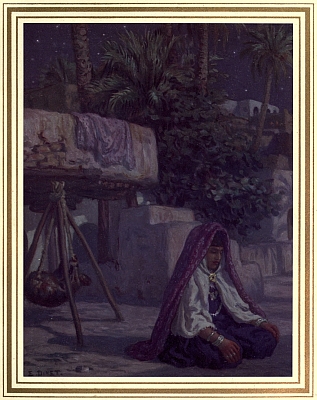
Moslem praying on the Terrace-roof of her dwelling.
When the pilgrims began to pour in, Walid and his accomplices were on the watch, posted on all the roads leading to Makkah. Not a single Arab passed along these highways without being warned against Mohammad by the conspirators in ambush. But although a few pilgrims were alarmed at these warnings and feared the spells that they were informed were threatening them, the majority felt their curiosity increasing with regard to this extraordinary man, whose utterances gave rise to such great apprehension among the lords of the city. Thus it came to pass that when the travellers returned to their tribes, they told what they had seen; so that it plainly resulted that the campaign, organised against Mohammad by his enemies, only achieved the purpose of spreading his renown all over Arabia.
In order to add fresh fuel to the fire of their rage, increasing as the Prophet's reputation became established—a result partly due to their involuntary efforts—the idol-worshippers sought every opportunity to heap insults on him. Being all together, one day, in the precincts of the Temple, they worked each other up. 'No! never have we endured from anybody what this man hath made us endure,' they cried out in chorus. At that very moment, Mohammad came on the scene and began to perform the ritual circuits round the Ka'bah. They rushed at him, all at one bound. 'Art thou the man who dareth to insult the gods of our fathers?' they shouted. 'Aye, I am that man!' he replied, undisturbed.
One of the enraged citizens caught hold of the collar of his mantle, and twisting it roughly, tried to strangle him. Abu Bakr, who chanced to be standing near, interfered. 'How now? Would ye kill a man who proclaimeth that Allah is his God?' he said sadly, and freed the Prophet, not without suffering ill-treatment himself, for a portion of his beard was plucked out by Mohammad's assailant.
The danger he had risked in these circumstances did not prevent the Prophet from returning to the Ka'bah to perform his devotions, without letting the furious glances of his assembled adversaries trouble him. Acting under the orders of Abu Jahal, a man fetched some sheeps' entrails from the slaughter-house. He chose those of an animal that had been killed several days before, and while the Prophet was prostrate as he prayed, the rascal covered the nape of his neck and his shoulders with the offal. All those present were seized with such outrageous fits of mirth that they fell seated on the ground, rolling one against the other. As for Allah's Elect, he seemed not even to have noticed the affront offered to him, and continued to pray. It was his daughter Fatimah who, arriving a few moments later, threw the filth far from her father, and railed at the wretches who had belittled themselves by the infliction of such a repulsive insult.
On a par with Abu Jahal, ranking with those who are branded eternally in history's pages on account of their atrocious treatment of the Prophet, was one of his uncles, a son of Abu Muttalib, surnamed Abu Lahab, "The Man Vowed to Hell-fire." Mohammad was preaching one day on the hill of Safa, in the midst of a crowd of inhabitants of that region, when Abu Lahab interrupted him rudely. 'Mayst thou be annihilated!' he bawled; 'thou who hast called us together to listen to such nonsense!' To this insult the following surah of the Qur'an (cxi) replies: "Let the hands of Abu Lahab perish, and let himself perish! * His wealth and his gains shall avail him not. * Burned shall he be at the fiery flame, * And his wife laden with the fire-wood, * On her neck a rope of twisted palm-fibre."
This Surah, quickly becoming renowned, increased Abu Lahab's resentment and probably had even more effect on that of his wife, Umm Jemil, who found herself attacked therein in a way that was as annoying as it was deserved. To be nicknamed "carrier of fire-wood" was past endurance; but had she not, on one occasion, strewn the path of Mohammad with thorny branches; had not her tongue lit up the fires of hatred with the faggots of calumny that she hawked about everywhere? The odious couple resorted shamelessly to the vilest acts, daily throwing heaps of filth on the terrace of Mohammad's house or in front of his door, for he was their neighbour.
Worked up or terrorised by these fanatics, most of the dwellers in Makkah repulsed the Prophet or avoided him. Children and wastrels pursued him with their jibes in the street. He was perfectly indifferent to such provocations. What was it all to him? Nothing more than a passing breeze. He never even seemed to notice the persons who acted thus; he only looked at those he hoped to convert.
THE INCIDENT OF THE BLIND MAN
It happened one day when Mohammad had taken in hand some of the most noted townsmen who were beginning to be moved by his arguments, that a blind pauper, Ibn Umm Maktum, came forward, and humbly begged to be granted a small share of the knowledge vouchsafed to the Prophet by Allah. Engrossed in his discussion with the citizens whose conversion he so ardently desired; fearing, too, to miss an opportunity which might never occur again, Mohammad was seized with a fit of momentary vexation and replied curtly to the blind man, who stumbled away sorrowfully without having been enlightened.
Immediately afterwards, the Prophet fell a prey to remorse. Might not that blind man, enlightened by faith, have been able to open the eyes of other human beings imprisoned in the darkness of ignorance? And the Revelation increased Mohammad's remorse by confirming his error: "He frowned, and he turned his back * Because the blind man came to him ... * As to him who hath become wealthy * Him therefore thou didst receive with honour * Yet it is not thy concern that he endeavours not to be pure; * But as to him who cometh to thee in earnest, * And full of fears, * Him dost thou neglect. * Do not so. Verily this surah is a warning." (The Qur'an, lxxx, 1-11.)
Ever since that day, the Prophet took great care to treat rich and poor, slaves and nobles alike, with the same consideration. The exasperation of the idolaters reached the highest pitch when they saw their own slaves drawn towards Mohammad by his levelling doctrines; and when the town rang with the Revelation of Surahs threatening the rich and the sweaters of the people. "The desire of increasing riches occupieth you, * Till ye come to the grave. * Nay! but in the end ye shall know * Nay! once more; in the end ye shall know your folly. * Nay! would that ye knew it with knowledge of Certainty; * Then shall ye surely on that day be taken to task concerning the pleasures of this life." (The Qur'an, cii, 1-8.)
Abu Jahal, meeting the Prophet at Safa, could not contain himself, and forgetting the self-control befitting a man of his high social position, he blurted out such a vulgar insult that the pen refuses to write it. The Prophet answered not a word, as was his wont, but a freed female slave of Abdullah ibn Jedhan had witnessed the scene, while looking out of the back of her dwelling that was just on the spot. As Hamzah, Mohammad's uncle, came by a few moments later, she told him what she heard.
HOW HAMZAH WAS CONVERTED. UTBAH'S PROPOSALS
Hamzah's disposition was haughty and choleric. He felt his blood boiling with rage when he heard of the affront offered to his nephew. When returning from the chase—his favourite pastime—he generally stopped to gossip with the folks he met on the road, but this time he never halted, hurrying as fast as his legs would carry him towards the Temple. When he caught sight of Abu Jahal, seated in a group of his partisans, he went straight up to him, and brandishing his bow above his head, he slashed the face of Mohammad's uncle by a stinging blow. 'So! thou dost insult my nephew,' he cried. 'Learn that I profess the same religion as he. All he proclaimeth, do I proclaim likewise. Stop me from doing so, if thou dost believe thou canst!'
All the assistants, belonging to the Banu Makhzum tribe of whom Abu Jahal was a chieftain, rose up to avenge him. But Abu Jahal, ashamed at having done a thing unworthy of a high-born lord, under the influence of profound hatred, bid them stand back. 'Let Hamzah go in peace,' he said to them, 'for verily, I did grievously offend my brother's son.'
As for Hamzah, the blessing of Allah was upon him in his outburst of rage and ennobled him by Islam of which he became one of the most devoted and formidable defenders.
Utbah ibn Rabiyah, one of the most noted idol-worshippers, was greatly shocked when his young son, Huzaifah, became a convert to Islam and drew away from his father. Hoping to put an end to the discord established by Mohammad's doctrines, not only in the Quraish tribe, but even in the bosom of families, he planned to come forward as mediator. Seeing Allah's Apostle seated, quite alone, near the Temple, Utbah said to his partisans: 'Will ye authorise me to speak to him, and discuss one or two proposals in your name? Perhaps he may accept them and so leave us in peace.'
Under the influence of the consternation they felt at the conversion of such an important personage as Hamzah—a conversion that had led others to follow suit—and well knowing that it would be best to come to some agreement, they replied: 'Aye, go to him and speak in our name.' Thereupon, Utbah left them and went to sit by the side of the Prophet. 'O son of my friend!' said Utbah in most affectionate tones; 'thou dost belong to us, although by insulting our religion and the traditions of our fathers, thou hast embroiled us. Therefore I come to thee to put an end to this great misfortune. Give an ear to my proposals. Maybe they will find grace in thy sight.'—'Speak! I am listening.'—'O son of my friend! If thou dost hope that thy undertaking will make thee wealthy, each of us is willing to sacrifice a part of his fortune, in order that thou shalt become the richest man among us. If thou seekest honours, we will set thee up as lord over us all and come to no decision without consulting thee. Dost dream of royal privileges? We will make thee our king. If, on the contrary, the thoughts that inspire thee arise from some malady which thou art powerless to resist, we will have fetched at any cost and from any country the most celebrated doctors, so that thou mayst be cured. Choose therefore!'
The Prophet had listened unmoved. 'Hast thou no more to say?' he answered Utbah. 'Now 'tis thy turn to hearken to my words.' He then recited the Surah of "The Made Plain," in which Unbelievers are menaced with the eternal torments of hell, and Believers comforted by the promise of the inconceivable felicity of Paradise (The Qur'an, xli). Utbah, his hands clasped behind his back, stood hearkening to the sentences, now imperative and then compassionate, that fell upon his ears in rhythm and cadence totally new to him. Stupefied, he remained stock-still, his attitude unchanged, although the Prophet had ceased speaking some little time. Mohammad, after having prostrated himself, his brow touching the earth, rose up and turned to Utbah, saying: 'Thou hast heard me, O Utbah? Now, 'tis for thee to choose.'
Utbah, bewildered, went back to his companions. They all noticed his troubled face, so different on his return from what it had been before he left them. 'Come now, O Utbah! what aileth thee?' they queried.—'I have just listened to extraordinary words,' he answered. 'By our Gods! I've never heard anything like it before. 'Tis neither poetry, nor sorcery, nor magic. O Quraish men assembled! believe me and let this man fulfil his Mission among the Arabs, for his words are full of surprising prophecies. If harm corrieth to him by the Arabs' fault, ye will be freed from all anxiety. If, on the other hand, he succeedeth and shall conquer the Arabs, his empire will be thy empire, seeing that he is one of us, and thanks to him, ye will attain the highest pinnacle of power.'
But what availed such prudent conclusions in the face of jealousy and hatred? 'With his tongue he hath cast a spell over thee, as he hath done to others,' his hearers replied; and Utbah, shrugging his shoulders, went away, declaring: 'Such is my advice. Now do as ye please.'
Nevertheless, Utbah's opinion impressed the idolaters. Next day, after sunset, they foregathered, according to custom, in the precincts of the Temple, and decided to speak to Mohammad in person. They sent for him, and he came, hoping that their eyes were open to the light. But they only wanted to renew the proposals of the day before. He refused just as scornfully. 'Since thou dost set thyself up as a Prophet,' they said, changing their arguments, 'take pity on thy country. There is no land more hemmed-in by mountains, or more poor in its water-supply; more difficult to live in. Therefore, ask Allah to put aside the girdle of mountains, make the soil easier to till, and give us rivers resembling those of Syria and Iraq. Or else, ask Him to resuscitate one of our ancestors, Qusaiyy ibn Kilab, for instance, who was a wise and truthful man, so that we may consult him concerning thy pretensions and let us know if they are veracious or false. If he giveth thee right and thou dost satisfy our demands, then will we believe thee and have faith in thy mission as Allah's Apostle.'
'I have not been sent to thee for this,' was all the Prophet cared to reply. 'I have told you what I was charged to do; and I tell you once more that if you accept, your happiness is assured in this life and the next. Should ye refuse, then I bow down to the decrees of Allah who shall judge between us.'—'Since thou wilt ask nothing for us,' they returned; 'crave a favour for thyself. Ask Allah to send one of his angels to convince us; ask Him to lavish on thee all the pleasures of this world that thy heart can desire, such as delicious gardens, marvellous palaces, or treasures of gold and silver. Instead of which, we see thee as one who "eateth food and walketh the marts" (The Qur'an, xxv, 8), exactly the same as the most humble among us! If thou art really a Prophet, let Allah give us proofs of the power with which He hath endowed thee, and of the dignity to which He hath raised thee.'—'I am not one of those who make such demands of Allah, and to you I renew my adjuration.'—'Ask Allah to "make the Heaven to fall in pieces on us, as thou hast given out," (The Qur'an, xvii, 94), if He hath power to do so, according to what thou dost maintain. If not, thy word deserveth no credit.'—'Nothing could be easier for the Almighty. If He shall decide to act as ye say, He will accomplish the task. Ye ask Him for miracles? The miracles are to be found in all He hath created and ye do not understand! See how death springeth from life and life from death! Of a surety, He can, by a miracle, undo the prodigies of the order of Nature he hath created. Thus did He for my predecessors, but in vain. Therefore, admire His unceasing miracles in Nature and crave no others.'
Unable to catch the Prophet tripping, the idol-worshippers, to check him, brought forward Nazir ibn Haris who, having been a great traveller, had garnered many fine stories. As soon as Mohammad began to preach, Nazir took his stand quite near him, trying to get his hearers away by reciting the wonderful exploits of Rustam and Isfandyar. 'See now, I lavish on my audience fine tales,' Nazir was bold enough to add, 'that will bear comparison with those sent down by Allah to His Prophet.'
The Quraish men also sent a delegation to the learned Jews of Yasrib and to the Prince Halib ibn Malik, illustrious above all men by reason of his wisdom, science and power, in order to ask that some means should be found to prove that Mohammad was an impostor. But all these efforts were useless, and there was no need to believe in the legend of a miracle based on these words of the Qur'an: "The hour hath approached and the moon hath been cleft." (liv, 1).
Some writers assert that Habib having asked the Prophet to perform a miracle, in order to prove the veracity of his mission, Mohammad gave an order to the moon which incontinently split into two equal parts; one ascending towards the East and the other to the West. According to the opinion of the most trustworthy doctors of Islam, such as Al Baidawi and Zamakhshri, this verse really means: "The hour (of the Day of Resurrection) approacheth and (to announce it) the moon will be cleft." The truth of this assertion is proved by the verses that follow almost immediately: "Turn away then from them (The Unbelievers)! On the day when the summoner shall summon to a horrible affair, * With downcast eyes shall they come forth from their graves, as if they were scattered locusts." (The Qur'an, liv, 6 and 7.)
Besides, this supposed miracle is so flagrantly contradicted by numerous verses of the Qur'an that it is not possible to admit it. "Nothing hindered Us from sending thee (Mohammad) with the power of working miracles, except that the people of old treated them as lies." (The Qur'an, xvii, 61.)
There was such slight efficacity in miracles! The Israelites bowed down to the Golden Calf immediately after the miracle wrought by Moses to save them from the waves of the Red Sea and Pharaoh's hosts. The idolaters of Makkah would not have been more greatly impressed by the sight of the most astonishing miracle. "With their most binding oath have they sworn by Allah, that if a sign come unto them, they will certainly believe it; Say: Signs are in the power of Allah alone: and what shall make ye to understand that if they were wrought these men would not believe it * And though We had sent down the Angels to them, and the dead had spoken to them, and We had gathered all things about them in hosts, they had not believed, unless Allah willed it." (The Qur'an, vi, 109, 111.)
THE MIRACLE OF THE QUR'AN
Nevertheless there was one miracle, the only one placed to Mohammad's credit, and which was the cause of great anxiety among the Quraish idolaters: the miracle of the "Ayates," a word generally rendered by "Verses," but really meaning: "miraculous signs" of the Qur'an.
The miracles wrought by earlier Prophets had been transient, so to say, and for that very reason, rapidly forgotten, while that of the Verses may be called "The Permanent Miracle." Its activity was unceasing. Everywhere and at all hours, each Believer, by reciting the Verses, helped to realise the miracle, and in this can be found the explanation of many sudden conversions, incomprehensible for the European who knows nothing of the Qur'an, or judges it by cold and inaccurate translations.
The wonderful charm of this Book, resembling no other masterpiece of the literature of mankind, needs not to be explained to us Moslems, because we consider it emanates from the words of Allah Himself, sent down through the mouth of His Prophet. In this connection, we think it will be interesting to quote the opinion of two Orientalists, justly celebrated.
This is the conception of Savary, the first to translate the Qur'an into French: "Mohammad was learned in the study of his language, the richest and the most harmonious in the world, and which, by the composition of its verses, permits thoughts as they soar to be correctly described. By the harmony of its sounds, it imitates the cries of animals, murmuring waters, thunder and the breeze. Mohammad, I repeat, being past master of a language that so many poets have embellished and which exists since the beginning of the world, took great pains to add every charm of elocution to his precepts of morality. Poets were greatly looked up to in Arabia. Labid ibn Rabyah, an illustrious poet, nailed one of his poems on the door of the Temple of Makkah. His reputation and the value of his works kept all competitors away. None came forward to compete for the prize.... The second chapter of the Qur'an—some writers say the 55th—was then placed by the side of the poem. Labid, although a worshipper of graven images, was seized with a fit of admiration after reading the first verses and confessed himself vanquished."
He became a convert very soon after and one day, his admirers being desirous of gathering together his complete works, questioned him on this subject. 'I have no recollection of any of my poetry,' he replied, 'for my entire memory hath been absorbed by the verses of the Book of Revelation.'
We will now give the opinion of Stanley Lane Poole: "The style (of the Surahs) is haughty in every part and full of passion. The words are those of a man who tries with all his heart to convince his readers. Even nowadays, they give an impression of the vehemence and fire with which they were originally hurled forth at Mohammad's hearers surrounding him. These are the broken utterances of a human heart totally incapable of hypocrisy; the heart of a man who has exercised extraordinary influence over mankind."
If the magic of the style and the thoughts of the Qur'an produced this effect on learned men, who were neither Arabs nor Moslems, how great then was the enthusiasm created among the Arabs of the Hijaz, especially as the verses were couched in their own poetical language? You only, travellers who have had an opportunity of seeing the emotion that overcomes the audience of an Imam reciting the Sacred Verses, can have a slight idea of this feeling. You may have seen poor caravaneers, still powdered all over by the sand of their desert, where they have just endured the greatest fatigue, rushing towards the Mosque, instead of seeking refreshing repose; drawn thither, as if hypnotised by the Imam's voice. Sometimes even, in the time of Ramadhan, Moslems, after having fasted all day, pass the whole of the night in ecstasy, as they listen to the Divine Word.
It is certain that the illiterate Bedouins of our day do not always understand the real meaning of the words recited by the Imam, but the rhythm, the cadence, the harmony of the assonances animating the wonderful verses, echoing in their breasts to the beatings of their hearts, convey to them an explanation, vague perhaps, but truly in accordance with the spirit of the text, and above all, full of incomparable suggestion. On the other hand, how vapid would seem to them the explanation, more literal but less emotional, of a "Talib" pedant or a frigid grammarian.
As for the Arab of the Hijaz, comprehending the most subtle hints of the language of the Qur'an—his own language—and who welcomed the Surahs as they issued from the lips of his fellow-countryman: the genial, inspired Messenger of Allah, that listener was overwhelmed by such sudden surprise that he remained as if petrified. Could this supernatural language come from Mohammad, known to be completely illiterate and possessing no other knowledge than that due to nature and intuition? This seemed perfectly impossible. The Arab was therefore forced to admit that Mohammad's words were dictated by the Almighty. Besides, it was following no ingenious falsehood that the Prophet attributed the verses of the Qur'an to Allah. He was absolutely convinced of their divine origin. The terrible crises by which the Revelation manifested itself, bringing him the solution of unknown problems in language so new to him; so different to his own; even upbraiding him when he made mistakes and commanding him to recite these verses, despite any resistance he might make, left him without the slightest doubt on that head.
Consequently, it was with the most perfect faith that he felt boundless admiration for the Qur'an; that is to say for the Words of Allah. Had not Allah revealed to him these verses: "Say: Then bring ten Surahs like it of your devising, and call whom ye can to your aid beside Allah, if ye are men of truth." (The Qur'an, xi, 16). Convinced of their powerlessness, "The Unlettered Prophet", (The qur'an, vii, 156), challenged the most celebrated poets, giving them the right to call him a cheat, if they could compose ten Surahs resembling his.
To doubt the absolute and strangely moving sincerity of Mohammad and picture him as a vulgar, but clever, ambitious man, as some modern historians have done, one must be blinded by preconceived ideas, worthy of the days of the Inquisition. Carlyle, in his book, "On Heroes," treated such fanaticism or stupidity as it deserved: "A false man found a religion?" he exclaims, speaking of Mohammad. "Why a false man cannot build a brick house! If he do not know and follow truly the properties of mortar, burnt clay and what else he works in, it is no house that he makes, but a rubbish-heap. It will not stand for twelve centuries, to lodge a hundred-and-eighty millions; it will fall straightway."
HOW IT WAS FORBIDDEN TO LISTEN TO THE QUR'AN
Being powerless to struggle against the irresistible effect produced by the recitation of the Qur'an, the Quraish idol-worshippers resolved to forbid people to listen to it.
By threats, the tribesmen frightened those who tried to approach the Prophet, when as was his wont, he recited, on the threshold of the Ka'bah, a few passages of the Revealed Book. So as not to hear him, they put their fingers in their ears; or else, to drown his voice, they whistled, clapped their hands, or bawled, as loudly as they could, scraps of doggerel composed by idolater-poets. The unexpected result was that the very men who had made it a crime to listen to the celebrated verses, were moved by that unconquerable curiosity which attracts weak mortals towards forbidden things.
One night, Abu Sufyan, Abu Jahal and Al-Akhnas went out of their houses, bending their steps, each unknown to the other, towards the dwelling of the Prophet. Once there, their ears glued to the wall, they tried to overhear the recital of some of the Divine Surahs. In the darkness of the night, they did not see one another. But when day dawned, they came face to face on their homeward road, and blamed each other mutually: 'What would our partisans think, if they had caught us doing this thing?' And they took a solemn oath never to be so imprudent again.
But the next night and the night after that, the same thing occurred, followed by the same exchange of reproaches.

O thou enwrapped in thy mantle! * Arise and warn! * And thy Lord--magnify Him!
Ornamental page - CHAPTER THE FOURTH
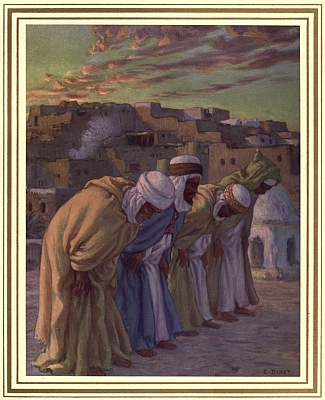
"Ar Ruku," or Inclination.

Ye shall assuredly be tried in your possessions and in yourselves.
CHAPTER THE FOURTH

PERSECUTION
uoth the Prophet: "Allah created Paradise for the man who obeyeth Him, even if only a black Abyssinian slave; and Hell for the man rebelling against Him, even if he be a nobleman of the Quraish."

Islam, tending towards the perfect equality of castes and races, naturally attracted all the poor and downtrodden of the city. With increasing vexation, the idolatrous masters saw their slaves, in eager crowds, converted to the new faith. But as these wretched folks were in the tyrants' power, they glutted their vengeance on them, not daring to attack disciples of the Prophet occupying higher rank.
Oummayatah ibn Khalaf, having become aware of the conversion of his black slave, Bilal ibn Hammah, was engrossed with but a single thought: that of torturing him with the most dastardly refinements. Placing his neck in a noose made from a rough rope of palm-fibre, he gave him into the hands of boys knowing no pity. They dragged him along behind them, like a beast of burden, just for amusement. The rope, pulled this way and that by the juvenile wrongdoers, ploughed a sanguinary furrow in Bilal's flesh. Nevertheless, he seemed insensible to pain. Thereupon his master deprived him of food and drink, and led him from the town at noonday, in the middle of summer, throwing him out in the "Ramda," a sandy plain, so torrid that a slice of meat, thrown on the ground, cooked itself immediately. He made his slave lie down, stretched out on his back, an enormous stone on his breast. 'Thou shalt stop there,' he ordered, 'until thou dost abjure Mohammad's doctrines, and worship Lat and Uzza.'
But the stoical Moslem did nothing more than lift the forefinger of his right hand, saying again and again: 'Ahad! Ahad! Allah is one! Allah is one!' thus testifying the scorn he felt for his master who dared to couple wooden or stone associates with the Master of the Worlds. The affirmation of the slave produced insensibility to pain, because the ineffable joy of the sacrifice for his faith mingled with and mastered the bitterness of torture.
Passing one day near the Ramda, Abu Bakr witnessed this cruel sight. 'Fearest thou not the justice of Allah, the Most High, O Oummayatah! when thou dost inflict such torment on that wretched man?' he cried indignantly.—'Thou didst corrupt him; therefore 'tis thy duty to save him,' was the cynical reply.—'Willingly! I possess a young black slave, stronger and a better worker than thine. Moreover, he is entirely devoted to thy idols. I offer him to thee in exchange.' Oummayatah accepted and turned Bilal over to Abu Bakr who granted him his freedom straightway. Besides, this generous man (may Allah make him welcome in His Grace!) purchased six other slaves, men and women, all Islamic converts, merely to set them free, and deliver them out of the hands of their idolatrous masters.
These persecutions continued notwithstanding, becoming more and more barbarous. The Banu Makhzum tribe took Ammar, with Yaser, his father, and Summayy, his mother, out on the Ramda, in order to make them suffer all the tortures prompted by diabolical ferocity. Ammar was enclosed in an iron breastplate that held him down on the ground, exposed to the blazing rays of the sun at its zenith. His flesh crackled as if in contact with molten metal. But the same thing happened as with Bilal; the idolaters were unable to drag from Ammar or his parents, tortured in like fashion, one blasphemous word. It was then that, blinded by rage, Abu Jahal drove his spear through Summayy's heart, mocking the dying woman by telling her: 'If thou dost believe in Mohammad, 'tis because thou art in love with his beauty!'
Summayy was the first martyr to Islam, but such constancy was not to be found in all. A few Believers, enfeebled by privation and torture to such an extent that they could not stand upright, finished by letting fall from their lips, despite themselves, the blasphemous utterances ensuring release. For such as these, crushed by shame and shedding tears of repentance, the following Surah of consolation has come down: "Whoso after he hath believed in God, denieth Him, if he were forced to it and if his heart remain steadfast in the faith (shall be guiltless:) * But whoso openeth his breast to infidelity—on them in that case shall be wrath from God, and a severe punishment awaiteth them." (The Qur'an, xvi, 108).
When the Prophet saw what tortures were inflicted on his disciples and that he was powerless to protect them, he was overwhelmed with intense sadness. The martyrs' courage proved to him how deeply the roots of faith were planted in their hearts; nevertheless he considered that such sacrifices should be avoided. So he advised all who were weak, or even such as were not forced by imperious necessity to remain in Makkah, to emigrate to Abyssinia, a land inhabited by Christians, whose Chieftain, the Najashi (Negus) was celebrated for his tolerance and justice.
THE EMIGRATION TO ABYSSINIA (A.D. 615)
Sixteen Moslems were the first to depart. Among them was Usman ibn Affan and his wife Ruqaiyah, one of the Prophet's daughters. They went out from Makkah secretly and on foot. Reaching the shore of the Red Sea, they chartered a felucca which carried them over to the opposite bank, from whence they journeyed to the Court of the Najashi who welcomed them kindly. Another caravan soon joined them, and the little Mussulman colony, having taken refuge in Abyssinian territory, was made up of eighty-three men and eighteen women.
Exasperated at seeing their victims escape from their clutches; and still more furious to have to include among the emigrants members of their own families, such as Umm-i-Habibah, daughter of Abu Sufyan, the idolaters despatched to the Najashi two ambassadors, Umar ibn al As and Abdullah, son of Abu Rabiyah, bearing rich presents, with a view to claiming the fugitives, described as being dangerous agitators, capable of causing a revolution in his kingdom.
The Najashi had already seen that the contrary was the case. By their honesty and virtue, the fugitives had gained the esteem and sympathy of his subjects, so that he did not feel inclined to favour the request of the ambassadors, despite their valuable gifts. They then thought it would be as well to touch upon the religious susceptibilities of the Christian monarch, and put him on his guard against the danger of Islam. 'Know then what these impostors seek to attain,' said they to him. 'They have set foot in thine empire in order to turn thy subjects away from the religion of Jesus, even as they sought to lead the Quraish astray from the religion of their ancestors. Shouldst thou wish to put our veracity to the test, question them concerning their opinions with regard to Jesus, thy God.'
The Najashi followed this piece of advice. He interrogated the most learned among the emigrants and elicited the following reply from Jafar, Mohammad's cousin, son of Abu Talib: 'These are the Verses revealed to the Prophet: "The Messiah Isa (Jesus), son of Maryam (Mary), is only an apostle of Allah, and His Word which He conveyed into Maryam..." (The Qur'an, iv, 169.)
This answer was not at all displeasing to the Najashi. If it did not acknowledge the divinity of Jesus, it showed, at least, the deep veneration in which He was held by the Moslems, and the Abyssinian monarch was fully reassured as to the fugitives' intentions. So he sent the ambassadors away, without accepting any of their presents or giving them the slightest satisfaction.
THE CONVERSION OF UMAR, SON OF AL-KHATTAB
The Unbelievers had succeeded in making fierce Umar think that he would save his country by ridding it of Mohammad. So Umar, having buckled on his sword, and his eyes flashing fire, bent his steps in the direction of the Safa district, where he fancied he might fall across the Prophet. Umar, on his way, met Na'im, who had gone over to Islam unbeknown to his fellow-tribesmen. 'Wither goest thou, O Umar?' queried the convert.—'To seek out this fellow Mohammad who hath stirred up strife in the midst of the Quraish. Oh, by our Gods! I must kill him!'—'By Allah! thy soul leadeth thee to do a mad act, O Umar! Dost thou think that the Abd-i-Manaf will leave thee in peace on the face of the earth, if thou dost put to death their relative, Mohammad?' he added, trying to deter him from carrying out his abominable plan. 'Would it not be far better to get certain members of thine own household to explain their doings?'—'Who are these persons under my roof?'—'Thy sister Fatimah and thy brother-in-law Said ibn Zayd. They, too, are Moslems.'
At these words, Umar stopped dead, the direction of his fury changing, and in great haste, he hurried to the dwelling of Fatimah, his sister. Just as he got there, Khubab, a fervent disciple, was reading the Surah "Ta-Ha" written out on a piece of parchment. At the sound of Umar's furious knocking, Khubab fled into an adjoining room, and Fatimah hid the parchment in the folds of her attire.
But Khubab's voice had been overheard by Umar who asked in imperative accents: 'What is this recitation in an undertone that I heard, and which ye cut short when I arrived?'—'There was nothing to hear. Thou art mistaken,' his brother-in-law and sister protested in chorus.—'No, no! There is no mistake; neither do I err when I tell you I have learnt that ye follow Mohammad's religion!' Without waiting for any further explanation, he rushed at his brother-in-law, knocked him down, sat on his chest and seized him by the beard.
Fatimah threw herself on her brother and made desperate efforts to free her husband. 'Thou speakest the truth! We are Moslems!' Umar lost his wits at this confession and by a brutal blow in the face, he dashed courageous Fatimah to the ground. 'Yea, we are Moslems, O enemy of Allah!' she repeated, staring boldly at him, her blood flowing freely. 'Yea, we believe in Allah and His Prophet! Now do with us as thou wilt!'
When Umar saw his sister's blood, the indomitable courage of the weak woman impressed him greatly and he was ashamed of what he had done. 'Give me the parchment that I heard you reading,' he asked his sister in softer accents; 'I wish to get some idea of that which hath been revealed to Mohammad.'—'We fear thou mayest destroy the writing.'—'Be not afraid! By Allah! ye shall have it back so soon as I shall have read it.'
Despite her wish to try and convert her brother, Fatimah raised objections. 'O my brother! I cannot confide it to thee, for thou art unclean. Only pure hands are allowed to touch the Book in which are inscribed the words of Allah.'
Umar rose with docility and performed his ablutions. Then did Fatimah hand over the parchment on which was written the Surah, "Ta-Ha", which begins with these words: Not to sadden thee have We sent down this Qur'an to Thee * But as a warning for him who feareth. (xx, 1 and 2.)
Immediately after the reading of the first verses, Umar, who was remarkably well learnt, could not refrain from uttering a cry of admiration: 'How beautiful! What sublime language!'—'O Umar!' exclaimed Khubab, coming out of his hiding-place, 'I had great hopes that the Almighty would fulfil, in thy favour, the wish I heard the Prophet make but yesterday: 'O Allah!' said he, 'strengthen Islam by the conversion of either one or the other of those two men: Abu Jahal or Umar.'—'Lead me at once to Mohammad,' replied Umar, 'so that I may become a convert to Islam in his presence. Where is he?' Khubab, in triumph, sent him to the dwelling of Arqam in the Safa district.
In that house, the disciples, clustering in union round the Prophet, were drinking in his words, when imperative knocks shook the door. One of the comrades rose up and, by a crack in the wood, caught sight of the terrible warrior, his sword dangling from his belt. Thunderstruck at this apparition, he came back to warn the Prophet who calmly told him: 'Bring him in here. If he cometh with good intentions, we will grant him generous welcome, but if evil designs guide his footsteps, we will kill him with his own sword.'
The companions having obeyed, Umar entered. Mohammad went to meet him, and coming face to face with him in the entrance-hall, he caught him by the collar and, with a sudden pull, dragged him into the midst of the company assembled. 'What is thy motive in coming here, O son of Al Khattab?' he asked. 'Dost thou still mean to remain wallowing in impiety until the wrath of the Almighty crusheth thee?'—'O Prophet!' answered Umar with unaccustomed humility, 'I come to declare my faith in Allah, His Messenger, and His Revelation.'—'Praise be to Allah! Glory to Him!' cried Mohammad. When his companions were informed of Umar's sudden conversion, they went their different ways, full of gratitude towards Him who had decreed it.
Umar was not a man to remain patient and conceal his convictions. In the street, he stopped the first passer-by he met, one Jamil ibn Mamar, of the Jumah tribe, and said to him: 'Dost know, O Jamil, that I have become a Mussulman?' The words were hardly out of his mouth, before Jamil, an incorrigible gossip, tucked his mantle tightly round him and ran to the Temple. 'O Assembly of the Quraish men!' shouted he to the idolaters who were there in groups. 'An astounding piece of news! The son of Al Khattab hath lost his reason!'—'Thou liest!' interrupted Umar who had followed him. 'On the contrary, I have set out on the Road to Salvation. I bear witness that there is no other God but Allah and that Mohammad is His Prophet!'
On hearing these words, amounting to insulting aggression, the Quraish bounded forward, as one man, to throw themselves on Umar, who steadfastly awaited their attack and a fearful struggle took place. The sun, darting its flaming rays on the fighters, forced them to desist for a short space of time. During the truce, Umar sat down on the ground, surrounded by his enemies whose threatening hands were stretched over his head. 'Do with me as ye will,' he told them in tones of the most scornful indifference, 'but, by Allah! if I were only at the head of three hundred Mussulmans, we should not be long before we wrested this Temple from you, and never would ye be able to retake it!'
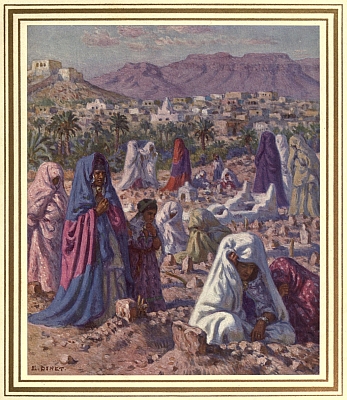
The Friday Visit of Moslems to the Cemetery.
At this juncture, a respected old man, attired in a striped mantle and a sumptuously embroidered tunic, drew nigh, brought there by the tumult of which he asked the cause. 'Umar is demented,' was the answer.—'How so?' said the old man to the idolaters. 'If this man hath voluntarily chosen some religion different to yours, hath he not a right to do so? What want ye of him? Moreover, think ye that his relatives will not feel inclined to interfere on his behalf?' Struck more by the fear of reprisals than by the wisdom of his words, Umar's assailants clustering round him, dropped back and dispersed. It seemed as if a heavy cloak had been lifted from his shoulders.
No one, except Mohammad, dared to pray in public. Umar, caring naught for the fury he might cause, made up his mind to follow the Prophet's example, and every day, the sturdy warrior turned like Mohammad in the direction of the Bait-ul-Muquaddas (The Holy Temple of Jerusalem). Doing exactly the same as the Prophet, Umar took his stand between the angle of the Ka'bah where the Black Stone is enframed and the angle looking towards the Yaman; and there publicly said his prayers. Encouraged by this audacity, numerous were the Moslems who came to pray in public by his side, despite the angry glances of the Unbelievers, only restrained by the reputation of Umar who had earned the surname of "Al Faruq," (The Cleaver), because he had once cleft in twain an Arab who refused to bow down to a decision given out by the Prophet.
THE EXILE OF THE BANU HA SHAM (A.D. 626)
Despite the superiority of numbers, the idol-worshippers of the Quraish were obliged to acknowledge the critical state of their party. Unless they could put an end to the irresistible movement that daily brought new conversions, their domination over the Arabs would soon become a thing of the past.
They called a meeting, and, after consulting, resolved to break off all relations with the Banu Hasham and the Banu Muttalib who were to be banished from Makkah until they consented to hand over Mohammad, their relative. In order to prevent themselves being tempted to break their word, the Quraish leaders wrote out the conditions of this compact on a sheet of parchment which they hung up inside the Ka'bah.
Their plan was most cunning. Among the Banu Hasham and the Banu Muttalib were a large number of idolaters who the Quraish thought would refuse to identify themselves with Mohammad and suffer for his cause. Therefore, strife would be stirred up in the bosom of the Prophet's family. But, contrary to the idol-worshippers' conjectures, the example of Abu Talib, Mohammad's uncle, carried away all the members of his family—with the exception of irreducible Abu Lahab—actuated by feelings of unanimous solidarity.
This fact enables us to divine one of the reasons that prevented Abu Talib from adopting the Islamic religion, although he worked hard and successfully, helping it to triumph. He did not forget Abu Lahab's ironical remark: 'Thou hast naught else to do than to obey thy son Ali, now that Mohammad hath chosen him to be his lieutenant.' Abu Talib's pride caused him to dread mockery. 'I would willingly become a convert to Islam,' said he, one day, 'were it not that I fear to become the laughing-stock of the men of Makkah when they would see me saying my prayers.' Nevertheless, these motives would not have held him back, if he had not considered that the protection he granted to his nephew, threatened on all sides, would lose all its power following the day when the uncle also should have abjured the religion of his forefathers.
Directly after the proclamation of the decree of expulsion, the members of the Prophet's family, Mussulmans or idolaters, left their houses, scattered here and there in different districts of the town, and assembled in a neighbouring ravine where Abu Talib possessed a stronghold.
During a period of two years, the exiles endured the greatest privations. Their provisions were quickly exhausted and it was impossible to renew them. They were forbidden to show themselves in the markets, and if one among them, having succeeded in getting to follow a caravan, tried to procure a few articles of food, the dealers, watched by Abu Jahal or fearing to be denounced, asked such high prices that the luckless wight was obliged to give up all ideas of purchase, and return empty-handed to his starving family.
The outlaws were sometimes secretly revictualled by compassionate folks, such as Hisham ibn Umar who had recourse to the following stratagem. At nightfall, he led a camel, laden with provisions, to the entrance of the ravine, and gave him a violent cut with a whip, in such a way that the animal bolted in the direction of the starving fugitives and was captured by them. But such a godsend was not an everyday occurrence, and Mohammad and his family were driven to feed on the leaves of the thorny bushes growing in the valley.
THE DECREE OF EXPULSION DESTROYED BY A WORM
Meanwhile, the Prophet was apprised by a vision that, in order to destroy the impious document, written by the Quraish, Allah had sent a gnawing worm and only the Holy Name had been respected.
Abu Talib, hearing about this, and having faith in his nephew's vision, went with his brothers and sought out the Unbelievers. They exulted on seeing him approach, his features distorted by the pangs of hunger. Conquered by famine, was Abu Talib about to throw over his nephew? They were so sure that this was the case, that they accepted his proposals without hesitation. 'Let us go and look at the parchment,' he said. 'If Mohammad speaketh truly, the act is abolished. Should that be, ye must swear to cancel your ruling of outlawry that oppresseth us. For my part, I swear to give Mohammad up to you if he hath lied.'
The act was sealed with three seals. Since it had been deposited in the Ka'bah, it had neither been seen nor touched by anyone. Therefore Allah's enemies thought it impossible that the Prophet's vision could be authentic and, anticipating victory, they went to the Temple with Abu Talib, to see the state of the parchment. The Prophet's words had come true. In the act in question, the gnawing maggot had destroyed every unjust and impious sentence. Naught remained intact except a narrow strip of parchment on which could be read these words: "In Thy name, Allah!"
This verification plunged the idolaters into a state of unspeakable stupor. Abu Jahal was the first to leave the Temple and he tried to retract the promise given by the Quraish. Thereupon, many among them, Hisham ibn Umar, Zohair ibn Abi Ommayah, Moutam ibn Adiyy, etc., whose interests and intercourse had suffered on account of the odious decree, having only signed it under duress, protested one after the other. "We supported this iniquitous law against our will. Now it no longer exists. Therefore the impious pact set forth therein should be annulled."
Abu Jahal was forced to bow down in the face of the prodigy and these vehement protestations. The compact was cancelled. The Banu Hasham and the Banu Muttalib returned without let or hindrance to their dwellings.
THE DEATH OF ABU TALIB AND KHADIJAH
It seemed as if Islam was henceforward to soar aloft safely, when two events suddenly caused its wings to be clipped. First came the death of Abu Talib, its indefatigable protector, who had passed the age of eighty.
We have already mentioned that, despite all his sympathy for Islam, Abu Talib had never consented to profess it. Abu Talib, in his dying moments, having advised all present to obey Mohammad in everything, for he was sure to lead them into the Path of Righteousness, the Prophet risked a supreme effort. 'O my uncle!' said Mohammad, 'thou dost soothe their souls with wise counsel, but wilt thou do nothing for thine own?'—'What wouldst have me do?'—'Bear witness simply that there is no Allah but Allah!—'O son of my brother! I know that thou dost speak truly, but I fear to be accused of only testifying in affright at the approach of death. Were it not for this fear, be assured that I would follow thy advice, in order to freshen thine eyes in which I read the high degree of thy affection.'
Some writers maintain that Abbas, seeing the dying man's lips move, and having placed his ear close to them, made the following declaration to the Prophet: 'Be not uneasy, O son of my brother! thy uncle hath just uttered the words thou didst wish him to say.' But the most accredited traditions refuse to accept this version. Where is the truth? Allah only knows!
Three days after this bereavement, fraught with fatal consequences, the Prophet had to put up with a still more grievous loss.
Khadijah, his admirable companion, who gave herself to him when he was poor and had believed in him when he was called an impostor; Khadijah, to whom he confided all his hopes; Khadijah, the sweet consoling creature when he was crushed by the weight of despair; Khadijah, the first female Moslem, the "Mother of the Believers," was taken from him by the Fates at the age of sixty-five. (May Allah welcome her in His Grace!)
Khadijah's ascendancy over him was so great and yet so tender that while she lived, he had never been unfaithful. Never, although he was then in the prime of life, would he consent to have other wives or concubines, as permitted by the customs of his country, in spite of being invited on all sides to do so. And never, when Khadijah was no more, did he forget her.
Ayishah, who later on became Mohammad's favourite spouse, was keenly jealous of the remembrance of his first wife, daily evoked by him. "Never was I so jealous of any wife of the Prophet as of Khadijah," Ayishah is known to have said, "although I never met her and notwithstanding that her death took place long before my marriage. But the Prophet was always talking about her, and when he slaughtered a sheep, he always kept back a liberal share to be given to Khadijah's female friends.
"I said to him once: 'It seems as if Khadijah was the only woman in the whole world!' Thereupon he began to enumerate her incomparable qualities and declared that she would have a palace built of pearls in Paradise, with no noise or household cares to trouble her.
"Hala bint Khuaild, Khadijah's sister, was taken to see Allah's Messenger. He noticed that she spoke in the same way as his dead wife, and was so stirred that, overcome by jealousy, I could not help showing temper and I exclaimed: 'What meanest thou by continually conjuring up the remembrance of these old Quraish females, with their toothless, red gums and faces betraying the ravages of age? Hath not Allah given thee better women in their stead?'"
But despite these scenes, despite the beauty and intelligence of Ayishah and his other wives, the Prophet always preferred Khadijah. He included her among the four most perfect women that ever came on earth. The three others were Asiyah, Pharoah's wife who saved Moses; Maryam (Mary), mother of Isa (Jesus); and Fatimah-tuz-Zahra, one of Mohammad's daughters by Khadijah.
THE JOURNEY TO TAIF
Stricken by his double mourning, threatened by the Unbelievers who no longer concealed their intentions, now that his noble protector was no more, the Prophet resolved to preach outside Makkah. If he succeeded in gaining over some of the neighbouring Arab peoples, these reinforcements, increasing the number of citizens of Makkah already converted, and which was far from inconsiderable, would make up a party sufficiently strong to hold his detractors in respect.
His first attempt was made at Taif, a small town about seventy-two miles to the east of Makkah, renowned for its grapes, figs, pomegranates and the roses of its enchanting gardens. Accompanied by Zayd ibn Haris, the Prophet arrived in the market-place where he found many noted Saqifs assembled. He sat by their side and stated the reasons of his journey: his Divine Mission and the hostility of his party.
Most of those present were beginning to fall under the influence of the wonted charm of his words, when three brothers, ranking among the most noble and predominant of the Saqifs, interrupted him abruptly. 'This man hath doubtless stolen or torn the veil of the Ka'bah!' exclaimed the first of the brothers, 'and now, having taken to his heels, he tells ye a story about being Allah's Messenger!'—'Hath Allah not been able to find anyone but thee?' jeered the second.—'By Allah! I'll never have anything to do with thee!' declared the third. 'If thou art truly the Prophet of Allah, as thou dost assert, thou art so far above me that I dare not argue with thee; and if thou art merely an impostor, it would not be fitting that I belittle myself by replying.'
These remarks broke the charm, and the crowd, veering round, showed its hostility by shouting insults. The Prophet saw that there was no hope for him in that town for the moment, and rose up to depart.
So as to make it impossible for him to renew his attempt, his contradictors stirred up the lowest dregs of the populace against him. Slaves and vagabonds, arrayed in a double row, awaited him on each side of the road he was bound to take. They found amusement in stoning his bare legs. When exhausted by his sufferings, he sat down in the middle of the road, trying to shield his bleeding feet, his tormentors lifted him up by the arms and continued their barbarous fun. In vain, devoted Zayd tried to protect him by getting in front of him; the faithful henchman was struck down by a stone that cut his face. Staggering, falling, rising and dragging themselves along in the midst of sneering jibes, Mohammad and his companion at last reached a garden wall, behind which they took refuge, and dropped extenuated in the shade of a tree covered with vine branches, leaves and grapes.
'O Allah!' cried the Prophet, 'To Thee I complain of my puny strength and the failure of my zeal with regard to these men. O Thou! most Compassionate and Merciful, Thou art the Lord of the weak and Thou art my Lord! I have none but Thee on whom to lean! But if Thou be not angry with me because I am powerless to ensure love and respect for Thy Word, I care nothing for all the ordeals I undergo!'
The villanous mob did not dare to trespass in the garden in order to follow up their victims. The owners of the property, charitable folks, indignant at the scene they had just witnessed, ordered Adas, their gardener, to gather bunches of grapes and carry a basketful to their momentary guests.
When the inflammation of their limbs, covered with bruises, had subsided by reason of repose in the beneficial shade; and their thirst being quenched by the honeyed juice of the celebrated grapes of Taif, the Prophet and his companion set out again on the road to Makkah.
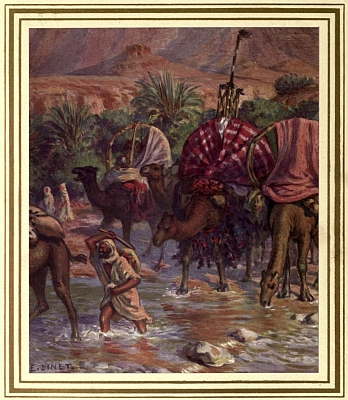
The Departure.
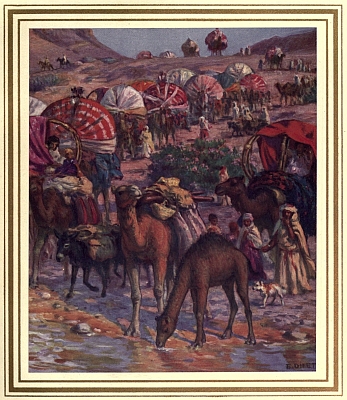
The Departure.
Foreseeing the welcome in store for him, Mohammad could not do otherwise than claim the assistance of some influential citizen. Halting at the cave of Mount Hira, he sent Zayd to find a protector. After two rebuffs at the hands of Al Akhnas and Sohail, who excused themselves, Zayd approached Muta'm bin Adiyy who, consenting to take the responsibility on himself, armed his serving-men and posted them in the precincts of the Ka'bah. Brought back by Zayd, Mohammad was then enabled, thanks to the escort of this little army, to make the seven ritual circuits before returning to his dwelling.
THE NOCTURNAL JOURNEY AND ASCENSION
"Al-Isra," the Nocturnal Journey, and "Al-Miraj" the Prophet's Ascension, have given rise to innumerable debates between the doctors of Islam. Some think that this miraculous journey was really, physically accomplished; whilst others, relying on the most accredited traditions—among which is that of Ayishah, Abu Bakr's daughter and Mohammad's favourite wife—maintain that Mohammad's soul alone undertook the journey, and that it should only be looked upon as a veracious vision such as frequently came to the Prophet in his sleep.
One night, the twenty-seventh of the month of Rabi'-ul-Awwal, the angel Jibra'il, upon whom devolved the duty of directing the heavenly bodies, was ordered by the Almighty to increase the moon's brilliancy by adding a part of the sun's radiance; and that of the stars by a share of the moon's brightness, so that the firmament that night should be resplendent with light. The Angel was then to descend to where Mohammad was sleeping, and carry him up to Allah through the seven zones of Heaven.
Quoth the Prophet: "I was in a deep sleep when Jibra'il appeared to me, bringing Al-Buraq, the Prophet's usual mount. This animal ressembled none to be found on earth. His size was greater than that of an ass; less than that of a mule. His coat was more dazzlingly white than snow; he had the face of a man, but was dumb. Great wings like those of a bird allowed him to rise in the air and career through space. His mane, tail, feathers and breast-piece were studded with priceless precious stones that sparkled like myriads of stars.
"I got on his back and, in a twinkling, he carried me from the "Masjidu'l-Haram" to the "Masjidu'l-Aqsa" (i.e. the Sacred Makkan Temple to the faraway Temple of Jerusalem). I alighted and fastened his bridle to the ring used by the Prophets. A man appeared in front of me, offering a cup of milk and a cup of wine. I drank the milk and refused the wine. Jibra'il, who had accompanied me without outstripping me or allowing me to outrun him, approved what I had done. 'If thou hadst preferred wine to milk,' he told me, 'thy people would have preferred Error to Truth.'"
After visiting the Temple, the Prophet climbed up the "Sakhrah," the Sacred Rock (on which now stands the marvellous dome of the Mosque of Umar) which bowed down in his honour and also so as to enable him to remount Al-Buraq. Still led by his celestial guide, he continued his journey by ascending through the Heavens.
We need not copy the descriptions of this Ascension, or "Miraj," in every detail. Many writers, particularly the Persians, have given a free rein to their imagination in this connection, whilst others, more serious, such as Ibn-i-Hisham, Ibn-i-Sad and Abul Fida, are content to set forth an extremely simple narrative. We shall only mention Mohammad's meeting with the Prophets known before him: Abraham, Moses and Jesus; then his visit to the Paradise of Believers, where the gardens honoured him by giving out sweet odours and his halt in Hell, destined to receive Unbelievers, where the flames congealed when he went along.
After having passed through the seven zones of the Heavens, it was not long before he heard the scratching of pens writing in the "Book of Fate," and the thanksgivings of the angels glorifying the Almighty. Finally, he reached the "Sidratu'l-Muntaha," the "Lote-tree of the Extremity." At this spot, Jibra'il left him, saying: "Here is the boundary of Knowledge, where I am forced to halt. As for thee, O Prince of Messengers! O friend of the Master of the Worlds! continue thy glorious Ascension and progress in the Light of thy Lights." And the Chosen One continued to pass through the veils covering that which is hidden, until he reached the veil of Unity and looked upon that which eyes cannot see, nor minds imagine. The eyes of his body would not have been able to support the brilliancy of this sight which must have brought on blindness. Therefore, Allah opened the eyes of Mohammad's heart, thus permitting him to contemplate the Infinite Splendour.
Allah bade him draw near to His throne, "at the distance of two bows, or even closer" (The Qur'an, liii, 9), and after having confirmed the choice He had made in charging Mohammad to be the carrier of Good Tidings to His servants, He fixed the number of prayers—fifty in all—that each Believer should offer up daily to the Creator, in gratitude for His bounty.
When the Chosen One went down, Moses met him again and questioned him. 'O Prophet of Allah! what hath our Master ordered thee with regard to the number of prayers which His disciples should offer up?'—'Fifty prayers during the day and the night.'—'O thou, the best of created beings!' Moses rejoined, 'go back to our Master, and beg Him to lighten this burden, too heavy for the weakness and laziness of mankind.' So Mohammad went back several times into the presence of the Master of the Worlds, until he prevailed upon Him to reduce the number of prayers to five only.
This parable, which serves to decide definitively the number of daily prayers, also demonstrates admirably that an excess of devotion, in the Islamic creed, is considered to be an error. "Allah desireth to make your burden light to you: for man hath been created weak." (The Qur'an, iv, 32.) Why should the Almighty be in need of the prayers of mankind? "We ask not of Thee to make provision for thyself—We will provide for Thee." (The Qur'an, xx, 132.)
Allah has sent prayer to His servants as one of His most salutary favours. Five times daily, devotion brings absolute rest to Believers; that is to say, complete interruption of the feelings that stir them, whether an excess of joy leading to ruin in the aberrations of debauchery, or an excess of sadness causing them to perish in the madness of despair. Five times daily, prayer forces them by its accompanying ablutions, to call to mind the cleanliness of the body, at the same time as the purity of the soul.
The day after his vision, the Prophet, beaming with delight, was met by his mortal enemy, Abu Jahal, who addressed him ironically: 'O Mohammad! hast thou not one of those marvellous tales which we are used to hear from thee to tell us this morning?'—'Indeed I have!' replied the Prophet. 'Between yesternight and this morning I have been to Jerusalem and back.'—'Gather round quickly, O Quraish! Hasten and hearken to the wonderful adventure of the nocturnal journey undertaken by Mohammad!' shouted Abu Jahal.
The crowd soon grew, and the Prophet gave out the narrative we have just set forth. Most of his hearers, belonging to the clan of the idol-worshippers, followed the example of their chieftain and received it with outbursts of the coarsest merriment. Some clapped their hands; others held their heads in their hands as if to stop their brains from bursting. As for the Believers, one party was undecided whether to put faith in the story or not; and the remainder, unsettled by the attitude of the public, dared not manifest their confidence openly.
Profiting by the confusion, Abu Jahal hastened to speak to Abu Bakr. 'Maybe thou dost not know the last extraordinary adventure of thy Prophet? He pretends to have accomplished in the night the journey from the "Holy Temple" of Makkah to the "Faraway Temple" of Jerusalem—there and back!' Abu Jahal was full of glee, in anticipation, at the thought of the vexation and bewilderment which were sure to be seen in the face of his fellow-citizen.
Contrary to Abu Jahal's expectations, however, Abu Bakr replied without uneasiness: 'Whatever Mohammad asserts is true and I believe it. If he maintains that he went up to the seventh Heaven in an hour and came back in the same space of time, I should still have faith in his declarations.'
Such dependable testimony caused the Faithful to take heart; thus it turned out that Abu Jahal, by trying to instil incredulity in men's minds, only succeeded in strengthening their beliefs. Desirous of catching the Prophet redhanded as a cheat, Abu Jahal interrogated him concerning the Temple of Jerusalem, calling on him for a description thereof. But he was utterly routed when Mohammad, whom his foe thought had never set foot in Jerusalem, except during this nocturnal vision, described the city in all its peculiarities and with great accuracy, endorsed by all among those assembled who had ever undertaken that journey.
Therefore the Believers, their faith revived, hastened to put on the five "Garments of Purity," which means that they offered up the five prayers brought down to them from Heaven by the Prophet.
HOW SIX INHABITANTS OF YASRIB WERE CONVERTED (A.D. 620)
Towards the end of the year, Usman ibn Affan and his wife Ruqaiyah returned from Abyssinia, accompanied by a few emigrants, among whom, one of them, called Sukran, died on arrival. The Prophet married his widow, Sauda, daughter of Zoma, thus rewarding the zeal of one of the first female converts to Islam, who had so valiantly undergone the ordeals of persecution and exile.
Wishing, in the same way, to show his appreciation of the unchanging devotion of Abu Bakr, the Veracious, and to bind him still closer by a matrimonial alliance, the Prophet, at the same epoch, espoused his daughter Ayishah, although she had barely reached the age of ten. But, in her case, the marriage was not consummated until many years later, at Al-Madinah, after the Hegira.
Despite Abu Bakr's energetic affirmations; despite the strengthening of the Believers' zeal by the rule of the five prayers, the story of the Nocturnal Ascension was far from being advantageous to the cause of Islam. The narrative, on the contrary, furnished its enemies with an opportunity of petty triumph, enabling them to pile up fresh mockery and institute greater persecution.
The case would have seemed hopeless to any other but Mohammad. He knew not what it meant to be discouraged, feeling certain that the Almighty would never abandon His Apostle to whom He had revealed the following verses: "Say: I betake me for refuge to the Lord of Men, * The King of Men, * Allah of Men * Against the mischief of the stealthily withdrawing whisperer (Satan) * Who hides himself at the Name of Allah, * Who whispereth in man's breast against Jinn and men." (The Qur'an, cxiv, 16.)
Postponing for the time being the conversion of the Makkans, the Prophet turned his attention towards Arab strangers in the town, attracted in great crowds by the ceremonies of the pilgrimage to the Ka'bah and the ritual circuits. During the fair that was held at that time, he went untiringly from group to group. But, just as indefatigable, close behind, was his uncle, Abu Lahab, who, as soon as he saw the Prophet in the centre of a ring of men, would call out loudly to them: 'Hearken not to that man! His sole thought is to tear the cult of Lat and Uzza from out of your hearts; and trick ye all with the insane doctrines that he pretends it is his Mission to preach.'
These words aroused the Arabs' suspicions, and they turned away from Mohammad with remarks after this fashion: 'Thy fellow-citizens know thee better than we, so begin by convincing them!' Or else: 'If Allah should cause thee to triumph, thy glory will not profit us, but only thy party. Therefore, it is not to our advantage to ally ourselves to thee.'
These rebuffs had no effect on the Prophet. No sooner did any noteworthy person arrive in Makkah than Mohammad sought his presence at once.
One day, on the hill of Aqabah, he went up to a group of six men, fresh arrivals, and with his usual politeness, he addressed them thus: 'What are you, O my good Lords?'—'We are of the Khazraj tribe.'—'Masters over the Jews settled in Yasrib, methinks?'—'We are indeed their masters.'—'Will ye not sit down here awhile, so that I may speak with you?'—'Willingly.'
They sat by his side, and he tried to gather them into the fold of Islam by reciting verses of the Qur'an. Charmed by his eloquence and the novelty of his words, the Khazraj men listened attentively and paused to reflect.