THE PARIS BOOK CLUB, 11, RUE DE CHATEAUDUN (continued 6)
Reading edition
Abashed at his first failure, Rabi'a followed this piece of advice and the famous warrior rolled dead in the dust.
Urged on by the spur of victory, the Prophet pursued the fugitives to the foot of the ramparts of Taif and tried to take the town. After a useless siege of twenty days, he preferred to give up all ideas of an attack in favour of other means, slower but more sure, and instead of invoking the wrath of the Divinity against the inhabitants, he said: 'O Allah! enlighten the people of Taif and inspire them with a desire to come to Thy Apostle of their own free will!'
Despite the disappointment of his troops, he retook the road to Makkah, camping at Al-Ji'rana where all the prisoners were collected, as well as all the booty to be divided.
When the Prophet arrived, a female captive, Ash-Shayma, of the Banu Sad, which was a fraction of the Hawazin, was struggling to escape from the brutality of the soldiery. On perceiving Mohammad, she cried out: 'O Prophet of Allah, I am thy foster-sister!'—'Prove it!'—'See the scar on my shoulder where thou didst bite me when I carried thee, a baby boy, on my back.'
The Prophet recognised the cicatrice. Much moved, he shed tears, spread his mantle on the ground, and asked Ash-Shayma to sit down on it. 'According to thy wish,' he said, 'thou wilt find generous friendship by my side; or thou canst return to thy tribe with all the gifts I'll lavish on thee.'—'Send me back to my people in the desert, O Prophet! Such is my sole desire.' Mohammad set her free, after having loaded her with presents.
A deputation of the Hawazin was presented to the Prophet, and Abu Sorada, an old man belonging to the division of the Banu Sa's, spoke in their name: 'O Prophet! among thy prisoners are thine aunts, sisters of the wet-nurses who suckled thee. As for the male captives, they were the companions of thy childhood—almost of thy race! In the great misfortune which crusheth us, we implore thee in the name of Allah! If, for the same reasons, we were forced to implore Al-Harith ibn Abi Chammar, or Nu'man ibnu'l Mundhir, they would surely take pity on us! Now thou art the best of nurslings!'—'Which do ye prefer: your families or your property?' asked Mohammad, scarcely able to hide his tender feelings.—' O Prophet! give our wives and children back to us. We love them quite otherwise to our property.'—'I restore to you all male and female captives belonging to the Banui Muttalib,' declared Mohammad loudly.—'But those who are ours belong to the Apostle of Allah!' cried the Mohadjirun and the Ansars immediately. Thus all the prisoners, numbering about six thousand, were given up to the delegates of the Hawazin.
The family of Malik ibn Awf formed an exception to this ruling. Mohammad, however, charged those he had just liberated to make him the following proposal: 'If Malik cometh to me and becometh a convert to Islam, I will give him back his property. Nay, more—I will make him a present of a hundred camels.'
Malik accepted. He left Taif secretly, and when converted, gave such tokens of sincerity, that the Prophet appointed him as commander over all the Mussulmans of the country. It was the best way to curb the resistance of the inhabitants of Taif.
And so it turned out indeed, for this able leader, proud of the investiture, at the head of troops stirred by faith, continued to war against the Saquifs. By pitilessly raiding their flocks and caravans, blocking them by hunger behind the ramparts of their city, he soon compelled them to come in their turn and implore the Prophet's mercy, when they were converted to Islam. The booty was considerable, consisting of about twenty-four thousand camels and forty thousand sheep. After the emotions of the affair of the prisoners, Mohammad resolved to postpone the division of the plunder until another day, and he mounted his she-camel. But his soldiers were so impatient to share the spoils that they followed and importuned him. By accident, they pushed his animal against a thorny shrub, and its branches tore the mantle of Allah's Chosen One. 'Now, you men, give me back my mantle!' he told them, and yielding to their entreaties, he returned to see the booty shared among them.
He tried, above all, to ingratiate himself definitively with the nobles of the city, by favouring them in all ways; and afterwards, they were called "Al-mu'allafa qulubuhum," "those whose hearts have been won over." Abu Sufyan and Mu'awiya his son; Hakim ibn Hizam, An-Nadr ibn Al-Harith, Suhayl, Ikrimah Uyayna, Al-Ajra, and Safwan, all received fifty camels each. This difference of treatment gave rise to protestations. Ibn Mirdas manifested his dissatisfaction in a piece of poetry: 'My share of the booty and that of Al-Ubayd have been distributed to Oyama and Al-Ajra. And yet their fathers, Al-Hasan and Al-Habis, never took precedence of my father in any assembly whatsoever!'
The Prophet sent for him and asked: 'Hast thou composed these rhymes: "My share of the booty and that of Al-Ubayd have been distributed to Al-Ajra and Oyama?" changing the order of the two last names mentioned; without noticing that he had thus broken the metre. In the Qur'an, Allah says: "We have not taught him (Mohammad) poetry." (xxxvi, 59.)
Abu Bakr pointed this out to him. 'No matter,' he replied. 'The meaning remaineth the same.' And he gave orders to "cut the poet's tongue" by granting him all he claimed.
An Arab of the Tamim tribe, Dhu'l Khuwaysira, dared to say to Allah's Messenger: 'Thou wert unjust in thy division.' Umar started up. 'I'll cut the throat of that insolent churl!' he shouted.—'Nay! let him go his own road,' was Mohammad's simple reply.
The Prophet was obliged to resort to most skilful political measures in order to spare all kinds of feelings during the division of these riches; and to prevent dangerous jealousy arising among his disciples. All the spoils, nevertheless, were nearly all allotted and he seemed to have forgotten his devoted Ansars who, naturally, expected to rank among the first to be rewarded. With ever-increasing surprise, they saw no share offered to them and the rich bounty flowing into the hands of the Quraish and the Bedouins.
At last there was no more left to give away and the Ansars exchanged bitter remarks: 'By Allah, the Prophet thinketh only of his own people. Now that, thanks to us, he hath returned victorious to his birthplace, we are forgotten and neglected.'
Sa'd ibn Ubada, having heard these complaints, went and told Mohammad, who said: 'Good! Call the Ansars together!'
When they were mustered, the Prophet came before them. 'O Assembly of the Ansars!' he said; 'I have been told about your talk and the sadness of your souls. Did I not seek you out when ye had been led astray? Hath not Allah led you all into the right path? Ye were unfortunate: hath not Allah made you happy? Each man was his brother's enemy: hath not Allah reconciled your hearts?'—'Truly!' they answered unanimously. 'Allah and His Apostle are the most compassionate and generous!'—'And on your part,' he added, 'did ye not welcome me with compassion and generosity when I was a homeless wanderer? Have ye not the right to say to me: "Thou wert branded as an impostor and we put faith in thee; thou wert east down and we helped thee to be victorious; thou wert poverty-stricken and we made thee rich?"'—'Nay, nay!' protested every man of the Assembly. 'We are indebted to thee for everything and thou dost owe us nothing!'—'In that case,' he went on, 'O Ansar comrades! how could you let the least feeling of affection arise in your hearts concerning the fleeting riches of this world, with which I have endowed certain persons in order to strengthen their vacillating faith, whilst I knew that you were unshaken. Know ye not that these people will return to their homesteads with camels and sheep only, whilst ye will take the Prophet of Allah back with you to your dwellings?... By Him who holdeth Mohammad's soul in His hands, I swear that if the Arab tribes retired into one valley and the Ansars into another, I would follow into the valley of the Ansars. For me, the Ansars are as a shirt on the skin; and for me, the other tribes are as the mantle outside everything. O Allah, show mercy to the Ansars; to the sons of the Ansars; and to the children of their children!'
These words, which the Prophet was unable to utter without betraying intense emotion, mollified the entire Assembly. Tears of gratitude flowed from the eyes of the Ansars so abundantly that their beards were wetted. All cried out, sobs causing them to falter: 'Aye, verily, we accept our share of the booty, for the most beautiful portion is ours!'

Now hath Allah helped you in many battle-fields, and, on the day of Hunain, when ye prided yourselves on your numbers; but it availed you nothing.
Ornamental page - CHAPTER THE EIGHTH
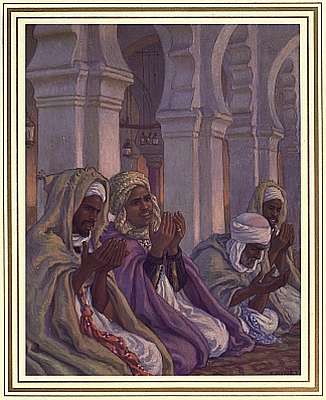
"Ad-da'wah" or the Invocation.

Accomplish the Pilgrimage and the Visitation of the Holy Places in honour of Allah.
CHAPTER THE EIGHTH

AYISHAH SLANDERED
uoth Ayishah: "During my return from the Mustaliq expedition, pressing need compelled me to alight from my Hawdaj, (a kind of litter carried on a camel's back). I found a lonely spot and stopped behind, waiting until all the soldiers had marched past. But seeing my camel halted, and thinking I was inside the hawdaj, they drove the animal forward to ensure it remaining in line with the rest.

"When I came back and found my camel gone, I shouted despairingly; but all in vain, until overcome by fatigue, I dropped down and fell asleep. One of the rearguards, Safwan Ibnu'l-Mu'attal, catching sight of me, recognised me and cried out: 'To Allah we belong and to Him shall we return!' Having awakened me by this exclamation, he brought up his camel, helping me into the saddle, and he led the animal by the bridle until we rejoined the Prophet."
Scandalmongers got hold of the story and ascribed shameful motives to this chance meeting. Despite the accused woman's protestations of innocence, Mohammad felt suspicion gnawing at his heart, and he kept Ayishah at a distance, greatly to the confusion of his father-in-law, Abu Bakr.
At last, a Revelation called the accusers liars, and condemned calumny: "With Allah it was a grave matter," (The Qur'an, xxiv, 14), thus ridding the Prophet of all suspicion and putting an end to a painful situation.
THE BIRTH AND DEATH OF IBRAHIM
In Year VIII of the Hegira, Mary, the Coptic concubine, gave birth to a boy. The Prophet, who had never found consolation for the death of his sons brought into the world by Khadijah, was beside himself with joy. He gave a slave as a present to Abu Rafi'a, for having brought the news that a son was born, and Mohammad declared that the child's advent freed the mother.
On the seventh day, the baby's hair was shaved off and buried; two sheep were sacrificed and alms were distributed to the poor. All the wet-nurses vied with each other for the honour of suckling the Prophet's son, who was called Ibrahim. He was given into the care of Umm Burda, wife of Al-Bara ibn Aws, and she, was rewarded by the gift of a palm-garden.
She took her nursling into the country, to the Banu Mazin, where the Prophet went frequently to see his son. He used to take him in his arms, unceasingly "smelling" him and covering him with kisses. The affection he felt for the child's mother, Mary the Copt, also increased, much to the great vexation of his other wives.
It happened, too, that he broke his strictly impartial household laws, and granted Mary a night that rightly belonged to Hafsa, Umar's daughter. She was grieved to the heart by her rights being forgotten and reproached Mohammad so bitterly that he promised to cease all intercourse with his freed slave on condition that Hafsa held her tongue. But haughty Hafsa broke her word. She told her grievances to Ayishah, who was likewise furiously exasperated at the favour shown to Mary. It was now the turn of Hafsa to rouse the indignation of the other joint wives.
Scenes, scandal and shrieks caused life to be unbearable; so, renouncing all consideration and refusing to let his spouses dictate to him, the Prophet put Hafsa away, after having blamed her severely for her indiscretion. For a whole month, he refused to have anything to do with his helpmates who, although there was now no cause for jealousy, still continued their quarrels; each woman accusing the other of being the cause of their common husband's neglect. All his wives swore that in future they would not pester him with their scolding.
But Mohammad kept his oath strictly. He sought seclusion in a room to which access could only be had by a staircase of palm-tree trunks, and where his sole couch consisted of a mat, of which the rough fibre made dents in his flesh. His meals were brought to him by a black guardian who stood—an inexorable sentinel—in front of the door, which remained closed even to the most beloved among the Prophet's companions. At last, on the twenty-ninth day, mindful of the grief felt by Umar and Abu Bakr at the humiliation experienced by their daughters, Hafsa and Ayishah, Mohammad took them both back, and all his other wives as well, after he had recited the following verses:
"If ye assist one another against the Prophet, then verily, Allah is his Protector and Gabriel and every just man among the Faithful; and the angels are his helpers besides. * Haply if he put you both away, his Lord will give him in exchange other wives better than you: Moslems, Believers, devout, penitent, worshippers, observant of fasting." (The Qur'an, lxvi, 4, 5.)
The joy and hopes accompanying the birth of Ibrahim were not destined to last long. The child breathed its last sigh at the age of seventeen months, under his father's eyes, and Mohammad could not repress showers of tears.
Seeing the Prophet's grief and remembering that in cases of mourning he forbade all lamentations, rending of garments, or laceration of faces, Abdu'r-Rahman ibn Awf said to him: 'Thou also, O Messenger of Allah?'—'O Ibn Awf!' he replied. 'Tears arise from compassion. They are not prohibited like shrieks and lamentations which are protestations inspired by the Evil One against the decrees of Providence.'
Then, as his tears flowed in still greater abundance, he added: 'The eyes shed tears; the heart is full of affliction, but we utter no exclamation displeasing to the Lord. True resignation is manifested at the first shock; as, later, time bringeth succour. O Ibrahim, we are deeply saddened by being separated from thee; but we belong to Allah and to Him shall we return!'
Zaira, mother of the wet-nurse, washed the poor little dead body; Al-Fadl ibn al-Abbas and Usama ibn Zayd carried it to the cemetary of Al-Bagi and lowered it into the grave. When the earth covered the son on whom he had founded such great hopes, the Prophet prayed over the tiny tomb, and exclaimed: 'Declare, O my son! Allah is my Lord, His Messenger is my father, and Islam is my Religion!'
All who assisted at this scene were shaken by sobs. All of a sudden, their faces took on a livid tint, which, at the same time, spread over the earth, the sand, and the rocks. The azure of the sky changed to a leaden hue; the sunlight paled and gradually faded away, although no clouds gathered to veil it. An icy shudder, resembling that of fever, caused the whole face of nature to be stirred; and the birds, with cries of fright, took refuge in their nocturnal shelters. The last rays, still illuminating surrounding objects with dim and sinister light, began to die away and darkness came on in open day, whilst a few twinkling stars appeared in the sky.
The people in terror knew not which way to turn so as to escape the fearful cataclysm they anticipated. Many in the crowd, struck by the phenomenon coinciding with the death of Ibrahim, cried out: 'O Prophet! the eyes of the sun itself are dimmed by tears and it hath departed to take part in thy mourning!'
The Prophet, struggling against his grief, drew himself up erect and proclaimed in firm accents: 'Nay; it is not so. The Sun and the Moon are two tokens of Allah's Almightiness. Like everything beautiful in this world, their beauty is liable to be eclipsed by His orders.... But there is no eclipse for the death of any mortal!'
GHAZWAH, OR EXPEDITION OF TABUK (Jumada, Year VIII of the Hegira, August A.D. 630)
At the battle of Mutah, the Christian Greeks learnt to their cost what it meant to put the valour of Allah's warriors to the test; and in their hatred of Islam's steady growth, they busied themselves in mustering a most terrible army to crush it.
The Prophet heard of this. He resolved to be first in the field and attack. Only his unshaken confidence in divine protection could have inspired him with such temerity. How many thousands of soldiers must he gather together so as not to court irretrievable disaster? Now the moment was not in the least favourable: a long drought had withered crops and herbage; flocks were decimated; horrible famine plunged the whole region in desolation; and the torrid heat of the second half of summer destroyed all energy. The harvest of the savoury fruit of each oasis, watered by inexhaustible wells, alone promised to be abundant and invigorating; and it was precisely when the Faithful were about to profit by the only benefits of this lean year that the Apostle issued his marching orders.
Secret discontent invaded every heart and the incorrigible "Hypocrites" hastened to exploit it by hawking about everywhere perfidious remarks, such as these: 'Do ye think this war against the Banu'l-Asfar (the descendants of fair-headed Ishaq) will be child's play, as was that against the swarthy sons of Ishmael? Remember that arriving exhausted by the intolerable heat of the season and the superhuman fatigue of the road, ye will have to face the Nazarene soldiers encased in armour!'
These arguments, which would have been logical if the struggle had not been in the cause of Allah, began to weaken the minds of those who were hesitating. As for those who were convinced, they could not get away from the unheard-of difficulties bound to be met with in feeding the troops, by reason of the dearth of provisions; and means of transport, in consequence of the scarcity of camels. Following the lack of pasturage, the majority of these animals that had not succumbed to hunger, were in a pitiful state of decline. All these circumstances were unfavorable; but no obstacle could stop the Chosen One.
As the "Hypocrites" met to conspire in the house of Suwaylim, a Jew, the Prophet sent Talha ibn Ubaydu'llah to burn their den. They said, "March not out in the heat." Say: "A fiercer heat wilt be the fire of Hell! Little then let them laugh, and much let them weep as the meed of their doings." (The Qur'an, ix, 82, 83.)
Caring nothing for his own toil, the Prophet spared no pains to impress upon his disciples the grandeur of the goal. So as to arouse general interest, he treated each man differently according to the inward aspirations of his being. If in some he awakened the pure hope of celestial satisfaction, suitable to their souls loving ideality; in others, he did not discourage hopes of material gratification, such as booty and profane pleasures.
Al-Jadd ibn Qays was a man of intrigue. He said to the Prophet: 'Thou knowest that in my "qawm" no man loveth woman better than I. Now, I fear I shall not be able to restrain myself at the sight of the charming lasses of the Banu'l-Asfar. In that case, wilt thou blame me?'
The Prophet avoided answering. Al-Jadd interpreted such silence as showing that Mohammad promised to shut his eyes. The debauchee could not repress a start of joy, despite the presence of his son, who made a gesture of disapproval, and his father threw his sandal in the lad's face.
Thanks to the indefatigable activity of their leader, it was not long before the Believers were carried away by enthusiasm. The difficulties to be overcome; the sacrifices to be made, instead of diminishing their optimism, only succeeded in feeding it, and those whose poverty or infirmities prevented them from joining the ranks of the fighters, became so sad that they were nicknamed the "Bakka'un," or "Weepers." Nevertheless, they are excused by this Revelation: "It is no crime in the weak, and in the sick, and in those who find not the means of contributing, to stay at home, provided that they are sincere with Allah and His Apostle. Nor in those who when they came to thee that thou shoulsdt mount them, and thou didst say: "I find not wherewith to mount you," and turned away their eyes, and shed floods of tears for grief, because they found no means to contribute towards the expense." (The Qur'an, ix, 92, 93.)
Moved by their despair, the Prophet made an urgent appeal to the devotion of all the Believers who, with admirable emulation, replied at once by bringing considerable sums. Abu Bakr placed the whole of his fortune at the disposition of the Prophet. Usman ibn Affan furnished ten thousand warriors with provisions and weapons. All vied with each other in acts of generosity and women stripped themselves of their most precious jewellery.
The expeditionary force was soon organised and numbered between thirty to forty thousand men; a figure hitherto unknown in Arabia. The troops were assembled at the Sanniyat-ul-Wida pass. Seeing the exaltation of the Believers, the "Hypocrites" considered it prudent to conceal their sentiments, but they arranged to group themselves together in the rear and when the army had disappeared behind the "Farewell Pass," the shufflers dropped out, one after the other, and made their way back to Al-Madinah.
Their conduct was not surprising, but unfortunately their fatal advice had deterred four good Moslems from their duty: the poet Ka'b ibn Mabk, Murara ibnu'r-Rabi', Hilal ibn Umayya and Abu Khaythama. The latter, suffocated by the extreme heat and also, perchance, by feelings of shame, went into his orchard, surrounded by protecting walls. It was there, under intertwining palms and vine-branches with leaves and grapes, which stretched like serpentine bind-weeds from one date-tree to another, that two shelters were erected, built of palm-tree trunks and foliage; so impervious to sunlight that the obscurity therein seemed to be the shades of night. To complete the resemblance, the mysterious darkness of each of these arbours was illuminated by a young woman's face, as brilliant as the moon in the fulness of its fourteenth night.
Kindly attentive as well as beautiful, these loving spouses had carefully watered the sandy soil, whence arose exquisite, moist odours. Ingeniously, too, they had hung up, in draughty corners, oozing goat-skins in which water got to be as cool as snow; and they had prepared delicate dishes of which the aroma sufficed to excite the most rebellious appetite....
Abu Khaythama, bathed in sweat, powdered all over with sand, experienced a sensation of Eden-like comfort, when he glanced at the delights in readiness and was about to revel in enjoyment by lazily stretching his limbs on soft rugs. But, suddenly, the emerald-tinted reflection of the shade that gently caressed his tired eyes, was furrowed by the flash of a vision:
In a gloomy, wild, boundless space, beneath the deep azure hue of a cloudless sky, under the unbearable sting of a pitiless sun, a long line of human beings dragged itself along with difficulty, coming into view and then being lost to sight amid yellowish waves formed by rocks or sandheaps.... He recognised these mortals. They were his brethren in Islam. At their head was ... Allah's Chosen One!
'The Prophet leads an expedition, under yon blazing sky! And Abu Khaythama is at rest, in this fresh shade, with fresh water and two fresh beauties! No! that cannot be!' he cried; and turning to his wives, each of them hoping to gain the preference: 'By Allah! I go not into the shelter of any among you! I rejoin the Prophet! Prepare my provisions for the journey; and that quickly!'
They obeyed. Releasing his camel, busy just then in drawing water, he clapped on the saddle. Then he took down his sword, spear and shield from where they were hanging, and without a look behind, abandoned fresh shade, fresh water and fresh beauties, to hurry in the track of the army. He rejoined it at Tabuk.
Meanwhile, after having followed the windings of the Wadi'l-Qura, a broad valley where the verdant splashes of colour of more than one oasis, encircling many villages or strongholds, stood out in gay, bold relief on the dull hue of the arid landscape, the expedition had reached the fringe of the frightful desert surrounding Al-Hijr, or Mada'in Salih, the Thamud country. The sight of this inhospitable region oppressed the hearts of the Believers. With its Harra, or burning soil cracked and laid waste by celestial flames that marked it with a distinguishing funereal hue of ashes and charcoal, it offered to their view the most startling image of a country cursed by the Almighty.
THE THAMUD COUNTRY
In the earliest ages, the idolatrous and debauched inhabitants of Thamud, proud of the prosperity of their seven towns and massive dwellings, hewn out of the solid rock, welcomed with derision the Prophet Salih, sent by Allah to lead them in the right path.
So as to show them that his mission was genuine, Salih implored the Most High to grant him the aid of a miracle. Thereupon, a rock split itself, with a roar which may be compared to that of ocean waves, and brought forth a wonder in the shape of a gigantic she-camel, wonderfully hairy and advanced ten months in pregnancy. She dropped a little foal, already weaned, and bearing an astonishing resemblance to its mother.
Miracles have nearly always been powerless to convert hardened sinners and the only result of this marvel was a recrudescence of perversity among the people of Thamud. To testify how little they valued such a portent, these impious wretches resolved to do away with the prodigy. With sharp blades, they studded the two steep sides of a narrow rocky pass, through which, each morning, the she-camel passed to graze in the plains. In the evening, returning with her little camel, she rushed through and tore her flanks most cruelly. The poor beast, quivering, uttered groans and, it is said, the echo thereof resounds even nowadays, from time to time. She dropped down and died at the egress of the defile that was called: "Al-Huwayra,"—the camel-foal—remarkable by reason of a rock that took on a faithful resemblance to the young animal.
Salih, after such sacrilege, realised how useless were his efforts, and called down the curse of Allah on the head of the Thamud people, upon whom punishment was quickly inflicted: "And they hewed them out secure abodes in the mountains * But they rebelled against their Lord's command: so the tempest took them as they watched its coming ... * So that they were not able to stand upright, and could not help themselves.... * We sent against them a single shout; and they became like the dry sticks of the fold-builders." (The Qur'an, xv, 82. li, 44, 46. liv, 31.)
Ever since the wrath of Heaven destroyed its inhabitants, the country of Thamud is deserted. The abodes of this ungodly people alone were left and are still remaining. Under the brows of their frontals, the wide-open doors look like the pupils of fantastic eyes, dilated by the horror of the formidable sight they witnessed. The crevices scarring the walls seem, likewise, to be mouths distorted by affright and calling out to those who dare set foot in this desolate domain: "Admire by our example, the vanity of mortals' pride and the emptiness of their undertakings. Who can describe the mighty efforts by which our masters carved us out of the heart of the mountain and adorned us with slender pillars and graceful sculpture? Sheltered in our bosom, stronger than iron, were they wrong to reckon that they were in perfect safety?
"How mad were they! In vain their contracted hands clung despairingly to the angles of our walls, the storm of divine wrath passed over them ... and they disappeared for evermore. Even we tottered on our foundations like unto the limbs of a man devoured by fever whose teeth chatter noisily. If we were spared, it was only so that we might serve as a lesson to travellers straying into our mournful land."
When the army of the Believers penetrated into the midst of strangely-shaped stone blocks, emerging like reefs from a sea of sand, and showing in their smooth sides the dark openings that were the abodes of the people of Thamud, the Prophet covered his face with a corner of his mantle, so as to avoid looking at these vestiges of impiety. He closed his mouth and nostrils, not wishing to breathe the impure air emanating from the ruins, and urged on his camel to get away from them as quickly as possible.
Fearing lest irresistible curiosity might lead the Soldiers of Islam astray, he exhorted them thus: 'If ye enter these dens of the ungodly, do so only with tears in your eyes as ye recall their sad fate.' He knew that tears of this kind, welling up by reason of such terrible remembrances, would cause the attraction of curiosity to be dominated by fear of the Almighty. Impressed, however, by the strangeness of these dwellings, seemingly those of superhuman beings or evil spirits; and by the deathly silence that reigned in these parts where formerly a powerful people lived a riotous life of pride and debauchery, the Faithful sought but to follow the example of their inspired guide and flee from the accursed ruins.
Besides, the soldiers were urged onwards by thirst; and when, in the midst of the sandy plains, the famous well of the Thamud people came in sight where the she-camel of the miracle used to drink, they broke their ranks in the greatest disorder, trying to outstrip each other, racing to be the first to slake their thirst. The Prophet, who had been unable to restrain them, hurried along with his she-camel, caught them up, and gave his orders in accents of great severity: 'Beware of that water, tainted by impiety. Take care not to use it for drinking purposes; nor for your ablutions; nor for cooking your food! Let all who have drunk of it, vomit it forth! Those who have kneaded "hays" with it must throw that "hays" to their camels! Those who have used it to cook their victuals must scatter those victuals on the ground without touching them!' To put an end to all temptation, he ordered the march to be resumed, without taking into account the fatigue or the thirst of his troops.
His face still veiled by a fold of his mantle, the Prophet, obeyed and followed blindly by his soldiers, among whom deception and suffering had not caused the slightest murmur, soon reached the entrance to the narrow, weird pass of the "Mabraku'n-Naqa."
Skirted on each side by crags from one hundred and fifty to two hundred cubits high, the dark defile produced the most sinister impression. The Faithful felt their breasts shrinking as if crushed between the dizzy dominating walls. What they most feared was to hear the resounding echoes of the miraculous, disembowelled she-camel. In that case, no power on earth could have mastered the mad terror that must have overwhelmed the animals ridden by the soldiers. By dint of wild leaps and bounds, the camels would have thrown off their loads of arms and food, and ridding themselves of their drivers, taken to flight; when, after throwing down and trampling all those who might have tried to stop them, the men must have been abandoned on foot in the midst of the most frightful of all deserts.
The slightest noises, amplified by the sonorous echoes of the rocky heights, made the Believers start and shudder. They went on in the most profound silence, thinking only of how best to speed their camels. At last the lugubrious passage was traversed; the soldiers' breath came and went normally in their breasts now relieved of all oppression, and a wide, open space, suitable for pitching the tents, offered itself to their gaze.
When the Believers had finished the work of encampment, the Prophet warned them that a heavy tempest would rage during the night, and he enjoined them solemnly: 'Let those in charge of camels tie them securely and no man leave his tent without a companion.'
They had scarcely time to give a look at the hobbles of their beasts than the Prophet's prediction began to come true. The sun had set, covered by a misty veil, contrasting with its habitual sumptuous purple; its rayless pallor was the sign of an extraordinary storm.
All of a sudden, a brownish curtain sprung up from the horizon, to drag in its moving folds the orb of day, and the shades of coming night took on a tarry tint. The darkness thickened to such an extent that each man might have thought he was struck blind. A strange rumbling sound arose from the depth of the desert and approached with incredible rapidity, soon changing its deafening uproar which might have been taken for the hissing of monstrous vipers, accompanied by diabolical vociferation. At the same moment, the camp was crushed by a gigantic whirling spout of sand, tearing away in its gyrations everything that was not securely fastened. The pitchy darkness gave way to yellow obscurity, still more impenetrable to the eye.
Sheltered behind their camels, turning their backs to the tempest whilst shuddering and snorting in terror, the Faithful veiled their faces and covered their arms and legs, so as to guarantee their limbs against the fury of the raging sand that sank painfully into their flesh like thousands of wasps' stings. The soldiers flattened themselves face downwards on the ground, digging in their nails; holding fast in fear of being swept away like flock of wool....
Despite the horror of the hour, two soldiers forgot the formal directions of the Prophet. One of them, urged by necessity, left the encampment and at once fell suffocated. The other tried to run after his maddened camel that had broken its trammels and galloped away, only to be caught immediately in the whirlwind, and rolled round and round in its spirals, like a pebble spinning when hurled from a sling; and he was whisked up to the summit of the Jabala Tay. When told of this, the Prophet exclaimed: 'Did I not forbid you to leave the camp without a companion?'
He invoked the Mercy of the Compassionate in favour of the suffocated soldier who gradually regained consciousness and came back to life. As for the other victim, the Tay mountains restored him when the expedition returned.
The hurricane, at last, after having exhausted its impotent fury against the soldiers of Allah, passed away to ravage other regions and the Faithful had no further accidents to deplore. But they were broken down by their former difficult marches; and that night, instead of granting invigorating rest, only brought them fresh fatigue. The simoon having dried up the last vestiges of moisture in their bodies, their thickened blood circulated difficultly in their veins and the beatings of their temples led to unbearable singing in the ears.
What would become of them on the long road they still had to travel before reaching the first well? The aspect of the surrounding country was not at all calculated to encourage them. They fancied that they were tramping through the ruins of a world destroyed by an inconceivable outbreak of fire. A black line marked the horizon: the never-ending Harra, which seemed in some parts to be formed of coal, soot and ashes; and in others, of iron congealed when molten, with enormous bubbles which, in bursting, had laid great crevices open, bordered with scattered slag as sharp as broken glass....
There, at any rate, the flames were extinguished, whereas, on the way they went, fires seemed to be still smouldering. Blocks of rock rose up on all sides, like a real forest, and by their shape and colour, they could bear comparison with gigantic tree-trunks, partly calcined and partly incandescent. Some were distorted in such strange fashion that, in the eyes of the Faithful, they looked like mouthing demons escaped from Hell and posted where they stood to revel in the torments of Allah's soldiers passing by.
Slippery slabs and pointed black stones of volcanic origin covered the earth, except where it was carpeted by sand of dazzling whiteness which, by its intense reverberation, kindled myriads of white-hot embers under every stone and in all the windings and turnings of the crags and peaks. Even in the depths of the sapphire sky, a hovering vulture and a rare fleeting cloud were tinted with a bright orange hue, as if they reflected the blaze of an immense furnace. To complete the illusion, lofty pillars of sand hung over all these remains, like columns of smoke issuing from a badly-extinguished conflagration.
The Believers' eyes, inflamed by the sandstorm, reddened by the refraction on the dunes, produced—even in their sockets—the effect of burning embers. Each time they put their feet, lacerated by the pebbles of the Hammada, to the overheated ground, their sufferings were unbearable. Their thickened saliva, mixed with impalpable dust, formed a firm paste, which the throat would not allow to pass. Their skin, stretched as on a drumhead, resounded at the slightest touch, cracking in broad furrows, and split lips made speech impossible.
Some of the soldiers were a prey to delirium, caused by thirst; a sure sign of death. To bring them back to life, the only resource of their companions was to make the sufferers drink the liquid contained in the stomach of a slaughtered camel, and to plaster the dying man's parched breast with the still moist residue.
The Prophet endured the sufferings of each of his disciples, but at no moment was his confidence shaken; he knew that if Allah often sees fit to put His servants to the test, never does He abandon them. So Mohammad never ceased to implore His mercy.
Would the day never come to an end? The sun, as if fastened in the sky by invisible bonds, at last seemed determined to come down to earth. The orb was veiled, as on the preceding eve; its ruby disc was swallowed up on the horizon by the dark cloud in waiting and which, travelling fast towards the zenith, covered the camp with an ebony canopy, fringed with stalactites reflecting coppery tints. A series of lightning flashes struck furiously against the sides of this cupola, breaking it into a thousand fragments. From between them, large drops of rain escaped, and then came more and more, to be followed at last by a diluvian downpour. The poor, parched soldiers shuddered delightfully in feelings of indescribable comfort when the blessed shower, soaking through their garments, refreshed their racked limbs; and they rushed to quench their thirst at the numerous pools which the waters of the heavens, rolling in cascades on the bare slopes, formed in every depression of the soil.
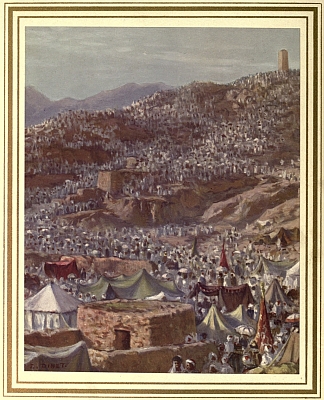
The Pilgrims of Mount Arafa, on the Ninth Day of the month of Zu'l Hijjah.
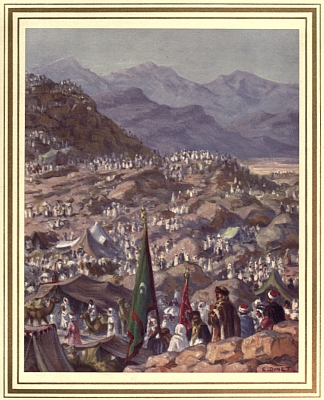
The Pilgrims of Mount Arafa, on the Ninth Day of the month of Zu'l Hijjah.
Thus reinvigorated, and their goat-skins filled again, the Believers joyfully resisted the fatigue of the march between each successive halting-place and finally emerged, safe and sound, from that accursed region.
ARRIVAL AND SOJOURN OF THE PROPHET AT TABUK
A vast plain of sparkling sand, streaked by a thin line of a beautiful peacock blue, now spread itself out to the gaze of the Prophet and his men. This line, the goal of their efforts, soon became notched; and at last appeared, sharply outlined on the turquoise sky, the slender tufts of the palm-trees of which it was formed.
This was the oasis of Tabuk! No pen can describe the joy of those, who having endured the anguish of thirst, arrived at this safe haven, an oasis of date-trees; nor give an idea of the expression on their faces when, having slaked their thirst and performed their ablutions, they looked down on the crystal water rippling in the "Sawaqi;" nor of their satisfaction when they laid themselves down in the light shade of the palm-trees.
The Prophet's soldiers had got through the hardest part of their task. They had triumphed over the obstacles opposed to them by Nature, and henceforward could look with deep disdain on any barriers formed by the weapons of the Infidels. Besides, thanks to the fantastic rapidity with which tidings travel through the desert, their arrival at Tabuk soon came to the ears of the Christians and the Syrian Arabs who had formed a coalition to fight the Believers.
The enemies of Allah were overcome by stupor, for they had felt certain that if the Prophet should try to carry out his audacious plan at such a time of year, the bones of all the men of his army would be scattered over the lonely Hijaz wilderness.
Therefore, in spite of their enormous numerical superiority, they concluded that any struggle against forty thousand Believers who had just accomplished this prodigious feat would be madness, and finish by overwhelming their opponents with indescribable disaster. Strife broke the ranks of their innumerable army, and each party it comprised fled towards its own part of the country without having dared to face the Prophet. The pitiful helter-skelter retreat of the allies enhanced the magic power of Islam as greatly as the most brilliant victory; and if Mohammad had not been kept back by the necessity of fulfilling his mission in the Hijaz before any other undertaking, he could have penetrated in the depth of the Palatinat almost without striking a blow.
As it was, established at Tabuk, he received the eager submission of the Arab lords who hurried to him, one and all, coming not only from the vicinity, but also from distant regions, such as those of Sinai and Syria. Alone, the proud Prince of "Dawmatu'l-Jandal," an important town situated on the outskirts of the "Nefud" (Desert of Red Sand), having refused submission, the Prophet sent Khalid the Terrible to him; and he was brought to his knees at once.
During the few weeks' rest granted to his army, Mohammad never ceased the work of organising the country and teaching new converts.
One event only saddened him in his success: the death of a most devoted comrade, known as "Dhu Nijadayn," (the man with the two shoulder-belts). To prove to all in what esteem he held this perfect Mussulman, he insisted in helping, with his own noble hands, the gravedigger to lower the body into the earth, and Ibn Mas'ud, jealous at seeing the dead man so highly honoured, exclaimed: 'Ah! why am I not buried in that tomb?'
THE PROPHET GOES BACK TO AL-MADINAH
The return journey took place without any incident worthy of narration. The hot months having gone by, the army was spared the pangs of thirst; and during the first days of the month of Ramadhan, the soldiers re-entered Al-Madinah.
In such a moment, in the midst of the acclamations greeting the returning, energetic soldiers, the perfidious "qawm" of the "Hypocrites" knew not where to turn to hide their shame. To palliate their meanness, they invoked the most specious pretexts in vain. The Apostle did not even deign to honour them by resentment, reserved for the shaming of the three Ansars, deterred from their duty by the double-faced crew.
Despite the repentant humility of the abashed men, the Prophet sentenced them most rigorously by putting them under interdict and forbidding the Believers to have anything to do with them. The delinquents were completely isolated and the Faithful fled from them as if they were plague-stricken. Allah, notwithstanding, moved by their remorse, pardoned them:
"He hath also turned in Mercy unto the three who were left behind, so that the earth, spacious as it is, became too strait for them; and their souls became so straitened within them, that they bethought them that there was no refuge from Allah but unto Himself. Then was he turned to them that they might turn to him. Verily Allah is He that turneth, the Merciful!" (The Qur'an, ix, 119.)
The "Ghazwah" of Tabuk was the last expedition led by the Prophet. To conclude the conquest of Arabia, he was satisfied thenceforth to send his lieutenants to accomplish a certain number of "Saraya" or expeditions, all fully successful, but which it would take too long to describe here.
He dwelt in Al-Madinah, kept busy in receiving the numerous submissions brought about by the victories of Islam. There were those of the Princes of Dawmatu'l-Jandal; of the Yaman; of the Uman, of Buhayra; of the Yamama; of Taif; of Najran, etc. He also devoted his energies to the most difficult task of governing the Arabs, for the first time united to form a people of brothers; and in his work as legislator, he displayed the resources of as much genius as when he was at the head of his armies.
About this time, the famous chief of the "Hypocrites," Abdullah ibn Salul, died. Seized with remorse in his last moments, Abdullah implored Mohammad's pardon and, despite the objections of ungovernable Umar, the Prophet was not to be stopped from saying prayers over the body of his perfidious foe and burying him with his own hands. After this proof of clemency and forgetfulness of offences, there no longer remained a single "Hypocrite" in Al-Madinah.
In his turn, Ka'b ibn Zuhayr, who had passed his life in composing virulent satires against the Prophet, came to be converted by him, and recited a poem which he had written in his honour. When Ka'b got as far as the fifty-first verse:
"The Messenger of Allah is a flaming sword illuminating mortals; a sword of India, unsheathed by Allah," Mohammad pardoned him, making him a present of his mantle which he threw over the poet's shoulders.
After the return of his victorious lieutenants, the Prophet despatched missionaries to the newly-converted tribes, in order to prevent them backsliding by introducing any of their past superstitions into the religion.
One of the principal missionaries was Mu'adh ibn Jabal, who was about to set out for the Yaman. So that all should see the consideration he attached to the mission entrusted to Mu'adh, the Prophet bound a turban round his envoy's head, helped him to mount his camel, and walked by the animal's side, giving final instructions. Mu'adh confused, made as if to alight, but Mohammad stopped him. 'Remain in the saddle, O sincere friend!' he said. 'I follow the orders of Heaven and satisfy my heart. It is needful that a man performing important duties should be honoured. Ah! if only I had hopes of seeing thee again, I should cut our conversation short; but probably I now speak to thee for the last time.' Much moved, they separated; never to meet again in this world....
In the month of Zu'l-Qa'dah, the Apostle, ever mindful of the religious and political importance of the pilgrimage to Makkah, sent Abu Bakr to accomplish it at the head of three hundred Mussulmans. Scarcely had Abu Bakr reached Zu'l Holifah, when the Surah of "Bara'ah" was revealed:
"O Believers! only they who join gods with Allah (that is to say, those who in any way whatsoever, associate Allah the Only One with other divinities or persons) are unclean! Let them not therefore, after this their year, come near the Sacred Temple (of Makkah)." (The Qur'an, ix, 28.)
This Surah, remarkable as being the only one in the Qur'an without the introductory form: "In the name of Allah, the Merciful, the Compassionate," was of the greatest importance, in so far as the pilgrimage was concerned. It forbid all who were not Mussulmans from setting foot in Holy Territory and even nowadays this prohibition being rigorously enforced, the pilgrims of Islam are safeguarded against enemy spies, and protected from the unseemly curiosity of foreigners.
This was also the final blow struck at idolatry among the Arabs who could no longer come to Makkah unless they disowned their idols. Consequently, the Prophet charged Ali to rejoin the pilgrims' caravan in all haste and recite this imperative Surah to the assembled Faithful, after the sacrifices had been made in the valley of Mina.
THE VALEDICTORY PILGRIMAGE (Zul-Hijjah, in Year X of the Hegira, March A.D. 632)
The following year, the Prophet determined to lead the pilgrimage to Makkah personally. Since the Hegira, he had only accomplished the "Amratu'l-Qada," or pious visitation, at a time when Makkah had not yet been entirely won over to Islam. Now the "Hajj u'l-Akbar," or Greater Pilgrimage, which imposes, besides the visit to the Sacred Temple of Allah, a visit to the mountain of Arafa, or of Recognition, (so called because our first parents, Adam and Eve, met each other there after having been driven out of Paradise), is one of the five pillars of the practical religion of Islam.
Mohammad also wished to see his native land for the last time, having a presentiment of his coming end, for he felt himself secretly undermined by the vestiges of poison remaining in his veins. He solemnly announced his intention. The idea of seeing the Apostle of Allah and accomplishing the pilgrimage with him, stirred the enthusiasm of the whole of Arabia, and the number of pilgrims who accompanied him from Al-Madinah or joined him on the way, may be set down at about hundred thousand.
At Zu'l Hobfah, all the Faithful, following the Prophet's example, put themselves in the state of "Ihram," as described in the chapter of al-Hudaibiyah, and assumed the robe also called "Ihram," consisting of two seamless wrappers free from any dye likely to stain the skin. One piece of drapery is wrapped round the waist and the other, thrown loosely over the shoulders, covers the chest; the head, arms, and legs being left bare. After the Prophet had proclaimed the "Talbiyah," the pilgrims took it up in chorus: "I stand up for thy service, O Allah! There is no Partner with Thee! Verily Thine is the Praise, the Blessing and the Kingdom!"
During the journey, two unimportant incidents arose which we note nevertheless, because they show that a pilgrim is obliged to suppress all feelings of impatience or anger. The camel of Safiyah, one of the Prophet's wives, was a slow animal, and being heavily laden, did not keep up with the caravan, despite the efforts of its driver. Ayishah's camel, possessing a good turn of speed and lightly burdened, Mohammad, after having tried to explain these facts to its fair rider, gave orders to change the loads of the two animals. But this displeased Ayishah. She lost her temper and cried out: 'Thou sayest thou art Prophet? Then why not do things justly?'
No sooner had these words escaped her lips, than her father, Abu Bakr, slapped her face; and as Mohammad upbraided him, he replied: 'Didst hear what she said?'—'Yea; but she must be excused. The essence of a woman's mind is jealousy; and when jealousy masters her, she is incapable of seeing in what direction runs the current of a wadi!'
On arriving at the encampment of Al-Arj, the camel carrying the provisions of the Prophet and of Abu Bakr was missing. Ayishah's father laid the blame on the driver: 'How's this? Thou hadst but one camel to look after and thou hast let it go astray?' Carried away by great anger, Abu Bakr, with his whip, gave the man a good hiding. 'Admire the conduct of this pilgrim in the state of "Ihram!"' said the Prophet, ironically. 'Come now, O Abu Bakr, be calm, and rest assured that thy serving-man's sole desire was not to lose thy camel.'
The caravan took the same road as that of the pious visitation. The Prophet entered Makkah in open day, and made his she-camel kneel in front of the entrance of the Sacred Precincts, called the "Door of Salvation," and on catching sight of the Ka'bah, he exclaimed: 'O Allah, increase the glory of this Temple and the number of its visitors!'
After three ablutions, he kissed the Black Stone, whilst tears welled up in his eyes. He then performed the "Tawaf," and the "Sa'y," in the same way as during the pious visit.
On the eighth day of the month of Zu'l-Hijjah, he went to the valley of Mina where he caused a tent of woollen stuff to be pitched; and it was there he said the prayers of the afternoon; of sunset; and of nightfall. Next day, after the prayer of the "Fajr," he once more bestrode his she-camel, al-Qaswa, in order to reach the mountain of Arafa.
Countless crowds having gathered on the mountain's rocky slopes, as well as on the plain and in the surrounding ravines, the Prophet preached, remaining on his she-camel which he had ridden and halted on the summit. Standing immediately beneath him, was Rabiyah ibn Ummayatah, posted there to repeat the words of the sermon, with his resounding voice, during a pause made for that purpose at the conclusion of each sentence.
After Allah had been glorified by the "Takbir," the Prophet exhorted the Faithful to treat their wives with the greatest gentleness, and never to forget that the rights of spouses are equal to their duties. He explicitly forbade the exaction of any interest whatsoever on money lent; and no murders committed during the "days of ignorance" were to be avenged. He fixed the duration of the year at twelve lunar months; and declared that the "Nasi," which added a month every three years to reestablish equilibrium and bring the same dates back to the same seasons, was impious and must be abolished....
He then concluded, as he cried: 'O Believers, your blood and your belongings ought to be looked upon as holy to each of you, even as this day is holy and as this land is holy! O Believers, remember what I say, for I know not if ever I shall be with you again on this spot, when this day is past. And, above all, never forget that every Mussulman should be truly a brother to every other Mussulman, for all the Mussulmans in the world form a single people of brothers!... O Allah! have I fulfilled my Mission?'—'Yea, verily, O Allah!' replied in unanimous outcry the hundred thousand mouths of the pilgrims, in accents of the most ardent gratitude.—'O Allah! hearken to their testimony!' cried Mohammad.
At another spot, near the summit of the Arafa, and known by the name of "As-Sakhrah," recognisable by being paved with broad slabs, a sudden Revelation came down to the Prophet. Under the burden of Divine Inspiration penetrating the heart of her rider, the she-camel al-Qaswa came nigh to breaking all her limbs, and she fell on her knees.
Here are the words of Allah, the Most High: "This day have I perfected your religion for you, and have filled up the measure of my favours towards you; and it is my pleasure that Islam be your religion...." (The Qur'an, v, 5.)
This Revelation, terminating the Prophet's sermon which had so deeply touched the Believers, stirred up the purest enthusiasm in the whole of the Assembly.
Nevertheless, Abu Bakr, far from participating in the general joy, was seized with a fit of intense melancholy, and was unable to hold back the tears that filled his eyes. He thought that having found favour in the eyes of the Almighty, His mercy was bound to decrease. Knowing that his son-in-law's Mission was terminated, Abu Bakr was afraid that the Prophet would soon disappear from this world....
The indigo shades of night had fallen over the valley and spread along the slopes of the Arafa. All by himself, on the mountain top, overlooking the great multitude of pilgrims, the Prophet, on the back of his tall she-camel, still remained in the light of the last golden rays of sunset. His glance, ecstatic by faith, was resplendent with superhuman brilliancy; but his face, emaciated by illness, had taken on the immaterial aspect of a vision about to fade.... The rising shadows reached and veiled him....
It was now the turn of the companions of the Prophet to find themselves overcome by the same mournful apprehension that Abu Bakr had felt, although scarcely a few moments before, they were manifesting their joy at hearing that their religion had been perfected by Allah.... By degrees, their emotion was communicated to the entire assembly of the Believers and their hundred thousand hearts were filled with the keenest anguish.
The Prophet gave the signal of departure; but to prevent the accidents which any haste would inevitably cause among the great masses of such a gathering, he tugged the bridle of swift Qaswa to him, twisting her head round until her nostrils touched her ribs, whilst he slid on to her withers; unceasingly exhorting all: 'Go quietly, O ye people!'
On arriving at Muzdalifa, he said the prayer, "Isha," and next day, after the daybreak prayer, riding his she-camel, led by Bilal, and protected from the sun by a mantle that Usama, riding behind him, held over his head, he went into the valley of Mina, in order to throw seven stones against each of the three pillars of rude masonry, called "Jumurat." This is in commemoration of the pebbles thrown by Abraham to drive away the Devil who thrice tried to stop him at that spot.
After that, the Prophet, to prove his gratitude for the sixty-three years of life granted to him by the Creator, freed sixty-three slaves and, with his own hands, sacrificed sixty-three camels, their flesh and skins being distributed among the pilgrims by Ali, acting under Mohammad's orders. He then had his head shaved by Mi'mar ibn Abdullah, who commenced at the right temple and finished at the left. Finally, after having once more performed the "Tawaf" round the Kab'ah, and drunk for the last time some Zamzam water in a vase offered to him by his uncle Abbas, the Superintendent of the Well, he set out again on the road to Al-Madinah.
Such was the pilgrimage called the "Valedictory Visitation," which overwhelmed the Believers with such deep emotion by apprising them that Mohammad's Mission was fulfilled. This pilgrimage serves as a pattern for all the pilgrimages which, during thirteen centuries, have brought annually to these Holy Places, one hundred and fifty to two hundred thousand pilgrims, collected from all parts of the universe.
Any pilgrimage, be the religion giving rise to it what it may, causes inexpressible emotion by the sight of so many faces beaming with faith; and the most sceptical among the onlookers finds it difficult to escape the contagion of this outbreak of fervour. But, among the majority of the spectators, inadmissible practices soon overcome sympathetic feelings and change them into aversion. At Makkah, doubtless, as in all religious centres without exception, pilgrims are ruthlessly exploited; but in this city, at least, the traffickers may be excused: they dwell in the most inhospitable of all deserts and have no other means of getting a living.
What makes the Mussulman pilgrimage essentially different to any other, is the absence of those innumerable chapels, whose narrow arches imprison souls, hampering them as they soar towards the Creator and holding them back on earth at the mercy of the clergy. Here are no fetishes, such as statuettes or miraculous icons, surrounded by their procession of votive offerings; nor that multitude of saints, their worship taking the place of that of the "Eternal," generally neglected on these occasions. There are also none of those monks clad in varied gowns, all jealous of each other; quarrelling over pilgrims and religious resorts for the greater glory of their sect or order.
At Makkah, prayers are said in the vast quadrangular courtyard surrounding the Ka'bah; the ethereal vault of heaven takes the place of the masonry work of chapel roofs and, purified from all its mists, it opens to souls thirsting for ideal good, its lapis-lazuli depths, more vertiginous here than in any other part of the world. At Makkah, nothing is worshipped except Allah, the Chosen One, and pilgrims seek the remembrance of Abraham and Mohammad for no other reason than to strengthen the fervour of their faith by following the Prophet's example. They never pray to these Prophets in the same way as Christians adore their saints; on the contrary, Moslems pray to Allah for their prophets.
The gates of the Ka'bah enclosure are open day and night. The pilgrim hurries there as soon as he gets to Makkah. At the sight of the temple draped in black, the object of his unceasing thoughts during the severe ordeals of the journey, in the midst of sandstorms or tempest-tossed, he is overtaken by such emotion that in this moment of superhuman ecstasy, he wishes his soul to be snatched away. Sobbing, his breast heaving fitfully, under the influence of remorse, his face convulsed by shame, he approaches the Black Stone to kiss it, exclaiming: 'O Allah! pardon me my sins; free my being from their burden and purify my heart, O Thou, the most Merciful among the Compassionate!'
When the hour of prayer is called by the Muazzin, the spacious quadrangle is invaded by a veritable sea of Believers; their hurrying waves scarcely leaving in the serried ranks the needful space for prostration. Following one of the "Takbirs" of the Imam, said after him in an immense sigh escaping simultaneously from every breast, a great swell passes over all the Faithful, causing every head to be bowed, like billows breaking.
At another "Takbir," it seems that the ground suddenly gives way under the pilgrims' feet. At one bound, every forehead is pressed to the earth, where the body of each man remains crushed by the threefold weight of Contrition, Gratitude and Adoration; like so many rays converging in the direction of the Temple which seems to be made still taller by the added height of the prostrated pilgrims. Above them, the black silk veil undulates, stirred by the gusts of a mysterious breeze which many attribute to angels' beating wings.
The Assembly of the Arafa is distinguished by quite as much grandeur. In a wild valley stands the conical mountain of Arafa. Its slopes, bare of all vegetation, bristle with enormous boulders. There is no sign of life on its sides, nor in the neighbourhood; all around is the image of desolation and the silence of death. But every year, on the ninth day of the month of Zu'l-Hijjah, the funereal landscape evokes most strikingly the future Day of Resurrection.
Soil, sand and rocks disappear, truly cloaked by human beings, enwrapped in their white "ihrams," and who might be taken for the resuscitated dead, freeing themselves from their shrouds after having lifted the rocks which were their gravestones. As it will happen on that supreme day, all the earth's races are represented in the countless crowds gathered together at this spot, deserted but a short time before. Here some Arabs, with eyes of eagles, their complexion of a reddish bronze; Ottomans, their features showing them to be energetic and headstrong; Hindoos, with faces clear-cut and olive-tinted; Berbers, fair-haired and rosy-cheeked, their eyes blue; Somalis and Soudanese, their black skins shining in the sun with lunar gleams; refined Persians; bold Turcomans; yellow Chinese, with closed eyelids; Javanese, high cheek-boned, etc.... Nowhere else in the world can such a variety of faces and languages be met with.
After the prayer of the "Asr," (afternoon), the "Khatib," or preacher, riding his she-camel, gorgeously harnessed, appears on the summit of the Arafa where the sermon is given forth, interrupted by frequent "Talbiyahs": "Labbaika! Allahummah! Labbaika!" (I stand up for Thy service, O Allah! I stand up! I stand up!)
At each "Talbiyah," the pilgrims wave the ends of their white draperies over their heads and the whole mountain seems to be palpitating under the beating of myriads of wings ready to fly, whilst a lengthy clamour rises to the sky from every part of the valley, reverberating in the sonorous echoes of the desert. "Labbaika! Allahummah! Labbaika!" shout two hundred thousand pilgrims with one voice, neglecting their own idioms, so as to become united in the same tongue: that of the Arabs, chosen by the Almighty for the Revelation of His Book.
In that sublime hour, in language as well as by the heart, all these mortals are cordially brothers. They have forgotten all their racial differences, distinctions of rank or caste, and all their political and religious feuds.... On the Arafa, Islam once more finds its perfect unity and its primitive outbreak of enthusiasm. What great consolation! What balm for some of its wounds!
Quoth the Prophet: 'The Moslems are as one body; the pain in any single limb gives rise to fever and insomnia in the whole of the frame.'
On the Arafa, Islam has nothing to fear from enemy spies; it can make good its losses and prepare its future. Despite its disasters, it is more alive than ever! Such is the impression of this unforgettable day, that each of the assistants takes back with him to his own country, as well as the title, so greatly envied, of "Haji," signifying Pilgrim to the Holy Places.

Say: Go through the earth, and see how He hath brought forth created beings.
Ornamental page - CHAPTER THE NINTH
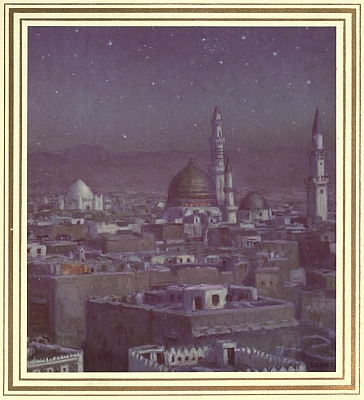
Al Madinah, the City of the Prophet. The Dome of Mohammad's Tomb.

Thou truly art mortal, O Mohammad, and they truly are mortals.
CHAPTER THE NINTH
ILLNESS AND DEATH OF THE PROPHET (Rabi'u'l-Awwal, Year IX of the Hegira. June A.D. 632.)
uoth Abu Muwayhiba, the Prophet's serving-man: "One night towards the end of the month of Safar, my master woke me up. "I must go and implore the blessing of Allah," said he, "for those at rest in the tombs of Baqui'u a'l-Gharqad. Come with me."
"I accompanied him. "Blessed be you, O dwellers in the tomb!" he exclaimed, when we reached the cemetery. "Rest in peace! Allah hath spared you terrible ordeals, like unto the anguish of a dark night, more terribly black at the end than at the beginning. Such are the torments in store for those who are still upon this earth!"
"As he finished speaking, the whole of his body was shaken by the palsy of fever, and he wended his way back to his dwelling with difficulty; his temples racked by the unbearable pains known as "Suda"...."
Quoth Ayishah: "When the Prophet returned from his visit to the cemetery of Al-Baqi, he came to see me in the middle of the night. I was suffering from violent headache and as I complained, he said: 'Ah! 'tis I who ought to complain of pains in the head and not thou!' He went on, jokingly: 'Would it not be better for thee to die whilst I am still in the land of the living? I could implore the Mercy of Allah in thy favour; with my own hands I could enfold thee in thy winding-sheet; I could pray over thy body and place thee in thy grave.' 'Of a surety thou doest me great honour in apprising me that thou wouldst act thus in my favour,' I replied; 'but I fear that after I was buried, thy sole consolation would be to bring back with thee, into my room, some other of thy wives!' At this sally, a smile returned to the Prophet's face and, for a brief moment, he forgot his pain."
As time went on, his illness left him no rest; nevertheless, mastering his sufferings, his mind was busier than ever, and he occupied himself with the future of Islam, for he felt that the effects of his management would soon be lacking.
Thinking that Syria was one of the gates through which the warriors of Allah would have to march to conquer the world, Mohammad's gaze was unceasingly turned towards that country and he resolved to organise a third expedition against the Christians, in whose power it was.
Great rivalry at once arose with regard to commanding such an incursion. Of heroes and generals having been put to the test, Islam had enough and to spare. The most famous among them: Ansars or Mohadjirun, anxiously awaited the Prophet's choice.
To the stupefaction of all, however, Usama, barely twenty years of age, was chosen. It is true that this lad was the son of Zayd ibn Harith, the martyr of Mutah. Mohammad placed great reliance on the revengeful ardour that Usama would show in fighting the murderers of his father on the very spot where he gloriously succumbed, than on the experience and warlike valour of the Mussulman generals.
This selection caused deception and gave rise to murmuring. The Believers hesitated to put boundless confidence, such as is indispensable for success, in a chief so young and inexperienced. Having been told about this, the Prophet rose and cut short all disputes by these words: 'Ye criticise my choice of Usama, even as ye formerly cavilled at that of Zayd, his father! Listen! To you I swear, by Allah! that Zayd was truly worthy of the post of command with which I did entrust him. I cherished him above all other men; and after him, his son is the man I prefer. Go, carry out my orders, and have confidence!'
These simple words, uttered in a tone of inspired conviction, banished all hesitation; smoothing away all jealousy as if by magic; and the noblest and most famous among all the chieftains, together with the most humble soldiers, came enthusiastically to obey the commands of the stripling. When the expedition marched into the "Farewell Pass," the Prophet was deeply moved as he saw his troops disappear. The superhuman faith animating the warriors at the parting hour proved to him that no obstacle could bar their way on the road to victory and that the irresistible torrent of Islam, like unto the salutary overflow of a wadi, was about to inundate the world and bring it the prolific germs of its new civilisation. Meanwhile, it was not long before the alarming news, relating to the Prophet's illness, stopped Usama's forward progress, bringing him back to Al-Madinah.
About that time, the Apostle received a letter, couched in these terms: "Musailimah, the Prophet of Allah, to Mohammad, the Prophet of Allah. Peace be with thee, I am thy associate. Let the exercise of authority be divided between us. Half the earth is mine, and half belongeth to the Quraish. But the Quraish are a greedy people, and will not be satisfied with a fair division."
The author of this epistle, Musailimah, Prince of the Yamama, had recently been converted to Islam; and then, fully appreciating the majesty of the part played by the Prophet, this pretender planned with monstrous pride to play the some part in his turn.
To the envoys bringing the impudent missive, Mohammad replied: 'Were it not that your situation as ambassadors causeth me to look upon your lives as sacred, I would have you beheaded.' And he handed them this answer: "Mohammad, the Prophet of Allah to Musailimah, the Impostor. Peace be with those who follow the right road! The earth is Allah's, and He giveth it to whom he will. Those only prosper who fear the Lord!"
Both Musailimah and Al-Aswad, another impostor, soon found out the danger run by those who enacted the part of Prophet without having been called by Allah. They expiated their temerity most cruelly.
The Prophet's illness became daily more serious. He grew so weak that he could only move about by dint of the most painful efforts.
Being in the house of Maimunah, he sent for his other wives. His usual habit was to pass the night in turn, impartially, at each of their dwellings; but feeling himself weighed down by intense suffering, he begged them to let him remain with Ayishah alone for the duration of his illness; and to this they consented.
Quoth Ayishah: "The Prophet left the abode of Maimunah, thanks to the assistance of Al-Fadl and Ali, who held him in their arms. A bandage was bound tightly round his head, and his weakness was so great that he had no sooner set foot in my room than he swooned. When he came to, lancinating pains tortured his temples; and hoping to soothe his pangs, he asked: 'Pour over me six skinsful of water drawn from a very cold spring, so that I may be in a fit state to go forth and preach to the Faithful.' We sat him in a stone trough, borrowed from Hafsa, and poured water over him in abundance, until he bade us stop, by a wave of his hand, saying: 'Enough!'"
Momentarily invigorated, Mohammad went out through Ayishah's door which gave on to the Mosque; and again supported by his cousin Ali and Al-Fadl, he had great trouble in mounting the steps of the pulpit, from which he made the following declaration to the Faithful assembled: 'O Believers, if among you there be one whose back I have beaten, here is my back so that he may do himself justice! If there be one whose honour I may have wounded, here is my honour, let him be avenged! If there be one whose property I may have seized, here is my property, let him satisfy his claim! Let no one hesitate in fear of my resentment, for resentment formeth no part of my disposition.' After having stepped down to give out the noonday prayer, he went up in the pulpit again and repeated the same declaration.
A man arose and claimed payment of a debt amounting to three drachmas. The Prophet handed them over to him at once, adding: 'It is easier to put up with shame in this world than in the other.'
He then evoked the remembrance of the martyrs of Uhud, to whom he devoted the best part of his prayer, imploring Allah's blessings in their favour. He wound up as follows: 'Allah hath offered one of His servants the choice between the riches of this earth and those that are to be found at His side.' At these words, divining that the Prophet was alluding to himself and the state of his health, Abu Bakr burst into tears, and exclaimed: 'Ah! why cannot we offer our lives as a ransom for thine?'—'O Believers!' replied Mohammad, 'it hath come to my ears that ye fear your Prophet may die; but before me hath any Prophet been immortal as he accomplished his Mission? How can I dwell eternally among you? Every soul is doomed to die. I must return to Allah and ye likewise will return to Him.'
Quoth Ayishah: "After this effort, when the Prophet came back to my room, he fainted away again. When the call of the Muazzin was heard, he rose up and asked for water wherewith to perform his ablutions, meaning to lead the prayers. He swooned three times.
"As the Faithful awaited his coming in the Mosque, he sent Bilal to fetch Abu Bakr, so that he could perform the duties of Imam instead of the Prophet. The crowd, guessing the reason of this change, broke out into fits of sobbing....
"The Prophet was frequently seized with delirium. One Thursday, whilst all his companions gathered round his bed, he said to them: 'Bring hither to me ink and parchment; I would place on record a book for you which shall prevent your going astray for evermore.'—'Allah's Messenger is burdened by pain,' said Umar; 'have we not the Qur'an? Allah's Book sufficeth for us.'
"Several of his companions, accustomed never to argue about anything said by the Prophet and remembering that he was illiterate, thought that in this supreme moment a miracle was about to be accomplished. Therefore they wanted to give him what he asked for. They were opposed by his partisans sharing Umar's opinion, and a quarrel began, the Prophet recovering his senses by the noise. He told them reproachfully: 'It is not seemly to quarrel thus at a Prophet's bedside. Go away!'
"To soothe his unbearable pain, he dipped his hands in a pitcher of cold water and passed his wet palms over his face, as if to wipe it: 'O Allah!' he cried, 'help me to support the terrors of the death struggle!'
"He had Fatimah, his beloved daughter, fetched to him twice and spoke to her secretly, whispering in her ear. The first time, Fatimah's face was bathed in tears; the second time, her features were lit up by a smile. We asked her the reason of her changed expression, and she told us: 'The first time, my father warned me that he must soon succumb to his illness, and I could not repress my tears. The second time, he informed me that of all his family, I should be the first to rejoin him, and so great was my joy that I could not stop myself from smiling.'"
On the Monday, the twelfth day of Rabi'u'l-Awwal, Abu Bakr was saying prayers in the presence of the Faithful, when Ayishah's door, giving into the Mosque, was thrown open. Supported by Ali and Al-Fadl, the Prophet appeared. His turban was twisted tightly round his head, and his benumbed feet dragged along the ground. On seeing him, the Faithful were comforted by a ray of hope and a wave of emotion stirred them all. Without turning round, Abu Bakr guessed that only the arrival of the Prophet could have given rise to such a manifestation while prayers were being said, and he moved away to join the ranks of the worshippers and let his place be taken by Mohammad. But he made Bakr go back; pulling him by his garment, as he said: 'Continue to lead the prayers.'
He then sat down on Abu Bakr's right hand, under the pulpit, and his face beamed with happiness, at the sight of the piety of the congregation. When prayers had been said, he spoke to the Believers for the last time; and in tones firm enough to be heard outside the Mosque, he preached a sermon predicting terrible ordeals and charging them with the strictest observance of the principles of the Qur'an, for such would be the only way leading to Salvation. Leaning against one of the palm-tree trunk pillars, he chatted familiarly with some of his companions, and then went back to his room.
Quoth Ayishah: "After this last effort, the Prophet was again overtaken by greater pain than ever, and covered his face with a black garment, which he threw off again, as it stifled him....
"Just then, Abdu'r Rahman, son of Abu Bakr, came in, holding in his hand a small twig of green "araq," with which he was picking his teeth. The Prophet stared at the little stick and I made out that he would have liked it. So I took it out of Abdu'r Rahman's hand. Cutting off the end of the toothpick, I shook it, cleaned it and gave it to Allah's messenger who immediately made use of it, picking his teeth more carefully than ever before. When he had finished, he let the little stick drop from between his faltering fingers. He raised his eyes to heaven, repeating three times: 'O Allah! with the Compassionate on High....!' And I felt his head, resting between my chin and shoulder, grow heavy on my arm.
"I guessed that the Prophet had chosen the eternal dwelling and that his noble soul had just been taken by the Angel of Death. I placed my head on the pillow and uttered a great cry of distress.... His wives came running in; and all together, we went down on our knees, and tore our faces with our nails."
On hearing these lamentations, the Believers filled the Mosque. They were dazed, like sheep straying on a dark, wintry night; but not one of the Faithful would admit that the Prophet was dead. The disappearance of the man who led them in every way seemed an impossibility.
'How can he be dead?' they cried. 'Did we not count upon him to be our witness on the Day of Resurrection? He is not dead; he hath been carried up to Heaven, even as was Isa (Jesus).' And through the door they cried: 'Beware lest ye bury him!'
This met with Umar's approval: 'No, verily, the Prophet is not dead! He hath gone to visit the Lord, even as Moses did, when after an absence of forty days, he reappeared to his people. In like fashion, Mohammad will be restored to us. Those who say he is dead are traitors to the cause of Islam. Let their hands and feet be cut off!'
At that juncture, Abu Bakr, who had been fetched from the As-Sunuh quarter where he lived, arrived on horseback, galloping as fast as possible. He alighted and, making his way through the crowd in consternation, he went into the Mosque without speaking to a soul, and from there, passed into the room of his daughter Ayishah in order to see Allah's Messenger. A piece of striped stuff was thrown over the body; Abu Bakr uncovered the Prophet's face, kissed him, wept and then broke down under the weight of his great grief.... 'O Thou for whose ransom I would have offered both father and mother,' he cried, 'thy career is well accomplished!'
Tearing himself away from his sorrowful contemplation, he covered up Mohammad's face again and went out, going straight up to Umar who was haranguing the people. 'Sit down, O Umar!' he said. Umar refused to obey him. In the meantime, the majority of the Faithful left him by himself, and gathered round Abu Bakr who told them: 'O Believers, if ye adore Mohammad, know that Mohammad is dead; but if ye adore Allah, know that Allah is alive, for Allah cannot die! Ye must have forgotten these verses of the Qur'an: "Mohammad is no more than an Apostle; other Apostles have already passed away before him; if then he die, or be slain, will ye turn upon your heels? Thou truly art mortal, O (Mohammad), and they truly are mortals." (The Qur'an, iii, 138, and xxxix, 31.)
Quoth Umar: "By Allah! scarcely did I hear Abu Bakr recite these verses than I felt my legs give way under me. I was near falling down, for then I began to understand that the Prophet was really dead!"
ABU BAKR ELECTED
Before thinking about the funeral, it was urgent to guard against the pressing danger threatening Islam, totally broken up by the loss of its inspired guide.
The man who had succeeded in bringing together in religious fraternity families and tribes at loggerheads for centuries, having disappeared, what would become of this brotherhood? The immediate nomination of a Caliph, or lieutenant appointed to continue the Prophet's task, could alone prevent irretrievable disaggregation. This urgent necessity stirred the tribes tumultuously; a tragical conflict between Ansars and Mohadjirun was imminent, each party claiming to have the Caliph chosen from among its adherents. Happily, Umar's energy and spirit of decision easily averted the crisis. Having succeeded in gaining a few moments' silence, he called upon the Believers to take notice that during the last days of his life, Mohammad had designated Abu Bakr, his companion during the Hegira, to take his place as "Imam," and doubtless the Prophet would have chosen him for Caliph.
This opinion carried the day. When the sun rose again, all the Believers, forgetting their disputes, came and took the oath of fidelity to Abu Bakr.
THE PROPHET'S BURIAL
This important question being settled, the Faithful were free to arrange the Prophet's funeral and give way to the despair that racked their souls.
At first, they were embarrassed, not daring to strip off his garments so as to wash the body according to the usual rites. Respect forbid them to look on his nakedness, as if it were sacrilegious to do so. After long discussions, irresistible sleep weighed down their eyelids; their chins rested on their breasts, when suddenly, a voice proceeding from the chamber of death was heard. They awoke at its sound and it replied to what was passing in their minds: 'Wash the Prophet without undressing him.' That was the solution they sought, and without further delay, they acted on the suggestion. With striped stuff of the Yaman, Abbas erected a kind of tent in the room, so as to keep the crowd away from the body. By the aid of seven skinsful of water drawn from the well of Al-Ghars, at Quba, preferred by Mohammad to any other, Ali, Usama, Abbas and his sons, and Shukran, the freed slave, proceeded with the ritual washing. Abbas, assisted by his sons, Al-Fadl and Qutham, turned the venerated body over. Usama and Shukran sprinkled it with water and Ali wiped it without removing the shirt.
The first washing was done with plain water, the next with an infusion of lotus-flowers; and the third, and last, with camphorated water. Abbas and Ali then perfumed every part of the body that comes in contact with the earth during the ceremony of prostration: forehead, nose, hands, knees and feet.
'How sweet is thy smell, O Prophet!' exclaimed Ali; and all marvelled at not finding on Mohammad's frame any of those horrible traces of decomposition following the separation of the soul from the body, with the exception of a slight bluish tinge appearing on the nails.
Instead of a shroud, the Prophet was wrapped in the garments he wore at the moment of death: his shirt, which after the ablutions was wrung out and allowed to drip; and a double robe woven at Najran. It was then that Ali and Abbas, having replaced Mohammad on his bed, allowed the crowd to enter.
The room was at once filled with as many Believers as it would hold, and after they had said: 'Peace be with thee, O Prophet, and also the Mercy and Blessing of Allah!' they got ready to pray without an "Imam" to lead them, for the real "Imam" was present, although his soul had been called back to the side of the Almighty.
Abu Bakr and Umar were in the front rank of the worshippers, and they concluded the prayer by these words: "O Allah! we bear witness that he hath accomplished the Mission Thou didst entrust to him. O Allah! grant peace to those among us who follow faithfully the orders Thou hast revealed to him and hasten to reunite us with him. Amin!" And all the people, stirred to the innermost depths of their being, repeated: "Amin! Amin!"
Fresh difficulties now arose, concerning the place of burial; some wanting the grave to be dug in the Mosque; others, at Al-Baqi, among the tombs of the Prophet's family. A few mentioned Makkah, his birthplace. Abu Bakr silenced them, affirming that he had heard Mohammad say: 'Allah only taketh the soul of a Prophet on the spot where it is fitting that he should be buried.'
The bed was accordingly moved away and the grave dug in the ground underneath it. This task was alloted to Talha, the gravedigger of Al-Madinah. He strengthened the sides of the grave by means of nine unburnt bricks, and carpeted the bottom with the red blanket that served the Prophet as a rug for his camel when travelling, and which was not to be used by anyone now that he was dead. Ali, Al-Fadl, Qutham, and Shakran lowered the body into its last resting-place....
Al Mughira ibn Shu'ba affirms that he was the last man to have the happiness of contemplating the face of the Chosen One before it was covered with earth. "I let my finger-ring drop into the grave,' he says, 'so that when I regained it, I should be the last to address a farewell salute to the Prophet."
The sad ceremony was concluded in the middle of the night between Tuesday and Wednesday. On the morrow, at dawn, when in his call to prayer, Bilal, the "Muazzin," proclaimed: 'There is no God but Allah, and Mohammad is the Prophet of Allah!' he could only shout the name of Mohammad through his sobs. The whole town replied to him, as by an echo, in a long moan of despair which rose to heaven, from every door and window of the houses....
Ever since that day, the twelfth of the month of Rabi'u'l-Awwal, Year XII of the Hegira, (June 8th, A.D. 632), this extraordinary man, who was, to say the least, the equal of the greatest of all Prophets; monarch, general theologian, legislator and philosopher, and whose religion counts at the present time three hundred millions of disciples, rests in this spot where his noble soul was carried aloft.
A sumptuous Mosque, erected over the room where he died, has taken the place of the humble temple of raw bricks and palm-trunks that he built up with his own hand. A visit to his tomb is not one of the pillars of Islamic pratical religion, but nevertheless there are few pilgrims who, after the severe trials endured during their journey to Makkah, hesitate to undertake the twelve days' caravan travel, so distressing and dangerous, between Mohammad's birthplace and Al-Madinah, in order to salute the Prophet's grave piously and enthusiastically....
Even the learned men of Europe are beginning to forget secular prejudices and do justice to the founder of Islam. 'If a man's value is to be estimated by the grandeur of his works,' declares Dr. G. Le Bon, 'we can say that Mohammad was one of the greatest men known in history.'

Mohammad is no more than an apostle; other apostles have already passed away before him; if then he die, or be slain, will ye turn upon your heels?
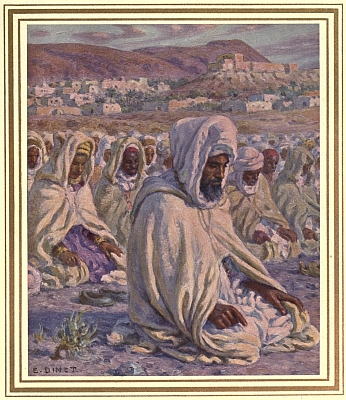
Imam leading the Prayers.

O my supreme Master, lavish thy Blessings and thy Favours for ever and ever on Thy Friend (Mohammad), the best of all created beings.
THE PROPHET'S PORTRAIT
ccording to his son-in-law, Ali, the Prophet was of middle height and sturdy build. His head was large, his complexion healthy; with smooth cheeks, a thick beard, and wavy hair. When he was vexed, a vein swelled out on his forehead, from the top of his aquiline nose between his eyebrows which were well arched and meeting.

His big eyes, framed by long lashes, were of a deep black, lit up at times by a few red gleams, and his glance was extraordinarily keen. His mouth was large, well suited to eloquence. His teeth, as white as hailstones, were slightly separated in front. The palms of his hands, of which the fingers were long and slender, were broad and soft to the touch like fine silk.
The Seal of Prophecy—which the monk Bahira discovered—was just below the nape of the neck, between Mohammad's shoulder-blades. It resembled the scar left by the bite of a leech, and was of a reddish hue, surrounded by a few hairs.
The Prophet's gait was slow, solemn and majestic. In all circumstances, he never lost his presence of mind and was quick-witted. When he turned round, the whole of his body moved, unlike frivolous folks twisting their necks and rolling their heads about. If he held out an object to show it, he made use of the whole of his hand and not two or three fingers. When surprised, he glorified Allah, turning the palms of his hands to heaven, nodding his head and biting his lips.
When he made an affirmation, he struck his widely-open left hand with his right thumb to lay stress on his declaration. If angry, his face flushed; he stroked his beard and passed his hand over his face, taking a deep breath and exclaiming: 'I leave it to Allah, the best proxy!'
He was a man of few words; but each had many different meanings, some plain and others hidden. As for the charm of his elocution, it was supernatural, going straight to the heart. None could resist it. The Prophet's merriment never went beyond a smile, but if he was overcome by an excess of gaiety, he covered his mouth with his hand.
His disposition was even, without self-sufficiency or obstinacy. Whenever any of his companions called him, he replied immediately: 'Here I am!' He liked to play with their children and would press them to his noble breast. He used to make the sons of his uncle Abbas stand in a row and, promising to reward the child who got first to him, they would all run into his arms and jump on his knees.
He interested himself in the doings of all, whether slaves or nobles, and followed the funeral of the most humble Believer. He flew one day into a most violent passion because, through negligence, he had not been apprised of the death of a poor negro who swept out the Mosque. He insisted on being told where the grave was situated and went to pray over it.
When an applicant tried to get close to the Prophet's ear so as not to be overheard, he would bend his head until the man had finished speaking. When a visitor took the hand of Mohammad, he was never the first to withdraw it, but waited until the other chose to relax his grasp. The Prophet often said: 'To be a good Mussulman, we must wish for others that which we wish for ourselves.'