THE PARIS BOOK CLUB, 11, RUE DE CHATEAUDUN (continued 3)
Reading edition
The Jews, inhabiting their land and bent beneath their yoke, were folks well versed in the knowledge of Holy Writ. Thus it was that whenever disagreement arose between them and their masters, these children of Israel were wont to murmur: 'We await the coming of a Prophet. When his hour arrives, we shall all follow him and thanks to his assistance, we shall triumph over you and become your masters in our turn.' Whilst Mohammad spoke unto the tribesmen, they exchanged glances and came to this conclusion: 'Evidently this is the Prophet whose advent is threatened by the Jews. We must not let them forestall us with him.'
So they replied to his appeal, saying: 'Our land is made desolate by perpetual war waged between us and our Arab brothers, the Aus tribe. We will go to them, and call their attention to thy cause and thy religion. If through thee, Allah should reconcile and unite us, there will not be in all Arabia a man more powerful than thee!'
THE TWO OATHS OF THE AQABAH (A.D. 621)
The new converts kept their word and spread Mohammad's doctrines in their region. The following year, twelve Mussulmans from Yasrib, ten being of the Khazraj and two belonging to the Aus, arrived in Makkah for the Mausam rejoicings. They met the Prophet on the Aqabah and took an oath of fidelity towards him. With a view to completing their religious education and making fresh converts, Mohammad delegated Musab ibn Umr, one of his most learned disciples, who went away with them.
In Yasrib, the Islamic creed did not meet with the difficulties that hampered its progress in Makkah, where it was harmful to the interests of the exploiters of the idols. Musab's task turned out to be particularly easy, and the "Permanent Miracle" of the Surahs of the Qur'an, recited by him, produced its effect with lightning-like rapidity. Resembling a beneficial rainstorm which might have broke, in a few minutes, over every part of a country suffering from drought, restoring life and fertility, Islam had diffused its wholesome dew over every district of the town, calming dissensions and causing the virtues necessary for its triumph to take root and flourish in the citizens' hearts.
Soon there was not a single family among the Aus or the Khazraj which did not count several Believers among its members. Musab, who had good reasons to be proud of the result of his mission, returned to Makkah to report progress to Mohammad. When the date of the pilgrimage came due, seventy-five Mussulmans, two being women, joined the caravan of their fellow-citizens who were still idolaters. The converts, full of zeal, arranged to meet the Prophet on the Aqabah, during the night preceding the second day of Tashriq, in order to offer a safe place of refuge in their city, for him and his disciples.
Ka'b ibn Malik, one of the pilgrims, has said: "We made up our minds to keep our movements secret from our idolatrous fellow-citizens, among whom we slept until one third of the night was passed. We then went out, one after another, stealthily, making our way, slowly and silently, towards a pass on the slopes of the Aqabah, where we all met together to await the Prophet. He soon arrived, accompanied by his uncle Abbas ibn Abdul-Muttalib.
"He had not yet abjured the religion of his ancestors, but he had great affection for his nephew from whom he wished to ward off all misfortune, following the example of his brother, Abu Talib. Having been informed of the plans of the people of Yasrib, Abbas wanted to see for himself what amount of confidence Mohammad could have in their proposals. Abbas was the first to address the meeting and spoke as follows: 'O Assembly of the Khazraj and the Aus! my brother's son, as ye know, holds high rank among us, and although we do not share his convictions, we have hitherto protected him against his fellow-citizens. In our "qawm" he finds honour and safety. Nevertheless, at the present hour, he turns towards you, and desires to settle in your midst. Reflect! if ye decide to remain faithful to your promises and shield him from all dangers whatsoever, it will be well. But should ye fear to be forced one day to throw him over, and give him into the hands of his enemies, it would be better, now at once, to confess that your purpose is not steadfast by withdrawing your proposals and leaving him with his own party.'
"Without the slightest hesitation, we answered Abbas: 'Thou hast heard what we proposed. Thou canst rely on us absolutely!' Then we turned to Mohammad: 'Speak, O Prophet! What dost thou want of us, for thy Lord and for thyself?'
"After having recited a few Surahs and recapitulated the fundamental principles of Islam, the Prophet added: 'Swear that ye will fight to defend me and my disciples, as ye would fight to defend your wives and children.'
"We took the required oath with unanimous enthusiasm: 'By Allah! we are war-children, and our fathers have taught us how to manufacture all weapons!'—'O Prophet!' broke in Abul Hasham, 'there exists a compact, between the Jews of Yasrib and us, which we shall have to break, perhaps, in order to uphold thy cause. What would be our position, in our land, if, after being victorious thanks to us, thou didst go back to thy "qawm"?'
"The Prophet smiled and protested: 'Rest easy on that score! Your blood hath become my blood and your honour, my honour. He who wrongeth you, wrongeth me. I'll fight the enemies you fight, and support whom ye support; ye are mine and I am yours! Choose then twelve Najibs among you as leaders.'
"After having consulted together, we chose nine Khazraj and three Aus. When we brought the twelve men to him, he said: 'Ye shall be my delegates in your "qawm," as were the apostles of Jesus, son of Mary, among their people.'
"The Najibs pledged their words; but, just as the solemn oath was about to be sworn, Ibn-i-Ubadah rose and said: 'O Assembly of the Khazraj and Aus! have ye reflected seriously anent the consequences of the compact ye intend to make with this man? For his sake ye swear to go to war with white, swarthy and black men. But if, in days to come, seeing your property pillaged and your nobles massacred, ye were to forsake him, shame would be brought upon you in this world and the next.'—'We are resigned in anticipation to the loss of our property and to the death of our best men, if such a sacrifice is useful for the cause of Islam,' we replied unhesitatingly, 'but may we ask the Prophet what we shall receive in exchange?' He replied: 'Paradise!'
"Who, from desire to behold the face of their Lord, are constant amid trials, and observe prayer, and give alms in secret and openly out of what We have bestowed upon them and turn aside evil by good: for these is the recompense of the abode * Gardens of Eden—into which they shall enter together with the just of their fathers, and their wives, and their descendants: and the angels shalt go in unto them at every portal: * Peace be upon you! say they, because ye have patiently endured! * And charming is the recompense of the Abode!
"So oft as they are fed therefrom with fruit for sustenance, they shall say, 'This same was our sustenance of eld!' But they will only resemble those of earth, being infinitely more delicious ... * And theirs shall be the Houris with large black eyes like close-kept pearls ... * No vain discourse shall they hear therein, nor charge of sin * We will remove whatever rancour was in their hearts ... and they shall say 'Praise be to Allah who hath guided us hither.' *
"And other things which ye desire will He bestow: Help from Allah and greedy conquest! ... * O ye who believe! be ansars of Allah! (i.e. helpers, soldiers.) (The Qur'an, xiii, 22, 23, 24. ii, 23. lvi, 22, 24. vii, 41. lxi, 13, 14.)"
"When they heard these promises of inconceivable bliss in Paradise, announced by such tokens as are understood by mortals' weak brains, the Faithful felt their souls filled with hope and said to the Prophet: 'Stretch out thine hand!' Mohammad offered his hand, opened out, the palm turned upwards; and Asad ibn Zarara came and struck it with his right hand, followed by Abul Hisham and Al Bara; and, one after the other, all the Yasrib pilgrims, who from that day forth called themselves, "Ansars."
"We were getting ready to return furtively to our encampment, our hearts brimming over with joy and hope, when, in the silence of the night, on the summit of the Aqabah, a voice resounded, the most shrill I had ever heard. 'O Assembly of the Quraish!' it shouted, 'be on your guard! The sons of the Khazraj and Aus have sworn to fall upon you with the sword!'
"We shuddered, but the Prophet removed our fears by saying: 'That is the voice of the demon of the Aqabah which means that Iblis (Satan) is shrieking. He is Allah's enemy, and his cry has not been heard by any of our adversaries.' We returned to our tents, where we found our fellow-citizens sleeping soundly, suspecting naught of that which had taken place.
"Nevertheless, upon awaking, next day, a deputation of Quraish nobles arrived, warned either by the voice of Iblis, or by reports of spies dogging the Prophet's footsteps. 'O Assembly of the Khazraj and Aus!' said these delegates, 'it hath come to our ears that ye have allured one of our men, Mohammad ibn Abdullah and taken an oath with him to wage war upon us.'
"The idolaters of our party, knowing nothing about the events of the night, swore with most evident sincerity that the Quraish were mistaken. 'This business is improbable!' exclaimed one of their chieftains, Abu Salul by name. 'My "qawm" would not have hidden it from me and I have heard naught about it.'"
The Quraish tribesmen went away, more or less tranquilised, but they met on their road some Bedouins who had been witnesses of the strange gathering in the Aqabah ravine and who imparted their suspicions. The Quraish, convinced of the treachery of the Khazraj and the Aus, turned back in great haste to the encampment. But the tents were struck; the birds had flown and were far off by that time, out of danger.
THE PLOT AGAINST THE PROPHET
Henceforward the Prophet could reckon on safety and shelter in the town of Yasrib and he gave orders to all his disciples to take refuge within its walls.
The idolaters could not help feeling great apprehension, by reason of their victims meeting with the inhabitants of a rival city. The worshippers of images impeded the union by means of great violence, and it was only one by one, or in small, successive groups, that the Believers were able to reach their place of safety. From that day onwards, they took the name of "Muhajirun," or emigrants.
As for the Prophet, relieved of all anxiety concerning them, he stopped in Makkah with Ali and Abu Bakr only. They knew full well the risk they ran, but despite Abu Bakr's adjurations, Mohammad wished to make a supreme effort, and resort to force before leaving his native town. He still hoped to rescue some of his fellow-countrymen from idolatry, especially as he now had a shelter to offer them; and besides, he did not like to leave his post without authorisation from the Lord.
The emigration of the Believers carried the fury of the Quraish idolaters to the highest pitch as well as causing them great anxiety. They resolved to strike a decisive blow.
They called a meeting in the "Dar-un-Nadwa," "House of Counsel," built by their ancestor, Qusayy ibn Kilab. The most important resolutions were taken in this "Dar-un-Nadwa," where only the descendants of Qusayy were admitted, but not until they had reached the age of forty.
Just as representatives of every division of the Quraish were entering the "House of Counsel," a tall, old man of haughty bearing, attired in woollen garments, appeared on the threshold. In reply to questions as to who he was and what he wanted, he replied: 'I am a Shaikh of the Najd. Attracted by your noble gait and the sweetness of your favourite scents, I feel great desire to hear you speak. If ye consent to admit me to your noble assembly, perchance my advice may not be entirely useless.'
The inhabitants of the Najd lived too far away to be suspected of acting in complicity with Mohammad, therefore the Committee of the Elders found that nothing prevented them from authorising the noble stranger to be present during the meeting, and he followed them into the hall of debate. The Head Committee started the discussion at once. 'We all know,' they said to each other, 'about the intrigues of this man Mohammad and the danger with which he threatens our country. We will talk over the best means of defence. Let each of us give his opinion freely.'
The first to speak was Abul Bukhtari who made this proposal: 'Let us cast our enemy into a dungeon, load him with chains, and bolt the door upon him until he die.'—'Such a proceeding would be fraught with fatal consequences,' the Shaikh of the Najd objected, 'if you carry it out. The news of your act of violence would filter through the prison gates and reach the ears of Mohammad's companions who, ye may be sure, would quickly attack you in order to free him. Thanks to assistance of the Yasrib Mussulmans, they would be victorious. Let us hear some one else's proposition.'
Asad ibn Rabiya rose and said: 'Why cannot we expulse him from among us and banish him from our country? When he is gone, little we reck where he taketh refuge or what becometh of him. We shall be well rid of him.'—'Truly, a fine piece of advice!' exclaimed the Shaikh of the Najd. 'Know ye nothing about the beauty of your adversary's speech, the charm of his voice and the strength of his arguments? Scarcely will he have set foot among the neighbouring Arab tribes, when he will dominate them by his eloquence, cause them to follow in his wake, and come back from exile at their head, to have his own way with you all! Try and find a more reasonable plan to crush him.'
Then it was the turn of Abu Jahal. 'By our gods!' said he, 'I have a project which, I am certain, will satisfy you entirely.'—'Speak! What is thy plan?' exclaimed his audience.—'This is it. In each subdivision of our tribe we'll choose a young, vigorous warrior belonging to a family equally noble and respected, and we'll place in his hand a well-sharpened sword. These young warriors, banded together, shall throw themselves on Mohammad at the same instant; all striking him at once. By acting in this way, the responsibility of shedding his blood will be shared among all the subdivisions to which the murderers belong, and the Abd Manaf, relatives of the dead man, unable to declare war upon every subdivision of our tribe, will be obliged to content themselves with receiving the "Diyah" (blood ransom) that we may be good enough to offer.'—'These are words of intelligence!' exclaimed the Shaikh of the Najd, who was no other than Iblis (Satan) disguised in human shape. 'That man's motion points to the only way out of your difficulty.'
This perfidious counsel met with the unanimous approval of the assembly. The Unbelievers flattered themselves that their enemy was already got rid of, but they had reckoned without the will of the Almighty. The angel Jibra'il, sent by Him, warned the Prophet of the conspiracy to take his life, and brought him orders to emigrate in his turn, at the same time warning him as follows: 'Sleep not this night upon thy wonted couch.'
In Mohammad's house were several sums of money deposited with him by Unbelievers, and he did not care to go away before having given back what was due to each rightful owner. He charged his faithful Ali to carry this out, after having told him what he had just heard and saying: 'Sleep in my stead, on my habitual couch, and wrap thyself in this—my green mantle of the Hazramaut. Fear naught; no harm can come to thee from my enemies.'
When the first four hours of the night had gone by, the conspirators, among whom was Abu Jahal who had come to excite their zeal, were posted in ambush close to the door of the house, to prevent Mohammad from escaping. They did not wish to consummate their crime in darkness, for people might then have denied the participation of the Quraish. They preferred to await daybreak, so that it might be plainly visible that each and every one had an equal share in the murder. But He who never sleeps watched over His Prophet surrounded by foes.
"Verily on their necks, We have placed chains which reach the chin, and forced up are their heads * And before them have We set a barrier and behind them a barrier, and We have shrouded them in a veil, so that they shall not see." (The Qur'an, xxxvi, 7-8.)
Confiding in the protection of his Lord, Mohammad crept quietly out of his dwelling, picking up some loose earth and throwing a handful or two on the head of each conspirator. He then went away. The eyes of the miscreants, beneath lids heavy with tedious waiting and blinded by the bandage of sleep that Allah had placed thereon, saw nothing.
'For whom are ye watching here?' quoth a passer-by, coming on the scene.—'For Mohammad.'—'Allah hath saved him and he hath tricked you all. He hath just departed right under your noses and after covering your pates with dust, he strode away gaily.'
Each startled man swiftly clapped his hand to his head and, withdrawing his fingers dirty with dust, gave signs of stupefaction. But, peering through a crack in the door, they saw Ali asleep on the Prophet's couch and wrapped in his green mantle. This sight set the villains' minds at rest and they all stood sentinel till dawn.
Actuated by the same impulse, when the sun rose, they battered down the door and with swords unsheathed, threw themselves on Ali. He sat up facing them. They recognised him and called out: 'How now! Can it be thee, O Ali? Where is thy companion?'—'I know not.'
In their fury at having been so finely tricked, they seized up Ali and imprisoned him in the Temple; but quickly recognising what a grave mistake they would make by being revenged on the son of Abu Talib, they set him free.

And before them have We set a barrier and behind them a barrier, and We have shrouded them in a veil, so that they shall not see.
Ornamental page - CHAPTER THE FIFTH
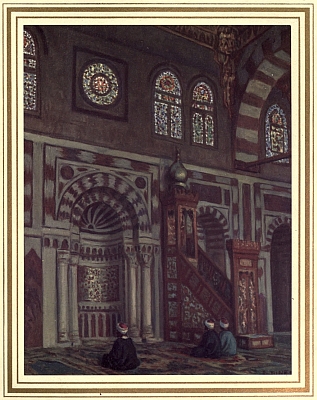
Interior of a Mosque. Al Mihrab: the niche marking the direction of Makkah.

And fight for the cause of Allah against those who fight against you.
CHAPTER THE FIFTH

THE HEGIRA, OR THE EMIGRATION OF THE PROPHET TO MADINAH
t the moment when the Mohammedans were emigrating to Yasrib, Abu Bakr begged the Prophet to let him join them, but was answered thus: 'It is needless to hurry. Maybe Allah may give thee the companion thou dost prefer to undertake the journey in thy company.'

Hoping that this companion would turn out to be the Prophet in person, Abu Bakr purchased two swift she-camels, which he stabled in the courtyard of his house, feeding them liberally, and keeping them in readiness to take to the road.
Ayishah has said: "The Prophet, who never let a day go by, without coming to see my father, morning or evening, arrived suddenly at an unwonted hour. Abu Bakr guessed that some serious matter brought his son-in-law to our dwelling, and made room for him on the bench. The Prophet sat down and told him: 'Allah authoriseth me to depart from Makkah with my "qawm." My turn hath come to emigrate.'—'With me, O Prophet! in company with me?' supplicated Abu Bakr, plying him with questions. 'Yea, in thy company.'—'At this answer, tears of joy such as I had never seen before, welled up in my father's eyes, and he apprised Mohammad of his preparations for travel.'"
The she-camels, in rare fettle, were handed over to Ibn-i-Arqas, an idolater, but in whom, nevertheless, Abu Bakr placed great confidence. Ibn-i-Arqas was to take them to graze, and three days later, lead them to a meeting-place appointed at the mouth of a cave in the Jabal Saur, about an hour and half's walk from Makkah, on the road leading to the sea. Ibn-i-Arqas would then serve as a guide as far as Yasrib.
By a small door at the back of the house, the two fugitives went off secretly, stepping softly, and making their way to the Saur cave. The Prophet's naked feet were soon bleeding, cut by the sharp, loose stones of the mountain paths. Abu Bakr, in despair at seeing the blood of God's Chosen One flowing, carried him on his back the rest of the way, and put him down in front of the entrance to the grot in which he entered first. He explored every hole and corner to make sure that it did not serve as a refuge for wild beasts or reptiles. He picked up all the stones, which he piled in his cloak, and threw them down the side of the mountain. Then, with torn fragments of his apparel, he stopped up any holes which might have been places of concealment for scorpions or other venomous insects. Then only did he admit Mohammad who fell asleep, his head resting on his companion's thigh.
But under the sand carpeting the cave, was hidden a viper which had thus escaped Abu Bakr's vigilant, searching glances. By an involuntary movement, the devoted disciple stamped on the reptile which, furious, turned with a hiss, and drove its dart into Abu Bakr's heel. The pain was atrocious, but, fearing to awaken the Prophet whose head was pillowed on his companion's thigh, Abu Bakr made not the slightest movement, nor did he let a cry escape his lips.
Shortly afterwards, the venom began its malignant course through his veins, and the intensity of the pain drew tears from his eyes. A few burning drops fell on Mohammad's cheek. Waking up with a start, the Prophet asked: 'What ails thee, O sincere friend?'—'I have been stung by a viper.'
The sacrifice of his being, made by Abu Bakr, had overwhelmed him with joy bringing warmth to his heart, and triumphed over the evil effects of the poison that had begun to freeze his limbs, so that directly the Prophet rubbed the poisonous wound with a little of his saliva, all pain and swelling disappeared.
The Quraish, disturbed and maddened by the flight of Mohammad and Abu Bakr, despatched two town-criers, one on each side of the city of Makkah, charging them to offer a reward of a hundred she-camels for anyone who should overtake the fugitives. The most cunning trackers set out in all directions.
Abu Jahal lost no time in rushing to Abu Bakr's dwelling, and knocked furiously at the door. Asma, Ayishah's sister, came out to him. 'Where is thy father?' he asked.—'By God! I know not,' she replied. He lifted his hand and slapped her face so brutally that he tore out one of her earrings. He then rejoined a group of young men who were following a clue that took them to the Jabal Saur.
Scarcely had His Apostle sought shelter in the grot, then Allah ordered a shrub, grown to about a man's height, and known as "Umm-ul-Ghilan," a little way off from the cave, to leave the spot where it flourished and block up the entrance. Then He sent a spider to spin its web between the branches of the shrub and the jagged edges of the cavern's mouth; and also a pair of wild pigeons that built a nest and laid eggs in the narrow entrance.
At that juncture, the trackers began to arrive from all parts, enticed by the bait of the reward; but they were brought to a standstill by the fragile barrier built by the most humble among insects: a web that the slightest breath of the breeze sufficed to destroy.
'There is nothing to be done in this cave,' declared one of the Unbelievers, Ummayyata ibn Khalaf, just as they were getting ready to enter. 'See this cobweb. It dates, without a doubt, from before the birth of the man we are pursuing. How could Mohammad have entered the cave without tearing these slender threads? And look at those pigeons' eggs. Would he not have broken them as well?'
All found these deductions well-grounded and gave up a search that seemed futile. Abu Jahal was the only one who guessed they were on the right track. 'Nevertheless, I feel that our enemy is not far off,' he said. 'He is looking at us now, but magic spells cloud our eyes!' They went away, never thinking about searching on the ground for the tell-tale traces of the fugitives' footsteps.
While this scene was being enacted, Abu Bakr trembled greatly; not for his own life, but for that of his companion, to whom he said: 'My death means nothing more than a man dying; but thine means all the lives of thy disciples!'
They remained in their hiding-place three days and three nights. Abdullah, son of Abu Bakr, passed the whole of the day among the Unbelievers of Makkah; and at night, brought all the news he could gather. Ibn-i-Fuhairah, one of Abu Bakr's shepherds, led his flock to graze among those of the Quraish. At night, he drove his sheep in front of the cave, thus bringing food to the fugitives: milk and the flesh of the lambs. The following day, he went away with his flock, leading it over Abdullah's tracks so as to efface them.
On the third day, the vigilance of the Quraish being somewhat relaxed, Ibn-i-Arqas kept his appointment punctually, bringing Abu Bakr's two she-camels, and a third belonging to him. Asma, too, had not been idle. She brought bags filled with provisions. All being in readiness, Abu Bakr made the best camel kneel down in front of the Prophet, whom he asked to mount on her back. 'I cannot ride a camel that doth not belong to me', replied Mohammad.—'By my father and mother, she's thine! I give her to thee.'—'I cannot accept the gift. Tell me what she cost thee. I'll buy her for the same price.'
The bargain concluded, the Prophet bestrode that she-camel. Abu Bakr rode the other, taking up behind him, Ibn-i-Fuhairah, his faithful serving-man. Ibn-i-Arqas, on his own camel, guided the little caravan on the western road to Yasrib which runs, now and again, along the seashore.
SURAQA'S MISHAP
Quoth Suraqa ibn Malik: "I was in a group of Makkans gossiping over recent events and the price set upon Mohammad's head, when a man of the nomadic tribes, coming from the Badya-land, told us the following story: 'On the road leading to the sea, I passed a small caravan comprising three she-camels. I seemed to recognise the riders. They were Mohammad and his companions.'
"I winked to him to be silent and said out loud, in an indifferent sort of tone: 'Thou art mistaken. The folks thou didst meet were Bedouins that I sent out to search for straying camels belonging to me.'
"I remained a little longer in the midst of the citizens, before returning to my dwelling, where I ordered my serving-maid to lead my horse to a secluded spot in the valley. I also ordered one of my slaves, a negro gifted with prodigious strength and indomitable courage, to drive one of my camels to the same place and there await my coming. I left my house by a back-door, bending down, trailing my spear low, on a level with the ground, so as to prevent the glistening of steel in the sunlight. I took all these precautions so as not to call the attention of those who, allured by the promised reward, might have followed and forced me to share with them, were I successful.
"Arrived at the place of meeting, I mounted my camel and, accompanied by my slave who ran behind, holding my horse by the bridle, I diligently followed the track of the fugitives. When I thought I was sufficiently near to them, I mounted my horse, and left my camel to the care of my slave, giving him orders to rejoin me as quickly as possible.
"My steed was fresh, not having been ridden for some days and he was renowned lor his speed. I put him at a gallop. But after a few strides, he stuck his toes in the ground and fell, his nostrils in the sand, snorting and trembling. I was thrown off. Impressed by this evil omen, I pulled some "azlams" (divining arrows) out of my quiver to consult the decrees of fate. The signs pointed to bad luck, but the reward excited my greed, so I stuck to my plan and continued in pursuit.
"Shortly afterwards I caught sight of the fugitives and, urging on my steed, I got so near that I could hear the voice of the Prophet reciting the Qur'an; but to my great astonishment, the noise of my galloping horse's hoofs did not cause him the least uneasiness. He did not even deign to turn his head. On the other hand, Abu Bakr kept on looking round, and seemed to be in a state of the liveliest anxiety.
"Just another effort and I was right up with them, when suddenly my horse's legs sank up to his knees into the earth, although it seemed very hard and firm in that spot. I was thrown over his head. I got up, exasperated, swearing at him and lashing him to make him get a foothold. But all in vain. His struggles and efforts only succeeded in making him sink more deeply down, as far as his belly, whilst a dust-cloud resembling a pillar of smoke, issued from the hole where he was swallowed up. I was overcome by sudden fear.
"Once more I tried my luck by the arrows. The forebodings of evil fortune were just as plainly shown. Feeling sure, therefore, that some great calamity was in store to punish me for my projects, I cried out: 'O Mohammad, I plead for mercy at thy hands! In exchange, I'll bring thee useful tidings and beguile all those who are following me; but pray to thy God that He set my horse free.'
"Mohammad threw up his hands, saying: 'O Allah! if Suraqa is sincere, deliver his steed.' The words were no sooner out of his mouth than the soil lessened its grip, and getting up on my horse whose legs were now at liberty, I rejoined the fugitives with whom I offered to share my arms, and provisions. They refused, not wishing to accept anything from an unbeliever and they commanded me to leave them in peace.
"From what I had witnessed, I became convinced that Mohammad would conquer in the end, and I persisted in demanding a safe-conduct proving that he granted me his pardon and that there no longer existed any cause for enmity between him and me. Obeying his orders, Abu Bakr made out, on a piece of leather, the document I claimed. It saved my life during the Taif expedition. I then turned back. Once more in Makkah, I told my black slave and all my fellow-citizens—who had guessed the motives governing my journey—that I had seen nothing, and I cursed the information that had led me to set out on such a useless and fatiguing expedition."
THE PROPHET'S ARRIVAL AT QUBA (June 28th A.D. 622)
Thanks to the inconceivable rapidity with which news travels in Arabian countries, the Mussulmen of Yasrib had already heard of the Prophet's departure and that he intended to rejoin them.
Quoth one among them: "Every day, after the morning prayer, we go to the Hira, a burning plain, covered with scattered black pebbles and which stretches out south-west of the town. There, our hands shading our eyes from the dazzling sun, we gaze as far as our sight permits, hoping to catch sight of Allah's Apostle. We turn not back in the direction of our dwellings until high noon, doubly defeated by the blaze of the perpendicular rays of the sun and their reverberation on white sand and calcined stones.
"One day, among all these days of overwhelming heat, we had just returned, when a Jew, noted for the extraordinary acuity of his sight, made out, from the top of one of the towers on the ramparts, a caravan consisting of a few men in white garb, mounted on camels. They seemed rising and falling, driven to and fro by the eddying mirage.
"Guessing that he saw the Prophet and his companions, the Jew turned round in the direction of the city. 'O Assembly of the Arabs!' he shouted in resouding accents, 'the good luck ye did expect hath come at last!'
"Awakened from our siesta, we rushed in the direction of the caravan. It was encamped at the foot of a solitary palm-tree, a few paces off the Quba oasis. With Abu Bakr, the Prophet was resting in the shade of this tree. As both appeared to be about the same age, and considering that the majority had never met Allah's Apostle, we hesitated, not knowing to whom of the couple we should pay homage.
"Just then, the palm's scanty shade having changed its direction, the sunlight fell on the face of one of the travellers. Thereupon, we noticed the other rise to his feet and stretch his mantle over the head of his companion, to protect him from the rays of the orb of day. Thus an end was put to our hesitation."
The Banu Amir ibn Auf to whom the hamlet of Quba belonged, now arrived, transported with joy, to invite to sojourn in their midst the illustrious guest sent to them by Allah. The Prophet lodged with Kulsum ibn Hidmi; Abu Bakr with Khubib ibn Saf, while the other Muhajirun took up their quarters with Sad ibn Khazimah, one of the Najibs.
THE ERA OF THE HEGIRA
This happy ending of Mohammad's journey took place on a Monday, at noon, the twelfth day of the month Rabi'u'l-Awwal. The year of this emigration, renowned under the name of "Hijrah" (called "Hegira" by the Europeans), has been adopted by Mussulmans for the beginning of their era. It corresponds to A.D. 622.
At first, such a choice creates surprise, and yet no other event in the Prophet's existence exercised more decisive influence over the world-wide success of his cause. Had he remained in Makkah, granting even his final triumph, Islam would have remained there with him. The Arabs of all Arabia, fearing the power with which Islam endowed the Quraish alone, would have formed a coalition to prevent it spreading out of the Sacred City. Whereas, after having begun, despite all malice, to plant the roots of his religion firmly in his native town, it was easy for the Prophet to return there when he had won over the rest of the Arabs to his cause.
This proves how impenetrable are the designs of Providence, and how frequently the misfortunes with which God afflicts us, burdening us with suffering, determine the cause of our successes. If the Prophet had not been persecuted and banished by his own people, he would never have been able to fulfil his universal mission, and the world would never have been enlightened by Islam.
The Prophet sojourned at Quba Tuesday, Wednesday and Thursday. All rejoined him there. His faithful henchman, after having restituted all the deposits confided to his care to their rightful owners, arrived at Quba, his feet badly lacerated, having tramped night and day. Mohammad embraced him warmly, bandaged his wounds with his blessed hands, and made him rest by his side in Kulsum's dwelling.
Mohammad also busied himself with laying the first brick of a Mosque—the first place of public prayer in Islam—and left to Ammar ibn Yasar the care of finishing it. This Mosque was called "At Taqwa," i.e. the Mosque of "The Fear of God." Reference is made to it in these verses: "There is indeed a Mosque founded from its first day upon the fear of God; More right is it that thou take thy stand therein; therein are men who aspire to keep themselves pure and Allah loveth those who purify themselves." (The Qur'an, ix, 109.)
ARRIVAL OF THE PROPHET AT YASRIB
Despite the persistence of the Banu Amir who wished him to remain in their hamlet, the Prophet departed on Friday, at daybreak, riding the she-camel he had bought of Abu Bakr, and which became celebrated under the name of "al-Qaswa," i.e. "She that hath split ears and nostrils." A great throng of horsemen and people on foot followed him, and his companions fought for the honour of holding his bridle.
The hour of prayer arrived when he was passing through the territory of the Banu Salim ibn Auf. He alighted and recited, for the first time, the Friday prayer, leading a numerous band of Believers in pious array behind him. At the termination of the prayer, he turned towards the Faithful to preach them a sermon. Then he once more bestrode his she-camel, and escorted by a crowd animated by the most ardent enthusiasm, made a triomphal entry into Yasrib.
On every terrace-roof, the "Zawat-ul-Khidar," those who are generally hidden inside houses—women and young girls—were grouped together, ressembling, in their bright-hued draperies, pretty birds of vividly-tinted plumage, perched on the edges of cliffs. With melodious voices, quavering by reason of emotion, they sang in chorus:
"The full moon hath risen above our heads—Emerging from the Sanniyat-ul-Wida (the Farewell Mountain Pass)!—Numerous are the thanksgivings we must offer up to Allah,—With the purest fervour of our supplications!—O thou, His Messenger among us,—The orders thou dost bring us shall be piously executed!"
In every district through which the Prophet passed, that of the Banu Baid, Banu Saida, Banu Haris, Banu Adyy, etc., a deputation of leading men caught his camel by the bridle and stopped it, to be able to say: 'Remain with us, O Prophet! Here wilt thou find riches, power and safety.' But he replied: 'Let my she-camel go, for she hath received orders from on High.' And smiling kindly, he added: 'The blessing of Allah be upon you!'
He let the reins hang loose on the neck of the animal he was riding, and she, stretching her long neck far above the escort of Believers, turned her head first to the right and then to the left, as if searching, with her great black eyes shaded by lengthy lashes, for the halting-place assigned to her by Providence. After a thousand windings and turnings, she stopped in the middle of a wide expanse of waste ground, and knelt down; but as the Prophet did not alight, she rose and took a few more strides, hesitatingly. Finally, and decisively, she went back to the spot where she had stopped at first, and knelt down again. She stretched the entire length of her neck on the ground and uttered low grunts.
So then Mohammad alighted, saying: 'Allah causeth me to set foot on the ground in a blessed spot. Here will be the finest place in which to dwell.' This piece of property was a "marbad," i.e. a barn-floor, where dates were laid out to dry. It was situated in the district of the Banu Nijar, not far from the house of Abu Ayyub Ansari who offered hospitality to the Prophet, and took his saddle and saddle-bags to his dwelling. Whilst the Apostle, momentarily freed from the veneration of the populace, was settling under that friendly roof, young people and slaves dispersed in all directions, singing: 'Mohammad hath come! The Prophet of Allah hath come to our town!'
Ever since that day, eternally memorable, the city of Yasrib was called, "Madinatu'n-Nabi," the City of the Prophet; and by abbreviation, "Al-Madinah." (Medinah).
HOW THE MOSQUE OF AL-MADINAH WAS BUILT
At Al-Madinah, Mohammad's first care was to erect a Mosque.
He sought for the owners of the ground where his she-camel had knelt, and they turned out to be two orphans, named Sahil and Sohail, whose guardian was Muaz ibn Afra. The Prophet asked them how much they wanted for their piece of property. 'Allah's reward is the only price we ask,' was their reply. Mohammad, however, refused the gift. The purchase-money, fixed at ten dinars, was advanced by Abu Bakr, who had transferred all his wealth from Makkah to Al-Madinah.
Acting under the Prophet's orders, the Believers lost no time in getting to work. They cleared up the "Marbad," where there were ruined walls, a palm-tree and a few neglected tombs. They levelled the ground and, as soon as the foundations were dug, Mohammad lifted a big stone to place in the cavity, and his noble breast became covered in dust. Seeing this, his companions tried to prevent him from doing manual labour; but he said to Abu Bakr: 'Say no more, but follow my example. Put a stone next to mine.' He then commanded Umar to place another at the side of the one set down by Abu Bakr; and each of the leading Moslems contributed in succession his stone to the structure.
When the stone foundations reached up to a third of the eventual height of the walls, the Believers began to knead clay with water, making unbaked bricks, with which they intended to finish the building. The Prophet, as before, continued to encourage his followers by his example, and he carried bricks in his mantle. Seeing one of the workers with a double load on his back, Mohammad wiped his disciple's hair and neck, soiled with clay, and said: 'The reward of the labourer awaits him in heaven, but thou wilt find a double reward.'
All the Believers toiled in high spirits, and to quicken their task by working in measure, the masons sang in chorus, and the verses of their chants related to their exalted hopes. When the walls were seven cubits high, the Faithful covered the building with a flat roof, made of palm-tree trunks, thatched with lathes and palm-leaves. On this, they spread a layer of beaten earth, thick enough to prevent rain filtering through. The ceiling was supported inside by columns of date-tree trunks, and the floor was sprinkled with gravel.
The building was one hundred cubits in length; its breadth being a little less. It could be entered by three doors; of which the principal was called "Bab-ur-Rahma," or "Door of Mercy." The "Mimbar," or pulpit, was fashioned out of a simple palm-tree trunk on which the Prophet mounted when he preached his sermons.
It can thus be seen that this first Mosque, identical with those of the poorest villages of the Sahara, was far from resembling the marvellous edifices which were to be constructed a little later for the Islamic religion.
At the same time as the Mosque was being finished, Mohammad had caused two little hovels to be built with clods of earth—"Hujrah"—leaning against the walls of the temple. The Prophet proposed to live there with his family and he sent Zayd, his adopted son, to Makkah to fetch them. When the houses were finished, he left the dwelling of Abu Ayyub and settled down with his people who lost no time in arriving.
As for the Muhajirun, they had all been generously and hospitably welcomed by the Ansars, proud and joyful to receive beneath their roof-trees those of the strangers who fell to them by lot.
Mohammad was especially moved by the cordial welcome extended to his fellow-countrymen by his new disciples. But, with his great insight concerning the souls of mortals, he resolved to tighten the bonds of such touching friendship. So that it should be proof against all insinuations dictated by the rivalry, inevitable in the future, between the Muhajirun who had forsaken their country, families and wealth to follow him; and the Ansars who had offered the safe shelter and material assistance to which his triumph was due. Would not each party have some little reason to claim for it alone first rank in the Prophet's affection and the annals of Islam?
In order to avoid such dangerous contingencies and create real family ties for the exiles, Mohammad profited by the cloudless exaltation uniting Muhajirun and Ansars just then, to issue a decree of perfect brotherhood between them. He ordained that they should pair off in couples consisting of a man of the Mohajirun and an Ansar. 'Fraternise in Allah!' he told them. 'Ye are brothers!' Henceforward, every Mussulman of Al-Madinah had for brother a Mussulman of Makkah.
It would be sheer madness to try and find words to express the degree of devotion attained by this brotherhood of religion, stronger than ties of blood, for it was supernatural. All these men's hearts, united in the love of Allah, were now nothing more than a single heart, palpitating in different breasts. Each man loved his brother better than himself, and during the first years of the Hegira, when one died, the other inherited his property, to the exclusion of his natural heirs.
Among the fraternal unions thus constituted, we may note those of Abu Bakr with Kharijah ibn Zayd; Ummar with Usman ibn Malik; Abu Ubaidah with Sad ibn Muaz; and Usman ibn Affan with Aus ibn Najar. The prophet had been the first to choose Ali for his brother, thus sealing the bond of fraternity that he had signed when beginning his mission. But as Ali belonged to the Muhajirun, the Ansars might have been vexed because the Apostle did not choose a brother in their ranks. That was why, at the death of one of their Najibs, Asad ibn Zararah, Mohammad took his place as Najib, pretexting that he was one of them, because his uncle on his mother's side had formerly dwelt in their city.
In this way, thanks to his sense of psychology and diplomatic skill, Mohammad achieved a wonderful result: the wars between the Kajraz and the Aus which, for centuries past, had deluged Yasrib with blood, ceased as by magic, soon after his arrival. He metamorphosed the inhabitants of Al-Madinah into the brothers of the Makkan emigrants, formerly their rivals.
THE QUIBLAH OF MAKKAH
In the beginning, the Prophet allowed the Believers full liberty to turn in any direction they pleased when saying their prayers, for: "The East and the West is Allah's; therefore, whichever way ye turn, there is the face of Allah. Truly Allah is Omnipresent, Omniscient." (The Qur'an, ii, 109).
While terminating the building of the first Mosque, the Prophet divined that prayerful impulsiveness diverted in one direction would be more thrilling, because of the feeling of union in the same ideals that was bound to result. By means of a cube of masonry, composed of stone and clay placed against the wall of the building looking south, he primitively established the Qiblah, or direction of prayer, towards the Temple of Jerusalem.
But he was ordered by a verse to change the direction towards Makkah: "We have formerly seen thee turning thy face towards every part of the Heaven; but We will assuredly have thee turn to a Qiblah which shall please thee. Turn then thy face towards the Sacred Mosque, and wherever ye be, turn your faces in that direction." (The Qur'an, ii, 139).
And ever since that day, the Qiblah remains definitively fixed for all the Mussulmans of the world, in the direction of the Temple of Makkah.
INSTITUTION OF THE AZAN, OR CALL OF THE MU'AZZIN
Prayer in common is incontestably the most profitable; the fervour of each Believer communicating with the soul of his neighbour. "It is worth twenty-seven times more than isolated prayer," says the Prophet. It was therefore necessary to summon all Believers together every day, at the same hours fixed for the five prayers.
How was the exact time of meeting to be determined? Scattered over the different districts of the city, some came too early; others too late. A consultation of the leading Moslems took place. Some were for the use of a beacon, to be lit on a commanding eminence; others suggested the blowing of a horn; and the rest proposed bell-ringing. But all these methods were rejected, because they were borrowed, from Persians, Jews or Christians.
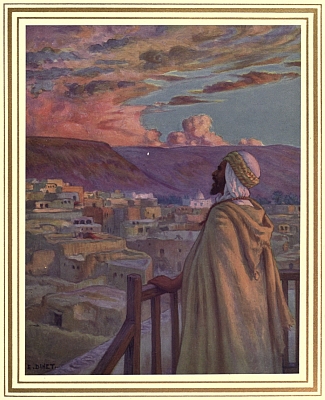
The Mu'azzin's Call.
Meanwhile, Abdullah ibn Zayd arrived, and he told of a dream he had had the night before. A man attired all in green passed close to me, carrying a hand-bell. I stopped him and begged him to sell me his bell. 'What dost thou want it for?'—'To summon Believers to prayer.'—'A much better way,' he replied, 'would be to proclaim the profession of faith of Islam with all the strength of thy lungs.'
The Prophet, alive to the fact that the resonance of the human voice is more capable of communicating emotion than the most perfect metal instrument of music, declared at once: 'In thy dream was truth. Go and find Bilal. His voice is powerful and harmonious. I charge thee to order him to mount to the roof of the Mosque and summon the Believers to prayers.' So Bilal, the freed negro, told to call all the Believers together, of all ranks and races, uttered from the terrace of the Mosque the cry of the Islamic soul: "Allah is great! There is no God but Allah, and Mohammad is the Prophet of Allah! Come to prayer! Come to Salvation!"
Like exquisite perfume wafted from a priceless flask, these words in the melodious voice of Bilal and issuing from his strong lungs, resounded through the city. Echoing in all dwellings, they caused every citizen to inhale with delight the refreshing scent of prayer.
Ever since, in every Mosque all the world over, it is the duty of a crier, called a "muazzin," to give this summons to prayer five times daily which he does from the top of a slender minaret erected for that purpose.
THE FAST OF RAMADHAN
After having decided that the human voice should be used for the call to prayer, Mohammad, when first he dwelt in Al-Madinah, continued to set forth the formal obligations of the Islamic religion.
He was in the habit of fasting three days every month when he received this Revelation: "As to the month Ramadhan, in which the Qur'an was sent down to be man's guidance ... as soon as anyone of you observeth the moon, let him set about the fast..... You are allowed on the night of the fast to approach your wives: they are your garment and ye are their garment ... Eat and drink until ye can discern a white thread from a black thread by the daybreak: afterwards fast strictly till night, and go not in unto them, but pass the time in the Mosques." (The Qur'an, ii, 181, 183).
By these verses was the fast of the month of Ramadhan established, and numerous were the advantages accruing therefrom: man, full of self-love, runs after everything bringing material gratification, and flees from all that falls to the lot of the poor and the weak. To rid him of this fatal propensity, nothing is more salutary than the pangs of hunger and thirst. The Faithful, their bodies no longer burdened by their aliments, foregathered all day long, and the nourishment that prayer provided for their souls, was more impatiently expected than the nourishment of their stomachs.
In the torrid climate of Al-Madinah, nevertheless, their thirst, unquenched during never-ending summer days, became real torture. With dry throats, gasping, many among them were on the point of breaking down when they looked upon the limpid water of the "saqiya" and heard its tempting trickling. The example of their brethren, more resigned, soon made them pluck up fresh courage. The bonds of religious fraternity were tightened still more by this ordeal, and, having assisted each other to vanquish such terrible adversaries as hunger and thirst, Believers were ready to stand firm against the fiercest enemies among mortals.
During thirty days, without murmuring and with ever-increasing exaltation, the Ansars and the Mohadjirun went through the first fast of Ramadhan. At last the crescent of the new month was about to appear; every terrace-roof and all the hills were crowded with the Faithful, all trying to get the first glimpse. The sun's golden disc was scarcely submerged in the blue waves of the desert's horizon when every eye scrutinised anxiously the depths of the sky of emerald-like limpidity. Suddenly, in the lower part of the shaded canopy of heaven, the thin silver bow appeared. A long-drawn sigh escaped from every breast, as if each had been pierced by invisible arrows, shot from this bow.
But the Faithful had heaved no sigh of deliverance. On the contrary, the sigh was caused by regret at having so soon concluded the fasting ordeal, in easy payment of the debt of gratitude owing to the Benefactor. During this pious trial, each soul was fortified and each body strengthened. In order to pass through the frightful deserts that encircled them, before going forth to conquer the world, the Believers were training themselves to get accustomed, as if it were a mere pastime, to endure the tortures of hunger and thirst that they were bound to undergo, later on, in the depths of these very wildernesses.
When, after such self-imposed deprivation, they were able to appreciate the real value of the benefit of food, the Prophet imposed upon them the "Sadaqat-ul-Fitr," the Alms of the Breaking of the Fast, forcing the Faithful rich to give a share of their victuals to the Faithful poor.
PROPERTY BESTOWED IN ALMS, AND THE PROHIBITION OF FERMENTED LIQUOURS
Mohammad judged that the obligation of feeding the poor once a year, the day after the fast, was insufficient. He completed his ruling by instituting the "Zakat-ul-Mal," the bestowal of property in alms, intended to safeguard the existence of pauper Mussulmans without overburdening rich folks.
This kind of almsgiving, being one of the five foundations of pratical religion, is due upon all property and revenue whatsoever: gold, silver, flocks, fruits, grain; and varies from a third to a tenth of such resources. It should be bestowed with the greatest tact and humility:
"O ye who believe! make not your alms void by reproach and injury, like him who spendeth his substance to be seen of men. The likeness of such an one is that of a rock with a thin soil upon it, on which a heavy rain falleth, but leaveth it hard * And the likeness of those who expend their substance from a desire to please Allah, and through their own steadfastness, is as a garden on a hill, on which the heavy rain falleth, and yieldeth its fruits twofold; and even if a heavy rain fall not on it, yet there is a dew ... * If ye give your alms openly, it is well; and if ye conceal them and give them to the poor, this too will be of advantage to you ... * Those who know them not, think them rich because of their modesty. By this their token thou shall know them—they ask not of men with importunity: and whatever good thing ye expend in alms, Allah verily taketh knowledge of it. * Ye shall by no means attain to goodness till ye expend that which ye love as alms. * But alms are only to be given to the poor and the needy, and those who collect them, and to those whose hearts are won to Islam, and for ransoming, and for debtors, and for the cause of Allah, and the wayfarer. This is an ordinance from Allah." (The Qur'an, ii, 266, 267, 275. iii, 86. ix, 60.) By the foregoing verses, was instituted the impost of the "Zakat-ul-Mal;" literally: "The Purification," because it serves, as it were, to "purify" wealth and excuse it.
The Prophet foresaw the universal ravages of alcoholism, as deadly in its effects as the worship of idols, and he forbade the use of fermented liquors. He had first received this Revelation: "They will ask thee concerning vinous liquors ... Say: In them is great sin, and advantage also, to men; but their sin is greater than their advantage." (The Qur'an, ii, 216.)
Many among the Faithful gave up these beverages, whilst others could not bring it over their hearts to do so. A second Revelation brought this caution: "Come not to prayer when drunken, bid wait till ye can understand what ye utter." (The Qur'an, iv, 46.)
Ali caused this announcement. Having drunk to excess just at the hour of prayer, he recited: 'O ye Unbelievers ... we worship what ye worship. Ye have no religion and I have no religion,' instead of saying: "O ye Unbelievers * I worship not what ye worship! * To you your religion; and to me my religion." (The Qur'an, cix, 1, 2, 6.)
Formal prohibition was finally decreed in these imperative verses: "O Believers! Wine and games of chance, and statues and the divining arrows, are only an abomination of Satan's work! Avoid them, that ye may prosper. * Only would Satan sow hatred and strife among you, by wine and games of chance, and turn you aside from the remembrance of Allah, and from prayer: will ye not, therefore, desist from them? Obey Allah and obey the Apostle!" (The Qur'an, v, 92, 93.)
AYISHAH IN THE HOUSE OF THE PROPHET
Ayishah, so kind, witty, and learned, was only the Prophet's wife in name. About this time, she became a member of his household.
Quoth Ayishah: "One day, surrounded by my companions, I was playing on a swing. Umm-i-Rumman, my mother, called me.
"I ran to her without knowing what she wanted of me. She took my hand, and made me stop on the threshold until I had got my breath. She then washed my face and forehead and led me into the house. Many women of the Ansars were there and they said to me: 'Happiness do we wish thee, and blessings, and the best of luck!'
"My mother left me to the care of these women. They decked me out and had scarcely finished when Allah's Apostle suddenly came in...."
HOSTILITY OF THE JEWS AND THE MUNAFIQIN
In the beginning, a certain number of Jews—and among them, the learned Mukhariq and Abdullah ibn Salam, were so moved by the advances and arguments of the Prophet that they came and were converted by him.
As for the others, their vanity was greatly flattered by the fact that the Temple of Solomon, their ancestor, had been chosen for the Qiblah, or direction in which Moslems were to pray. Their pride, therefore, led them to conclude that their Temple was immensely superior to that of Makkah, and consequently that the Jewish race dominated the Arabs.
When, following the orders of Allah, the Qiblah was changed from Jerusalem to the Ka'bah, they were deeply mortified. Besides, they soon found out how prejudicial to their interests was the coming of Mohammad to Al-Madinah. Thanks to his efforts, fraternity reigned among the Arab factions, whose feuds had hitherto been a source of profit. The Prophet, whose advent was foreshadowed in their books and on whom they founded great hopes, was born at last. They saw him in their midst, but he did not belong to their race; he sprung from that of Ishmael. Mohammad brought with him the pure light of Islam which they sought to extinguish by every means in their power.
Not venturing to rely on their own strength, they sought to embroil the Arab townsmen and met with valuable assistance granted by a few noblemen, whose prejudices were wounded by the principles of equality of the Qur'an. They felt belittled at merely becoming the brothers of those they scorned as being beneath them.
These fresh adversaries, who were called "Munafiqin," or Hypocrites, were particularly dangerous, for they mingled in the ranks of sincere Mussulmans and, to all appearances, professed the same doctrines. In this way, they wormed out secrets and sold them to Jews and idolaters.
AL-JAHAD (THE HOLY WAR), AND HOW IT WAS INSTITUTED
The Prophet began to feel the urgency of taking up arms for the triumph of the faith, which could not be definitive until after the conquest of Makkah where stood the Holy Temple of the Arabs. He had received the Revelation of the warlike undertaking with orders to unsheath the sword in his struggle against idolaters: "And fight for the cause of Allah against those who fight against you: but commit not the injustice of attacking them first: verily Allah loveth not the unjust: * And kill them wherever ye shall find them, and eject them from whatever place they have ejected you..." (The Qur'an, ii, 186, 187.)
Such were the ordinances of "Al-Jahad," "the Holy War" so violently criticised by Christians.
But did not Jesus—their Lord and ours—Himself declare: "Think not that I am come to send peace on earth: I come not to send peace, but a sword." (St. Matthew, x, 34.) "I am come to send fire on the earth; and what will I, if it be already kindled?" (St. Luke, xii, 49.)
If the institution of the "Jahad," destined for the triumph of truth over idolatry, stirred up strife among the families of Mohammad's fellow-countrymen for a few years, did not the words of Jesus, still more imperative in this connection, lead to much more terrible consequences; lasting too, for centuries among all Christian nations?
"For I am come to set a man at variance against his father, and the daughter against her mother, and the daughter-in-law against her mother-in-law." (St. Matthew, x, 35.) "If any man come to me, and hate not his father, and mother, and wife, and children, and brethren, and sisters, yea, and his own life also, he cannot be my disciple." (St. Luke, xiv, 26.)
The "Jahad" was not instituted to attack the adversaries of religion only; it was also proclaimed against those enemies, no less perfidious, that lurk in every man's own heart. Quoth the Prophet: "The most meritorious Holy war is that which one declares against one's own "passions.""
Mohammad and the Believers had been patient quite long enough. Banished from the land of their birth after having endured pitiless persecution, did they not have the right, relying on the Revealed Verses, to resort to the force of arms? The site of Al-Madinah ensured victory, for that city overlooked all the caravan routes to Syria, of which the commerce formed the sole resource of Makkah, surrounded by barren wastes. By stopping these caravans, the Prophet could starve out the ungrateful town and force its citizens to beg for mercy. In this way, the Apostle would not be compelled to kill too many of his fellow-countrymen, whom he still loved despite their iniquity. He wanted to spare them, hoping to win them over and induce them to become steadfast supporters of religion.
Thus began the long series of campaigns called "Ghazwah" when the Prophet was personally in command; and "Saria," when one of his lieutenants led the van. We shall only mention the most characteristic of these innumerable expeditions; putting on one side the first minor skirmishes and come at once to the famous Ghazwah of Badr.
THE GHAZWAH OF BADR (Year of the Hegira, A.D. 624)
A caravan of exceptional importance, comprising a thousand camels, had been sent into Syria by the citizens of Makkah. It was to bring back the most valuable and highly-prized merchandise. This was the opportunity awaited by the Prophet. If he succeeded in capturing the caravan, he would deal a ruinous blow at those who banished him and, as he hoped, without useless bloodshed, for the escort of the convoy numbered at most two score. These men could oppose no real resistance and would be obliged to surrender without fighting.
The Prophet arrived too late. The caravan had gone past. He made up his mind to fall upon it by surprise during its return journey. One of his partisans, posted by him to watch the roads, brought the news that the caravan had been seen, and would soon be near Al-Madinah, following the usual route, between the mountains and the sea.
Thereupon, the Prophet summoned all the Believers, of any origin whatsoever. The call was answered by more than three hundred men, all desirous of inflicting exemplary punishment on the idolaters. Seventy-three Mohadjirun joined the ranks and, for the first time, two hundred and forty Ansars stood shoulder to shoulder with their brothers in Islam. Seventy camels were gathered together to carry water and food; and also to relieve men on foot who took it in turns to ride.
The expedition was poor in cavalry, possessing only four horses whose names were Beraja, Al-Bahrmi, Yasum and Sail. They were led riderless by the bridle, only to be used at some propitious moment during the battle. The "Liwa," or white banner, was confided to Musab-al-Abdri, and the flag of the Ansars was carried by Sad ibn Muaz.
Unfortunately, the organisation of such a numerous "qawm" could not be kept secret. The "Hypocrites" and the Banu Israil, watching every step taken by Mohammad, found out what he was preparing and also his destination. They send messengers to Abu Sufyan, the leader of the caravan, to inform him of the threatening danger. He sent an Arab of the Ghifar tribe, named Dhamdham, to beg for assistance and promised him a rich reward if, thanks to his diligence, the convoy could be saved.
All the inhabitants of Makkah had contributed, more or less, to the organisation of the great caravan; and, counting upon its approaching return, they were already revelling in the fine profits that would accrue to them. All day long, in groups, they wended their way to the city gates, gazing, till their eyes ached, into the depths of the valley following the road to Syria, hoping to catch sight of a messenger.
At last there came a day when a man, swaying to and fro, by reason of the swift amble of his racing camel, appeared at the end of the ravine, advancing towards them. When he was near enough to enable his aspect and that of the animal to be made out, the stupefaction of the Makkans was inconceivable. To show his despair, the man, who was no other than Dhamdham, had rent his garments, turned his saddle round, slit the nostrils and cut the ears of his camel. As soon as he was near enough to make himself heard, weak from fatigue, gasping for breath, he cried out: 'Woe unto you, O men of the Quraish! Your caravan—your caravan!...'
In great anxiety, the Quraish gathered round him, besieging him with questions; and when he could breathe freely, he described the perilous plight of their caravan. Their fury broke loose. Just when they were on the point of fulfilling their most dazzling hopes, this man Mohammad, of whom they thought they had rid themselves for ever, threatened them with ruin!
An urgent council, called together hastily, decided that there was not a moment to lose. To prevent such a catastrophe, every one, rich or poor, was ready to sacrifice riches and life. An army was immediately raised, composed of nine hundred and fifty men, having at their disposal one hundred horses and seven hundred camels. The idolatrous troops marched out of the town amidst frenzied cheers; groups of young singing-girls, each as dazzling as the sun; their faces radiant; their eyes sparkling; their garb of the brightest hues, glittering with gold and precious stones, headed the warriors. These girls shouted bitter mockery against the Mussulmans; or recited epic poems, accompanying their rhymes with the thumping of tabors, causing the hearts of their lovers to palpitate with burning ardour.
What spurred them on even better were the suggestions of Iblis (Satan) who, lurking in the recesses of their souls, filled the Unbelievers with dreams of victory and vengeance, although ready to desert his victims shamelessly in case Allah should exert His Might in favour of their adversaries.
"The Evil One had already bewitched them by exaggerated praise of their actions; and furthermore had said: 'No man shall conquer you this day; and verily I will be near to help you.'" (The Qur'an, viii, 50)
The Prophet had no idea of his enemies' preparations. After having laid in a stock of water at Al-Rouha, he halted near the village of Safra; pitched his tents in the valley of Zufran, and sent out two scouts, Bisbas and Adi, to seek for information.
At early morn, the following day, he took to the road again, halting a few miles away from the wells of Badr. The two scouts, guessing that the caravan was heading towards this important spot for replenishing water supplies, reached there by having urged on their camels unmercifully. On arriving, they met two Bedouin women who were quarrelling loudly, while they filled their goat-skins. With insulting remarks, one claimed the repayment of a loan, and the woman in debt replied: 'Have patience until to-morrow or the day after, for by then the great caravan will have come back and thereby I shall have earned enough to settle with thee.'—'She is right,' broke in An Najd, chief of the Juhinna tribe, who happened to be at the well. 'They tell me that the caravan will certainly be here to-morrow or the next day.'
Having got to know all they wanted, Bisbas and Adi watered their animals and rode back in all haste to bring the news to the Prophet, well pleased to see that things had turned out exactly as he foresaw.
A few minutes later, however, he was rejoined by one of his partisans in his pay at Makkah. This friend brought bad news: the expedition of the idol-worshippers was coming by forced marches to the succour of Abu Sufyan. These tidings caused Mohammad the greatest anxiety: the ardour of the Mussulmans, who had set out to attack a caravan defended by a weak escort, might perhaps be damped upon finding themselves faced by superior forces? He did not intend to hide the gravity of the situation, but calling the head-men together, he laid the information before them, and asked where they thought it would be best to make their effort.
They were submerged by a great wave of vacillation. It must be confessed that the irresistible bait of booty added great charm to a wish to inflict punishment on the idolaters. Under the necessity of coming to a decision, some of them objected: 'Dost thou lead us to be slaughtered?' They were severely blamed for speaking thus. "And remember when Allah promised you that one of the two troops should fall to you, and ye desired that they who had no arms should fall to you." (The Qur'an, viii, 7.)
Then uprose Mikdad, protesting stoutly: 'O Prophet! go without hesitation whither thou art ordered. By Allah! we'll not tell thee as the Banu Israil told Moses: "Go fight by the side of the Lord and we'll await thy return here!" On the contrary, we say to thee: "Go fight by the side of thy Lord and thou wilt find us with thee, always and everywhere."'
The Prophet called down divine blessings on the head of his courageous disciple; and then added: 'Reflect, O my partisans!' He then turned towards the Ansars who might not have considered themselves bound by the oath of the Aqbah to do anything else than to protect him so long as he dwelt in their town.
But Sad ibn Muaz rose to his feet, pained to have to think that the devotion of the Ansars could be doubted, if only for a moment. 'Our confidence in thee is unlimited. We have given thee our word,' he exclaimed. 'Go where thou art ordered and I swear by Him who sendeth thee to bring about the triumph of truth, that shouldst thou ask us to jump in the sea, we would leap with thee!'
This declaration freed the Prophet from the anxiety that weighed him down, and which had prevented him from having recourse to the Ansars in preceding expeditions. His features were radiant with inspired, grateful emotion; and fixing his eyes on a vision that he alone was privileged to see: 'Rejoice, O men of my "qawm!"' he cried. 'I look upon warriors fighting, and the enemy's troops are routed!' There was not a man but what understood that soon the battle would rage and all made preparations with admirable confidence.
As for Abu Sufyan, ever since he had been warned that the Mussulmans were on the march, he was constantly on the look-out. He accelerated the speed of the caravan and, going on in front himself, arrived at Badr soon after the Prophet's scouts. He questioned An Najd who had not yet left the well. 'Hath no prowler been seen about here?'—'I only saw two camels, each ridden by a man; and they watered their animals.'
Abu Sufyan hastened to the spot where the traces could still be seen, showing where the camels had knelt whilst their masters drew water from the well. He found fresh droppings, and, crumbling some in his fingers, picked out many date-kernels. 'By our gods! these camels hail from Al-Madinah, and the enemy is not far off!' he thought, knowing that in all the country round, only the camels of Al-Madinah were fed on soaked kernels of dates.
Therefore, changing the direction of the caravan at once so as to leave the Badr well on one side, he turned off the direct road and took a westerly route along the sea-shore. He was thus able to escape from the soldiers of Islam; and when he was safe, sent another messenger to the Quraish, to inform them of what he had done, advising them to return to Makkah, as he no longer desired their aid.
'Nothing of the kind!' exclaimed their chief, Abu Jahal, carried away by hatred. 'Let us push on to the well of Badr. We'll camp there three days and three nights, passing the time in joyous revels, slaughtering cattle, enjoying the meat, and drinking our fill of wine. Every year a fair is held there, lasting a week, attracting Arabs from far and near. When they hear of our expedition to that spot, the echo of the news will have a great effect, inspiring all with salutary fear of our power!'
Puffed up with pride by reason of this speech, so flattering to their vanity, and allured by the festivals and liquors in store for them, the idolaters approved their chieftain's plan and continued on the march to Badr.
The Believers bent their steps towards the same goal, not knowing whether they would meet the caravan, the Quraish army, or both united. In order to find out, Mohammad sent Ali and Zubayr as scouts. They caught two young men seeking for a well from which to fill their empty goat-skins, strapped to their shoulders. They were made prisoners and taken to the camp to be interrogated, but as the Prophet was at his devotions, the scouts questioned the lads. 'We were looking for water for the Quraish army,' the two captives confessed.
The Quraish forces, therefore, were already in these parts? This seemed most unlikely, for the scouts did not know the strength of the enemy in camels and horses, and considered the prisoners' avowal to be a falsehood. So they fell to brutally beating the young idolaters. 'Think not that ye can hoodwink us with your lies,' said Ali and Zubayr. 'We know perfectly well that ye belong to the caravan of Abu Sufyan.'
Again they rained blows on the boys. To escape such unjust chastisement, and also to keep the Mussulmans in this state of error so profitable to Abu Jahal's plans, because it prevented Mohammad's men from suspecting how close their enemies were to them, the prisoners began to supplicate their tormentors. 'Mercy, my lords! Verily nothing escapeth your sharp sight! Yea, we confess it—we belong to Abu Sufyan's caravan.'
Proud of their perspicacity and content with having obtained this avowal, Ali and Zubayr set them free. Meanwhile the Prophet had finished praying, and as he knew how to read men's minds, he upbraided his disciples. 'What is all this? When your prisoners tell you the truth, ye beat them, and now they lie and ye set them free?' He continued the examination. 'Where are the Quraish?'—'On the other side of that high hill of sand.'—'How many are they?'—'We know not.'—'How many camels do they slaughter daily?'—'Nine or ten.'—'Oho? they number from nine hundred to a thousand,' said Mohammad to himself. 'Who is at their head?' The prisoners quoted the names of the most noted men of the city, and the Prophet, shaking his head sadly, turned to his companions, saying: 'Of a truth, Makkah sends against us the best part of its liver!' (Meaning its best beloved children.)
Nevertheless, the die was cast. The Mussulmans, who had set out to fall on a caravan protected by a puny escort, found themselves facing a force at least three times greater than theirs, and assisted by formidable cavalry. At all costs, the well of Badr must be reached before the enemy. The Believers began their march again and attained the borders of the Wadi Superior which they found quite dry. Their supply of water was exhausted, and next day they suffered terribly from thirst. Satan tried to exploit these pangs by filling their brains with most depressing thoughts. 'See where you are led by the man who pretendeth to be the messenger of the Almighty! Ye are surrounded by countless enemies, only waiting till your strength be broken by the agonies of thirst. They will then attack you and ye will be defenceless and an easy quarry.'
Every brain was bewildered. Luckily, their training during the fast of Ramadhan had accustomed the Believers to endure the torments of thirst and prevented them from breaking down. At the very moment when the heat, concentrated in the lofty heights of the Wadi, was on the point of making their position untenable, great clouds crowned the high peaks. The sombre veils darkening the sun were torn aside, and Allah let loose beneficial showers to drench His faithful servants. The Wadi, only just before filled with stones and sand, was transformed into a raging torrent.
The Believers were able to quench their thirst, and they dug holes all along the Wadi that was at once filled by the swelling of the waters. They washed their clothing, heavy with sweat, and performed their ablutions. Last, but not least, the shifting sands that rendered their advance so difficult, grew solid by the damp, and made the ground firm beneath their feet. "He sent down upon you water from Heaven that He might thereby cleanse you, and cause the pollution of Satan to pass from you, and that He might gird up your hearts, and stablish your feet by it." (The Qur'an, viii, 11.)
For the idolaters, the storm was most disastrous. It overtook them in soil known as "Sabkha," signifying low-lying clay mixed with salt, churned by wet into greasy, sticky mud. Their camels slipped up and fell, their long legs comically gliding backwards, powerless to rise without the help of their drivers. Horses floundered, their hoofs sinking in the mire and, unable to find foothold, dropped back on their riders. The confusion and tumult cannot be described, and the efforts of the Unbelievers, to extricate themselves, hampered their advance and exhausted them by fatigue.
The Believers, being cleansed, purified and refreshed, passed the night in invigorating sleep. They did not even take the trouble to post sentinels, relying blindly on the words of the Prophet who assured them that the angels would guard the camp. He alone remained wakeful, absorbed in prayer. "Recollect when sleep, a sign of security from him, fell upon you." (The Qur'an, viii, 11.)
The hour arrived when the fate of Islam was to be decided. It was on a Friday, the seventeenth day of the month of Ramadhan.
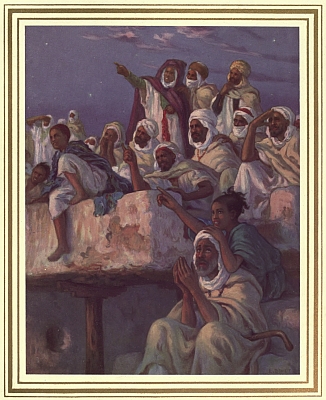
Believers perceiving the New Moon of the Month of Ramadhan.
Hubbab-ul-Ansari, renowned for his sage counsels, craved permission to be heard, 'O Prophet!' said he; hath the spot where we are now encamped been pointed out by a Revelation, and therefore we are forbidden to go forward or retreat? Or are we free to discuss the choice of ground befitting warlike strategy?'—'No Revelation hath imposed this place upon me. Speak freely and explain any stratagem that thou dost judge the most advantageous.'—'In that case, strike the tents,' Hubbab rejoined, 'and with our troops, go down the channel of the Wadi and fill up every well we pass until arriving at the last. There thou must dig a reservoir that will fill itself with all the water running under the sand, whilst the wells higher up, which we shall have choked, will have run completely dry. I know the strength and direction of the stream. Thanks to this reservoir, our warriors, during the battle, will be able to refresh their burning throats or relieve their sufferings if wounded, but our adversaries will not find anywhere in the surrounding country a single drop of water wherewith to slake their thirst.'
This piece of advice seemed reasonable to the Prophet, who carried out Hubbab's idea to the letter, and so fixed the future battlefield, for the Unbelievers would be forced to come and try to wrest from him the only spot where water was to be found.
Then Sad ibn Muaz spoke: 'O Prophet! allow us to build for thee an "arish" (shelter from the sun's rays) on this hill, from which thou wilt be able to watch every move in the fighting. Near thee, thy she-camel shall be hobbled, and we will gallop into the enemy's midst. Should Allah grant us victory, thine eyes will be gladdened by the sight of our valour in defending the faith. Should fate be against us, thou wilt have naught else to do than to climb into the saddle and rejoin our rearguards, as devoted to thee as we are, and who will cover thy retreat.' The Prophet accepted, adding: 'Allah will reward you all by rendering assistance more efficacious than anything ye can imagine.'
The Believers cut down twigs of "araq" which they wattled, and so set up a shelter thatched with sheaves of "surfah". Mohammad retired therein in company with Abu Bakr, and when the advanced groups of enemy horsemen made their appearance, wheeling about defiantly before his eyes: 'O Allah!' he exclaimed, 'so there are the Quraish at last; urged on by monstrous pride to brave Thee and call Thy Messenger a liar!'
The enemy was assembled. After their efforts of the preceding day to extricate themselves from the briny mud of the "Sabkah," they had awakened with their throats afire; the storm, over too soon, not having filled any of the "ghadirs" and the wells of the Wadi having been choked up, the idolaters had not been able to find the least drop of water to allay the thirst that began to torture them. It was not to be wondered at, therefore, that the sight of the sheet of water sparkling in the reservoir dug by the Believers and which reflected the sun's rays, blinding their eyes, should increase the fury of their revengeful feelings.
Some of the horsemen, reckoning on the speed of their steeds, dashed recklessly forward, hoping to reach the tempting liquid. The Prophet ordered his archers to let the mounted men get quite near, and when they were well within range, to riddle them with showers of arrows. All rolled on the ground, mortally wounded, with the exception of one rider, called Hakim.
Al Asad al Makhzumi, another idolater, instead of being discouraged by the result of this first attempt, felt his blood boiling in his veins and shouted loudly enough to be heard by both parties: 'By our gods! by Lat and Uzza! I swear to slake my thirst in the cistern of Mohammad's "qawm." Then I'll demolish it and only death can stop me!'
He dashed forward, brimming over with arrogance. Hamzah went to meet him and, with a blow from his scimitar, sliced off one of his legs and sent it flying. Al Asad fell backwards, turned himself over, and hopping with surprising agility on both hands and his sound leg, tried to make his way to the reservoir and keep his oath. But Hamzah was there to meet him and finished him off just as he reached the goal.
Three champions came forward from among the ranks of the Unbelievers to challenge the Believers to single combat, and they were Utbah with his son, Al Walid, and his brother, Shaibah. Hamzah, Ali, and Obaidah were chosen by the Prophet to oppose them. Stalwart Hamzah and impetuous Ali soon rid themselves of their adversaries, stretching them bleeding and lifeless on the sand, but Obaidah and Utbah had no sooner crossed swords than they both wounded each other grievously.
Obaidah, one leg so deeply gashed that the marrow dripped from the bone, was on his back, at his enemy's mercy, when Ali and Hamzah came to the rescue and freed him by killing Utbah. They then lifted up their wounded comrade and carried him to the Prophet, who supported his head lovingly on his knee, consoling him by the glad tidings of the reward awaiting him in Paradise. Obaidah soon breathed his last sigh and was thus the first martyr struck down in the Holy War.
After these single combats causing the hearts of all the lookers-on to palpitate with warlike ardour, the shock of the forces could no longer be postponed. The Prophet had drawn up his warriors in line, shoulder to shoulder, in serried ranks, like stone blocks cemented to form a wall, and it was all he could do to restrain the impatience of many who, outstripping their brothers-in-arms, would have run to face certain and useless slaughter.
Such an one, Sad ibn Quzai, was far in advance of the post assigned to him. So as to make him take his proper place, Mohammad struck him on the breast with the shaft of an arrow he held in his hand. 'Thou didst hurt me, O prophet!' cried Sad. 'As a messenger from Allah, sent to bring about the triumph of Right and Justice, thou dost owe me reparation on thine own body.'—'Satisfy thyself!'—'Thou art clothed, whereas my flesh was naked.' The Prophet laid bare his breast, saying: 'Give me as good as I gave, O Sad!'
Profiting by the permission, Sad threw himself on Mohammad, took him in his arms and pressed his lips to his body. 'Why do thou this thing?' asked the Prophet.—'O Messenger of Allah! death faceth me and I desired that for my last farewell, my flesh should touch thy flesh!'
Moved by such fierce devotion, Mohammad called down the blessing of the Most High on Sad. Then, having ordered his men to wait without flinching for the enemy's attack, he went back with Abu Bakr to the arish, of which the entrance was guarded by Sad ibn Muaz, sword in hand. The Prophet prayed: 'O Allah, remember Thy promise! If this day, Thou dost let the army of the soldiers of the faith be exterminated, no one will be left on earth to adore Thee!'
Uneasy at the great disparity of numbers, Mohammad renewed his supplicating prostrations. His mantle slipped from his shoulders. Abu Bakr picked it up and threw it over him again, saying: 'Rest easy, O Prophet! Allah will surely do what He promised!'
Overwrought by excess of fatigue and anxiety, the Prophet lost his senses, and his eyes closed for a second, only to reopen almost immediately. A smile lit up his features. 'Good news, O Abu Bakr!' he cried. 'The angel Jibra'il flieth to our assistance. I see the sand rising in a whirlwind under his horse's hoofs!
Leaving the "arish" abruptly, he called out to his army: 'Our enemies are routed! Already I see their backs turned in wild flight! I swear by Him who holdeth Mohammad's soul in the hollow of His hand, that any Believer killing a foe hath the right to his spoils; and any Believer killed face to the enemy will be immediately welcomed by Allah in the gardens of Paradise.'
Amir ibn Hammam, listening to these promises, held a handful of dates, and was about to lift them to his mouth, when he threw them on the ground with a sudden gesture of disdain, and shouted in tones of joyous exaltation: 'Bakhr! Bakhr! Considering that between me and my entry into Paradise there is only the slight barrier of death at the hands of the men over there'. Without finishing the sentence, he drew his sword and fell on the idolaters, digging a bloody road through their ranks, until be succumbed outnumbered.
Another among the Faithful having heard the Prophet declare that Allah would consider the martyr fighting with no armour than that of his faith to be more deserving than any, threw off his breastplate and followed Amir's footsteps until he, too, fell cut to pieces, but not until he had sent many Unbelievers to the infernal regions.
From that moment, it was impossible to restrain the Believers. The Apostle scraped up a handful of dust, throwing it in the direction of the Quraish. 'May their faces be covered with confusion!' he cried. 'Forward! O Believers! Forward!'
The Faithful, like a human hurricane, threw themselves on the Unbelievers and frightful noises rent the air. The clashing of weapons, cries of despair and triumph, reverberating again and again by reason of the echoes of the valley, were accompanied by a strange uproar, sounding jerkily, like the beating a of a drum.
Quoth an Arab idolater of the Banu Ghifar: "I went with one of my cousins to the top of a hill overlooking the battlefield, so as to find out which side was victorious, meaning to join the conquerors and plunder the vanquished.
"All of a sudden, at the very moment when the warriors of Islam attacked, I saw rising up behind them, from the depths of the valley, a great pillar of sand approaching with marvellous velocity. In its tawny spirals that threatened the clouds, fantastic and terrifying visions appeared and faded. It was like a gigantic combat of the Earth rebelling against the Heavens!
"Sounds quite as strange escaped from the whirlwind, freezing my blood with horror. There was the neighing and trampling of galloping steeds; the beating of great wings; the roll of loud drums and, dominating the tumult, an imperious voice shouting: 'Forward, Haizum!'
"In less than the twinkling of an eye, the whirlwind overtook the Believers, falling with them on to the ranks of the idol-worshippers. It soon reached us as well, smothering us in its yellow darkness. I lost sight of my companion, and was nigh fainting with fear. Powerful gusts of wind drove me hither and thither, and I had to cling to projecting rocks so as not to be swept away like a wisp of straw. My ears were deafened by atrocious clamours. The curses and the groans of the wounded; the blasphemy of the vanquished, mingled now with the rumbling of thunder. In the yellow, foggy obscurity, flashes of lightning gleamed; swords and spears glittered.
"At last, when the whirlwind passed away, I saw my comrade prone on the ground, his breast torn open, showing the membrane of his heart and, like trees uprooted by a hurricane, countless dead bodies strewed the bed of the Wadi; and in the distance, lit up by a ray of sunlight, the soldiers of Islam pursued the enemy in flight."
This whirlwind was the track of Jibra'il riding his horse, Haizum, that Mohammad had seen at the head of three thousand angels flying to his aid. The whirlwind of sand, uplifted by the tempestuous wind, allied itself to the human whirlwind swept along by the stormy breeze of faith and both, at one bound, rushed upon Allah's foes. The shock was irresistible. The furious billows of the raging sands struck the idolaters straight in the face, blistering the flesh, filling mouths and nostrils, blinding eyes, so that they knew not where to strike, nor where to turn to defend themselves.
The Believers, on the contrary, felt their impetuosity increased by the pushing of the hurricane, and their eyes, freely open, enabled them to avoid their adversaries' attack, and cut them down to a certainty. Better still: unknown, supernatural strength increased the strength of their arms tenfold, to such an extent that they fancied they struck at empty air, because they felt no resistance to the impact of their weapons. "Scarcely did I threaten a head with the edge of my blade," one of the conquerors narrated later, "than I saw it fly off my adversary's shoulders and roll on the ground, even before my weapon touched it." "So it was not ye who slew them, but Allah slew them." (The Qur'an, viii, 17). Seventy idolaters bit the dust; and, among them, all the conspirators who tried to assassinate the Prophet at Makkah. Twenty-four of the dead belonged to the highest aristocracy: Utbah, Al Walid, Shaibah, Umaiyah ibn Khalaf, Abu Bukhtari, Hanzalah, Abu Sufyan's son, etc., and, most important of all, the chief of the expedition, the famous Abu Jahal.
Knowing that the latter was the life and soul of the plots weaved against the Prophet, the Faithful sought for the arch-conspirator everywhere in the fight. One of them, Muaz ibn Amr, having succeeded in falling across him, pierced his thigh with a furious lunge. Ikrimah, Abu Jahal's son, rushed to his father's assistance and, with a scimitar, avenged him by hacking the left arm of Muaz. It hung from his shoulder by a strip of flesh. His movements hampered by the useless, swinging limb, Muaz stooped, and placing his foot on it, tore it off by roughly standing erect again. He threw it far from him and went on fighting.
Two young Ansars, sons of Afrah, coming to the rescue, dragged Abu Jahal out of the saddle and left him for dead, riddled with wounds.
The Prophet's mind was more engrossed with the fate of Abu Jahal than with that of any other of his foes. Ibn-i-Masud went out to search, and found him at last, in the midst of a pile of corpses. The chief of the idolaters was still breathing. Ibn-i-Masud placed his foot on the dying man's neck, even as one stamps on a viper, but just as he leant over, Abu Jahal, to brave him, seized him by the beard, and gazing at his conqueror, with a mad look of impotent rage, he shouted, the death-rattle sounding in his throat: 'Hast ever seen such a noble fellow as I, murdered by such vile ploughmen?'