XXXII POOR OPHELIA
Katharine F. Boult translation
I would I were done with these wearisome reminiscences! When I have written a few pages more I shall have said enough to give a fair sketch of the mill-round of thought, work and sorrow wherein I am fated to turn, until I cease to turn for ever. However long may still be the days of my pilgrimage, they can but resemble those that are past. The same stony roads, the same Slough of Despond, with here and there a blessed oasis of
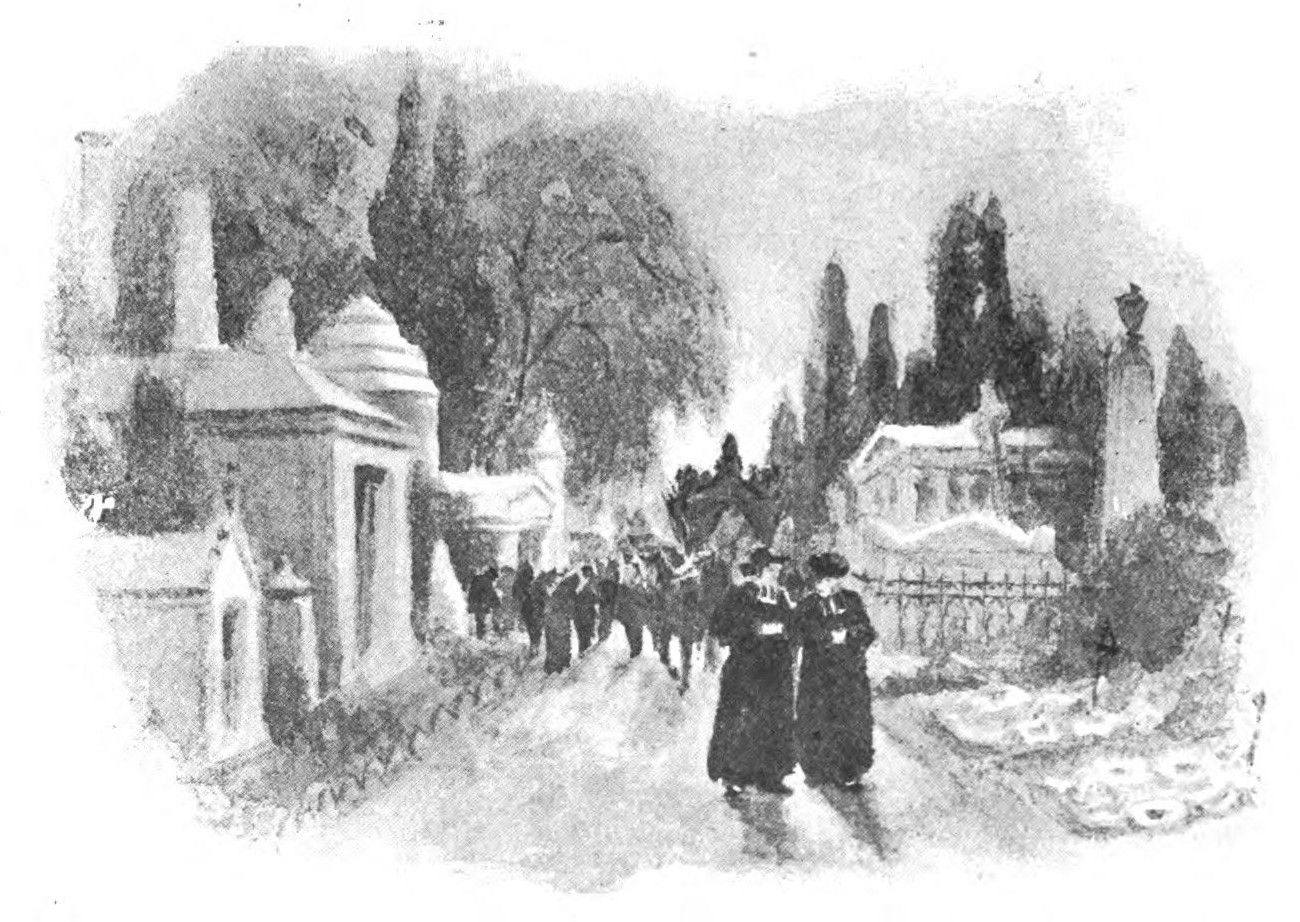
Montmartre Cemetery
rest or a mighty rock that I may painfully climb, thereon to forget, in the evening sunshine, the cold rains of the plain beneath. So slow are changes in men and things that one would need to live two hundred years to mark any difference.
Nanci, my sister, died of cancer, after six months’ frightful suffering. Adèle, worn out with the fatigue and anxiety of nursing, nearly followed her.
Why had no doctor the humanity to put an end to that awful martyrdom with a little chloroform? They administer it to avoid the pain of an operation that lasts, perhaps, an hour, and they refuse it when they know cure to be impossible, to spare months of torture, when death would be the supreme good. Even savages are more humane.
But no doubt my sister would have refused the boon had it been offered. She would have said, “God’s will be done!” Would not God’s will have been as well interpreted by a calm, swift death as by these months of useless agony?
My wife, too, died—mercifully without much suffering.
After four years’ death-in-life, unable to speak or move, she passed quietly away at Montmartre on the 3rd March 1854. Her last hours were sweetened by Louis’ presence. He was home on leave from Cherbourg four days before she died.
I had been out for two hours when one of her nurses came to tell me all was over, and I returned but to draw aside the shroud and kiss her pale forehead.
Her portrait, painted in the days of her radiant beauty, and which I had given her the year before, hung above her bed, looking calmly down on the poor shell that had once enshrined her brilliant genius.
My sufferings were indescribable. They were intensified by one feeling that has always been the hardest for me to bear—that of pity.
Again and again I went over Henriette’s troubles and their crushing weight bore me to the earth. Her losses before our marriage, her accident, the fiasco of her second appearance, her lost beauty and renown, our home quarrels, her jealousy—not, in the end, without cause—our separation, her son’s absence, her helplessness and dreary years of retrospection, of contemplating approaching death and oblivion.
Oh, the pity of it! It turns my brain.
Shakespeare! Shakespeare! Thou alone couldst have understood us both, thou alone couldst have pitied us—poor children of Art—loving, yet wounding each other through our love! Thou art our God, if that other God sits aloof in sublime indifference to our torments. Thou art our father. Help us! Save us!
De profundis ad te clamo!
Alone I went about my sorrowful task.
The Protestant pastor lived at the other side of Paris and I went to him that evening. As my cab passed the Odéon I thought of how, in that theatre twenty-six years before, my poor dead wife had burst like a meteor upon Paris and had come forward, trembling and awed at her own success, to receive the plaudits of all that was best and brightest in France. Ophelia! Ophelia!
Through that door I saw her pass to a rehearsal of Othello. I was nothing to her then. She would have thought the prophet mad who pointed out a worn, distraught, unknown youth and said:
“Behold your husband!”
Yet he it is, my poor Ophelia, he who loved and suffered with you, who tends you on this last long journey.
“... Forty thousand brothers Could not, with all their quantity of love, Make up my sum.”
Shakespeare! Shakespeare! The waters have gone over me. Father! Father! where art thou?
Next day, out of love for me, came d’Ortigue, Brizeux, Léon de Wailly, some artists brought by good Baron Taylor and other kind friends to accompany Henriette to her last rest. Twenty-five years earlier all intellectual Paris would have been there—now, he, who loved her and had not the courage to go with her to the little Montmartre God’s-acre, sits and weeps alone in her deserted garden, and her young son wanders afar on the dreary ocean.
They turned her face towards the north, to that England she never saw again, and her humble grave bears only—
Henriette Constance Berlioz-Smithson, born at Ennis, Ireland, died at Montmartre, 3rd March 1854.
The papers barely noticed her death, but Jules Janin remembered and wrote in the Débats:
“These stage divinities how soon they pass!
“How short a time it seems since we sat with Juliet on that balcony above the Verona road. Juliet, so fair, so ethereal, listening dreamily as Romeo speaks, her golden voice vibrating with the undying poetry of Shakespeare, the whole world bound by her magic spells!
“She was barely twenty, this Miss Smithson, and, without knowing it, she was a poem, a passion, a revolution—By her absolute truth she conquered.
“She it was who gave the lead to Dorval, Malibran, Victor Hugo and Berlioz. To her Delacroix owed his conception of sweet Ophelia.
“Now she is dead and her dream of glory—that glory which passes so rapidly—is over and done.
“In my young days they used to sing a funeral dirge to Juliet, wherein recurred, like an old Greek chorus, the heart-breaking refrain, ‘Throw flowers! Throw flowers!’
“‘Juliet is dead. Throw flowers! Death lies upon her, softly as frost on April grass. Throw flowers! Her love song is a funeral knell. Throw flowers! Her marriage feast the feast of Death. Throw flowers! Her marriage blossoms deck her tomb. Throw flowers!’”
Liszt wrote from Weimar as only he can write:
“She inspired you, you loved and sang of her. Her work is done!”
To Louis Berlioz.
“6th March 1854.—My poor dear Louis,—You know all. I am alone and writing to you in the large sitting-room next to her deserted bedroom. I have just been to the cemetery where I laid two wreaths upon her grave—one for you and one for myself. The servants are still here and are arranging things for the sale; I want to realise as much as possible for you.
“I have kept her hair.
“You will never know how much we made each other suffer; our very suffering bound us one to the other. I could neither live with her nor without her.
“Alexis and I talked much of you yesterday. How I wish you were more rational! It would make me so happy to feel that you were sure of yourself.
“I shall be able to do more for you now than has hitherto been possible, but I shall take every precaution to prevent your squandering money. Alexis agrees that I am right.
“At present I am penniless and shall be for at least six months; I must pay the doctor and the sale will bring in but little. The King of Saxony’s director wishes me to be in Dresden next month and I shall have to borrow money for my journey.”
“23rd March.—Your letter is an unexpected pleasure, dear boy. With seventy francs a month you can easily save, if you give up your habit of squandering money. Tell me whether you can get back the watch you pawned at Havre. My father gave it to you. If you cannot, I will buy you another. I have had a watch chain made for you of your mother’s hair; keep it carefully. I also had a bracelet made for my sister, the rest of the hair I shall keep.
“Did you see Jules Janin’s touching words on your poor mother and his exquisite reference to my Romeo ‘Throw flowers?’ I hope for another letter from you before Saturday.
“God grant that my German trip may bring in something! The Montmartre house is not let and I may have to pay rent there a year longer.”
What more can I say of the two great passions that influenced my life? One was a childhood’s memory—yet not to be despised since, with my love for Estelle, awoke my love of nature. The other—coming in my manhood with my worship of Shakespeare—took possession of me and overwhelmed me completely. Love of Art and the artist intermingled, each acting upon and intensifying the other.
Those who cannot understand this will still less understand my vague poetic longings at the scent of a lovely rose, the sight of a beautiful harp. Estelle was the rose that bloomed alone, Henriette the harp that shared my music, my joys, my sorrows and of which alas! I snapped so many, many strings!
To Louis Berlioz.
“October 1854.—I am sad this morning, dear Louis. I dreamt that we were walking—you and I—in the garden at La Côte, and not knowing exactly where you are, my dream troubles me.
“I have some news that will not, I think, surprise you. Two months ago I married again.
“I could not live alone, neither could I desert the woman who, for fourteen years, has been my companion.
“My uncle and all my friends agree with me.
“I need not tell you that your interests are safe. If I die first my wife will have but a quarter of my small fortune and even that I know she intends to leave to you.
“If you still have any painful thoughts of Mademoiselle Recio I know you will hide them for my sake.
“We were married very quietly without fuss or mystery. If you mention this in your letters, write nothing that I cannot show to my wife; I must have no cloud in my home. But your own heart will tell you what to do.
“Admiral Cécile tells me he has received your letter. You cannot enter the Marines until the end of your three years’ cruise.
“I am overwhelmed with rehearsals and arrangements for producing my new work, the Childhood of Christ. It bristles with difficulties.
“Good-bye, dear Louis.”