XVIII ITALIAN MUSIC
Katharine F. Boult translation
I did not hurry back to Rome, but spent some time in Genoa, where I heard Paër’s Agnese, and where I could find no trace of bust or statue or tradition of Columbus. I also tried in vain to hear something of Paganini, who at that moment was electrifying Paris, while I—with my usual luck—was kicking my heels in his native town.
Thence I went back to Florence, which of all Italian cities appeals to me most. There the spleen that devours me in Rome and Naples takes flight. With barely a handful of francs—since my little excursion had made a big hole in my income, knowing no one and being consequently entirely free—I passed delicious days visiting odd corners, dreaming of Dante and Michael Angelo, and reading Shakespeare in the shady woods on the Arno bank.
Knowing, however, that the Tuscan capital could not compare with Naples and Milan in opera, I took no thought for music until I heard people at table d’hôte talking of Bellini’s Montecchi, which was soon to be given. Not only did they praise the music, but also the libretto. Italians, as a rule, care so little for the words of an opera that I was surprised, and thought:
“At last I shall hear an opera worthy of that glorious play. What a subject it is! Simply made for music. The ball at Capulet’s house, where young Romeo first sees his dazzling love; the street fight whereat Tybalt presides—patron of anger and revenge; that indescribable night scene at Juliet’s balcony; the witty sallies of Mercutio; the prattle of the nurse; the solemnity of the friar trying to soothe these conflicting elements; the awful catastrophe and the reconciliation of the rival families above the bodies of the ill-fated lovers.”
I hurried to the Pergola Theatre.
What a disappointment! No ball, no Mercutio, no babbling nurse, no balcony scene, no Shakespeare!
And Romeo sung by a small thin woman, Juliet by a tall stout one. Why—in the name of all things musical—why?
Do they think that women’s voices sound best together? Then why not do away with men’s entirely?
Why should Juliet’s lover be deprived of all virility? Could a woman or a child have slain Tybalt, having burst the gates of Juliet’s tomb and stretched County Paris a corpse at his feet?
Surely Othello and Moses with high women’s voices would not be more utterly incongruous.
In justice, I must say that Bellini has got a most beautiful effect in a really powerful incident. The lovers, dragged apart by angry parents, tear themselves free and rush into each other’s arms, crying: “We meet again in heaven.”
He has used a quick, impassioned motif, sung in unison, that expresses most eloquently the idea of perfect union.
I was unwontedly moved, and applauded heartily. Thinking that I had better know the worst that Italian opera could perpetrate, had better—as it were—drink the cup to the dregs, I went to hear Paccini’s Vestal. Although I knew it had nothing in common with Spontini’s opera, I little dreamed of the bitterness of the cup I had to face. Licinius, again, was a woman.... After a few minutes’ painfully strained attention I cried, with Hamlet, “Wormwood! wormwood!” and fled, feeling I could swallow no more, and stamping so hard that my great toe was sore for three days after.
Poor Italy!
At least, thought I, it will be better in the churches. This was what I heard.
A funeral service for the elder son of Louis Bonaparte and Queen Hortense was being held.
What thoughts crowded into my mind as I stood amid the flaming torches in the crape-hung church! A Bonaparte! His nephew, almost his grandson, dead at twenty; his mother, with his only brother, an exile in England.
I thought of the gay creole child dancing on the deck of the ship that carried her to France, untitled daughter of Madame Beauharnais, adopted daughter of the master of Europe, Queen of Holland, exiled, forgotten, bereft, without a kingdom, without a home!
Oh, Beethoven! Great soul! Titan, who couldst conceive the Eroica and the Funeral March, is not this a meet subject for thy genius?...
The organist pulled out the small flute stops and fooled about over twittering little airs at the top of the key-board, exactly like wrens preening themselves on a sunny wall in winter!
Again, hearing great things of the Corpus Christi music in Rome, I hurried there in company with several Italians bent on the same errand.
They raved all the way of the wonders we should see, dangling before my eyes tiaras, mitres, chasubles, etc., etc.
“But the music?” I asked.
“Oh, signor, there will be an immense choir,” then they went back to their crosses and incense, and bell-ringing and cannon.
“But the music?” I repeated.
“Oh, there will be a gigantic choir.”
“Well, anyway,” I thought, “things will be on a magnificent scale,” and my vivid imagination raced off to the glories of Solomon’s Temple and the colossal pageants of ancient Egypt. Cruel gift of Nature that clothes dull life in a golden veil! It simply made more appalling and impossible the shrill nasal voices of the singers, the quacking clarinets, the bellowing trombones, and the rampant vulgarity of the big drums. It was brutal unadulterated cacophony.
Rome calls this military music!
Then, behold me once more safe at the Villa Medici, welcomed by the director and my comrades, who most kindly and tactfully hid their curiosity concerning my crazy journey. I had gone off having good reason to go; I had come back—so much the better. No remarks, no questions.
To Gounet, Hiller, etc.
“6th May 1831.—I have made acquaintance with Mendelssohn; Monfort knew him before.
“He is a charming fellow; his execution is as perfect as his genius, and that is saying a good deal. All I have heard of his is splendid, and I believe him to be one of the great musicians of his time.
“He has been my cicerone. Every morning I hunt him up; he plays me Beethoven; we sing Armida; then he takes me to see ruins that, I must candidly own, do not impress me much. His is one of those clear pure souls one does not often come across; he believes firmly in his Lutheran creed, and I am afraid I shocked him terribly by laughing at the Bible.
“I have to thank him for the only pleasant moments I had during the anxious days of my first stay in Rome.
“You may imagine what I felt like when I received that astonishing letter from Madame Moke announcing her daughter’s marriage. She calmly said that she never agreed to our engagement, and begs me, dear kind creature! not to kill myself.
“Hiller knows the whole story, and how I left Paris with her ring upon my finger, given in exchange for mine. However, I am quite recovered and can eat as usual. I am saved, they are saved! I threw myself into the arms of music, and felt how blessed it is to have friends.
“I am working hard at King Lear.
“Write to me, each of you, a particular and separate and individual letter.”
To F. Hiller.
“Has Mendelssohn arrived yet? His talent is wonderful, extraordinary, sublime. You need not suspect me of partiality in saying this, for he frankly owns that he cannot in the least understand my
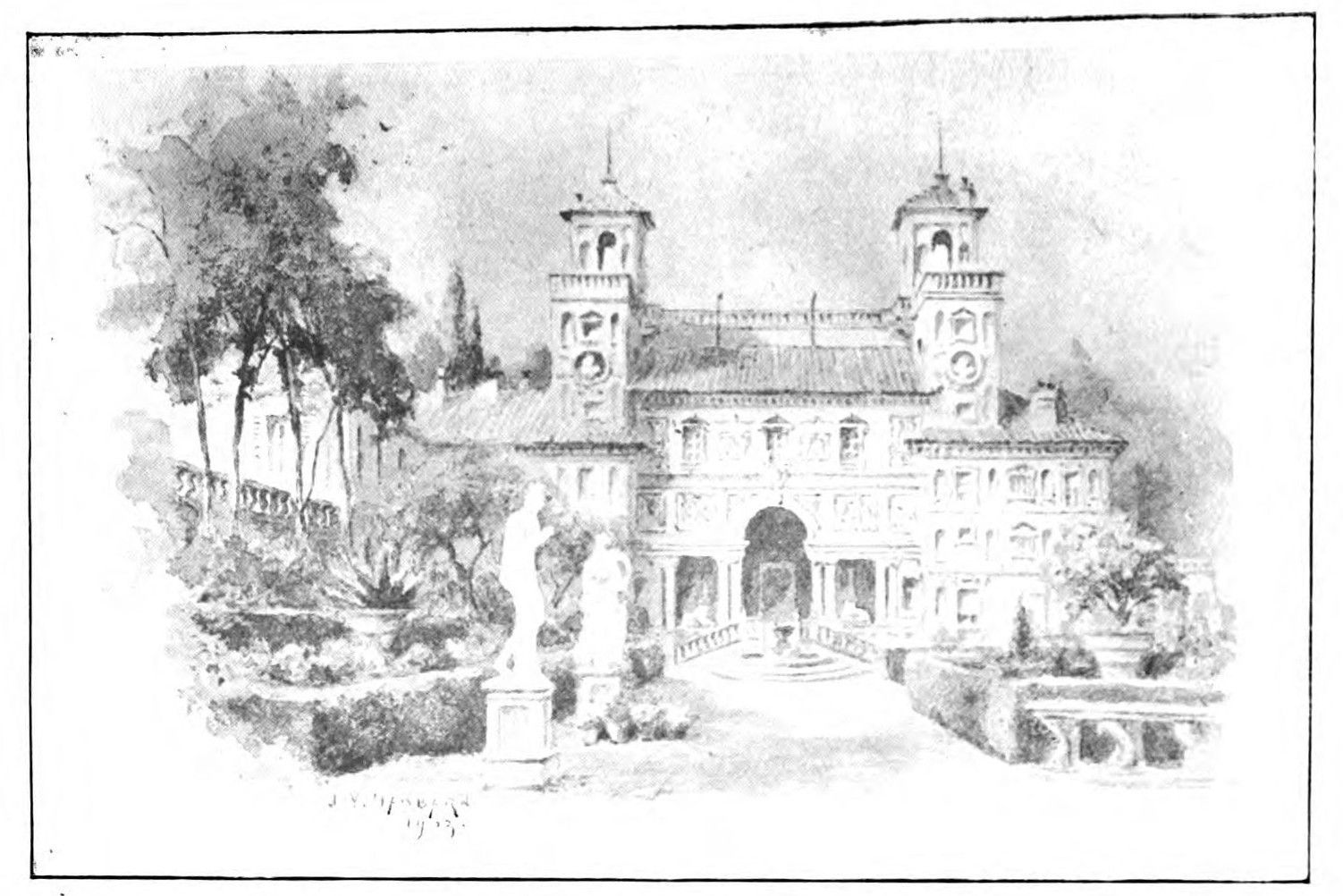
The Villa Medici, Rome
music. Greet him for me; he does not think so, but I truly like him thoroughly.”