Volume 1 — WITH BOOTH AT THE CALIFORNIA.
Reading edition
The period of about two and a half years, from August, 1876, to February, 1879, was one of incessant activity for Belasco: in it he underwent much toil and acquired much knowledge which served to develop his faculties and tended to equip him for the many-sided labor of his later life. At first, his progress in that period was slow; but it is not daily exercise, it is the total effect of long persistence in it, that develops, and scrutiny of the register of Belasco’s experience in those years exhibits various events of signal significance and many incidents of interest which require mention and comment. One of the latter, which he recalls with special pleasure, was his meeting with Edwin Booth. That great actor, whose professional novitiate was served in San Francisco,—chiefly at the old Metropolitan Theatre,—from 1852 to 1856, left there in September, 1856, and did not again visit the West for exactly twenty years. On September 4, 1876, at the California Theatre, acting Hamlet, he began an engagement which lasted for eight weeks, in the course of which he was seen, in succession, as Richelieu, Iago, Othello, King Richard the Second, King Lear, Bertuccio, in “The Fool’s Revenge”; Shylock, Pescara, in “The Apostate”; Marc Antony, Cassius, and Brutus, in “Julius Cæsar”; King Richard the Third, Mr. Haller, in “The Stranger”; Lucius Brutus, in “The Fall of Tarquin,” and Claude Melnotte. Belasco was intensely eager to see and study the acting of Booth—surely the greatest tragic genius that has graced our Stage and a consummate executant in art—and he sought to obtain an engagement at the California Theatre to play the same “line of parts” (as the phrase goes among old stock company actors) which he had performed in the preceding Spring with Barry Sullivan. Though he failed in that effort—and was keenly disappointed thereby—he was not to be balked in his purpose, and got himself employed, during the Booth engagement, as a super. “I could not give every night to such work,” he has told me; “but I ’walked on’ with him, at least once, in every play he did,—and in ’Hamlet,’ ’Richelieu,’ and ’Julius Cæsar’ I think I went on at every performance. In ’Cæsar’ when Booth played Cassius McCullough was the Brutus and Thomas W. Keene the
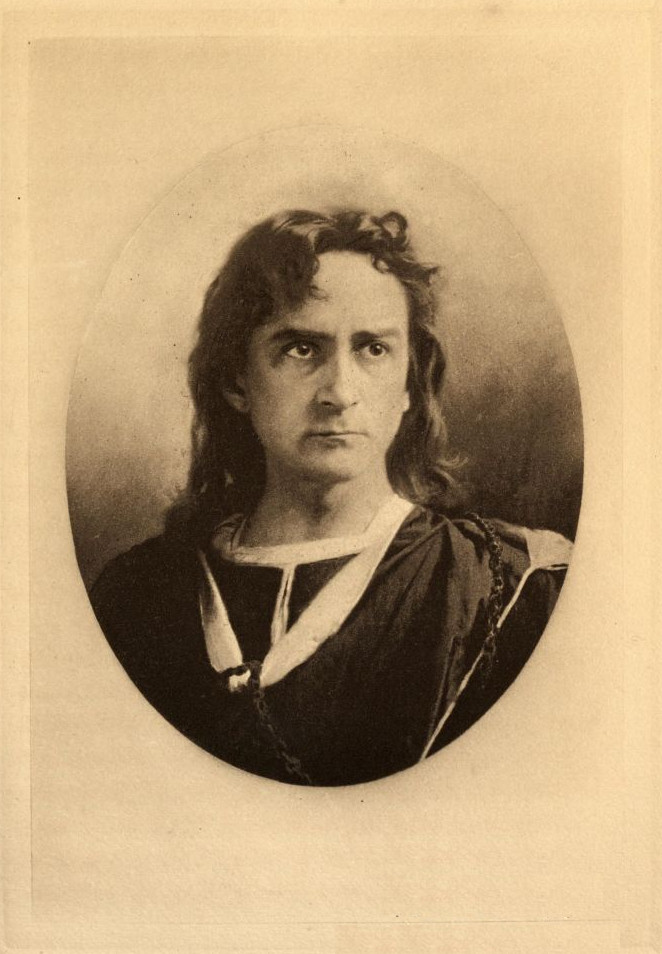
EDWIN BOOTH AS HAMLET
“There’s something in his soul O’er which his melancholy sits on brood.” —Act III, sc. 1
Photograph by Sarony. Authors’s Collection.
Antony; when Booth played Brutus McCullough was Cassius; when Booth was Antony Keene was Cassius and McCullough went back to Brutus. We used to wish we had Lawrence Barrett there for Cassius—but ’Tom’ Keene was a fine actor in his way, and I shall never forget those performances of ’Cæesar,’ nor those of ’Othello,’ in which Booth and McCullough alternated as Othello and Iago. Booth was my great idol; the one actor who, for me, could surpass McCullough, Barrett, and Montgomery. I found him very uneven—that is, his performances were not always up to his own standard. But, when he was really ’in the vein,’ there was nobody like him; there never has been, and there never will be! I never heard such a voice,—so full of fire, feeling, and power,—and I never saw such eyes as Booth’s, when he played King Richard the Third, Richelieu, or Iago. At first I used to go to the California to watch his rehearsals, but I soon found out it was little use. The plays were all an old story to him and he wouldn’t rehearse. McCullough had Booth’s prompt books, and Booth left the company pretty much to him and just ’ran through’ the big scenes with the principals. He was very gentle, considerate, and kind to everybody, but he seldom said much unless spoken to. I valued my acquaintance with him greatly; I never missed an opportunity to see him, and I cherish his memory as that of one of the best of men and greatest of actors.”
Belasco’s enthusiasm for Booth has led him, in recent years, to make an extensive collection of precious stage relics associated with that sombre genius: visitors to the reception room on the stage of the Belasco Theatre will find the “star’s” dressing room, which opens off it, indicated by a star of brilliants which was worn, first, by William Charles Macready as Hamlet, and, afterward, by Booth, in the same part. There, also, are displayed Booth’s Brutus sandals and sword, his Macbeth spear, his Bertuccio bauble, the mace carried by him when acting King Richard the Third, the sceptre he used as King Lear, the hat he wore as Petruchio, his Shylock knife and scales, and his make-up box.
During October of 1876 Belasco worked for a short while with James W. Ward and Winnetta Montague (he appeared with them at the Grand Opera House, October 16, in “The Willing Hand”), as stage manager and as adapter and rectifier of several plays. On Sunday, October 22, he participated in a benefit for Katie Mayhew given at Baldwin’s Theatre, appearing as Doctor of the Hospital, in “The Two Orphans.” Soon after that, declining a minor position in a new company, headed by Eleanor Carey and organized for “a grand re-opening of the Grand Opera House” (effected November 13, with “Wanted, a Divorce”), he joined a travelling company, at Olympia, Washington, headed by Fanny Morgan Phelps, and for about three months resumed the precarious life of a strolling player.