Volume 1 — PRODUCTION, AND CONTENTS, OF “ZAZA.”
Reading edition
“Zaza” was first produced, December 25, 1898, at the Lafayette Opera House (now, 1917, the Belasco Theatre), Washington, D. C. The first presentment of it in New York occurred, January 9, 1899, at the Garrick Theatre, where it was acted till June 17, receiving 164 performances. “Zaza” is not so much a play as it is a series of loosely jointed, sequent episodes. The story is simple and vulgar. Zaza is a French prostitute. She has passed from the streets to the stage of country music halls and has become a singer. She is a common, shameless, termagant wanton, possessed, however, of an animal allurement which infatuates a man of respectable position and outwardly decent character. His name is Dufrène. By him she is removed from a life of miscellaneous degradation and,—“purified” by “love”!—she dwells with him, in contentment, for six months,—remarking, as she pulls on her stockings, “I do think it’s the most beautiful thing in the world when two lovers come together.” At the end of that time she discovers that her paramour is married, and that he maintains his wife and their child in a respectable rural home and, at intervals, bestows upon them the boon of his precious company. With the tigerish resentment often characteristic of her class, she immediately repairs to that home, intent to “revenge” herself upon Dufrène’s wife by revealing the husband’s infidelity. Her amiable purpose is diverted by an encounter with his child, whose prattle so profoundly affects her supersensitive “better feelings” that she quits the field, returns to her civic bower, which has been provided by Dufrène, there provokes a violent quarrel with that hypocritical libertine, so enrages him that he threatens to strike her, and finally elicits from him the assurance that his wife is much more precious to him than his harlot is. The separation of this edifying couple ensues. Stimulated by this experience of “purification by love,” Zaza determines to achieve artistic greatness without further delay, and this she incontinently does, becoming, within two years,—“through much misery, much grief, much work, and a little luck,” as she expresses it,—a great artist, wealthy and (general concomitant of wealth!) respected, and, most delightful of all, a paragon of virtue, gently dismissing her recalcitrant paramour, Dufrène (who, unable to forget the rapturous interlude of his amatory association with her, has sought to renew it), in the peaceful seclusion of the Champs Elysees!
The play of “Zaza,” in the French original, is even more offensive than in Belasco’s adaptation, but it possesses more unity as a dramatic fabric and more authenticity as a portrayal of a revolting phase of life. Belasco’s version is much the superior as a commercial and theatrically useful vehicle. His purpose in adapting the play for the English-speaking Stage is thus stated by himself: “I wanted my audience to find some excuse for Zaza’s past and to have less pity for the wife. When the play was produced in America and Zaza sacrificed her own feelings for the sake of a child the audience was so entirely in her favor that she won the tears of New York and, later on [sic], of London.” “The tears” of New York, London, or any other residential locality are not difficult to “win” when an experienced hand at the theatrical fount pumps hard enough for them. Freed of flummery, what does this play signify? A woman essentially vile in nature, degraded by a career of vice, gross in her conduct, vitiated in her principles and feelings, is sentimentally affected by the babble of a child, and her holy “sacrifice of her own feelings” consists in abstention from wrecking the happiness of an innocent and injured woman who has never done her any harm. As a matter of fact, such a drab as Zaza would not have denied herself that gratification for the sake of a whole regiment of children,—but truth was not the goal desired: that object was profitable effect. Such dramas as “Zaza” defile the public mind and degrade the Stage, and it would be propitious for the community if they could be played on from a fire hose and washed into the sewer where they belong.
MRS. CARTER’S IMPERSONATION OF ZAZA.
Mrs. Carter’s performance of the patchouly-scented heroine of this tainted trash was much admired and extravagantly commended. As a work of dramatic art it was trivial: as a violent theatrical display of common surface traits,—a demonstration, in “Ercles’ vein,” of ability to tear a cat,—it was highly effective. The language of the gutter was spoken in the tone and with the manner of the gutter. The method of the execution was direct, broad, swift,—and coarse. The best technical merit of it was clarity of utterance. In Zaza’s scene with the child Mrs. Carter was mechanical and monotonous. It was the utter, reckless abandon, the uncontrolled physical and vocal vehemence, the virago-like intensity of her abuse of her lover, which, communicating themselves to the nerves of her auditors and overwhelming them by violence, gained the actress her success in the part. If to “tear a passion to tatters, to very rags,” to take up the carpet tacks
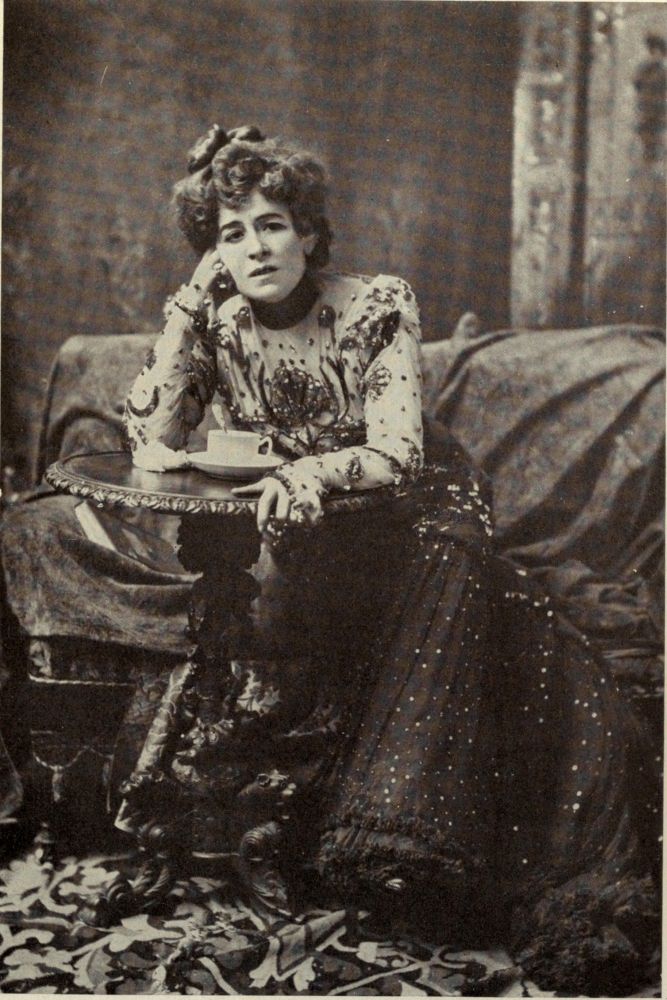
Photograph by Sarony. Belasco’s Collection.
MRS. LESLIE CARTER AS ZAZA
and demolish the furniture, be to act greatly, then Mrs. Carter’s Zaza was a great piece of acting; not otherwise. Her popularity was unequivocal, and it constituted a triumph for Belasco even more remarkable than for her.
This was the original cast of “Zaza,” at the Garrick Theatre, New York, January 9, 1899:
Bernard DufrèneCharles A. Stevenson.
Duc de BrissacAlbert Bruning.
CascartMark Smith (Jr.).
Jacques RigaultHugo Toland.
Chamblay, JrGilmore Scott.
HectorLester Gruner.
BlacHarold Howard.
BrigardW. B. Murray.
Mounet-PomblaGerard Anderson.
JolyHerbert Millward.
Carvallo Bros. (acrobats) Leona and Master Bimbi.
JabowskiWalter Stuart.
AdolpheLawrence Reeves.
CoachmanAlfred Hollingsworth.
CriquetEdgar Hart.
Rosa BonnéMarie Bates.
Madame DufrèneMabel Howard.
DivonneLizzie DuRoy.
LizetteEmma Chase.
TotoHelen Thill.
FlorianneAnne Sutherland.
Alice MorelMaude Winter.
LolotteMarie Thill.
JulietteEleanor Stuart.
NinicheElizabeth Belknap.
LeonieCorah Adams.
ClairetteHelma Horneman.
AdeleAurelia A. Granville.
Flower GirlLouisa Burnham.
NathalieHelen Tracy.
ZazaMrs. Leslie Carter.
(Mem. When “Zaza” was revived, in 1905, a minor character called Lisvon was added: it was played by Amelia G. Granville.)