Volume 1 — BELASCO’S “THE STORY OF MY LIFE.”
Reading edition
In making a critical examination of Belasco’s “The Story of My Life,”—a document which, of course, it has been necessary for me to consult in writing this Memoir,—I have observed many misstatements of fact in it, due to defective memory or to haste and heedlessness in composition, and also the assertion of various erroneous notions and mistaken doctrines as to the art of acting, and as to the difference in the practice of that art between the customs of the present and the past. Turning to that “Story” in the expectation that it would prove helpful, I found only another specimen of the irresponsible writing which is deemed permissible relative to the Theatre, and viewing its formidable array of misstatements I have ruefully recalled the remark of Artemus Ward that “it is better not to know so many things than to know so many things that ain’t so.” Some of its errors I have specified and rectified, in other places, in the course of this narrative. Others of its errors and some of its errant notions and doctrines require passing reference here.
Belasco records that he early observed and condemned “the incongruity between the stage way of doing things and the way of life itself,”—the implication being that, in acting, actual life should be literally copied. That is an error. There always is, and from the nature of things always will be, a certain incongruity between actual life and an artistic transcript of it. A literal copy of actual life shown on the stage does not usually cause the effect of actual life: it causes the effect of prolixity and tediousness. Belasco lays much stress on his early and sedulous practice of making himself acquainted, by observation, with all sorts of grewsome facts, assuring his readers that he visited lunatic asylums in order to study madness; talked with condemned murderers immediately prior to their execution and later witnessed the hanging of them; observed the effects of surgical operations performed in hospitals; contemplated deaths occurring there as the result of violence elsewhere; obtained from a friendly, communicative physician knowledge of the manner of death which ensues from the action of several sorts of poison, and was favored, in a dissecting room, with a view of a human heart which had just been extracted from a corpse,—his purpose in this line of inquiry having been to ascertain the multifarious manners in which persons suffer and die, and thus to qualify himself, as actor and stage manager, to imitate them himself or instruct others in the imitation of them. His notion, obviously, is that the actor ought to be acquainted with these things, and, when depicting death, should correctly and literally simulate the particular variety of the throes of dissolution which is appropriate as a climax to the mortal ailment or lethal stroke that destroys him.
All this is well enough in its way, but it is only a little part of the knowledge required by the actor, and a special objection to Belasco’s way of introducing it is the implication that such minute preparation was peculiar and original with him. The doctrine of “realism” is often oppugnant to dramatic art, and an extreme adherence to it has been a primary cause of whatever is defective in Belasco’s dramatic work. “Surely,” he exclaims, “people do not die as quietly as they do upon the stage.” It all depends on the “people” and the circumstances, whether on the stage or off. Death, in fact, sometimes comes so gently that its coming is not perceived. On the other hand, “people” do not always die quietly on the stage. Edwin Forrest, as the dying Hamlet, made a prodigious pother in his expiration and was a long time about it, and he maintained that a man of his size and massive physique could not die from poison without manifestation of extreme agony. I many times saw that muscular Hamlet die, and the spectacle, while
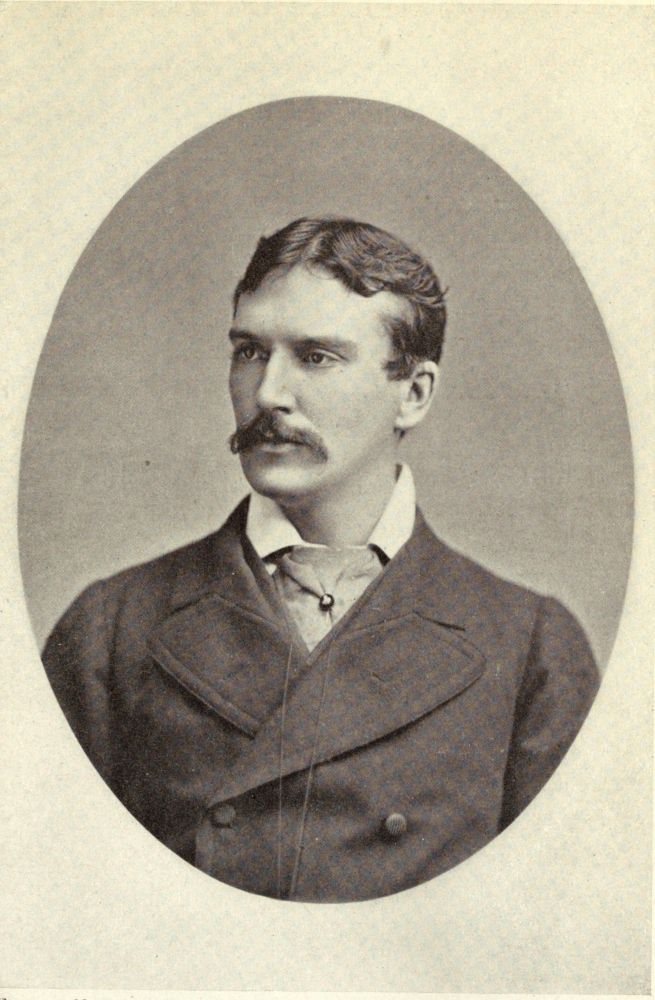
From an old photograph. Author’s Collection.
HENRY J. MONTAGUE
(1844-1878)
it might have been correct (since the nature of the poison which kills Hamlet is unknown the question is wholly assumptive), was never affecting. I recollect the death of Camille, when that pulmonary courtesan was impersonated by Matilda Heron: it was protracted, vulgar, obnoxious, merely distressful, not the least pathetic, whereas the death of Camille when Modjeska played the part or when Sarah Bernhardt played it was attended by no spasms, no convulsions, no gurgitations, was almost instantaneous, and was inexpressibly touching.
Belasco is not the only actor, by many, who has studied madness in lunatic asylums, or observed the phenomena of death in hospitals, or sounded the depths of human depravity in slums and bagnios, or looked at human nature and human life through a microscope. The biographies of Garrick, Kemble, Cooke, Kean, Macready, Forrest, and Booth, for example, teem with evidence to the contrary. It is indisputably necessary that the authentic actor should know, but it is equally essential that when he comes to practise his art he should possess the judgment to select and the skill to use his selected knowledge in such a way as to accomplish his purpose—not mar or defeat it.
Another of Belasco’s completely mistaken and indeed comically errant notions is set forth in the following paragraph from his “Story”:
“Coming to New York as a stranger, I knew I had a task before me to introduce the new style of acting which I felt was destined to take the place of the melodramatic method.... For a long time I had promised myself to give the public a new style of acting and playwriting, all my own.... New York audiences had been trained in a school of exaggerated stage declamation, accompanied by a stage strut, and large, classic, sweeping gestures, so, when I introduced the quiet acting, we were laughed to scorn, and the papers criticised our ’milk and water’ methods. It was all new, and those who saw went away stunned and puzzled. We were considered extremists at the Madison Square Theatre, but we persisted, with the result that our method prevails to-day.” [The italics are mine.—W. W.]
It is difficult to understand how such emanations of error could have proceeded from the pen of such an experienced actor, manager, dramatist, and observer as David Belasco, and it is even more difficult to be patient with them. New York audiences before his time had never been “trained in a school of exaggeration,” and there was nothing in the least new,—unless, perhaps, it were Sunday-school tameness,—in the style of acting that was exhibited in the Madison Square Theatre. Long before Belasco’s advent the New York audience had seen, enjoyed, admired, and accepted Edwin Booth as Hamlet and Richelieu, Lester Wallack as de Vigny and as Don Felix, Gilbert as Old Dornton, Blake as Jesse Rural, Chippindale as Grandfather Whitehead, Henry Placide as Lord Ogleby, Couldock as Luke Fielding, Jefferson as Rip Van Winkle, Salvini as Conrad and Sullivan, Owens as Caleb Plummer, Walcot as Touchstone, Emery as Bob Tyke, Davenport as St. Marc, Elizabeth Jefferson (Mrs. Richardson) as Pauline, Agnes Robertson as Jeanie Deans, Mrs. Hoey as Lady Teazle, Laura Keene as Marco and as Peg Woffington, Julia Bennett (Mrs. Barrow) as Hypolita and Cicely Homespun, Mrs. Vernon as Lady Franklin, Mary Carr as Temperance, and Mary Gannon as Prue,—all of whom (and many more might be mentioned) were conspicuously representative of the most refined, delicate, “natural,” “quiet” style of acting that has been known anywhere. That the New York audience had seen “barnstormers” and “soapchewers” is true—but the educated, intelligent part of it had laughed at them before Belasco’s time just as heartily as it has since. I recollect evenings of frolic, many years ago, when I repaired, with gay comrades, to the old Bowery Theatre, with no other intent than to be merry over the proceedings of posers and spouters, of the Crummles and Bingley variety, who were sometimes to be found there. That tribe has always existed. Cicero derided it, in old Rome. In Shakespeare’s “Hamlet,” written more than three hundred years ago, the Prince condemns the “robustious, periwig-pated fellow,” who tears “a passion to tatters, to very rags, to split the ears of the groundlings,” and utters his well-known, wise counsel to actors that they should “acquire and beget a temperance” that may give “smoothness” to their expression of even the most tempestuous passion. The movement toward artistic acting has always, apparently, been going on. Every student of theatrical history has read about the elocutionary improvement effected by David Garrick, in 1741. It is a matter of common knowledge that Macready was famous for the great excellence of his “quiet acting,” his wonderful use of facial expression, while never speaking a word. Edmund Kean, it has been authentically recorded, moved his audience to tears, merely by his aspect, while, as the Stranger, he sat gazing into vacancy, listening to the song,—sung for him, when he acted in this country, by Jefferson’s mother:
“I have a silent sorrow here, A grief I’ll ne’er impart, It breathes no sigh, it sheds no tear, But it consumes my heart.”
I have seen many an audience in tears when the elder Hackett acted Monsieur Mallet and when Jefferson, as poor old Rip, murmured the forlorn question, “Are we so soon forgot when we are gone?” No modern manager has invented “natural,”—by which I mean artistic,—acting. Belasco did not invent it, nor did he introduce it at the Madison Square Theatre. He was affected by what he saw around him in acting, precisely as he was affected by what he saw around him in playwriting: like other workers in the Theatre, he sought to better his instruction, and he has contributed to the development of changes (not all of them beneficial) in the Theatre. At the Madison Square, both as stage manager and dramatist, he dissipated the insipidity with which a deference to clerical management was blighting the prospects of a capital company at that house, so that from the moment he joined it its fortunes began to improve.
THE EVIL OF INCOMPETENT CRITICISM.
It is one of the hardships under which actors are compelled to pursue their vocation that the Theatre and its votaries are continually subject to the idle comment, indiscriminate praise, and capricious censure of many incompetent writers in the press. A few capable, well-equipped, earnest, and thoughtful critics unquestionably there are, in various parts of the Republic, but every little publication in the country parades its dramatic “critic,” and most of those scribblers show themselves ignorant alike of dramatic literature, dramatic art, the history of the Stage, human nature, and human life. That statement is proved every day of the year, and it is folly to ascribe it to the discontent of age or to lack of sympathy with contemporary life. Any intelligent, educated person can put it to the test as often as desired. The newspapers, as a rule, do not wish dramatic criticism: theatrical managers, almost without exception, resent it and oppose it: the newspapers receive paid advertisements and the theatrical advertisers assume to be entitled to forbearance and to puffery in the “critical” columns. This is not true of all newspapers, but it is generally true, and the writers, whether competent or not, can bear testimony to its truth. I know of nothing more dreary than the pages of drivel about the drama which periodically make their appearance in many newspapers and magazines. A favorite topic of those commentators is the immense superiority of the plays and the acting of To-day over the plays and the acting that pleased our forefathers. There was, it appears, nothing good in the Past: there is nothing but good in the Present. The old actors were artificial “pumps,” stagey, declamatory, “spouters.” Shakespeare is archaic. Old Comedy is a bore. The plays of Molière and Sheridan creak on their hinges. The plays of twenty, fifteen, ten years ago have “aged”! “Progress” has become of such celerity that the dramas of yesterday are “out of date”—before the second season begins! The principles of art have altered, and they alter afresh with the startling discoveries of each new batch of collegiate criticasters. Human nature has changed. The forces of the universe are different. The sun rises in the west and water runs uphill. Acting now is smooth, flexible, natural, fluent. Behold, we have made a new theatrical Heaven and Earth wherein dwelleth a NEW STYLE! It is lamentable that these ignorant, frivolous babblers of folly should be able to cite even one word from such an authority as David Belasco in support of their ridiculous pretensions: it is the more deplorable since, if he were brought to a serious consideration of his heedless assertions, he would certainly recant them. I am not able to believe, for example, that he would stigmatize Edwin Booth as a strutting exponent of exaggerated declamation,—an actor who could speak blank verse as if it were the language of nature, and always did so: an actor and manager, moreover, who did more than any other one person of the Theatre to make possible the career of many who followed him, including David Belasco. Nor can I believe that he would call Florence a spouter,—Florence, who was one of the most adroit and delicate of artists,—or deride such performances as John Nickinson’s Haversack, Blake’s Geoffrey Dale, and Burton’s Cap’n Cuttle as specimens of flannel-mouthed melodramatic rant. Yet such were the actors to whose style the New York audience had been accustomed long before the time when Belasco declares that he brought an entirely new and improved style of acting to the Madison Square Theatre and thus,—by implication at least,—asserts that he reformed the Stage.
Augustin Daly, who began theatrical management in New York, in 1869, when Belasco was a schoolboy of sixteen, in San Francisco, constrained the actors whom he employed to respect and emulate the best traditions of acting, and, while he never sought to establish a school of acting, insisted on Hamlet’s right doctrine of “temperance” and “smoothness”; and when he carried his dramatic company to San Francisco, in 1875, at which time Belasco saw and studied performances that were there given by it, “The Evening Bulletin,” of that city, displeased by the delicate, refined, “quiet” acting which had charmed New York, thus testified:
“The Fifth Avenue Theatre Company have a style of their own. It is emasculated of vigor, force in action, and anything like declamation in reading. It is quiet, elegant, languid; making its points with a French shrug of the shoulders, little graceful gestures, and rapid play of features. The voice is soft, the tone low, and the manner at once subdued and expressive. It pleases a certain set of fashionables, but to the general public it is acting with the art of acting left out.”
THE NATURE OF BELASCO’S TALENTS AND SERVICES.
There has always been a desire and endeavor to act truly, and, side by side with that desire and endeavor, there has always been abuse of the art by incompetents and vulgarians. If you were to attend rehearsals at some of our theatres now, you would behold coarse and blatant bullies, of the Mr. Dolphin order, blaring at the actors “More ginger!” It is the way of that tribe and the custom in those temples of intellect. But while Belasco has not invented any new style of acting he has done great service to the Stage, and his name is written imperishably on the scroll of theatrical achievement in America. As an actor his experience has been ample and widely diversified. He possesses a complete mastery of the technicalities of histrionic art. As a stage manager he is competent in every particular and has no equal in this country to-day. His judgment, taste, and expert skill in creating appropriate environment, background, and atmosphere for a play and the actors in it are marvellous. His attention to detail is scrupulous; and his decision is prompt and usually unerring. No theatrical director within my observation,—which has been vigilant and has extended over many years,—has surpassed him in the exercise of that genius which consists in the resolute, tireless capability of taking infinite pains. Many of the performances which have been given under his direction are worthy to be remembered as examples of almost perfect histrionic art. As a dramatist he is essentially the product of that old style of writing which produced “Venice Preserved,” “Fazio,” “The Apostate,” “The Clandestine Marriage,” “The Jealous Wife,” etc.,—a style with which his mind was early and completely saturated,—and of the example and influence of Dion Boucicault, whose expertness in construction, felicity in fashioning crisp dialogue, and exceptional skill in creating vivid dramatic effect he has always much and rightly admired. He has written many
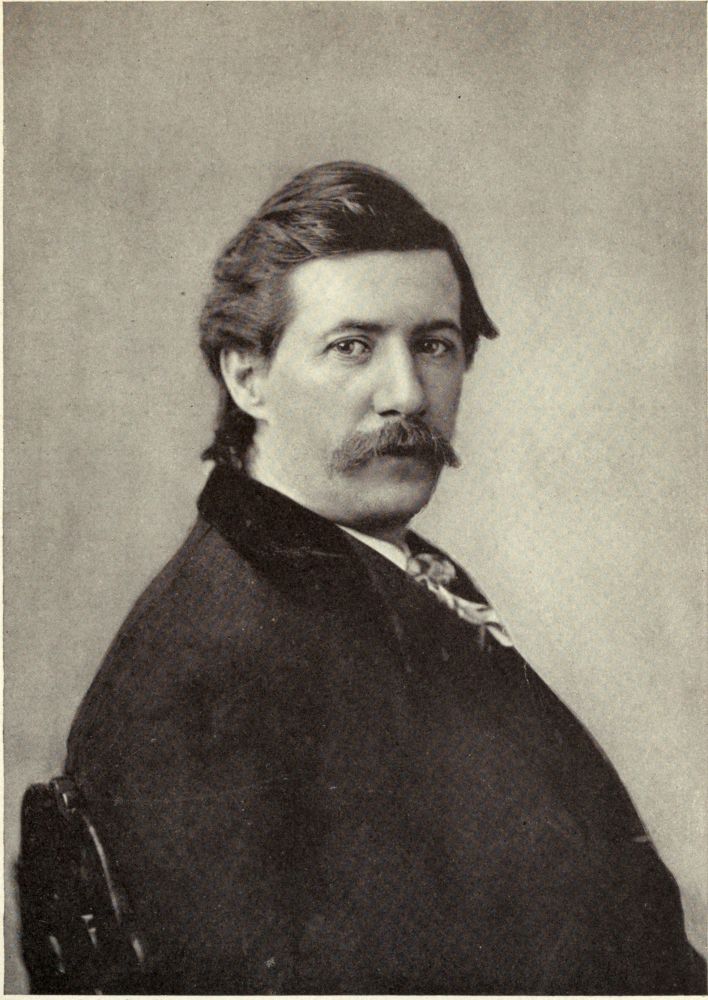
Photograph by Sarony. Author’s Collection.
AUGUSTIN DALY, ABOUT 1870-’75
plays and he has co-labored with other authors in the writing of many more. He has exerted a powerful influence upon the Stage in every part of our country. He has battled successfully against the iniquitous Theatrical Trust and in a great measure contributed to the curtailment of its oppressive power. He has developed and made efficient several stars who, without his assistance, would never have gained the prominence which, with it, they have attained. He has established and now (1917) maintains one of the finest theatres in the world. To have done all this,—to have raised himself from indigence and obscurity to honorable distinction and actual leadership in an intellectual calling, to have made his way by force of character, native talent, indomitable resolution, patient, continuous, indefatigable labor; to have borne, with unshaken fortitude, hardships, trials, disappointment, enmity, and calumny, and to have risen above all the vicissitudes of fortune,—this surely is to have shown the steadfast man of the old Roman poet and to have merited the reward of prosperity and the laurel of fame. His eminence in his vocation, accordingly, and the obligation to him of the Theatre and the Public do not require the claim of imaginary achievements to enhance his reputation. There never was any need that he should have claimed that he had introduced a new style of acting. I do not doubt, judging from what I have read of his many impersonations, that Betterton, who performed on the London stage more than two hundred years ago, could and did exemplify “quiet acting” as thoroughly as John Mason does, performing on the New York stage to-day. Changes, modifications of all kinds, have occurred, many varieties of personality have been exhibited, in many varieties of speech and bearing, but the radical, structural change in method that has been effected, the change from extravagance and elaborate artifice to refined simplicity, has not been wrought by any one person but by many persons, actuated by the same influences that have changed the physical investiture of the Theatre, and by the advance of intelligence, sense, and taste. It is peculiarly deplorable that the authority of Belasco should even seem to sustain such carping criticasters as I have indicated (writers who, ignorant of theatrical history and, apparently, of much else, seek to exalt the Present by impudent disparagement of the Past), because many of that tribe have, recently, taken to publishing idle and stupid detraction of Belasco himself, on the ground that he is “unprogressive” and belongs to “the old fashion.” He has done more by a single production such as “The Darling of the Gods” than the whole swarm of his detractors has ever done, or ever will do, in a lifetime of scribbling, and his name will live as a beacon of achievement, in life as well as in the Theatre, generations after they are all vanished and forgotten, like wind-blown dust.
CONCERNING MATTERS OF FACT.
Genest, in his exceedingly valuable “Account” of the Theatre in Great Britain,—a work to which every later writer on the subject finds himself more or less indebted and which ought to be reprinted,—sagely remarks that “In giving an account of the Stage a good story may sometimes be admitted on slender authority, but where mere matters of fact are concerned the history of the Stage ought to be written with the same accuracy as the history of England.” The attainment of accuracy, however, exacts scrupulous attention, ceaseless vigilance, patient inquiry, and hard work, and only a few writers about the Stage have ever taken the trouble to be thorough and exact. I had expected that Belasco’s “Story” could be depended upon in every particular and that it would prove of invaluable aid in writing this Memoir. I do not doubt that he designed it to be literally true, but, as a conscientious biographer, I am compelled to mention its errors of fact, and I deem it my duty to specify and correct some of them, as an act of justice alike to him and to his, and my, readers.
Belasco, as I have ascertained and stated, was born not in 1858 or 1859, as various accounts of him have declared, but in 1853. He has himself affirmed that in 1865, in San Francisco, he walked in a funeral procession expressive of the public grief for the death of Abraham Lincoln and at that time wrote a play, on the tragic and pathetic fate of that illustrious American, expositive of his views of the motives of Lincoln’s murderer. If we were to accredit the dates which are given as authentic in various published sketches of his life,—which appear to have been formally sanctioned,—we should find him to have reached only to the age of five years and nine months when he walked in that procession and wrote that play; we should find him,—according to such wild statements,—when he acted, in Victoria, with Julia Dean and Charles Kean, performing with those distinguished players about three years after both of them had died; we should admire him when, before the age of eleven, he was critically estimating the histrionic style of Walter Montgomery; and when, between the ages of thirteen and fourteen, he was giving counsel, which Raymond the comedian had solicited, relative to the play of “The Gilded Age,” and also as acting as amanuensis to Dion Boucicault. He states that Lawrence Barrett loved John McCullough “like his son.” Barrett, born in 1838, was six years younger than McCullough, born in 1832, and he could not have viewed that stalwart comrade with anything like a paternal—or a filial—feeling. In fact, though they dwelt in amicable association as managers and actors (it would have been hard for anybody to dwell in association with McCullough in any other way), there was no special affection between them, as I personally know. Belasco’s statement that McCullough was at one time Forrest’s dresser is incorrect. He admired Forrest and he imitated him (until the veteran gruffly told him to leave off “making a damned fool” of himself by so doing), but he never was Forrest’s servant or lackey. Belasco says that Barrett’s first appearance as Cassius, in “Julius Cæsar,” was made in 1870, in San Francisco, and that he “hated” the part and wished to play Antony, but could not because it was Walter Montgomery’s part,—the fact being that he played Cassius for the first time about 1855, when he was about seventeen years old, at the Metropolitan Theatre, Detroit; that he loved the part; that his affinity with it was very strong, and that he esteemed it, as what indeed it is, the moving impulse of the whole tragedy. Barrett first played Cassius in San Francisco March 9, 1869, at the California Theatre, Edwards acting Antony; that is, about one year before Montgomery visited San Francisco. I have talked with Barrett for hours and hours about acting, and especially about the play of “Julius Cæsar,” but I never heard him speak with enthusiasm about the part of Marc Antony, or express any desire to act that part, though he thoroughly understood it and knew its value. Another of Belasco’s mistaken assertions is the assurance that Walter Montgomery,—who acted Antony with Barrett as Cassius and McCullough as Brutus,—was enamoured of an actress named Rose Massey; that he (Belasco) witnessed their first encounter, on the stage of the California Theatre, when Montgomery was smitten speechless at the sight of the young woman; that he soon married her; and that, after a quarrel with her, he committed suicide, aboard a ship bound for England. Inquiry would have corrected his memory. Poor Montgomery (a genial fellow and a fine actor) was easily and often enamoured: as was said of the poet Heine, “His heart was a good deal broken in the course of his life.” Rose Massey was an ordinarily pretty woman, one of the many devotees of the Blonde Troupe
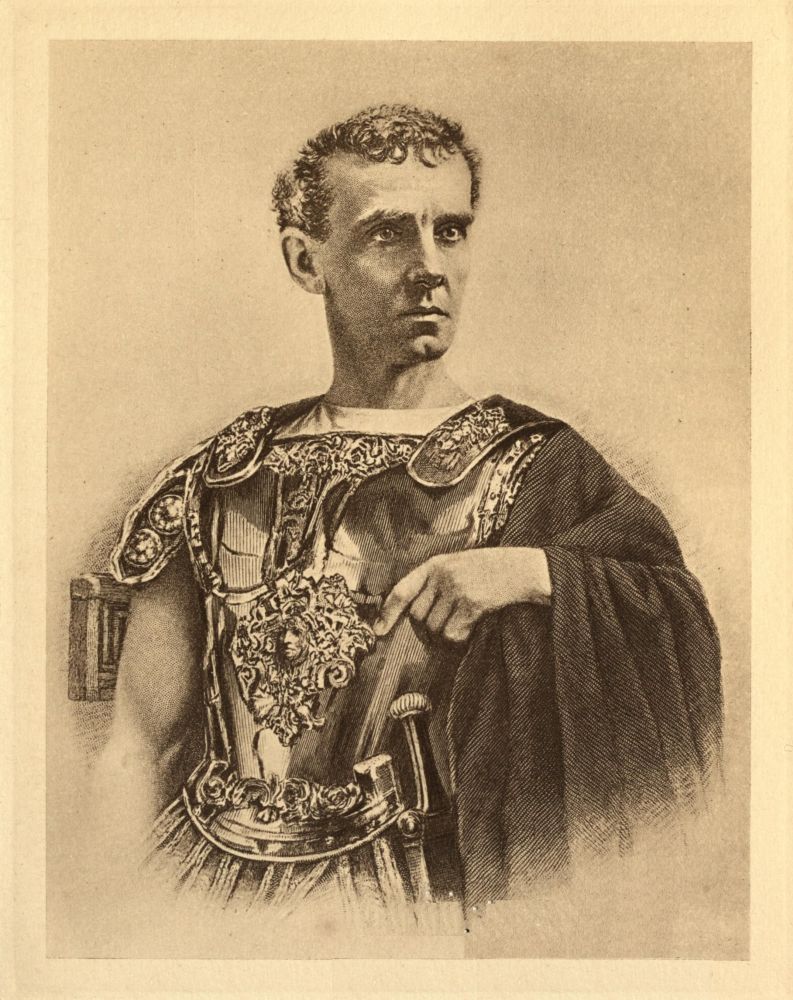
LAWRENCE BARRETT AS CAIUS CASSIUS.
IN “JULIUS CAESAR”
“If we do meet again, we’ll smile indeed; If not, ’tis true this parting was well made!” —Act V. sc. 1
From a steel engraving. Author’s Collection.
manager, Alexander Henderson, and I remember her as a female at whom it was easily possible to gaze without blinking. Montgomery never married her. Walter Montgomery (Richard Tomlinson, 1827-1871: Montgomery was his mother’s name) married an actress called Winnetta Montague. Her real name was Laleah Burpré Bigelow. She had been the wife of a Boston gentleman, Arnold W. Taylor. Montgomery met her on the stage at the Boston Theatre. She was attracted by him, followed him to England, and captured him. Their marriage occurred on August 30, 1871, and on September 2, in a lodging in Stafford Street, Bond Street, London, he committed suicide, by shooting, and he was buried in Brompton Cemetery. Winnetta Montague returned to America, resumed acting, allied herself with an Irish comedian named James M. Ward, died in New York, in abject poverty, in 1877, and was buried by charitable members of the dramatic profession.
The excellent and famous personation of Fagin which was shown throughout our country by J. W. Wallack, the Younger, is ascribed by Belasco to “Lester’s father,” J. W. Wallack, the Elder, who was “Jim” Wallack’s uncle, and by whom the part was never played. The movable stage introduced at the Madison Square Theatre in 1879 is designated “an innovation” invented by Steele Mackaye, whereas, in fact, it was a variant of the movable stage scheme introduced at Booth’s Theatre, in 1869, by Edwin Booth.
“Looking over theatrical history,” Belasco exclaims, “has it ever occurred to you how many players have based their fame on just one rôle?—Salvini as Othello, Irving as Mathias, in “The Bells”; Booth as Hamlet, Raymond as Mulberry Sellers, Sothern as Dundreary, Emmet as Fritz, Jefferson as Rip, Mayo as Davy Crockett, Chanfrau as Kit?... Most of these men struggled a lifetime and gained recognition as creditable actors. Then, suddenly, they struck a particular part, a sort of entertainment, a combination of all the excellent things they had done throughout their lives but never before had concentrated on one rôle. And there you are! Any other actor might have become just as famous if Fate had thrown the part first in his way. I have seen three Rips,—that of Jefferson, that of Robert McWade, and finally that of James A. Herne. This last was a wonderful characterization, with all the softness and pathos of the part. I was a Dwarf, to Herne’s Rip, in the Maguire’s Opera House days. But Fate chose to thrust forward Jefferson as the only Rip that ever was or ever could be. I happen to know better. Jefferson was never the Dutchman; he was the Yankee personating the Dutchman. But James A. Herne’s Rip was the real thing.... These actors of one part are like the favored children of heaven; they are handed something on a golden platter, already created by the author. It is to the author, the director, the stage manager, that the true credit of the creation belongs. Jefferson did not really create Rip; through a certain undeniable art of his he simply put into visible form what Washington Irving in the story suggested and Dion Boucicault so cleverly fitted to his personality for the stage; he utilized every bit of the descriptive business of the tale.”
Seldom has so much error and injustice been packed into so small a space! It is true that, in many instances, individual actors have abundantly prospered by the long-continued repetition of a single performance: this fact, I remember, was impatiently noticed many years ago by Don Piatt, who testily expressed in a Washington newspaper an ardent wish that old Rip Van Winkle and old Fanchon would get married and both retire. It is not because the individual actor finds “a particular part, a sort of entertainment, a combination of all the excellent things” he has done throughout his life, that he often becomes most famous in one part; it is because, in every art, the artist’s range of supreme merit is, comparatively, narrow; no matter how well he can do fifty things, he can, as a rule, do one thing best of all,—that thing being always one for which, whether he happens to like it or not, he possesses a peculiar capacity, one with which he possesses a close artistic and physical affinity, so that, in the doing of it, he can make an ampler and more effective display of his talents than he can make in any other way; and also because the public (with a generally sound instinctive preference for seeing an actor in the thing which he can do best) insists on seeing him in it and will not go in large numbers to see him in anything else.
How much judgment is there in a statement which classifies performances of Othello, Mathias, and Hamlet among “entertainments”? Salvini had played nothing like Othello, Irving nothing like Mathias, Booth nothing like Hamlet before, respectively, they played those parts. (Such performances as Sellers, Fritz, Crockett, and Kit, well enough in their way, do not deserve thoughtful consideration as the basis of histrionic “fame.”) “Any other actor might have become just as famous if Fate had thrown the part first in his way!” That is, according to this careless commentator, although a “one-part actor” achieves his greatest success in a part which happens to combine “all the excellent things,” the peculiar, individual merits, of that special actor, nevertheless any other actor could have achieved the same success if he had been fortunate enough to receive the golden opportunity first. Charles Harcourt played Mathias, under the name of Paul Zegers, at the Alfred Theatre (the old Marylebone), London, in a version of “The Polish Jew” by Frank Burnand, several months before Irving ever played it—and Harcourt utterly failed in it. Othello and Hamlet had been played by scores of contemporary actors before Salvini and Booth, respectively, played those parts,—yet the effect produced by those actors in those parts was not the less unique and extraordinary. Irving’s fame as an actor, moreover, rested and rests at least as much on his Hamlet, Shylock, King Louis, Mephistopheles, and Benedick as on his Mathias. Hamlet certainly was Booth’s most typical performance, but also certainly he was more popular as Richelieu than as Hamlet, and his fame rests on that part and on his Brutus, Shylock, King Richard the Third, and Iago as much as on his Hamlet. Salvini’s fame rests as much on his Corado, Niger, King Saul, and Orosmane as on his Othello—and in all of those parts he was finer than he was in Othello. Salvini, Irving, and Booth were not “one-part actors,” nor does their fame rest on any one performance, nor should the credit for their achievement be given to any author, director, or stage manager—or to anybody but themselves. Booth, Irving, and Salvini were stage directors and managers, and though they did not write the parts which they acted, they certainly arranged them, and as to some of them they supplied vital suggestions. The character of Mathias, in “The Bells,” for instance, was completely reconstructed by Leopold Lewis, at Irving’s suggestion, to adapt it to his mysterious personality and peculiarities of style. Lord Dundreary, when first given to Sothern by Laura Keene, was a wretched part, about seventeen lines in length,—“a dyed-up old man” she called it, asking him to accept it,—but the comedian eventually expanded it till it dominated the play, and it is fair to say that, literally, he “created” it.
THE FACTS ABOUT JEFFERSON’S RIP.
Jefferson was a youth when he was first attracted to the part of Rip Van Winkle. He had seen it played by his half-brother, Charles St. Thomas Burke, who was esteemed by his contemporaries a great comedian, and had acted in the play with him, as Seth. He has himself told me that long before he attained a position in which he could publicly assume it he frequently made up for it and rehearsed it in private. The play that he at first used was one Burke had made, which Jefferson tinkered and improved. There were at least ten plays on the subject in existence before Jefferson ever appeared as Rip, and eight recorded performers of that part. The first Rip was Thomas Flynn, the second was Charles B. Parsons; both of them acted it in 1828,—a year before Jefferson was born. Their successors were William B. Chapman, 1829; James Henry Hackett, 1830; Frederick Henry Yates, 1831; William Isherwood, 1833-’34; Joseph Jefferson, the second (our Jefferson’s father), about 183(8?), and Charles Burke, 1849-’50, or earlier. Jefferson first acted Rip at Caruso’s Hall, in Washington, in 1859, and he continued to act it for forty-five years. I first saw him in it, in the season of 1859-’60, at the Winter Garden Theatre, New York, and was deeply impressed by his performance, which almost ever since I have extolled in the press as one of the greatest pieces of acting that have been seen in our time. Down to 1865, Hackett, by birth a Hollander, was highly esteemed as Rip, but neither he nor either of the actors above mentioned was ever “just as famous” in it as Jefferson became, though “Fate” had thrown it in their way long before that deity had thrown it in his. His achievement has been more or less disparaged ever since he first won the public suffrage in it. His success has been ascribed to almost anything except the real cause,—for example, to Chance, to “Fate,” to Dion Boucicault, and to me,—which is mere nonsense. Jefferson’s wonderful artistic triumph as Rip Van Winkle was due to just one person—himself. He would have gained it if all the persons who have been credited with “making him” had never lived. His impersonation was entirely his own conception and construction—a work of pure genius. The play that Boucicault, in 1865, in London, made for him, on the basis of the old version which he had used for more than six years, was largely fashioned after suggestions made by Jefferson himself, the most important of which being that in the mysterious, supernatural midnight scene on the lonely mountain top the ghosts should remain silent and only the man should speak. Jefferson had the soul of a poet, the mind of a dreamer, the eye of a painter, the imagination and heart of a genius, and he was a consummate actor. As an executant in acting he operated with exquisite precision, and his art was infiltrated with light, geniality, and humor. “It is to the author, the director, the stage manager that the true credit of the creation belongs,” writes Belasco, himself an author, a director, and a stage manager, and therefore not an altogether impartial witness; forgetful, also, that Jefferson was experienced in all those callings. The author of a play provides the soul of a part, the actor provides the body and vitalizes it with all his being, and shapes and adorns it, revealing the soul, with all his art:
“But by the mighty actor brought, Illusion’s perfect triumphs come,— Verse ceases to be airy thought, And Sculpture to be dumb!”
Jefferson used only the skeleton of the story of Rip Van Winkle as told by Washington Irving, in “The Sketch Book” (1819): the character, as he portrayed it, is quite different from the commonplace sot designated by Irving. As to Boucicault’s version of the play—that dramatist disparaged it, did not believe in it, and actually assured Jefferson, just before the curtain rose on its first performance (September 4, 1865, at the Adelphi Theatre, London), that it would fail; and after he had seen Jefferson’s performance he said to that comedian, “You are shooting over their heads,” to which Jefferson answered, “I am not even shooting at their heads—I am shooting at their hearts.” He hit them. Later, Boucicault discovered what Jefferson meant (he could see a church by daylight as well as another!), and paid him the compliment of devising for himself an Irish Rip Van Winkle, under the name of Conn, the Shaughraun, which he admirably acted, as nearly as he could, in Jefferson’s spirit and manner. “Jefferson,” writes Belasco, “was the Yankee personating the Dutchman.” Another mistake. “Yankee” is an epithet of disparagement which the British contemptuously applied to the rural inhabitants of New England in the time of the American Revolutionary War. Jefferson did not possess any of either the physical or mental qualities of a New Englander. He was of English, Scotch, and French lineage. His grandfather was a Yorkshire man; his father a Pennsylvanian; his mother a French lady (born in the Island of San Domingo); himself a native of Philadelphia—and no more a “Yankee” than J. A. Herne was, whose lineage was Irish, who was born at Cohoes, New York, and whose performance of Rip (a respectable one) was based in part on Jefferson and in part on Hackett. It is idle to disparage Jefferson as Rip Van Winkle. That impersonation will live in theatrical history when all the Hernes, McWades, etc., are lost in oblivion!