Volume 1 — ORIGIN OF THE EMPIRE THEATRE.
Reading edition
About March-May, 1892, James M. Hill, who had been managing the Union Square Theatre since September 7, 1885, being in financial difficulties,—which soon caused his failure,—found it expedient to dispose of his interest in that theatre, which he sold to his brother, Richard Hill, who directed it for a short time, beginning June 6, 1892, after which it was hired by A. Y. Pearson and Henry Greenwall. During several months preceding Hill’s failure a lease of the Union Square could have been obtained, and that fact was generally known in the theatrical community. William Harris (1845-1916), desiring to obtain a theatre in New York, and knowing that Charles Frohman cherished a like ambition, proposed to the latter that they should coöperate and lease one. Frohman agreed to this, specifying that the Union Square was available. Harris immediately undertook to confer with the persons then in control of that house, but, casually meeting Mr. Al. Hayman, he mentioned the
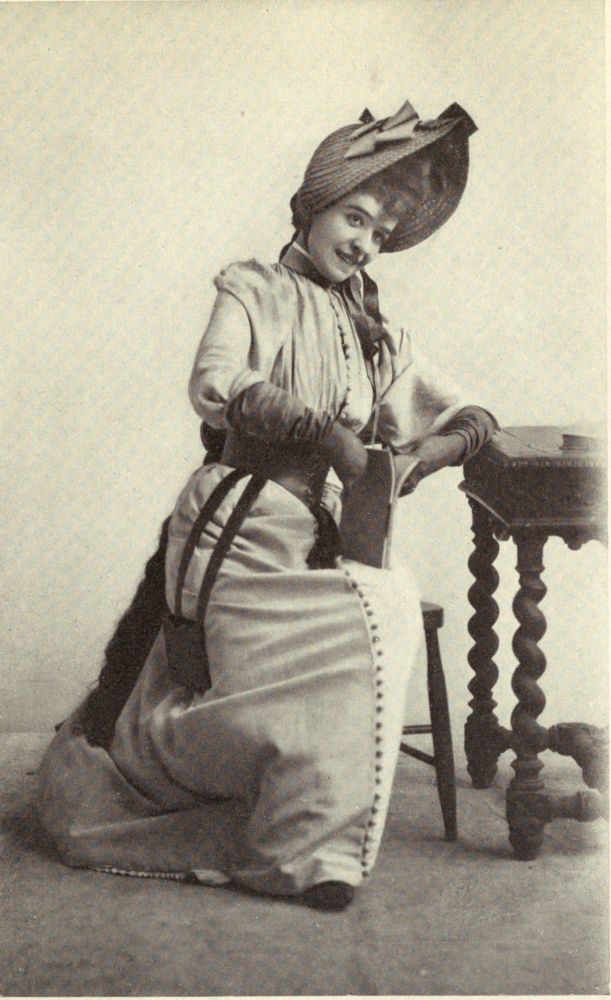
Photograph by Sarony. Belasco’s Collection.
MRS. LESLIE CARTER AS MISS HELYETT
project to that person. In a concoction of records, errors, and idle praise which has been put forth as a “Life” of Charles Frohman the following account is printed of the conversation which ensued between them:
“‘That’s foolish,’ said Hayman; ’Everything theatrical is going uptown.’
“‘Well,’ answered Harris, ‘“C. F.” wants a theatre, and I am determined that he shall have it, so I am going over to get the Union Square.’
“‘If you and Frohman want a theatre that badly, I will build one for you,’ he responded.
“‘Where?’ asked Harris.
“‘I’ve got some lots at Fortieth and Broadway, and it’s a good site, even if it is away up-town.’
“They went back to Frohman’s office, and here was hatched the plan for the Empire Theatre.”
This theatre was built as an investment by Al. Hayman, William Harris, and Frank Sanger. The corner-stone was laid in May, 1892, and the house, leased by Charles Frohman and Messrs. Rich & Harris, was opened under the direction of Frohman eight months later. That enterprising speculator in public amusement, who had long been eager to establish himself in the metropolis, in a fine theatre under his direct control, keenly appreciated Belasco’s abilities, and at the time when the new house was projected was associated with him in the presentment of Mrs. Carter in “Miss Helyett.” Frohman’s main interest, however, was centred in the Empire, and, though aware that Belasco was preoccupied with work on “The Heart of Maryland,” he urgently requested him to write a new play with which to open that theatre. At first Belasco demurred to the undertaking, deeming it essential to restrict himself to the work he had already begun, and to devote all his strength to the establishment of Mrs. Carter. That actress, however, hearing of Frohman’s proposal and appreciating the possible advantage that might accrue to Belasco from his acceptance of it, insisted that he should provide the play for the opening of the Empire, even at the sacrifice of an early appearance for herself. The upshot of the negotiation was Belasco’s agreement to write the desired play, in collaboration with his friend Franklyn Fyles (1847-1911),—then dramatic reviewer for “The New York Sun.” “All through the storm of malicious lies that Mrs. Carter and I had to weather,” said Belasco, “Fyles had been sympathetic and kind to us; writing under the pen-name of ’Clara Belle,’ he had given Mrs. Carter many a lift and helped us a lot. I was grateful and I wanted to help him, if I could; and he was an experienced, good writer, and I was glad to have him to help me, for I wanted ’Charlie’s’ venture to succeed, and I felt the responsibility.”