Volume 2 — LETTERS 1890-1904 (continued 8)
Reading edition
At this moment, a beautiful, shining, plump, gathered-up-for-a-jump flea is walking over my hand.
Affectionately,
Lafcadio.
TO MITCHELL McDONALD Tōkyō, September, 1899.
Dear Mitchell,—I am sending you two documents just received—one from Lowder’s new company, I suppose; the other, which makes me rather vexed, from that —— woman, who has evidently never seen or known me, and who spells my name “Lefcardio.” (Wish you would point out to her somebody who looks small and queer,—and tell her, “That is Mr. Hearn—he is waiting to see you.”) At all events, these folks have simply been putting up a job to amuse themselves or to annoy me;—— has apparently been putting up a job to annoy you. We are in the same boat; but you can take much better care of yourself than I can. I do wish that you could find out something about those —— people: I am very much ashamed at having left my card at the hotel where they were stopping.
One thing sure is that I shall not go down to the Grand Hotel again for ages to come—I wish I could venture to say “never”—nevermore. It is one more nail in my literary coffin every time I go down. If I am to be tormented by folks in this way, I had better run away from the university and from Tōkyō at once.
That —— woman is a most damnable liar. I wonder who she can be.
Well, so much for an outburst of vexation—which means nothing very real; for I only want to pour my woes into your ear. I can’t say how good I think you are, nor how I feel about the pleasure of our last too brief meeting. But I do feel more and more that you do not understand some things,—the immense injury that introductions do to a struggling writer,—the jealousies aroused by attentions paid to him,—the loss to him of creative power that follows upon invitations of any kind. You represent, in a way, the big world of society. It kills every man that it takes notice of—or rather, every man that submits to be noticed by it. Their name is legion; and they are strangled as soon as they begin to make the shadow of a reputation. Solitude and peace of mind only can produce any good work. Attentions numb, paralyze, destroy every vestige of inspiration. I feel that I cannot go to America without hiding—and never can let you know where I go to. I shall have to get away from Tōkyō,—get somewhere where nobody wants to go. You see only one side—what you think, with good reason, are the advantages of being personally known. But the other side,—the disadvantages,—the annoyances, the horrors—you do not know anything about; and you are stirring them up—like a swarm of gnats. A few more visits to Yokohama would utterly smash me—and at this moment, I do wish that I never had written a book.
No: an author’s instincts are his best guide. His natural dislike to meet people is not shyness,—not want of self-appreciation: it is empirical knowledge of the conditions necessary to peace of mind and self-cultivation. Introduce him, and you murder his power,—just as you ruin certain solutions by taking out the cork. The germs enter; and the souls of him rot! Snubs are his best medicine. They keep him humble, obscure, and earnest. Solitude is what he needs—what every man of letters knows that an author needs. No decent work was ever done under any other conditions. He wants to be protected from admiration, from kindnesses, from notice, from attentions of any sort: therefore really his ill-wishers are his friends without knowing it.
Yet here I am—smoking a divine cigar—out of my friend’s gift-box,—and brutally telling him that he is killing my literary soul or souls. Am I right or wrong? I feel like kicking myself; and yet, I feel that I ought never again in this world to visit the Grand Hotel! I wonder if my friend will stand this declaration with equanimity. He says that he will never “misunderstand.” That I know. I am only fearing that understanding in this case might be even worse than misunderstanding. And I can’t make a masterpiece yet. If I could, I should not seem to be putting on airs. That is the worst of it.
Hope you will forgive and sympathize with
Lafcadio.
TO MITCHELL McDONALD Tōkyō, October, 1899.
Dear Mitchell,—No news up here, to interest you.
I am not doing anything much at present. Don’t know whether I shall appear in print again for several years. Anyhow, I shall never write again except when the spirit moves me. It doesn’t pay; and what you call “reputation” is a most damnable, infernal, unmitigated misery and humbug—a nasty smoke—a foretaste of that world of black angels to which the wicked are destined. (Thanks for your promise not to make any more introductions; but I fear the mischief has been done; and Yokohama is now for me a place to be shunned while life lasts.)
Six hundred pages (about) represent my present quota of finished manuscript. But I shall this time let the thing mellow a good deal, and publish only after judicious delay. While every book I write costs me more than I can get for it, it is evident that literature holds no possible rewards for me;—and like a sensible person I am going to try to do something really good, that won’t sell.
In the meanwhile, however, I want not to think about publishers and past efforts at all. That is waste of time. I shall prepare to cross the great Pacific instead,—unless I have to cross a greater Pacific in very short order. I should like a chat with you soon; but I am not going down to Yokohama for an age. It is better not. When I keep to myself up here, things begin to simmer and grow: a sudden change of milieu invariably stops the fermentation. Wish you were anywhere else that is pleasant except—at the G. H.
Affectionately ever,
Lafcadio.
TO MITCHELL McDONALD Tōkyō, October, 1899.
Dear Mitchell,—I cannot quite tell you how sorry I felt to part from you on the golden afternoon of yesterday: like Antæus, who got stronger every time he touched the solid ground, I feel always so much more of a man after a little contact with your reality. Not more of a literary man, however; for I try to shut the ears of my mind against your praise in that direction, and I close the door of Memory upon the sound of it. If I didn’t, I should be ruined by self-esteem.
And to think that you will be eight, ten or twenty thousand miles away, after next year!
Woke up this morning feeling younger—not quite fifty years of age. Gradually the sense of age will return: when I feel about sixty again—which will be soon—I shall run down to see you.
Want to say that those cigars of the doctor’s are too good for me: luxury, luxury, luxury. The ruin of empires! But I like a little of it—not too often—once in a year. It makes me buoyant, imponderable—fly in day dreams.
And I want to see Bedloe. Do not, if you can help it, fail to come up again, once anyhow, before the good year dies. Only this word of love to you.
In haste,
Lafcadio.
TO PROFESSOR FOXWELL Tōkyō, October, 1899.
Dear Professor,—I had given up all expectation of seeing you again in Japan,—as a letter received from Mr. Edwards gave me to understand that you were on your way back to England. To-day, however, I learned by chance that you were still in Tōkyō,—though no longer an inhabitant of the Palace of Woe. Therefore I must convey to you by this note Mr. Edwards’s best regards, and express my own regret that you will not again help me through with a single one of those dreary quarters between classes. However, I suppose that the day of my own emancipation cannot be extremely remote.
I have had a number of pleasant letters from that wonderful American friend of ours. He has been in Siam,—where he sold to the King’s people more than two tons of dictionaries without emerging from the awning of his carriage; and I suppose that the books were carried by a white elephant with six tusks. He has been since then in Ceylon, Madras, Calcutta,—all sorts of places, too, ending in “bad,”—doing business. But he will not return to Japan—he goes to the Mediterranean. He sent me a box of cigars of Colombo: they are a little “sharp,” but very nice—strange in flavour, but fine.
No other news that could interest you. Excuse me for troubling you with this note—but the idea of seeking you at the Metropole would fill me with dismay. If you do go to England, please send me a good-bye card. If you do not go very soon, I shall probably see you somewhere “far from the madding crowd.”
Best regards,
Lafcadio Hearn.
TO PROFESSOR FOXWELL November, 1899.
Dear Professor,—Nay! I return into my shell for another twelve months at least. You see—I thought you were going away, and felt a little sorry, and therefore went to that dreadful hotel and let you hand me over for an afternoon to your American friend who quotes Nordau’s “Degeneration,” but that was really, for me, supreme heroism of self-sacrifice.... (By the way, I have seen too much of that type of man elsewhere to be altogether delighted with him: superficies of bonhomie, studied suggestions of sympathy, core hard as Philadelphia pressed brick: he swarms in America; and I much prefer the Gullman brand.) As for a party of four,—“Compania de cuatro, compania del diablo!” The only way I can have a friend in these parts is to make this condition: “Never introduce me; and never ask me to meet you in a crowd.” You ought to recognize, surely, that I couldn’t afford to be known and liked, even if that were possible. I can “keep up my end” only by strictly following the good maxim: Tachez de n’avoir besoin de personne. Now, really, dear Professor, why should I lose an evening of (to me) precious work, and tire myself, merely to sit down with Mr. G. and Mr. M.? What do I care for Mr. G. or Mr. M.? What do I care for the whole foreign community of Tōkyō? Why should I go two steps out of my way for the sake of men that I know nothing about, and do not want to know anything about? “Life is too short,” as the Americans say. With thanks all the same,
Crankily yours,
Lafcadio Hearn.
Next time—next two times we meet—it is my turn to play host, remember.
TO MRS. WETMORE Tōkyō, January, 1900.
Dear Mrs. Wetmore,—Memories of handwriting must have become strong with me; for I recognized the writing before I opened the letter. And thereafter I did not do more than verify the signature—and put the letter away, so that I might read it in the time of greatest silence and serenity of mind. During the interval there rose up reproachfully before me the ghost of letters written and rewritten and again rewritten to you, but subsequently—I cannot exactly say why— posted in the fire! (This letter goes to you in its first spontaneous form—so much the worse for me!)
“Indifferent” you say. But you ought to see my study-room. It is not very pretty—a little Japanese matted room, with glass sliding windows (upstairs), and a table and chair. Above the table there is the portrait of a young American naval officer in uniform—he is not so young now;—that is a very dear picture. On the opposite wall is the shadow of a beautiful and wonderful person, whom I knew long ago in the strange city of New Orleans. (She was sixteen years old, or so, when I first met her; and I remember that not long afterwards she was dangerously ill, and that several people were afraid she would die in that quaint little hotel where she was then stopping.) The two shadows watch me while the light lasts; and I have the comfortable feeling of monopolizing their sympathy—for they have nobody else to look at. The originals would not be able to give me so much of their company.
The lady talks to me about a fire of wreckwood, that used to burn with red and blue lights. I remember that I used to sit long ago by that Rosicrucian glow, and talk to her; but I remember nothing else—only the sound of her voice,—low and clear and at times like a flute. The gods only know what I said; for my thoughts in those times were seldom in the room,—but in the future, which was black, without stars. But all that was long ago. Since then I have become grey, and the father of three boys.
The naval officer has been here again in the body, however. Indeed, I expect him here, upstairs, in a day or two,—before he goes away to Cavite,—after which I shall probably never see him again. We have sat up till many a midnight,—talking about things.
Whether I shall ever see the original of the other shadow, I do not know. I must leave the Far East for a couple of years, in order to school a little son of mine, who must early begin to learn languages. Whether I take him to England or America, I do not yet know; but America is not very far from England. Whether the lady of the many-coloured fires would care to let me hear her voice for another evening, sometime in the future, is another question.
Two of the boys are all Japanese,—sturdy and not likely to cause anxiety. But the eldest is almost altogether of another race,—with brown hair and eyes of the fairy-colour,—and a tendency to pronounce with a queer little Irish accent the words of old English poems which he has to learn by heart. He is not very strong; and I must give the rest of my life to looking after him.
I wish that I could make a book to please you more often than once a year. (But I have so much work to do!) Curiously enough, some of the thoughts spoken in your letter have been put into the printer’s hands—ghostly anticipation?—for a book which will probably appear next fall. I cannot now judge whether it will please you—but there are reveries in it, and sundry queer stories.
I think that you once asked me for a portrait of my boy. I send one—but he is now older than his portrait by some two years. I shall send a better one later on, if you wish. I should like to interest you in him—to the simple extent of advising me about him at a later day; for you represent for my imagination all the Sibyls, and your wisdom would be for me as the worth of things precious from the uttermost coasts.
Perhaps something of me lives in that collie you describe: I think that I can understand exactly what she feels when the Invisible gathers about,—that is what she feels in regard to her mistress. A collie ought to recognize the ghostly, anyhow: her ancestors must have sat at the feet of Thomas of Ercildoune. By the way, my poor dog did get murdered after all,—killed by men from a strange village. They were chased by the police; but they “made good their escape.” She left behind her three weird little white puppies. We fed them and nursed them, and saved two. It is painful being attached to birds and dogs and cats and other lovable creatures: they die before us, and they have so many sorrows which we cannot protect them from. The old gods, who loved human beings, must have been very unhappy to see their pets wither and perish in a little space.
Good-bye for the moment. It was so kind to write me.
Lafcadio Hearn.
TO MASANOBU ŌTANI Tōkyō, January, 1900.
My dear Otani,—I suppose that, when you ask me to express my “approval” or non-approval of a society for the study of literature, etc., you want a sincere opinion. My sincere opinion will not please you, I fear, but you shall have it.
There is now in Japan a mania, an insane mania, for perfectly useless organizations of every description. Societies are being formed by hundreds, with all kinds of avowed objects, and dissolved as fast as they are made. It is a madness that will pass—like many other mad fashions; but it is doing incomparable mischief. The avowed objects of these societies is to do something useful; the real object is simply to waste time in talking, eating, and drinking. The knowledge of the value of time has not yet even been dreamed of in this country.
The study of literature or art is never accompanied by societies of this kind. The study of literature and of art requires and depends upon individual effort, and original thinking. The great Japanese who wrote famous books and painted famous pictures did not need societies to help them. They worked in solitude and silence.
No good literary work can come out of a society—no original work, at least. Social organization is essentially opposed to individual effort, to original effort, to original thinking, to original feeling. A society for the study of literature means a society organized so as to render the study of literature, or the production of literature, absolutely impossible.
A literary society is a proof of weakness—not a combination of force. The strong worker and thinker works and thinks by himself. He does not want help or sympathy or company. His pleasure in the work is enough. No great work ever came out of a literary society,—no great original work.
A literary society, for the purpose of studying literature, is utterly useless. The library is a better place for the study of literature. The best of all places is the solitude of one’s own room.
I should not say anything against a society organized for the translation and publication of the whole of Shakespeare’s plays,—for example. But translation is a practical matter—not original work, nor even literary study in the highest sense.
Even in the matter of making a dictionary, no society, however, can equal the work of the solitary scholar. The whole French Academy could not produce a dictionary such as Littré produced by himself.
I have said that I think these Japanese societies mean a mischievous waste of time. Think of the young scholars who go from Japan to Europe for higher study. They are trained by the most learned professors in the world,—they are prepared in every way to become creators, original thinkers, literary producers. And when they return to Japan, instead of being encouraged to work, they are asked to waste their time in societies, to attend banquets, to edit magazines, to deliver addresses, to give lectures free of charge, to correct manuscripts, to do everything which can possibly be imagined to prevent them from working. They cannot do anything; they are not allowed to do anything; their learning and their lives are made barren. They are treated, not like human beings with rights, but like machines to be used, and brutally used, and worn out as soon as possible.
While this rage for wasting time in societies goes on there will be no new Japanese literature, no new drama, no new poetry—nothing good of any kind. Production will be made impossible and only the commonplace translation of foreign ideas. The meaning of time, the meaning of work, the sacredness of literature are unknown to this generation.
And what is the use of founding a new journal? There are too many journals now. You can publish whatever you want without founding a journal. If you found a journal, you will be obliged to write for it quickly and badly; and you know that good literary work cannot be done quickly,—cannot be made to order within a fixed time. A new journal—unless you choose to be a journalist, and nothing but a journalist—would mean not only waste of time, but waste of money.
I am speaking in this way, because I think that literature is a very serious and sacred thing—not an amusement, not a thing to trifle and play with.
Handicapped as you now are,—with an enormous number of class-hours,—you cannot attempt any literature work at all, without risking your health and injuring your brains. It is much more important that you should try to get a position allowing you more leisure.
And finally, I have small sympathy with the mere study of English literature by Japanese students and scholars. I should infinitely prefer to hear of new studies in Japanese literature. Except with the sole purpose of making a new Japanese literature, I do not sympathize with English or French or German studies.
There is my opinion for you. I hope you will think about it,—even if you do not like it. Work with a crowd, and you will never do anything great.
Many years ago, I advised you to take up a scientific study. It would have given you more leisure for literary work. You would not. You will have future reason to regret this. But if you want advice again, here it is: Don’t belong to societies, don’t write anything that comes into your head, don’t waste the poor little time you have. Take literature seriously,—or leave it alone.
Yours very truly,
Y. Koizumi.
TO YASUKOCHI Tōkyō, November, 1901.
Dear Mr. Yasukochi,—Not the least of my pleasure in looking at the fine photograph, so kindly sent to my little son, was in observing how very well and strong you appear to be. Let me also have the privilege of thanking you—though my boy, of course, sends his small recognition of the favour.
Your letter of September 3d interested me very much; for I had not heard anything about you at all since the last visit you made to my little house in Tomihisa-chō. For example, I had not heard of your going to Kumamoto Ken; and although I often wondered about you, I knew nobody who could inform me. (I had, indeed, one Kumamoto pupil, Mr. Gōshō; but I quite forgot about his having been in my class at Kumamoto, until he came to see me after graduating—to say good-bye.) The experience of army-life which you have had must have been somewhat hard as discipline; but I imagine that, after all those years of severe study and mental responsibility, the change to another and physical discipline must have been good from the point of health. I think that it probably made you stronger; and I am glad you were in the artillery-corps,—where one has an opportunity to learn so many things of lasting value. But I trust that many years will elapse before Japan again needs your services in a military capacity.
It was kind of you to remember Numi. A curious thing happened after the last time we saw him. One in my household dreamed that he came back, in his uniform, looking very pale, and speaking of a matter concerning his family. The next day, the papers began to print the first accounts of the ship being missing. The coincidence was curious. The matter of which he seemed to have spoken was looked after, as he would have wished.
I have no doubt at all of good things to come for you, if you keep as strong as your picture now proves you to be. The rest will be, I think, only a question of time and patience. I look forward with pleasure to the probability of seeing you again. (Except that I have got greyer, I fear you will find me the same as of old,—somewhat queer, etc.) I have been working very steadily, rather than hard; but by systematically doing just exactly so much every day, neither more nor less, I find that I am able to do a good deal in the course of a year. I mean “good deal” in the sense of “quantity”—the quality, of course, depends upon circumstances rather than effort.
Thanks, again, for your kindness in sending the photograph, and for the pleasant letter about yourself. May all good fortune be yours is the earnest wish of
Y. Koizumi.
TO YRJÖ HIRN Tōkyō, January, 1902.
Dear Professor,—About a week ago I received from Messrs. Wahlstrom and Weilstrand—how strangely impressive these Northern names!—the dainty “Exotica,” with its sunrise and flying-swallows-design, and—my name and private address in Japanese thereon!... I have sent a book for Mrs. Hirn. If there are any of my books that you do not know, and would like to have,—such as “Gleanings in Buddha-Fields” or “Youma”—I shall be glad to have them sent you from America.
Thanks indeed for the photograph. I had imagined a face with the same strong, precise lines, but in a blond setting. Yet some shades of fair hair come out dark in photographs—so that I am not yet quite sure how far my intuition miscarried. You are what I imagined—but a shade or two stronger in line.
As for myself, I have no decent photograph at present.... I am horribly disfigured by the loss of the left eye—so get photographed usually in profile, or looking downward. I am a very small person; and when young, was very dark, with the large alarming eyes of a myope.
I imagine that you have been tactfully kind in your prefatory notice of me. I could only guess; but your letter confirms a number of my guesses. The article by Zilliacus, to which you refer, I do not know: I cannot read German in any event. The paper by Dr. Varigny in the Revue des Deux Mondes was a mere fantasy,—unjust in the fact that it accredited me with faculties and knowledge which I do not possess. The mere truth of the matter is that I have had a rather painful experience of life, for lack of the very qualities ascribed to me. (In American existence one must either grind or be ground—I passed most of my time between the grindstones.)
As for the choice of the subjects translated, it gave me most pleasure to find some of my “Retrospectives” in that stern and sturdy tongue: it was a bracing experience. The selections from “Glimpses” I should not have advised; for the book is disfigured by faults of “journalistic” style, and was written before I really began to understand, not Japan, but how difficult it is to understand Japan. Nevertheless your judgement in this particular was coincident with the general decision: the story of the Shirabyoshi has, for example, appeared in four languages. It is a story of the painter Bunchō,—and the merit is in no wise mine, as I merely paraphrased a Japanese narrative. Don’t think me ungrateful, please, because I express my preferences thus. Really the experience of trying to follow in Swedish the meaning of my “Serenade,” etc., was more than a delight,—and I imagined that the translator had successfully aimed at reproducing in Swedish the rhythm of the English sentences.
I am happy in reading your words about the Japanese dances: as you have seen a living example of one kind, you will not judge them all severely hereafter. Of course there are dances and dances. I wish that you could see the dancing of a pair of miko,—little Shintō maid-priestesses: it is a simple performance, but as pleasing as a hovering of butterflies.
Your “Origins of Art” is a book that seems to have proved above the range of some small critics; but you have been felt and appreciated in higher spheres, I think. I was amused by the dullardism of some English critics, evidently incapable of perceiving that the sterling value of such a book is suggestive,—that it was intended to make men think, not to furnish some intellectual lazy-bones with ready-made ideas....
Finland I know only through Léouzon Le Duc’s delicious prose-translation. I think of forests of birch, and lakes interminably opening into lakes, and rivers that roar in lonely places, and “liver-coloured earth.” Wonder if the earth is really that colour?—the ground of my garden, after a shower, is exactly “liver-colour”—a rich reddish brown.
Please convey my humble thanks to Mrs. Hirn, and believe me
Yours most sincerely,
Lafcadio Hearn.
TO YRJÖ HIRN Tōkyō, April, 1902.
Dear Professor,—Many thanks for the archæological treatise, and for your kindness in sending me the “critical” news. (I think that I can appreciate the good will that can impel so busy a professor to give me so much of his time.) And please to convey my thanks to Mrs. Hirn for her charming letter.
Concerning your project for another volume of “Exotica,” kindly assure Mrs. Hirn that she is as fully authorized as I can authorize her to translate whatever she pleases to select from my books.
By the way, you appear to have been deceived by some bookseller; for none of my books are out of print, except “Some Chinese Ghosts,” and that by my own will and desire....
Far from being uninterested in the social and political changes of Finland, I feel, as every generous thinker ought to feel, sincere regret at the probable disappearance of a national civilization, and the inevitable loss of intellectual freedom. I think of the “absorption” as a great political crime.... Here in Japan, I watch, day by day, the destruction of a wonderful and very beautiful civilization, by industrial pressure. It strikes me that a time is approaching in which intellectual liberty will almost cease to exist, together with every other kind of liberty,—the time when no man will be able to live as he wishes, much less to write what he pleases. The future industrial communism, in its blind dull way, will be much less liberal than Russian rule, and incomparably more cruel. By that time, Russia herself will be getting less conservative; and I imagine that the Englishman and the American of the future may flee to the new Russia in search of intellectual freedom!
At present, however, the United States offers great opportunity to merit, and every latitude to mental liberty. If you should ever have to leave your own beloved country, I think you would be most happy in America.
The Far East is not impossible—if you wish very much to visit it. Government service anywhere is not a bed of roses; and Tōkyō is said to be the most “unsympathetic” place in the world. But salaries are fair; and a three years’ sojourn would furnish rich experience. If you ever want very much to see Japan, perhaps you may be able to obtain a Government post—especially if you have friends in legations, and “high places.” Then I can write more to you about the matter. But at present you are fortunate enough to be envied in a brotherly way. I wish you every happiness on your European journey.
How much I should like to see Europe again!—I have three boys to look after, however, and all things are uncertain. I am glad that you have a bright little son;—you know what hopes and fears the possession involves. His travels with you will be of priceless advantage to him. The best of all education is through Ear and Eye—while the senses are most fresh and plastic.
Sincerely yours,
Lafcadio Hearn.
TO DR. AND MRS. YRJÖ HIRN Tōkyō>, May, 1902.
Dear Friends,—I am a little disappointed in being able to send you to-day only “Kokoro” and “Gleanings in Buddha-Fields”—these being the only books of mine, not in your possession, that I could lay hands on. However, they are the best of the earlier lot; and I imagine that you will be interested especially in the latter. Japan is changing so quickly that already some of the essays in “Kokoro”—such as the “Genius of Japanese Civilization”—have become out-of-date. By the way, have you seen Bellesort’s “La Société Japonaise?”—a wonderful book, considering that its author passed only about six months in Japan!
A few days ago I had the delightful surprise of your album-gift: I have lived in Finland! It is very strange that some of the pictures are exactly what I dreamed of—after reading the “Kalewala.” In fact, the book illustrates the “Kalewala” for me: even the weird expression in the eyes of the old Kantele-singers seems to me familiar. Of course, the views of city streets and splendid buildings were all surprises and revelations; but the hills and woods and lakes looked like the Finland of my reveries. Of all the views, that of Tmatia seemed to me most like the scenery of the Runoia: there was something in it of déjà vu, most ghostly, that gave me particular delight. My affectionate thanks to you both. I shall ever treasure the book and remember the kind givers.
Lafcadio Hearn.
TO MRS. HIRN Tōkyō, June, 1902.
Dear Mrs. Hirn,—I have received the copy of Euterpe, so kindly sent me, containing your translation,—which gave me much pleasure.
What a nice little paper Euterpe is! Long ago we used to have good papers like that—real literary papers, in nearly the same format—in America. Now, alas! they have become impossible. The taste for good literature in America is practically dead: vulgar fiction has killed the higher fiction; “sensationalism” and blatant cheap journalism have murdered the magazines; and poetry is silent. I wish there could be another paper in America like Euterpe....
I have been wondering, in reading your translation, whether there is no better word for the English “ghostly” than mystika—surely, they are not alike in meaning. The old English name for a priest, you know, is “a ghostly father.” And I am wondering whether “ewigt” really has the sense of “infinitely.” The Buddhist thought is that the innermost eternal life in each of us becomes “infinite” by union with the One, when the shell of Karma is broken. Individuality and personality exist only as passing phenomena: the Reality is One and infinite.
Please pardon these little observations, which are not intended as criticisms, but only as suggestions.
Believe me ever most sincerely yours,
Lafcadio Hearn.
TO MRS. WETMORE Tōkyō, July, 1902.
My dear Mrs. Wetmore,—Perhaps you can remember having said, twelve years ago, “I want you to go to Japan, because I want to read the books that you will write about it.” As my tenth volume on the subject is now in press,—you ought to be getting satisfied.
I am writing—not without some difficulty—to ask whether you would or could play the part of a fairy god-sister, in helping me to find, for the time of a year or two years, some easy situation in America.
As my eyes are nearly burnt out, I should have to depend upon quality rather than quantity of work. Some post upon a literary weekly—where I could employ a typewriter—would be good. I doubt whether the universities would give me a chance at English literature.
So much for the want. I must bring my boy with me: it is chiefly for his sake. Once that he learns to speak English well, the rest of his education will not disturb me. I am his only teacher and want to continue to teach him for a few years more.—South or West I should prefer to East—“where only a swordfish can swim.”
As you are a queen of fairies, you might touch with your wand the only thing that would exactly help me. England is hopeless, of course: I have no chance of earning anything in that “awful orderliness.” My family will be well provided for during my absence; but the provision will leave me under the necessity of earning something abroad....
What is worse still, I have been so utterly isolated here that I have no conception of the actual tone and state of things abroad. I do not know “how I stand.”
You should try to think of your old acquaintance as a small grey unpleasant “old man.” ...
Yours very sincerely,
Lafcadio Hearn.
TO MRS. WETMORE Yaidzu, August, 1902.
Dear Mrs. Wetmore,—Your kindest letter of July 23d reached me on the 15th of August,—at this little fishing-village of Yaidzu, where I am staying with my boy.
What you say about my finding you a “grey-haired woman of forty” is, of course, impossible. Even if my eyes said so, I should say that they were telling untruth. It is quite certain that you are a fairy,—capable of assuming myriad shapes,—but I know the shapes to be each and all—Maya! I never really saw any of the magical forms but two—no, three—in photograph; and they were all different persons, belonging to different centuries, and containing different souls. About you I should not even trust the eyes of the X-rays. My memory is of a Voice and a Thought,—multiple, both, exceedingly,—but justifying the imagination of une jeune fille un peu farouche (there is no English word that gives the same sense of shyness and force) who came into New Orleans from the country, and wrote nice things for a paper there, and was so kind to a particular variety of savage that he could not understand—and was afraid.
I am half-sorry already for not having written you more fully. I fear you think that I am in a very immediate hurry. No: if a fair chance can come to me in the course of a year, or even fifteen months, I can easily wait. My people have their own homes now, and I have some little means; and nothing presses. Even if the ——s should find ways and means to poke me out of the Government service (they have tried it—in oh! so many ways—for four years past), I should feel quite easy about matters for a twelvemonth. Please do not think that I would dream of giving you any hurry-scurry trouble. But, perhaps in a year’s time, something might offer itself.
I am afraid of New York City for my boy’s sake. I should not like to let him risk one New York winter. Besides, what exercise can a boy have in New York—no trees, fields, streams. Awful place—New York. If anything were to happen to him, the sun would go out. I can’t take risks—must be sure what I am doing.... Oh, if I were by myself—yes: twenty dollars a month in America would suit me anywhere. I have no longer any wants personal.
Every year there are born some millions of boys cleverer, stronger, handsomer than mine. I may be quite a fool in my estimate of him. I do not find him very clever, quick, or anything of that sort. Perhaps there will prove to be “nothing in him.” I cannot tell. All that I am quite sure of is that he naturally likes what is delicate, clean, refined, and kindly,—and that he naturally shrinks from whatever is coarse or selfish. So that he might learn easily “the things that are most excellent”—and most useless—in the schooling of civilization. Anyhow, I must do all I can to feed the tiny light, and give it a chance to prove what it is worth. It is me, in another birth—with renewed forces given by a strange and charming blood from the Period of the Gods. I must not risk the blowing out of the little lamp.
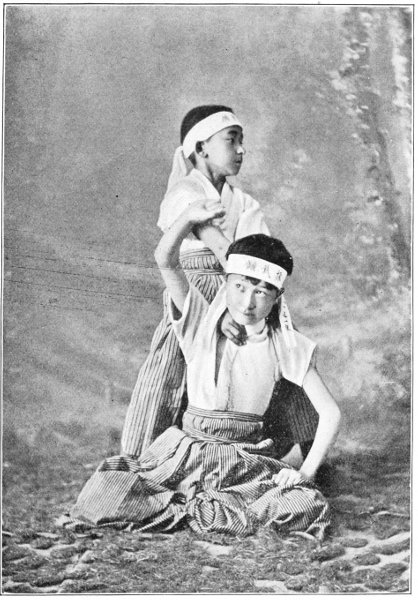
KAZUO AND IWAO, MR. HEARN’S OLDER CHILDREN
I heard that in the Stanford University in California, there are somewhat romantic conditions,—“no ceremonies,” no humbug,—estimates only of “efficiency.” Long ago I wrote the letter of application, and—like many a letter to you—posted the same in the ravening stove. “Too idyllic,”—I thought to myself,—“in the present state of evolution, no human institution could be suffered to realize the ideals of that university!” If I were wrong or right—I should like to know.
But sufficient for this writing is the perfect selfishness thereof. My dear fairy god-sister, please do not take any painful trouble for me, but—if you can hit something with your moonshiny wand, during the next year or so, I shall be so glad! Even though I be not glad, I shall always be grateful for the last kind letter.
My best wishes to you in everything that you can imagine, you will be always sure of. “If wishes”—but, after all, there is some human sweetness in these conventional phrases. They help one to utter a mood, or a sense of gratefulness for pleasure given.
Lafcadio Hearn.
TO YRJÖ HIRN Yaidzu, August, 1902.
Dear Professor,—Your kind letter of July 20th is with me....
I am so glad to hear that you are not likely to be obliged to leave Europe. It is perhaps the greatest possible misfortune for a man of culture to find himself obliged to withdraw from intellectual centres to a new raw country, where the higher mental life is still imperfectly understood. There are certain compensations, indeed,—such as larger freedom, and release from useless conventions, but these do not fully make up for the sterility of that American atmosphere in which the more delicate flowers of thought refuse to grow. I am delighted to think of your prospective pleasure in the Italian paradise.
I am writing to you from the little fishing-village of Yaidzu—where there are no tables or chairs.
Bellesort’s book is a surprisingly good book in its way. It describes only the disintegration of Japanese society—under the contact of Western ideas—the social putrefaction, the dégringolade of things. As a book dealing with this single unpleasant phase of Japanese existence, it is a very powerful book; and there are some touching pages in it. It was I who gave Bellesort the story of the little boy who committed suicide when falsely accused of stealing a cake,—and he made good use of it.... I don’t think that he is able to see the beautiful out of conventional limits; and he mostly confines himself to the directions in which he is strong. I am inclined to believe that his sympathies are clerical—that he presents Brunetière and the Jesuit side of things. However, his book is the best thing of its kind yet produced—the critical kind. It requires a special nervous structure, like that of Pierre Loti, to see the strange beauty of Japan. Let me, however, advise you to read many times the charming book of the American, Percival Lowell,—“The Soul of the Far East.” It is strange that Lowell should have written the very best book in the English language on the old Japanese life and character, and the most startling astronomical book of the period,—“Mars,”—more interesting than any romance....
Lafcadio Hearn.
TO ELLWOOD HENDRICK Tōkyō, September, 1902.
My dear Hendrick,—I had to wait several days before answering your letter,—as I felt too much pleased to venture writing for that length of time. And now, in answering, I shall have to talk a great deal about myself, and my own affairs,—which seems to me rather graceless.
All that you proposed, except two things, appear to me very good. But to put the question in the best general way, I am convinced by long experience that I can do nothing profitable with publishers, except at such serious cost to health and to literary reputation as would be utterly prohibitive. What I have been able to do so far has been done mostly in dead opposition to publishers, and their advisers; and in the few cases where I tried to do what publishers wished I have made very serious mistakes.
Editorial work on a monthly or weekly paper, with a sympathetic head, who would let me have my own way, and use a typewriter—let me agree to furnish at fixed intervals certain material, while free to use the over-time as I pleased—would be good....
Of course, the main trouble about any kind of newspaper work is that it kills all opportunity for original literary work—but I could afford the sacrifice.
Certain branches of teaching admit of opportunity for literary work,—particularly those in which teaching rises to the dignity of the lecture....
The main result of holding a chair of English literature for six years has been to convince me that I know very little about English literature, and never could learn very much. I have learned enough, indeed, to lecture upon the general history of English literature, without the use of notes or books; and I have been able to lecture upon the leading poets and prose-writers of the later periods. But I have not the scholarship needed for the development and exercise of the critical faculty, in the proper sense of the term. I know nothing of Anglo-Saxon: and my knowledge of the relation of English literature to other European literature is limited to the later French and English romantic and realistic periods.
Under these circumstances you might well ask how I could fill my chair. The fact is that I never made any false pretences, and never applied for the post. I realized my deficiencies; but I soon felt where I might become strong, and I taught literature as the expression of emotion and sentiment,—as the representation of life. In considering a poet I tried to explain the quality and the powers of the emotion that he produces. In short, I based my teaching altogether upon appeals to the imagination and the emotions of my pupils,—and they have been satisfied (though the fact may signify little, because their imagination is so unlike our own).
Should I attempt to lecture on literature in America, I should only follow the same lines—which are commonly held to be illegitimate, but in which I very firmly believe there are great possibilities. Subjects upon which I think that I have been partly successful are such as these:—
The signification of Style and Personality.
Respective values of various styles. Error of the belief that one method is essentially superior to another.
Physiological signification of the true Realism—as illustrated by the Norse writers and, in modern times, by Flaubert and Maupassant. Psychological signification of Romantic methods.
Metaphysical poetry of George Meredith: illustrating the application of the Evolutional Philosophy to Ethics.
D. G. Rossetti and Christina Rossetti.
The Poetical Prose and the Poetry of Charles Kingsley.
Four great masters of modern prose: Carlyle, Ruskin, De Quincey, Froude.
The mystical element in modern lyric verse. (I use the term “mystical” in the meaning of a blending of the religious with the passional emotion.)
Of the truth and the ideal beauty in Tolstoi’s Theory of Art.
“Beyond man:”—a chapter upon the morality of insect-communities,—suggesting the probable lines of ethical evolution.
Very heterogeneous, this list; but I have purposely made it so. I have had to lecture upon hundreds of subjects, without ever having had the time to write a lecture. (I have to lecture here twelve hours a week, on four different subjects—and to do one’s best is out of the question. The authorities never pay the slightest attention to what the professor does; but they hold him strictly responsible for the success of his lectures!) ...
I think that I have hinted ways in which I might be able to make myself useful—i. e., in the teaching of certain literary values.—There is also the subject of Composition (method, independently of grammatical and rhetorical rules). The hard experience of writing certain kinds of books ought to be of some practical worth. The art of what not to say,—the art of focussing effects,—the means of avoiding imitation (even of the unconscious order), and of developing a literary personality;—these can be talked of, I think, without a knowledge of Greek or Sanscrit. I really think that I could do some good by lecturing on these things—though conscious of having often failed in the very directions that I should recommend.
One thing more, I must not forget to say. I cannot be separated from my boy—not even for twenty-four hours. I have taught him about three hours a day every day for several years. When he becomes a little older, I may be able to let him attend a day-school; but at present, I imagine that this would be difficult. I feel handicapped; but it can’t be helped, and the race is for him.
Summary: As a cog in a wheel I should probably break off. As a personal equation I might have some worth. And I can wait a full year for a chance.
Your letter was a wonderful event for me—a great and happy surprise. The Fairy Queen also wrote me a beautiful letter (I suppose that all she does is beautiful): I had to read it many times to learn the full charm of it. I have lost all power to write a nice letter of thanks—feel stupid.
We have a nice home a little out of Tōkyō—to which I should not be ashamed to invite you, or even the Fairy Queen: only, you would have to take off your shoes, for it is a Japanese house.
I shall try to atone later on for the great length of this weary scrawl: how tired you must be after reading it! All happiness to you. Be sure that, whether I win or fail, I shall never be able to even tell you how sincerely and deeply I remain grateful for that letter.
Y. Koizumi, Lafcadio Hearn.
TO ELLWOOD HENDRICK Tōkyō, 1902.
Dear Hendrick,—I am glad to hear that you are a strong and successful swimmer in that awful sea of struggle, and that your home is happy. Having two little ones, you can understand now what the Japanese call Mono no aware,—weirdly translated by Aston as “the Ah-ness of things.”[3]
Thanks for the Martinique clippings. The Swede’s account seems to me possibly apocryphal,—for his localizations are all wrong. The other man did, apparently, visit Saint-Pierre, and explore the vicinity.—I opened and re-read that black day a letter from Saint-Pierre, enclosing a spray of arborescent fern, labelled “From the sunny garden.”
The time is approaching in which I must go abroad, for my boy’s sake. To Queen Elizabeth I wrote, asking for a possible smoothing of the way; and if you can put a spoke in my wheel any time about next spring, or during the summer, I should be as grateful as I can—which is nothing to brag of, I need scarcely say. I should like some easy post, for about two years. “Easy posts” must be in sharp demand; and I am not sure that I am asking for the possible. New York is, of course, the place where I do not want to go—for my lad’s sake; but I shall probably make a flying trip there,—if the gods allow.
For the time being, I am with Macmillan. But I fancy really that all publishers regard authors merely as units in a calculation,—excepting the great guns who, like Kipling, can force strong respect. I need scarcely tell you that my books do not make me rich. In fact, I have given up thinking about the business side of literature, and am quite content to obtain the privilege of having my book produced according to my notion of things. Still, by reason of various translations into Swedish, Danish, German and French, I have some literary encouragements.
I believe you know that I have three boys: they are sturdy lads all—though the eldest is rather too gentle up to date. I live altogether in Old Japan, outside of lecture-hours; and might think myself lucky, but for that “Ah-ness of things.” Of course, I have become somewhat old—it is more than twelve years since I saw you! And then I have had to learn a multitude unspeakable of unpleasant things. But, as they say here, Shikata ga nai! There’s no help for that!
Japan is changing rapidly, as you can imagine; and the changes are not beautiful. I try to keep within fragments of the old atmosphere—that linger here and there, like those bands of morning-coloured mist which you have seen spanning Japanese pictures. Within these wreaths of the lifting mirage, all is Fairy-land still; and my home will always have its atmosphere of thousands of years ago. But in the raw light outside, the changings are ugly and sad.
Ever faithfully,
Y. Koizumi.
TO MRS. WETMORE Tōkyō, November, 1902.
Dear Mrs. Wetmore,— ... I have had your beautiful letter in my drawer for about a week, before daring to re-read it. And I have been thinking in circles,—about how to answer it.
For—O fairy! what have you dared to say? I am quite sure that I do not know anything about Japanese art, or literature, or ethnology, or politics, or history. (You did not say “politics” or “history,” however, and that seems to be what is wanted.) But perhaps you know what I know better than I myself know,—or perhaps you can give me to eat a Fairy Apple of Knowledge. At present I have no acquaintance even with the Japanese language: I cannot read a Japanese newspaper; and I have learned only enough, even of the kana, to write a letter home. I cannot lie—to my Fairy: therefore it is essential that I make the following declaration:—
I have learned about Japan only enough to convince me that I know nothing about Japan.
Perhaps your kind professor suspects as much;—for has he not plainly said that no (American) university would hire me to teach English or French literature? That means accurate perception of my range, in one direction. Possibly, therefore, he would not expect from me any attempts at a pretence of exact knowledge.
I have held a chair of English literature here for nearly seven years, by setting all canons at defiance, and attempting to teach only the emotional side of literature, in its relations to modern thought;—playing with philosophy, as a child can play with the great sea. I have been allowed to do just as I pleased,—on the condition of being interesting (which condition the students take care shall be fulfilled). Should I attempt to lecture about Japan, I imagine that it would be necessary to allow me nearly the same liberty in America. I might hope to be suggestive,—to set minds dreaming or darkling in new directions. But I could not pretend to impart exact knowledge. I could not afford to fail: that would be ... a great shame to my good name at home. So I cannot answer “Yes” without being certain of my ability to perform all that could be reasonably expected of me,—as a small “man-of-letters” (not as anything else).
What I could do would be about thus:—
I could attempt a series of lectures upon Japanese topics,—dealing incidentally with psychological, religious, social, and artistic impressions,—so as to produce in the minds of my hearers an idea of Japan different from that which is given in books. Something, perhaps, in the manner of Mr. Lowell’s “Soul of the Far East” (incomparably the greatest of all books on Japan, and the deepest),—but from a different point of view.
What I could not do would be to put myself forward as an authority upon Japanese history, or any special Japanese subject. The value of my lectures would depend altogether upon suggestiveness,—not upon any crystallizations of fact.
Again, there is a doubt to be solved—concerning quantity as well as quality. To do my best, I should hope that quantity were not too strongly insisted upon. How many lectures would be wanted during one term—distinct lectures? and how many hours would be demanded for a lecture?... You see, the conditions in Tōkyō are monstrous: I have to lecture twelve hours a week on four different subjects;—that means for lecturing what reporter’s work means in relation to literature!... I imagine that I could endeavour to do something about equal to the work of Professor Rhys-Davids in his American lectures,—as to bulk. The six lectures represent a volume of about 225 pages. Lectures to represent, in printed form, a carefully made book of about 250 or 300 pages would represent my best effort.
For I have reached that time of life at which “the state of the weather” becomes a topic of enormous importance.
And the rest of what has to be said I shall put into a letter, which I pray you to read, and to poke into the fire if it is not satisfactory.
To fail, after being recommended by you, would be an unpardonable sin against all the higher virtues. Can’t risk it.
Well, if President Schurman can make good use of me, and arrange things within my capacity, I will go straight to your Palace of Faery before going elsewhere. Only to see you again—even for a moment,—and to hear you speak (in some one of the Myriad Voices), would be such a memory for me. And you would let me “walk about gently, touching things”?...
It is an almost divine pleasure and wonder to watch the unfolding of a soul-blossom, as you say,—providing that one is strong enough not to be afraid. I am, or have been, always afraid: the Future-Possible of Nightmare immediately glooms up,—and I flee, and bury myself in work. Absurd?
And your book—of course that will be some opportunity for a delightful chat. You will find me as good as I can be in expressing an opinion,—if the subject be within my range. I know that the work of such a person as—Mrs. Deland, for example—is beyond my limit; and I imagine that you would write of highly complex existences....
Excuse my anxiety about my chicken. I want to feel sure that I can make him comfortable and warm if I do go to Cornell. I want to make all the money, too, that I honestly can earn, for his sake and the mother’s. She will have some trying moments in the hour of parting with him. But there is no other future chance for him, and no educational place here to which I could trust him—least of all, the Jesuits. Very different it is with my second sturdy boy, who has no trace of European blood. His way is straight and smooth. I send his picture, that you may see the difference. And my third boy—sturdiest of all—will have other friends to help him, I fancy....
Lafcadio Hearn.
TO MRS. WETMORE Tōkyō, January, 1903.
Dear Mrs. Wetmore,—It was a shock to receive your beautiful letter, because I had waited so long and anxiously,—fearing that the last gleam of hope in my Eastern horizon had been extinguished. It would be of no use whatever to tell you half my doubts and fears—they made the coming of your letter an almost terrible event.
Well, what you say about my work (always seizing upon the best in it, and showing such penetrant sympathy with its effort or aim) counts for more than a myriad printed criticisms.
My boy is accustomed to kissing—from his father only, who always so dismisses him at bed-time; and he understands very well the charm of Lady Elizabeth’s sweet message, after hearing from me what the privilege signifies. But I have fairly given up the idea of taking him with me to America for the present. The risk is too great. I must try to make a nest for him first, and be sure of keeping alive myself.
In the mean time, I have been treated very cruelly by the Japanese Government, and forced out of the service by intrigues,—in spite of protests from the press, and from my students, who stood by me as long as they dared. To make matters worse, I fell sick;—I have been sick for months. About three weeks ago, I burst a blood-vessel, and I am not allowed to talk. So I fear that the lecture-business is out of the question; and I am not altogether sorry, because I do not know enough about the subject. I would wish never again to write a line about any Japanese subjects: all my work has only resulted in making for me implacable enemies.
The problem with me now is simply how I shall be able to live, and support my family. I must try to do something in America,—where the winter will not kill me off in a hurry. Literary work is over. When one has to meet the riddle of how to live there must be an end of revery and dreaming and all literary “labour-of-love.” It pays not at all. A book brings me in about $300,—after two years’ waiting. My last payment on four books (for six months) was $44. Also, in my case, good work is a matter of nervous condition. I can’t find the conditions while having to think about home—with that fear for others which is “the most soul-satisfying” of fears, according to Rudyard Kipling. However, we are all right for the time being; and I can provide for the home before I go.
Thank you for telling me the name of your book. I had hard work to get your little volume of travel when it came out: ages pass here before an “ordered” book comes. But in America I can keep track of you. I want very much to see your book. It will either tell me very, very much about you—or it will tell me nothing of you, and therefore have the charm of the Unknowable. Oh! do read the divine Loti’s “L’Inde sans les Anglais!” No mortal critic—not even Jules Lemaître or Anatole France—can explain that ineffable and superhuman charm. I hope you will have everything of Loti’s. Sometime ago, when I was afraid that I might die, one of my prospective regrets was that I might not be able to read L’Inde sans les Anglais.”
Much I should wish to see you in Japan—but human wishes!... Yet I think I could make you feel pleased for a little while—though our cooking be of the simplest. My little wife knows your face so well—your picture hangs now in her room. We have a garden, and a bamboo grove.
Now you must be tired reading me. As soon as I can feel well, I shall go to some fishing-village with my boy; and, if lucky, perhaps I shall leave for America in the fall. But nothing is yet certain.
With all grateful thought from
Lafcadio Hearn.
You cannot imagine how hungry and thirsty I have become to see you again,—or how much afraid I feel at times that I may not see you: though a season is short.
By waiting a few months more in Japan, I can, of course, make the lectures much better. But the time will seem long. Here the winter is very mild—but damp, as in New Orleans.
TO MRS. WETMORE Tōkyō, 1903.
Dear Mrs. Wetmore,—You will probably have heard by this time that President Schurman cancelled the offer made me—by reason of the trouble at Cornell University. As I had taken several steps in connection with that prospect,—the blow was rather heavy; and this you will better understand in view of the following facts:—
On the 31st March, as I anticipated, I was forced out of the university—on the pretext that as a Japanese citizen I was not entitled to a “foreign salary.” The students having made a strong protest in my favour, I was offered a reëngagement at terms so devised that it was impossible for me to reëngage. I was also refused the money allowed to professors for a nine-months’ vacation after a service of six years. Yet I had served seven years.
So the long and the short of the matter is that after having worked during thirteen years for Japan, and sacrificed everything for Japan, I have been only driven out of the service, and practically banished from the country. For while the politico-religious combination that has engineered this matter remains in unbroken power, I could not hold any position in any educational establishment here for even six months.
At my time of life, except in the case of strong men, there is a great loss of energy—the breaking-up begins. I do not think that I should be able to do much that would require a sustained physical strain. But if I could get some journalistic connection, assuring a regular salary,—for example, an engagement to furnish signed or unsigned articles, once or twice a week, or even three times,—I believe that I could weather the storm until such time as a political reaction might help me to return to Japan. For my boy’s sake these events may prove fortunate,—if I find an opportunity to take him abroad for two years.
At all events, O Fairy Queen, your gifts have “faded away”—even as in the Song,—and I am also fading away. I do not know whom else I should pray to, for the moment.
I have material evidence also that certain religious combinations want to prevent my chances in America; if you can help me to something journalistic, I imagine that it were better to let the matter remain unknown for the time being.
Perhaps I shall be able to leave Japan with McDonald (that would be nice!)—but only the gods know when he will return. Meantime, however, he gives me much comfort and promises me the fortunes of Aladdin. He seems to think I am quite safe and certain. But I am exercised about home—that is the chief trouble.
Please pardon this fresh appeal,—with all thanks for past kindness, and for those delightful letters.
Ever sincerely yours,
Lafcadio Hearn.
TO MRS. WETMORE Tōkyō, July, 1903.
Dear Mrs. Wetmore,—Your most kind letter is with me,—and I do not know what to say to thank you for the extraordinary interest and trouble that you have taken in my poor case. It is too bad that, having only one Fairy-Sister in the world, I should prove to her such a Torment. Perhaps I may be able to be at some future time a pleasure-giver—I shall pray to all the gods to help me thereunto.
Please do not worry about that Cornell matter: I suppose that President Schurman must have been in great anxiety and trouble when he wrote that letter.
You will be glad to hear that I am now much better than when I last wrote to you, and that I have finished most of the lectures—in rough draft. To polish them for publication will be at least a year’s work, I fear; but I am now able, I think, to give a cultured audience a new idea of Japan, in large outline.
I have to be careful of my health for some time. Perhaps I shall get quite strong by the end of summer. But I am now only allowed to walk in the garden....
I cannot write you a pretty letter: I have tried for two days,—but I feel so stupid.
What I want much is to get a little human sympathy and something quiet to do. Of course, I should like a university of all things,—but ... is it possible? I have a new book in MS.; but as I was expecting to go to America, I did not send it to the publisher. It will chiefly consist of ghost-tales.
My dear Fairy-Sister, I now am writing only to reach you as soon as possible,—to thank you, and to reassure you about myself. So please excuse this poor effort, and believe me most gratefully worshipful.
Lafcadio Hearn.
TO MRS. WETMORE Tōkyō, 1903.
Dear Mrs. Wetmore,—Your letter from Virginia came, and made fires of hope burn up again, with changing vague colours,—like the tints of a fire of wreck-drift remembrance from the snowy winter of 1889. It has given me a great deal to think about—not merely as regards myself, but also as regards another and very dear person....
I am delighted to read President Jordan’s kind words. I shall write him a letter to-day, or to-morrow, enclosing it to you. From Johns Hopkins I have a reply, enclosed,—which does not promise much. I shall see what can be done there. But the Lowell Institute affair promises better. As for President Jordan, I should be glad to speak at Leland Stanford independently of salary, on the way going or coming—could no other arrangement be made. It strikes me, however, that there is danger of any and every arrangement being broken up. The power of certain religious bodies is colossal.
Spring would be the best time for me to go to America, if I can get through the spider-web now spun all around me. It would be the best time, because those lectures are taking handsome shape, towards a volume of 500 to 600 pp.; and it were a pity to leave anything unfinished before I go. Spring again would be the best time, because I am not yet so strong that I can face a down-East winter without some preparation. Spring would be the best time, because my fourth child is coming into the world. Spring would be the best time, because I am getting out a new book of ghost-stories, and would like to read the proofs here, in Japan. I think it were imprudent to go before spring.
I have to think seriously about the money-question—at 53, with a large family. To go to America alone means $500 U.S., and as much to return—that signifies 2000 yen; with which I can live in Japan for two years. Then there are the necessary expenses of living. To take my boy were a great risk. Had the Japanese Government been willing to pay me the vacation money they morally owed me (about 5600 yen), I could have done it. (They told me that I ought to be satisfied to live on rice, like a Japanese.) Then I must be sure of being able to send money home. At present there is no money certainly in sight. But here I can live by my pen. Since I was driven out of the university, I have not been obliged to drop even one sen of my little hoard. The danger is the risk to sight of incessant work; but that danger would exist anywhere, except perhaps in a very hot country. And sooner or later the Government must wake up to the fact that it was wicked to me.
To go to America with some sense of security would be mental medicine; and any success that I could achieve there would make a good impression here with friends. It would mean larger experience. It would mean also an opportunity to enter some society that would protect liberal opinions. I have not said much as to the pleasure I could look forward to—that goes without saying. But I cannot be rash on the money-question, or trust to my luck as in old days. To use a Japanese expression, “my body no longer belongs to me,”—and I have had one physical warning.
Anxiety is a poison; and I do not know how much more of it I could stand. It was a friend’s treachery that broke me up recently: I worked hard against the pain—only to find my mouth full of blood. With a boy on my hands, in a far-away city, and no certainties, I don’t know that being brave would serve me much—the bodily machine has been so much strained here.
With a clear certainty ahead of being able to make some money, I could go, do good things, and return to Japan to write more books,—perhaps to receive justice also. In a few years more my boy will be strong enough to study abroad.
Very true what you say—no one can save him but himself, and unfortunately, though the oldest, he is my Benjamin. My second boy is at school, captain of his class, trusted to protect smaller boys. My eldest, taught only at home, between his father’s knees, is everything that a girl might be, that a man should not be,—except as to bodily strength,—sensitive, loving pretty things, hurt by a word, always meditating about something—yet not showing any great capacity. I taught him to swim, and make him practise gymnastics every day; but the spirit of him is altogether too gentle. A being entirely innocent of evil—what chance for him in such a world as Japan? Do you know that terribly pathetic poem of Robert Bridges’—“Pater Filio”?
That reminds me to tell you of some obligations. You are never tired of telling me that I have been able to give you some literary pleasure. How many things did you not teach me during those evening chats in New York? It was you that first introduced me to the genius of Rudyard Kipling; and I have ever since remained a fervent worshipper. It was you who taught me to see the beauty of FitzGerald’s translation, by quoting for me the stanza about the Moving Finger. And it was you who made me understand the extraordinary quaint charm of Ingelow’s “High Tide”—since expounded to many a Japanese literary class....
But this is too long a letter from
Lafcadio Hearn.
TO MRS. WETMORE Tōkyō, 1903.
Dear Mrs. Wetmore,— ... I am getting quite strong, and hope soon to be strong, or nearly as strong, as before. The bleeding was from a bronchial tube,—so I have to be careful about getting cold. But my lungs are quite sound. For the sake of the lectures, it is better that I should wait a little longer in Japan. Most of them have been written twice; but I must write them all once more—to polish them. They will form a book, explaining Japan from the standpoint of ancestor-worship. They are suited only to a cultivated audience. If never delivered, they will still make a good book. The whole study is based upon the ancient religion. I have also something to say about your proposed “Juvenilia.”
I think this would be possible:—
To include in one volume under the title of “Juvenilia”—(1) the translations from Théophile Gautier, revised; (2) “Some Chinese Ghosts;” (3) miscellaneous essays and sketches upon Oriental subjects, formerly contributed to the T.-D.; (4) miscellaneous sketches on Southern subjects, two or three, and fantasies,—with a few verses thrown in.
For this I should need to have the French texts to revise, etc. Perhaps I shall be able to make the arrangement, and so please you. But I badly need help in the direction of good opinion among people of power. The prospect of “nothing” in America is frightening. I should be glad to try England; but scholars are there plentiful as little fleas in Florida;—and the power of convention has the force of an earthquake. When one’s own adopted country goes back on one—there is small chance at the age of fifty-three.
Ever most gratefully,
L. H.
I tried to join the Masons here—but it appears that no Japanese citizen is allowed to become a Mason—at least not in Japan. The Japanese Minister in London could do it; but he could not have done it here.
TO MRS. HIRN July, 1903.
Dear Mrs. Hirn,—Your very kind letter from Italy is with me. I am sorry to know that you have met with so painful a trial since I last wrote to you. Indeed, I hope you will believe that I am sincerely and sympathetically interested in the personal happiness or sorrow of any who wish me well,—and you need never suppose me indifferent to the affairs of which you speak so unselfishly and so touchingly.
By this time, no doubt, you will have seen much of the fairest land of Europe, and will scarcely know what to do with the multitude of new impressions crowding in memory for special recognition. Perhaps Italy will tempt you to do something more than translate: one who becomes soul-steeped in that golden air ought to feel sooner or later the impulse to create. I wish I could find my way to Italy: when a child I spoke only Italian, and Romaic. Both are now forgotten.
Thanks for the magazine so kindly sent me, and thanks for your explanation of that rendering of “ewigt” as signifying endlessness in space as well as time. That, indeed, settles the matter about which I was in doubt.
It is a pleasure to know that you received “Kotto,” and liked some things in it. I thought your list of selections for translation very nice,—with one exception. “The Genius of Japanese Civilization” is a failure. I thought that it was true when I wrote it; but already Japan has become considerably changed, and a later study of ancient social conditions has proved to me that I made some very serious sociological errors in that paper. For example, in feudal times, up to the middle of the last century, there was really no possibility of travelling (for common people at least) in Japan. Iron law and custom fettered men to the soil, like the serfs of mediæval Europe. My paper, unfortunately, implied the reverse. And that part of the paper relating to the travelling of Japanese common people is hopelessly wrong as regards the past. As regards the present, it requires modification.
Your remark about the hard touch in Bellesort’s book is very just.... He was accompanied by his wife,—born in Persia, and able to talk Persian. She was keener even than he,—a very clever silent woman, attractive rather than sympathetic.... Bellesort has been travelling a great deal; and “La Société Japonaise” is his best volume of travel. His book on South America is cruel.
I am not sure whether you would care for Nitôbé’s book “Bushidō”—a very small volume, or rather treatise upon the morale of Samurai education. From a literary standpoint it would not tempt you: it is only a kind of “apology.” But it is to some extent instructive....
I suppose that Dr. Hirn will meet Domenico Comparetti, the author of “The Traditional Poetry of the Finns.” I gave a lecture lately on the poetical values of the “Kalewala,” and I found that book of great use to me.
Please excuse my loquacity, and let me wish you and the doctor every happiness and success. Perhaps I shall write you again—from America. Only the gods know.
Sincerely yours,
Lafcadio Hearn.
TO MRS. WETMORE Tōkyō, August, 1903.
Dear Mrs. Wetmore,—I am sorry for my dismal letter of the other day. I feel to-day much braver, and think that I can fight it out here in Japan. Anyhow, I have discovered that I have a fair chance of being able to live by my work—providing my health is good; and if I must live by my pen, there is no place in the world where I can do so more cheaply than here. When my boy is bigger, I may be able to send him abroad. Unless I could make money in America, it were little use to drop two thousand dollars (Japanese money) for going and coming. Besides, out of those lectures in book-form I shall make some money....
For the present, I think that I shall simply sit down, and work as hard as Zola,—though that is to compare a gnat to an eagle. It only remains for me to express to you all possible devotion of gratitude. If I had dreamed of the real state of things, I should long ago have begged you to do nothing for me in high places. I have tried to break out of my chrysalis too soon,—but, with the help of the gods, my wings will grow. To have even one well-wisher like you in America, is much;—and I have a friend or two in England, some in France, some in Denmark, Sweden, and Russia. Non omnis moriar thus.
You will hear from me in print:—there I can give you pleasure, perhaps: I am not fit to write letters. But I am getting very strong again.
With reverential gratitude,
Lafcadio Hearn.
TO MRS. WETMORE Tōkyō, 1903.
Dear Mrs. Wetmore,—I have your kindest note of June 16th, and am returning, with unspeakable thanks, the letters forwarded. I have written also to President Remsen and to President Taylor, as you wished me to do, directly.
You will be glad to hear that I am almost strong again; but I fear that I shall never be strong enough to lecture before a general public. Before a university audience I could do something, I believe; but the strain of speaking in a theatre would be rather trying. The great and devouring anxiety is for some regular employ—something that will assure me the means to live. With that certainty, I can do much. Lecturing will, I fear, be at best a most hazardous means of living. But it may help me to something permanent. I have now nearly completed twenty-one lectures: they will form eventually a serious work upon Japan, entirely unlike anything yet written. The substantial idea of the lectures is that Japanese society represents the condition of ancient Greek society a thousand years before Christ. I am treating of religious Japan,—not of artistic or economical Japan, except by way of illustration. Lowell’s “Soul of the Far East” is the only book of the kind in English; but I have taken a totally different view of the causes and the evolution of things.
I am worried about my boy—how to save him out of this strange world of cruelty and intrigue. And I dream of old ugly things—things that happened long ago, I am alone in an American city; and I have only ten cents in my pocket,—and to send off a letter that I must send will take three cents. That leaves me seven cents for the day’s food. Now, I am not hard up, by any means: I can wait another six months in Japan without anxiety. But the horror of being without employ in an American city appalls me—because I remember. All of which is written in haste to catch the mail. How good you are! I ought not to tell you of any troubles of mine—but if I could not, what would have happened me?
Lafcadio Hearn.
TO MRS. WETMORE Tōkyō, October, 1903.
Dear Mrs. Wetmore,—I have had a charming letter from Vassar,—indicating that the president must be a charming person.
I have also—which surprised me—the most generous of letters from Sir William Van Horne, President of the C. P. R. R., agreeing to furnish me with means of transportation, both ways, to Montreal and back to Japan. I shall have to do some writing, probably; but that is a great chance, and I am grateful.
French friends have taken up the cudgels for me against the Japanese Government—unknown friends. The Aurore had a 2-col. article entitled “Ingratitude Nationale,” which somebody sent me from Italy. I am too much praised; but the reproach to Japan is likely to do me good. For I have really been badly treated, and the Government ought to be made ashamed.
I am nearly quite well, though not quite as strong as I should wish. My lectures, recast into chapters, will form a rather queer book—perhaps make a quite novel impression.
I have a little daughter; and all that anxiety is past. (If I could only get quite strong, I could make a good fight for myself later on.) Anyhow, I see no great difficulty about an American trip, once the sharp cold is over; and I think you will be glad of this note from your troublesome but always grateful
Lafcadio Hearn.
TO MRS. WETMORE Tōkyō, December, 1903.
Dear Mrs. Wetmore,— ... Of course your critics have been kind. Other things of yours seemed to have a distinct quality; but this is your Self, the clearest and dearest best of you. It is so much alive that I cannot believe I have been reading a story: I thought that I knew and remembered all the people and all that they said—surely none of the life in those pages could have been imagined! I am puzzled by the brightness of the memories and the freshness of the feeling: the real world of self-seeking has such power to dull and numb that I cannot understand how you could have conserved the whole delightfulness of child-experience in spite of New York....
With me all the past is a blur—except the pain of it. It is not so much what one sees in your story, or what one hears folk say, that makes the thing so pleasing: it is rather the soft appeal made to one’s moral understanding. I mean that I never imagined how good and brave and lovable those people were till you made me comprehend. And I felt about as “home-sick” as it is lawful for a Japanese citizen to feel. But I am afraid that your very own South is now of the past:—wherefore we can appreciate it incomparably more than when it was our every-day environment....
Lafcadio Hearn.
TO TANABE Tōkyō, January, 1904.
Dear Mr. Tanabe,—I received your kind New Year’s greeting, and your good letter; and if I have delayed so long in replying, it has been only because, for some weeks past, I have not had five minutes to spare.
I was much touched by the sad news about your little girl,—and I can understand all that one does not write about such matters. Some nine years ago, I very nearly lost my little boy: we sat up with him night after night for weeks, always dreading that he was to be taken from us. Fortunately he was saved; but the pain of such an experience is not easily forgotten. As a general rule, the first child born to young parents is difficult to bring up. With the next, it is very different;—perhaps you will be more fortunate later on. One has to be brave about such matters. When Goethe was told of the death of his only son, he exclaimed: “Forward—over the dead!” and sat down to write, though the blow must have been terrible to him,—for he was a loving father.
I suppose that Mr. Ibaraki will soon be coming back to Japan. He deserves much success and praise;—for he had great obstacles to overcome as a student, and triumphed over them. I do not know who told him that I was going to England; but several persons were so—incorrectly—informed. Whether I shall go or not remains for the present undecided.
Of course the real philosophy of “Undine” is the development of what Germans call “the Mother-Soul” in a young girl. By marriage and maternity certain beautiful qualities of character are suddenly evolved, which had remained invisible before. The book is a parable—that is why it has become a world-classic.
What you tell me about your reading puzzles me a little. One must read, I suppose, whatever one can get in the way of English books at Kanazawa. Still, if my advice be worth anything, I should especially recommend you to avoid most of the current novel literature—except as mere amusement. The lasting books are few; but one can read them over so many times, with fresh pleasure every time. I should think, however, that Stevenson would both please and profit you,—the last of the great nineteenth-century story-tellers.
May all happiness and success come to you is the sincere wish of
Y. Koizumi.
TO ERNEST CROSBY Tōkyō, August, 1904.
Dear Mr. Crosby,—A namesake of yours, a young lieutenant in the United States Army, first taught me, about twenty years ago, how to study Herbert Spencer. To that Crosby I shall always feel a very reverence of gratitude; and I shall always find myself inclined to seek the good opinion of any man bearing the name of Crosby.
I received recently a copy of The Whim containing some strictures upon the use of the word “regeneration,” in one of my articles, as applied to the invigorating and developing effects of militancy in the history of human societies. I am inclined to agree with you that the word was ill-chosen; but it seems to me that your general attitude upon the matter is not in accordance with evolutional truth. Allow me to quote from Spencer:—
“The successive improvements of the organs of sense and motion, and of the internal coördinating apparatus, which uses them, have indirectly resulted from the antagonisms and competitions of organisms with one another. A parallel truth is disclosed on watching how there evolves the regulating system of a political aggregate, and how there are developed those appliances for offence and defence put in action by it. Everywhere the wars between societies originate governmental structures, and are causes of all such improvements in these structures as increase the efficiency of corporate action against environing societies.”
The history of social evolution, I think, amply proves that the higher conditions of civilization have been reached, and could have been reached, only through the discipline of militancy. Until human nature becomes much more developed than it is now, and the sympathies incomparably more evolved, wars will probably continue; and however much we may detest and condemn war as moral crime, it will be scarcely reasonable to declare that its results are purely evil,—certainly not more reasonable than to assert that to knock down a robber is equally injurious to the moral feelings of the robber and to the personal interest of the striker. As for “regeneration”—the Reformation, the development of European Protestantism and of intellectual liberty, the French Revolution, the Independence of the United States (to mention only a few instances of progress), were rendered possible only by war. As for Japan—immediately after her social organization had been dislocated by outside pressure,—and at a time when serious disintegrations seemed likely,—the results of the war with China were certainly invigorating. National self-confidence was strengthened, national discords extinguished, social disintegrations checked, the sentiment of patriotism immensely developed. To understand these things, of course, it is necessary to understand the Japanese social organization. What holds true of one form of society, as regards the evil of war, does not necessarily hold true of another.
Yours faithfully,
Lafcadio Hearn.
I have reopened the envelope to acknowledge your interesting sketch of Edward Carpenter.... What an attractive personality.
But I fear that I must shock you by my declaration of non-sympathy with much of the work of contemporary would-be reformers. They are toiling for socialism; and socialism will come. It will come very quietly and gently, and tighten about nations as lightly as a spider’s web; and then there will be revolutions! Not sympathy and fraternity and justice—but a Terror in which no man will dare to lift his voice.
No higher condition of human freedom ever existed than what America enjoyed between—let us say, 1870 and 1885. To effect higher conditions, a higher development of human nature would have been necessary. Where have American liberties now gone? A free press has ceased to exist. Within another generation publishers’ syndicates will decide what the public shall be allowed to read. A man can still print his thoughts in a book, though not in any periodical of influence; within another twenty years he will write only what he is told to write. It is a pleasure to read the brave good things sometimes uttered in prints like the Conservator or The Whim; but those papers are but the candlesticks in which free thought now makes its last flickering. In the so-called land of freedom men and women are burnt at the stake in the presence of Christian churches—for the crime of belonging to another race. The stake reëstablished for the vengeance of race-hatred to-day, may to-morrow be maintained for the vengeance of religious hate—mocking itself, of course, under some guise of moral zeal. Competition will soon be a thing of the past; and the future will be to your stock-companies, trusts, and syndicates. The rule of the many will be about as merciful as a calculating-machine, and as moral as a lawn-mower. What socialism means really no one seems to know or care. It will mean the most insufferable oppression that ever weighed upon mankind.
Here are gloomy thoughts for you! You see that I cannot sympathize with the Whitmanesque ideal of democracy. That ideal was the heart-felt expression of a free state that has gone by. It was in itself a generous dream. But social tendencies, inevitable and irresistible, are now impelling the dreamers to self-destruction. The pleasure that in other times one could find in the literature of humanity, of brotherhood, of pity, is numbed to-day by perception of the irresistible drift of things.
Ever faithfully yours,
L. Hearn.
TO MRS. WETMORE Tōkyō, September, 1904.
Dear Mrs. Wetmore,—To see your handwriting again upon the familiar blue envelope was a great pleasure; and what the envelope contained, in the same precious text, was equally delightful ... excepting some little words of praise which I do not deserve, and which you ought not to have penned. At least they might have been altered so as to better suggest your real meaning—for you must be aware that as to what is usually termed “life” I have less than no knowledge, and have always been, and will always remain, a dolt and a blunderer of the most amazing kind....
I left the dedication of the “Miscellany” untouched,—because the book is not a bad book in its way, and perhaps you will later on find no reason to be sorry for your good opinions of the writer. I presume that you are far too clever to believe more than truth,—and I stand tolerably well in the opinion of a few estimable people, in spite of adverse tongues and pens.
That little story of which you tell me the outline was admirable as an idea. I wish that you had sent me a copy of it. But you never sent me any of your writings, after I departed from New York—except that admirable volume of memories and portraits. Of course, that paper about the morals of the insect-world was intended chiefly (so far as there was any intention whatever) to suggest to some pious people that the philosophy of Evolution does not teach that the future must belong to the strong and selfish “blond beast,” as Nietzsche calls him—quite the contrary. Renan hinted the same fact long ago; but he did not, perhaps, know how English biologists had considered the ethical suggestion of insect-sociology.
In spite of all mishaps, I did tolerably well last year—chiefly through economy;—made money instead of losing any. I have a professorship in Count Okuma’s university (small fees but ample leisure); and I was able to take my boys to live with the fishermen for a month—on fish, rice, and sea-water (with sake, of course, for their sire). I have got strong again; and can use the right arm as well as ever for swimming....
The “rejected addresses” will shortly appear in book-form. The book is not what it ought to be—everything was against me—but it ought to suggest something to somebody. I don’t like the work of writing a serious treatise on sociology. It requires training beyond my range; and I imagine that the real sociologist, on reading me, must smile—
“as a Master smiles at one That is not of his school, nor any school, Save that where blind and naked Ignorance Delivers brawling judgement, unashamed, On all things, all day long.”...
I ought to keep to the study of birds and cats and insects and flowers, and queer small things—and leave the subject of the destiny of empires to men of brains. Unfortunately, the men of brains will not state the truth as they see it. If you find any good in the book, despite the conditions under which it was written, you will recognize your share in the necessarily ephemeral value thereof.