Volume 2 — LETTERS 1890-1904 (continued 5)
Reading edition
Ever with best regards,
Lafcadio Hearn.
TO PAGE M. BAKER Kōbe, May, 1895.
Dear Page,—It was almost unkind, after all to have sent the very dear picture, because it brought back too vividly hours of pleasant talk and kind words and great projects and all sorts of things which have forever passed away. But there was a pleasure in the pain too,—for it is quite a help in life to feel that ever so far away there is somebody who loves you, and whom Time will not quickly change. You look just the same. I—I should scare you were I to send you a picture—you would think Time was much faster than he is. For I am very ancient to behold.
Well, love to you for the picture....
Of news little to tell you that you do not get from other sources. Japan has yielded the Liao-tung Peninsula; but the nation is full of sullen anger against Russia and the interference-powers. The press is officially muzzled; but there is no mistaking the popular feeling. Even an overthrow of the existing Government is not impossible, and a return to that military autocracy which is really the natural government of an essentially military race. If the Japanese house of representatives had not interfered seriously and idiotically with naval expansion, Russian interference would have been almost impossible.
I was on the Matsushima yesterday, the flag-ship. She has few scars outside; but she must have been half torn to pieces inside. Her decks were covered only a few months back with blood and brains. She is only 4280 tons; and she had to fight with two 7400 ton battle-ships and European gunners. She lost half her crew, but won gloriously. (The Japanese really never lost one ship—only a torpedo-boat that got run aground.) The people are proud of her with good reason; and the officers let them come with their babies to look at the decks where stains still tell of the sacrifices for Japan’s sake.
Ever faithfully and affectionately,
Lafcadio Hearn.
TO PAGE M. BAKER. Kōbe, July, 1895.
Dear Page,—Your kindest letter has come. Of course my mention of the postage-payment was only playful spite; for I should be glad to get letters from you upon those conditions. The Japanese P.O. people don’t seem to do things after our fashion just now, since discharging all their foreign employés. The new clerks get about $10.00 a month ($4.50 American money), and most of them are married on that!
No: I do not see the newspapers. The clubs have them; but I take infinite care to avoid the vicinity of clubs. Sometimes a friend sends me a paper (the Herald, for example); and the publishers sent me only a few notices this time,—about three, I think. That Herald I saw, through kindness of a man whom I don’t even know.
I don’t know that you are wrong about not ordering the dress just now. The taller the little Constance gets, the better she will look in one. I fancy that the summer dress will be best,—it shows the figure a little: the winter dress, for a cold day, makes one look a little bit roly-poly. Perhaps a little school-girl’s dress would please you;—though it is not very dear, but rather very cheap, it is pretty,—quite pretty and of many colours. The Japanese robes bought in Japan by foreign ladies are especially made for them;—they are not the real thing. No pretty grown-up American girl would feel comfortable in the Japanese girdle, which is not tied round the waist, but round the hips,—so that Japanese women, well dressed, look shorter-limbed then they really are, and they are short of limb compared with the women of Northern races. Much stuff has been written, however, about the short-legged Japanese. I have seen as well-limbed men as one could care to see:—they are shorter of stature than Northern Europeans or Americans, but they would make a very good comparison with French, Spanish, or Italians—the dark types. They are heavily built, too, sometimes. The Kumamoto troops are very sturdy; and the weight of the men surprised me. But the finest men, except labourers, that I have seen in Japan are the men-of-war’s-men,—the blue-jackets. They are picked from the sturdiest fishing population of Southern Japan, where the men grow big, and I have seen several over six feet.
But I have been digressing. It was very sweet,—your little picture of home life with the darling fillette. She is much more advanced than my boy. He is younger, of course; but girls mature intellectually so much quicker than boys. He is puzzled, too, by having to learn two languages,—each totally different in thought construction; but he knows, when the postman gives him a letter, which language it is written in. I think, though it is not for me to say it, that the whole street loves him;—for everybody brings him presents and pets him. At first he worried me a little by calling out to every foreigner,—some rough ones into the bargain,—“Hei, papa!” But the old sea-captains and the mercantile folk thus addressed would take him up in their arms and pet him; and there is a big captain with a red face who watches for him regularly, to give him candies, etc. We are going soon to another house; and we shall miss the good kind captain.
I’m still out of work, and going to stay out of it. I think I can live by my pen. I am not sure, of course; but I can hang out here a couple of years more, anyhow,—and trust to luck. My publishers seem to be all right.
Infinite thanks about the syndicate project. I can certainly undertake the matter for the figure named,—for I won’t be away more than six months. I have written my publishers to ask if I can get certain proofs of a new book (not quite finished yet—so please don’t mention it) early enough to start about October. I should like one provision,—that I may choose another point, such as Java, in preference to Manila or Ryūkyū,—supposing ugly circumstances, such as cholera, intervene. I might try a French colony,—Tonkin, Noumea, or Pondicherry. At all events this would not hurt the syndicate’s interests. I should hope to be back in spring; and I would not disappoint you as to quality. Perhaps the more queer places I go to, the better for the syndicate.
I don’t know what to tell you about war-matters. The unjust interference of the three powers has to be considered, though, from two points of view. The first is, that the anger of the nation may create such a feeling in the next Diet as to provoke a temporary suspension of the constitution. The second is that most of us feel the check to Japan was rather in the interest of foreign residents. The feeling against foreigners had been very strong, not without reason, as the foreign newspapers, excepting the Mail and the Kōbe Chronicle, had mostly opposed the new treaties, and criticized the war in an unkindly spirit. Besides, there never had been any really good feeling between foreigners and Japanese in the open ports. Now there was really danger that after a roaring triumph, without check, over China, the previous feeling against foreigners would take more violent form. The sympathetic action of England improved the feeling very much; and really I think the check will in the end benefit Japan. She will be obliged to double or triple her naval strength, and wait a generation. In the meantime she will gain much in other power, military and industrial. Then she will be able to tackle Russia,—if she feels as she now does. The army and navy were furiously eager to fight Russia. But Russia has enormous staying power; and the fleets of three nations stood between the 150,000 men abroad and the shores of Japan. Of course it was a risk. England might have settled the naval side of the matter in Japan’s favour. But war would have had sad consequences to industry and commerce. The Japanese statesmen were right. Besides, what does Japan lose?—Nothing, except a position; for the retrocession must be heavily paid for. The anger of the people is only a question of national vanity wounded;—and though they would sacrifice everything for war, it is better that they were not suffered by the few wise heads to do so.
I was sorry about your having to slap that fellow. But you will always be the old-style Knight—preferring to give a straight-out blow, than simply to sit down at a desk and score a man every day, unwearyingly, as Northern editors do.
I am glad to hear of Matas. I used to love him very much....
As to kissing in Japan, there is no kissing. Kissing is not “forbidden” at all;—there is simply no impulse to kiss among the Turanian races. All Aryan races have the impulse, as an affectionate greeting. Children do not kiss their parents;—but the pressing of cheek to cheek is nearly the same thing—as a demonstration. Mothers lip their little ones;—but—how shall I explain? The kiss, as we understand it in the Occident, is considered not as an affectionate, but as a sexual impulse, or as of kin to such an impulse. Now this is absolutely true. Undoubtedly the modern kiss of the cultivated West may have no such meaning in 99,997 cases out of 99,998. But the original primitive signification of pressing lip to lip, as Aryan races do, or even lip to cheek, is physiologically traceable to the love which is too often called l’amour, but which has little to do with the higher sense of affection. With us the impulse of a child to kiss is absolutely instinctive. The Japanese child has no such impulse whatever; but his way of caressing is none the less delicious.
On the other hand, it is significant that the Japanese word for “dear,” “lovable” is also used to signify “sweetness” of the material saccharine kind. But perhaps this is offset by the fact that Japanese confectionery, though delicious, never nauseates through over-sweetness; and that the quantity of sugar used is very much less than with us. One never gets tired of kwashi; but plumcake and bonbons in the West need to be sparingly used. Perhaps we want too much sweetness of all kinds. The Japanese are in all things essentially temperate and self-restrained—as a people. Of course, Western notions and examples begin to spoil them a little.
It is possible by the time this reaches you that I shall have become a Japanese citizen,—for legal reasons. (Say nothing yet about it.) If I marry my wife before the consul, then she becomes English, and loses the right to hold property in her own country. Marrying her by Japanese custom will not be acknowledged as legal, without special permission of the minister of foreign affairs,—but if I get the permission, then she becomes English, and the boy too. So my marriage, though legal according to every moral code, and according to the old law, becomes illegal by new law, and the wife and family—as I really follow the Japanese code, supporting father, mother, and grandparents—have no rights except through a will, which relatives can dispute. I therefore cut the puzzle by changing nationality, and becoming a Japanese. Then I lose all chance of Government employ at a living salary; for the Englishman who becomes a Japanese is only paid by the Japanese scale. Also I lose the really powerful protection given to Englishmen by their own nation. Finally I have to pay taxes much bigger than consular fees, and my boy becomes liable to military service. (But that won’t hurt him.) I hope in any case to give him a scientific education abroad. The trouble is I am now forty-five. I’ll be sleeping in some Buddhist cemetery before I can see him quite independent....
I have lost friends because their wives didn’t like me—more than once;—as Chamberlain says, “No: you’ll never be a ladies’ man.” But the kindly spirit of Mrs. Baker shows even through your own letters;—and if I can ever see you again, I know that, although not a ladies’ man, I won’t be disliked in one friend’s home as a fugitive visitor. Say everything grateful to her for me that you can.
Good-bye, with love to your pretty gold-head,—and regards to all friends.
Lafcadio Hearn.
TO BASIL HALL CHAMBERLAIN Kōbe, July, 1895.
Dear Chamberlain,—In reading Schopenhauer (I believe you have the splendid Haldane & Kemp version in three volumes: it is said to preserve even the remarkable sonority of the German original), you may notice where Schopenhauer failed, only through want of knowledge undeveloped in his time. While highly appreciating Lamarck,—the greatest of the evolutionists before Darwin, greater even than Goethe,—he finds fault with his theory as not showing proof of the prototype formless animal from which all organic forms existing are derived. Therefore Schopenhauer insisted on the potential prototype existing in the Will only. But since Schopenhauer’s day, the material formless prototypal animal has been found; and the theory of Schopenhauer as to forms falls back into a region of pure metaphysics. He is none the less valuable on that account. He represents the soul (psyche) of an enormous fact, or at least a soul which can be fitted to the body of science for the time being. He has been justly called a German Buddhist; and his philosophy is entirely based on the study of Brahmanic and Buddhist texts. The only absolutely novel theory in his book is the essay on sexual love,—vol. 3 in your edition. There is one defect in it, but that does not hurt the value of the whole. And then the splendour of style, of self-assertion, of imagery Huxley equalled only, I think twice, in all of his essays. Of course Schopenhauer belongs to the evolutional school; that is the reason why he has been taken up to-day after long neglect. His work gives new force to evolutional psychology of the new school. The most remarkable popular effect of the newer school has not, I think, yet been noticed. It is in fiction; and the success of a work taken in this line recently has made a fortune for publishers and author. Unfortunately, poor I have not the constructive art necessary to attempt anything of the kind—not yet! Perhaps in twenty years more.
Very faithfully,
Lafcadio Hearn.
TO BASIL HALL CHAMBERLAIN Kōbe, August, 1895.
Dear Chamberlain,—A delicious surprise,—though one that gave some pain; for I suffered to think you should have used your eyes to such an extent for my sake. Mason, too, one day actually wrote me that he would copy something for me if I needed it (which luckily I had got from another source): I should be pained to have either of you try your eyes for my poor vagaries. Please don’t think me too selfish;—it was simply lovable of you, but don’t do it again.
I think I may be able to use a fragment or two effectively: what I want now to get is the rhythm used in the singing,—and that none of my people can remember. They said it was very wonderful, but very difficult to catch: so that it would seem some melodies are as hard for the Japanese themselves to learn by ear, as they are for us to so learn. I had the same curious experience at Sakai and in Kizuki; yet I asked persons who had been listening to the singing for several hours, and were natives of the place. They all said, “Ah! that is very difficult. So a good ondo tori is hard to find; and they are paid well to come to our festivals.” But when the woman comes again I shall try to syllabify the measure on paper.
I can feel the popular mind in the peasant songs: in the military songs I cannot. But there is a queer variation in tone used in military singing which is very effective. The leader suddenly turns down his voice nearly a full octave, and all the chorus follow: it is like a sudden and terrible menace,—then all go back to high tenor notes again. What you tell me about Ryūkyū priests’ songs surprised me. You must have got everything that could be got there in an astonishingly short time. I sent you the Nara miko-songs,—mystical hymns about sowing, etc.,—very artless. The Nara and Kompira miko are really virgins. Entre nous I am sorry to say that the miko of Kizuki are not: but, as they ought to be, there is no use specifying in any public way. It would be like denying the virtue of nuns in general, because one or two sisters fall from grace. While the ideal lives anywhere it strikes me as wrong to insist too much on realism.
I know you make a collection of everything relating to Japan, so I must send you a photo of Yuko Hatakeyama. I had it copied from a badly faded one—so it does not come out well. You are not of those who refuse to see beyond the visible; and though there is nothing beautiful or ideal in this figure, it was certainly the earthly chrysalis of a very precious and beautiful soul, which I have tried to make the West love a little bit. So you may prize it.
Some one, thinking to please me, sent me by this mail a large French periodical, full of gravures porno-or semi-pornographiques, Saint Anthony and French courtesans and angels mixed up together. I burned the thing,—astonished at the revulsion of feeling it produced in myself. (The work was beautiful in its way, of course, but the way!) After all, it seems to me that Japanese life is essentially chaste: its ideals are chaste. I can feel now exactly how a Japanese feels about certain foreign tendencies. I know all about Japanese picture-books of a certain class—innocent things in their very frankness: there is more real evil, or at least more moral weakness in any number of certain French public prints. It strikes me also that the charm even of the jōro to the Japanese mind is quite different from any corresponding Western feeling. She figures simply as an ideal lady of old time, and the graces cultivated in her, and the costume donned, are those of an ideal past. The animalism of half-exposures and suggestions of whole exposures is not any more Japanese than it was old-Persian. Even the naughty picture-books were intended for imitations, catechism.
Talking of catechism, I have been thinking of making a Buddhist catechism of a somewhat fantastic sort.
“How old are you?”
“I am millions of millions of years old, as a phenomenon. As absolute I am eternal and older than the universe,” etc.
Faithfully ever,
Lafcadio Hearn.
TO ELLWOOD HENDRICK Kōbe, September, 1895.
Dear Hendrick,— ... I am waiting every day for the sanction of the minister to change my name; and I think it will come soon. This will make me Koizumi Yakumo, or,—arranging the personal and family names in English order,—“Y. Koizumi.” “Eight clouds” is the meaning of “Yakumo,” and is the first part of the most ancient poem extant in the Japanese language. (You will find the whole story in “Glimpses”—article “Yaegaki.”) Well, “Yakumo” is a poetical alternative for Izumo, my beloved province, “the Place of the Issuing of Clouds.” You will understand how the name was chosen.
If all goes well, and I am not obliged to return to America, I shall next year probably return to Izumo, and make a permanent home there. So long as I can travel in winter, I need not care about the weather. When my boy grows big enough, if I live, I shall take him abroad, and try to give him a purely scientific education—modern languages if possible, no waste of time on Latin, Greek, and stupidities. (Literature and history can be best learned at home; and the greatest men are not the products of schools, not in England or America, at least: Germany is an exception.) He might turn out to be very commonplace, in which case all plans must be changed; but I suspect he will not be stupid. He says, by the way, that he was a doctor in his former birth. It is quite possible, for he has my father’s eyes.
In regard to what you asked me about the English literature business, I think there is no way of teaching English literature except by selections,—joined together with an evolutional study of English emotional life, illustrated after the manner of Taine’s “Art in Italy,” etc. But such work, combining history with literature, would involve the use of an immense library, and would be very costly to the teacher. By the way, I hate English literature. French literature is much more interesting. What I should most like would be to make a study of comparative literature—including Sanscrit, Finnish, Arabic, Persian,—systematizing the best specimens of each into kindred groupings on the evolutional plan. That would be worth doing; for it means a study of the evolutional development of all mankind. But such undertakings, I fear, are for the extremely rich.
Lafcadio Hearn.
TO ELLWOOD HENDRICK Kōbe, Autumn, 1895.
Dear Hendrick,— ... It has often occurred to me to ask whether you think other men feel as I do about some things—you yourself, for example. Work with me is a pain—no pleasure till it is done. It is not voluntary; it is not agreeable. It is forced by necessity. The necessity is a curious one. The mind, in my case, eats itself when unemployed. Reading, you might suggest, would employ it. No: my thoughts wander, and the gnawing goes on just the same. What kind of gnawing? Vexation and anger and imaginings and recollections of unpleasant things said or done. Unless somebody does or says something horribly mean to me, I can’t do certain kinds of work,—the tiresome kinds, that compel a great deal of thinking. The exact force of a hurt I can measure at the time of receiving it: “This will be over in six months;” “This I shall have to fight for two years;” “This will be remembered longer.” When I begin to think about the matter afterwards, then I rush to work. I write page after page of vagaries, metaphysical, emotional, romantic,—throw them aside. Then next day, I go to work rewriting them. I rewrite and rewrite them till they begin to define and arrange themselves into a whole,—and the result is an essay; and the editor of the Atlantic writes, “It is a veritable illumination,”—and no mortal man knows why, or how it was written,—not even I myself,—or what it cost to write it. Pain is therefore to me of exceeding value betimes; and everybody who does me a wrong indirectly does me a right. I wonder if anybody else works on this plan. The benefit of it is that a habit is forming,—a habit of studying and thinking in a way I should otherwise have been too lazy-minded to do. But whenever I begin to forget one burn, new caustic from some unexpected quarter is poured into my brain: then the new pain forces other work. It strikes me as being possibly a peculiar morbid condition. If it is, I trust that some day the power will come to do something really extraordinary—I mean very unique. What is the good of having a morbid sensitive spot, if it cannot be utilized to some purpose worth achieving?
There was a funny suicide here the other day. A boy of seventeen threw himself on the railroad track and was cut to pieces by a train. He left a letter to his employer, saying that the death of the employer’s little son had made the world dark for him. The child would have nobody to play with: so, he said, “I shall go to play with him. But I have a little sister of six;—I pray you to take care of her.”
Ever affectionately,
Lafcadio Hearn.
TO BASIL HALL CHAMBERLAIN September, 1895.
My dear Chamberlain,—Your paper on Luchu gave me more pleasure, I am sure, than it even did to the president of the society before whom it was read; and I was delighted with the nice things said of you. Of course this paper—being a much more elaborate monograph than the other—differs from its predecessor in the matter of suggestiveness. To me it is like a graded anthropological map,—shading off the direction of character-tendencies, language, customs, to the uttermost limit of the subject. I had no idea how much you had been doing in the Archipelago—your own field of research by unquestionable right. If I ever go down there I shall certainly attempt nothing out of the much humbler line which I can follow: there is really nothing left for another man to do in the way of gathering general knowledge about an unfamiliar region.
There is one expression of opinion in the monograph which I may venture a remark about. The idea is growing upon me, more and more each day I live, that the supposed indifferentism of the Japanese in religious matters is affected indifferentism—that it is put on like yofuku, only for foreigners. I see too much of the real life, even here in Kōbe, to think the indifferentism real. And I believe the Jesuits, who are better judges far than our comfortable modern proselytizers, never accused the Japanese of indifference. However, this is but suggestive: I think that should you ever find time to watch the incidents of common life minutely, you will recognize the Jesuits as the keenest observers. As for the educated classes, I have also reason to know that in most cases the indifference is feigned. This will show you how my own opinions have changed in five years’ time.
Very truly yours,
Lafcadio Hearn.
TO SENTARŌ NISHIDA Kōbe, October, 1895.
Dear Nishida,—Kazuo knows your picture, always hanging on the wall by my desk, and your name—so that if you see him soon, he will not think you a stranger. He talks well now, but is getting naughty, like his father used to be—very naughty. I see my own childish naughtiness all over again. I think he will be cleverer than his father. If he shows real talent, I shall try to take him to France or to Italy, later on in life. English schools I don’t like: they are too rough. New England schools are better; especially for the earlier teaching. The systems of Spencer and others have been much better followed out in Eastern Massachusetts than in England, where religious conservatism persists in loading the minds with perfectly useless acquirements. The future demands scientific education—not ornamented; and the thoroughly trained man never needs help. I remember a friend in the United States Army,—engineer and graduate of West Point (a splendid institution): he was coaxed out of the army by an electrical company because of his knowledge of applied mathematics. What wonderful men one meets among the scientifically educated to-day one must go abroad to know. Such men, unfortunately, do not come to Japan. If they had been chosen for teachers, I fancy that education would have felt their influence. It does not feel the influence of common foreign teachers. But, a student said to me, “We must cultivate our own powers through our own language hereafter,”—and I think he expressed the sensible general feeling of the day.
Ever with kindest hopes and wishes for you,
Lafcadio Hearn.
TO BASIL HALL CHAMBERLAIN Kōbe, November, 1895.
Dear Chamberlain,—Your more than gracious flying visit, having set in motion the machinery of converse, left me long continuing a phantom talk with a phantom professor across a real table,—which I touched to make sure.
Then my wife’s delight with her Miyako-miyage, and the boy’s with the pictures, you can imagine,—though not perhaps my own feeling of mingled pleasure and sorrow. Whatever you do is done so delicately and finely that I fear I could show no appreciation of it in writing.
It was lucky that we had returned from Kyōto just so as to be here for your visit. What pleased me most of all, perhaps, was your seeing my boy. I have often thought if I can realize my dream of taking him to Europe, which now seems quite possible, I might some day have the pleasure of presenting him as a man.
You wanted a thinking book; and I must confess that is now my own want: I care only for a novel when it illustrates some new philosophical idea, or when it possesses such art that it can be studied for the art alone. Perhaps Lombroso would interest (and revolt) you at the same time: Nordau is only a new edition of Lombroso, I think—a journalistic one. I detest his generalizations, so far as I know them through extracts: all being false that I have seen. Progress depends on variation; and the morale of Nordau would lead to, or accentuate, already existing Chinese notions in the conventional world, that all departures from formality and humbug are to be explained by degeneration. Without having read it, I should judge the book a shallow one,—much at variance with Spencer’s views on eccentricity and its values. Of the Italian school, Mantegazza most appeals to me, and would, I think to you—though he is sentimental as Michelet in “L’Amour.” ...
You think me too dissatisfied, don’t you? It is true I am not satisfied, and already unable to look at my former work. But the moment a man can feel satisfied with himself, progress stops. He can only move along a level afterwards; and I hope the level is still some years off. (I see a possibility to strive for; but I am afraid even to speak of it—so well out of reach it now is.) But what you will be glad to hear is that my publishers are treating me well enough. I have up to September made about 2000 yen (Japanese money), and prospects of making about 4000 in 1896. It is now largely a question of eyes.
I visited the grave of Yuko Hatakeyama last week at Kyōto,—and saw all the touching relics of her, and of her suicide: also secured copies of her letters, etc. A nice monument has been erected over her resting-place by public subscription; and there was a little cup of tea before the sekito when I arrived.
Needless to say that I am asked to send messages which could only be spoiled by putting them into English, and my wife is ashamed, or at least shy, of writing what she would like to write if possessing more self-confidence in matters epistolary. But you will understand without more words.
Most gratefully,
Lafcadio Hearn.
TO SENTARŌ NISHIDA Kōbe, December, 1895.
Dear Nishida,—I suppose we have both been very busy—you with the winter school-term, and I with my new book. I trust you got my last letter, and that you know how grateful we feel to you for the advice and help given to Mr. Takaki, and for smoothing matters. We are also anxious to hear that you are well, and are hoping to see you this coming summer.
As for the naturalization business, it seems to hang fire.[2] A couple of months ago, there came to the house an official, who asked us many questions. What he asked me was not important or interesting; but his questions to Setsu were amusing. He enquired how long we had been together—whether I had always been kind—whether she thought I would always be good to her—whether she would be content always to have such a husband—whether she was in earnest—whether she had made the application of her own free will, or under pressure from relations—whether I had not forced her to make such an application—whether she held any property in my name. Afterwards she had to go to some office where she was asked the same questions over again. Since that time we have heard nothing. I am wondering if my request (or her request, I should say) will be refused. I suppose it could be; and I have not been over-prudent, for I did not reply respectfully to the offer of a place of some sort in the university—what kind of place I don’t know—made through Kano,—and I think Saionji has charge of the foreign business just now. Perhaps it is all right;—the delay, however, has its legal vexations:—money-orders having been made out, for example, in a Japanese name,—a little too soon. What a funny thing it all is.
I made the acquaintance some ten days ago of Wadamori Kikujirō,—the memory-man. He is a native of Shimane. I did all I could to please him, and hope to do more. He gave me an exhibition of his wonderful power,—and another exhibition to a small circle of foreigners to whom I was able to introduce him. They were very much pleased.
I think I told you that “Kokoro” is printed,—that is, in type. I am waiting only for the proofs. I think you will get a copy in March or April. Half of another Japanese book has been written, and part of another book (not on Japanese subjects)—so you will see how hard I have been working. Also my eyes are very much better. It seems to have been a case of blood to the eyes; and a doctor told me that if I took violent exercise I should get well. I did so,—and got quite well. I have only now to be careful.
Exercise was difficult at first; but now I am used to it. By exercising every day, I have kept quite well.
Kazuo, except for a cold, is all a father can imagine. He talks very well now, and tries to draw a little. I must get rich for his sake if I have any brains to make money. My friends in America and England predict good fortune for me. I am not too hopeful; but I think it is much better that I hereafter devote all my efforts to writing—until I find whether I can do well by it. Should I succeed I can travel everywhere, and Kazuo’s education abroad would not be a cause of anxiety.
Ever with warmest regards,
Lafcadio Hearn.
TO ELLWOOD HENDRICK Kōbe, December, 1895.
Dear Hendrick,—Eyes a little better, and courage reviving. Moreover I enclose letter showing prospects in a better light. The book is to be out in spring.
My boy is beginning to talk, and to look better. He walks now. He has much changed,—always growing fairer. I shall send a photo of him as soon as I think the difference from his first chubby aspect becomes apparent enough to interest you....
What succeeds like force?—eh? See what Japan has now become in the eyes of the world! Yet that war was unjust, unnecessary. It was forced upon Japan. She knew her strength. Her people wished to turn that strength against European powers. Her rulers, more wisely, turned the storm against China,—just to show the West what she could do, if necessary. Thus she has secured her autonomy. But let no man believe Japan hates China. China is her teacher and her Palestine. I anticipate a reaction against Occidental influence after this war, of a very serious kind. Japan has always hated the West—Western ideas, Western religion. She has always loved China. Free of European pressure, she will assert her old Oriental soul again. There will be no conversion to Christianity. No! not till the sun rises in the West. And I hope to see a United Orient yet bound into one strong alliance against our cruel Western civilization. If I have been able to do nothing else in my life, I have been able at least to help a little—as a teacher and as a writer, and as an editor—in opposing the growth of what is called society and what is called civilization. It is very little, of course,—but the gods ought to love me for it. They ought to make me rich enough to go every year for six months to uncivilized lands—such as Java, Borneo, etc. If I have good luck with my books, I’ll make a tropical trip next spring.
Love to you,
Lafcadio.
TO ELLWOOD HENDRICK Tōkyō, January, 1896.
Dear Hendrick,—It is really queer, you know—this university. It is imposing to look at,—with its relics of feudalism, to suggest the picturesque past, surrounding a structure that might be in the city of Boston, or in Philadelphia, or in London, without appearing at all out of place. There is even a large, deserted, wood-shadowed Buddhist temple in the grounds!
The students have uniforms and peculiar caps with Chinese letters on them; but only a small percentage regularly wear the uniform. The old discipline has been relaxed; and there is a general return to sandals and robes and hakama,—the cap alone marking the university man.
About seventy-five per cent of the students ought not to be allowed in the university at all for certain branches. Some who know no European language but French attend German lectures on philosophy; some who know nothing of any European language attend lectures on philology. What is the university, then?—is it only a mask to impose upon the intellectual West? No: it is the best Japan can do, but it has the fault of being a gate to public office. Get through the university, and you have a post—a start in life. Fancy the outside Oriental pressure to force lads through—the influences intercrossing and fulminating! Accordingly, the power within is little more than nominal. Who rules in fact? Nobody exactly. Certainly the Directing President does not,—nor do the heads of colleges, except in minor matters of discipline. All, or nearly all, are graduates of German, English, or French or American universities;—they know what ought to be—but they do only what they can. Something nameless and invisible, much stronger than they,—political perhaps, certainly social,—overawes the whole business.
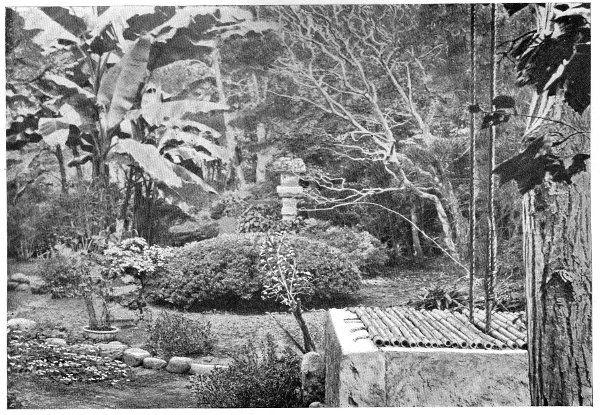
MR. HEARN’S GARDEN IN TŌKYŌ
I ought not to say anything, and won’t except to you. No foreign professor says much,—even after returning home. None have had just cause to complain of treatment received. Besides, if things were as they are in the West, I wouldn’t be allowed to teach (there would be a demand for a “Christian” and gentleman). I lecture on subjects which I do not understand; and yet without remorse, because I know just enough to steer those who know much less. After a year or two I shall probably be more fit for the position.
Studying in one class, for a university text, Tennyson’s “Princess” (my selection); in another, “Paradise Lost,”—the students wanted it, because they heard it was difficult. They are beginning to perceive that it is unspeakably difficult for them. (Remember, they know nothing of Christian mythology or history.) I lecture on the Victorian poets, etc., and on special themes,—depending a good deal on dictation.
Only two and one half miles from the university. Seas of mud between. One hour daily to go, and one to return by jinrikisha!—agony unspeakable. But I have one joy. No one ever dreams of coming to see me. To do so one should have webbed feet and be able to croak and to spawn,—or else one should become a bird. It has rained for three months almost steadily;—some of the city is under water: the rest is partly under mud. And to increase the amphibious joy, half the streets are torn open to put down Western water-mains. They will yawn thus, probably, for years to come.
The professors I have seen few of. I send you two books; notice the charming pictures to “Inoshima.” Florenz is a Magister Artium Liberalium of Heidelberg, I think,—fat and good-natured and a little—odd. There is a Russian professor of philosophy, Von Koeber,—a charming man and a divine pianist. There is a go-and-be-damned-to-you American professor of law.... There is a Jesuit priest, Emile Heck,—professor of French literature. There is a Buddhist priest, professor of Buddhism. There is an anti-Christian thinker and really great philosopher, Inoue Tetsujirō,—lectures against Western Christianity, and on Buddhism. There is an infidel,—a renegade,—a man lost to all sense of shame and decency, called Lafcadio Hearn, professing atheism and English Literature and various villainous notions of his own.
The Jesuit I did not want to know. I am afraid of Jesuits. Out of the corner of mine cyclops-eye I looked upon him. Elegantly dressed,—with a beard enormous, bushy, majestic, black as hell,—and a small keen bright black caressing demoniac eye. The Director, who knows not, introduced me!—oh! ah! Embarrassed at the thought of my own thoughts contrasted with the perfect courtesy of the man. Blundered;—spoke atrocious French; gave myself away; got questioned without receiving any idea in return except an idea of admiration for generous courtesy and very quick piercing keenness. Felt uncomfortable all day after—talked to myself as if I had still before me the half-shut Jesuit eye and the vast and voluminous beard. Et le fin au prochain numéro,—ou plus tard.
L. H.
TO PAGE M. BAKER Kōbe, January, 1896.
Dear Page,—What a pleasure your letter was—in spite of the typewriting! How shall I answer it? From the end backwards,—as the last was the most pleasant.
Of course it was really long ago that we used to sit together—sometimes in your office, sometimes upon a doorstep, sometimes at a little marble-topped table somewhere over a glass of something,—and talk such talk as I never talked since. It is very nearly ten years ago. That is quite true. But you say that my flitting has been my gain, and that I have made myriads of friends by my books. That is not quite so true as you think. You think so only because you have still the heart of the old Southern gentleman,—the real aristo. and soldier,—the man who said exactly what he thought, and expected other people to do the same, and lived in a world where people did so. That is why also you remain for me quite distinct and different from other men: you have never lost your ideals—therefore you can remain ideal to others, as you will always do to me. But you are enormously mistaken in supposing that I have made myriads of friends, or gained anything—except what one gains by disillusion, and the change that comes with the care and love of others: this, of course, is gain. But book-success! No: it seems to me just the reverse. The slightest success has to be very dearly paid for. It brings no friends at all, but many enemies and ill-wishers. It brings letters from autograph-hunters, and letters enclosing malicious criticisms, and letters requesting subscriptions to all sorts of shams, and letters of invitation to join respectable-humbug societies, and requests to call on people who merely want to gratify the meanest sort of curiosity,—that which views a fellow creature only as a curiosity. Then, of course, there are uncounted little tricks and advertising dodges to be avoided like pitfalls,—and extravagant pretences of sympathy, often so clever as to seem really genuine, made for utilitarian purposes. Then there are all sorts of little snobberies and patronizings and disappointments. And after the work is done, it soon begins to get shabby and threadbare in memory; and I pick it up and wonder how I could have written it, and marvel how anybody could have bought it, and find that the criticisms which I didn’t like were nearly all true. Sometimes I feel good, and think I have really done well; but that very soon passes, and in a day or two I find I have been all wrong, and sure never to write anything quite right.
The fact seems to be that when ideals go away, writing becomes mere downright hard work; and the reward of the pleasure of finishing it is not for me, because I have nobody to talk to about it, and nobody to take it up, and read it infinitely better than I could do myself. The most delightful criticisms I ever had were your own readings aloud of my vagaries in the T.-D. office, after the proofs came down. How I should like to have that experience once more—just to hear you read something of mine quite fresh from the composition-room,—with the wet sharp inky smell still on the paper!
But I suppose I have gained otherwise. You also. For there is something in everybody—the best of him, too, isn’t it?—which only unfolds in him when he has to think about his double,—the other self to which he has given existence; and then he sees things differently. I suppose you do. I imagine you must now be ever so much more lovable than you used to be—but that you have less of yourself proportionately to give away. If I were in New Orleans I don’t think that I could coax you to talk after a fixed hour: you would say, “—! it’s after twelve o’clock: I must be off!”
What you write about little Miss Constance is very sweet. I hope soon to send her some Japanese fairy-tales written by your humble servant;—that is, I hope; for the Tōkyō publisher is awfully slow in getting them out. You have had anxiety, I find. But the delicacy that causes it means a highly complex nervous organization; and the anxieties will be well compensated, I fancy, later on. She will become, judging from the suggestion of that gold-head in the photograph, almost too beautiful: I hope to see another photograph later on. I shall send one of Kazuo in a few days. We were terribly frightened about him,—for he caught a serious cold on the lungs; but after a few weeks he picked up well. He gets taller, and every day surprises us with some new observation. He seems to get fairer always instead of darker—nobody now ever takes him to be a Japanese boy. He is very jealous of his mother,—won’t allow me to monopolize her for even five minutes; and I am no longer master in my own house. Servants and relatives and grandparents, they all obey him,—and pay no attention at all to my wishes unless they happen to be in harmony with his own. Certainly Japanese people are kinder to children than any other people in the world,—too good altogether. Still, they do not spoil children,—for as a general rule they manage to make them grow up strangely, incomprehensibly obedient. I don’t understand it,—except as heredity: indeed, I may as well frankly say that the longer I live in Japan, the less I know about the Japanese. “That is a sign,” says one Oriental friend, “that you are beginning to understand. It is only when a foreigner confesses he knows nothing about us that there is some reason to expect he will understand us later on.”
About the letters, I need only say, perhaps, that I shall give you the best of what I write this year (excepting, of course, essays on Buddhist philosophy, or stuff of that sort, which would be out of place, no doubt, in a newspaper). I may include a few little stories....
“Kokoro” ought to reach you next March. It is rather a crazy book; but I wish I could hear you read one or two pages in it....
Ever affectionately,
Lafcadio Hearn.
TO OCHIAI Kōbe, February, 1896.
Dear Ochiai,—I am delighted that you have taken up medicine, for two reasons. First, it will assure your independence—your ability to maintain yourself, and to help your people. Secondly, it will change all your ideas about the world we live in, and will make you large-minded in many ways, if you study well. For in these days, you cannot study medicine without studying many different branches of science—chemistry, which will oblige you to understand something of the nature of the great mystery of matter,—physiology, which will show you that the most ordinary human body is full of machinery more wonderful than any genius ever invented,—biology, which will give you perceptions of the eternal laws which shape all form and regulate all motion,—histology, which will show you that all life is shaped, after methods that no man can understand, out of one substance into millions of different forms,—embryology, which will teach you how the whole history of a species or a race is shown in the development of the individual, as organ after organ unfolds and develops in the wonderful process of growth. The study of medicine is, to a large extent, the study of the universe and of universal laws,—and makes a better man of any one who is intelligent enough to master its principles. Of course you must learn to love it,—because no man can do anything really great with a subject that he does not like. There are many very horrible things in it which you will have to face; but you must not be repelled by these, because the facts behind them are very beautiful and wonderful. There is so much in medicine—such a variety of subjects, that you will have a wide choice before you in case some particular branch should not be attractive to you.
Also do not forget that your knowledge of English will be of great use to you in medicine, and that, if you love literature, medicine will give you plenty of chance to indulge that love. (Some of our best foreign authors, you know, have been practising physicians.) In Kōbe I find that some of the best Japanese doctors find English very useful to them, not only in their practice, but also in their private studies. But you will also have to learn German; and that language will open to you a very wonderful literature, if you like literature—not to speak of the scientific advantages of German, which are unrivalled.
Well, I trust to hear good news from you later on. Take great care of your health, I beg of you, and believe me ever anxious for your success.
Very truly always,
Lafcadio Hearn.
TO SENTARŌ NISHIDA Kōbe, February, 1896.
Dear Nishida,—I should have answered your kindest letter before now but for illness,—so I only sent a photo of Kazuo, as I had a cold in my eyes, nose, chest, back; a most atrocious and damnable cold, which rendered any work out of the question.
Mr. Katayama—dear Mr. Katayama—wrote a charming little poem. I am going to have a large copy made of it, and have it mounted as a little kakemono, for a souvenir. I love all these funny little things: they are the real Japan—the humour and the kindness and the grace of it. As for the so-called New Japan,—with its appearance of Occidentalism, and its utter loss of the old poetry and the old courtesy—well, however necessary it may be, it is certainly as much of a moral loss as it is a material advance. I wish I could live somewhere out of the sight and the sound of all that is new.
I had a letter from Ochiai, which I shall answer in a day or so;—for the moment I am behind with all my correspondence. What can be the matter with the lad? He did not tell me the nature of his sickness. I am really sorry for him. Strangely enough, on the very same day, I had a letter from one of the cleverest of the Kumamoto students, who seemed a tower of strength, but who has broken down after a year at the university. Some students I liked have gone mad; numbers have died; numbers have had to give up. The strain is too great because the hardship is too great,—the cold, the poor cheap food, the poor thin clothes. “Hardy” the lads claim to be. So naturally they are—much hardier than Europeans in certain respects. But some knowledge of physiology seems to be needed in Government schools. No man—however strong—can keep hardy while the heavy strain of study is unsupported by good living. I think most of the lads I know who died or went mad would never have even fallen sick if they had had only hard physical labour. Physical labour is not dangerous, but strengthening. And in the Government schools there is no feeling for the lads: everybody has to do the best he can for himself. Those who do get through the mill are not always the best—though they may be the strongest.
Ever, with best regards of all of us,
Lafcadio Hearn (Koizumi Yakumo).
TO PAGE M. BAKER Kōbe, March, 1896.
Dear Page,—I have your exquisite photo of Constance—like a bit of marble it is.... And I have your letter—a very dear letter, though—excuse me—I cannot help hating the typewriter!
I have been very sick with inflammation of the lungs, and unable to move until recently. But I shall soon, I hope, be able to send you something....
About my name. Koizumi is a family name: I take my wife’s name as her husband by adoption— the only way in which I could become a Japanese citizen. Koizumi means “little spring” or “little source.” The other name means “many clouds,” and is an alternate poetical name for Izumo, the “Place of the Issuing of Clouds.” For I became a citizen of the province of Izumo, where I am officially registered. The word is also the first word of the most ancient poem in the Japanese language—referring to a legend of the sacred records. Please do not publish this! it is a little private matter, and the whole explanation, though read at a glance by a Japanese, would require many pages to make clear. As to your other question, I always wear the Japanese dress at home or in the interior. In Kōbe or the large cities I wear Western clothes when I go on the street; because it does not do there for a man with a long nose to be too “Japanesey”—there has been a surplus of “Japanesey” display on the part of foreigners of the jocose class. I am Japanese only among Japanese....
And you have been very sick too. Do you know that I am often worried by the fear that one of us might die before we meet again? I very often think about you. Please take every care of yourself,—all the outing you can. I think, though, you are a long-lived tough race—you Bakers; and that Page M. Baker will be writing some day an obituary of Lafcadio Hearn that was,—with many pleasant observations which the said Lafcadio never deserved and never will deserve.
You think I am misanthropic—no, not exactly; but I do feel an intense hatred for the business class of Northern mankind. You know I never could learn much about them till I was ass enough to go North.... And you will remember that settled dislikes or likes come to this creature at intervals—never thereafter to depart. My last horror—one that I can scarcely bear—is what is called “business correspondence.” That is why I say that I dislike the sight of typewriting—though I assure you, dear Page, I am glad to get a line from you written or printed in any way, shape, or form.
Ghosts! After getting your letter last night I dreamed. Do you remember that splendid Creole who used to be your city editor—whose voice seemed to come up from a well, a lover of music and poetry and everything nice? John——? Is it not a sin that I have forgotten his name? Next to yourself I see him, however, more distinctly than any other figure of the old days. He recited “The Portrait” of Owen Meredith in that caressing abysmal voice of his. Last night I was talking to him. He sat in a big chair in the old office, and told me wonderful things,—which I could not recall on waking; but I was vaguely annoyed by the fact that he “avoided the point.” So I interrupted, and said: “But you do not tell me—you are dead—is there ...” I only remember saying that. Then the light in his eyes went out, and there was nothing. I woke up in the dark and wondered.
For six years in Japan I have been walking up and down—over matted floors—by myself, just as I used to do in that room you wrote me from. Curiously, my little boy has the same habit. It is very difficult to make him keep still at meal-time. He likes to take a nibble or sup of something, then walk up and down, or run, then another nibble, etc.—I hope the gods will save him from adopting other former habits of mine, which are less innocent, when he grows up:—for example, if he should take a foolish fancy to every damozel in his path. However, I expect that his mother’s strong common-sense, which he seems to inherit, will counterbalance the fantasticalities bequeathed him by me.... It has only been since his entrance into this world that I fully realize what a “disgraceful person” I used to be.
I live pretty much alone—have no foreign friends and very few Japanese friends outside of my family, which numbers, however, a good many dear souls. How isolated I have managed to be you can imagine from the fact that sometimes for months no one sees me except home-folks. I work when I can; and when I cannot I bury myself in studies—philosophical studies: you can scarcely believe how they interest me now, and I find worlds of inspiration in them—new perceptions of commonplace fact. I try not to worry, and let things take their course. Probably next year I shall be leading a busier life; but I don’t know whether Japanese officialism can be endured for any great length of time. I had one dose of it too much already. The people are the best in the world; the military and naval men are men, and generally braves garçons....
The old men are divine: I do not know any other word to express what they are. When you meet a horrid Japanese, though, there is a distorted quality about him that makes him a unique monster—he is like an awry caricature of a Western mean fellow, without the vim and push—solid contemptibility in petto. You can scarcely imagine what he may be. Every transition period has its peculiar monsters.
I wonder, wonder, wonder whether I shall see you again,—and walk up and down on that cocoanut matting,—and make noises through the speaking-tube leading to the composing-room. Perhaps I could make some sketches of American life better now—after having looked back at it from this distance of eight thousand odd miles....
Lafcadio Hearn (Y. Koizumi).
TO SENTARŌ NISHIDA Kōbe, April, 1896.
Dear Nishida,—It made me happy to get your letter, and to hear from you that you think I am beginning to understand the Japanese a little better. My other books have had success in Europe as well as America;—the leading French review (Revue des Deux Mondes) had a long article about me; and the Spectator, the Athenæum, the Times and other English journals have been kind. Still, I am not foolish enough to take the praise for praise of fact,—feeling my own ignorance more and more every day, and being more pleased with the approval of a Japanese friend than with the verdict of a foreign reviewer, who, necessarily, knows nothing to speak of about Japan. But one thing is encouraging,—namely, that whatever I write about Japan hereafter will be widely read in Europe and elsewhere,—so that I may be able to do good. My first book is being translated into German.
I got a beautiful letter from Mr. Senke the other day, to which he has, I trust, by this time the answer,—in which I told him that I hope to see Matsue and Kizuki again in about another month. Setsu, mother, and the boy come with me. Kazuo is now much better—except morally;—he is more mischievous than ever. I want him to have as much of the sea this summer as he can bear. And I want to swim at Kizuki and Mionoseki, and to talk to you all I can—without tiring you.
I have been away. I have been at Ise, Futami, and nearly a week in Ōsaka. Ise disappointed me a little. The scenery is superb; but I like Kizuki better. At Ise there is so much money,—such enormous hotels,—such modernization: the place did not feel holy to me, as Kizuki did. Even the miko won’t show their faces for less than five yen. Besides, it was bitterly cold, and hurt my lungs. I came back sick. Ōsaka delighted me beyond words. Excepting Kyōto, it is certainly the most interesting city on this side of Japan. And I could never tell you how Tennōji delighted me—what a queer, dear old temple. I went to Sakai, of course,—and bought a sword, and saw the grave of the eleven samurai of Tosa who had to commit seppuku for killing some foreigners,—and told them I wished they could come back again to kill a few more who are writing extraordinary lies about Japan at this present moment. I would rather live a month in Ōsaka than ten years free of rent in Tōkyō.
Speaking of Tōkyō reminds me to tell you that my engagement with the university is not yet assured. Day before yesterday I had a letter from Professor Toyama that my becoming a Japanese citizen had raised a difficulty “which,” he wrote, “we must manage to get over somehow.” I wrote him that I was not worried about the matter, and had never allowed myself to consider it very seriously,—hinting also that I would not accept any low salary. What he will next write I don’t know, and don’t very much care. If Matsue were a little warmer in winter I should rather be teaching there. Indeed I think that even after a few years in Tōkyō, I should be asking to get back to Matsue; and in any event I hope to make a home there. If I can get such a yashiki as I had—I mean buy one for my own home—Matsue would be a very happy place to work and study in. Besides, if my health keeps fair, I can hope eventually to be able to travel in the coldest winter months, and then the Matsue climate would make no difference for me. In summer it is delicious. Even Setsu now thinks it better to live in the interior; and I shall be glad to escape from the open ports. I have seen enough of the foreigners here, and like them less than ever.
I should certainly like Mr. Asai very much, from your charming account of him; and, at any rate, I expect to see both you and him within forty days from this writing. If you think he would like a copy of “Kokoro” it will make me very happy to send him one. As he has studied philosophy, however, I don’t know what he will think of the chapters on the Idea of Preëxistence and the Worship of Ancestors. You know the school of thought that I follow is bitterly opposed; and I believe it is not honestly taught in any English establishment. In one or two American universities it is partly taught; but only the French have given it really fair attention abroad.
Lafcadio Hearn (Y. Koizumi).
P. S. It made me feel queer to be addressed by Prof. Toyama as “Mr. Yakumo Koizumi”!
TO ELLWOOD HENDRICK Tōkyō, May, 1896.
Dear Hendrick,— ... Somebody (who, I do not know) has been sending me books. Did you send me a book by Richard LeGallienne? I thought Mrs. Rollins had sent it, and I wrote to her nice things about it, which vexed her into sending me a very sharp criticism of it (she is a critic), and proving me to have praised a worthless book out of liking for the sender! Where am I? I am certainly wrong. I did think the book nice because of my belief that she sent it; and I am now equally convinced that it is n’t nice at all, because she proved that it was not. I should certainly make a bad critic if I were acquainted with authors and their friends. One sees what does not exist wherever one loves or hates. As I am rather a creature of extremes, I should be an extremely crooked-visioned judge of work. I have not tried to answer Mrs. Rollins’s letter—fact is, I can’t.
No: the head on the title-page of “Kokoro” is not Kazuo, but the head of a little boy called Takaki. The photograph was soft and beautiful, and showed an uncommonly intellectual type of Japanese head. The woodcut is rather coarse and hard.—But I enclose a third edition of Kazuo: he is growing a little better-looking, but is not so strong as I could wish; and he is so sensitive that I am very much worried about his future. Physical pain he bears well enough; but a mere look, a careless word, a moment of unconscious indifference is fire to his little soul. I don’t know what to do with him. If he shows the artistic temperament I shall try to educate him in Italy or France. With an emotional nature one is happier among Latins. I confess that I can only bear the uncommon types of Englishmen, Germans, and Americans,—the conventional types simply drive me wild. On the other hand, I can feel at home with even a villain, if he be Spaniard, Italian, or French. According to evolutionary doctrine, however, it seems not unlikely that the Latin races will be squeezed out of existence in the future pressure of civilization. They cannot hold their own against the superior massiveness of the Northern races,—who, unfortunately, have no art-feeling at all. They will be absorbed, I suppose. In the industrial invasion of the barbarians, the men will be quietly starved to death, and the women taken by the conquerors. History will repeat itself without blood and shrieks.
What is the present matter with American civilization? Nearly all the clever American authors seem to be women, and most of them have to go “out of town” for their studies of life. American city-life seems to wither and burn up everything. There is something of the same sort noticeable in England—the authors have to go out of England. Of course, there are some great exceptions—like James and Mallock. But how many great writers deal with civilized life as it is? They go to the Highlands, like Black and Barrie,—or to Italy, like Crawford,—or to strange countries, like Kipling;—but who to-day would write “A London Romance”? This brings up another question. What is the meaning of English literary superiority? It is all very well to howl about the copyright question, and the shameful treatment of American authors; but what American authors have we to compare with the English? Excepting women like Mrs. Deland and Miss Jewett and Mrs. Phelps, etc.,—what American writers can touch English methods? James is certainly our best;—so London steals him; but he stands alone. America has no one like a dozen,—nay, a score of English writers that might be named. It certainly is not a question of remuneration; for real high ability is always sooner or later able to get all it asks for. It must be an effect of American city-life, and American training, and American environment;—perhaps over-education has something to do with it. Again—English work is so massive—even at its worst: the effort made is always so much larger. Perhaps we do things too fast. The English are slow and exact. I am told that the other Northern races are still somewhat behind—always excepting great Russia. But in the France of 1896, what is doing? The greatest writers of the age are dead or silent. Is not our horrible competitive civilization at last going to choke all aspirational life into silence? After the Du Maurier school, what will even England be able to do? Alfred Austin after Alfred Tennyson!
These are my thoughts sometimes;—then, again, I think of a possible new idealism,—a new prodigious burst of faith and passion and song greater than anything Victorian;—and I remember that all progress is rhythmical. But if this comes, it will be only, I fear, after we have been dust for a century.
I feel this is an awfully stupid letter. But I’ll write a better one soon. My best wishes for your big, big, big success. They will be realized, I think.
Ever affectionately,
Lafcadio Hearn.
TO ELLWOOD HENDRICK Mionoseki, Izumo, July, 1896.
Dear Hendrick,—I have just had a most delightful letter from you. Your letters are full of witty flashes and curious observation. As they contain personal portraits, I make it a duty to burn them; but I regret it—like a destruction of the artistic. The rapid sketches they give of the most extraordinary bits of character, in the midst of the most extraordinary and complicated life of the century, are such as only one having your own most peculiar opportunities could make.
Do you ever reflect how much more of life you are able to see in one month than the ordinary mortal in twenty-five years? You belong to a purely modern school of travelling observers. Fifty years ago such experiences were not possible—at least upon any scale to speak of.
But why is it that the most extraordinary experiences of business men are never written? Is it because, like the scholarly specialist who knows too much about literature to make any literature, they see too much of the wonderful to feel it? The astounding for others is for them the commonplace,—perhaps. Or perhaps they are not sympathetic like your friend Macy,—have no inclination to apply the philosophy of relations to what they see and study?
I have been sick—eyes and lungs;—and now I am in an Izumo fishing-village to recruit. I swim in the harbour every day for about five hours, and am burnt all over in all colours, and getting thinner and stronger. There are no tables here, and I have to write on the floor.
With best love and felicitations,
Lafcadio Hearn.
TO SENTARŌ NISHIDA August, 1896.
Dear Nishida,—We got back on the night of the twenty-third. We had to wait a couple of days at Sakai; and I had some more swimming. Dr. Takahashi was very much surprised at my condition. He said that my lungs had become perfectly well, and that the swimming had brought out all the chest-muscles again in an extraordinary way—considering the time in which it had happened. He tells me to go to the sea whenever I feel pulled down again.
Sakai is a queer place for swimming. The currents change three times every day, and twice at least become very strong. One who cannot swim far has to be careful. Straws in the water show the way of the current near shore; but in the middle there are cross-currents going the other way.
There were eight foreign officers on the Meiji Maru. They were very kind to us. The captain (his name is Poole) was decorated with the 3d Order of the Rising Sun (I think) and got a present of $2000 for services during the war,—the transport-service, of course. He told me some very interesting things about the behaviour of the soldiery,—very nice things.
I felt unhappy at the Ōhashi, because you waited so long, and I had no power to coax you to go home. I can still see you sitting there so kindly and patiently,—in the great heat of that afternoon. Write soon,—if only a line in Japanese,—to tell us how you are.
Kaji-chan remembers you, and sends his little greeting to Nishida-San no Oji-San. We all hope to have another summer with you next year.
Ever faithfully, with warmest regards of all,
Lafcadio Hearn.

I still see you sitting at the wharf to watch us go. I think I shall always see you there.
TO ELLWOOD HENDRICK Tōkyō, 1896.
Dear Hendrick,—I am in immediate and awful need of books, and am going to ask you to put me into communication with a general book-dealer to whom I can send P. O. orders, and who will mail me books directly on receipt of cash. It is hopeless ordering through local book-dealers,—not simply because of charges and errors, but because of enormous delays. On a separate sheet I enclose some titles of what I badly want for the moment; and I am sending some cash. This said, I promise not to trouble you further except when I can’t help it. See what a nuisance I am!
You may well believe me in a hurry when I send a letter with such a beginning. Imagine my position:—a professor of literature without books, improvising lectures to students without books. I reached Tōkyō about seven days ago, and have not yet got a house,—but am living in a hotel. At present I can give you no valid impressions:—everything is a blur. But so far the position does not seem disagreeable—rather the reverse. In fact I am afraid to express my satisfaction,—remembering Polyxenes. The salary is 400 yen,—and in Japan, a yen is a dollar though it is only fifty-odd cents in America. Old pupils of Izumo and elsewhere gather round me, welcoming me, delighted—some needing help and winning it—some needing only sympathy. Professors far off, moving in separate and never-colliding orbits. I can teach for years—if I please—without ever seeing any of my colleagues. But Government favour, you know, is uncertain. The chances are that I shall hold on for three years at least.
When I heard last from you I was in Izumo. There I became very strong by constant swimming and starving,—Japanese diet takes all the loose flesh from a man in short order. My lungs got quite sound, and my miserable eye nearly well.
I suppose that I partly owe this place to my books, and partly to Professor Chamberlain’s kind recommendation. The Japanese seldom notice literary work,—but they have paid considerable attention to mine, considering that I am a foreigner. My ambition, though, is independence in my own home,—an old-fashioned yashiki, full of surprises of colour and beauty and quaintness and peace. And a few years abroad with my boy,—who is very mischievous now, and beats his father occasionally.—Curious, how much better the Japanese understand children than we do. You remember as a boy the obligatory morning dip in the sea, no doubt. This no Japanese parents would inflict on their child. I tried it with mine, but the folks said, “That is wrong: it will only make him afraid of the water.” Which proved true. Moreover, he would not allow me to come near him any more in the sea,—but used to order me to keep away. “Go away, and don’t come back any more.” Then the grandmother took him in charge; and in a week he was as fond of the water as I,—had overcome his fear of it. But it requires great patience to treat children Japanese-style,—by leaving them almost free to follow their natural impulses, and coaxing courage by little and little.
Awful weather,—floods, wreckings, ruinings, drownings. I think the deforestation of the country is probably the cause of these terrible visitations. In Kōbe just before I left, the river, usually a dry sandbed, burst its banks after rain, swept away whole streets, wrecked hundreds of houses, and drowned about a hundred people. Then you know the tidal wave in the north—it was only 200 miles long—destroyed some 30,000 lives. A considerable part of East Central Japan is still under water at this moment—river water. Lake Biwa rose and drowned the city of Ōtsu.
Isn’t it almost wicked of me to have fought for a foreign salary under such circumstances?—especially while students come to tell me: “My father and mother have educated me thus far by selling all their property,—piece by piece,—even mother’s dresses and our lacquer-ware had to be sold. And now we have nothing, and my education is unfinished—and unless it is finished I cannot even hope for a position. Teacher, I shall work six years to pay the money back, if you will help me.” Poor fellows!—their whole expense is only about $120 (Japanese) a year. But if I did not take the salary, another foreigner would ask even more; and I am working for a Japanese community of my own. Buying books is rather extravagant, but my literary work pays for that.
Well, here’s love to you. (If the book-business does not bother you too much, please tell the book-dealer to mail everything,—not to send by express.)
Ever faithfully,
Lafcadio Hearn.
(Y. Koizumi.)
TO ELLWOOD HENDRICK October, 1896.
Dear Hendrick,—I have two unanswered letters from you—delayed in reaching me because of my change of residence. One is only a glorious shout of joy and sympathy;—the other describes charmingly the incidents and sensations of your Nova Scotia days. It struck me while reading it that the great pleasure each of you had was in watching the display of the powers and the graces of the other, in the new field,—and from thinking about that I began to think of my own experiences. I believe that my happiest glows of sympathetic admiration have been felt under somewhat like circumstances. If one’s friend is a fine keen man, and one is proud of him, what greater enjoyment than to see him face the unfamiliar and watch him dealing with it en maître,—turning it this way and that with symmetrical ease,—and winning all he wants with a smile or a bright jest? The pleasure of watching a play is nothing to it. And again, what novel (it is always new, you know)—what novel delight that of seeing a soldier, a man of business, or even a “man of God,” turning into a boy under the mere joyous bath of air and sun and summer air out of town! It gives one a larger sense of humanity, and a sort of awe at the omnipotent magic of Nature.
Well, I have a house,—a large, but, I regret to say, not beautiful house in Tōkyō. There is no garden,—no surprises,—no delicacies,—no chromatic contrasts: a large bald utilitarian house, belonging to a man who owns eight hundred Japanese houses, and looks after them all at seventy-eight years of age. He was a sake-brewer: he is now good to the poor,—buries free of charge the head of any family unable to pay the expenses of a Buddhist funeral. He looked at my boy and played with him and said: “You are too pretty,—you ought to have been a girl. When you get a little older you will be studying things you ought not to study,—pulling girls about, and doing mischief.” (Because he used to be an old rascal himself.) But he set me thinking. I don’t think K. will be very handsome; but if he feels like his father about pretty girls,—what shall I do with him? Marry him at 17 or 19? Or send him to grim and ferocious Puritans that he may be taught the Way of the Lord? I am now beginning to think that really much of ecclesiastical education (bad and cruel as I used to imagine it) is founded upon the best experience of man under civilization; and I understand lots of things which I used to think superstitious bosh, and now think solid wisdom. Don’t have children (Punch’s advice is the same, you know) unless you want to discover new Americas....
In haste to give a lecture on ballad literature(!).
Affectionately,
Lafcadio.
TO ELLWOOD HENDRICK Tōkyō, October, 1896.
Dear Hendrick,—I have had several delightful letters from you, some of which were not answered in detail, though deserving to be. Let me see about my deficiencies in acknowledging your letters during recent hurry and flurry:—That sermon, belonging to the 13th—or perhaps the 10th century—was really an amazement. Thanks for kindly note about Lowell’s words of praise....
As for the university. Because the shadow of the Jesuit, broadening back through the centuries, is very black, and because I saw stake-fires in it, I didn’t relish the idea of his acquaintance. But that had to come, you know. There was a weary matriculation ceremony at which all of us had to be present; and it was purely Japanese, so that we could not understand it. We had to sit for three hours and listen. So I and the Jesuit, for want of anything else to do, got into a religious discussion; and I found him charming. Of course, he said that every thought which I thought was heresy,—that all the philosophy of the 19th century was false,—that everything accomplished by free thought and Protestantism was folly leading to ruin. But we had sympathies in common,—the contempt of religion as convention, scorn of the missionaries, and just recognition of the sincerely and profoundly religious character of the Japanese,—denied, of course, by the ordinary class of missionary jackasses. Then we were both amused by the architecture of the university. It is ecclesiastical, of course,—and the pinnacles and angles are tipped with cruciform ornaments. “C’est tout-a-fait comme un monastère,” said my comrade of the beard;—“et ceçi,—on en fera une assez jolie église. Et pourtant ce n’est pas l’esprit Chrétien qui,” etc. His irony was delicious, and the laughter broke the ice.
Now comes a queer fact. The existing group of professors in the Library college who keep a little together are the Professor of Philosophy (Heidelberg), the Professor of Sanscrit and Philology (Leipsig), the Professor of French Literature (Lyons), and the Professor of English Literature—from the devil knows where. There is little affiliation outside. Now all this group is—including myself—Roman Catholic by training. Why it is, I can’t say, except the Jesuit, we are not believers,—but there is a human something separating us from the froid protestantisme, or the hard materialism of the other foreign professors,—something warmer and more natural. Is it not the Latin feeling surviving in Catholicism,—and humanizing paganly what it touches?—penetrating all of us—the Russian, the German, the Frenchman, and L. H., through early association? Really there is neither art nor warm feeling nor the spirit of human love in the stock Protestantism of to-day.—I regret to say, however, that I have no Spencerian sympathizer. In my beliefs and tendencies I stand alone; and the Jesuit marvels at the astounding insanity of my notions. He, like all of his tribe, does not quite know how to take the American. The American Professor of Law—enormously self-sufficient, and aggressive—rather embarrasses him. I saw him wilt a little before him; and I like him all the better for it,—as he is certainly very delicate, and his shrinking was largely due to this delicacy. But all these are only impressions of the moment.
As a member of the faculty, I have to sometimes attend faculty meetings, called for various purposes. One of the purposes was to decide the fate of a certain German Professor of History—not nominally for the purpose, but really. I could not help the professor, and I felt that he was really unnecessary—not to speak of $500 per mensem. I do not think his contract will be renewed. I did not like the man very much: he is a worshipper of Virchow and an enemy of English psychology, etc., ipso facto. We could have no sympathies. But I was startled by the fashion in which those who professed to be his friends suddenly went back upon him, when they saw the drift of things. The drift was given by the Japanese Professor of Philosophy (Buddhist and other),—a fine, lean, keen, soft-spoken, persistent champion of Japanese national conservatism, and a good honest hater of sham Christianity. I like him: his name is Inoue Tetsujirō. He very sensibly observed that he saw no reason why foreign professors should forever teach history in a Japanese university,—or why students should be obliged to listen to lectures not in their native tongue. I felt he was right; but it meant the doom of nearly all foreign teaching. (Perhaps I shall last for some years more, and the professors of foreign languages—but the rest will certainly go before long.)
I said to my little self: “Don’t expect any love from those quarters, old fellow: the Japanese themselves will treat you more frankly, even if they get to hate you.” I have no doubt whatever that there will be as much said against me as dare be said. Happily, however, my engagement is based on Japanese policy—kindly policy—with a strong man behind it; and mere tongue-thrusts will do me no harm at all in the present order of things.
“Sufficient for the day is,” etc.
Lafcadio Hearn.
TO ELLWOOD HENDRICK Tōkyō, November, 1896.
Dear Hendrick,—I fear—I suspect that this position has been given unto me for a combination of reasons, among which the dominant is that I may write at ease many books about Japan. This has two unfortunate aspects. Firstly, the people who do not know what labour literary work is imagine that books can be written by the page as quickly as letters, and keep asking me why I don’t get out another book—that means the Influence of Hurry-Scurry. Secondly, I am plunged into a world of which the highest possible effort in poetry seems to be this:—
“Sometimes I hear your flute, But I never can see your face, O beautiful Oiterupé!”
Who is Oiterupé? Euterpe, of course. And this represents, I do assure you, the very highest possible result of a Western education at Göttingen, etc., upon the mind of the modern Japanese poet. Formerly he would have said something. Now he is struck dumb by—Heidelberg or Göttingen.
I have only twelve hours a week in which to teach; but, as I told you before, there are no text-books, and the university will not buy any; and the general standard of English is so low that I am sure not half of my classes understand what I say. Worst of all, there is no discipline. The students are virtually the masters in certain matters: the authorities fear their displeasure, and they do things extraordinary which fill European professors with amazement and rage—such as ordering different hours for their lectures, and demanding after a menacing fashion subscriptions for their various undertakings. Fancy the following colloquy:—
Professor—“But this is not a case of distress: I don’t think a professor should be asked for money where money is not needed—and then—”
Student—“The question is simply, will you pay or will you not?”
Professor—“I have told you my ideas about—”
Student—“I am not interested in your ideas. Will you or will you not?”
Professor (flushing with anger, like Sigurd the Bishop)—“No.”
Student turns his back upon professor, and walks away with the air of one going to prepare for a vendetta.
I have told you before that the first, second, and third year classes are mixed together. But that makes no matter. The matter is that the students can change the subjects of their studies when they please, and do so occasionally by way of showing their disapproval of the professor. “You must not teach that subject: I wish you to teach us about Greek mythology instead” is a specimen observation.
I cannot write to you about such delightful friends as the one described in your last letter, for the simple reason that I haven’t any. (You know that it is very difficult for me to find sympathizers in such a frogpond as the foreign community of an open port.) The Russian professor of philosophy, although boasting a Heidelberg degree, acknowledges to me that he believes heretics ought to be burnt alive (“for the saving of their souls”), and that he hopes to see the whole world under Catholic domination. I fancy he dreams of the Russian conquest to come; and the Panslavic dream is not impossible! He is a queer man,—about fifty at least,—a bachelor. Soft and cold—snowy in fact. The Jesuit improves on acquaintance—gentle, courteous, half-sympathetic, but always on guard, like a man afraid of being struck by some human affection. The American lawyer, hard and grim, has a rough plain goodness about him—providing that he be put to no trouble.... And the German, Dr. R——, of whom I spoke rather unsympathetically before, seems to me now the finest man of the lot. There can be no question of his learning, and his dogmatism; but he gives me the solid feeling of a man honest like a great rock of black basalt—huge, hard, direct—one of those rare German types with eyes and hair blacker than a coal. His hand is broad, hard, warm always, and has something electrical in its grasp. I think I shall get fond of him, if he doesn’t talk Virchow to me. (For Virchow is my bête noir! I hate his name with unspeakable hatred.) At all events, to my great surprise, I find this grim dark German takes absolute pleasure in doing a kindness, and in speaking well of others. Wherefore I feel that I am unreasonable and wrong to feel repelled by his liking for Virchow.
Of course, we must all go some day, if the university doesn’t go first. But as all have big salaries, all prepare for the rainy day. I shall not complain if allowed to finish my three years—though I should prefer six. But you can imagine how unstable everything looks—with changes in the ministry of education about every twelve months,—and the political influences behind the students. I am reposing upon the safety-valves of a steam-boiler,—much cracked, with many of the rivets loose,—and the engineers studying how to be out of the way when the great whang-bang comes around.
And when it does come, may it blow me, for a moment at least, in the immediate vicinity of Ellwood Hendrick.
Ever affectionately,
Lafcadio Hearn.
TO ELLWOOD HENDRICK Tōkyō, December, 1896.
Dear old Fellow,— ... The Emperor paid us a visit the other day; and I had to don a frock-coat and a thing which inspired the Mohammedan curse,—“May God put a hat on you!” We stood in sleet and snow—horribly cold (no overcoats allowed) and were twice permitted to bow down before His Majesty. I confess I saw only les bottes de S. M. He has a deep commanding voice—is above the average in height. Most of us got cold, I think—nothing more for the nonce. Lowell discovered one delicious thing in the Far East—“The Gate of Everlasting Ceremony.” But the ancient ceremony was beautiful. Swallow-tails and plugs are not beautiful. My little wife tells me: “Don’t talk like that: even if a robber were listening to you upon the roof of the house, he would get angry.” So I am only saying this to you: “I don’t see why I should be obliged to take cold, merely for the privilege of bowing to H. M.” Of course this is half-jest, half-earnest. There is a reason for things—for anything except—a plug-hat!...
Affectionately,
Lafcadio Hearn.
TO ELLWOOD HENDRICK Tōkyō, January, 1897.
Dear Hendrick,—“Sentimental Tommy” is marvellous. Gives me a very great idea of Barrie. The question with me is whether such a milieu and such a suggested ancestry could produce such types as Grizel and Tommy. I am not quite sure of it: I am still under the impression that blood will tell, and that children of drunkards and whores are not apt to prove angels—though there must be exceptions when the better inheritance dominates. However, the book has a good meaning as well as a great art, and the tendency is to recognitions of truths deeper than those of “Philistia.” You were awfully good to send it; but I feel rather small—my last sending being so poor a sprat to your salmon.
Never mind. I’ll send you my own book sometime this year—I think. It ought to be in the printer’s hands by the time you get this letter. It will probably be called “A Living God, and Other Studies”—or something of that sort. But only the gods exactly know.
Half of my psychological book—or nearly half—is also written. I shall dedicate it probably to the Lady of a Myriad Souls—whose photo in a black frame decorates my Japanese alcove. Provided—I don’t die or worse before it is finished. Any suggestions? I’m trying to explain all mysterious things which philosophers, etc., call inexplicable feelings. Have you any? Please turn some over to me, and let me digest them. I’ve managed the frisson (woman’s touch), some colour-sensations, sublimities, etc. I want some mysterious feelings—some exquisitenesses,—normal only. Parfum de jeunesse suggests experiences. Do you know any?...
Ever faithfully,
Lafcadio.
TO ELLWOOD HENDRICK Kōbe, February, 1897.
Dear Hendrick,— ... Oh! have you read those two marvellous things of Kipling’s last—“McAndrews’ Hymn,” and “The Mary Gloster”? Especially the “Mary Gloster.” I have no more qualified ideas about Kipling. He is to my fixed conviction the greatest of living English poets, and greater than all before him in the line he has taken. As for England, he is her modern Saga-man,—skald, scôp, whatever you like: lineal descendants of those fellows to whom the Berserker used to say: “Now you just stand right here, and see us fight so that you can make a song about it.”
Meanwhile the Holy Ghost has become temporarily (perhaps) disgusted with me; and I am doing nothing for three days past. Simply can’t—no feelings. I can grind; but what’s the use? I want to do something remarkable, unique, extraordinary, audacious; and I haven’t the qualifications. I want sensations—dreams—glimpses. Nothing! Will I ever get another good idea? Don’t know. Will I ever have any literary success?—So swings the pendulum! I fear my next book won’t be as good as it ought to be....
After all, the Jesuit is really the most interesting person. We are close to each other because we are so enormously far away,—just as in Wundt’s colour-theory the red and violet ends of the spectrum overlap after a fashion....
Ever faithfully,
Lafcadio Hearn.
(Y. Koizumi.)
TO ELLWOOD HENDRICK Tōkyō, May, 1897.
Dear E. H.,—I have been reading your last over and over again—because it is very pretty indeed, one of the very prettiest letters I ever read. There is altogether something so deliriously assured about it—so full of happy confidence, that I feel quite comfortable and jolly about you ... notwithstanding the fact that I am tolerably sure you will be taken utterly away from me in the end. For this shall a man leave not only his friend, but his father and his mother,—saith the Sacred Book. You know that particular passage makes the Japanese mad,—but not quite so mad as the observation: “Unless a man shall hate his father and his mother,” etc., which has knocked the wind out of much missionary enterprise.
I can’t write much more about yourself, because I don’t know anything yet. So I shall talk about Tōkyō.
As you know, I have been somewhat idle—for a month at least. And the loneliness thickens. And certain gentlemen make it a rule to spit upon the ground with a loud noise when I pass by. I believe the trick is not confined to the Occident, having found Japanese skilful at it; but these be nevertheless manners of Heidelberg doctors! Nevertheless, it won’t work.
But really the conditions are very queer. I felt instinctively before going to Tōkyō, that I was going into a world of intrigue; but what a world I had no conception. The foreign element appears to live in a condition of perpetual panic. Everybody is infinitely afraid of everybody else, afraid to speak not only their minds, but to speak about anything except irrelevant matters, and then only in a certain formal tone sanctioned by custom. They huddle together sometimes at parties, and talk all together loudly about nothing,—like people in the expectation of a possible catastrophe, or like folks making a noise to drive away ghosts, or fear of ghosts. Somebody, quite accidentally, observes—or rather drops an observation about facts. Instantly there is a scattering away from that man as from dynamite. He is isolated for several weeks by common consent. Then he goes to work to reform a group of his own. Gradually he collects one—and rival groups are formed. But presently some one in another party or chat talks about something as it ought to be. Bang-fizz—chaos and confusion. Then all the groups unite to isolate that wicked tongue. The man is dangerous—an intriguer—ha! And so on—ad lib.