Volume 2 — LETTERS 1890-1904 (continued 3)
Reading edition
And now for Ego and Egotisms. In my home the women are all making baby-clothes,—funny little Japanese baby-clothes. All the tender Buddhist divinities, who love little children, have been invoked except one,—he who cares for them only when they are dead, and plays little ghostly games with them in the shadowy world. Letters of congratulation come from all directions, and queer, pretty presents; for the announcement of pregnancy is a subject of great gladness in Japan. And one theme of rejoicing is that the child will look more like a Japanese than the children of other foreigners, because the father is dark. Behind all this, of course, there is a universe of new sensations,—new ideas,—revelations of things in Buddhist faith and in the religion of the more ancient gods, which are very beautiful and touching. About the world an atmosphere of delicious, sacred naïveté,—difficult to describe, because resembling nothing in the Western world.—Some doubts and fears for me, of course; but they are passing away gradually. I have only some anxiety about her: still she is so strong that I trust the gods will be kind to us....
This summer I shall not be able to travel far. First, of course, I can’t leave my little woman too long alone; second, I have proofs to correct; third, I am economizing. We have now nearly $3500 between us; and I want to try to provide for her as soon as I can,—so that once the chances of ill luck are off my mind, I can make a few long voyages to other places east of Japan. The Chinese ports are only a few days distant; and there is Manila, there is the French Orient to see. I hope to be able to do this in a few years more. You will be glad to hear I am very strong, though getting grey,—much stronger than I was at thirty.
Professor Chamberlain and I have a secret project in hand,—a book on Japanese folk-lore. Whether we can carry it out I do not know; but if the dear Professor’s health keeps up we shall do something together....
Ever faithfully,
Lafcadio Hearn.
TO SENTARŌ NISHIDA Kumamoto, August, 1893.
Dear Nishida,—I got your kind letter,—and the money,—and the ballads; for all of which a thousand thanks. I feel you have been very, very kind in all this, even while you were sick: so that my poor thanks signify little of what I really feel towards you. It has given me much pleasure to hear of your being better; but I am disappointed at your being unable to travel,—very much disappointed, as I fear I will not be able to leave Kumamoto again this vacation....
I see that, as regards Kyūshū compared with Tōkyō, you take the moral aspect of the question, while I have possibly been ruled too much by the artistic side. I cannot fully understand the moral side, of course: I can only perceive that the Kyūshū students are allowed to dress as simply as possible,— are encouraged to be frugal and frank, and rough in their sports,—and are generally said to be extremely independent and what you call katai, isn’t it? But whether they are really any better than Matsue students, I don’t know. Certainly they have no pleasures to soften their minds. There is nothing to see, and nowhere to go. And Kyōto is the most delightful city in the whole of Japan. However, I suppose it has also temptations for students of a dangerous sort....
I had no luck with Kumagae Masayoshi, and was obliged to send the boy back to Oki, after he had worried and made unhappy everybody in the house. He was an extraordinarily clever boy,—both at school, and at everything he undertook,—extremely skilful with his hands, and almost diabolically intelligent. But he had no affection at all, and seemed to be naturally very cruel and cunning. He was strictly honest, and trustworthy,—for all that. But his character was supremely selfish and malignant. He made nasty songs about people, and sang them, and gave us the impression of being a small devil.
I am trying to do some literary work. Your ballad of Shuntoku-maru proved quite useful to me in the course of an essay I wrote on the difficulty experienced by Japanese in understanding a certain class of English poetry and fiction. It revealed a popular conception of things,—that ballad, which I took for an illustration, in showing the total unlikeness of Western to Oriental society—especially in the family relation; the absence of flirting and kissing and woman-worship which we have in the West. Indeed I think the great difficulty of mutual comprehension between the Japanese and the English is chiefly due to the predominance of a feminine idea in our language, our art, and our whole conception of Nature. Therefore the Oriental can see aspects of Nature to which we remain blind....
Lafcadio Hearn.
TO OCHIAI Kumamoto, August, 1893.
My dear Ochiai,—It has given me much pleasure to hear of your success at the examinations. I wish you all good fortune for the coming year, and good health to aid you.
I want also to talk to you about another matter very much to your interest. Please pay attention to my words, and think about them. I only wish your happiness;—therefore remember that what I say deserves your attention and your thought.
I want to talk to you about Christianity, as a religion,—not as a shū, or sect. I hope you will understand the distinction I make. A religion is a moral belief which causes men to live honestly and to be kind and good to each other. A sect is made by a difference of belief as to what is true religious teaching. Thus in Buddhism there are many sects or shū; and in Christianity, there are also many sects or shū. But it is not what makes the sects that has made Buddhism. Neither is it what has made the Christian sects that has made Christianity. Truth makes a religion—moral truth; sects are made by differences of opinion about the meaning of kyō, or the meaning of other sacred texts.
So much for this. I want now to tell you, as your friend, that it is not Christianity to refuse to bow before the portrait of the Emperor, or before the tombs of the great dead. If anybody tells you that is Christianity,—that person is not a Christian, but a bigot, and an enemy of his country. Whenever we sing the English national anthem, we take off our hats. Whenever we enter into the presence of one of Her Majesty’s representatives, we take off our hats. We stand up to drink Her Majesty’s health. We are taught that the Queen rules by divine command. It is the same in Germany, in Austria, in Italy, in Spain,—in all except republican countries. So much for that. It is quite right, even for a Christian, to bow before the Emperor’s picture;—it is loyal, noble, and good to do it. To refuse to do it is ignorant and vulgar. It is not Christian at all.
Now about the question of tombs and temples. What is the Christian custom? The Christian custom is to pay proper and just respect to the religion which other people believe in. If I go into a Christian church,—although I am not a Christian,—I must take off my hat. If I go into a Mohammedan mosque, I must take off my shoes. Such tokens of respect are purely social,—they are just and right. In Mexico, for example, when a religious procession passes, everybody who is polite takes off his hat. That means,—“Although I am not of your religion, I respect your religion,—your prayers to heaven, and your wish to be good.”
Again, when a funeral goes by, we take off our hats. That means, “Although none of my friends have died, I sympathize with your sorrow.” It is courteous and it is right.
Whatever you believe, my dear Ochiai, you need never refuse to show respect to the tomb of an Emperor, to the memory of an ancestor, or the religion of another people or another country. Christianity teaches no such discourtesy. Only bigots teach it,—and even they teach it for reasons you are not able to understand. I do not want to question your religious belief at all;—that is not my duty. I want only to talk to you about social action in reference to real religion. No honest religion ought to cause you any unhappiness, or to cause you to be blamed by others. Religion ought to be of the heart. It is not a question of hats and shoes. Do not refuse to show respect to honest customs and honest reverence for ancestors, by a bow, or a removal of the hat. It will injure your prospects in life to make ill will for yourself by refusing to show respect to the beliefs of your nation and country. Such respect has nothing to do with your faith;—it is a question of social politeness and gentlemanliness. And when you refuse, you will not be judged for your belief,—not at all. You will simply be thought vulgar,—not a true gentleman.
A true gentleman respects all religions. That is the real Western idea. Do not deceive yourself.
This from your true friend and teacher,
Lafcadio Hearn.
TO ELLWOOD HENDRICK Kumamoto, August, 1893.
Dear Hendrick,— ... And now for a letter. Your last two letters were full of curious things that call for no answer, but, in connection with foregoing ones, certainly invite comment. More and more, reading your lightning-flash glimpses of life, I think how terribly tragical modern life is becoming. What is its law? Is it not something like this?—
General: (1) Theoretically, you must be good. (2) Practically you must be not very good,—unless you wish to starve or live in the slime. (3) Reconcile these facts very intelligently, without making any blunders.
Special: (1) If you are not more intelligent than the average man, you must be both theoretically and practically good,—and resign yourself to remaining poor and despised all your blessed life. Don’t kick: if you do, you‘ll die! (2) In proportion as you are more intelligent than your fellow man, the more to your interest to depart from abstract moral rules;—the more, indeed, you must. It is quite true that vice and crime lead to ruin. Still, you must perform your part of both without getting into trouble. If you don’t, you will die. (3) Reconcile intelligently these seeming contradictions.
The contradictions can only be fully recognized and reconciled through a profound knowledge of social conditions, not in the abstract only, but in the most complex operation. This is the theoretical recognition. But the practical recognition requires special hereditary gifts,—intuitions,—instincts,—powers. Mere education in business alone won’t do. That only makes servants. Masters must be natural masters of men. Life is an intellectual battle, but not a battle to be fought out by mere chess-combinations. It is also a battle of characters. The combinations required for success are of the most difficult—comprising force, perception, versatility, resource,—and enough comprehension of morals as factors in sociology to avoid fatal mistakes. He who has all this, and strong health, goes to the top. But he has there to fight for his standing-room. Besides all other fighting, he has to fight against himself.
In the Buddhist system, the soul, by self-suppression and struggle against temptation, obtains Light and effects progress. The Past begins to be remembered, the Future to be foreseen. But always in proportion to the progress and the enlightenment, the temptations increase. For example, one reward of virtue is beauty and high sexual power (!) The more indulgence is despised, the greater these gifts. The Soul reaches heaven. Then is the greatest of all temptations. Life for thousands of ages,—supreme beauty and power,—supreme loveliness of celestial beings offered to feast upon. And here can be no sin: it is only a question of further progress. Indulgence means retrogression. The wise only pass to Nirvana.—Now I fancy the battle of life has the same moral.
It is a terrible battle now, though; and is becoming fiercer every year,—and aggravating with a velocity beyond all precedent. (I see there is a falling-off in the birth-rate of the U.S.—which means increased difficulty of living.) And ultimately what must come out of all this? Pain is certainly the only reliable creator,—the only one whose work endures. Extraordinary intelligence and, mental dynamical power will be results, of course,—up to a certain time. I do not see much likelihood, however, of moral development. Indeed, as Mackintosh long ago said, morals have been at a standstill since the beginning of history: we have made no apparent progress in that. Then comes the question, Are we not developing immorally?
I have begun to think immorality must be, in the eternal order of things, a moral force. That is, some kinds of it,—the aggressive kinds: those which the whole world agrees to call immoral. For the physical value and excellence of a life in its relation to other lives is primarily in its capacity to meet all hostile influences by changes correspondingly effected within itself. This is called adaptation to environment. If this be the physical side of the question, what is the moral side? That the perfect character must be able to oppose or to meet all hostile influences by corresponding changes within itself. This necessarily involves a prodigious experience of evil,—a deep, personal, intimate, artistic, loving knowledge of evil. I see a frightful dualism only in prospect. No love or mercy outside of the circle of each active life. As Spencer holds, absolute morality can only begin where the struggle for existence has ceased. This is not new. The appalling prospect is this,—How infinitely worse the world must become before it begins to improve at all!—And surely education ought to be conducted with a knowledge of these things.
But will the existing state of things continue indefinitely? Surely, it can‘t! It is too monstrous, and the suffering too infernal! There must be social smashings, earthquakes, chaos-breakings-up, recrystallizations to lighten the burthen. And what will these be?
I cannot send you, because there is no copy here, but I recommend you a book,—Pearson’s “National Character,” a study. He takes the ground that the future is not to the white races,—not to the Anglo-Saxon. I think this almost certain. I think of the awful cost of life to the white races,—the more awful cost of character. I think of the vast races of creatures—behemoths and megatheriums and ichthyosaurians—which have disappeared from the earth simply because of the cost of their physical structure. But what is the physical cost of even the structure of an ichthyosaurus to the cost of the structure of a master of applied mathematics! It costs one educated European,—receiving, say, a salary of $100 a month,—exactly as much as it costs twenty educated Orientals to live—each with a family of at least three persons,—or in other words 1 European = 120 Orientals. There is an instinctive knowledge, perhaps, of the future, in the instinctive hatred of the Chinese in America. There is an instinctive sense of the same kind in the feeling which prompts the Oriental to exclude Europeans. The latter overlive the former; the former underlive the latter. But in all this there are complicated physiological questions extraordinary.
Ever affectionately,
Lafcadio Hearn.
TO ELLWOOD HENDRICK Kumamoto, 1893.
Dear Hendrick,— ... “Thou shalt not love” is of Buddha. “He who hath wife and child hath taken upon him fear. Such a fear is greater than that which the man should feel who, unarmed and alone, entering a cavern, meets a tiger face to face.” It is true, the greatest of all fear is the fear for another,—the pity for another,—the frightful imaginings of sorrow or want or despair for another. But there might be perfect conditions. That is true;—but then,—beware the jealousy of the gods. A Rossetti finds his Ideal Maiden, weds, loses, maddens, and passes the rest of his nights in tears of regret, and his days in writing epitaphs. Children may console and they may shame,—and they may die just when they have become charming,—and they may ruin us; and at best, in the world of the West, they separate from us, and we can keep only memories of them. Some woman or some man gets hold of their heart and bites it, and the poison spreads a veil between parents and offspring for all time. Finally, in any conditions, the burthen of life is enormously increased. How much more must a man bear, and how much less can he assert himself, when he has ever to remember that he has ceased to belong to himself. Such is a Buddhist view of the thing. It is not all wrong....
L. H.
TO ELLWOOD HENDRICK August, 1893.
Dear Hendrick,—What you wrote about the charming person “flirting with her maternal instincts” is delicious. I recognized the portrait in a most fantastic past experience,—but of that anon. The thought sent me off into a reverie about—adulteration.
There is a philosophy about adulteration I don’t know much about. I have not sufficiently learned the main facts about the practical and utilitarian side of adulteration,—though I read the “petit dictionnaire des falsifications,” and other things. However, let’s try. Most of what we sell now is adulteration. We used to feel angry, when I was a boy, at the mere thought that leather-composition should be sold for genuine leather,—shoddy for wool,—cotton mixed with silk for pure silk, etc. We wanted our spoons to be genuine silver, and our claret quite trustworthy. Since then we have had to resign ourselves to margarine, glucose, and other products which have become vast staples of commerce. In some cases the genuine has been altogether supplanted by the false; and the false has been universally accepted with full knowledge of its origin. There have been advantages enormous to industry and manufacture, of course; and the public health has not been ruined, according to prediction. On the contrary it has been improving, and the nervous system developing.
Now may not the same thing be going on in our morals? Or rather, must it not go on? We are substituting the sham for the real. It is very sorrowful and excites awful surmises; but nevertheless the sham seems to do very well. The trouble with the original article was its cost and its enormous solidity. It was not malleable. It resisted pressure. It was not adapted at all to the new life of cities and science. For example, absolute veracity interfered with business,—absolute love became a nuisance, took up too much space, and proved too incompressible. Just as we have become too sensitive to bear the rawness of pure colour, so have we become too sensitive to bear the rawness of pure affection. We consider persons vulgar who wear blood-red, grass-green, burning yellows and blues—persons of undeveloped feeling and taste. So also we begin to think people vulgar who are prone to live by any simple emotions. We hold them undeveloped. We don’t want the real thing. No: we want shades, tones,—imperceptible tones, ethereal shades. Even in books the raw emotion has become distasteful, savage. Pure passion is penny-theatrical. Isn’t all this a suggestion of fact? And isn’t the fact founded upon necessary physiological changes? Existing life is too complex for pure emotions. We want mixed tonics,—delicately flavoured and tinted.
All of which means that the primal sources of life are becoming forgotten. Love, honour, idealism, etc., these can no longer be supreme or absorbing motives. They interfere with more serious necessities, and with pleasure. We have first to learn how to live inside the eight-day clock of modern life without getting caught in the cogs. This learned,—and it is no easy lesson,—we may venture to indulge in some falsifications of emotion, some shot-silk colours of love. Such seems to me the drift. The most serious necessity of life is not to take the moral side of it seriously. We must play with it, as with an hetaira.
The genuine is only good for the agricultural districts.
And is this progress in a durable sense, or morbidness in evolution? Really I am not sure.
Ever affectionately,
Lafcadio Hearn.
TO SENTARŌ NISHIDA Kumamoto, August, 1893.
Dear Nishida,—I have missed you very much this long vacation; but, as I anticipated, it could not be helped. Another bundle of proofs has been keeping me at work; and I find the book promises to be bigger than I told you in my last letter. They are using type that will spread it out to probably 750 pp. I send you one specimen proof—just to show you the size of the type.
The man who has been sent for to fill the place in Kyōto, will not, I imagine, be able to keep it. He is a rabid proselytizer; in Kumamoto, years ago, he formed a society of Christians, called the Christian Band (I forget the Japanese name): that is why the Kyūshū folk nearly killed him. Privately—between you and me—I think there will be great changes in the Kyōto middle school next year; and I think that I shall get there. But there is nothing sure. I will not go to Tōkyō as long as I can help it.
Many thanks for your splendid letter about the legends of the ballads. I have put it away carefully to use in a future essay.—You say, if you were to tell me about the noble things the common people do, you would never get done. Indeed, one strong fact would give me work for two or three months. The publishers wrote me to say they want stories of the life of the common people to-day,—showing the influence of moral teaching on conduct: that is, Buddhist, Shintō, and ancestor-teaching. I have been trying to get the facts about the poor girl who killed herself in Kyōto because the Emperor “augustly mourned” after the crazy action of Tsuda Sanzo; but I have not yet succeeded. By the way, I think Tsuda Sanzo will be more kindly judged by a future generation. His crime was only “loyalty-run-mad.” He was insane for the moment with an insanity which would have been of the highest value in a good cause and time. He saw before him the living representative of the awful Power which makes even England tremble;—the power against which Western Europe has mustered an army of more than 15,000,000 of men. He saw, or thought he saw (perhaps he really did see: time only can show) the Enemy of Japan. Then he struck—out of his heart, without consulting his head. He did very wrong;—he made a sad mistake; but I think that man’s heart was noble and true, in spite of all his foolishness. He would have been a hero under happier circumstances....
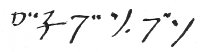
I have just heard that the name of one kind of those horrid beetles in Kumamoto is gane-bun-bun, and the hyakushō call them gane-bu; and people throw them out of the window, saying, “Come back the day-before-yesterday.” Then they never come back at all.
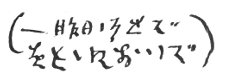
I have made a mistake again. The gane-bun-bun is not the greatest plague I was complaining of,—but the fu-mushi. There is yet another small one, I have not found out the name of. They make a whole room smell horribly. Some, however, call both the big fu-mushi and the small creature by the same name—distinguishing them only as the green and the black. By the way, I will put a fu-mushi in this letter, because they keep coming on the table so that I think it may be well to send one to Izumo, in the hopes of inducing the rest to emigrate.
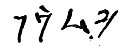
All send kindest regards to you, and pray you to take good care of your health.
With every best wish, believe me ever,
Most faithfully,
Lafcadio Hearn.
TO SENTARŌ NISHIDA Kumamoto, 1893.
Dear Nishida,—It gave me much pleasure to get your last kind letter. There was much depth in your statement of the present instability being consequent upon the stagnation of three hundred years. As to the consequence, however, only two theories are possible. The instability means—however it end—disintegration. Is the disintegration to be permanent?—or is there to be a re-integration? That is what nobody can say. There is this, however. Usually a movement of disintegration represents something like this line,—the undulations signifying waves of reaction. This movement is downward, and ends in ruin. However, so far, the undulations in Japan have been, I think, of a very different character,—something like this:—
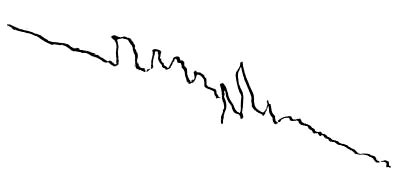
which would mean restoration of national solidity upon a much higher plane than before. The doubt is whether a much larger movement of disintegration is not going on,—whose undulations are too large to be seen in a space of thirty years.
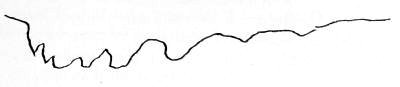
You have noticed that under all the surface waves of a sea, far vaster waves move—too large to be seen. They are only felt—upon long voyages.
Mr. Senke has sent me a letter which I think is the most wonderfully kind and gracious letter anybody ever received in this whole world, and how to answer it at all, I don’t know. He has also promised to send some souvenir; I am not quite sure what it is: I must try to write him a nice letter when it comes. But Mr. Senke writes as an Emperor would write—with a grace for which there is no equivalent in Western speech at all; and whatever I try to do, it must seem vulgar and common beside the splendid courtesy of Mr. Senke’s style.
Lafcadio Hearn.
TO OCHIAI Kumamoto, November, 1893.
Dear Ochiai,—I was very glad indeed to get your letter. It came while the school was closed—all the students having gone upon an excursion to Ōita, so that I did not receive it until to-day (the 11th), when I went to the school to see if there were any letters for me.
Don’t think any more about any mistakes you may have made;—everybody will forget them quickly: only think about what makes you happy. But as for Christianity, of course that is a matter for your own conscience; and I would not advise you at all unless you are in doubt. I can only tell you this,—that there are a great many different forms of what is called the Christian religion—a very great many. But what is called the “higher Christianity” is a pure code of ethics; and that code of ethics recognizes that in all civilized religions,—whether of Japan, India, China, Persia, or Arabia,—there is some eternal truth; because all religions agree in the deepest teaching about duty and conduct to one’s fellow men; and therefore all are entitled to the respect of good men. But in all religions also there are some things which even very good men cannot approve: that is not the fault of the true part of religion, but only the fault of social conditions—that is, the state of society. No state of society is yet perfect; and there can be no perfect religious system until all men become perfectly good. How to become good is, nevertheless, taught by all civilized religions. Nearly everything which is eternally true is taught by one as well as by the other; and therefore a society cannot throw away its religion on account of some errors in it. And each religion represents the experience of a nation with right and wrong—its knowledge of morality. But as society is constructed quite differently in different countries, the religion of one country may not be suited to another. That is why the introduction of a foreign religion may often be opposed by a whole people. For some things which are right in one country may not be right in another. It is not right in China or in Japan to leave one’s parents, and to neglect them when they are old. But in England and America and other countries, sons and daughters go away from their parents, and do not think it a duty to support them;—and there is no family relation in those countries such as there is in the Orient. And therefore many things in Western religion are not suited to the kinder and more benevolent life of Japan. Also, some religions teach loyalty, and some do not. For Japan to become strong, and to remain independent, it is very necessary that her people should remain very loyal. Her ancient religion teaches loyalty;—therefore it is still very useful to her. And that is why there is anger shown against some Christians who show no respect to that religion. They are not blamed for not believing in dogmas, but only for what seems to be not loyal.
Perhaps it is better that you should not think a great deal about religious questions until you become old enough to study scientific philosophy—because these questions ought to be studied in relation to society, in relation to history, in relation to law, in relation to national character, and in relation to science. Therefore they are very difficult. But if you should like to read the highest thoughts of Western people about modern religious ideas, I can send you some little books which will show you that the highest religion agrees with the highest science. What I mean by the highest religion is the belief in eternal laws of right conduct. However, as I said, to think about these questions at all requires great study and much knowledge. I think the best advice I can give you in a general way is this,—Do not believe a new thing told you because it is told you; but think for yourself, and follow your own heart when you are in doubt. But remember that the old things taught you have been valuable to society—and have been useful for thousands of years—so that we cannot despise them.
I send you a book of old Greek stories to read. Perhaps it will interest you. You will see from the stories how different the old Greek life was from modern life in many things. You must tell me, too, what books you like to read—novels, history, etc.; perhaps I shall be able to send you some from time to time.
Study well, and never be discouraged;—think only how to make yourself a noble and perfect man. And remember the best men in public life have generally been those who made plenty of mistakes and got into plenty of trouble when they were boys.
And never, never be afraid—except of your own heart.
Lafcadio Hearn.
TO ELLWOOD HENDRICK Kumamoto, November, 1893.
Dear Hendrick,—I have been waiting several weeks to tell you of an event which occurred later than I expected. Last night my child was born,—a very strong boy, with large black eyes; he looks more like a Japanese, however, than like a foreign boy. He has my nose, but his mother’s features in some other respects, curiously blended with mine. There is no fault with him; and the physicians say, from the form of his little bones, that he promises to become very tall. A cross between European and Japanese is nearly always an improvement when both parents are in good condition; and happily the old military caste to which my wife belongs is a strong one. She is quite well.—Still, I had my anxiety, and the new experience brought to me for a moment, with extraordinary force, the knowledge of how sacred and terrible a thing maternity is, and how even religion cannot hedge it about sufficiently with protection. Then I thought with astonishment of the possibility that men could be cruel to women who bore their children; and the world seemed very dark for a moment. When it was all over, I confess I felt very humble and grateful to the Unknowable Power which had treated us so kindly,—and I said a little prayer of thanks, feeling quite sure it was not foolish to do so.
If ever you become a father, I think the strangest and strongest sensation of your life will be hearing for the first time the thin cry of your own child. For a moment you have the strange feeling of being double; but there is something more, quite impossible to analyze—perhaps the echo in a man’s heart of all the sensations felt by all the fathers and mothers of his race at a similar instant in the past. It is a very tender, but also a very ghostly feeling.
Now the kind dull veil that Nature keeps during most of a life stretched between it and such extraordinary glimpses of the Unknown, is drawn again. The world is the same nearly as before; and I can plan. The little man will wear sandals and dress like a Japanese, and become a good little Buddhist if he lives long enough. He will not have to go to church, and listen to stupid sermons, and be perpetually tormented by absurd conventions. He will have what I never had as a child,—natural physical freedom.
Your two late letters were full of interest and beauty, and you are getting most surprising glimpses of life. I have long had in my mind the idea of a chapter on “Morbid Individuality”—taking issue with Lowell’s position in “The Soul of the Far East.” Instances like those you have cited are very telling as proofs. The story of the father also is wonderful—absolutely wonderful,—a beautiful surprise of human nature.
What also much impressed me in your letter was the feeling of sadness the spectacle of the great Exposition gave you. But I scarcely think it was due to any reminiscences of boyhood—not simply because of its being certainly a feeling infinitely too complex to have sprung out of a single relative experience in the past (your confession of inability to analyze it, and the statement of others who had the same feeling, would show that),—but also because, if you reflect on other experiences of a totally different kind, you will find they give the same sensation. The first sight of a colossal range of mountains; the awful beauty of a peak like Chimborazo or Fuji; the majesty of an enormous river; the vision of the sea in speaking motion; and, among human spectacles, a military sight, such as the passing-by of a corps of fifty thousand men, will give also a feeling of sadness. You will feel something like it standing in the choir of the Cathedral of Cologne; and you will feel something like it while watching in the night, from some mighty railroad centre, the rushing of glimmering trains,—bearing away human lives to unknown destinies beyond the darkness.
Probably, as Schopenhauer said, the vision of mountains has the effect of producing sadness, because the sense of their antiquity awakens sudden recognition of the shortness of human life. But I do not think it is a mere individual feeling. It is a feeling we share with countless dead who live in us, and who saw the same mountains,—perhaps felt the same way. Besides, there should be a religious ancestral feeling there—since mountains have ever been the abode of gods, and the earliest places of worship and of burial. And I think there is. You do not laugh when you look at mountains—nor when you look at the sea.
What effect does the sudden sight of an extraordinarily beautiful person have upon you? I mean the very first. Is it not an effect of sadness? Analyze it; and perhaps you will find yourself involuntarily thinking of death.
What has the effect of any great beauty—of art, or poetry or utterance—no matter what the subject? Is it cheerful? No, it is very sad. But why? Perhaps partly because of the consciousness of the exceptional character of that beauty,—therefore the sudden contrast between the tender dream-world of art and goodness, and the hideous goblin realities of the world we know. At all events the sadness is certainly the ancient sadness,—the sadness of life, which must, for reasons we cannot learn, begin and end with an agony.
Now at the Exposition you had all the elements for what Clifford would call a “cosmic emotion” of sadness. Vastness, which forced the knowledge of individual weakness; beauty, compelling the memory of impermanency; force, suggesting weakness also; and prodigious effort,—calling for the largest possible exertion of human sympathy, and love, and pity, and sorrow. That you should feel like crying then, does you honour: that is the tribute of all that is noblest in you to the eternal Religion of Human Suffering.
Dear H., I have not slept last night: I am going to rest a little;—good-bye for a short time, with love to you.
Lafcadio Hearn.
TO SENTARŌ NISHIDA Kumamoto, November, 1893.
Dear Nishida,—A few days ago there came from Kizuki a little box addressed to me,—from Mr. Senke; and opening it, I found therein the robe of a Kokuzō—all black silk with the sacred mon of the temple worked into the silk. Accompanying the robe were two poems, very beautifully written upon vari-coloured paper. The robe was very curious in itself, and of course most precious as a souvenir. I hesitated to write at once; for I could not answer Mr. Senke’s magnificent letter in a worthy way at all. It was a very long letter, written on fine paper and in large handsome characters. I have now tried to reply, but my answer reads very shabbily compared with Mr. Senke’s gracious style.
I found I had forgotten, in writing you the other day, to speak about Kompira, as you asked me. What a pity I had not known about the real temple of Kompira, which I did not see at all. Yes, I did find the place interesting and very beautiful. But it was interesting because of the quaint shops and streets and customs; and it was beautiful because the day happened to be very beautiful. The vast blue light coloured everything,—walls, timbers, awnings, draperies, dresses of pilgrims; and the cherry-trees were one blaze of snowy blossoms; and the horizon was clear as crystal. In the distance towered Sanuki-Fuji,—a cone of amethyst in the light. I wished I could teach in some school at Kompira uchimachi, and stay there always.
I like little towns. To live at Tadotsu, or at Hishi-ura in Oki, or at Yunotsu in Iwami, or at Daikon-shimain Naka-umi, would fill my soul with joy. I cannot like the new Japan. I dislike the officials, the imitation of foreign ways, the airs, the conceits, the contempt for Tempō, etc. Now to my poor mind, all that was good and noble and true was Old Japan: I wish I could fly out of Meiji forever, back against the stream of Time, into Tempō, or into the age of the Mikado Yūriaku,—fourteen hundred years ago. The life of the old fans, the old byōbu, the tiny villages—that is the real Japan I love. Somehow or other, Kumamoto doesn’t seem to me Japan at all. I hate it.
Ever with best regards,
Lafcadio Hearn.
TO SENTARŌ NISHIDA Kumamoto, November, 1893.
Dear Nishida,—Both of your letters were as interesting as they were kind. They revealed to me much more than I had been able to learn from the newspapers. I am more than sorry for that terrible destruction and suffering in the Ken; but when I think of Okayama, again, I cannot help thinking that the good fortune, which seems especially to belong to Matsue, has not yet deserted her. And the Governor seems to be a first-class man. I like that story of his action with the rice-dealers. But really, the people are very patient. In some Western countries, notably in parts of America, it would have been more than dangerous for men to have acted so selfishly; and they would be in any case afterwards “boycotted,” and obliged perhaps to leave the city. It is a great pity they were not made to suffer for such atrocious meanness. When I think of the chrysanthemums in your garden, and read your extraordinary story about catching fish in it, I can realize what a tremendous loss there must have been through all the rice-country. Certainly Matsue is fortunate to have escaped as she did.
Almost at the same time there came to me news from the Gulf of Mexico. Perhaps you will remember that I wrote a novel about some islands there. I used to pass my summers in those islands. They were about sixty miles from the city of New Orleans. Well, on October 4th, a storm burst over that coast, killing more than 2000 people. The island of Grand Isle was covered by the sea in the night; and everything—houses, trees, and people—carried away. Hundreds I used to know are dead. It is a year of storms and calamities, surely, in all parts of the world.
I will write a better letter later: I am writing now to answer your questions about those sentences:—
(i) “Choppy”—“chopped” or “chapped” by cold: “chapped hands”—hands of which the skin is cracked by frost. “His hands are all chapped”—that is, all roughened by frost. “Choppy” is not so often used as “chapped:” it is a poetical use of the word.
(ii) “He had torn the cataracts from the hills.” You must remember here Winter is personified as a monstrous giant. “Cataracts” is used in the sense of “waterfalls.” The waterfalls are frozen into solid masses of ice. Winter, the giant, breaks them off, and hangs them round his waist.

(iii) “And they clanked at his girdle like manacles” (from Latin manus, “hand”) (you spelled the word wrong: it is “manacles”). “Manacles,” iron fetters for the hands;—handcuffs. They are made in pairs, fastened together by a chain, and closed by a key. They clank when they strike together,—(i. e.) make a ringing metallic noise—because they are of fine steel usually. The sound made by iron is “clank”—“to clank” (verb), “a clank” (noun). Why does Shelley use such a simile? Because Winter is like a jailer, like the keeper of a prison. He fastens up, or imprisons, the rivers, lakes, and ponds with ice. So he is described as a keeper of prisoners,—with manacles or handcuffs hanging to his waist, ready for use. Ice striking against ice makes a ringing noise, very much like iron—sometimes. The comparison is very strong.
And why does he put his chapped finger to his lip? To put the first finger on the lips is a sign for “Be silent!” “Do not speak!” In winter the world becomes silent. The birds are gone; the insects are dead.
P. S.
Dear Nishida,—I waited over last night to hunt up the quotation for you; and during the night my child was born. A very strong boy,—dark eyes and hair; he has some of my features, some of Setsu’s. Setsu is well enough to send kind words, and to tell you what I was intending to tell you myself,—how delighted we have all been to hear of your good health this year.
I intended to write more, but I am too tired for the moment,—as I have not been in bed for more than 24 hours. So for a little, good-bye,—best regards to you and yours always from
Lafcadio Hearn.
TO SENTARŌ NISHIDA Kumamoto, November, 1893.
Dear Nishida,—Everybody is well up to date: the little boy looks prettier every day, and gives very little trouble. He scarcely cries at all. Many people come to look at him, and express surprise that he looks so much like a Japanese. But he is going to have a nose something like mine, certainly, when he grows up.
Setsu advises me to write you about another matter. I wanted, and tried several times since coming to Kumamoto, to have Setsu registered as my lawfully married wife, but the answer was always the same—that it was a difficult matter, and would have to be arranged in Tōkyō, if at all. The day before yesterday, I made another attempt when registering the birth of the boy. The registry people said that as the parties came from Matsue, Izumo, they would only make the statement of the marriage by Matsue authority,—and that I had better write to Matsue. But at the same time, they said words to this effect: “The law is difficult for you. If you wish the boy to remain a Japanese citizen, you must register him in the mother’s name only. If you register him in the father’s name, he becomes a foreigner.”
Of course we all want the child to be a Japanese citizen, as he will be the heir and stay of the old folks after I am dead—whether he goes abroad for a few years‘ study or no. Prudence seems to dictate the latter course. Yet the whole thing is a puzzle. By becoming myself a Japanese citizen, everything would be settled. Even that, however, is more difficult than it at first seemed. Again, I believe that I could become a Japanese citizen by making direct application to the Government;—but at the present time the result might not be for the best. An Englishman in Yokohama, who became a Japanese citizen, had his salary immediately reduced to a very small figure, with the observation: “Having become a Japanese citizen, you must now be content to live like one.” I don’t quite see the morality of the reduction; for services should be paid according to the market-value at least;—but there is no doubt it would be made. As for America, and my relatives in England, I am married: that has been duly announced. Perhaps I had better wait a few years, and then become a citizen. Being a Japanese citizen would, of course, make no difference whatever as to my relations in any civilized countries abroad. It would only make some difference in an uncivilized country,—such as revolutionary South America, where English or French or American protection is a good thing to have. But the long and the short of the matter is that I am anxious only about Setsu’s and the boy’s interests; my own being concerned only at that point where their injury would be Setsu’s injury. I suppose I must trust to fate and the gods. If you can suggest anything good to do, however, I will be very grateful.
Every day, it strikes me more and more how little I shall ever know of the Japanese. I have been working hard at a new book, which is now half-finished, and consists of philosophical sketches chiefly: It will be a very different book from the “Glimpses,” and will show you how much the Japanese world has changed for me. I imagine that sympathy and friendship are almost impossible for any foreigner to obtain,—because of the amazing difference in the psychology of the two races. We only guess at each other without understanding; and it is only a very keen guesser, indeed, of large experience, who can ever guess correctly. I have met no one else like you. Nothing is so curious as to sit down and talk for hours with a Japanese of the ordinary Tōkyō modernized class. You understand all he says, and he understands all you say,—but neither understands more than the words. The ideas behind the words are so different, that the more we talk the less we know each other. In the case of the students, I found myself obliged to invent a new method of teaching. I now teach my higher classes psychologically. I give them lectures and dictations on various difficulties of the preposition, for example, starting out with the announcement that they must not allow themselves to think of the Japanese preposition at all....
I have followed this plan with great success in teaching the articles, the value of English idioms, etc., and the comparative force of verbs. But it shows how hopeless for a stranger to see deeply into the Japanese mind. I am taking almost exactly the opposite ground to that of Lowell.
Faithfully ever,
Lafcadio Hearn.
TO OCHIAI Kumamoto, January, 1894.
Dear Ochiai,—Many thanks for your kind letter, with its kind wishes,—and many happy New Years to you.
I have been very glad to hear of your success at school, and all the news about your reading. I think Mr. Nishida’s plan is very wise and good. It is true that the lives of such men as Clive and Hastings—and above all Napoleon—are full of interest and romance, because they show the wonderful things that can be achieved by force of character united with great intellect,—Clive being the best man, morally, of the three. But, on the other hand, it is sadly true that the genius and the courage of those three wonderful men were not employed in the noblest way, but most often in a bad cause. Strong characters are very attractive, because those who read about them take pleasure in imagining what they would do if they had the same power and opportunity. But strong characters are only really admirable when they are employed in a good, just, noble cause. And of such characters, the number in Western history is few. Pericles, Miltiades, Epaminondas, were nobler than Alexander; yet people like to read about Alexander, who was not a good man. Marcus Aurelius was nobler than Cæsar; but people like to read more about Cæsar, because he was a great conqueror. And so on through all Western history. There is splendour and honour in brave fighting for what is right; but I do not think we ought to allow ourselves to praise brave fighting for what is wrong. Bravery is noble only when the object is noble. As a quality, it is not peculiar to man at all;—a wild bull is braver than any general. It is very noble to sacrifice one’s life for a good cause—for love of parents, country, duty; but we ought not to admire the throwing away of life for an unjust cause. The real rule by which to measure what is admirable and what is despicable is the rule of Duty.
That is why I admire very, very much, all that was noble in the old Japanese life,—its moral code, its household religion, and its unselfishness. Everything is now passing away. By the time you are as old as I now am, all Japan will have been changed; and I think you will remember with regret the kindness and the simplicity of heart and the pleasant manners of the Old Japan, that used to be all about you. The New Japan will be richer and stronger and in many things wiser; but it will neither be so happy nor so kindly as the old.
Well, I trust you will have all possible success,—not only in your school-life, but in all your life to come. I have hopes you will do great and good things, and that I will hear of them.
Ever affectionately yours,
Lafcadio Hearn.
TO MASANOBU ŌTANI Kumamoto, March, 1894.
My dear Ōtani,—To study philology, with the idea of becoming a philologist, scarcely seems to me a hopeful undertaking for you. Philology means a great deal, including the comparative study of languages; and it requires a very special natural gift in acquiring languages, to be of any very practical value to you. It would also require, I think, years of study in foreign universities. I am not quite sure what you mean by philology, and what your purpose in following that course would be. You might, of course, do as many do—take the literary and philological course at the university. But the question, to my mind, seems to be this: “What would be the practical value of such studies afterwards?” Do you wish to become a Professor of Philology? Do you wish to give your life to the scientific study of languages? If you do, are you quite sure you have the particular kind of talent required (for, remember, everybody cannot become a philologist any more than everybody can become a mathematician)?
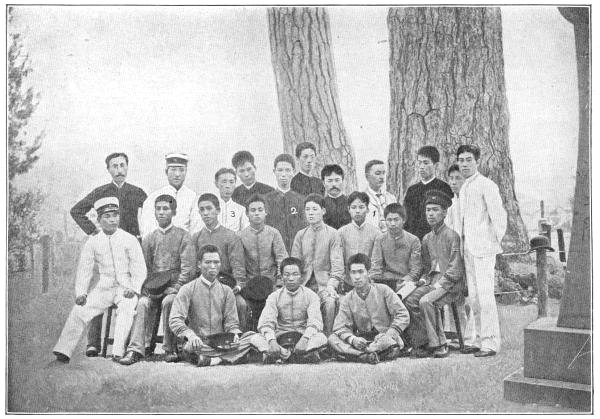
A GROUP OF GRADUATES OF THE MIDDLE SCHOOL 1 Mr. Hearn 2 Mr. Nishida 3 The old teacher of Chinese Classics
The truth is, I do not know enough about your circumstances and intentions and abilities to advise you well. I can only tell you in a general way what I think.
I think you ought not to study what would not be of practical use to you in after-life. I am always glad to hear of a student studying engineering, architecture, medicine (if he has the particular moral character which medicine requires), or any branch of applied science. I do not like to see all the fine boys turning to the study of law, instead of to the study of science or technology. Of course much depends upon the mathematical faculty. If you have that faculty, I would strongly advise you to direct all your studies toward a scientific profession—something really practical,—engineering, architecture, electricity, chemistry, etc. If you should ask which, I could not tell you, because I do not know your own highest capacities in such directions. I would only say,—“Whatever you are most sure of loving as a practical profession.”
Japan wants no more lawyers now; and I think the professions of literature and of teaching give small promise. What Japan needs are scientific men; and she will need more and more of them every year. To-day you are fortunate; but nothing in this world is sure. Suppose you were obliged suddenly to depend entirely on your own unassisted power to make money,—would it not then be necessary to do something practical? Certainly it would. And according to the rarity of your abilities would be your remuneration,—your money-making power. Even the Queen of England obliged her children to learn professions.
Now scientific men are still comparatively rare in Japan. The science-classes in the colleges are small. Many students begin the study,—but they find it hard for them, and give it up. Nevertheless, it is just because it is hard that it is so important and of such high value to the person who masters it. If you were my son, or brother, I would say to you, “Study science,—applied science; study for a practical profession.” As for languages and other subjects, you can study them whenever you please. The practical knowledge is the only important knowledge now,—and your whole life will depend upon your present studies.
You asked whether philology was difficult. Science is difficult,—really difficult; but everything worth having in this world is difficult to get, exactly in proportion to its value. The only question, I think, should be, “What study will be most useful to me all through life?” But not whether it is difficult. What is important to know is always difficult to learn. Philology is difficult; practical science is difficult;—both are very difficult. But philology would never be of much use to you, unless you have a natural genius for language-study. And science would be of immense value to you, whether you have any genius or not. You will need, however, as I said before, mathematical study to fit you for that. And I would also remind you of this:—
Hundreds of students leave the university without any real profession, and without any practical ability to make themselves useful. All cannot become teachers, or lawyers, or clerks. They become soshi, or they become officials, or they do nothing of any consequence. Their whole education has been of no real use to them, because it has not been practical. Men can succeed in life only by their ability to do something, and three fourths of the university students can do nothing. Their education has been only ornamental.
Faithfully yours,
Lafcadio Hearn.
TO SENTARŌ NISHIDA Kumamoto, April, 1894.
Dear Nishida,—You are becoming a very indifferent correspondent, if one should judge by scarcity of letters,—so I suppose I am not to hear from you again until something extraordinary happens. So runs the world away from a man. But never shall I be able to understand the people of “the most Eastern East.”
Well, I have been to Kompira,—in a fune-fune to Tadotsu, thence by rail to the wonderful, quaint old town. We took Kaji along. He never cries now, and behaved so well that on all the railroads and steamers people fell in love with him and played with him. He made the acquaintance of many politicians, of surveyors, of some silk merchants, of two captains, of a naval surgeon, of many gentle women, of the miko at Kompira, and—I am sorry to say—of some geisha. However, that was because he was very young, and did not know. I hope when he gets bigger he will be more reserved with his smiles. One thing showed his good taste: he was especially attracted by the two young miko, who were really very sweet and pretty,—the prettiest I ever saw, and he made one of them smile even during her dance. I have sent a better picture of him.
I should much rather be in a country-school again. However, so far as I can see, the same trouble is going to find its way into all the public schools, and stay there, until some means be devised of removing schools altogether from the domain of politics by something like the American system. The American system is imperfect; but it has at least this merit,—that the leading citizens and merchants of a place can act as boards of directors, and that the temporary officials proper cannot meddle directly in school matters at all. Thus the school interests are taken care of by those most directly concerned in their welfare, and not by strangers. Each community supports its own school by a general tax. Of course in so corrupt a country as America the pecuniary side of the question is attended with some ugly stealing; but that is done before the money is placed in the hands of the directors, and is done at a serious risk. In some American States, too, the text-books are meddled with by politicians. But I think it might be quite possible in Japan to adopt a system of school-support, which, while removing the schools from the power of the Kenchō to meddle with them, would also establish something like permanency in their management and method. At present everything is so unpermanent and unsteady that one feels the tendency is to dissolution rather than integration.
Ever very truly yours,
Lafcadio Hearn.
P. S. I forgot your question about the summer vacation. I have not yet been able to decide exactly what to do, but it is at least certain that I go to Tōkyō, and that I hope to meet you there. Should anything prevent you from going, I may try to meet you elsewhere. I should like to see you, and hear some more of the same wonderful things you used to tell me,—which you will read in that much-delayed book. By the way, I did not tell you that the publishers concluded to delay it again, on account of what they call the trade-season. I suppose they are right, but it is very provoking. Including the index the book makes about 700 pages, in two volumes. Meantime I have half written a philosophical book about Japanese life.
Ever faithfully,
Lafcadio Hearn.
TO ELLWOOD HENDRICK Kumamoto, Spring, 1894.
Dear Hendrick,— ... Are you reading the Atlantic at all? There is a wonderful story by Mrs. Deland, “Philip and his Wife.” Philip’s wife makes me think always of E. B.
The problem of merely being able to live. What a plague it is! And the pain of life isn’t hunger, isn’t want, isn’t cold, isn’t sickness, isn’t physical misery of any kind: it is simply moral pain caused by the damnable meanness of those who try to injure others for their own personal benefit or interest. That is really all the pain of the struggle of life.
Ever faithfully,
Lafcadio Hearn.
TO ELLWOOD HENDRICK Kumamoto, May, 1894.
Dear Hendrick,— ... I think there was one mistake in the story of [OE]dipus and the Sphinx. It was the sweeping statement about the Sphinx’s alternative. It isn’t true that she devoured every one who couldn’t answer her riddles. Everybody meets the Sphinx in life;—so I can speak from authority. She doesn’t kill people like me,—she only bites and scratches them; and I‘ve got the marks of her teeth in a number of places on my soul. She meets me every few years and asks the same tiresome question,—and I have latterly contented myself with simply telling her, “I don’t know.”
It now seems to me that I was partly wrong in a former letter to you about business morality: I took much too narrow a view of the case, perhaps. The comparison between the Western and Oriental brain—which everybody is forced to make after a few years‘ sojourn here—now appears to me appalling in its results. The Western business man is really a very terrible and wonderful person. He is the outcome, perhaps, of a mediæval wish. For types are created by men’s wishes—just as men themselves are created. The greatest teaching of science is that no Body made us,—but we made ourselves under the smart stimulus of pain. Well, as I was saying, the business man is an answer to a wish. (You know about the frogs who asked Jupiter for a King.) In the age of robber-barons, racks, swordmills, and droit de cuissage,—men prayed Jupiter for Law, Order, System. Jupiter (in the shape of a very, very earnest desire) produced the Business man. He represents insatiate thirst of dominion, supreme intellectual aggressive capacity, faultless practical perceptivity, and the art of handling men exactly like pawns. But he represents also Order, System, Law. He is Organization, and is King of the Earth. The pawns cry out, “We are not pawns.” But he always politely answers, “I am sorry to disagree with you, but I find it expedient for our mutual interest to consider you pawns; besides, I have no time to argue the matter. If you think you are not pawns, you must show the faculty of Organization.”
The tyranny of the future must be that of Organization: the monopoly, the trust, the combination, the associated company—representing supremely perfect mathematical unification of Law, Order, and System. Much more powerful than the robber-baron, or Charlemagne, or Barbarossa, these are infinitely less human,—having no souls, etc. (What would be the use of souls!—souls only waste time.) Business is exact and dangerous and powerful like a colossal dynamo: it is the extreme of everything men used to pray for,—and it is not what they did not pray for. Perhaps they would like the robber-baron better.
We little petty outsiders—the gnats hovering about life—feel the world is changing too quickly: all becoming methodical as an abacus. There isn’t any more room for us. Competition is of no use. Law, Order, and System fill the places without consulting us,—the editorial desks, the clerkships, the Government posts, the publishers‘ offices, the pulpits, the professorships, the sinecures as well as the tough jobs. Where a worker is unnecessary, a pawn is preferred. (Oh, for a lodge in some vast wilderness!—provided with a good table and a regular supply of reading from Murray’s circulating library!) One thing is dead sure: in another generation there can be no living by dreaming and scheming of art: only those having wealth can indulge in the luxury of writing books for their own pleasure....
Faithfully ever,
Lafcadio Hearn.
TO ELLWOOD HENDRICK Kumamoto, May, 1894.
Dear Hendrick,—So far from your letters not being interesting, they are always full of interest—first, simply because they are your letters; secondly, because they tell the evolution of you—showing how, after all, we are made by the eternal forces. That you become a business man, in every sense of the word, is inevitable. It would be wrong if you did not. It would be wrong not to love your profession. The evil of becoming a business man exists only for small men—dries small men up. Surely you are not small! There is nothing to regret—except perhaps a temporary darkness which may yield to enormous light later on. Some would say to you, “Always keep one little place in your heart from hardening.” I would say nothing of the kind now: I think you are too large to be talked to in that way.
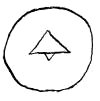
Suppose I try to illustrate by reference to the scope of human thinking in general. Ethical theology might be represented then as an inverted pyramid,—thus ; hard, skeptical science by a larger figure, pressing it down; the highest philosophy by a circle,—something like this figure. The largest thought accepts all, surrounds all, absorbs all,—like light itself. The ugly and the beautiful, the ignorant and the wise, the virtuous and the vile,—all come within its recognition; nature and sins as well as societies and clubs,—prisons and churches, brothels and houses. The very duties of observation forced upon you compel two things: the study of all moral and material details; the study of all combinations and wholes. And the larger the grasp of the whole the larger must become your power and value; for you will have to see eternal laws working down out of the unknown and thereafter ramifying and inter-ramifying into innumerable actions, reactions, disintegrations, and crystallizations. The horrible thing about business, men say, is that it considers men as pawns. But if your sight becomes large enough,—if your thought widens enough,—you must look upon men as pawns. To be a brother to all you cannot. To be a friend to many you cannot. You become the agent—not of the Commercial Union Assurance Co. only,—but the special agent of infinite laws; and if you act efficiently in that capacity, you cannot do very wrong. The Cosmos will be responsible for you.

The business man to-day is the king of the earth; merchants and bankers are the rulers, and will for all time be, while industrialism continues necessary. They seek and win power, and all the good things of life; they also prevent others from getting either. They may not be poets, philosophers, didactic teachers, artists; but their mental organization is undoubtedly the highest,—because its achievements represent the mastery of the highest difficulties, the deepest problems, the most intricate riddles. Certainly this higher organization is obtained at a heavy cost in the majority of cases. The emotions dry up in the evolution of it, and the moral sense weakens. But because this must happen in the majority of cases when any new faculty is being developed, it is far from happening in all. The man whose vision is vast enough can scarcely do more evil than a god. He cannot injure his world voluntarily without suffering from his own action. He must study his world as a naturalist his ant-hill. And even as a God he must feel the ultimate evil and good is not of him; but is being forever viewlessly woven in Shadow by the Fates of the Infinite,—whose distaff twists the thread of his own life, and whose will guides his own courses.
The great desire would be for the combination of emotion with knowledge, of philosophy with mathematics, of Plato with a Napoleon, or Spinoza with a Gould. This will come. Now it is very rare....
You might reply, “In the present order of things the combination would ruin the working-power of the man. The Gould could not act the Gould if combined with the Spinoza,—nor could the Napoleon se foule de la vie d‘un million d’hommes if crossed with a Plato.”
I would answer, “Not in the elder generation, but why not to-day? If the moral laws that in a Spinoza would have checked a Gould, or in a Plato checked a Napoleon, were essentially limited in other years, are they so to-day? If the two philosophers had had larger horizons of thinking, would they have recognized a tether,—or would they not rather have viewed themselves as mere force-atoms in an infinite electric stream? Are there not now recognitions of laws transcending all human ethics?—laws of which Goethe threw out such weird suggestions?—and must not business, from its very nature, drift into the knowledge of these laws?”
To-day, it is true, the highest possible type of business man would have to follow the small policy of the majority. But certainly he can be like one of those compound double-engines,—whereof the best half is kept idle in reserve,—always oiled and speckless and ready for rare emergencies or opportunities. If something within you regrets something else that is passing away, that need not be any alarming sign. The mere fact that the regret exists, indicates higher possibilities. Don’t you remember Emerson’s extraordinary lines,—
“Though thou love her as thyself— As a self of purer clay,— Though her parting dim the day Stealing grace from all alive,— Heartily know, When half-gods go The Gods arrive!”
The dear little psyche is going? Well, let her go! Regret her a little—that is sweet and good. Feel lonesome for her awhile. Wait. Then make yourself a new soul, large enough to wrap round the whole world, like the Æther.
Faithfully ever,
Lafcadio Hearn.
TO PAGE M. BAKER Kumamoto, 1894.
Dear Page,—Though I never hear from you directly, the T.-D. brings me occasionally very emphatic proof that I am not forgotten, and am perhaps forgiven. So I venture a line or two, hoping you will not show the letter to anybody.
I told you some years ago I was married; but I did not tell you I had a son,—who is, of course, dearer than my own life to me. Curiously, he is neither like his mother nor like me: he takes after some English ancestor,—for he is grey-eyed, fair-haired (curly chestnut), and wonderfully strong: he is going, if he lives, to be a remarkably powerful man; and, I hope, a more sensible man than his foolish dad.
Well, now two perils menace me. First, the immense reaction of Japan,—reasserting her individuality against all foreign influence, which has resulted in the discharge of most of the high-paid foreign employees; secondly, the war with China. The Japanese—essentially a fighting race, as Bantams are—will probably win the battles every time; but if China be in dead, bitter earnest, she will win the war. (Probably her chances will be snatched from her by foreign intervention.) But whatever be the end of this enormous complication, Japan is going to empty her treasury. The chances for Government employees are dwindling: my contract runs only till March, and the chances are 0.
Of course, I can peg along somehow,—getting odd jobs from newspapers, etc., doing a little teaching of English, French, or Spanish. I can’t help thinking I would do better to go abroad—especially at a time when every American 100 cents is worth nearly 200 Japanese cents.
Here goes. Could you get me anything to do if I started in the spring for America? I mean something good enough to save money at. I am past all nonsense now, and for myself only would need very little. But it would not be for myself that I should go. I should want to be sure of being able to send money to Japan, by confining my own wants to good living and an occasional book or two. If you could get me something anywhere south of Mason and Dixon’s line, I should try to be practically grateful in some way. I am not in the least desirous of seeing Boston or New York or Philadelphia—or being obliged to exist by machinery. I would rather infinitely be in Memphis or Charleston or Mobile or—glorious Florida.
Or can you get me anything educational in Spanish-America? I could scarcely take my people to the U.S.,—but to South America I might try later on. I am now 44, and all grey as a badger. Unless I can make enough to educate my boy well, I don’t know what I am worth,—but I feel that I shall have precious little time to do it in. Add 20 to 44,—and how much is left of a man?
Perhaps you will think—if I am worth thinking about at all: “Well, why were you such a d——d fool as to go and have a son?” Ask the gods! Really I don’t know.
Ever faithfully—or, as the Japanese would say, unfaithfully,—yours,
Lafcadio Hearn.
TO ELLWOOD HENDRICK Kumamoto, June, 1894.
Dear Hendrick,— ... We were chatting last time about the morality of business. Now let me tell you how the question strikes an intelligent Japanese student.
“Sir, what was your opinion when you first came to our country about the old-fashioned Japanese? Please be frank with me.”
“You mean the old men, who still preserve the old customs and courtesy,—men like Mr. Akizuki, the Chinese teacher?”
“Yes.”
“I think they were much better men than the Japanese of to-day. They seemed to me like the ideals of their own gods realized. They seemed to me all that was good and noble.”
“And do you still think as well of them?”
“I think better of them, if anything. The more I see the Japanese of the new generation, the more I admire the men of the old.”
“But you must have, as a foreigner, also observed their defects.”
“What defects?”
“Such weaknesses or faults as foreigners would observe.”
“No. According as a man is more or less perfectly adapted to the society to which he belongs, so is he to be judged as a citizen and as a man. To judge a man by the standards of a society totally different to his own would not be just.”
“That is true.”
“Well, judged by that standard, the old-fashioned Japanese were perfect men. They represented fully all the virtues of their society. And that society was morally better than ours.”
“In what respect?”
“In kindness, in benevolence, in generosity, in courtesy, in heroism, in self-sacrifice, in simple faith, in loyalty, in self-control,—in the capacity to be contented with a little,—in filial piety.”
“But would those qualities you admire in the old Japanese suffice for success in Western life—practical success?”
“Why, no.”
“The qualities required for practical success in a Western country are just those qualities which the old Japanese did not possess, are they not?”
“I am sorry to say they are.”
“And the old Japanese society cultivated those qualities of unselfishness and courtesy and benevolence which you admire at the sacrifice of the individual. But Western society cultivates the individual by a competition in mere powers—intellectual power, power of calculating and of acting?”
“Yes.”
“But in order that Japan may be able to keep her place among nations, she must adopt the industrial and financial methods of the West. Her future depends upon industry and commerce; and these cannot be developed if we continue to follow our ancient morals and manners.”
“Why?”
“Not to be able to compete with the West means ruin; yet in order to compete with the West, we must follow the methods of the West,—and these are contrary to the old morality.”
“Perhaps—”
“I do not think there is any ‘perhaps.’ To do any business on a large scale, we must not be checked by the idea that we should never take any advantage if another be injured by it. Those who are checked by emotional feeling, where no check is placed upon competition, must fail. The law of what you call the struggle for existence is that the strong and clever succeed, and the weak and foolish fail. But the old morality condemned such competition.”
“Then, sir, no matter how good the old morality may seem to be, we can neither make any great progress in industry or commerce or finance, nor even preserve our national independence, by following it. We must forsake our past, and substitute law for morality.”
“But it is not a good substitute.”
“It seems to me that it has proved a good substitute in Western countries—England especially—if we are to judge by material progress. We will have to learn to be moral by reason, not by emotion. Knowledge of law, and the reasons for obeying law, must teach a rational morality of some sort at last.”
Pretty good reasoning for a Japanese boy, wasn’t it? He goes to the university next month,—a splendid fellow. Later the Government is to send him abroad.
Ever faithfully,
Lafcadio Hearn.
TO SENTARŌ NISHIDA Kumamoto, August, 1894.
Dear Nishida,—Many, many best thanks for the excellent photograph of yourself, and your kindest letter. The photograph brought so vividly before me again the kind eyes that saw so much for me, and the kind lips that told me so many wise, good things, and advised me and helped me so much,—- that I could not but feel more sorry than ever at having missed you.
Mr. Senke has sent me the most beautiful letter, which I hope to answer by this same mail. What a divine thing the old Japanese courtesy was! and how like Kami sama the dear old men who remember it, and preserve it. Of course Mr. Senke is a young man, but his courtesy is the old courtesy. The high schools seem to me to be ruining Japanese manners, and therefore morals—because morals are manners to a certain extent. Those who lose the old ways never replace them; they cannot learn foreign courtesy, which is largely a matter of tone,—tone of voice, address, touch of minds, and benevolence in small things, which is our politeness. So they remain without any manners at all, and their hearts get hardened in some queer way. They cease to be lovable, and often become unbearable. I hope the great reaction will bring back, among other things, some of the knightly old ways.
I send a reprint of my last Japanese story. Hope my book will reach you soon, and will not displease you. Of course, you will find in it many mistakes—as any book written by a foreigner must be rich in errors. But the general effect of the book will not be bad, I think. I am now trying to write a sketch about Yuko Hatakeyama, the girl who killed herself at Kyōto in May, 1891, for loyalty’s sake. The fact is full of wonderful meaning—as indicating a national sentiment.
Kazuo is crawling about, opening drawers, and causing much trouble. His eyes have again changed colour,—from blue to brown, like my own; but his hair remains chestnut. His upper teeth are well out, and everybody wonders how strong he is. He has one Japanese virtue: he does not cry, and keeps his self-control even when hurt. I hope he will keep all these traits. My whole anxiety is now about him: I must send him, or, if possible, take him abroad—for a scientific education, if he prove to have a good head. That will be expensive. But I hope to do it. I do not think a father should leave his son alone in a foreign school, if it can be helped: he ought to be always near him, until manhood. And Setsu would feel at home soon in France or in Italy,—at least at home enough to bear the life until Kazuo could get through a course or two.
The foreign community sorrows about the war,—naturally. Business is paralyzed. Every one feels the Japanese will win the fights. But who will win the war? That might be a question of money. Japan is daring to do what the richest country in Europe fears to do—because it costs so much to fight China. And some of the Izumo boys are out there in the rice-fields of Chosön. I trust they will pass safely through all perils. Please send me any news of them you can.
Lafcadio Hearn.
TO ELLWOOD HENDRICK Matsue, September, 1894.
Dear Hendrick,—If ever I must go to America, I hope I can keep out of New York. The great nightmare of it always dwells with me,—moos at me in the night, especially in the time of earthquakes. Of London I should be much less afraid. But in such great cities I do not think a literary man can write any literature. Certainly not if he has to stay in the heart of the clockwork. Society withers him up—unless he have been born into the manner of it; and the complexities of the vast life about him he never could learn. Fancy a good romance about Wall Street,—so written that the public could understand it! There is, of course, a tremendous romance there; but only a financier can really know the machinery, and his knowledge is technical. But what can the mere littérateur do, walled up to heaven in a world of mathematical mystery and machinery! Your own city of Albany is a paradise compared to the metropolis: you are really very fortunate—very, very happy to be able to live at home.
Of course, there is a philosophy of good manners—too much of it, eh? There is Emerson, all suggestive,—but touching eternal truths in his essays on conduct, behaviour, etc.; and there is Spencer, who traces back the history of nearly all good manners to the earliest period of savagery and perpetual war. (You know about the origin of the bow, of our forms of address, and of the forms of prayer.) Politeness survives longest and develops most elaborately under militant conditions, and diminishes in exact proportion as militancy decreases. That there should be less politeness in America than in other countries, and less in the Northern States than in the Southern, might be expected. This was true as to both conditions: it is now true probably only as to the first. With the growth of industrialism,—the sense of equal chances, at least of equal rights before the law,—the abolition of class distinctions,—fine manners vanish more or less. Nevertheless I fancy that under all the American roughness and lack of delicacy, or of that politeness which means “benevolence in small things,” there is growing up a vast, deep feeling of human brotherhood,—of genuine kindliness, which may show itself later under stabler conditions. All now is unsettled. It is said that nearly all our formal politeness must eventually disappear under conditions of industrialism, and be replaced by something more real and more agreeable,—kindly consideration, and natural desire to please. But that will be in ages and ages only after we are dead. There must be an end of all fighting first,—of cruelty in competition, and this cannot happen until with intellectual expansion, population ceases to so increase as to enforce competition without mercy.
The tendency now (referring to what you said about trusts) seems to point indeed to what Spencer calls “The Coming Slavery.” Monopolies and trusts must continue to grow and multiply,—must eventually tend to coalesce,—must ultimately hold all. Bellamy’s ideas will be partly carried out, but in no paradisaical manner. The State itself will become the one monstrous trust. Socialism will be promised all, and be compelled to work against its own ends unconsciously. The edifice is even now being reared in which every man will be a veritable slave to the State,—the State itself a universal monopoly, or trust. Then every life will be regulated to infinitesimal details, and the working population of the whole West find themselves situated just as men in factories or on railroads are situated. The trust will be nominally for the universal benefit, and must for a time so seem to be. But just so surely as human nature is not perfect, just so surely will the directing class eventually exploit the wonderful situation,—just as some Roman rulers exploited the world. Assuredly anarchy will eventuate; but first,—in spite of all that human wisdom can do,—nations will pass under the most fearful tyranny ever known. And perhaps centuries of persistent effort will scarcely suffice to burst the fetters which Socialism now seeks to impose on human society;—the machinery will be too frightfully perfect, too harmonious in operation, too absolutely exact and of one piece,—to be easily attacked. As well try with naked hands to pierce the side of an iron-clad. The law, the police, the military power, religious influence, commercial and industrial interests,—all will be as One, working to preserve the form of the new socialism. To seek redress, to demand change, were then sheer madness. And even the power to flee away out of the land, to dwell among beasts and birds, might be denied. Liberty of opinion, which we all boast of now, would be then less possible than in the time of the sway of Torquemada....
You have heard of the Japanese facile victories by land and sea. I should not be surprised to hear of their winning every engagement, and capturing Pekin. But what the end will be for the country, who can say? The whole thing is the last huge effort of the race for national independence. Under the steady torturing pressure of our industrial civilization,—being robbed every year by unjust treaties,—Japan has determined to show her military power to the world by attacking her old teacher, China. At the same time she has asked and obtained from England such revision of the treaty as would not only protect her against the danger of large fresh investments of foreign capital, but would probably result in driving existing capital away. I cannot think that the United States will be short-sighted enough to grant the same terms. For instance, though the country is to be opened to foreign settlement, no Englishman can hold land except on lease; and the lease, by Japanese law, expires with the death of the lessor. So that if I build a stone house, and my landlord die in twenty years after, I must be at the mercy of his heir, or carry away my house on my back.
It is an ugly business, this war. It may leave Japan absolutely independent, as in the days of Ieyasu. But will that be best for her? I am no longer sure. The people are still good. The upper classes are becoming corrupt. The old courtesy, the old faith, the old kindness are vanishing like snow in sun.
Ever affectionately,
Lafcadio Hearn.
TO OCHIAI Kumamoto, September, 1894.
Dear Mr. Ochiai,— ... I was much interested in what your letter related about the doves leaving Kizuki, and about the O mamori. It is a curious fact that nearly the same story is told in Kumamoto, in regard to Katō Kiyomasa. At the Nichiren temple of Hommyōji the helmet, armour, and sword of the great Captain were always preserved. Lately they disappeared, and some say they were sent to Korea,—to stimulate the zeal of the army. But some of the people say that in the night horse-hoofs were heard in the temple court; and that a great shadowy horseman, in full armour, was seen to pass. So it is whispered that Kiyomasa rose up from his grave, and buckled on his armour, and departed to lead the Imperial Armies to glory and conquest.
Thanks also for the very interesting note about the Emperor Go-Daigo. You know I visited the place where he lived at Oki, and the little village—Chiburi-mura—from which he made his escape in the fishermen’s boat.
What you said about the mamori of the soldier reminds me that at the ujigami here little charms are being given to thousands of soldiers. They are very narrow, and contrived so as to be slipped into the lining (ura) of a uniform.
Thanks for your two kindest letters. I shall write you again another day,—this is only my answer to one of your two letters; the other I still owe you for.
Best wishes and regards to you always.
Lafcadio Hearn.
TO ELLWOOD HENDRICK Kōbe, December, 1894.
Dear Hendrick,—So it was you that sent me “Trilby”—the magical thing! I never knew till the Spencer came, and Kipling’s “Jungle Book.” And the joke is that I thanked another man for the gift of “Trilby,” and the beast never let on. And I wrote a two and one-half column review of “Trilby” to please him. Oh! you rascal! why didn’t you tell me? Love to you for “Trilby.” ...
Glad you liked my first book on Japan. The Tribune essay vexed me.... The curious fact of the article was the statement about the influence of the decadents and of Verlaine being “apparent.” Never read a line of Verlaine in my life,—and only know enough of the decadent school to convince me that the principle is scientifically wrong, and that to study the stuff is mere waste of time.
I am writing one article a day for 100 yen a month. Exchange is so low now that the 100 represents something less than 50 in American money. And my eyes, or eye, giving out. Curious!—cold seriously affects my remnant of sight. If I had a few thousand I should go to a hot climate during the winter months. Heat gives me good vision. Even a Japanese hot bath temporarily restores clearness of sight....
Of course, we shall never see each other again in this world. And what is the use of being unkind—after all? Life to us literary folk—small and great—is so short, and we are never in competition, like business men who must compete—what is the use of meanness? I suppose there must be some use. The effect is certainly to convince a man of “fourty-four” that the less he has to do with his fellow men the better,—or, at least, that the less he has to do with the so-called “cultured” the better....
The other day you told me of some queer changes in your inner life wrought by the influences of the outer. In my case the changes are very unpleasant. I can’t feel towards men generally any longer as I used to—I feel, in short, a little misanthropic. The general facts seem to be that all realities of relations between men are of self-interest in the main; that the pleasures of those relations are illusions—dependent upon youth, power, position, etc., for degree of intensity. No man, as a general rule, shows his soul to another man; he shows it only to a woman,—and then only with the assurance that she won’t give him away. As a matter of fact, she can’t:—the Holy Ghost takes care of that! No woman unveils herself to another woman—only to a man; and what she unveils he cannot betray. He can only talk of her body, if he is brute enough to wish to: the inner being, of which he has had some glimpses, can be pictured only in a language which he cannot use. But what a fighting masked-ball the whole thing is!
Have you read Huxley’s views on Ethics and Evolution? They have been a great revelation to me. They make it perfectly plain why men cannot be good to one another on general principles without causing trouble in the order of the universe. They also explain the immorality of Nature. Cosmic principles afford explanations of—but not consolations for—individual experiences.
L. H.
TO ELLWOOD HENDRICK Kumamoto, December, 1894.
Dear Hendrick,—Of course I shall teach the “Jungle Book” to the little fellow, when he gets big enough. How pretty of you to send it. I sent some little prints—don’t know if you like them; in an album they would perhaps interest your friends who have not been in Japan. I shall look out for seeds for you regularly hereafter.
About Emerson. Last spring I got a pretty edition of him from H. M. & Co. and I digested him. He is only suggestive, but wondrously so at times, as in his poems. As a suggester he will always be great. The talk about his truisms must depend upon the knowledge of the speaker. Emerson will be large or small,—commonplace or profound,—according to the reader’s knowledge of the thought of the age.
My reading out here has been pretty heavy. I have had to digest a good deal of Buddhist and Chinese stuff, of course. My philosophical favourites are still Spencer and Huxley, Lewes and Fiske and Clifford. I made Kipling’s acquaintance out here (I mean his books), and told you what I think of him. Next to Kipling I like Stevenson. But I have really read very little of anything new. Browning is a pet study still. Somehow I have tired of Tennyson—don’t exactly know why.
The labour of a mother is something which, I imagine, no man without a child can understand. We big folks forget what our own mothers did for us,—and we have no real chance to see all that other mothers do. My whole family are always caring for the boy: his interest and necessities rule the whole house,—but the mother!! for a single hour she has no rest with him (Japanese give the breast for two years)—no sleep except when he allows it,—and yet it all is joy for her. How they have already taught him Japanese politeness, how to prostrate himself before his father the first thing in the morning and last at night,—to ask for things, putting his hands in the proper way,—to smile,—to know the names of things before he can pronounce them,—I can’t understand. Angel-patience and love alone could have done it. I want her to wean him—but she won’t hear of it; and the old grandmother gets angry at the mere idea. It is only in home-relation that people are true enough to each other,—show what human nature is—the beauty of it, the divinity of it. We are otherwise all on our guard against each other. I cannot say how happy I think you are—you can see Souls without armour or mail,—loving you. That is the joy of life, after all—isn’t it?
Lafcadio Hearn.
TO SENTARŌ NISHIDA Kōbe, January, 1895.
Dear Nishida,—I have just written to Mr. Senke, to apologize for delay in sending my annual contribution—which I had hoped to be able to do as a Japanese citizen. But this may give me a chance to write again, when I get naturalized.
The Governor of Hyōgo did a very strange thing—informed the British Consul that I was to make a declaration in writing, presumably before the Consul, that I intended to be faithful to the Emperor of Japan, and to obey the laws. I did make the declaration; and the Consul is kind enough to forward it. But I believe he is doing this out of personal kindness; for I do not think it is according to English ideas, much less English laws, for a Consul to accept such a declaration at all. Indeed, what was asked was equivalent to requesting the English Consul to accept an English subject’s renunciation of allegiance to Queen Victoria,—and I am astonished that the Consul, who is a rigid disciplinarian, in this case allowed me to submit to him any declaration on the subject. One thing is sure, that others who want to become Japanese subjects are going to have plenty of trouble. These measures are entirely new, and quite different to anything ever before exacted—for example, in the case of Warburton and other Kōbe residents who became Japanese subjects, perhaps for business reasons.
I am thinking of building Setsu a house, either in Kōbe or Kyōto. When I say Kōbe, I mean Hyōgo, really; for I cannot well afford to buy land at $40 to $70 per tsubo in the back streets of Kōbe. In Hyōgo, I can do better. Setsu and I both agree that Kōbe is warmer than Kyōto; but, except for the winter months, I should rather live in Kyōto than in any part of Japan. Tōkyō is the most horrible place in Japan, and I want to live in it just as short a time as possible. The weather is atrocious;—the earthquakes are fearsome;—the foreign element and the Japanese officialism of Tōkyō must be dreadful. I want to feel and see Japan: there is no Japan in Tōkyō. But in spite of all I say, Setsu thinks of Tōkyō just as a French lady thinks of Paris. After she has passed a winter there, perhaps she will not like Tōkyō so much. I imagine that she thinks the Tōkyō,—the really beautiful Tōkyō—of the old picture-books, and the bank-bills, still exists. Then she knows all the famous names—the names of the bridges and streets and temples,—and these are associated in her mind with the dramas and the famous stories and legends of Japan. Perhaps I should love Tōkyō just as much as she does, if I knew the history and the traditions of the country as well.