Volume 2 — LETTERS 1890-1904 (continued 6)
Reading edition
This is panic, pure and simple, and the selfishness of panic. But there is some reason for it—considering the class of minds. We are all in Japan living over earthquakes. Nothing is stable. All Japanese officialdom is perpetually in flux,—nothing but the throne is even temporarily fixed; and the direction of the currents depends much upon force of intrigue. They shift, like currents in the sea, off a coast of tides. But the side currents penetrate everywhere, and clapotent all comers, and swirl round the writing-stool of the smallest clerk,—whose pen trembles with continual fear for his wife’s and babies’ rice. Being good or clever or generous or popular or the best man for the place counts for very little. Intrigue has nothing at all to do with qualities. Popularity in the biggest sense has, of course, some value, but only the value depending upon certain alternations of the rhythm of outs-and-ins. That’s all.
In the Orient intrigue has been cultivated as an art for ages, and it has been cultivated as an art in every country, no doubt. But the result of the adoption of constitutional government by a race accustomed to autocracy and caste, enabled intrigue to spread like a ferment, in new forms, through every condition of society,—and almost into every household. It has become an infinite net—unbreakable, because elastic as air, though strong enough to upset ministers as readily as to oust clerks.
Future prospects—? Dégringolade.
I feel sorry to say that I think I have been wrong about a good many of my sincere hopes and glowing predictions. Tōkyō takes out of me all power to hope for a great Japanese future. You know how easily a society in such a state can be manipulated by shrewd foreign influence. The race must give evidence of some tremendous self-purifying and self-solidifying power, before my hopes can be restored to their former rainbow hues. At present I think it can truthfully be said that every official branch of service shows the rapidly growing weakness that means demoralization. The causes are numerous—too numerous to mention,—inadequate pay being a large one, as the best men will not take positions at $15 or $20 a month. But the great cause is utter instability and discouragement. The P. O., the telegraph-service, the railroads, etc., all are in a queer state.
And I—am as a flea in a wash-bowl. My best chance is to lie quiet and wait the coming of events. I hope to see Europe, with my boy, some day.
Well, this is only private history to amuse E. H., to make Western by contrast to Eastern life seem more beautiful to him. Affectionately,
Lafcadio.
TO ELLWOOD HENDRICK Tōkyō, May, 1897.
Dear E. H.,—I am still alive in alternations of gloom and sun. I anticipate now chiefly a national bankruptcy, or a war with Russia to upset my bank-account. There is a Buddhist text (Saddharma-Pundarika, chap. III, verse 125):—“The man whom they happen to serve is unwilling to give them much, and what he gives is soon lost. Such is the fruit of sinfulness.” It would be impossible, I imagine, that I should escape some future extraordinary experience of calamity. It is simply ridiculous,—can’t help seeing the absurdity of it. Otherwise I have sorrow.
For my friends have been dying quickly. Some years ago, one said to me: “You will outlive us: foreigners live longer than Japanese.” This I did not think true, as I know many Japanese over eighty, and the longevity of the western farmers is sometimes extraordinary—110 years being not very rare, and 100 plentiful, as examples. But my friend was doubtless referring to the more delicate classes—the hot-house plants, conservatory-growths, moulded by etiquette and classical culture and home-law. And I fear he was right. Nearly all my Japanese friends are dead. The last case was three or four days ago,—the sweetest of little women,—a creature not seemingly of flesh and blood, but made of silk embroidery mixed with soul. She was highly accomplished—one of my wife’s school friends. Married to a good man, but a man unable to care for her as she ought to have been cared for. No force to bear children: the pretty creature had never been too strong, and over-education had strained her nerves. She ought never to have been married at all. She knew she was dying, and came to bid us good-bye, laughing and lying bravely. “I must go home,” she said, “but I’ll soon be well and come back.” She must have suffered terribly for more than a year—but she never complained, never ceased to smile, never broke down. Died soon after reaching home.
Another friend, a man, dying, tells his wife: “Open the windows (shōji) wide, that my friend may see the chrysanthemums in the garden.” And he watches my face, laughing, while I pretend to be pleased. The beauty of his soul is finer than any chrysanthemum, and it is flitting. He wakes up in the night and calls: “Mother, did you hear from my friend? is his son well?” Then he goes to sleep again—his last words—for he is dead at sunrise. These lives are too fine and frail for the brutal civilization that is going to crush them all out—every one of them,—and prove to the future that sweetness is immoral à la Nietzsche: that to be unselfish is to sentence one’s self to death and one’s beloved to misery and probable extermination.
But then imagine beings who never, in their lives, did anything which was not—I will not say “right,” that is commonplace—any single thing which was not beautiful! Should I write this the world would, of course, call me a liar, as it has become accustomed to do. But I could not now even write of them except to you—the wounds are raw.
I am thinking about Velvet Souls in general, and all ever known by me in particular. Almost in every place where I lived long, it was given me to meet a velvet soul or two—presences (male or female mattered nothing) which with a word or look wrapped all your being round in a softness and warmth of emotional caress inexpressible. “Velvet” isn’t a good word. The effect is more like the bath of tropical light and warmth to the body of a sick voyager from lands of consumption and rheumatism. These souls are intellectual in many cases, but that is not the interest of them—the interest is purely emotional. A purely intellectual person is unpleasant; and I fancy our religion is chiefly hateful because it makes its gods of the intellectual kind now-a-days. I should like to write about such souls—but how difficult. A queer thing for me is that in memory they unite, without distinction of sex, into one divine type of perfect tenderness and sympathy and knowledge,—like those Living Creatures of Dante’s Paradise composed of many different persons. I have found such souls also in Japan—but only Japanese souls. But they are melting into the night.
Lafcadio.
P.S. A very sad but curious story. A charming person, of high rank, bore twins. A Western woman would be proud and pleased. Shame struck the Japanese mother down. She became insane for shame. All Japanese life is not beautiful, you see. Imagine the cruelty of such a popular idea,—a peasant would have borne the trouble well,—but a daughter of princes—no!
TO SENTARŌ NISHIDA Tōkyō, 1897.
Dear Nishida,—Your last kind letter came just after I had posted mine to you. Since then I have been horribly busy, and upset, and confused,—and even now I write rather because feeling ashamed at having been so long silent, than because I have time to write a good letter. We got a house only on the 29th, and are only half-settled now. The house is large—two-storied, and new—but not pretty, and there is no garden (at least nothing which deserves to be called a garden). We moved into it before it was finished, so as to make sure of it. It is all Japanese, of course—ten rooms. It belongs to a man who owns seven hundred and eighty houses!—a very old man, a Sakeya, named Masumoto Kihei. (Somebody tells me I am wrong,—that he has more than eight hundred houses.) He buries poor people free of charge—that is one of his ways of showing charity. He has one superintendent who, with many assistants, manages the renting of the houses. The house is very far from the university—forty-five minutes by kuruma—in Ushigome, and almost at the very end of Tōkyō. But it was a case of Shikata ga nai.
I teach only twelve hours. I have no text-books except for two classes,—one of which studies Milton’s “Paradise Lost” and the other Tennyson’s “Princess” (at my suggestion). I did not suggest “Paradise Lost;” but as the students wanted in different divisions of the class to study different books, made them vote, and, out of seventy-eight, sixty-three voted for “Paradise Lost”! Curious! (Just because it was hard for them, I suppose.) My other classes are special, and receive lectures on special branches of English literature (such as Ballad Literature, Ancient and Modern; Victorian Literature, etc.);—the professor being left free to do as he pleases. Of course, the position, as I try to fill it, will be an expensive one. I shall probably have to buy $1000 worth of books before next summer. Ultimately everything will be less expensive. The classes are very badly arranged (badly is a gentle word); for the 1st, 2d and 3d years of literature make one class;—the 2d and 3d together another class;—the 3d by itself a third class. You will see at once how difficult to try to establish a systematic three-years’ course. I am doing it, however,—with Professor Toyama’s approval;—hoping that the classes may be changed next year.
The students have been very kind and pleasant. My old Kumamoto pupils invited me to a meeting, and I made a speech to them. They meet in the same temple where Yaoya-O-Shichi used to meet Kichizo Sama,—her acolyte-lover. It is called Kichijōji.—I met some of my old pupils who had become judges, others who were professors, others engineers. I felt rather happy.
Professor Toyama I like more and more. He is a curious man,—really a solid man and a man of the world,—but not at all unkind, and extremely straightforward. He can be very sarcastic, and is very skilful at making jokes. Some of the foreign professors are rather afraid of his jokes: I have heard him make some sharp ones. But he does not joke yet with me directly—seems to understand me very well indeed. He knows a great deal about English authors and their values,—but says very little about his own studies. I do not understand how he found time to learn as much about the English and American authors as he seems to know. He gave me some kind hints about the students—told me exactly what they liked, and how far to humour them. I had only one long talk with him,—that was at the house of Dr. Florenz one evening. The doctor had invited five of us to dinner.
What else is there to tell you? I must not say too much about the mud, the bad roads, the horrible confusion caused by the laying-down of those new water-pipes. The weather is vile, and Tōkyō is hideous in Ushigome. But Setsu is happy—like a bird making its nest. She is fixing up her new home, and has not yet had time to notice what ugly weather it is.
In Tōkyō we find everything very cheap,—except house-rent. And even house-rent is much lower than in Kōbe,—very much lower. I pay only $25 for a very big house; but I expect to do even better than that. Affectionate regards,
Lafcadio Hearn (Y. Koizumi).
TO SENTARŌ NISHIDA Tōkyō, 1897.
Dear Nishida,—This morning (the 17th) Mr. Takahashi came with your letter of introduction. He is a charming gentleman, and I felt unhappy at not being able to talk Japanese to him. He brought a most beautiful present—a tea-set of a sort I had never even seen before,—“crackled” porcelain inside to the eye, and outside a chocolate-coloured clay etched with pretty designs of houses and groves and lakes with boats upon them. The cups were a great surprise and delight—especially as they were made in Matsue. Mr. Takahashi gave me better news of you than your last letter brought me: he thought you were getting stronger,—so I have hopes of pleasant chats with you. He told us many things about Matsue. He is a very correct, courteous gentleman; and I felt quite clumsy, as I always do when I meet a real gentleman of the Japanese school. I think I should like any of your friends. Mr. Takahashi had something about him which brought back to me the happy feeling of my pleasant time in Izumo.
I don’t feel to-day, though, like I used to feel in Izumo. I have become very grey, and much queerer looking; and as I never make any visits or acquaintances outside of my quiet little neighbourhood, I have become also rather henjin. But I have written half a new book. I am not able to say now what it will be like: for the things I most wish to put into it—stories of real life—have not yet been written. I have finished only the philosophical chapters. One subject is “Nirvana,” and another the study of matter in itself as unreality,—or at least as a temporary apparition only. Then I have taken up the defence of Japanese methods of drawing, under the title of “Faces in the Old Picture-Books.” My public, however, is not all composed of thinkers; and I have to please the majority by telling them stories sometimes. After all, every public more or less resembles a school-class. They say, just like my students always used to say when they felt very tired or sleepy, hot days,—“Teacher, we are tired: please tell us some extraordinary story.”
I can’t just now remember when—at Matsue—a man came into the classroom to watch my teaching. He came from some little island. I have quite forgotten the name. He looked a little like Mr. Takahashi;—but there was something different in his face,—a little sad, perhaps. When the class was over he came to me and said something very good and kind, and pressed my hand and went away to his island. It is a queer thing that experiences of this kind are often among the most vivid of one’s life—though they are so short. I have often dreamed of that man. Often and often. And the dream is always the same. He is the director of a beautiful little school in a very large garden, surrounded by high white walls. I go into that garden by an iron gate. It is always summer. I teach for that man; and everything is gentle and earnest and pleasant and beautiful, just as it used to be in Matsue,—and he always repeats the nice things he said long ago. If I can ever find that school, with the white walls and the iron gate,—I shall want to teach there, even if the salary be only the nice things said at the end of the class. But I fear the school is made of mist, and that teacher and pupils are only ghosts. Or perhaps it is in Hōrai.
Ever with best regards from all of us, faithfully,
Lafcadio Hearn.
TO ELLWOOD HENDRICK Tōkyō, August, 1897.
Dear Hendrick,—As for Miss Josephine’s letter, I believe that I cannot answer it at all: it was so sweet that I could only sit down quietly and think about it,—and I feel that any attempt to answer it on paper would be no use. There is only one way that it ought to be adequately answered, and that way I hope that you will adopt for my sake.
It was a more than happy little romance—that which you told me of, and makes one feel new things about the great complex life of your greater world. The poetry of the story makes a singular appeal to me now—possibly because in this Far East such loving sympathy is non-existent (at least outside of the household). Artistic life depends a great deal upon such friendships: I doubt whether it can exist without them, any more than butterflies or bees could exist without flowers. The ideal is created by the heart, no doubt; but it is nourished only by others’ faith and love for it. In all this great Tōkyō I doubt if there is a man with an ideal—or a woman (I mean any one not a Japanese); and so far as I have been able to hear and see there are consequently no friendships. Can there possibly be friendships where there is no aspirational life? I doubt it very much.
I must eat some humble pie. My work during the past ten months has been rather poor. Why, I cannot quite understand—because it costs me more effort. Anyhow I have had to rewrite ten essays: they greatly improved under the process. I am trying now to get a Buddhist commentary for them—mostly to be composed of texts dealing with preëxistence and memory of former lives. I took for subjects the following:—Beauty is Memory;—why beautiful things bring sadness;—the riddle of touch—i. e., the thrill that a touch gives;—the perfume of youth;—the reason of the pleasure of the feeling evoked by bright blue;—the pain caused by certain kinds of red;—mystery of certain musical effects;—fear of darkness and the feeling of dreams. Queer subjects, are they not? I think of calling the collection “Retrospectives.” It might be dedicated to “E. B. W.,”—I fancy that I should do well to use the initials only; for some of the essays might be found a little startling. But when the work will be finished I cannot tell.
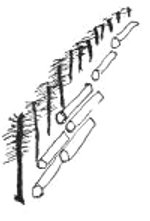
In this Tōkyō, this detestable Tōkyō, there are no Japanese impressions to be had except at rare intervals. To describe to you the place would be utterly impossible,—more easy to describe a province. Here the quarter of the foreign embassies, looking like a well-painted American suburb;—near by an estate with quaint Chinese gates several centuries old; a little further square miles of indescribable squalor;—then miles of military parade-ground trampled into a waste of dust, and bounded by hideous barracks;—then a great park, full of really weird beauty, the shadows all black as ink;—then square miles of streets of shops, which burn down once a year;—then more squalor;—then rice-fields and bamboo groves;—then more streets. All this not flat, but hilly,—a city of undulations. Immense silences—green and romantic—alternate with quarters of turmoil and factories and railroad stations. Miles of telegraph-poles, looking at a distance like enormous fine-tooth combs, make a horrid impression. Miles of water-pipes—miles and miles and miles of them—interrupt the traffic of the principal streets: they have been trying to put them underground for seven years,—and what with official trickery, etc., the work makes slow progress. Gigantic reservoirs are ready; but no water in them yet. City being sued by the foreign engineer (once a university professor) for $138,000 odd commission on plans! Streets melt under rain, water-pipes sink, water-pipe holes drown spreeing men and swallow up playful children; frogs sing amazing songs in the street.—To think of art or time or eternity in the dead waste and muddle of this mess is difficult. The Holy Ghost of the poets is not in Tōkyō. I am going to try to find him by the seashore.
The other night I got into a little-known part of Tōkyō,—a street all ablaze with lanterns about thirty feet high, painted with weird devices. And I was interested especially by the insect-sellers. I bought a number of cages full of night-singing insects, and am now trying to make a study of the subjects. The noise made by these creatures is very much more extraordinary than you could imagine; but the habit of keeping them is not merely due to a love of the noise in itself. No: it is because these little orchestras give to city-dwellers the feeling of the delight of being in the country,—the sense of woods and hills and flowing water and starry nights and sweet air. Fireflies are caged for the same reason.
This is a refinement of sensation, is it not?—only a poetical people could have imagined the luxury of buying summer-voices to make for them the illusion of nature where there is only dust and mud. Notice also that the singers are night-singers. It is no use to cage the cicadæ: they remain silent in a cage, and die.
In this horrid Tōkyō I feel like a cicada:—I am caged, and can’t sing. Sometimes I wonder whether I shall ever be able to sing any more,—except at night?—like a bell-insect which has only one note.
What more and more impresses me every year is the degree to which the writer is a creature of circumstance. If he can make the circumstance, like a Kipling or a Stevenson, he can go on forever. Otherwise he is likely to exhaust every motive in short order, to the same extent that he depends on outer influence.
There was a little under-ripple of premonition in that very sweet letter from Miss Josephine,—just the faintest suggestion of a thought that the future might hold troubles in its shadow. Now I suppose that for none can the future be only luminous; but that you will have a smooth and steady current to bear you along to the great sea appears to me a matter of course. I do not imagine there will be rocks and reefs and whirlpools for you. You have both such large experience of life as it is, and of the laws and the arts of navigating that water, that I have no anxiety about you at all. Such little disillusions as you may have should only draw you nearer together. But there is the sensation of being afraid for somebody else—one has to face that; and the more boldly, perhaps, the less the terror becomes. It is worse in the case where one would be helpless without the other. But I imagine that your union is one of two strong independent spirits—each skilled in self-guidance. That makes everything so much easier.
One thing you will have to do,—that is, to take extremely good care of yourself for somebody else’s sake. Which redounds to my benefit; for I really don’t know what I should do without that occasional wind of sympathy wherewith your letters refresh me. I keep telling my wife that it would be ever so much better to leave Tōkyō, and dwell in the country, at a very much smaller salary, and have peace of mind. She says that nowhere could I have any peace of mind until I become a Buddha, and that with patience we can become independent. This is good; and my few Japanese friends tell me the same thing. But perhaps the influence from 40 Kilby Street, Boston, is the most powerful and saving of all.
An earthquake and several other things (I hate earthquakes) interrupted this letter. It is awfully dull, I know—forgive its flatness....
Ever, dear H., your
Lafcadio.
TO ELLWOOD HENDRICK Tōkyō, 1897.
Dear Hendrick,— ... You speak about that feeling of fulness of the heart with which we look at a thing,—half angered by inability to analyze within ourselves the delight of the vision. I think the feeling is unanalyzable, simply because, as Kipling says in that wonderful narrative, “The Finest Story in the World,” “the doors have been shut behind us.” The pleasure you felt in looking at that tree, at that lawn,—all the pleasure of the quaint summer in that charming old city,—was it only your pleasure? There is really no singular,—no “I.” “I” is surely collective. Otherwise we never could explain fully those movements within us caused by the scent of hay,—by moonlight on summer waters,—by certain voice tones that make the heart beat quicker,—by certain colours and touches and longings. The law that inherited memory becomes transmuted into intuitions or instincts is not absolute. Only some memories, or rather parts of them, are so transformed. Others remain—will not die. When you felt the charm of that tree and that lawn,—many who would have loved you were they able to live as in other days, were looking through you and remembering happy things. At least I think it must have been so. The different ways in which different places and things thus make appeal would be partly explained;—the supreme charm referring to reminiscences reaching through the longest chain of life, and the highest. But no pleasure of this sort can have so ghostly a sweetness as that which belongs to the charm of an ancestral home—in which happy generations have been. Then how much dead love lives again, and how many ecstasies of the childhoods of a hundred years must revive! We do not all die,—said the ancient wise man. How much of us dies is an unutterable mystery.
Science is rather provoking here. She tells us we are advancing toward equilibration, to be followed by dissolution, to be succeeded by another evolution, to end in another disintegration—and so on forever. Why a cosmos must be dissipated into a nebula, and the nebula again resolved into a sun-swarm, she confesses that she does not know. There is no comfort in her except the comfort of doubt,—and that is wholesome. But she says one encouraging thing. No thought can utterly perish. As all life is force, the record of everything must pass into the infinite. Now what is this force that shapes and unshapes universes? Might it be old thoughts and words and passions of men? The ancient East so declares. There can be rest eternal only when—not in one petty world, but throughout all the cosmos—the Good only lives. Here all is, of course, theory and ignorance,—for all we know. Still the faith ought to have value. How would the well-balanced man try to live if once fully persuaded that his every thought would affect not only the future of himself, but of the universe! The other day something queer happened. I was vexed about something wrong that had been done at a distance. Some days after, one said to me: “The other day, while you were so angry, people were killed”—mentioning the place. “I know that,” I said. “But do you not feel sorry?” “Why should I feel sorry?—I did not kill anybody.” “How do you know you did not? Your anger might have been added to the measure of the anger that caused the wrong.” Unto this I could not reply. Thinking over the matter, indeed, who can say what his life may be to the life of the unseen about him?
Ever very affectionately,
Lafcadio Hearn.
TO ELLWOOD HENDRICK 1897.
Dear Hendrick,— ... The idea of a set of philosophical fairy-tales often haunts me. One doesn’t need to go to the Orient for the material. It is everywhere. The Elle-woman is real. So are the Sirens, Circe, and the Sphinx and Herakles and Admetos and Alkestis. So are the Harpies, and Medusa, and the Fates who measure and cut and spin. But when I try, I find myself unable to create for want of a knowledge of every-day life,—that life which is the only life the general reader understands or cares about.
Then the philosophical fairy-tales might deal with personal experiences common to all men,—impulse and sorrow and loss and hope and discovery of the hollowness of things. But the inclination only is with me,—the pushing sensation,—the vague cloud-feeling of the thing. Can you help—suggest—define—develop by a flash or two? If you can, be sweet, and tell me; and the fairy-tales shall be dedicated unto you. Indeed they shall in any case, if I can ever write them. In haste, with love,
Lafcadio Hearn.
TO MITCHELL McDONALD Tōkyō, November, 1897.
Dear McDonald,—I can only very poorly express my real feeling at the true goodness shown me, not only in coming out to my miserable little shanty, over that muddy chaos of street,—but in making me feel so free-and-easy with you, in the charming way you accepted the horrid attempt at entertainment, and in the hundred ways by which you showed your interest and sympathy. It was more than nice—that is all I can say.
But you set some mental machinery at work too. I believe almost your first remark was your desire that I should write fiction,—and I believe I understand why you wish this. It is because you wish me to make some profit out of my pen; and, being well informed on all business matters, you know, just as well as we literary men do, that fiction is about the only material that really pays. And now I am going, after a little thinking about the matter, to answer you in kind.
Why do not men like myself write more fiction? For two reasons. The first is because they have little knowledge of life, little savoir-vivre, to help them in the study of the artificial and complex growth of modern society. The second is that, unless very exceptionally situated, they are debarred, by this very want of knowledge and skill, from mixing with that life which alone can furnish the material. Society everywhere suspects them; common life repels them. They can divine, but they must have rare chances to do that. Men like the genius Kipling belong to the great life-struggle, understand it, reflect it, and the world worships them. But dreamers who talk about preëxistence, and who think differently from common-sense folk, are quite outside of social existence. But—I can do this: You know all about the foreign life of these parts,—the shadows and the lights. You can give me, perhaps, in the course of three years, suggestions for six little stories—based upon the relations between foreigners and Japanese in this era of Meiji: studies of the life of the “open ports.” I should need only real facts—not names or dates—real facts of beauty or pathos or tragedy. There are hosts of these. All the life of the open ports is not commonplace: there are heroisms and romances in it; and there is nothing in this world nearly as wonderful as life itself. All real life is a marvel—but in Japan a marvel that is hidden as much as possible—especially hidden from dangerous chatterers like Lafcadio Hearn.
Of course I could not make a book in a few months,—not in less than two or three years; but I could make one, with the mere help of hints from a man who knows. And if that book of short stories (six would be enough to make a book) should ever be so written, I should certainly make a dedication of it to M. McD. as prettily as I could.
There is an answer to your wish so far as I can make one for the present. I shall be down to see you the next month, probably, and we can chat over matters if you have time. And I shall take care not to come when you are too busy.
Faithfully, with affectionate regards and thanks,
Lafcadio Hearn.
TO MASANOBU ŌTANI Tōkyō, December, 1897.
Dear Ōtani,—I have your very nice letter, which gave me much pleasure. This is just a line before I go away, in regard to the subject for January, and relevant matters.
First let me tell you that you are very, very much mistaken—extraordinarily mistaken—in thinking that I do not care for what you call “vulgar” songs. They are just what I care most about. In all the poems that you translated for me this month, I could find but one that I liked very much; and that was a dodoitsu.
Now I am going to shock you by saying something that may surprise you; but if I do not say it, you will never understand what I want. In all the great mass of student poetry that you collected for me, I found only seventeen pieces that I could call poetry,—and on submitting those seventeen pieces to higher tests, I found that nearly all were reflections of thoughts and feelings from older poets. As for the book that you translated, I could find no true poetry in it at all, and scarcely anything original.
And now let me tell you my honest opinion about this whole matter. The refined poetry of this era, and most of the poetry that you collected for me of other eras, is of little or no value. On the other hand, the “vulgar” songs sung by coolies and fishermen and sailors and farmers and artisans, are very true and beautiful poetry; and would be admired by great poets in England, in France, in Italy, in Germany, or in Russia.
You will think, of course, that this only shows my ignorance and my stupidity. But please reflect a little about the matter. A great poem by Heine, by Shakespeare, by Calderon, by Petrarch, by Hafiz, by Saadi, remains a great poem even when it is translated into the prose of another language. It touches the emotion or the imagination in every language. But poetry which cannot be translated is of no value whatever in world-literature; and it is not even true poetry. It is a mere playing with values of words. True poetry has nothing to do with mere word-values. It is fancy, it is emotion, it is passion, or it is thought. Therefore it has power and truth. Poetry that depends for existence on the peculiarities of one language is waste of time, and can never live in people’s hearts. For this reason there is more value in the English ballad of “Childe Waters” or of “Tamlane,” than in the whole of the verse of Pope.
Of course, I know there are some beautiful things in Japanese classical poetry—I have translations from the Manyōshū and Kokinshū which are beautiful enough to live forever in any language. But these are beautiful because they do not depend on word-values, but upon sentiment and feeling.
I fear you will think all this very foolish and barbarous; but perhaps it will help you to understand what I want. “Vulgar” poetry is supremely valuable, in my humble opinion.
Please this month collect for me, if you can, some poems on the Sound of the Sea and the Sound of the Wind. If there are not many poems on these subjects, then you might add poems on the Sea and the Wind in any other connection. What I want to get is the feeling that the sound and the mystery of Wind and Sea have inspired in Japanese Song.
With best wishes ever, faithfully yours,
Y. Koizumi.
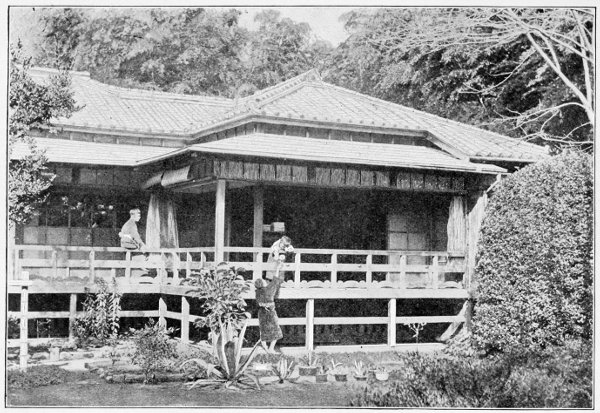
WRITING-ROOM IN MR. HEARN’S TŌKYŌ HOUSE His three sons on the verandah
TO MASANOBU ŌTANI Tōkyō, June, 1898.
My dear Ōtani,—I am pleased to hear that the incident was imaginary,—because this gives me a higher idea of your sense of art. True literary art consists very largely in skilful combination of real or possible facts in an imaginary succession. Literature artistic never can be raw truth, any more than a photograph can be compared with a painting. Here is a little sentence from one of the greatest of modern French writers:—
“L’art n’a pas la vérité pour objet. Il faut demander la vérité aux Sciences, parce qu’elle est leur objet;—il ne faut pas la demander a la littérature, qui n’a et ne peut avoir d’objet que le beau.” (Anatole France.)
Of course this must not be taken too literally; but it is substantially the most important of truths for a writer to keep in mind. I would suggest this addition: “Remember that nothing can be beautiful which does not contain truth, and that making an imagination beautiful means also to make it partly true.”
Your English is poor still; but your composition was artistic, and gave me both surprise and pleasure. You understand something about the grouping of facts in the dramatic sense, and how to appeal by natural and simple incidents to the reader’s emotion. The basis of art is there; the rest can only come with years of practice,—I mean the secret of compressed power and high polish. I would suggest that when writing in your own language, you aim hereafter somewhat in the direction of compression. You are now somewhat inclined to diffuseness; and a great deal is gained in strength by understanding how much of detail can be sacrificed....
Yours faithfully,
Y. Koizumi.
TO MITCHELL McDONALD Tōkyō, January, 1898.
Dear McDonald,—I believe those three days, of mine in Yokohama were the most pleasurable in a pilgrimage of forty-seven years. I can venture to say little more about them per se. Such experience will not do for me except at vast intervals. It sends me back to work with much too good an opinion of myself,—and that is bad for literary self-judgement. The beneficial result is an offsetting of that morbid condition,—that utter want of self-confidence. On the whole, I feel “toned-up”—full of new energy; that will not be displeasing to you. I not only feel that I ought to do something good, but I am going to do it,—with the permission of the gods.
How nice of you to have invited Amenomori to our tiffin,—and the trip to Ōmori! I look forward in the future to a Kamakura day, under like circumstances, when time and tide permit. I believe A. can surprise us at Kamakura, which he knows better than any man living. He does not give his knowledge to many people.
I am sending you Knapp’s book, as I promised, and that volume of mine which you have not read. Excuse the shabbiness of the volumes. I think Dr. Hall knows much about the curious dialect which I have used,—the Creole. Please say to him for me what you feel ought to be said.
I won’t write any more now—and I settle down forthwith to work with fresh vim and hope.
With more than grateful remembrance,
Affectionately yours,
Lafcadio Hearn.
TO MITCHELL McDONALD Tōkyō, January, 1898.
Dear McDonald,—I have both of your kindest letters. It gave me no small pleasure to find that you liked “Youma:” you will not like it less knowing that the story is substantially true. You can see the ruins of the old house in the Quartier du Fort if you ever visit Saint-Pierre, and perhaps meet my old friend Arnoux, a survivor of the time. The girl really died under the heroic conditions described—refusing the help of the blacks, and the ladder. Of course I may have idealized her, but not her act. The incident of the serpent occurred also; but the heroine was a different person,—a plantation girl, celebrated by the historian Rufz de Lavison. I wrote the story under wretched circumstances in Martinique, near the scenes described, and under the cross with the black Christ. As for the “Sylvestre Bonnard” I believe I told you that that was translated in about ten days and published in two weeks from the time of beginning—at the wish of the Harpers. Price $115, if I remember rightly,—and no commission on sales,—but the work suffers in consequence of the haste.
How to answer your kind suggestion about pulling me “out of my shell,” I don’t well know. I like to be out of the shell—but much of that kind of thing could only result in the blue devils. After seeing men like you and the other Guardsman,—the dear doctor,—one is beset with a foolish wish to get back into the world which produced you both, back to the U. S. A.,—out of Government grind, out of the unspeakable abomination and dulness and selfishness and stupidity of mere officialism. And I can’t afford that feeling often—not yet. I have too many little butterfly-lives to love and take care of. Some day, I know, I must get back for a time. Meanwhile I must face the enemy and stand the music.
Now I want you to tell me that Highbinder romance when I next meet you. Perhaps your solitary experience could give me more than one good story. Every good man’s life is full of romances. The trouble is to get him to tell them, and to understand them properly when told. Your “Prussian officer” is delicious; but I fear my talent is not quite up to the mark of telling it as it ought to be told. Maupassant—Kipling—they would delight the world with such a thing. Never mind!—I am sure, if you want me to write stories, that you can give me all the material you want or that I need. I shall sit again at the table, supporting that beautiful cap with its silver-eagle,—and I shall talk and talk and talk until you tell me more stories.
Won’t you be glad to hear that my new book will be finished this month,—perhaps this week? Then for the “Stories from Many Lips”—or something of that kind.
Ever affectionately yours,
Lafcadio Hearn.
TO MITCHELL McDONALD Tōkyō, January, 1898.
Dear McDonald,—I got your kindest reply to my note of the other day,—actually apologizing for not writing sooner. But I told you never to bother yourself about writing me when you do not feel like it or when you are in the least busy; and I shall never feel neglected if you be silent, but only think that you have business on hand, and hope that you will have good luck in the undertaking.
Why, yes: I must get down some Saturday, or Friday afternoon—that would be still better—so as to return to Tōkyō Sunday night: for my Saturdays are free. But not too soon. It is only about two weeks since I was with you—though I acknowledge that it seems to me like three months. I wish I could see you more often;—then again, I think, you would be tired of my chatter soon. (I know what you would protest; but it doesn’t matter.) Well, not to argue too much, I promise to make a visit during February,—though I shall scarcely be able to name an exact day in advance.
I have never been in San Francisco, unfortunately. But that matters little, if I can ask all the questions I want. The value in a literary way of the scenes would be less the scenes themselves than the impression which they made upon your own memory. I anticipate much pleasure in asking you about it, as well as delight in hearing the story itself.
What will you think of my wickedness? I am going to tell you a bad story about myself. The other day (I mustn’t try to pretend it was long ago, like I did about the Club-Hotel story in your carriage, for fear of being questioned as to direct facts) my publishers sent me some rather nasty newspaper clippings, together with what affected to be a manuscript history of my personal eccentricities and weaknesses. They suggested that I should correct, amend, or reject, but that they should be glad to publish it with my approval. (About 19 pp. I think.) Having read it with considerable anger, I laid it aside for a couple of days,—during which time I effectually restrained the first impulse to write a furious letter. Then I most effectually amended that MS.; I corrected it as thoroughly as it could possibly be corrected—but not with pencil or pen: such instruments being quite inadequate for the purpose. In short, I corrected, amended, and rejected it all at the same time—with the assistance of a red-hot stove. They shall never know; but as murder will out, I must tell somebody, and that somebody shall be you. With best regards to the doctor,—ever with hopes to see you soon,
Lafcadio Hearn.
TO MITCHELL McDONALD Tōkyō, January, 1898.
Dear McDonald,—It would do me a great deal of harm if I could believe your appreciations and predictions; but I am quite sure you are mistaken about both. As to success, I think my greatest good fortune would consist in being able occasionally to travel for about six months,—just to pick up strange or beautiful literary material. If I can ever manage that much—or even if I can manage to get so far independent that I can escape from officialdom—I shall be very fortunate indeed. Want to get to Europe for a time, in any case, to put my boy there. But all this is dream and shadow, perhaps.
Literary success of any enduring kind is made only by refusing to do what publishers want, by refusing to write what the public want, by refusing to accept any popular standard, by refusing to write anything to order. I grant it is not the way to make money quickly; but it is the way—and the only way—to win what sincerity in literary effort ought to obtain. My publishers have frankly gone over to the Philistines. I could not write for them further even if they paid me $100 per line.
What a selfish letter I am writing! You are making me talk too much about my own affairs, and you would really spoil me, if you could. Talking to me of fame and hundreds of thousands of dollars! Of course I should like to have hundreds of thousands, and to hold them at your disposal; but I should also like to live in the realization of the life of the Arabian Nights. About the truth of life seems to be this: You can get what you wish for only when you have stopped wishing for it, and do not care about keeping it.
I see your name in the papers often now, and in connections that fill me with gladness. You are a power again in the land—wish you could be here for longer than you are going to stay. But, after all, that would not be best for you—would it?
Affectionately ever,
Lafcadio.
TO MITCHELL McDONALD Tōkyō, January, 1898.
Dear McDonald,—After all, instinct isn’t a bad thing. Your just-received excellent advice is precisely what my “blind instinct”—as scientific men call it—told me. No: I shall do nothing without consulting you.
Well, I imagine that not next Friday, but the Friday after will be most convenient to you. I’ll try the later date, therefore. (Friday need not be a Black Friday in Japan—I used to hate to do anything on that day—landed in Japan on Good Friday (!) but now I belong to the Oriental gods.)
Wonder if you know that the Revue des Deux Mondes has sent a poet here to write up Japan—M. André Bellesort. He is a man of big literary calibre, and has a rare wife—who speaks Persian. About as charming a Frenchwoman as one could wish to know. She speaks English, Italian, and Spanish besides. Trying to get them interested in Amenomori. They are at the Hotel Metropole,—perhaps on account of the Legation.
Faithfully and affectionately yours,
Lafcadio Hearn.
TO MITCHELL McDONALD Tōkyō, February, 1898.
Dear McDonald,—I ought to have answered you about the subject of investment the other day; but I thought it would be better to wait. However, now I think (I have just received your telegram, and I confess it made me uncomfortable) that I had better write my feelings frankly. I suppose that, being naturally born to bad luck, I shall lose my small savings in the ordinary course of the world’s events; but I would prefer this prospect to the worry of mind that I should have about any investment. In fact, rather than stand that worry again (I have had it once) I should prefer to lose everything now. The mere idea of business is a horror, a nightmare, a torture unspeakable. The moment I think about business I wish that I had never been born. I can assure you truthfully that I would rather burn a five hundred dollar bill than invest it,—because, having burned it, I could forget all about it, and trust myself to the mercy of the gods. Even if I had Jay Gould behind me, to pull me up every time I fell, I should not have anything to do with business. Even to have to write you this letter makes me wish that all the business in the world could be instantly destroyed. I am afraid to explain more. I think I won’t go to Yokohama on Friday next—but later,—well, what’s the use of writing more—you will understand how I feel. Ever most faithfully,
Lafcadio Hearn.
TO MITCHELL McDONALD Tōkyō, February, 1898.
Dear McDonald,—When I saw that big envelope, I thought to myself, “Lord! what a lot of h—l I am going to get!” You see my conscience was bad. I was wrong not to have told you long ago of my peculiar ’phobia. And inside that envelope there was only the kindest of kind letters,—proving that you understood me perfectly well, and forthwith putting me at ease.
I read the prospectus with great interest (by the way, I am returning it, because, as it is still in the state of a private document, I think it is better that I do not keep it); and I am proud of my friend. He can do things! “Canst thou play with Leviathan like a bird? Or canst thou bind him for thy handmaidens?” No, I can’t, and I am not going to try; but I have a friend in Yokohama—an officer of the U. S. Navy—he plays with Leviathan, and makes him “talk soft, soft words”—indeed he even “presses down his tongue with a cord.” Well, I should like you to be as rich as you could be made rich, without having worry. But as for me!—the greatest favour you can ever do me is to take off my hands even the business that I have—contracts, and the like,—so that I need never again remember them. Besides, if I were dead, you are the one I should want to be profiting by my labours. Then every time you set your jaw square, and made them “fork over,” my ghost would squeak and chipper for delight,—and you would look around to see where the bats came from.
Well, next week I’ll try to get down. In fact I feel that I must go to Yokohama, for various reasons besides imposing upon a certain friend there. To-day I have been packing up my book all the time from morning until now—so as to send by registered letter.
About “the best.” You are a dreadful man! How could you think that I had got even halfway to the bottom. I have only drunk three bottles yet; but that is a shameful “only.” Three bottles in one month is simply outrageous; and I look into the glass often to observe the end of my nose. That “best” is too seductive.
With affectionate thanks for kindest letter,
Faithfully ever,
Lafcadio.
TO MITCHELL McDONALD Tōkyō, February, 1898.
Dear McDonald,—Your telegram made me feel comfortable. I had been a little uneasy,—especially because you never told me what really was the matter;—and when a man like you cannot bend his back, the matter could not have been a joke. Also the telegram convinced me that you were really thinking about coming up, and possibly might come up during the spring or the summer or the coming autumn season, and that I could squat on the floor and talk to you—which made me comparatively happy.
I have been otherwise disgracefully blue. When I want to feel properly humble, I read “Glimpses of Unfamiliar Japan”—about half a page;—then I howl, and wonder how I could ever have written so badly,—and find that I am really only a very twenty-fifth-rate workman and that I ought to be kicked. Then the weather has been trying;—the mails are behind;—the afflictions of Tōkyō manifold. Also I have been provoked to think that there is no other person like you known to me in the entire world,—and that you are by no means immortal,—and that, even as it is, you think ever so much more of me than I deserve. Also I have been meditating on the unpermanency of the universe, and considering the possible folly of making books at all.—This must be the darkness before the dawn: at least I ought to think so.
I have partly in mind the plan for making the best part of number eight out of stories adapted from the Japanese. Not sure that I can carry the plan out satisfactorily;—but I am resolved that number eight must be worthy of your hopes for me,—and that it shall prove an atonement for the faults of the first book dedicated to you.
Take all care of yourself, and believe me most grateful for that telegram.
Affectionately,
Lafcadio.
TO MITCHELL McDONALD Tōkyō, February, 1898.
Dear Friend,—Two or three mornings ago I woke up with a vague feeling of pleasure—a dim notion that something very pleasant had occurred the day before. Then I remembered that the pleasure had come from your unanswered letter. I kept putting off writing, nevertheless, day after day, in consequence partly of the conviction that such a letter should not be answered in a dull mood, and partly because some of my college work this past week has been more than usually complicated—involving a study of subjects that I thoroughly hate, but must try to make interesting—the literature and spirit of the eighteenth century.
Well, even now, I do not quite know what to say about your letter. To tell me that I have something of your father’s spirit more than pleased me—not because I could quite believe it, but because you did. Your father must have been a very fine man, without any pettiness,—and I have more smallness in me than you can suspect. How could it be otherwise! If a man lives like a rat for twenty or twenty-five years, he must have acquired something of the disposition peculiar to house-rodents,—mustn’t he? Anyhow, I could never agree to let you take all the trouble you propose to take for me merely as a matter of “thank you.” I must contrive ways and means to better your proposal—not to cancel the obligation, for that could not be done, but at least to make you quite sure that I appreciate the extreme rarity of such friendship.
I am writing with hesitation to-day (chiefly, indeed, through a sense of duty to you),—for I fear that you are in trouble, and that my letter is going to reach you at the worst possible time. However, I hope you have not lost any very dear friends by that terrible accident at Havana. I think you told me that you were once on that ship, nevertheless; and I fear that you must receive some bad news. My sympathies are with you in any event.
My Boston friend is lost to me, certainly. I got a letter yesterday from him—showing the serious effect upon friendship of taking to one’s self a wife,—a fashionable wife. It was meant to be exactly like the old letters;—but it wasn’t. Paymaster M. M. must also some day take a wife, and ... Oh! I know what you are going to say;—they all say that! They all assure you that they both love you, and that their house will be always open to you, etc., etc., and then—they forget all about you—purposely or otherwise. Still, one ought to be grateful,—the dropping is so gently and softly done.
Affectionately ever,
Lafcadio Hearn.
TO MR. AND MRS. JOHN ALBEE Tōkyō, February, 1898.
My dear Friends,—I am going to address you together, as that will save me from the attempt to write in two keys corresponding to the differing charm of your two letters. Certainly it gave me, as you surmised, sincere pleasure to hear from you. Mrs. Albee surprised me at the same time by a most agreeable, though I fear somewhat generous, reference to a forgotten letter. I think I must have penned many extravagances in those days. I know it—in certain cases: anyhow I should be afraid to read my own letters to Mr. Albee over again. As for my old ambition then expressed, I don’t quite know what to say. The attempt referred to led me far at one time in the wrong direction—though whatever I have learned of style has certainly been due rather to French and Spanish studies than to English ones. I have now dropped theories, nevertheless; and I simply try to do the best I can, without reference to schools.
Do you know that I had a dim notion always that Mr. Albee was a millionaire,—or at least a very wealthy dilettante?—which would be the best of reasons for never sending him a book, notwithstanding my grateful remembrance of his first generous encouragement. (Here I use “generous” in the strongest meaning possible.) I am, selfishly, rather pleased to hear that the price of a book is sometimes for him, as for me, a question worth thinking over—because the fact permits me to offer him a volume occasionally. Otherwise indeed I wish he were rich as my fancy painted him.
You say that you have not read “all my books on Japan.” Any that you particularly care to read, I can send you—though I should not recommend the “Glimpses,” except for reference. “Kokoro” would probably best please Mrs. Albee, and after it, “Out of the East.” Hereafter I shall send a copy of every “new book” to you. Of course I shall be glad to have the pleasure of seeing Mr. Albee’s “Prose Idyls”—many sincere thanks for the kind remembrance!
With kindest and best regards, faithfully ever,
Lafcadio Hearn.
TO JOHN ALBEE Tōkyō, May, 1898.
Dear Mr. Albee,—My best thanks for the “Prose Idyls.” The book leaves on the mind an impression of quiet brightness like that of a New England summer sky thinly veiled. Three idyls especially linger in my imagination,—each for a reason all its own. Hawthorne might have written “The Devil’s Bargain:” it is a powerful moral fancy, and the touch of grotesque humour in it is just enough to keep it from being out of tone in the gallery of optimist studies. “The Family Mirror” is haunting: the whole effect, to my notion, being brought out by that charming reference to the damaged spot at the back. Then “A Mountain Maid” much appealed to me by its suggestion of that beautiful and mysterious sauvagerie, as the French call it,—that wholly instinctive shrinking from caress, which develops with the earliest budding of womanhood, but which the girl could not herself possibly explain. Indeed I fancy that only evolutional philosophy can explain it at all. Analogous conditions in the boy of fourteen or fifteen are well worthy of study—already I had attempted a little sketch on this subject, which may be printed some day or other: “A Pair of Eyes.”
My next volume will have a series of what I might call metaphysical idyls, perhaps, at its latter end. I fear you will think them too sombre,—now that I have felt something of the sunshine of your soul. However, each of us can only give his own tone to the thread which he contributes to the infinite warp and woof of human thought and emotion. Is it not so? With kindest regards to Mrs. Albee, very gratefully yours,
Lafcadio Hearn (Y. Koizumi).
TO MITCHELL McDONALD Tōkyō, February, 1898.
Dear McDonald,—I must try to forget some of your beautiful letter for fear that it should give me much too good an opinion of myself. A reverse state of mind is, on the whole, much better for the writer,—I mean for any professional writer.
I believe all that you wish me to believe about your generous call—but, if friend McDonald does not think my house a poor rat-trap, that is because friend McDonald has not yet discovered what a beautiful Japanese house is like. Let me assure him, therefore, that it is something so dainty, so wonderful, that only by custom can one cease to be afraid to walk about in it.
Yes, as you surmised, one of your suggestions is wrong. The professional writer, however small his own powers may be, generally knows the range of literary possibilities; and I know that what you wish cannot be done by any Western writer with the least hope of success. It has been extensively tried—always with the result of failure. The best attempt, perhaps, was the effort of Judith Gautier,—a very delicate French writer; but it did not succeed. As for “A Muramasa Blade,” “Mito Yashiki,” etc., the less said the better. In any case, it is not so much that the subject itself is immensely difficult for a foreigner, as that even supposing this difficulty mastered, the Western public would not care twopence about the result. Material is everywhere at hand. Yearly, from the Japanese press are issued the most wonderful and thrilling stories of Japanese feudal life; but a master-translation of these, accompanied with illustrations of the finest kind, would fall dead in a Western book-market, and find its way quickly into the ten-cent boxes of second-hand dealers. And why? Simply because the Occidental reader could not feel interested in the poetry or romance of a life so remote.
No: the public want in fiction things taken raw and palpitating out of life itself,—the life they know,—the life everybody knows,—not that which is known only to a few. Stories from Japan (or India or China, for that matter) must be stories about Western people among alien surroundings. And the people must not be difficult to understand; they must be people like the owner of the “Mary Gloster” in Kipling’s “Seven Seas.” (You ought to buy that book—and love it.) Of course, I don’t mean to say that I could ever do anything of Kipling’s kind—I should have to do much humbler work,—but I am indicating what I mean by “raw out of life.”
As for the other suggestion,—who ever was such a pretty maker of compliments!—I can only say that I am happy to have a friend who thus thinks of me.
Gratefully, with much thanks for your charming letter,
Lafcadio Hearn.
TO MITCHELL McDONALD Tōkyō, March, 1898.
Dear McDonald,—I did not think much of the title of Morrow’s book; but your judgement of the stories interested me, and the selfsame evening I began the volume—in bed. I read three quarters at a run, and the rest early in the morning. They are queer and sometimes powerful little stories—not less interesting because they are, most of them, improbable. They have the charm of the now old-fashioned stories of 1850-70,—perhaps not finished to the same extent as the Atlantic stories used to be; but they make me think of them a little. (The literary centres clamour for realism to-day; but I fancy that the taste for the romantic will live a good while longer.) Then again there is a little of the old-time gold light of California days here—that will always have a charm for readers. I wonder if Morrow is a young man: if he is, I should believe him likely to do still better in the future. If he writes for money, he need not do much finer work; but if just for love of the thing, I should say that he could finish his work better than he does,—as in the study of the emotions of the man who finds his wife untrue to him, and solves a moral problem after quite an ideal fashion. The subject was splendid: it might have been made more of.—But not to criticize things—especially things which I could not do myself—I must say that I enjoyed the tales, and that they ought to have a very good sale.
Somehow your own story—the “Highbinder story”—kept riding on the back of that gold dragon all the while I was reading. The real dominated the romantic, and yet betimes made the romantic seem possible. I could feel everything to be just as it was—my experience as a police-reporter gave verisimilitude to the least detail. You are after all a knight-errant in soul,—a real knight, tilting, not against shadows and windmills, but against the dragons of corrupted law and the giants of fraud who haunt the nineteenth century. You are a survival, I fear—there are few like you: you ride alone: all the more reason that you should take every care of yourself—care of your health; I fear you are not exercising enough, keeping too confined. If you are really, as I believe, fond of your little friend, don’t forget his prayer that you make health your No. 1 consideration.
Hope to be down Friday about 2 P. M. or 2.30 at latest.
Affectionately,
Lafcadio.
TO MITCHELL McDONALD March, 1898.
Dear McDonald,—I do not feel pleased at your returning to me the money and giving me your own copy of the book. I feel mean over it. But what can one do with a man who deliberately takes off his own coat to cover his friend during a nine minutes’ drive? I shall remember the feeling of that coat—warmth of friendship must also have been electrical in it—until I die.
Affectionately and somewhat reproachfully,—in haste,
Lafcadio Hearn.
I write in haste, so as not to keep your man waiting.
TO MITCHELL McDONALD Tōkyō, March, 1898.
Dear McDonald,—Just got your letter,—your more than kind letter. Happily there is no occasion to send the telegram. I am getting well fast, and think I shall be lecturing on Monday. No: I did not minimize things. I have been laid up, but it was more painful than serious. Can’t tell what it was—a painful swelling of one side of the face, and nose. My picturesque nose suffered most. That a square mile of solid pain could be concentrated into one square inch of nose was a revelation! Anyhow, it felt just like a severe case of frost-bite; but I suppose it was only some sort of a cold. Going to Yokohama had nothing to do with it; but the weather must have had. It was rather trying, you know, last Tuesday.
You are the one who tries to minimize things, my dear friend, by assuring me that there are thousands of ... people like yourself. I am glad to think that you can believe thus well of the world; but I can’t, and I should not be glad to think you were right. I prefer the exceptional. Then you will remember my philosophical theory that no two living beings have even the same voice, and that it is the uniqueness of each that has value. I should have to abandon my theories to accept your opinion of things in general, and I am prejudiced in favour of my theories.
Perhaps next week I can run down, and if that be not a good time for you, the week following. Anyhow the term will be over in about two weeks more, and—I hope—the cold. Tuesday deceived even the creatures of the spring. Hundreds of little frogs began to chant their song of birth, and flowers were opening everywhere. Now there is no sound of a frog. They woke up too soon, the creatures,—and the flowers look as if they were dying of consumption. In your hotel you don’t know all this—because you keep up the atmosphere of the Bermudas under that roof. In Ushigome we are practically in the country, and observe the seasons.
Affectionately,
Lafcadio.
TO MITCHELL McDONALD Tōkyō, March, 1898.
Dear McDonald,—Wasn’t I lucky in deciding to get back early last night? It would have been no easy matter getting back this morning—everything is drowned in snow! That was the reason of yesterday’s atrocious cold. Verily I was inspired by the gods—both as to going and returning.
This morning I woke up with an extreme feeling of comfort and lightness—which reminded me that something very pleasant must have happened the day before,—and I heard the U.S.C. cynically observing with a Mephistophelian smile, “Well, I guess our friend here will pull your chestnuts out of the fire for you!” And then I thanked all the host of heaven for that which had been, and also for that which would never again be. After all, I am rather a lucky fellow,—a most peculiarly lucky fellow. Principally owing to the note written some eight years ago by a certain sweet young lady whose portrait now looks down on me from the ceiling of No. 21 Tomihisa-chō, Ichigaya, Ushigome-ku, in the city of Tōkyō, Japan.
I send with this “Some Chinese Ghosts” in awfully bad condition. Early work of a man who tried to understand the Far East from books,—and couldn’t; but then, the real purpose of the stories was only artistic. Should I ever reprint the thing, I would change nothing,—but only preface the new edition with a proper apology.
You remember my anecdote yesterday of the Memphis man—“What! a d—d nigger? I’d as soon shoot a nigger as I’d shoot a rat!” He was a very pretty boy, too. I forgot to tell you something also about him that occurs to me this morning. He was walking lame in a pair of top-boots one morning, and I asked him what was the matter. “Only these d—d boots,” he said; “they’ve taken all the skin off my feet.” “Haven’t you another pair?” I asked. “Lots of ’em,” he answered; “but I’m not going to give in to these: I won’t let ’em get the better of me!—I won’t let them get the better of me!” I rather admired this vengeful and foolish pluck; and I am thinking now that I’d better follow the example. Spite of all conditions I’m getting No. 6 book under way; and I won’t give in either to publishers or to public.
Loving thanks for yesterday’s extraordinary enjoyableness and for all things. In haste.
Affectionately ever,
Lafcadio Hearn.
TO MITCHELL McDONALD Tōkyō, March, 1898.
Dear McDonald,—I am looking and looking for your last kind letter; but for the moment I cannot find it. So I must give it up for to-night, if I am to write you.
I’m through with the university; and I must get down to Yokohama, either to-morrow or Monday, and try to bore you, and to coax that story from Mrs. Burns (is that the name?),—but I shall make another visit later, if the weather allows. This will be only an expedition—partly in search of literary material. I feel I must get a few stories, to keep on the surface. Otherwise I’ll get heavy and sink. I have been rather heavy lately. My dog-sketch has developed into such a nightmare that I myself am afraid of it, and don’t want to think about it for a few days. Then I have just finished a short sketch, “In a Pair of Eyes”—considerably metaphysical. Such things may interest; but they will not touch hearts; and an author must try to get loved by his readers. So I shall forage.
Consul General Gowey gave me an agreeable start the other day by sending me a number of “The Philistine”—you know the little thing, very clever—with a pretended quotation from one of my books. The quotation, however, hit what I think,—though I never put the matter in just that shape. It was nice of the consul to send it—made me feel jolly. I must some day send him something to amuse him. Not to like him is impossible.
I think you must have hosts of friends now calling on you,—since the battle-powers of the great Republic are gathering out this way. I hope you won’t have to get yourself killed for Uncle Sam; but if you have, I want to be in the conning-tower about the same time. I fancy, however, that Manila would not be a mouthful if the navy is ordered to gobble it; and that the chief result of the expedition to U. S. officers would be an uncommonly large and fine supply of cigars.
I have last week declined three dinners. It strikes me that the average university professor is circumstanced about thus:—
1. Twelve to fourteen lectures a week.
2. Average of a hundred official banquets per year.
3. Average of sixty private society-dinners.
4. Average of thirty to fifty invitations to charitable, musical, uncharitable, and non-musical colonial gatherings.
5. Average of a hundred and fifty social afternoon calls.
6. Average of thirty requests for contributions to Japanese publications.
7. Average of a hundred requests for pecuniary contributions from all sources.
8. Average of four requests per month for speeches or outside lectures.
9. Average of a hundred calls from students “wanting” things—chiefly to waste the professor’s time.
This is only about half the list. I say “No” to everything—softly, of course. Otherwise how should I exist, breathe, even have time to think?—much less write books? Oh dear, oh dear!—What a farce it is! When they first started, they wanted the professors to wear a uniform of scarlet and gold. (I am sure about the gold—not quite sure about the scarlet.) The professors kicked at the gold,—luckily for themselves!
Ever affectionately,
Lafcadio.
TO MITCHELL McDONALD Tōkyō, March, 1898.
Dear McDonald,—Sunshine, warmth, and beauty in the world to-day; and sunshine and warmth of another sort in my heart—beautiful ghostly summer made by words and thoughts in Yokohama. “When the earth is still by reason of the South wind”—that is my mental world.
I am sending the photo of our friend, which reminds me that I was reproached very justly on reaching home last night. “But you did not bring your American friend’s picture?... Forgot to put it into the valise?... Oh! but you are queer—always, always dreaming! And don’t you feel just a little bit ashamed?” I do feel ashamed, but more than a little bit.
Also I send you a little volume containing “The House and the Brain”—published in other editions under the title “The Haunted and the Haunters.” (Usually it is bound up with that tremendous story about the Elixir of Life,—the “Strange Story” of Bulwer Lytton.) Professor Saintsbury calls this the best ghost-story ever written. But you ought to read it at night only—after the hotel becomes silent.
By way of precaution I must make a confession. I shall not be able to eat again until about Tuesday noon, I think. The tiffins, dinners, “irresistibles,” and above all that Blue Soul, were too much for me. I am getting old, sure enough,—and when I go down again to Yokohama I must live in the most ascetic manner. I feel constitutionally demoralized by all that luxurious living. Still, I must say that I suspect the sudden change of the weather is partly responsible for the feeling.
Now, really—don’t you feel tired of all this talk? Of course I know—but the conditions are so much like those of old college friendships that they seem more of dreams than of reality.
Ever affectionately,
Lafcadio.
TO MITCHELL McDONALD Tōkyō, April, 1898.
Dear McDonald,—Your kindest letter came last night. I must confess to a feeling of remorse for transferring all my troubles to your broader shoulders,—a remorse tempered somewhat, of course, by the certainty that you find a pleasure in helping your friend, but nevertheless, a remorse. So pray do not do anything more than you find it pleasant and inexpensive to do.
We are under the weather for the moment. We shall not be able to profit by the holidays. I have escaped cold and all other troubles; but I could not escape the generally depressing influence of this chilly, sunless, muddy, slimy season. In other words, I feel too stupid to do anything. Probably the sight of the sun will make us all feel happy again.
Of course I shall be unhappy till I get your photos,—both military and civilian. I fear to ask too many; but all I can get, I want. Don’t hurry; but—don’t forget me, if you think I deserve to be remembered.
I am a little anxious lest war take you away from Japan, which would leave me less satisfied with this world than I now am. But I should like indeed to accompany you in a descent on Manila, and to chronicle events picturesquely.
I should never be able, however, to do anything so wonderful as did Loti in describing the French attack on the coast of Annam. It was the greatest literary feat ever done by a naval officer; but it nearly cost him his place in the navy, and did in fact suppress him for several years. In his reissue of the narrative I see that he was obliged to suppress the terrible notes on the killing.
Ever affectionately,
Lafcadio Hearn.
TO MITCHELL McDONALD Tōkyō, April, 1898.
Dear Friend,—The holidays are over; and the winter is still dying hard. We are all feeling pretty well now notwithstanding,—and my imp was down yesterday to Ueno, in the sea of people, trying to get a glimpse of things. Because he had a naval uniform on, he became quite angry at the kurumaya for proposing to lift him up to look over the heads of the people. The K. wisely answered: “I know you are a man—but then you must think that I am a horse only, and ride on my back. Even military men ride horses, you know!” Subsequently, the imp had to submit to circumstances,—swallowed his pride,—and got on the man’s back. I liked the pride, though: it was the first flash of the man-spirit in him.
I wonder if you are ever tired simply of living! That is what the weather made me for a time. Glimpses of sun now seem quite delicious. Well, it is the same way with my Yokohama friend. If I saw him too often, I should not feel quite so warm in the sunshine that he can make—should begin to think the light a normal and usual, instead of a most extraordinary condition. There is one thing, however, that I hope to live to see: M. McD. in a private residence of his own, and a beautiful young Mrs. McD. therein.
If the quarrel with Spain does nothing else, perhaps it will stir up the American people to make a good-sized navy in short order. With so many thousand miles of coast to defend they are at a big disadvantage compared with most European powers. I see that Captain Mahan has been getting out a new book on the subject, just at the right time. What a lucky author he has been on the whole; and all circumstances seem to have actually bent themselves in his favour.
Affectionately, with regards to the doctor and all friends,
Lafcadio.
TO MITCHELL McDONALD Tōkyō, April, 1898.
Dear McDonald,—Just after having posted my letter (dated 11th, but mailed 14th) yours came, together with the most precious photographs. My warmest thanks, not only for them, but also for the friend’s inscription upon them, which adds to their preciousness. But—see how mean I am!—I hope for at least one more,—the one with the full-dress hat on. You don’t like it; but I just love it, and I hope you will save one for me. The two you sent are admirable: I am going to put the large one in a frame.
Shall I climb Fuji? Perhaps; but I know that at this blessed moment I could not do it. I am too soft now. Must harden up first in the sea; and then, please the gods, I’ll climb with you. The climb is simply horrid; but the view is a compensation.
I don’t know what to do with you—after that remark about Loti. Unless I can manage in the next three years to write something very extraordinary indeed, I fear you will be horribly disappointed some day. You should try to consider me as a tenth-rate author, until the literary world shall have fixed my place. And don’t for a moment imagine me modest in literary matters. I am Satanically proud—not modest at all. If I tell you that much of my work is very bad, I tell you so, not because I am modest, but because, as a professional writer, I can see bad execution where you would not see it unless I pointed it out to you. It is like an honest carpenter, who knows his trade, and will tell his customer: “That isn’t going to cost you much, because the work is bad. See! this is backed with cheap wood underneath! It looks all right only because you don’t know how we patch up these things.”
Ever most affectionately,
Lafcadio Hearn.
TO MITCHELL McDONALD Tōkyō, April, 1898.
Dear McDonald,—Your letter came this morning (Sunday), and it rejoiced me to find that you are not yet in likelihood of being allowed to attend the Asiatic side of the smash; while, as you suggest, before you could join ... on the other side, the serious part of the campaign would be over. That torpedo squadron at Porto Rico is apparently stronger than any force of the same kind possessed by the U.S.; and although Northern seamanship must tell in a fight, machinery in itself is a formidable thing, even without anything more than mere pluck behind it. But just think how a literary narrative of a battle would sell in America! Wouldn’t L. B. & Co. make money!
How kind of you to send photo of Amenomori! (Yes; you returned the little one.) This will not fade, and is a decided improvement. I need scarcely tell you that out of a million Japanese heads, you could not find another like this. It represents the cream of the race at its intellectual best.
In writing hurriedly the other day, I forgot to answer your question about the Athenæum paper. Yes: the notice was hostile,—but not directly so; for a literary work the book was highly praised. The critic simply took the ground of denying that what I wrote about existed. I was braced with a missionary, and while the missionary’s book was accepted as unquestionable fact, mine was pronounced a volume from Laputa. The Saturday Review knew better than that.
As to the royalties given to Kipling, they are fancy rates, of course, and probably never twice the same. Publishers bid against each other for the right of issuing even a limited edition. Macmillan & Co. hold the ultimate right in all cases; but they do not often print the first edition. Jas. Lane Allen probably gets only ten per cent. He may get more; but not much more—there is no American to compare with Kipling in the market, except Henry James and Marion Crawford. Kipling probably outsells both together. James is too fine and delicate a writer—a psychological analogist of the most complex society—ever to become popular. In short, any writer’s chances of good terms, in England or America, must depend upon his popularity,—his general market value. Once that he makes a big success—that is, a sale of 20,000 copies of a book within a year and a half, suppose—he can get fancy terms for his next book.
... As to when I shall have another MS. I don’t know. To-day, I am hesitating whether I ought or ought not to burn some MS. My work has lately been a little horrible, a little morbid perhaps. Everything depends upon exterior influence,—inspiration; and Tōky=[o] is the very worst place in all Japan for that. Perhaps within a year from now, I shall have a new book ready; perhaps in six months—according to what comes up,—suggestions from Nature, books, or mankind. At the very latest, I ought to have a new book ready by next spring.
But there is just one possibility. In case that during this year, or any year, there should come to me a good idea for such a story as I have been long hoping to write,—a single short powerful philosophical story, of the most emotional and romantic sort,—then I shall abandon everything else for the time being, and write it. If I can ever write that, there will be money in it, long after I have been planted in one of these old Buddhist cemeteries. I do not mean that it will pay because I write it, but because it will touch something in the new thought of the age, in the tendencies of the time. All thought is changing; and I feel within myself the sense of such a story—vaguely, like the sense of a perfume, or the smell of a spring wind, which you cannot describe or define. What divine luck such an inspiration would be! But the chances are that a more powerful mind than mine will catch the inspiration first,—as the highest peak most quickly takes the sun. Whatever comes, I’ll just hand or send the MS. to you, and say, “Now just do whatever you please—only see that I get the proofs. The book is yours.”
Ever so many thanks for kind advice, and for everything else.
I read that war has begun. Hope it will soon end. Anyhow Uncle Sam does not lose time: he knows too well that time is money. And after it is over, he will probably start to build him the biggest fleet in creation; for he needs it. Ever affectionately,
Lafcadio Hearn.
TO MITCHELL McDONALD Tōkyō, April, 1898.
Dear Friend,—Your kindest letter is with me. I cannot quite understand your faith in my work: it is a veritable Roman Catholic faith,—for it refuses to hear adverse arguments. I only say that I can see no reason to suppose or even hope that I can ever be worth to publishers nearly as much as the author of a blood-and-thunder detective story contributed to a popular weekly.
About getting killed:—I should like nothing so much if I had no one but myself in the world to take care of—which is just why I would not get killed. You never get what you want in this world. I used to feel that way in tight places, and say to myself: “Well, I don’t care: therefore it can’t happen.” It is only what a man cares about that happens. “That which ye fear exceedingly shall come upon you.” I fear exceedingly being burned alive slowly, in an earthquake fire,—being eaten by sharks,—being blinded or maimed so as to prove of no further use;—but dying is probably a very good thing indeed, and as much to be desired for one’s self as dreaded for one’s friends.
But my work is not done yet: I can’t afford luxuries till it is done, I suppose—at least so the gods think.
No: I shall not burn the MS. yet; but if I decided, after deliberation, to burn it, I think I should be right. How much I now wish I had burned things which I printed ten or twelve years ago!
I think with you that the U.S.N. will sweep the Spaniards off the sea; but still I feel slightly uneasy.
I have met a most extraordinary man to whom I gave your address,—in case he should need advice, or wish to see Amenomori. He is going to the hotel, but is now at Nikko. His name is E. T. Sturdy. He has lived in India,—up in the Himalayas for years,—studying Eastern philosophy; and the hotel delicacies will do him no good, because he is a vegetarian. He is a friend of Professor Rhys-Davids, who gave him a letter of introduction to me; and has paid for the publication of several Eastern texts—Pali, etc. Beyond any question, he is the most remarkable person I have met in Japan. Fancy a man independent, strong, cultivated, with property in New Zealand and elsewhere, voluntarily haunting the Himalayas in the company of Hindoo pilgrims and ascetics,—in search of the Nameless and the Eternal. Yet he is not a Theosophist exactly, nor a Spiritualist. I did not get very near him—he has that extreme English reserve which deludes under the appearance of almost boyish frankness; but I think we might become fast friends did we live in the same city. He told me some things that I shall never forget,—very strange things. I envy, not him, but his independence. Think of being able to live where one pleases, nobody’s servant,—able to choose one’s own studies and friends and books. On the other hand, most authors write because they are compelled to find occupation for their minds. Would I, being independent, become idle? I don’t think so; but I know that some of my work has been done just to keep the mind from eating itself,—as does the stomach without food. Ergo, perhaps, I ought to be maintained in a condition of “eternal torment”?
Well, it is not impossible that you may eventually suggest to me something of the great story that is eventually to be written—let us hope. Assuredly if I once start in upon it, I shall be asking you questions, and you will be able to help me very much.
Ever affectionately,
Lafcadio.
TO ERNEST FENOLLOSA Tōkyō, May, 1898.
Dear Professor,—It is too bad that I should twice have missed the pleasure of seeing you,—and still worse that Mrs. Fenollosa should have come into my wretched little street to find me absent. But it were better always when possible to let me know in advance of any chances for a visit—otherwise I can seldom be relied upon; especially in these months, for I am over head and ears in work,—with the dreadful prospect of examinations and the agonies of proof-reading to be rolled upon me at the same moment. You are so far happy to be able to command your time: I cannot often manage it.
Well, even if I had been free, I do not think I should have cared to go to the Ukioy-e exhibition again—except, of course, to hear you talk about it. I am inclined to agree with one who said that the catalogue was worth more than the view. It (not the catalogue) left me cold—partly, perhaps, because I had just been looking at a set of embroidered screens that almost made me scream with regret at my inability to purchase them. I remember only three or four at Ukioy-e,—the interesting Kappa; Shōki diverting himself; a Listening Girl—something of that sort: nothing excited in me any desire to possess it, even as a gift, except the Kappa and the Shōki. (I know I am hopeless—but it were hopeless to try to be otherwise.) Verily I prefer the modern colour-prints, which I can afford sometimes to buy. What is more, I do not wish to learn better. While I know nothing I can always follow the Shintō code and consult my heart about buying things. Were I to know more, I should be less happy in buying cheap things. It is like the Chinese characters on the shop-fronts. Once you begin to know the meaning of a few, the magical charm—- the charm of mystery—evaporates. There’s heresy for you! As for the catalogues—especially the glorious New York catalogue—I think them precious things. If they do me no other good, they serve the purpose of suggesting the range and unfathomability of my ignorance. I only regret that you do not use legends,—do not tell stories. If you did, Andersen would be quickly superseded. We buy him only for the folk-lore and the references.
Now I must thank Mrs. Fenollosa for the exceeding kindness of bringing those books so far for me. I fear I shall have little chance to read within the next couple of weeks; but if I get the least opportunity, I must try to read the “Cardinal” anyhow. I shall, whatever happens, return the volumes safely before very long. As for the Stevenson, it was not worth while thanking me for; besides, I do not candidly think it an example of the writer at his highest. But one reads these things because the times force you to.
As for the Mountain of Skulls—yes: I have written it,—about seven or eight times over; but it still refuses to give the impression I feel, and can’t define,—the impression that floated into my brain with the soft-flowing voice of the teller. I shall try again later; but, although I feel tolerably sure about the result, nothing but very hard work will develop the thing. Had I only eleven more stories of such quality, what a book could be made out of them! Still, it is quite impossible that a dozen such tales could exist. I read all the Jatakas to no purpose: one makes such a find only by the rarest and most unexpected chance.
By the way, it puzzled me to imagine how the professor knew of my insignificance having visited the exhibition! But a charming professor who made three long visits there wants very much to make Professor Fenollosa’s acquaintance,—E. Foxwell, a fellow of Cambridge, and an authority on economics. Quite a rare fine type of Englishman,—at once sympathetic and severely scientific,—a fine companion and a broad strong thinker.
Faithfully, with best regards and thanks,
Lafcadio Hearn.
TO MITCHELL McDONALD Tōkyō, June, 1898.
Dear McDonald,—I wonder if you are perfectly disgusted with my silence and general invisibility. But perhaps you have been far too busy to think enough about me even to say, “D—n his lying little soul!” (which is what I would have said under like circumstances); for I have been reading about you,—and know that you have had some sad and very important duties to perform, of an unexpected character.
I got by the last steamer only two notices for you; they are amusing, because they represent two entirely different religious points of view in Methodist criticism. Perhaps you will think the favourable notice very kindly under the circumstances.
What to say about the Manila matter I don’t know. My notion is that you will not be likely to get the furlough so soon. Events are thickening, and looking very dark as well as strange. What most delights me is the prospect of an Anglo-American alliance. Then will come the world-struggle of races—British and Yankee against the Slav and his allies. Hope we shall not see that—it will be a very awful thing,—a vast earthquake in all the world’s markets. And the Latins, curiously enough, are being drawn together by the same sense of their future peril. Their existence is in danger. Loti offers his services to Spain, after having been dropt from the French navy,—not because the moral justice of the question is understood by him, or even felt by him; but because his blood and ancestral feelings naturally attract him to Spain rather than to America. I should be sorry to see the best writer of prose of any country in this world blown to pieces for his chivalrous whim; but he is very likely to get killed if he goes into this mess. All men of letters will feel then very sorry; and a marvellous genius will have been thrown away for nothing—since there is no ghost of a hope for Spain.
I shall get down to Yokohama unexpectedly, I suppose, very soon—if I feel well enough: the weather has been so atrocious that I had fire in my room up to last week. I hope you have not felt any the worse for these abominable changes of temperature. Another such “spring” would drive me wild! In spite of it I have nearly completed a sixth chapter or essay for book Number Six. I am full of projects and suggestions; but cannot yet decide which among the multitude are strong enough to survive and bear development.
Ever affectionately, with faint hopes of forgiveness,
Lafcadio Hearn.
TO ELLWOOD HENDRICK Tōkyō, June, 1898.
Dear Wizard, Magician, Thaumaturgist,—Your letter was wonderful. It made things quite vivid before me; and I can actually see G. and M. and the others you speak of (including myself, under the influence of demophobia). Also you cannot imagine how much good such a letter does a fellow in my condition. It is tonicky,—slips ozone of hope into a consumptive soul. I must now keep out of blues for at least another seven years.