THIRD DIVISION.—Colour Printing.
John Spanton translation
ON CALICO-PRINTING, AND PRINTING PAPER-HANGINGS.
370. I propose to examine only the optical, not the chemical, effects produced by patterns printed upon woven fabrics.
Printing on textile fabrics was for a long time limited, so to speak, to cotton cloths. It is only of late years that it has been extended to fabrics of silk and wool, for furniture and clothing. This branch of industry has now undergone an immense extension, fashion having accepted these products with extreme favour; but, whatever may be the importance of the subject, in a commercial point of view, I must treat it briefly. This book is not directed exclusively to that branch of inquiry, and as all the preceding part is intimately connected with it, I shall merely state some facts which show, that, in ignorance of the law of contrast, the manufacturers and printers of cotton, woollen, and silk stuffs are constantly exposed to error in judging the value of recipes or colours, or as to the true tint of the design applied upon grounds of a different colour.
FALSE JUDGMENT OF THE VALUE OF RECIPES FOR COLOURING COMPOSITIONS.
371. At a certain calico-printer’s a recipe for printing green had always succeeded up to a certain period, when it began to give bad results. They were lost in conjectures upon the cause, when a person, who at the Gobelins had followed my researches on contrast, recognised that the green of which they complained, being printed on a ground of blue, inclined to yellow through the influence of orange, the complementary of the ground. She therefore advised that the proportion of blue in the colouring composition should be increased in order to correct the effect of contrast. The recipe, modified according to this suggestion, gave the beautiful green which they had obtained formerly.
372. Thus every recipe for colours to be applied upon a ground of another colour, must be modified conformably to the effect which the ground will produce. It is this great facility in correcting the ill effect of certain contrasts which explains why they so often succeed without being able to account for it. Here, notwithstanding their colour, the eye judges them to be colourless, or of the tint complementary to that of the ground. These appearances have been the subject of questions frequently addressed to me by the manufacturers of printed stuffs, and by drapers: they are due to the law of simultaneous contrast of colours. In fact, when the patterns appear white, the ground acts by contrast of tone ( 9); if they appear coloured (and this appearance generally succeeds to that where they appear white), the ground then acts by contrast of colour (13). The manufacturer of printed stuffs therefore will not seek to attribute the cause of these phenomena to the chemical actions in his operations.
373. Ignorance of the law of contrast has, among drapers and manufacturers, been the subject of many disputes, which I have been happy to settle amicably, by demonstrating to the parties that they had no possible cause for litigation in the cases they submitted to me. I will relate some of these, to prevent similar disputes.
Certain drapers gave to a calico-printer some cloths of single colours, red, violet, and blue, upon which they wished black figures to be printed. They complained that upon the red cloths he had put green patterns; upon the violet, the figures appeared greenish-yellow; upon the blue, they were orange-brown or copper-coloured—instead of the black which had been ordered. To convince them that they had no ground for complaint, it sufficed to have recourse to the following proofs:—
1. I surrounded the patterns with white paper, so as to conceal the ground; the designs then appeared black.
2. I placed some cuttings of black cloth upon stuffs coloured red, violet, and blue; the cuttings appeared like the printed designs, i. e., of the colour complementary to the ground, although the same cuttings, when placed upon a white ground, were of a beautiful black.
374. The modifications which black designs undergo upon different coloured grounds are the following:—
Plate 13.
Upon Red stuffs they appear Dark Green.
Upon Orange stuffs they appear of a Bluish-black.
Upon Yellow stuffs they appear Black, the violet tint of which is very feeble, on account of the great contrast of tone.
Upon Green stuffs they appear of a Reddish-grey.
Upon Blue stuffs they appear of an Orange-grey.
Upon Violet stuffs they appear of a Greenish-yellow Grey.
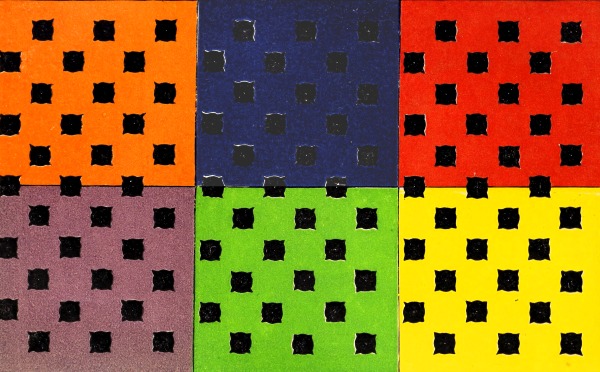
PLATE XIII.
These examples are sufficient to enable us to comprehend their advantage to the printer of patterns in colours complementary to the colours of the ground, whenever contiguous tints are to be mutually strengthened without going out of their respective scales.
DESIGNS FOR PAPER-HANGINGS.
375. The manufacture of paper-hangings has now arrived at such a point, that a knowledge of the law of contrast of colours is indispensably necessary to this branch of industry. We cannot estimate the true relations between the law of contrast and the art of paper-staining without dividing the papers into several categories to which the law is applicable.
1. Papers having figures and landscapes, or flowers of different sizes, and of varied colours, not intended for borders; these approach the nearest to painting.
2. Papers with patterns of one colour, or of colours but slightly varied.
3. Those employed as borders.