Chapter VIII
John Spanton translation
On the Application of the Law of Contrast to the Hypothesis that Red, Yellow, and Blue are the only Primary Colours; and that Orange, Green, Indigo, and Violet are Secondary or Composite Colours.
76. The experiments to which I have just applied the principle of the modification which colours undergo by juxtaposition, and the explanation consequent upon the manner in which white light has been considered, are also clearly explained in the language of painters and dyers, who admit of only three primary colours—red, yellow, and blue. As there are persons who, while they hold this opinion, desire, notwithstanding, to give a reason for the phenomena resulting from the juxtaposition of colours, I will explain them in accordance with this language; and, for greater clearness, I make five groups of juxtaposed colours, beginning with those which include the observations to which the preceding law is most easily applied. I shall presume that orange is composed of red and yellow, green of yellow and blue, indigo and violet of red and blue.
First Group.—Two Secondary Colours having a Simple Colour as a Common Element.
It is very easy to verify the law when we look at two colours which form part of the group: we see that by their reciprocal influence they lose more or less of the colour which is common to them. It is evident that they become more unlike each other in proportion to this loss.
1. Orange and Green.—These colours having the element yellow in common, lose it by juxtaposition. The orange appears redder, and the green bluer.
2. Orange and Indigo.—These colours having the element red in common, lose it by juxtaposition. The orange appears yellower, and the indigo greener.
3. Orange and Violet.—Like the preceding.
4. Green and Indigo.—These colours having the element blue in common, lose it by juxtaposition. The orange appears yellower, and the indigo bluer.
5. Green and Violet.—Like the preceding.
Second Group.—A Compound Colour, and a Simple Colour, which is found in the Compound.
Plate 6.
1. Orange and Red.—The orange loses red, and appears yellower; the red becomes bluer, to differ as much as possible from the orange.
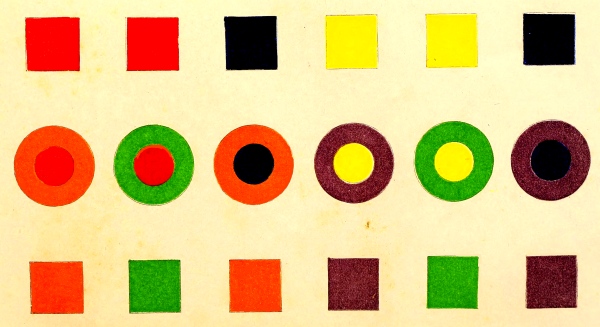
PLATE VI.
2. Violet and Red.—The violet loses red, and appears bluer; the red becomes yellower, to differ as much as possible from the violet.
3. Indigo and Red.—Like the preceding.
4. Orange and Yellow.—The orange loses yellow, and appears redder; the yellow becomes bluer, to differ as much as possible from the orange.
5. Green and Yellow.—The green loses yellow, and appears bluer; the yellow becomes redder, to differ more from the green.
6. Green and Blue.—The green loses blue, and appears yellower; the blue becomes redder, to differ as much as possible from the green.
7 Violet and Blue.—The violet loses blue, and appears redder; the blue must become yellower to differ as much as possible from the violet.
8. Indigo and Blue.—Like the two preceding.
Third Group.—Two Simple Colours. (See 6, 7.)
1. Red and Yellow.—Red in losing yellow appears bluer; and the yellow losing red appears bluer; or, in other words, the red inclines to purple, and the yellow to green.
2. Red and Blue.—The red in losing blue appears yellower; and the blue losing red appears yellower; or, in other words, the red inclines to orange, and the blue to green.
3. Yellow and Blue.—The yellow in losing blue appears redder; and the blue losing yellow appears more violet; or, in other words, the yellow inclines to orange, and the blue to violet.
Fourth Group.—Two Compound Colours consisting of the same Simple Colours.
Indigo and Violet.—As indigo differs from violet only in containing more blue in proportion to red, it follows that the difference will be greatest when the indigo loses red and inclines to greenish blue, while the violet, by gaining red, inclines toward that colour. It is clear that, if the violet lost red, or if the indigo acquired it, the two colours would approximate; but, as they differ from each other, the first effect ensues.
We may further explain the preceding phenomena by considering indigo relatively to violet, as blue; then it will lose its blue, which is common to both colours, and incline to green; while the violet, also losing its blue, will appear redder.
Fifth Group.—A Compound Colour, and a Simple Colour, which is not found in the Compound.
1. Orange and Blue. 2. Green and Orange. 3. Violet and Greenish Yellow.
Upon the hypothesis that orange, green, and violet are compound colours, and that red, blue, and yellow are simple, it follows that in opposing them in the order in which they are reciprocally complementary, and supposing also that the colours so juxtaposed are entirely free from any foreign colour, there appears no reason for the compound colour losing one of its elements rather than another, or for the simple colour being unlike one of the elementary colours rather than another. For instance, in the juxtaposition of green and red, we see no reason why green should pass into blue rather than into yellow, or why the red should incline to blue rather than to yellow.
SECTION II.
ON THE DISTINCTION BETWEEN SIMULTANEOUS, SUCCESSIVE, AND MIXED CONTRAST OF COLOURS, AND ON THE CONNEXION BETWEEN THE EXPERIMENTS MADE BY THE AUTHOR, AND THOSE PREVIOUSLY MADE BY OTHER OBSERVERS. DISTINCTION BETWEEN SIMULTANEOUS, SUCCESSIVE, AND MIXED CONTRAST OF COLOURS.
77. Before speaking of the relation of my experiments to those made by others on the contrast of colours, we must distinguish three classes of contrast. The first includes those relating to the contrast which I term simultaneous; the second to that which I term successive; and the third to that which I term mixed.
78. Simultaneous contrast of colours includes that phenomena of modification which objects variously coloured seem to undergo in physical composition, and in the depth of tone of their respective colours, when seen at the same time.
79. Successive contrast of colours includes the phenomena observed when the eyes having looked for some time at one or more coloured objects, perceive, after having ceased to look at them, images of those objects, presenting the colour complementary to that of the actual object.
80. This distinction also facilitates the understanding of the phenomena which maybe called mixed contrast; for, the retina having seen a certain colour for some time, has an aptitude to see for a further time the complementary of that colour, as well as any new colour presented by an external object; the sensation perceived being the result of this new colour, and the complementary of the first.
For want of this distinction, one of the branches of optics most fertile in applications, has not been treated with the clearness and precision which are necessary to show its importance to those who have not experimented upon it.
81. The following is a simple mode of observing mixed contrast:—Having closed one eye, the right for example, look steadily with the left at a sheet of paper of a colour A; when this colour seems to become dull, look immediately at a sheet of paper of the colour B, the eye then has the impression produced by the mixture of this colour B with the complementary (C) of the colour A.
82. To be convinced of this mixed sensation, it is only necessary to shut the left eye, and to look at the colour B with the right eye; when the sensation perceived is not only that of the colour B, but it may appear modified in the contrary way to that of the mixed sensation C + B, or what is the same, it appears to be rather A + B.
83. Upon shutting the right eye, and looking again at the colour B with the left eye, and that many times in succession, different sensations are successively perceived, but more and more feebly, until at length the left eye returns to its normal state.
84. I advise any person who thinks that one of his eyes is more able to perceive colours than the other, to look at a sheet of paper alternately with the right and left eye; if the sensations of each are identical, he may conclude that he has deceived himself. And even if the sensations be different, the experiment should be repeated several times, successively, for the difference observed in a single experiment might be occasioned by one of the eyes having been previously modified or fatigued.
85. This practice appears to me especially useful to painters. I now give some examples of mixed contrast.
86. The left eye, having looked for some time at red, has an aptitude to see afterwards green, the complementary of red. If then it be attracted by yellow, it perceives a sensation resulting from the mixture of green and yellow. The left eye being shut, and the right eye, which has not been modified by the sight of red, being opened, it sees yellow, and it is possible that this yellow may appear more orange than it is really.
87. If the left eye had first seen and had afterwards seen the latter would have seemed
Yellow Red Violet.
88. Red Blue Greenish.
89. Blue Red Orange-red.
90. Yellow Blue Blue-violet.
91. Blue Yellow Orange-yellow.
92. Red Orange Yellow.
93. Orange Red Red-violet.
94. Red Violet Deep blue.
95. Violet Red Orange-red.
96. Yellow Orange Red.
97. Orange Yellow Greenish-yellow.
98. Yellow Green Bluish-green.
99. Green Yellow Orange-yellow.
100. Blue Green Yellow-green.
101. Green Blue Blue-violet.
102. Blue Violet Reddish-violet.
103. Violet Blue Greenish-blue.
104. Orange Green Bluish-green.
105. Green Orange Reddish-orange.
106. Orange Violet Bluish-violet.
107. Violet Orange Yellowish-orange.
108. Green Violet Red-violet.
109. Violet Green Yellow-green.
110. Red Green Bluer.
111. Green Red Tinted-violet.
112. Yellow Violet A little bluer.
113. Violet Yellow Greenish.
114. Blue Orange Yellower.
115. Orange Blue More violet.
116. I should observe that all these colours, at least to my eyes, did not undergo equally intense or equally continuous modifications. For instance, the modification produced by the successive view of yellow and violet, or of violet and yellow, is stronger and more durable than that produced by the successive view of blue and orange, and still more than that of orange and blue. The modification produced by the successive view of red and green, of green and red, is but slight, and not enduring.
I may also add that the depth of tone exercises some influence on the modification; for, if after looking at orange, we look at dark-blue, the latter will appear greenish rather than violet, a result contrary to that afforded by a light blue.
117. I have thought it the more necessary to mention under a special name the phenomenon which I call mixed contrast, as it explains certain facts remarked by dealers in coloured fabrics, as well as the inconvenience felt by painters, who, wishing to produce an exact imitation of their models, look at them so long as to be unable to perceive their tones and modifications. I will mention two facts which have been communicated to me by manufacturers, referring the reader to Part II. for the application of the study of mixed contrast to painting.
118. First Fact. When a purchaser has looked a long time at a yellow cloth, and he is then shown an orange, orange-red, or scarlet one, he finds it dull, and judges it to be a dark or crimson-red; because the retina affected by the yellow has a tendency to see violet; and hence all the yellow of the orange colour disappears, and the eye sees it as a red, or a red inclining to violet.
119. Second Fact. If there be presented to a purchaser, one after another, fourteen pieces of a red fabric, he judges the six or seven last pieces to be less beautiful than the first, although they may be all identical. What is the reason of this false judgment? It is, that the eyes which have seen six or eight red pieces in succession, are in the same condition as if they had looked steadily for the same length of time at a single red stuff,—having a tendency to see the complementary of red, that is green. This tendency necessarily enfeebles the brilliancy of the red of the last pieces. The dealer, therefore, that he may not be a sufferer from the fatigued eyes of his customer, after showing him a few red pieces, should present some green ones, to restore the eyes to their normal state. If the view of the green were sufficiently prolonged to pass the normal state, the eyes would acquire a tendency to see red, and then the pieces seen last would appear more beautiful than the rest.