APPLICATIONS TO HORTICULTURE.
John Spanton translation
Section I.
548. The applications I propose to make are of two kinds: the one relating particularly to the arrangement of plants in gardens, according to the colour of the flowers; the other, to the method of distributing and planting ligneous plants in masses, which I suppose to have been previously planned. Doubtless, I need not have discussed the latter subject, but I have been led to it so naturally, and the rules which guided me are so positive and simple, that I have no doubt of their proving profitable to those of my readers who follow them in laying out plantations, &c.
The artist who conducts these operations is called a Gardener, or Landscape Gardener.
ON THE ART OF ARRANGING ORNAMENTAL PLANTS IN GARDENS SO AS TO DERIVE THE GREATEST POSSIBLE ADVANTAGE FROM THE COLOURS OF THEIR FLOWERS.
549. Among the pleasures afforded us by the cultivation of choice plants, there are few so intense as the sight of a collection of flowers, varied in colour, form, size, and position. It is probably because we admire the plants individually, and become attached to them on account of the pains they cost us, that we have hitherto so generally neglected to dispose them in such a manner as to produce the best possible effect when their flowers are seen collectively.
Thus, no defect is more common than that of the proportion in which flowers of similar colours are distributed in a garden. Sometimes the eye is struck by blue or white, sometimes it is dazzled by yellow. Add to this defect of proportion, the ill effect produced by placing together many species of flowers, which, although of the same colour, are not of the same tint: for instance, in spring we see the leopard’s bane (doronica), of a brilliant golden yellow, side by side with the narcissus, which is of a pale greenish yellow; in autumn, the Indian pink beside the African marigold, dahlias of various reds grouped together, &c.
Such arrangements as these cause the eye, accustomed to appreciate the effects of contrast of colours, to feel sensations quite as disagreeable as those experienced by the musician whose ear is struck with discords.
550. Previously to my observations on simultaneous contrast, and the demonstration of the law which governs it, it was impossible to prescribe rules which, by instructing horticulturists to place, with certainty of success, flowers in proximity whose colours reciprocally enhance each other, enabled them to avoid either the monotony resulting from the grouping of flowers of the same colour, or the disagreeable effect of a collection of flowers whose hues are mutually injurious.
ASSORTMENTS OF FLOWERS,
Where the Plants are apart.
551. The associations of flowers which relate to the harmonies of contrast of colour, are first, those with colours mutually complementary to each other; such as blue with orange, or yellow with violet. Rose or red flowers contrast with their own leaves.
552. White flowers accord more or less favourably with blue and orange flowers, already allied together; and perfectly with rose or red flowers, but not so well with yellow or violet flowers, already allied. White associates much less favourably when the latter is brighter or greener.
White flowers are the only ones that possess the advantage of heightening light tones of any colour, and of separating those whose colours are mutually injurious.
553. Yellow flowers, especially those which incline to orange, accord very well with blue ones.
Flowers of a yellow, more green than orange, have a very good effect with flowers of a red inclining to blue, rather than to orange.
Deep red flowers accord well with deep-blue flowers.
Orange flowers are not misplaced near violet flowers.
ASSORTMENTS RELATING TO THE HARMONIES OF CONTRAST OF HUES.
554. It is so difficult to make associations of hues which will have a satisfactory effect, that I prescribe in general the mutual association of flowers whose colours belong to neighbouring scales.
We must then separate
Pink flowers from those that are either Scarlet or Crimson.
Orange ” ” Orange-yellow,
Yellow ” ” Greenish-yellow,
Where the Plants are indiscriminately mixed.
555. Flowers which only present contrasts of hues and which spring from seeds sown thickly in borders, or in beds, will not have the same objection as when the roots are planted at a distance from each other.
556. Flowers, presenting a disagreeable contrast of hues, may still produce a good effect, when their assortment makes part of an arrangement of contrasts of colours, strongly opposed; in this case being no longer seen isolated, they become in a manner the element of a picture.
Section II.
ASSORTMENTS AS TO HARMONY OF ANALOGY.
557. I only reckon shrubs susceptible of this harmony; because only perennial plants afford to the horticulturist a guarantee that the flowers of one year will be identical with those of the preceding; consequently, if we plant woody shrubs in such manner as to secure a regular gradation of tones, the successive annual flowerings will be constantly according to that order. We may apply this kind of arrangement to standard roses.
558. But I do not advise any one to attempt submitting annuals to this arrangement, because of the uncertainty that exists in the tones of their colour.
Harmonies of Analogy of Hues.
559. If I have spoken against the associations of contrast of hues (554), I am more inclined to speak against the associations of analogy of hues, always remembering the restrictions I have stated above (Section 1). We must not forget that my intention is to describe assortments, whose good effects are certain. Now the more the colours contrast, conformably to our law, the more latitude there will be, although the colours of individual flowers associated vary in tone and in hue.
560. An objection might be addressed to me that the green of the leaves, which serves as a ground to the flowers, destroys the effect of their contrast. But it is not so; and to be convinced of it, it is sufficient to fix upon a screen of green silk, two kinds of flowers in conformity with the arrangement of the coloured bands (pl. 1. fig. 7), and to look at them from a distance of about ten paces; for when the eye is fixed on two well-defined objects simultaneously, surrounding objects, especially distant ones, produce but feeble impressions.
ON THE ART OF ASSORTING LIGNEOUS PLANTS IN GARDENS, SO AS TO DERIVE THE BEST POSSIBLE ADVANTAGE FROM THE COLOUR OF THEIR FOLIAGE.
561. If we consider trees and shrubs no longer under the relation of the colour of their flowers, but with regard to the manner in which we may employ their foliage in the decoration of gardens, we shall perceive that there is only a very small number of contrasts of scale and hue which we can realize while vegetation is active; yet in autumn, when plants, losing their leaves before falling, assume various colours, as red, rose, scarlet, orange, and yellow, these, by their brilliancy, recall the season of flowers. Most trees and shrubs present, in the summer season, only the green of their foliage; and, although this green varies in tone and hue, the differences are always trifling.
562. Harmonies of Contrast.—The most decided contrast of colour that we can establish between the leaves of ligneous plants, is that of green, with foliage nearest to red. But even the purple beech is more of a red-brown than a dark red, properly so called, for the colour of leaves results from a mixture of red and green, which, according to the principle of mixing colours must produce black, if they are in suitable proportion, or a brown tone of the green or red scale, according as one or the other colour predominates. The contrast of hue is established by the assortment of a bluish-green and a yellowish green of tones unequally high, by the contrast of a bluish-green brown with a yellowish light green, &c.
563. Harmonies of Analogy.—Nearly all the masses of various trees in our landscape gardens present certain harmonies of hues mostly resulting from associations established according to considerations foreign to those of the assortment of foliage—an evident result, remembering (561) that the colours of the leaves of the greater part of plants are of green belonging to scales more or less allied, and of tones but little distant from each other.
(a) Harmonies of analogy of hues formed of allied tones belonging to neighbouring scales, are those which it is least difficult to obtain.
(b) Arrangements of foliage presenting a series of equidistant tones of the same scale of green.
ON THE DISTRIBUTION AND PLANTING OF TREES, ETC., IN MASSES.
564. The principal object of the two following chapters is to supply a deficiency in works on gardening as to the manner of distributing and planting trees in masses, &c., the outlines of which have been previously sketched conformably with precise rules. For authors say nothing on this subject, and the embarrassment of a landowner who wishes to plant an estate already planned out, is further increased by this circumstance, that, in the majority of cases, the author of the plan of the projected garden, after having defined the lines of the plantations, indicated the places where isolated trees must be placed, designated the kinds of trees which should constitute groups, and others which must enter into the formation of masses with trees and shrubs (which he does not generally indicate), leaves the care of planting and other details to ordinary gardeners.
Yet the distribution of trees and shrubs, however easy it may appear, in a piece of ground otherwise perfectly planned, contributes more than is generally supposed to the pleasure of a landscape garden, and presents also more difficulties than to allow of its being effected in a satisfactory manner, when it is abandoned, as generally happens, to chance. In fact, if, at the end of a few years, we observe the greater part of masses planted as they frequently are, we shall be struck with defects which were not at first perceptible, because we were then under the influence of the pleasure we always experience at witnessing the development of plants which have been confided to a carefully prepared soil; and besides, there are some defects which are only perceptible after a certain time, such, for example, as that resulting—
1. From the plants being placed too near together.
2. From placing, in the front row, clumps which rise too high, or which lose their lower branches. Such are the elder tree, and sumach.
565. It was after many years of lost enjoyments, through having planted without fixed rule, masses otherwise well designed in their contours, that I was led by my own experience to seek the means of avoiding similar errors in future. The rules I now give are not the result of reflection merely; they have been practised many years, and I am much deceived if those who observe them will not derive great facilities in their application, and experience from them a lively satisfaction.
566. I will now define several expressions employed to designate the different associations of plants which may form part of a landscape garden.
An assemblage of trees and shrubs, occupying a large space, is termed a forest. But in a landscape garden a similar assemblage, or that which has been arranged to present the appearance of a vast space, is called a wood, if it is composed of trees and underwood; and a park, if it consists of trees only.
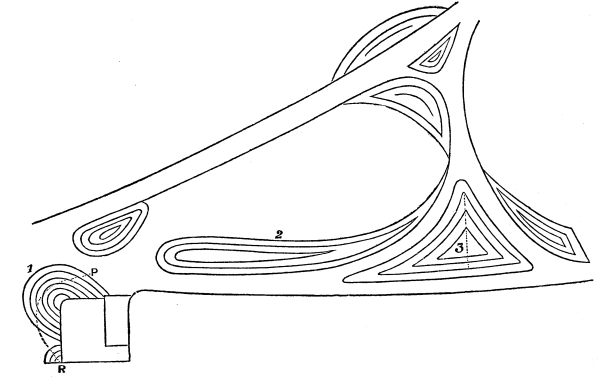
ARRANGEMENT OF PLANTS IN LANDSCAPE GARDENING.
PLATE XVIII.
A collection of trees, shrubs, bushes, and underwood, is called a grove; when it consists only of trees, it is termed a group of trees.
There are thickets of shrubs, bushes, underwood, and of flowering herbaceous plants.
There are thickets formed of a single species of plants, and thickets formed of several species. The first are called homogeneous, and the second heterogeneous, or varied.
There are isolated masses, and masses subordinated together.
A small mass of flowers or shrubs, isolated, and of a circular or elliptical form, is called a bed.