Mrs Molesworth (continued 6)
Reading edition
She was recalled from her own abstraction by her father’s voice, replying to an inquiry from her mother as to whether Mr Littlewood had made his appearance.
“Oh dear, yes,” was the reply. “We’ve had a long talk this morning. I was, of course, able to give him the information he wanted. But he is coming again this afternoon.”
“Oh, indeed,” said Lady Emma, with more interest; “then I hope we may see something of him.”
“I doubt it,” Mr Morion replied. “His time is limited, and we have a good deal to go over yet. Really,” with a little self-conscious smile, “if I don’t take care I shall be getting myself into the position of doing agent’s work for no pay,” and he leaned back in his chair complacently.
“I am sure Mr Ryder Morion should be very much obliged to you,” said Lady Emma, “and, indeed, to Mr Littlewood too. It isn’t every young man, with plenty of affairs of his own, no doubt, who would give himself so much trouble for a friend.”
“Humph! he is an intelligent young fellow,” said Mr Morion; “seems glad to gain experience. I don’t know what his prospects are, but he may have property of his own some day, though a younger son. The mother is wealthy. I have promised to look up some things for him this afternoon, so see that tea is brought into my study.”
“Won’t it do in the drawing-room?” said Eira, who could keep silence no longer. “Mr Littlewood surely won’t leave without seeing us at all! We should like to know how Madeleine is, and all sorts of things.”
“Nonsense,” said her father. “He has come down for other purposes than idle chatter with you girls. If his sister sends any message, I can give it you.”
He rose from the table as he spoke, Eira receiving her snub with the keenest sense of enjoyment.
“You don’t mind asking him to give our love to Madeleine, all the same, do you, papa?” she said meekly.
“I will do so if I remember,” Mr Morion replied, as he left the room, followed, as usual, by his wife.
“Francie,” said Betty, in a low voice, for Eira had had the discretion to leave her sisters alone together. “Francie, come out into the garden with me for a moment or two; I want to speak to you,” and Frances understood.
Tea was served in Mr Morion’s room, as he had ordered. But a long time passed after the ladies had finished theirs in the drawing-room, without any sign of the visitor’s departure. At last even Lady Emma began to fidget.
“I am afraid poor papa will be quite tired out,” she said. “I wish I had insisted on their coming in here to tea. Frances, Eira—no, it would scarcely do to send one of you—I think I must go myself. It is really inconsiderate of the young man.”
She was preparing to do as she said, when the door opened, and the two men came in; Horace, slightly flushed, eager, and a little embarrassed as he made his way up to Lady Emma, and shook hands with her heartily. But she scarcely noticed him, so struck and startled was she by Mr Morion’s almost indescribably strange, half-dazed manner and expression. He seemed like a man walking in a dream.
“My dear!” exclaimed his wife, “I am quite sure you are dreadfully tired. Mr Littlewood will excuse you, I have no doubt, if you go and lie down till dinner-time.”
Mr Morion started.
“Tired! I? Oh, no,” he said, “nothing of the kind! Don’t be so fanciful, Emma.”
“And I mustn’t stay,” said Horace—“not for more than a few minutes, at most. There are letters I must write for the night mail. I’m afraid I have tired you, Mr Morion,” and indeed the poor man did look, for once, in danger of a thorough collapse.
Lady Emma glanced at him again with increasing anxiety, while Horace, looking and feeling very guilty, still stood irresolutely, making no attempt to sit down.
Frances came to the rescue, as usual. Doing so, indeed, seemed to be her mission in life. She turned to Horace with a smile.
“Supposing we go out into the garden for a minute or two,” she said, “or at least we can go as far as the gate with you, Mr Littlewood, and leave papa to rest. We want to hear about Madeleine, too.”
Lady Emma looked relieved.
“Frances really has a good deal of tact,” she thought, “but it is very stupid of Mr Littlewood to have tired George so, by staying so long.”
Once outside the house Horace turned eagerly to Frances.
“I hadn’t the least idea,” he began, “that your father was really so nervous. I’m afraid I must have been far too abrupt.”
He glanced round for Betty as he spoke. She had moved towards him, her face full of anxiety.
“But it is all right, surely?” she whispered. “Papa wasn’t angry, was he?”
“I don’t think so,” answered Horace, “he only seemed extremely surprised. What do you think, Miss Morion?” turning to Frances. “You don’t anticipate any real difficulty, I trust?”
“No,” said Frances, with a smile. “I think it will be all right. But we must have a little time to get used to the idea. I suppose fathers always feel a certain shock when they have to face the thought of parting with a daughter.” Her words dispelled the slight misgiving, and Horace’s spirits rose again, and so, as a matter of course, did Betty’s. Eira’s were already bubbling over, and soon, very soon, the merriest of laughter might have been heard through the open windows of the drawing-room, had Lady Emma and her husband not been too preoccupied to notice it.
To say that the mother was less astonished than had been Betty’s father would still leave a wide margin for surprise on her part. For Mr Morion’s state of mind far exceeded that of even extreme astonishment. He was amazed, unable even now to take in as a fact that Betty, insignificant little Betty, as he had been rather in the habit of considering her, could have become a person of sufficient consequence to attract the notice—nay, more than notice, the admiration—of an intelligent man, whom he had honoured with his own friendly regard, and he blurted out the news with an abruptness and almost incoherence enough to have startled any one less calm and in some ways phlegmatic than his wife.
“Mr Littlewood,” she repeated, “Mr Littlewood has proposed for Betty? Betty! you are sure it is she—not, not Fr—?” Here some unexplained instinct made her stop short.
“Betty, of course it is Betty,” was the reply. “Though I confess I am not a little astonished. A child—an undeveloped child—and he, a man of the world and of very fair average intellect. What is he thinking of?”
“You didn’t speak in that way to him, I hope,” said Lady Emma. “It seems to me natural enough—he has fallen in love with her—and to my mind has shown his good taste in doing so. She is not a showy girl, I allow, but eminently refined and sweet-looking. And you forget that she is twenty-four. A very suitable age. And except that she has no money, I, her mother, consider her a prize worth winning.”
“Ah, well,” said Mr Morion, in a more conciliatory tone, for the rarity of the occasions on which his wife “spoke out” to him made them the more impressive. “Ah, well, I was taken aback, I suppose. You forget the wretched state of my nerves. And—my being utterly unprepared for anything of the kind. But you needn’t be uneasy. I shall doubtless get over it in a day or two.”
For once the mother in Lady Emma asserted itself more strongly than the wife.
“I have no doubt you will,” she said, with a touch of irony which, even if her husband had perceived, he could not have believed in. “But I am, if not uneasy, at least anxious to learn more. Naturally so—for Betty’s sake. Is all satisfactory? His position and prospects? And his mother’s approval?”
At this Mr Morion began to feel and look rather small.
“I—I really can scarcely say,” he replied. “He said a good deal—something about India in the first place.”
“Ah, yes,” said Lady Emma, “he may have to go out for a few months, perhaps, before he can arrange things for settling down.”
“And as to his mother’s approval,” continued Mr Morion, not sorry to turn the tables, “I scarcely understand you. How could there be any possible question of her disapproval? One of my daughters? And a Morion? Where were the Littlewoods, I should like to know, in the days when the Morions owned half a county and more in these parts? Besides, it is not the first alliance between the two houses.”
“True,” said Lady Emma dryly. “But not only was Conrad Littlewood the elder son—practically free to please himself—but his Miss Morion, as is often the case with the choice of a rich man, had a large private fortune of her own.”
To this Mr Morion found no reply. He was not going to allow that there could be any possible question as to one of his daughter’s eligibility.
And if Lady Emma’s misgivings were not dispersed, there was too much latent womanly sympathy about her for her to express them so as to cloud the sunshine of Betty’s first happiness. The sight of her radiant face, half-an-hour or so later, when Horace had at last torn himself away, and she crept into the drawing-room, her sisters having had the discretion to betake themselves to their own quarters, appealed to the deepest of her maternal feelings.
“My darling child,” she said. “I am so happy for you, and I think I have good reason to be so. I feel sure we may trust him.”
“Dearest mamma,” was all Betty’s reply. Later in the evening she confided to Frances that it all seemed too happy.
“In story-books,” she said, “and it is only from them that I know about anything like this, things never go so well, there are always lots of troubles, and uncertainties, and difficulties.”
“But there is no rule without exception, you know,” said Frances, smiling at the sweet little face. “Let us hope that your case is in this way to prove the rule.”
In her own heart, nevertheless, Frances was by no means free from misgiving, though in these first happy days she would not for worlds have suggested anything to mar the fresh brightness.
And they were happy days, even to Frances herself. There came to her almost at once the reward of her self-effacement, aided no doubt by her resolutely refraining as yet from dwelling on the mortification which at first had seemed to her so well-nigh unendurably bitter. Horace had but a short time to spare, two or three days at most, and then came the good-bye, not a very melancholy one, as he was only rejoining as yet the depot of his regiment. He was to pass through London on his way thither, for Frances, the only one whom he thought it well to consult on the point, agreed with him that it was better that his news should be communicated to his mother by word of mouth than by letter. Mr Morion entered into no practical details, the state of his own nerves occupying him sufficiently for the present—a circumstance which, considering his own uncertainty as to his plans, Horace could scarcely regret.
“I am very sanguine about it all,” he said to Frances the evening before he left. “There is no doubt as to my mother’s great liking for Betty.”
Frances smiled.
“Yes,” she said demurely, “she likes her much the best of us, I know; it is not Betty personally that she will object to, of course.”
“As soon as I get on to definite ground with her,” Horace continued, “I will try to come down here again, and go into things with your father, who will have got accustomed to the idea by then, I hope. You don’t think I have any reason to feel uneasy on that score, do you? Mr Morion has not even spoken against India, so far.”
Frances hesitated in her reply.
“I don’t think he has taken in the possibility of Betty’s going to India,” she said. “Indeed, I don’t think his mind has gone into any details, though I fancy both he and mamma have some vague idea that you may have to go out for a time in the first place.”
Horace’s face fell.
“That would never do,” he exclaimed. “I should not have a moment’s peace of mind if I went back there alone. And I don’t see that that need be anticipated. Heaven knows I don’t want to take her out there, but plenty of girls, even delicate girls, do go and are none the worse for it, for a short time, and my mother would not like me to be so far away indefinitely. It might be the best thing—to bring her to her senses,” he was going to have added, but the expression jarred on him. “I cannot think that your father would really object to it.”
“Not on ordinary grounds,” Frances replied. “But—papa is peculiar. If he thought that Mrs Littlewood opposed your marriage on any grounds, he, on his side, would not give in in the least. On the contrary, he would seek for all sorts of objections. He would be too indignant at the idea of a child of his being unwelcome to any family to be even reasonable.”
Horace sighed.
“Well,” he said, “we must hope for the best, and thank you very much, Frances, for putting things so clearly. I know my ground better now. If,” he went on—“forgive me if you don’t like the suggestion—if Ryder Morion had been a nearer relation of yours, or on more intimate terms, he might have seemed the natural person to influence my mother, should need arise.”
“Yes,” said Frances, thoughtfully, “but, you see, he is not in that position towards us, and it would have had to be done very, very carefully, so that my father should never have suspected any intervention on his part. There is still the old sore, though I am very glad that we now know him better.”
The next few days were passed in keener anxiety on Frances’ part than on Betty’s. Nor, if she had been gifted with clairvoyant powers, would her misgivings have been decreased, but very much the reverse, by a conversation which took place between the Littlewoods, mother and son, the day following that of the latter’s arrival in London.
Mrs Littlewood’s tone and manner at the opening of this tête-à-tête were strangely disconcerting, and the cause of this ever remained a mystery to Horace, completely unsuspicious, as he was, of his mother’s fears lying in the direction of Frances instead of Betty. And as the conversation proceeded, and light broke in upon her, he naturally attributed the unmistakable softening of her tone to his own good management, and his hopes rose accordingly; only, however, to be dashed to the ground again, for while Mrs Littlewood’s relief was great at the substitution of the one sister for the other—towards whom she had allowed herself to indulge in really unjustifiable prejudice—this happy effect was greatly marred by her personal feeling of annoyance that she herself should have been so mistaken. Her pride rose in arms, for she would not allow, even to herself, that she was actuated by anything but purely disinterested regard for Horace’s welfare.
And her ultimatum, when she delivered it, was in accordance with this position.
“My dear Horace,” she said, “the whole thing could scarcely be more unfortunate. She is a dear, sweet child, I own, but about as little fitted to be your wife as Conrad’s Lilian. So delicate, too, you could never dream of taking her out to India.”
A pang of cruel disappointment shot through the young man’s heart at these words.
“I have certainly not the slightest wish to do so,” he replied, “though she is not as delicate as she looks. I agree with you, however, as to the inadvisability of such a step. That, indeed, is my reason for putting it all before you in this way.”
Mrs Littlewood raised her eyebrows.
“But what is the alternative?” she said. “If you exchange, you lose all your steps, as you have constantly impressed upon me, not to speak of the diminished pay in England. Of course the only thing to be done is for you to go out alone again till you get your troop. And in every way this is the wisest course. It gives time for consideration of the whole affair. I need not remind you of the old proverb, ‘Marry in haste—’”
“But, mother,” said poor Horace, almost stunned by her words. “You have over and over again begged me to retire altogether, and—and promised to make my doing so possible, though you know I would never have led an idle life at home or anywhere.”
“I have never promised, nor dreamt of promising, material help towards your making an undesirable marriage,” was the cold reply. “If you can get employment in England which would justify you in marrying a penniless, inexperienced, fragile girl like Betty Morion, do so. There shall be no scandal about it in the family, but I entirely wash my hands of any and all responsibility in the matter.”
There was no more to be said. Half brokenhearted, for Frances’ warnings as to the probable effect on her father of such opposition naturally came to add their force to his distress, Horace left his mother and spent the rest of the morning in writing a very long letter to Frances explaining the whole state of the case, and, by the same post, a much more carefully worded one to his father-in-law elect, setting forth the advantages to his future of his not leaving the service at present, and expressing his hopes that, as the regiment was at a healthy station, the marriage might take place within the next few months, so that Betty might accompany him on his return to India. He did not name his mother.
Frances’ heart sank when her father summoned her into his study the morning of the receipt of these letters.
“What is the meaning of all this?” he demanded. “Littlewood says you understand his position! Not very complimentary to Betty—baby though she is. Does he think I am going to allow a daughter of mine to marry into a marching regiment and go to the ends of the earth? What is his mother thinking of?”
Chapter Twenty Three.
Not too “Smooth.”
The storm had burst. Poor little Betty’s half-superstitious misgivings, that in their case “the course of true love” was “running too smooth” to last, for her and Horace, seemed to have been prophetic. For, as Frances, with her experience of her father’s peculiarities, had feared, once the idea had entered Mr Morion’s mind (suggested in the first place negatively by Horace’s non-allusion in his letter to his mother or his family) that but scanty welcome was to be accorded to his daughter, he mounted a very high horse indeed. He refused to entertain for an instant the idea of India for her; he went back upon the Littlewoods’ shorter pedigree and deficient quarterings; he worked himself up to refuse his sanction to any engagement of any kind!
Horace, as his letter showed, was in despair. Betty was palely miserable, though between the two themselves the opposition but strengthened their trust and devotion. Frances suffered for both to an extent which really blotted out the sting of her own disillusionment more completely than she as yet realised.
Things were in this position when one afternoon, about a week after the receipt of Horace’s letter by Mr Morion, Frances, feeling self-reproachful for having omitted her usual visits to Scaling Harbour during the last few days, made her way thither, feeling, sadly depressed and almost hopeless. The sight of Betty’s white face was beyond the reach of her philosophy.
“I cannot bear to see her,” she thought to herself, “just when I thought her happiness, at least, was secured;” and it took considerable self-control to listen with her usual sympathy and attention to all the confidences, requests for advice, hopes and troubles, which were poured out upon her by her now familiar friends among the fisher-folk. And of all these there was to-day a more than usual amount, partly owing to her own temporary absence, partly owing to an unfortunate coincidence, which she now learnt for the first time, that during the last fortnight Mr Darnley had been forced to go away for change and rest.
Everything down here, too, seemed to have been going crookedly, and her face, as she turned the corner of the main street on her way home again, looked very unlike its serene self.
So absent-minded was she that she almost ran against a man walking rapidly in the opposite direction; it was not till his murmured “I beg your pardon” made her glance up quickly that she saw, to her amazement, that the newcomer was no other than Mr Ryder Morion. She gave a little exclamation of surprise, and somehow, almost in the same instant, the expression of his eyes, kind and somewhat concerned, sent through her a curious little instinct of hopefulness.
“Can he have heard about it?” she thought, and his next words did not dispel the idea, though they scarcely confirmed it. He turned at once as if to accompany her.
“You are not looking well, Miss Morion,” he said. “I am afraid you have been overworking yourself down here, with Darnley’s absence. I only heard of it on my arrival at Craig-Morion last night. There are several things that need seeing to at once, so I am doubly glad I came, even though I may miss him. But you mustn’t burden yourself too much.”
“On the contrary,” said Frances, her colour deepening, “I am reproaching myself with having done nothing here lately. I—we have been a good deal absorbed at home by other things. And I, too, did not know Mr Darnley had been ill. It does seem unfortunate—before his helper, the new curate, has come, too. Things always seem so contrary,” with a little attempt at a smile.
“That is not your usual way of looking at the world,” said her companion. “I hope—I am afraid—do not think me impertinent—I hope your home absorptions have not been painful ones.”
Frances’ lips opened and closed again. “I—I wonder if you know anything?” she said, with a kind of abrupt frankness; “but I must not take you out of your course—you were going in the opposite direction.”
“I had only one more thing to do,” he said, “and then I am going home. It was, in fact, a second thought—may I overtake you? I shall not be more than five minutes, and I want to talk to you about some of the people down here. I am sorry about the Silvers. I want to see Mrs Silver again for half a moment.”
Frances looked up.
“I was afraid there was something the matter there,” she said. “Though Jenny did not say much.”
“I will tell you about it,” he replied, as he hurried off.
As soon as he had turned the corner, Frances—who was feeling very tired, and yet, inconsistently enough, far less depressed than five minutes ago—sat down on one of the rocky boulders strewn capriciously about this part of the coast, even some little way inland. Down below, the little waves were rippling in gently, gleaming softly in the sunshine; the day was balmy rather than brilliant—there was a sense of afternoon restfulness over the whole, very soothing and congenial. She felt as if she could trust Ryder Morion, and the impulse grew stronger upon her to tell him everything, whether or not he was already prepared for it. But before she had time to come to any decision he was back again. She started to her feet at the sound of his approaching steps.
“What is it about the Silvers?” she said.
“Nothing very grave, I hope; it is only that Jack came home—well, not sober—the other night. It is only the second time it has happened, but I don’t wonder at the poor little woman being uneasy. She was ashamed to tell you, but—I am sure you will not mind—she has promised me to let you know if it seems well to do anything in the way of giving him ‘a talking-to.’ It appears that Mr Ferraby knows them both well—he married them—and in Darnley’s absence his influence might be of use.”
For a minute or two they went on talking about the Harbour and its inhabitants. Then there came a little pause. Without appearing to do so, Mr Morion had by this time made his own observations, and drawn his own conclusions therefrom.
“She is very troubled,” he thought. “I feel sure that it is about this affair of Horace’s. I wish I understood better. Why could he not have told me the whole?”
Frances walked on, her eyes bent on the ground, thinking deeply. Once or twice her companion hazarded some remark in hopes of drawing her into speech again. But she scarcely seemed to hear him. Then, suddenly, she looked up as if she had come to a decision.
“Mr Morion,” she began, “I am anxious and unhappy, as you have seen. Worst of all, I am utterly at a loss how to act, or rather how to advise others to act who look to me for advice. I had not, of course, the slightest idea that you were here, but yet you were one of the very few whom I wished I could tell about this trouble. You—and Madeleine—the only two, perhaps. Shall I tell you the whole?—regardless of the rather peculiar position you are in to both sides, as it were.”
“Perhaps I know more already than you suspect,” he said gently. “That may make it easier for you. It is about Horace Littlewood, is it not? and—your sister. Please do tell me exactly how things stand. I gather that you are free to do so. And please forget that I am myself—except in so far as my position towards all concerned might give me more power of judgment. You see, I know all the Littlewoods well. Horace’s mother is a good woman and means to be a just one. Don’t exaggerate about her. I fancy she is not at present being true to her best self.”
“I hope so,” said Frances. “I hope so indeed. I will tell you all,” and so she did.
It was not difficult, once she had begun. He drew from her with infinite tact, the tact born of true interest, the conflicting shades of feeling which were complicating the whole. For she was too essentially dutiful a daughter to throw any avoidable blame upon her father, yet too fair-minded not to allow that his extreme attitude—his mixing up of personal feeling and family prejudice where there was no need to have brought them in—was every day making conciliation more and more difficult.
“He will not hear of Betty’s going to India,” she said, “and has now reached the length of saying that under no circumstances would he sanction the engagement. And surely that is not fair or right? Eira declares,” she went on in a lighter tone, “that it is a case which would justify the two principals in running away.”
“I almost sympathise with her,” said Mr Morion, “still—that would be an extreme measure! If Horace were independent, I mean practically so—so placed that he could marry without imprudence, I should say, do so! and trust to time and her real good feeling to conquer his mother’s unreasonableness.”
“Ah, yes,” said Frances, “but you are forgetting papa: we could not risk it with him, and Betty would be miserable through her whole life if there were any coldness with her own people. You see, papa is so sore. It is not that he is ungenerous: he wouldn’t mind if Horace had nothing, if he could give her enough. But he has been brought up to feel sore about things, and he cannot throw it off.” For the moment she had really forgotten to whom she was speaking.
In one direction her companion was glad of this; it was what he had asked her to do. On the other hand—“Am I growing very selfish and grasping?” was the thought that went through his mind. “I should like to say, or at least to feel, that all this has come from the old disappointment—our great-grand-aunt’s failing to keep her promise, and to regret it as heartily as George Morion himself could do. But I cannot. There is a strange survival in me of the old family feeling as to this queer place. I would sacrifice a good deal rather than let it go from the old name.”
“Some way must be found out of the difficulty,” he said at last, aloud. “We cannot stand by and see these two young lives clouded and perhaps spoilt, and Betty looks a fragile, sensitive little creature.”
“She is stronger than you would think; strong enough and deep enough to suffer a good deal,” answered Frances; but, as Mr Morion glanced at the grave young face beside him, it struck him that Betty would be by no means the only one on whom all this trouble would leave its mark.
“I shall be here for a few days,” he said. “Will you trust me to think it well out, and see where or how I can be of use? I would go to see Mrs Littlewood if that could help matters.”
Frances looked at him with thankful eyes, and again there came over her, still more strongly, the sense of strength and protection she had already been instinctively conscious of. To her it was a strange and novel but none the less grateful sensation. Even with Horace she had never experienced it in the same way.
“I suppose it is that he is so much older,” she thought, “and that it has never come in my way before—for with poor papa it has always been us trying to shelter him!”
Their talk had carried them far on their road. Half-unconsciously Frances had passed through the lodge gates which Mr Morion opened for her, thus making her way home across the park, till they reached the usual short cut to Fir Cottage, where he came to a halt.
“I will not attempt to see your father for a day or two,” he said. “I will write to him asking when I may call.”
“Thank you,” said Frances, “that will be best. And in the meantime I will not mention having seen you. As things are, I think it will be better. But,” with a little touch of anxiety and appeal, new in her, but none the less charming, “you will be sure not to go away without letting me know?”
“Certainly not,” he replied. “I think very probably my first step will be to write fully to Horace, which may lead to my going to see his mother. If so, I will tell you.”
Five minutes later Frances entered her own home with a heart considerably lightened. Her burden was at least shared. She felt too that she had laid it in willing and helpful hands.
“How little, how very little,” she thought to herself, “did we ever imagine that Ryder Morion was the sort of man—would be the sort of friend he is!” And though she did not as yet feel free to tell Betty of the somewhat clearing horizon, her new hopefulness made itself instinctively felt.
“Things will come right somehow, I feel convinced!” she did say to her sisters, for poor Eira stood in need of cheering almost as much as Horace’s fiancée herself.
Frances’ sleep that night was disturbed, to an extent which rarely occurred with her, by strange and fantastic dreams. Her common-sense explained them, partially at least, by the unusually anxious and almost overstrained condition of her mind and nerves. Yet, as she lay awake the next morning in the early summer daylight, she could not altogether account for them in this way.
“I wonder if there really are occult influences of which we are only conscious when the more material part of us is inactive,” she said to herself. “It would seem so, though it would be dangerous to give too much thought to such a possibility. It would interfere with ordinary life and duties.”
Yet, despite this practical view of the matter, she could not succeed in throwing off what had been the predominant impression of her visions, even though these in themselves had grown vague and confused. She was haunted by a feeling that there was something for her to do, something that some one—who or where she knew not—was wishing her to do. Now and then in the stillness, broken but by the voices of the little birds outside, she could almost have believed that whispers, like a far-off murmur of the sea, were growing all but audible to some interior faculty of hearing which under normal conditions she was unconscious of possessing. The dreams themselves had been a fantastic mingling of fact and fancy, as indeed dreams commonly are. It had seemed to her that she was again on the sea-shore near the Harbour, but late at night instead of in the balmy sunshine. Cries of distress reached her, apparently from a boat some little way out at sea, and her first thought was of Jack Silver, who, she imagined, must be in danger. She turned to run homewards in search of help, when suddenly she found herself in the Laurel Walk, at the other extremity of which—the farther end from the house—she saw a light gleaming more distinctly and brightly than the faint reflection which it had puzzled both herself and Ryder Morion to account for that night when they were standing at the library window. She tried to follow the light, but found to her distress that she could not overtake it, her feet seeming too tired and heavy to move, though she was conscious that the beacon was intended to direct her towards the church. Then came another sudden change of scene and of time. She was a little girl again, playing in their own garden with her two still smaller sisters, Eira rolling on the lawn, Betty clinging to her as if asking to be carried. But with the effort to lift the child came again the painful sensation of powerlessness, till, glancing up, she saw a white figure standing beside them, whose sweet, pale face bent gently over the child, while a voice whispered softly: “Forgive me, and let me lift her!” At the words a shudder, not so much of fear as of awe, went through Frances, and the relief was great when, on her endeavouring to interpose, she saw that where the weird figure had been standing there was now in its stead that of Ryder Morion with a reassuring smile on his face. But before she quite awoke she seemed again to hear the pleading voice, though from a greater distance, and to feel, rather than hear, the words “Forgive me, and try—” and with the unfinished sentence the dream broke off, and she awoke with the sense, as has been said, of some task having been laid upon her to accomplish.
Nor did this leave her during the next few days, though from time to time the impression somewhat faded. Rather to her disappointment and surprise, she heard nothing of any note or letter to her father from Ryder Morion. No one but herself seemed to have known of his being in the neighbourhood! She could almost have fancied that her walk and talk with him had been a curiously rational episode in the strange dream which had visited her that same night. But all doubt of the reality of his material presence was put to flight by a letter which she received on the fourth morning after having met him. A letter which fortunately did not attract her father’s attention, as the Fir Cottage bag was rather unusually full that day, and which she was able to read without any one noticing it. It contained but a few lines:
“Dear Miss Morion,— “I am afraid you will scarcely feel inclined to trust me any more, when you see that I have left Craig-Morion without seeing you again or writing to you,”—for the letter was dated from the writer’s club in London. “I was summoned quite unexpectedly up to town. I think, however, the matter which we were talking about will not suffer from this; on the contrary, it may turn out for the better. I will write again before long,— “Yours very sincerely,— “Ryder Morion.”
This explained the silence, and Frances was fain to take refuge again in the patience of not wholly unhopeful waiting. More than this, she succeeded in cheering poor Betty, and that not groundlessly, for her confidence in Ryder Morion suffered no diminution.
Still those were trying days, at best.
Late one afternoon, just as tea was over, Frances was told that a young woman was asking to speak to her, waiting at the back door.
“Is it any one you know by sight?” she inquired of the parlour-maid.
“I think she has been here before, miss,” was the reply. “She comes from Scaling Harbour, but”—with a little hesitation—“she seems rather in trouble. I don’t think she would give me her message,” and at these words there returned to Frances’ memory the promise Ryder Morion had made to Jenny Silver of help and advice, should need arise, from herself.
She started to her feet with some self-reproach for having forgotten, in the pressure of other thoughts, the poor girl’s anxiety. And further back in her mind there lurked another remembrance, which did not till later on take distinct form. It was that of the association of some trouble menacing the young couple of which she had dreamt, though but for this visit she would probably never have thought of it again.
As she expected, the figure awaiting her was that of Jenny Silver.
“Oh, miss!” she exclaimed. “I am ashamed to trouble you, but the gentleman told me I might come to you if things got worse.”
“You were quite right to come,” said Frances, and as she spoke she glanced round. “I will come out with you a little,” she said. She still wore her out-of-door things. “We shall be quieter in the garden.” And she took the poor woman to a seat hidden in the shrubberies.
After all, things with the Silvers were not in one direction as bad as she had feared. Jenny had come to her partly because her husband’s old father was very ill—dying, in short. Her Jack, she went on to say, had not offended again, but he had remained sullen and unlike himself. This had troubled the old man, and Jenny had come to ask if Miss Morion thought it would be possible to get Mr Ferraby to go to see him the next day.
“Father thinks a deal of the old vicar,” said the young woman, “and he thinks maybe it would be a good chance for Jack to start fresh again. Father can’t be with us long, and the vicar might know how to get hold of Jack just at this time.”
Frances quite agreed with her that the opportunity should not be lost, and after a little more talk it was settled that she should walk up to the vicarage with Jenny, and explain things in the first place to Mr Ferraby, as it was a good while since he had seen any of the Silver family. Jenny was full of gratitude for Miss Morion’s help, and fortunately they found the old vicar at home. A few minutes’ talk between him and Frances while Mrs Silver waited outside put him in possession of the state of the case, and he expressed himself as eager and ready to help and sanguine as to the result of a good talk with the young man.
“He is far from a bad fellow,” he said, “though I am not surprised at Jenny being anxious. Her own people, the Bretts, have always been so very respectable and sober that the contrast between them and what she sees down at the Harbour must be painful. But put them off your mind, my dear Frances; Darnley and I will see to it that he is pulled up in time.”
So Frances was able to say a hopeful word to the young wife before she sent her into the vicarage, promising to look her up at home before long; and when Jenny disappeared through the glass door of Mr Ferraby’s study, she turned away again with a feeling of relief, so far as her poor friends were concerned.
Chapter Twenty Four.
“The Secret of the Panel.”
Frances stood for a moment in hesitation. Should she go home at once, or stroll a little farther? No one was wanting her at Fir Cottage just then, and she rather shrank from tête-à-têtes with her sisters in their present suspense. Her glance fell on the old church, and there came upon her a strange feeling of attraction thither, overmastering the remembrance of the shock she had received there. And somehow, almost before she knew it, for the door was again open, she found herself in the old pew in the very same corner where both she and Eira had in different ways been so startled.
Her glance fell on the woodwork where her frill had caught. Yes, the little splinter was still sticking out. She touched it: it was stronger than she had thought, and did not yield to her intention of pulling it off. She pulled again, then pressed it backwards.
“I must either pull it off or push it in,” she thought, “or it will be tearing our things.”
But the pressing had an unexpected effect. Suddenly something gave way under her fingers: the whole little panel, about a foot in length, fell in with a clatter, and she saw before her a small cupboard of which she had inadvertently touched the spring, something like the concealed boxes to be found in the wainscoting of old windows, which used to be called “fan cupboards.”
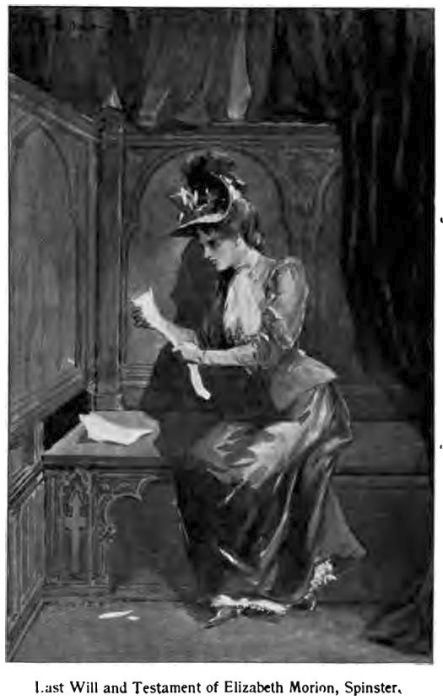
At the first glance there was nothing to be seen. The panel in falling flat had covered the contents of the little receptacle. But as she put in her hand to draw it upwards again, she caught sight of something white lying beneath. Another moment and she drew out a lone narrowly folded parchment document, on which, to her unmitigated amazement, were inscribed in crabbed old-fashioned letters, the words: “Last Will and Testament of Elizabeth Morion, spinster,” with the date.
Breathless with excitement, feeling as if in a dream, Frances unfolded it. It was almost impossible for her to decipher much, couched as it was not only in technical but very old-fashioned phraseology, with a great mixture of legal Latin, and the usual absence of punctuation. But she read enough to satisfy herself that it was the missing will, the will devising to her grandfather the smaller of his aunt’s (the testator) properties, i.e., Craig-Morion, while Witham-Meldon, with its long list of appertaining estates, was bequeathed to the elder nephew, the direct ancestor of Ryder Morion.
For a few moments after this extraordinary discovery Frances was literally physically incapable of moving. Half mechanically she at last managed to pull back the panel into its place, and then she sat clasping the document in her hands, while a whirl of ideas rushed through her mind as to the consequences of her trouvaille. She felt no sensation of fear, though she actually listened in a kind of expectation of hearing again the softly drawn-out breath, sigh, or the rustle of the stiff silken garments, by means of which the perturbed spirit of her long-dead great-grand-aunt had seemed to endeavour to draw the attention of the still living to her secret. But there was nothing to be heard. Perfect stillness reigned. And at last Frances drew herself together and made her way out of the ancient building.
In the still sun-flecked churchyard, where the long evening shadows were now falling on the familiar tombstones, Frances felt herself in the ordinary world again. But for the contact of the thick sheets in her hand she would have fancied herself waking from a dream. Gradually the question took shape in her mind, what was best for her to do? Her first impulse was to hasten home with the wonderful story to her sisters, to consult them before any one else. But Frances had drilled herself rarely, if ever, to yield to first impulses. As she stood there, her perturbation of spirit, insensibly coloured, and composed with the sweet yet solemn peace around, a new impression stole into her mind. To whom was it due to confide first of all this extraordinary discovery, if not to the head of her house, the representative of the elder branch of the Morions, whose resting-places for centuries past were all around her as she stood there? And who, from what she had come to know of him, could better be trusted to act with fairness and right judgment—nay, even more, with sympathy for those whose interests conflicted with his own—than Ryder Morion himself?
“Yes,” was her mental decision, “that is the right thing to do. It is straightforward and best in every way.”
For though not a moment’s doubt crossed her mind as to the result of what she had found—what she now believed she had been guided to find by the strange influences she had more than once been conscious of—yet, knowing her father’s peculiarities, and the critical state of things in her family at the present juncture, she felt it would be kinder and better, even though at some cost to herself, to keep the events of that afternoon secret till she should have related them to the present owner of Craig-Morion.
“If only he were still here,” she thought, “or if I knew when he was returning! I don’t want to write it to him—I really feel as if I could not!” For now her scattered faculties, fast recovering their balance, reminded her that there were two sides to the strange restitution.
True, Ryder Morion was by all accounts far too wealthy a man to take into consideration the two or three thousand a year—which at most Frances imagined it must be—of loss of income, involved by the alienation of his smaller property. But independently of this she felt a strong persuasion that his interest in the place had come to be a close and personal one.
“It will seem an instance of the irony of fate to him,” she thought, “that just as he has got to identify himself more with Craig-Morion, he should have to give it up.” Yet, on the other hand, her cheeks flushed with delight as she thought of the advantages to those nearest and dearest to her of this almost incredible windfall. “It is not only the money,” she went on thinking, “though to us that will seem great riches, but the position it will give papa. Mrs Littlewood will think differently of a marriage with one of us now.”
All these reflections, as everybody knows is the case—above all, in moments of excitement—took far less time to pass through her mind than is required to relate them.
When Frances had reached this point she was no farther on her way home than the little gate leading into the Laurel Walk. Her glance fell on it.
“I know what I can do,” she thought. “I will go up to the house at once. The Webbs are sure to be there, as Mr Morion is expected back again, and I can hear from them how soon he is returning. If there is to be any delay about it, I may have to write and hint at a new development which makes me more anxious to see him again.”
And, acting on this determination, she lifted the latch and made her way towards the side-entrance of the big house.
Was it her fancy, or was it owing to some peculiar effect of the time of day, that the Laurel Walk looked less gloomy than she had ever before seen it? Streaks of sunshine crept through unexpected places, falling athwart the old gravel path, usually so grey and colourless. The cheerful, chirped “good-night” of the little birds sounded full of hope and happy summer anticipation of another blissful day. It really seemed to Frances as if some spell of gloom and sad regret had been dispersed.
When she reached the house the door at the top of the short flight of steps stood slightly ajar. She was scarcely surprised, as she knew Mrs Webb’s uncomfortable love of “spring cleanings” at every season, orthodox or unorthodox, of the year.
“She is probably having a turn-out of the library because poor Mr Morion has used it lately,” she thought; and, instead of making her way round to the back premises by the narrow path skirting the house, she ran up the steps, calling out as she pushed open the glass door, “Are you there, Mrs Webb?”
Some one was there, some one who came forward at her words from the other side of the dimly lighted room, some one whose voice made her start and stop short in her surprise. It was the very person she had been wishing to see, and now that he was there it was all she could do to reply with any composure to his own somewhat astonished exclamation of “Miss Morion! You cannot have got my letter already?”
“Your letter?” she repeated, shaking her head; “no, I have had no letter except the one saying you had to go. I had not the least idea you were here. I was—looking for Mrs Webb.”
“Shall I find her for you?” he asked, turning towards the inner door.
“N-no,” said Frances; “no, thank you.” Then, summoning her courage: “The truth is, I only wanted to hear from her if she knew when you would be coming back again. I—I wanted to see you very, very much! Something quite extraordinary, something you can hardly believe, has happened. The old will—the missing will—has been found.”
“The missing will?” he repeated. “Whose will?”
“Our great-grand-aunt’s, of course,” she said impatiently. “The will she always promised to make, and which could never be found. Our great-grand-aunt, Elizabeth Morion! Oh! you do know about it!”
His face changed, he was beginning to take it in.
“And who found it, and where?” he said rapidly. “And why was I not told of it at once?”
Frances drew herself up.
“I found it,” she said, “this very afternoon, not an hour ago, in a panel in the old pew. And no one knows of it as yet—I meant, I thought it was right to tell you first.”
She held out the packet, but, before taking it from her, Mr Morion drew forward a chair.
“I will look through it as quickly as possible,” he said, “but do sit down.”
She did so, watching him intently as he opened out the stiff, crackling sheets, and set himself to study their contents. At first his face remained absolutely impassive. He had turned over three or four sides—after all, as such things go, it was not a very long document—when some sudden thought made him glance at the end. Then came a change, a strange change in his expression: he knit his brows and his whole face clouded in perplexity.
Now again, for the first time since entering the house, Frances remembered what, in her excitement, she had momentarily forgotten—that these must be the revers de la médaille, and her own face fell as she realised the blow that her discovery might cause to her kinsman.
“May I,” he began at last—“don’t hesitate to say if you would rather not consent—may I keep this document for a day or two—nay, even less, a few hours would do?”
Frances coloured.
“Of course,” she said, “it is safer with you than with me. Keep it as long as you like, except that—I am naturally anxious to tell the others.”
He did not reply, a little to her surprise, but sat for a moment in consideration.
“Yes,” he said at last, “a few hours will be enough for me to take it all in. Can I see you again to-morrow? Do you mind telling no one else till then?”
“I will do as you think best,” she replied; “but how can I see you without fear of interruption? Oh! I know! Will you meet me at the church? I can easily get the key. I should like to show you the cupboard in the pew. I can be there quite early, and then we can settle about telling papa.”
“Thank you,” he said. “Yes, you will find me in the churchyard waiting for you.”
Frances rose to her feet. As they shook hands, she felt his eyes, the kindly grey eyes she had learnt to trust, fixed upon her with an expression she could not define, and, as she walked home slowly, the question as to what it meant came to add itself to the already existing whirl of thought in her brain.
“It was almost as if he were sorry for me,” she reflected, “whereas, I think I should be sorry for him. What strange minglings and revulsions of feeling I have had to go through in the last few weeks! I, whose life had hitherto been so monotonous. After all, how difficult it is to get at even one’s own real self! That afternoon when I first found out about Horace and Betty—was what I felt all a mistake? Was it only mortification? I begin to think so, and that there is no need for me to examine the wound—that there is no wound, scarcely a scratch! Otherwise could it have healed so quickly?”
The remaining hours of that day seemed interminable, and the next morning found her at the church gate, armed with the great key, some minutes before the time agreed upon. But, early as it was, Mr Morion was there before her, and together they made their way to the pew, where she pointed out the secret of the panel.
“It is very curious,” he said, “very curious indeed,” but his manner was somewhat absent and “carried.”
“Before we talk about this,” he went on, touching the large envelope in his hand, “I should like to tell you that I am much happier about Horace Littlewood’s affairs. I have—we have, he and I—arranged something. One of my agencies will shortly be vacant, he is just the man I should like for it, and a short training will make him quite competent. I should have offered it to him in any case. It gives him the independence he longs for, and—I do not see that your father can now oppose the engagement.”
Frances hesitated.
“It is very, very good of you,” she said; “you must let me thank you, even though you may have acted primarily as Horace’s friend. Certainly, my father will have no reason for any objection—no valid reason. But except for,”—and she glanced at the packet—“the change in his position, I doubt if he would have got over his hurt feelings towards Mrs Littlewood.”
A look of real distress came over Ryder Morion’s face.
“I think it will be all right,” he began. “I think Horace and I can make him see things differently, independently of,”—here he broke off—“and,” he resumed, “once Mrs Littlewood takes in that Horace has a right to act upon his own judgment and that he is no longer a boy at her beck and call, she too will act reasonably, I feel sure. But—I scarcely know how to tell you what must be told. This discovery of yours, so strangely made, practically leads to nothing. You had not observed,” and again he hesitated with a painful consciousness that Frances was growing terribly white, “that—that the will is not signed.”
They were in the porch by now. Frances sank down on the stone bench beside her, without speaking.
“Not signed!” she gasped out at last; and for all reply Ryder Morion held out the last page for her to see, and a glance satisfied her.
“Oh dear!” she murmured, “how could I have been so blind? Not signed!”
He gave her a moment or two in which to recover herself a little.
“There is still more to tell you, and it is best to get it over,” he said. “Even if it had been signed, I believe it could not have been acted upon, after this long lapse of years, though I should have done my best, you may be sure. But as things are, I have nothing in my power. This property, like the rest, is strictly limited to the descendants of the elder branch.”
“And papa, of course,” said Frances sadly, “is very proud. A doubt of any kind as to perfect legality would have—I mean to say he would never have taken advantage of your good will.”
“Which, as you see, I have no chance of exerting. Still,” he went on, “I am not without some hope that I may persuade him, seeing that there is now no doubt of our great-grand-aunt’s intention, to look upon Craig-Morion as his home for life. As regards this, things are made easier by his having no son.”
But Frances shook her head. The tears were slowly welling up into her eyes, and she made no attempt to hide them.
“I wish I could thank you as you deserve,” she said. “I feel horribly selfish at being so disappointed, when—I should remember that it could not but have been a wrench to you to part with the old place. And, too, when you have been so very, very good to Horace. I am afraid my father would never agree to any arrangement such as you propose.”
“If only—” he began impulsively, then checked himself again. “Frances, I cannot bear to see you in such trouble, and I may succeed with your father by showing him that even by the terms of this will, failing a son, he would have been in much the same position of only life-renting the place. At any rate I will do my best.”
“Then you have no doubt as to its being well to tell him?” she asked.
“None whatever,” he replied warmly. “You yourself, or I, if you prefer it, or—both together, perhaps, can do so.”
Then followed a long silence. Frances quietly wiped her tears away, while the colour slowly returned to her cheeks.
“I think I had better go home now,” she said.
“I would rather not tell papa to-day. I would like him first to have heard about Horace. You are free to tell him, I suppose?”
“Yes, Horace has empowered me to do so,” he replied, “and there is no reason for delay. I will ask him to see me to-morrow morning, and then,”—he looked at her interrogatively.
“Then I suppose I had better tell him my story?” said Frances. “Though I should like, if possible, to hear in the first place the result of your talk with him.”
“That can easily be managed,” he answered. “I will write to you as soon as possible after seeing your father.”
“Thank you,” said Frances.
They strolled slowly down the churchyard path: the subject of her discovery was still prominent in the girl’s mind.
“Mr Morion,” she began again abruptly. “I cannot help saying what can have been the poor old lady’s motive in acting so inconsistently? Just think of all it has caused! No wonder her spirit has not been able to rest,”—with a half-smile—“if it is really the case that any supernatural influence has been exerted upon us!”
Ryder did not show any sign of making light of the supposition.
“It will be curious to notice,” he said, “if these strange experiences, which I own I can’t explain, come to an end now that she has at least vindicated her intention of acting up to her promise. It almost seems as if she had been under some fear of the elder of the two cousins—my forbear! Perhaps she meant to leave the will in its hiding-place till the very last, and then have it brought to her for signature, when no anger could fall upon herself. And she may have died too suddenly to carry this out.”
“It looks like it,” said Frances. “But no one will ever know fully.”
“I should say no one,” repeated Mr Morion.
“And all the poor old great-grand-aunt’s efforts to put things right will after all have been in vain,” Frances resumed.
“Not quite, I hope,” said her companion eagerly. “You are forgetting that I am depending much on your discovery as a lever wherewith to persuade your father to agree to what has become almost my greatest wish, especially as—I wish I dared hope that other possibilities might tend in the same direction.” Frances looked up, perplexed.
“I don’t understand,” she said; but no explanation followed.
“I have tired and worried you enough for to-day,” said Ryder, regretfully.
“You forget the good side of it all,” said Frances, gratefully. “Betty’s happy prospects!”
He smiled with gratification.
“I hope our next talk will have no bad side to it,” he said, as they parted.
A week later saw the fulfilment of Ryder Morion’s good hopes of a successful termination to his interference on Horace’s behalf. How far this was due to the skilful diplomacy exercised, how far aided and abetted by Mr Charles Morion’s immense satisfaction at the tenor of the will, which almost nullified the disappointment at its practical inadequacy, it is not necessary to define. From henceforth the master of Fir Cottage was able to speak with confident magnanimity of the position and possessions which should in “all equity” have been his. And though as yet he had not absolutely consented to the position of life-tenant of Craig-Morion, which his kinsman urged upon him, the latter was sanguine as to his eventual success in this particular also. For, as he had prophesied, Horace’s mother had given in, and that graciously, being far too clever a woman to do a thing of the kind by half, if she did it at all.
After the manner of the old fairy-tale we may here say good-bye to little Betty and the prince, who, though in nineteenth-century garb, had after orthodox fashion broken the long captivity not only of his lady-love but of those about her.
But there is more to tell.
There came a day on which Mr Ryder Morion’s allusion to other vague possibilities was explained to Frances, and that not in vain.
“Though there is one confession I feel it due to you to make,” she said to him. “It is all so different now—so much, much happier and surer and more restful—that I can scarcely believe I was ever so foolish! But—Ryder—there was a time that I thought I cared for some one else, and, worse still, that he cared for me!”
The smile with which this avowal was received was more than reassuring.
“Worse still?” he repeated; “no, as to that I can’t agree with you—not as far as I am concerned. Perhaps I knew or suspected more than you had any idea of. Perhaps you were not alone in your suspicion, deepened in my case into fear, that the ‘some one’ did care for you! And the relief was great when I found my mistake. But it would have been worse had your feelings been involved as you may have imagined they were.”
“And as I now know so certainly they were not,” said Frances happily. “You see, I was so inexperienced in such things, though not young.”
“Not young! When my greatest misgiving has been that I was far, far too old for you,” he answered. “For there was a time when I thought I should never again care for any woman—I was scarcely more than a boy and she still younger when I lost her. Some day I will tell you more; there is nothing painful in it to me now, and her short life was very happy.” And as Frances looked at him she thought indeed that it could scarcely have been otherwise.
The rôle of “great lady” was not what she had ever dreamt of for herself, not, assuredly, what she would have chosen; but she fulfilled it well, bringing to bear upon its difficulties and responsibilities—its temptations even—the same single-minded sincerity of purpose which is, in all conditions in life, the best armour for man or woman.
Even Mrs Conrad Littlewood came by degrees to own that no better châtelaine could have been selected to do honour to the glories of Witham-Meldon, and to dispense its generous bounties in all right directions.
And “great-grand-aunt” Elizabeth slept henceforth in peace.
The End.
|
Chapter 1
| |
Chapter 2
| |
Chapter 3
| |
Chapter 4
| |
Chapter 5
| |
Chapter 6
| |
Chapter 7
| |
Chapter 8
| |
Chapter 9
| |
Chapter 10
| |
Chapter 11
| |
Chapter 12
| |
Chapter 13
| |
Chapter 14
| |
Chapter 15
| |
Chapter 16
| |
Chapter 17
| |
Chapter 18
| |
Chapter 19
| |
Chapter 20
| |
Chapter 21
| |
Chapter 22
| |
Chapter 23
| |
Chapter 24
|