Mrs Molesworth (continued 5)
Reading edition
With these words she passed through the gate which he was holding open for her, though a friendly little nod of farewell took away any possible savour of animosity from her words.
Ryder Morion went slowly home, this time by the lower path leading through the new open part of the park.
Chapter Eighteen.
“Elise.”
That evening, that still chilly evening, was always in Frances’ mind, when she recalled the winter of the Littlewoods’ sojourn at Craig-Morion, associated with the eve of the real spring. For the next morning came one of those bursts of warmth and sunshine which go far to make amends for the trying side of our capricious climate.
And this year there was no harking back upon the winter. It said “good-bye” and went, closing the door behind it like a well-trained servant. The month of March for once was true to its proverbial character, while its often coquettish successor, April, proved, even up in the north, so altogether charming that the visitors to the big house were constantly tempted into expressions of regret that its close must see their departure for the south.
“I had no idea,” said Madeleine one day, when she and her Fir Cottage friends were primrose and cowslip gathering as busily as if they were still children, “that I should have been so sorry to leave this place, though I think I had premonitions of great enjoyment here.”
“I am so glad,” was the reply from Frances, “so very glad that you liked being here.”
“It has been more than half,” Madeleine rejoined—“three-quarters, seven-eighths, if you like—owing to all of you, as you must know.”
“Well, only think, then,” said Eira, “what your being here has been to us! But don’t talk as if it was all at an end already! We have three weeks at least of this lovely weather, for I am determined to believe in its lasting till you go.”
“I hope it will,” said Madeleine, “for more reasons than one. I waited to tell you and Betty about some news we have had.”
Betty, who was near her, glanced up quickly. Betty was looking tired and pale, notwithstanding the sunshine and the warmth. “Perhaps, indeed, because of them,” said her mother; “early springs are often trying to sensitive people.”
“Oh! I hope it is not that your brother is going away,” said Eira. “He’s so nice about planning expeditions! And now that the spring is here, there really are some you should make in the neighbourhood. There are ruins and things we have scarcely even seen ourselves. It would be nice to have a brother,” with a little sigh.
“If we had had one,” said Betty, “he could not have stayed at home. He would have most probably been away in India or the colonies, or some terrible place! A brother’s no good if you are poor.”
“And as for having one always with you,” said Madeleine, “that is not to be counted on, whatever other circumstances are. I am not speaking about Horace’s present plans, though, for I hope when he comes back,”—he had not yet returned from a short absence in town, whither he had accompanied Mr Ryder Morion—“that it will be to stay nearly as long as we do. No, my news is not about him, and perhaps it is rather horrid of me not to feel more pleased about it. It is only that the Conrads are coming down upon us,” with a half-rueful smile. “Next week they come, for ten days or so; it is sure to get into a fortnight, and I feel as if it would be a finish up of this comfortable, self-arranging life that I have so enjoyed!”
“Will your sister-in-law expect you to be so much with her then?” asked Frances.
“N-no,” said Madeleine, “not exactly that. Mamma and she suit each other perfectly, and require no third person—are much better without one, indeed. But—oh, really,” with a change of tone, “I cannot explain it without seeming a little unkind, so, if I do seem so, promise to forget that part of it, for I do want you to understand about my sister-in-law. She is, so to say, a typical person, one of the best of her class, quite good and high principled, and with a strong sense of her responsibilities, and all that side of things. But yet she and I are not and never could be great friends, though, on the other hand, I am equally sure that we should never quarrel. Now with her brother, Ryder, I very often—no, I can’t say quarrel, it’s too strong an expression—but we very often openly disagree and argue it out, and yet I feel that we have more in common than Elise and I ever could have.”
Her three companions listened with great interest, Frances and Betty especially.
“I think I do understand,” said the former, “and I am sure I shall do so still better when I have seen her. But you know, Madeleine, you don’t perhaps take sufficiently into account that you yourself are not a typical person, by any means!”
“Am I not?” said Madeleine, laughing. “In what way?”
“There are very few,” said Frances gravely, “who would have remained so unspoilt, unself-engrossed as you, in the same circumstances.”
This was strong commendation, above all from such a person as Frances, whom no one could have suspected for an instant of flattery, and who yet loved to be able to admire. And whenever she had a fit occasion to express her admiration and appreciation, few things pleased her more than doing so, and few people could have done so more gratifyingly.
For such power of expression is not a common gift. Nothing is easier than to criticise with even a certain cleverness, on which its possessors will always be found to pride themselves most unduly; but to “admire,” to discern “the admirable,” of which few human beings are entirely devoid, one must indeed have risen to a far higher plane, both morally and intellectually. Nay, indeed, might not one almost add “spiritually?” And a curious anomaly is to be observed as regards this subject. One often hears the excuse—“I am not effusive—it does not come naturally to me to praise people. I have a horror of flattery”—yet this same reticence, this same powerlessness of expression disappears in a really remarkable and all but magical way when a disagreeable or hurting remark, personal or otherwise, suggests itself.
Madeleine’s pleasant brown eyes sparkled with gratification.
“I do like you to say so,” she said, “for I know you mean it, little as I feel I deserve it. Don’t you think,” she continued, “that real praise always makes one feel very humble?”
“Yes,” said Frances, with a smile, “your thinking so much of mine has that effect on me at this moment.”
“Please leave off paying each other compliments,” said Eira, “I want to hear some more about Mrs Conrad Littlewood. Is she always called ‘Elise?’ her real name is Elizabeth, I know. I don’t think Elise suits a very stately, ‘grande dame’ sort of person!”
“She isn’t that,” said Madeleine, “she is really very nice—what a stupid expression!—it is just, I suppose, that she has always lived in a certain way, and not come really into contact with the other half of the world, though she believes herself to be very wide-minded, and is benevolent. I often think if she hadn’t married my brother, though he is a good fellow too, she would have been different—really wider in her outlook.”
She smiled to herself as she spoke.
“What are you thinking about?” asked Frances.
“I was only picturing to myself,” was the reply, “how differently you and she would go about the same sort of thing, even with equally good intentions. I was thinking, down at the harbour, how you forget yourself and your own standpoint almost, for the time, in your sympathy with the people! That is how you gain their confidence. Whereas Elise, with the best will in the world, however kindly she spoke, would remain an outsider. She would come away saying one must never expect gratitude, and be very good to them all the same, and very pleased with herself for not being repelled by their peculiar offhand manners and want of deference.”
“Well,” said Betty, speaking for the first time. “I must say I should have some fellow-feeling with my namesake as regards your pet fisher-folk. They are unusually queer, you must allow; in fact, they seem to me half-savages, wherever they came from.”
“Your bark is worse than your bite, Betty,” said Eira. “I saw you hugging, yes, really hugging, one of those little black-eyed imps down there one day, one of the rare days we persuaded you to go with us. And he clung on to you like a limpet!”
“Oh,” said Betty coolly, “that was because he was like a little Murillo! and his mother looked quite fierce.”
“Nonsense,” said Frances. “She was intensely gratified and horribly shy. If our poor friends can be so misunderstood, Madeleine, I think on the whole we had better not suggest Mrs Conrad Littlewood’s visiting them. Is it next week she and your brother are coming?”
“Yes,” Madeleine replied. “We must make the best of our time till then.”
And she and Frances went on talking together on the subject which their conversation had drifted into—“that everlasting Scaling Harbour,” as naughty Betty called it.
“I hope,” said Eira, when Madeleine had left them and they were turning in at their own gate, “I hope Horace Littlewood will come back a few days before those other people come up—just for us to have a sort of Saint Martin’s Summer of what this winter has been. For I feel convinced that once they are here it will be the real good-bye to it all.”
“Or,” thought Frances in her secret heart, “the real beginning;” but aloud she said nothing, though she endorsed Eira’s hopes as regarded Horace’s return. Somehow—how was it, she asked herself, that she felt more drawn to him, more nearly sure of her own capacity for responding to the devotion which, from her first suspicion of its existence, had profoundly touched and gratified her, in his absence than when actually with him? Was it always so, she wondered, or was she in any way, thanks to her delayed experience in such things, exceptional? If only there were any one, any woman, she could quite entirely confide in! If her mother had been what—in fiction at least—some mothers are to their daughters—closer, in fuller sympathy, more able, as it were, to recall her own youth and the perplexities, hopes, and fears which doubtless had their place in it—how gladly would Frances have confided in her! But as things were, this would have been useless, nay, more than useless, impossible.
“I know,” she thought, “how good and unselfish mamma is. Never was there a better wife, but I have read somewhere that every woman is more wife than mother, or vice versa. I think the former must be the case with mamma, and in one way I should be glad of it, for I think it has given more object and motive to my own life, in the trying to be a real elder sister to the others.”
Eira’s hopes as to what she had spoken of as a “Saint Martin’s Summer,” in connection with the pleasant experiences of the last two or three months, were not destined to be fulfilled.
For the expected guests at Craig-Morion arrived there some days before Horace Littlewood’s own return.
A day or two afterwards Lady Emma called, but found no one at home, somewhat to the disappointment of her daughters, whose curiosity concerning Mrs Littlewood the younger had been naturally aroused by Madeleine’s description of her. All the more welcome, therefore, was Madeleine’s own appearance at Fir Cottage about five o’clock the following afternoon.
“I thought I was never going to get here again, and that the end of everything had come,” she exclaimed, as she threw herself into the most luxurious of the wicker chairs, the pride of the sisters’ little sitting-room, which Eira drew forward for her eagerly, as soon as her bright face was perceived at the door.
By good luck, as some special formalities in the shape of curtains changing or something of the kind were taking place in the drawing-room, a pleasant fire was burning in the little grate, for however bright and sunny spring days may be, it is rarely the case that their close is not chilly. And Lady Emma was herself spending the afternoon with her husband in the study.
“How cosy it is in here!” Madeleine went on. “I just managed to escape before I was caught for tea. When Elise is there I really don’t see that it does her any harm for her to act daughter of the house—every one knows that mamma and she are devoted to each other.”
“Then you have not had tea?” said Frances quickly, “nor, for a wonder, have we. Eira—” but Eira had already disappeared, returning in an incredibly short time, followed by the parlour-maid and a welcome little clatter of tea-cups, for Madeleine’s attractiveness had not stopped short at winning the younger members of the household—Mr Morion appreciating her quick intelligence, and Lady Emma often declaring that Miss Littlewood’s manners reminded her of the days of her own maidenhood, when the young knew what it was to pay some deference and attention to their elders—thanks to which fortunate circumstances, “tea in our own room” had been more readily conceded than would otherwise have been the case.
Frances glanced at their guest with a little smile, though she waited to speak till the servant had closed the door behind her.
“You are not quite,” she said, “in your usual spirits, Madeleine.”
“No,” was the honest reply. “Somehow Elise seems to rub me the wrong way this time more than usual, and it makes me blame myself, for I know she means to be nice, and she is really interested in the old place and all about it, as she should be, of course.”
She did not allude to, or even hint at, her sister-in-law’s “tone,” when “those other Morions,” as she called them, had been spoken of, though this had, in point of fact, been the chief cause in her own mind of the annoyance she had experienced—annoyance the more difficult to pass over philosophically as it had to be borne in silence, past experience having well taught her that any expressed disagreement with Elise, on her part, was sure to do more harm than good.
“And for Horace’s sake,” she said to herself, “I must be as wise as possible. Perhaps when she sees them for herself, if I don’t set up her opposition, she will be won over, to some extent at least.”
“Poor Madeleine!” said Frances sympathisingly, “yes, I agree with you. I think that sort of thing is more trying than—almost than a quarrel, an honest quarrel, between friends even, which often puts things right again.”
“Oh, far, far more,” said Madeleine, yet in spite of the emphasis she spoke absently. “I must not forget,” she began again after a little pause, “that I have a message from mamma. If I don’t see Lady Emma, will some of you undertake to deliver it conscientiously? It is to ask you all to tea to-morrow, to meet Elise of course. I think that your father and mother are going to be asked more formally to dine next week, but of course I had no message about that.”
“I doubt if they will be able to go,” said Frances, “for papa is anticipating a touch of bronchitis, having already got a cold,” and she could not repress a tiny smile.
“I doubt,” said Eira, “very seriously indeed, my dear Madeleine, if the youngest Miss Morion will be able to join you to-morrow afternoon!”
“Why not?” exclaimed Frances; “oh, you must come, Eira,” for Eira’s comfortable absence of self-consciousness had often been a relief in the somewhat strained position brought about greatly by Mrs Littlewood’s undoubted prejudice against Frances, of late even more marked than heretofore.
“Oh,” replied Eira airily, “because I should be terrified out of my wits by your respected sister-in-law. And as I’ve two elder sisters, I don’t see that I need sacrifice myself.”
“Don’t talk nonsense,” said Madeleine. “You know you are never really shy or frightened. You are quite different from little Betty here.”
Eira reared her head.
“Perhaps that is true,” she said, “but I have feelings, all the same, Madeleine. If there is one thing in the world that I hate, it is being criticised.”
“You don’t suppose anyone likes it,” said Betty, “and I don’t quite see why you, the youngest of us all, should imagine that you will come in for much of it. It’s rather conceited of you!”
Eira’s colour rose.
“You might credit me with disliking the idea of it for us all,” she said. “You really are getting into the way of saying such disagreeable things, Betty.”
Before Betty had time to reply, perhaps fortunately so, Frances interrupted the discussion.
“My dear Eira,” she said, “it is all very well to treat Madeleine to the privileges of intimate friend in the shape of small family jars, but I really think you are overdoing it a little.”
“Yes,” agreed Madeleine, though the kindly laugh which accompanied her words took from them any possible sting. “You will end by making me the self-conscious one if you don’t take care. I shall feel as if I had been dreadfully disloyal to poor Elise if I have made you feel so about her! She is not unkind, and she does not mean to be censorious. It is only—I wish I could make you understand—that she has got an orthodox little conventional standard of her own that she tries to fit every one into, and if they won’t go in, why then—”
“A kind of bed of oh! what was the man’s name? It begins with P—Pro—” said Eira.
“Procrustes,” said Frances, with a smile; and Madeleine laughed. Only Betty remained grave.
“The results are not quite so terrible in Elise’s case,” said her sister-in-law. “You really need not be afraid of her. But I am rather afraid of my own sensations to-morrow! If the poor thing looks at you, or makes the mildest remark, you will suspect something personal! You, at least, Eira, will do so, and then you will get onto your high horse at once!”
“No, no,” said Frances, “she will not be so foolish. Mounting one’s high horse is a very lowering proceeding.”
“Yes,” said Eira, “I think I agree with you—on consideration. And if I come, Madeleine, please forget all the silly things I have said. Candidly speaking, I think my chief feeling about your sister-in-law is curiosity. I liked Mr Ryder Morion, and it is interesting to fit in what you have said of her with a certain amount of resemblance to him—her brother.”
But Eira’s curiosity was not destined to be directly gratified as soon as she expected. For Lady Emma, on receiving the invitation, decided that it was far better not to accept it too literally as regarded the “all of you,” and it was accompanied by her two elder daughters only that she set forth, the following afternoon, on the visit to the Craig-Morion of much more formality than the recent almost familiar intercourse which even the elders of the two households had half-unconsciously drifted into.
Nor was this feeling modified by the reception which awaited them. Conrad Littlewood’s wife was nothing if not ceremonious. She prided herself, and that somewhat unduly—for she was a less clever woman intellectually than she believed—on her infallible discrimination as to shades of position, and still more of character as affecting such position. There were people decidedly beneath her to whom she considered it quite “safe” and even expedient to unbend to the point of making herself charming, in the superficial sense of the word. There were others, again, whom even she recognised as superiors in every sense of the word, whom she would on no account have condescended to appear to court. To-day she was in a not unpleasing state of expectancy as regarded these hitherto unknown relations. Kinship to a certain point she recognised as establishing its own distinct claims; beyond this, “I must wait till I see them,” she said to herself, for she did not pin her faith by any means to her mother-in-law’s dicta on such points, and in the present instance still less than usual.
“For, after all, they are my own blood-relations,” she thought, “and it is only through us that they are anything to Mrs Littlewood, or that she has had anything to do with them. And she does take up prejudices. I can see that she dislikes the eldest daughter.” And in this, as we know, Elise was not mistaken, for as regarded Frances the dowager lady had allowed her own keen and true perceptions to be unfairly clouded.
The visitors were ushered into the large drawing-room, hitherto but rarely occupied during the daytime. There was also an atmosphere of things being to a greater extent en grand tenue than had been usual; and the very look of Mrs Conrad’s tall figure, robed in unexceptionable, somewhat severe attire, as she rose and stood aside for a moment till the first greetings had been exchanged, effectually destroyed the old association of pleasurable intimacy.
Lady Emma, as was always the case when she chose to give herself a little trouble, was fully equal to the occasion. She held out her hand with the amiable but slightly indifferent air of an elder to a much younger woman, in whom nevertheless she feels in duty bound to show some special interest.
“I am pleased to meet you,” she said. “I hope you are pleasantly impressed by this place?”
Mrs Conrad was somewhat taken aback.
She covered this at once by turning to the two girls.
“Your daughters, I suppose?” she said, more stiffly than she had intended to speak, for the first glimpse of Frances’ graceful and yet dignified person also tended to bewilder her, and her eyes rested with greater satisfaction on Betty’s less imposing figure and dainty face, out of which two grave dark eyes were looking up, with the unconscious expression of childlike appeal habitual to her when she was feeling shy. And the touch of Elise’s fingers as they met those of the younger girl had a kindly pressure entirely wanting in that which she bestowed upon Frances.
“I feel, after all, that I shall agree with mother,” was the thought that flashed across her mind: “the little one is infinitely the nicer. The elder girl is handsome, but evidently too pleased with herself. Independently of outside circumstances, not at all what we should choose for—” But the consciousness of some pause in the conversation that had followed the Morions’ entrance aroused her to her duties to the visitors, and prevented her from pursuing her private reflections further.
She turned to Frances, who was sitting near her, as she was not sorry to see. For the unfavourable prepossession had by no means diminished her curiosity as to this certainly not “commonplace-looking” girl.
And Elise Littlewood was fond of thinking of herself as a student of character.
“I suppose you are devoted to the country, Miss Morion?” she said. “Naturally so. It must be in many ways delightful,” with the smallest of sighs, “to be able to enjoy it in the spring and early summer.”
“Of course,” said Frances, “those seasons are the loveliest everywhere. But I don’t quite agree with you that one naturally likes what one has the most of. On the contrary, many people long for the things that don’t come in their way,” and as she spoke a slight twinkle of amusement might have been discerned in her usually quiet eyes.
“Perhaps so,” was the rejoinder, “though it is perfectly impossible for any one to judge fairly of a kind of life they have never experienced.”
The touch of acerbity in the speaker’s tone roused Frances to a very rare impulse of self-assertion, and she was on the point of a reply which, however courteous, would not have tended to smooth matters, when there came an unexpected distraction in the sound of wheels driving up rapidly to the hall door, for the windows of the large drawing-room looked on to the front entrance.
“Who can that be?” said the elder Mrs Littlewood.
“It is too early for Conrad,” said his wife, “and yet,” for by this time she was glancing out of the window—“yes, it is a dog-cart; why, I declare, it is Horace!”
“Horace!” exclaimed his mother, “impossible! He was not to return till next week, and then only to—say good-bye.”
But all the same she rose to her feet, and turned towards the door with a word of apology to Lady Emma.
Chapter Nineteen.
Unsatisfactory.
If Mrs Littlewood’s intention had been to meet the newcomer in the hall, and by the exercise of some diplomacy prevent his joining the party of ladies in the drawing-room, it was frustrated. For before she reached the door it was thrown open, not by a servant, but by Horace himself. An expression of surprise crossed his face on first catching sight of the six or seven occupants of the room, to be, however, quickly replaced by a smile of pleasure and slightly heightened colour.
“So glad I am in time for a cup of tea,” he said; “I was in luck to find the dog-cart waiting for Con at the station—don’t be afraid, Elise, I’ve sent it straight back again—I wasn’t expected,” he continued, to Lady Emma, as he shook hands with her, then with Betty, who happened to come next, and lastly with Frances, on whose fingers he bestowed an earnest pressure which brought the colour into her cheeks, this latter incident, slight as it was, not passing unperceived by Elise’s observant eyes.
Then things settled down again, Horace accepting his position as the only man of the party with perfect equanimity, and availing himself with satisfaction of the resources of the tea-table, going on to explain that he had had no luncheon and was as hungry as a hawk.
“That’s what men always say,” observed Madeleine. “I mean they always have some excuse ready if they have a weakness for afternoon-tea.”
“I’m not ashamed of an honest appetite at any time,” said Horace. “May I have some more sandwiches, Madeleine?”
“My dear boy,” said his mother, “you will spoil your dinner, to use a commonplace expression. Do you know what o’clock it is?” At these words Lady Emma made a slight movement, as if in preparation for going. Mrs Littlewood turned at once, laying a detaining hand on her arm.
“Please don’t think of leaving us yet,” she said, “it is only a little past six. The evenings are so light now.”
But by this time Lady Emma was on her feet, and she was not the sort of person to sit down again, once she had decided to go. So a little bustle of leave-taking ensued, the lady of the house excelling herself in cordiality, for in her heart she felt a little guilty. Her punishment followed quickly, for, without waiting for the fresh relay of sandwiches which his sister had ordered, Horace calmly accompanied the Morions across the hall and, seizing a cap as he passed, out into the grounds, with the evident intention of escorting them, if not the whole way home, at least to the door in the wall.
In the natural order of things he should have walked first with Lady Emma, but Betty was too quick for him.
“Let me go on with you, mamma,” she whispered, slipping her little hand inside her mother’s arm, and hurrying forward with her, so as to leave the other two in the rear.
Whether or no her tactics were at all appreciated by Lady Emma, the action was not repulsed; indeed there would have been explanation enough of it in the family legend of Betty’s chronic shyness.
Somewhat to Frances’ surprise Horace walked for a few moments in silence; gradually the consciousness of this became almost oppressive to her, and, anxious at any cost to break it, she turned towards him with a few quick words.
“You have come back sooner than you expected?” she said.
He gave a slight start.
“Yes, that is to say sooner than I have lately expected,” he answered. “Though when I left here I had no idea of being away so long. Things never turn out as one anticipates, and still more rarely as one hopes,” and again he grew silent, and this time Frances made no further effort at talking.
So they walked till within a few yards of the boundary of the grounds, Lady Emma and Betty coming to a halt when they reached the door in the wall, glancing towards the two in the rear, to show that they were waiting for them.
Then, at last, Horace spoke again, this time hurriedly and nervously and as if indifferent whether this was perceived or not.
“I have been hesitating,” he said, “hesitating terribly, as to what was best to do. I was not even sure of seeing you at all, for I leave again to-morrow night, so I think it is hopeless to attempt any satisfactory explanation. My only comfort is that I believe you trust me, and as soon as I possibly can do so, I will write to you fully.”
Frances glanced up at him; her face was calm but very pale.
“Just tell me one thing,” she said. “Is there any chance of—is it likely that you will have to return to India immediately or very soon?”
He shook his head.
“No,” he replied. “It is not quite as bad as that. At all costs, whatever turns up, I shall not leave England without coming down here again.”
By this time they were within earshot of the others, and no more was said.
“I am afraid,” began Horace, addressing himself to Lady Emma, “that this must be good-bye, for some little time to come, at least. I had hoped to have had a week or two here still.”
“Indeed,” said Lady Emma courteously, but with some not unintended indifference of manner. “I am sorry for you all to leave just as our best season is coming on, but we shall of course be pleased to see you if ever you are in the neighbourhood again,” and she held out her hand as if in polite dismissal. “We must not linger, my dears.”
Neither of her daughters replied. Frances shook hands with Horace without looking at him. Betty’s little face, on the contrary, was turned full upon him, and as her dark eyes scanned him with a strange, indescribable, almost pathetic questioning, verging on reproach, his hand retained hers for a second longer than need have been. Then her mother and sister disappeared through the doorway, and before following: them she looked at her hand with a curious expression. Had it been her fancy? What did he mean?
As she passed through the door she closed it behind her without looking back, so she did not see him still standing there, where they had said good-bye, motionless.
When Horace got back to the house again, he hesitated for a moment as he was crossing the hall in the direction of his own quarters.
“No,” he said to himself, “I had better go back to the drawing-room. If things are ever to come right I shall have worse than that to do, and I must face it. If even I could win over Elise, it would be something, perhaps even a great deal, to the good, for Conrad always sees through her eyes.”
He rejoined the family circle therefore. When his mother saw him a slight touch of relief overspread her face; she had been dreading his accompanying the Morions all the way home and not returning till dinner-time.
“You have taken us by surprise, Horace,” she said, smiling at him with what was intended to be a perfectly natural expression, “and I am so anxious to hear what you have settled. It was provoking that we were not alone when you came back, but poor, dear Lady Emma is not wanting in tact, after all.”
Her daughter-in-law half rose from her seat: “I think,” she said, “in my turn I had better leave you; you must have a lot to talk about.”
“Nothing but what I flatter myself you may be interested in, too, Elise,” replied Horace quickly, gently advancing her chair again. “I am very lucky to have got down here at all to have a glimpse of you and Con. But I am sorry to say it will be only a glimpse. I have to leave again to-morrow night, mother.”
His mother’s face fell, for though she did not desire his prolonged stay at Craig-Morion, she hated parting with him, and she feared that this recall to his work meant business.
“To-morrow!” she repeated, rather blankly. “That is very soon, but,” as a new idea struck her, “it means, I hope, that you are only joining at the depot preliminary to—what you know I long for! Otherwise you would have had all your leave clear, till you had to go back to India, would you not?”
He had sat down beside her, and took her hand in his.
“Not exactly that, mother dear,” he replied. “I am not forced to join at the depot, but my doing so will be a great help to them just now, as one or two are on sick leave, and they are unexpectedly short-handed. I may get a month or two, later on, just before I shall have to start.”
“Oh, Horace!” his mother exclaimed.
“Are you really deciding to go out again,” said Elise, “when mother does so want you to give it up? Are you so devoted to your profession, Horace? It isn’t as if there were active service in prospect. I do think you have had enough of it.”
“But remember, my dear Elise,” answered Horace, “that I am not a second Con, and I am quite content to be myself. But I could not stand nothing to do, and no distinct position. I should hate hanging about.”
“But you know, my dear boy,” said his mother, “there are plenty of things you could get to do.”
“Not without some capital,” said Horace pointedly.
“Perhaps not,” she replied, flushing a little. “All the same you need not talk as if you were alone in the world. There is nothing I long for more than to see you settled down with—plenty to do, and—” but she did not finish her sentence—“that would come no doubt in good time.”
“I don’t know that it would,” said Horace, not affecting ignorance of her meaning, “not if I give up my only certainty, or, practically speaking, my only certainty of better things in the future, at any rate.”
For though Horace was not entirely unprovided for on the paternal side as a younger son, the family property was strictly entailed on the elder brother, leaving the others to a great extent dependent on their mother.
Mrs Littlewood made a movement as if to withdraw her hand.
“You pain me, Horace,” she said, “when you say such things.”
He retained her fingers in his clasp.
“Heaven knows I don’t mean to do so in the least, mother dear,” he said. “But you, and Elise too,” with a little smile towards her, “are not the sort of women to respect a man less for wishing to guard his independence, for wishing to feel that he is doing some work in the world, earning enough at least not to feel himself a fainéant.”
“There is always useful work to do,” said Elise, “though, perhaps, the most useful to others does not directly repay the doer of it. Look at Conrad, how he devotes his time to our tenants, and the many dependent on us.”
“Of course,” said Horace, “and he is quite right, but the positions are perfectly different. I want to feel—well—” he stopped, and, getting up, strolled towards the window. The two ladies exchanged glances. Then Elise, by a gesture, made her mother-in-law understand that she thought it would be better for her herself to leave the room; but Mrs Littlewood negatived the suggestion in the same way. And in a moment or two, Horace came back again and took up his position by the fire.
“It’s really too bad of me,” he said, “to be entertaining you with all this talk about myself.”
“No, my dear boy,” said his mother, “but I just wish I understood you a little better.”
“You are rather enigmatical, you know,” said Elise. “If it were not—” but here she hesitated.
“Go on,” said Horace smiling, and, as this was followed by no hint of caution from his mother, Elise did go on.
“After all, it was something silly I was going to say!” the younger woman continued, “for I know you have been quite out of the way of anything of the kind for ever so long, but except for that, I was going to say I should almost have suspected it was a case of the ‘not impossible she’ with you!”
Mrs Littlewood glanced up, for her, nervously at her son. He was quite calm and apparently in no way annoyed by his sister-in-law’s speech.
“Provided it were ‘a not impossible she,’” said his mother pointedly. “Few things, indeed nothing, would give me greater pleasure!” Horace did not reply for a moment or two.
“I quite believe you, my dear mother,” he said at last, “but,” as the sound of approaching wheels was heard, “there’s the dog-cart again and Conrad. I hope it was in time for him.”
“By-the-by, Elise,” said her mother-in-law, “we must settle about asking the old people at Fir Cottage to dine here soon. We must make sure of Conrad. I don’t think we need ask any of the daughters again, and really, poor girls, I doubt if it gives them any pleasure—they are so painfully shy.”
“Not the eldest one,” said Elise. “To me she would be much more attractive if she were less self-confident, I might almost say self-asserting, but I suppose it is a natural result of the kind of life they have led, that they should fall into one extreme or the other. I almost wonder Miss Morion hasn’t taken some line of her own, like the rather emancipated young women of the day. Especially as, in their practical reasons for this being advisable. Surely no foolish family pride can be in the way.”
“I really don’t know,” said Mrs Littlewood. “Where people have nothing but a good old name to fall back upon, they are, I fear, apt to overestimate its value. Of course,” with a little hesitation, “I cannot in anyway think of them as relations of yours, Elise!”
“Naturally so,” said her daughter-in-law indifferently. “Nor can I feel as if they were except in so far that I should really be glad to be of use to them if any opportunity offered itself. And I must say,” with a certain softening in her tone, “there is something very sweet and lovable about the younger one.”
“I am glad you feel that,” said the elder woman, “dear little Betty. Yes, her shyness is certainly an additional charm. I really love the child.”
Horace had taken no part in this conversation; up till now he had remained standing on the hearth-rug with an impassive countenance. Now, he turned abruptly, murmuring something about his brother, towards the door. But as the movement caught her attention, Elise, whose ears were very keen, glanced up at him. Somewhat to her surprise, there was a slight smile on his face, a smile that no one could have mistaken for one of anything but pleasure, and—or was it her fancy? or the glow from the fire? No, he had not been facing it, and, as she glanced again, she felt sure she was not mistaken—a distinct heightening of colour through the still remaining sunburn on her brother-in-law’s cheeks and forehead.
“Really,” thought the younger Mrs Littlewood, “the plot thickens. I cannot make him out. I wonder if Ryder could explain things? But he is sometimes so absurdly Quixotic, unconventional; a man in his position may, of course, take up that line if he chooses without detriment to himself, though I hope he would not be unwise enough to back up poor old Horace in anything absurd; still, all men are contradictory. I don’t think it would be well to consult Ryder. And, at present, at any rate, I will not say anything to mother.”
For Elise was not fond of giving an opinion or taking a distinct line on any subject till she was fairly sure of her data; a characteristic caution which, perhaps, had a good deal to do with the reputation for wisdom which she enjoyed, and that in the literal sense of the word, among her special friends.
The dinner invitation to Mr and Lady Emma Morion was duly sent, and duly—declined, though with all the expressions of regret that courtesy could demand. Mr Morion’s expected bronchitis was still hovering about somewhere—ready to pounce upon him, or, so at least, he believed, which in the present instance served the purpose quite as well. For Lady Emma did not care to spend an evening at the big house without a daughter, and was glad of a civil excuse. She had not “taken to” the new Mrs Littlewood, and in her secret heart—the home of more genuine maternal pride and affection than would easily have been believed—it was to this new influence that she attributed the fact of none of her daughters being included in the invitation.
And with this interchange of notes the more formal intercourse between the two houses practically ceased. Mr Morion called on the younger Mrs Littlewood in spite of the sword of Damocles, in the shape of bronchitis, hanging over him, and seemed, on the whole, to have been more favourably impressed by her than were the ladies of his family—possibly because she had taken more pains in his case that it should be so.
As regarded Madeleine, however, things were quite different; that is to say, they remained to the last on the old familiar footing. As often as was possible for her, she made her escape from Craig-Morion during her sister-in-law’s visit, if but for half-an-hour or so at a time, to her friends at Fir Cottage, where she was always welcomed with the same affection that on her side brought her thither. But she seemed, for her, almost dull and depressed, and, when taxed with this by Eira, tried to evade any definite reply, attributing it only to her regret at leaving and that circumstances should have so interfered with the pleasant conditions of things previous to “the Conrads’” appearance on the scene.
“If they had come earlier in the winter,” she said, “it wouldn’t have mattered so much. We should have had time to get over it again before this, and I should have had Horace to back me up at home. As it is I really feel like a caged bird sometimes, mentally as well as physically. I couldn’t stand much more of it, and I know that nothing would be so foolish as any sort of ‘squabbling’ among us.”
“And they are staying longer than you expected?” inquired Frances.
“Yes, indeed, a whole week longer,” was the reply; “they only leave two days before we go ourselves. They seem to have rather taken a fancy to the place. Elise is becoming quite interested in family lore. She should have applied to some of you on the subject.”
She did not add, as she might have done, that her sister-in-law had announced on more than one occasion that such matters were of no real interest to so very remote and junior a branch of a family, for Madeleine was the very reverse of a mischief-maker, and, much as she would have appreciated the full sympathy of her friends had she entered more into detail as to the difficulties of her present position, she even blamed herself for the little she had allowed herself to say.
“And your brother Horace,” said Eira, “is not coming back at all?”
“I am afraid not,” was the reply, with an unmistakable sigh, which it took some self-restraint on Eira’s part not to echo.
A sort of cloud seemed to be falling over the brightened life at Fir Cottage again. The day before that of Madeleine’s leaving, when she ran in to say good-bye, it was all that Eira at least could do, not to speak of her sisters, to repress the tears very near her eyes—tears in which disappointment, as well as the natural regret in parting with their friend, had no small part.
Chapter Twenty.
An Afternoon Letter.
Ten days, a fortnight passed, a few hurried words from Madeleine reporting the re-installation of her mother and herself in their London house for the season, full of affectionate assurances of her constant thought of them, Frances especially, and regret that they were now so separated, seemed the only break in the old monotony settling down again over the sisters.
Eira frankly owned herself to be feeling “terribly dull.” Betty said nothing, though she looked not only depressed but really ill. Frances, on the contrary, was cheerful, by fits and starts that is to say, though her old equability had strangely deserted her. She was restless and preoccupied. The reasons for this change were suspected by those about her more than she knew or ever did know, though, in time to come, her sisters and even her mother became convinced that they had been entirely mistaken.
There came a crisis.
One afternoon, chance—a most fortunate chance, she afterwards saw that it had been—led to her going alone to the village on some little errand, and on her way back she called at the post-office for the letters which otherwise, if there were any, would not have reached the cottage till the following morning.
It was a lovely day. A typical spring day, showing to the greatest advantage the peculiar beauties, greatly enhanced by clear light and shade, of that part of the country. On her way to the village Frances could not help stopping now and then, arrested by sheer admiration of the loveliness around her. Her spirits rose high, as in those days they were more apt to do; misgivings, half-acknowledged apprehensions, disappeared. She felt as if on the eve of some great happiness such as life had not yet brought her.
And when, in reply to her inquiry, “Any afternoon letters?” the smiling postmistress handed to her three or four, some for her father, but one, yes one, in recognised, though scarcely familiar handwriting, her heart gave a great throb of anticipation.
“It has come,” she thought to herself, as she turned to make her way homewards by the least frequented route. “Now I must pull myself together, and think it well—well over!”
Yet now that it had come, she almost shrank from facing the “it.” Now that she believed the matter to be in her own hands, she wished she could put it from her. But soon her natural womanly feeling reasserted itself, and she realised—whatever her own decision might be—the gratification, the satisfaction to her self-respect of the definiteness, the actual expression in plain terms of Horace’s regard for her, which, as she believed, the letter in her hand contained.
And, as soon as she found herself in a part of the road where interruption was improbable, she broke the seal—for sealed the letter was, which in itself marked it as something out of the common—and drew forth the sheet it contained.
It was dated from his club, and had been written only the day before.
“My dear Miss Morion,” it began—why did these four words, correct and natural enough under the circumstances, cause to pass through her a little thrill of—she scarcely knew what? Misgiving? Apprehension? Neither word expressed it clearly. It was more a sort of intuitive anticipation of some great impending change in the aspect of things, something which would cause her bewilderment as well as pain, which would, as it were, necessitate a reconstruction of all the theories as to herself and her own life, in which of late she had been living.
She read on.
“My dear Miss Morion,—First of all, I feel that I must thank you, and that most heartily, for your goodness to me of late. You have cheered and encouraged me more than you know; in no way resenting the, in one sense, unsatisfactory degree of confidence which was all I felt free to give you hitherto. No one could have been wiser than you have been, no one, I am well assured, could have been more entirely trustworthy. Sometimes, I may confess, I could scarcely have borne it all but for feeling and knowing that I had your sympathy and good wishes, and pity, even, for the miserable uncertainty in which I was forced to leave things; the uncertainty, I mean, as to her feeling towards me, as to the possibility, which now and then seems to me a wild dream, of her in any way responding to what I feel for her. But now I have come to a certain decision. I must know the best or the worst, by which of course you will understand that I mean my chances at head-quarters—with your sister herself. I have sounded my mother so far as I felt it expedient to do so, for I am most anxious to keep Betty’s name out of the way of all remark till I know how I stand with her. I am delighted to find that my mother has a strong personal liking for her—though how could it be otherwise? But I will not trust to this in any practical way. I have decided not to give up my profession, which, with the small private means I am sure of, makes marriage possible without any wild imprudence. Scores of men, especially in India, get on all right with less, and without things being too hard upon their wives. That I could not bear. And even as it is, I dread the thought of the climate for one so tender and fragile. Still, all things considered, I think the time has come for laying it before her, not hiding from her the sacrifices it might have to entail upon her, though these, I need not say, so far as it lies within the power of man to do so, should be counterbalanced by the entire and absolute devotion of my whole life. I intend coming down to Craig-Morion in the course of a few weeks, nominally to settle up some things there for my mother and myself, in reality to learn my fate. I may perhaps write a word or two to your father, just to allude to my coming, in a commonplace way, which may come round to her. You will, I know, do whatever is judicious as to this, although you will see that it is best for her never to suspect that you have been my confidante. And now you must forgive this long letter; selfish, I should feel it, were it not that I well know the depth of your sisterly devotion, and that nothing concerning her can fail to ensure your heartiest interest. So I will not inflict more apologies upon you. I will only thank you again and again.
“Yours most sincerely,—
“Horace Bertram Littlewood.”
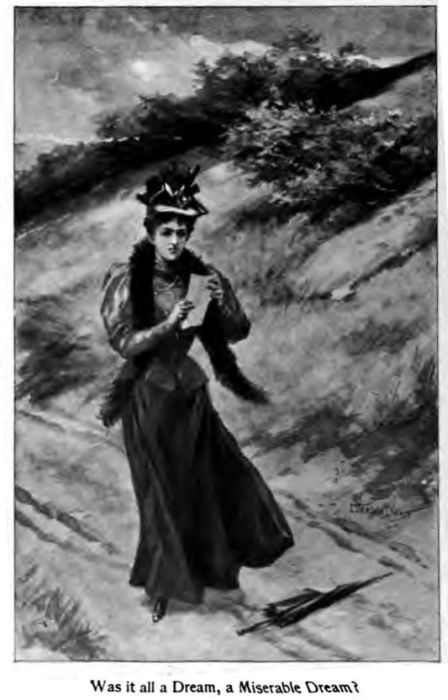
Did she read it once or twice or twenty times? or had she not read it at all? Was it all a dream, a miserable dream of shameful self-disgust and mortification? For some minutes, I doubt if Frances knew, or that she could have replied with any accuracy to any of these questions.
She was utterly, completely stupefied, and when at last her ideas began to take coherent form again it was only in the shape of increasingly definite pain and self-abasement. Unselfish, radically unselfish as she was, it became for some little time impossible for her to think of, to care for any one but herself, in the shock of revolted, almost outraged, feeling that overwhelmed her. For she was of a nature to be terribly sensitive to mortification, and with such natures, proud, dignified, mentally and morally on a high plane, recognising high ideals as the goal of all endeavour, mortification, paradoxical though it may sound, can be almost a passion.
Not that she dreaded or even thought as yet for a moment of others—outsiders—in this terrible mistake. It was herself as judging herself that she cowered before.
“I who thought myself the soul of modesty and delicacy, as I see now that I did—I, to have imagined such a thing! At my age, older than he—oh, it is dreadful to realise,” and she sat down on some rising ground by the side of the road and covered her burning face with her hands, while slow hot tears forced themselves through her fingers. In these few minutes—a quarter of an hour at most—Frances Morion seemed to herself to have lived years.
”‘No fool like an old fool!’ it is like having the measles in middle age—always worse than at the normal time, they say.”
These and other bitter, absurdly exaggerated cynical remarks passed through her mind, not to be harboured there, however, for her real character, her habitual attitude of mind, could not for long be untrue to themselves.
And “Oh, what a selfish, shamefully selfish, woman I am—I must be!” was the next phase. “I needed this lesson to open my eyes. Yes, indeed, I needed it,” and already, though the pain was still so stinging, the wound so raw, curious suggestions began to insinuate themselves. If it had been “the real thing,” would not its overthrow have affected her somewhat differently—would not the true malady have developed other symptoms?
For the moment she put these vague hints aside, to be taken out and examined into more at leisure, with possibly some salutary, health-restoring result, and with new resolution tried to concentrate her mind on what now lay before her—on the thorny, self-effacing path which duty, affection, all the associations and motives of her life pointed out as the only one she could tread.
There were alleviations—alleviations and mitigations—of her present suffering, and by degrees the first, perhaps the greatest, of these gradually crept into her thoughts. No one need ever know; more than this, it would be wrong, disloyal to others, to allow her secret to escape. This was so clearly binding upon her that it reconciled her to the necessity, already making itself felt, of to some extent acting a part. And the very relief of knowing that she must thus shield herself brought with it another, as yet faint, but yet suggestive, source of support.
“If it were really that I had got to care for him—thoroughly, genuinely in that way,” she asked herself, “would I so soon be ready to accept any sort of comfort?” But again for the present she put these ideas aside, concentrating all her powers in the direction of the immediate action required of her. “All I can do to help him, I must do,” she thought; “as to that there can be no sort of question. I must as far as I possibly can tacitly familiarise Betty with the idea of what is coming, for he is good and true, I feel convinced, and worthy of her. Oh if I had but known it sooner! It would have been nothing but happiness.”
And this was true. Six months ago, if Frances had been asked what was the darling wish of her heart, her reply would have been to see one of her sisters, Betty especially, well and safely married.
But, as things were, would Betty respond to him? It almost seemed impossible. Or perhaps the entire dislocation of the positions of all involved made it as yet seem so to her.
“I am to exert myself doubly,” she went on thinking. “It is a case in which non-interference on my part would be a crime. I have so much to make amends for in this horrible, miserable mistake of mine. I must not allow the slightest trace of depression or agitation to appear. And, oh! how unutterably grateful I should be and am that the blow has fallen in this way, by a letter instead of—in any other way; all my thought, all my care now must be for my dear little Betty.”
She rose to her feet, composed and even strengthened, and as her thoughts concentrated themselves more and more on her sister, new and strange suggestions took shape respecting her.
Had Betty been quite like herself of late? Was she not looking less well, less restful than was usual with her? She had been, for her, abnormally energetic, it was true, but all the same, on looking back, Frances began to see that there had been a curious self-repression about the girl. She had certainly avoided any talk about herself; the old, almost childish habit with which she had often been laughingly charged, of “saying out whatever came into her head,” had deserted her. Yes, she had grown strangely reticent.
Was it possible, Frances asked herself, that in her own self-absorption she had been blinded to the true state of affairs with Betty? Was it possible that the child had already learnt to care for Horace? That, anxious as he had been to do nothing to gain her affections till he was justified in doing so, he had unconsciously betrayed himself?
“If it is so,” thought Frances, “I should have still more to be thankful for. For in my determination to forget myself there might be a real danger of my influencing her too much in his favour. And yet the suggestion must in some way be made; perhaps—we shall see—Eira may be brought to help in it. I must at least find this out, for I very much fear that poor Eira, as well as dear Betty herself, has been deceived by her affection for me into imagining what—oh! how could I ever have thought it?”
And again there came the sharp stab of mortification, which indeed it would take time and resolution entirely to overcome.
The consciousness, however, of how much she might have to undo as well as to do brought vigour with it. She walked on with a firm step, a step that had something of hardness in it, hardness directed solely against herself and the weakness which she was so resolutely determined to overcome.
It was, as has been said, a lovely day, an exquisite spring day, and for this, too, Frances felt a strange new sense of gratitude. A lark rose over her head with its never-to-be-mistaken song of jubilance, all but disappearing, as she gazed after it, into a scarcely discernible speck in the blue.
“So fade our hopes,” thought Frances, “many of them at least. But yet,” for in another moment the happy bird was back again within hearing, “perhaps it only seems so to us. There must always be real sources of joy and thankfulness, even if they are sometimes beyond our perception.”
Yet she did not deceive herself. This sensation of almost exhilarating resolve and self-sacrifice would not, she knew, be lasting. There were hard struggles before her still, for the mere habit of thought into which she had almost insensibly glided during the last few weeks as to her own life and future was not to be shaken off all at once.
“The best I can do,” she went on, “is to fill my mind, to the exclusion as far as possible of everything else, with Betty. Time enough, when I can feel at rest about her, for me to unlock it all again and decide to what extent I have been to blame.”
A few yards before their own gate she caught sight of her sisters coming to meet her, and, as she watched them approaching, the listlessness and languor of Betty’s movements struck her forcibly.
“How I wish I had gone with you, Francie,” said Eira. “Betty is so tiresome! She wouldn’t go for a walk, she wouldn’t even sit out in the garden comfortably, and I only stayed at home to keep her company, because she seemed dull!”
“Are you dull, dear?” said Frances, turning to Betty. Her tone was very kind, indeed tender, and Betty, glancing up at her, read a confirmation of this in her sister’s eyes.
Betty’s cheeks grew pink, though the colour left them again as quickly as it had come.
“Spring often makes people feel rather tired,” she said. “There is nothing the matter with me except that.”
“But you mustn’t be tired,” said Frances. “It is so lovely now, so very lovely. We must be all quite well—and happy, so as to enjoy it. We can stay out a little longer. Let us sit down, and I am rather tired myself.”
Betty’s face expressed some self-reproach. “Eira,” she said. “We should not have let her go alone to the village. She always does the disagreeable things.”
Frances’ hand was lying on her knee. Betty took it in hers as she spoke and stroked it. To the elder sister the little action said much. It seemed as if in some intuitive way the coldness or constraint which had been creeping in between them for the first time in their lives was melting away, though by no visible agency. Tears crept up very near to Frances’ own eyes, but she resolutely kept them back, though a feeling of gratitude for this scarcely looked-for prompt encouragement on the path she saw before her warmed her heart.
“What a pity,” exclaimed Eira, “that Madeleine couldn’t have stayed two or three weeks longer, just to see how pretty this place can be. I don’t think, however rich I were, that I could ever make up my mind to spend this part of the year in London.”
“It is very pretty there, too, just now though,” said Frances absently. “If it were a little nearer I dare say Madeleine would come down again for a few days—with her brother, perhaps,” she went on more brightly. “I am sure Mr Morion would always be glad for them to use the big house.”
Eira, who had been leaning back on the rustic bench in rather a depressed attitude, pricked up her ears at this.
“Oh, how nice that would be!” she said. “Better than my poor Indian summer which never came to pass. What made you think of it, Francie?” And as the only reply was a smile, “I do believe that you’ve heard something! Have you had a letter from Madeleine that you have not told us about?”
Frances shook her head.
“No, truly I have not,” she said. “But Horace Littlewood did—does mean to come down again. He said so, definitely, and it just struck me how nice it would be if Madeleine could come with him.”
Eira’s face by this time was gleaming with excitement.
“Francie!” she exclaimed, “you never told us before! Betty, do you hear?”
But for all reply, Betty seemed to creep back further into her corner. Frances turned to her. “You don’t dislike him?” she said. “We got to know him so well!”
“I never said I disliked him,” said Betty. “But you know him far better than I do, and if—of course you know, Francie, if—if anybody liked you, or—or you liked anybody in a special sort of way, of course I should like such a person too!”
Frances drew a deep breath, and gathered herself together. It had come—the supreme moment, sooner than she had expected, and she must meet it bravely. It had come—to Betty too, and the little creature had risen, in her own way, with heroism. But this state of things as yet Frances scarcely realised.
“Betty, my dear child,” she began, “don’t get any mistaken ideas into your head about me—your second mother, as I always feel myself. I won’t pretend to misunderstand you, and I am glad you have spoken about it. No, no, don’t dream of anything of that sort about me, the time for it has passed. Why, I must be a year or two older than Horace! He and I are excellent friends, and I do believe he looks upon me almost as an elder sister. I should be glad,” here she spoke with hesitation that she did not attempt to conceal, “I should be glad to feel sure that as regards you yourself no shadow of the old prejudice about him remains. He deserves to be thoroughly liked and trusted.”
There was no answer from either of the other two, though Frances felt Eira’s eyes fixed on her in half-dazed amazement. She felt, too, that at Betty it was better not to glance! And after a moment or two she got up slowly, saying it must be near tea-time and that she would like to take off her outdoor things, and steadily, though with inward tremulousness, little suspected by the two others, she made her way to the house.
“Betty,” said Eira, when sure that Frances was beyond earshot. “Betty, do you hear me, what does she mean?”
But for all answer Betty turned her head away, so that her face was quite hidden from her sister, and only by the convulsive movement of her shoulders did Eira know that she had burst into uncontrollable tears.
“Never again,” thought Eira to herself, “will I meddle with or even think of other people’s affairs of this kind! There have I been for months past wearing myself out with hopes and anxieties about Frances and Horace Littlewood. And for all I know now, torturing Betty! Who would have dreamt of such a thing? It is rather too bad of Frances not to have given me some idea of how the land lay, for from her very superior well-informed manner, it is evidently not new to her. As to Betty, I don’t know what I feel. She might have—no, I don’t see that she could have acted differently, but I won’t call her cross or depressed any more. Poor little Betty! Still, on the whole, for the present, I think I had better leave her alone.”
And Eira, feeling considerably discomposed and “out of it,” not yet able to realise that this new turn of affairs might bring as much cause for congratulation as the fulfilment of the hopes on which she told herself she had wasted so much care and thought—Eira, swinging her garden-hat on her arm with a great air of “nonchalance,” followed her elder sister into the house, though not upstairs. But a moment or two after she entered the drawing-room the door reopened to admit Frances. Gladly would the elder sister have remained upstairs in the quiet of her own room if but for half an hour, but this she felt she must not do. For the moment the privilege of solitude and reflection must be renounced.
“It is only a bit, a very little bit, of the whole,” she thought to herself. “Just at first, of all times, it is most important that I should seem quite like myself, and not give the very slightest opening for suspicion that things are turning out differently from what I expected. And it will not be difficult to do so, if I keep my thoughts centred at this crisis on my poor little Betty.”
And her mother’s first words as she caught sight of her brought a little glow of gratitude to her heart—not so much of gratitude to Lady Emma herself, but of thankfulness in the abstract for this first little touch of encouragement in the road she had marked out for herself.
“You look as if you had enjoyed your walk, Frances,” was her mother’s remark. “You have got such a nice colour,” mentally adding to herself, “really Frances grows handsomer and handsomer as she gets older. Her eyes have such a bright expression,”—little suspecting the tears those eyes had so recently shed, still less those which had been repressed with so much resolution. “I have never thought them as fine as Betty’s, but somehow Betty doesn’t look like herself now-a-days,” and she gave a little sigh. “Where is Betty?” she asked aloud.
Frances glanced at Lady Emma quickly. Now and then there seemed a curious tacit sympathy between the mother and daughter, just now this struck the latter, for she herself was feeling anxious about her younger sister.
“She is coming in a moment,” said Eira, with a slight nervousness unusual to her. “Shall I run and tell her that tea is ready?”
There was no need for a reply. Betty herself came in. She was looking pale, but to a superficial observer the traces of tears had already disappeared. Her dark eyes with their even darker fringes were not easily disfigured. Tea-time passed quietly and more quickly than when Mr Morion was present. For this Frances was grateful, as it left her the sooner at liberty.
“I am going up to the vicarage,” she said, as she left the room. “I had a little commission for Mrs Ferraby in the village.”
Ten minutes later she rang at the vicarage bell, and handed in the small parcel she had brought. When she got back to the gate again, she stood still for a moment in hesitation.
“I wonder if by chance the church is open,” she thought. “I should like to go in there for a few minutes. I don’t think I have ever been there alone since the afternoon Eira was so startled;” and with a rather sad smile, “I don’t think anything would startle me to-day.”
Chapter Twenty One.
Horace.
Yes, the church door was unlocked, as happened not unfrequently, though not of intention on the worthy vicar’s part, or on that of his subordinates.
Inside, though of course the sunny daylight out-of-doors was still at its full, thanks to the high pews, and narrow windows deep set in the massive walls, all was dusk and gloom. The more so at first from the sudden contrast.
But to Frances just now this was congenial. Half mechanically she made her way up to her usual place, for one act of courtesy on the part of the temporary occupants of the big house had been to beg that the Fir Cottage family would not think of vacating the spacious old pew, where indeed there was room enough and to spare for the united households.
With a sense of weariness, to which for the first time she ventured to yield, Frances leaned back in her old corner. Venerable as it was, the church was not one, under present conditions, which lent itself readily to devotion. And it was scarcely with any feeling in this direction that the girl had sought its shelter—only a vague yearning for quiet and solitude had brought her thither. But gradually as she sat alone thinking, though but dreamily, more than what she had sought seemed to creep into her spirit. A sense of world-wide sympathy, sympathy extending indeed into time as well as space, came to soften and yet strengthen her.
How much sorrow there was in the world! Sorrow and disappointment and perplexity, bravely borne in so many cases, unsuspected even. How much sorrow there had been, how much was yet to come! How many fatal mistakes, inexplicable shortcomings, whose results stretched far!
For it was almost impossible to sit there alone in the quiet dusk, without her thoughts reverting to the strange old story of her own ancestress’ lack of good faith, from which indirectly she and those dearest to her were even now suffering.
“Our lives would have been so different!” thought Frances, “our lives and characters and everything about us. So much more consistent if we had been less isolated, and in a sense less ignorant. At least it appears as if it would have been better for us, but it is not for us to judge. I really do not think that the best side of me is inclined to murmur for myself if things go right for the others.”
The last word at the present juncture being synonymous with “Betty.”
She half rose to go, but sat down again for a moment, as she heard the clock striking, in order to count its tale of time.
“I may stay five minutes longer,” she thought, but somehow the sense of repose and comfort had been disturbed; in spite of herself, a very slight sensation of eeriness began to creep over her. It was in the evening that Eira had been so frightened. Could that be the favourite time for her troubled, old, great-grand-aunt’s visit to the church? “I wish I could feel sure,” she went on thinking, “that it is not true, that she does not really wander about in that sad, lonely restlessness! I can’t bear to think of it! Poor soul! Perhaps, after all, she was not to blame.”
What was that? Frances started, as again the long-drawn, all but inaudible breath, rather than sigh—which she and Ryder Morion had been conscious of that evening several weeks ago when standing at the end of the Laurel Walk—made itself felt rather than heard.
“It must be the draught from the open door,” she thought. “But I am getting fanciful; I had better go,” and she rose to her feet with decision.
But—now came a shock, a real shock, which could not be put down to fancy or an accidental draught of air. For as she stood up, Frances felt herself caught back, jerked back almost, by a sharp sudden catch at the little mantle she wore; it was all she could do to suppress a scream—perhaps, indeed, she did scream. She could not afterwards say. The shock, under the circumstances and with her already overstrained nerves, was really dreadful; no one who had seen her just then, white to the very lips, shivering and breathless, would have recognised poor Frances.
But the terror was not for long: the strange incident was quickly explained. “Thank God!” murmured the girl, as she discovered its cause; “I could not have stood any supernatural experience. I believe it would have nearly killed me. I have been too self-confident,” with a rather piteous smile, as she disengaged the fold of her cloak from the crevice where it had caught.
For that was all that had happened. In the corner of the pew, the old panels, as Eira had already noticed, seemed to fit less well than elsewhere. Time, doubtless, had made the wood shrink; there was a line of interstice all but in the corner, giving the look of an intended opening—a small cupboard door, as it were, of which the narrow strip of space might be either the closing or the opening side. It was a little above this that a splinter had been partly broken off, the point of which had hooked, in the extraordinarily clever way in which, in similar cases, such things do hook or catch, the silk frill of her cape. It was freed in a moment; in fact, if the tiny accident had happened elsewhere, Frances would scarcely have perceived it, except, perhaps, for the sound of some slight fracture of stuff or stitches, though, as things were, the tug, apparently from invisible fingers, had caused her a sensation of real horror. And for a minute or two, anxious though she was to get out into the cheerful daylight again, she felt too shaken to move. But by degrees this feeling passed off, and with but small trace of her recent agitation she made her way home again, devoutly wishing that the evening were over and she herself free to rest and think in the solitude of her own room.
All passed off, however, more easily than she had feared. She thought it best to own to being a little tired, and was pleased to find Betty coming about her more in the old caressing way than had been the case for long; and there was a look in the girl’s face which Frances was glad to see, not so much of actual happiness as of freedom from constraint—of hopefulness.
“It will be all right,” thought Frances. “I can see already that it is going to be all right. I shall have nothing to reproach myself with as regards the effect on them of my deplorable mistake. It is only I—and how thankful I should be for this—that will have any suffering to bear, and I shall be able to hide it. And as for Betty, perhaps the child needed the training of what I now feel convinced she has gone through.”
Nevertheless, it was a relief, and a great one to Frances, as the days went on, to perceive that Betty sought, and intended to seek, no further confidence or explanation of her elder sister’s undisguised hints. More than this, Eira had evidently been tutored to take the same line, though in both instances it was done with affectionate delicacy, so as to give rise to no misgiving on Frances’ part that for any reason she was less trusted than heretofore.
Just one word in allusion to what had passed between the sisters that afternoon when they were sitting on the garden bench came from Eira:
“Francie dear,” it was, “we are not to speak about it, not even when you and I are alone. Betty begs us not to, and I have promised. I think—she is perhaps afraid of letting herself get too sure, so many, many things might come in the way.”
“Wise little Betty,” was Frances’ reply, but the smile which accompanied it went far to raise Eira’s spirits, at any rate, whether or no she ventured to insinuate a greater degree of confidence into Betty’s own views.
After this, which occurred within a short time of the receipt of her letter from Horace, Frances felt that she might write to him with less caution. He had not asked her to reply—not directly so, at least; but her own intuition told her that he would be very grateful for even a few words. But, as is sometimes the case where lives or circumstances have droned along with but the minimum of movement, once the turn comes events seem to precipitate themselves far beyond reasonable anticipation.
“We may have to wait some time,” Frances had said to herself, “in spite of Horace’s ‘few weeks.’ He will scarcely dare to take any very decided step till he is a little more settled.” And this not improbable space of waiting was what for herself she had dreaded almost more than anything.
She was not called upon to face it. Before she had written, before she had even framed in her mind an answer to his letter, all doubts were set at rest.
“What’s this?” said her father one morning, as he scrutinised his scanty correspondence. “I should know the handwriting, surely. Oh, yes, of course,” as he opened the envelope, and ran his eyes over its contents. “It’s from Littlewood—Horace Littlewood. He is coming: down again for a day or two. One or two things Ryder wants him to see to.” This to Lady Emma, as if by no possibility the news could in any way interest his daughters. “Matters as to which he would like my advice—naturally. Oh, I remember now, by-the-by, that he said something about it before he left, and hoped I should be at home.”
“When is he likely to come?” asked his wife with mild interest.
“Let me see,” Mr Morion went on, reverting to the letter. “He doesn’t say definitely. In the course of a day or two. Ah, well,” and he pushed his spectacles up on to his forehead, “remember to tell that stupid parlour-maid—Frances, or one of you girls—to let him in whenever he calls, into my study at once. I see he will depend a good deal on my opinion.”
“Will he, indeed?” muttered Eira, making a little face behind the shelter of her breakfast cup.
And two or three times at least in the course of the next twenty-four hours the somewhat querulous voice of the master of the house was heard inquiring if they, or she, or “one of you” had seen to it that Brown understood clearly about “when young Littlewood calls,” though a couple of words to the servant herself might have set his own mind at rest, and saved his family the irritation of having on each occasion meekly to reply, “Yes, papa; she quite understands.”
No steps or precautions were taken by Frances towards securing for Horace any private interviews with Betty.
“It would only annoy her inexpressibly if I did so,” she said to herself, “and he has scarcely empowered me to act for him in any more definite direction than I have done. He is well able to manage matters for himself and will prefer doing it.”
But while cheerful and practical in her ordinary intercourse with her sisters, she was specially tender to Betty, in small, almost indescribable ways, which the younger girl’s quick instincts were at no loss to appreciate. On her side too, and consistently with her own character, Betty comported herself after a manner which won for her not only her elder sister’s admiration but increased respect.
“There is no lack of real strength about her,” thought Frances. “She will enter into nothing rashly or childishly, nor without grave consideration. And—at best it is not likely to be all roses for her: Mrs Littlewood may be attracted by Betty herself, but ‘the connection,’ as people call it, will not, most assuredly, find favour in her eyes. All I can possibly do to help my little sister, I am very distinctly bound to do, and gladly will I lend myself to it.”
“He” did not delay. The very next morning but one after his letter had arrived at Fir Cottage, there came the ring at the front door bell which in their hearts the three sisters had been on the alert to hear. Frances and Eira were together, sorting some of the now rapidly increasing and important Scaling Harbour papers—notices of lectures, evening classes, magazines for distribution, and all the paraphernalia connected with well-organised parish work—in their own little sitting-room, a pleasant enough den in the warm bright weather. Betty was out of doors, “somewhere about,” a frequent resort of the least practical of the three!
Eira stopped short in the midst of making up a packet; she grew a little pale, though her eyes were bright with expectancy.
“Francie,” she exclaimed breathlessly, “there he is, I do believe.”
“Well,” said Frances smiling, “I dare say it is, as we know he is coming. Don’t look so startled, Eira. There is nothing for us to do just now.”
“But I don’t know where Betty is,” said Eira uneasily. “She may be in the garden, and may have gone up to the church or anywhere.”
“We must leave it to chance, and to Horace,” answered Frances. “Remember, he will be going straight into papa’s room, as he has come ostensibly to see him. It would never do for us to look for Betty: it would only annoy her.” So, in deference to her elder sister’s opinion, Eira went on as best she could with her sorting and folding, though little gasps, which from time to time escaped her, betrayed that she was in anything but a philosophical mood. At last Frances could stand it no longer. With a laugh, born, to tell the truth, in great part of the nervousness she herself was so resolutely repressing, she turned to her sister.
“You had much better tell me what you have got on your mind, Eira,” she said. “I can feel that you are working yourself up, though really unnecessarily, about it all.”
With this encouragement Eira flung her papers on the table and herself into a chair.
“It has just struck me, Francie,” she ejaculated, “that, supposing—supposing, you know, for he must have seen how peculiar papa is, that he went first to him in the old-fashioned way, and that he—you know how astonished he’d be—on the first shock of such a thing—negatived it before he had given himself time to think it over, and take in that nobody could object to him, that he is quite un—exceptional—no, unexceptionable I mean! Wouldn’t it be awful? For, once he had committed himself, there is no moving him. Don’t laugh at me, I am really frightened.”
“I am quite sure,” said Frances, “that you need not dread anything of the kind. Even at the risk of any possible difficulty with papa, he—Horace, I mean—your personal pronouns are really too chaotic, Eira!—would not set about things in that way. But if you are feeling so worried, leave these Scaling Harbour papers just now, and go out. You may very likely meet Betty, and as you don’t know that there is any one in the library, you can do no harm.”
Off flew Eira, delighted to be free, and full of excellent resolutions as to the discretion with which she would act should need arise.
There was no Betty in the garden, nor, without asking a direct question, which under the circumstances she thought it best to avoid, could Eira satisfy herself that Mr Littlewood had really come. So she strolled along the road towards the church, her perseverance being rewarded before long by the sight of Betty seated calmly on a very ancient moss-covered tombstone, meditating apparently, with somewhat eccentric inappropriateness, present circumstances considered, rather on the end of life than on the changes which it was on the point of bringing to her.
“Oh, Betty!” exclaimed Eira, “what are you doing there? You might have stayed in the garden, or at least told me if you meant to come up here.” For by this time the younger sister’s excitement was in danger of lapsing into the cross stage. And it was very hot!
“I am thinking,” replied Betty coolly. “There’s no place like a churchyard for it, and this is a very comfortable seat. And it is nice to remember about all the people that have once been alive and have now got out of it all!”
“Tastes differ,” said Eira, rather sharply. “I shouldn’t call this exactly the time for a new edition of Young’s ‘Night Thoughts’ or Grey’s ‘Elegy,’ whichever suits you best, just when—when other people,” with marked emphasis, “are feeling very anxious about you, and wondering—”
Betty looked up at her with irritating composedness in her eyes.
“What are you talking about, and who has asked you or any one else to feel anxious about me, or to worry about me in any way?” she asked calmly.
Eira felt that she had made a mistake.
“How vexed Frances would be with me!” she thought. And “I did not say ‘worry,’” she replied meekly; “I said,” but she stopped in time. “Wondering” would have been even worse. She felt herself growing very red, with the consciousness of Betty’s steady, calmly inquiring gaze upon her. “Oh, never mind,” she broke off petulantly, “never mind what I was going to say; I’m a fool, I know. It is much better not to care about anybody or anything. I don’t pretend to be wise and well-balanced and superior and all the rest of it, like you and Frances,” but all she got in return was a quiet little rejoinder.
“I don’t know what is the matter with you this morning, Eira. You are very cross.”
It was too bad, she thought, this “pose” on Betty’s part, when only a few days ago she had burst into tears and not attempted to hide the fact from Eira.
“One’s sister’s love affairs are best left alone,” was the resolution she at last arrived at. All the same, she was restless and uneasy; it was almost unbearable to think of Horace Littlewood at that very moment “cooped up with papa—thinking, perhaps, that Betty is keeping out of his way on purpose, for he must have meant us to know that he was coming, and I feel almost sure there is some understanding between him and Frances about it. And a really nice man, so at least I have always read in novels, is so easily discouraged.” At last she could stand it no longer. She got up from the old stone, where for the last few minutes she had been sitting in silence beside her sister.
“Betty,” she said, “I am going home. Won’t you come too? I don’t want to stay here thinking about dead and gone people, as you do. I am too interested in the living,” though the moment she had blurted out the words she regretted them again.
Betty looked up.
“There is no hurry,” she said, “but you need not stay. I will come soon, and—oh, there is Mr Ferraby,” and she rose from her seat and went towards the old vicar, emerging from his own garden by the little gate between it and the churchyard, while Eira, in a fever of irritation and impatience, made her way home again. Nor was her mood any calmer by the time she had reached her own door, for she had stopped a moment at the gate leading into the Laurel Walk, with a sudden instinct that here might be something to be seen. Nor was she mistaken. Half-way down the path she descried a figure—a familiar figure—that of Horace Littlewood, wending his way, and that—or so it seemed to her—with a dejected air, towards the house. He was too far off for her to have accosted him, nor would she have known what to give as an excuse for so doing.
“It is too bad of Betty,” she said to herself, “playing with a man’s feelings in this way. I do believe she has managed it on purpose, and Frances seems to be aiding and abetting her. I dare say we shall hear that he has gone back to London to-night, and is off to India in disgust.”
There was no one to be seen when she got to the cottage. It was still fully an hour till luncheon-time. Eira went up to her room and occupied herself resolutely with certain “tidyings-up,” which she reserved as a species of tonic when feeling herself unusually discomposed. And as she possessed one of those healthy natures which have the power of throwing themselves heartily into whatever is the occupation of the moment, the time passed more quickly than she realised.
It was within a few minutes, a very few minutes, of the luncheon hour, when the door opened softly and some one came in.
“Who is there?” said Eira, without looking round. “Is it you, Frances? The luncheon bell hasn’t sounded yet, I’m sure.”
“It isn’t Frances,” was the reply, in a voice which she knew to be Betty’s, though with something—what was it?—in it which had never been there before, and, turning round quickly, with a curious thrill of eager anticipation in her warm, sisterly little heart, she faced the newcomer.
Yes, Betty it was, but what a Betty! Whence had come this wonderful glow, almost radiance, which seemed to transfigure and illumine her whole personality? Were there tears trembling on her eyelashes? It may have been so, or it may have been the reflection of the new light within the dark eyes themselves.
“Eira,” she exclaimed tremulously, “dear little Eira! I know you thought me horrible this morning, but I didn’t mean it really. I was only—frightened to—to let myself believe about it. I had no certain reason, you see, and I thought it might be just a mistake of dear Francie’s. Please forgive me. I thought I must tell you first—even before her, for we have been almost like one, haven’t we? And—oh, I am so happy now!”
She threw her arms round her sister; for a moment or two neither spoke. Then Eira looked up.
“Betty, dear,” she whispered, “have you seen him then? did you meet him?”
“Yes,” was the reply, while Betty’s face grew rosy all over. “He was waiting for me, watching for me to pass back home. He had found out somehow—perhaps he met Frances—where I was, and we strolled up and down the Laurel Walk. I am rather glad it was there—aren’t you? Perhaps somehow poor old great-grand-aunt, whose namesake I am, will know it and be glad. He is coming this afternoon to see you all, and—” with an irrepressible smile—“to speak to papa.”
The smile of amusement developed into a laugh of mingled delight and mischief in Eira’s case.
“To speak to papa,” she repeated, “how lovely! He is perfectly satisfied that Horace came down on purpose to consult him about the new gamekeeper’s cottage, or something of that sort, that Ryder Morion is settling about. What will papa say? He will never be able to believe that one of us could be more interesting to talk to under any circumstances than he himself. Oh, it will be fun!”
But a tiny shadow had crept over Betty’s face. “You don’t think papa will be angry, do you, Eira?” she said, “or set himself in any way against it? Of course it won’t be all perfection, nothing ever is; we shall have to go to India, I’m afraid.”
“I don’t see why,” said Eira, “when the Littlewoods are so rich. But even if you have to, think what hundreds do so! Papa couldn’t be so unreasonable. And you may trust Horace to have thought everything well out.”
“Oh dear, yes,” said Betty, all the brightness returning. “He is only too anxious, too careful for me. No, I must not spoil it by being afraid about papa.”
Chapter Twenty Two.
Proverbs and Parents.
The luncheon bell rang at that moment. Eira, on the tiptoe of expectation, took her place quietly at table, and no one would have suspected the spirit of mischief which was largely mingled with her happy excitement. She spoke little, and only in her dancing eyes could anything unusual have been discerned.
Betty, on the contrary, was more talkative than her wont, and now and then Frances glanced at her in some perplexity, for Eira’s suspicion that a hint as to Betty’s probable whereabouts that morning had been given by the elder sister to Horace, when she met him for an instant, was well founded.
Had they come across each other? Frances asked herself. She could scarcely think so, and yet Betty was not quite like herself.
“Surely she would have told me first,” thought Frances, though as quickly as the thought came she put it from her as savouring of self-seeking. Why should she expect it? Betty had no idea on what foundation was built the fabric of her own happiness, and nothing was more earnestly desired by Frances than that her sister should never, in the very slightest degree, suspect the real state of the case.