Mrs Molesworth (continued 2)
Reading edition
“I don’t know about being uncommon,” she said; “but assuredly, Betty, nobody could accuse you of being monotonous! Why, you are never in the same mood for three minutes together!”
“But her moods are monotonous,” said Eira. “She’s either up in the skies about nothing at all, or down in the depths about—no, I can’t say that there’s often nothing at all as an excuse for descending in that direction.”
Thus chattering, with the pleasant certainty of mutual understanding, they had walked on for some distance, when a glance at the red autumn sun already nearing the horizon made Frances decide that it was time to turn.
“It’s always extra dull to go back the way we came,” said Betty, “and to-day it’s my fault, for I do want to pick up my beautiful leaves and berries.”
“We must walk quickly, then,” said Frances; “or you’ll scarcely be able to distinguish your nosegay. Dear me! the days are getting depressingly short already.”
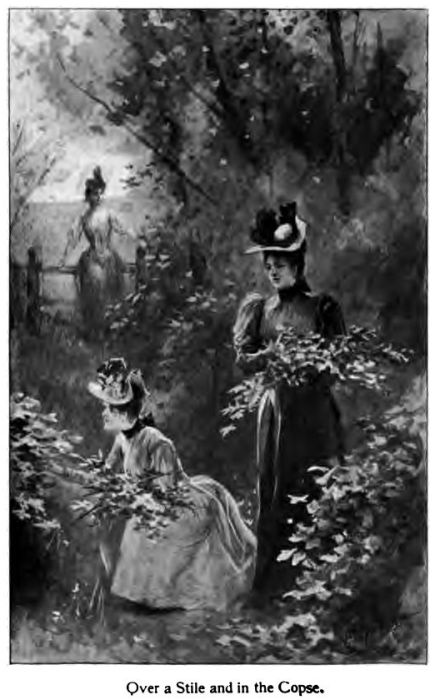
“And then they will begin to get long again, and you will be saying how cheering it is,” said Betty. “You are so terribly good, Francie. I quite enjoy when I catch you in the least little ghost of a grumble. It really exhilarates me.” A few minutes’ rapid walking brought them to the steep path again. Then they crossed the road and were soon over a stile and in the copse. None too soon—here under the shade of the trees it was almost dark already, and Betty’s soft plaintive voice was heard in lamentation.
“I don’t believe we shall ever find the bundle,” she said. “Francie, Eira, do help me—can you remember if it was as far on as this, or—”
“Oh, farther, some way farther,” interrupted Eira. “Much nearer the other stile. Don’t you see—”
She started and did not finish her sentence, for at that moment a figure suddenly made its appearance on a side-path joining the rather wider one where the sisters were. And, though it was almost too dark to distinguish the action, a hand was instinctively raised to remove the wearer’s cap, and a voice, recognisable though not familiar, was heard in greeting.
“Good-evening,” it said. “Can I be of any use?” for its owner had heard enough to guess that the sisters had met with some small mishap.
“Oh,” replied Betty, who was the first to identify the newcomer, “no, thank you. It’s only Frances,” with a significant change of tone, “it’s Mr Littlewood.”
Frances, self-possessed as usual, came forward quietly and held out her hand.
“We are hunting for some lost treasures,” she said, “which it is too dark to distinguish.”
“Anything of value?” he said quickly, glancing about him.
His tone of concern was too much for Eira’s gravity. A smothered laugh added to Mr Littlewood’s perplexity, for Eira’s person had till now been hidden behind some bushes where she was groping to help her sister in her search. Frances turned upon her rather sharply, for, despite her comforting tone to Betty two evenings before, she had no wish for any further gaucherie on the part of her sisters.
“What are you laughing at, Eira?” she said, and then, without waiting for an answer, she went on in explanation to Mr Littlewood: “Oh, no, thank you; nothing of value in one sense. It’s only a large bunch of shaded leaves and berries that we gathered on our way out: they were too heavy to carry, so we hid them somewhere about here, and now we can’t find them—it has got so dark.”
Mr Littlewood smiled.
Perhaps it was fortunate that only Frances was near enough to him to perceive it. He was turning towards the hedges where the two younger girls were still poking about, when a joyful cry from Betty broke the momentary silence.
“Here they are!” she exclaimed. “Help me to get them out, Eira;” which Eira did so effectually that there was no occasion for the young man’s offered help.
And once laden with her booty, a share of which she bestowed on her sister, Betty hurried onward, Eira accompanying her, leaving Frances to dispose of Mr Littlewood as she thought well.
He did not intend to be disposed of just at once. As Frances walked on slowly towards home in her sisters’ rear, he suited his step to hers with an evident intention of beguiling the way with a little conversation.
“I’m afraid,” he began, with a touch of hesitation which scarcely seemed consistent with his ordinary tone and bearing, “I am afraid that your—your sister—I do not know if she is the youngest?—has not quite forgiven me for my stupid speech the other day.”
Frances tried to answer lightly, but in her heart she felt annoyed with Betty.
“I hope she is not so silly,” she replied. “More probably she is still vexed with herself for having taken offence at—at really nothing.”
“Nothing in intention, most assuredly,” he replied, with a touch of relief in his tone. “But still, she was annoyed. And—if I am not making bad worse—would you mind giving me some idea, Miss Morion, what it was that she referred to? In case, you see, of my people coming down here, as seems very probable, it would be just as well—it might avoid friction if I understood just a little how the land lies.” Frances hesitated.
“It is such an old story,” she said, “and rather an involved one, and really not of any interest except to ourselves!”
“I don’t know that,” he replied quickly. “To tell you the truth—you mustn’t be vexed with me—I asked Milne about it, but he was rather muddled, I think. Possibly he scarcely felt free to explain it, so he ended up by saying he was too busy to go into it then, all of which, of course, whetted my curiosity.”
There was something naïf, almost boyish, in his manner, which Frances had not before been conscious of, and it gave her a feeling of greater sympathy with him.
“There is really no secret or mystery of any kind,” she said. “I mean nothing that I could have the least hesitation in telling you, or any one who cared to hear. Though a mystery there is, a commonplace enough one too, I suppose: a lost or hidden will! It was long ago—” but by this time they were at the stile, over which the two younger girls had already clambered, and now stood waiting on the road, evidently expecting that at this juncture their companion would take himself off.
“It’s getting so chilly, Frances,” said Betty, “I think we had better walk quicker.” With which faint approach to apology for her abruptness, she was starting off, when Mr Littlewood interposed.
“Why don’t you go through the park?” he said. “I thought you always did. It must make quite half a mile’s difference.”
“Yes,” said Frances, “it does. Come back to the lodge, Betty and Eira!” for she felt it would look too ridiculous to depart from their usual habit merely because this young man happened to be staying a night or two at the big house. Furthermore, she was conscious that her companion was really anxious to hear what she had to tell, and if she and the others went home by the road, he would scarcely have a pretext for accompanying them.
“Oh, Frances,” said Betty, “I think at this time of day the road is much the best. It’s so gloomy in the park.”
“Only the last little bit,” replied her sister, with a certain intonation which the younger ones understood, “and it is considerably shorter.”
“And,” interposed Mr Littlewood, so quickly as to seem almost eager, “you will of course allow me to see you through the gloomy part.”
“Thank you,” said Frances courteously, “it is not that we are the least afraid. We are far too well accustomed to looking after ourselves, and this is not a part of the country much frequented by tramps, I am glad to say.”
She had turned already, however, in the direction of the big gates, so there was no occasion for further discussion, and the old programme was soon resumed, Betty and Eira hurrying on well in front, though not so far in advance but that a faint sound of laughter—laughter with a touch of mischief or mockery in it which made their elder sister’s cheeks burn with annoyance—from time to time was carried back by the breeze to the ears of the two following more slowly. This made Frances the more anxious to divert her companion’s attention from her sisters.
“I really must pull them up when we get home,” she thought to herself. “They will have no one but themselves to thank for it if Mr Littlewood puts them down as a couple of silly school-girls.”
She was turning over in her mind how best to revert to the subject of their conversation before Betty’s interruption, when, to her relief, her companion himself led the way to it.
“Won’t you go on with what you were telling me?” he said, with a slight touch of diffidence, “that is to say, if you are sure you don’t in the least mind doing so. Perhaps you wouldn’t think so of me,” he went on, “but there’s something of the antiquary about me. Old bits of family history always have a fascination for me.”
“This bit,” said Frances, “is, as I was saying, rather commonplace. It is simply that an ancestress of ours—no, scarcely an ancestress—a certain Elizabeth Morion, a grand-aunt of my father’s, in whom the whole of the family possessions at that time centred, played his father false by promising what she never did. That is, by leaving a will which gave everything to the elder of her two nephews, the—yes, the great-grandfather of your—” here she hesitated and looked up inquiringly. “What is the present Mr Morion to you, by-the-by?” she asked.
“Nothing, nothing whatever,” said Mr Littlewood. “A brother’s brother-in-law is no relation.”
“N-no,” Frances half agreed, “but it’s a connection. Let me see, your brother married his sister?”
“Yes, that’s it,” he answered. “Ryder Morion’s sister is my sister-in-law. There, now, that puts it neatly. Then, this capricious spinster broke her word to your grandfather, did she?”
“Well, yes, we must suppose so, unless—there has always been the alternative possibility that she did make the right will, and that it got lost or mislaid.”
“H-m-m!” murmured Mr Littlewood thoughtfully. “I suppose that does happen sometimes, but rarely, I should think. I don’t know if I have peculiarly little faith in human nature, but in a general way there’s been something worse than accident at work in such cases. Was the old lady on good terms with both nephews?”
“I believe so,” Frances replied. “Though she was much more in awe of the elder. He had made an extremely good marriage, and, besides coming into the more important Morion place, his wife had heaps of money. I have always thought,” she went on, “that great-grand-aunt Elizabeth was a little afraid of telling him that she had left this property, small as it is, away from him. For, you see, it has the family name; yet, elder branch though they are, its owners have never cared for it. So,” with a slightly rising colour which it was too dark for him to see, and a half-deprecating tone in her voice which he was quick to hear, “there is some excuse for the way we feel about it, though certainly Betty need not have blurted it out as she did the other day for your benefit!”
“On the contrary,” exclaimed her companion, “I enter most thoroughly into her feelings. And it is delightful to come across some one that isn’t afraid to speak out her mind. But—now, do scold me if I am indiscreet—considering these very natural feelings, which your father must realise to the full, is it not rather a pity to have settled down here, in constant, hourly view of what should have been your home?”
“Well, yes,” said Frances, “on the face of it I can understand it striking you so, but circumstances often lead up to the very things one would originally have avoided. So it has been with us. My grandfather bought our present little house, which did not belong to the Morions though surrounded by the property, for a very small sum: he kept a sort of foothold in the place I fancy, in case—just in case—of the will, in whose existence he never lost faith, turning up; and also perhaps out of a sort of not unnatural self-assertion. And when papa retired—he was many years in India, you know, and married rather late—it seemed the best place for us to come to. We three were tiny children, and Anglo-Indians of all people believe in country air for their children, and here we have been ever since, our income, unfortunately, having creased as time went on, instead of improving.”
For a moment or two Mr Littlewood walked on in silence. He was really of an impressionable nature, despite appearances, and the girl’s simple words told him even more than she was conscious of.
“Dull little lives,” he thought to himself. “Poor children! If my people come down here they must try to do something for them, though I see it must be done with tact. Dear me! what a clumsy fool I must have seemed to that sweet little Betty.”
Then turning to Frances:
“Thank you,” he said gently, “thank you so much for telling me about it. I quite see the whole thing. I wonder,” he went on, with a slight laugh, “I wonder if anything will turn up some day?”
“Oh, no,” said Frances, “it’s far too long ago now. We amuse ourselves sometimes by building castles in the air about it, but I am not sure that it is a very wholesome occupation.”
“It would be very good fun,” said the young man, “if our living in the house somehow led to any discovery! By-the-by,” he added suddenly, “it would make a splendid groundwork for a ghost story. If the old lady is repentant for breaking her word, she shouldn’t be having a peaceful time of it; or even if she were not to blame, and the will were in existence, that’s the sort of thing ghosts should come back to set right, isn’t it?”
“Well, yes,” said Frances, “I suppose so, but the queer thing about ghosts is that they so much more often appear for no reason than for a sensible one.” But there was a certain repression in her tone which returned to his mind afterwards.
They had crossed the park by this time, and were close to the door into the road, where a little way farther on stood Fir Cottage. The voices of the two girls in front sounded softly now, and here in this more sheltered spot the evening breeze had grown gentle and caressing in its dainty touch. The moon, too, had come out, and the whole feeling of the evening breathed peace and restfulness.
“It scarcely seems like late autumn now, does it?” said Frances. “And, oh!” she went on, “isn’t the glimpse of the old church pretty, Mr Littlewood?”
From where they stood, the windows at one side and the ivy-covered tower of the venerable building, more picturesque than beautiful in the full daylight, had caught the silvery gleam.
“Yes,” he agreed, “it looks at its best, doesn’t it? If Ryder was more here, he’d have gone in for restoring it by now; and, inside, I must say, it would be an improvement, though it would almost seem a pity to tear down that ivy. I looked over it this morning.”
“Oh, did you?” said Frances. “It is getting to be almost a survival. The day must come, I suppose, for overhauling it, if it is to hold its own much longer. Papa says the masonry is becoming very bad. I should like to see it really well done, though I am heathen enough to have a queer affection for it as it stands.”
“Do the visitors from Craig Bay come up here?” Mr Littlewood inquired.
“Not regularly,” Frances replied. “There is a very modern, tidy little church near the station. Were you thinking of funds for restoring this one when you spoke of the visitors? Our old vicar is too old, I suppose, to take any interest in doing it up, otherwise something might be done.”
“Oh, funds can’t be the difficulty,” said Mr Littlewood quickly. “Ryder Morion has far more money than he knows what to do with. I dare say he has restored other people’s churches more than once; that sort of thing is rather in his line.”
“Then, why doesn’t he begin at home?” asked a clear voice, startling them a little. It was Eira’s. Frances and Mr Littlewood, gazing at the church, which stood just outside the park wall in the opposite direction from Fir Cottage, had not observed that the two younger girls had retraced their steps some little way, and now were standing close behind them.
Again Frances felt annoyed, though she could not help being glad that this time the offender was not Betty. But her companion was on his guard: he answered gently, in a matter-of-fact tone, of itself conciliatory, “You may well ask. I shall tell Ryder what I think about it when I see him,” he said. “Why, he has never been here that any of you can remember, has he?” There was no immediate reply. It was, naturally enough, a trifle mortifying that on the few occasions—rare enough, it must be allowed—on which the owner of Craig-Morion had visited the place, he had taken no notice, direct or indirect, of his kindred at Fir Cottage. But the three sisters were nothing if not candid—candid and ingenuous in a very unconventional degree—and the silence was almost immediately broken by Frances’ clear, quiet voice.
“Oh, yes,” she said, “he has been here several times for a few days together, but we don’t know him at all, not even by sight.” Again Mr Littlewood anathematised his bad luck.
“Really?” he said, with apparent carelessness.
“I can’t call him exactly a genial person,” he went on, “and you know, I suppose, that his wife died a few years ago, which has not made him less of a recluse. All the same,”—for the young man was on common ground with his new friends so far as a constitutional love of candour goes—“all the same, I’m very much attached to him. He’s been a good friend to me in more ways than one.”
“I’m glad to hear it,” said Frances. “One can never be without interest in the head of one’s family, it seems to me.”
They had been strolling on during the last few moments towards their own gate, and, there arrived, Frances held out her hand.
“Good-night, Mr Littlewood,” she said simply, adding no invitation to come in with them.
“Good-night,” he repeated, shaking hands with each in turn, “but—it need not be ‘Good-bye,’ as I don’t leave till the day after to-morrow. Do you think Lady Emma would allow me to look in some time in the afternoon?”
“Y-yes, I will tell her,” was Frances’ rather ambiguous reply; and as the young man re-entered the park, his thoughts busied themselves with the glimpse, the almost pathetic glimpse, he had had into these young lives.
Chapter Six.
“Not at Home.”
“What in the world,” said Betty, “what in the whole world, Frances, did you get to talk about to him, all that long way across the park?”
“Really, Betty,” said Frances, for her, almost crossly, “you are too bad! Did I elect to have a tête-à-tête with Mr Littlewood? If it were worth while I might blame you and Eira seriously for the way you behaved—like two—”
Betty was on the point of interrupting with some vehement repetition of the dislike she had taken, and that not causelessly, to their uninvited visitor, when a significative tug at her sleeve from Eira startled her into silence, though thereby Frances’ intended lecture made no further way, as the interruption came from Eira instead.
“You are not to say ‘silly school-girls,’” she exclaimed. “I know that’s what you were going to say. We simply walked on because three women and one man seem—are—so stupid. Why does it always seem as if there were too many women?”
“In a family where there are no brothers it couldn’t very well seem anything else,” replied Frances, rather shortly; but she did not resume her remonstrances, for by this time they were by the front door, and she hurried into the drawing-room, where, as she expected, tea, and a somewhat ruffled Lady Emma, were awaiting them.
“You are very late, why—” were the words that greeted her; but before hearing more, Eira softly closed the door, holding back Betty for a moment’s confabulation in the hall.
“What is it, Eira?” said Betty impatiently. “You tug my sleeve, and then you pull me back when I’m tired and want some tea. What is it you want to say?”
“We had better leave our cloaks outside,” said Eira, rapidly unbuttoning her own garment as she spoke. “What I want to say can’t be said in a moment, it is something too tremendous! I only felt that I must give you a hint to be more careful in your way of speaking about Mr Littlewood.”
“Why?” asked Betty, opening her dark eyes to their widest.
“Because,” said Eira, “I am not at all sure but what a most wonderful thing is going to happen, or, for that matter, has happened. Betty, suppose—just suppose—that he has fallen in love with Frances.”
Betty gasped, unable for a moment to articulate.
“That man!” she at last ejaculated.
“Well, why not?” returned Eira. “You’ve taken a dislike to him of some kind, or you fancy you have, and of course I don’t mean to say that I think he’s good enough, but still—but I can’t speak about it just now, only take care!”
She had certainly succeeded in taking Betty’s breath away. The girl would scarcely have been capable of a coherent reply, but she was not called upon for one. The drawing-room door opened, and their elder sister’s voice was heard.
“Do come in to tea,” she said, “and, Eira, you run and tell papa it is ready. I had no idea it was so late,” she went on. “Poor mamma has been wondering what was keeping us,” she added, in a deprecatory tone, as Betty followed her into the room.
“We can’t blame Mr Littlewood for it,” said Betty eagerly; “we were walking almost all the time we were talking to him, so he can’t have delayed us!”
“Mr Littlewood?” repeated Lady Emma, in the high-pitched tone which with her was one of the signs of disturbed equanimity. “Mr Littlewood? What is she talking about? You don’t intend to say that you have been a walk with a—perfect stranger! Frances, what does this mean? I insist on your telling me.”
“I have not the very least objection to telling you, mamma,” said Frances. “In fact, I have a message for you from Mr Littlewood, which I was just going to deliver.”
Her tone was absolutely respectful, but there was a touch of coldness in it, not without its effect on her mother. In her heart Lady Emma not only trusted her eldest daughter entirely, but looked up to her in a way which showed her own involuntary consciousness of the superiority in many ways of the girl’s character to her own. But any approach to acknowledgment of this real underlying admiration and respect would have seemed to her so strange and paradoxical, considering their mutual relations, as to be almost equivalent to a reversal of the fifth commandment.
She contented herself with replying in a calmer tone, “Did you meet Mr Littlewood, then? Naturally I can’t understand things till you explain them.”
“Yes,” Frances replied, “we met him on our way home, not in the park, but in the little copse on the Massingham road.”
“I am glad you were not in the park,” said Lady Emma.
“But we did come through it after meeting him,” said Frances. “It would have been affected to do otherwise just because he is staying at the house, and I suppose, as he was walking our way, he could scarcely have avoided walking on beside us. He asked me if he might call to say good-bye to you, mamma, to-morrow afternoon?”
The last words, unfortunately as it turned out, were overheard by Mr Morion as he entered the room. His wife, taught by long experience, made no reply, so the message remained uncommented upon, unless a doubtful grunt from the depths of the arm-chair where the master of the house had settled himself could have been taken as referring to it.
Silence, not an unusual state of things at Fir Cottage, ensued, and as soon as the two younger girls could escape from the room they hastened to their own quarters, a small and in wintertime decidedly dreary little chamber, which in old days had been used as their schoolroom. It looked out to the side of the house and was ill lighted. But its propinquity to the kitchen was, practically speaking, in cold weather no small boon, preventing its ever becoming very chilly, for, though it boasted a fireplace, the restrictions as to fuel formed one of the most disagreeable economies in practice at Fir Cottage. In summer, on the other hand, the schoolroom was apt to become unbearably hot; but in summer, if it is anything like a normal season, and in the country, life usually presents itself under a very different aspect. Such things as fires and chilblains do not enter into one’s calculations; one’s own room, in nine cases out of ten, is a pleasant resort, and even if not so, are there not out-of-doors boudoirs by the dozen?
Dreary enough, though, the little room looked this evening, when by the light of one candle Betty and Eira established themselves as comfortably as circumstances allowed of, that is to say, on two little low basket-chairs, dismissed from the drawing-room long ago as too shabby, which had been one of their few luxuries in lessons days. Just now, also, the extraordinary possibilities which they were about to discuss so filled their imaginations that the uninviting surroundings over which they often groaned would have passed unnoticed had they been ten times worse. And worse they might have been most assuredly! For one fairy gift was shared alike by the three sisters—the gift of dainty orderliness; and where this reigns one may defy poverty to do its worst, for with such a background the tiniest attempt at prettiness or grace is trebled in pleasing effect.
“Eira,” said Betty in an almost awe-struck whisper, “do you really, really mean what you said? Do you think it possible? And—” with a touch of hesitation, quaint and almost touching in its contrast to the outspoken treatment of such subjects by the typical maiden of to-day, “if—if he had—fallen in love with Frances, could she ever care for him, I wonder?”
A dreamy questioning came into her eyes as she spoke.
“I don’t see why she shouldn’t,” said Eira. “Of course neither you nor I can picture to ourselves any man being good enough for Frances, so we need not expect the impossible. But taking that for granted, I don’t see why she mightn’t get to care for this man. Indeed, she has liked him from the beginning, and stuck up for him against you. And as men go—of course we really don’t know any, but I suppose some books are more or less true to life?—as men go, I suppose any one would consider him very attractive.”
“Perhaps,” said Betty gently, for she was already beginning to see her bête noire through very different spectacles, “perhaps. And then,” she added, with an amusing little air of profound worldly wisdom, “he must be rich, and made a good deal of, and all that sort of thing, and for a man of that kind to find out what a girl really is, in spite of her plain simple life, and way of dressing, and all that—though, of course, nobody can say that Francie is not good-looking, far more than merely pretty—don’t you think, Eira, that that of itself shows that he must have a great deal of good in him?”
“Yes,” Eira agreed, “I do. Though it doesn’t do to be too humble, Betty, even about external things. Remember, however poor we are, that as far as family and ancestry go we could scarcely be better. No one need think it a condescension to marry a Morion.”
“Of course,” said Betty, speaking half absently. “Oh, Eira, how interesting it will be when he comes to-morrow! Do let us think what we can do to—to show everything to advantage. If we could persuade Francie to sing, for her voice is so lovely!”
“She never would,” said Eira, “not to any one like that, who is pretty sure to be a good judge, for she knows her voice is untrained. Why, she has never had a lesson in her life! Can’t we do anything about her dress, however? She always looks nice, perfectly nice, but almost too plain, too severe, as if she had retired from the world and was above such things as dress and looks.”
“Perhaps it’s just that that attracts him in her,” said Betty—“the difference, I mean, between her and the fashionable girls he is accustomed to.”
“Yes,” replied Eira, “up to a certain point that’s all very well, but no man would like to have a wife, however beautiful she was, who did not to some extent look like other people. Betty, how could we contrive to make her wear her own black silk blouse to-morrow? It is even more becoming to her than ours are, and a little handsomer. Don’t you remember her saying when we got them that hers mustn’t look too young? She is rather absurd about her age, for certainly she doesn’t look older than twenty-four at most.”
“I wonder how old Mr Littlewood is?” said Betty, thoughtfully: “I’m afraid not more than twenty-seven; and Frances is one of those people who would think it almost a crime to marry a man younger than herself.”
“We can easily keep off the subject,” said Eira. “Indeed, after he has left, I think we had better say very little about him, though we may go on planning all the time by ourselves, you know, how to help it on in every possible way, once he comes back again.
“Oh, Betty!” and she clasped her hands in excitement, “isn’t it nice to have something to make plans about?”
Somewhat to their surprise and still more to their satisfaction, the two girls found their sister, the next morning, much more amenable to their tactfully administered suggestions than they had anticipated.
“Yes,” she said simply, “I should like to make the room nice, and ourselves too, so that he may take as favourable an impression as possible back with him to his people and the other Morions, and you will be careful, Betty dear, won’t you, not to hoist your flag of war again?”
“Don’t be afraid,” said Betty, kissing her sister as she spoke. “I see now that I behaved idiotically, and I see too how kind he was to take it as he did.”
In their uncertainty as to the time at which their acquaintance might call, the sisters decided on taking their usual walk in the morning, and remaining about the premises after luncheon. There was not much fear of their mother’s not being at home, in the literal as well as conventional sense of the words, for Lady Emma was not given to constitutionals, or, except on the rarest occasions, to returning the formal calls of the few neighbours with whom she was on visiting terms, and in her heart she was rather gratified than otherwise at the stranger’s overtures, due, as she imagined, to some extent at least, to the impression made upon him by her own cold dignity of manner, seconded, however childishly, by Betty’s outburst of self or family assertion.
All, therefore, promised propitiously for the expected visit of farewell, though at luncheon a not unfamiliar gloom was to be discerned on the paternal countenance which sent a thrill through the hearts of the two younger girls, Betty’s especially, the most sensitive to such misgivings.
“Let us keep out of his way,” she whispered to Eira as they left the dining-room: “if he had the least, the very least, idea that we wanted to stay at home he would be sending us off on some message to that wretched chemist’s, as sure as fate!”
“But how about Frances?” said Eira, in alarm.
“I think it’s all right,” Betty replied. “Both she and mamma, though they don’t perhaps say so, want it all to be nice, I feel sure. I saw Frances giving some finishing touches to the drawing-room, which really looks its best, and I heard mamma saying something about tea cakes, and you know how in reality mamma depends on Frances: she won’t let her go out, even for papa.”
Mr Morion’s “den,” as in jocund moments he condescended to call it, opened unfortunately on to the hall, almost opposite the drawing-room. In some moods he had a curious and inconvenient habit of sitting with the door open, and though he sometimes complained of advancing years bringing loss of hearing, there were times at which his ears seemed really preternaturally acute, and this afternoon, thanks to this peculiarity, aided possibly by some occult intuition of anticipation in the air, he was somewhat on the qui-vive for—he knew not what. Suffice to say he was in a raw state of nervous irritability, ready to quarrel with his own shadow, could that meek and trodden-upon phantom have responded to his need.
Four o’clock struck, the light was rapidly waning, when he issued an order to whatever daughter was within hearing to have tea hastened, as he wanted it earlier than usual.
It was Frances who heard him, and she at once rang the bell, though not without a silent regret as to this unusual precipitancy.
“For Mr Littlewood is pretty certain not to call before half-past,” she reflected, “and afternoon-tea looks so untidy when it has been up some time.”
Some little delay, however, ensued. It was between a quarter and twenty minutes past the hour when she summoned her sisters, hidden till then in their little sitting-room.
“Has he come?” whispered Betty.
Frances shook her head.
“No,” she replied, in the same voice, “but papa would have tea extra early. Help me to keep the table tidy.”
Mr Morion, by this time, had taken possession of an arm-chair by the drawing-room fire, which he pulled forward out of its place, as he was feeling chilly. As Frances was handing him his cup of tea the front door bell rang. A thrill of expectancy passed through Betty and Eira.
“Who can that be?” said their father, in a tone of annoyance.
“It is probably Mr Littlewood,” said Lady Emma quietly, “calling to say good-bye. I was expecting him.”
“Very strange, then, that you didn’t mention it to me,” replied her husband acridly. “Am I in a fit state of health to be troubled with visitors to-day? Not that it signifies: he need not be admitted.”
“Papa,” said Frances, in a tone of remonstrance, “it will seem very rude—he asked if he might call—we met him yesterday, and—”
But the parlour-maid’s approaching footsteps were already to be heard in the hall, and, without taking the slightest notice of his daughters words, Mr Morion rose from his seat, and, opening the door, gave his orders in a decided voice.
“Parker,” he said, “if that is a visitor, say at once that her ladyship is not at home, and that I am not at home either.”
No one spoke. In the perfect silence the short colloquy which ensued at the front door was distinctly heard. Then came the sound of its shutting, and Parker appeared in the drawing-room with a card on a salver, which bore the name of Mr Horace Littlewood, an address, and added, in pencil in one corner, the letters, “p.p.c.”
Mr Morion threw it on to the table without comment; then turned sharply on Frances with a demand for a second cup of tea.
Frances handed it to him. Her face had grown scarlet—a most unusual occurrence with her. Lady Emma leaned back in her chair with an expressionless face. The younger girls, sitting together, clasped each other’s hand secretly in mute, inexpressible disappointment and indignation. Frances, crossing the room on the pretext of handing them their tea, glanced at them with such sympathy in her eyes as all but upset their outward composure. It is, indeed, to be questioned if in Eira’s case at least her tea was not mingled with unperceived tears; and as soon as they dared to do so all three sisters left the room.
Two or three days later came the climax to the episode which had broken the monotony of life at Fir Cottage, in anticipation even more than in actuality. For Frances, returning from one of the endless expeditions to the village from which as often as possible she saved the younger ones, came into their little sitting-room with a half-rueful, half-comical expression on her face.
“My dear pets,” she said, “I feel half-inclined to laugh at myself for minding what I have just heard, but for once I must own to absurd disappointment. Mr Webb has just told me that the Littlewoods have given up thoughts of taking Craig-Morion.”
Betty and Eira gazed at her speechless.
“I had hoped,” she went on, “that it would have brought some brightness, change, at least, and variety into your lives, you poor dears.” They glanced at each other.
“Dear Frances,” said Betty at last.
“But how little—oh! how little,” she said to Eira, when they were alone again, “Frances suspects why we mind so much!”
Eira was by this time quietly wiping her eyes.
“Betty,” she replied, “from this moment I give up castle-building for ever. Let us settle down to be three old maids—they always go in threes—the sooner the better.”
“Yes,” Betty agreed, “and some day, I suppose, Eira, we shall find out how to make some use of our lives.”
“I don’t know,” said Eira. “I’m not as good as you and Frances. Just now I don’t feel as if I cared!”
Chapter Seven.
The Curtained Pew.
There is a commonplace saying that old people love best the springtime of the year, as it brings back the brighter memories of their youth, and to a certain extent the sense of buoyancy which fades with increasing age; while the young, on the other hand, love the autumn with its tender sadness in contrast to their own joyous anticipations. But generalities are, after all, but generalities; there was little in the lives of the three Morion daughters this autumn to induce them to turn with any sentimentality or even sentiment to outside nature in its fall; there was too much real greyness, too much real endurance of daily, hourly depressing circumstances for them to long for anything but change.
“It wouldn’t be so bad, it really wouldn’t,” said Eira, “if it were the spring, but another long, long winter, when we can be so much less out of doors; and to have had the glimpse of a chance of a break in it all only seems to have made it worse. Surely, Frances, without wrong complaining and grumbling, isn’t it the case that we are peculiarly unlucky in some ways—that our lives are, I mean? Now, supposing we had had to work for our living, we should probably have been far happier, don’t you think?”
Frances hesitated in her reply, and a shadow clouded her face. Unwittingly enough, Eira had touched on perplexing ground, all too familiar to the eldest sister’s thoughtful mind. Had she done wrong or unwisely in regard to her younger sisters? Not very much, perhaps, had been practically in her power, but, still, had she given too much consideration to the right of their all too quickly passing youth, the right of happiness, of enjoyment, of the many things that only during youth can normally exist, and too little to the actual formation of character, to the development of their individual capacities? Had she been too sorry for them, or shown it too much? Strange reflections, more maternal than sisterly, when the actual small amount of difference in their ages was remembered. But since little girlhood Frances Morion had felt herself more mother than sister to the two younger ones.
“That’s a big question, Eira,” she said, trying to speak lightly. “We must believe that the circumstances of every life are, to a certain point at least, meant—intended.” And her voice changed as she went on, more slowly and seriously: “The puzzle is to find out the point at which we should resist them, and not carry resignation or submission too far.”
“There’s not much puzzle about it for us,” said Betty. “We are pretty clearly hedged in! Papa and mamma would never allow us to take any sort of line of our own.”
“Then, for the present at least,” said Frances, “the line is drawn, and I suppose if by the end of life one had learnt perfect patience one would have learnt a good deal; but still—”
“Still what?” said Eira.
“I am not quite ready to say what is in my mind,” replied her sister. “Perhaps it will come when I have thought more about it. Roughly speaking, I was considering if there is nothing that we can do—nothing that I can help you two to do, in the way of extending your interest a little, even as things are. And, of course, the best way to do that is to look out for what we can reach of helping others.”
“We do do what we can, I think, Francie,” said Eira, in a tone of some disappointment. “We have our Sunday-school classes, and Betty’s blind old man and my bedridden old woman that we go to read to; but beyond that there are always the old difficulties: papa’s opposition and—want of money. I’m sure now we could do a lot at Scaling Harbour, among the fisher-children—such a terribly rough set—if we had money and a little more freedom.”
“I know,” said Frances quietly; but, though for the moment the subject dropped, she thought the more.
And the next few weeks gave her both leisure and cause for ever-deepening reflection.
The weather was unusually and monotonously disagreeable. Raw, grey, and as cold as weather can be when it just falls short of the stimulus and exhilaration which, to the young and strong at least, usually accompany frost. Letters, rare at all times, dwindled down to almost none. Even a family chronicle from their ex-governess, now a settler’s wife in the Far West, was hailed almost enthusiastically as a welcome distraction.
“There is only one thing in the world that I have to be thankful for,” said Eira one day, when, defiant of wind and threatening rain, they started for their afternoon walk, “and that is, that, thanks to you, Francie, and all the wonderful things you’ve done for me and made me do, my chilblains haven’t got bad again—not since—oh, yes! do you remember?—not since the time Mr Littlewood was here.”
“That’s one good thing,” said Frances, “one very good thing. I sometimes think I wouldn’t have made a bad woman-doctor.”
“What a horrible idea!” said Betty, with a shudder. “I hope it doesn’t mean that you ever think of becoming a hospital nurse. If you did, I should just simply drown myself, and make Eira do the same!”
“Hush!” said Frances. “Don’t say such things, even in fun. No, I’ve no ambition of the kind—not while I’ve got my own place at home, any way. But it’s rather curious you should have said that, Betty, for an idea has come into my head of something we could do for the people at Scaling Harbour, which really would cost us nothing, or next to nothing. It struck me when Mrs Ramsay”—(the ex-governess)—“sent me that commission for a few simple surgical books, to teach her to know what to do out there in case of accidents, which she says are always happening.”
“And certainly, by all accounts,” said Eira, with interest, “they are always happening at Scaling Harbour. But what is your idea?”
“It is not very definite yet,” said Frances. “Only the first steps towards it. What I am thinking of is, if we could use part of this winter, when we have so much time on our hands, for teaching ourselves the elements of surgical aid, and then when we have, to some extent, mastered it, to give simple little lectures—lessons, rather—to the fisher-women down there once a week or once a fortnight.”
Eira’s eyes brightened.
“Yes,” she said, “I would like that! There is something, I think, very attractive about those people; something a trifle wild, almost foreign. They do say, you know,” she went on, “that there’s a strain of Spanish descent among them; and, in any case, they are quite unlike the inland people about here, who are peculiarly dull and phlegmatic.”
“I should be frightened to go much among them,” said Betty.
“Possibly,” went on Frances, “we might persuade mamma to let two or three of them come up to us a few times. We could teach them a little of the practical part in the first place, and get to know them, and then they might talk about it to their neighbours. To begin with, all we want is one or two sensible books, or possibly, a set of ambulance lessons by correspondence. I think I have heard of such things.”
“They would be sure to cost a lot of money,” said Betty, who was evidently not inclined to take an optimistic view of the scheme.
“Don’t be such a wet blanket, Betty,” said Eira. “We can but try.”
“And even if we couldn’t manage it just now,” said Frances, “something might make it feasible after a time. It might prove the getting in the thin end of the wedge; you know papa and mamma sometimes come round to things if we wait long enough for—for them to get accustomed to the idea, as it were.”
“And when that time comes,” said Betty dolorously, “all the interest of the thing we wanted has gone.”
“O Betty, do not croak so,” said Eira; “it’ll depend on ourselves to keep up the interest by talking about it.”
“Yes,” said Frances, “you are quite right, though I have noticed that pleasant things seldom come quickly, and troubles and disappointments do. It isn’t often that one has some quite delightful surprise! Nice things either come in bits, so that you scarcely realise the niceness, or else they are pulled back when you feel sure of them, so that, even if they come after all, the bloom seems taken off.”
“Dear me, Frances,” said Eira, glancing up at her with a smile, “you are quite a pessimist for once.”
“No—no,” returned Frances. “I don’t mean to be. I was really thinking about it to myself and wondering why it is so. When there appears to be a sort of rule about anything, you can’t help beginning to hunt for the reason of it.”
“The rule with us,” said Betty, still in the same plaintive tone, “according to the old saying, is no rule, for the exceptions never appear.”
Both Frances and Eira laughed.
“Why, Betty, you are becoming quite paradoxical, inspired by melancholy,” exclaimed the latter; but not the ghost of a smile was to be raised this afternoon on Betty’s pretty little face.
“I suppose it’s very wrong of me,” she said, “but I do feel cross and dull. Even these horrid, dirty roads, and this detestable wind, add to it all. It’s scarcely worth while coming out, except that there’s nothing to do indoors.”
“I really think it’s no use attempting a long walk,” said Frances. “Let us turn here, and get home by the other road, past the church; it will be a little more sheltered.”
“If the church were open and decently warm,” said Eira, “like the little new one in the village, it would be rather nice to go in there sometimes. I’m not imaginative, but I can fancy things in there. Even the mustiness, the very old smell, carries one back in a fascinating way. I always begin thinking of great-grand-aunt Elizabeth, though I’ve no love for her! But she must have been young once upon a time, and pretty and lovable perhaps.”
“Perhaps she was,” agreed Frances, “though her position—put in her brother’s place—makes one feel as if she may have been unsisterly and designing. But then, no one knows the rights of the story, or what her brother had done for his father to disinherit him.”
They were nearing the church by this time; as the old porch came within view, Eira gave a little cry of satisfaction.
“It is open, I declare,” she said. “Do let us go in, Francie. I hate going home before there is a prospect of tea, and it’s too early for that yet.”
Her sisters made no objection, and they entered. Inside it felt comparatively warm, and, though at first almost dark, as their eyes got accustomed to the gloom they caught sight of the old vicar, standing in a pew near the chancel, apparently looking for something.
He turned as he heard their steps, and greeted them kindly:
“Good-day, young ladies,” he said. “If I may venture to trouble you, Miss Eira—your young eyes are keener than mine. Mrs Ferraby has lost a little brooch, not a thing of much value except to herself, and it struck her that it may have dropped off her in church, as that was the last time she remembered wearing it. Of course it would be better to look for it by a clearer light.”
As he spoke he drew still further aside the red moreen curtain which separated the vicarage pew from the larger square one belonging to the big house, permission to occupy which was one of the very few advantages enjoyed by the Fir Cottage family, as representatives of the Morions. Betty and Eira came forward eagerly.
“Do let us look,” they said, both together; Eira, who was the old vicar’s favourite, adding, playfully, “But you must come out yourself, Mr Ferraby, please. If it is anywhere, it is pretty sure to be on the floor.”
“I don’t know that,” said Betty, who had no special wish to grope on her hands and knees. “You may feel on the floor if you like, Eira; I shall look on the seats and the book-rail.” And, strange to say, she had scarcely begun to do so when she gave a little cry of pleasure. “Here it is,” she exclaimed, “wedged into a crack in the woodwork between the pews, ever so neatly; but no doubt it would have dropped down the first time the pew was dusted,” and with deft fingers she withdrew the little trinket from its temporary resting-place. “It is queer,” she added; “there must be a hollow space between this and the panel on our side. Perhaps it’s the place with a little door where we leave our prayer-books,” and, standing on a hassock, she peered over into their own pew, adding, “No, our book-cupboard is farther along.”
No one paid any attention, however, to her researches. Mr Ferraby was too delighted to have recovered the brooch to care much about where it had been concealed. He thanked Betty with effusion.
“My good wife will not have come home yet; she is in the village,” he said. “So I am not in a hurry, and quite at your service, young ladies. Were you looking for me?”
For, in his mild, unenergetic, though kindly way, the old vicar was always ready to be consulted as to the few poor people under his wing, or indeed on any other subject as to which the Morion sisters could apply for his advice or sympathy.
For half an instant an impulse came over Frances to confide in him her little scheme for benefiting the fisher-folk at Scaling Harbour, but a glance at the bent and fragile figure of their old friend made her dismiss the idea.
“He wouldn’t understand it,” she thought; “it would seem to him new-fangled and unnecessary; and then he is so poor and so generous,”—for it was well known that out of his tiny stipend Mr Ferraby was far too ready to give more than he could really afford—“he would be writing for books for us, even if he thought it would only be an amusement. No, I had better not speak of it.”
And—“Thank you,” Frances went on aloud, “no, we had no idea you were in the church; seeing it open, we just strolled in, with no better motive than to kill a little time, I’m afraid. It is not tempting weather for walking.”
“No, indeed,” the vicar agreed. “The season is peculiarly dull and depressing this year, even to one who should be well accustomed to this climate and to everything about the place. I have been here over fifty years, half a century,” and he gave a little sigh.
“And we have been here,” said Eira, “nearly all of our lives that we can remember; so we should be accustomed to it, too, shouldn’t we, Mr Ferraby?”
He shook his head.
“Scarcely so,” he replied, “at least not necessarily. The sort of ‘getting accustomed’ to things—in reality I was thinking of more than the climate—that I had in my mind—is not of a piece with youth and its natural distaste for monotony. My wife and I often think it must be dreary for you three, and we wish we had it in our power to help you to a little variety. If things had been different with us—if that poor boy of ours had been spared—we should not now be the dull old couple I fear we are.”
His hearers were touched by his simple self-depreciation.
“Dear Mr Ferraby,” said Frances, “you mustn’t speak like that. It is very nice for us to feel that we are always sure of two such kind friends at hand.”
There was more pathos in his allusion than a stranger would have understood, for this same “boy,” of whom he spoke, would by this time have been not far off fifty himself, though to his parents he ever remained the bright, promising young fellow suddenly cut off in his early manhood.
“Who was here before you came, Mr Ferraby?” Eira inquired abruptly.
The little group was seated by this time in the large, square pew, which almost looked like a cosy little room, and even to-day it felt fairly warm.
“Who was here before me?” the old man repeated. “Broadhurst was the last vicar, and before him there was a private chaplain resident at Craig-Morion. That was in its palmy days, when the family spent most of the year here—quite early in this century, that is to say—for I remember Broadhurst telling me that things had been quiet enough during his time, and he was here for nearly twenty years.”
“And you never saw our great-grand-aunt Elizabeth, did you?” Betty inquired. “I think we’ve asked you before.”
“No,” the vicar replied. “Strangely enough, her funeral was one of the first ceremonies at which I officiated—that was in the year forty. She was very ill when I came, and refused to see me, and indeed, for several years before that, she had led a life of utter seclusion. I remember hoping for brighter days coming, for I was young then, and no misanthrope, but they never did, as the elder of her two nephews took a dislike to the place, which his son—a grandson now—seems to have inherited!”
“I wonder how it would have been if our grandfather—her younger nephew—had come in for it, as she led him to expect,” said Frances. “Of course, you know all about that, Mr Ferraby?”
“Very different, I expect,” said the vicar. “I often wish there was a law against pluralists of estates, as well as of livings. When a man has only one place, you see, it is his home, and that insures his interest in it. Putting aside my natural wish that the big house here were your home, I really do feel it a terrible loss that its owner should be such a complete absentee.”
“It is very wrong,” said Frances, “wrong of Mr Morion, I mean, never to come here, even though there are not many tenants. I should be glad to have an opportunity of saying so to him. You heard of the talk there was a little while ago of some of his connections coming here for a time, I suppose, Mr Ferraby?”
“Yes,” the vicar replied, “and I began to build some hopes on it, and was disappointed to hear it had ended in nothing.”
He glanced round the whole building as he spoke.
“I should like to see this church in better condition,” he went on. “Not that I go in for new-fangled ways, but a good deal could be done without trenching on such ground. I can’t say that it is substantially out of repair, but Mr Milne only advises what is absolutely necessary, and unless Mr Morion came down here enough to get to care for the place, I can hope for nothing more.”
“Is it any prejudice against the place?” said Betty, in her abrupt way. Then a curious gleam came into her eyes. “You know what the people about here say, Mr Ferraby?” she asked; “that great-grand-aunt Elizabeth ‘walks.’ I wonder if possibly, when Mr Littlewood was here, anything—of that kind, like seeing her—happened to him. For he told us his people’s coming was all but decided upon.”
The old vicar looked at her as if he scarcely understood, and Frances turned rather sharply.
“Don’t talk nonsense, Betty,” she said. “Somehow things of that kind—about a place being haunted and so on—ooze out, if one isn’t very careful, and I can’t see but what they may do mischief.”
Mr Ferraby looked at her approvingly.
“I quite agree with you, Frances,” he said: “though certainly nobody would accuse the good folk about here of too much imagination or nerves. Hard work have I to impress them in any way, yet it is an undoubted fact that stolid souls of this kind are often absurdly superstitious. They are too conservative, perhaps, or too stupid, to invent new ideas. If they would hark back a little further still, one would have better ground to work upon.”
“Mr Ferraby,” said Betty, “you’re becoming quite a Radical.”
“No, no, my dear,” he replied, “have I not just said that I wish they would retain some of the belief in the supernatural, even if mingled with some superstition, which the last century did so much to destroy? That is what I meant to imply, though I did not express it clearly. Yes,” he went on, replying to her former remark, “I have of course heard the talk about old Miss Morion’s unrestful condition. But,”—and, had it been light enough to see his faded blue eyes more clearly, a gleam of mischief, akin somewhat to the recent sparkle in Betty’s own orbs, might have been discovered—“you are not quite on the right tack. It is not the house, but this church which the poor lady is said to frequent. Indeed, the very spot where we are seated is said to be her favourite resort.”
Betty almost screamed, and even Frances and Eira involuntarily drew closer together, for there was no denying the creepiness of their old friend’s information under present circumstances.
“No,” said Eira eagerly, “I never heard that. Have you any theory to account for her coming here? Can it be that she wants to be shriven for her misdeeds, and that she chooses the spot where, Sunday after Sunday, she accused herself of being a miserable sinner?”
“Come now, my dear,” said the old man, “don’t be too severe upon your dead kinswoman.”
“No,” said Frances, “it isn’t kind, for, after all, we don’t know that she did break her word. The will may have been stolen or suppressed.”
“I beg her pardon, then,” said Eira. “I wonder if she can hear me! Can’t you tell us something more, Mr Ferraby? Does she suddenly appear here, or is she seen coming from the house?”
“I believe,” the vicar replied, “she is supposed to come along the path they call the Laurel Walk, that leads from the side-entrance. A safe place to choose, as it is always dark and shadowy there; and her visits are not restricted to the night, though I forget what is supposed to be her favourite time.”
“Late on a winter’s afternoon, I should say,” remarked Eira. “Just such a time as this, don’t you think?”
At this Betty started to her feet.
“Eira,” she said, “you are very, very unkind, and—Mr Ferraby, you don’t know how she tries to frighten me sometimes, though I dare say I’m very silly.”
The others could scarcely help laughing at her pitiful tone, though Frances’ ears detected that very little more would bring tears.
“Let us go,” she said; “it is getting chilly, and mamma will be expecting us.”
Betty caught hold of her arm.
“I dare not walk down the aisle alone,” she whispered, “especially with Eira behind us.”
“Eira,” said Frances, “are you coming, or will you follow with Mr Ferraby?”
“I must be off too,” said the vicar. “I am eager to tell my wife of Miss Betty’s successful search.”
So the quartette, Eira bringing up the rear, made their way to the door.
“I wish,” thought she, “I could do some little thing to frighten Betty. I know what—I will stretch out my umbrella and touch her neck with the cold end,” for there was still light enough for this piece of mischief; and she was leaning forward to put it into execution when a slight sound in the pew they had just quitted arrested her. It was that of stiffly rustling garments, as of a person clad therein rising with difficulty from a kneeling posture.
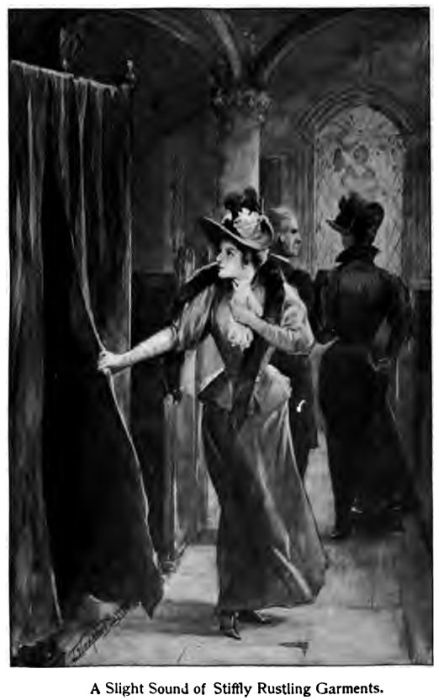
The biter was bitten!
“Mr Ferraby,” she exclaimed, clutching at his arm, “did you hear that?”
“What?” was the reply. “No, nothing; but then I am a little deaf.”
“What is it?” said Frances quickly.
Eira turned off the question with some laughing remark as to the difficulty of groping their way without misadventure; but the old vicar glanced at her curiously in the clearer light outside the porch.
“That child had better not be too confident about her own nerves,” he thought to himself. “She is looking quite pale.”
Chapter Eight.
When Things are at the Worst.
There was no waiting for tea this afternoon; on the contrary, when the three girls reached home, tea was waiting for them, and, beside the table, their mother, with unmistakable annoyance in her face.
“Why have you stayed out so late?” she questioned. “You know how it vexes your father; in fact, he has had tea and has gone back to the study.”
“I am very sorry, mamma,” said Frances. “It was thoughtless of me. We have been in the church with Mr Ferraby,” and she went on to relate the little incident of the lost brooch, and how cleverly Betty had found it, thinking that it would distract Lady Emma’s attention—in which hope she was not disappointed; so well did she succeed in gaining her mother’s interest that, under cover of the little narrative, Betty was able to steal from the room with the teapot and to obtain a fresh supply, without risk of tannin poisoning, unobserved.
Tea over, Betty and Eira disappeared, as was their habit, leaving Frances to entertain their mother, during what—in a very small country house, above all, one in which the family party is but seldom unbroken—is perhaps the dreariest hour of the twenty-four which make up a winter’s day and night.
Frances’ spirits rose on finding that her mother’s annoyance had been but passing. For half a minute she felt tempted to relate to her their conversation with the vicar, but on second thought she decided that it was better to avoid the always sore subject of the Craig-Morion inheritance. So she went on talking lightly and pleasantly on ordinary topics.
“I told you of Mrs Ramsay’s letter, did I not, mamma? She really seems to have fallen on her feet, and to be quite happy as a colonist’s wife.”
“Yes,” her mother agreed, with a little shudder, “though to me it is perfectly incomprehensible how any one, any lady—and Miss O’Hara was essentially a lady—can endure it.”
“She was so brave,” said Frances. “I often think, mamma, that I owe a great deal to her—or rather, to go to the root of it, to you, for choosing her so well.”
Her mother looked gratified. To do her justice, in spite of her cold reticence of manner, she was easily gratified, especially by any expression of appreciation from her eldest daughter.
“Her coming to us,” she said, “was really more good luck than good management on my part, and I do believe she was happier with us than she could have been in many other families. She knew that I understood her position—in a sense,” with a little sigh, “not unlike my own. We poor Irish always sympathise with each other, whatever our faults are. I often wish Miss O’Hara—no, I really must say Mrs Ramsay—could have stayed longer, for the sake of the two younger ones, except, of course, that had she not married it would have been too much of a sacrifice to expect of her—the staying on, I mean, at a still smaller salary.”
“Perhaps it was all for the best,” said Frances cheerfully, if tritely. “The teaching Betty and Eira was an immense interest to me; and I can never be thankful enough that I had it. Indeed, sometimes, mamma,”—she stopped, hesitating. “May I tell you something I have been thinking about?” she went on, for it seemed just then one of the occasions on which her mother and herself were drawn together in fuller sympathy than often happened.
“Of course,” replied Lady Emma. “Why need you hesitate? I am sure I am always ready to give attention to anything you want to say.”
“It is about Betty and Eira,” said Frances. “Sometimes it does seem to me that we look upon them still too much as children; that they haven’t enough interest—responsibility—I scarcely know what to call it, for they are not idle exactly.”
Lady Emma sighed.
“Oh, my dear Frances,” she said, “I don’t think there’s any use in your worrying yourself or me about that sort of thing. It is simply a bit of the whole—inevitable, as we are placed. At their age, of course, girls of our class are usually absorbed by amusement and society—too much so, I dare say, in many cases. But still there it is, and I hope I should have steered clear of letting them spend their lives in empty frivolity in other circumstances. I think my mother did so; for, of course, poor as we were, it was nothing to be compared with what my married life has made me acquainted with. Each of us had one or two seasons in London, and there was always a good deal going on at Castle Avone in the winter, and yet we were taught to be good housekeepers and to look after our poor people, and all that sort of thing.”
“Yes,” said Frances, “I know.” For in her more effusive moments her mother had sometimes entertained the three girls with reminiscences of the happy, careless Irish home-life, in which, to see her now, it was difficult to believe that poor Lady Emma Morion had ever had the heart or spirit to join. “Yes, I know,” Frances repeated, “it always sounds to me delightful. But it was not so much amusement that I was thinking about for Betty and Eira. That kind of thing is literally and practically out of our power. But I have been wondering if we couldn’t help them to have some more definite occupation or interest—they are both, though with such perfectly different temperaments, in danger of becoming very desultory, I fear—if not, what is even worse, discontented, and every one knows there is nothing so invigorating as feeling oneself of use to other people,” and with that she proceeded with great care and tact to unfold to her mother her simple little scheme in connection with the fisher-people at Scaling Harbour.
Lady Emma listened with attention, and not without interest, but with no brightening of expression or respondent gleam, such as had sprung out of Eira’s eyes when the plan was first mentioned. Not that Frances had expected this—even Betty, unselfish and tender-hearted as she was, had none of the latent enthusiasm which Frances often found so invigorating in her youngest sister, and which went far to balance her greater amount of self-will. And Betty had not welcomed the suggestion with any eagerness; so how could she expect anything of the kind from her mother, tired and in a sense worn out by the incessant small worries of her restricted home-life?
No, it was not to be wondered at that Lady Emma could not rise to any very great interest in philanthropic work.
“Poor mamma,” thought Frances, always ready to judge the deficiencies of others in the gentlest and most generous spirit, “she has reason enough to be absorbed by home things.” But she watched her mother’s face anxiously, nevertheless, hoping for at least conditional consent, and what furtherance of the scheme should be possible for her to promise.
And the disappointment was extreme when Lady Emma slowly shook her head.
“That’s been put into your mind by Mrs Ramsay’s writing to you on the subject,” she began, and immediately poor Frances’ hopes faded. “I can’t say that it’s the sort of thing I should at all care for you to do, though what ever I feel about it really does not signify, as your father would never allow it. Then there is the expense of it—everything of that kind costs money.”
“Very little, as I tried to explain,” said Frances; “some of the books I got for Mrs Ramsay were most inexpensive.”
“I dare say,” said her mother, touched a little, in spite of herself, at the girl’s evident disappointment. “Of course, if I had any money to spare, I should have no objection to your all acquiring a little good practical knowledge of the kind. We, my sisters and I, were by no means ignorant about household remedies. The poor people used to come to the Castle as a matter of course when they were at a loss what to do. But it was so different! The people at Scaling Harbour can send for a doctor. There is a parish doctor, I suppose?”
Frances said no more. She knew by experience that it was a mistake to enter into an argument which would only end by emphasising opposition. She had learnt for so long the philosophy of thankfulness for small mercies that she was even glad of the inferred permission to get the books, should the chance of so doing ever present itself—but for the present, yes, the outlook was dreary enough. Frances could not but own it to herself.
“It does seem hard,” she thought, “very hard, not even to be allowed to use what little talent one may have in some good, sensible direction.”
She was on her way to join her sisters when she made these reflections, though with no intention of repeating to them the conversation that had just passed. She found them in the dining-room, kneeling on the rug before the fire—at this hour of the day a safe resort, as Mr Morion, though nothing would have made him acknowledge it, indulged in a before-dinner nap, apt to be somewhat prolonged, between tea and dinner-time. Considerably to her surprise, even more to her relief, the two girls were talking eagerly, almost indeed excitedly, though their voices were low.
“Oh, Francie, I’m so glad you’ve come!” said Betty. “Do you know what Eira has been telling me? She didn’t want to frighten me, but I made her tell. Do you know she really did hear something in the church?” and she proceeded to repeat Eira’s strange experience of the sound of rustling garments in the big pew.
Frances was inclined to be sceptical; sensible people usually are when first confronted with anything of the kind. It was easily to be accounted for, she thought, considering that Mr Ferraby had just been telling that the squire’s pew was, by repute, the haunted spot.
“I dare say it was one of the stiff moreen curtains dropping back into its place again, after you had been pushing them aside,” she said. But Eira shook her head.
“No,” she maintained, with conviction in her voice, “it wasn’t the least like that. It was a slow, rising sort of sound, and it was the rustle of silk, of stiff silk—of that I am certain; at least, I mean to say I am certain that that was the impression produced on my senses.”
“You’d better write it out for the Psychical Society, it has made you so eloquent,” said Frances laughingly, though in the depths of her heart she was not a little impressed. Then came an exclamation from Betty, which, accustomed as they were to the startling suggestions she was apt to burst out with, for once really took their breath away.
“Frances,” she said, “I’ve thought of something. I’m getting nearly desperate for a change of some kind, and I feel as if I could be brave enough to do anything, especially if you and Eira will back me up. Supposing we three manage to get into the church some evening and wait for the ghost, and try to get something out of her? Would you have the nerve for it?” Her eyes gleamed with excitement, and her whole face was lighted up in a way that for the moment transformed it.
“Betty!” exclaimed her sisters, together, in amazement.
“You must be joking,” Frances added. “You, of all people, to dream of such a thing!”
“I am not joking,” Betty replied. “Just fancy, if we did find out anything. It would be worth while having one’s hair turned grey with fright to begin with.”
“Betty,” said Eira solemnly, “you don’t know what you’re talking about. If you had said such a thing this time yesterday, I should have felt quite different about it. But I can’t put into words the impression left upon me by what I heard—little as it seems. No, indeed,” and she shook her head, “I should never be able to attempt anything of the kind.”
“If you both work yourselves up about it so,” said Frances, “you will make me sorry that it has ever been alluded to. Don’t talk about it any more to-night, or neither of you will sleep. Promise me you won’t?”
“Very well,” Betty replied reluctantly, though her face fell as she gave the promise; for, although it only bound her to the avoidance of the subject for that evening, she felt pretty sure that there would be no chance of enlisting either of her sisters in her scheme. “And,” she thought to herself, “I’m afraid I should never have courage to try it alone, and without courage it would be no use, as everybody knows that unless you speak first to a ghost, he, or she, or it—why does ‘it’ seem so much more terrible?—will never speak to you!”
If it is true, as is often said, that happy times require no chronicler, it is certainly also the case in life that one has to traverse dreary, monotonous stretches of which there is literally nothing to record. This, certainly, was no new experience to the Morion sisters, but it is to be questioned if they had ever before been so painfully conscious of the almost unendurable dreariness of their general circumstances.
Nature, even, seemed maliciously inclined just now to make things worse for them. No winter sprightliness came to relieve the autumn gloom which, in this country, we have come to look upon as more or less inevitable. It was the dullest of dull weather; the very thought of Christmas seemed out of place.
“It is as if the sun had really said ‘good-bye’ to us for ever,” remarked Betty one day. “I am growing so stupefied that I think the only living creatures I now envy are dormice. Don’t you think, Eira, that Providence, if that isn’t irreverent, might have arranged for human beings to have a good long sleep of several months together, if, or when, they have absolutely nothing to do which it would in the least matter to themselves or any one else if they left undone?”
Eira’s only answer was a sigh, and even Frances, from the low chair where, for once in a way, she was sitting idle, said nothing. For poor Frances’ spirits were, at the present moment, really depressed by physical causes; she had had a wretched cold, which, though not very severe, had been sufficiently so to lower her vitality uncomfortably and disturb her usually well-balanced mental and moral condition.
She glanced at the window.
“Who would think it was Christmas week?” she said. “Actually, it comes next Friday, and this is Tuesday.”
“I had almost forgotten it,” said Eira. “What about those little things, Frances, that you said you had still to get in the village? Cards, wasn’t it?”
“Yes,” Frances replied, “and one or two trifles; literal trifles they’ll have to be this year, for the servants and our two or three poor people. Which of you will come with me this afternoon to help me to choose them?”
Eira looked at her doubtfully.
“Are you sure, Francie dear,” she said, “that you are fit to go out to-day? Your cold has pulled you down so.”
“Oh, it’s over now,” said Frances. “A walk will do me good. Are you coming too, Betty?”
“Would you mind if I didn’t?” said Betty; “for once I’ve got some sewing that I’m rather in a hurry about, but I will come to meet you—you won’t be very long?”
“As quick as possible, you may be sure,” replied Frances. “But, any way,” she added, with a smile, “if possibly we are later than I mean to be, we won’t expect to see you, Betty, as I know you’ve no love for being out alone when it’s getting dark.”
So they set off, and Betty, exhilarated a little by the work she hoped to finish in their absence, which had to do with her Christmas presents for her sisters, spent the first part of the afternoon cheerily enough, though by herself.
“I do feel brighter to-day somehow,” she thought, “and, after all, it’s terribly pagan not to cheer up at Christmas-time. Then, too, though it’s such a platitude, things are never so bad but they might be worse. Supposing Francie’s cold had turned into bronchitis, or something dreadful like that, and she had been very, very ill, how miserable we might have been just now! What would Eira and I do without her? Even if she married, how dreadfully dull it would be—but no, it wouldn’t, she would have a charming home of her own, and we would go and stay with her and—oh, yes! it would change everything. But I must remember I had made up my mind to give up building castles in the air!”
By four o’clock she was ready to go out to meet her sisters, her work completed and laid safely away. It was dusk, almost more than dusk, when she opened the gate and passed out into the road. But a little further on it grew lighter again, as here the trees were less thickly planted. Betty went into the park through the usual entrance, and, crossing through the shrubbery quickly, stood for a moment on a little knoll which commanded a view of the open drive from the lodge, by which her sisters would make their way.
It was light enough still to have perceived them, had they been within the park walls; but they were not to be seen.
“I don’t care to go all the way to the gates,” she said to herself. “I’m not in the humour for gossiping with the old Webbs. I’ll just walk up and down about here till I see them, or till I hear the gates clang. It is so very, very still to-day, and the ground feels harder, as if frost were coming; I could almost hear their steps before I saw them.”
But, though clear and still, it was not a bright evening. Walking up and down soon palls, and Betty stood still, half hesitating as to whether she should change her mind and go farther to meet the others.
Suddenly—most things were sudden with Betty—an idea struck her.
“I have a great mind,” she thought, “to run up to the church end of the Laurel Walk, and peep along it, just to see if possibly—oh! of course there could be nothing to see, or even to hear; but it would be rather fun to be able to tell Eira that I had done it. She couldn’t but think it brave of me, and I can certainly be back in time to meet them, before they’re half across.”
But she had reckoned without her host—that is to say, in ignorance of her own uncertainty as to the nearest way to the aforesaid Laurel Walk, for it was in a part of the grounds she seldom frequented, as it led straight from the church to a side-entrance of the big house, nowadays rarely used. Betty made two or three wrong détours—not to be wondered at, for, once in among the shrubs again, it was really almost dark; and when at last she came out at the point she was in search of she began to repent what now seemed to her foolhardiness, for the thickly bordered path in question did look from her end of its long, narrow course extremely eerie and forbidding.
“I can’t risk losing my way in those shrubberies again,” she thought. “I remember now that there is a side-path a little farther along, which will take me by a short cut out into the open again. I’ll run along as fast as I can till I come to it.”
But alas! for poor Betty. There was more than one side-path, and the first she tried, after pursuing it for some yards, only landed her more confusingly than ever in the thickest part of the plantation.
“This isn’t the right one,” she thought. “I must go back again, and rather than risk remaining hereabouts I’ll go straight to the church.”
Running just here was not an easy matter. The nervous fears which were beginning, in spite of herself, to overcome her, were once or twice dispersed for a moment by a bang against some obtruding tree or branch.
“Oh, how silly I have been!” thought Betty. “But here’s the opening into the Laurel Walk. Yes, I’d better make straight for the church.”
Something—she could not have said what—made her stop for a moment, as she turned into the path of uncanny reputation. She started—what was that? A rustle of some kind in the direction of the house, a falling branch or leaf, no doubt—all was so still! She turned towards the churchyard, walking fast, her heart beating quickly enough already, when—oh, horrors!—she heard all too distinctly the sound of a tread behind her. For half an instant she stopped in vain hope that she might have been mistaken.
It stopped.
“Shall I have strength to get out of this horrible place?” thought Betty, for she felt her limbs already all but failing her, from her now excessive trembling. But desperation gives courage. She hurried on again; again, too, the footsteps behind became audible.
“Oh,” thought Betty, “if it tries to overtake me, I shall die. If I can but keep up for half a minute more, I shall be at the little gate into the churchyard, if only—oh, if only it’s not padlocked!”
Chapter Nine.
They Begin to Mend.
Alas! for poor Betty, the little gate, her only hope of escape, was padlocked. At the first moment she scarcely realised this. She seized its upper bar by both hands and shook it violently, and for half a moment she fancied it yielded; all her faculties were confused by fright, and even the short distance over which she had run so fast had been enough to add materially to the overwhelming beating of her heart, the surging of blood into her ears, which all but deafened her.
But as her repeated shaking proved of no avail, and the tumult in her veins somewhat abated, terror notwithstanding, again, to her horror, she became conscious of the advancing footsteps behind. True, they did not sound like those of any one in pursuit; but what then?—ghosts didn’t run! The steady tread of the advancing presence was scarcely a source of consolation, till, frightened as she was, she began to perceive that the footsteps were firm and unfaltering—there was something commonplace and matter-of-fact about them, by no means ethereal or feeble, such as one would picture those of a ghostly visitor, especially the ghost of an old lady, who, in the many years during which she was supposed to have perambulated the Laurel Walk, was not likely to derive any increased energy from her fruitless peregrinations.
A sudden impulse of courage, though perhaps but the courage of desperation, flashed through Betty.
“I will face it,” she said to herself, “and know the worst.”
She turned. The advancing figure was now but a short distance from her, and—oh! thank Heaven—it was that of a man! Cold drops slowly gathered on her forehead in the intensity of her relief. At another time she might have been frightened at the very fact for which she was now so thankful. But all visions of tramps or other nefarious-minded intruders had been banished for the moment by the overpowering dread of the supernatural.
Her heart still beat uncomfortably, but she moved forward a few steps.
“This gate is locked,” she called out, trying to master the quaver in her voice. “Is that you, Webb?”—though before the name had passed her lips she could distinguish enough to make sure it was not that of the newcomer. “Have you got the key with you?”
There was no immediate reply. Then came the sound of hastening footsteps, and an exclamation of surprise.
“Is it—can it be Miss Morion?” were the first words, “or—”
“It is I, Betty Morion,” she replied mechanically, for her own astonishment was far greater than her questioner’s could have been, as regarded herself, when her eyes as well as her ears told her that he was none other than Mr Littlewood. “Oh!” she ejaculated, with a strange sense of weakness and relief, while her arms dropped to her side, “can it be you? I have been so terrified! I thought you were the ghost.”
“The ghost?” he repeated; “what ghost?” But then, seeing how really startled and upset the poor child was, he continued in a matter-of-fact tone: “No, no, I am no ghost, though dreadfully sorry to have frightened you. If I had had the least idea who it was, I would have called out before. But till a moment or two ago I was scarcely sure it was any one! Yes, I have the key of the padlock. I only arrived this afternoon, and I was going across to the vicarage to consult Mr Ferraby about a little matter. I used this short cut two or three times when I was here before. Allow me,” and he came forward to the gate, and in another moment it stood open and they passed through.
Betty, who was slowly recovering her wits by this time, glanced up half shyly at her companion.
“If I hadn’t been so frightened, I should have been still more astonished,” she said, “at seeing you. We thought—we were told that you had given up all idea of coming down here.”
“So we had,” he replied; “it’s rather a long story. I needn’t go into it all. My mother heard of another place which she thought would be better. I was awfully vexed when I went back to find it so. But it’s all right now. You will have us down here soon after Christmas. This time I have come with plenipotential powers to settle everything.”
Betty could scarcely believe her ears. What news for Frances and Eira! A real prospect of change and variety and break in their dull life at last, not to speak of the fascinating possibilities for the future which Eira and she had given up with such wistful regret.
“I—I am very glad,” she said timidly, and her words evidently pleased her hearer.
“It’s very good of you to say so,” he replied heartily. “On my side I hope you will find us pleasant neighbours. My sister—I’ve one still unmarried—is looking forward very much to coming here.”
“I do hope the weather will be better,” said Betty; “it has been—oh! so horrid since you were here, so dull and depressing.”
“It has been pretty bad all over the country, I fancy,” he replied. By this time they were at the gate of Fir Cottage. “I hope,” he continued, “that Lady Emma and Mr Morion are well, and that I may have the pleasure of seeing them in a few days. I shall probably stay on here now, as I have a visit to pay in the neighbourhood. I mean I shall not go all the way home again before my people come down. And—though I mustn’t detain you now—you will tell me the story of the ghost some day, I hope—and how you came to be wandering in search of it?”
“Oh!” cried Betty in alarm, “please don’t speak of it! Please,” imploringly, “don’t ever tell any one that I did. I should be so scolded. I was really going to meet my sisters, and it was very silly of me to go near the Laurel Walk.”
“Oh, well,” he said, “I won’t betray your confidence, but on your side you must promise to tell me all about it some day soon. Perhaps,”—with a slight touch of hesitation—“I may look in to-morrow afternoon on the chance of finding some of you at home.”
A sudden inspiration seized Betty.
“Is—is there possibly anything that you would like to ask papa about?” she said abruptly. “I am sure he would be pleased to—to be of use to you, if there were:” and to herself she added mentally, “It is the only chance of propitiating papa, I am sure, for Mr Littlewood to seem to seek his advice. He rarely has the pleasure, poor papa, of being applied to as if he were of any consequence, and he’d be gratified at it.”
Horace Littlewood was by no means devoid of tact and insight into the peculiarities of those with whom he had to do. His first blunder, as regarded the feelings of his new acquaintances, had also sharpened his perceptions with regard to them—he read between the lines, so to say, of Betty’s innocent appeal; indeed, it was not difficult to put two and two together in this case, for Mr Milne had descanted at some length on the idiosyncrasies of the master of Fir Cottage. And even kindly old Mr Ferraby had given more than one hint of the same nature, greatly influenced, no doubt, by his earnest wish that circumstances might arise to break the monotony of the three young lives in which both he and his wife felt so natural and sincere an interest. So Betty’s suggestion fell on prepared ground.
“How very kind of you to think of such a thing!” he said quickly. “Well, yes, if it were not troubling your father too much—for I know he is something of an invalid—I should be glad of his opinion on some little local matters. There is one of the keepers I don’t quite like the look of, and yet, as you can understand, I don’t want to begin by making myself disagreeable.”
“There is one, I know, that papa doesn’t like,” said Betty eagerly, “though he has been a long time about the place. Of course papa never shoots now, himself, though he used to be a very good shot. But it will be far the best for you to ask him yourself.”
And delighted with having obtained a definite message for her father, she held out her hand in farewell, and ran up the little drive to her own door, brimful of her unlooked-for news.
They were all in the drawing-room when she got in, tea half over, to say the least, and Betty’s heart went down in some apprehension of paternal or maternal reproof. But the first words that greeted her came from Frances, and, simple as they were, something in her tone carried immediate conviction to Betty that the news she was so eager to tell had already reached her sister’s ears.
“Where have you been? How did you manage to miss us?” Frances inquired. “We had quite a nice walk; it is really getting to feel more like Christmas.”
“The missing you was my fault,” said Betty. “When I first went out it was fairly light, and as I couldn’t see you in the park I strolled about a little, and came home another way. And—oh, papa, I mustn’t forget to give you a message I have for you. I met Mr Littlewood on my way in,” and as she named him she took care to avoid looking at her sisters, and to speak in a studiously matter-of-fact voice; “he has just arrived here again, and his people are taking the big house, after all. And he wants to talk over something, something private about the keepers, as to which he thought you would be so kind as to advise him if it will not be a trouble to you—though he said he knew that you are a good deal of an invalid.”
“What does he want?” said Mr Morion, and though his tone was superficially testy, it was easy for his family to discern his underlying gratification. “Is he going to write to me, or does he expect me to call on him, or what? Of course he couldn’t apply to any one who knows more about the place, and the idle lot of rascals with no one to look after them—it will be an uncommonly lucky thing for him to be forewarned.”
“Oh,” said Betty, “of course he didn’t expect you to go out of your way; he only seemed afraid of bothering you. He asked if he might call to-morrow afternoon on the chance of your being able to see him.”