Mrs Molesworth (continued 3)
Reading edition
“He must take the chance,” said Mr Morion, evidently by no means displeased. “If I’m well enough, I will see him; if not, he must wait till I am.”
“Is he to be here for some time?” asked Lady Emma. “And when do his people mean to come?”
“He said soon, I think,” Betty replied; “but no doubt he’ll tell papa all about it,” and then she turned her attention to the tea, which Frances, with her usual thoughtfulness, had managed to keep hot for her, though she nearly scalded herself in her eagerness to swallow it quickly, so as to leave the room on pretext of taking off her outdoor things, sure that she would at once be followed by Eira at least, if not by Frances.
And in this expectation she was not disappointed, for before she had had time to unbutton her boots the bedroom door was burst open, and in rushed Eira, followed more deliberately by Frances.
“Oh, Betty,” exclaimed the former, “what an afternoon! Just fancy you having met him, and we having heard it. The only pity is that neither of us had the pleasure of telling the other. But how well you managed to smooth down papa!”
“Eira, dear,” said Frances, “do be a little more careful how you speak. I don’t like the idea of managing or planning, though I was glad that Betty had a definite message, for of course, as the Littlewoods are coming, it would be most disagreeable, and a great loss to us all probably, if we were not on friendly terms with them.”
“Who told you?” asked Betty.
“The old Webbs, of course,” said Eira. “But, Betty, there’s some other news! Only Francie must tell you herself. You’ll scarcely be able to believe it.”
Betty turned to Frances, with intense curiosity in her eyes.
“What is it? What can it be?” she ejaculated.
For all reply Frances held out a large thin-looking envelope, from which she proceeded to extract, with great care and deliberation, a sheet or two of what is called “foreign” writing paper.
“This is,” she said at last, “a letter from Mrs Ramsay. Look, Betty,” and here she displayed a smaller slip of paper which told its own tale. “She has done it so thoughtfully,” Frances continued; “it is an English bank-note, you see. I wonder how she managed to get it out there in New Zealand? A bank-note for ten pounds, so there will be no trouble about cashing it, or anything of that sort! And, Betty, it is a Christmas present to be divided between us three! Isn’t it—oh! isn’t it good of her?”
Betty, as yet, had not gotten beyond a gasp. The full realisation of this fairy gift of fortune was still to come to her.
“You must read the letter,” went on Frances. “She doesn’t want us to tell papa and mamma; she is so terribly afraid of it vexing them. And, of course, it isn’t as if we were children now, I especially.”
“Of course not,” Eira chimed in.
“It is good of her, so good that I can scarcely believe it,” said Betty, who by this time had found her voice; “but, Francie, I don’t think you should divide it equally. I think you should keep five pounds, or four, any way, and Eira and I have three each. Think of how you gave us what you once made by your lace—and of the lace itself you have given us, which, after all, you might have sold.”
“No, no,” Frances replied. “Don’t talk such nonsense! Of course it must be in equal shares, though I’ll tell you what we might do, if you two agree to it. We might spend one pound on books and things for our ‘ambulance society,’” and she laughed, “which would leave three pounds each to do as we like with. And I certainly think you two should spend it on your clothes.”
“You too?” said Eira.
“Well, yes,” Frances agreed. “There are lots of little things, gloves and shoes, that we can scarcely do without if we are to see anything of the people at Craig-Morion—things that are matters of course for other girls.”
“Let us settle it that way,” said Betty. “If you promise, Francie, to spend your three pounds on yourself, on your own adornment, I don’t mind using the odd pound for—in a sense—charity: at least, for something which we hope will be of use to other people some day! It may bring us good luck!”
“Better than that, I hope,” said Frances softly. “A tenth is a nice proportion to spend not on ourselves!”
“Though I warn you,” said Betty again, “that I could never be of the least use in your medical or surgical lessons. I hate everything to do with illness or suffering!—unless you like to make a dummy of me for bandaging me up, and rolling sheets under me without my knowing it, and so on.”
The joke was of the mildest, but the new sensation of happy excitement made them all laugh. Then Eira got out paper and pencils, and began a series of abstruse and most interesting calculations as to how many pairs of gloves, including a possible pair each for evening wear, shoes, re-trimmings for hats, and additions to Frances’ lace for the one presentable evening dress possessed by each could, by dint of good management, be coaxed out of three pounds a head.
The result proved on the whole very satisfactory. The sisters even went the length of discussing what shops they should write to for the various treasures so unexpectedly placed within their reach.
“It is too late for to-night’s post,” said Eira, “and perhaps, after all, we had better wait till Christmas is over.”
“Yes,” said Betty, “let us each make a definite list of what we want, by—let us see—next Monday; and then, Francie, darling, you will write for us, won’t you? You would do it so much the best, and then you know the shops.”
For once upon a time, four or five years ago, the eldest sister had spent a never-to-be-forgotten fortnight in London, every detail of which was impressed upon her memory with an almost pathetic vividness.
The wonderful subject of Mrs Ramsay’s gift discussed and dismissed for the time being, Eira’s curiosity had to be satisfied as to all that had passed between Betty and Mr Littlewood, for by this time Frances had left the two younger ones by themselves.
Eira’s eyes grew round with excitement and sympathy, as Betty related the fright she had had.
“It was silly of you,” she said, when she had heard the whole, “really very silly of you to go to the Laurel Walk after dark, when you know how nervous you are. I don’t know what Frances will say when she hears about it.”
“She will say nothing,” said Betty, decidedly, “because she is not going to hear anything. You are not to tell her, Eira. I especially don’t want her to know; and, besides the delight of that money coming, I am very glad that it prevented her cross-questioning me any more about my walk.”
“But if Mr Littlewood calls to-morrow,” said Eira, “is he not pretty sure to talk about it? Or did you ask him not to?”
“Yes,” said Betty, “I did, and he promised he would not, on condition that I would tell him all about our great-grand-aunt’s ghost some time or other.”
“It’s all very queer,” said Eira meditatively. “Till the other day when Mr Ferraby told us about it, we really knew very little ourselves. But why do you specially not want Frances to know of your fright?”
“Because,” said Betty slowly, “I’ve got a curious feeling now that some day something else will happen, and I don’t want to be hedged in by promises to Frances, promises of not doing anything ‘foolhardy,’ as she would call it. Now that I have got over my fright, I feel as if I were braver than I was before! I think, if need were, I could almost make up my mind to speak to her, to the poor old thing, if I knew she were there!”
She fixed her dark eyes impressively on her sister as she spoke. But Eira shook her head.
“What are you doing that for?” asked Betty.
“Because,” replied Eira, “from what you say, from the feeling you have about it, I am more and more convinced that what I heard in the church was something real. You couldn’t possibly think of trying it again if you had felt what I did. I know I wouldn’t for worlds—not for a dozen Craig-Morions—risk meeting the ghost. And I am naturally both stronger and braver than you.”
Chapter Ten.
The Eyrie.
A tall girl was standing at the window of a drawing-room in a large house at the corner of a certain London square.
It was a good house, though with nothing very distinctive about it; one of the class that now, at the end of the nineteenth-century, people are beginning to look upon as somewhat old-fashioned. There was nothing “Queen Anne” about it, or its furniture; though, to make amends for this, it gave the impression of dignity and stateliness: perhaps, after all, the points that it is safest to aim at in a definitely town house, where light and height and air are the great desiderata. And there was nothing grim or gloomy in the colouring of the room, though a perhaps too studied avoidance of mere prettiness, which would, I fear, have been designated by its mistress as “tawdry frippery” or something analogous thereto.
And this was the home—since his father’s death, that is to say—of Horace Littlewood, who at this present moment was successfully accomplishing the afternoon call which, with Betty’s assistance, he had arranged to pay at Fir Cottage, primarily, of course, on the master of the house, whose favour he had gained to such an extent that, after a discussion of local matters in his study, his host had begged him to join the ladies of the family at tea in the drawing-room.
Madeleine Littlewood, his only unmarried sister, was the tall girl who stood gazing out into the gloom of the late winter afternoon. From the position of the house she could see more ways than one. In the square itself the lamps were now in process of being lighted. One by one she saw them twinkle out, though the result was but faint and dim in comparison with the brilliance of the adjoining street—a wide and important one, where the presence of shops made the contrast with the silent square the more striking.
The girl gave a little sigh.
“Dear me,” she said to herself, “how well I remember watching the lamplighter when we were children! We each used to try to catch sight of him first. There seemed something mysterious about him. I think it began the first winter we were ever in London; it was all so new, and then for so long we only came up in the summer, and everything was different. And now again it will be quite a new experience to be in the country for so long together in the winter. I wonder how we shall like it, and if mamma won’t find it dreadfully dull, after all.” She turned from the window as she spoke, partly because at that moment the front door bell rang sharply, and, as a rule, at this hour, she and her mother were supposed to be “at home.”
“I wonder who that is,” she thought.
She was not long left in doubt, for a minute later the door was thrown open, the butler announcing—“Mr Morion.”
“Bring the lamps,” she said, as she moved forward a little to greet the newcomer, “and let Mrs Littlewood know Mr Morion is here.”
“Horace is away, I suppose,” were the visitor’s first words.
“Yes,” she replied, “the day before yesterday; in such spirits too. He seems to be greatly taken with that eyrie of yours up in the North. He was quite disappointed when mamma gave up thought of it.”
“I hope you’ll all like it,” was the reply, though the tone was indifferent enough. “But you mustn’t blame me if you don’t.”
“Well, no!” she replied. “I can’t say that you painted it for us in very attractive colours; in fact, you have not praised it up at all.”
“I could scarcely have done so,” he said; “I know it so little. But hearing what you, or rather what your mother wanted—bracing northern air, with a touch of the sea, and to be left at peace, it would have been rather dog-in-the-manger of me not to suggest it.”
“Oh! it was very kind of you to think of us,” she replied, more cordially than she had yet spoken. “You must come down when we are there and learn to know your own home, or rather the home of your forefathers, for Horace tells me it was the cradle of your race. It is odd,” she went on, reflectively, “that you should never have cared to know it better.”
Something in her words or tone slightly jarred on the owner of Craig-Morion.
He pushed his chair back a little, and hesitated in his reply.
“A great many things seem odd to outsiders,” he said, dryly.
Madeleine smiled. Somehow, though she scarcely could have said why, for she had no real antipathy to her sister-in-law’s brother, she and Ryder Morion never “got on,” though underneath this surface antagonism each had for the other a solid foundation of respect and even liking.
“Yes,” she replied coolly, “it is not always the case that they see ‘the most of the game.’ I am afraid I am a born gossip,” she added, with a little laugh. “I like to know the ins and outs of my friends’ affairs. And oh, by-the-by, à propos of Craig-Morion, you have relations there of your own name, I hear! Do tell me something about them.”
“You could not apply in a worse quarter,” he said. “I know literally nothing of them, except that the father is a peculiar, and, as far as any personal experience of him goes, a very disagreeable man. There was an old—complication. He believes his grandfather should have inherited the place, instead of my people, though really, as it all happened ages before I was born, I don’t see why he visits it on me.”
“And does he?” inquired Madeleine.
“Well, yes, I fancy so. He was very rude to me once, at all events, and naturally that didn’t add to the attractions of Craig-Morion, for these people live almost on my own ground. But really,” he went on frankly, “there are no reasons for my avoidance of the place, except negative ones. I get into grooves, I fear, and feel lazy about things that I have not always done.”
There was silence for a moment or two, then Miss Littlewood spoke again.
“Horace has interested me in those relations of yours,” she said, “from what he has told me of them. Let me see, cousins, are they not? But not at all near? Or is the father a sort of great-uncle to you?”
“Oh, dear, no,” replied Mr Morion, speaking more briskly than he had yet done. “The father is actually of my own generation, though old enough almost to be my father. I have never counted the cousinship—it must be of the third or fourth degree by this time—in fact, as I said before, I have had little or nothing to do with them.”
Madeleine did not reply. A certain occult suspicion of unexpressed disapproval in her mind made itself felt by her companion. He glanced at her rapidly.
“They are very poor, from what Horace says,” she remarked.
“Are they?” Mr Morion answered indifferently. “I really can’t say. I don’t suppose they are rich, but there is no son, and little girls are easily educated.”
“Little girls!” repeated Madeleine, with a slight laugh. “Why, you are ignorant about them. The eldest certainly, if not the middle one, is as old as I, four or five and twenty.”
“Really?” he said, in the same tone. “I thought their father married late in life, and I am getting to an age when youth at any stage seems some distance from me. Poor girls! their life must be dull enough up there with that old bear. You may be able to show them some kindness, Madeleine. I know you are one of those people whose benevolence is somewhat abnormally developed.”
“I should like to be kind to them,” she said, simply, and Mr Morion believed her and admired her, as he often did. But yet something in her very downrightness had a slightly irritant effect upon him, and of this in return Madeleine was not unconscious.
“I wonder,” she thought to herself, “why Mr Morion and I always rub each other the wrong way? I never feel sure if he is talking in good faith or sarcastically. I suppose one must put down a good deal to the change in him caused by his wife’s death. And yet that is long ago now, and she was so very young, and the marriage only lasted a year or so. Still—” Her train of thought was interrupted by the door opening to admit her mother, who came forward with an expression of pleasure as her eyes fell on their visitor, for Mr Morion was decidedly a favourite of hers, and on the whole he preferred her society to that of her daughter, though by no means unaware of the latter’s great intellectual superiority.
Mrs Littlewood was still very pretty, though she by no means obtruded this fact, for her taste was good, and her tact excellent. As a rule, she was a very gentle woman, but a strong will underlay the gentleness, genuine though it was. She liked to be liked, and disliked making herself disagreeable, in consequence of which perhaps, when her disapproval or opposition was once aroused, it was not easily resisted.
“We have, of course, been talking about Craig-Morion,” said Madeleine, when she had provided her mother with tea. “But I can’t get much information about it.”
“I really know it so little,” repeated Mr Morion. “My chief feeling about it now is the hope that you will like it, and not be disappointed.”
“That is not likely,” said his hostess. “To begin with, I am one of those philosophical people who never expect perfection, and what we do want I think we are sure to find there: fresh, bracing air, quiet, and some amount of amusement for Horace.”
“I hope it won’t be too bracing for him,” said Mr Morion, “or too cold rather, though they do say that the first winter home from India one never feels the cold so much—still, there was his illness.”
For Horace Littlewood had but recently returned home from his regiment in the East, in consequence of an accident at polo, complicated by a sharp attack of fever, and at present his future career was, to some extent, in abeyance. His mother, whose favourite son he was, was most anxious for him to settle down in England, to which, however, the very fact of his dependence upon her—for Mrs Littlewood had been more or less of an heiress—caused him to hesitate in his consent. He hated the thought of an idle life, and was not, moreover, without experience of the love of power, but little suspected by many who imagined that they knew her well, latent in Mrs Littlewood.
“I think he will be all right,” Horace’s mother replied, “with us—Madeleine and me—to look after him, and he is very pleased with the shooting. Oh, yes, Mr Morion, I am sure we shall be quite satisfied, and, if you won’t take it on hearsay, the only thing to do will be for you to come down and judge for yourself.”
“Thank you very much,” he replied, adding, somewhat to Madeleine’s surprise, if not to that of her mother, “Yes, I think I should like to come down for a little while you are there.” For, as a rule, any invitation to Mr Morion was either politely put aside or accepted on such general terms as to leave but vague probability of his ever availing himself of it.
Mrs Littlewood glanced at him as she responded cordially that she was delighted to hear it. And across her own mind there flashed again a reviving hope—a hope which she had once cherished eagerly, though for some time past it had all but faded.
“Can it be,” she thought, “that, after all, he does care for Madeleine? They say that such things often begin by a kind of antagonism. And in many ways, au fond, they would be so well suited.”
Madeleine’s unspoken reflections ran in a very different direction.
“I wonder,” she said to herself, “if it has possibly struck him that he should know something of those poor relations of his. He is not the sort of man to shirk a duty, or even a piece of kindness, once he recognises it; but he has got into a curiously indifferent sort of way of looking at things. Lives and circumstances are oddly arranged. He is just the type of man who would have been quite happy and content, and probably more useful in his generation, had he had moderate means and been able to devote himself to study—as, indeed, I suppose he does; but then comes the question, Has he a right to do so, considering that he is a large landed proprietor, with so many, in a sense, dependent upon him?”
She looked at him, as the thoughts, as they had often done before, passed through her mind. He felt conscious of her involuntary scrutinising expression, and again he grew slightly irritated.
“That girl lives upon criticising other people,” he said to himself. “I wonder what she is inwardly arraigning me for now.”
To some extent he did her injustice; to a greater extent she was guilty of the same offence towards him. But there are people who, in obeying the command of concealing from the one hand the good deeds of the other, lose sight of the equally authoritative warning against hiding our light, humble as we may and should esteem it, “under a bushel.” And such people must often be misjudged.
“When do you think of going down?” Mr Morion went on. “I believe Horace mentioned a date, but I have forgotten it.”
“The end of next week probably,” replied Mrs Littlewood promptly, for she still kept the reins of family plans and arrangements well in her own grasp, her daughter being often in ignorance of them till the eve of their accomplishment. “Horace does not come south again—or at least only part of the way. He has an invitation to the Scoresbys for the next few days; then he will return to Craig-Morion and be there to welcome us—some of the servants go on Monday.”
“And how do you propose to employ—nowadays one is frightened to say ‘amuse’ to young women—yourself in my eyrie (I rather like the name), as you call it, Madeleine?” inquired their visitor. “Horace has his shooting, and a little hunting for a change if he thinks it worth a short journey for, and your mother quiet, and, I trust, the consciousness of invigoration. But what are you going to do?”
“Oh,” said she, “I have given no very special thought to it as yet. Of course we shall have books, as usual—by-the-by, have you a library there? And driving—we are taking down a little cart on purpose for me, and Horace is looking out for a stout pony, not afraid of hills. And—walking—I have a great idea that exploring a new country is better done on foot than any other way, and I love exploring. I expect I shall be able to make a guide-book for you of your unknown part of the country before we leave it.”
“But you cannot explore all by yourself,” said Mr Morion, “and I don’t suppose Horace will be always at your command.”
A very slight twinkle of amusement might have been discerned in Madeleine’s eyes by a close observer. She guessed that almost in spite of himself Mr Morion was leading back again to the rather delicate subject of his ignored relations, which seemed to have a kind of fascination for him. And she was not unwilling to play into his hands.
“Perhaps,” she replied, “once I have made acquaintance with them, your cousins may be good enough to accompany me in my rambles. Doubtless they know their own neighbourhood well.”
“Mr Morion’s cousins?” said her mother, before he had time to say anything. “Whom are you talking about, Madeleine? Oh, yes, I remember; Horace said something about a family of your own name, I think,” turning to her visitor, “who are living up near there. But they are scarcely within countable relationship, are they?”
“I’m afraid I have got into the way of thinking of them as not so, or rather of not thinking of them at all,” he replied. “But Madeleine has been obliging enough to remind me, at least tacitly so, that blood is thicker than water. Horace, too, has discovered that these cousins of mine, many times removed, are very poor, so on the whole I am beginning to feel rather guilty.”
Mrs Littlewood turned to her daughter with something in her manner which to Madeleine revealed a sense of annoyance, though her tone and words were gentle.
“My dear child,” she said, ignoring the latter part of Mr Morion’s speech, “you should be getting old enough by this time to realise that few of us have a mission for correcting other people. In very early youth such ideas are more excusable.”
Madeleine’s rather pale face flushed all over. She looked reproachfully at their guest.
“Mr Morion,” she exclaimed, “I really don’t think you are—” and then she stopped.
“Mamma,” with considerable appeal in her tone, “truly I don’t think that I was so impertinent as—as it sounds.”
Mr Morion felt sorry for her, and again vexed with himself.
“I was more than half joking,” he said apologetically. “Forgive me. I must be becoming more bearish than I realise. You will have to take me in hand, Mrs Littlewood.”
The elder woman smiled pleasantly.
“On my side,” she replied, “I fear I am growing very matter-of-fact in my old age. But no harm is done. Of course you have only to tell us if you wish us to make friends with the family in question. Did not, by-the-by, one of the Avone family marry a Mr Morion? The Avones, as every one knows, are terribly poor for their position, so it sounds as if it might be the same.”
“It is the same family,” answered Mr Morion. “The mother was Lady Emma Marne.”
Then the subject of the Fir Cottage people dropped, and was not again reverted to. Still the illusion to them had left its mark, in a decided amount of curiosity as regarded them, in Madeleine’s mind; some self-reproach and a touch of interest in Mr Morion’s; and a quick questioning, which darted across Mrs Littlewood’s, in connection with Horace’s name.
“I do hope,” she was already saying to herself, “that there are no pretty daughters among them. It would never do for Horace to entangle himself in any stupid way, when even Conrad, who had so much less reason to consider ways and means, made such a wise choice. But I need not be afraid. Horace is far too difficult to please to be attracted by any girl who has laboured under the enormous disadvantages of these poor Miss Morions.”
And she dismissed the unknown sisters from her mind, nor was the Fir Cottage family again alluded to, even between Madeleine and herself, when Mr Morion had taken his leave.
Madeleine thought about them, nevertheless, a good deal. She had extracted a certain amount of information from her brother—more than she had mentioned to the owner of Craig-Morion, more than she thought it expedient to retail to Mrs Littlewood. For while she thoroughly, and with reason, trusted her mother and greatly admired her, she had learnt by long experience that even with those nearest and dearest “least said is” not unfrequently “soonest mended.” There were directions of thought in which she felt intuitively that their two minds would not run together. For Madeleine, beneath her calm, occasionally, in appearance, almost too composed and self-contained manner, was at heart enthusiastic, eager, and impetuous. She knew this well, however; she was on her guard, and thus the very fact of her impressionable nature made her appear cold and even “stand-off,” while Mrs Littlewood’s though not unreal or insincere of its kind, often misled others into stigmatising the daughter as hard and dictatorial—“laying down the law” to the mother, with whom, in point of fact, she very rarely ventured to disagree, whose slightest wish or opinion was weighted for her with authority, but rarely, nowadays, existent in such a relationship.
Horace had not said much, after all. He had not seemed inclined to discuss the family whose acquaintance he had made the first time he went down to Craig Bay with “Old Milne.” And this of itself struck Madeleine as unlike him, and prepared the ground with her for greater curiosity concerning them. She had satisfied herself that one, at least, of the sisters was “pretty”—“very pretty, indeed, if she were decently dressed,” but beyond that, and replying to some of her questions as to the manner of living, etc, of the Fir Cottage Morions, she had found her brother more reticent than usual. Of this, the principal reason had been his own annoyance with himself for his clumsy blunder, as he styled it, to which he could not but attribute the “not at home” with which he had been met the second time he called, and which somehow he had not felt inclined to relate to his sister.
Had it been possible for Madeleine to have seen him this evening, she would have found his mood greatly changed, for, thanks to Betty’s inspiration, and the good tact of Frances and her mother, this third bearding of the lion in his den was crowned with success.
Horace left the cottage after a somewhat prolonged visit in the best of spirits, full of projects for introducing his sister and his new friends to each other—inclined, as he had never before been in his life, to see everything through very rosy-coloured spectacles.
The next few days passed monotonously enough for Madeleine. She missed her brother; the weather was wretchedly dull and gloomy; there was no interest in looking up such friends as were winter residents in London, and likely to be returning there after spending Christmas in the country, seeing that she herself was on the verge of leaving; there was no interesting shopping to do, as Craig-Morion was not likely to make great demands on her wardrobe. In short, everything seemed very flat and unexciting: an impression increased by the more or less dismantled aspect of the house in preparation for a long absence. Nothing seemed worth while, and Madeleine felt half ashamed of herself.
It was with feelings very much the reverse of those of one anticipating an “exile”—as some of their friends had chosen to call their voluntary banishment to an out-of-the-way part of the country—that both Madeleine and her mother found themselves at last fairly started on their journey.
“I don’t know how it is,” said the former, when they were comfortably seated in the railway carriage, “that I have never felt better pleased to leave London than just now; not even after a hot summer. Don’t you feel a little the same, mamma? Somehow I fancy you do.”
“Yes,” Mrs Littlewood replied, “I am glad to get away. I have a sort of longing to feel myself farther north, and, above all, free to do just as we like, and to see no one if we are not inclined for it. I suppose Conrad and Elizabeth will be coming to us, but not just yet, I hope. They are sure to prefer waiting till the days are a little longer,” and she turned to the book with which she was provided, with an evident and wise determination not to tire herself by talking in the train.
Madeleine did not regret this, for she was not inclined to talk either. After a certain point on the journey, the country was new to her, and therefore interesting, and she regretted the early falling darkness which soon hid the outside world from view.
It was quite dark when they reached Craig Bay, quite dark and very cold when they stepped out on to the platform, where her brother had no difficulty in at once distinguishing them, as they were almost the only arrivals.
It was cheering to hear his voice in welcome.
“Come on quickly,” he said, as he gave his arm to his mother, “the carriage is waiting for you, and I have made everything as comfortable as I could. You must expect a tiresome bit of hill, though at first the road is on the level; it takes more than half an hour to get to the house.”
“I am glad of it,” said Madeleine; “I want to forget everything about trains and stations, and everything civilised and modern.”
Horace laughed.
“I don’t think the absence of civilisation will be as pleasant as you think,” he said; “but it isn’t as bad as that; it is really a place where comfort and antiquity might be excellently blended.”
And when at last they turned in at the lodge gates, and a few minutes later found themselves in front of the somewhat rugged granite steps leading up to the door, and then, in another moment, inside the lofty arched hall, of which the walls were hung round with trophies of the chase interspersed with old—and, it must be confessed, rusty—armour, a great wood fire burning in the vast stone hearth, an indescribable feeling of isolation and yet homelikeness pervading all—Madeleine drew a deep breath of satisfaction.
“It is delightful,” she said, turning to her brother. “I am sure we are going to love being here.”
Chapter Eleven.
First Impressions.
Breakfast-time the next morning found the brother and sister at table by themselves, for Mrs Littlewood, of late, did not make her appearance much before noon.
“How did you sleep, Madeleine?” asked Horace. “Nothing disturbed you, I hope?”
“Why do you ask? I am not given to bad nights. I slept very well, except that I think one never sleeps quite as soundly the first night in a new place,” she replied.
“H’m-m!” murmured her brother, but there was a good deal of meaning in the inarticulate sound, and a decidedly mischievous sparkle in his eyes when she again addressed him and he was obliged to look up.
“Horace,” she said, “you have some reason or motive for asking how I slept! You must tell it to me. Are you only wanting to tease, or is there something that you’ve kept to yourself about this house? Is it supposed to be haunted?”
Mr Littlewood’s face put on an expression of preternatural gravity, but Madeleine knew him too well to be deceived by this.
“Don’t be silly,” she said. “I believe you are trying to invent something just to frighten me. I know your little ways of old. If there had been—” she hesitated.
“What?” asked her brother.
“I was going to say anything real,” she replied: “if there had been anything real of the kind, you would not have let us take the house, or rather Ryder Morion would not have done so without warning us.”
“Perhaps he doesn’t know,” said Horace mysteriously, with a shake of his head which expressed more than his words.
“Tell me at least what you know,” rejoined his sister, rather impatiently.
“Will you first promise me,” he replied, really in earnest, “that you won’t mention it to mother? Though she is so strong-minded, I honestly don’t think she’d like it, not having been well lately.”
Madeleine nodded in acquiescence.
“I promise,” she replied; “but do be quick.”
“Well,” he said, “to tell you the truth, up to now I know very little, but I mean to find out more, and I hope you will help me. It has something to do with an old story of the place being left away from the other branch of the family, to whom it had been promised by an ancestress. She, as far as I can make out, is credited with conscientious remorse for her misdeeds or non-deeds, and walks about a certain part of the grounds in the stupid way that ghosts always do. There, now, that is really all I know; but I am not inventing.” And Madeleine felt satisfied that he was speaking in good faith, as his story tallied with the allusions made by Mr Morion, that last time she had seen him in London, to some ancient family complications. “I know you’ve good nerves,” Horace went on, “and it may add a spice of excitement to our time here!”
“But how are we to find out more?” asked Madeleine. “It would never do to be cross-questioning the people about; that might annoy Ryder Morion seriously. Who told you what you do know?”
“Two or three people,” he replied. “The old vicar knows the whole story, I strongly suspect, but I couldn’t get much out of him. The best people to apply to, but we must do it carefully, are the Miss Morions—the other Morions, you know, at the cottage over there,” inclining his head as he spoke in the direction alluded to.
Madeleine’s interest increased.
“Would they not mind talking about it?” she asked. “Family ghosts are ticklish subjects sometimes, and in this case there really is some sore feeling still existent, it appears.”
Horace looked up in surprise.
“How do you know that?” he inquired.
And then she told him what had passed between her and Mr Morion on the subject.
“The daughters, at least one of them,” said her brother, “I know would not mind talking about it to us privately. She has half promised to tell me all she knows; but I certainly would be very sorry to allude to it to the father, or to their mother, for that matter. They are both so peculiar, though quite different.”
“Well, I hope we shall get to know the girls,” replied Madeleine, “whatever the parents are.”
“That reminds me,” said Horace, in a would-be offhand tone, “I was to tell you that Lady Emma hopes to call on my mother. Will you tell her so? She surely won’t mind having to know these people, the only ones really in the place that there would be any question of knowing. Of course there are others farther off, at the other side of the county, or, indeed, some in the next county, nearer at hand, whom we know already, the Thurles and the Laughtons—the Scoresbys are almost too far off to count—and these we can arrange to see or not, as we like, later on.”
Madeleine’s expression was somewhat dubious.
“Of course, when Lady Emma comes, mamma must see her, and return the call,” she said; “but there, as far as mamma is concerned, the acquaintance would probably end. She really does want—mamma, I mean—to be perfectly quiet here. Anything more than that, Horace, I can scarcely answer for.” And she watched with some curiosity the effect of her words.
A shade of disappointment crossed his face—as to that there was no doubt—but he threw it off quickly.
“I don’t see that that matters,” he said. “The old bear and his wife—a very submissive wife, too, I should imagine her—wouldn’t interest my mother, or be interested themselves. I believe they ask nothing more than to be left alone. But as regards the daughters—to tell you the truth, Maddie, I can’t help being very sorry for them, and it would really be kind of you to cheer them up a little.”
“I have no objection,” said Madeleine cordially; “on the contrary, it would be a pleasure and interest to me to make friends if—you are sure you are not reckoning without your host, Horace?—if—I was going to say—these girls, on their side, would care about it.”
“I am sure they would,” said her brother.
“I don’t know,” Madeleine went on. “The way they have lived may make them extra shy—proud—I don’t know what to call it!—ungetatable. But I promise you to do my best, and that carefully in every way. I don’t want mamma to begin warning me against flying into sudden friendships!—at my age it is absurd; but then, mamma never remembers that I am no longer in my first youth.”
As she said the words, something in her mind seemed to contradict them, and gradually she recalled what gave her this feeling. It was the remembrance of her mother’s remark the afternoon that Mr Morion had called, as to her no longer having the excuse of “early youth” for thinking she could set other people to rights.
“I wonder what made her say that?” thought Madeleine to herself, but Horace’s next words put the subject out of her head.
“I don’t think you need anticipate any holding back on their side,” he said. “Certainly not on the part of—two of them. The youngest is almost childlike, and the eldest, oh! she is really charming and out of the common. I am sure you will take to her.”
“And why do you except the middle one?” asked Madeleine.
“I don’t feel as if I could judge of her,” he said indifferently. “She seems a changeable sort of girl.”
“And they are all pretty, more or less, I think you said?” continued his sister.
“I don’t know that I did say so, though—well, yes, I suppose they are. But Miss Morion is the sort of person whose looks you forget in what you feel she must be in herself, and the others—they really are so atrociously dressed!” he broke off rather ruefully, and yet with a little laugh. “You won’t be hypercritical, Maddie, but I don’t know about my mother.”
Madeleine was standing looking out of the window by this time. For a midwinter day it bade fair to be a very pleasant one. The sky was clear, though the lights were thin, and in the air there was a decided touch of frost.
“I am glad to be here at last,” she said. “You are not doing anything to-day, I hope, Horace—shooting or anything? For I want you to show me all over the place.”
“I’ve kept free on purpose for that,” he answered. “Shall we go out at once?”
“No,” replied Madeleine, with some regret in her tone, “I don’t think that would quite do. Mamma may want me. I had better wait until after luncheon, except for a mere stroll near the house. And in the first place I want to see something of the house itself. Is this the only dining-room?” glancing around her as she spoke.
“Yes,” Horace answered; “none of the rooms are very large, except the hall and the library. That is really the most curious room. I can’t make it out: it seems disproportionately big, and perfectly filled with books, the most modern of which must be fifty years old, I should say. Lots of rubbish among them, no doubt, and probably some of value if we had an expert to look them over.”
“Long ago,” said Madeleine, “no books were considered rubbish. They cost too much, and the bindings were so heavy that they took up much more room. Let us go and have a look at them. Just ring the bell to let the servants know that they can come in.”
Horace led the way through a little anteroom, on the opposite side of which high doors led into the two drawing-rooms—all the rooms at Craig-Morion were lofty—down a short passage leading into a longer and wider one, then up two or three shallow steps to a sort of little dais or landing railed round with heavily carved balusters. Then, with a certain air of proprietorship, he threw open the heavy oaken door facing them, and stood back for his sister to pass in.
She gave a little cry of surprise.
“Yes,” she said, “this is quite a unique room. And oh! what a musty smell, Horace!”
The mustiness was quickly accounted for. Up to a certain height the walls were lined with books, except at one end, where two long painted windows looked out on to a dark and gloomy path among the shrubberies. The room, even in full daylight, would have been almost dark had these windows been its only source of illumination. But this was not the case, for the walls rose to the full height of that part of the house, and the arched roof was completed by a glazed dome, through which some rays of wintry sunshine lighted up the dusty old volumes into an almost uniform tint of orange-brown which would have delighted the eyes of many a painter.
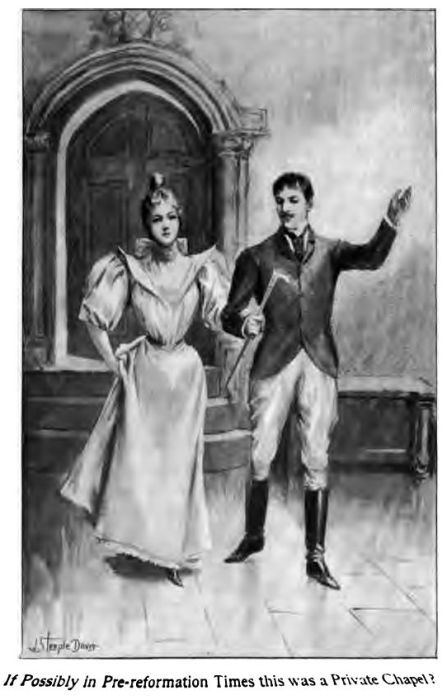
“I wonder,” continued Madeleine, “if possibly in old pre-Reformation times this was a private chapel?”
“How clever of you to think of it!” said Horace. “It never struck me before, but it may very well have been so, I should say, though I am no archaeologist. We will suggest it to Ryder when he comes down. That gloomy walk,” and he crossed to one of the windows as he spoke, “is the short cut through the grounds to the church, which stands just outside the park wall. So the chaplain, if chaplain there was, must have found it convenient, as you see there is a door in this window.”
He opened it, and Madeleine looked over his shoulder at a short flight of broken, moss-grown steps leading to the ground.
“What a gloomy place!” she said, with a little shiver, caused partly no doubt by the sharp air which met her, “and how long and straight the walk is! I should not like, Horace, I confess, to pace up and down here in the twilight, and scarcely, indeed, at any time of the day—it can never be anything but twilight here!”
“They call it the ‘Laurel Walk,’” said her brother. “It is—” but he stopped short, and Madeleine, who had retreated inside the room again, did not notice his breaking off.
“It’s too gloomy here,” she said. “Why isn’t there a fire? A huge fire would mend matters a little and be good for the books too, though the room does not seem damp, I must say.”
“No,” Horace replied, “the whole place is wonderfully dry. You see, it has splendid natural drainage from standing so high. There is a fire once a week or so, I believe, but we can have one every day if you like, though I fear the books, if there are any valuable ones, are gone past redemption with the long neglect.”
“I should like to get to the brighter part of the house—the other side,” said Madeleine, moving towards the door by which they had entered; but, to her surprise, Horace crossed the room to the other corner—that farthest from the windows, and appeared to be fumbling among the book-shelves.
“Oh come,” she said impatiently, “it is so cold, and I don’t want my first impression of the house to be a gloomy one.”
“Nor do I,” he answered; and then, glancing in his direction, Madeleine was almost startled by a sudden glow of light and warmth behind him. “You don’t call this gloomy,” he proceeded, and Madeleine, hastening forward, saw that his apparent fumbling among the books had in reality been the feeling for a spring, by which to open a door, concealed by rows of “dummy” volumes, which now stood wide open, giving access to a cosy and inviting looking sanctum or smaller library, where a splendid fire was burning, and where, moreover—for this was at an angle of the building—the morning sun penetrated brightly, through windows facing east and south.
“Oh, how charming!” cried Madeleine, hurrying over to the fireplace. “Is this where you have established yourself, Horace?”
“Yes,” he replied, “hence my intimate acquaintance with the library, and the short cut down the Laurel Walk. This is one of the jolliest rooms in the house, and you see I’ve got all my own belongings here already. And you don’t know all its attractions yet! There is a hidden door in the corner here too, opening on to a private staircase up to a couple of capital rooms—bedroom and dressing-room—which I’ve taken possession of. They communicate as well with the main part of the house, where all your rooms are. But it is jolly, isn’t it? I don’t believe Ryder has any idea how comfortable this old place might be.”
He seemed as pleased as any school-boy with his new quarters; and Madeleine, on her side, was girl enough to enter into the little excitement in connection with their temporary home with equal zest. She insisted on following her brother up the little staircase to see his other rooms, then down passages and across landings to the main staircase, down which they came again to visit the drawing-rooms. Of these there were two, on the whole the most attractive rooms on the ground floor, for they had windows on both sides, and though their furniture was somewhat scanty and quaint, and there was naturally an air of unusedness about them, Madeleine’s quick eye soon decided that with a little rearrangement, some high-growing plants and ferns here and there, books, photographs, and so on, it would be easy to give them a homelike and gracious aspect.
“I thought,” said Horace, “that mother could probably use the smaller one as a sort of boudoir, and if you want a den of your own, Maddie, there’s rather a nice little corner room close to where you are, upstairs. A plainly furnished little place, as you prefer, I know, for your various avocations, which don’t always find favour in the maternal eye.”
Madeleine laughed.
“Show it to me,” she said. And upstairs again they went. The little room was greatly approved of. “Yes,” agreed Madeleine, “it is just what I like. Not so very little, after all—large enough to have a friend or two at tea privately. You must hunt me up a few more chairs and a sofa from somewhere. Yes, this room is a capital idea. I can bring in any botanical spoils, or cut out my poor work, without fear of annoying mamma by my untidiness.”
“You are very untidy, you know,” said Horace, who had all a soldier’s precision and orderliness. “I don’t mean in your dress, of course, but I do sometimes sympathise with mother.”
“Oh, don’t preach, Horace!” answered his sister, for her untidiness was an old story. “By-the-by, are there any poor people about here?”
“Scarcely any in the place itself,” said Horace. “But there is a queer fishing village not far off, the old vicar tells me, full of attraction for the artistic as well as the philanthropic. The people keep very much to themselves, and are delightfully picturesque, awfully dirty, and generally barbaric.”
“Why doesn’t he look after them, then?” said Madeleine rather sharply.
“Poor old chap,” answered Horace, “he can’t. He would if he could, even though it isn’t his business. But he has plenty of work in his own parish, even though there’s very little actual poverty.”
“Of course,” said Madeleine, “the cure of souls is the same responsibility whether it concerns the well-to-do or the poor. What is the name of the fishing village?”
“Scaling Harbour. The people are supposed to be partly of Spanish descent,” said her brother, “and they look like it.”
“Is there no church, then, or mission-room, or anything?” inquired Madeleine.
Horace shook his head.
“Certainly no church; and mission-rooms don’t seem to have found their way up here. The parson at Craig Bay should look after it, I suppose! He is certainly not overburdened with money, though.”
“And whom does the place belong to?” asked his sister.
“Partly to Ryder,” Horace replied, as if rather tired of the subject. “You can tackle him about it—you generally have a crow of some kind or other to pick with him, it seems to me.”
Madeleine flushed a little.
“Don’t say that,” she began. “To tell you the truth, I fear I have already annoyed him rather about his ‘absenteeism’ as regards this place.”
Horace laughed.
“Upon my word, Maddie,” he said, “no one can accuse you of not having the courage of your opinions. It isn’t everybody—not I, I confess, for one—who would venture to pull up Ryder Morion for anything he does or does not do, or choose to do.”
Madeleine still looked annoyed.
“I think it must run in the family,” she said, in a tone of irritation.
“What—and what family?” inquired her brother.
“Bearishness,” she replied curtly—“bearishness in the Morion family, of course.” Horace shrugged his shoulders.
They were crossing the landing to go downstairs again; but at that moment Mrs Littlewood’s maid met them with a request that Madeleine would go to her mother’s room for a moment. So, telling her brother that she would join him in a few minutes for their projected stroll round the house, she left him, to do as she was asked.
Chapter Twelve.
Lady Emma “Gets it Over.”
A day or two passed. The weather fulfilled its amiable promises to the Littlewoods on their first arrival, and was all that could be desired, excepting that the cold increased.
But then, as Mrs Littlewood observed with warmth, what else could be expected up in the north, and in the month of January? For her part she enjoyed the bracing air—it was what she had wanted. Nor did Madeleine object to it: she drove with her mother in an open carriage in the afternoon, Mrs Littlewood well enveloped in furs, and she went long walks with her brother in the morning, so that before she had slept three or four nights at Craig-Morion she had already acquired some knowledge of the locality.
There came a day, however—the Friday after their arrival—when the forbidding aspect of the sky made Mrs Littlewood decide that it would be scarcely prudent to risk the possibilities of the heavy clouds, and more advisable to remain indoors. Her daughter received this ultimatum with philosophy, even though Horace was off on his own account, and not available for a walk or drive. The pony had not yet been found, though several had been interviewed. But this morning’s post had brought news of one which, according to the description, bade fair to unite all desirable qualifications, and Madeleine’s brother had gone at once—a journey of some little distance—to judge for himself as to its suitability.
Luncheon over, Madeleine, wrapping herself up warmly, started for a brisk walk to the village, which had not yet begun to pall upon her by its familiarity. Indeed, the shops were so far a source of amusement to her, combining, as most of them did, during the winter, a little of everything, including some things rarely to be found except in such “olla podrida.”
“It reminds me,” she said to herself, “of that queer little hamlet on the Devon coast, where Horace and I were sent for change of air after whooping-cough. I remember the wonderful little work-boxes, or button-boxes, with landscapes on the lid, which we considered perfect works of art, and which I am certain one could never have found in any London shops at any date. Horace and I joined together to get one for mamma, and I believe she has it still.”
She entered the shop in front of whose window she was standing, and made some trifling purchases—two or three baskets of different sizes and of rather quaint construction, which would be “just the thing,” she thought, for the treasures—botanical and others—which, even in midwinter, she seldom came home from a ramble in the country without. Then she took a fancy for some wonderful, many-coloured check material, which she caught sight of on a shelf: it was of the old-fashioned “gingham” make, and struck Madeleine as a pleasing variety for the aprons she contributed to her needlework guild. And she was much amused by finding, when she came to give her name and address for sending the somewhat bulky parcel, that doing so was quite a work of supererogation, as the well-pleased shop-woman intercepted the words of direction by a deferential, “Oh, yes, ma’am, quite right—Miss Littlewood, at the big house!”
Madeleine walked home briskly, but she had made a détour on her way to the village, and it was now later than she had imagined. As she paused in the hall on her return, intending merely to divest herself of her outermost wraps before glancing in to see if her mother was in the drawing-room, a door leading to the offices opened, and a footman—who, to tell the truth, had been posted by his superior in office, to look out for the young lady’s return, in order to pave the way for a possibly called-for mediation with his mistress—appeared, of whom she made the inquiry.
“Yes, ma’am,” was the reply. “Mrs Littlewood is in the inner drawing-room, and,” with the air of announcing an event which made Madeleine realise how far they were from London, “there are visitors, ma’am.”
“Who are they?” she inquired, with some apprehension of her mother’s displeasure.
“Lady Emma Morion and two young ladies. Bateson thought it right to say ‘at home,’ though we had no orders, owing to the name, ma’am.” But there evidently was some misgiving in his mind, not unshared by Madeleine.
“It is unlucky,” she thought, “that I should have gone out this afternoon, for I don’t want mamma to be prejudiced against these Morions, for the daughters’ sakes. Who could have thought of them calling on such a threatening day? I must do my best.” And without further delay she passed through the larger drawing-room into the smaller one, where her mother usually sat.
It was not till long afterwards—an “afterwards” bringing with it relations which allowed the tragic element to melt into the comic, on looking back to that afternoon’s history—that Madeleine fully knew the relief her appearance brought with it to the very unhappy-looking group in the boudoir.
“You came in like a ray of sunshine or a breath of fresh, sweet air,” she was told in that hereafter-to-come “afterwards.”
She meant to do her best, and she did it, and she was not one to do such things by halves. As far as “good-will” went Frances Morion was certainly not behind her; but then Frances was at a disadvantage from her want of social experience—more at a disadvantage than the quiet calm of her manner might have led one to suppose, as this only made her appear somewhat impassive and phlegmatic. Madeleine, on the contrary, forearmed by a certain amount of knowledge of the ground, discarded for once the self-containedness which was usual to her, and which she had learned to adopt as a cloak for her real impulsiveness. Nothing could have been easier, kindlier, more girlish even, without a touch of self-assertion, than her greeting of the three strangers—Lady Emma stiffly established on one end of her hostess’ sofa, her eldest daughter a chair or two off, cudgelling her brains for some observations which might possibly draw forth a spark of kin-making “nature” in the direction of sympathy from Mrs Littlewood; Betty seated at a much greater distance, dreamily gazing out into the wintry garden, apparently indifferent, in reality throbbing with disappointment for Frances’ sake at “Mr Littlewood’s” non-appearance, and at the well-bred unapproachableness of the two seniors of the party.
She had begged to be allowed to come, and Lady Emma had given in, little suspecting the girl’s real motive of hoping, by some innocent tact and diplomacy, to help the position, perhaps to “throw them together,” as Eira expressed it, seeing that it was almost a case of “three being no company.”
“For mamma and Mrs Littlewood are sure to talk,” said Eira, “and then Miss Littlewood would absorb Frances, and Frances in her usual dreadfully unselfish way would think herself bound to talk only to her, and he would feel himself snubbed very likely.”
And, alas! “mamma and Mrs Littlewood” found nothing to say; and for once even Frances seemed discomfited, and no “he” appeared, and his sister evidently did not want to make friends. For her mother forgot to mention—or refrained from doing so—that Madeleine was out.
Altogether it was a terrible fiasco, and Betty’s one great longing was to get out, and rush home, and burst into tears in the arms of the sympathetic Eira, when—the door opened, and, with it, light and life and “sugar and spice and all things nice” seemed almost immediately to pervade the atmosphere.
Madeleine’s first greeting—to Lady Emma, of course—had just that touch of deference which gratified the elder woman. Mrs Littlewood, who, to give her her due, was feeling far more conscious of being bored and stupid herself—for to tell the truth she had been more than half asleep when the visitors were announced—than of any positive irritation at them, gave an inaudible sigh of relief. Frances, when the newcomer turned to her with something in her eyes which said tacitly, “I hope you will like me, I mean to like you,” was won on the spot. Only Betty’s half-childish gravity, her big dark eyes fixing themselves on Madeleine with dubious inquiry—only Betty struck Madeleine as somewhat baffling and unresponsive. The thought darted quickly through her mind:
“I wonder if this is the youngest of the or the middle one, whom Horace spoke of as a ‘changeable sort of girl not easy to understand.’ I fancy she must be that one. She is pretty, very pretty, but the other one is almost beautiful.”
We all know how much more quickly thoughts pass through our minds than it takes to relate them. The sound of the door opening seemed still in the visitors’ ears as Madeleine seated herself in the best position for talking to Frances, and at the same time keeping an alert though dutiful eye on the two mammas.
“I am so sorry I was out when you came,” she began. “I wish I had happened to meet you in the park; I should have turned back, as I had really nothing to do of the least consequence.”
“I am very glad you have come in,” said Frances, in a tone that gave the commonplace words real meaning. “But we have only been here a few minutes.”
“What a gloomy day it is!” resumed Madeleine. “My mother was afraid of going out, though really, mamma,” she went on, turning to her, “it is scarcely colder than yesterday.”
“Do you dread the cold much?” inquired Lady Emma. “I did when we first came here, but once I got used to it a little I found it really less insidious than the damp of the winters of my own old home.”
Mrs Littlewood brightened up.
“In Ireland that was, I believe?” she inquired, with more interest than she had yet shown. “How one’s life changes! I was brought up principally abroad, a good deal in hot climates, as my father had several diplomatic appointments in South America and elsewhere, and yet now I prefer a cold, or at least a bracing, climate to any other.”
“So do I,” said Lady Emma, “though it necessitates some care. I make a rule of never staying out—” But Madeleine listened to no more—the good ladies were sufficiently launched on their way probably to as much intimacy as they would ever achieve. This reflection, however, did not trouble Mrs Littlewood’s daughter.
“It is not the least necessary,” she thought, “for them to see very much of each other. Neither wishes it, I am sure, and it will do just as well, or better, to be just on friendly terms, and leave me free to see as much as I can of the daughters, at least of this eldest one. I quite agree with Horace about her,” and she turned with a pleasant feeling of relief again to Frances, feeling at liberty now to give to her her whole attention, not troubling herself specially about the younger girl with the dreamy, just now almost gloomy eyes, who still sat gazing out of the window, as if absorbed in the wintry scene before her.
The next few minutes passed rapidly for the two elder girls. Something in Frances’ quiet eyes told Madeleine that the attraction she felt was reciprocated, and not likely to be effervescent, and already they touched upon several topics which promised to call forth their common sympathy—like glades in a forest clearing, gently lighted by the sunshine, inviting and promising further charm in exploring at one’s leisure.
Then afternoon-tea made its appearance, and Madeleine’s duties in dispensing it, tactfully aided by Frances, for still the little figure in the window sat motionless, scarcely arousing itself even when summoned to come nearer the tea-table.
“Can I help you in any way?” she—Betty—asked, half mechanically. Then, seeing that everybody’s wants had been supplied, she retreated again, cup in hand, to the corner.
“What a queer girl she seems,” thought Madeleine. “Perhaps she is only desperately shy.”
Suddenly the door opened, and Horace made his appearance. By this time the fading daylight was giving a shadowy look to the room, and for the first moment the young man’s eyes were a little at a loss. But the fire was burning brightly, and another glance or two revealed to him the position of things. It all looked very comfortable and friendly, and a feeling of satisfaction stole through him, though his manner was studiously quiet, almost deferential as he shook hands with Lady Emma and her elder daughter. Then turning in quest of Betty, whom he had early perceived by her window, to his surprise he found her flown. For with one of her sudden movements—Betty’s impulses were not confined to speech—she had darted at his entrance across the room towards the tea-table, and was now established as near to Madeleine as she could manage, looking up in her face, greatly to the latter’s surprise, with a curious air of determination to find something to talk about to her!
Considerably amused, a little puzzled, but nothing loath, Madeleine responded to Betty’s unexpectedly friendly overture.
“She is a funny little thing,” she thought. “But Horace will enjoy talking to Miss Morion;” and she devoted herself with kindly unselfishness to encourage Betty’s spasm of sociability.
“Do you care for pictures?” inquired the younger girl, so abruptly that Madeleine for an instant or two scarcely took in the sense of the words.
“Pictures,” she repeated absently, “what kind of pictures?” with the sort of smile with which one encourages a timid child.
“Oh! I don’t know exactly,” said Betty, “any kind of pictures. I—I suppose you see lots in London?”
“Do you mean in exhibitions?” said Madeleine. “Yes, of course, they are always interesting. I don’t paint myself, though; do you?”
“Oh dear, no,” said Betty, with rather unnecessary emphasis; “and I don’t know anything about pictures. I don’t think I care for them much.” And then, as she fancied that Madeleine’s head was veering in the direction of Frances and her brother, she burst out into another little rush of polite conversation.
“I have never been in London,” as if this fact was sure to enlist her companion’s interest, which, to tell the truth, it did.
“Really?” said Madeleine. “I rather envy you. I often do envy those who have not seen much or travelled much till they were old enough to understand something of what they saw.”
At another time Betty would have understood and probably taken up the suggestions in this remark, but just now her brain, by no means a deficient one, was too absorbed by one dominant idea.
“They are getting on nicely,” she thought as some snatches of the tête-à-tête a few chairs off caught her ears. “I must keep Miss Littlewood talking to me, or Eira will think me stupid when I tell her about it.”
“Frances was there once,” she said, “for a fortnight. She got to know several of the shops, which was a very good thing, wasn’t it? She wrote down the names and addresses of some of them, and just lately we have written for things—we had—” here she stopped and grew crimson, and Madeleine, wondering what could be the cause of this sudden embarrassment, said kindly:
“Yes? I hope the results were satisfactory. About Christmas-time, in the country, one seems always to have so many wants.”
Betty laughed. Her laugh was extremely pretty, and it seemed to set both her and her companion more at their ease.
“Wants!” she said, with, for the first time, some of her own natural manner. “I don’t think our wants are confined to Christmas! They go on all the year round, but—” then with a little flush again, and a mental “she looks so kind”—“I don’t see why I mayn’t tell you,” she went on aloud, though with a slightly lowered voice. “This Christmas we were so lucky. A friend—an old friend—sent us a present to spend as we liked, and you don’t know how delightful it has been! We have so enjoyed ordering things! The only fear was that mamma wouldn’t like it, but it has come all right. Frances explained it so nicely to her!”
“How nice!” said Madeleine. “That kind of present often gives far more pleasure than anything else. I remember when I was about—I suppose about your age—the intense delight of my father’s giving me money one birthday, when he had not been able to choose a gift as usual.”—“She is a dear little thing, after all,” she thought to herself: “she cannot be more than eighteen or nineteen: she is surely the youngest!”
“How interesting it must be,” she went on again aloud, “to have sisters to consult with about such things. My two sisters were the eldest of us all, and I am the youngest. They married before I grew up, so I almost feel like an only daughter at home. And you are like me, are you not? the youngest, though you still have your sisters with you.”
Betty shook her little head sagely.
“No,” she said, “I am not the youngest. Eira is nearly two years younger, just twenty-two.”
“Just twenty-two!” repeated Madeleine, “and you two years older! You don’t mean to say you are twenty-four! I can’t believe it.”
“But it’s true,” said Betty, with a smile; then, a sudden misgiving seizing her that by her way of speaking Miss Littlewood might infer that Frances’ age was more mature than it was in reality, she went on quickly: “We are all three near in age, though Frances is so much better and wiser than Eira and I—especially than I—that it often seems as if she were a second mother to us!”
“I see,” said Madeleine thoughtfully, her eyes straying in Frances’ direction. Then a smile irradiated her whole face, adding greatly to its charm. “I dare say you wouldn’t suspect me of such a thing,” she said, “but do you know, if I let myself go, I should really be afraid of getting too enthusiastic about your sister? She is so—beautiful, in the best way; beautiful with goodness as well as literally!”
Betty’s heart was now completely won.
“Yes,” she said simply, “what you say is true.”
Just then there came a little break in the conversation between Frances and her host, which had hitherto been progressing most propitiously. Horace glanced in Betty’s direction.
“Madeleine is greatly interested in this house,” he observed. “I suppose you all know it well?” and, as he addressed himself directly to the younger sister, she had no choice but to reply, and at the same moment, Frances moved to a chair nearer Madeleine’s, and the two went on with their interrupted talk.
“No,” said Betty, “not so very well, though of course we have been all over it.”
“My sister was much struck by the library,” he resumed, in his turn changing his seat for one nearer hers.
Betty’s shy eyes glanced at him questioningly with latent reproach. She knew that he knew the association that the room must have for her with the dreaded Laurel Walk, and she looked upon his avoidance of the other evening’s adventure as tacitly promised, till an opportunity presented itself of her explaining more to him.
“I don’t like the library,” she said, in a lower tone. “I don’t like that side of the house at all.”
He understood her.
“Don’t be afraid,” he said, dropping his voice also. “I am not going to tease you about it, though I should like to know more of the story.”
A grateful glance out of those same eyes was his reward, and at that moment Lady Emma rose from her seat.
“Dear me!” she exclaimed, with unwonted affability. “I had no idea it was so late. Frances, my dear, Betty, we shall be benighted if we don’t make haste!”
“I hope you have plenty of wraps,” said Mrs Littlewood. “Are you driving?”
“Oh no,” Lady Emma replied, though the inquiry did not displease her, “it is nothing of a walk. Mr Morion hopes to find you at home some day soon, I was nearly forgetting to say.”
“I shall be delighted,” murmured Mrs Littlewood, not sorry, however, that the farewells to Frances and her sister obviated the need of saying more. Her eyes rested a moment somewhat coldly on Frances as they shook hands, then glanced off with more cordiality to Betty’s solemn little face.
“Good-by, my dear,” the last two words escaping her almost involuntarily. Then, to everybody’s surprise, her own possibly included, she gently touched the girl’s soft slightly flushed cheek, with a little gesture of caress in her pretty fingers. “You will come to see us again soon, I hope?”
And Betty, lifting her eyes, realised for the first time the delicate charm of “Mr Littlewood’s mother,” as she smiled in response.
“What a lot I shall have to tell Eira!” thought Betty, as she followed her mother and sister out of the room. “After all, it has gone off capitally, and I thought everything at first was turning out wrong.”
Their host accompanied them to the hall door. “You are sure you don’t mind crossing the park alone, now it is so nearly dark?” he said, with some little hesitation.
“Oh, not in the least,” replied Lady Emma, with decision; for, truth to tell, she had had enough and to spare of “society” for the time being, though on the whole it had been less antipathetic than she had expected.
“Oh dear, no, we are so accustomed to it,” Frances repeated, though as her mother walked on she was obliged to delay a moment to listen to Horace’s last words.
“There is a pony in the yard,” he said, “waiting for Madeleine to see. Otherwise I hope you would have allowed me to escort you home.”
Betty had already run on.
“Oh, we are quite right, I assure you,” said Frances. “I hope the pony will please your sister.”
Horace stood for a moment looking after them, then turned into the house again to summon Madeleine.
“Well?” he began, when they were on their way to the stable-yard. “What do you think of the Fir Cottagers?”
“I like the daughters extremely,” said Madeleine heartily, “both of them, though they are so different; and mamma and Lady Emma took to each other quite satisfactorily—quite as much as is necessary.”
“I’m glad of that,” her brother replied simply.
On their side the three wending their way homewards were discussing their new acquaintances in greater detail.
“I think them charming,” said Betty eagerly, “even the mother, and somehow I didn’t expect to like her. But didn’t she speak kindly at the end? And, oh! how pretty she must have been, Frances.”
“Yes,” agreed Lady Emma, one of whose good qualities, negatively speaking, was an absence of any spirit of small feminine jealousy. “Her daughter is not nearly so pretty.”
“But she, Miss Littlewood, has a very nice face,” said Frances. “On the whole, I am sure we shall find them pleasant neighbours.”
Lady Emma gave a sigh.
“I am glad to have got the call over, any way,” she said, in a tone of relief, adding, reflectively, “and I daresay if your father has no objection you may enjoy seeing something of the girl. It might be mutually pleasant,” mentally resolving to put things in this light to her husband, whose terror of being patronised was a mania.
Chapter Thirteen.
Growing Interests.
Pleasant bits in life’s journey are in reality not unfrequently monotonous, though this fact may not be realised at the time. This much indeed is certain: that they often leave little for their chronicler to record.
With the coming of the Littlewoods to Craig-Morion, things in general took almost at once an aspect of new and unwonted interest for Frances and her sisters. There was no longer the dreary waking in the morning to the often reiterated question: “What shall we do with ourselves to-day?” For once its few “musts” and “oughts” had been attended to, and that dutifully, there yet always remained a doleful stretch of hours to fill up as best might be, and Frances’ anxious invention was taxed to the uttermost, in winter especially, to employ this enforced leisure, healthily as well as pleasantly, for the two younger ones, whose welfare was seldom if ever absent from her mind.
Now all seemed different. For even if meetings or expeditions of some kind were not planned for every day, and even if these same little plans were of the simplest and least exciting nature, there was always the consciousness of outside interest and sociability at hand, hitherto so peculiarly absent from the young lives at Fir Cottage.
Ten to one, before Frances had left her father’s study, where most mornings she wrote to his dictation business letters, more often than not entirely works of supererogation, or while Betty and Eira were doing their best to brighten up the drawing-room with such wintry spoils as were to be had, the parlour-maid would appear with a note from the big house, asking: “If one of you would care to drive with me this afternoon, and the others meet us at tea-time in my own room?”
This of course from Madeleine.
Or Horace would make his appearance with unacknowledged calculations as to its being an hour when the great bear was not to the fore, with a proposal, were the weather specially promising, for a good walk, not seldom in the direction of Scaling Harbour; as to the increasing attractions of which unique spot more hereafter.
On these occasions the two younger sisters always found it impossible to give an answer without an appeal to their senior, and Mr Littlewood waited with exemplary patience while Eira made some excuse for penetrating into her father’s sanctum, and there conveying by means of some “family masonic” sign a hint to Frances that she was wanted.
Things fitted themselves in marvellously well and apparently without effort. The three elders of the two groups scarcely realised how much the young people were together. Horace’s utmost tact was employed to propitiate Mr Morion in various ways. Now and then he made a special call upon him, during which the ladies of the family were not alluded to, or he would ask his advice on some matter on which the elder man’s opinion was really worth having, as he himself knew. And, if her husband was content, Lady Emma, who had thoroughly learnt the lesson, not perhaps uncongenial to her temperament, of letting well alone, was not likely to make or notice rocks ahead of any description.
But there remained Mrs Littlewood, as a matter of fact the most acute and the most powerful of those concerned. She knew much more than the parents of her young neighbours, whose worldly experience through disuse had grown rusty, the possible complications that this familiar daily intercourse might initiate. But it was a rule of life with her to refrain from acting till she was pretty sure of being able to do so effectually. She contented herself negatively with reflections that “Horace knew what he was about”—“All young men were the same”—“Conrad,” naturally far more inflammable than his younger brother, “could not have done better for himself than he had done, and even Madeleine—well, Madeleine might be Quixotic and romantic in certain ways”—for Mrs Littlewood gauged the impulsive side of her daughter’s character more accurately than that daughter suspected—“but au fond she had her brother’s real interest at heart.” And, positively, Mrs Littlewood now and then exerted herself to bring a fresh element into the group. It was she who suggested Horace’s inviting his old friend, Mark Brandon, to give them a day or two on his way south from Scotland; though as far as Madeleine was concerned such a visit could result in nothing, Sir Mark Brandon not being in the very least to her taste. It was also by a hint from Mrs Littlewood as to the kindliness of such an attention that the curate-in-charge at Craig Bay was more than once invited to join their expeditions, and on the one or two occasions when Frances or her sisters were at luncheon at the big house, to make one of the party.
“For that now,” said Mrs Littlewood to herself, with the comfortable ignoring of ways and means below a certain level, peculiar to the rich, “is the sort of marriage that a sensible girl like Frances Morion should make. She would have nothing new to face considering her present life.”
But curates-in-charge, like more important people, may be led with facility to the water’s edge, and arrived there refuse all attempt to drink thereof. Mr Darnley had eyes and ears for no one except Miss Littlewood, whose growing concern as to Scaling Harbour and the grave questions of what could be done for it made her always ready to respond to the young man’s gratification in her interest in his work.
There came a day on which some self-invited guests for a couple of nights at Craig-Morion opened the way, naturally enough, to asking Mr Morion, his wife and eldest daughter to join the party there at dinner in a quite unceremonious way.
It was Horace who undertook the negotiation, for his mother hesitated not a little as to the propriety of such a step.
“The poorer people are, the prouder they are, of course,” she reminded him, “and, old-fashioned as Lady Emma is in her ideas, I should greatly dread offending her.”
“Put it upon your own health, my dear mother, and make a favour of it—a great favour of it on their side. Say how kind it would be of them to help us to entertain the Charlemonts coming to us so unexpectedly, or something of that kind. No one is cleverer than you, mother, at saying the right thing. And I’ll take the note this afternoon and see what I can do.”
“After all,” said Mrs Littlewood quietly, “we are not at all obliged to have them, and it does not matter whether they come or not except—”
Her son glanced up with a shade of disappointment on his face.
“Except what?” he said quickly. “Though not of course that you need do it unless you thoroughly like it.”
“It is really of too little consequence to talk so much about,” said his mother languidly. “I was only going to say, except that I think it might please Madeleine. She has taken to these girls a good deal, and they really are quite unobjectionable. I fancy, too, she would like to show Ryder Morion, if he comes down while we are here, that the sympathy she expressed for them has led to friendly relations.”
Horace gave a slight laugh.
“I am by no means sure,” he replied, “that Morion would look upon it in that way. It would be tacit reproach to him for his neglect of them!”
“He would not be so foolish,” replied Mrs Littlewood calmly. “He is not a small-minded man, and very likely he has been thinking over what Madeleine said”—“and,” she added in her own mind, “likes her all the better for the interest she has taken in them. Furthermore, if there were any fear of Horace’s being seriously attracted by that eldest girl, nothing would be so fatal as for me to appear to oppose it.” No more was said on the subject, at least by or to Mrs Littlewood, till the next day, and even then not till the evening, when, after the servants had left the dining-room, she looked up suddenly, with an inquiry:
“By-the-by, Horace, what about the invitation to Fir Cottage? I have had no answer.” Horace started to his feet with an exclamation of annoyance.
“Really,” he said, “I am not to be trusted. The answer was written there and then by Miss Morion and given to me, and is at the present moment, I have no doubt, in my overcoat pocket. Excuse me an instant, mother,” and he left the room to return immediately with the letter in his hand. Madeleine, as it happened, had not seen her friends that day, though she had known of her mother’s invitation.
“Oh! I hope they are coming,” she said. “You are talking about next week, I suppose, when the Charlemonts will be here?”
Mrs Littlewood did not reply till she had opened and read the note.
“Yes,” she said, “they accept. Not that I had much doubt of it. Pretty handwriting,” she went on. “I wonder how those girls got educated?” Her daughter’s face grew rather red.
“They are very well educated,” she said. “Frances undoubtedly is, and she is naturally the cleverest. Whatever the other two are, and they would certainly pass muster to say the least, they owe greatly to her. She is a model elder sister.”
“She would be a model in any relation of life, it seems to me,” said Horace, for the slight irritation which his mother’s tone had caused his sister was not unshared by him.
Mrs Littlewood’s underlying, though usually well-controlled spirit of perversity, here slightly got the better of her.
“For my part,” she said, “I confess to being very much more attracted by the younger sister. I don’t mean Eira—what a fantastic name!—she is too much of a hoyden still to please me, but by that dark-eyed Betty. There is something quite unique about her.”
Madeleine said nothing, but glanced at her brother with a certain anxiety.
“Horace is by no means a diplomatist,” she thought to herself, “if what I more than half suspect is the case,” for her glance revealed to her a slight deepening of colour through the sunburn of his face. “He is annoyed,” she went on in her own mind, “but he should not show it.” And anxious to change the subject to some extent, and at the same time to please her mother, she turned towards Mrs Littlewood quickly.
“Yes,” she said, “Betty has something very uncommon about her. I should like to see her in the evening. I wonder how she ‘lights up.’”
Her success was greater than she had expected, greater than she had dreamed of, for though her mother’s next words contained a suggestion in every way congenial to Madeleine, it was one she would never herself have ventured upon making.
“I don’t see why she should not give you an opportunity of satisfying your curiosity,” said Mrs Littlewood pleasantly. “Supposing we ask the two younger girls to come in after dinner? Gertrude Charlemont would make friends with them—she must be about the same age.” Gertrude Charlemont was only eighteen or nineteen at most, as Madeleine knew. But she did not correct her mother’s impression as to Betty or Eira’s age. “She is all the more likely to judge them leniently if she thinks of them as so young,” said the Morion sisters’ warmhearted champion to herself, with some pardonable calculation, as she turned to her mother and replied quietly—Madeleine was always afraid of laying herself open to any charge of “gushing” or exaggeration—
“What a good idea, mamma! I am sure they would be very pleased to come. Shall I ask them when I see them? It is scarcely worth while to write another note about it.”
Horace said nothing.
“Do just as you like, my dear,” Mrs Littlewood replied. “I leave it in your hands.”
And she could not have done better.
To describe the excitement caused at Fir Cottage by Madeleine’s message, delivered in a kindly, matter-of-fact tone, as if it were a suggestion of but slight importance, would expose the chronicler of these simple annals, deservedly enough, to a strong suspicion of exaggeration. So no attempt to do so will be made. All the more that the expression of this excitement had to be confined to the sisters’ own quarters, and private confabulations. For in their different ways both parents would have resented any appearance of treating the invitation as anything out of the common—Mr Morion, when by any chance such a subject as his now grown-up family’s isolation from ordinary social life came on the tapis, always speaking as if it were entirely a question of “choice” on his part; Lady Emma, though more practical, also taking for granted that only material difficulties as to ways and means were to be thanked for the exceptional state of things. And in this she was probably correct. For her husband’s eccentricities would undoubtedly have never become so marked had he been a rich man, or, even had he all the same deserved Horace’s sobriquet of “the bear,” bears are tolerated when their trappings are of gold—sometimes with really astonishing leniency.
There was from the first no opposition to the invitation of which Madeleine’s brother was the bearer. Lady Emma thanked him—or rather requested him to thank his mother—with calm equanimity.
Yes, Betty and Eira would be pleased to come, she had no doubt. That is to say, if there were no very appalling change in the weather, which would make it scarcely desirable to go out so late.
“You know,” she added, with a smile, “we are terribly rustic in our habits, Mr Littlewood. It is so seldom that anything in the way of evening engagements tempts us to leave our own fireside.”
“I suppose you have any amount of garden parties and that sort of thing in the fine season,” he said; “though you probably find them a great bore?” he added, turning to Betty.
The girl opened her eyes very wide.
“A great bore,” she repeated; “oh dear, no. I think they are delightful. But there are not many here. The Ferrabys have one on the vicar’s birthday if it is fine—that is the end of July, so it suits very well, as it is just about the time for the school feasts, and—”
A glance from Eira arrested her confidences, and Horace was left to wonder why the two entertainments coming together should be so desirable, Betty meekly accepting the reproof from her younger sister administered in privacy that she really need not say things “like that.”
“Mrs Ferraby would not like it,” she explained; “for of course I know what you were going to say—that the cakes and buns and things over came in so usefully.”
Her interruption in Mr Littlewood’s presence had been, she flattered herself, skilfully managed.
“The Ferrabys’ garden party is the dullest of any; I don’t think you need give it as an example, Betty,” she had said, and Horace listened with some amusement to her graphic description of the few neighbours within hail, who blossomed out into entertaining of even this mildest description.
“It is certainly rather an unusually isolated part of the world,” said he. “We shall be all the more grateful to you next week for helping us to amuse these good people—the Charlemonts. The daughter, by-the-by, Gertrude, is quite a nice little girl, about your own standing—eighteen or nineteen.”
This time it was Eira who was interrupted. She was just beginning a protest against being defrauded of the three or four years of seniority to the “nice little girl,” of which she was young enough to be rather proud, when Frances crossed the room with a note she had been writing to Miss Littlewood, which she wished her friend’s brother to take charge of.
“You won’t forget it?” she added, with a touch of playfulness rather new to her. Of late Frances had seemed younger; her manner to Horace was decidedly cordial and friendly—increasingly so, as they got to know each other better—and as he replied with an earnest disclaimer of any such possibility as his omitting to execute her commission, Eira’s slipper toe touched Betty’s significantly.
“Isn’t it lovely?” she said five minutes later, when their visitor had left and they were alone in her own quarters, “isn’t it delightful to see how well they are getting on?”
“Yes,” Betty replied, though there was a half-absent, almost dreamy tone in her voice. “Yes,” she repeated, rousing herself a little, “that is if—you are sure they are getting on all right, Eira?”
“Of course,” said Eira, “nothing could be better, and I really think, though I’m younger than you, Betty, that I understand some things more quickly! Indeed, more than Frances herself does! She has lived so for other people, so entirely putting herself in the background, that I dare say it will be difficult for her to realise such a thing. It will come to her,” she went on sagely, “through friendship, so to say, and anyone can see how Mr Littlewood respects her opinion, and tries to get it on all subjects. He loves talking to her, of that I am certain.”
“And Madeleine is devoted to her,” said Betty, “and she and her brother are firm friends. That must be a good thing. But, O Eira, we must make her look very, very nice the night she dines there.”
“I’m sure she will,” said Eira. “I really think I’ve got everything about her dress quite settled in my head, though there are a few points we had better not come upon to her till the last minute. The thing for her hair that we’ve ordered, she won’t be able to refuse it when she sees that we’ve actually got it. O Betty, what should we have done with all this happening but for Mrs Ramsay’s present, for you see now that we are going too, or half going anyway, we couldn’t have done without our new shoes and gloves and sashes.”
Betty looked up anxiously.
“You’ve been thinking it all over already, I see,” she said. “You do think our best evening dresses—the new white nun’s veiling ones, I mean—will do? Of course they are perfectly clean, we’ve never worn them since we’ve turned them into evening dresses, and we took such care of them last summer!”