Front matter (continued 5)
Reading edition
The township of Glenrowan consists of about half a dozen houses, inclusive of two bush hotels, Jones's Glenrowan Hotel being about 200 yards from the station, on the west side of the line, whilst M'Donald's Hotel is about the same distance on the other side of the line. In an instant the men on the platform were convinced, by the report of a shot fired from Jones's Hotel, that they were in the presence of the desperate outlaws. [This is an error; no shot was fired until we were within sixteen yards of the hotel.] The next few minutes were productive of painful excitement. The police abandoned the horses and rushed to their arms. The black trackers sprang forward with their leader, and soon took up a good position in front of the house. Mr. Hare could be plainly seen by the light of the moon. He walked towards the hotel, and when within about twenty-five yards of the verandah, the tall figure of a man came round the corner, and fired. The shot took effect on Mr. Hare's wrist. Senior-constable Kelly and Rawlings were close to him, and the former promptly returned the fire, which was taken up by Hare, although wounded, and Mr. Rawlings followed his example.
Just before Superintendent Hare was wounded, Constable Bracken, the local policeman, who had been made prisoner in the hotel, courageously made his escape, and running towards the railway station, quickly spread the information that the Kellys, with about forty prisoners, were inmates of the hotel, which was a weather-board building, containing about six rooms, inclusive of the bar. Behind the building there was a kitchen, the walls of which were constructed of slabs. Into this the police fired. When about sixty shots had been sent into the walls of the building, the clear voice of Hare was distinguished above the screams of the terrified women and children who were in the hotel, giving the order to stop firing. This was now repeated by Senior-constable Kelly to the men who, under cover, were surrounding the house at the back, but the Kellys fired three or four more shots, after which one of them gave vent to coarse and brutal language, calling to the police, "Come on, you —— wretches, and you can fire away; you can never harm us." A few straggling shots were then fired, the sharp sounds of the rifle being echoed from the mount called Morgan's Look-out, at the foot of which the fight took place.
Then all was silent again, and after the lapse of about a quarter of an hour Superintendent Hare approached the station and stated that he had been wounded in the wrist. The wound was a very bad one, and was bleeding very much. There was no doctor present, but the representatives of the press succeeded in stopping the rapid loss of blood. During the trying ordeal, Mrs. O'Connor and Miss Smith remained unwilling witnesses of the terrible scene. They retained their seats in the railway carriage, and the courage which they displayed, notwithstanding that the bullets from the outlaws whistled past the train, surely ought to have had a good effect on the men who were facing death in the execution of their duty. Seeing the wound, the ladies implored Mr. Hare not to return to the fight, but he did so. His re-appearance in the trenches was the signal for renewed firing, and the valley was soon filled with smoke. Mr. Hare then became faint from loss of blood, and was compelled to leave the field. He went back to Benalla on an engine in order to have his injury attended to, and to send more men to the front.
A long and tedious interval followed, during which time Mr. Stanistreet, the station-master, suddenly left the hotel, where he had been kept prisoner with the other residents of Glenrowan. He walked boldly away, and had a narrow escape of being shot by the police, but he saved himself by proclaiming he was the station-master. He reported that the gang were still in the house, and that the shots of the police had struck the daughter of Mrs. Jones, a girl fourteen years of age, on the head, whilst the son, John Jones, a boy of nine years, was wounded in the hip. Very soon after this, painful, hysterical screams of terror were heard from Mrs. Jones and a Mrs. Reardon, both of whom were walking about the place, disregarding the danger to be feared from the volleys which the police, at short intervals, poured into the hotel. Mrs. Jones's grief occasionally took the form of vindictiveness towards the police, whom she called murderers. The police frequently called upon the women to come away, but they hesitated, and Mrs. Reardon and her son were afraid to accompany Mr. Reardon to the station. The poor woman was carrying a baby only a few months old in her arms, and she eventually ran to the station, where she received every kindness from the persons there assembled. She was then in a very terrified condition, and told the following story, which serves to show the manner in which the gang took possession of Glenrowan.
She said: "My husband is a plate-layer, employed on the railway, and we live about a mile from the station, on the Benalla side. At three o'clock on Sunday morning we were all in bed. We were aroused by Ned Kelly, who knocked at the door, and told my husband, when he opened it, to surrender. He advised us to dress, and I did so. They had also made a prisoner of Sullivan, another plate-layer, and Kelly brought us to the station, where I was kept for some hours. Kelly took my husband and Sullivan down the line, in order to tear up the line and destroy the train with the police. He was afterwards taken to the hotel. There are a lot of innocent people in there now, and they are frightened to come out for fear the police will kill them. Amongst the people who are in there are:—James and Michael Reardon, my husband and son, Catherine and William Rennison, John and Patrick Delaney (who are here coursing), W.S. Cooke (a labourer), Martin Sherry (a plate-layer), John Larkins (a farmer), Edward Reynolds (the brother of the postmaster), Robert Gibbons, the brothers Meanliffe, and other strangers I do not know."
When the poor woman had completed her story, the firing of the police became very brisk, and it was replied to by the desperadoes in the hotel. Senior-constable Kelly at that juncture found a rifle stained with blood lying on the side of the hill, and this led to the supposition that one of the gang had been wounded, and had escaped through the forest towards Morgan's Look-out. Just then nine police with Superintendent Sadleir and Dr. Hutchinson came from Benalla. Almost immediately after, seven policemen under Sergeant Steele arrived on horse-back from Wangaratta. The alarm had been given there by Trooper Bracken, who caught a horse and rode the ten miles in a surprisingly short space of time. The conduct of Bracken, and the promptitude of the Wangaratta police, is to be highly commended. Just before their arrival a heavy volley was poured into the hotel by the police.
According to the statement of some of the prisoners, afterwards made, that volley proved fatal to Joe Byrne, who was standing close to young Delaney, drinking a nobbler of whisky at the bar, when he was shot in the groin. He was then carried to the back of the building, where he gradually sank and died a painful death. This fact at the time was unknown to the police.
The morning broke beautiful and clear. The police were disposed all round the hotel, when they were beset by a danger from the rear. Ned Kelly was the cause. It appears he was the man who shot Mr. Hare, and he himself was wounded in the arm by the fire which was returned. He could not without danger get into the hotel, so he sprang upon his horse, and during the excitement which followed, he got away towards Morgan's Look-out, but it was not the intention of the bold ruffian to desert his comrades, and he returned to fight his way to them. [This is quite wrong. Kelly being wounded, tried to escape on foot, but being shot in the foot was unable to walk. No man left the hotel on horse-back, but, to make a hero of himself, he told this story.]
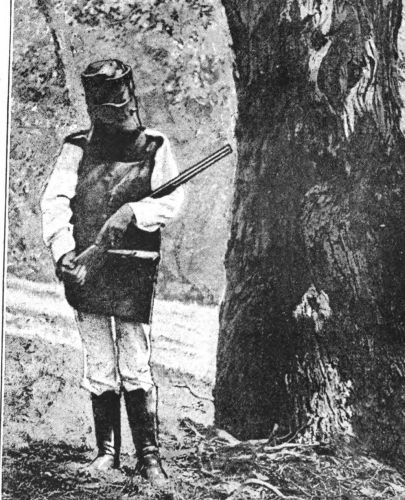
Ned Kelly in his Armour.
It was nearly eight o'clock when his tall figure was seen close behind the line of police. At first it was thought he was a black fellow. He carried a grey coat over his arm, [he wore the coat over his armour], and walked coolly and slowly among the police. His head, chest, back, and sides were all protected with heavy plates of quarter-inch iron. When within easy distance of Senior-constable Kelly, who was watching him, he fired. The police then knew who he was, and Sergeant Steele, Senior-constable Kelly, with Mr. Dowsett (a railway guard), fired on the ruffian. The contest became one which, from its remarkable nature, almost baffles description. Nine police joined in the conflict and fired point blank at Kelly; but although, in consequence of the way in which he staggered, it was apparent that many of the shots hit him, yet he always recovered himself, and tapping his breast, laughed derisively at his opponents, as he coolly returned the fire, fighting only with a revolver. It appeared as if he was a fiend with a charmed life.
For half an hour this strange contest was carried on, and then Sergeant Steele rapidly closed in on him, and when within only about ten yards of him, fired two shots into his legs which brought the outlaw down. He was only wounded, and appeared still determined to carry on the desperate conflict, but Steele bravely rushed him and seized the hand in which he held his revolver, the only weapon with which he was armed. He fired one shot after this, but without effect. When on the ground he roared with savage ferocity, cursing the police vehemently. He was stripped of his armour, and then became quite submissive, and was borne to the railway station by Sergeant Steele, Constable Dwyer, and two representatives of the Melbourne press.
Great praise is due to Guard Dowsett for the plucky manner in which he assisted the police. He was armed with a revolver, and got very close to the outlaw. At the railway station Kelly appeared to be very weak from the loss of blood, and some brandy was given him. He was examined in the guard's van by Dr. Nicholson and Dr. Hutchinson, who found that he was suffering from two bullet wounds in the left arm, a bullet in the right foot near the right toe, and two wounds in the right leg, those inflicted by Sergeant Steele.
The outlaw was quite composed, and in answer to inquiries he made the following statement:—"What I intended to do, and in fact was just about doing, was to go down with some of my mates and meet the special train and rake it with shot. The train, however, came before I expected, and I had to return to the hotel. I thought the train would go on, and on that account I had the rails pulled up, so that these ---- black trackers might be settled. It does not much matter what brought me to Glenrowan. I do not know, or I do not say. It does not seem much, any way. If I liked, I could have got away last night. I got into the bush with my grey mare, and laid there all night. I had a good chance, but I wanted to see the thing end.
"When the police fired the first round I got wounded in the foot. It was the left one. Shortly afterwards I was shot through the left arm. It was in the front of the house where I received these injuries. I don't care what people say about Sergeant Kennedy's death. I have made my statement as to it, and if they don't believe me I can't help it. At all events, I am satisfied Scanlan was not shot kneeling. That is not true. He never got off his horse. At the commencement of the affair this morning I fired three or four shots from the front of Jones's Hotel, but I do not know who I was firing at. I only fired when I saw flashes. I then cleared for the bush, but remained there near the hotel all night. Two constables passed close by me talking, and I could have shot them before I had time to shout, if I liked. I could have shot several constables at one time. I was a good distance away, but I came back again. I have got a charge of duck-shot in my leg. Why don't the police use bullets instead of duck-shot?
"One of the policemen that was firing at me was a splendid shot. I don't know his name. Perhaps I would have done better if I had cleared away on my grey mare. [He never had a chance.] It was just like blows from a man's fist receiving the bullets on my armour. I wanted to fire into the carriages, only the police started on us too quickly. I knew the police would come, and I expected them."
Inspector Sadleir here remarked, "You wanted then to kill the people in the train?" Kelly replied, "Yes; of course I did. God help them, they would have got shot all the same. Would they not have tried to kill me?" Every kindness was shown to Kelly by the police, and his two sisters were permitted to remain with him during the afternoon. He was also seen by Father Tierney, to whom it is understood he made a confession, but the reverend gentleman courteously declined to state the nature of it.
At various times during the morning more police arrived, but the bushrangers could not be dislodged; and what was more perplexing still, the prisoners inside could not be persuaded to leave, although the police repeatedly called upon them to come out. At twelve o'clock, however, the people inside, consisting of about thirty men and youths, suddenly rushed out of the front door, carrying their hands aloft. The police told them to advance towards where they were located, but many of the unfortunate people were so terror-stricken that they ran hither and thither screaming for mercy. They then approached the police and threw themselves upon their faces.
One by one they were called on, and having been minutely searched, were despatched to the station. When the turn of two youths named M'Auliffe came. Superintendent Sadleir directed Constable Bracken to arrest them as Kelly sympathizers. They were accordingly handcuffed, and taken with the others to the railway-station. Young Reardon, who with his father had been confined in the hotel, was severely wounded in the shoulder by a bullet fired from a rifle in the hands of one of the police. The unfortunate youth was at once attended to by the doctors already named. Although the wound was a serious one, it was not considered such as would prove fatal.
The police after this kept up a constant fire on the place, Dwyer and Armstrong in front of the house, Andrew Clarke, sen., and Constable Kelly getting very close in at various quarters of attack. It was noticed that the fire from the besieged bushrangers was not returned after one o'clock, but it was believed that Dan Kelly and Hart intended to lie quiet until night, and under cover of the darkness make their escape. The police for a time also ceased firing. A consultation was held amongst the officers as to what was to be done next. During the cessation of hostilities I visited the locality where the line had been torn up; it is about three-quarters of a mile on the Wangaratta side of Glenrowan. Several lengths of rails had been wrenched from their places at a curve terminating at a rapid decline, and had not timely warning been given, the pilot-engine, followed closely by the special, would have inevitably toppled over an embankment into a defile over thirty feet in depth. I arrived back at the station in time to witness the most tragic and exciting scene of the day. The police had telegraphed for a field-gun from Melbourne, but fearing it would not arrive in time to be of any use, it was determined to adopt another mode of dislodging the remaining outlaws.
CHAPTER XIII.
From The Age (continued). Mrs. Skillian comes on the Scene—The Hotel fired—Rescue of Sherry—Fate of Dan Kelly and Hart—Statement of Various Prisoners made by the Gang—The Incident of the Cannon.
Just as they were about to put this newly-conceived plan into operation, Mrs. Skillian, sister of the Kellys, dressed in a dark riding-habit trimmed with scarlet, and wearing a jaunty hat adorned with a conspicuous white feather, appeared on the scene. Father Tierney earnestly requested her to go to the hotel and ask her brother and Hart to surrender. She said she would like to see her brother before he died, but she would sooner see him burned in the house than ask him to surrender. This, in fact, was the procedure which the police had decided upon in order to bring the outlaws from their cover. Some 200 people by this time had arrived on the platform.
The police opened up a heavy fire on the hotel from the front and rear. This was done in order to cover the operations of Senior-constable Johnstone, who rapidly approached the house on the north side with a bundle of straw, which he placed against the weather-boards and set fire to. It was known that Martin Sherry, an old man, was still in the house, and when the last prisoners had escaped he was alive, though badly wounded. The thought that the unfortunate man would be sacrificed, and perish in the flames with the determined bushrangers who had made so long a stand, caused a feeling of horror to pervade the crowd.
Kate Kelly at this juncture came upon the scene, but the only expression which escaped her lips was the one uttered in heart-broken accents, "My poor, poor brother." Mrs. Skillian exclaimed, "I will see my brother before he dies," and then sped towards the hotel, from the roof of which by this time tongues of flame were beginning to ascend. The police ordered her to go back, and she hesitated.
Father Tierney emerged from the crowd, saying he would save Sherry. The brave clergyman was encouraged on his mission by a cheer from the spectators. He walked boldly to the front door, was lost to view amongst the smoke, and directly afterwards a mass of flames burst from the walls and roof of the dwelling at the same instant. A shout of terror from the crowd announced the fear that was felt for the safety of the courageous priest. Constable Armstrong, with some other policemen, rushed into the building from the rear, and a few seconds afterwards their forms, with that of Father Tierney, were seen to emerge, carrying with them Sherry, who was in a dying state, and the dead body of the outlaw Byrne.
On reaching a place of safety they stated that Dan Kelly and Hart were lying upon the floor apparently dead. Nothing, however, could be done to rescue their remains from the fire. Soon afterwards the building was completely demolished, and on a search being made amongst the ruins, two charred skeletons were raked out from the smouldering débris. Wild, Wright, Hart (the brother of Steve), and other well-known friends were witnesses of this terrible scene. All the bushrangers were clad in the same kind of armour as that worn by Ned Kelly, which weighed as much as ninety-seven pounds, and had evidently been constructed by some country blacksmith out of ploughshares. The marks on Kelly's armour showed that he had been hit seventeen times with bullets.
The unfortunate man Sherry died soon after being rescued from the burning building. Ned Kelly was brought on to Benalla by the evening train, and lodged in the lock-up, to await the inquest to be held in the morning.
The statement of Constable Bracken is to the effect that the first intimation of the presence of the gang at Glenrowan was on Sunday night at eleven o'clock, when he was bailed up by Ned Kelly. He had been confined to bed through illness. Whilst a prisoner in the hotel he courageously managed to steal the key of the front door, which enabled him to escape in time to warn the police that the outlaws were in the house.
Mr. John Stanistreet, station-master at Glenrowan, states—"About three o'clock on Sunday morning a knock came to my door, at the gatehouse, within one hundred yards of the station, on the Melbourne side. I jumped up, and thinking it was some one wanting to get through the gates in a hurry, I commenced to dress as soon as possible. I half dressed, and went to the door. Just when I got there it was burst in, but previous to that there was some impatient talk, which caused me to dress quickly. When the door was burst in I asked, 'What is that for?' or 'Who are you?' The answer was, 'I am Ned Kelly.' I then saw a man, clad in an overcoat, standing in the doorway. He pushed me into my bedroom, where my wife and some of the children were in bed. There were two girls and one infant besides my wife. Then he said to me, 'You have to come with me and take up the rails.' 'Wait,' said I, 'until I dress.' He said, 'Yes,' and I completed my dressing and followed him out of the house.
"On the line there were seven or eight men standing at the gate which crosses the line to Mrs. Jones's hotel, the Glenrowan Inn. He said, 'You direct those men how to raise some of the rails, as we expect a special train very soon.' I objected, saying, 'I know nothing about lifting rails off the line; the only persons who understand it are the repairers; they live outside and along the line.' Ned Kelly then went into Reardon the plate-layer's house. Reardon lives outside the line on the Greta side, about a quarter of a mile away. Steve Hart was present, and Kelly left us in his charge. When Kelly went away Hart gave me a prod with his rifle in the side, saying, 'You get the tools out that are necessary to raise those rails.' I said, 'I have not the key of the chest;' and he said, 'Break the lock.' He told one of the men to do so, and on arriving at the station he got one of the men to do it. This was in the little back shed used as a store-room, between the station and the gatehouse. The tools were thrown out, and in the meantime Reardon and Sullivan, the line-repairers, arrived with Ned Kelly. These two men and Ned proceeded down the line towards Wangaratta to lift the rails. We were still under Steve Hart, and we remained where we were over two hours, and then Ned Kelly and the repairers returned. Ned then inquired about the signalling of trains, as to how I stopped a train with the signal-lights. I said, '"White is right, red is wrong, and green is gently, come along."' He said, 'There is a special train coming; you give no signals.' Speaking to Hart he said, 'Watch his countenance, and if he gives any signal, shoot him.' He then marched us into my residence, and left us there under Steve Hart. There were there then about seventeen altogether, other persons subsequently being placed in my house also. There were present Reardon's family, the Ryan family, Cameron (son of the gatekeeper on the other line), Sullivan, line-repairer, and others whom I do not remember. We were locked up all day on Sunday, and were only allowed out under surveillance. The women were permitted to go to Jones's Hotel about five o'clock, and shortly afterwards all the men but me and my family went away. Steve Hart stopped with us, and during the night Dan Kelly relieved Hart, and he was afterwards relieved by Byrne.
"Just before the special train arrived I was ordered to the hotel by Hart, who was on and off duty all the time, to follow him to Jones's, and not signal the train. I went into the back kitchen, where Mrs. Jones and daughter, aged about fourteen, and two younger children were. There was also a man there named Neil M'Kew. By this time the train had arrived, and firing was going on furiously. I did not see Ned Kelly in the room. I with others stood in the chimney. I did not hear any remark passed by any of the gang, and they disappeared. A ball passed through the hut, and grazed Miss Jane Jones, fourteen years of age, on the forehead. The girl said, 'I'm shot,' and turned to me. I saw the blood and told her it was nothing. The mother commenced to cry, and soon afterwards I left the kitchen, and went into the back-yard. I then saw three of the gang there standing behind the chimney. They had their rifles in their hands. One of them said, I don't know which, 'If you go out you'll be shot.' I walked straight down the path towards the house. The firing was then going on all round me, but I was uninjured. One of the police very nearly shot me, but I said 'Station-master' when he challenged me. I forgot to mention that during Sunday afternoon Steve Hart demanded and received my revolver."
Robert Gibbons states—"I am a farmer, and have recently been stopping at Glenrowan with Mr. Reynolds. I came to the railway-station about eight o'clock on Sunday night with Mr. Reynolds to ask about his little boy, who had not been home. When we knocked at the door, Mrs. Stanistreet told us that Mr. Hart was inside, and that they had been stuck up ever since three o'clock on Sunday morning. We followed her in, and saw Steve Hart. She told him who we were, and he then put his fire-arms down, giving us to understand that we were not to go out. We remained there about two hours, when Ned Kelly came, and Hart ordered us to come out of the room. Ned Kelly then told us that we would all have to go down to the police-barracks with him. He kept us waiting there for about two hours, he having gone for Bracken. He returned to us with Bracken. He kept us waiting there about an hour and a half. Byrne at that time was with us. There he told me and Mr. Reynolds we would have to go to Jones's Hotel. We went to the hotel, and he told us to get into the bar parlour. It was then about ten o'clock on Sunday night, and we remained there until the train came. During that time the Kellys were going about the place making themselves quite jolly. Byrne was in charge of the back-door, the other door being locked. A little after three o'clock the train came. Prior to that the gang drank quite freely with the others. When the train arrived, Ned came and said, 'You are not to whisper a word that has been said here about me. If I hear of any one doing so I will shoot you.' He went to the door of the room and said, 'Here she comes,' and then the gang busied themselves in making preparations, but for what I did not know. They came back and said the first man who left the room in which we were would be shot. Two of them then mounted their horses, and rode away, but I could not tell which two. They came back in about ten minutes' time. When they came back, I saw that Dan was one of the two who had gone away. Dan went into a back room. All four in turn went into the same room. Very soon afterwards a hurried move was made, and firing commenced. There must have been about forty men, women, and children in the house then. The women and children commenced to shriek, and Mrs. Jones's eldest daughter was wounded on the side of the head, and the eldest boy shot in the thigh. The bullets rattled through the side of the house, and we laid down. We were packed so close that we had to lie on our sides. It was those who laid next the door who prompted us to come out, and we did so because we feared that the bullets would come through faster than ever. We also feared a cannon would be used; and about ten o'clock we ran out. I heard some of them say that Byrne, or one of the gang, was lying dead in the back. I know that Dan was alive when I left."
Arthur Loftus Mauld Steele states—"I am a sergeant of police at Wangaratta. I arrived here with five men about five a.m. We were at once challenged by police, and answered, 'Wangaratta police.' My men were then distributed around the hut, and I got to the tree near the back door of the hut. There was no firing then. A woman and child came to the back-door screaming, and I told the woman if she ran in quick she would not be molested. A man then came to the back-door, and I asked him to throw up his arms or I would fire on him. He was only about twenty-five yards distant. The man stooped and ran towards the stables and I fired. He then turned and ran back to the house, and I fired again. I am certain I hit him with the second shot, as he screamed and fell against the door. There was then some hot firing, and the bullets whistled all around me. The firing was kept up for some time, and some of the men behind me called out. It was then breaking day. I looked round, and saw a man stalking down. I thought he was a black-fellow, and called on the others to be careful. I then saw him present a revolver and fire at the police. I could see the bullets hitting him, and staggering him for a moment, with no further effect. I therefore thought he had armour on, and determined to have a close shot at him. I ran towards him, and when within ten yards of him he saw me, and turned round to fire at me. I then aimed at his legs, and he staggered, but he still tried to aim at me. I then fired the second barrel on the legs. We were then in the open. He fell, and cried, 'I'm done, I'm done.' I ran up to him then, and he again tried to shoot me, but I caught the revolver and pushed it down. I was behind him, and he could not turn on me quick enough to shoot me. Whilst I held the revolver away from me he fired the revolver. Senior-constable Kelly then came up and assisted me to secure him. So did O'Dwyer, and a host of others at once followed. We only found one revolver on him, and a bag of ammunition. We divested him of his armour. I was strained after the scuffle which ensued."
Senior-constable Kelly states—"When we started from the platform we ran down towards the railway-gates, hearing that the gang were in Jones's public-house. The men at that time had not sufficient time to scatter, and all made towards the hotel. As we approached, some one came out on the verandah and fired on us. Mr. Superintendent Hare, with Mr. Rawlings, a volunteer from Benalla, was close to me. Mr. Hare said, 'I am shot in the wrist,' but he continued to fire. We sought cover, and Hare said to me, 'For God's sake, surround the house, and don't let them escape.' He then fired again, and gave the gun to Rawlings. He then left, saying, 'Kelly, place the men under cover,' and I placed the men around the house. Mr. O'Connor and his trackers took up a position in front of the hotel. I then went round towards the back of the premises. Constable Arthur was with me, and we crawled about 400 yards. In this way we got to within about fifty yards of the house, at the back of a tree. In the scrub I found a revolving rifle covered with blood, and a padded skull-cap." [This was Ned Kelly's. Being wounded in the thumb, he could not use his rifle.] "We kept strict watch, and fired upon any one who attempted to leave the hut. There were four horses saddled and tied up to the back-door. These we shot in order to prevent the sudden escape of the gang. When we left the station we met Constable Bracken, who told us that the gang were at Jones's. He, I believe, jumped on one of our horses, and rode off to Benalla to get further assistance, and at half-past six o'clock he returned with the Wangaratta police, Sergeant Steele being at their head. We continued to fire, and at about eight o'clock, so far as I can remember, Ned Kelly made his appearance under the brow of the hill, 300 yards from the hut. He deliberately fired at me. I returned the fire, and my men closed around him, Sergeant Steele being behind him, myself on one side, and Dowsett, the railway-guard, on the other. About ten rifles were brought to bear on him, and we hit him several times. His heavy armour, however, protected him, and he walked boldly to and fro. Near a fallen tree he fell, and we rushed forward. I caught him by the head as Steele grasped his hand, in which he still held his revolver. He fired it, but did no damage. His armour was taken off, and he was carried to the railway-station, where he was searched, but only threepence was found on him, a silver Geneva watch, and a lot of ammunition. I asked him to tell me where Sergeant Kennedy's watch was, and he said, 'I cannot tell you; I would not like to tell you about it.' He also said, 'I had to shoot Sergeant Kennedy and Scanlan for my own safety. I cannot tell you any more.' We then gave him over to the medical gentleman and Mr. Sadleir."
During the forenoon Colonel Anderson received information from Captain Standish that in order to dislodge the two remaining members of the gang without endangering any further life, the hotel would have to be blown down, and as the best means for accomplishing that object, a small cannon would probably be required. The Commandant, telegraphing for further particulars in order to guide him in the selection of a gun, received from Superintendent Sadleir the following reply—"Glenrowan.—Weather-board, brick chimneys, slab kitchen. The difficulty we feel is that our shots have no effect on the corner, and there are so many windows that we should be under fire all the day. We must get the gun before night, or rush the place." Immediately upon the receipt of this message, Colonel Anderson arranged for the supply of a twelve-pound Armstrong gun, which was quickly placed upon a truck at the Spencer-street station. A special train was soon in readiness, and at twenty minutes past two it departed, carrying the formidable-looking weapon, a detachment of the Garrison Artillery under Lieutenant Nicholson, and the Commandant himself. The train, in order to land the gun at the scene of action while it was yet daylight, started at a pre-arranged rate of forty miles per hour. Seymour was reached in due average time, but before the soldiers had time to step upon the platform, came the not altogether unexpected, though disappointing, news that the gun was no longer required, as the whole of the outlaws had been taken. The train proceeded no further, and the gun, officers, and men returned by the first passenger goods-train to Melbourne.
On Saturday night, at six o'clock, the Chief Secretary was informed by telegram of the murder at Sebastopol, and he at once communicated with Captain Standish, Chief Commissioner of Police, with whom he consulted. Seeing the gravity of the situation, and remembering how previously the gang had always managed to obtain a good start of the police after the commission of their outrages, it was decided to despatch a special train to Beechworth at once. The Minister of Railways was informed of that determination, and without delay a train was got in readiness. Superintendent Hare, who was at Benalla, was telegraphed to, and instructed to proceed to Beechworth, and the black trackers, under Lieutenant O'Connor, who were at Essendon, where they were staying previously to their return to Queensland, were also apprised of the fact that they were required. As their engagement to the Victorian Government had expired, Captain Standish telegraphed to the Commissioner of Police at Brisbane, and requested that they might be allowed to remain, but that permission was refused. Mr. Ramsay, however, would not allow the Government to be so curtly treated, and he communicated with Mr. Palmer, Chief Secretary of Queensland, and at two o'clock on Sunday morning he obtained the required permit.
In the meantime—at about a quarter to ten—the train left Spencer Street with the tracking party. At a later period of the day—about nine a.m.—when the news of the commencement of the fight at Glenrowan was received, the Commissioner and the Chief Secretary again consulted, and it was then arranged that a reinforcement of police should be despatched, and an ample supply of ammunition was ordered to be sent up with it. As it would be almost impossible for any firing to take place without some of the men being injured, it was considered necessary that an experienced surgeon should also be sent to the scene, and accordingly Dr. Charles Ryan, who, it is well known, was attached to the medical staff at Plevna during the Russo-Turkish war and the bombardment of that town, was requested to place his services at the disposal of the authorities. He consented, and at about ten o'clock another special, taking Captain Standish, Dr. Ryan, Senior-constable Walsh and five other constables, and a quantity of ammunition, left for Glenrowan. The circumstances of the wounding of Superintendent Hare, and the commencement of the attack; that Ned Kelly had been wounded and captured; that he had been discovered to be wearing a breastplate of iron, a mask, and helmet; that his wounds were not considered to be mortal, were all duly telegraphed.
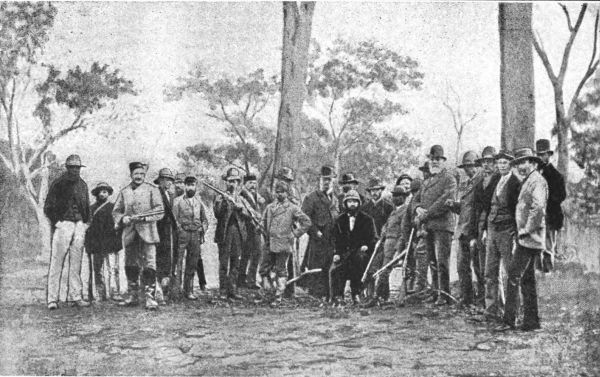
Group taken during the Fight.
At twenty minutes to eleven a.m., it was officially intimated that the civilians had been liberated from the hotel; that Byrne had been shot; and that Dan Kelly and Hart maintained possession, and were firing in reply to the incessant firing by the police. As there appeared to be every likelihood that, if the fight was continued, some of the police might be seriously injured, the Chief Secretary instructed Captain Standish, if possible, to blow the house up, but before doing so to see that none but members of the gang were in it. Colonel Anderson was summoned to a consultation with a view to steps being taken to effect that object, and the result was that at twenty minutes past two p.m. a third special, conveying that officer and a detachment of artillery, with a 12-pounder field-piece, left for Glenrowan, but as the termination of the conflict before the arrival of the train at Benalla rendered it unnecessary that it should proceed further, it was detained at that place. The Chief Secretary also advised by telegram that a wooden bullet-proof shield should be constructed to be fitted on a dray or wagon, under cover of which the attacking party might approach the house and effect its ruin, always assuming that the gang were the sole occupants. It was also feared by Mr. Ramsay that the fight would not be concluded before nightfall, and that if that was so, the outlaws might escape in the dark. He therefore consulted with Mr. Ellery, the Government astronomer, and asked his advice as to the practicability of sending up an electric-light apparatus, but that gentleman expressed the opinion that it would be of little utility adopting such a course, as it would take quite twenty-four hours after the apparatus arrived on the ground to get it fairly at work. To carry out the same idea, however, Mr. Ramsay telegraphed suggesting that large bonfires should be burnt round the house so as to give the required light and prevent the bushrangers escaping. But all these precautions were not required to be put in practice, as before sundown the final scene in the tragedy had been enacted.
His Excellency the Governor telegraphed about noon to Superintendent Hare, congratulating him on the bravery displayed by himself and his men, and encouraging them in the struggle in which they were engaged. The Chief Secretary, on behalf of the Government, also telegraphed to Mr. Hare to the same effect; and at twenty minutes past one p.m., Sir Henry Parkes, Premier of the Government of New South Wales, telegraphed to the Victorian Government, expressing the great satisfaction which was experienced in Sydney at the prospect of a speedy destruction of the gang, and congratulating the Government.
The change which had been lately made in the control of the police in the Kelly district gave rise at the time it was decided upon to some comment. Mr. Ramsay states that on assuming office he made the determination that, if possible, the Kellys should be discovered without delay. He accordingly summoned Assistant-Commissioner Nicholson, who was in charge of the police in the district, and told him of the dissatisfaction which was experienced at the absence of results from the presence of the force there. He reminded him that he had been there for ten months, but that nothing had been done, and said that unless within a reasonable time something definite was effected or ascertained, an alteration of the arrangements would be made. Mr. Nicholson requested to be allowed a month longer, but he eventually returned to his position as Assistant-Commissioner at Melbourne.
Mr. Hare, who had been engaged in the capture of Power, the notorious bushranger, was spoken to as to his filling the vacancy. In Mr. Ramsay's opinion he had been very badly treated, inasmuch as he had not received any recognition of the services he had rendered to the colony on that occasion. He had had his salary increased by £100 a year at the time that Superintendent Winch's was also added to, but under the régime of the late Government his salary had been reduced by Parliament, whilst Mr. Winch's was continued. He was regarded as being specially qualified for the duty which he was required to perform, and he was instructed to choose the best men and officers in the force with whom to act. He was further assured that he would be untrammelled by any official rules and regulations.
The Chief Secretary received a later telegram from the Chief Secretary of Queensland in the forenoon, which stated that from what had been reported officially, and had been communicated by residents of Queensland who had visited Victoria, it appeared that a considerable amount of jealousy was evinced by the Victorian police with respect to the trackers, and that unless they were allowed to go to the front at once, it was little use their being required to do so, because if the white police preceded them and effaced the tracks, they could not do their work.
The outlaws were disposed of in time to give the police a claim to the reward of £8000 offered by the Governments of Victoria and New South Wales. For it was notified on the 20th of April that the reward would be withdrawn on the 20th of July.
At the inquest on the body of Aaron Sherritt, held at the Vine Hotel, Beechworth, before Mr. W.H. Foster, P.M., the jury having been empanelled, the following evidence was heard:—
John Sherritt, father of deceased, deposed that he had seen the body of the deceased, and identified it as that of his son Aaron, aged twenty-five years. He did not know from his personal knowledge how his son came by his death.
William Sherritt, brother of the deceased, identified the body as that of his brother, but did not know from personal knowledge how he came by his death.
Ellen Barry stated—"I am deceased's mother-in-law, and identify the body as that of my late son-in-law. I was at Aaron Sherritt's house on Saturday last, and was present at his death. I was at the house between six and seven o'clock, half an hour before the outlaws arrived. There were also my daughter and the deceased present. I was sitting at the fire when we heard a knock at the door. The deceased and his wife were having tea. There was a candle alight in the room in which I was sitting. An ordinary knock was given at the back-door, that being the first sign we got of any one being about. Aaron answered the knock, and said, 'Who's there?' and he heard Antone Wicks reply, 'I have lost my road, Sherritt; come and put me on the road.' I heard no other noise at the time. The deceased then opened the door and put his head out. I heard something said outside, but could not say what. The deceased appeared to be inclined to step back into the room, but before he could retreat a shot was fired from outside—by whom I do not know. The shot was fired very close to the door, and as soon as deceased was struck he stepped backwards into the centre of the room. After the first shot, Joe Byrne stepped up to the door and fired a second shot at the deceased, who was still standing in the centre of the room. Deceased then fell back to the ground. Byrne remained at the door for a short time. My daughter then asked, 'Joe, why did you shoot Aaron?' and Byrne replied, 'If I did not, he would shoot me.' Byrne, who had a gun in his hand, was in sight during the whole of the conversation. Byrne then told me to open the door opposite the one at which he stood. I did so, and saw Dan Kelly outside with a gun in his hand. I was then allowed to go outside. When outside Byrne asked me, 'Is there a window in front of the house?' I said, 'Yes,' and Byrne called out, 'Look out, Dan; there is a window in the front of the house.' Dan Kelly then joined me and Byrne, and I recognized him. He afterwards returned to the front of the house. About five or ten minutes elapsed from the time I heard the knock until I saw Dan Kelly. Two shots had been fired by Byrne before I went outside, and he afterwards fired two shots at the bedroom. Byrne was directly in front of the house when he fired at the bedroom."
CHAPTER XIV.
The Outlaws' Plans—Execution of Ned Kelly—Habits and Customs of the Gang—Katie Kelly's behaviour—Kelly's distrust of Hart—The Cost of the Destruction of the Gang.
It was noticed by the constables who surrounded the hotel that a number of horses, saddled and bridled, were ready to be used by the outlaws; some of them were horses recently reported as stolen, and others were those which we had frequently seen ridden by Kelly's sisters. The constables shot some of them so as to prevent the escape of the outlaws. The prisoners were allowed out soon after daylight, and when the last of them came away, only Steve Hart and Dan Kelly were alive in the hotel. The police say Hart and Dan Kelly kept firing out of the windows up to one or two o'clock in the day, but having the armour on they were unable to take accurate aim. I have no hesitation in saying that had they been without armour when we first attacked them at the hotel, and could have taken proper aim at us, not one of us could have escaped being shot. They were obliged to hold the rifle at arm's-length to get anything of a sight. When I was hit I had my arm under my gun and was running towards them; they were on my right front, the butt of my gun was under my elbow with the left hand under the barrels, ready to be used in a moment. Had it been an inch higher or lower it would have missed me.
The outlaws had provided themselves with another set of horses on the opposite side of the railway, so that had they been obliged to cross the line in a hurry, they would have been able to mount their horses and get off in a moment. The plan they arranged was as follows:—
Joe Byrne and Dan Kelly went to Woolshed to shoot Aaron Sherritt on Saturday night, whilst Ned and Steve Hart were to go to Glenrowan and pull up the rails. They knew it was our habit, whenever they showed themselves in any part of the district, immediately to get a special train and go to the spot and start on their tracks. They knew, therefore, directly the news reached Benalla that Sherritt was shot, I should start off with a party of police and black trackers to pick up their trail. No trains ran on that line on Sundays; therefore, the only one likely to come along would be a "special," with a party of police. There was no telegraph station at Glenrowan, and the special would not stop there. They thought that the train would get up great speed going down the incline after passing Glenrowan, and it would be smashed up and most of the party killed. They were then to jump on to their horses and go to the spot, and finish off those who had escaped.
The line was taken up about half a mile from Glenrowan. They would then have started off to Benalla, robbed all the banks, and probably secured £4000 or £5000. If they had worn their armour with overcoats they might have been shot at fifty times without being injured. They had arranged to have placed one of their number on the bridge in Benalla, so as to prevent any person giving information concerning them. The police were all on the opposite side of the river, and it was their intention to blow up the railway bridge at Benalla, so as to stop the traffic on the line. I believe they had a keg of gunpowder and fuse ready for the purpose at Glenrowan.
This was what Mrs. Byrne alluded to when she said they were about "to do something that would astonish not only all the colonies, but the whole world." Had they succeeded in wrecking our train that morning, there would have been fearful carnage afterwards. There is no question of doubt that at Glenrowan they had parties of scouts, both in the hotel and outside of it; most of them, no doubt, were their own relations, and their name was legion. The Kellys were very short of cash when they stuck up Glenrowan. Their sisters were in debt everywhere, and they were compelled to make a raid in order to get money.
About a fortnight before they were captured, I was speaking to the owner of a hotel not far from Glenrowan. He told me the outlaws were in debt to him to the amount of £26. I asked him how he ever expected to be paid. He replied—"Oh, they will get another bank some of these days." I said to him, "I suppose you will be very sorry when they are captured?" "No," he said, "I won't. I am getting tired of them. They give us a lot of trouble—destroy our fences and injure our property, and we dare not say a word about it. If we did we would only get the worst of it."
Notwithstanding all Kelly's boasted pluck and bounce, how game he would die, &c., he was the only one who in any way showed the white feather. When the constables ran up to him after Steele had hold of him, he begged for mercy, and asked them to spare his life. There is no doubt that, had he been able to walk, he would have gone off, leaving his comrades behind him in the hotel. It was always said that Dan Kelly was the most blood-thirsty wretch of the whole gang, and that Ned had the greatest difficulty in restraining him from shooting every person he came across.
After the building was burnt, the charred remains of Dan Kelly and Steve Hart were pulled out of the fire and were given over to their relatives; Joe Byrne's remains were taken to Benalla, and an inquest held on them. Ned Kelly was taken to Benalla, and next day he was forwarded to the Melbourne gaol, where he was for some weeks under the care of Dr. Shields. Subsequently he was sent up to Beechworth, where he was committed for trial, and then sent back to Melbourne, where he was tried and sentenced to be hanged. He had quite recovered from his wounds before he was executed. He was allowed to see his mother, who was an inmate in the Melbourne gaol, the day before his execution, and say good-bye to her. Her last words to him were, "Mind you die like a Kelly." The coroner who held the inquest on Ned Kelly told me he seldom saw a man show so little pluck, and if it had not been for his priest, who kept him up, he would not have been able to walk to the gallows.
As for myself, I was sent to Melbourne the day after the fight, under the care of Dr. Ryan, who bestowed the greatest attention on me for some months. My wound was more serious than I thought. To use the words of the Police Commission—"In the very first volley Superintendent Hare received a bullet wound in the left wrist which rendered his arm useless. The ball passed through the limb, shattering the bone and severing the artery."
I should like to add a few remarks as to the origin of this outbreak and the disordered state of the district. For years this part of the colony had been infested with horse and cattle-stealers. The number of relations which the Kelly family possessed all over the colony was surprising. There was hardly a district in Victoria, and also in some parts of New South Wales, that they could not have found a blood-relation to have assisted in harbouring them. Joe Byrne was better educated than any of his companions. He was very fond of writing, and was a bit of a poet. A great deal of his writings fell into our hands. They were chiefly directed against the police. Aaron Sherritt told me that when they contemplated committing a robbery, such as sticking up a bank, Byrne wrote down the contemplated plan, and then the party decided what part each of them was to take in the affair. They were most particular about where they camped not to leave any marks behind them.
On one occasion, when talking to Aaron, I inadvertently broke a twig off a tree and began breaking up the leaves. He immediately stopped me, and said, "You would never do for a bushranger." I said, "Why not?" He replied, "If Ned Kelly saw any of his men break a twig off a tree when he was camped, he would have an awful row with them." When the outlaws travelled on horse-back they never carried anything beyond one overcoat. This had to cover them day and night, and it seemed to me wonderful that men could exist in this manner. Sherritt quite astonished me by the way in which he used to dress in the coldest weather. I asked him if the Kellys were as hardy as he was, and could do without sleep as he could. He said that Ned Kelly was ten times as hardy.
Under the altered conditions which now exist, and the progress of settlement, there is no likelihood of another Kelly episode in the history of the colony.
I hardly think any one out of Australia could possibly conceive the hardships that men of this stamp can endure. They have an extraordinary way of sleeping; they coil themselves up like dogs. I remember one night finding Aaron on my door-mat, about one o'clock in the morning. He came to my quarters, and not finding me, he lay down and fell asleep; his head appeared between his knees, and he said, when camping out he always slept in that position. He could go without sleep for a longer period than any other man I ever met, and he said that the Kellys could do the same. It was doubtless a most fortunate occurrence that Aaron was shot by the outlaws; it was impossible to reclaim him, and the Government of the colony would not have assisted him in any way, and he would have gone back to his old course of life, and probably spent his days in gaol, or he might have turned bushranger himself, when he would have been quite as dangerous a man as Edward Kelly. The Government gave his widow a comfortable allowance, and she was much better off without him. Katie Kelly, no doubt, was a most loyal sister to her brothers, and must have sacrificed a great deal for them; day and night she was always on the alert, and assisting them in every possible way. Of course she was very flash, and liked being noticed. When appearing in any of the townships, she always rode a good horse and wore a lot of jewellery; but it was noticed that if there was a long interval between the bank robberies, the jewellery disappeared. Katie behaved in a most disgusting manner after Ned was hanged; the evening of his execution in Melbourne she appeared on the stage of a music-hall with a bunch of flowers in her hand, together with her brother Jim, and exhibited herself to the public on payment of a shilling entrance-fee. When the curtain rose, she smiled and bowed to the audience, and felt proud of having so much notice taken of her. The Government put a stop to these exhibitions, and she afterwards went to Sydney, but she was not allowed to exhibit herself there either. The notes stolen from Euroa by the outlaws were very soon afterwards circulated amongst their friends. They were aware the numbers of the notes were not known, and persons passing them could not be convicted of receiving stolen property; and all debts incurred by their relations were at once paid with National Bank notes, which were, without doubt, the proceeds of the robbery. Subsequently the bank authorities took the numbers of all notes sent to their country branches, so as to endeavour, if possible, should another robbery take place, to be able to trace them. But in this case there was a further point in which the officials failed, for they neglected to take the numbers of the notes they paid over the counter, and when the stolen notes got into circulation, they found they bore the same numbers as those sent from Sydney to Jerilderie, but they could not swear they had not been paid over the counter.
It was currently reported that Steve Hart, who was a very undersized man, was in the habit of riding about the country dressed as a woman. I never believed it, and I feel sure Ned Kelly would not have trusted him away from himself, for fear of his surrendering and turning informer against his companions. Wherever Ned Kelly was seen, Hart was always with him, and Byrne and Dan Kelly went together. The horses stolen from the police at Jerilderie were some months afterwards found in the mountains at the head of the King river in Victoria, which the gang were known to frequent. It was a strange coincidence that none of the rifles stolen by the outlaws from the police at Jerilderie or the Wombat ranges were used by them at Glenrowan, but they had most inferior and obsolete repeating-rifles which had been cut short, and no proper aim could be taken with them, as they were not sighted.
Jerilderie is about 120 miles from Benalla and the outlaws, with a change of horses, could have been back in their hiding-places in thirty-six hours after they left Jerilderie. Possibly they would ride by night only, and lie in the thick scrub during the day. Parties of police were sent out to watch the different crossing-places directly we received information of the robbery; but at that season of the year, the Murray being low, there were dozens of places where they could cross, and no one knew the river better than they did, and in consequence they were able to return without being interfered with.
I need hardly say that the cost of the search for, and the subsequent destruction of, the Kelly gang came to a very large sum. Mounted constables were brought from all parts of Victoria and stationed in the Kelly country; besides, special men were engaged, and many incidental expenses incurred. After the destruction of the gang a return was asked for in the Legislative Assembly showing the cost of effecting the capture of the outlaws, and it was then stated that a sum of thirty or forty thousand pounds had been spent; whereas if the salaries and wages of those engaged in the search had been included in this estimate, the cost would have been over £115,000—a large price to pay for the capture of four desperadoes and the destruction of a gang of malefactors. However, this apparently excessive expenditure on a series of thief-catching expeditions has had results which reach further, and are of much greater value to the colony of Victoria; for the habitual criminal in Australia has been taught that, however romantic and exciting the career of the bushranger may appear, as a trade bushranging "does not pay"; while the criminal classes have been shown that the Government of the colony is not to be played with, that crime will be followed up and put down with a determined hand, and that no considerations of economy, no saving of trouble, no sacrifice of time, energy, or even life will be allowed to stand in the way when the law has to be upheld by the Executive. To the wisdom of such a policy let this fact bear witness—The execution of the last of the Kelly gang destroyed the "Last of the Bushrangers."
THE END
Richard Clay & Sons, Limited, London & Bungay.