Front matter (continued 2)
Reading edition
We then searched his tent, and found his six-chambered Colt's revolver, loaded; and from the ridge-pole of his tent hung his double-barrelled shot gun, fastened by two strings, commanding a view of the path we had come up. It was loaded with slugs, and doubtless had he been awake, we should have had the contents in our bodies; but it was not to be.
The first thing we did was to ask Power to give us something to eat, as we were starving. He said, "If you go to that tree," pointing to it, "you will find some fine corned beef;" and so it turned out. We also found some tea, sugar, and bread in his tent. We threw away the water that was boiling, for fear it might have been poisoned, refilled the "billy," and made some tea. When the black-fellow saw the bread and meat he exclaimed, "Oh, golly, what a feed we shall have!" And so we did. Power tried to eat some breakfast, but complained that we had taken his appetite away. The only money we found in his tent or gunyah consisted of the three five-pound notes with my initials on them.
The spot on which the gunyah was situated was a most commanding position, and it would have been almost impossible to approach it without observation, had Power been awake. It was within half a mile of Quinn's house. I found out afterwards that the signal given by the Quinns when danger was near was the crack of a stock-whip, which meant, "Be on the look-out." The dogs and peacock were also signals, but, as luck would have it, appeared to be off their guard that night.
The place where Power was captured was about fifty miles from the nearest watch-house, and after breakfast we started on our journey. The first difficulty we had to contend with was how the two of us, viz., my brother officer and myself, were to pass these desperadoes at Quinn's house without an attempt at a rescue. The clerk had aroused the Quinns when he had passed to secure the horses, and when we were within sight of the house, we saw six or eight men standing at the door, and the dogs were barking at a great rate, and the peacock shrieking. My brother officer went in advance with Power, revolver in hand, while I remained some distance in the rear armed with Power's double-barrelled gun, so as to protect them if an attempt at a rescue had been made, but no attempt was made, not even a remark while he passed. Of L—— we saw nothing more; after we found the hollow tree he returned to Greta as fast as he could, without, as far as we know, being seen by any one. We mounted Power on the black-fellow's horse until we were able to secure another for him, and at seven o'clock on Sunday night we had him in the Wangaratta lock-up, safe and secure. During the journey he related many of his exploits, and seemed quite proud of his doings. Many of his stories were most amusing, and whenever we met any one on the road he called out, "They have got poor Power at last, but they caught him asleep."
On arriving at Wangaratta, we found the inhabitants were all going to church; in some way it became known that Power was captured, and in a few moments the churches were emptied, and every one flocked to see the notorious bushranger who had kept the whole colony in such a state of excitement for so many months.
It would take me too long to relate one tenth of his anecdotes, nor had I any guarantee as to the truth of them, but I may give one or two for a sample. He stated that he had robbed a number of stores and draymen, at Bright. The morning before he committed the robbery he changed his clothes, putting on very old ones, and mounted a miserable old roan horse which he had picked up for the occasion, leaving his own horse and clothes in some secure place in the bush. After committing the robberies, he started off to his retreat in the mountains, riding in the most unfrequented passes. About sunset in the evening, he met three young men who appeared to him like office lads, or bank clerks; each of them had a revolver round his waist. They came up to him, and said, "Have you seen a man riding a roan horse?" at the same time describing the dress Power had worn in the morning. He replied, "No; who is he?" The young men replied, "We are looking for Power the bushranger, who has stuck up a number of drays and stores near Bright this morning." Power then told them he had seen no one answering the description they gave. Power asked them where they intended spending the night; they said they were going towards Myrtleford; he said he was going in that direction also, and would accompany them in their search for Power. They rode along talking about the robberies, the three young fellows never dreaming they were talking to Power.
After they had gone some distance, Power got them in a certain position, and ordered them to hold up their hands on pain of being shot, at the same time pointing his revolver at them and informing them he was Power the bushranger. He made them all dismount from their horses, undo the belts of their revolvers, let them drop on the road, and move away from them. He then ordered them all to undress and place their clothes on a log, even down to their shirts, and ordering them away from the log, lit a fire and burnt every article! He let their horses go, and then told them they might return to Bright, and inform their employers they had seen Power! I never could ascertain whether this story was true, beyond the fact of his having stuck up the stores and draymen on that road.
Another story Power told me is worth recording. He said he had stuck up a number of draymen on the road between Avenel and Seymour, and after stopping some eight or nine of them and seeing another approach him, he stepped from behind a tree, and ordered the driver to "bail up," calling out, "I am Power, the bushranger," at the same time covering him with his double-barrelled gun. The drayman pulled up his horses, and Power demanded his money, but the driver, who proved himself to be a Scotchman, most positively declined to hand it over. He said, "I have worked hard for my money, and have only £9 upon me, and nothing in the world will induce me to give it up." Power replied, "You see all these gentlemen here," pointing to the drivers of the other waggons, "have given me up all their money, and you will have to do the same." The drayman still remained obdurate, and Power then said to him, "Look here my good man, you see the position I am in; if I allow you to pass without giving me your money, my occupation will be gone. I am a bushranger, and make my living as a highwayman. Suppose I let you pass, the next person I stick up will also refuse to hand over his money, and the public will say I am afraid to shoot a man. I will therefore give you five minutes to think over the matter, and if after that time you still refuse, I will have to shoot you." Power said to me, "I did not want to shoot the poor fellow, so I left him and went behind a tree and prayed to God to soften his heart, and the Lord answered my prayer. At the end of the appointed time, I again called on the drayman to hand over his cash, and he handed it to me without a murmur."
Power was a most careful man in his dress. No one would have thought he was a bushranger, his clothes were always so clean and neat, and he always rode splendid horses (of course, stolen property). After his capture I was a good deal with him. I drove him to Beechworth in my buggy, and he talked all the way; and subsequently I was asked by Captain Standish to bring him from Beechworth to Melbourne by coach, and all the way down he related his adventures and experiences since his escape from Pentridge. On his arrival in Melbourne by the coach, which carried the mails, we stopped at the post-office, where a large crowd awaited his arrival. He put his head out of the coach window and took off his hat to the people, and then, when the coach arrived at Cobb's office, he wanted to make a speech to the crowd, but I prevented his doing so.
On the way from Beechworth after the sentence was passed, he thanked me for all my kindness towards him, and told me he would like to make me a present of a magnificent black mare he had in the mountains (telling me where she was). I asked him how she came into his possession, but he replied, "You must not ask me that question." I said, "Did you get her on the square?" His reply was "No." "Then I can have nothing to do with her," I replied. He afterwards offered me his pipe, but as I was not a smoker I declined the offer.
Power was put on his trial at Beechworth, charged with highway robbery under arms, which meant sticking up the Myrtleford coach and robbing the passengers. He pleaded guilty to one charge, and was sentenced to fifteen years in Pentridge; he served over fourteen years of this sentence, and was then released. He was afterwards employed as gamekeeper to Sir William Clarke, at Bald Hill Station. I had a conversation with him whilst there. He appeared very dissatisfied at the unexciting life he was leading. He was a hale, strong man even then, very fond of telling his experiences to any one who would listen to him.
Our guide, L——, I never saw again after leaving him at the hollow tree the morning of Power's capture. I had letters from him, and paid the £500 reward promised to him, to a gentleman he named, who paid him portions of the sum as he required it, but he made no good use of the money. He squandered it, and it became known in the district that he had informed against Power, in consequence of his having so much money at his disposal. He was galloping his horse one Sunday after he had drawn the last instalment, and in riding home from the hotel, where he had been drinking heavily, he fell from his horse and broke his neck. Power himself never suspected L——, but thought the Quinns had given information, or, as it is termed, "put him away;" he thought it quite impossible for our party to have passed Quinn's house unobserved.
I might add that afterwards the squatter who had given us £15 to obtain his watch, and through whose instrumentality the capture was made, sent in an application to the Government to refund the amount, but the Chief Secretary point blank refused the request.
CHAPTER IV.
A Sporting Party on the Murray—"Winkle"—How to take Aim—After the Ducks—A Night with the Snakes—Kangarooing—A Runaway Bed.
Perhaps as a change from the somewhat lurid record of crime, which from the very nature of things must constitute the principal portion of a police officer's reminiscences, I may be allowed to turn to the lighter incidents of a sportsman's recreations. Sport was a very different thing years ago, before the progress of settlement had driven the game away from the more readily accessible regions. I can recall many happy days spent on the Murray plains in the exciting chase after the bounding kangaroo, or in dealing devastation among the feathered fowl, which then abounded on the lagoons and swamps along the river's course. For the amusement of my readers I will recall one occasion, which was not without a spice of humorous incident. A party of four, we started from Melbourne for a week's shooting on the Murray river. Three of us were well accustomed to this branch of sport, but the fourth member of the band, a very good fellow, and a valued friend to us all, was better acquainted with legal sharpshooting than with modern arms of precision. Still, he had been seized with a sudden desire to distinguish himself in a new line, and, like Mr. Winkle, was prepared to uphold his reputation. Not owning, and never having owned, a gun, he deputed me to select a weapon, the best breech-loader that money could buy, determined that the birds should not escape, at any rate through any fault of the weapon. I fulfilled the commission accordingly. Intending to camp out most of the time, we laid in a stock of provisions and other necessaries, and, proceeding to Echuca by train, started off to our destination lower down the Murray. We camped the first night at a water-hole near Gunbower, and next morning after breakfast the new gun was brought out to be inspected.
I should state that in all shooting parties it is usual to appoint one of the number as captain. He decides what is to be done each day, and his instructions are law. I was appointed on this occasion. Winkle highly approved of my purchase, eyeing the gun, nevertheless, as if it were a doubtful point of law, of whose possible consequences he was exceedingly dubious. Another member of the party, who dearly loves a practical joke, suggested that the new weapon ought to be tried without delay, and turning to me, with a twinkle in his eye, said—"Make him fire off the gun at the black shag sitting on that log in the water."
Winkle trembled at the suggestion, never having fired off a double-barrelled gun in his life, but with legal acumen he objected, on the ground that such a weapon should not be desecrated by being turned against an ignoble object like a shag, and said with dignity he would prefer commencing his shooting when he got amongst the game. This plea, however, availed him not. I told him he must obey orders; and accordingly, having put a couple of cartridges into the gun, I handed the weapon to its owner, who received the gift with manifest consternation. Still he obeyed. First he fixed his eyes steadfastly on the shag, then firmly closed them, and, without taking aim, levelled his weapon, and pulled the trigger. As might have been expected under such conditions, the shot struck the water thirty or forty yards from the bird, which soared away with contemptuous deliberation.
"What on earth do you mean by shooting in that way?" called out our humorous friend.
"What do I mean?" repeated the sporting novice with astonishment.
"Why, you never took aim at the bird," was the reply.
"No," responded Winkle, with virtuous surprise. "Why should I? I have often heard Hare say, and also many other sportsmen, that they never aimed at a bird; they merely looked at it, and pulled the trigger." The retort was evidently considered a crushing negative, though any sportsman will understand the difference between firing off the gun without covering the bird, and pulling the trigger, and not letting the gun follow the eye.
We went on our journey for some distance. We had two buggies, our waggish friend driving with me, and the novice with the remaining member of the party in the second buggy. I was driving about a quarter of a mile ahead, when we saw a huge snake lying in the road. I drove over it, and broke its back, preventing it from moving. We pulled up our buggy and waited till the others came up. Then, for another bit of fun, I ordered Winkle to get out his gun, put it together himself, and shoot the snake. The order, given with the utmost seriousness of countenance, was received with horror. He objected most strongly, pleading that I knew his antipathy to snakes; besides, he had always heard that where there was one snake there was sure to be another close by, and as the grass was long he begged not to be compelled to get out of the buggy. He was quite unaware that the back of the snake was broken, and that the reptile could not move, though it kept raising its head viciously, and wriggling about in a manner quite sufficient to alarm the uninitiated. My companion, alive to the joke, urged me to insist. At last, with the utmost reluctance, he slowly and with unwilling step reached the ground. I told him to aim at the snake. With trembling caution he raised the gun to his shoulder, keeping the while at a respectful distance from the disabled snake, and then pulled both triggers. Belying on the sporting doctrine that it is quite unnecessary to take aim, he fired at random, and I need hardly say that neither shot went anywhere near the snake. Then he got into the buggy as quickly as he could, afraid apparently that the snake was in eager pursuit.
We laughed, and told him that the snake could do him no harm, as its back was broken. He took the joke good-humouredly, but with more seriousness repeated that he had a horror of snakes, and he begged us not to play any practical jokes of this kind upon him.
That night we reached our destination, and met the then manager of the station, who gave us a good account of the game we were likely to see. My companion and I used to have a shooting trip every year to this station, and the manager was accustomed to reserve all the unmanageable horses he met with during the year for us to break in. Turkey shooting in those days required a good deal of skill in getting near the birds, and we often had a pair of horses which would take a considerable time to yoke up, but would return in the evening tired out and quite broken in. The manager began to tell us what a pair of devils he had for us next morning. We were not dismayed, thinking the more spirit the horses had the better, but our verdant friend did not at all coincide with this view. When he went out shooting, he said, he wanted to shoot, and did not like his attention distracted by the antics of wild, untamed animals. The manager, all hospitality, agreed that he should have a quiet, steady pair.
After a good night's rest, off we started in the direction where the game was to be found. At first Winkle declined to repeat his shooting experiences. He preferred holding the horses, and it was not until the afternoon that we could prevail on him to take his gun and creep along a gully where some ducks were hiding in the reed-beds. He was not used to country life, nor to stalking game, and when we called on him to keep as close to the ground as possible, he put down his head and raised another part of his body to such a height, that we could scarcely wonder the ducks rose in affright over such an extraordinary figure, long before he got within range. He, however, was no whit disappointed. Having been directed to fire he obeyed orders, and though more than 200 yards away he discharged both barrels, and came back much satisfied with himself. He explained that we must have started the ducks, but when we showed him the figure he presented when stalking them, he was not surprised at the birds flying off.
We had a good day's sport, and made up our minds to stay at a deserted hut on the run that night. In those days the snakes were very plentiful on the Murray Flats. This was long before selection took place, and the huts deserted during the winter months were taken possession of by those reptiles. On being made acquainted with this strange fact in natural history, our friend was strongly averse to anything which would savour of the nature of trespass, and disclaimed any desire to serve a writ of ejectment. The manager, who was with us, said that it would be safer to take refuge in the hut than to camp out, as at that season snakes always travelled by night. When we arrived there we found three old bunks, consisting of four posts driven into the ground with bars across them, and an old bag fastened over them. As old campaigners, my companion, myself, and the overseer took possession of the bunks, leaving the less astute members of the party to lie on the floor. Our friend put on his glasses and took a good survey of the position. "Ah!" he said, "I see what it is, the three old birds have taken possession of the bunks, and we," turning to his companion, "have to lie on the floor." As night came on we made ourselves as comfortable as we could under the circumstances, and turned in early. In the night friend number two called out to the snake-hating Winkle, "Lie quiet, a snake has just crawled over me!" At once a light was struck, but the snake could not be found, but the alarmist, who was a very old bushman, declared he distinctly felt a snake crawl over him.
Next day we had another good day's sport, and saw no end of snakes, and again we started our friend off to stalk another lot of ducks. He positively refused to crawl along on his hands and knees, as he did not care about the snakes pecking at his nose and face, so the same exhibition occurred as the day before, he presenting a figure that I feel sure the game in the district had never before seen. There was the same result, the ducks flew away unharmed. On this occasion he did not fire at them, but coming back to the buggy his gun went off of its own accord. On his return we asked him what he fired at, and he candidly admitted that the gun was responsible and not himself. He stated positively he would never again attempt to fire off a gun, for, said he, "I don't quite know which hammer I am to put my finger on when I put the gun on half-cock." It then appeared he put his thumb on the left hammer, whilst his finger was on the right trigger; consequently, the gun went off. We all recognized that there was a great risk in shooting with our friend, and were glad that he decided to put away his gun, and so avoid bagging bigger game than we had any intention of securing.
We decided to cross the Murray and stay the night at a station on the opposite bank. We arrived late in the evening, and were disappointed to find the owner absent from home. However, bush fashion, we went up to the house and told the housekeeper we intended staying there for the night. Our friend at once asked the housekeeper whether there were any snakes about. She replied, "I don't think there are many. One was seen on the verandah this morning, and he got under the floor of the house, but a good many were seen some time ago." He did not at all relish the idea of sleeping there that night. After a good dinner we went to bed early, our friend, with due regard to his personal comfort, being given the owner's bed. Two of us were sleeping in the next room, and during the night my friend awoke me and said that he heard groaning in the next apartment, and asked me to see what was the matter. I lighted a candle and went into the room.
Such a sight I never witnessed before or since. There was our snake-haunted friend sitting doubled up on the bed, fully dressed, with gaiters on, and bandages round his wrists and neck. He was groaning as if in great pain.
"What on earth is the matter with you?" said I.
"Oh, Hare! Such a night I never spent before in my life. The snakes have been running up and down the wall after the mice, and I have been afraid that the mice would run up my legs or arms, and the snakes would follow, so I got up, dressed, and put on my gaiters, and tied handkerchiefs round my wrists."
I could scarcely stand for laughing, and went next door and called in my companion, who, appreciating the humour of the situation, exploded with laughter. Never before having slept in a wooden room with a paper partition, our frightened friend did not know that mice invariably amused themselves running races all night within the paper lining. We explained matters to him, and he undressed and got into bed again.
Next day we intended changing our sport, and having a day's kangaroo hunting—the owner of the station being known all over the district as having the best kangaroo dogs on the Murray. The manager warned our friend against getting into a buggy with me driving, saying that I did not know the danger I ran, galloping across the plains as hard as the horses could go, following the dogs. Under this influence he came to me and said, "Hare, I don't think I care about kangarooing; I won't go out to-day." I told him it was his duty to obey orders, and as I had decided we were all to go out kangarooing, he must come with us. I drove the buggy; the horses played up when starting, and he begged to be allowed to stay at home, but we would not hear of his staying by himself, and at last we made a start. The hounds were sent out in a cart, and at an appointed place we all met. The kangaroos were in hundreds, and a pair of dogs were slipped by a man on horse-back when at full gallop. The two buggies and half a dozen station hands and blacks, perfectly naked, went in full gallop across the plains, the kangaroos running in every direction, one hound following one kangaroo, and the other another; such a helter-skelter was never before seen. Our friend was perfectly quiet and resigned to his fate. The game took to a clump of timber, and I saw my way to dash through it. The manager, who galloped past us, called out that it was perfect madness to allow me to drive as I was doing. However, I got through all right, but was pulled up on the other side by a deep ravine. Then my friend begged me to stop, and said he did not see anything in kangaroo hunting, and he preferred shooting ducks. We had another run, but he still declared that as far as he was concerned he could see no sport in kangarooing, and he had seen enough to last him his life.
We stayed another night at the station, and the next night crossed the Murray, and went back to Victoria. We had another good day's turkey and duck shooting, and that night we camped on a sandhill near a shepherd's hut. After selecting a spot whereon to camp, our friend strolled about, and met the wife of the shepherd. He at once entered into conversation with her, and said, "My good woman, are there any snakes about here?" She replied, "Law, sir, the place is stiff with them. They have been carting in a supply of wood for the winter, and in every hollow log there appears to be a snake." He returned to us downcast and dejected, and taking me aside, said, "Hare, I cannot sleep on the ground to-night; you must let me sleep in the waggon." I consulted with the others, and we agreed, after the miserable nights he had passed, he should be allowed to clear out the waggon, and put his 'possum rug in it. I must describe the position we selected for our camp. It was a steep hill on the side we were on, with a wide creek at the foot of it. His attention was drawn to the position, and we pointed out the possibility of the waggon running down the hill; but he took the precaution of putting chocks under the wheels, so as to prevent such an accident. I had no idea at the time of the reason why my waggish friend took so much trouble to point out the position of the waggon. However, I plainly saw the reason afterwards! We had our tea, which consisted of kangaroos' tails boiled in water, with some pepper and salt, which were not by any means palatable, but after a hard day's shooting anything goes down! Having selected our sleeping places round the fire, we all turned in, and our friend getting into the waggon, coiled up in his rug, began to chaff us, and ask us if there were any snakes knocking about. He little thought what was going to take place during the night. We all fell asleep, and later on I was awakened by dreadful screams from the waggon, calling out, "Hare, Hare, the waggon is off down the hill, and I will be drowned." I jumped up, and there saw the wag of the party at the pole of the waggon, pulling it down the hill. I could scarcely stand for laughing. The frightened occupant jumped out, and not seeing the joker at the pole, called out, "Good heavens, what a narrow escape I've had."
Next morning there was a discussion whether we should go back to Melbourne, or continue shooting.
One of the party was for having another day's sport, but the amateur sportsman turned upon him and told him he knew nothing about shooting, and begged us take no notice of what he said, but to make back to the station at once and endeavour to reach Echuca next day. Finally we agreed to do so.
On the road back one of the blacks who was with us started off in a gallop and rescued our little dog from being picked up by a huge eagle-hawk that was pouncing down upon the spaniel running ahead of us. These eagles, when hungry, generally hunt together, and have often been seen following a large kangaroo until it could scarcely stand; then they would attack it, and tear it to pieces and eat it. We got back to Echuca that night in time to catch the train. Our bag consisted of thirty-five turkeys, 120 couple of ducks, fifty geese, and no end of kangaroo tails. Our friend gave me his gun to sell, and I believe he has never since fired off a shot, and never intends to do so again. He got back to the bosom of his family, and registered a vow that he would never again go for a shooting trip as long as he lived, as he found he was not a sportsman, although highly thought of in his profession.
CHAPTER V.
The Kelly Gang—Ned and Dan Kelly—Steve Hart—Joe Byrne—The Origin of the Bushranging Outbreak—Search Party organized—Murder of Kennedy—M'Intyre's Escape—Arming the Police—Tracking the Gang—Close on them.
The events in connection with the outbreak of the Kelly gang, from the murder of the ill-fated party of police in the Wombat Ranges, in October 1878, until the capture and death of the bushrangers at Glenrowan, in June 1880, are still too fresh in the minds of the public to need more than the briefest recapitulation as an introduction to my own experiences in their pursuit. Perhaps there was no one who had a better opportunity of obtaining information concerning their career than myself. Not that I wish to take any special credit, but I am merely mentioning facts that came to my knowledge and experiences during the search for the outlaws. For nearly ten months I was engaged searching for them, and both before I went to the north-eastern district and after I was relieved, Captain Standish, the Chief Commissioner of Police, consulted me concerning all the information that came to hand.
Ned Kelly, the leader of the gang, was born in 1854, at Wallan Wallan. At an early age he took to criminal courses, and was regarded as a horse and cattle stealer from his earliest boyhood. He was known to steal carriers' horses at night, "plant" them in the bush until a reward was offered for their recovery, and then in the most innocent manner claim the reward. Afterwards he took to stealing and selling any horses he found straying about. When he was sixteen years of age he joined Power, although he never assisted in any of his sticking-up cases; still, he was with him on two or three occasions when Power committed some of his depredations. He merely took charge of Power's horses at a distance, but he could not be recognized by any of the victims, and consequently he was never tried for any offence in connection with him; but he served two or three sentences for horse and cattle stealing. When with Power, Ned Kelly was a flash, ill-looking young blackguard. He told me the reason he left him was because Power had such an ungovernable temper that he thought Power would shoot him. He told me that when they were riding in the mountains, Power swore at him to such an extent, without his giving him any provocation, that he put spurs to his horse and galloped away home. It was generally supposed by the public that Ned Kelly gave the police some information which led to Power's arrest; but this is entirely untrue. Power would not at that time have trusted Kelly with the knowledge of his whereabouts. Power had a very poor opinion of Kelly's courage, and told me that once or twice Ned Kelly suggested that they should surrender, more especially when Kelly and he were trying to steal some of Dr. Rowe's horses at Mount Battery station, Mansfield, and Dr. Rowe fired on them with a long distance rifle. Power said Kelly turned deadly white, and wished to surrender. He had the greatest difficulty in getting him off the ground, he was in such a fright. Between the interval of his exploits with Power, and the time of the outbreak of the gang of which he was the leader, Ned Kelly had grown into a man, and had become so hardened in crime as to be perfectly reckless.
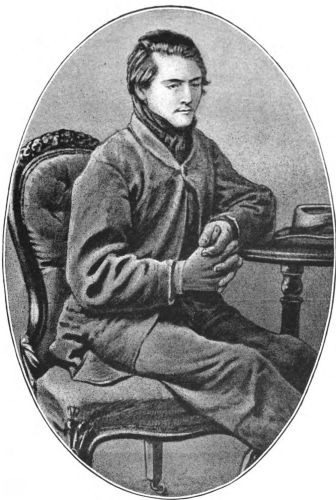
Dan Kelly.
Ned Kelly had two brothers and four sisters, Dan, Jim, Mrs. Gunn, Mrs. Skillian, Kate and Grace. His father, who died in 1865, was a notorious criminal, having been transported from Ireland. He married a Miss Quinn, and all her people were thieves. The mother (Mrs. Kelly) is still alive, but was in gaol during most of the time her sons were outlaws, having been convicted of aiding in the shooting of Constable Fitzpatrick.
Dan Kelly was born in 1861, and was a good deal mixed up with Ned in his criminal pursuits. They were the terror of all persons who travelled with stock in that part of the district, and many drovers were accustomed to go miles out of their way to avoid Greta, for fear of their cattle being stolen. Dan was always known to be a cunning low little sneak, he would be prowling about half the night seeing what he could pick up; of course he knew every road, lane, and mountain gully in the district, and could ride about the darkest night and find his way as if in his own garden.
Steve Hart was born in 1860, near Wangaratta, he also was a horse-stealer, and was frequently prowling about of a night to pick up a stray drayman's horse, or any other animal that did not belong to him.
Joe Byrne was born in 1857 at Woolshed, near Beechworth. He was a fine strapping young fellow, but he took early in life to evil courses, and received a sentence of six months in Beechworth for cattle-stealing. He was educated at the Eldorado school, where he and Aaron Sherritt were most intimate friends.
Aaron Sherritt, who figures conspicuously throughout this narrative, was born near Beechworth. His parents and sisters were respectable and well-conducted people, his father having been in the police force in the old country. He was a strapping, tall, well-made young fellow, and associated himself with the Kellys and Byrne in their horse-stealing raids, giving himself up entirely to a disreputable life.
It will be observed that as the Kelly family lived near Greta, the Hart family near Wangaratta, with the Warby ranges behind them, and Joe Byrne's family resided at Woolshed, they had miles of ranges to retreat into with which they were well acquainted, and to this fact I attribute in a great measure their successful evasion from arrest. If, for instance, the police made up their minds to search the interminable ranges at the back of Greta, extending for over one hundred miles, the outlaws would, through their sisters, get the information furnished to them that the police were in that district, and they would shift their position during the night to the Warby Ranges, at the back of Hart's place; if parties of police were sent there, they would move over to Byrne's friends. In this manner they could find retreats over hundreds of miles of impenetrable mountains, amongst which they had been brought up all their lives, and where they knew every road, gully, and hiding-place.
The origin of the bushranging outbreak was the shooting at a young constable named Fitzpatrick in April 1878. He had been sent to arrest Dan Kelly at his mother's house near Greta. He was invited into Mrs. Kelly's hut and there set on by a number of people, and in the scuffle Ned Kelly shot him in the wrist. Mrs. Kelly, the mother of Ned and Dan, with two or three others, was subsequently arrested, tried, and convicted for aiding in the shooting of Fitzpatrick, and received long sentences. Warrants were then issued, and a reward of £100 offered for the arrest of Ned and Dan Kelly. For some months nothing was heard of them; they were doubtless in the district, but the police could not lay their hands on them, although every effort was made to capture them.
In October 1878, search parties were organized of three or four men, and were sent to search the mountains. The party in charge of Sergeant Kennedy, one of the best men in the force, comprised also Constables Lonergan, Scanlan, and M'Intyre. They had orders to scour the Wombat Ranges. They left Mansfield on the 25th of October, 1878, with pack-horses and provisions to last them some days. Sergeant Kennedy was a shrewd, intelligent man, and there is every reason to believe he had received information of a most positive nature as to where the Kellys were to be found, the information being supplied by a man whom I must call P——, a well-educated fellow, who had held various responsible positions in the district, on the promise from Kennedy that if he arrested the offenders, the reward offered by the Government for their apprehension should be paid to him. It is also stated, that no sooner had P—— given this information to Kennedy and seen the police started in search of the bushrangers, than he went straight to the Kellys and told them that Kennedy was to camp in a certain spot in the Wombat Ranges. Kennedy never for a moment thought the Kellys would attack him; such an idea never entered his head, and he camped for the night in a spot he had selected in the Stringy Bark Ranges, about twenty miles from Mansfield; the country was almost impassable from the impenetrable scrub.
The following morning Kennedy and Scanlan got their horses and started off to search the ranges, leaving M'Intyre and Lonergan in the camp; the former was acting as cook for the day. The camp consisted of a tent, which the men slept in. About two o'clock that day the two men left in camp were suddenly called on to "bail up and throw up their hands" by four armed men, who were presenting rifles at them. M'Intyre, being unarmed, immediately obeyed and threw up his hands, his revolver being inside the tent. Lonergan, instead of following the example, ran to get behind the shelter of a tree, at the same time drawing his revolver out of the case, but before he got to the tree he was shot in the forehead, and dropped down dead. The armed men were found to be Ned and Dan Kelly, Joe Byrne, and Steve Hart; they at once took possession of Lonergan's arms and all the other arms lying about the camp. M'Intyre was made to sit on a log, and he had a good opportunity of seeing the faces of the four men. Either Ned or Dan Kelly shot Lonergan, and M'Intyre states that Byrne and Hart were dreadfully cut up at the turn things had taken, especially Byrne, who was nervous and downcast.
The bushrangers were evidently aware that Kennedy and Scanlan were away, and would shortly be returning. They arranged that M'Intyre would sit in some conspicuous place where he could be seen by his comrades, and they themselves laid down in some sheltered spot where they could not be seen, and they advised M'Intyre to induce Kennedy and Scanlan to surrender, saying that if they consented they would not be shot. M'Intyre told Kelly that he would induce his comrades to surrender, if he promised to keep his word.
Kennedy and Scanlan rode into the camp. M'Intyre went forward and said, "Sergeant, I think you had better dismount and surrender, as we have been captured." Kelly at the same time called out, "Put up your hands." They both appear to have grasped the situation in a moment, for Scanlan threw himself from his horse to get behind a tree, but was shot before he reached the ground. Kennedy jumped from his horse, and getting the animal between him and the bushrangers, opened fire upon them. The horse bolted and passed close by M'Intyre, who vaulted on it and galloped off, throwing himself on the horse's neck. Several shots were fired, but, fortunately, none hit him, and he rode off as hard as he could. Kennedy was left then to fight these four scoundrels.
What happened no one knows, beyond what Ned Kelly stated himself. He said that Kennedy was a brave man, and fought the four of them until he had fired all the shots in his revolver. His body was afterwards found a quarter of a mile from where M'Intyre last saw him, with several bullet wounds and fearfully mutilated. Ned Kelly said that after Kennedy was wounded and fell, they all ran up to him, and Kennedy begged them to spare his life for the sake of his wife and children, but the inhuman brute said that he did not like to leave him in the bush in such a state, and so out of compassion he blew his brains out. An inquest was held on the bodies of the murdered men. Lonergan had received seven bullet wounds, one of them through the eye-ball. Scanlan's body had four shot marks on it, the fatal bullet had gone through his lungs. Kennedy's body was fearfully mutilated, he had three bullets through his head, and several in his body. Aaron Sherritt afterwards gave me another version of this matter. He said Ned Kelly told him that he made both Joe Byrne and Steve Hart fire into Kennedy whilst he was lying wounded, as neither of them had shot either Scanlan or Lonergan, and he made them kill Kennedy so as to prevent their turning informers against him and his brother. In support of this theory, it may be noted that when Kennedy's body was found, it was apparent that the bullets which put an end to his life must have been fired by men standing close over him, as the skin was burnt by the powder.
M'Intyre after his escape rode off as fast as the nature of the country would permit, until his horse fell and threw him across a log, on his loins, and then bolted off. M'Intyre felt sure he was being followed by one of the gang, and no doubt they did endeavour to overtake him, but the country was so dense with scrub that they were unable to follow on his tracks. After being thrown from his horse, he ran as far as he could, until through exhaustion he fell down, and close by he found a wombat hole, into which he crept, hoping to evade his pursuers. Whilst he was in this hole in the earth, he tore a sheet out of his pocket-book and wrote as concise an account as he could, thinking if the Kellys did overtake him, he would leave the slip of paper in the hole, in the hope that it might be found some day. Fortunately darkness came on, and M'Intyre got out of the hole and travelled all night on foot. Towards morning he found himself near Mr. Tolmie's station, between Mansfield and Benalla. At first he was rejoiced at seeing some habitation, but to his horror he fancied he saw the police horses which had been ridden by Kennedy's party feeding near the house, and he thought the bushrangers had come down and taken possession of the place. Acting on this idea, he made off as fast as he could. He found his way into Mansfield some time during the afternoon.
I afterwards spoke to M'Intyre concerning these horses, and he told me he felt perfectly convinced in his own mind that he saw the horse he had been riding, together with the three others, but it turned out that they were only the station horses. M'Intyre was much blamed for the way he had acted in the affair, but my own idea is, that unless he had been a brave man, he could not have seized the opportunity in the way he did in vaulting on Kennedy's horse as it passed him. He was of no use to Kennedy, he had no arms in his possession, and the fact of his bolting off as he did, gave Kennedy a better opportunity of shooting one or two of the bushrangers if they attempted to pursue him. He had seen his two companions shot dead and the third fired at; clearly his best course was to escape and give the alarm. There can be no question that if M'Intyre had also been shot (which he would have been, had he not escaped), the world would never have known the fate of the four men. The bush near the spot where the tragedy took place is so dense that, if the bodies had been burned and the ashes covered up, no sign of the bodies could have been discovered.
To show how difficult it was to find anything in the locality, it may be mentioned that poor Kennedy's body, although only a quarter of a mile away from the others, was not found for two or three days, although dozens of people were searching. When found, it was covered with a coat, although Lonergan's and Scanlan's bodies were lying in the camp uncovered. Afterwards I asked Sherritt the cause of Kennedy's body being covered, and he said Ned Kelly told him he was the bravest man he had ever heard of, and out of respect he went all the way to the camp, got a cloak, and threw it over the body, and I have not the least doubt that was the case.
M'Intyre having given the alarm at Mansfield, a party of police were sent out at once to the Wombat, and after much difficulty they reached the spot described by M'Intyre, and found the two bodies, and some days afterwards the remains of Kennedy were found as stated. The bodies had to be tied on horse-back to be brought out of the forest, and they were buried at Mansfield, where a monument has been erected to the memory of the murdered men. Kennedy was a great favourite with every one. He left a wife and children at Mansfield. The Government behaved liberally, allowing the widow to draw her husband's full pay to support herself and children ever since.
The news of these murders was very soon sent to all parts of the colonies, and caused great consternation. Captain Standish at once despatched the inspecting superintendent to the district, and mounted constables from all parts of the colony were sent in pursuit of the offenders. The police were blamed for being unprepared for such an outbreak, but, to my certain knowledge, for years Captain Standish had been asking for authority to arm his men with proper carbines, but his request was refused, the men not even being supplied with ammunition to practise with, because of the expense. Yet when this outbreak took place, blame was heaped upon the head of the department for being in such a state of unpreparedness. Authority was then given to purchase arms that were thought suitable for the purpose, but rifles of the description required could not be obtained. The military sent some old-fashioned rifles, but they were not to be depended on. Captain Standish then obtained authority to purchase from a gun-maker in Melbourne a large number of shot-guns, breech-loaders, and these were sent to the north-eastern district, and were well adapted for the purpose, and the men felt great confidence in using them. Each of these breech-loading shot-guns cost the Government about £8. However, we had to purchase some reliable weapons, and these shot-guns were considered the best, especially for inexperienced men.
The inspecting superintendent, and the officer in charge of the district, at once set to work to organize search parties to go in pursuit of the gang. The whole district at this time was in an intense state of excitement, and reports came from all parts of the district that suspicious persons answering the description of the bushrangers had been seen. There were several hundred square miles of country which the murderers knew every inch of, and it was difficult to say in which direction they would fly. One of the parties organized to search for the offenders found, within a few miles of the spot where the murders were committed, a very strong stockade, built of logs laid one on top of the other, with loop-holes all round, through which shots could be fired, and the person firing remain quite unseen, the trees within one hundred and fifty yards being full of bullet marks, where evidently considerable practice had taken place. It is believed that the bushrangers were living in this stockade when they attacked Kennedy's party, and from all appearances had been living there for some considerable time.
Aaron Sherritt told me it was quite by accident that Joe Byrne and Hart happened to be with the Kellys when they attacked the police. They were always great friends and companions in their horse-stealing raids, and Sherritt said they had no idea of shooting the police the morning they started to attack the camp. Their chief aim was to secure some good fire-arms and horses, and they were under the impression that all they would have to do was to cover them with their rifles, and the police would surrender. Instead of this they had to shoot the police to save their own lives.
Of course the bushrangers took away everything belonging to the murdered men. The police had good Webley revolvers, a Spencer carbine, and two shot-guns, the latter borrowed from some one at Mansfield. The police horses were also taken away by the gang.
The Government immediately offered a reward of £1000 for information that would lead to the apprehension of the offenders, they were outlawed, and every inducement was given to people to inform against them. After the murders the first information that was received concerning them was from the Murray River, below Wodonga, about ninety miles from the scene of the murder. They called at the house of a German, who knew them. They were riding the police horses belonging to Kennedy's party, and had their arms in their possession, and were seen going towards the Murray. They evidently meant to cross the river, but it was flooded, and they got on some of the islands and were very nearly drowned. The police had information of this, but they either disbelieved it, or failed to take action. At all events, a day or two afterwards the outlaws were seen making their way back riding through the water, and obliged to swim their horses to get out. When they reached the shore they had to make a fire to dry their arms, and they remained there some hours.
The next thing heard of them was their going through Wangaratta about daylight, crossing the bridge through the town, the whole country being flooded to such an extent that they were compelled to come through the town. Four men were seen crossing under a culvert on the railway, and it was known that no one but persons who had resided in Wangaratta could have known how to cross the creek in the swollen state it was in, as there was great risk in doing so. Information was given to the police at Wangaratta, but they doubted the truth of the report. After a day or two convincing proof was given that the four men seen passing under the railway were the bushrangers. An effort was then made to follow their tracks. This could be done by the men in full gallop, as the country was so boggy the tracks were plainly visible. The police tracked the foot-prints of the outlaws' horses to a well-known sympathizer's house, where it was afterwards ascertained the outlaws had breakfasted. Then the tracks were followed up still further into the Warby Ranges, and the police found Kennedy's horse, which the outlaws had abandoned. The animal was knocked up and its feet were bleeding from travelling over stones without shoes.
This I consider the best opportunity thrown away of capturing the offenders throughout the whole of the search. But unfortunately there was an officer at that time stationed at Wangaratta who was from physical and other disqualifications quite unfit to be sent on duty of this kind. Instead of following up the tracks when he found the lame and bleeding horse with signs of having recently been ridden, he threw up the search and made all his men return back to Wangaratta to show he had found the horse. It was afterwards discovered that the outlaws at this time were completely done up; their horses had been some days without feed, and they themselves were wet and tired out. There would have been no difficulty in capturing them. Unfortunately the inspecting superintendent was engaged in some other part of the district, and so also was the officer in charge of the district. The outlaws had got back to near where their relations lived. They had the Kellys' house on one side of them, and the Harts' on the other, and they could go to their own blood relations for any food and help they required.
Search parties were kept up all over the district, men sleeping out, or I should say staying out without fire or shelter; badly-fed horses knocked up, reports coming in from every direction hundreds of miles off, that the Kellys had been seen here, there, and everywhere. Many of these reports were circulated for the purpose of deceiving the police. The inspecting superintendent had had a great deal of experience in the detective force, and was able to obtain information from persons that no one else would think of getting it from. He set to work to endeavour to organize men of this class and get information as to the whereabouts of the outlaws, but there was the greatest difficulty in doing this. The murders committed by the outlaws had created such a scare in the district, that any person who did know anything of their movements was afraid to say anything about it; besides which, they had such a crowd of relations in the district, that it was impossible to find a person who was not in some way or other interested or connected with the gang. No one but the police themselves knew the hardships they went through all that winter whilst searching for the outlaws. They did it most cheerfully, one and all. Their whole aim and object was to fall in with the Kellys. The officers had a most trying time. They had to decide between false and deceiving reports, and those that were true. They were constantly on the move themselves, meeting persons in the bush quite alone, and obtaining information concerning the outlaws, some purposely misleading with a view of favouring the outlaws and getting payment for their services.
CHAPTER VI.
Euroa Bank Robbery—Euroa—"Sticking up" Mr. Younghusband's Station—Mr. Macauley "bailed up"—The Hawker Gloster—Cheap Outfits—The Raid on the Bank—The Manager and Family made Prisoners—The Return to Mr. Younghusband's—The Retreat of the Gang and Liberation of the Prisoners—Explanatory Statement of the Author.
The next exploit of the gang was the Euroa Bank robbery, on the 11th Dec. 1878. Euroa is situated on the main railway line between Melbourne and Sydney, about one hundred miles from the former. The town at that time had about three hundred inhabitants; there was a police station, where one mounted man was stationed, and it had two hotels and some substantially built buildings in it. A court was held there once a month, and the town was built close by the railway line. The bank that was stuck up was within fifty or sixty yards of the railway station, and trains are constantly passing throughout the day; the nearest townships on each side of Euroa are Lowground on the Melbourne side, about nine miles distant, and Violet Town on the north side, about eleven miles. A considerable amount of business is, however, done in this place. It is the outlet for a large agricultural district, reaching down the valley of the Goulbourne river; at the back of it, and but a short distance away, are the Strathbogie ranges, which are covered with thick scrub, and heavily timbered for thirty or forty miles, reaching to near Mansfield, giving excellent cover for any persons trying to escape justice.
About noon on Monday, the 18th of December 1878, an employé named Fitzgerald, on Mr. Younghusband's station, was sitting in the hut eating his dinner, when a man who looked like an ordinary bushman quietly sauntered up to the door, and taking his pipe out of his mouth inquired if the manager, Mr. Macauley, was about. Fitzgerald replied, "No, but he will be back towards evening. Is it anything in particular? Perhaps I will do as well." The bushman said, "No, never mind; it is of no consequence," and then walked away from the hut. Fitzgerald continued eating his dinner without taking any further notice of the man; but he happened to look up, and saw the bushman beckoning to some person in the distance. About five minutes afterwards, two more rough-looking characters joined the bushman; they were leading four very fine horses, in splendid condition, they were three bays and a gray. The three men went to the homestead, which was close to the hut, and walked in. They met Mrs. Fitzgerald, the wife of the employé already mentioned, who was engaged in some household duties.
The old dame was considerably surprised at the strangers walking in without an invitation, and asked them who they were, and what they wanted. One replied, "I am Ned Kelly, but you have nothing to fear from us, we shall do you no harm; but you will have to give us some refreshment, and also food for our horses. That is all we want." The old lady was naturally very much surprised, and called out to her husband to come to her. Fitzgerald left his dinner at the hut, and walked over to the house, when his wife introduced him to the strangers, saying, "There is Mr. Kelly, he wants some refreshments, and food for his horses." By this time Kelly had drawn his revolver, evidently to show them there was no joking on his part; and Fitzgerald, no doubt thinking discretion the better part of valour, accepted the inevitable, and resignedly said, "Well, if the gentlemen want any refreshment, they must have it."
Shortly after this conversation had taken place, the station hands began to drop in for their dinner. Joe Byrne took up his position outside, keeping watch over the place, and Dan Kelly found the horse-feed, and was attending to the horses. Ned Kelly and Hart, as the men approached the homestead, made prisoners of all of them; Ned took possession of a detached building, which had been used as a store-room, into which he put Fitzgerald, and each man that came up to the station was served in the same manner, and the door locked. The women on the station were in no way interfered with, and they were all assured that no harm was intended to anybody; as each man walked up for his dinner, they were very quietly ordered to "bail up," and were unresistingly marched into the storehouse, no violence being used towards any of them, as they went quietly. Ned Kelly put several questions to each of the workmen, making inquiries about every one on the station, so as to test the credibility of each of them; their answers appeared to satisfy him, he was very quiet in his manner, and kept telling the men they had nothing to fear, provided they did not interfere with him or his companions.
About five o'clock in the afternoon Mr. Macauley, the manager of the station, rode up to the homestead (he had been to one of the out-stations), and when crossing the creek which led up to the station he noticed, with some surprise, the quietness which reigned about the place, and the absence of the station hands about the huts. However, he did not give it a second thought, and proceeded on his way, until nearing the storehouse, when he suddenly reined up. This was in consequence of Fitzgerald calling out to him from the building, "The Kellys are here, you will have to bail up." He could not believe this at first, but almost at that instant Ned Kelly came out of the house, and covering him with his revolvers, ordered him to "bail up." Macauley without dismounting said, "What is the good of your sticking up the station? We have got no better horses than those you have." Ned Kelly replied, "We are not going to take anything, we only want some food, and rest for our horses, and sleep for ourselves."
Macauley, seeing it was no use offering any resistance, at once dismounted, and surrendered. They did not treat him as they did the others, but allowed him to remain at liberty for some time, but always keeping a watchful eye upon him. Even then Macauley did not believe they were the Kelly gang, but when Dan Kelly came out of the house, he recognized, as he said, "his ugly face" from the photos he had seen of him. Macauley said, "Well, as we are to remain here, we may as well make ourselves as comfortable as possible, and have our tea." The outlaws however were too cautious, and only two of them sat down together, whilst the others kept a look-out, and then they relieved each other. They also took great care that some of their prisoners should taste the food first, being apparently afraid of poison being put in.
About this time a hawker named Gloster, who had a shop at Seymour, but was in the habit of travelling about the country with a general assortment of clothing and fancy goods, drove his waggon up to the entrance of the station, and according to his usual custom unharnessed his horses, and made preparations for camping out for the night; and having made all in readiness, he walked up to the station to get some water to make his tea with. When he reached the hut, he was told "the Kellys" were there, and that he would have to "bail up." Macauley, knowing Gloster to be a plucky fellow, was afraid that he might draw his revolver and there would be blood shed; however, Gloster got his water from the kitchen, and was going back to his cart, when Ned Kelly called out to him to stop. Gloster turned round and looked at him, but thinking it was all a lark, went on his way towards his cart. Dan Kelly immediately raised his gun, and was about to fire, when Ned Kelly ordered him not to do so. Macauley called out to him to "bail up," in order to prevent bloodshed. Gloster, who appeared a very obstinate fellow, took no notice of the threats of the Kellys, or the entreaties of Macauley, but steadily continued on his way and got up into his cart. Ned Kelly appeared to be losing his temper, and went down to the cart followed by his brother Dan. Ned then put his revolver to Gloster's cheek, and ordered him to come out of his cart, or he would blow his brains out. Many angry words passed between them, and it was only by the endeavours of Macauley that Ned Kelly was prevented shooting Gloster.
Kelly then said he would let him off this time, at the same time praising his own leniency, by saying not one man in a hundred would have dealt so leniently with him, after the manner in which he had behaved. Dan Kelly was evidently eager for blood, as he expressed a strong wish to put a bullet through "the wretch." Gloster was then marched up to the store-room, and locked up with the other prisoners. The four ruffians then proceeded to ransack the hawker's cart, and provide themselves with a new fit out; they made regular bush-dandies of themselves, and helped themselves pretty freely to the contents of the scent-bottles which they found amongst the stock. They also took what fire-arms he had. Before going to bed for the night, the Kellys opened the door of the store-room, and let the prisoners out for a little while to get some fresh air, but at the same time holding their revolvers in their hands and keeping a sharp look-out after them all. The Kellys had frequent conversations with their prisoners in a most friendly manner, and conversed freely on any subject. All night long two of the outlaws kept guard, whilst the others slept. Tuesday morning they were up early; they appeared to keep a good watch on the approaches to the homestead, so that no information would reach Euroa that would interfere with the successful carrying out of their plans of robbing the National Bank.
About two o'clock on Tuesday afternoon a party of four men, named Mr. McDougal, Mr. Dudley, Mr. Casement, and Mr. Jennant, who were returning from the Strathbogie ranges, were "bailed up," and made prisoners. Mr. McDougal's account of what took place is as follows:—"We had just reached the railway gates where there is a crossing to Mr. Younghusband's station, three of us driving in a spring-cart, and Mr. Jennant on horse-back. The gates were closed, and nothing was farther from our thoughts than the idea of the Kelly gang being close to us; we were laughingly speculating with each other on the chances of the gates, which are on private property, leading into the run, being locked. Mr. Jennant got down from his horse, and finding them unlocked, was opening them, when two men suddenly made their appearance, one coming from behind us on horse-back, and the other advancing on foot in front. Both presented revolvers, and called on us to 'bail up.'
"The one on horse-back, who, I afterwards learned, was Ned Kelly, cried out, 'Surrender, or you will be shot.' As both men looked like mounted policemen in plain clothes, and held up handcuffs and accused us of stealing the trap we were driving, we at first thought they were troopers, and Mr. Dudley called out, 'What right have you to arrest us?' and appeared as if he was not going to take any notice of their summons. Ned Kelly then rode close up to him, shouted in a violent manner, at the same time presenting a revolver at his head, and said, 'I'll shoot you dead on the spot if you give me any cheek.' Fearing Kelly was going to carry out his threat, I interposed and asked Dudley to surrender quietly, as it was no use resisting, and said to Kelly, 'You would not shoot an old man!' Kelly replied, 'I won't harm the old man if he surrenders quietly.' A tall young man (Byrne) told us to drive up to the homestead. As we approached the gate leading to the station, one of the station hands opened it, and said in a laughing manner, pointing to Ned Kelly and addressing us, 'Gentlemen, allow me to introduce you to Mr. Edward Kelly.' This was the first intimation who our captors were, and the information was by no means a pleasant one, and did not tend to re-assure us; in fact we were all greatly frightened, and for myself I may say my heart was in my mouth. When we got to the store-room we found Dan Kelly and Hart there guarding the place, in which the manager Mr. Macauley and about twenty others had been imprisoned for twenty-six hours.
"The store-room was a wooden building about twenty yards away from the house; it only had one door and window, near each other, and was easily guarded. Our party of four were put into the room with the others, and, there being no ventilation, we soon found the atmosphere very hot and close. In the meantime the gang had thrown everything out of our cart, they took possession of a rifle and double-barrelled gun, eighty bullets, and some powder and caps.
"Our imprisonment lasted eight hours, during which time, however, several of us were permitted to go out occasionally to get some fresh air, but we were never allowed out of sight. Only the men were put in confinement, the women being allowed to walk about, and they were in no way molested, but from some remark I heard dropped by Dan Kelly (who appeared the greatest ruffian of the lot and a thorough type of a larrakin), he did not desire to leave them alone; he said something about having a lark with the women, but was apparently restrained by his brother. During the time we were in the store-room four trains passed, two each way, and when any of these were heard approaching, we were kept close and told not to make any noise."
This statement of Mr. McDougal, almost verbatim as related, was given by him to the reporter of the Melbourne Argus on the evening of the day after the occurrence.
The next step taken by the gang, after capturing these men, and openly stating their intention of robbing the bank at Euroa, was, about half-past two o'clock, to destroy the telegraph line, leaving their prisoners guarded by Joe Byrne. They got tomahawks, and cut down one of the telegraph posts, tearing away all the wire for a considerable length, so that it could not be repaired by the usual quantity of wire carried by a line repairer; they cut down the posts on both sides of the line, and scattered the wire in every direction. Whilst doing this, a further capture of four men who were working on the line as gangers, and who saw them cutting down the wires, was made. These men walked towards the bushrangers to ask them what they meant by cutting down the wires, when Ned Kelly called on them to "bail up." They did so, when told who their captors were, without making any resistance, and were at once marched up to the store-room, into which they were put with the rest of the prisoners.
At half-past three o'clock Ned and Dan Kelly, with Steve Hart, started for Euroa, all dressed in new clothes stolen from Gloster the hawker's cart. They plainly stated they were going to rob the National Bank, but before leaving they got a cheque on this bank signed by the manager Mr. Macauley for a small amount, about three pounds. Ned Kelly drove Gloster's cart, with a hood over it. Dan Kelly took McDougal's, and Hart rode one of the horses. They turned their own horses into the paddock before leaving. Joe Byrne, left in charge of the prisoners, was heavily armed, having two revolvers in his belt, a double-barrelled gun in his hand, and two rifles placed within easy reach. He marched round the building whilst all the prisoners were locked in, and was evidently most watchful.
Whilst the three were away from the station a train stopped in front of the door; a man, who proved to be a line repairer, named Watts, jumped down from the train, coming from the north; he had been sent to repair the line, and he evidently saw that it had not been injured by accident. He walked towards the station for assistance, and to ascertain who had caused the break in the line, when he was suddenly pulled up by Byrne and ordered to approach him, and he also was put into the store-room, having been first searched for fire-arms. Byrne asked him several questions as to the movements of the police and their numbers at the adjoining townships. Nothing else of note transpired during the absence of Ned and his companions from the station.
The proceedings of the three outlaws after leaving the station were as follows. It will be remembered the bank was three miles from Younghusband's station, and they left it at half-past three o'clock. These banks as a rule close about this hour, and when the outlaws reached the township the bank door was closed. It was then five minutes to four as Ned Kelly drew up the hawker's cart in front of the bank, sending his brother and Steve Hart to the back of the premises. Ned then knocked at the front-door; one of the clerks asked who was there. Kelly replied, "I have a cheque of Mr. Macauley's to change; will you please cash it?" The clerk answered, "It is after hours; and we cannot open the door now;" but Kelly begged so hard, saying it would be a great inconvenience not to get the cash that night, that the clerk opened the door and admitted him. Ned closed the door after him, and at once presented a revolver at his head, and ordered him to "bail up." At the same time Steve Hart, with a revolver in each hand, entered the back-door, and they took possession of the fire-arms that were in the bank.
Ned Kelly went in search of Mr. Scott the manager, and found him in an office adjoining the bank. He stood at the end of the table, at the same time covering Scott with a revolver, and said, "I am Ned Kelly; bail up." Mr. Scott's revolver was lying at the other end of the table, and had he picked it up, he would have been shot dead on the spot. Scott did not at first throw up his arms, but they pretty soon made him do so. Ned Kelly then went back to the bank, and left Hart in charge of Scott, and ransacked the place, and took possession of all the cash that had been in use during the day, which amounted to between £300 and £400 in notes, gold, and silver.
Kelly next went over the private apartments where Mr. Scott's family and servants were, and Scott cautioned him concerning his behaviour towards them, thereupon Hart at once pointed his revolver at his head, and told him to be careful how he addressed Kelly. Mrs. Scott was not the least alarmed when she found out who her visitors were, and began chaffing Kelly, and telling him he was a much better-looking man than she fancied he would be; but he was most polite towards her, and told her he wanted her with all the family to get ready to take a drive to Mr. Younghusband's station, three miles off. Mrs. Scott at once obeyed his commands, and told all the children and servants to put on their hats, as they were all obliged to go for a drive. Kelly went back into the bank, and told Scott he knew there was more money in the bank, and he insisted upon having it. The accountant opened the safe, and Kelly took £1500 in notes, 300 sovereigns, £90 in silver, and thirty ounces of gold-dust. He then went into the strong-room, but left the bills and securities undisturbed. Kelly often said whilst in the bank, that it was no use resisting them, as he had eight armed men outside the bank, and he could call them to his assistance; but this was only "blow."
Mrs. Scott afterwards told me that when Kelly spoke to her, she could hardly believe he could be the person he represented himself to be; he was a tall, handsome man, well dressed (with the hawker's clothes on), and spoke so kindly to her. She once or twice said, "Oh, nonsense, you are not that blood-thirsty villain you have been represented to be." I might here state, that after the murders at the Wombat, the description of the outlaws was circulated all over the colony, and special measures were taken to protect the banks, and all kinds of weapons were supplied to their officers. It was feared that they would stick up one of these institutions, and Euroa was one of the most likely to be attacked; and yet the ease with which the whole affair was conducted appears to an outsider almost ridiculous.
The gang, having secured all the cash and arms in the bank, commenced to make preparations for their departure, and return to Mr. Younghusband's station. Provision had to be made for the carting away of the whole household, which consisted of Mr. and Mrs. Scott, two bank clerks, Mrs. Scott's mother, and seven children and two servants. Kelly went to Scott, and said, "You have such a large household, I must have your buggy; go and put your horse in it." Scott refused to do this, saying his groom was out, and told Kelly he had better do it himself. Kelly replied, "Well, I will do it myself." He accordingly harnessed the horse, and put Mrs. Scott and family into the buggy, she driving it; and before starting away Ned Kelly, seeing that Mrs. Scott was so little scared at their presence, said to her, "Now, none of your larks."
He then told Mr. Scott he would have to go with him in the hawker's waggon; but before leaving the bank, Mr. Scott invited the bushrangers to have a drink of whisky with him, which they accepted, making Mr. Scott drink first, for fear of the liquor being drugged. They all drank each other's health. The remainder of the party were divided, and put equally in the three conveyances. The hawker's waggon came first, with Dan Kelly driving, next came Mrs. Scott with her own buggy, and Ned Kelly drove the other cart, with Steve Hart bringing up the rear on horse-back. When driving along, Mr. Scott and Ned Kelly had a long conversation, and he told the bank manager all about the shooting the police at the Wombat, and showed him the gold presentation watch he had taken from Sergeant Kennedy's body, and said, "It was I who shot Constable Lonergan." Scott asked Kelly what Hart would have done to him when he threatened to strike him in the bank; his reply was, "He would have shot you dead on the spot." Whilst travelling along to the station, and when about a quarter of a mile from Euroa, they had to pass the cemetery; they observed a large party of people returning from a funeral, and these people were walking towards the cavalcade.
Ned Kelly took his revolvers from his belt and looked at Mrs. Scott, with a peculiar expression on his face, as much as to say, the first person who gives the alarm will be the first to die. The return funeral party passed them without taking the least notice of them, and so they continued their journey. Mr. Scott asked Kelly which road he intended taking. Kelly replied, "Oh, the country belongs to us, we can go any road we like." Scott asked Kelly to drive, as he knew the road, but he refused this request. The road was very bad, and the cart going up a steep bank upset. Scott ran to the horse's head, and Kelly lifted out one of the servants; they got the cart up and made a fresh start. The money stolen from the bank was lying in the cart which Kelly drove. On arriving at the station, all the males were put in the store-room, and the females and children were allowed to go into the house.
It was then half-past five o'clock. The gang began to make preparations for starting off, when a train was seen approaching from Euroa. It pulled up opposite the station, with the intention of picking up the line repairer Watts, who had been left at this spot an hour or so before. Ned Kelly called out, "Here comes a special train with bobbies, but we are ready for them, we don't care how many there are, we can fight them." The train after waiting a short time moved on; the driver, not seeing Watts anywhere, started for Benalla.
During the absence of the gang at Euroa Mr. McDougal suggested to some of the prisoners to make an effort to escape, as there were fifteen or sixteen axes hanging up in the store; "and," he added, "if each of us takes one, and commences chopping our way out, we can easily manage it." But the whole party declined to assist in their escape, for, said they, "some of us must be shot in the attempt." Besides, it was generally urged that they had nothing to gain by the attempt which would compensate for the great risk, and they were pretty sure to be released when the bushrangers returned from Euroa. Tea was got ready for the women and children, and Mrs. Scott appeared almost to enjoy the situation in which she found herself. The Kellys had their tea also, and then, much to the relief of those in confinement, they saw evident signs of the gang departing. The money taken from the bank was distributed amongst the gang; so also the arms taken from the prisoners and bank officials. Ned Kelly came to the store-room, and announced that they were about leaving, and warned his prisoners they were not to stir for three hours (it was then about half-past eight); he said, "If one of you leaves this spot within three hours I will shoot that man dead. You cannot any of you escape me in this country, I can track you anywhere, and I can assure you I will keep my word." He then called upon Mr. Macauley to come to the front, and he said to him, "I will hold you responsible for the escape of any of these prisoners until the period I have named has expired. Mind! if you let one of them go, I will meet you some time or other, and then you may consider yourself a dead man!" Before leaving, Ned Kelly came to the door of the store-room, and asked Mr. McDougal for his watch. He handed it to him and told him it was a keepsake from his dead mother. Kelly apparently whispered and said, "No, I will never take that from you," and returned it to him, taking, instead, a watch from Mr. Macauley; and Byrne took Mr. Scott's watch from him.
The outlaws then mounted their horses, which were all splendid animals; it was then half-past eight o'clock and quite dark. Hart and Dan Kelly began to ride about, and show off on their horses, and brag about what they were going to do when they met the police. It was noticed by some of the prisoners that, when the gang returned from Euroa with their prisoners, before they came to the house, signals passed between them and Byrne, who was on guard; this was evidently pre-arranged, so as to denote all was well. After the gang left, they rode off in the direction of the Strathbogie ranges, and nothing more was seen of them. The prisoners then began to discuss what had best be done; some were for starting off at once, others thought they would only be risking their lives, and it was feared the outlaws might have left one of their party to watch; so the majority decided it was safer to wait until the three hours were up.
The station hands during their confinement took the matter very easily; they were well fed, and passed away the time chiefly in playing cards, knowing nothing serious was likely to happen to them. Most of them looked upon the affair as a capital joke, which had cost them nothing but their confinement. At half-past ten o'clock they all agreed it was time to get out, which they had no difficulty in doing. Mr. and Mrs. Scott and party returned at once to Euroa, which they reached at midnight; the rest of the people stopped at the station that night, except Mr. Casement and McDougal, who went to the house of the former, who lived not far from Euroa.
It was noticed by all the prisoners, that during their imprisonment, although they were domineering in giving their orders, no attempt at violence or roughness was used towards any of them. Ned Kelly was the most communicative of the gang, and conversed freely with many of the prisoners during the day, asking questions as to the movements of the police, and talking of the kick-up which they had caused in the force. When Mr. Scott got back to Euroa at midnight, the bank was just in the same state as when he had left it—the doors all locked, and the inhabitants of the township perfectly unconscious of what had happened in the midst of them during the afternoon. Some of my readers in England may possibly not be able to grasp the matter in its true light. A few remarks in explanation of the doings of the outlaws may therefore not be out of place.
It was evident the gang knew perfectly well the ways and doings of the bank, the hour of closing, and who the occupants were. They wanted a base of operations, where they could confine any one who happened to see them, so that no information might be given concerning them. They selected Younghusband's station, which from its position was well adapted for their purpose. They wanted food for their horses, and rest for themselves, as they would probably have to ride day and night before they reached their mountain retreat. They knew the police would endeavour to follow their tracks, and they had to keep on the alert. But every pass and track in the mountains was known, and every hiding-place familiar to the gang. After an exploit of this kind they seldom rode together. Each man took his own line to the first of several appointed meeting-places. If something occurred to prevent any one of them from putting in an appearance there, they made for the second, and so on until they met. When robbing the bank, they fixed on a time when they knew it would be closed, and they could remain inside without raising any suspicion. Fortune favoured them in a marvellous manner. The hawker, coming to Younghusband's, gave them an opportunity of dressing themselves so respectably, that no one meeting them would take them to be bushrangers; the carts also were of great use to them, and they could scarcely have carried out their plans without them. No doubt all the prisoners who were put into the store-room will be looked upon as cowards, but it should be remembered that it was a well-known fact that, after the Wombat murders, the gang were only too anxious to shed blood, especially Dan Kelly, who was the most blood-thirsty of the lot, and on the least provocation would have done so, his brother frequently having to restrain him from shooting any one he met in the bush.
The prisoners were all taken by surprise. Although they may have had fire-arms near them, the moment they attempted to touch them they would have been shot dead on the spot. Besides, in the store-room the gang had several of their sympathizers who were put amongst the prisoners, so that they could give intelligence by signs to the outlaws, should a rush have been contemplated; the sympathizers were not known to the others in confinement. People in the bush, or on stations, seldom or never carry fire-arms; they have no money about them to lose, and know the bushrangers will not harm them. They do not suspect every one they meet to be a bushranger, especially fine, good-looking, and well-dressed men, as Ned Kelly and Joe Byrne were. There is no doubt the gang had great luck all that day. Their plans were well laid, and carried out splendidly. They never molested the working men or farmers, and in that way gained great sympathy amongst all classes of people, and information concerning the outlaws was withheld from the police. I have often spoken to respectable farmers, and pointed out to them that it was their duty to assist the police, and their reply was, "I want to stand aloof from everything connected with the Kellys; if they hear the police have been to my place, my stacks will be burnt down, my fences broken, and probably all my cattle and horses will be stolen." The only policeman in Euroa on the day of the robbery was absent from his station on some other duty, but had he been in barracks, he would probably not have heard of the matter until twelve o'clock at night. At daylight the police attempted to pick up the tracks of the outlaws. There were foot-prints of horses leading in every direction. The sympathizers who had been in confinement up to eleven o'clock that night, had mounted their horses, and kept riding round the station in every direction, together with the scouts who had been watching all day, one starting off in one direction and another in an opposite one, under the pretence of looking for the tracks of the offenders, whereas it was for the sole purpose of baffling the trackers when daylight came.
CHAPTER VII.
The Police at Euroa—Aaron Sherritt—Jerilderie—Capture of the Police Station and Constables—Amateur Policemen—The Royal Hotel stuck up—Raid on the Bank of New South Wales—£2000 taken—Kelly's Autobiography—His Account of the Fitzpatrick Affair—Departure of the Gang—Return to their Haunts.
Very shortly before the Euroa Bank robbery, news came to hand that the outlaws were about to make an attempt to leave Victoria, and cross the Murray into New South Wales. The description of the place of crossing and other details were given in such a circumstantial manner, that it convinced both the inspecting superintendent and the officer in charge of the district that the Kellys were to cross the Murray on the night of the 9th December 1878. The inspecting superintendent went to Albury, and he had hardly arrived there when he received a telegram, stating that the bank at Euroa had been stuck up by the outlaws. He immediately took a special train to Euroa. Before the arrival of the inspecting superintendent a party of police were on the ground, and were waiting for daylight in order to find which direction the outlaws had taken. The police had some black trackers with them, but these were of little use, being Victorian blacks, whose sense of sight and sagacity had been destroyed by drink. All day long search was made, but no trace of the outlaws could be obtained. The police were sent in every direction, trying to find out some tidings of the outlaws, but without effect. Some of the men were so knocked up from want of sleep, and the heat, that it was thought many of them would have to go into hospital. The inspecting superintendent was also exhausted with the hardships he had gone through, and was suffering from bad eyes to such an extent, that Captain Standish had to relieve him.
The day after the Bank robbery took place Captain Standish started for Euroa. When he got there he found the inspecting superintendent so ill that he telegraphed for me to come up and take his place, ordering me to report myself at Euroa that evening. I did so. On my arrival I heard the statements concerning the robbery, and endeavoured to obtain all the information about the outlaws I could possibly gather. The whole community were perfectly scared at what had taken place, and rumours were coming in from all quarters concerning persons being seen answering the descriptions of the outlaws.
When the bushrangers appeared at Euroa they were riding three bay horses and one grey. Every report that came to hand had to be inquired into and reported on, otherwise complaints were made that the police took no notice of information furnished to them. The most absurd statements were made, too ridiculous to be noticed. For instance, a squatter sent in word to Benalla that the Kelly gang were shooting parrots near his garden. The messenger who conveyed the information was told to go and inform the police as fast as his horse could carry him. The officer in charge of the district sent the messenger back, and told him to tell his master that he must be mad to send in such an absurd message. The officer sent a constable to inquire who the people were that were shooting birds, and found them to be a survey party. The squatter was under the impression that no inquiries were made concerning his report, and afterwards wished to bring a charge against the officer for not capturing the Kellys when he had sent word to him where they were to be found, and to this day he believes that if steps had been taken on that occasion the outlaws would then have been arrested.
On another occasion a message was wired one Sunday morning to Melbourne to the late Chief Justice, that the gang had been in Mrs. Rowe's garden cutting cabbages, near Euroa, and similar reports were daily being made, all of which had to be inquired into. At the same time information would be sent in that the Kellys were to be found at the head of some of the rivers, in a country quite unoccupied, and that they were living on wild cattle, away from all their friends, some 150 miles from Benalla. From time to time reliable information was obtained that they were seen in different parts, and the spies and agents employed were hearing of them.