Front matter (continued 4)
Reading edition
We saw at once our chance was gone. I never could learn whether this man, upon seeing us pass the previous evening, had gone over to warn the Kellys to be on the look-out. We searched the haystack, outbuilding, and every place that we could think of, but all to no purpose. There was nothing to be done but to return to the camp a disappointed crew. I don't think I ever saw the men so down-hearted. Whilst returning, I thought I would try to raise their spirits, and so I took them across country. We got in amongst the fences, and there was a good deal of jumping to do to get back to camp. One of the men had a narrow escape of falling off, his horse blundering over a fence. He landed on its ears, and had the greatest difficulty in getting back to his saddle. This little incident put the men in good humour again. We had our breakfast, turned the horses loose, and got into our hammocks, where we remained all that day, both men and horses requiring rest. Next day we took a turn in the Warby Ranges, and made back to Benalla.
I had a great many trips with my party in the Warby Ranges. I was told by a sergeant of police, who ought to have known better, that I could search these ranges thoroughly in a couple of days. However, after a month's experience, I found every day new hiding-places where the outlaws could conceal themselves. I had a splendid lot of fellows in my party. My right-hand man was Mayes, who acted as my sergeant; next to him was Mills, and the others were Lawless, Faulkner, Barry, O'Loughlin, and Kirkham. They were all men who belonged to my own district, and had served under me for years. There was not a weak spot in any of them. I felt that I could at any moment have said, "I think the outlaws are in that cave, go and pull them out," and they would have been proud to have been selected for the purpose. No work was too much for them, day or night, and I never heard a grumble. Lawless and Faulkner were equal to any bush-riders in the world, and I often wished that they might have a chance of showing whether they or the Kellys were the best men on horse-back. Johnstone was another of my men, but he was not always with me. He also was a magnificent rider, but he required some restraint, being both wild and reckless, and inclined to lose his head.
Generally speaking, we had two pack-horses to carry our provisions and rugs, enough to last us eight or ten days; after that the men required a spell in barracks, for our life was a very hard one, sleeping in the open without tent or fire, living on potted beef, and biscuit, and sardines. Bushmen think nothing of camping out for months, but ask any of them in the winter months to camp out without a fire, and see how long they will stand it. I remember once, when I was searching the mountains at the head of the Broken river, the weather was terribly cold, and the men were getting very down-hearted at not having any luck. Mayes came to me and asked me to let the men have a fire for one night, as they were very low-spirited, and were feeling the cold terribly. He said, "I am sure if we could get to some quiet spot in the mountains you could let us have one good warm, and we shall be all right to-morrow." I agreed, and took them to a most retired gully, and told them they might light a fire that night. They were so surprised, it acted like magic on them. They selected a large hollow tree, set fire to it, and there was a grand blaze. They heaped up wood all round, and sat all night enjoying themselves.
After I had had a good warm I took my hammock and went about a hundred yards from them, and kept, as it were, watch over them, because I never knew when the Kellys might have crept on us, and without any difficulty they might have shot the whole of the men standing round the fire; so I thought if they were attacked I could have assisted them. First of all they made bets as to how long it would be before the tree would fall; one said two hours, another three, and so on. Then they began to bet how many native bears there would be in the tree when it fell, then who would catch the first opossum, and so they went on all night, like a lot of school-boys out for a holiday.
The next day they were quite different men, and we had several adventures, such as one of the pack-horses rolling down a precipice. I was riding ahead, and hearing a terrible noise, looked round and saw that one of the pack-horses had slipped and fallen over the cliff. It was rolling down, turning over and over like a barrel, the stones and rattling of the pack on his back making such a noise that I thought half the men were over. The track was too narrow to turn my horse round, but I jumped off and looked over the embankment, and there I saw the poor old horse lying on his side eating grass. I expected to see him smashed to pieces. We had to work our way down to the bottom, take off the pack, and lead the horse a mile or two round before we got him to where the rest were. Strange to say, with the exception of a few cuts, the horse was all right, but this accident caused a delay of two hours.
The tracks in the mountains are made by the wild cattle, and I am sure I often thought it a marvel that we did not roll down the sidlings we crossed. One night we spent a terrible time. We had arrived at the foot of a steep mountain, and I told the men to camp there, and fixed the spot where my hammock was to be slung. I then took three men with me and ascended the mountain. It was a fearfully wild place. I went up to see if I could observe any signs of fire in the distance. We stayed on the top of the mountain for an hour or two, and then descended; but we had a terrible job to get back with our rifles in our hands. It was pitch dark, and the difficulty of our position caused much amusement. Every now and then one of us would come bump up against a rock, and we would be calling to each other to ascertain whether we were keeping together, and we were very doubtful whether we should find the spot where the other men were camped. However, I had taken particular notice of the hills as I went up, and if there is one thing I am proud of being able to do more than another, it is being able to find my way about the bush. I have been thirty years knocking about the country, and I only once lost myself, and had to stay out all night, and that was under very exceptional circumstances.
We got to the camp, had some tucker, and I jumped into my hammock, which had been slung between two saplings, when two or three native bears began to sing out in a most piteous manner, like children crying. I stood this for a short time, and then called out to one of the men to cut the tree down, so as to get rid of the bears. He did so, and I fastened my hammock to the stump of the tree, and fell asleep. When I awoke in the morning my rug was frozen, the country round was perfectly white with frost, and the men told me the running water in the creek close by was frozen.
One night in the Warby Ranges is forcibly fixed in my mind. We were in one of the most favourite resorts of the outlaws, and were searching a side of the mountain. The men were stationed at equal distances from one another. I was very anxious to search all the gullies leading up the mountain, so I took the lower position myself, the men being all above me. They searched every nook and corner, behind all the rocks, the scrub, and any place in which a man could hide.
As I was riding along I saw a newspaper a day or two old folded up and stuck between two rocks. It had a long article abusing the police for not capturing the Kellys, and had evidently been put there for the outlaws' perusal. Not far from this I found a track leading up a gully in the mountains. I looked up, and saw Lawless about 100 yards above me, and beckoned to him to come to me, which he did. I showed him the track into the gully. He said, "What shall we do?" I told him we had better search it. We got off our horses, tied them to a tree, and walked up the gully. I took one side and Lawless the other. We were not more than eighty yards apart.
Shortly afterwards I saw Lawless trying to attract my attention; he beckoned to me to come to him; I did so. When I got near he pointed downwards, as if there was something beneath the rock he was standing on. He had his rifle in position to fire at a moment's notice. I could not understand what he meant or what he had seen. He remained where he was, and I went round to the front of the rock he was standing on. He said when he jumped on the rock he felt something move it, and heard a noise as if some one was running underneath it. I went close up to the opening, and there I saw a large wombat in the hole. I told him what was there, and his countenance changed in a moment. When I first came up to him his eyes were starting out of his head with excitement, and he said, "I thought we had them at last."
We continued our search, but as usual, there was nothing to be seen. We got on our horses and rode about the place until about five o'clock, when we came across a nice paddock, and decided upon turning our horses into it and camping for the night. We had fixed the different spots for our hammocks, and were just going to our meal, when one of the men called me, and pointed out the tracks of fresh horse foot-prints going into the mountains from the direction of the lowlands. The tracks appeared to be an hour or two old. We were considering what we should do, and sat down in the usual manner away from each other with our rifles beside us, when all of a sudden every man jumped to his feet and called out, "Look out, sir, they are coming straight for us." I stood up and saw four men riding towards us as hard as their horses could go. It was the habit of the Kellys to ride like demons through the country.
My whole party rushed to a brush fence and got behind it; I followed them, and the men came straight for us. When they were within a few yards we all jumped up and confronted them. They were not the outlaws, but were well-known spies of theirs. Directly we stopped them they began to slang and chaff us. Sergeant Mayes turned upon them in the most indignant manner, and asked if they knew who they were speaking to. Mayes asked me if he might arrest them, as he felt sure the outlaws were close by.
I consented, and told him the better plan would be for him to take three of our men to the house from whence these men had come, and put the four sympathizers in it, and allow no person to leave the place that night. I and the three other men would watch the pass leading into the mountains. Mayes, Lawless, Faulkner, and O'Loughlin went off, leaving three men with me. They proceeded towards the house, which was the same place where the outlaws had their breakfast after riding through Wangaratta, shortly after the murders.
As the party approached, all the occupants came to the door, evidently thinking the four strangers were the Kelly gang, and there appeared to be great rejoicing over the prospect of their calling there, but as the party got closer, and were recognized as policemen, they all beat a retreat into the house. Lawless, who was a small man, not at all unlike Steve Hart in figure and appearance, saw a person walking in the garden, and directly he caught sight of him the man appeared to vanish out of his sight. Lawless followed him, and when he got near, the man called out, "Is that you, Steve?" Lawless replied, "No." He said, "Then it must be his brother." Lawless replied, "It is neither." The man then took a good look at Lawless and said, "I beg your pardon, I thought you were some one else." Lawless said, "Who did you take me for?" He replied, "Some one we expected to-night." Lawless at once reported this conversation to Mayes, who sent him to where they had left me, and Lawless informed me of all that had passed between him and the stranger. I at once decided to watch the place with my three men. About a mile from the house there was a good stable, with abundance of feed in it, which was evidently left there for the outlaws. Mayes had told the inmates of the house they were not to come out during the night, as he and his men intended keeping watch over the place, and they might be mistaken for some one else, and shot. When I reached the house they appeared to be very happy inside; they kept dancing half the night, and I believe this was a sign for the outlaws, if they were about, to keep away.
There we remained without covering of any kind until daylight. The night was bitterly cold, and I, being in the most exposed place, became nearly frozen. About two o'clock in the morning I had a consultation with Mayes, and we decided to send a man into Wangaratta to bring out four additional constables to keep watch, whilst my party tried to pick up the tracks we had seen the evening before, leading into the mountains. I sent Faulkner with another man to Wangaratta, at about four o'clock in the morning; he returned with the four men. On his arrival, I met him near the house, and directly I approached him he sheered off from me, and said, "Who are you?" I said, "Don't you know me?" When he heard my voice, he replied, "Is that you, Mr. Hare? You are so white with the frost I did not know you." I gave orders to Sergeant Kelly, who was in charge of the fresh men, to guard the house, and to allow no person to leave until I communicated with him. I told him on no account to allow any signals to be put out, especially any sheet to be thrown over a bush in the garden, this being a well-known sign of the Kellys as a warning not to approach the house. Sergeant Kelly afterwards told me, directly the people of the house had finished breakfast, one of the girls brought out a table-cloth, shook it on the verandah, and then threw it over a bush in the garden. He removed it at once.
At daybreak I and my party went to the pass in the mountains, where we had left all our packs and provisions. We had some breakfast, and started off immediately to follow the tracks. I had no black tracker with me, but I had an excellent man named Bellis; he was one of the special men engaged by the police, who knew the country. He was a capital bushman, a good shot, a fair tracker, and a thoroughly trustworthy man. We took our horses with us. Bellis and several of the men picked up the tracks, whilst the others followed with the horses. For a mile or so the tracks were very distinct, but after some distance they appeared to separate, going in different directions. Some of the men fancied they heard voices ahead, and asked me to allow them to run over, as they felt certain the outlaws were quite near. I could hear no voices, but two or three of the men said they did. There was a thick clump of scrub in the direction where the men thought they heard the voices, so I beckoned to them to join together, and we rushed towards the scrub and surrounded it. We searched it thoroughly, but could find no trace of anybody being there. The men were much excited from want of sleep, and they appeared hardly to know what they were doing, so I made them have a rest. Afterwards we went back to pick up the tracks again, but were unable to do so. We searched the mountains until evening, and then made back to the spot where we had left our packs.
Next day we started off into the hills. I sent a man from the house to Senior-constable Kelly, and told him to withdraw his men into the mountains, so as to keep watch over the house, and to remain as long as his provisions would last. We searched all the day without finding any signs of the outlaws. We camped that night at the foot of a steep mountain, and were starting off next morning when Bellis drew my attention to what we all thought were the heads of four men looking over the hill at us. Without a moment's consideration, the whole party started to get up the hill as fast as they could. It was a difficult job for the horses, but we urged them on. The only things we could see were four goats feeding quietly. We looked for traces of men, but could find none, and so came to the conclusion that we must have mistaken the goats for four men looking down on us. I myself had grave doubts, and still think they were men. There was a high point of the mountain in front of us, which we next proceeded to search.
As my horse was carrying twenty stone, when I got on the top of the hill I dismounted and walked over to some shelving rocks. There I found the foot-marks of a man on the green moss, as if done that morning. I went back to meet my men, and showed the foot-marks to them, and after we had followed the tracks for some distance we came across a lot of stones recently moved, the earth being quite fresh. The stones were up on end, all pointing in one direction, and that was to another high hill three or four miles off. We lost the tracks in the rocky ground, so decided to try our luck on the other hill. We kept some distance apart from each other, making for the steep ground in front of us. After a most tedious ascent we reached the top, at least four of us did, and, strange to relate, here we found the stones stuck up on end just as we had found them on the other hill. We were greatly puzzled at this, and while we were talking over the matter one of the men saw a person at the foot of the hill on horse-back, riding along at a good pace. I sent a man after him to see who he was, and he overtook him as he was making for the mountain. The man I had sent immediately beckoned to me to come down, and appeared to be very excited. We all made down the hill as fast as we could.
This person was a well-known squatter living close by, who had often aided the police when in want of assistance. He told me that when he was in the mountains the previous day looking for some sheep, he saw a tent erected in a retired spot, and it must only recently have been put there. I asked him if he would take us to it. He said "Certainly." I collected all my men, and off we started, following our leader. After riding some four or five miles the tent was pointed out. We dismounted and surrounded it, and rushed down on it, only to meet with another disappointment. The tent was quite empty. We searched all round the place, and found tracks of shod horses where the animals had been feeding. We retired from the tent and slept that night near the squatter's homestead, and I dined with him, but slept with my men.
Next morning at daylight we saddled our horses and made back to the tent we had searched the previous evening. We again crept down, thinking the occupants, if any, might be asleep; but it was still empty. Some time afterwards I heard the tent belonged to a party of men engaged collecting honey, who are known as "bee men." Many of them were sympathizers of the outlaws, and used to leave horse-feed and provisions in their tents for them. We continued searching for three or four days after this, but nothing of any interest transpired.
We were constantly receiving information that the outlaws were likely to be hiding amongst their friends on the low land below Euroa, where they were known to have several cousins who did not bear very good characters. Captain Standish suggested that I should again take a trip down there. I had made several trips in those parts before, but some fresh information supplied to us was to the effect that they were hiding in the flat country. I started off with my party and a black-fellow called Moses. He was a Queensland man, and a capital tracker. He had been with me on several occasions before. We searched about the country, but could hear nothing of the outlaws.
One morning we made an early start to search a place belonging to a connection of the Kellys. We left our pack-horses behind us, and also our bedding and provisions, intending to go across country, getting over the fences the best way we could. After riding two or three hours we came across a stiff fence, and there was no way of getting over except to jump it. The men went over it with the greatest ease, but when I brought my horse up he baulked. I turned him round and put him at it again, and he made a tremendous spring and got over. Something gave way in my back, just above my right hip, and the agony I went through that day was beyond anything I ever experienced.
A most amusing incident occurred on this day. We had received information that the outlaws were amongst their relations, and during the day they occupied a very large haystack, near the house of one of their relatives. I was in great agony when I reached this place; still the description we had received of the premises was so accurate that we made straight for the stack, and much to my astonishment found a chamber or passage leading into it. We all dismounted from our horses, and I called for a volunteer to creep inside and see what was in it. Every man begged to be allowed to explore it, and I selected Johnstone. He disappeared in a moment, but very soon reappeared, coming out a good deal faster than he went in. He said, "I heard some noise in the stack, and I came back to tell you to keep a sharp look-out all round." I started him back, and told him to turn the fellows out, and in he went again; but he had hardly been away twenty seconds when out he came again like a flash of lightning. I said, "What is the matter?" He replied, "Lor, sir, there is an old sow in there with a lot of young ones, and she did go for me; it was as much as I could do to keep clear of her." The old pig came out shortly afterwards, and we all had a good laugh.
We had information about another place further on, but I was unable to proceed. I lay down in the bush in great pain, and sent the men to search the locality; and on their return they picked me up, and we returned to where we had left the camp in the morning, a distance of about twenty-five miles.
Next morning I was better, and the men got a buggy for me, and I drove myself into Euroa. I do not to this day know what was the matter with me, or the cause of the pain I suffered. The party I left behind in charge of Senior-constable Johnstone remained out for five or six days, and then returned to Benalla. On my arrival at Benalla I told Captain Standish that the hardships I had gone through had affected my constitution, and I was not fit to go out with the search party again, and I wished him to relieve me, as I had then been camping out for eight or nine months. He promised to do so, and ordered the inspecting superintendent to come up and take over charge of the business. I got a week's leave, and remained quietly at Benalla.
CHAPTER X.
Black Trackers—Again in Charge with carte blanche—Aaron Sherritt's Doom—The Beginning of the End—Glenrowan—Sticking up the Hotel—Bracken's Escape—The Police on the Alert—A Dangerous Journey—Mr. Curnow's Adventure.
Before I close this part of my narrative I wish to say that I have not given a hundredth part of what actually took place during the time I was searching for the outlaws. I felt sure, sooner or later, one of the different parties who were out in search of them would drop across them, as the outlaws had always to be on the alert, never knowing when a party would be on them. Ned Kelly said after his capture, the hardest part of their life was the constantly keeping guard for fear of surprise. They were dreadfully afraid of the black trackers—I mean the men that came from Queensland—I was told it was marvellous how these men could follow a track across the bush. I was out on two occasions with them, but I did not see anything particularly striking about them, but other Victorian officers spoke in the highest terms of their wonderful skill in tracking.
When Moses was with me I saw him do a fine piece of tracking. We were on a flat at the back of Warby's Ranges, and after lunch started to search a range in the mountains, leaving our packs at the camp, and a man in charge. We had been searching several hills, and about half an hour before sunset one of the men drew my attention to some tracks of horses coming from the Wangaratta side of the range. I called Moses and showed them to him. He dismounted, looked about, and said they were from horse tracks about four days old, three big horses and one small one; he pointed in the direction they were going. It was exactly in the opposite direction to where our camp was. He said, "Shall I follow them?" I replied, "Yes." He took some cartridges out of his belt and put one in his rifle, and without saying another word, off he galloped as hard as he could go across country, we all following him. We went for about five or six miles. Suddenly Moses pulled up, and we found ourselves on the cross road running from Wangaratta to Yarrawonga. Moses said, "The tracks have gone into this dusty road, and I can't follow them any further." I replied, "Surely you have not been on the tracks all the while." He said, "Oh, yes; I will show you." He got off his horse and showed me the four tracks—three large horses and one small one. He then galloped up one side of the cross road and back the other, to see if the tracks crossed either the one side or the other, but without any result. We then returned to our camp. We were without coats, it was bitterly cold, and we had nine or ten miles to ride.
Next morning we started to try and pick up the tracks again, and I suggested we should work back to see where they came from. We did so, and found they were coming from the direction of a sympathizer's house which we had surrounded a few nights before. We rode on for about a mile, and suddenly Moses pulled up, and said, "They have been camping here." I could see no signs of anything. I said, "How do you know?" He replied, "One saddle been there," pointing to a spot, "another there, and there." I dismounted and could see no signs of anything. We searched about and found where a small fire had been made. Searching further he found under some rocks, where the black fellow had noticed the stones had been removed, the identical tins which we had given Sergeant Kelly when I directed him to take up his position in the mountain overlooking the house. I afterwards ascertained that it was just four days before we were there, that Sergeant Kelly had left this camp and gone the road Moses had followed the previous evening. I have given this story just to show the wonderful powers these blacks have in following tracks.
In addition to going out in search parties, I had a number of agents always working for me, but I felt the information they gave was of little use. They would tell us the outlaws were seen at some distant place, and what they intended doing, but all this information was of little service to us, beyond letting us know they were in the country. This we had no doubt of, and I often asked Sherritt if there was any chance of them leaving the district, and he scorned the idea. He said, "Most decidedly they can never leave, and the day they attempt to do so they will be captured." I never could understand why they did not separate and make for Queensland as swagmen; but Sherritt was quite right; they never did leave, beyond going across the Murray, where they had many friends, and they were always within a day or two's ride of their own relations. They never had horses with them, except when they went on some raid; otherwise we must some time or other have come across their tracks. They could not have kept their horses out of sight. I was told that on two or three occasions I and my party nearly surprised them, and that once they had to take refuge in the head of a fallen tree to escape us.
When the inspecting superintendent relieved me he adopted a different system to mine. He did away with all search parties, and depended entirely on agents, thinking he might lead the outlaws to believe that he was under the impression they had left the colony, and thus beget a feeling of security which might lead them to become careless about their movements. He had some reliable agents, who were giving him information of all the movements of the outlaws. Our two systems were entirely different. I thought mine was the best, the inspecting superintendent thought otherwise, and he begged to be allowed to continue carrying out his plans. The press throughout the colony was calling out about the disgraceful conduct of the police in not capturing the offenders. A change of Ministry having taken place about this time, the Government were determined to try some other measures to effect the arrest of the bushrangers.
One morning Captain Standish told me that Mr. Ramsay, the chief secretary, had decided I was to relieve the inspecting superintendent, and take charge of affairs again at Benalla. I protested, and told him I had already tried my hand and failed, and that there were many officers in the force senior to me who should have a trial. He replied: "The Government have decided upon your going, and you must go." I saw the chief secretary on the subject, and his reply was, "Mr. Hare, the Cabinet have decided that you are to take charge of affairs at Benalla. They have the utmost confidence in your discretion, we give you carte blanche to do whatever you think desirable, you are to consider yourself independent of all control, and anything you do the Government will bear you out in." I told Mr. Ramsay that I felt very much flattered at the confidence reposed in me, and that I was ready to start at once.
In the meantime the inspecting superintendent, having received orders to hand over the charge of affairs to me, came at once to Melbourne, and saw Mr. Ramsay. He told the chief secretary he felt sure if left in the district a short time longer, he would without doubt capture the outlaws. He begged to be allowed to remain a little while, and Mr. Ramsay gave him another month. He went back to Benalla, and did everything in his power to effect a capture, but all to no purpose—and I was compelled to go back to Benalla, very much against my inclination, on 1st June 1880.
I first began to find out what had been going on during my absence from the district. I saw some of the agents who had been employed by the inspecting superintendent, and got them to remain in my employ. I then took steps to remove the trackers, as I had informed Mr. Ramsay, it was said that as long as they were in the district the outlaws would not show out, and I was anxious they should do something, as it would give us a better opportunity of falling across them. Besides, the Queensland authorities wanted their trackers back, as they belonged to their force of native police, and the officer in charge was anxious to return also. I arranged with Captain Standish they should leave as soon as they could conveniently do so.
After I had found out all I could concerning the movements of the outlaws at Benalla, I started off to Beechworth and saw Aaron Sherritt. I found he had married during my absence, and his family and his wife's relations did not get on together, as she was a Roman Catholic and he a Protestant, and his family were vexed with him for marrying. Aaron had taken a cottage on the road from Beechworth to Eldorado near Woolshed, where he and his wife resided. I had a long interview with him, finding out all that had taken place during my absence, and the different interviews he had had with the outlaws whilst I was away from the district. He expressed himself very pleased at my return, and told me he did not get on as well with the inspecting superintendent as he did with me, and he would set to work with fresh zeal and endeavour to find out where the outlaws were to be found. He told me that a fortnight ago they were at his mother's house looking for his brother Jack, whom they wanted to join them, and four constables had been sent to his house in hopes that they might call on him; but when the inspecting superintendent was leaving the district, these men had been removed, and he was of opinion that it would be as well to send them back.
I ordered them back, and directed that they should stay indoors all day and watch Mrs. Byrne's house by night, as Aaron lived about three-quarters of a mile from her. I also made arrangements to have the Harts' house watched from Wangaratta, and for a party to watch Kelly's house from Glenrowan. The orders to the men were, that after dark every night they were to leave their abode singly, and walk away to the watching-place, so that if any of them should be met, no notice would be taken of a man walking alone. They were to take up their positions within view of the houses, but not near enough for the inmates to discover their whereabouts.
I kept moving about and working hard. Rumours were coming in from all directions that the sympathizers were very active, that something was about to happen. Old Mrs. Byrne was very jubilant, and she told a person—who repeated it to me—that the gang was about to do something that would astonish not only the colony, but the whole world.
Horses were reported as being stolen in several directions, all supposed to be by the gang. Constable Bracken, who was in charge at Glenrowan, reported that the four men who had been watching Kelly's house were completely knocked up, being out night after night in the wet, and asked me to let them be sent to Benalla to recruit themselves for a few days. I consented, but I had no other men to replace them. I paid another visit to Beechworth, saw Detective Ward, and told him I was not at all satisfied with the way the men were conducting things at Aaron's house.
Two or three reports came to hand, informing me that Paddy Byrne had saddled his horse at his mother's place at two o'clock in the morning, and started off into the ranges, and instead of the men accompanying Aaron to endeavour to follow him, they let him go alone. I decided to go down that night to visit the party at Woolshed. Ward and I started away from Beechworth about eight o'clock, and reached Aaron's house about 9.30. I stood in the road whilst Ward went to the house to find out from Aaron's wife where the men were to be found, as they should have been out watching. We found one of the men at the hut, and he told us the others were away with Aaron watching Mrs. Byrne's house. I left Ward at the hut, and got this constable to show me where the men were watching. He purposely lost his way, and kept me fully an hour going one mile. I believe he kept me all this while in the bush to gain time for the men to take up their positions, as it turned out that none of the men were watching Mrs. Byrne's house but Aaron.
When I got to the watching-place I met the constable who was in charge of the party. I asked him why he had left one constable behind at Aaron's house? His reply was, "That man has deceived you, Mr. Hare; we were all of us at Aaron's house when you called with Ward," he said. "I was collecting wood on the hills—Aaron alone was watching." I severely reprimanded the constable for misleading me. I then spoke to the constable in charge about matters in general. He appeared to be a smart, intelligent man. I asked if he had made up his mind what he would do if the outlaws came to Mrs. Byrne's. He said: "I would shoot the lot of them if Aaron said they were the men." I told him to be careful not to make a mistake and shoot any one else. I left them, and Aaron walked back with me to his house to pilot me across the diggings.
No sooner did he get within sight of his house than he said, "You can't go wrong; there is the house. I will return, as I don't like leaving the men there alone." I saw he was just as zealous as ever. I thought all this zeal might have been put on to deceive me, but I listened to his footsteps making back as fast as he could. I thought after he had let me go he would probably return to his hut for a cup of tea, as the night was bitterly cold, and he was dressed as usual, with a white shirt, trousers, and boots. I sat there fully half an hour, but I heard no sign of his returning. I went to the hut, picked up Ward and my horse, and rode back to Beechworth, telling Ward I was convinced that the men at Sherritt's house were not working as they should, and that I had decided I would remove them and send others in their place as soon as I could arrange to do so. Exactly at that time on the following Saturday Aaron was shot, and two of the outlaws were guarding his place for some hours afterwards.
On Saturday evening, the 26th June, about nine o'clock, a man named Antone Wicks, a German, who lived about a quarter of a mile from Aaron Sherritt's house, was stuck up by Joe Byrne and Dan Kelly. He was handcuffed by the outlaws, and made to accompany them to Sherritt's house. He was told to call Aaron out, and say he had lost his way, and ask him to put him on the road, as it was quite dark. When the three arrived at Aaron's house Wicks knocked at the door; Aaron said, "Who is there?" The German replied, "It is Antone Wicks, he has lost his way." Aaron opened the door, and Wicks said, "Come and show me the way." Aaron said, "Who is that?" at the same moment stepping out of his door. Joe Byrne jumped forward and fired at him. He retreated to the middle of the room, and Byrne stood in the doorway and fired a second shot, and Aaron dropped down dead without saying a word. It is commonly believed that Ned Kelly was present at the shooting of Sherritt, but Wicks stated that only Byrne and Dan Kelly were there; they kept him handcuffed all the while they remained at Sherritt's house.
It might be as well to explain why they took Wicks up to Aaron's house to call him out. The outlaws may have heard voices in Aaron's house, and thought that if they called him outside his door their voices would have been recognized by him, and he would have been on his guard, so they got Wicks, who lived close by Aaron, to call him.
Whilst all this was going on at Woolshed, Ned Kelly and Hart were busy elsewhere. About 2.20 o'clock on Sunday morning 27th June, a railway line repairer, named Reardon, was awakened by Ned Kelly and Hart at Glenrowan, and told to get up and dress himself. Kelly presented a revolver at his head, and told him he wanted him and a man named Sullivan, also a line repairer, to go and pull up the rails. He said, "We were at Beechworth last night, and killed several people. I expect a special train will be sent from Benalla with a number of police and black trackers, and I am going to kill the lot." Reardon begged Kelly not to take him, as he had a wife and large family. Kelly replied, "You must come, or I will shoot you." Kelly told him to pick up the tools he required. Kelly, Hart, Reardon, and some other workmen walked along the line to a place about half a mile away from Glenrowan, where there was a steep embankment with a fall on each side of about twenty or thirty feet. Hart pointed out the rails to be taken up, and Reardon and the others took up two rails. They were a considerable time about it, and Kelly found fault with them for not being quicker, and threatened to tickle some of them with his revolver if they did not hurry up. When this was done they all walked back to Glenrowan, and were marched into Mrs. Jones's hotel, and were kept prisoners there.
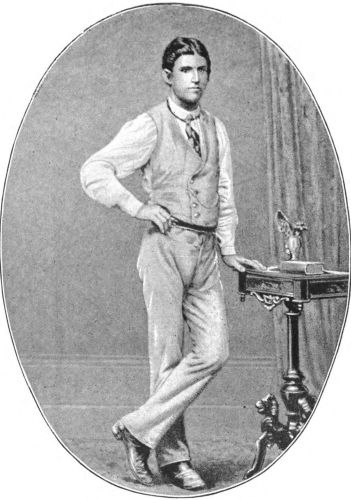
Steve Hart.
It is not positively known at what hour Joe Byrne and Steve Hart appeared on the scene, but it was some time in the morning. Throughout the day the four outlaws took possession of the township. They kept watching for persons passing Mrs. Jones's hotel, and they would call upon them to "bail up," and march them off to the hotel, which for the time being was converted into a prison-house by the outlaws. By the evening they had captured sixty-two people. Amongst those thus detained was Constable Bracken, an excellent ex-constable, who rejoined the force for the express purpose of assisting in the capture of the Kelly gang. He was a clever, shrewd, careful, quiet man. Young Reynolds, the son of a neighbour, came to the police station about eight or nine o'clock on Sunday night, and called Bracken to come outside to his father, who wanted him. The object in getting Reynolds to call Bracken, was to prevent the constable from recognizing the outlaw's voice, so the boy, who lived near the police station, was made to call him.
It was the habit of constables, when called by any one during the night, not to show themselves unless they had their revolvers in their hands. Bracken, hearing young Reynolds' voice, got up without taking this precaution; being unwell, he had gone to bed early. The moment he opened his door, which led into the yard, Ned Kelly, who was standing beside the boy, covered him with his revolver, and ordered him back into the house. One of the other outlaws was also present. Kelly at the time had his armour on, with a waterproof coat over all. They made Bracken dress himself, he being the only constable at the station, and told his wife that she was to remain in the barracks, and, if she gave information to any one, or answered any call during the night, they would shoot her husband. Mrs. Bracken said she looked out of her window two or three times during the night, and saw men watching her house. This may have been fancy or fear on her part. Bracken was marched off to Jones's hotel, and found sixty-two prisoners there. Dancing was going on, and everybody appeared in great spirits. Of course, amongst these sixty-two prisoners there were several of the Kellys' sympathizers, who, if a rush had been contemplated, would have given the gang warning. When Bracken was admitted into the room the doors were locked, so that nobody could leave. Dan Kelly had charge of the key which opened the front door, and Bracken kept watching him.
About ten or eleven o'clock at night Dan Kelly commenced to dance, and before doing so he put the key on a mantel-piece. Bracken sidled towards the fire-place, and taking the key, slipped it down his boot unobserved by any one. The dancing was kept up with great spirit until some one called out, "The train is approaching!" The outlaws at once went into an adjoining room and began to put on their armour, but no one knew what they were doing. About ten minutes afterwards the train stopped, and there was great excitement. Bracken saw his chance of escape. He took the key from his boot, opened the front door, and ran towards the railway station. The first thing the Kellys did when they came out of the side room was to look for Bracken, but they could not find him, and appeared very much annoyed.
About one o'clock on Sunday afternoon, 27th June, a messenger was sent to my hotel in Benalla, who told me that there was an important message for me at the telegraph office. I went there, and found that intelligence had come that Aaron Sherritt had been shot at his own house at nine o'clock the previous night by the outlaws. I at once sent a wire to Captain Standish, telling him of the circumstances, and requesting him to send the black trackers back to Benalla at once, as they had left for Melbourne on the previous Friday.
Captain Standish was out of town when the telegram arrived, and it did not reach him till about five in the afternoon. He then at once placed himself in communication with Mr. Ramsay, the chief secretary, and, strange to say, sent me a wire that he would send the trackers up by an early train next morning. I replied, "If they are not sent up by a special train to-night, they need not come at all." In the meantime Mr. Ramsay called on the Minister of Railways, and arranged to have a "special" ready to take the trackers back to Benalla, and they left town about eight or nine o'clock that night, and were to reach Benalla about 12.30 A.M. The officer in charge of the district and myself remained all the afternoon at the telegraph office, and I can never forget the assistance rendered me during that trying afternoon by that officer. Unfortunately, it being Sunday, many of the operators were away from their offices. We called as many as we could, and had to engage private individuals to convey on horse-back the intelligence to others, directing them to be ready for any emergency that might happen. We felt sure that something of importance would follow such a deed, but had no idea when or where it would take place, so that every possible precaution had to be taken.
We sent to the railway station and ordered a special train to be ready in case the trackers were not coming up that night, and I arranged to take a party of men from Benalla to Beechworth. Unfortunately, none of my old men were there, but still I had a very good lot. I had also two of our own black trackers, "Moses" and "Spider," both Queensland men, but they did not come specially to Victoria as trackers. I kept them, and would have taken them had the others not been sent back to me; and we also arranged, in the event of anything happening during my absence, to have a party of men ready to start off at a moment's notice.
We got a wire that the trackers would leave Melbourne that night, and so we decided to keep the special engine that was ready for us to act as a pilot to our train. Everything was in order to start off directly the men arrived. My plans were as follows:—The train with my own men, horses, and trackers would reach Beechworth about four o'clock in the morning (Monday); we would get our horses out directly we arrived, and start off to Sherritt's house, put the trackers on the outlaws' tracks, and endeavour to follow them.
We had made no other plans beyond these. In my own mind I felt convinced we should never reach Beechworth, but I told no one of my convictions. About ten o'clock I lay down to get an hour's sleep, and at midnight had all the horses and baggage put in the train, so that we could start off directly the trackers arrived. They reached Benalla a little after one, having had some delay on the road in consequence of having run through some gates, which flew up and broke the brakes.
It was decided by the railway authorities at Benalla that the engine that came from Melbourne should act as pilot. I had a consultation with the two engine-drivers before we started, telling them to be on the alert and keep a good look-out, as I felt sure either the rails would be pulled up, or something would happen before we got to Beechworth. The driver of the Benalla engine asked me to let a constable stand on the side-plate in front so as to keep a good look-out. I selected Constable Barry for this post. He was to fasten a strap round the brass rod which runs along the engine, and to put his arm through that to hold on by. It was afterwards stated that I had made him sit on the buffers. However, the driver of the pilot engine dispensed with his services, so Barry was not put in this dangerous position. I told the driver of my train on no account to let the pilot get more than a hundred yards away from him, and consulted the two drivers as to the most probable place for the rails to be interfered with. They fixed on the very spot where the rails were taken up. I told them to be very careful in going down the hill indicated. It was arranged we were not to stop between Benalla and Wangaratta, there being no occasion for doing so.
We left Benalla a little before two o'clock. The train from Melbourne had brought up the officer in charge of the five trackers, and five reporters connected with the Melbourne papers. The officer in charge of the trackers having recently been married, we allowed his wife and sister to accompany him in the train, intending that they should remain at Beechworth while he followed the tracks of the outlaws. I got into the compartment with the officer and the ladies, the reporters having a compartment to themselves, and the constables another. I had put my rifle on the rack of the carriage, and was just arranging to lie down and have a sleep, when the engine gave a whistle, and stopped. I jumped up, put my head out of the window, and saw the three red lights of the pilot just ahead of us. I loaded my rifle, jumped out of the train, and met the guard of the pilot coming towards me. We were then about a mile from Glenrowan. He told me that they had seen a red light on the line, and pulling up to ascertain what it was, found a man, who said he was the school-master, and stated that the Kelly gang had pulled up the line of rails, and he told the driver he must be very careful. This person then ran away, notwithstanding that the driver begged him to see me before he left. They told him I was in the train behind; but he said no, he had to return to his wife, and ran off. It afterwards turned out the man was Mr. Curnow, the local school-master, who, having no lamp by which to stop the train, got a red scarf and held a candle behind it when he heard the train approaching, but, having left his wife alone, he hurried back for fear some of the gang might see him.
After the guard of the pilot had related this story to me, I called four of my men, and putting two on each side of the line, we walked towards the engine. The driver told me the same story as the guard. I considered for a moment what was best to be done, consulting with my men, and thinking that the information given by the person representing himself as a school-master was a ruse, especially as Glenrowan was only about three miles from Kelly's house, I returned to my train (they were about 150 yards apart), and told those who were in the train to be prepared for any emergency, as I could not say what might happen. I put my senior constable with three men on the tender belonging to the train engine, and went myself with the three remaining men on the pilot engine, both being coupled together. In that way we went slowly along, half the men facing one side of the line, half the other, I myself standing beside the driver of the pilot engine.
In that way we approached Glenrowan station, which was all in darkness. When about fifty yards from the station the driver would insist that there was a man standing on the platform, but it was only his imagination. We pulled up, but not seeing or hearing any one about, we proceeded slowly into the station. I ordered the men to jump on to the platform, and keep a sharp look-out.
In order that the reader may have a clear idea of the events happening at Glenrowan, I break off here my own personal narrative to insert the account given before the police commissioner afterwards, by Mr. Curnow, one of the sixty-two prisoners confined in the hotel by the gang.
"On Sunday morning, 27th June, 1880, I determined to take my wife, sister, and child out for a drive along the road from Glenrowan to Greta. We left the school in a buggy at about eleven o'clock in the morning, accompanied by David Mortimer, my brother-in-law, who rode on horse-back. When we got in sight of Mrs. Jones's hotel, and opposite the railway crossing, through which we intended to pass, we noticed a number of people about the hotel, and at the crossing. I said, 'Mrs. Jones must be dead; she has been very ill.' As we got near the hotel, a man ran out of it towards Mrs. Jones's stable, distant about twenty yards from the hotel. I drove past the hotel to the crossing, and, seeing Mr. Stanistreet, asked him, 'What's the matter?' He replied, 'The Kellys are here; you can't go through.' I thought he was joking, and made a motion to drive through the gates, when a man on horse-back, who blocked up the crossing, and was talking to a young man whom I knew to be named Delaney, wheeled round his horse and said to me, 'Who are you?' I then saw that he had revolvers in his belt, and was convinced of the truth of Mr. Stanistreet's statement that the Kellys were there. I replied that I was the teacher at Glenrowan. He said, 'Oh! you are the school-master here, are you? and who are those?' pointing to my wife, sister, and brother-in-law. I told him. He then said, 'Where are you going?' I answered, 'Out for a drive.' He then said, 'I am sorry, but I must detain you,' and directed us to get out of the buggy, which we did. He then turned again to Delaney and resumed his conversation with him. I afterwards found that the man who had addressed me was Ned Kelly, the outlaw. I noticed another armed man near Ned Kelly, and I afterwards found out that he was Byrne.
"When we got out of the buggy, I led the horse off the crossing, and tied him to the railway fence alongside, directing Mrs. and Miss Curnow to go into Mr. Stanistreet's house, which they did. As soon as I had fastened the horse, I joined Mr. and Mrs. Stanistreet and others, who I was told had been taken prisoners by the gang, and was informed by them that Glenrowan had been stuck up since three o'clock that morning, and that the gang had forced Reardon and others to tear up part of the railway line beyond the station, for the purpose of wrecking a special train of police and black trackers, which the outlaws said would pass through Glenrowan. Some person—I believe it was one of the boys who had been bailed up by the gang—then told me that the Kellys had been at Beechworth during the previous night, and had shot several policemen.
"After some further conversation, we all listened to what Ned Kelly was saying to Delaney. The outlaw was accusing Delaney of having, some short time previously, ridden a horse from near Greta into Wangaratta to oblige a policeman, and of having sought admission into the police force. He threatened to shoot Delaney for this, and pointed a revolver at him several times. Ned Kelly declared to all of us who were listening to him, that he would have the life of any one who aided the police in any way, or who even showed a friendly feeling for them, and declared that he could and would find them out. He said that a law was made rendering it a crime for any one to help them (the outlaws), and that he would make it a crime for any one to aid the police against the Kelly gang. The women, who were listening to what Kelly was saying, asked him to let Delaney off. After keeping Delaney in a state of extreme terror for about half an hour, the outlaw made him promise never again to seek admission into the police force, and finally said, 'I forgive you this time; but, mind you, be careful for the future.' Byrne then produced a bottle of brandy, and offered some in a tumbler to all adults there. Some accepted it. Byrne drank some himself, and gave Delaney two-thirds of a tumbler, which he drank. Ned Kelly refused to take any, and directed some of his boy prisoners to take my horse and buggy into Mrs. Jones's yard, which they did.
"Ned Kelly and Byrne then went from the railway crossing to Mrs. Jones's hotel, preceded by the majority of their male prisoners, and I was with them. When we reached Mrs. Jones's there were, including those who had just been taken over, about fifty persons in and about the hotel, all of whom appeared to be prisoners of the gang. We were allowed to go about in the hotel, except into one room, which the outlaws used, and of which they kept the key, and we were allowed outside, but were forbidden to leave the premises. Dan Kelly, a short time after I entered the hotel, asked me to have a drink, and I drank with him at the bar. I said to him that I had been told they had been at Beechworth during the previous night, and had shot several police. I asked him whether it was true. He replied that they had been near Beechworth last night, and had done 'some shooting,' and that they had burned the 'devils out,' alluding to police. Byrne came in the bar, and, looking at Dan Kelly's glass, said, 'Be careful, old man.' Dan Kelly replied, 'All right,' and poured water into his brandy. While talking with Byrne and Dan Kelly, I expressed surprise at Glenrowan being stuck up by them, and they said that they had come to Glenrowan in order to wreck a special train of inspectors, police, and black trackers, which would pass through Glenrowan for Beechworth, to take up their trail from there. They said that they had ridden hard across country, often being up to the saddle-girths in water, to get to Glenrowan, and that they had had the line torn up at a dangerous part, and were going to send the train and its occupants to h—l.
"About one o'clock I was standing in the yard of Jones's hotel, thinking of the intentions of the gang, and I keenly felt that it was my duty to do anything that I could to prevent the outrage, which the outlaws had planned, from being accomplished, and I determined that I would try to do so. While standing in the yard, Dan Kelly came out of the hotel and asked me to go inside and have a dance. I said that I could not dance in the boots which I had on. Ned Kelly then came out of the hotel, and hearing me object to dance because of my boots, said, 'Come on; never mind your boots.' I said to him that it was awkward to me to dance in those boots, as I was lame, but that I would dance with pleasure if he would go to the school with me to get a pair of dancing boots. It flashed across my mind that, in passing the Glenrowan police barracks to reach my house, Bracken, the trooper stationed there, might see us, and would be able to give an alarm. I knew that Bracken had been stationed at Greta, and felt sure that he would recognize Ned Kelly. He (Ned Kelly) said that he would go, and we were getting ready, when Dan Kelly interfered, and said that Ned had better stay behind, and let him or Byrne go with me. Some one else also urged Ned Kelly not to go away, and said that my house was near the police barracks. Ned Kelly turned to me, and asked if it was. I said, 'Yes, we shall have to pass the barracks. I had forgotten that.' He then said that he would not go, and I went into the hotel, and danced with Dan Kelly.
"After we had finished dancing, Ned Kelly said that he would go down to the police barracks and bring Bracken, and Reynolds, the postmaster, up to Jones's. I laughed and said to him that I would rather he did it than I, and asked to be allowed to accompany him when he went, and to take home my wife, sister, and child. He gave me no reply. The intention to do something to baffle the murderous designs of the gang grew on me, and I resolved to do my utmost to gain the confidence of the outlaws, and to make them believe me to be a sympathizer with them. I saw clearly that unless I succeeded in doing this, I should not be able to get their permission to go home with my wife, child, and sister, and consequently should not be able to do anything to prevent the destruction of the special train and its occupants, by giving information to the police in Benalla, which I purposed doing if I could induce the outlaws to allow me and mine to go home. The outlaws kept a very sharp watch on their prisoners without seeming to do so.
"About three o'clock in the afternoon Ned and Dan Kelly caused several of their prisoners to engage in jumping, and in the hop, step, and jump. Ned Kelly joined with them, and used a revolver in each hand as weights. After the jumping was concluded, I left Jones's and went to Mrs. Stanistreet's house to see my wife and sister. They came out to meet me, and noticing the red llama scarf wrapped round my sister caused me to think, 'What a splendid danger signal that would make.' The idea of stopping the train by means of it then entered my mind, and made me still more anxious for liberty. I went with my wife and sister into Mr. Stanistreet's house, and saw Hart lying down on a sofa. He had three loaded guns by his side. He complained to me of having swollen and painful feet, caused, he said, by not having had his boots off for several days and nights. I advised him to bathe them in hot water, and asked for some for him. It was brought, and he followed my advice.
"Shortly after, Mr. Stanistreet and I were walking about at the back of his house, and Mr. Stanistreet expressed a wish that an alarm could be given. Mrs. Stanistreet came out to us, and I asked them if they thought it would be wrong to break a promise given to the outlaws. They said it would not. I then asked Mr. Stanistreet if the outlaws had taken his revolver from him. He said they had not. I saw what use this fact could be made of by me in my efforts to gain the confidence of the outlaws, and to make them believe that they could safely allow me to go home. I said to Mr. and Mrs. Stanistreet that we had better go inside, for I was afraid of being suspected by the gang if they saw us in private conversation, and we did so. I do not know whether Mr. and Mrs. Stanistreet suspected the use I intended making of my liberty if I got it; but afterwards I heard Mrs. Stanistreet saying to Ned Kelly that he ought to allow me to take home my sister, who was in delicate health.
"I was sitting in Mr. Stanistreet's when Dan Kelly came in, inquiring for a parcel in a small bag, which he had lost. He seemed very anxious about it, and examined the house throughout in search of it. He could not find it, and went to McDonald's hotel to see if it was there. He came back unsuccessful, and I went to Jones's with him, and he searched there, but failed to find it. When he gave up searching for it, I requested him to tell Ned that I wanted to speak to him. I was near the door of Jones's kitchen then. He went into the hotel and brought Ned Kelly out, and I told him that Mr. Stanistreet possessed a loaded revolver from the railway department, and advised them for their safety to obtain it, as some one might get it and do them an injury. They thanked me, and I perceived that I had in a great measure obtained their confidence by telling them this.
"About dusk I heard Ned Kelly saying to Mrs. Jones (they were standing between the hotel and the kitchen, which was a detached building) that he was going down soon to the police barracks to capture Bracken, and that he was going to take her daughter down to call him out. Mrs. Jones asked him not to take her. Ned Kelly said that he did not intend to shoot Bracken, and that her daughter must go. I advanced to them, and said to Ned Kelly that I thought it would be better for him to take Dave Mortimer, my brother-in-law, to call Bracken out, because Bracken knew his voice well, and by hearing it would suspect nothing. Ned Kelly, after a pause, said that he would do so. He then went to Mrs. Jones's stable, and I followed him, and asked if he would allow me to take my party home when he went down for Bracken; and I assured him that he had no cause for fearing me, as I was with him heart and soul. He replied, 'I know that, and can see it,' and he acceded to my request. I went over to Mrs. Stanistreet's and brought my wife and sister to Mrs. Jones's, and took them into the kitchen. Ned Kelly said that we must wait till he was ready to go. I found, on going back to Jones's, that a log fire had been made on the Wangaratta side of the hotel yard, and that many of the prisoners of the gang were standing around it.
"It was then dark. Other prisoners were in the hotel, and the outlaws encouraged them to amuse themselves by playing cards. I waited with my wife and sister in Jones's kitchen for, I believe, two or three hours, before Ned Kelly directed me to put my horse into the buggy. He and Byrne then went into the room which they had reserved for their own use. I drove to the front of Jones's hotel, and put my wife and sister and Alec Reynolds, the son of the postmaster at Glenrowan, who was about seven years of age, into the buggy. Ned Kelly directed me to take the little boy with us. We were kept waiting in front of the hotel about an hour. Ned Kelly then came to us on horse-back, and told me to drive on.
"It was then, I believe, about ten o'clock. As we got into the road, I found that we were accompanied by Ned Kelly, Byrne, and my brother-in-law, each on horse-back, and by a Mr. E. Reynolds and R. Gibbins on foot, both of whom resided with Mr. Reynolds, the Glenrowan postmaster. On the road down, Ned Kelly said that he was going to fill the ruts around with the fat carcases of the police. The outlaws each had a light-coloured overcoat on, and I was amazed at the bulky appearance which they presented. I had then no knowledge that the outlaws possessed iron armour. Each one carried a bundle in front of him, and in one hand a gun or a rifle.
"We reached the barracks, and were directed by Ned Kelly to halt about twenty yards distant from the front door of the building. Ned Kelly got off his horse, and fastened him to a fence near, ordering my brother-in-law to do the same, and he did so. Kelly then ordered him to advance to the barracks' door and knock, which he did. Ned Kelly got behind an angle of the walls, and levelled his rifle either at Dave Mortimer, or at the door. No reply came to the knocking or calling, though they were often and loudly repeated at Ned Kelly's whispered command. When I saw Kelly level his rifle, I told my party to get out of the buggy, which they did, and I advanced to my horse's head, for I thought Kelly might fire. I was then about seven or eight yards from Kelly. No result being produced by either knocking or calling, Ned Kelly left his position and advanced to Byrne, directing me, in an undertone, to call Mortimer away, which I did, and he came. Byrne, who had remained near us, and Ned Kelly, then spoke to one another, and Kelly took Alec Reynolds, the postmaster's son, and Mr. E. Reynolds, and passed with them into Reynolds's yard.
"We neither saw nor heard anything for, I think, more than an hour, when Ned Kelly appeared, having Bracken, E. Reynolds, and Bracken's horse with him. Kelly stopped when he reached us, and ordered Bracken to mount the horse brought round, and Bracken did so. Ned Kelly put a halter on the horse, which he kept hold of, saying, 'I can't trust you with the bridle, Bracken.' Bracken said to Ned Kelly that had he not been ill in bed all day he (Kelly) would not have taken him easily, and that if the horse he was on was what it used to be, it would take more than Ned Kelly to keep him a prisoner. Ned Kelly and Byrne mounted their horses, and I and my party got into the buggy.
"It was then, I believe, between eleven and twelve o'clock. Ned Kelly then said I could go home and take my party with me. He directed us to 'go quietly to bed, and not to dream too loud,' and intimated that if I acted otherwise we would get shot, as one of them would be down at our place during the night to see that we were all right. I then left them and drove home, distant from the barracks one or two hundred yards, leaving the outlaws and their captives ready to start back to the railway station. As soon as we were out of hearing of the outlaws, I announced to my wife and sister my intention to go to Benalla and give information as to the intentions and whereabouts of the outlaws. They both anxiously and earnestly opposed my purpose, saying that it was not at all likely that we should be allowed to come home unless some of the agents of the gang were watching; that I should not be able to reach Benalla, as I should be shot on the road by spies, and that, even if I succeeded, we should be hunted out and shot.
"While the discussion was going on, and supper was being got ready, I quietly prepared everything, including the red llama scarf, candle, and matches, to go to Benalla, intending to keep as close to the railway line as I could, in case of the special coming before I could reach there. I declared to my wife that I did not intend to go by the road—that I meant to keep as close to the line as possible in order to be safer. At last my sister gave way, but my wife worked herself into such an excited and hysterical state, that she declared that she would not leave the house—that if I would go, she would stay there, and she, baby, and my sister would be murdered. I wanted to take them to my mother-in-law's farm, about one-third of a mile from our place, for safety, while I was away. At length Mrs. Curnow consented to go to her mother's to obtain advice, and, as we were momentarily expecting the promised visit from one of the gang, I left the doors unlocked, and wrote a note, leaving it on the table, stating that we were gone to Mrs. Mortimer's to obtain medicine, as Miss Curnow was taken ill. My sister wore her red llama scarf, at my request. When we got there Mrs. Curnow was exceedingly anxious to get home again, and would not stay there, and we went back. I succeeded in persuading Mrs. Curnow to go to bed; and my sister and I told her I had given up my project.
"My sister engaged my wife's attention while I went out to harness my horse to go, for I could not rest, and felt that I must perform what was clearly my duty. I heard the train coming in the distance as I was harnessing the horse, and I immediately caught up the candle, scarf, and matches, and ran down the line to meet the train. I ran on until I got to where I could see straight before me some distance along the line, and where those in the train would be able to see the danger signal. I then lit the candle and held it behind the red scarf.
"As the guard's van got opposite me I caught sight of the guard, who shouted, 'What's the matter?' I yelled, 'The Kellys,' and the pilot engine then stopped a little past me, and the guard jumped down. I told the guard of the line being torn up just beyond the station, and of the Kelly gang lying in wait at the station for the special train of police. He said a special train was behind him, and he would go on to the station and then pull up. I cried, 'No, no! don't you do that, or you will get shot.' He then said that he would go back and stop the special which was coming on. He asked me who I was, and I told him I was the school teacher there, and requested him not to divulge who it was that stopped and warned him, as I was doing it at the risk of my life. He promised to keep my name secret. He asked me to jump in the van, but I declined, as my wife and sister were without protection. The pilot engine whistled several times while I was talking with the guard.
"The pilot went back, and I hastened home, and found Mrs. Curnow had been almost insane while I was stopping the train, and had been made worse by the whistling of the pilot engine. She would not leave the house after I had stopped the train, and we blew out the lights to seem to be in bed. My sister hid the red scarf and my wet clothes, and we were going to deny that it was I who had stopped the train, if one of the outlaws came down to us.
"After the first volleys had been fired, I, with an old man who lived opposite me, went up to Jones's to ascertain who were victorious, but we were ordered back by the police, and we returned home. While I was away my sister and wife had a terrible fright through Mr. Rawlings, who had accompanied the police, coming down to the school. They thought that he was Ned Kelly when he asked for the door to be opened. When I reached home I found Mr. Rawlings there. He asked me to draw a plan of Mrs. Jones's house, which I partly did; but, on hearing the train returning from Benalla, he hurried out, and stopping it, he got into it. During the Sunday afternoon I had heard Mr. Stanistreet ask Ned Kelly to allow the rails torn up to be replaced, and he pointed out to Ned Kelly the sacrifice of innocent lives which would ensue if the Monday morning's passenger train was wrecked. The outlaw refused to allow it to be done. In speaking of and to one another the outlaws had assumed names.
"In the Argus report (May 16th) of James Reardon's evidence, given before the Police Commission at Glenrowan, it is stated that James Reardon said he told me that 'the line was broken,' and that he also told me 'how the train could be stopped.' Mr. Reardon is labouring under a wrong impression. I am positive that he did not tell me how the train could be stopped. Stopping the train, nor how to stop it, was not mentioned to me by any one. Of this I am absolutely certain. I have been informed that an impression prevails that it was in my power, before the outlaws stuck up Glenrowan, to have furnished information to the authorities relating to the Kelly gang or their friends. Others assert that I was employed by the authorities to obtain information. I desire to emphatically state that this impression and assertion are both false.
"The outlaws were perfectly sober. One of them, I think Byrne, lay down on the bed about twelve o'clock in the day, and had a sleep, but the others were quite sober."
CHAPTER XI.
The Attack on the Hotel—Wounded.
I must now return to my own share in the undertaking. When we arrived at Glenrowan the station was in total darkness. I saw a light in the window of the station-master's house, which was about 100 yards from the platform. I asked a gentleman, Mr. Rawlings, who had come with me from Benalla in our special, to accompany me to the station-master's house, leaving all the men on the platform, telling them to keep a sharp look-out during my absence. I knocked at the window, and a woman, who was crying, opened it. I said to her, "Where is your husband?" She would not answer me. I asked her two or three times and could get no reply. At last I said, "My good woman, do calm yourself and answer me. I will see no harm come to you." She said nothing, but pointed in the direction of the Warby Ranges, and also in the direction of the hotel. I took her to mean that he was taken into the ranges. I said, "Who took him away?" She replied, "The Kellys." I said, "How long ago?" She replied, "Ten minutes."
I must here state that Hart guarded the station-master in his own house, and was with him the greater part of the night, and when he heard my train stop about a mile away he took Stanistreet, the station-master, up to Jones's hotel, and reported the matter to Ned Kelly. Stanistreet was put in with the remainder of the prisoners. Their object in doing this was, that they thought when the special arrived at Glenrowan the train might require some signal before it would pass, and that they would compel the station-master to give this while they covered him with their pistols. I left Mrs. Stanistreet, and returned to the platform with Rawlings. I told my men that the Kellys had been there ten minutes ago and had taken away the station-master, and ordered our horses to be taken out of the train as quickly as possible.
I had hardly given these orders, when I heard the sentry placed at the back of the platform call out, "Who goes there?" The reply was "Police." I saw a man getting over the back of the platform, and heard him calling out my name. I said, "Who is it?" He replied, "Bracken. Go quickly over to Mrs. Jones's, the outlaws are all there, and if you don't go this moment they will be gone." I called on the men to follow me. A voice cried out, "What shall I do with the horses?" I said, "Let them go." The men, when taking out the horses, had put down their arms and ammunition on the platform, and in the hurry had a difficulty in finding them. I called out, "Come on, men, or they will be gone." I saw two men standing beside me ready to start, and off I hurried, accompanied by these two. By the path we took, the hotel would be about 200 yards from the platform. I looked round whilst running, and saw several of the men following me.
The hotel, which was in total darkness, was a weather-board house with a verandah in front; not a sound came from it. The moon was setting behind the house; our approach could be seen distinctly by any one standing under the verandah, which to us was in total darkness. When I was within sixteen yards of the verandah I saw a flash, and heard a report from a rifle, fired from about a yard in front of the verandah, and my left hand dropped beside me. Three flashes came from under the verandah. The man who fired the first shot stepped back under the verandah, and began firing upon us. He called out, "Fire away, you beggars, you can do us no harm." One of the men beside me said, "That is Ned Kelly's voice." The four outlaws continued firing some minutes; I suppose they must have fired thirty or forty shots at us, as they had repeating rifles and revolvers. My men returned the fire very briskly; I fancy we must have fired at least fifty or sixty shots, for there were not only my men, but the trackers also, who were blazing away as hard as they could fire. We could only fire in the direction from which the flashes came, as the figures of the men were invisible in the darkness.
When we commenced firing, we were unaware there was any one in the house, until we heard the most fearful shrieks coming from inside the hotel from men, women, and children. We discovered afterwards that the front of the building, which the outlaws were standing against, was composed of thin weather-boards, and the Martini-Henry bullets were going through the building amongst the occupants. Two or three children were shot. There was a general cry to lie down, Bracken, with great forethought, before he left the house, having told them to do so. By this means most of them escaped without injury. Eventually the outlaws retreated inside the hotel, which was still in total darkness. There must have been a terrible scene inside.
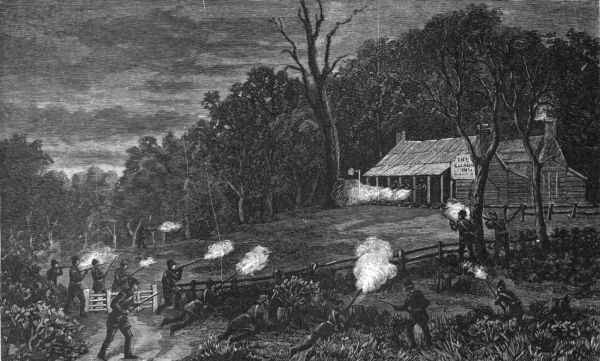
Night Attack on the Glenrowan Hotel.
The moment the outlaws retreated into the house I ordered my men to cease firing, and told them to surround the hotel and see that no one escaped, whilst I went to the railway platform to have my arm bandaged. It was bleeding fearfully; a bullet had entered one side of my wrist and gone out at the other. I went to the platform, where I found some of the reporters, one of whom kindly bandaged my wrist up. I made arrangements for a train to be sent to Benalla to inform the officer in charge of what had occurred, and to send a few more men up, as I had no notion what effect the firing had taken upon the outlaws.
At this time I had no idea how serious my wound was, as I had not felt very much pain in it. I then returned to the hotel. I tried to get through the fence, but was unable either to get over it or through it, in consequence of my hand being useless. I could see that the men had taken up their positions surrounding the house, and sat down in a position where I also had good command over the house. Having remained there about a quarter of an hour I began to feel very faint and dizzy; the wound was bleeding copiously. I attempted to stand up, but had great difficulty in doing so. I managed, however, to get back to the platform, but fell down in a faint from loss of blood. Some restoratives were given me and I recovered consciousness. I was put on the second engine that was at the platform, and sent to Benalla, the blood still running fast from the wound. On my arrival there it was five o'clock. I found a gentleman on the platform, and I asked him to accompany me to the doctor's house, and then to the telegraph station. Before I left Glenrowan I told them all I would be back immediately. I called at the doctor's, told him I had been wounded by Kelly, and requested him to follow me to the telegraph station, as I wanted to communicate with the other stations, and get them to send some assistance.
When I got to the telegraph office I was much exhausted, and terribly excited. I could not write, but got the telegraph master to write to my dictation. I sent messages to all surrounding stations, and just as I had finished, the doctor came in. He took the handkerchief off my arm and said that I was bleeding from the artery. I asked him to attend to it at once, as I wished to return to Glenrowan. The officer in charge also came into the office and I said, "Don't go without me, I shall be all right in a few minutes." His answer was, "Don't be such a glutton, you have got one bullet in you, and you want more." I said I was determined to go back. I remember their pulling a mattress on to the floor of the telegraph office, and my lying on it, and then I fainted away and continued unconscious for some time. When I recovered consciousness I felt terribly weak, and could scarcely stand. I was assisted to my hotel and went to bed.
I have hitherto merely given my personal experiences with reference to the capture of the Kelly gang, but I think the history would hardly be complete without a full account of all that transpired at Glenrowan during the capture. I have, therefore, taken the following narrative from The Age newspaper of the 29th of June, 1880—they had their own correspondent on the ground during the fight. A few errors have crept in, and these I have corrected in brackets; but on the whole it is a very fair account of what took place.
CHAPTER XII.
From The Age Newspaper, 29th June, 1880—The Start—The Journey—A Timely Warning—The Gang surprised—Death of Byrne—Capture of Ned Kelly—His Statement—The Prisoners released—Renewal of the Fight.
Benalla, Monday Night.
Immediately on the receipt of the news by Captain Standish on Sunday night that the Kellys had at last broken cover, and committed another diabolical outrage near Beechworth, he ordered a special train at once to start from Spencer Street. He was induced to do so because of the fact that Sub-inspector O'Connor had, with his black trackers, been withdrawn from the Kelly country. They were on the eve of their departure for Queensland, and were staying at Essendon. Captain Standish ordered the special train to convey the blacks to the scene of the outrage, so that they might there pick up the tracks of the dreaded gang; but no one at that time imagined that the expedition would have such a speedy and sensational termination; that, in fact, it would end in the annihilation of the band in a manner that must strike terror into the hearts of all sympathizers and men inclined to imitate the doings of the gang. When the news arrived at the station that a special train was required, all the engines were cold, and it was not till a quarter past ten o'clock that a start was made; and the small party of press gentlemen, who in good spirits took their seats in the carriage, little thought that the journey they were undertaking was of such a perilous nature. Only one gentleman was armed. At Essendon Inspector O'Connor and his five black trackers were picked up, together with Mrs. O'Connor and her sister, Miss Smith. [Those ladies intended to proceed to Beechworth and remain there whilst we went in pursuit of the gang.] The men were evidently in excellent spirits at the prospect of an encounter. The train proceeded rapidly on its way. At Craigieburn it ran through a gate, which carried away the brake of the engine, and necessitated a stoppage of about twenty minutes. After that, fair progress was made to Benalla, where Superintendent Hare, who was in waiting with eight men and seventeen horses, joined the party. Mr. Chas. C. Rawlings also became one of the number. The night was a splendid one, the moon shining with unusual brightness, whilst the sharp frosty air caused the slightest noise in the forest beyond to be distinctly heard. It was thought that the Kellys or some of their friends might place an obstruction on the line, and in order that danger in this direction should be avoided as much as possible, it was determined to lash one of the police to the front of the engine, so that he might there keep a good look-out. At the last moment this plan was abandoned, and it is a merciful intervention of Providence that it was so. Time certainly was lost by the change of tactics, but the loss was gain. There was a spare engine in the station, and it was determined to use this as a pilot. [The pilot was arranged for early in the afternoon.] Accordingly, it started about half a mile ahead of the special [only 100 yards], which it was intended to run through to Beechworth. Glenrowan is the next station to Benalla, being about fourteen miles distant.
However, when within a mile and a quarter of Glenrowan, just opposite Playford's and De Soir's paddocks, the special came to a sudden halt. Danger signals from the pilot engine were the cause, and in a very few seconds the pilot came back with an intimation that a man, in a state of great excitement, had stopped the engine, and had stated that Glenrowan was stuck up by the Kellys, who had torn up the lines just beyond the station in order to destroy the party which they knew would pass along the line in the special. The news and the stated intentions of the gang had not a cheering effect, but the police displayed an eagerness for action. The members of the press barricaded their windows with the cushions upon which they had previously sat, and in response to the request which some of the number made, the lights in the train were extinguished. It was then ten minutes to three o'clock, and Superintendent Hare was not long in determining what to do. The man who gave the information disappeared in the forest as soon as he had imparted his news, and his story was accepted with caution; but it was soon made apparent that he had saved the lives of those in the train, which to a certainty would, along with the pilot engine, have been hurled into a deep gully just below the Glenrowan Station, and behind a curve in the line which would have prevented the conductors from seeing the pilot go over the embankment where the rails had been torn up. Mr. Hare, with one or two of the police, proceeded in the pilot engine to the railway station, closely followed by the special. On arriving at the station the horses were quickly got out of the trucks by the men, whilst Mr. Hare, with one or two men and Mr. Rawlings, proceeded towards the Glenrowan Hotel to seek information. Mr. Rawlings, when he left Benalla, jocularly made a boast that they would bring back the remains of the outlaws. He little thought at that time that his prediction would prove to be absolutely correct.