Volume 2 — CHAP. XVII. THE DOWN-MARCH TO THE COAST.
Reading edition
On the 5th September 1858, Musa Mzuri—handsome Moses, as he was called by the Africans—returned with great pomp to Kazeh after his long residence at Karagwah. Some details concerning this merchant, who has played a conspicuous part in the eventful “peripéties” of African discovery, may be deemed well placed.
About thirty-five years ago, Musa, a Moslem of the Kojah sect, and then a youth, was driven by poverty from his native Surat to follow his eldest brother “Sayyan,” who having sought fortune at Zanzibar, and having been provided with an outfit by the Sayyid el Laghbari, then governor of the island, made sundry journeys into the interior. About 1825, the brothers first visited the Land of the Moon, preceding the Arab travellers, who in those days made their markets at Usanga and Usenga, distant about a dozen marches to the S.S.E. of Kazeh. Musa describes Unyamwezi as richly cultivated, and he has not forgotten the hospitable reception of the people. The brothers bought up a little venture of forty Farasilah or twenty men’s loads of cloth and beads, and returned with a joint stock of 800 Farasilah (800 × 35 = 28,000 lbs. avoirdupois) in ivory; as Sayyan died on the road, all fell to Musa’s share. Since that time he has made five journeys to the coast and several to the northern kingdoms. About four years ago Armanika, the present Sultan of Karagwah, was besieged in a palisaded village by a rebel brother Rumanika. On this occasion Musa, in company with the king, endured great hardships, and incurred no little risk; when both parties were weary of fighting, he persuaded, by a large bribe of ivory, Suna, the powerful despot of the neighbouring kingdom of Uganda, to raise the siege, by throwing a strong force into the field. He has ever since been fraternally received by Armanika, and his last journey to Karagwah was for the purpose of recovering part of the ivory expended in the king’s cause. After an absence of fifteen months he brought back about a score of splendid tusks, one weighing, he declared, upwards of 200 lbs. During his detention Salim bin Sayf, of Dut’humi, who had been entrusted by Musa with sixty-five Farasilah of ivory to barter for goods on the coast, arrived at Unyanyembe, when hearing the evil tidings, the wily Harisi appropriated the property and returned to whence he came. Like most merchants in East Africa, Musa’s business is extensive, but his gains are principally represented by outlying debts; he cannot, therefore, leave the country without an enormous sacrifice. He is the recognised Doyen of the commercial body, and he acts agent and warehouseman; his hall is usually full of buyers and sellers, Arab and African, and large investments of wires, beads, and cotton-cloths, some of them valuable, are regularly forwarded to him with comforts and luxuries from the coast.
Musa Mzuri is now a man of the uncertain “certain age” between forty-five and fifty, thin-bearded, tall, gaunt, with delicate extremities, and with the regular and handsome features of a high-caste Indian Moslem. Like most of his compatriots, he is a man of sad and staid demeanour, and he is apparently faded by opium, which so tyrannises over him that he carries pills in every pocket, and stores them, lest the hoard should run short, in each corner and cranny of his house. His clean new dress, perfumed with jasmine-oil and sandal-wood, his snowy skull-cap and well-fitting sandals, distinguish him in appearance from the Arabs; and his abode, which is almost a village, with its lofty gates and its spacious courts, full of slaves and hangers-on, contrasts with the humility of the Semite tenements.
On arrival at Kazeh I forwarded to Musa the introductory letter with which H. H. the Sayyid Majid had honoured me. Sundry civilities passed between his housekeeper, Mama Khamisi, and ourselves; she supplied the Baloch with lodgings and ourselves with milk, for which we were careful to reward her. After returning from Ujiji we found Abdullah, the eldest of Musa’s two sons by different slave girls, resting at Kazeh after his down-march from Karagwah. He knew a few words of English, but he had learned no Hindostani from his father, who curious to say, after an expatriation of thirty-five years, still spoke his mother-tongue purely and well. The youth would have become a greater favourite had he not been so hard a drinker and so quarrelsome in his cups; on more than one occasion he had dangerously cut or stabbed his servile boon-companions. Musa had spared the rod, or had used it upon him to very little purpose; after intruding himself repeatedly into the hall and begging for handsome clothes, with more instance of freedom than consisted with decorum, he was warned that if he stayed away it might be the better for his back, and he took the warning.
Musa, when rested after his weary return-march, called upon me with all due ceremony, escorted by the principal Arab merchants. I was not disappointed in finding him wholly ignorant concerning Africa and things African; Snay bin Amir had told me that such was the case. He had, however, a number of slaves fresh from Karagwah and Uganda, who confirmed the accounts previously received from Arab travellers in those regions. Musa displayed even more hospitality than his fellow-travellers. Besides the mbogoro or skinful of grain and the goat usually offered to fresh arrivals, he was ever sending those little presents of provisions which in the East cannot be refused without offence. I narrowly prevented his killing a bullock to provide us with beef, and at last I feared to mention a want before him. During his frequent visits he invariably showed himself a man of quiet and unaffected manners, dashed with a little Indian reserve, which in process of time would probably have worn off.
On the 6th September, Said bin Salim, nervously impatient to commence the march homewards, “made a khambi,” that is to say, pitched our tents under a spreading tree outside and within sight of Kazeh. Although he had been collecting porters for several days, only two came to the fore; a few refreshing showers were falling at the autumnal equinox, and the black peasantry so miscalculated the seasons that they expected the immediate advent of the great Masika. Moreover, when informed that our route would debouch at Kilwa, they declared that they must receive double pay, as they could not expect there to be hired by return caravans. That the “khambi” might assume an appearance of reality, the Baloch were despatched into “country-quarters.” As they followed their usual tactic, affecting eagerness to depart but privily clinging to the pleasures of Kazeh, orders were issued definitively to “cut” their rations in case of necessity. The sons of Ramji, who had returned from Msene, without, however, intrusion or swagger, were permitted to enter the camp. Before the march I summoned them, and in severe terms recapitulated their misdeeds, warned them that they would not be re-engaged, and allowed them provisions and protection only on condition of their carrying, as the slaves of Arab merchants are expected to do, our lighter valuables, such as the digester, medicine-chest, gun-cases, camp-table and chair. They promised with an edifying humility to reform. I was compelled, however to enliven their murmuring by a few slight floggings before they would become amenable to a moral rule, and would acquire those habits of regularity which are as chains and fetters to the African man. The five Wak’hutu porters who, after robbing and deserting us on the road to Ujiji, had taken service with my old acquaintance, Salim bin Rashid—the well-informed Coast Arab merchant, originally named by H. H. the Sayyid Majid, as my guide and caravan leader,—begged hard to be again employed. I positively refused to see them. If at this distance from home they had perjured themselves and had plundered us, what might be expected when they arrived near their native country?
As the time of departure approached, I regretted that the arrival of several travellers had not taken place a month earlier. Salim bin Rashid, whilst collecting ivory in Usukuma and to the eastward of the Nyanza Lake, had recovered a Msawahili porter, who, falling sick on the road, had been left by a caravan from Tanga amongst the wildest of the East African tribes, the Wamasai or Wahumba. From this man, who spent two years amongst those plunderers and their rivals in villany the Warudi, I derived some valuable information concerning the great northern route which spans the countries lying between the coast and the Nyanza Lake. I was also called upon by Amayr bin Said el Shaksi, a strong-framed and stout-hearted greybeard, who, when his vessel foundered in the waters of the Tanganyika, saved his life by swimming, and as he had no goods and but few of his slaves had survived, lived for five months on roots and grasses, till restored to Ujiji by an Arab canoe. A garrulous senior, fond of “venting his travels,” he spent many hours with me, talking over his past adventures, and his ocular knowledge of the Tanganyika enabled me to gather many, perhaps, reliable details concerning its southern extremity. A few days before departure Hilal bin Nasur, a well-born Harisi, returned from K’hokoro; he supplied me with a list of stations and a lengthy description of his various excursions to the southern provinces.[14]
Said bin Salim, in despair that the labours of a whole fortnight spent in the jungle had produced the slenderest of results, moved from under the tree in Kazeh plain to Masui, a dirty little village distant about three miles to the east of our head-quarters. As he reported on the 25th of September that his gang was nearly completed, I sent forward all but the personal baggage. The Arab had, however, secured but three Hammals or bearers for my hammock; one a tottering old man, the other a knock-kneed boy, and the third a notorious skulk. Although supplied with meat to strengthen them, as they expressed it, they broke down after a single march. From that time, finding it useless to engage bearers for a long journey in these lands, I hired men from district to district, and dismissed them when tired. The only objection to this proceeding was its inordinate expense: three cloths being generally demanded by the porter for thirty miles. A little calculation will give an idea of the relative cost of travelling in Africa and in Europe. Assuming each man to receive one cloth, worth one dollar, for every ten miles, and that six porters are required to carry the hammock, we have in Africa an expenditure on carriage alone of nearly half a crown per mile: in most parts of Europe travel on the iron road has been reduced to one penny.
Our return from Unyanyembe to the coast was to take place during the dead season, when provisions are most expensive and are not unfrequently unprocurable. But being “Wazungu” and well provided with “African money,” we might expect the people to sell to us their grain and stores, which they would have refused at tariff-prices to Arabs or Wasawahili. We carried as stock fourteen porters’ loads of cloth, viz., 645 domestics, 653 blue-cottons, and 20 coloured cloths, principally Debwani, Barsati, and Subai, as presents to chiefs. The supply of beads was represented by one load of ububu or black-porcelains—afterwards thrown away as useless—half a Frasilah (17·5 pounds) of “locust-legs,” or pink-porcelains, purchased from Sallum bin Hamid, and eight Kartasat or papered-bundles of the heavy and expensive “town-breakers,” vermilion or coral-porcelains, amounting to seventy Fundo, each of which covered as a rule the day’s minor expenses. The other stores were the fifty-four Jembe purchased at Msene, besides a few brought from Usukuma by my companion. These articles are useful in making up kuhonga or blackmail; in Ugogo and Usagara, which is their western limit, they double in value, and go even further than a white cotton-cloth. Finally, we had sixteen cows, heifers, and calves, bought in Usukuma by my companion, at the rate of six domestics per head. We expected them to be serviceable as presents, and meanwhile to add materially to our comfort by a more regular supply of milk than the villages afford. But, alas! having neglected to mark the animals, all were changed—a fact made evident by their running dry after a few days: the four calves presently died of fatigue; whenever an animal lay down upon the road its throat was summarily cut, others were left to stray and be stolen, and the last bullock preserved for a sirloin on Christmas was prematurely lost. A small per-centage proved useful as tribute to the chiefs of Ugogo, and served as rations when grain was unprocurable. The African, however, looks upon meat, not as “Posho”—daily bread—but as kitoweyo—kitchen: two or three pounds of beef merely whet his teeth for the usual Ugali or porridge of boiled flour. It is almost needless to state that, despite the best surveillance and the strictest economy, we arrived at the coast almost destitute; cloth and beads, hoes and cattle, all had disappeared, and had we possessed treble the quantity, it would have gone the same way.
The 26th September, 1858, saw us on foot betimes. The hospitable Snay bin Amir, freshly recovered from an influenza which had confined him for some days to his sleeping-mat, came personally to superintend our departure. As no porters had returned for property left behind, and as all the “cooking-pots” had preceded us on the yester, Snay supplied us with his own slaves, and provided us with an Arab breakfast, well cooked, and as usual, neatly served on porcelain plates, with plaited and coloured straw dish-covers, pointed like Chinese caps. Then, promising to spend the next day with me, he shook hands and followed me out of the compound. After a march of three miles, under a white-hot sun, and through a chilling wind, to which were probably owing our subsequent sufferings, we entered the dirty little village of Masui, where a hovel had been prepared for us by Said bin Salim. There we were greeted by the caravan, and we heard with pleasure that it was ready, after a fashion, to break ground.
Early on the next morning appeared Snay bin Amir and Musa Mzuri: as I was suffering from a slight attack of fever, my companion took my place as host. The paroxysm passing off, allowed me to settle all accounts with Snay bin Amir, and to put a finishing touch to the names of stations in the journal. I then thanked these kind-hearted men for their many good deeds, and promised to report to H. H. the Sayyid Majid the hospitable reception of his Arab subjects generally, and of Snay and Musa in particular. About evening time I shook hands with Snay bin Amir—having so primed the dear old fellow with a stirrup-cup of burnt-punch, that his gait and effusion of manner were by no means such as became a staid and stately Arab Shaykh.
On the 4th October, after a week of halts and snail’s marches—the insufficiency of porterage compelled me to send back men for the articles left behind at the several villages—we at last reached Hanga, our former quarters on the eastern confines of the Unyanyembe district. As long as we were within easy distance of Kazeh it was impossible to keep the sons of Ramji in camp, and their absence interfered materially with the completion of the gang. Several desertions took place, a slave given by Kannena of Ujiji to Said bin Salim, old Musangesi the Asinego, and two new purchases, male and female, made by the Baloch at Kazeh, disappeared after the first few marches. The porters were troublesome. They had divided themselves as usual into Khambi, or crews, but no regular Kirangozi having been engaged, they preferred, through mutual jealousy, following Shehe, one of the sons of Ramji. On the road, also, some heads had been broken, because the cattle-drivers had attempted to precede the line, and I feared that the fall of a chance shower might make the whole squad desert, under the impression that the sowing season had set in. In their idleness and want of excitement, they had determined to secure at Hanga the bullock claimed by down caravans at Rubuga. After four days’ halt, without other labour but that of cooking, they arose under pretext of a blow given by one of the children of Said bin Salim, and packing up their goods and chattels, poured in mass, with shouts and yells, from the village, declaring that they were going home. In sore tribulation, Said bin Salim and the Jemadar begged me to take an active part, but a short experience of similar scenes amongst the Bashi-Buzuks at the Dardanelles had made me wiser than my advisers: the African, like the Asiatic, is naturally averse to the operation proverbially called “cutting off one’s own nose;” but if begged not to do so, he may wax, like pinioned men, valorous exceedingly, and dare the suicidal deed. I did not move from my hut, and in half an hour everything was in statu quo ante. The porters had thrown the blame of the proceeding upon the blow, consequently a flogging was ordered for Said bin Salim’s “child,” who, as was ever the case, had been flagrantly in the wrong; but after return, evading the point, the plaintiffs exposed the true state of affairs by a direct reference to the bullock. Thus the “child” escaped castigation, and the bullock was not given till we reached Rubuga.
At Hanga my companion was taken seriously ill. He had been chilled on the line of march by the cruel easterly wind, and at the end of the second march from Kazeh he appeared trembling as if with ague. Immediately after arrival at the foul village of Hanga—where we lodged in a kind of cow-house, full of vermin, and exposed directly to the fury of the cold gales—he complained, in addition to a deaf ear, an inflamed eye, and a swollen face, of a mysterious pain which often shifted its seat, and which he knew not whether to attribute to liver or to spleen. It began with a burning sensation, as by a branding-iron, above the right breast, and then extended to the heart with sharp twinges. After ranging around the spleen, it attacked the upper part of the right lung, and finally it settled in the region of the liver. On the 10th October, suddenly waking about dawn from a horrible dream, in which a close pack of tigers, leopards, and other beasts, harnessed with a network of iron hooks, were dragging him like the rush of a whirlwind over the ground, he found himself sitting up on the side of his bedding, forcibly clasping both sides with his hands. Half-stupefied by pain, he called Bombay, who having formerly suffered from the “Kichyoma-chyoma”—the “little irons”—raised his master’s right arm, placed him in a sitting position, as lying down was impossible, and directed him to hold the left ear behind the head, thus relieving the excruciating and torturing twinges, by lifting the lung from the liver. The next spasm was less severe, but the sufferer’s mind had begun to wander, and he again clasped his sides, a proceeding with which Bombay interfered.
Early on the next morning, my companion, supported by Bombay and Gaetano, staggered towards the tent. Nearing the doorway, he sent in his Goanese, to place a chair for sitting, as usual, during the toils of the day, outside. The support of an arm being thus removed, ensued a second and violent spasm of cramps and twinges, all the muscles being painfully contracted. After resting for a few moments, he called his men to assist him into the house. But neglecting to have a chair previously placed for him, he underwent a third fit of the same epileptic description, which more closely resembled those of hydrophobia than aught I had ever witnessed. He was once more haunted by a crowd of hideous devils, giants, and lion-headed demons, who were wrenching, with superhuman force, and stripping the sinews and tendons of his legs down to the ankles. At length, sitting, or rather lying upon the chair, with limbs racked by cramps, features drawn and ghastly, frame fixed and rigid, eyes glazed and glassy, he began to utter a barking noise, and a peculiar chopping motion of the mouth and tongue, with lips protruding—the effect of difficulty of breathing—which so altered his appearance that he was hardly recognisable, and completed the terror of the beholders. When this, the third and the severest spasm, had passed away, he called for pen and paper, and fearing that increased weakness of mind and body might presently prevent any exertion, he wrote an incoherent letter of farewell to his family. That, however, was the crisis. He was afterwards able to take the proper precautions, never moving without assistance, and always ordering a resting-place to be prepared for him. He spent a better night, with the inconvenience, however, of sitting up, pillow-propped, and some weeks elapsed before he could lie upon his sides. Presently, the pains were mitigated, though they did not entirely cease: this he expressed by saying that “the knives were sheathed.” Such, gentle reader, in East Africa, is the kichyoma-chyoma: either one of those eccentric after-effects of fever, which perplex the European at Zanzibar, or some mysterious manifestation of the Protean demon Miasma.
I at once sent an express to Snay bin Amir for the necessary drugs. The Arabs treat this complaint by applying to the side powdered myrrh mixed with yoke of egg, and converted into a poultice with flour of mung (Phaseolus Mungo). The material was duly forwarded, but it proved of little use. Said bin Salim meanwhile, after sundry vague hints concerning the influence of the Father of Hair, the magnificent comet then spanning the western skies, insisted, as his people invariably do on such conjunctures, upon my companion being visited by the mganga, or medicine-man of the caravan. That reverend personage, after claiming and receiving the usual fee, a fat goat, anointed with its grease two little bits of wood strung on to a tape of tree-fibre, and contented himself with fastening this Mpigi—the negroid’s elixir vitæ—round my companion’s waist. The ligature, however, was torn off after a few minutes, as its only effect was to press upon and pain the tenderest part.
During the forced halt which followed my companion’s severe attack, I saw that, in default of physic, change of air was the most fitting restorative. My benumbed legs and feet still compelling me to use a hammock, a second was rigged up for the invalid; and by good fortune thirteen unloaded porters of a down caravan consented to carry us both for a large sum to Rubuga. The sons of Ramji were imperatively ordered to leave Kazeh under pain of dismissal, which none would incur as they had a valuable investment in slaves: with their aid the complement of porters was easily and speedily filled up.
Seedy Mubarak Bombay—in the interior the name became Mamba (a crocodile) or Pombe (small beer)—had long before returned to his former attitude, that of a respectful and most ready servant. He had, it is true, sundry uncomfortable peculiarities. A heaven-born “Pagazi,” he would load himself on the march with his “T’haka-t’haka,” or “chow-chow,” although a porter had been especially hired for him. He had no memory: an article once taken by him was always thrown upon the ground and forgotten: in a single trip he broke my elephant gun, killed my riding-ass, and lost its bridle. Like the Eastern Africans generally, he lacked the principle of immediate action; if beckoned to for a gun in the field he would probably first delay to look round, then retire, and lastly advance. He had a curious inverted way of doing all that he did. The water-bottle was ever carried on the march either uncorked or inverted; his waistcoat was generally wound round his neck, and it appeared fated not to be properly buttoned; whilst he walked bareheaded in the sun, his Fez adorned the tufty poll of some comrade; and at the halt he toiled like a charwoman to raise our tents and to prepare them for habitation, whilst his slave, the large lazy Maktubu, a boy-giant from the mountains of Urundi, sat or dozed under the cool shade. Yet with all his faults and failures Bombay, for his unwearied activity, and especially from his undeviating honesty,—there was no man, save our “Negro Rectitude,” in the whole camp who had not proved his claim to the title triliteral—was truly valuable. Said bin Salim had long forfeited my confidence by his carelessness and extravagance; and the disappearance of the outfit committed to him at Ujiji, in favour, as I afterwards learned, of an Arab merchant-friend, rendered him unfit for the responsibilities of stewardship.
Having summoned Said bin Salim, I told him with all gentleness, in order to spare his “shame”—the Persian proverb says, Fell not the tree which thou hast planted—that being now wiser in Eastern African travel than before, I intended to relieve him of his troublesome duties. He heard this announcement with the wriest of faces; and his perturbation was not diminished when informed that the future distribution of cloth should be wholly in the hands of Bombay, checked by my companion’s superintendence. The loads were accordingly numbered and registered; the Pagazi were forbidden, under pain of punishment, to open or to change them without permission; and Said bin Salim received, like the Baloch, a certain monthly amount of beads, besides rations of rice for the consumption of his children. This arrangement was persevered in till we separated upon the seaboard: it acted well, saving outfit, time, and a host of annoyances; moreover, it gave us command, as the African man, like the lower animals, respects only, if he respects anything, the hand that gives, that feeds him. It was wonderful to see how the “bone of contention,” cloth, having been removed, the fierceness of those who were formerly foes melted and merged into friendship and fraternisation. The triad of bitter haters, Said bin Salim, the monocular Jemadar, and Muinyi Kidogo, now marched and sat and ate together as if never weary of such society; they praised one another openly and without reserve, and if an evil tale ever reached my ear its subject was the innocent Bombay—its object was to ruin him in my estimation.
Acutely remembering the trouble caused by the feuds between Said bin Salim and Kidogo upon the subject of work, I directed the former to take sole charge of the porters, to issue their rations, and to superintend their loads. The better to assist him, two disorderly sons of Ramji were summarily flogged, and several others who refused to carry our smaller valuables were reduced to order by the usual process of stopping rations. “Shehe,” though chosen as Kirangozi or guide from motives of jealousy by the porters, was turned out of office; he persisted in demanding cloth for feeing an Unyamwezi medicine-man, in order to provide him, a Moslem! with charms against the evil eye, a superstition unknown to this part of Eastern Africa. The Pagazi, ordered to elect one of their number, named the youth Twánígáná, who had brought with him a large gang. But the plague of the party, a hideous, puckered, and scowling old man who had called himself “Muzungu Mbaya,” or the “Wicked White,” so far prevailed that at the first halt Twanigana, with his blushing honours in the shape of a scarlet waistcoat fresh upon him, was found squatting solus under a tree, the rest of the party having mutinously preceded him. I halted at once and recalled the porters, who, after a due interval of murmuring, reappeared. And subsequently, by invariably siding with the newly-made Kirangozi, and by showing myself ready to enforce obedience by any means and every means, I gave the long-legged and weak-minded youth, who was called “Gopa-Gopa”—“Funk-stick”—on account of his excessive timidity, a little confidence, and reduced his unruly followers to all the discipline of which their race is capable.
As we were threatened with want of water on the way, I prepared for that difficulty by packing a box with empty bottles, which, when occasion required, might be filled at the best springs. The Zemzemiyah or travelling canteen of the East African is everywhere a long-necked gourd, slung to the shoulder by a string. But it becomes offensive after a short use, and it can never be entrusted to servant, slave, or porter without its contents being exhausted before a mile is measured.
By these arrangements, the result of that after-wisdom which some have termed fools’ wit, I commenced the down march under advantages, happy as a “bourgeois” of trappers in the joyous pays sauvage. I have detailed perhaps to a wearisome length the preparations for the march. But the success of such expeditions mainly depends upon the measures adopted before and immediately after departure, and this dry knowledge may be useful to future adventurers in the great cause of discovery.
The stages now appeared shorter, the sun cooler, the breeze warmer; after fourteen months of incessant fevers, the party had become tolerably acclimatised; all were now loud in praise, as they had been violent in censure, of the “water and air.” Before entering the Fiery Field, the hire for carrying the hammocks became so exorbitant that I dismissed the bearers, drew on my jack-boots, mounted the half-caste Zanzibari ass, and appeared once more as the Mtongi of a caravan. After a fortnight my companion had convalesced so rapidly that he announced himself ready to ride. The severe liver pains had disappeared, leaving behind them, however, for a time, a harassing heart-ache and nausea, with other bilious symptoms, which developed themselves when exposed to the burning sun of the several tirikeza. Gradually these sequelæ ceased, sleep and appetite returned, and at K’hok’ho, in Ugogo, my companion had strength enough to carry a heavy rifle, and to do damage amongst the antelope and the guinea fowl. Our Goanese servants also, after suffering severely from fever and face-ache, became different men; Valentine, blessed with a more strenuous diathesis, carried before him a crop like a well-crammed capon. As the porters left this country, and the escort approached their homes, there was a notable change of demeanour. All waxed civil, even to servility, grumbling ceased, and smiles mantled every countenance. Even Muzungu Mbaya, who in Unyamwezi had been the head and front of all offence, was to be seen in Ugogo meekly sweeping out our tents with a bunch of thorns.
We left Hanga, the dirty cow-village, on the 13th October. The seven short marches between that place and Tura occupied fifteen days, a serious waste of time and cloth, caused by the craving of the porters for their homes. It was also necessary to march with prudence, collisions between the party and the country-people, who are unaccustomed to see the articles which they most covet carried out of the country, were frequent: in fact we flew to arms about every second day, and after infinite noise and chatter, we quitted them to boast of the deeds of “derring do,” which had been consigned to the limbo of things uncreate by the fainéance of the adversary. At Eastern Tura, where we arrived on the 28th October, a halt of six days was occasioned by the necessity of providing and preparing food, at that season scarce and dear, for the week’s march through the Fiery Field. The caravan was then mustered, when its roll appeared as follows. We numbered in our own party two Europeans, two Goanese, Bombay with two slaves—the child-man Nasibu and the boy-giant Maktubu—the bull-headed Mabruki, Nasir, a half-caste Mazrui Arab, who had been sent with me by the Arabs of Kazeh to save his morals, and Taufiki, a Msawahili youth, who had taken service as gun-carrier to the coast: they formed a total of 10 souls. Said bin Salim was accompanied by 12—the charmers Halimah and Zawada, his five children, and a little gang of five fresh captures, male and female. The Baloch, 12 in number, had 15 slaves and 11 porters, composing a total of 38. The sons of Ramji, and the ass-drivers under Kidogo their leader, were in all 24, including their new acquisitions. Finally 68 Wanyamwezi porters, carrying the outfit and driving the cattle, completed the party to 152 souls.
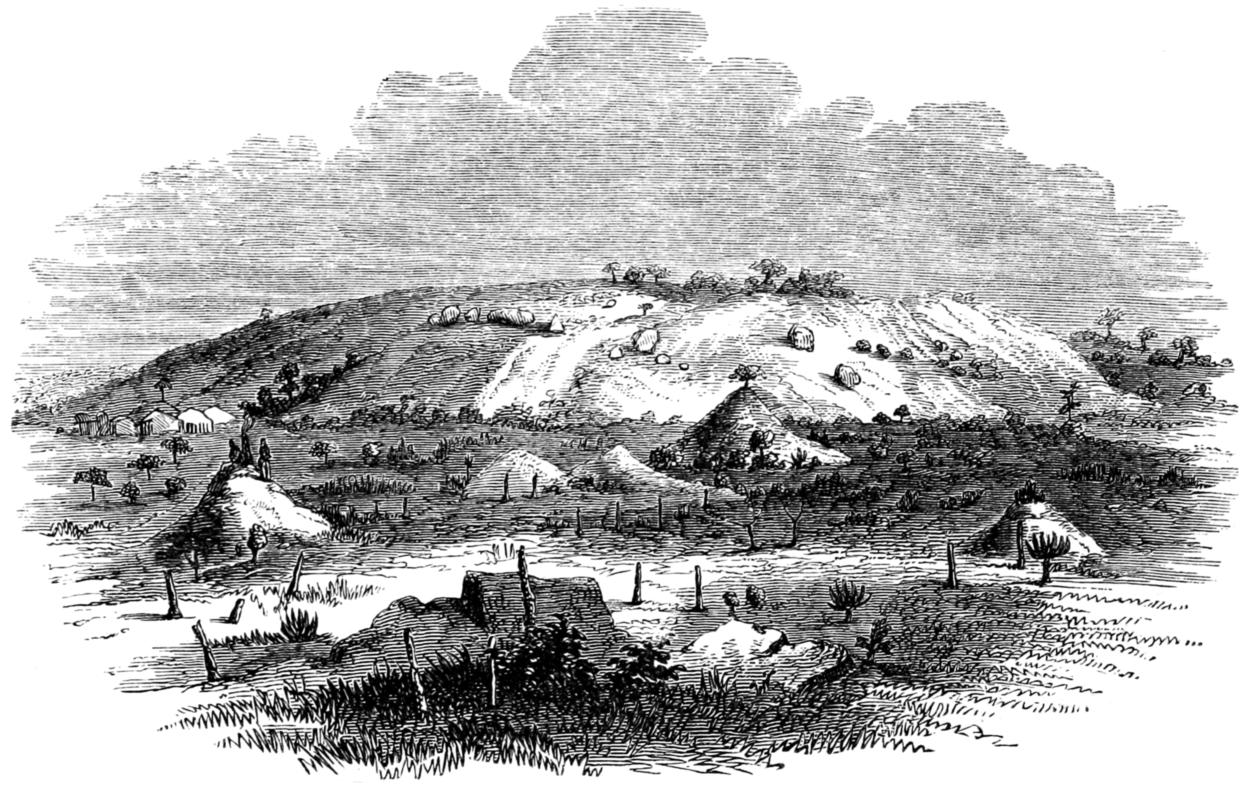
Jiwe la Mkoa, the Round Rock.
On the 3rd November, the caravan issuing from Tura plunged manfully into the Fiery Field, and after seven marches in as many days, halted for breath and forage at Jiwe la Mkoa, the Round Stone. A few rations having been procured in its vicinity, we resumed our way on the 12th November, and in two days exchanged, with a sensible pleasure, the dull expanse of dry brown bush and brushwood, dead thorn-trees, and dry Nullahs, for the fertile red plain of Mdaburu. After that point began the transit of Ugogo, where I had been taught to expect accidents: they resolved themselves, however, into nothing more than the disappearance of cloth and beads in inordinate quantities. We were received by Magomba, the Sultan of Kanyenye, with a charge of magic, for which of course it was necessary to pay heavily. The Wanyamwezi porters seemed even more timid on the down-journey than on the up-march. They slank about like curs, and the fierce look of a Mgogo boy was enough to strike a general terror. Twanigana, when safe in the mountains of Usagara, would frequently indulge me in a dialogue like the following, and it may serve as a specimen of the present state of conversation in East Africa:—
“The state, Mdula?” (i.e. Abdullah, a word unpronounceable to Negroid organs.)
“The state is very! (well) and thy state?”
“The state is very! (well) and the state of Spikka? (my companion).”
“The state of Spikka is very! (well.)”
“We have escaped the Wagogo (resumes Twanigana), white man O!”
“We have escaped, O my brother!”
“The Wagogo are bad.”
“They are bad.”
“The Wagogo are very bad.”
“They are very bad.”
“The Wagogo are not good.”
“They are not good.”
“The Wagogo are not at all good.”
“They are not at all good.”
“I greatly feared the Wagogo, who kill the Wanyamwezi.”
“Exactly so!”
“But now I don’t fear them. I call them ——s and ——s, and I would fight the whole tribe, white man O!”
“Truly so, O my brother!”
And thus for two mortal hours, till my ennui turned into marvel. Twanigana however was, perhaps, in point of intellect somewhat below the usual standard of African young men. Older and more experienced was Muzungu Mbaya, and I often listened with no small amusement to the attempts made by the Baloch to impress upon this truly African mind a respect for their revelation. Gul Mohammed was the missionary of the party: like Moslems generally, however, his thoughts had been taught to run in one groove, and if disturbed by startling objections, they were all abroad. Similarly I have observed in the European old lady, that on such subjects all the world must think with her, and I have been suspected of drawing the long-bow when describing the worship of gods with four arms, and goddesses with two heads.
Muzungu Mbaya, as the old hunks calls himself, might be sitting deeply meditative, at the end of the march, before the fire, warming his inner legs, smoking his face, and ever and anon casting pleasant glances at a small black earthen pipkin, whence arose the savoury steam of meat and vegetables. A concatenation of ideas induces Gul Mohammed to break into his favourite theme.
“And thou, Muzungu Mbaya, thou also must die!”
“Ugh! ugh!” replies the Muzungu personally offended, “don’t speak in that way! Thou must die too.”
“It is a sore thing to die,” resumes Gul Mohammed.
“Hoo! Hoo!” exclaims the other, “it is bad, very bad, never to wear a nice cloth, no longer to dwell with one’s wife and children, not to eat and drink, snuff, and smoke tobacco. Hoo! Hoo! it is bad, very bad!”
“But we shall eat,” rejoins the Moslem, “the flesh of birds, mountains of meat, and delicate roasts, and drink sugared water, and whatever we hunger for.”
The African’s mind is disturbed by this tissue of contradictions. He considers birds somewhat low feeding, roasts he adores, he contrasts mountains of meat with his poor half-pound in pot, he would sell himself for sugar; but again he hears nothing of tobacco; still he takes the trouble to ask
“Where, O my brother?”
“There,” exclaims Gul Mohammed, pointing to the skies.
This is a “chokepear” to Muzungu Mbaya. The distance is great, and he can scarcely believe that his interlocutor has visited the firmament to see the provision; he therefore ventures upon the query,
“And hast thou been there, O my brother?”
“Astaghfar ullah (I beg pardon of Allah)!” ejaculates Gul Mohammed, half angry, half amused. “What a mshenzi (pagan) this is! No, my brother, I have not exactly been there, but my Mulungu (Allah) told my Apostle[15], who told his descendants, who told my father and mother, who told me, that when we die we shall go to a Shamba (a plantation), where——”
“Oof!” grunts Muzungu Mbaya, “it is good of you to tell us all this Upumbafu (nonsense) which your mother told you. So there are plantations in the skies?”
“Assuredly,” replies Gul Mohammed, who expounds at length the Moslem idea of paradise to the African’s running commentary of “Nenda we!” (be off!), “Mama-e!” (O my mother!) and “Tumbanina,” which may not be translated.
Muzungu Mbaya, who for the last minute has been immersed in thought, now suddenly raises his head; and, with somewhat of a goguenard air, inquires:
“Well then, my brother, thou knowest all things! answer me, is thy Mulungu black like myself, white like this Muzungu, or whity-brown as thou art?”
Gul Mohammed is fairly floored: he ejaculates sundry la haul! to collect his wits for the reply,—
“Verily the Mulungu hath no colour.”
“To-o-oh! Tuh!” exclaims the Muzunga, contorting his wrinkled countenance, and spitting with disgust upon the ground. He was now justified in believing that he had been made a laughing-stock. The mountain of meat had, to a certain extent, won over his better judgment: the fair vision now fled, and left him to the hard realities of the half-pound. He turns a deaf ear to every other word; and, devoting all his assiduity to the article before him, he unconsciously obeys the advice which many an Eastern philosopher has inculcated to his disciples—
“Hold fast the hour, though fools say nay, The spheres revolve, they bring thee sorrow; The wise enjoys his joy to-day, The fool shall joy his joy to-morrow.”
The transit of Ugogo occupied three weeks, from the 14th of November to the 5th of December. In Kanyenye we were joined by a large down-caravan of Wanyamwezi, carrying ivories; the musket-shots which announced the conclusion of certain brotherly ties between the sons of Ramji and the porters, sounded in my ears like minute-guns announcing the decease of our hopes of a return to the coast viâ Kilwa. At Kanyenye, also, we met the stout Msawahili Abdullah bin Nasib, alias Kisesa, who was once more marching into Unyamwezi: he informed me that the slaughter of Salim bin Nasir, the Bu-Saidi, and the destruction of the Rubeho settlements, after the murder of a porter, had closed our former line through Usagara. He also supplied me with valuable tea and sugar, and my companion with a quantity of valueless, or perhaps misunderstood, information, which I did not deem worth sifting. On the 6th of December, arrived at our old ground in the Ugogi Dhun, we were greeted by a freshly-arrived caravan, commanded by Jumah bin Mbwana and his two brothers, half-caste Hindi or Indian Moslems, from Mombasah.
The Hindis, after receiving and returning news with much solemnity, presently drew forth a packet of letters and papers, which as usual promised trouble. This time, however, the post was to produce the second manner of annoyance—official “wigging,”—the first being intelligence of private misfortune. Imprimis, came a note from Captain Rigby, the newly-appointed successor to Lieut.-Col. Hamerton at Zanzibar, and that name was not nice in the nostrils of men. Secondly, the following pleasant announcement. I give the whole letter:
Dear Burton,—Go ahead! Vogel and Macguire dead—murdered. Write often to Yours truly, N. S.
And thirdly came the inevitable official wig.
Convinced, by sundry conversations with Arabs and others at Suez and Aden, during my last overland journey to India, and by the details supplied to me by a naval officer who was thoroughly conversant with the Red Sea, that, in consequence of the weakness and insufficiency of the squadron then employed, slavery still flourished, and that the numerous British subjects and protegés were inadequately protected, I had dared, after arrival at Zanzibar, privately to address on the 15th of December, 1856, a letter upon the subject to the secretary of the Royal Geographical Society. It contained an “Account of Political Affairs in the Red Sea,”—to quote the words of the paper, and expressed a hope that it might be “deemed worthy to be transmitted to the Court of Directors, or to the Foreign Office.”[16] The only acknowledgment which I received, was the edifying information that the Secretary to Government, Bombay, was directed by the Right Honourable the Governor in Council, Bombay, to state that my “want of discretion and due regard for the authorities to whom I am subordinate, has been regarded with displeasure by the Government.”
This was hard. I have perhaps been Quixotic enough to attempt a suggestion that, though the Mediterranean is fast becoming a French lake, by timely measures the Red Sea may be prevented from being converted into a Franco-Russo-Austrian lake. But an Englishman in these days must be proud, very proud, of his nation, and withal somewhat regretful that he was not born of some mighty mother of men—such as Russia and America—who has not become old and careless enough to leave her bairns unprotected, or cold and crusty enough to reward a little word of wisdom from her babes and sucklings with a scolding or a buffet.
The sore, however, had its salve. The official wig was dated the 23rd of July, 1857. Posts are slow in Africa. When received on the 5th of December, 1858, it was accompanied by a copy of a Bombay Newspaper, which reported that on the 30th of June, 1858, “a massacre of nearly all the Christians took place at Juddah, on the Red Sea,” and that “it was apprehended that the news from Juddah might excite the Arab population of Suez to the commission of similar outrages.”
At Ugogi, which, it will be remembered, is considered the half-way station between Unyanyembe and the coast, the sons of Ramji and the porters detained us for a day, declaring that there was a famine upon the Mukondokwa road which we had previously traversed. At the same time they warned us that we should find the great chief, who has given a name to the Kiringawana route, an accomplished extortioner, and one likely to insist upon our calling upon him in person. Having given their ultimatum, they would not recede from it: for us, therefore, nothing remained but to make a virtue of necessity. We loaded on the 7th of December, and commenced the passage of the Usagara mountains by the Kiringawana line.
I must indent upon the patience of the reader by a somewhat detailed description of this southern route, which is separated from the northern by a maximum interval of forty-three miles. The former being the more ancient, contains some settlements like Maroro and Kisanga, not unknown by report to European geographers. It is preferred by down-caravans, who have no store of cloth to be demanded by the rapacious chiefs: the up-country travellers, who have asses, must frequent the Mukondokwa, on account of the severity of the passes on the Kiringawana.
The Kiringawana numbers nineteen short stages, which may be accomplished without hardship in twelve days, at the rate of about five hours per diem. Provisions are procurable in almost every part, except when the Warori are “out;” and water is plentiful, if not good. Travel is rendered pleasant by long stretches of forest land without bush or fetid grass. The principal annoyances are the thievish propensities of the natives and the extortionate demands of the chief. A minor plague is that of mosquitoes, that haunt the rushy banks of the hill rivulets, some of which are crossed nine or ten times in the same day; moreover, the steep and slippery ascents and descents of black earth and mud, or rough blocks of stone, make the porters unwilling to work.
Breaking ground at 6 A.M. on the 7th December, we marched to Murundusi, the frontier of Usagara and Uhehe. The path lay over a rolling thorny jungle with dottings of calabash at the foot of the Rubeho mountains, and lumpy outliers falling on the right of the road. After three hours’ march, the sound of the horses announced the vicinity of a village, and the country opening out, displayed a scene of wonderful fertility, the effect of subterraneous percolations from the highlands. Nowhere are the tamarind, the sycamore, and the calabash, seen in such perfection; of unusual size also are the perfumed myombo and the mkora, the myongo, the ndabi, the chamvya, with its edible yellowish-red berries, and a large sweet-smelling acacia. Amidst these piles of verdure, troops of parroquets, doves, jays, and bright fly-catchers, find a home, and frequent flocks and herds, a resting-place beneath the cool shade. The earth is still sprinkled with “black-jacks,” the remains of trees which have come to an untimely end. In the fields near the numerous villages rise little sheds to shelter the guardians of the crops, and cattle wander over the commons or unreclaimed lands. Water, which is here pure and good, lies in pits from fifteen to twenty feet deep, staged over with tree trunks, and the people draw it in large shallow buckets, made of gourds sewn together and strengthened with sticks. Towards the evening, a cold east-wind brought up with it a storm of thunder and rain, which was pronounced by the experts to be the opening of the rainy monsoon in Usagara.
The next day led us over an elevated undulation cut by many jagged watercourses, and still flanked by the outlying masses which fall westward into the waste of Mgunda M’khali. After an hour’s march, we turned abruptly eastwards, and crossing a rugged stony fork, presently found a dwarf basin of red soil which supplied water. The Wahehe owners of the land have a chronic horror of the Warori; on sighting our peaceful caravan, they at once raised the war-cry, and were quieted only by the certainty that we were even more frightened than they were. At Kinganguku, the night was again wild and stormy; in fact, after leaving Ugogi, we were regularly rained upon till we had crossed the Mountains.
On the 9th December, we marched in six hours from Kinyanguku to Rudi, the principal district of Uhehe. It was an ascent plunging into the hills, which, however, on this line are easy to traverse, compared with those of the northern route; the paths were stony and rugged, and the earth was here white and glaring, there of a dull red colour. Water pure and plentiful was found in pits about fifteen feet deep, which dented the sole of a picturesque Fiumara. The people assembled to stare with the stare pertinacious; they demanded large prices for their small reserves of provisions, but they sold tobacco at the rate of two or three cakes, each weighing about one pound and a half, for a shukkah.
Passing from the settlements of Rudi, on the next morning we entered a thorn jungle, where the handiwork of the fierce Warori appeared in many a shell of smoke-stained village. We then crossed two Fiumaras exactly similar to those which attract the eye in the Somali country, broad white sandy beds, with high stiff earth-banks deeply water-cut, and with huge emerald-foliaged trees rising from a hard bare red plain. After a short march of three hours, we pitched under a tamarind, and sent our men abroad to collect provisions. Tobacco was cheap, as at Rudi, grain and milk, whether fresh or sour, were expensive, and two shukkahs were demanded for a lamb or a young goat. The people of Mporota are notorious pilferers. About noontide a loud “hooroosh” and the scampering of spearmen over the country announced a squabble; presently our people reappeared driving before them a flock which they had seized in revenge for a daring attempt at larceny. I directed them to retain one fine specimen—the lex talionis is ever the first article of the penal code in the East—and to return the rest. Notwithstanding these energetic measures, the youth Taufiki awaking in the night with a shriek like one affected by nightmare, found that a Mhehe robber had snatched his cloth, and favoured by the shades had escaped with impunity. The illness of Said bin Salim detained us for a day in this den of thieves.
The 12th December carried us in three hours from Mporota to Ikuka of Uhehe. The route wound over red steps amongst low stony hills, the legs of the spider-like system, and the lay of the heights was in exceeding confusion. Belted by thorny scrub and forests of wild fruit trees—some edible, others poisonous—were several villages, surrounded by fields, especially rich in ground-nuts. Beyond Ikuka the road entered stony and rugged land, with a few sparse cultivations almost choked by thick bushy jungle; the ragged villages contained many dogs, and a few peculiarly hideous human beings. Thence it fell into a fine Fiumara, with pure sweet water in pools, breaking the surface of loose white sand; upon the banks, red soil, varying from a few inches to 20 feet in depth, overlay bands and lines of rounded pebbles, based on beds of granite, schiste, and sandstone. After ascending a hill, we fell into a second watercourse, whose line was almost choked with wild and thorny vegetation, and we raised the tents in time to escape a pitiless pelting, which appeared to spring from a gap in the southern mountains. The time occupied in marching from Ikuka to Inena of Usagara was four hours, and, as usual in these short stages, there was no halt.
Two porters were found missing on the morning of the 14th December,—they had gone for provisions, and had slept in the villages,—moreover, heavy clouds hanging on the hill-tops threatened rain: a Tirikeza was therefore ordered. At 11 A.M. we set out over rises, falls, and broken ground, at the foot of the neighbouring highlands which enclose a narrow basin, the seat of villages and extensive cultivation. Small cascades flashing down the walls that hemmed us in showed the copiousness of the last night’s fall. After five hours’ heavy marching, we forded a rapid Fiumara, whose tall banks of stiff red clay, resting upon tilted-up strata of greenstone, enclosed a stream calf-deep, and from 10 to 12 feet broad. At this place, called Ginyindo, provisions were hardly procurable; consequently the caravan, as was its wont on such occasions, quarrelled for disport, and the Baloch, headed by “Gray-beard Musa,” began to abuse and to beat the Pagazis.
The morning of the 15th December commenced with a truly African scene. The men were hungry, and the air was chill. They prepared, however, to start quietly betimes. Suddenly a bit of rope was snatched, a sword flashed in the air, a bow-horn quivered with nocked arrow, and the whole caravan rushed frantically with a fearful row to arms. As no one dissuaded the party from “fighting it out,” they apparently became friends, and took up their loads. My companion and I rode quietly forward: scarcely, however, had we emerged from the little basin in which the camp had been placed, than a terrible hubbub of shouts and yells announced that the second act had commenced. After a few minutes, Said bin Salim came forward in trembling haste to announce that the Jemadar had again struck a Pagazi, who, running into the Nullah, had thrown stones with force enough to injure his assailant, consequently that the Baloch had drawn their sabres and had commenced a general massacre of porters. Well understanding this misrepresentation, we advanced about a mile, and thence sent back two of the sons of Ramji to declare that we would not be delayed, and that if not at once followed, we would engage other porters at the nearest village. This brought on a denouement: presently the combatants appeared, the Baloch in a high state of grievance, the Africans declaring that they had not come to fight but to carry. I persuaded them both to defer settling the business till the evening, when both parties well crammed with food listened complacently to that gross personal abuse, which, in these lands, represents a reprimand.
Resuming our journey, we crossed two high and steep hills, the latter of which suddenly disclosed to the eye the rich and fertile basin of Maroro. Its principal feature is a perennial mountain stream, which, descending the chasm which forms the northern pass, winds sluggishly through the plain of muddy black soil and patches of thick rushy grass, and diffused through watercourses of raised earth, covers the land with tobacco, holcus, sweet-potato, plantains, and maize. The cereals stood five feet high, and were already in ear: according to the people, never less than two, and often three and four crops are reaped during the year. This hill-girt district is placed at one month’s march from the coast. At the southern extremity, there is a second opening like the northern, and through it the “River of Maroro” sheds into the Rwaha, distant in direct line two marches west with southing.
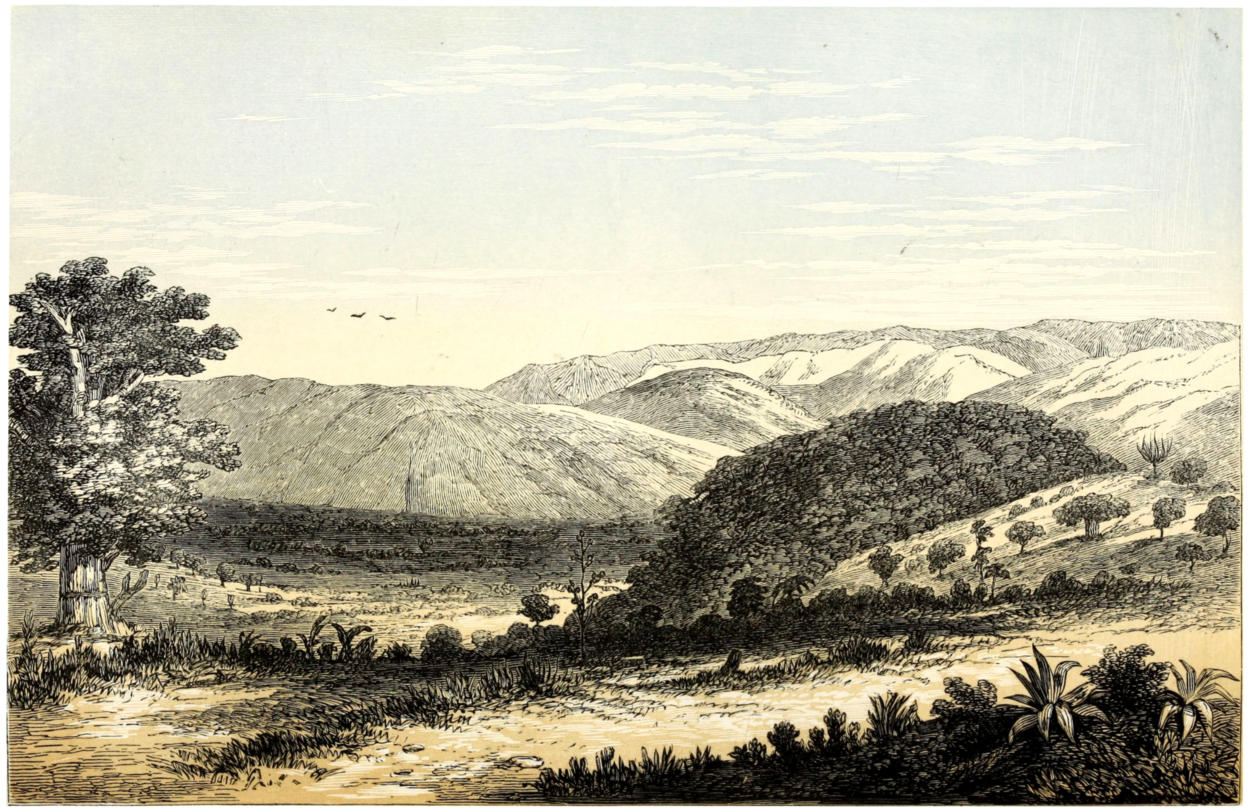
THE BASIN OF MARORO.
Maroro, or Malolo, according to dialect, is the “Marorrer town” of Lt. Hardy, (Transactions of the Bombay Geographical Society, from Sept. 1841 to May 1844,) who, in 1811-12, was dispatched with Capt. Smee by the Government of Bombay to collect information at Kilwa and its dependencies, and the East African coast generally. Mr. Cooley (Inner Africa Laid Open, p. 56) writes the word Marora, and explains it to mean “trade:” the people, however, ignore the derivation. It is not a town, but a district, containing as usual on this line a variety of little settlements. The confined basin is by no means a wholesome locality, the air is warm and “muggy,” the swamp vegetation is fetid, the mosquitos venomous, and the population, afflicted with fevers and severe ulceration, is not less wretched and degraded than the Wak’hutu. Their habitations are generally Tembe, but small and poor, and their fields are dotted with dwarf platforms for the guardians of the crops. Here a cow costs twelve cloths, a goat three, whilst two fowls are procurable for a shukkah. Maroro is the westernmost limit of the touters from the Mrima; there are seldom less than 150 muskets present, and the Wasagara have learned to hold strangers in horror.
In these basins caravans endeavour, and are forced by the people, to encamp upon the further end after marching through. At the end of a short stage of three hours we forded three times the river bed, a muddy bottom, flanked by stiff rushes, and encamped under a Mkamba tree, above and to windward of the fetid swamp. The night was hot and rainy, clouds of mosquitos rose from their homes below, and the cynhyænas were so numerous that it was necessary to frighten them away with shots. The labour of laying in provisions detained us for a day at Maroro.
On the 17th December we left the little basin by its southern opening, which gradually winds eastward. The march was delayed by the distribution of the load of a porter who had fled to the Warori. After crossing a fourth rise, the road fell into the cultivated valley of the Mwega River. This is a rush-girt stream of pure water, about 20 feet broad, and knee-deep at the fords in dry weather; its course is S.W. to the stream of Maroro. Like the Mukondokwa, it spreads out, except where dammed by the correspondence of the salient and the re-entering angles of the hill spurs. The road runs sometimes over this rocky and jungly ground, horrid with thorn and cactus, fording the stream, where there is no room for a path, and at other times it traverses lagoon-like backwaters, garnished with grass, rush, and stiff shrubs, based upon sun-cracked or miry beds. After a march of four hours we encamped in the Mwega Basin, where women brought down grain in baskets: cattle were seen upon the higher grounds, but the people refused to sell milk or meat.
The next stage was Kiperepeta; it occupied about 2 hours 30 min. The road was rough, traversing the bushy jungly spurs on the left bank of the rushy narrow stream; in many places there were steps and ladders of detached blocks and boulders. At last passing through a thick growth, where the smell of jasmine loads the air, we ascended a steep and rugged incline, whose summit commanded a fine back view of the Maroro Basin. A shelving counterslope of earth deeply cracked and cut with watercourses led us to the encamping-ground, a red patch dotted with tall calabashes, and boasting a few pools of brackish water. We had now entered the land of grass-kilts and beehive huts, built for defence upon the ridges of the hills: whilst cactus, aloe, and milk-bush showed the diminished fertility of the soil. About Kiperepeta it was said a gang of nearly 400 touters awaited with their muskets the arrival of caravans from the interior.
On the 19th December, leaving Kiperepeta, we toiled up a steep incline, cut by the sinuated channels of water-courses, to a col or pass, the water-parting of this line in Usagara: before south-westerly, the versant thence-forward trends to the south-east. Having topped the summit, we began the descent along the left bank of a mountain burn, the Rufita, which, forming in the rainy season a series of rapids and cascades, casts its waters into the Yovu, and eventually into the Rwaha River. The drainage of the hill-folds cuts, at every re-entering angle, a ragged irregular ditch, whose stony depths are impassable to heavily-laden asses. After a toilsome march of three hours, we fell into the basin of Kisanga, which, like others on this line, is an enlarged punchbowl, almost surrounded by a mass of green hills, cone rising upon cone, with tufted cappings of trees, and long lines of small haycock-huts ranged along the acclivities and ridge-lines. The floor of the basin is rough and uneven; a rich cultivation extends from the hill-slopes to the stream which drains the sole, and fine trees, amongst which are the mparamusi and the sycomore, relieve the uniformity of the well-hoed fields. Having passed through huts and villages, where two up-caravans of Wanyamwezi were halted, displaying and haggling over the cloths intended as tribute to the Sultan Kiringawana, we prudently forded the Yovu, and placed its bed between ourselves and the enemy. The Yovu, which bisects the basin of Kisanga from N. to S. and passes by the S.E. into the Rwaha, was then about four feet deep; it flowed down a muddy bed laced with roots, and its banks, whence a putrid smell exhaled, were thick lines of sedgy grass which sheltered myriads of mosquitos. Ascending an eminence to the left of the stream, we obtained lodgings, and at once proceeded to settle kuhonga with the chief, Kiringawana.
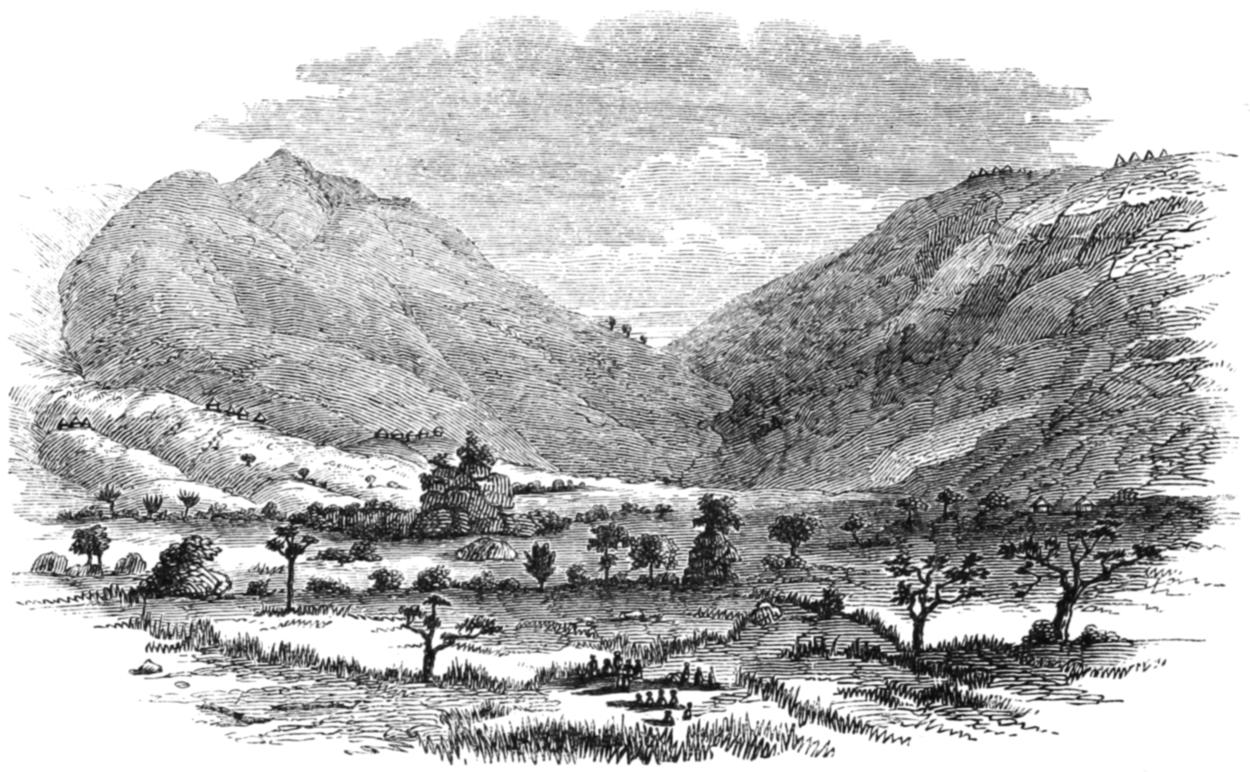
Rufita Pass in Usagara.
The father, or, according to others, the grandfather of the present chief, a Mnyamwezi of the ancient Wakalaganza tribe, first emigrated from his home in Usagozi, and, being a mighty elephant-hunter and a powerful wizard, he persuaded by arts and arms the Wasagara, who allowed him to settle amongst them, to constitute him their liege lord. The actual Kiringawana, having spent his heir-apparent days at Zanzibar, returned to Kisanga on the death of his sire, and reigned in his stead. His long residence among the Arabs has so far civilised him that he furnishes his several homes comfortably enough; he receives his tributary-visitors with ceremony, affects amenity of manner, clothes his short, stout, and sooty person in rainbow-coloured raiment, carries a Persian blade, and is a cunning diplomatist in the art of choosing cloth.
On the day of arrival I was visited by Msimbiri, the heir-apparent—kingly dignity prevented Kiringawana wading the Yovu,—who gave some information about the Rwaha river, and promised milk. The 20th of December was expended in the palaver about “dash.” After abundant chaffering, the chief accepted from the Expedition, though passing through his acres on the return-march, when presents are poor, three expensive coloured cloths, and eight shukkah of domestics and Kaniki; wondering the while that the wealthy Muzungu had neglected to reserve for him something more worthy of his acceptance. He returned a fat bullock, which was instantly shot and devoured. In their indolence the caravan-men again began to quarrel; and Wulaydi, a son of Ramji, speared a porter, an offence for which he was ordered, if he failed to give satisfaction for the assault, to be turned out of camp. A march was anticipated on the next day, when suddenly, as the moon rose over the walls of the basin, a fine bonfire on the neighbouring hill and a terrible outcry announced an accident in the village occupied by the sons of Ramji. Muinyi Buyuni had left in charge of the hearth the object of his affections, a fine strapping slave-girl, whom for certain reasons he expected to sell for a premium at Zanzibar, and she had made it over to some friend, who probably had fallen asleep. The hut was soon in flames,—in these lands fires are never extinguished,—and the conflagration had extended to the nearer hovels, consuming the cloth, grain, and furniture of the inmates. Fortunately, the humans and the cattle escaped; but a delay was inevitable. The elder who owned the chief hut demanded only eighty-eight cloths, one slave, thirteen Fundo of beads, and other minor articles:—a lesser sum would have purchased the whole household. His cupidity was restrained by Kiringawana, who named as indemnity thirty cloths, here worth thirty dollars, which I gave with extreme unwillingness, promising the sons of Ramji, who appeared rather to enjoy the excitement, that they should pay for their carelessness at Zanzibar.
During the second day’s halt, I attempted to obtain from Kiringawana a permission to depart from the beaten track. The noble descent of this chief gives him power over the guides of the Wanyamwezi caravans. In consequence of an agreement with the Diwans of the Mrima, he has lately closed the direct route to Kilwa, formerly regularly traversed, and he commands a little army of touters. He returned a gracious reply, which in East Africa, however, means no gracious intentions.
Resuming our march on the 22nd of December, we descended from the eminence into the basin of the Yovu River, and fought our way through a broad “Wady,” declining from east to west, with thick lines of tree and bush down the centre, and everywhere else an expanse of dark and unbroken green, like a plate of spinach. Passing along the southern bank amongst wild Annonas and fine Palmyras, over a good path where there was little mud, we presently ascended rising ground through an open forest, of the rainbow hues before described, where sweet air and soft filmy shade formed, whilst the sun was low and the breath of the morning was pure and good, most enjoyable travelling. After about five hours we descended into the basin of the Ruhembe rivulet, which seems to be the “Rohambi people” of Mr. Cooley’s Itinerary. (Geography of N’yassi, p. 22.) The inhabitants are Wasagara; they supply travellers with manioc, grain, and bitter egg-plants, of a scarlet colour resembling tomatos. Cultivation flourishes upon the hill-sides and in the swampy grounds about the sole of the basin, which is bisected by a muddy and apparently stagnant stream ten feet broad. We pitched tents in the open central space of a village, and met a caravan of Wasawahili from Zanzibar, who reported to Said bin Salim the gratifying intelligence that, in consequence of a rumour of his decease, his worthy brother, Ali bin Salim, had somewhat prematurely laid violent hands upon his goods and chattels.
The porters would have halted on the next day, but the excited Said exerted himself manfully; at 2 P.M. we were once more on the road. Descending from the village-eminence, we crossed in a blazing sun the fetid Ruhembe; and, after finding with some difficulty the jungly path, we struck into a pleasant forest, like that traversed on the last march. It was cut by water-courses draining south, and at these places it was necessary to dismount. At 6 P.M. appeared a clearing, with sundry villages and clumps of the Mgude tree, whose tufty summits of the brightest green, gilt by the last rays of the sun, formed a lovely picture. The porters would have rested at this spot, but they were forced forwards by the sons of Ramji. Presently we emerged upon the southern extremity of the Makata Plain, a hideous low level of black vegetable earth, peaty in appearance, and, bearing long puddles of dark scummy and stagnant rain-water, mere horse-ponds, with the additional qualities of miasma and mosquitos. The sons of Ramji had determined to reach the Makata Nullah, still distant about two hours. I called a halt in favour of the fatigued Pagazi, who heard it with pleasure, and sent to recall Wulaydi, Shehe, and Nasibu, who were acting bell-wethers. The worthies returned after a time, and revenged themselves by parading, with many grimaces, up and down the camp.
On the morning of the 24th of December, we resumed the transit of the Makata Plain, and crossed the tail of its nullah. It was here bone-dry; consequently, had we made it last night, the thirsty caravan would have suffered severely. Ensued a long slope garnished with the normal thin forest; in two places the plots of ashes, which denote the deaths of wizard and witch, apprised us that we were fast approaching benighted K’hutu. A skeleton caravan of touters, composed of six muskets and two flags, met us on the way. Presently we descended into the basin of Kikoboga, which was occupied in force by gentry of the same description. After wading four times the black, muddy, and rushy nullah, which bisects the lake, we crossed a lateral band of rough high ground, whence a further counter-slope bent down to a Khambi in a diminutive hollow, called Mwimbi. It was the ideal of a bad encamping ground. The kraal stood on the bank of a dark, miry water at the head of a narrow gap, where heat was concentrated by the funnel-shaped hill-sides, and where the dark ground, strewed with rotting grass and leaves, harboured hosts of cock-roaches, beetles, and mosquitos. The supplies, a little grain, poor sugar-cane, good wild vegetables, at times plantains, were distant, and the water was vile. Throughout this country, however, the Wasagara cultivators, fearing plunder should a caravan encamp near their crops, muster in force; the traveller, therefore, must not unpack except at the kraals on either edge of the cultivation.
The dawn of Christmas Day, 1858, saw us toiling along the Kikoboga River, which we forded four times. We then crossed two deep affluents, whose banks were thick with fruitless plantains. The road presently turned up a rough rise, from whose crest began the descent of the Mabruki Pass. This col may be divided into two steps: the first winds along a sharp ridge-line, a chain of well-forested hills, whose heights, bordered on both sides by precipitous slopes of earth overgrown with thorns and thick bamboo-clumps, command an extensive view of spur and subrange, of dhun and champaign, sprinkled with villages and dwarf cones, and watered by streamlets that glisten like lines of quicksilver in the blue-brown of the hazy distant landscape. Ensues, after a succession of deep and rugged watercourses, with difficult slopes, the second step; a short but sharp steep of red earth, corded with the tree-roots that have been bared by the heavy rains. Beyond this the path, spanning rough ground at the hill-base, debouches upon the course of a streamlet flowing southwards from the last heights of Usagara to the plains of Uziraha in K’hutu.
The bullock reserved for the occasion having been lost in Uhehe, I had ordered the purchase of half a dozen goats wherewith to celebrate the day; the porters, however, were too lazy to collect them. My companion and I made good cheer upon a fat capon, which acted as roast-beef, and a mess of ground-nuts sweetened with sugar-cane, which did duty as plum-pudding. The contrast of what was with what might be now, however, suggested only pleasurable sensations; long odds were in favour of our seeing the Christmas Day of 1859, compared with the chances of things at Msene on the Christmas Day of 1857.
From Uziraha sixteen hours distributed into fourteen marches conducted us from Uziraha, at the foot of the Usagara mountains, to Central Zungomero. The districts traversed were Eastern Mbwiga, Marundwe, and Kirengwe. The road again realises the European idea of Africa in its most hideous and grotesque aspect. Animals are scarce amidst the portentous growth of herbage, not a head of black cattle is seen, flocks and poultry are rare, and even the beasts of the field seem to flee the land. The people admitted us into their villages, whose wretched straw-hovels, contrasting with the luxuriant jungle which hems them in, look like birds’ nests torn from the trees: all the best settlements, however, were occupied by parties of touters. At the sight of our passing caravan the goatherd hurried off his charge, the peasant prepared to rush into the grass, the women and children slunk and hid within the hut, and no one ever left his home without a bow and a sheath of arrows, whose pitchy-coloured bark-necks denoted a fresh layer of poison.
We entered Zungomero on the 29th of December, after sighting on the left the cone at whose base rises the Maji ya W’heta, or Fontaine qui bouille. The village on the left bank of the Mgeta, which we had occupied about eighteen months before, had long been level with the ground; we were therefore conducted with due ceremony into another settlement on the right of the stream. An army of black musketeers, in scanty but various and gaudy attire, came out to meet us, and with the usual shots and shouts conducted us to the headman’s house, which had already been turned into a kind of barrack by these irregulars. They then stared as usual for half-a-dozen consecutive hours, which done they retired to rest.
After a day’s repose, sending for the Kirangozi, and personally offering a liberal reward, I opened to him the subject then nearest my heart, namely, a march upon Kilwa. This proceeding probably irritated the too susceptible Said bin Salim, and caused him, if not actually to interfere, at any rate to withhold all aid towards furthering the project. Twanigana, after a palaver with his people, returned with a reply that he himself was willing, but that his men would not leave the direct track. Their reasons were various. Some had become brothers with the sons of Ramji, and expected employment from their “father.” Others declared that it would be necessary to march a few miles back, which was contrary to their custom, and said that they ought to have been warned of the intention before passing the Makutaniro, or junction of the two roads. But none expressed any fear, as has since been asserted, of being sold off into slavery at Kilwa. Such a declaration would have been ridiculous. Of the many Wanyamwezi caravans that have visited Kilwa none has ever yet been seized and sold; the coast-people are too well acquainted with their own interests to secure for themselves a permanent bad name. Seeing, however, that energetic measures were necessary to open the road, I allowed them two days for consideration, and warned them that after that time Posho or rations should be withdrawn.
On the next day I was privately informed by the Mnfumo or parson of the caravan, that his comrades intended to make a feint of desertion, and then to return, if they found us resolved not to follow them. The reverend gentleman’s sister-in-law, who had accompanied us from Unyamwezi as cook and concubine to Seedy Bombay, persuaded our managing man that there was no danger of the porters traversing Uzaramo, without pay, escort, or provisions. On the 1st January, 1859, however, the gang rose to depart. I sent for the Kirangozi, who declared that though loth to leave us he must head his men: in return for which semi-fidelity I made him name his own reward; he asked two handsome cloths, a Gorah or piece of domestics, and one Fundo of coral beads—it was double his pay, but I willingly gave it, and directed Said bin Salim to write an order to that effect upon Mr. Rush Ramji, or any other Hindu who might happen to be at Kaole. But I rejected the suggestion of my companion, who proposed that half the sum agreed upon in Unyanyembe as payment to the porters—nine cloths each—should be given to them. In the first place, this donation would have been equivalent to a final dismissal. Secondly, the Arabs at Kazeh had warned me that it was not their custom to pay in part those who will not complete the journey to the coast; and I could see no reason for departing from a commercial precedent, evidently necessary to curb the Africans’ alacrity in desertion.
On the day following the departure of the gang I set out to visit the Jetting Spring, and found when returning to the village shortly before noon that my companion had sent a man to recal the “Pagazi,” who were said to be encamped close to the river, and to propose to them a march upon Mbuamaji. The messenger returned and reported that the Wanyamwezi had already crossed the river. Unwilling that the wretches should lose by their headstrongness, I at once ordered Said bin Salim to mount ass and to bring back the porters by offers which they would have accepted. Some time afterwards, when I fancied that he was probably haranguing the men, he came to me to say that he had not eaten and the sun was hot. With the view of shaming him I directed Kidogo to do the work, but as he also made excuses, Khamisi and Shehe, two sons of Ramji, were despatched with cloths to buy rations for the Pagazi, and, coûte que coûte, to bring them back. They set out on the 2nd January, and returned on the 7th January, never having, according to their own account, seen the fugitives.
This was a regrettable occurrence: it gave a handle to private malice under the specious semblance of public duty. But such events are common on the slave-path in Eastern Africa; of the seven gangs of porters engaged on this journey only one, an unusually small proportion, left me without being fully satisfied, and that one deserved to be disappointed.
We were detained at K’hutu till the 20th January. The airiest of schemes were ventilated by Said bin Salim and my companion. Three of the Baloch eye-sores, the “Graybeard Mohammed,” the mischief-maker Khudabakhsh, and the mulatto Jelai, were sent to the coast with letters, reports, and officials for Zanzibar and home. The projectors then attempted to engage Wak’hutu porters, but after a long palaver, P’hazi Madenge, the principal chief of Uziraha, who at first undertook to transport us in person to Dut’humi, declared that he could not assist us. It was then proposed to trust for porterage to the Wazaramo; that project also necessarily fell to the ground. Two feasible plans remained: either to write to the coast for a new gang, or to await the transit of some down-caravan. As the former would have caused an inevitable delay I preferred the latter, justly thinking that during this, the travelling-season, we should not long be detained.
On the 11th January, 1859, a large party of Wanyanwezi, journeying from the interior to the coast, bivouacked in the village. I easily persuaded Muhembe, the Mtongi or leader, to make over to me the services of nine of his men, and lest the African mind might conceive that in dismissing the last gang cloth or beads had been an object, I issued to these new porters seventy-two cloths, as much as if they had carried packs from Unyanwezi to the coast. On the 14th January, 1859, we received Mr. Apothecary Frost’s letters, drugs, and medical comforts, for which we had written to him in July 1857. The next day saw us fording the warm muddy waters of the Mgeta, which was then 100 feet broad: usually knee-deep, it rises after a few showers to the breast, and during the heavy rains which had lately fallen it was impassable. We found a little village on the left bank, and there we sat down patiently to await, despite the trouble inflicted by a host of diminutive ants, who knew no rest by day or night, the arrival of another caravan to complete our gang. The medical comforts so tardily received from Zanzibar fortified us, however, to some extent against enemies and inconveniences; we had æther-sherbet and æther-lemonade, formed by combining a wine-glass of the spirit with a quant. suff. of citric acid; and when we wanted a change the villagers supplied an abundance of Pombe or small beer.
On the 17th Jan. a numerous down-caravan entered the settlement which we occupied, and it proved after inquiry to be one of which I had heard often and much. The chiefs, Sulayman bin Rashid el Riami, a coast-Arab, accompanied by a Msawahili, Mohammed bin Gharib, and others, called upon me without delay, and from them I obtained a detailed account of their interesting travel.
The merchants had left the coast for Ubena in June, 1857, and their up-march had lasted six months. They set out with a total of 600 free men and slaves, armed with 150 guns, hired on the seaboard for eight to ten dollars per head, half being advanced: they could not persuade the Wanyamwezi to traverse these regions. The caravan followed the Mbuamaji trunk-road westward as far as Maroro in Usagara, thence deflecting southwards it crossed the Rwaha River, which at the ford was knee-deep. The party travelled through the Wahehe and the Wafaji, south of and far from the stream, to avoid the Warori, who hold both banks. The sultan of these freebooters, being at war with the Wabena, would not have permitted merchants to pass on to his enemies, and even in time of peace he fines them, it is said, one half of their property for safe-conduct. On the right hand of the caravan, or to the south from Uhehe to Ubena, was a continuous chain of highlands, pouring affluents across the road into the Rwaha River, and water was procurable only in the beds of these nullahs and fiumaras. If this chain be of any considerable length, it may represent the water-parting between the Tanganyika and the Nyassa Lakes, and thus divide by another and a southerly lateral band the great Depression of Central Africa. The land was dry and barren; in fact, Ugogo without its calabashes. Scarcely a blade of grass appeared upon the whity-brown soil, and the travellers marvelled how the numerous herds obtained their sustenance. The masika or rainy monsoon began synchronously with that of Unyamwezi, but it lasted little more than half its period in the north. In the sparse cultivation, surrounded by dense bush, they were rarely able to ration oftener than once a week. They were hospitably received by Kimanu, the Jyari or Sultan of Ubena. His people, though fierce and savage, appeared pleased by the sight of strangers. The Wabena wore a profusion of beads, and resembled in dress, diet, and lodging the Warori; they were brave to recklessness, and strictly monarchical, swearing by their chief. The Warori, however, were the cleaner race; they washed and bathed, whilst the Wabena used the same fluid to purify teeth, face, and hands.
At Ubena the caravan made considerable profits in slaves and ivory. The former, mostly captured or kidnapped, were sold for four to six fundo of beads, and, merchants being rare, a large stock was found on hand. About 800 were purchased, as each Pagazi or porter could afford one at least. On the return-march, however, half of the property deserted. The ivory, which rather resembled the valuable article procured at Karagwah than the poor produce of Unyanyembe, sold at 35 to 70 fundo of yellow and other coloured beads per frasilah of 35 lbs. Cloth was generally refused, and the kitindi or wire armlets were useful only in purchasing provisions.
On its return the caravan, following for eighteen stages the right bank of the Rwaha River, met with an unexpected misfortune. They were nighting in a broad fiumara called Bonye, a tributary from the southern highlands to the main artery, when suddenly a roar and rush of waters fast approaching and the cries of men struck them with consternation. In the confusion which ensued 150 souls, for the most part slaves, and probably ironed or corded together, were carried away by the torrent, and the porters lost a great part of the ivory. A more dangerous place for encampment can scarcely be imagined, yet the East African everywhere prefers it because it is warm at night, and the surface is soft. In the neighbourhood of the Rwaha they entered the capital district of Mui’ Gumbi, the chief, after a rude reception on the frontier, where the people, mistaking them for a plundering party of Wabena, gathered in arms to the number of 4000. When the error was perceived, the Warori warmly welcomed the traders, calling them brothers, and led them to the quarters of their Sultan. Mui’ Gumbi was apparently in his 70th year, a man of venerable look, tall, burly, and light-coloured, with large ears, and a hooked nose like a “moghrebi.” His sons, about thirty in number, all resembled him, their comeliness contrasting strongly with the common clansmen, who are considered by their chiefs as slaves. A tradition derives the origin of this royal race from Madagascar or one of its adjoining islets. Mui’ Gumbi wore a profusion of beads, many of them antiquated in form and colour, and now unknown in the market of Zanzibar: above his left elbow he had a lumpy bracelet of ivory, a decoration appropriated to chieftains. The Warori expressed their surprise that the country had not been lately visited by caravans, and, to encourage others, the Sultan offered large gangs of porters without pay to his visitors. These men never desert; such disobedience would cost them their lives. From the settlement of Mui’ Gumbi to the coast the caravan travelled without accident, but under great hardships, living on roots and grasses for want of means to buy provisions.
The same caravan-traders showed me divers specimens of the Warori, and gave me the following description, which tallied with the details supplied by Snay bin Amin and the Arabs of Kazeh.
The Warori extend from the western frontier of the Wahehe, about forty marches along principally the northern bank of the Rwaha River, to the meridian of Eastern Unyanyembe. They are a semi-pastoral tribe, continually at war with their neighbours. They never sell their own people, but attack the Wabena, the Wakimbu, the Wahehe, the Wakonongo, and the races about Unyangwira, and drive their captives to the sea, or dispose of them to the slavers in Usagara. The price is of course cheap; a male adult is worth from two to six shukkah merkani. Some years ago a large plundering party, under their chief Mbangera, attacked Sultan Kalala of the Wasukuma; they were, however, defeated, with the loss of their leader, by Kafrira of Kivira, the son-in-law of Kalala. They also ravaged Unyanyembe, and compelled the people to take refuge on the summit of a natural rock-fortress between Kazeh and Yombo, and they have more than once menaced the dominions of Fundikira. Those mighty boasters the Wagogo hold the Warori in awe; as the Arabs say, they shrink small as a cubit before foes fiercer than themselves. The Warori have wasted the lands of Uhehe and Unyangwira, and have dispersed the Wakimbu and the Wamia tribes. They have closed the main-road from the seaboard by exorbitant blackmail and charges for water, and about five years ago they murdered two coast Arab traders from Mbuamaji. Since their late defeat by the Watuta, they have been comparatively quiet. When the E. African Expedition, however, entered the country they had just distinguished themselves by driving the herds from Ugogi, and thus prevented any entrance into their country from that district. Like the pastoral races generally of this portion of the peninsula, the object of their raids is cattle: when a herd falls into their hands, they fly at the beasts like hyænas, pierce them with their assegais, hack off huge slices, and devour the meat raw.
The Warori are small and shrivelled black savages. Their diminutive size is doubtless the effect of scanty food, continued through many generations: the Sultans, however, are a peculiarly fine large race of men. The slave-specimens observed had no distinguishing mark on the teeth; in all cases, however, two short lines were tattooed across the hollow of the temples. The male dress is a cloak of strung beads, weighing ten or twelve pounds, and covering the shoulders like a European cape. Some wind a large girdle of the same material round the waist. The women wear a bead-kilt extending to the knees, or, if unable to afford it, a wrapper of skin. The favourite weapon is a light, thin, and pliable assegai; they carry a sheath of about a dozen, and throw them with great force and accuracy. The bow is unknown. They usually press to close quarters, each man armed with a long heavy spear. Iron is procured in considerable quantities both in Ubena and Urori. The habitations are said to be large Tembe, capable of containing 400 to 500 souls. The principal articles of diet are milk, meat, and especially fattened dog’s flesh—of which the chiefs are inordinately fond,—maize, holcus, and millet. Rice is not grown in these arid districts. They manage their intoxication by means of pombe made of grain and the bhang, which is smoked in gourd-pipes; they also mix the cannabis with their vegetable food. The Warori are celebrated for power of abstinence; they will march, it is said, six days without eating, and they require to drink but once in the twenty-four hours. In one point they resemble the Bedouins of Arabia: the chief will entertain his guests hospitably as long as they remain in his village, but he will plunder them the moment they leave it.
On the 19th January the expected down-caravan of Wanyamwezi arrived, and I found no difficulty in completing our carriage—a fair proof, be it remarked, that I had not lost the confidence of the people. The Mtongi, however, was, or perhaps pretended to be, ill; we were, therefore, delayed for another day in a place which had no charms for us.
The 21st January enabled us to bid adieu to Zungomero and merrily to take the footpath way. We made Konduchi on the 3rd February, after twelve marches, which were accomplished in fifteen days. There was little of interest or adventure in this return-line, of which the nine first stations had already been visited and described. As the Yegea mud, near Dut’humi, was throat-deep, we crossed it lower down: it was still a weary trudge of several miles through thick slabby mire, which admitted a man to his knees. In places, after toiling under a sickly sun, we crept under the tunnels of thick jungle-growth veiling the Mgazi and other streams; the dank and fetid cold caused a deadly sensation of faintness, which was only relieved by a glass of æther-sherbet, a pipe or two of the strongest tobacco, and half an hour’s repose. By degrees it was found necessary to abandon the greater part of the remaining outfit and the luggage: the Wanyamwezi, as they neared their destination, became even less manageable than before, and the sons of Ramji now seemed to consider their toils at an end. On the 25th January we forded the cold, strong, yellow stream of the Mgeta, whose sandy bed had engulfed my elephant-gun, and we entered with steady hearts the formerly dreaded Uzaramo. The 27th January saw us pass safely by the village where M. Maizan came to an untimely end. On that day Ramazan and Salman, children of Said bin Salim, returned from Zanzibar Island, bringing letters, clothing, and provisions for their master, who, by way of small revenge, had despatched them secretly from Zungomero. On the 28th January we reached the Makutaniro or anastomosis of the Kaole and Mbuamaji roads, where on our ingress the Wazaramo had barred passage in force. No one now ventured to dispute the way with well-armed paupers. That evening, however, the Mtongi indulged his men with “maneno,” a harangue. Reports about fatal skirmishes between the Wazaramo and a caravan of Wanyamwezi that had preceded us had flown about the camp; consequently the Mtongi recommended prudence. “There would be danger to-morrow—a place of ambuscade—the porters must not rise and be off too early nor too late—they must not hasten on, nor lag behind—they had with them Wazungu, and in case of accidents they would lose their name!” The last sentence was frequently repeated with ever increasing emphasis, and each period of the discourse was marked by a general murmur, denoting attention.
As I have said, there was no danger. Yet on the next day a report arose that we were to be attacked in a dense thicket—where no archer, be it observed, could bend his bow—a little beyond the junction of the Mbuamaji road with that of Konduchi, our destination. In the afternoon Said bin Salim, with important countenance, entered my tent and disclosed to me the doleful tidings. The road was cut off. He knew it. A great friend of his—a slave—had told him so. He remembered warning me that such was the case five days ago. I must either delay till an escort could be summoned from the coast, or—I must fee a chief to precede me and to reason with the enemy. It was in vain to storm, I feared that real obstacles might be placed by the timid and wily little man in our way, and I consented most unwillingly to pay two coloured cloths, and one ditto of blue-cotton, as hire to guard that appeared in the shape of four clothless varlets, that left us after the first quarter of an hour. The Baloch, headed by the Jemadar, knowing that all was safe, distinguished themselves on that night, for the first time in eighteen months, by uttering the shouts which prove that the Oriental soldier is doing “Zam,” i.e. is on the qui vive. When requested not to make so much noise they grumbled that it was for our sake, not for theirs.
On the 30th January our natives of Zanzibar screamed with delight at the sight of the mango-tree, and pointed out to one another, as they appeared in succession, the old familiar fruits, jacks and pine-apples, limes and cocoes. On the 2nd February we greeted, with doffed caps and with three times three and one more, as Britons will do on such occasions, the kindly smiling face of our father Neptune as he lay basking in the sunbeams between earth and air. Finally, the 3rd February 1859 saw us winding through the poles decorated with skulls—they now grin in the Royal College of Surgeons, London—a negro Temple-bar which pointed out the way into the little maritime village of Konduchi.
Our entrance was attended with the usual ceremony, now familiar to the reader: the warmen danced, shot, and shouted, a rabble of adults, youths, and boys crowded upon us, the fair sex lulliloo’d with vigour, and a general procession conducted their strangers to the hut swept, cleaned, and garnished for us by old Premji, the principal Banyan of the head-quarter village, and there stared and laughed till they could stare and laugh no more.
On the evening of the same day an opportunity offered of transferring the Jemadar, the Baloch, and my bête noire, Kidogo, to their homes in Zanzibar Island, which lies within sight of Konduchi: as may be imagined, I readily availed myself of it. After begging powder and et cæteras to the last, the monocular insisted upon kissing my hand, and departed weeping bitterly with the agony of parting. By the same boat I sent a few lines to H. M. consul, Zanzibar, enclosing a list of necessaries, and requesting that a Battela, or coasting-craft, might be hired, provisioned, and despatched without delay, as I purposed to explore the Delta and the unknown course of the Rufiji River. In due time Said bin Salim and his “children,” including the fair Halimah and Zawada—the latter was liberally rewarded by me for services rendered to my companion—and shortly afterwards the sons of Ramji, or rather the few who had not deserted or lagged behind, were returned to their master, and were, I doubt not, received with all the kindness which their bad conduct deserved.
We were detained at Konduchi for six days between the 3rd and 10th February. There is nothing interesting in this little African village port: instead of describing it, I will enter into a few details concerning African matters of more general importance.
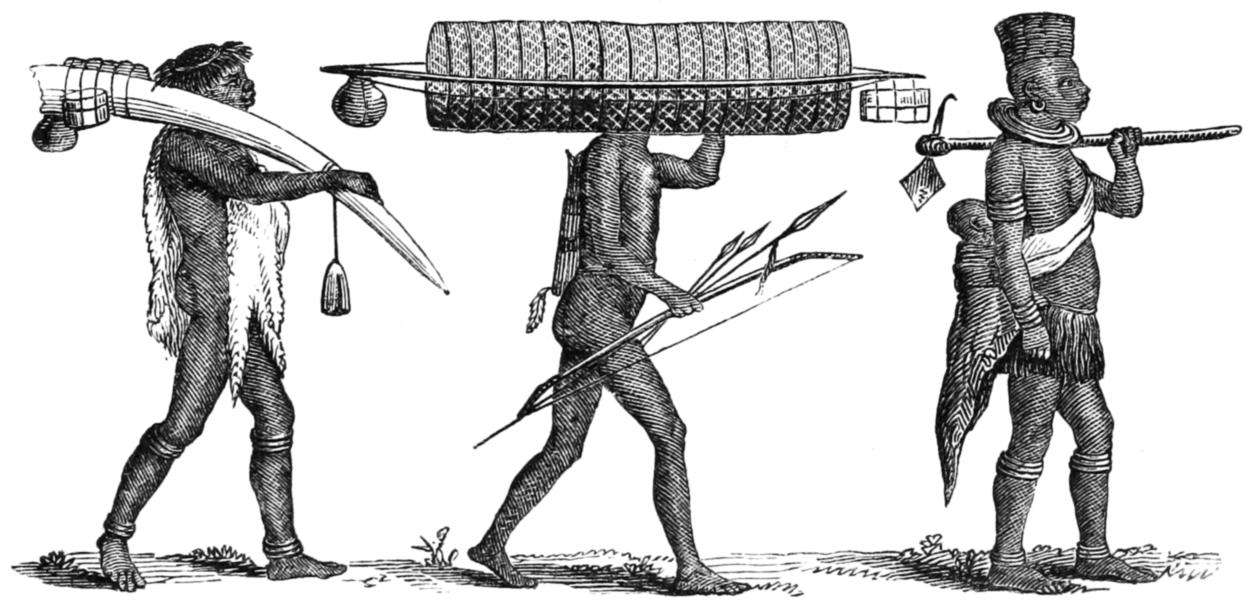
The Ivory Porter, the Cloth Porter, and Woman, in Usagara.