Volume 2 — CHAP. XIII. AT LENGTH WE SIGHT THE LAKE TANGANYIKA, THE “SEA OF UJIJI.”
Reading edition
The route before us lay through a howling wilderness, once populous and fertile, but now laid waste by the fierce Watuta. Snay bin Amir had warned me that it would be our greatest trial of patience. The march began badly: Mpete, the district on the right bank of the Malagarazi River, is highly malarious, and the mosquitoes feasted right royally upon our life, even during the day-time. We bivouacked under a shady tree, within sight of the ferry, not knowing that upon the woody eminences above the valley there are usually fine kraals of dry grass and of mkora or myombo-bark. During the rainy monsoon the best encampments in these regions are made of tree-sheets: two parallel rings are cut in the bole, at a distance of six to seven feet; a perpendicular slit then connects them, the bark is easily stripped off, and the trunk, after having been left for a time to season, is filled for use.
On the 5th of February we set out betimes, across a route traversing for a short distance swampy ground along the river-side. It then stretched over jungly and wooded hill-spires, with steep rough ascents and descents, divided from neighbouring elevations by slippery mire-runs. Exposed to the full break of the rainy monsoon, and the frequent outbursts of fiery sun, I could not but admire the marvellous fertility of the soil; an impervious luxuriance of vegetation veils the lowlands, clothes the hill-sides, and caps their rounded summits. After marching five hours and twenty minutes, we found a large kraal in the district of Kinawani: the encamping ground,—partially cleared of the thick, fetid, and putrescent vegetation around,—hugs the right bank of the Malagarazi, and faces the village of Sultan Mzogera on the southern or opposite side. A small store of provisions—grain and sweet-potatoes—was purchased from the villagers of Kinawani, who flocked across the stream to trade. They were, however, fanciful in their requirements: beads, especially the coral porcelain, iron-wire, salt, and meat. The heaviness of this march caused two of the Hammals engaged at Usagozi to levant, and the remaining four to strike work. It was therefore again necessary to mount ass—ten days after an attack of “paraplegia!”
We left Kinawani on the next morning, and striking away from the river we crossed rugged and rolling ground, divided by deep swamps of mire and grass. To the southward ran the stream, rushing violently down a rocky bed, with tall trees lining its banks. Sailing before the morning east-wind, a huge mass of nimbus occupied the sky, and presently discharged itself in an unusually heavy downfall: during the afternoon the breeze veered as usual to the west, and the hot sunshine was for once enjoyable. After a weary trudge of five hours and twenty minutes, we entered a large and comfortable kraal, situated near a reach where the swift and turbid river foamed over a discontinuous ledge of rock, between avenues of dense and tangled jungle. No provisions were procurable at this place; man appeared to have become extinct.
The 7th of February led us over broken ground, encumbered by forest, and cut by swamps, with higher levels on the right hand, till we again fell into the marshes and fields of the river-valley. The district on the other side of the river, called Jambeho, is one of the most flourishing in Uvinza; its villages of small bird-nest huts, and its carefully hoed fields of grain and sweet-potato, affected the eye, after the dreary monotony of a jungle-march, like the glimmer of a light at the end of a night-march, or the discovery of land at the conclusion of a long sea-voyage. The village ferry was instantly put into requisition, and the chief, Ruwere, after receiving as his “dash” eight cloths, allowed us to purchase provisions. At that season, however, the harvest of grain and sweet-potatoes had not been got in, and for their single old hen the people demanded an exorbitant price. We hastened, despite all difficulties, to escape from this place of pestilence, which clouds of mosquitoes rendered as uncomfortable as it was dangerous.
The next day ushered in our departure with drizzling rain, which drenched the slippery paths of red clay; the asses, wild with wind and weather, exposed us to accidents in a country of deep ravines and rugged boulders. Presently diverging from the Malagarazi, we passed over the brow of a low tree-clad hill above the junction of the Rusugi River, and followed the left bank of this tributary as far as its nearer ford. The Rusugi which drains the northern highlands into the Malagarazi, was then about 100 yards in width: the bottom is a red ochreish soil, the strong stream, divided in the centre by a long low strip of sand and gravel, flowed at that time breast-deep, and its banks,—as usual with rivers in these lands,—deeply cut by narrow watercourses, rendered travelling unusually toilsome. At the Rusugi Ford the road separates into a northern and a southern branch, a hill-spur forming the line of demarcation. The northern strikes off to the district of Parugerero on the left bank, where a shallower ford is found: the place in question is a settlement of Wavinza, containing from forty to fifty bee-hive huts, tenanted by salt-diggers. The principal pan is sunk in the vicinity of the river, the saline produce, after being boiled down in the huts, is piled up, and handmade into little cones. The pan affords tripartite revenue to three sultans, and it constitutes the principal wealth of the Wavinza: the salt here sold for one shukkah per masuta, or half-load, and far superior to the bitter, nitrous produce of Ugogo, finds its way throughout the heart of Africa, supplying the lands adjoining both the Tanganyika and the Nyanza Lakes.
We followed the southern line which crosses the Rusugi River at the branch islet. Fords are always picturesque. The men seemed to enjoy the washing; their numbers protected them from the crocodiles, which fled from their shouting and splashing; and they even ventured into deep water, where swimming was necessary. We crossed as usual on a “unicorn” of negroids, the upper part of the body supported by two men, and the feet resting upon the shoulders of a third,—a posture somewhat similar to that affected by gentlemen who find themselves unable to pull off their own boots. Then remounting, we ascended the grassy rise on the right of the stream, struggled, slipped, and slided over a muddy swamp, climbed up a rocky and bushy ridge, and found ourselves ensconced in a ragged and comfortless kraal upon the western slopes, within sight of some deserted salt-pans below. As evening drew in, it became apparent that the Goanese Gaetano, the five Wak’hutu porters, and Sarmalla, a donkey-driving son of Ramji, had remained behind, in company with several loads, the tent, two bags of clothes, my companion’s elephant-gun, my bedding, and that of my servant. It was certain that with this provision in the vicinity of Parugerero they would not starve, and the porters positively refused to halt an hour more than necessary. I found it therefore compulsory to advance. On the 11th February three “children” of Said bin Salim consented, as usual, for a consideration, to return and to bring up the laggers, and about a week afterwards they entered Ujiji without accident. The five Wak’hutu porters, probably from the persuasions of Muinyi Wazira, had, although sworn to fidelity with the strongest oaths, carried into execution a long-organised plan of desertion. Gaetano refused to march on the day of our separation, because he was feverish, and he expected a riding-ass to be sent back for him. He brought up our goods safely, but blankets, towels, and many articles of clothing belonging to his companion, had disappeared. This difficulty was, of course, attributed to the Wak’hutu porters; probably the missing things had been sold for food by the Goanese and the son of Ramji: I could not therefore complain of the excuse.
From the Msawahili Fundi,—fattore, manciple or steward—of a small caravan belonging to an Arab merchant, Hamid bin Sulayyam, I purchased for thirty-five cloths, about thrice its value, a little single-fold tent of thin American domestics, through which sun and rain penetrated with equal facility. Like the cloth-houses of the Arab travellers generally, it was gable-shaped, six or seven feet high, about eight feet long by four broad, and so light that with its bamboo-poles and its pegs it scarcely formed a load for a man. On the 9th February, we descended from the ridge upon which the kraal was placed, and traversed a deep swamp of black mud, dotted in the more elevated parts with old salt-pans and pits, where broken pottery and blackened lumps of clay still showed traces of human handiwork. Beyond this low-land, the track, striking off from the river-valley and turning to the right, entered toilsome ground. We crossed deep and rocky ravines, with luxuriant vegetation above, and with rivulets at the bottom trickling towards the Malagarazi, by scrambling down and swarming up the roughest steps of rock, boulder, and knotted tree-root. Beyond these difficulties lay woody and stony hills, whose steep and slippery inclines were divided by half a dozen waters, all more or less troublesome to cross. The porters, who were in a place of famine, insisted upon pushing on to the utmost of their strength: after six hours’ march, I persuaded them to halt in the bush upon a rocky hill, where the neighbouring descent supplied water. The Fundi visited the valley of the Rusugi River, and finding a herd of the Mbogo or Bos Caffer, brought home a welcome addition to our well-nigh exhausted rations.
The 10th February saw us crossing the normal sequence of jungly and stony “neat’s-tongues,” divided by deep and grassy swamps, which, stagnant in the dry weather, drain after rains the northern country to the Malagarazi River. We passed over by a felled tree-trunk an unfordable rivulet, hemmed in by a dense and fetid thicket; and the asses summarily pitched down the muddy bank into the water, swam across and wriggled up the slimy off-side like cats. Thence a foul swamp of black mire led to the Ruguvu or Luguvu River, the western boundary of Uvinza and the eastern frontier of Ukaranga. This stream, which can be forded during the dry season, had spread out after the rains over its borders of grassy plain; we were delayed till the next morning in a miserable camping ground, a mud-bank thinly veiled with vegetation, in order to bridge it with branching trees. An unusual downfall during the night might have caused serious consequences;—provisions had now disappeared, moreover the porters considered the place dangerous.
The 10th February began with the passage of the Ruguvu River, where again our goods and chattels were fated to be thoroughly sopped. I obtained a few corn-cobs from a passing caravan of Wanyamwezi, and charged them with meat and messages for the party left behind. A desert march, similar to the stage last travelled, led us to the Unguwwe or Uvungwe River, a shallow, muddy stream, girt in as usual by dense vegetation; and we found a fine large kraal on its left bank. After a cold and rainy night, we resumed our march by fording the Unguwwe. Then came the weary toil of fighting through tiger and spear-grass, with reeds, rushes, a variety of ferns, before unseen, and other lush and lusty growths, clothing a succession of rolling hills, monotonous swellings, where the descent was ever a reflection of the ascent. The paths were broken, slippery, and pitted with deep holes; along their sides, where the ground lay exposed to view, a conglomerate of ferruginous red clay—suggesting a resemblance to the superficies of Londa, as described by Dr. Livingstone—took the place of the granites and sandstones of the eastern countries, and the sinking of the land towards the Lake became palpable. In the jungle were extensive clumps of bamboo and rattan; the former small, the latter of poor quality; the bauhinia, or black-wood, and the salsaparilla vine abounded; wild grapes of diminutive size, and of the austerest flavour, appeared for the first time upon the sunny hill-sides which Bacchus ever loves, and in the lower swamps plantains grew almost wild. In parts the surface was broken into small deep hollows, from which sprang pyramidal masses of the hugest trees. Though no sign of man here met the eye, scattered fields and plantations showed that villages must be somewhere near. Sweet water was found in narrow courses of black mud, which sorely tried the sinews of laden man and beast. Long after noon, we saw the caravan halted by fatigue upon a slope beyond a weary swamp: a violent storm was brewing, and whilst half the sky was purple black with nimbus, the sun shone stingingly through the clear portion of the empyrean. But these small troubles were lightly borne; already in the far distance appeared walls of sky-blue cliff with gilded summits, which were as a beacon to the distressed mariner.
On the 13th February we resumed our travel through screens of lofty grass, which thinned out into a straggling forest. After about an hour’s march, as we entered a small savannah, I saw the Fundi before alluded to running forward and changing the direction of the caravan. Without supposing that he had taken upon himself this responsibility, I followed him. Presently he breasted a steep and stony hill, sparsely clad with thorny trees: it was the death of my companion’s riding-ass. Arrived with toil,—for our fagged beasts now refused to proceed,—we halted for a few minutes upon the summit. “What is that streak of light which lies below?” I inquired of Seedy Bombay. “I am of opinion,” quoth Bombay, “that that is the water.” I gazed in dismay; the remains of my blindness, the veil of trees, and a broad ray of sunshine illuminating but one reach of the Lake, had shrunk its fair proportions. Somewhat prematurely I began to lament my folly in having risked life and lost health for so poor a prize, to curse Arab exaggeration, and to propose an immediate return, with the view of exploring the Nyanza, or Northern Lake. Advancing, however, a few yards, the whole scene suddenly burst upon my view, filling me with admiration, wonder, and delight. It gave local habitation to the poet’s fancy:—
“Tremolavano i rai del Sol nascente Sovra l’onde del mar purpuree e d’oro, E in veste di zaffiro il ciel ridente Specchiar parea le sue bellezze in loro. D’Africa i venti fieri e d’Oriente, Sovra il letto del mar, prendean ristoro, E co’ sospiri suoi soavi e lieti Col Zeffiro increspava il lembo a Teti.”
Nothing, in sooth, could be more picturesque than this first view of the Tanganyika Lake, as it lay in the lap of the mountains, basking in the gorgeous tropical sunshine. Below and beyond a short foreground of rugged and precipitous hill-fold, down which the foot-path zigzags painfully, a narrow strip of emerald green, never sere and marvellously fertile, shelves towards a ribbon of glistening yellow sand, here bordered by sedgy rushes, there cleanly and clearly cut by the breaking wavelets. Further in front stretch the waters, an expanse of the lightest and softest blue, in breadth varying from thirty to thirty-five miles, and sprinkled by the crisp east-wind with tiny crescents of snowy foam. The background in front is a high and broken wall of steel-coloured mountain, here flecked and capped with pearly mist, there standing sharply pencilled against the azure air; its yawning chasms, marked by a deeper plum-colour, fall towards dwarf hills of mound-like proportions, which apparently dip their feet in the wave. To the south, and opposite the long low point, behind which the Malagarazi River discharges the red loam suspended in its violent stream, lie the bluff headlands and capes of Uguhha, and, as the eye dilates, it falls upon a cluster of outlying islets, speckling a sea-horizon. Villages, cultivated lands, the frequent canoes of the fishermen on the waters, and on a nearer approach the murmurs of the waves breaking upon the shore, give a something of variety, of movement, of life to the landscape, which, like all the fairest prospects in these regions, wants but a little of the neatness and finish of Art,—mosques and kiosks, palaces and villas, gardens and orchards—contrasting with the profuse lavishness and magnificence of nature, and diversifying the unbroken coup d’œil of excessive vegetation, to rival, if not to excel, the most admired scenery of the classic regions. The riant shores of this vast crevasse appeared doubly beautiful to me after the silent and spectral mangrove-creeks on the East-African seaboard, and the melancholy, monotonous experience of desert and jungle scenery, tawny rock and sun-parched plain or rank herbage and flats of black mire. Truly it was a revel for soul and sight! Forgetting toils, dangers, and the doubtfulness of return, I felt willing to endure double what I had endured; and all the party seemed to join with me in joy. My purblind companion found nothing to grumble at except the “mist and glare before his eyes.” Said bin Salim looked exulting,—he had procured for me this pleasure,—the monoculous Jemadar grinned his congratulations, and even the surly Baloch made civil salams.
Arrived at Ukaranga I was disappointed to find there a few miserable grass-huts—used as a temporary shelter by caravans passing to and from the islets fringing the opposite coast—that clustered round a single Tembe, then occupied by its proprietor, Hamid bin Sulayyam, an Arab trader. Presently the motive of the rascally Fundi, in misleading the caravan, which, by the advice of Snay bin Amir, I had directed to march upon the Kawele district in Ujiji, leaked out. The roadstead of Ukaranga is separated from part of Kawele by the line of the Ruche River, which empties itself into a deep hollow bay, whose chord, extending from N.W. to S.E., is five or six miles in length. The strip of shelving plain between the trough-like hills and the lake is raised but a few feet above water-level. Converted by the passage of a hundred drains from the highlands, into a sheet of sloppy and slippery mire, breast deep in select places, it supports with difficulty a few hundred inhabitants: drenched with violent rain-storms and clammy dews, it is rife in fevers, and it is feared by travellers on account of its hippopotami and crocodiles. In the driest season the land-road is barely practicable; during and after the wet monsoon the lake affords the only means of passage, and the port of Ukaranga contains not a single native canoe. The Fundi, therefore, wisely determined that I should spend beads for rations and lodgings amongst his companions, and be heavily mulcted for a boat by them. Moreover, he instantly sent word to Mnya Mtaza, the principal headman of Ukaranga, who, as usual with the Lakist chiefs, lives in the hills at some distance from the water, to come instanter for his Honga or blackmail, as, no fresh fish being procurable, the Wazungu were about to depart. The latter manœuvre, however, was frustrated by my securing a conveyance for the morrow. It was an open solid-built Arab craft, capable of containing thirty to thirty-five men; it belonged to an absent merchant, Said bin Usman; it was in point of size the second on the Tanganyika, and being too large for paddling, its crew rowed instead of scooping up the water like the natives. The slaves, who had named four khete of coral beads as the price of a bit of sun-dried “baccalà,” and five as the hire of a foul hovel for one night, demanded four cloths—at least the price of the boat—for conveying the party to Kawele, a three hours’ trip. I gave them ten cloths and two coil-bracelets, or somewhat more than the market value of the whole equipage,—a fact which I effectually used as an argumentum ad verecundiam.
At eight A.M., on the 14th February, we began coasting along the eastern shore of the lake in a north-westerly direction, towards the Kawele district, in the land of Ujiji. The view was exceedingly beautiful:
“... the flat sea shone like yellow gold Fused in the sun,”
and the picturesque and varied forms of the mountains, rising above and dipping into the lake, were clad in purplish blue, set off by the rosy tints of morning. Yet, more and more, as we approached our destination, I wondered at the absence of all those features which prelude a popular settlement. Passing the low, muddy, and grass-grown mouth of the Ruche River, I could descry on the banks nothing but a few scattered hovels of miserable construction, surrounded by fields of sorghum and sugar-cane, and shaded by dense groves of the dwarf, bright-green plantain, and the tall, sombre elæis or Guinea-palm. By the Arabs I had been taught to expect a town, a ghaut, a port, and a bazar, excelling in size that of Zanzibar, and I had old, preconceived ideas concerning “die Stadt Ujiji,” whose sire was the “Mombas Mission Map.” Presently Mammoth and Behemoth shrank timidly from exposure, and a few hollowed logs, the monoxyles of the fishermen, the wood-cutters, and the market-people, either cut the water singly, or stood in crowds drawn up on the patches of yellow sand. About 11 A.M. the craft was poled through a hole in a thick welting of coarse reedy grass and flaggy aquatic plants to a level landing-place of flat shingle, where the water shoaled off rapidly. Such was the ghaut or disembarkation quay of the great Ujiji.
Around the ghaut a few scattered huts, in the humblest bee-hive shape, represented the port-town. Advancing some hundred yards through a din of shouts and screams, tom-toms and trumpets, which defies description, and mobbed by a swarm of black beings, whose eyes seemed about to start from their heads with surprise, I passed a relic of Arab civilisation, the “Bazar.” It is a plot of higher ground, cleared of grass, and flanked by a crooked tree; there, between 10 A.M. and 3 P.M.—weather permitting—a mass of standing and squatting negroes buy and sell, barter and exchange, offer and chaffer with a hubbub heard for miles, and there a spear or dagger-thrust brings on, by no means unfrequently, a skirmishing faction-fight. The articles exposed for sale are sometimes goats, sheep, and poultry, generally fish, vegetables, and a few fruits, plantains, and melons; palm-wine is a staple commodity, and occasionally an ivory or a slave is hawked about: those industriously disposed employ themselves during the intervals of bargaining in spinning a coarse yarn with the rudest spindle, or in picking the cotton, which is placed in little baskets on the ground. I was led to a ruinous Tembe, built by an Arab merchant, Hamid bin Salim, who had allowed it to be tenanted by ticks and slaves. Situated, however, half a mile from, and backed by, the little village of Kawele, whose mushroom-huts barely protruded their summits above the dense vegetation, and placed at a similar distance from the water in front, it had the double advantage of proximity to provisions, and of a view which at first was highly enjoyable. The Tanganyika is ever seen to advantage from its shores: upon its surface the sight wearies with the unvarying tintage—all shining greens and hazy blues—whilst continuous parallels of lofty hills, like the sides of a huge trough, close the prospect and suggest the idea of confinement.
And now, lodged with comparative comfort, in the cool Tembe, I will indulge in a few geographical and ethnological reminiscences of the country lately traversed.
The fifth region includes the alluvial valley of the Malagarazi River, which subtends the lowest spires of the Highlands of Karagwah and Urundi, the western prolongation of the chain which has obtained, probably from African tradition, the name of “Lunar Mountains.” In length, it extends from the Malagarazi Ferry in E. Lat. 31° 10′ to the Tanganyika Lake, in E. Long. 30° 1′. Its breadth, from S. Lat. 3° 14′, the supposed northern limit of Urundi, to S. Lat. 5° 2′; the parallel of Ukaranga is a distance of 108 rectilinear geographical miles. Native caravans pass from the Malagarazi to Ujiji in eight days, usually without halting till arrived within a stone’s throw of their destination. To a region of such various elevations it would be difficult to assign an average of altitude; the heights observed by thermometer never exceeded 1850 feet.
This country contains in due order, from east to west, the lands of Uvinza, Ubuha, and Ujiji: on the northern edge is Uhha, and on the south-western extremity Ukaranga. The general features are those of the alluvial valleys of the Kingani and the Mgeta Rivers. The soil in the vicinity of the Malagarazi is a rich brown or black loam, rank with vegetable decay. This strip along the stream varies in breadth from one to five miles; on the right bank it is mostly desert, but not sterile, on the left it is an expanse of luxuriant cultivation. The northern boundary is a jagged line of hill-spurs of primitive formation, rough with stones and yawning with ravines: in many places the projections assume the form of green “dogs’ tails,” or “neat’s tongues,” projecting like lumpy ridges into the card-table-like level of the river-land southwards. Each mound or spur is crowned with a tufty clump, principally of bauhinias and mimosas, and often a lone, spreading and towering tree, a Borassus or a Calabash, ornamenting the extreme point, forms a landmark for the caravan. The sides of these hills, composed of hornblende and gneissic rock, quartzite, quartz-grit, and ferruginous gritstone, are steep, rugged, and thickly wooded, and one slope generally reflects the other,—if muddy, muddy; and if stony, stony. Each “hanger,” or wave of ground, is divided from its neighbour by a soft sedgy valley, bisected by a network of stagnant pools. Here and there are nullahs, with high stiff earthbanks for the passage of rain torrents. The grass stands in lofty screens, and the path leads over a matted mass of laid stalks which cover so closely the thick mud that loaded asses do not sink; this vegetation is burned down during the hot season, and a few showers bring up an emerald crop of young blades, sprouting phœnix-like from the ashes of the dead. The southern boundary of the valley is more regular; in the eastern parts is an almost tabular wall of rock, covered even to the crest with shrub and tree.
As is proved by the regular course of the Malagarazi River, the westward decline of the country is gentle: along the road, however, the two marches nearest to the Tanganyika Lake appear to sink more rapidly than those preceding them. The main drain receives from the northern hill-spurs a multitude of tributaries, which convey their surplus moisture into the great central reservoir.
Under the influence of the two great productive powers in nature—heat and moisture—the wondrous fertility of the soil, which puts forth where uncleared a rank jungle of nauseous odour, renders the climate dangerous. The rains divide the year into two unequal portions of eight and four months, namely, the wet monsoon, which commences with violence in September and ends in May, and the dry hot weather which rounds off the year. The showers fall, as in Zanzibar, uncontinuously, with breaks varying from a few hours to several days; unlike those of Zanzibar, they are generally accompanied by violent discharges of electricity. Lightning from the north, especially at night, is considered a sign of approaching foul weather. It would be vain to seek in these regions of Central Africa the kaskazi and kosi, or regular north-east and south-west monsoons, those local modifications of the trade-winds which may be traced in regular progress from the centre of Equatorial Africa to the Himalayas. The atmospheric currents deflected from the Atlantic Ocean by the coast-radiation and the arid and barren regions of Southern Africa are changed in hydrometric condition, and are compelled by the chilly and tree-clad heights of the Tanganyika Lake, and the low, cold, and river-bearing plains lying to the westward, to part with the moisture which they have collected in the broad belt of extreme humidity lying between the Ngami Lake and the equator. When the land has become super-saturated, the cold, wet, wind, driving cold masses, surcharged with electricity, sets continually eastward, to restore the equilibrium in lands still reeking with the torrid blaze, and where the atmosphere has been rarified by from four to six months of burning suns. At Msene, in Western Unyamwezi, the rains break about October; thence the wet monsoon, resuming its eastward course, crosses the Land of the Moon, and, travelling by slow stages, arrives at the coast in early April. Following the northing sun, and deflected to the north-east by the rarified atmosphere from the hot, dry surface of the Eastern Horn of Africa, the rains reach Western India in June, and exhaust themselves in frequent and copious downfalls upon the southern versant of the Himalayas. The gradual refrigeration of the ground, with the southing of the sun, produces in turn the inverse process, namely, the north-east monsoon. About the Tanganyika, however, all is variable. The large body of water in the central reservoir preserves its equability of temperature, while the alternations of chilly cold and potent heat, in the high and broken lands around it, cause extreme irregularity in the direction of the currents. During the rains of 1858 the prevalent winds were constantly changing: in the mornings there was almost regularly a cool north breeze drawn by the water from the heights of Urundi; in the course of the day it varied round towards the south. The most violent storms came up from the south-east and the south-west, and as often against as with the gale. The long and rigorous wet monsoon, broken only by a few scattered days of heat, renders the climate exceedingly damp, and it is succeeded by a burst of sunshine which dries the grass to stubble in a few days. Despite these extremes, the climate of Ujiji has the reputation of being comparatively healthy; it owes this probably to the refreshing coolness of the nights and mornings. The mukunguru, or seasoning-fever of this region, is not feared by strangers so much as that of Unyanyembe, yet no one expects to escape it. It is a low bilious and aguish type, lasting from three to four days: during the attack perspiration is induced with difficulty, and it often recurs at regular times once a month.
From the Malagarazi Ferry many lines traverse the desert on the right or northern bank of the river, which is preferred to the southern, whence the Wavinza exclude travellers. Before entering this region caravans generally combine, so as to present a formidable front to possible foes. The trunk road, called Jambeho, the most southerly of the northern routes, has been described in detail.
The district of Ukaranga extends from the Ruguvu or the Unguwwe River to the waters of the lake: on the south it is bounded by the region of Ut’hongwe, and on the north by the Ruche River. This small and sluggish stream, when near the mouth, is about forty yards in breadth, and, being unfordable at all seasons, two or three ferry-boats always ply upon its waters. The rauque bellow of the hippopotamus is heard on its banks, and the adjacent lowlands are infested by mosquitoes in clouds. The villages of Ukaranga are scattered in clumps over the plain—wretched hamlets, where a few households live surrounded by rare cultivation in the drier parts of the swamps. The “port of Ukaranga” is an open roadstead, which seldom shows even a single canoe. Merchants who possess boats and can send for provisions to the islands across the lake sometimes prefer, for economy, Ukaranga to Kawele; it is also made a halting-place by those en route to Uguhha, who would lose time by visiting Ujiji. The land, however, affords no supplies; a bazar is unknown; and the apathetic tribe, who cultivate scarcely sufficient grain for themselves, will not even take the trouble to cast a net. Ukaranga sends bamboos, rafters for building, and fire-wood, cut in the background of highlands, to Kawele and other parts of Ujiji, at which places, however, workmen must be hired.
Ukaranga signifies, etymologically, the “Land of Groundnuts.” This little district may, in earlier ages, have given name to the Mocarangas, Mucarongas, or Mucarangas, a nation which, according to the Portuguese historians, from João dos Sanctos (1586-97) to Don Sebastian Xavier Botelho (1835), occupied the country within the Mozambique, from S. lat. 5° to S. lat. 25°, under subjection to the sovereign and the people of “Monomotapa.” In the absence of history, analogy is the only guide. Either, then, the confusion of the Tanganyika and the Nyassa Lakes by the old geographers, caused them to extend the “Mocarangas” up to the northern water—and the grammatical error in the word “Mucaranga” justifies some suspicion as to their accuracy—or in the space of three centuries the tribe has declined from its former power and consequence, or the Wakaranga of the Tanganyika are a remnant of the mighty southern nation, which, like the Watuta tribe, has of late years been pressed by adverse circumstances to the north. Though Senhor Botelho, in his ‘Memoria Estatisca,’ denominates the “Monomoezi country” “Western Mucaranga,” it is certain that no Mnyamwezi in the present day owns to connection with a race speaking a different dialect, and distant about 200 miles from his frontier.
The land of Ujiji is bounded on the north by the heights of Urundi, and on the south by the Ukaranga country: eastward it extends to Ubuha, and westward it is washed by the waves of the Tanganyika Lake. On its north-east lies the land of Uhha, now reduced by the predatory Watuta to a luxuriant desert.
The head-quarter village of Ujiji was in 1858 Kawele. To the westward of this settlement was the district of Gungu, facing the islet rock Bangwe. This place was deserted by travellers on account of the plundering propensities of its former chief. His son “Lurinda,” however, labours to recover lost ground by courtesy and attention to strangers. South-eastwards of Kawele is the district of Ugoyye, frequented by the Arabs, who find the Sultans Habeyya and Marabu somewhat less extortionate than their neighbours. It is a sandy spot, clear of white ants, but shut out by villages and cultivation from the lovely view of the lake. To one standing at Kawele all these districts and villages are within two or three miles, and a distant glance discloses the possessions of half-a-dozen independent tribes.
Caravans entering Ujiji from the land side usually encamp in the outlying villages on the right or left bank of the Ruche, at considerable inconvenience, for some days. The origin of this custom appears to date from olden time. In East Africa, as a rule, every stranger is held to be hostile before he has proved friendly intentions, and many tribes do not admit him into their villages without a special invitation. Thus, even in the present day, the visitor in the countries of the Somal and Galla, the Wamasai and the Wakwafi, must sit under some tree outside the settlement till a deputation of elders, after formally ascertaining his purpose, escort him to their homes. The modern reason for the custom, which prevails upon the coast, as well as on the banks of the Tanganyika, is rather commercial than political. The caravan halts upon neutral ground, and the sultans or chiefs of the different villages send select messengers carrying various presents: in the interior ivory and slaves, and in the maritime regions cloth and provisions, technically called “Magubiko,” and intended as an earnest of their desire to open trade. Sweet words and fair promises win the day; the Mtongi, or head of the caravan, after a week of earnest deliberation with all his followers, chooses his host, temporary lodgings are provided for the guests, and the value of the retaining fees is afterwards recovered in Hongá and Kirembá—blackmail and customs. This custom was known in Southern Africa by the name of “marts;” that is, a “connection with a person belonging to another nation, so that they reside at each other’s houses when visiting the place, and make mutual presents.” The compulsory guest amongst the Arabs of Zanzibar and the Somal is called “Nezil.”
At Ujiji terminates, after twelve stages, which native caravans generally finish in a fortnight, all halts included, the transit of the fifth region. The traveller has now accomplished a total number of 85 long, or 100 short stages, which, with necessary rests, but excluding detentions and long halts, occupy 150 days. The direct longitudinal distance from the coast is 540 geo. miles, which the sinuosities of the road prolong to 955, or in round numbers 950 statute miles. The number of days expended by the Expedition in actual marching was 100, of hours 420, which gives a rate of 2·27 miles per hour. The total time was seven and a-half months, from the 27th June, 1857, to the 18th February, 1858; thus the number of the halts exceeded by one-third the number of the marches. In practice Arab caravans seldom arrive at the Tanganyika, for reasons before alluded to, under a total period of six months. Those lightly laden may make Unyanyembe in between two and a-half and three months, and from Unyanyembe Ujiji in twenty-five stages, which would reduce their journey to four months.
Dapper (‘Beschryving van Afrika,’ Amst. 1671) asserts that the “blacks of Pombo, i. e. the Pombeiros, or native travellers of W. Africa, when asked respecting the distance of the lake, say that it is at least a sixty days’ journey, going constantly eastwards.” But the total breadth of the continent between Mbuamaji and Loanda being, in round numbers, 1560 geographical miles, this estimate would give a marching rate of twenty-six geographical and rectilinear miles (or, allowing for deviation, thirty-six statute miles) per diem. When Da Couto (1565), quoting the information procured by Francisco Barreto, during his expedition in 1570, from some Moors (Arabs or Wasawahili) at Patta and elsewhere, says that “from Kilwa or Atondo (that is to say, the country of the Watondwe) the other sea of Angola might be reached with a journey of fifteen or twenty (150 or 200?) leagues,” he probably alludes to the Nyassa Lake, lying south-westwards of Kilwa, not to the Tanganyika. Mr. Cooley gives one itinerary, by Mohammed bin Nasur, an old Arab merchant, enumerating seventy-one marches from Buromaji (Mbuamaji) to Oha (Uhha), and a total of eighty-three from the coast to the lake; and a second by a native of Monomoezi, Lief bin Said (a misprint for Khalaf bin Saíd?) sixty-two to Ogara (Ugala), which is placed four or five days from Oha. In another page he remarks that “from Buromaji, near Point Puna, to Oha in Monomoezi is a journey of seventy-nine, or, in round numbers, eighty days, the shores of the lake being still six or eight days distant.” This is the closest estimate yet made. Mr. Macqueen, from the itinerary of Lief bin Said, estimates the lake, from the mouth of the river Pangani, at 604 miles, and seventy-one days of total march. It is evident, from the preceding pages, that African authorities have hitherto confounded the Nyanza, the Tanganyika, and the Nyassa Lakes. Still, in the estimate of the distance between the coast and Ujiji there is a remarkable and a most deceptive coherence.
Ujiji—also called Manyofo, which appears, however, peculiar to a certain sultanat or district—is the name of a province, not, as has been represented, of a single town. It was first visited by the Arabs about 1840; ten years after that they had penetrated to Unyamwezi; they found it conveniently situated as a mart upon the Tanganyika Lake, and a central point where their depôts might be established, and whence their factors and slaves could navigate the waters, and collect slaves and ivory from the tribes upon its banks. But the climate proved unhealthy, the people dangerous, and the coasting-voyages frequently ended in disaster; Ujiji, therefore, never rose to the rank of Unyanyembe or Msene. At present it is visited during the fair season, from May to September, by flying caravans, who return to Unyanyembe as soon as they have loaded their porters.
Abundant humidity and a fertile soil, evidenced by the large forest trees and the abundance of ferns, render Ujiji the most productive province in this section of Africa: vegetables, which must elsewhere be cultivated, here seem to flourish almost spontaneously. Rice of excellent quality was formerly raised by the Arabs upon the shores of the Tanganyika; it grew luxuriantly, attaining, it is said, the height of eight or nine feet. The inhabitants, however, preferring sorghum, and wearied out by the depredations of the monkey, the elephant, and the hippopotamus, have allowed the more civilised cereal to degenerate. The principal grains are the holcus and the Indian nagli or nanchni (Eleusine coracano); there is no bajri (panicum or millet) in these regions; the pulses are phaseoli and the voandzeia, groundnuts, beans, and haricots of several different species. The manioc, egg-plant, and sweet-potato, the yam, the cucumber, an edible white fungus growing subterraneously, and the Indian variety of the Jerusalem artichoke, represent the vegetables: the people, however, unlike the Hindus, despise, and consequently will not be at the pains to cultivate them. Sugar-cane, tobacco, and cotton are always purchasable in the bazar. The fruits are the plantain and the Guinea-palm. The mdizi or plantain-tree is apparently an aborigen of these latitudes: in certain parts, as in Usumbara, Karagwah, and Uganda, it is the staff of life: in the hilly countries there are, it is said, about a dozen varieties, and a single bunch forms a load for a man. It is found in the island and on the coast of Zanzibar, at K’hutu in the head of the alluvial valley, and, though rarely, in the mountains of Usagara. The best fruit is that grown by the Arabs at Unyanyembe: it is still a poor specimen, coarse and insipid, stringy and full of seeds, and strangers rarely indulge in it, fearing flatulence. Upon the Tanganyika Lake there is a variety called mikono t’hembu, or elephant’s-hands, which is considerably larger than the Indian “horse-plantain.” The skin is of a brickdust red, in places inclining to rusty-brown; the pulp is a dull yellow, with black seeds, and the flavour is harsh, strong, and drug-like. The Elæis Guiniensis, locally called mchikichi, which is known by the Arabs to grow in the islands of Zanzibar and Pemba, and more rarely in the mountains of Usagara, springs apparently uncultivated in large dark groves on the shores of the Tanganyika, where it hugs the margin, rarely growing at any distance inland. The bright-yellow drupe, with shiny purple-black point, though nauseous to the taste, is eaten by the people. The mawezi or palm-oil, of the consistency of honey, rudely extracted, forms an article of considerable traffic in the regions about the Lake. This is the celebrated extract, whose various officinal uses in Europe have already begun to work a social reformation in W. Africa. The people of Ujiji separate, by pounding, the oily sarcocarpium from the one seed of the drupe, boil it for some hours, allow the floating substance to coagulate, and collect it in large earthen pots. The price is usually about one doti of white cotton for thirty-five pounds, and the people generally demand salt in exchange for it from caravans. This is the “oil of a red colour” which, according to Mr. Cooley, is bought by the Wanyamwezi “from the opposite or south-western side of the lake.” Despite its sickly flavour, it is universally used in cooking, and it forms the only unguent and lamp-oil in the country. This fine Guinea-palm is also tapped, as the date in Western India, for toddy; and the cheapness of this tembo—the sura of West Africa—accounts for the prevalence of intoxication, and the consequent demoralisation of the Lakist tribes.
The bazar at Ujiji is well supplied. Fresh fish of various kinds is always procurable except during the violence of the rains: the people, however, invariably cut it up and clean it out before bringing it to market. Good honey abounds after the wet monsoon. By the favour of the chief, milk and butter may be purchased every day. Long-tailed sheep and well-bred goats, poultry and eggs—the two latter are never eaten by the people—are brought in from the adjoining countries: the Arabs breed a few Manilla ducks, and the people rear but will not sell pigeons. The few herds at Ujiji which have escaped the beef-eating propensities of the Watuta are a fine breed, originally, it is said, derived by the Wahha from the mountains of Karagwah. Their horns in these lands appear unusually large; their stature combines with the smallness of the hump to render them rather like English than Indian or African cattle. They are rarely sold of later days, except for enormous prices, an adult slave being the lowest valuation of a cow. The cattle is never stalled or grain-fed, and the udder is little distended; the produce is about one quarter that of a civilised cow, and the animals give milk only during the few first months after calving. The “tulchan” of Tibet is apparently unknown in Central Africa; but the people are not wanting in barbarous contrivances to persuade a stubborn animal to yield her produce.
The fauna appear rare upon the borders of the Tanganyika: all men are hunters; every human being loves animal food, from white ants to elephants; the tzetze was found there, and probably the luxuriance of the vegetation, in conjunction with the extreme humidity, tends to diminish species and individuals. Herds of elephants exist in the bamboo-jungles which surround the sea, but the heaps of ivory sold in the markets of Ujiji are collected from an area containing thousands of square miles. Hippopotami and crocodiles are common in the waters, wild buffaloes in the plains. The hyænas are bold thieves, and the half-wild “Pariah-dogs” that slink about the villages are little inferior as depredators. The people sometimes make pets of them, leading them about with cords; but they do not object to see them shot after a raid upon the Arab’s meat, butter, or milk. These animals are rarely heard to bark; they leave noise to the village cocks. The huts are as usual haunted by the grey and the musk-rat. Of birds there is a fine fish-eagle, about the size of a domestic cock, with snowy head and shoulders relieving a sombre chocolate plume: he sits majestically watching his prey upon the tall trees overhanging the waves of the Tanganyika. A larus, or sea-gull, with reddish legs, lives in small colonies upon this lake. At the end of the monsoon in 1858 these birds were seen to collect in troops upon the sands, as they are accustomed to do at Aden when preparing to migrate. The common kingfisher is a large bird with a white and grey plume, a large and strong black bill, and a crest which somewhat resembles that of the Indian bulbul: it perches upon the branches over the waters, and in flight and habits resembles other halcyons. A long and lank black plotus, or diver, is often seen skimming the waters, and sandpipers run along the yellow sands. The other birds are the white-breasted “parson-crow,” partridges, and quails seen in Urundi; swallows in passage, curlews, motacillæ, muscicapæ, and various passerines. Ranæ, some of them noisy in the extreme, inhabit the sedges close to the lake. The termite does great damage in the sweet red soils about Kawele: it is less feared when the ground is dry and sandy. The huts are full of animal life—snakes, scorpions, ants of various kinds, whose armies sometimes turn the occupants out of doors; the rafters are hollowed out by xylophagous insects; the walls are riddled by mason-bees, hideous spiders veil the corners with thick webs, the chirp of the cricket is heard both within and out of doors, cockroaches destroy the provisions, and large brown mosquitoes and flies, ticks and bugs, assault the inhabitants.
The rise in the price of slaves and ivory has compelled Arab merchants, as will be seen in another chapter, to push their explorations beyond the Tanganyika Lake. Ujiji is, however, still the great slave-mart of these regions, the article being collected from all the adjoining tribes of Urundi, Uhha, Uvira, and Marungu. The native dealers, however, are so acute, that they are rapidly ruining this their most lucrative traffic. They sell cheaply, and think to remunerate themselves by aiding and abetting desertion. Merchants, therefore, who do not chain or cord together their gangs till they have reached the east bank of the Malagarazi River, often lose 20 per cent. The prevalence of the practice has already given Ujiji a bad name, and, if continued, will remove the market to another place, where the people are somewhat less clever and more sensible. It is impossible to give any idea of the average price of the human commodity, which varies, under the modifications of demand and supply, from two to ten doti or tobes of American domestics. Yet as these purchases sell in Zanzibar for fourteen or fifteen dollars per head, the trade realises nearly 500 per cent., and will, therefore, with difficulty be put down.
The principal tribes in this region are the Wajiji, the Wavinza, the Wakaranga, the Watuta, the Wabuha, and the Wahha.
The Wajiji are a burly race of barbarians, far stronger than the tribes hitherto traversed, with dark skins, plain features, and straight, sturdy limbs: they are larger and heavier men than the Wanyamwezi, and the type, as it approaches Central Africa, becomes rather negro than negroid.[1] Their feet and hands are large and flat, their voices are harsh and strident, and their looks as well as their manners are independent even to insolence. The women, who are held in high repute, resemble, and often excel, their masters in rudeness and violence; they think little in their cups of entering a stranger’s hut, and of snatching up and carrying away an article which excites their admiration. Many of both sexes, and all ages, are disfigured by the small-pox—the Arabs have vainly taught them inoculation—and there are few who are not afflicted by boils and various eruptions; there is also an inveterate pandemic itch, which, according to their Arab visitors, results from a diet of putrid fish.
This tribe is extensively tattooed, probably as a protection against the humid atmosphere, and the chills of the Lake Region. Some of the chiefs have ghastly scars raised by fire, in addition to large patterns marked upon their persons—lines, circles, and rays of little cupping-cuts drawn down the back, the stomach, and the arms, like the tattoo of the Wangindo tribe near Kilwa. Both sexes love to appear dripping with oil; and they manifestly do not hold cleanliness to be a virtue. The head is sometimes shaved; rarely the hair is allowed to grow; the most fashionable coiffure is a mixture of the two; patches and beauty-spots in the most eccentric shapes—buttons, crescents, crests, and galeated lines—being allowed to sprout either on the front, the sides, or the back of the head, from a carefully-scraped scalp. Women as well as men are fond of binding a wisp of white tree-fibre round their heads, like the ribbon which confines the European old person’s wig. There is not a trace of mustachio or whisker in the country; they are removed by the tweezers, and the climate, according to the Arabs, is, like that of Unyamwezi, unfavourable to beards. For cosmetics both sexes apply, when they can procure such luxuries, red earth to the face, and over the head a thick-coating of chalk or mountain-meal, which makes their blackness stand out hideously grotesque.
The chiefs wear expensive stuffs, checks, and cottons, which they extract from passing caravans. Women of wealth affect the tobe or coast-dress, and some were seen wearing red and blue broadcloths. The male costume of the lower orders is confined to softened goat, sheep, deer, leopard, or monkey skins, tied at two corners over either shoulder, with the flaps open at one side, and with tail and legs dangling in the wind. Women who cannot afford cloth use as a succedaneum a narrow kilt of fibre or skin, and some content themselves with a tassel of fibre or a leafy twig depending from a string bound round the waist, and displaying the nearest approach to the original fig-leaf. At Ujiji, however, the people are observed, for the first time, to make extensive use of the macerated tree-bark, which supplies the place of cotton in Urundi, Karagwah, and the northern kingdoms. This article, technically termed “mbugu,” is made from the inner bark of various trees, especially the mrimba and the mwale, or huge Raphia-palm. The trunk of the full-grown tree is stripped of its integument twice or thrice, and is bound with plantain-leaves till a finer growth is judged fit for manipulation. This bark is carefully removed, steeped in water, macerated, kneaded, and pounded with clubs and battens to the consistency of a coarse cotton. Palm-oil is then spirted upon it from the mouth, and it acquires the colour of chamois-leather. The Wajiji obtain the mbugu mostly from Urundi and Uvira. They are fond of striping it with a black vegetable mud, so as to resemble the spoils of leopards and wild cats, and they favour the delusion by cutting the edge into long strips, like the tails and other extremities of wild beasts. The price of the mbugu varies according to size, from six to twelve khete or strings of beads. Though durable, it is never washed: after many months’ wear the superabundance of dirt is removed by butter or ghee.
Besides the common brass-wire girdles and bracelets, armlets and anklets, masses of white-porcelain, blue-glass, and large pigeon-egg beads, and hundreds of the iron-wire circlets called sambo, which, worn with ponderous brass or copper rings round the lower leg, above the foot, suggest at a distance the idea of disease, the Wajiji are distinguished from tribes not on the lake by necklaces of shells—small pink bivalves strung upon a stout fibre. They have learned to make brass from the Arabs, by melting down one-third of zinc imported from the coast with two parts of the fine soft and red copper brought from the country of the Kazeembe. Like their Lakist neighbours, they ornament the throat with disks, crescents, and strings of six or seven cones, fastened by the apex, and depending to the breast. Made of the whitest ivory or of the teeth, not the tusks, of the hippopotamus, these dazzling ornaments effectively set off the dark and negro-like skin. Another peculiarity amongst these people is a pair of iron pincers or a piece of split wood ever hanging round the neck; nor is its use less remarkable than its presence. The Lakists rarely chew, smoke, or take snuff according to the fashion of the rest of mankind. Every man carries a little half-gourd or diminutive pot of black earthenware, nearly full of tobacco; when inclined to indulge, he fills it with water, expresses the juice, and from the palm of his hand sniffs it up into his nostrils. The pincers serve to close the exit, otherwise the nose must be temporarily corked by the application of finger and thumb. Without much practice it is difficult to articulate during the retention of the dose, which lasts a few minutes, and when an attempt is made the words are scarcely intelligible. The arms of the Wajiji are small battle-axes and daggers, spears, and large bows, which carry unusually heavy arrows. They fear the gun and the sabre, yet they show no unwillingness to fight. The Arabs avoid granting their demands for muskets and gunpowder, consequently a great chief never possesses more than two or three fire-locks.
The Lakists are an almost amphibious race, excellent divers, strong swimmers and fishermen, and vigorous ichthyophagists all. At times, when excited by the morning coolness and by the prospect of a good haul, they indulge in a manner of merriment which resembles the gambols of sportive water-fowls: standing upright and balancing themselves in their hollow logs, which appear but little larger than themselves, they strike the water furiously with their paddles, skimming over the surface, dashing to and fro, splashing one another, urging forward, backing, and wheeling their craft, now capsizing, then regaining their position with wonderful dexterity. They make coarse hooks, and have many varieties of nets and creels. Conspicuous on the waters and in the villages is the Dewa, or “otter” of Oman, a triangle of stout reeds, which shows the position of the net. A stronger kind, and used for the larger ground-fish, is a cage of open basket-work, provided, like the former, with a bait and two entrances. The fish once entangled cannot escape, and a log of wood, used as a trimmer, attached to a float-rope of rushy plants, directs the fisherman. The heaviest animals are caught by a rope-net—the likh of Oman—weighted and thrown out between two boats. They have circular lath frames, meshed in with a knot somewhat different from that generally used in Europe; the smaller variety is thrown from the boat by a single man, who follows it into the water,—the larger, which reaches six feet in diameter, is lowered from the bow by cords, and collects the fish attracted by the glaring torch-fire. The Wajiji also make large and small drag-nets, some let down in a circle by one or more canoes, the others managed by two fishermen, who, swimming at each end, draw them in when ready. They have little purse-nets to catch small fry, hoops thrust into a long stick-handle through the reed walls that line the shore; and by this simple contrivance the fish are caught in considerable quantities. The wigo or crates alluded to as peculiar in the ‘Periplus,’ and still common upon the Zanzibar coast, are found at the Tanganyika. The common creel resembles the khún of Western India, and is well-known even to the Bushmen of the South: it is a cone of open bamboo-strips or supple twigs, placed lengthways, and bound in and out by strings of grass or tree-fibre. It is closed at the top, and at the bottom there is a narrow aperture, with a diagonally-disposed entrance like that of a wire rat-trap, which prevents the fish escaping. It is placed upon its side with a bait, embanked with mud, reeds, or sand, and seems to answer the purpose for which it is intended. In Uzaramo and near the coast the people narcotise fish with the juice of certain plants, asclepias and euphorbias: about the Tanganyika the art appears unknown.
There are many varieties of fish in the waters of this Lake. The Mvoro is a long and bony variety, in shape like a large mackerel; the Sangále resembles it, but the head and body are thicker. The Mgege, which suggests the Pomfret of Western India, is well flavoured, but full of bones. The Mguhe is said to attain the length of five or six feet: it is not unlike the kheri of the Indian rivers, and to a European palate it is the best fish that swims in these waters. The largest is the Singá, a scaleless variety, with black back, silvery belly, small fins, and long fleshy cirri: it crawls along the bottom, and is unfit for leaping or for rapid progress. This sluggish and misshapen ground-fish is much prized by the people on account of its rich and luscious fat. Like the Pallu of Sindh, it soon palls upon the European palate. Want of flavour is the general complaint made by the Arabs and coast people against the produce of the Tanganyika: they attempt to diminish the wateriness of the fish by exposing it spitted to a slow fire, and by subsequently stowing it for the night in well-closed earthen pots. Besides the five varieties above alluded to, there are dwarf eels of good flavour, resembling the Indian Bam; Dagá’a, small fish called by the Arabs Kashu’a, minnows of many varieties, which, simply sundried, or muriated if salt can be afforded, find their way far east; a dwarf shrimp, about one quarter the size of the common English species; and a large bivalve called Sinani, and identified as belonging to the genus Iridina. The meat is fat and yellow, like that of a well-fed oyster, but it is so insipid that none but a Mjiji can eat it. The shells collected upon the shores of the Tanganyika and on the land journey have been described by Mr. Samuel P. Woodward, who courteously named the species after the European members of the Expedition. To his memoir—quoted in pages 102, 103 of this volume—the reader is referred.
The Wajiji are considered by the Arabs to be the most troublesome race in these black regions. They are taught, by the example of their chiefs, to be rude, insolent, and extortionate; they demand beads even for pointing out the road; they will deride and imitate a stranger’s speech and manner before his face; they can do nothing without a long preliminary of the fiercest scolding; they are as ready with a blow as with a word; and they may often be seen playing at “rough and tumble,” fighting, pushing, and tearing hair, in their boats. A Mjiji uses his dagger or his spear upon a guest with little hesitation; he thinks twice, however, before drawing blood, if it will cause a feud. Their roughness of manner is dashed with a curious ceremoniousness. When the sultan appears amongst his people, he stands in a circle and claps his hands, to which all respond in the same way. Women curtsy to one another, bending the right knee almost to the ground. When two men meet they clasp each other’s arms with both hands, rubbing them up and down, and ejaculating for some minutes, “Nama sanga? nama sanga?—art thou well?” They then pass the hands down to the forearm, exclaiming “Wákhe? wákhe?—how art thou?” and finally they clap palms at each other, a token of respect which appears common to these tribes of Central Africa. The children have all the frowning and unprepossessing look of their parents; they reject little civilities, and seem to spend life in disputes, biting and clawing like wild cats. There appears to be little family affection in this undemonstrative race. The only endearment between father and son is a habit of scratching and picking each other, caused probably by the prevalence of a complaint before alluded to; as amongst the Simiads, the intervals between pugnacity are always spent in exercising the nails. Sometimes, also, at sea, when danger is near, the Mjiji breaks the mournful silence of his fellows, who are all thinking of home, with the exclamation, “Yá mgúri wánje!—O my wife!” They are never sober when they can be drunk; perhaps in no part of the world will the traveller more often see men and women staggering about the village with thick speech and violent gestures. The favourite inebrient is tembo or palm-toddy; almost every one, however, even when on board the canoe, smokes bhang, and the whooping and screaming which follow the indulgence resemble the noise of wild beasts rather than the sounds of human beings. Their food consists principally of holcus, manioc, and fish, which is rarely eaten before it becomes offensive to European organs.
The great Mwami or Sultan of Ujiji in 1858-59 was Rusimba. Under him were several mutware (mutwale) or minor chiefs, one to each settlement, as Kannena in Kawele and Lurinda in Gungu. On the arrival of a caravan, Rusimba forwards, through his relations, a tusk or two of ivory, thus mutely intimating that he requires his blackmail, which he prefers to receive in beads and kitindi or coil-bracelets, proportioning, however, his demand to the trader’s means. When this point has been settled, the mutware sends his present, and expects a proportionate return. He is, moreover, entitled to a fee for every canoe hired; on each slave the kiremba or excise is about half the price; from one to two cloths are demanded upon every tusk of ivory; and he will snatch a few beads from a man purchasing provisions for his master. The minor headmen are fond of making “sare” or brotherhood with strangers, in order to secure them in case of return. They depend for influence over their unruly subjects wholly upon personal qualifications, bodily strength, and violence of temper. A chief, though originally a slave, may “win golden opinions” by his conduct when in liquor: he assumes the most ferocious aspect, draws his dagger, brandishes his spear, and, with loud screams, rushes at his subjects as intent upon annihilating them. The affairs of the nation are settled by the mwami, the chief, in a general council of the lieges, the wateko (in the singular mteko) or elders presiding. Their intellects, never of the brightest, are invariably fuddled with toddy, and, after bawling for hours together and coming apparently to the most satisfactory conclusion, the word of a boy or of an old woman will necessitate another lengthy palaver. The sultans, like their subjects, brook no delay in their own affairs; they impatiently dun a stranger half-a-dozen times a day for a few beads, while they patiently keep him waiting for weeks on occasions to him of the highest importance, whilst they are drinking pombe or taking leave of their wives. Besides the magubiko or preliminary presents, the chiefs are bound, before the departure of a caravan which has given them satisfaction, to supply it with half-a-dozen masuta or matted packages of grain, and to present the leader with a slave, who generally manages to abscond. The parting gifts are technically called “urangozi,” or guidance.
Under the influence of slavery the Wajiji have made no progress in the art of commerce. They know nothing of bargaining or of credit: they will not barter unless the particular medium upon which they have set their hearts is forthcoming; and they fix a price according to their wants, not to the value of the article. The market varies with the number of caravans present at the depôt, the season, the extent of supply, and a variety of similar considerations. Besides the trade in ivory, slaves, bark, cloth, and palm-oil, they manufacture and hawk about iron sickles shaped like the European, kengere, kiugi, or small bells, and sambo, locally called tambi, or wire circlets, worn as ornaments round the ankles; long double-edged knives in wooden sheaths, neatly whipped with strips of rattan; and jembe or hoes. Of bells a dozen were purchased in March and April of 1858 for two fundo of white beads. Jembe and large sime averaged also two fundo. Of good sambo 100, and of the inferior quality 200, were procurable for a fundo. The iron is imported in a rough state from Uvira. The value of a goat was one shukkah, which here represents, as in Unyamwezi, twelve feet, or double the length of the shukkah in other regions, the single cloth being called lupande, or upande. Sheep, all of a very inferior quality, cost somewhat more than goats. A hen, or from five to six eggs, fetched one khete of samesame, or red-coral beads, which are here worth three times the quantity of white porcelain. Large fish, or those above two pounds in weight, were sold for three khete; the small fry—the white bait of this region—one khete per two pounds; and diminutive shrimps one khete per three pounds. Of plantains, a small bunch of fifteen, and of sweet potatoes and yams from ten to fifteen roots, were purchased for a khete; of artichokes, egg-plants, and cucumbers, from fifty to one hundred. The wild vegetables generically called mboga are the cheapest of these esculents. Beans, phaseoli, ground-nuts, and the voandzeia, were expensive, averaging about two pounds per khete. Rice is not generally grown in Ujiji; a few measures of fine white grain were purchased at a fancy price from one Sayfu bin Hasani, a pauper Msawahili, from the isle of Chole, settled in the country. The sugar-cane is poor and watery, it was sold in lengths of four or five feet for the khete: one cloth and two khete purchased three pounds of fine white honey. Tobacco was comparatively expensive. Of the former a shukkah procured a bag weighing perhaps ten pounds. Milk was sold at arbitrary prices, averaging about three teacups for the khete. A shukkah would procure three pounds of butter, and ghee was not made for the market. It was impossible to find sweet toddy, as the people never smoke nor clean the pots into which it is drawn; of the acid and highly intoxicating drink used by the Wajiji, from five to six teacups were to be bought with a khete. Firewood, being imported, was expensive, a khete being the price of a little faggot containing from fifty to one hundred sticks. About one pound of unclean cotton was to be purchased for three khete of samesame. It must be observed, that this list of prices, which represents the market at Kawele, gives a high average, many of the articles being brought in canoes from considerable distances, and even from the opposite coast.
The traveller in the Lake Regions loses by cloth; the people, contented with softened skins and tree-bark, prefer beads, ornaments, and more durable articles: on the other hand, he gains upon salt, which is purchased at half-price at the Parugerero Pan, and upon large wires brought from the coast. Beads are a necessary evil to those engaged in purchasing ivory and slaves. In 1858 the Wajiji rejected with contempt the black porcelains, called ububu. At first they would not receive the khanyera, or white-porcelains; and afterwards, when the Expedition had exchanged, at a considerable loss, their large stock for langiyo, or small blues, they demanded the former. The bead most in fashion was the mzizima, or large blue-glass, three khete of which were equivalent to a small cloth; the samesame, or red-corals, required to be exchanged for mzizima, of which one khete was an equivalent to three of samesame. The maguru nzige, or pink porcelains, were at par. The tobacco-stem bead, called sofi, and current at Msene, was in demand. The reader will excuse the prolixity of these wearisome details, they are necessary parts of a picture of manners and customs in Central Africa. Moreover, a foreknowledge of the requirements of the people is a vital condition of successful exploration. There is nothing to arrest the traveller’s progress in this section of the African interior except the failure of his stores.
A serious inconvenience awaits the inexperienced, who find a long halt at, and a return from, Ujiji necessary. The Wanyamwezi pagazi, or porters, hired at Unyanyembe, bring with them the cloth and beads which they have received as hire for going to and coming from the lake, and lose no time in bartering the outfit for ivory or slaves. Those who prefer the former article will delay for some time with extreme impatience and daily complaints, fearing to cross Uvinza in small bodies when loaded with valuables. The purchasers of slaves, however, knowing that they will inevitably lose them after a few days at Ujiji, desert at once. In all cases, the report that a caravan is marching eastwards causes a general disappearance of the porters. As the Wajiji will not carry, the caravan is reduced to a halt, which may be protracted for months, in fact, till another body of men coming from the east will engage themselves as return porters. Moreover, the departure homewards almost always partakes of the nature of a flight, so fearful are the strangers lest their slaves should seize the opportunity to desert. The Omani Arabs obviate these inconveniences by always travelling with large bodies of domestics, whose interest it is not to abandon the master.
South of the Wajiji lie the Wakaranga, a people previously described as almost identical in development and condition, but somewhat inferior in energy and civilisation. Little need be said of the Wavinza, who appear to unite the bad qualities of both the Wanyamwezi and the Ujiji. They are a dark, meagre, and ill-looking tribe; poorly clad in skin aprons and kilts. They keep off insects by inserting the chauri, or fly-flap, into the waistband of their kilts: and at a distance they present, like the Hottentots, the appearance of a race with tails. Their arms are spears, bows, and arrows; and they use, unlike their neighbours, wicker-work shields six feet long by two in breadth. Their chiefs are of the Watosi race, hence every stranger who meets with their approbation is called, in compliment, Mtosi. They will admit strangers into their villages, dirty clumps of beehive huts; but they refuse to provide them with lodging. Merchants with valuable outfits prefer the jungle, and wait patiently for provisions brought in baskets from the settlements. The Wavinza seldom muster courage to attack a caravan, but stragglers are in imminent danger of being cut off by them. Their country is rich in cattle and poultry, grain and vegetables. Bhang grows everywhere near the settlements, and they indulge themselves in it immoderately.
The Watuta—a word of fear in these regions—are a tribe of robbers originally settled upon the southern extremity of the Tanganyika Lake. After plundering the lands of Marungu and Ufipa, where they almost annihilated the cattle, the Watuta, rounding the eastern side of the Lake, migrated northwards. Some years ago they were called in by Ironga, the late Sultan of U’ungu, to assist him against Mui’ Gumbi, the powerful chief of the Warori. The latter were defeated, after obstinate fighting for many months. After conquering the Warori, the Watuta settled in Sultan Ironga’s lands, rather by might than right, and they were expelled by his son with the greatest difficulty. From U’ungu their next step was to the southern bank of the Malagarazi River. About three years ago this restless tribe was summoned by Mzogera, the present Sultan of Uvinza, to assist him in seizing Uhha, which had just lost T’háre, its chief. The Watuta crossed the Malagarazi, laid waste the lands of Uhha and Ubuha, and desolated the northern region between the river and the lake. Shortly afterwards they attacked Msene, and were only repulsed by the matchlocks of the Arabs, after a week of hard skirmishing. In the early part of 1858 they slew Ruhembe, the Sultan of Usui, a district north of Unyanyembe, upon the road to Karagwah. In the latter half of the same year they marched upon Ujiji, plundered Gungu, and proceeded to attack Kawele. The Arab merchants, however, who were then absent on a commercial visit to Uviva, returned precipitately to defend their depôts, and with large bodies of slave musketeers beat off the invader. The lands of the Watuta are now bounded on the north by Utumbara, on the south by Msene; eastwards by the meridian of Wilyankuru, and westwards by the highlands of Urundi.
The Watuta, according to the Arabs, are a pastoral tribe, despising, like the Wamasai and the Somal, such luxuries as houses and fields; they wander from place to place, camping under trees, over which they throw their mats, and driving their herds and plundered cattle to the most fertile pasture-grounds. The dress is sometimes a mbugu or bark-cloth; more generally it is confined to the humblest tribute paid to decency by the Kafirs of the Cape, and they have a similar objection to removing it. On their forays they move in large bodies, women as well as men, with the children and baggage placed upon bullocks, and their wealth in brass wire twisted round the horns. Their wives carry their weapons, and join, it is said, in the fight. The arms are two short spears, one in the right hand, the other in the left, concealed by a large shield, so that they can thrust upwards unawares: disdaining bows and arrows, they show their superior bravery by fighting at close quarters, and they never use the spear as an assegai. In describing their tactics, the Arabs call them “manœuvrers like the Franks.” Their thousands march in four or five extended lines, and attack by attempting to envelop the enemy. There is no shouting nor war-cry to distract the attention of the combatants: iron whistles are used for the necessary signals. During the battle the sultan, or chief, whose ensign is a brass stool, sits attended by his forty or fifty elders in the rear; his authority is little more than nominal, the tribe priding itself upon autonomy. The Watuta rarely run away, and take no thought of their killed and wounded. They do not, like the ancient Jews, and the Gallas and Abyssinians of the present day, carry off a relic of the slain foe; in fact, the custom seems to be ignored south of the equator. The Watuta have still however a wholesome fear of fire-arms, and the red flag of a caravan causes them to decamp without delay. According to the Arabs they are not inhospitable, and though rough in manner they have always received guests with honour. A fanciful trait is related concerning them: their first question to a stranger will be, “Didst thou see me from afar?”—which, being interpreted, means, Did you hear of my greatness before coming here?—and they hold an answer in the negative to be a casus belli.
Remain for consideration the people of Ubuha and Uhha. The Wabuha is a small and insignificant tribe bounded on the north by Uhha, and on the south by the Malagarazi River: the total breadth is about three marches; the length, from the Rusugi stream of the Wavinza to the frontiers of Ujiji and Ukaranga, is in all a distance of four days. Their principal settlement is Uyonwa, the district of Sultan Mariki: it is a mere clearing in the jungle, with a few pauper huts dotting fields of sweet potatoes. This harmless and oppressed people will sell provisions, but though poor they are particular upon the subject of beads, preferring coral and blue to the exclusion of black and white. They are a dark, curly-headed, and hard-favoured race: they wear the shushah or top-knot on the poll, dress in skins and tree-barks, ornament themselves with brass and copper armlets, ivory disks, and beads, and are never without their weapons, spears and assegais, sime or daggers, and small battle-axes. Honourable women wear tobes of red broadcloth and fillets of grass or fibre confining the hair.
Uhha, written by Mr. Cooley Oha, was formerly a large tract of land bounded on the north by the mountains of Urundi, southwards and eastwards by the Malagarazi River, and on the west by the northern parts of Ujiji. As has been recounted, the Wahha dispersed by the Watuta have dispersed themselves over the broad lands between Unyanyembe and the Tanganyika, and their own fertile country, well stocked with the finest cattle, has become a waste of jungle. A remnant of the tribe, under Kanoni, their present Sultan, son of the late T’háre, took refuge in the highlands of Urundi, not far from the principal settlement of the mountain king Mwezí: here they find water and pasture for their herds, and the strength of the country enables them to beat off their enemies. The Wahha are a comparatively fair and a not uncomely race; they are however universally held to be a vile and servile people; according to the Arabs they came originally from the southern regions, the most ancient seat of slavery in E. Africa. Their Sultans or chiefs are of Wahinda or princely origin, probably descendants from the regal race of Unyamwezi. Wahha slaves sell dearly at Msene; an adult male costs from five to six doti merkani, and a full-grown girl one gorah merkani or kaniki.
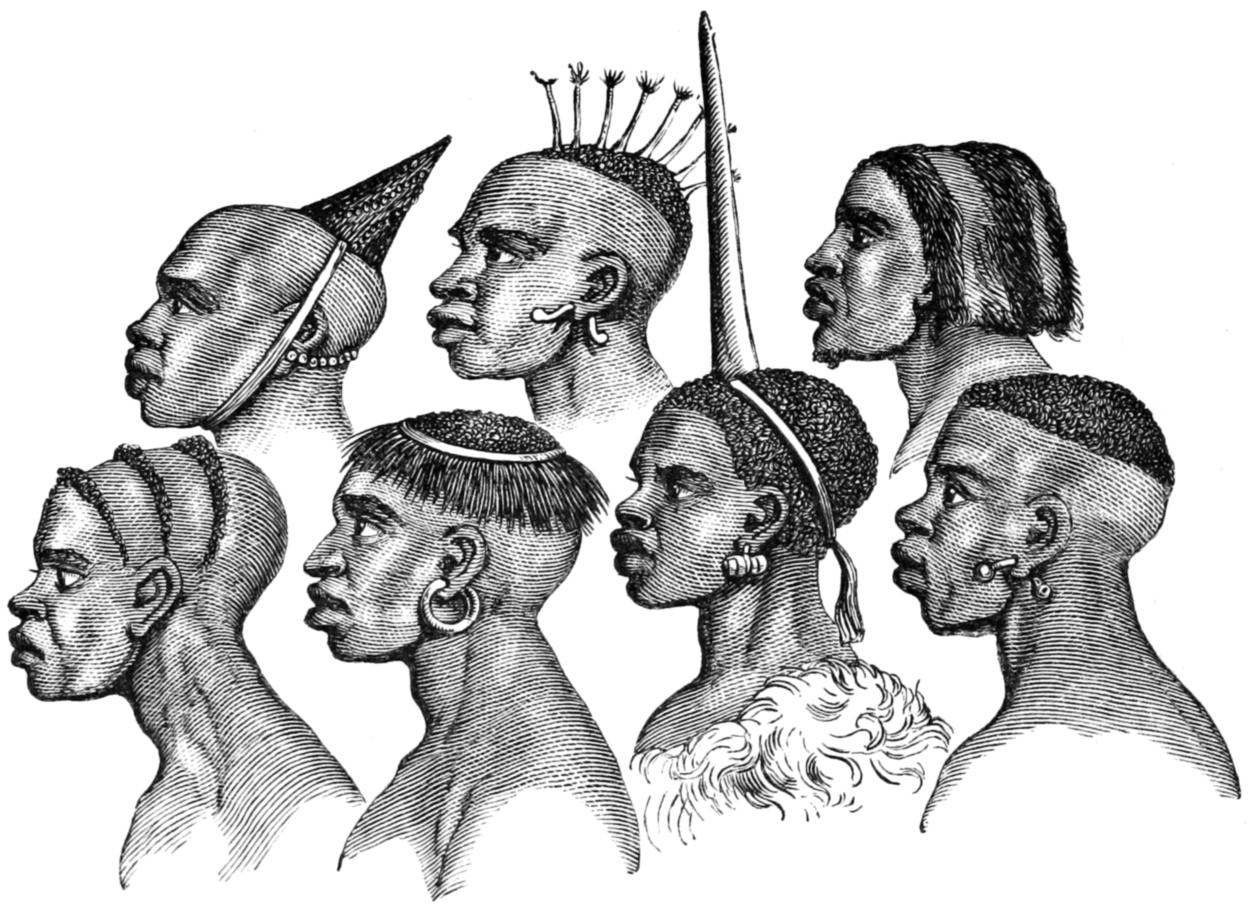
Head Dresses of Wanyamwezi.