Volume 2 — CHAP. XIV. WE EXPLORE THE TANGANYIKA LAKE.
Reading edition
My first care after settling in Hamid’s Tembe, was to purify the floor by pastiles of assafœtida, and fumigations of gunpowder; my second was to prepare the roof for the rainy season. Improvement, however, progressed slowly; the “children” of Said bin Salim were too lazy to work; and the Wanyamwezi porters, having expended their hire in slaves, and fearing loss by delay, took the earliest opportunity of deserting. By the aid of a Msawahili artisan, I provided a pair of cartels, with substitutes for chairs and tables. Benches of clay were built round the rooms, but they proved useless, being found regularly every morning occupied in force by a swarming, struggling colony, of the largest white ants. The roof, long overgrown with tall grass, was fortified with an extra coat of mud; it never ceased, however, leaking like a colander; presently the floor was covered with deep puddles, then masses of earth dropped from the sopped copings and sides of the solid walls, and, at last, during the violent showers, half the building fell in. The consequence of the extreme humidity was, that every book which had English paste in it was rendered useless by decay; writing was rendered illegible by stains and black mildew; moreover, during my absence, whilst exploring the Lake, Said bin Salim having neglected to keep a fire, as was ordered, constantly burning in the house, a large botanical collection was irretrievably lost. This was the more regretable as our return to the coast took place during the dry season, when the woods were bare of leaf, flower, and fruit.
On the second day after my arrival I was called upon by “Kannena,” the headman of Kawele, under Rusimba, the Mwami, or principal chief of Ujiji. I had heard a bad account of the former. His predecessor, Kabeza, a great favourite with the Arabs, had died about two months before we entered Kawele, leaving a single son, hardly ten years old, and Kannena, a slave, having the art to please the widows of the deceased, and, through them, the tribe, caused himself to be elected temporary headman during the heir’s minority. He was introduced habited in silk turban and broadcloth coat, which I afterwards heard he had borrowed from the Baloch, in order to put in a prepossessing first appearance. The effort, however, failed; his aspect was truly ignoble; a short, squat, and broad-backed figure, with natural “plumpers,” a black skin cut and carved in various patterns, thick straight, stumpy, legs, and huge splay feet; his low narrow brow was ever knotted into a peevish frown, his apology for a nose much resembled the pug with which the ancients provided Silenus, and a villanous expression lurked about the depressed corners of his thick-lipped, sensual, liquorish mouth. On this occasion he behaved with remarkable civility, and he introduced, as the envoys commissioned by the great Rusimba to receive his blackmail, two gentlemen a quarter-clad in the greasiest and scantiest bark-aprons, and armed with dwarfish battle-axes. The present was finally settled at ten coil-bracelets and two fundi of coral-beads. I had no salt—the first article in demand—to spare, or much valuable merchandise might have been saved. The return was six small bundles of grain, worth, probably, one-tenth of what had been received. Then Kannena opened trade by sending us a nominal gift, a fine ivory, weighing at least seventy pounds, and worth, perhaps, one hundred pounds, or nearly two mens’ loads of the white or blue-porcelain beads used in this traffic. After keeping it for a day or two, I returned it, excusing myself by saying that, having visited the Tanganyika as a “Sarkal,” I could have no dealings in ivory and slaves.
This was right and proper in the character of a “Sarkal.” But future adventurers are strongly advised always to assume the character of traders. In the first place, it explains the traveller’s motives to the people, who otherwise lose themselves in a waste of wild conjecture. Secondly, under this plea, the explorer can push forward into unknown countries; he will be civilly received, and lightly fined, because the hosts expect to see him or his semblables again; whereas, appearing without ostensible motive amongst them, he would be stripped of his last cloth by recurring confiscations, fines, and every annoyance which greed of gain can suggest. Thus, as the sequel will prove, he loses more by overcharges than by the trifling outlay necessary to support the character of a trader. He travels respectably as a “Mundewa” or “Tajir,” a merchant, which is ever the highest title given by the people to strangers; and he can avoid exciting the jealousy of the Arabs by exchanging his tusks with them at a trifling loss when comforts or provisions are required for the road.
So strange an announcement on my part aroused, as may be supposed, in the minds of the Wajiji marvel, doubt, disbelief, ill-will. “These are men who live by doing nothing!” exclaimed the race commercial as the sons of Hamburg; and they lost no time in requesting me to quit their territory sooner than convenient. To this I objected, offering, however, as compensation for the loss of their octrois and perquisites to pay for not trading what others paid for trading. Kannena roughly informed me that he had a claim for Kiremba, or duties upon all purchases and sales; two cloths, for instance, per head of slave, or per elephant’s tusk; and that, as he expected to gain nothing by brokerage from me, he must receive as compensation, four coil-bracelets and six cotton cloths. These were at once forwarded to him. He then evidenced his ill-will in various ways, and his people were not slow in showing the dark side of their character. They threatened to flog Sayfu, the old Msawahili of Chole, for giving me hints concerning prices. The two surviving riding asses were repeatedly wounded with spears. Thieves broke into the outhouses by night, and stole all the clothes belonging to the Jemadar and to the bull-headed slave Mabruki. At first the widows of the late Kabeza, to whom the only cows in the district belonged, supplied us plentifully with milk; gradually the quantity shrank, whenever an opportunity offered it was “cut off;” and, at last, we could no longer afford the exorbitant price demanded. My companion having refused a cheese to Kannena, the dowager ladies, who owned the cows, when applied to for milk, threw away the vessel, and swore that by boiling what ought to be drunk unboiled, we were manifestly bewitching and killing their cattle. On one occasion, a young person related to Rusimba went to the huts of the Baloch, and, snatching up a fine cloth which she clasped to her bosom, defied them to recover it by force, and departed, declaring that it was a fine for bringing “whites” into the country. At first our heroes spoke of much slaughter likely to arise from such procedure, and with theatrical gesture, made “rapière au vent;” presently second-thoughts suggested how beautiful is peace, and thirdly, they begged so hard, that I was compelled to ransom for them the article purloined. I had unwittingly incurred the animosity of Kennena. On the day after his appearance in rich clothing he had entered unannounced with bare head, a spear or two in hand, and a bundle of wild-cats’ skins by way of placket; not being recognised, he was turned out, and the ejectment mortally offended his dignity. Still other travellers fared even worse than we did. Said bin Majid, who afterwards arrived at Ujiji to trade for ivory and slaves, had two followers wounded by the Wajiji, one openly speared in the bazaar, and the other at night by a thief who was detected digging through the wall of the store-hut.
After trade was disposed of, ensued a general Bakhshish. Nothing of the kind had been contemplated or prepared for at Zanzibar, but before leaving Unyanyembe, I had found it necessary to offer an inducement, and now the promise was to be fulfilled. Moreover, most of the party had behaved badly, and in these exceptional lands, bad behaviour always expects a reward. In the first place, says the Oriental, no man misconducts himself unless he has power to offend you and you are powerless to punish him. Secondly, by “petting” the offender, he may be bribed to conduct himself decently. On the other hand, the Eastern declares, by rewarding, praising, or promoting a man who has already satisfied you, you do him no good, and you may do him great harm. The boy Faraj, who had shamelessly deserted his master, Said bin Salim, was afterwards found at Unyanyembe, in Snay bin Amir’s house, handsomely dressed and treated like a guest; and his patron, forgetting all his stern resolves of condign punishment, met him with a peculiar kindness. I gave to the Baloch forty-five cloths, and to each slave, male and female, a pair. The gratification, however, proved somewhat like that man’s liberality who, according to the old satirist, presented fine apparel to those whom he wished to ruin. Our people recklessly spent all their Bakhshish in buying slaves, who generally deserted after a week, leaving the unhappy ex-proprietor tantalised by all the torments of ungratified acquisitiveness.
At first the cold damp climate of the Lake Regions did not agree with us; perhaps, too, the fish diet was over-rich and fat, and the abundance of vegetables led to little excesses. All energy seemed to have abandoned us. I lay for a fortnight upon the earth, too blind to read or write, except with long intervals, too weak to ride, and too ill to converse. My companion, who, when arriving at the Tanganyika Lake was almost as “groggy” upon his legs as I was, suffered from a painful ophthalmia, and from a curious distortion of face, which made him chew sideways, like a ruminant. Valentine was nearly blind; and he also had a wry mouth, by no means the properest for the process of mastication. Gaetano, who arrived at Ujiji on the 17th February, was half-starved, and his anxiety to make up for lost time brought on a severe attack of fever. The Baloch complained of influenzas and catarrhs: too lazy to build huts after occupying Kannena’s “Traveller’s Bungalow” for the usual week, they had been turned out in favour of fresh visitors, and their tempers were as sore as their lungs and throats.
But work remained undone; it was necessary to awake from this lethargy. Being determined to explore the northern extremity of the Tanganyika Lake, whence, according to several informants, issued a large river, flowing northwards, and seeing scanty chance of success, and every prospect of an accident, if compelled to voyage in the wretched canoes of the people, I at first resolved to despatch Said bin Salim across the water, and, by his intervention, to hire from an Arab merchant, Hamid bin Sulayyam, the only dow, or sailing-craft then in existence. But the little Arab evidently shirked the mission, and he shirked so artistically, that, after a few days, I released him, and directed my companion to do his best about hiring the dow, and stocking it with provisions for a month’s cruise.
Then arose the preliminary difficulties of the trip. Kannena and all his people, suspecting that my only object was economy in purchasing provisions, opposed the project; they demanded exorbitant sums, and often when bargained down and apparently satisfied, they started up and rushed away, declaring that they washed their hands of the business. At length, Lurinda, the neighbouring headman, was persuaded to supply a Nakhoda and a crew of twenty men. An Arab pays on these occasions, besides rations, ten per cent. upon merchandise; the white men were compelled to give four coil-bracelets and eight cloths for the canoe; besides which, the crew received, as hire, six coil-bracelets, and to each individual provisions for eight days, and twenty khete of large blue-glass beads, and small blue-porcelains were issued. After many delays, my companion set out on the 2nd of March, in the vilest weather, and spent the first stormy day near the embouchure of the Ruche River, within cannon shot of Kawele. This halt gave our persecutors time to change their minds once more, and again to forbid the journey. I was compelled to purchase their permission by sending to Kannena an equivalent of what had been paid for the canoe to Lurinda, viz. four coil-bracelets and eight cloths. Two days afterwards my companion, supplied with an ample outfit, and accompanied by two Baloch and his men—Gaetano and Bombay—crossed the bay of Ukaranga, and made his final departure for the islands.
During my twenty-seven days of solitude the time sped quickly; it was chiefly spent in eating and drinking, smoking and dozing. Awaking at 2 or 3 A.M., I lay anxiously expecting the grey light creeping through the door-chinks and making darkness visible; the glad tidings of its approach were announced by the cawing of the crows and the crowing of the village cocks. When the golden rays began to stream over the red earth, the torpid Valentine was called up; he brought with him a mess of Suji, or rice-flour boiled in water, with a little cold milk as a relish. Then entered Muhabanya, the “slavey” of the establishment, armed with a leafy branch to sweep the floor, and to slay the huge wasps that riddled the walls of the tenement. This done he lit the fire—the excessive damp rendered this precaution necessary—and sitting over it he bathed his face and hands—luxurious dog!—in the pungent smoke. Ensued visits of ceremony from Said bin Salim and the Jemadar, who sat, stared, and, somewhat disappointed at seeing no fresh symptoms of approaching dissolution, told me so with their faces, and went away. From 7 A.M. till 9 A.M., the breakfast hour, Valentine was applied to tailoring, gun-cleaning, and similar light work, over which he groaned and grumbled, whilst I settled down to diaries and vocabularies, a process interrupted by sundry pipes. Breakfast was again a mess of Suji and milk,—such civilised articles as tea, coffee, and sugar, had been unknown to me for months. Again the servants resumed their labour, and they worked, with the interval of two hours for sleep at noon, till 4 P.M. During this time the owner lay like a log upon his cot, smoking almost uninterruptedly, dreaming of things past, and visioning things present, and sometimes indulging himself in a few lines of reading and writing.
Dinner was an alternation of fish and fowl, game and butchers’ meat being rarely procurable at Ujiji. The fish were in two extremes, either insipid and soft, or so fat and coarse that a few mouthfuls sufficed; most of them resembled the species seen in the seas of Western India, and the eels and small shrimps recalled memories of Europe. The poultry, though inferior to that of Unyanyembe, was incomparably better than the lean stringy Indian chicken. The vegetables were various and plentiful, tomatoes, Jerusalem artichokes, sweet potatoes, yams, and several kinds of beans, especially a white harricot, which afforded many a purée; the only fruit procurable was the plantain, and the only drink—the toddy being a bad imitation of vinegar—was water.
As evening approached I made an attempt to sit under the broad eaves of the Tembe, and to enjoy the delicious spectacle of this virgin Nature, and the reveries to which it gave birth.
“A pleasing land of drowsihed it was, Of dreams that wave before the half-shut eye, And of gay castles in the clouds that pass, For ever flushing round a summer sky.”
It reminded me of the loveliest glimpses of the Mediterranean; there were the same “laughing tides,” pellucid sheets of dark blue water, borrowing their tints from the vinous shores beyond; the same purple light of youth upon the cheek of the earlier evening, the same bright sunsets, with their radiant vistas of crimson and gold opening like the portals of a world beyond the skies; the same short-lived grace and loveliness of the twilight; and, as night closed over the earth, the same cool flood of transparent moonbeam, pouring on the tufty heights and bathing their sides with the whiteness of virgin snow.
At 7 P.M., as the last flush faded from the occident, the lamp—a wick in a broken pot full of palm oil—was brought in; Said bin Salim appeared to give the news of the day,—how A. had abused B., and how C. had nearly been beaten by D., and a brief conversation led to the hour of sleep. A dreary, dismal day, you will exclaim, gentle reader; a day that
“lasts out a night in Russia, When nights are longest there.”
Yet it had its enjoyments. There were no post-offices, and this African Eden had other advantages, which, probably, I might vainly attempt to describe.
On the 29th of March the rattling of matchlocks announced my companion’s return. The Masika had done its worst upon him. I never saw a man so thoroughly moist and mildewed; he justified even the French phrase “wet to the bone.” His paraphernalia were in a similar state; his guns were grained with rust, and his fire-proof powder-magazine had admitted the monsoon-rain. I was sorely disappointed: he had done literally nothing. About ten days before his return I had been visited by Khamis bin Jumah, an Arab merchant, who, on the part of the proprietor of the dow, gave the gratifying message that we could have it when we pleased. I cannot explain where the mismanagement lay; it appears, however, that the wily “son of Sulayyam” detained the traveller simply for the purpose of obtaining from him gratis a little gunpowder. My companion had rested content with the promise that after three months the dow should be let to us for a sum of 500 dollars! and he had returned without boat or provisions to report ill success. The faces of Said bin Salim and the Jemadar, when they heard the period mentioned, were indeed a study. I consoled him and myself as I best could, and applied myself to supplying certain deficiencies as regards orthography and syntax in a diary which appeared in Blackwood, of September 1859, under the title “Journal of a Cruise in the Tanganyika Lake, Central Africa.” I must confess, however, my surprise at, amongst many other things, the vast horseshoe of lofty mountain placed by my companion in the map attached to that paper, near the very heart of Sir R. Murchison’s Depression. As this wholly hypothetical, or rather inventive feature,—I had seen the mountains growing upon paper under my companion’s hand, from a thin ridge of hill fringing the Tanganyika to the portentous dimensions given in Blackwood (Sept. 1859), and Dr. Petermann’s Mittheilungen, (No. 9, of 1859,)—wore a crescent form, my companion gravely published, with all the pomp of discovery, in the largest capitals, “This mountain range I consider to be THE TRUE MOUNTAINS OF THE MOON.” * * * Thus men do geography! and thus discovery is stultified.
When my companion had somewhat recovered from his wetness, and from the effects of punching-in with a pen-knife a beetle which had visited his tympanum[2], I began seriously to seek some means of exploring the northern head of the Tanganyika. Hamid bin Sulayyam had informed his late guest that he had visited the place, where, although attacked by an armada of thirty or forty hostile canoes, he had felt the influence of a large river, which drains the water northwards: in fact, he told the “lie with circumstance.” By a curious coincidence, Sayfu, the Mswahili of Chole, declared that he also had sighted a stream issuing from the northern extremity of the lake—this was the “lie direct”—and he offered to accompany me as guide and interpreter. When we compared statements, we saw what was before us,—a prize for which wealth, health, and life, were to be risked.
It now became apparent that the Masika or rains, which the Arabs, whose barbarous lunar year renders untrustworthy in measurements of time, had erroneously represented as synchronous with the wet monsoon of Zanzibar, was drawing to a close, and that the season for navigation was beginning.[3] After some preliminaries with Said bin Salim, Kannena, who had been preparing for a cruise northwards, was summoned before me. He agreed to convey me; but when I asked him the conditions on which he would show me the Mtoni, or river, he jumped up, discharged a volley of oaths, and sprang from the house like an enraged baboon. I was prepared for this difficulty, having had several warnings that the tribes on the northern shores of the Tanganyika allow no trade. But fears like Kannena’s may generally be bought over. I trusted, therefore, to Fate, and resolved that at all costs, even if reduced to actual want, we should visit this mysterious stream. At length the headman yielded every point. He received, it is true, an exorbitant sum. Arabs visiting Uvira, the “ultima thule” of lake navigation, pay one cloth to each of the crew; and the fare of a single passenger is a brace of coil-bracelets. For two canoes, the larger sixty feet by four, and the lesser about two-thirds that size, I paid thirty-three coil-bracelets, here equal to sixty dollars, twenty cloths, thirty-six khete of blue glass beads, and 770 ditto of white-porcelains and green-glass. I also promised to Kannena a rich reward if he acted up to his word; and as an earnest I threw over his shoulders a six-foot length of scarlet broadcloth, which caused his lips to tremble with joy, despite his struggles to conceal it. The Nakhoda (captain) and the crew in turn received, besides rations, eighty cloths, 170 khete of blue glass-beads, and forty of coral-porcelains, locally three times more valuable than whites or greens. Sayfu, the interpreter, was as extravagantly paid in eight cloths and twenty-seven pounds of white and blue-porcelains. After abundance of dispute it was settled that the crews should consist of fifty-five men, thirty-three to the larger and twenty-two to the smaller canoe. It was an excess of at least one-half, who went for their own profit, not for our pleasure. When this point was conceded, we were kindly permitted to take with us the two Goanese, the two black gun-carriers, and three Baloch as an escort. The latter were the valiant Khudabakhsh, whom I feared to leave behind; Jelai, the mestiço-Mekrani; and, thirdly, Riza, the least mutinous and uncivil of the party.
Before departure it will be necessary to lay before the reader a sketch of our conveyance. The first aspect of these canoes made me lament the loss of Mr. Francis’ iron boat: regrets, however, were of no avail. Quocumque modo—rem! was the word.
The Baumrinden are unknown upon the Tanganyika Lake, where the smaller craft are monoxyles, generally damaged in the bow by the fishermen’s fire. The larger are long, narrow “matumbi,” or canoes, rudely hollowed with the axe—the application of fire being still to be invented,—in fact, a mere log of mvule, or some other large tree which abound in the land of the Wagoma, opposite Ujiji. The trunks are felled, scooped out in loco, dragged and pushed by man-power down the slopes, and finally launched and paddled over to their destination. The most considerable are composed of three parts—clumsy, misshapen planks, forming, when placed side by side, a keel and two gunwales, the latter fastened to the centre-piece by cords of palm-fibre passing through lines of holes. The want of caulking causes excessive leakage: the crew take duty as balesmen in turns. The cry Senga!—bale out!—rarely ceases, and the irregular hollowing of the tree-trunks makes them lie lopsided in the water. These vessels have neither masts nor sails; artifices which now do not extend to this part of the African world. An iron ring, fixed in the stern, is intended for a rudder, which, however, seldom appears except in the canoes of the Arabs, steering is managed by the paddle, and a flag-staff or a fishing-rod projects jib-like from the bow. Layers of palm-ribs, which serve for fuel, are strewed over the interior to raise the damageable cargo—it is often of salt—above the bilge-water. The crew sit upon narrow benches, extending across the canoe and fastened with cords to holes in the two side-pieces; upon each bench, despite the narrowness of the craft, two men place themselves side by side. The “Karagwah,” stout stiff mats used for hutting and bedding, are spread for comfort upon the seats; and for convenience of paddling, the sailors, when at work, incline their bodies over the sides. The space under the seats is used for stowage. In the centre there is a square place, about six feet long, left clear of benches; here also cargo is stored, passengers, cattle, and slaves litter down, the paddles, gourds, and other furniture of the crew are thrown, and the baling is carried on by means of an old gourd. The hold is often ankle-deep in water, and affords no convenience for leaning or lying down; the most comfortable place, therefore, is near the stern or the bow of the boat. The spears are planted upright amidships, at one or two corners of the central space so as to be ready at a moment’s notice; each man usually has his dagger stuck in his belt, and on long trips all are provided with bows and arrows. These Africans cannot row; indeed they will not use oars. The paddle on the Tanganyika is a stout staff, about six feet long, and cut out at the top to admit a trefoil-shaped block the size of a man’s hand:—it was described in South Africa by Captain Owen. The block, adorned with black paint in triangular patches, is lashed to the staff by a bit of whipcord, and it seldom lasts through the day without breaking away from its frail tackling. The paddler, placing one hand on the top and the other about the middle of the staff, scoops up as it were, the water in front of him, steadying his paddle by drawing it along the side of the canoe. The eternal splashing keeps the boat wet. It is a laborious occupation, and an excessive waste of power.
The Lake People derive their modern practice of navigation, doubtless, from days of old; the earliest accounts of the Portuguese mention the traffic of this inland sea. They have three principal beats from Ujiji: the northern abuts at the ivory and slave marts of Uvira; the western conducts to the opposite shores of the Lake and the island depôts on the south-west; and the southern leads to the land of Marunga. Their canoes creep along the shores like the hollowed elders of thirty bygone centuries, and, waiting till the weather augurs fairly, they make a desperate push for the other side. Nothing but their extreme timidity, except when emboldened by the prospect of a speedy return home, preserves their cranky craft from constant accidents. The Arabs, warned by the past, rarely trust themselves to this Lake of Storms, preferring the certain peculation incurred by deputing for trading purposes agents and slaves to personal risk. Those who must voyage on the lake build, by means of their menials and artisans, dows, or sailing-vessels, and teach their newly-bought gangs to use oars instead of paddles. This is rather an economy of money than of time: they expend six months upon making the dow, whereas they can buy the largest canoe for a few farasilah of ivory.
As my outfit was already running low, I persuaded, before departure, two of the Baloch to return with a down-caravan westwards, and arrived at Unyanyembe, to communicate personally with my agent, Snay bin Amir. They agreed so to do, but the Mtongi, or head of the African kafilah, with true African futility, promised to take them on the next day, and set out that night on his journey. As Said bin Majid was about despatching a large armed party to the north of the Lake, I then hurried on my preparations for the voyage. Provisions and tobacco were laid in, the tent was repaired, and our outfit, four half loads of salt—of these two were melted in the canoe, six Gorah,—or one load of domestics, nine coil-bracelets, the remainder of our store, one load of blue porcelain beads, and a small bag of the valuable red coral intended for private expenses, and “El Akibah” (the reserve), was properly packed for concealment. Meanwhile some trifling disputes occurred with Kannena, who was in the habit of coming to our Tembe, drunk and surly, with eyes like two gouts of blood, knitted front, and lips viciously shot out: when contradicted or opposed, he screamed and gesticulated as if haunted by his P’hepo,—his fiend;—and when very evilly disposed, he would proceed to the extreme measure of cutting down a tent. This slave-sultan was a “son of noise:” he affected brusquerie of manner and violence of demeanour the better to impressionise his unruly subjects; and he frightened the timid souls around us, till at last the Jemadar’s phrase was, “strength is useless here.” Had I led, however, three hundred instead of thirty matchlocks, he would have crouched and cowered like a whipped cur.
At 4 P.M., on the 9th April, appeared before the Kannena in a tattered red turban donned for the occasion. He was accompanied by his ward, who was to perform the voyage as a training to act sultan, and he was followed by his sailors bearing salt, in company with their loud-voiced wives and daughters performing upon the wildest musical instruments. Of these the most noisy was a kind of shaum, a straight, long and narrow tube of wood, bound with palm-fibre and provided with an opening mouth like a clarionet; a distressing bray is kept up by blowing through a hole pierced in the side. The most monotonous was a pair of foolscap-shaped plates of thin iron, joined at the apices and connected at the bases by a solid cross-bar of the same metal; this rude tomtom is performed upon by a muffled stick with painful perseverance; the sound—how harshly it intruded upon the stilly beauty of the scenes around!—still lingers and long shall linger in my tympanum. The canoe had been moved from its usual position opposite our Tembe, to a place of known departure—otherwise not a soul could have been persuaded to embark—and ignoring the distance, I condemned myself to a hobble of three miles over rough and wet ground. The night was comfortless; the crew, who were all “half-seas over,” made the noise of bedlamites; and two heavy falls of rain drenching the flimsy tent, at once spoiled the tobacco and flour, the grain and the vegetables prepared for the voyage.
Early on the next morning we embarked on board the canoes: the crews had been collected, paid, and rationed, but as long as they were near home it was impossible to keep them together. Each man thinking solely of his own affairs, and disdaining the slightest regard for the wishes, the comfort, or the advantage of his employers, they objected systematically to every article which I had embarked. Kannena had filled the canoes with his and his people’s salt, consequently he would not carry even a cartel. Various points settled we hove anchor or rather hauled up the block of granite doing anchoral duty, and with the usual hubbub and strife, the orders which every man gives and the advice which no man takes, we paddled in half an hour to a shingly and grassy creek, defended by a sandpit and backed by a few tall massive trees. Opposite and but a few yards distant, rose the desert islet of Bangwe, a quoin-shaped mass of sandstone and red earth, bluff to the north and gradually shelving towards the water at the other extremity: the prolific moisture above and around had covered its upper ledge with a coat of rich thick vegetation. Landward the country rises above the creek, and upon its earth-waves, which cultivation shares with wild growth, appear a few scattered hamlets.
Boats generally waste some days at Bangwe Bay, the stage being short enough for the usual scene being encored. They load and reload, trim cargo, complete rations, collect crews, and take leave of friends and relatives, women, and palm-wine. We pitched a tent and halted in a tornado of wind and rain. Kannena would not move without the present of one of our three goats. At 4 P.M., on the 11th April, the canoes were laden and paddled out to and back from Bangwe islet, when those knowing in such matters pronounced them so heavily weighted as to be unsafe: whereupon, the youth Riza, sorely against my will, was sent back to the Kawele. On that night a furious gale carried away my tent, whilst the Goanese were, or pretended to be, out of hearing. I slept, however, comfortably enough upon the crest of a sand-wave higher than the puddles around it, and—blessings on the name of Mackintosh!—escaped the pitiless pelting of the rain.
The next morning showed a calm sea, levelled by the showers, and no pretext or desire for longer detention lingered in the hearts of the crew. At 7·20 A.M., on the 12th April, 1858, my canoe—bearing for the first time on those dark waters—
“The flag that braved a thousand years The battle and the breeze,”
stood out of Bangwe Bay, and followed by my companion’s turned the landspit separating the bight from the main, and made directly for the cloudy and storm-vexed north. The eastern shore of the lake, along which we coasted, was a bluff of red earth pudding’d with separate blocks of sandstone. Beyond this headland the coast dips, showing lines of shingle or golden-coloured quartzose sand, and on the shelving plain appear the little fishing-villages. They are usually built at the mouths of the gaps, combes, and gullies, whose deep gorges winding through the background of hill-curtain, become, after rains, the beds of mountain-torrents. The wretched settlements are placed between the tree clad declivities and the shore on which the waves break. The sites are far from comfortable: the ground is here veiled with thick and fetid grass; there it is a puddle of black mud, and there a rivulet trickles through the villages. The hamlet consists of half a dozen beehive-huts, foul, flimsy, and leaky; their only furniture is a hearth of three clods or stones, with a few mats and fishing implements. The settlements are distinguished from a distance by their plantations of palm and plantain, and by large spreading trees, from whose branches are suspended the hoops and the drag-nets not in actual use, and under whose shade the people sit propped against their monoxyles, which are drawn high up out of danger of the surf. There was no trade, and few provisions were procurable at Kigari. We halted there to rest, and pitching a tent in the thick grass we spent a night loud with wind and rain.
Rising at black dawn on the 13th April, the crews rowed hard for six hours between Kigari and another dirty little fishing-village called Nyasanga. The settlement supplied fish-fry, but neither grain nor vegetables were offered for sale. At this place, the frontier district between Ujiji and Urundi, our Wajiji took leave of their fellow-clansmen and prepared with serious countenances for all the perils of expatriation.
This is the place for a few words concerning boating and voyaging upon the Tanganyika Lakes. The Wajiji, and indeed all these races, never work silently or regularly. The paddling is accompanied by a long monotonous melancholy howl, answered by the yells and shouts of the chorus, and broken occasionally by a shrill scream of delight from the boys which seems violently to excite the adults. The bray and clang of the horns, shaums, and tomtoms, blown and banged incessantly by one or more men in the bow of each canoe, made worse by brazen-lunged imitations of these instruments in the squeaking trebles of the younger paddlers, lasts throughout the livelong day, except when terror induces a general silence. These “Wáná Máji”—sons of water—work in “spirts,” applying lustily to the task till the perspiration pours down their sooty persons. Despite my remonstrances, they insisted upon splashing the water in shovelsful over the canoe. They make terribly long faces, however, they tremble like dogs in a storm of sleet, and they are ready to whimper when compelled by sickness or accident to sit with me under the endless cold wave-bath in the hold. After a few minutes of exertion, fatigued and worn, they stop to quarrel, or they progress languidly till recruited for another effort. When two boats are together they race continually till a bump—the signal for a general grin—and the difficulty of using the entangled paddles afford an excuse for a little loitering, and for the loud chatter, and violent abuse, without which apparently this people cannot hold converse. At times they halt to eat, drink, and smoke: the bhang-pipe is produced after every hour, and the paddles are taken in whilst they indulge in the usual screaming convulsive whooping-cough. They halt for their own purposes but not for ours; all powers of persuasion fail when they are requested to put into a likely place for collecting shells or stones.[4] For some superstitious reason they allow no questions to be asked, they will not dip a pot for water into the lake, fearing to be followed and perhaps boarded by crocodiles, which are hated and dreaded by these black navigators, much as is the shark by our seamen, and for the same cause not a scrap of food must be thrown overboard—even the offal must be cast into the hold. “Whittling” is here a mortal sin: to chip or break off the smallest bit of even a condemned old tub drawn up on the beach causes a serious disturbance. By the advice of a kind and amiable friend[5], I had supplied myself with the desiderata for sounding and ascertaining the bottom of the Lake: the crew would have seen me under water rather than halt for a moment when it did not suit their purpose. The wild men lose half an hour, when time is most precious, to secure a dead fish as it floats past the canoe entangled in its net. They never pass a village without a dispute; some wishing to land, others objecting because some wish it. The captain, who occupies some comfortable place in the bow, stern, or waist, has little authority; and if the canoe be allowed to touch the shore, its men will spring out without an idea of consulting aught beyond their own inclinations. Arrived at the halting-place they pour on shore; some proceed to gather firewood, others go in search of rations, and others raise the boothies. A dozen barked sticks of various lengths are planted firmly in the ground; the ends are bent and lashed together in the shape of half an orange, by strips of tree-fibre; they are then covered with the karagwah—the stiff-reed mats used as cushions when paddling—these are tightly bound on, and thus a hut is made capable of defending from rain the bodies of four or five men whose legs which project beyond the shelter are apparently not supposed to require covering. Obeying only impulse, and wholly deficient in order and purpose, they make the voyage as uncomfortable as possible; they have no regular stages and no fixed halting-places; they waste a fine cool morning, and pull through the heat of the day, or after dozing throughout the evening, at the loud cry of “Pakírá Bábá!”—pack up, hearties!—they scramble into their canoes about midnight. Outward-bound they seek opportunities for delay; when it is once “up anchor for home,” they hurry with dangerous haste.
On the 14th April, a cruise of four hours conducted us to Wafanya, a settlement of Wajiji mixed with Warundi. Leaving this wretched mass of hovels on the next day, which began with a solemn warning from Sayfu—a man of melancholic temperament—we made in four hours Wafanya, the southern limit of Urundi, and the only port in that inhospitable land still open to travellers. Drawing up our canoes upon a clear narrow sandstrip beyond the reach of the surf, we ascended a dwarf earth-cliff, and pitching our tents under a spreading tree upon the summit, we made ourselves as comfortable as the noisy, intrusive, and insolent crowd, assembled to stare and to laugh at the strangers, would permit. The crew raised their boothies within a stone-throw of the water, flight being here the thought ever uppermost in their minds.
The people of this country are a noisy insolent race, addicted, like all their Lakist brethren, to drunkenness, and, when drunk, quarrelsome and violent. At Wafanya, however, they are kept in order by Kanoni, their mutware or minor chief, subject to “Mwezi,” the mwami or sultan of Urundi. The old man appeared, when we reached his settlement, in some state, preceded by an ancient carrying his standard, a long wisp of white fibre attached to a spear, like the Turkish “horse-tail,” and followed by a guard of forty or fifty stalwart young warriors armed with stout lance-like spears for stabbing and throwing, straight double-edged daggers, stiff bows, and heavy, grinded arrows. Kanoni began by receiving his black-mail—four cloths, two coil-bracelets, and three fundo of coral beads: the return was the inevitable goat. The climate of Wafanya is alternately a damp-cold and a “muggy” heat; the crews, however, if numerous and well armed, will delay here to feed when northward bound, and to lay in provisions when returning to their homes. Sheep and fine fat goats vary in value from one to two cloths; a fowl, or five to six eggs, costs a khete of beads; sweet potatoes are somewhat dearer than at Ujiji; there is no rice, but holcus and manioc are cheap and abundant, about 5 lbs. of the latter being sold for a single khete. Even milk is at times procurable. A sharp business is carried on in chikichi or palm-oil, of which a large earthen pot is bought for a cloth; the best paddles used by the crews are made at Wafanya; and the mbugu, or bark-cloth, is bought for four to ten khete, about one third of the market-price at Ujiji. Salt, being imported from Uvinza, is dear and scarce: it forms the first demand for barter, and beads the second. Large fish is offered for sale, but the small fry is the only article of the kind which is to be purchased fresh. The country owes its plenty, according to the guides, to almost perennial showers.
The inhospitality of the Warundi and their northern neighbours, who would plunder a canoe or insist upon a black-mail equivalent to plunder, allows neither traffic nor transit to the north of Wafanya. Here, therefore, the crews prepare to cross the Tanganyika, which is divided into two stages by the island of Ubwari.
In Ubwari I had indeed discovered “an island far away.” It is probably the place alluded to by the Portuguese historian, De Barros, in this important passage concerning the great lake in the centre of Africa: “It is a sea of such magnitude as to be capable of being navigated by many sail; and among the islands in it there is one capable of sending forth an army of 30,000 men.” Ubwari appears from a distance of two days bearing north-west; it is then somewhat hazy, owing to the extreme humidity of the atmosphere. From Wafanya it shows a clear profile about eighteen to twenty miles westward, and the breadth of the western channel between it and the mainland averages from six to seven miles. Its north point lies in south lat. 4° 7′, and the lay is N. 17° E. (corrected). From the northern point of Ubwari the eastern prolongation of the lake bears N. 3° W. and the western N. 10° W. It is the only island near the centre of the Tanganyika—a long, narrow lump of rock, twenty to twenty-five geographical miles long, by four or five of extreme breadth, with a high longitudinal spine, like a hog’s back, falling towards the water—here shelving, there steep, on the sea-side—where it ends in abrupt cliffs, here and there broken by broad or narrow gorges. Green from head to foot, in richness and profuseness of vegetation it equals, and perhaps excels, the shores of the Tanganyika, and in parts it appears carefully cultivated. Mariners dare not disembark on Ubwari, except at the principal places; and upon the wooded hill-sides wild men are, or are supposed to be, ever lurking in wait for human prey.
We halted two miserable days at Wafanya. The country is peculiarly rich, dotted with numerous hamlets, which supply provisions, and even milk, and divided into dense thickets, palm-groves, and large clearings of manioc, holcus, and sweet potatoes, which mantle like a garment the earth’s brown body. Here we found Kannena snugly ensconced in our sepoy’s pal, or ridge-tent. He had privily obtained it from Said bin Salim, with a view to add to his and his ward’s comfort and dignity. When asked to give it up—we were lodging, I under a lug-sail, brought from the coast and converted into an awning, and my companion in the wretched flimsy article purchased from the Fundi—he naively refused. Presently having seen a fat sheep, he came to me declaring that it was his perquisite: moreover, he insisted upon receiving the goat offered to us by the Sultan Kanoni. I at first demurred. His satisfactory rejoinder was: “Ngema, ndugu yango!—Well, my brother,—here we remain!” I consulted Bombay about the necessity of humouring him in every whim. “What these jungle-niggers want,” quoth my counsel, “that they will have, or they will see the next month’s new moon!”
The morning of the 18th April was dark and menacing. Huge purpling clouds deformed the face of the northern sky. Having loaded the canoes, however, we embarked to cross the channel which separated us from the Ubwari island. As the paddles were in hand, the crew, starting up from their benches, landed to bring on board some forgotten manioc. My companion remained in his boat, I in mine. Presently, hearing an unusual uproar, I turned round and saw the sailors arming themselves, whilst the “curtain-lion,” Khudabakhsh, was being hustled with blows, and pushed up the little cliff by a host of black spearmen; a naked savage the while capering about, waving the Baloch’s bare blade in one hand and its scabbard in the other. Kannena joined majestically in the “row,” but the peals of laughter from the mob showed no signs of anger. A Mjiji slave, belonging to Khudabakhsh had, it appears, taken flight, after landing unobserved with the crowd. The brave had redemanded him of Kannena, whom he charged, moreover, with aiding and abetting the desertion. The slave Sultan offered to refer the point to me, but the valiant man, losing patience, out with his sword, and was instantly disarmed, assaulted, and battered, as above described, by forty or fifty sailors. When quiet was restored, I called to him from the boat. He replied by refusing to “budge an inch,” and by summoning his “brother” Jelai to join him with bag and baggage. Kannena also used soft words, till at last, weary of waiting, he gave orders to put off, throwing two cloths to Khudabakhsh, that the fellow might not return home hungry. I admired his generosity till compelled to pay for it.
The two Baloch were like mules; they disliked the voyage, and as it was the Ramazan, they added to their discomforts by pretending to fast. Their desertion was inexcusable; they left us wholly in the power of the Wajiji, to dangers and difficulties which they themselves could not endure. Prudent Orientals, I may again observe, never commit themselves to the sole custody of Africans, even of the “Muwallid,” namely those born and bred in their houses. In Persia the traveller is careful to mix the black blood with that of the higher race; formerly, whenever the member of a family was found murdered, the serviles were all tortured as a preliminary to investigation, and many stories, like the following, are recounted. The slaves had left their master in complete security, and were sitting, in early night, merrily chatting round the camp fire. Presently one began to relate the list of their grievances; another proposed to end them by desertion; and a third seconded the motion, opining, however, that they might as well begin by murdering the patroon. No sooner said than done. These children of passion and instinct, in the shortest interim, act out the “dreadful thing,” and as readily repent when reflection returns. The Arab, therefore, in African lands, seldom travels with Africans only; he prefers collecting as many companions, and bringing as many hangers on as he can afford. The best escort to a European capable of communicating with and commanding them, would be a small party of Arabs fresh from Hazramaut and untaught in the ways and tongues of Africa. They would by forming a kind of balance of power, prevent that daring pilfering for which slaves are infamous; in the long run they would save money to the explorer, and perhaps save his life.
Khudabakhsh and his comrade-deserter returned safely by land to Kawele; and when derided by the other men, he repeated, as might be expected, notable griefs. Both had performed prodigies of valour; they had however been mastered by millions. Then they had called upon “Haji Abdullah” for assistance, to which he had replied “My power does not extend here!” Thus heartlessly refused aid by the only person who could and should have afforded it, they were reduced, sorely against their will, to take leave of him. Their tale was of course believed by their comrades, till the crews brought back the other version of the affair, the “camel-hearts” then once more became the laugh and jibe of man and woman.
After a short consultation amongst the men concerning the threatening aspect of the heavens, it was agreed by them to defer crossing the Lake till the next day. We therefore passed on to the northern side of the point which limits the bay of Wafanya, and anchoring the craft in a rushy bayou, we pitched tents in time to protect us against a violent thunderstorm with its wind and rain.
On the 19th April we stretched westward, towards Ubwari, which appeared a long strip of green directly opposite Urundi, and distant from eighteen to twenty miles. A little wind caused a heavy chopping swell; we were wet to the skin, and as noon drew nigh, the sun shone stingingly, reflected by a mirrory sea. At 10 A.M. the party drew in their paddles and halted to eat and smoke. About 2 P.M. the wind and waves again arose,—once more we were drenched, and the frail craft was constantly baled out to prevent water-logging. A long row of nine hours placed the canoes at a roadstead, with the usual narrow line of yellow sand, on the western coast of Ubwari Island. The men landed to dry themselves, and to cook some putrid fish which they had caught as it floated past the canoe, with the reed triangle that buoyed up the net. It was “strong meat” to us, but to them its staleness was as the “taste in his butter,” to the Londoner, the pleasing toughness of the old cock to the Arab, and the savoury “fumet” of the aged he-goat to the Baloch. After a short halt, we moved a little northwards to Mzimu, a strip of low land dividing the waters from their background of grassy rise, through which a swampy line winds from the hills above. Here we found canoes drawn up, and the islanders flocked from their hamlets to change their ivory and slaves, goats and provisions, for salt and beads, wire and cloth. The Wabwari are a peculiar, and by no means a comely race. The men are habited in the usual mbugu, tigered with black stripes, and tailed like leopard-skins: a wisp of fine grass acts as fillet, and their waists, wrists, and ankles, their knob-sticks, spears, and daggers, are bound with rattan-bark, instead of the usual wire. The women train their frizzly locks into two side-bits resembling bear’s ears; they tie down the bosom with a cord, apparently for the purpose of distorting nature in a way that is most repulsive to European eyes; and they clothe themselves with the barbarous goat-skin, or the scantiest kilts of bark-cloth. The wives of the chiefs wear a load of brass and bead ornaments; and, like the ladies of Wafanya, they walk about with patriarchal staves five feet long, and knobbed at the top.
We halted for a day at Mzimu in Ubwari, where Kannena demanded seventy khete of blue-porcelain beads as his fee for safe conduct to the island. Suddenly, at 6 P.M., he informed me that he must move to other quarters. We tumbled into the boats, and after enjoying two hours of pleasant progress with a northerly current, and a splendid moonshine, which set off a scene at once wild and soft as any
“That savage Rosa dashed, or learned Poussin drew,”
we rounded the bluff northern point of the island, put into “Mtuwwa,” a little bay on its western shore, pitched the tent, and slept at ease.
Another halt was required on the 22nd April. The Sultan Kisesa demanded his blackmail, which amounted to one coil-bracelet and two cloths; provisions were hardly procurable, because his subjects wanted white beads, with which, being at a discount at Ujiji, we had not provided ourselves; and Kannena again successfully put in a tyrannical claim for 460 khete of blue-porcelains to purchase rations.
On the 23rd April we left Mtuwwa, and made for the opposite or western shore of the lake, which appeared about fifteen miles distant; the day’s work was nine hours. The two canoes paddled far apart, there was therefore little bumping, smoking, or quarrelling, till near our destination. At Murivumba the malaria, the mosquitoes, the crocodiles, and the men are equally feared. The land belongs to the Wabembe, who are correctly described in the “Mombas Mission Map” as “Menschenfresser—anthropophagi.” The practice arises from the savage and apathetic nature of the people, who devour, besides man, all kinds of carrion and vermin, grubs and insects, whilst they abandon to wild growths a land of the richest soil and of the most prolific climate. They prefer man raw, whereas the Wadoe of the coast eat him roasted. The people of a village which backed the port, assembled as usual to “sow gape-seed;” but though
“A hungry look hung upon them all,”—
and amongst cannibals one always fancies oneself considered in the light of butcher’s meat,—the poor devils, dark and stunted, timid and degraded, appeared less dangerous to the living than to the dead. In order to keep them quiet, the bull-headed Mabruki, shortly before dusk, fired a charge of duck-shot into the village; ensued loud cries and deprecations to the “Murungwana,” but happily no man was hurt. Sayfu the melancholist preferred squatting through the night on the bow of the canoe, to trusting his precious person on shore. We slept upon a reed-margined spit of sand, and having neglected to pitch the tent, were rained upon to our heart’s content.
We left Murivumba of the man-eaters early on the morning of the 24th April, and stood northwards along the western shore of the Lake: the converging trend of the two coasts told that we were fast approaching our destination. After ten hours’ paddling, halts included, we landed at the southern frontier of Uvira, in a place called Mamaletua, Ngovi, and many other names. Here the stream of commerce begins to set strong; the people were comparatively civil, they cleared for us a leaky old hut with a floor like iron,—it appeared to us a palace!—and they supplied, at moderate prices, sheep and goats, fish-fry, eggs, and poultry, grain, manioc and bird-pepper.
After another long stretch of fifteen rainy and sunny hours, a high easterly wind compelled the hard-worked crews to put into Muikamba (?) of Uvira. A neighbouring hamlet, a few hovels built behind a thick wind-wrung plantain-grove, backed a reed-locked creek, where the canoes floated in safety and a strip of clean sand on which we passed the night as pleasantly as the bright moonlight and the violent gusts would permit. On the 26th April, a paddle of three hours and a half landed us in the forenoon at the sandy baystand, where the trade of Uvira is carried on.
Great rejoicings ushered in the end of our outward-bound voyage. Crowds gathered on the shore to gaze at the new merchants arriving at Uvira, with the usual concert, vocal and instrumental, screams, shouts, and songs, shaums, horns, and tom-toms. The captains of the two canoes performed with the most solemn gravity a bear-like dance upon the mat-covered benches, which form the “quarter-decks,” extending their arms, pirouetting upon both heels, and springing up and squatting down till their hams touched the mats. The crews, with a general grin which showed all their ivories, rattled their paddles against the sides of their canoes in token of greeting, a custom derived probably from the ceremonious address of the Lakists, which is performed by rapping their elbows against their ribs. Presently Majid and Bekkari, two Arab youths sent from Ujiji by their chief, Said bin Majid, to collect ivory, came out to meet me; they gave me, as usual, the news, and said that having laid in the store of tusks required, they intended setting out southwards on the morrow. We passed half the day of our arrival on the bare landing-place, a strip of sand foully unclean, from the effect of many bivouacs. It is open to the water and backed by the plain of Uvira; one of the broadest of these edges of gently-inclined ground which separate the Lake from its trough of hills. Kannena at once visited the Mwami or Sultan Maruta, who owns a village on a neighbouring elevation; this chief invited me to his settlement, but the outfit was running low and the crew and party generally feared to leave their canoes. We therefore pitched our tents upon the sand, and prepared for the last labour, that of exploring the head of the Lake.
We had now reached the “ne plus ultra,” the northernmost station to which merchants have as yet been admitted. The people are generally on bad terms with the Wavira, and in these black regions a traveller coming direct from an enemy’s territory is always suspected of hostile intentions,—no trifling bar to progress. Opposite us still rose, in a high broken line, the mountains of inhospitable Urundi, apparently prolonged beyond the northern extremity of the waters. The head, which was not visible from the plain, is said to turn N.N. westwards, and to terminate after a voyage of two days, which some informants, however, reduce to six hours. The breadth of the Tanganyika is here between seven and eight miles. On the 28th April, all my hopes—which, however, I had hoped against hope—were rudely dashed to the ground. I received a visit from the three stalwart sons of the Sultan Maruta: they were the noblest type of Negroid seen near the Lake, with symmetrical heads, regular features and pleasing countenances; their well-made limbs and athletic frames of a shiny jet black, were displayed to advantage by their loose aprons of red and dark-striped bark-cloth, slung, like game-bags, over their shoulders, and were set off by opal-coloured eyeballs, teeth like pearls, and a profusion of broad massive rings of snowy ivory round their arms, and conical ornaments like dwarf marling-spikes of hippopotamus tooth suspended from their necks. The subject of the mysterious river issuing from the Lake, was at once brought forward. They all declared that they had visited it, they offered to forward me, but they unanimously asserted, and every man in the host of bystanders confirmed their words, that the “Rusizi” enters into, and does not flow out of the Tanganyika. I felt sick at heart. I had not, it is true, undertaken to explore the Coy Fountains by this route; but the combined assertions of the cogging Shaykh and the false Msawahili had startled me from the proprieties of reason, and—this was the result!
Bombay, when questioned, declared that my companion had misunderstood the words of Hamid bin Sulayyam, who spoke of a river falling into, not issuing from the lake; and added his own conviction that the Arab had never sailed north of Ubwari Island. Sayfu, who at Ujiji had described, as an eye-witness, the mouth of the déversoir and its direction for two days, now owned that he had never been beyond Uvira, and that he never intended to do so. Briefly, I had been deceived by a strange coincidence of deceit.
On the 28th April, we were driven from the strip of land which we originally occupied by a S. E. gale; here a “blat,” or small hurricane, which drives the foaming waters of the tideless sea up to the green margin of the land. Retiring higher up where the canoes were careened, we spread our bedding on the little muddy mounds that rise a few inches above the surface of grass-closed gutter which drains off the showers daily falling amongst the hills. I was still obliged to content myself with the lug-sail, thrown over a ridge-pole supported by two bamboo uprights, and pegged out like a tent below; it was too short to fall over the ends and to reach the ground, it was therefore a place of passage for mizzle, splash, and draught of watery wind. My companion inhabited the tent bought from the Fundi, it was thoroughly rotted, during his first trip across the Lake—by leakage in the boat, and by being “bushed” with mud instead of pegs on shore. He informed me that there was “good grub” at Uvira, and that was nearly the full amount of what I heard from or of him. Our crews had hutted themselves in the dense mass of grass near our tents; they lived as it were under arms, and nothing would induce them to venture away from their only escape, the canoes, which stood ready for launching whenever required. Sayfu swore that he would return to Ujiji rather than venture a few yards inland to buy milk, whilst Bombay and Mabrukí, who ever laboured under the idea that every brother-African of the jungle thirsted for their blood, upon the principle that wild birds hate tame birds, became, when the task was proposed to them, almost mutinous. Our nine days’ halt at Uvira had therefore unusual discomforts. The air, however, though damp and raw, with gust, storm, and rain, must have been pure in the extreme; appetite and sleep—except when the bull-frogs were “making a night of it”—were rarely wanting, and provisions were good, cheap, and abundant.
I still hoped, however, to lay down the extreme limits of the lake northwards. Majid and Bekkari the Arab agents of Said bin Majid, replied to the offer of an exorbitant sum, that they would not undertake the task for ten times that amount. The sons of Maruta had volunteered their escort; when I wanted to close with them, they drew off. Kannena, when summoned to perform his promise and reminded of the hire that he had received, jumped up and ran out of the tent: afterwards at Ujiji he declared that he had been willing to go, but that his crews were unanimous in declining to risk their lives,—which was perhaps true. Towards the end of the halt I suffered so severely from ulceration of the tongue, that articulation was nearly impossible, and this was a complete stopper to progress. It is a characteristic of African travel that the explorer may be arrested at the very bourne of his journey, on the very threshold of success, by a single stage, as effectually as if all the waves of the Atlantic or the sands of Arabia lay between.
Maruta and his family of young giants did not fail to claim their blackmail; they received a total of twelve cloths, five kitindi, and thirty khete of coral beads. They returned two fine goats, here worth about one cloth each, and sundry large gourds of fresh milk—the only food I could then manage to swallow. Kannena, who had been living at Maruta’s village, came down on the 5th May to demand 460 khete of blue porcelains, wherewith to buy rations for the return-voyage. Being heavily in debt, all his salt and coil-bracelets had barely sufficed for his liabilities: he had nothing to show for them but masses of Sambo—iron-wire rings—which made his ankles resemble those of a young hippopotamus. The slaves and all the fine tusks that came on board were the property of the crew.
Our departure from Uvira was finally settled for the 6th May: before taking leave of our “furthest point,” I will offer a few details concerning the commerce of the place.
Uvira is much frequented on account of its cheapness; it is the great northern depôt for slaves, ivory, grain, bark-cloth, and ironware, and, in the season, hardly a day elapses without canoes coming in for merchandise or provisions. The imports are the kitindi, salt, beads, tobacco, and cotton cloth. Rice does not grow there, holcus and maize are sold at one to two fundo of common beads per masuta or small load,—perhaps sixteen pounds,—and one khete is sufficient during the months of plenty to purchase five pounds of manioc, or two and even three fowls. Plantains of the large and coarse variety are common and cheap, and one cloth is given for two goodly earthen pots full of palm-oil. Ivory fetches its weight in brass wire: here the merchant expects for every 1000 dollars of outfit to receive 100 farasilah (3500 lbs.) of large tusks, and his profit would be great were it not counterbalanced by the risk and by the expense of transport. The prices in the slave-mart greatly fluctuate. When business is dull, boys under ten years may be bought for four cloths and five fundo of white and blue porcelains, girls for six shukkah, and as a rule at these remote places, as Uvira, Ujipa, and Marungu, slaves are cheaper than in the market of Ujiji. Adults fetch no price, they are notoriously intractable, and addicted to desertion. Bark-cloths, generally in the market, vary from one to three khete of coral beads. The principal industry of the Wavira is ironware, the material for which is dug in the lands lying at a little distance westward of the lake. The hoes, dudgeons, and small hatchets, here cost half their usual price at Ujiji. The people also make neat baskets and panniers, not unlike those of Normandy, and pretty bowls cut out of various soft woods, light and dark: the latter are also found, though rarely, at Ujiji and in the western islets.
A gale appeared to be brewing in the north—here the place of storms—and the crews, fearing wind and water, in the afternoon insisted upon launching their canoes and putting out to sea at 10 A.M. on the 6th May. After touching at the stages before described, Muikamba, Ngovi and Murivumba of the anthropophagi, we crossed without other accidents but those of weather—the rainy monsoon was in its last convulsions—the western branch or supplementary channel separating the Lake from the island of Ubwari. Before anchoring at Mzimu, our former halting-place, we landed at a steep ghaut, where the crews swarmed up a ladder of rock, and presently returned back with pots of the palm-oil, for which this is the principal depôt.
On the 10th May the sky was dull and gloomy, the wind was hushed, the “rain-sun” burnt with a sickly and painful heat; the air was still and sultry, stifling and surcharged, while the glimmerings of lurid lightning and low mutterings from the sable cloud-banks lying upon the northern horizon, cut by light masses of mist in a long unbroken line, and from the black arch rising above the Acroceraurian hills to the west, disturbed at times the death-like silence. Even the gulls on the beach forefelt a storm. I suggested a halt, but the crews were now in a nervous hurry to reach their homes,—impatience mastered even their prudence.
We left Mzimu at sunset, and for two hours coasted along the shore. It was one of those portentous evenings of the tropics—a calm before a tempest—unnaturally quiet; we struck out, however, boldly towards the eastern shore of the Tanganyika, and the western mountains rapidly lessened on the view. Before, however, we reached the mid-channel, a cold gust—in these regions the invariable presage of a storm—swept through the deepening shades cast by the heavy rolling clouds, and the vivid nimble lightning flashed, at first by intervals, then incessantly, with a ghastly and blinding glow, illuminating the “vast of night,” and followed by a palpable obscure, and a pitchy darkness, that weighed upon the sight. As terrible was its accompaniment of rushing, reverberating thunder, now a loud roar, peal upon peal, like the booming of heavy batteries, then breaking into a sudden crash, which was presently followed by a rattling discharge like the sharp pattering of musketry. The bundles of spears planted upright amidships, like paratonnerres, seemed to invite the electric fluid into the canoes. The waves began to rise, the rain descended, at first in warning-drops, then in torrents, and had the wind steadily arisen, the cockle-shell craft never could have lived through the short, chopping sea which characterises the Tanganyika in heavy weather. The crew, though blinded by the showers, and frightened by the occasional gusts, held their own gallantly enough; at times, however, the moaning cry, “O my wife!” showed what was going on within. Bombay, a noted Voltairian in fine weather, spent the length of that wild night in reminiscences of prayer. I sheltered myself from the storm under my best friend, the Mackintosh, and thought of the far-famed couplet of Hafiz,—with its mystic meaning I will not trouble the reader:—
“This collied night, these horrid waves, these gusts that sweep the whirling deep! What reck they of our evil plight, who on the shore securely sleep?”
Fortunately the rain beat down wind and sea, otherwise nothing short of a miracle could have preserved us for a dry death.
That night, however, was the last of our “sea-sorrows.” After floating about during the latter hours of darkness, under the land, but uncertain where to disembark, we made at 7 A.M., on the 11th May, Wafanya, our former station in ill-famed Urundi. Tired and cramped by the night’s work, we pitched tents, and escaping from the gaze of the insolent and intrusive crowd, we retired to spend a few hours in sleep.
I was suddenly aroused by Mabruki, who, rushing into the tent, thrust my sword into my hands, and exclaimed that the crews were scrambling into their boats. I went out and found everything in dire confusion. The sailors hurrying here and there, were embarking their mats and cooking-pots, some were in violent parley with Kannena, whilst a little knot was carrying a man, mortally wounded, down to the waters of the Lake. I saw at once that the affair was dangerous. On these occasions the Wajiji, whose first impulse is ever flight, rush for safety to their boats and push off, little heeding whom or what they leave behind. We therefore hurried in without delay.
When both crews had embarked, and no enemy appeared, Kannena persuaded them to reland, and proving to them their superior force, induced them to demand, at the arrow’s point, satisfaction of Kanoni, the chief, for the outrage committed by his subjects. During our sleep a drunken man—almost all these disturbances arise from fellows who have the “vin méchant”—had rushed from the crowd of Warundi, and, knobstick in hand, had commenced dealing blows in all directions. Ensued a general mêlée. Bombay, when struck, called to the crews to arm. The Goanese, Valentine, being fear-crazed, seized my large “Colt” and probably fired it into the crowd; at all events, the cone struck one of our own men below the right pap, and came out two inches to the right of the backbone. Fortunately for us he was a slave, otherwise the situation would have been desperate. As it was, the crowd became violently excited, one man drew his dagger upon Valentine, and with difficulty I dissuaded Kannena from killing him. As the crew had ever an eye to the “main chance,” food, they at once confiscated three goats, our store for the return voyage, cut their throats, and spitted the meat upon their spears:—thus the lamb died and the wolf dined, and the innocent suffered and the plunderer was joyed, the strong showed his strength and the weak his weakness, according to the usual formula of this sublunary world.
Whilst Kannena was absent, on martial purposes intent, I visited the sole sufferer in the fray, and after seeing his wound washed, I forbade his friends to knead the injured muscles, as they were doing, and to wrench his right arm from side to side. A cathartic seemed to have a beneficial effect. On the second day of his accident he was able to rise. But these occurrences in wild countries always cause long troubles. Kannena, who obtained from Sultan Kanoni, as blood-money, a small girl and a large sheep, declared that the man might die, and insisted upon my forthwith depositing, in case of such contingency, eight cloths, which, should the wound not prove fatal, would be returned. The latter clause might have been omitted; in these lands, nescit cloth missa reverti. As we were about to leave Ujiji, Kannena claimed for the man’s subsistence forty cloths,—or as equivalent, three slaves and six cloths—which also it was necessary to pay. A report was afterwards spread that the wretch had sunk under his wound. Valentine heard the intelligence with all that philosophy which distinguishes his race when mishaps occur to any but self. His prowess, however, cost me forty-eight dollars, here worth at least £100 in England. Still I had reason to congratulate myself that matters had not been worse. Had the victim been a Mjiji freeman, the trouble, annoyances, and expense would have been interminable. Had he been a Mrundi, we should have been compelled to fight our way, through a shower of arrows, to the boats; war would have extended to Ujiji, and “England,” as usual, would have had to pay the expenses. When Said bin Salim heard at Kazeh a distorted account of this mishap—of course it was reported that “Haji Abdullah” killed the man—he hit upon a notable device. Lurinda, the headman of Gungu, had often begged the Arab to enter into “blood-brotherhood” with him, and this had Said bin Salim pertinaciously refused, on religious grounds, to do. When informed that battle and murder were in the wind, he at once made fraternity with Lurinda, hoping to derive protection from his spear. His terrors afterwards persuaded him to do the same with Kannena: indeed at that time he would have hailed a slave as “Ndugu yango!” (my brother!)
When Kannena returned successful from his visit to Kanoni, we prepared to leave Wafanya. The fierce rain and the nightly drizzle detained us, however, till the next morning. On the 11th May we paddled round the southern point of Wafanya Bay to Makimoni, a little grassy inlet, where the canoes were defended from the heavy surf.
After this all was easy. We rattled paddles on the 12th May, as we entered our “patrie,” Nyasanga. The next night was spent in Bangwe Bay. We were too proud to sneak home in the dark; we had done something deserving a Certain Cross, we were heroes, braves of braves; we wanted to be looked at by the fair, to be howled at by the valiant. Early on the morning of the 13th May we appeared with shots, shouts, and a shocking noise, at the reed-lined gap of sand that forms the ghaut of Kawele. It was truly a triumphal entrance. All the people of that country-side had collected to welcome the crew, women and children, as well as men, pressed waist-deep into the water to receive friend and relative with becoming affection:—the gestures, the clamour, and the other peculiarities of the excited mob I must really leave to the reader’s imagination; the memory is too much for me.
But true merit is always modest; it aspires to Honor, not honours. The Wagungu, or whites, were repeatedly “called for.” I broke, however, through the sudant, strident, hircine throng, and regaining, with the aid of Riza’s strong arm, the old Tembe, was salaamed to by the expectant Said bid Salim and the Jemadar. It felt like a return home. But I had left, before my departure, with my Arab chargé-d’affaires, four small loads of cloth, and on inspecting the supplies there remained only ten shukkah. I naturally inquired what had become of the 110 others, which had thus prematurely disappeared. Said bin Salim replied by showing a small pile of grain-bags, and by informing me that he had hired twenty porters for the down-march. He volunteered, it is true, in case I felt disposed to finish the Periplus of the Lake, to return to Kazeh and to superintend the transmission of our reserve supplies; as, however, he at the same time gave me to understand that he could not escort them back to Ujiji, I thanked him for his offer, and declined it.
We had expended upwards of a month—from the 10th April to the 13th May, 1858—in this voyage fifteen days outward bound, nine at Uvira, and nine in returning. The boating was rather a severe trial. We had no means of resting the back; the holds of the canoes, besides being knee-deep in water, were disgracefully crowded;—they had been appropriated to us and our four servants by Kannena, but by degrees, he introduced in addition to the sticks, spears, broken vases, pots, and gourds, a goat, two or three small boys, one or two sick sailors, the little slave-girl and the large sheep. The canoes were top-heavy with the number of their crew, and the shipping of many seas spoilt our tents, and besides, wetted our salt, and soddened our grain and flour; the gunpowder was damaged, and the guns were honeycombed with rust. Besides the splashing of the paddles and the dashing of waves, heavy showers fell almost every day and night, and the intervals were bursts of burning sunshine.
The discomfort of the halt was not less than that of the boat. At first we pitched tents near the villages, in tall, fetid grass, upon ground never level, where stones were the succedanea for tent-pegs stolen for fuel, and where we slept literally upon mire. The temperature inside was ever in extremes, now a raw rainy cold, then a steam-bath that damped us like an April shower. The villagers, especially in the remoter districts, were even more troublesome, noisy, and inquisitive, than the Wagogo. A “notable passion of wonder” appeared in them. We felt like baited bears: we were mobbed in a moment, and scrutinised from every point of view by them; the inquisitive wretches stood on tiptoe, they squatted on their hams, they bent sideways, they thrust forth their necks like hissing geese to vary the prospect. Their eyes, “glaring lightning-like out of their heads,” as old Homer hath it, seemed to devour us; in the ecstasy of curiosity they shifted from one Muzungu to his “brother,” till, like the well-known ass between the two bundles of hay, they could not enjoy either. They were pertinacious as flies, to drive them away was only to invite a return; whilst, worst grief of all, the women were plain, and their grotesque salutations resembled the “encounter of two dog-apes.” The Goanese were almost equally honoured, and the operation of cooking was looked upon as a miracle. At last my experience in staring enabled me to categorise the infliction as follows. Firstly, is the stare furtive, when the starer would peep and peer under the tent, and its reverse, the stare open. Thirdly, is the stare curious or intelligent, which, generally accompanied with irreverent laughter regarding our appearance. Fourthly, is the stare stupid, which denoted the hebete incurious savage. The stare discreet is that of sultans and great men; the stare indiscreet at unusual seasons is affected by women and children. Sixthly, is the stare flattering—it was exceedingly rare, and equally so was the stare contemptuous. Eighthly, is the stare greedy; it was denoted by the eyes restlessly bounding from one object to another, never tired, never satisfied. Ninthly, is the stare peremptory and pertinacious, peculiar to crabbed age. The dozen concludes with the stare drunken, the stare fierce or pugnacious, and finally the stare cannibal, which apparently considered us as articles of diet. At last, weary of the stare by day, and the tent by night, I preferred inhabiting a bundle of clothes in the wet hold of the canoe; this, at least, saved the trouble of wading through the water, of scrambling over the stern, and of making a way between the two close lines of grumbling and surly blacks that manned the paddle-benches; whenever, after a meaningless halt, some individual thought proper to scream out “Safári!” (journey!)
Curious to say, despite all these discomforts our health palpably improved. My companion, though still uncomfortably deaf, was almost cured of his blindness. When that ulcerated mouth, which rendered it necessary for me to live by suction—generally milk and water—for seventeen days, had returned to its usual state, my strength gradually increased. Although my feet were still swollen by the perpetual wet and by the painful funza or entozoon, my hands partially lost their numbness, and the fingers which before could hold the pen only for a few minutes were once more able freely to write and sketch. In fact, I date a slow but sensible progress towards a complete recovery of health from the days and nights spent in the canoe and upon the mud of the Tanganyika Lake. Perhaps mind had also acted upon matter; the object of my mission was now effected, and this thought enabled me to cast off the burden of grinding care with which the imminent prospect of a failure had before sorely laden me.
The rainy monsoon broke up on the 14th May, the day after my return to Kawele, and once more, after six months of incessant storm-wind and rain, clouds and mists, we had fine, cool mornings, clear warm sun, and deliciously cold nights. The climate became truly enjoyable, but the scenery somewhat lost its earlier attractions. The faultless, regular, and uniform beauty, and the deep stillness of this evergreen land did not fail to produce that strange, inexplicable melancholy of which most travellers in tropical countries complain. In this Nature all is beautiful that meets the eye, all is soft that affects the senses; but she is a Siren whose pleasures soon pall upon the enjoyer. The mind, enfeebled perhaps by an enervating climate, is fatigued and wearied by the monotony of the charms which haunt it; cloyed with costly fare, it sighs for the rare simplicity of the desert. I have never felt this sadness in Egypt and Arabia, and was never without it in India and Zanzibar.
Our outfit, as I have observed, had been reduced to a minimum. Not a word from Snay bin Amir, my agent at Kazeh, had arrived in reply to my many missives, and old Want began to stare at us with the stare peremptory. “Wealth,” say the Arabs, “hath one devil, poverty a dozen,” and nowhere might a caravan more easily starve than in rich and fertile Central Africa. Travellers are agreed that in these countries “baggage is life:” the heartless and inhospitable race will not give a handful of grain without return, and to use the Moslem phrase, “Allah pity him who must beg of a beggar!” As usual on such occasions, the Baloch began to clamour for more rations—they received two cloths per diem—and to demand a bullock wherewith to celebrate their Eed or greater Festival. There were several Arab merchants at Kawele, but they had exhausted their stock in purchasing slaves and ivory. None in fact were so rich as ourselves, and we were reduced to ten shukkah, ten fundo of coral beads, and one load of black porcelains, which were perfectly useless. With this pittance we had to engage hammals for the hammock, to feed seventy-five mouths, and to fee several Sultans; in fact, to incur the heavy expenses of marching back 260 miles to Unyanyembe.
Still, with an enviable development of Hope, Said bin Salim determined that we should reach Kazeh unfamished. We made the necessary preparations for the journey, patched tents and umbrella, had a grand washing and scouring day, mended the portmanteaus, and ground the grain required for a month’s march, hired four porters for the manchil, distributed ammunition to Said bin Salim and the Baloch, who at once invested it in slaves, and exchanged with Said bin Majid several pounds of lead for palm-oil, which would be an economy at the Malagarazi Ferry. For some days past rumours had reached here that a large caravan of Wanyamwazi porters, commanded by an Arab merchant, was approaching Kawele. I was not sanguine enough to expose myself to another disappointment. Suddenly on the 22d May, frequent musket shots announced the arrival of strangers, and at noon the Tembe was surrounded with boxes and bales, porters, slaves, and four “sons of Ramji,” Mbaruko, Sangora, Khamisi, and Shehe. Shahdad the Baloch, who had been left behind at Kazeh in love, and in attendance upon his “brother,” Ismail, who presently died, had charge of a parcel of papers and letters from Europe, India, and Zanzibar. They were the first received after nearly eleven months, and of course they brought with them evil tidings,—the Indian mutinies. En revanche, I had a kindly letter from M. Cochet, Consul of France, and from Mr. Mansfield, of the U.S., who supplied me with the local news, and added for my edification a very “low-church” Tract, the first of the family, I opine, that has yet presented itself in Central Africa. Mr. Frost reported that he had sent at once a letter apprising me of Lieut.-Colonel Hamaton’s death, and had forwarded the medical supplies for which I indented from K’hutu: these, as has been explained, had not reached me. Snay bin Amir also informed me that he had retained all the packages for which he could find no porters; that three boxes had been stolen from his “godown;” and finally, that the second supply, 400 dollars-worth of cloth and beads, for which I had written at Inenge and had re-written at Ugogo and other places, was hourly expected to arrive.
This was an unexpected good fortune, happening at a crisis when it was really wanted. My joy was somewhat damped by inspecting the packs of the fifteen porters. Twelve were laden with ammunition which was not wanted, and with munitions de bouche, which were: nearly half the bottles of curry-powder, spices, and cognac were broken, tea, coffee, and sugar, had been squeezed out of their tin canisters, and much of the rice and coffee had disappeared. The three remaining loads were one of American domestics,—sixty shukkahs—and the rest contained fifteen coral-bracelets and white beads. All were the refuse of their kind: the good Hindoos at Zanzibar had seized this opportunity to dispose of their flimsy, damaged, and unsaleable articles. This outfit was sufficient to carry us comfortably to Unyanyembe. I saw, however, with regret that it was wholly inadequate for the purpose of exploring the two southern thirds of the Tanganyika Lake, much less for returning to Zanzibar, viâ the Nyassa or Maravi Lake, and Kilwa, as I had once dreamed.
I received several visits from our old companion, Muhinna bin Sulayman of Kazeh, and three men of his party. He did not fail to improve the fact of his having brought up my supplies in the nick of time. He required five coil-bracelets and sixteen pounds of beads as my share of the toll taken from him by the Lord of the Malagarazi Ferry. For the remaining fifteen coil-bracelets he gave me forty cloths, and for the load and a half of white beads he exchanged 880 strings of blue porcelains—a commercial operation by which he cleared without trouble 35 per cent. Encouraged by my facility, he proposed to me the propriety of paying part of the kuhonga or blackmail claimed from new comers by Rusimba and Kannena. But facility has its limits: I quietly objected, and we parted on the best of terms.
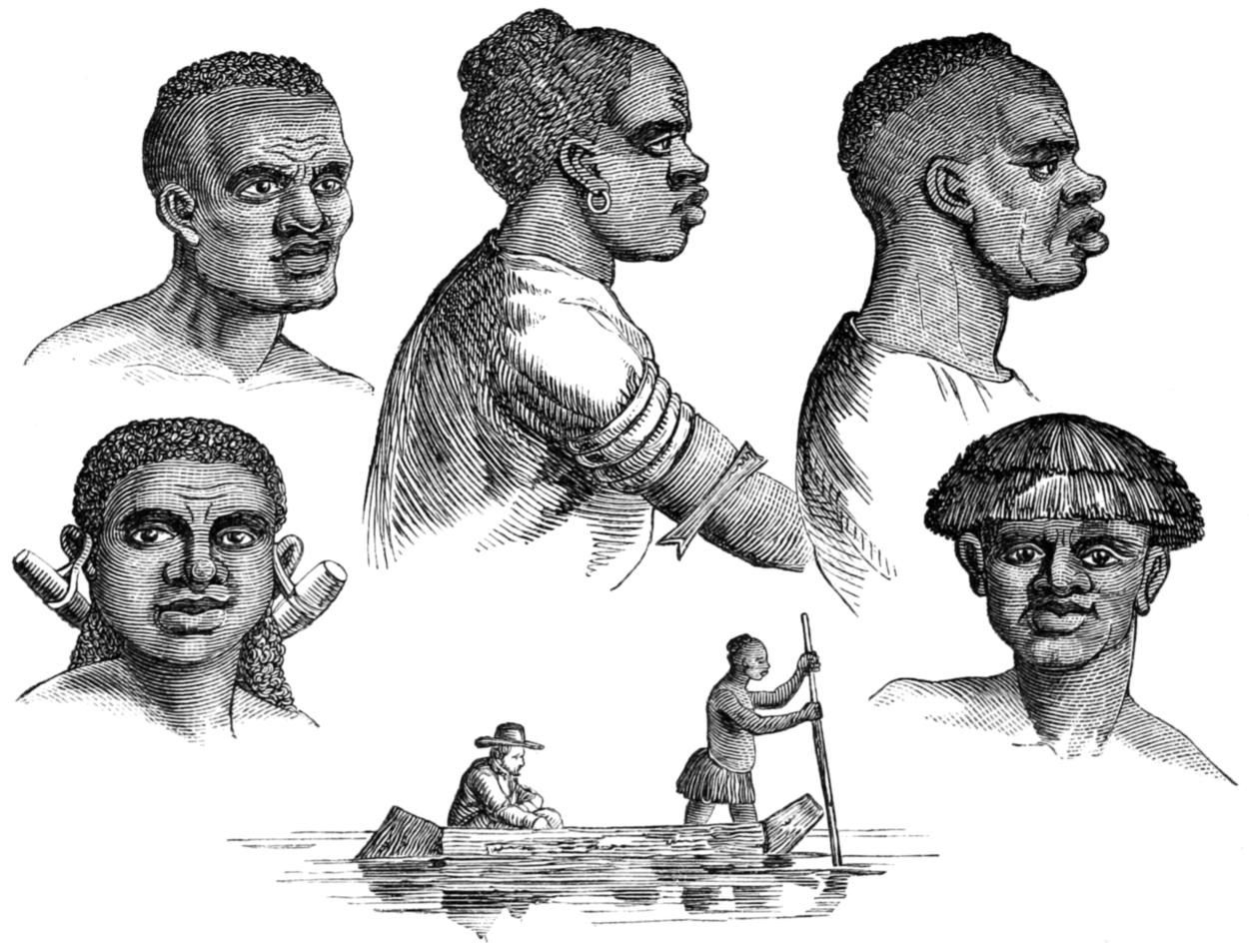
A Mnyamwezi.
A Mjiji.
Mugungu Mbaya, “the wicked white man.”
A Mgogo.
A Mzaramo.
Ferry Boat on the Malagarazi River.