THE KNIGHTS OF THE ROUND TABLE (continued 5)
Reading edition
"Sir Bedivere looked after the boat till it had been gone from his sight for a long time. Then he turned away from the lake, went down the hill, and wandered away through the woods. He did not know where he was going and he did not care. He scarcely saw what places he passed. He was thinking of his King who had been taken away from him. He thought of the bright old days when Arthur won his crown in the battles with the rebel Kings, when his own knights learned to love his strength and his truth and his nobleness. He thought of the happy days when the greatest knights of the world gathered at the Round Table in Camelot. He thought of how they had helped the King to bring peace and plenty and content to the land. He thought of the sad later days and of these last days of all and he wished that he might have died before they came. He could not think at all yet of what he was still to do or how he was to live without his King.
"So, deep in these sad thoughts, he went on and on, stopped now and then, where he could, to eat or drink, because he knew he must, or lay down in the forest to sleep, but never thought and never knew how long he had been on the way or how weary he was. At last he heard a bell and saw an abbey before him. He went into the chapel and saw a man kneeling upon a tomb. The man rose and came to meet him. He was the abbot. 'Sir,' said Bedivere, 'whose tomb is that where I saw you praying?'
"'I do not know,' said the abbot. 'Last night a great company of ladies came here and brought a dead man and begged me to bury him. And I buried him in that tomb there before the altar, but they did not tell me who he was.'
"'Then I will tell you,' said Bedivere. 'If a company of ladies brought him, it was King Arthur.'
"Then Bedivere asked the hermit to let him stay there and live with him. And he stayed for a long time there in the Abbey of Glastonbury, and visited the poor and the sick, and at last he became a priest.
"And that was all that was known of how King Arthur passed away from the battle, of how he came to Avalon, and of how he was buried. The abbot did not know who the man was whom he had buried, till Bedivere told him, and Bedivere thought that he was King Arthur only because a company of ladies had brought him. But Arthur himself had told Bedivere that he was going to Avalon to be cured of his wound, and that some time he might come again. And so, on a stone over the grave at Glastonbury, they put the words:
hic jacet Arthurus, Rex quondam Rexque futurus.
That is Latin and it means: 'Here lies Arthur, King that was and King that shall be.' And so it was long believed that some time King Arthur would come back to conquer the foes of England and to save the people. Some said that he was taken away in the boat to some happy island, to be cured of his wound and to wait for the time when England should need him most. Some said that he was sleeping down under the ground, with his knights, at Caerleon-upon-Usk, and others that he was in the enchanted castle on the hill at Camelot. Some believed that he was a raven, flying around the Cornish coast, and some that he was dead like other men, and in his grave in the Abbey of Glastonbury."
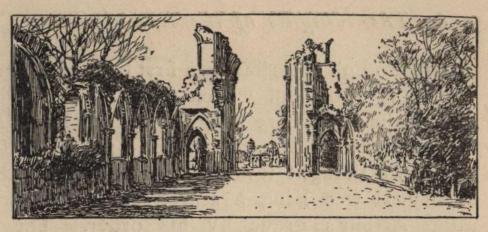
The Choir, Glastonbury Abbey
CHAPTER XVIII
THE ABBESS AND THE MONK
We did get back to Glastonbury at last, and this time we did not miss seeing the abbey. We spent some time in tracing it all out from its ruins. It was a great and beautiful church in its time. Now it has been crumbling and falling for many years. Worse than that, the people of the country about here, when they wanted stone for building, instead of finding new stone, used to come and take some from the old abbey. But, after all that time and men could do to it, much of it still stands, and it is full of that sad, sweet beauty and stateliness that nothing but a ruin ever has. The walls of St. Joseph's chapel still remain, all covered with ivy, there is a good deal of the choir left, and there are two of the great, tall piers that held the tower. Then, some way off, there is the abbot's kitchen, still all but perfect.
We found the place, or thought we did, where Joseph of Arimathæa first built his little church of wood and woven twigs. We tried to find the spot where King Arthur was buried. That is not easy, but we hit upon a place at last where we thought it must have been. When Henry II was King a search was made for King Arthur's grave by his order. They found it, they said, and Henry had a monument put over it. The monument is gone now, probably carried away, like so much of the abbey, to build stables, or something else just as noble and important, and there is nothing left to show where it stood. If we were talking of history instead of stories I might have something to say about this one of Henry II. But, as it is, it may as well stand with the rest of them.
"There is one more story," I said, "that I must tell you while we are here among these ruins. Then I shall have told you all that I set out to tell, and we shall have made the journey that we set out to make.
"When the letter that Gawain wrote was brought to Lancelot he lost no time in calling his knights and his army together and starting toward England to help King Arthur. If the King could only have delayed that last great battle, as he tried to do, Lancelot would have been with him and all would have been well. But when Lancelot landed at Dover the people told him that he had come too late. They told him of the battle that had been fought there, in which Gawain was killed, and of the greater battle that had been fought afterward far away in the West. All that they could tell him of the King was that he was gone. Some said that he was dead, and some that he had been carried away to Fairyland, where he would live till his people needed him.
"Then Lancelot asked: 'Where is the Queen?'
"'She shut herself up in the Tower of London,' some one answered, 'to save herself from Mordred. Then, when Mordred left London and came here to meet the King, she left the Tower, too, and they say that she went to some abbey and is living with the nuns.'
"Then Lancelot told Bors and the other knights who were with him to wait at Dover while he went to find the Queen. He rode alone through the country, asking at all the abbeys that he found, and at last he came to Almesbury, the place that is now called Amesbury, where we went, you know, on our way to Stonehenge. And at the abbey there he saw the Queen walking in the cloister. She saw him too and came to meet him.
"'I have come,' Lancelot said, 'to take you from this place. The King is gone from us now, and we shall never see him in this world again. Come with me now to my own city. While the King was with us I did not care whether I had a city. I thought it grander and nobler to be his knight than to be King of all the world but England. You know, my Queen, that I am King of Benwick. Come with me now and be my Queen still, more my Queen than ever, the Queen of Benwick. It is a little place, but my people love me, and they will love you, too.'
"'Lancelot,' said the Queen, 'we must not think of such things—I must not. You must go back and rule your people well and make them happy—yes, and be happy yourself, if you can—but I must stay here and try to do a little good to the poor, and fast and pray, so that God will forgive me and so that he will forgive you and let us see our Arthur in another world, since we cannot in this. For, Lancelot, do you know that it is because of us—because of me and of you—that our Arthur has gone from us?'
"'No, no,' said Lancelot, 'it is not true. I will not let you say such things of yourself, even though you say them of me. We did nothing that was wrong, you and I. They charged us with some plot—I do not know what it was, and they did not know themselves. Then I saved you and I saved myself, as it was right that I should do. The King made war on me. I made no war on him. I only guarded my knights and my people. I would not even have fought with Gawain, only he would have it so. And when I heard that the King needed me here in England I came back to help him, and it was too late. But it was the traitors who brought all this death and ruin.'
"'It was not that we did any wrong, Lancelot,' said the Queen, 'it was that we did not do all that was right. You would rather be Arthur's knight, you said, than to be King of all the world but England. Ah, yes, but what of England? Did you never wish, even in your heart, that you were King of that? Arthur had noble thoughts for the good of his country and of his people, and you swore to be faithful in everything to him and to help him. And so your thoughts, Lancelot, should have been all for the King and for his people, and so should mine. And were they so? Did you never forget these things and work and fight for your own name and your own glory, instead of for the glory of the King and for the good of England? You fought, too, many times, for my name and for my glory, and I was foolish and let you do it, when my thoughts, too, should have been all for him and for England. But here alone, since we were all parted, I have had time to think, and I have seen more clearly than I ever saw before. Lancelot, it is not the great sins of the wicked people that bring ruin to the world; it is the follies and the failings of those who should be most true and most faithful, and so help and save the world, but do not do it. We were the nearest to the King, I his Queen and you his greatest knight. We should have been as strong and as firm in our faithfulness to him as he was to himself. If we ever had selfish and vain thoughts, thoughts that were not for the King, for a single hour, it was a worse wrong in us than the wrongs that those poor, weak knights did when they let Mordred persuade them and lead them against the King. Do you not know why you could not see the Holy Grail, as Galahad and Percivale and Bors saw it? This was why. And they could see it because in every thought and wish they were true to what they and all of the Round Table swore to the King. And so, Lancelot, my own best knight, as there is work for you to do among your people, go and do it, but I must stay here and do a little good, if I can, and pray for you and for myself, so that some time we may be nearer to the King than we have ever been.'
"'If you are right,' said Lancelot, 'and you must be right—if you are right in staying here and doing what you say that you will do, then it is right for me, too. I will not go back to France. I will find some peaceful place and some good man, some hermit perhaps, and ask him to let me stay with him and do as you are doing. Pray for me sometimes, my Queen, and I will pray for you always.'
"Now I can guess just what you think of all this. You think that Lancelot had not done any wrong at all and that the Queen was a great deal too hard on him. But I know that the Queen was right. Think over all that she said again and you will know it too. The Queen and Lancelot had stood next to the King for all these years. They had been proud of him and proud that they were so near to him, and if they had been steadfast in all that they did and said and thought, nothing could ever have harmed him or his country while they all lived. But sometimes they were weak and thoughtless, and then the King was left to work alone. Though this was all that they had done amiss, it was enough.
"So Lancelot left the Queen and went on his way. And Guinevere stayed there at Almesbury and lived with the nuns. She never left the abbey except to walk a little way among the fields, in the woods, and along the river that we saw when we were at Amesbury, or, more often, to carry help or comfort to the poor or the sick.
"After she had been with the nuns for a time she became one of them, and no one among them worked more than she for the people near who needed help, and no one among them was loved more than she. And no one, even of those who knew her best, could tell whether she was happy. But they all knew that she was always gentle and patient, that she never said that her work was hard, that she never seemed to wish for her old life, and that the sick people watched for her and the poor people prayed for her. And when the old abbess died they were all sure that no one could take her place so well as Guinevere. And so, for what was left of her life, Guinevere was abbess at Almesbury.
"When Lancelot rode away from Almesbury he felt that it was nothing to him where he went. He felt that he hated courts and tournaments and battle-fields now, and he wished only to find some place away from the busy and noisy world, where he could live as the Queen was living. And so he wandered here to Glastonbury. And when he found Bedivere here, when Bedivere had told him all about the great battle, and when he had shown him the grave in the chapel where he believed that King Arthur was buried, then Lancelot begged the abbot to let him stay here and be a monk with the rest of them as long as he lived. And the abbot and Bedivere were both glad to have him stay. So Lancelot, too, lived his life among his brother monks and among the poor and the sick, and they all learned to love him, as, long ago, all the good knights in Arthur's court had learned to love him.
"Bors and his fellows waited for Lancelot at Dover for a long time. At last Bors sent the army back to France, with all the knights except a few who were the best friends of Lancelot. With these he set out through England to search for him. They searched for a long time and at last they found him. And when they saw that he was a monk they said that they would all stay at Glastonbury and be monks too.
"When Lancelot had been at Glastonbury for a long time he had a dream one night. He dreamed that an angel stood beside him and said to him: 'Lancelot, take all your fellows here who were knights of the Round Table to-morrow and go to Almesbury. When you come there the abbess, Queen Guinevere, will be dead. Bring her here and bury her in the chapel beside the King.' And twice more that same night Lancelot had this dream.
"In the morning Lancelot told the abbot of his dream, and the abbot said that it would be best for him to take his fellows with him and go to Almesbury, as he had been told to do. So they all set out, and when they came to the abbey at Almesbury the nuns knew who they were and why they had come, without being told. For they said: 'Our abbess died not an hour ago, and she told us that after she was dead the monk who used to be Sir Lancelot of the Lake would come for her and would bury her at Glastonbury, beside the King. She had been told of it in a dream.'
"So Lancelot and his fellows took the body of the Queen back with them to Glastonbury. There they made another grave before the altar in the chapel, beside the grave of King Arthur, and buried Queen Guinevere in it.
"And after this was done Lancelot would scarcely leave that chapel. He was there for nearly all of every day and much of every night, kneeling over the graves of the King and the Queen and praying. He would eat scarcely anything and he slept but little. And so he grew thin and pale and weak. The abbot and his friends could not comfort him or make him eat, and at last he told them that he should live only a little longer. 'When I am dead,' he said, 'take me and bury me in the chapel of my own old castle of Joyous Gard. I would far rather lie here in your chapel, near my King and my Queen, but years ago I made a vow that I would be buried in Joyous Gard, and I must keep that vow, so take me there.'
"That night the abbot awoke some of the monks by laughing aloud in his sleep. They went to the abbot's bed and he awoke and said: 'I have had the most beautiful dream that I have ever had in my life.'
"'What was it?' said Bors.
"'I dreamed,' the abbot said, 'that I saw Lancelot in the midst of a great company of angels. More angels there were than I ever saw of men in an army. Some of them lifted Lancelot up and they all rose to Heaven. I could see Lancelot's face as they went, and it was full of peace and gladness. They came near the gates of Heaven and the gates were opened for them and they all passed in. And as they passed I could see the great light that shone out and I could hear voices singing, and the gates were closed and then I awoke.'
"Then they all went to Lancelot's bed. He did not awake when they came to him, as the abbot had done. He lay still and his face was full of peace and gladness and he was dead.
"They took him the next day, all his friends and the abbot with them, and they journeyed slowly till they came to Joyous Gard. There they buried him and then they journeyed slowly back again to Glastonbury. They did not talk much as they went, but now and then they spoke a little, sadly, as people will at such times, of the older and happier days. To Bors and to some of the others it seemed only a little while since a hundred and fifty knights sat at the Round Table in the hall at Camelot. Here were some of the knights of the Round Table still, but the glory of it had passed away with the King and Galahad and Gawain and Lancelot."
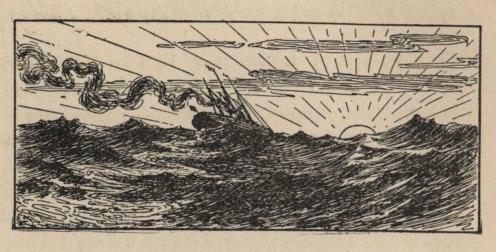
"On toward the gold and the purple in the west"
CHAPTER XIX
"REXQUE FUTURUS"
We were at sea on our way home. We had left Southampton, where Arthur embarked when he went to fight the Emperor of Rome, and all day we had made our swift way west through the British Channel. When we came up on deck after dinner we had just passed the Scilly Islands. Dark and rough and hard they stood up out of the sea behind us, and a pale mist was just beginning to wrap them around and hide them a little from sight. Before us all the air was clear. The sun was just setting and was filling the sky with a dozen lovely hues of rose and violet and turning the water into tossing and tumbling gold.
"See," I said, "there are the Scilly Islands. They are all that is left of that lost land of Lyonnesse, Tristram's country, that used to reach from here back to the Land's End. The rest of it is sunk deep down under the water. This is all of Lyonnesse that we can ever see."
Helen did not seem to care very greatly even for this. She was thinking of the last of our stories. "Was King Arthur really buried," she said, "there in the Abbey of Glastonbury?"
"It is not easy to answer that," I said. "It seems to me that I have read enough books about King Arthur to fill this ship, yet I never could see that the writers of them had settled among themselves whether he was buried there or not. If we care to believe that he was, I think we may as well believe it."
"But do you believe it?"
"Yes, I believe it."
"Then he never came back, the way he said he would, and the way the people believed he would?"
"No, he never came back."
"And he never will come back, the way the stories said?"
"Oh, yes, I think he will."
For a few minutes Helen watched the water that was whirling by the side of the ship and I looked at the colors of the sea and the sky, that were growing brighter still. Then she said: "But if King Arthur really died and really was buried at Glastonbury and the three Queens didn't cure his wound at all, how can he come back?"
"I don't know whether I can make you see it quite as I do," I said, "but I will try. You know what it was that King Arthur tried to do. I have told you all these stories very badly, if you do not. He tried to save his people from the harms and the wrongs that they suffered. He tried to make all of them, the rich and the poor, the lords and the common people, good and brave and strong, true and gentle and noble. And he did make them better and happier than they were before. But the time had not come for all that he wished. After he passed away things got to be as bad almost, as they had been before. Some people, here in our own time, think that the world is not growing any better. That is because they look back only a few years, perhaps a hundred, and they do not see any change. There has been a change, though they do not see it. But they would see it, if they would look back to those fearful old days before Arthur came, yes, or half way back, for there were days then that were not much better. They would see then how selfish and how cruel men were and what wicked and heartless things they would do for a little power or a little gain.
"This was what Arthur tried to change, and he did change it partly, for a little while. But it was too soon to change it altogether. When he was gone everything soon came to be nearly as it was before. Yet it was never quite the same again, perhaps. Other good men came, not with the strength of Arthur, yet with a strength of their own. And they passed away too and left England and the world a little better than they had found them. Slowly and slowly, yet surely and surely, men have thought more, learned more, worked more, and so, slowly and slowly, yet surely and surely, they have grown wiser and juster and stronger, and so, too, they have grown freer and better and happier.
"The men of England and of our own country and of all the world are not yet what Arthur would have had them. They are still far from it, perhaps, yet they are nearer to it, and they are always getting nearer still. The way is long and it seems hopeless, sometimes, but it is not hopeless. And in some great, good time, far off, when this England and our own country and all the world come to be as just and noble and happy as Arthur tried to make his people—then cannot men say: 'King Arthur is not dead any more; he has come back and is among us again, for it is his will that guides us and it is his law that rules us now?' Do you see now how Arthur did not die, but only passed away, to come again? And do you see how he may come again, even though they buried him there at Glastonbury?"
"I don't know," Helen said, after she had thought for a minute. "I don't think I quite understand it, and any way, I would rather you would tell stories than talk like that."
But I had no more stories to tell just then, and so we only stood and watched the water and the sky, while the ship carried us along, farther and farther away from the dim, dark rocks, with the fog around them, and on toward the gold and the purple in the west.
* * * * * * * *
Charles Scribner's Sons'
New and Standard Books for Young Readers for 1897-98...
MRS. BURNETT'S FAMOUS JUVENILES
An entirely new edition of Mrs. Burnett's famous juveniles from new plates, with all the original illustrations. Bound in a beautiful new cloth binding designed by R. B. Birch, and sold at very much reduced prices.
LITTLE LORD FAUNTLEROY
TWO LITTLE PILGRIMS' PROGRESS
SARA CREWE and LITTLE SAINT ELIZABETH AND OTHER STORIES (in one vol.)
PICCINO AND OTHER CHILD STORIES
GIOVANNI AND THE OTHER
Five Volumes, 12mo, each, $1.25
The original editions can still be supplied at the former prices:
LITTLE LORD FAUNTLEROY. Beautifully illustrated by REGINALD B. BIRCH. Square 8vo, $2.00.
TWO LITTLE PILGRIMS' PROGRESS. A STORY OF THE CITY BEAUTIFUL. By Mrs. FRANCES HODGSON BURNETT. Illustrated by REGINALD B. BIRCH. Uniform with "Fauntleroy," etc. Square 8vo, $1.50.
SARA CREWE; OR, WHAT HAPPENED AT MISS MINCHIN'S. Richly and fully illustrated by REGINALD B. BIRCH. Square 8vo, $1.00.
LITTLE SAINT ELIZABETH, AND OTHER STORIES. With 12 full-page drawings by REGINALD B. BIRCH. Square 8vo, $1.50.
GIOVANNI AND THE OTHER: CHILDREN WHO HAVE MADE STORIES. With 9 full-page illustrations by REGINALD B. BIRCH. Square 8vo, $1.50.
PICCINO, AND OTHER CHILD STORIES. Fully illustrated by REGINALD B. BIRCH. Square 8vo, $1.50.
* * * * *
G. A. HENTY'S POPULAR STORIES
New Volumes for 1897-98. Each, crown 8vo, handsomely illustrated, $1.50.
Mr. Henty, the most popular writer of Books of Adventure in England, adds three new volumes to his list this fall—books that will delight thousands of boys on this side who have become his ardent admirers.
WITH FREDERICK THE GREAT. A TALE OF THE SEVEN YEARS' WAR. With 12 full-page illustrations. 12mo, $1.50.
This story, more than any other of Mr. Henty's, follows closely the historic lines, and no better description of the memorable battles of Rossbach, Leuthen, Prague, Zorndorf, Hochkirch, and Torgau can be found anywhere than is given in this volume. Through the historic part there runs the record of the daring and hazardous adventures of the hero, so that the charm of romance is given to the whole narrative. It is one of the most important volumes Mr. Henty has written.
A MARCH ON LONDON. A STORY OF WAT TYLER'S RISING. With 8 full-page illustrations by W. H. MARGETSON. 12mo, $1.50.
This book weaves together, in a most interesting way, the story of Wat Tyler's rebellion under King Richard, the civil war in Flanders which occurred soon after, and the ill-planned attack upon the French led by the Bishop of Norfolk. The whole story is singularly interesting, covering as it does a period of history which is but little known and which is well worth narrating.
WITH MOORE AT CORUNNA. A STORY OF THE PENINSULAR WAR. With 12 full-page illustrations by WAL. PAGET. 12mo, $1.50.
A bright Irish lad, Terence O'Connor, is living with his widowed father, Captain O'Connor of the Mayo Fusiliers, with the regiment, at the time when the Peninsular War against Napoleon began. Under the command of Sir John Moore, he shared in the same marching and sharp fighting which that expedition experienced up to the battle of Corunna. By his bravery and great usefulness, in spite of his youth, he received a commission as colonel in the Portuguese army, and during the remainder of the war rendered great services, being mentioned twice in the general orders of the Duke of Wellington. The whole story is full of exciting military experiences and gives a most careful and accurate account of the conduct of the campaigns.
* * * * *
MR. HENTY'S OTHER BOOKS
Each volume with numerous illustrations; handsomely bound. Olivine edges. 12mo. $1.50.
"Mr. Henty's books never fail to interest boy readers. Among writers of stories of adventure he stands in the very first rank."—Academy, London.
"No country nor epoch of history is there which Mr. Henty does not know, and what is really remarkable is that he always writes well and interestingly. Boys like stirring adventures, and Mr. Henty is a master of this method of composition."—New York Times.
AT AGINCOURT. A TALE OF THE WHITE HOODS OF PARIS. With 12 full-page illustrations by WAL. PAGET.
COCHRANE THE DAUNTLESS. A TALE OF THE EXPLOITS OF LORD COCHRANE IN SOUTH AMERICAN WATERS. With 12 full-page illustrations by W. H. MARGETSON.
ON THE IRRAWADDY. A STORY OF THE FIRST BURMESE WAR. With 8 full-page illustrations by W. H. OVEREND.
THROUGH RUSSIAN SNOWS. A STORY OF NAPOLEON'S RETREAT FROM MOSCOW. With 8 full-page illustrations by W. H. OVEREND.
A KNIGHT OF THE WHITE CROSS. A TALE OF THE SIEGE OF RHODES. With 12 full-page illustrations by RALPH PEACOCK.
THE TIGER OF MYSORE. A STORY OF THE WAR WITH TIPPOO SAID. With 12 full-page illustrations by W. H. MARGETSON.
IN THE HEART OF THE ROCKIES. A STORY OF ADVENTURE IN COLORADO.
WHEN LONDON BURNED. A STORY OF RESTORATION TIMES AND THE GREAT FIRE.
WULF THE SAXON. A STORY OF THE NORMAN CONQUEST.
ST. BARTHOLOMEW'S EVE. A TALE OF THE HUGUENOT WARS.
THROUGH THE SIKH WAR. A TALE OF THE CONQUEST OF THE PUNJAUB.
A JACOBITE EXILE. BEING THE ADVENTURES OF A YOUNG ENGLISHMAN IN THE SERVICE OF CHARLES XII. OF SWEDEN.
CONDEMNED AS A NIHILIST. A STORY OF ESCAPE FROM SIBERIA.
BERIC THE BRITON. A STORY OF THE ROMAN INVASION.
IN GREEK WATERS. A STORY OF THE GRECIAN WAR OF INDEPENDENCE [1821-1827].
THE DASH FOR KHARTOUM. A TALE OF THE NILE EXPEDITION.
REDSKIN AND COWBOY. A TALE OF THE WESTERN PLAINS.
HELD FAST FOR ENGLAND. A TALE OF THE SIEGE OF GIBRALTAR.
* * * * *
SOME OF THE NEWEST BOOKS
WILL SHAKESPEARE'S LITTLE LAD. By IMOGEN CLARK. With illustrations and cover design by R. B. Birch. 12mo, $1.50.
A story, full of warm color and brisk movement, of Stratford life in Shakespeare's day, the local atmosphere being reflected with rare fidelity, and the hero, the poet's son, being drawn with sympathy and charm.
CHILD POEMS. By EUGENE FIELD. With an introduction by KENNETH GRAHAME and profusely illustrated by CHARLES ROBINSON. Uniform with Robert Louis Stevenson's "Child's Garden of Verses," also illustrated by Charles Robinson. 12mo, $1.50.
THE STEVENSON SONG BOOK. VERSES FROM "A CHILD'S GARDEN," by ROBERT LOUIS STEVENSON. With music by various composers. A companion volume to the Field-DeKoven song book printed last year. Large 8vo, $2.00.
AN OLD-FIELD SCHOOL GIRL. By MARION HARLAND. With 8 full-page illustrations. 12mo, $1.25.
LORDS OF THE WORLD. By ALFRED J. CHURCH. A STORY OF THE FALL OF CARTHAGE AND CORINTH. With 12 full-page illustrations by RALPH PEACOCK. 12mo, $1.50.
The scene of this story centres in the overthrow and destruction of Carthage by the Romans. The story is full of valuable historical details and the interest never flags.
HEROES OF OUR NAVY. By MOLLY ELLIOT SEAWELL. Illustrated. 12mo. In press.
Never has this entertaining writer been more felicitous than in the present volume.
THE LAST CRUISE OF THE MOHAWK. By W. J. HENDERSON. Illustrated by HARRY EDWARDS. 12mo, $1.25.
The book is crowded with dramatic incident—mutiny, shipwreck, Farragut's great fight in Mobile Bay—and the narrative is as simple as the events and characters are entertaining.
* * * * *
KIRK MUNROE'S STIRRING TALES
THE WHITE CONQUEROR SERIES
WITH CROCKETT AND BOWIE THE WHITE CONQUERORS AT WAR WITH PONTIAC THROUGH SWAMP AND GLADE
Each, illustrated, 12mo, $1.25. The complete set, 4 vols., in a box, $5.00.
JUST PUBLISHED
WITH CROCKETT AND BOWIE; OR, FIGHTING FOR THE LONE STAR FLAG. A TALE OF TEXAS. With 8 full-page illustrations by VICTOR PERARD.
The story is of the Texas revolution in 1835, when American Texans under Sam Houston, Bowie, Crockett, and Travis, fought for relief from the intolerable tyranny of the Mexican Santa Ana. The hero, Rex Hardin, son of a Texas ranchman, and graduate of an American military school, takes a prominent part in the heroic defense of the Alamo, the terrible scenes at Golead, and the final triumph at San Jacinto. The historical side of the story has been carefully studied and its localities rendered familiar by a special trip to Texas undertaken by the author for that purpose within a year.
PREVIOUS VOLUMES
THROUGH SWAMP AND GLADE. A TALE OF THE SEMINOLE WAR. With 8 full-page illustrations by VICTOR PERARD. 12mo, $1.25.
In this new story Mr. Munroe opens to view an exceedingly interesting period of American history—the period of the Seminole War in Florida. Coacoochee, the hero of the story, is a young Indian of noble birth, the son of Philip, the chieftain of the Seminoles. He is a boy at the time of the beginning of the Seminole troubles and grows up to lead his tribe in the long struggle which resulted in the Indians being driven from the north of Florida down to the distant southern wilderness. It is full of strange adventure, of stirring incident and rapid action, and it is a true and faithful picture of a period of history little known to young readers.
AT WAR WITH PONTIAC; OR, THE TOTEM OF THE BEAR. A TALE OF REDCOAT AND REDSKIN. With 8 full-page illustrations by J. FINNEMORE. 12mo, $1.25.
A story of old days in America when Detroit was a frontier town and the shores of Lake Erie were held by hostile Indians, under Pontiac. The hero, Donald Hester, goes in search of his sister Edith, who has been captured by the Indians. Strange and terrible are his experiences; for he is wounded, taken prisoner, condemned to be burned, and contrives to escape. In the end there is peace between Pontiac and the English, and all things terminate happily for the hero. One dares not skip a page of this entralling story.
THE WHITE CONQUERORS. A TALE OF TOLTEC AND AZTEC. With 8 full-page illustrations by W. S. STACEY. 12mo. $1.25.
This story deals with the Conquest of Mexico by Cortes and his Spaniards, the "White Conquerors," who, after many deeds of valor, pushed their way into the great Aztec kingdom and established their power in the wondrous city where Montezuma reigned in barbaric splendor.
* * * * *
BOOKS BY WILLIAM HENRY FROST
JUST PUBLISHED
THE KNIGHTS OF THE ROUND TABLE. Illustrated and cover designed by S. R. BURLEIGH. 12mo, $1.50.
Mr. Frost's volumes of folk-lore stories have achieved a deserved popularity, and this last one, dealing with the ever-fascinating theme of the Round Table and its knights, is equal to either of his earlier books.
MR. FROST'S FORMER BOOKS
THE COURT OF KING ARTHUR. STORIES FROM THE LAND OF THE ROUND TABLE. Illustrated by S. R. BURLEIGH. 12mo, $1.50.
Mr. Frost has had the happy idea of making a journey to the different places connected with the Arthurian romances by history or legend, and of relating the ever new Round Table Tales on their sites, to the same little girl, now somewhat older, to whom he told his charming Wagner stories.
THE WAGNER STORY BOOK. FIRELIGHT TALES OF THE GREAT MUSIC DRAMAS. Illustrated by SIDNEY R. BURLEIGH. 12mo, $1.50.
"A successful attempt to make the romantic themes of the music drama intelligible to young readers. The author has full command of his subject, and the style is easy, graceful, and simple."—Boston Beacon.
* * * * *
ROBERT GRANT'S TWO BOOKS FOR BOYS
JACK HALL; OR, THE SCHOOL DAYS OF AN AMERICAN BOY. Illustrated by F. G. ATTWOOD. 12mo, $1.25.
"A better book for boys has never been written. It is pure, clean, and healthy and has throughout a vigorous action that holds the reader breathlessly."—Boston Herald.
JACK IN THE BUSH; OR, A SUMMER ON A SALMON RIVER. Illustrated by F. T. MERRILL. 12mo, $1.25.
"A clever book for boys. It is the story of the camp life of a lot of boys, and is destined to please every boy reader. It is attractively illustrated."—Detroit Free Press.
* * * * *
THE KANTER GIRLS
By MARY L. B. BRANCH. Illustrated by HELEN M. ARMSTRONG. Square 12mo. $1.50.
The adventures of Jane and Prue, two small sisters, among different peoples of the imaginative world—dryads, snow-children, Kobolds, etc.—aided by their invisible rings, their magic boat, and their wonderful birds, are described by the author with great naturalness and a true gift for story-telling. The numerous illustrations are very attractive, and in thorough sympathy with the text.