THE KNIGHTS OF THE ROUND TABLE (continued 4)
Reading edition
Then the weariness and faintness came upon Percivale once more, and he lay down there on the rough rocks of the sea-shore and slept again. It was morning when he awoke. As he looked around him he saw that the rocks about him were so high that they made a mountain and the water seemed to be all around it, or nearly so. And as he was looking for a way to get back to the mainland he saw coming toward him a great serpent, carrying a young lion in its mouth. An old lion was following, and it came up and began to fight with the serpent, but it could not make it drop the young lion. Then Percivale thought that of the two beasts he liked the lion better, and that he would try to help it. So he drew his sword and put his shield before him and ran to the serpent and cut off its head.
And the old lion went to the cub and found that it was not much hurt, and then it came to Percivale and licked his hand, as a dog would, and tried to thank him for saving the cub. After that it carried the cub away, but in a little while it came back and stayed with Percivale all day, and at night, when Percivale lay down to sleep, the lion watched beside him.
The next morning Percivale saw a ship coming toward the land. It came close to the rock where he was and he could see no one in it but one old man, in the dress of a priest. It had been so long since Percivale had had any friend but the lion that he was glad to see the priest and he told him who he was and how he had come there, and that he did not know how to get away from the place.
"Do not try to find any more adventures now," the priest answered, "but come into this ship and wait in it for the adventures that will come to you."
So Percivale went on board the ship and at once it started out into the sea. He did not see the priest again and he could not tell where he had gone, but he could see the lion still standing on the shore and looking after him, till the ship had gone so far that he could no longer make it out. And Percivale must have slept again in the ship, though he did not know how long. But he awoke and saw a man bending over him, and the man was Bors.
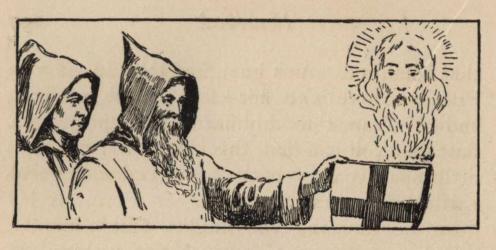
"'It was King Evelake's shield'"
CHAPTER XIV
GALAHAD
When Galahad left Camelot he had no shield. He had carried none in the tournament and he had done better without one than any of the other knights. He still had none when the knights parted. He rode alone for four days without any adventure. It was then that he came to an abbey and went in to spend the night. Another knight of the Round Table had come there before him, and as they sat talking together the monks told them of a shield that they had. It had been in the abbey for many years, they said, and it had been foretold that no one except the best knight of the world should ever carry it without coming to some harm.
"I will take that shield to-morrow morning," said the knight, "and see what comes of it. I do not think myself the best knight of the world, but I do not fear any adventure that may befall me. And you, Sir Galahad—if you will, you may wait here for a little while to know if I come to any harm, and then I am sure that you can bear this shield, if I cannot."
"It shall be as you say," said Galahad, "and I will wait to hear from you."
In the morning the knight asked for the shield, and the monks brought it to him. It was white, with a red cross upon it. The knight took it and rode away with his squire, and Galahad waited. He did not wait long, for before noon the knight was brought back to the abbey so badly wounded that they could scarcely tell at first whether he would live or die. The squire came with him and brought the shield. He brought it straight to Galahad and said: "Sir Galahad, we met a knight who fought with my lord and wounded him as you see. Then the knight told me to bring the shield to you and to say that no one but you ought to carry it."
"Then tell me," said Galahad to the monks, "what this shield is and why no one may use it but me."
"It was King Evelake's shield," one of the monks answered. "In the time of Joseph of Arimathæa, Evelake was King of the City of Sarras. He bore this shield in a great battle that he fought, and it was Joseph who made this red cross upon it for him. Afterward he came to England with Joseph. When he died the shield was left here in this abbey and Joseph foretold that it should never be borne with safety by anyone till the best knight of the world should come."
When Galahad heard that, he took the shield and made ready to go on his way. But first he asked the monks about his fellow of the Round Table, and they told him that he had been nearly killed, but that they could cure him.
I have told you already some of the things that Galahad did. You know how he overcame both Lancelot and Gawain, how he drove the murderers out of the Castle of Maidens, and how he saved Percivale from his enemies. It was after all these things that he was sleeping one night in the cell of a hermit, and a woman came to the door and called to him. The hermit opened the door and she said to him: "I must speak to the knight who is here with you."
Then the hermit awoke Galahad and told him that there was a woman at the door who said that she must speak to him. So Galahad went to the door and she told him that he must put on his armor and come with her. Galahad did not know who she was or what she wanted of him, but something made him feel sure that he ought to do what she said. He put on his armor and rode with her for the rest of the night and all the next day, and then, as it was getting toward night again, they came to a castle.
The lady of the castle welcomed them and told Galahad that he must eat and sleep a little and then be ready to ride again. It was still night when they came and woke him, and he put on his armor and rode again with the woman who had brought him to the castle. It was only a little way that they rode this time and then they came to the sea-side and saw a ship, all covered with canopies of white silk. They went on board and found Percivale and Bors. As soon as Galahad and the woman were in the ship it left the land and went straight out into the open sea.
When the three knights had greeted one another and when each had told the others something of where he had been and what he had done since they had parted last, Galahad said: "I should never have found you here if this woman had not brought me and shown me the way, and I am sure that you must thank her as much as I for bringing us together."
Then the woman said: "Percivale, do you know who I am?"
"No," said Percivale, "I do not know you."
"I am your sister," she said, "whom you have not seen since you first went to King Arthur's court."
Then they all stood together, talking and looking out upon the dim sea, till slowly they began to see it more plainly and the sky grew lighter and the stars faded away in it, and a faint and then a brighter glow rose in the east and the day came. When it was fully light Percivale's sister said: "Come now and let me show you what there is in this ship that you have not seen."
She led them to another part of the ship and there they saw a sword in a scabbard. The hilt of the sword was set with jewels and the scabbard seemed to be of serpent's skin. It was all rich and beautiful except the girdle which was fastened to it, and that was of hemp and looked poor and weak. "Galahad," said Percivale's sister, "this sword is for you, and I must tell you how long it has been waiting for you. It was King David's sword, and his son, King Solomon, built this ship and put this sword in it and said that it should be for the best knight of the world and for no other. King Solomon was the wisest man that ever lived, yet he had a wife who in one thing was wiser than he. For she was to make a girdle for this sword, and she made this poor one of hemp that you see. When the King saw it he was angry and he told her that such a sword as this ought to have the best girdle in the world, not the worst. 'That is true, my lord,' she answered, 'but I had nothing that was fit for the best girdle in the world, and so I have made this one. And this one shall stay on the sword till it is time for the best knight of the world to come and take it. Then the sword shall have a new girdle. It shall be made by another woman, a young maiden, and she shall make it of what she loves best and is proudest of in all the world.' And when Solomon had built the ship and put the sword in it, and his wife had put the girdle of hemp on the sword, they saw the ship, all of itself, move out to sea, and it passed out of their sight and they never heard of it again. And ever since King Solomon's time this ship has floated on the sea, and now I have brought you to it, Galahad, to take this sword which is yours."
"This is a wonderful story that you have told us," Galahad said. "How have you learned these things?"
"I cannot tell you," she said. "It seems to me that I know them without learning them. It is the Holy Grail, I think, that has given me the knowledge of them, but I cannot tell you how; only, when I have seen the Holy Grail, I have thought that all at once I knew many wonderful things that I did not know before."
"The Holy Grail?" said Galahad. "You have seen it then?"
"Yes," she answered, "many times. You knights go far to seek the Holy Grail, but it has come to me without my seeking it. Now, Galahad, take your sword, for soon we must leave this ship."
"But where is the new girdle for the sword?" said Galahad. "It seems to me that this old one of hemp will scarcely hold it. And who is the maiden who is to make the new girdle?"
"I am she," said Percivale's sister, "and I have made the girdle and have brought it. It is made of my own hair. It was long and beautiful once, like fine threads of gold, and I was proud of it and loved it more than anything else in the world. But when I had seen the Holy Grail and when I knew of this sword and knew that it was I who must make the new girdle for it, then I cut off my hair and wove it into a girdle."
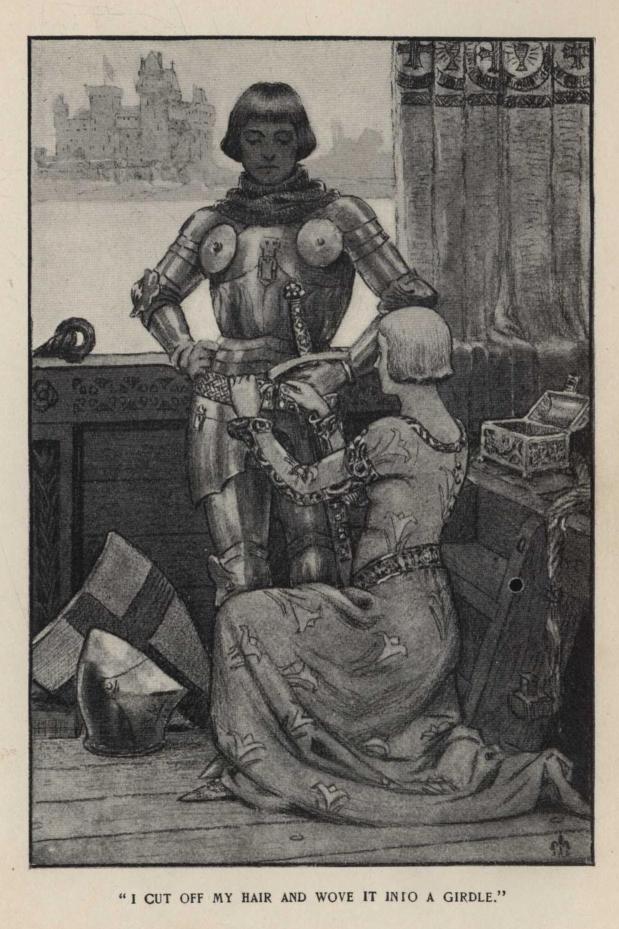
"I CUT OFF MY HAIR AND WOVE IT INTO A GIRDLE."
Then she took the girdle out of a casket that she had brought, and it was indeed like a broad band of soft gold. And she fastened it upon the sword and bound the sword upon Galahad's side.
They saw that the ship was coming near the land again and soon it touched the shore. They all went on shore, and, when they had gone a little way they saw a great castle before them. When the three knights and Percivale's sister came near the castle, men came out of it and told them that they could not pass till they had done the custom of the castle. And the custom of the castle was that the maiden must give a silver dish full of her blood to cure a sick lady. The three knights would have fought the men of the castle and tried to pass by force, but Percivale's sister would not let them do it. "The lady of the castle shall have my blood," she said, "and it will cure her."
"But if you lose so much blood," said Galahad, "you may die yourself."
"Yes," she answered, "I shall die, but it is no matter for that. All that I had to live for was to give you the sword that you have, to make the girdle for it of my hair, and to cure this lady. When I have done that I shall have done all that I had to do. Now let me tell you what to do when I am dead. When I am dead, do not bury me here, but put me in the ship that we have come in. Leave me in it alone and go on your way. You will see me again sooner than you think, but there is something still for you to do here. You must go to the Castle of Carbonek to heal King Pelles's wound. After that you three must bring the Holy Grail to the City of Sarras. I shall be there as soon as you and there you must bury me. And two of you will not live long after that, and you will be buried beside me. For you, Galahad, and you, my brother Percivale, will stay there with me, and then you, Bors, must come back to England and tell the King and the rest all that we have seen and done. Now let us talk of it no more. The Holy Grail has shown me all that I must do and neither you nor I must try to change it."
All this, you may be sure, made the three knights very sad, but Percivale's sister had shown them and had told them so much that was wonderful that they did not dare to disobey her. They all stayed in the castle that night. In the morning Percivale's sister gave the silver dish full of her blood and it cured the lady of the castle, and soon after that Percivale's sister died.
The three knights carried her to the shore and put her into the ship again, as she had told them to do. As soon as they were on the shore again, the ship started out to sea and they stood and watched it. It went away from them swiftly and they looked till its canopies of white silk seemed no more than the wings of a sea-bird resting on the water, and then, with a last fading flash in the morning sunlight on the edge of the ocean and the sky, it was gone. Yet still they watched and they saw a little brown spot of mist rise up where the ship had vanished. It grew larger and came toward them and spread over the sky and shut off the water from their eyes and it wrapped them all around. They could scarcely see the path before them as they turned to go away. The cold, damp, sad mist cloud was over all the land and the ocean, only before them there was a pale, silvery shimmer of the sun still shining on the cloud.
The Dove with the golden censer
CHAPTER XV
THE CITY OF SARRAS
The knights went to the castle and found horses, and mounted and rode toward the Castle of Carbonek. The silvery shimmer of the sun upon the mist grew brighter. The mist itself grew thinner and lighter and at last it all melted away into the clear air, and the sun shone warmly upon the fields and the woods, which the morning mist had left cool and fresh and dewy. The knights did not speak much to one another. They were thinking too much of what had passed. And so they rode till late in the day, and then they saw the Castle of Carbonek before them.
Everything there was as if they had been expected. The porters opened the gate for them, King Pelles's men led them to chambers, where they took off their armor, and then to the great hall, and there they found places ready for them at the table and the table laid, though with no food upon it. When they had sat down, King Pelles was brought in and was placed at the table, too. "Galahad," he said, "no one could be more glad to see you than I am, for I know that you have come to cure my wound. I have suffered with it every day for all these many years; yes, since long before you were born. And all that time I have known that no one could cure it but you, and so I have waited and waited for you to grow up and be a knight and go out in the quest of the Holy Grail, for I knew that it was not till then that you could come to cure me. I have tried to be patient all these years, but now, Galahad, that you have come, it seems to me that I could not bear this wound another day."
When the King had said this, the dove that carried the little golden censer in its peak flew into the hall, as it had done when Bors was there before, long ago. The thin smoke floated through the room and it was filled again with that sweet odor that Bors remembered. Then a door of the hall opened and an old man—the same whom Bors had seen before, the same who had brought Galahad to the Siege Perilous—came in. He carried the Holy Grail itself, and this time there was no covering of silk upon it. It was not the old rosy glow that came from the cup now. The blood that was in it shone like one clear, red gem, resting in the pure crystal of the cup. It shone brighter, the knights thought, than any light they had ever seen before, yet it did not hurt their eyes when they looked at it. The beams that came from it made a broad halo of beautiful colors all about it, and the light that it shed through the room was like the light of day, only brighter and clearer, and everything that was seen in it looked finer and more beautiful.
The old man held the Holy Grail high up above his head for them to see it better, and then he put it on the little table of gold and silver that was in the room. Another door of the hall was opened and four boys came in and brought the spear with the drops of blood flowing from the point. They came and stood with it before the old man and he looked at the spear and then he looked at Galahad. Galahad rose from the table and went to the spear and touched the blood on the point of it with his fingers. Then he went to the King and touched the wound in his side with the blood, and at once the wound was healed. The King stood up for a moment and felt that his strength and his health had come back to him, and then he sank down again in his place and scarcely moved, but gazed at the Holy Grail and at the spear and at Galahad.
"Galahad," said the old man, "you have done now all that you had to do here. You have seen the Holy Grail and you have healed the King's wound. To-morrow you must leave this land, and the Holy Grail will leave it too. Go to-morrow, with your two fellows, to the sea. There you will find your ship. You must go in it to the City of Sarras and you must take the Holy Grail with you. When you are there, you will know what more you have to do."
The old man lifted the Holy Grail again and went out of the hall with it, and the boys who carried the spear followed him. The table was covered with food and wine now and they all ate and drank, and then they all left the hall and slept till morning.
In the morning Galahad and Percivale and Bors left the Castle of Carbonek and went to the shore. And there, as the old man had said, they found a ship. As soon as they were on board they saw that the Holy Grail was there before them. It stood on the table of gold and silver and the covering of white silk was over it again.
The knights did not know how long they were in that magic ship, or what way or how far they went. They were moving swiftly always, they slept and they awoke, and they saw sunlight and moonlight and starlight. The Holy Grail was always with them and they never felt hunger or cold or weariness. And while they were in the ship Galahad told Percivale and Bors that he had prayed that he might leave this world whenever he wished it, and he knew that his prayer would be answered. And one morning, just as the sun was rising, they saw a low bank of white mist far before them, and above the mist they could see the pale, silvery lines of spires and towers and domes, and they knew that this was the City of Sarras. The ship brought them quickly nearer and nearer, and as they came into the harbor they saw another ship going in before them. It was all covered with white, and they knew that it was the ship that carried Percivale's sister.
When they came to the shore they took hold of the table with the Holy Grail upon it to carry it out of the ship. But it was too heavy for them and they looked about to find some one to help them. The nearest man was an old cripple who sat begging. Galahad called to him and told him to come and help them carry the table. "I cannot help you," he said; "it is many years since I could even stand, except with crutches."
"No matter for that," said Galahad, "come and do your best." And the old cripple came and helped them, and he was as strong and as well as any man. They carried the table and the Holy Grail to the cathedral and left them before the altar, and then they came back to the shore and brought Percivale's sister out of the ship and up to the cathedral too, and buried her there.
When the King of Sarras heard of the strange knights who had come and of the cripple who had been healed, he sent for the knights and asked them who they were and whence they came. Now this King was a tyrant, and when Galahad had told him all about the Holy Grail he began to be afraid of these knights, for he feared that they would have more power over the people than he had himself. So he sent all three of them to prison. But as soon as they were in prison the Holy Grail came to them of itself, and it stayed with them and fed them, as it had fed Joseph of Arimathæa, when he was in prison. And, like him, they scarcely knew how long they were there. But when they had been in prison for a year the King was sick and felt that he was going to die, and then he began to have worse fears than before.
So he sent for the three knights again and told them that he had done wrong in putting them in prison and begged them to forgive him. "We forgive you," Galahad answered; "you had no power to harm us, for the Holy Grail was always with us."
Then the King said to Galahad: "I am sure that I shall die soon and I wish that you might be King here after me, for I know that my people could have no better king than you."
So it was agreed, and soon after that the King died and Galahad was crowned in his place. When Galahad was King the Holy Grail was put before the altar in the cathedral again and Galahad had a chest made to cover it. And every day he and Percivale and Bors went to the cathedral to pray before it.
And one day, when Galahad had been King of Sarras for a year, he told Percivale and Bors that the time had come for him to leave this world, and they must come with him to the cathedral now for the last time. So they went to the cathedral together and they saw an old man kneeling at the altar. He was the same old man whom they had seen so many times before, who had been made to live so far beyond his time by the power of the Holy Grail, Joseph of Arimathæa. On the altar before him lay the spear with the drops of blood flowing from its point.
The three knights knelt before the altar, Galahad nearer to it than the others, and they were there for a long time. Then the old man rose and came to the chest where the Grail was and took it out and held it up before them, and the light that shone from the blood that was in it, through the crystal of the cup, was greater and stronger than ever. The whole cathedral was bright with it. It streamed up among the arches of the roof and lighted old pictures that were painted there. For years before they had scarcely been seen, they were so dim with time and with dust and with the smoke of incense. Now, with the light of the Holy Grail upon it, the place was again a piece of Heaven, filled with wonderful forms. There was Elijah, in his chariot of fire; there were saints and angels; and all about them and among them there were little stars of gold, that glowed and twinkled in the new brightness like the stars of the real Heaven.
The old man set the Grail upon the altar and came to Galahad and touched his hand and kissed him. Then all at once the church grew dark and Percivale and Bors could see nothing but the Grail and the spear upon the altar and the old man who stood before it. He took the Grail and the spear and then he seemed to rise and to go farther from them, though they could not see how he went. It seemed to them, too, that Galahad was with him, and they did not see that the form of Galahad still lay before them on the steps of the altar.
In this way they watched for a long time and then Percivale said to Bors: "Do you not see, far off there in the sky, as it seems, Galahad himself, with his crown and his royal robes, holding the Holy Grail in his hands?"
"I cannot see that," Bors answered; "the window of the choir is open, but the air outside is growing darker. I see a little cloud that the setting sun has turned all to crimson and to gold, and that is all."
After a time Percivale said again: "Bors, do you not see now? He is farther away, but still I can see the shining of the Holy Grail."
And Bors answered: "Even the little cloud is gone now, and where it was a bright star is shining. I can see no more."
And again Percivale said: "I hear music—trumpets and harps and voices—and I see Galahad still, and plainer than I saw him before, holding up the Holy Grail. Do you hear nothing, Bors, and see nothing?"
"I heard a loud wind," Bors answered. "It passed us and blew against the window of the choir and shut it. I cannot see the sky any more, but in the colored glass of the window I see Joseph of Arimathæa, holding up the Holy Grail, but I cannot see him clearly, it is growing so dark outside."
And still, though they did not see it then, the form of Galahad lay before them on the steps of the altar. And again there was no King of Sarras. They buried him, Percivale and Bors, in the cathedral, beside Percivale's sister. And after that Percivale found a cell outside the city and lived there as a hermit for a time, and then he died. Bors stayed with him till then, and he buried him in the cathedral, with his sister and Galahad. And when he had done that Bors left the City of Sarras and went on his way back toward England, to tell King Arthur the last of the story of the Holy Grail.
The Cheesewring
CHAPTER XVI
STORIES OF STRANGE STONES
What I wanted to find was Dozmare Pool. I had heard about it and I had read about it, and I wanted to see it. I studied the maps and the time-tables. We had to go from Penzance to Exeter, and I thought that if we got off the train at Liskeard we could find a carriage to take us to Dozmare Pool and back in time to catch another train and get to Exeter before night. Then it turned out that Helen's mother did not care about going to Dozmare Pool at all.
You may never have noticed it, but one of the best ways in the world for two people to get along together is for each of them to have his own way always. So it took us less than a minute to settle that Helen's mother should just stay in the train till it got to Exeter and wait there for us. Helen was young enough to feel an ambition to see and do as much as possible, instead of as little as possible, and she said that she would go to see Dozmare Pool too. And so Helen and I got off the train at Liskeard and stood on the platform and saw it go on and watched it till it was out of sight. Then we felt that we were alone in a strange land, for we knew almost as little about Liskeard as we did about the moon, and how could we tell that we should be able to get to Dozmare Pool at all? We left the station and began to look around. We did not have to look far. Just across the road there was a little hotel called the Stag. We went in and the landlord did not seem quite so surprised to see us as some of the hotel keepers we had met before. We asked him if we could have luncheon and he said we could. Then we asked him if he knew where Dozmare Pool was. That made him stare a little, but he said he did. Next we asked him if he could find a carriage and a driver to take us there. "Yes," he said, "and I suppose you will want to go to the Cheesewring too."
"What is the Cheesewring?"
"It's some very curious stones, sir; visitors almost always go to see it, sir."
"Is it near Dozmare Pool?"
"Oh, it's a matter of three miles, sir."
"Shall we have time to go to both places and get back so as to catch a train for Exeter?"
"Oh, yes, sir; you'll have plenty of time, I think."
"Very well, then, we will go to the Cheesewring."
That is the way with hotel keepers in such places. They have certain sights that they expect everybody to go to see, but they never can understand why you want to see anything else. And of course it doesn't really matter whether they understand or not. Still I was willing to take the landlord's advice. I had read something about the Cheesewring before and I was glad to find that we had such a good chance to see it.
When we had finished luncheon the carriage and the driver were ready, and in a few minutes Liskeard was behind us. The country was of the same pretty sort that we had seen so many times before, with tall trees, that hung over the road, and fields and high hedges. They were not wonderful scenes that we were riding through, but just fresh and bright and lovely scenes.
There was a place where, for a short way, we rode along beside a little brook, and even from the carriage, as we passed, we could see the trout swimming in it. The driver told us that the boys of a school near-by often caught the trout by letting down wide-mouthed bottles, with bait in them, into the water. The fish would go into the bottles and the boys would pull them up by the strings. This was a way of catching trout that I had never heard of, but it seemed likely enough that it might be done, with a stream so full of them as this one was.
I tried, as usual, to get the driver to tell us stories. "What sort of place is this Dozmare Pool, where we are going?" I said. "I have heard that there are some very wonderful stories about it."
"I can't say, sir," he answered; "I never heard any stories about it in particular."
This was just the answer that I expected. It is not at all easy to get people to tell you the stories about the places where they live, even when they know them. I don't know why it is. Perhaps they are afraid of being laughed at, if the stories happen to be a little hard to believe, and perhaps they feel that the stories belong to them and to their neighbors, and they do not like to give them to strangers.
But one of the best ways to get them to tell you a story is to tell them one. I thought that this way was worth trying, so I said: "I am surprised at that. I thought everybody about here must know stories about Dozmare Pool. Why, I was reading only the other day about a giant named Tregagle, who lived about the pool and had a great deal of trouble. He was once a wicked steward, I think, who killed his master and mistress and got the property that belonged to their child, and for that he was condemned to empty Dozmare Pool with a limpet shell. Of course he never could do it, but he had to keep working at it forever. And then, as if that was not enough, the story said that sometimes the devil used to come after him, and the only way that he could get away from the devil was to run fifteen miles to the Roche Rocks and put his head in at the window of a chapel there, and then the devil could not harm him. And when the devil got tired of waiting and went away, poor old Tregagle had to come back and go to work again at emptying the pool with his limpet shell."
"I never heard of Tregagle," said the driver, "but the way I heard the story was that it was the devil himself who had to empty the pool with a limpet shell, and he did it. Then he was condemned to bind the sand and mike the binds of the sime, and that he couldn't do."
So the driver did know a story after all. I must tell you just here that this driver had a very queer way of speaking, as it seemed to us. I am not quite sure whether it was a Cornish way or not. It was harder to understand than any other speech that we had heard in Cornwall. Liskeard is almost on the edge of Devonshire and this man's talk, too, had something that sounded like London in it. I try to tell you the things that he said in every-day English, and not just the way he said them. But I have tried, too, to give you a few words just as they sounded, to show you what they were like. But I feel that I have not quite done it. When the driver told us that the devil was condemned to "bind the sand and mike the binds of the sime," Helen and I stared at each other and could not make out what he meant at first. But we soon thought it out. The words that he had tried to say were "bind the sand and make the binds of the same," and what he meant was, that the devil was to make the sand into bundles and make ropes out of the sand to bind them around. Making ropes out of sand has always been counted a hard thing to do, and it is really no wonder that the devil could not do it.
After he had told us this one story the driver was much better company, and I think he tried to tell us all that he could about all that we saw. "The well of St. Keyne is not far from here," he said. "Perhaps you may have heard of it, sir. They tell the story about it that when a man and a woman are married, the one of them that drinks from the well of St. Keyne first will always be the ruler of the house. And the story tells how there was a man who was married, and he wanted to be sure to drink first. So as soon as the marriage was over he left his wife in the church and ran and drank from the well. But his wife was before him after all, for she had brought a bottle of the water to church with her. There was a piece of poetry made about it. I don't remember who did it."
"Southey?" I suggested.
"Yes, sir; I think so, sir."
The driver showed us two curious stones in a field that we passed and waited while we went to look at them more closely. They stood on end and were rather higher than a man's head, as I remember. They were square at the bottom, but smaller at the top, and one of them had somewhat the form of a chair. There was some rough carving on the sides. The driver said that he had heard that some old King of Cornwall was buried there. Since then I have read more about these stones in a very old book about Cornwall. The writer does not seem to know much more than we as to how they came there, but he says that they are called "the Other Half Stone." I think that you will say that that is as curious a name as you ever heard. The old writer seems to think so too, and he does not know anything about the one half stone of which these are "the other half." But he says that they are just half way between Exeter and the Land's End.
The driver decided that he would take us to the Cheesewring before Dozmare Pool, and by and by he said that we were as near to it as we could go with the carriage. He pointed it out to us, on a hill, a long way off, as it seemed. Then he drove along to a poor little village, where we left the horse and carriage at a house that called itself an hotel, and from there we walked to the Cheesewring. The way was across a broad stretch of rough ground and it was not at all easy walking. We had not gone far before the driver had some more stones to show us. They were not very large, but there were a good many of them, and they stood on end, as usual. They had stood in two great circles once, as if they were little stones trying to look like Stonehenge, but now some of them had fallen down, and of course that was a part of their game of Stonehenge too.
"They call these the Hurlers," said the driver, "and they tell the story that they were men, who were turned into stone for playing quoits on Sunday." (He pronounced it "kites.") Then he pointed to two stones that stood by themselves, a little way from the circles, and said: "I suppose those two were men who were only looking on, and not playing."
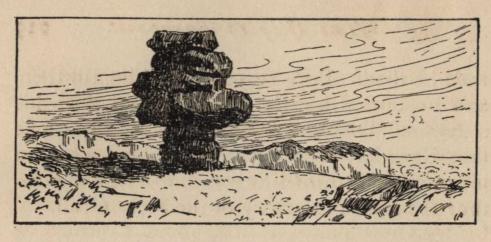
We resolved that we would never play quoits on Sunday, or so much as look at anybody playing quoits on Sunday, and then we went on toward the Cheesewring. We had to climb a little way up the hillside to get to it, and then we stood almost on the edge of a precipice, looking down into a great quarry, where there were men at work cutting out stone. The Cheesewring itself was almost on the edge of the precipice too. It was a great pile of stones—a great pile, but few stones, for they were huge ones. They were skilfully fitted and balanced, one upon the other, and the top one was much the largest of them all, so that the whole pile had somewhat the shape of a rude anvil. The whole pile was perhaps four times as high as our heads. I think I have forgotten to say till now that "Cheesewring" means "cheese-press," and surely a very large and very stiff cheese might be well flattened out by having that pile of stones set upon it.
The puzzle of it, as usual, is how the stones got there. The machinery that they are using down below there in the quarry to-day would be none too good to move such stones as these. Yet there they are, and there is no history of the time when they were put there. "What do you think of them," I said, "and whoever do you suppose knew how to pile them up there?"
"I don't know," Helen answered, "but when there are any big stones anywhere you generally say that Merlin put them there."
"Well, I am not going to say so this time, though these stones do somehow remind me of Merlin. Did I ever tell you what became of him at last?"
"No," said Helen, "of course you didn't."
"Why, here we are," I said, "telling stories about the very end of King Arthur's reign, and nobody had seen or heard anything of Merlin since almost the very beginning of it. And do you mean to tell me that I have never told you what became of him?"
"Why, you know you never did; what was it?"
"Well, to be sure, if I have never told you that, we ought not to lose another minute about it. But you must forget everything that you have heard lately and go away back, for that is where this story begins. After Merlin had taken good care of King Vortigern and of King Pendragon, King Arthur's uncle; and King Uther Pendragon, Arthur's father; and of King Arthur himself; after he had set him on his throne and had helped him to win battles and to get his sword Excalibur, what do you think Merlin did? You would think that he was old enough to know better, only I believe nobody is ever old enough to know better. He fell in love.
"Merlin knew everything, and so he knew that he was going to fall in love. He knew, too, that because of his falling in love he should go away from the court and away from the King and away from all the world, and that after that he should never be of any use again to the King or to England or to the world. Merlin knew, and yet he could not help it. Merlin could rule kingdoms and set up and cast down kings, yet there was one power in the world that he could not rule and could not resist. He could not save himself from the end that he knew was coming. He told King Arthur that he should leave him soon and should never see him again, and King Arthur tried to reason with him and to make him use his magic against his fate. But Merlin said that no magic could do any good; in this one thing he was helpless; when the time came he must go, and the time was coming soon.
"And who was it, do you suppose, that Merlin was in love with? It was Nimue, the Lady of the Lake, Lancelot's Fairy Mother. He met her in a forest over in France, where she had her home. He taught her magic and he made a splendid palace by magic and filled it with knights and ladies for her, and there they had feasts and dances and games. One day she asked him to show her how she could put to sleep any one whom she chose, so that he could not awake till she should let him awake. And Merlin knew that it was himself whom she wished to put to sleep so, yet he knew that it was fate that he should tell her, and so he told her.
"They used to meet in the forest near a spring that was famous afterward, for the water of the spring used to bubble up when anything of iron or copper or brass was thrown into it, and the children who knew the spring threw pins into it and said: 'Laugh, spring, and I will give you a pin,' and then the spring would laugh for them. Merlin sat often beside the spring with Nimue and taught her magic. He taught her so much that at last there was nobody in the world who knew so much of it as she, except himself and perhaps King Arthur's sister, Queen Morgan-le-Fay.
"Then another time Nimue begged Merlin to teach her how one man or woman could be shut up by another, so that he never could get away again, so that no one could ever come to him but the one who had worked the spell, so that he could never see any but that one, and no one could break the spell but the one who made it. Then Merlin was sad again, for he knew that Nimue loved him so much that she wanted to keep him all to herself and never to let any one else see him or hear of him. And he knew, too, that she must have her way in this. 'I know,' he said, 'what it is that you wish, and I love you so much that I know that I must do what you ask.'
"'If you know what it is that I wish,' she said, 'you know that I want a place where we can be together always, only we two, where nobody else can ever come to us and where I shall never see any one but you and you will never see anyone but me. Surely, when I love you so much as you know I do, you should love me enough for that.'
"And still Merlin was sad, knowing that this was to be the end of all his work for the King and for the world, but he answered: 'I will do what you ask. I will make a place where we two can be and no one else can ever come to us or see us or know of us.'
"But Nimue said: 'I do not wish it so; you must teach me the magic, so that I can do it myself. Then I will make the enchantment when I please.'
"So Merlin, knowing that it was fate and that there was no other way, taught her all the charms by which she could do what she wished. He taught her how to walk about in circles and how to wave her hands and what words to say. And she learned it and remembered it all. Then they left France and came over into Cornwall and wandered together about the hills and the woods. And one day, when they had gone a long way, they sat down to rest. And Nimue took Merlin's head in her lap and put him to sleep with the charm that he had taught her. When he was asleep she rose and walked around him nine times and waved her hands and began to say the words that he had taught her. And as she worked the charm Merlin slept more soundly, and then the ground opened and he sank down into it. She sank down too, and when they were deep enough the ground closed above them. But still she went on with the charm and great stones were moved by the magic words and piled themselves high above the place where they had sunk.
"When Merlin awoke he knew that the spell was done. He was in a beautiful place and Nimue was with him. She could go out and come in when she chose, and she often did so, but he could never go out till the spell was broken. And nobody could ever break the spell but Nimue, who had made it. Merlin himself, with all his magic, could not break it, for it was one of his own spells and the strongest of them, and it was planned so that it could never be undone by anyone, even the greatest magician of the world, except the one who had done it. And Nimue never undid the spell.
"Now I am not sure where all this happened, and you know I would not tell you anything that I was not sure of. Some say that it was here in Cornwall and some say that it was over in France, and that Merlin and Nimue did not come back to England at all. Some say, too, that there was another Cornwall in France. But if they did come to England again, and if the place was in this very Cornwall, then why might not this be the very place where we are? Here is this great pile of stones and neither we nor anybody else can tell how they came here or how they could come here. Why might they not be the very ones that Nimue piled up over Merlin by the enchantment that he taught her? I don't say that they are, but I do say that I cannot see why they might not be, so let us believe that they are."
Helen looked over the edge of the hill, down into the quarry. "If those men down there dig out the rock a little more over this way," she said, "they will let Merlin out, if he is still there."
"They will do nothing of the sort," I answered; "do you think that Merlin's charms were worth no more than that? No one can ever let Merlin out of his prison but Nimue, and she never did and never will. If those men down there should dig to where Merlin was, you may be sure that he would sink again, down and down through the earth, so that no quarriers in the world could ever reach him. Merlin's charms were charms that were made to last, and Merlin will never be seen again on the earth as long as Stonehenge is on Salisbury Plain."
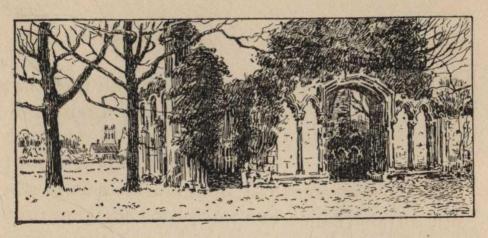
St. Joseph's Chapel, Glastonbury Abbey
CHAPTER XVII
"AND ON THE MERE THE WAILING DIED AWAY"
It was only a short drive from the place where we had left the carriage to Dozmare Pool. That is, it was a short drive to the nearest place to it where we could get with the carriage. The carriage could not go close to it, any more than it could to the Cheesewring. The driver began to remember still more about Dozmare Pool, as we got nearer to it. The water was salt, like the sea, he had heard, and in stormy times it had great waves like the sea.
This reminded me of some things that I had heard and read about it myself. The name "Dozmare," I had been told somewhere, meant "drop of the sea." I had been told somewhere else that the name was made up of two Cornish words that meant "come" and "great," and that the name was given to it because it had tides, like the ocean. Long ago it had no outlet that anybody could see, but it was said that something that was thrown onto it was found many miles off, on the seashore. So it was believed that a passage under ground led from it to the sea. It was said, too, that it was so deep that no plummet had ever reached its bottom.
We came at last to the foot of a steep hill and the driver said that we could not go any farther with the carriage. He would stay here and attend to the horse, and we must go straight up this hill and we should find Dozmare Pool. Up the hill we went, a good, long climb, and when we got to the top, though we knew what we had come to see, we were surprised to see it. For all of a sudden there it was before us, the broad lake on the top of the hill, just where we should expect to find the downward slope of the other side of the hill. It did not look like a stormy sea to-day, but a fresh breeze was blowing over it and drove the little waves before it against the bank, where they made a plashing noise at our feet. The pool seemed to be at the very top of everything, except that far away across it we could see a mountain, with two peaks.
There was one little house near us and no other in sight. Near the house a man was at work piling up turf, cut in long, square strips, for winter fires. A little boy was playing about, or trying to help the man, and a woman was driving a cart that brought the turf from somewhere down below. We asked the man what mountain that was with the two peaks.
"Brown Gilly, sir," he said.
"Is the water of this lake salt?" we asked again.
"No, sir, it's fresh."
"Is it good to drink?"
"We don't drink it ourselves, sir, but it's good for washing and the cattle drink it."
"How big is the lake?"
"It's about a mile and a quarter round, sir."
"And is there any outlet?"
"Yes, sir, down at the other end there's one."
"It was not always there, was it? When was it made?"
"I couldn't say, sir; it was there before my time."
We left the man to pile his turf and wonder what strange sort of people we could be who wanted to know so many useless things. "Well, there is so much of our story spoiled," I said. "It is not salt and it probably does not have waves like the ocean, and an outlet has been made for it. Still, as you stand and look over it, do you not feel that there is something lonely and solemn and mysterious and magical about it? When you think of its being here at the top of a hill, instead of down in a valley, like a common lake, and when you see no higher hill around it, except that one mountain over there, and when you think of the stories about it, do you not get a little of what our old friend of the Alice books calls the 'eerie' feeling? Have you guessed that the reason why I brought you here was that this was the lake where King Arthur found his sword Excalibur? Well, it was. And now I have another story to tell you about it. It is rather a sad story. The most of our stories are getting to be rather sad now, but there are not many more of them."
I had told Helen long before how King Arthur got his sword Excalibur. His sword had been broken in a fight one day, and Merlin led him to the shore of a little lake—this very lake where we stood now—and out in the middle of it he had seen an arm rising out of the water. The arm was covered with white silk and the hand held a sword, the most beautiful that Arthur had ever seen. Merlin and Arthur went out to it in a boat and the King took the sword and kept it. That was the wonderful sword Excalibur. Merlin told Arthur strange things about the sword. No one else ever knew what they were, and it may be that we do not know, even yet, of all the wonders of that sword.
But now for the story. "You know," I said, "that I do not often throw morals at you in these stories. As a general thing, I hate to see morals hung up on the ends of stories as much as you do. If the moral cannot make itself felt as the story goes along, it isn't of much use, usually, to drag it out and hold it up at the end. But this story has such a good and sound and useful moral that I can't help pointing it out to you. But I will put it here at the beginning, instead of at the end, and have it over with. It is that when a lie has been told about anybody, no matter how wicked and silly it is, no matter how clearly it may have been proved to be a lie, it will always stick to him, it will never be forgotten, and there will always be people who will half believe it.
"You remember how once Meliagraunce charged Queen Guinevere with treason against King Arthur. Everybody knew that Meliagraunce himself was a traitor and a liar and that he got killed for telling that one lie. Still it never was forgotten and there were some who never had quite the trust in the Queen again that they had had before. And since it was Lancelot who had fought for the Queen then and at other times, they looked at him just as they did at her, and shook their heads and whispered to one another that they wondered if Lancelot was quite as true to the King as he ought to be. There were some who said, too, that Lancelot and the Queen both cared too much about honors and glory for themselves and not enough about the honor of the King. And I am afraid that was not a lie.
"Still all this thinking and talking counted for little for a long time. And then there came a time when they counted for much. It was after the quest of the Holy Grail. Lancelot had come back to the court and Bors had come back from the City of Sarras, and all had come back who were ever coming. Then, all at once, as it has always seemed to me, without any reason, half the people in King Arthur's court went mad. The first and the worst of them was Mordred, King Arthur's nephew, Gawain's brother. He was always all but mad with jealousy and envy and hatred of all who were greater than himself. And now he thought that nothing less could please him than to overthrow King Arthur and to be King of England.
"There are some people who cannot think of any better way of helping themselves than by doing all the harm that they can to those who stand in their way. Mordred was of this sort. He looked about him to see who there was whom he could harm, and he thought of this old lie about the Queen and of these new doubts about Lancelot. Then he went to the King and told him that he had found that Lancelot and the Queen were plotting treason together and forming some plan against the King. If the King wanted proof of it, Mordred said, let him go hunting the next day, and while he was gone, Mordred and some others would find Lancelot and the Queen together.
"Now Lancelot and the Queen had always been the best of friends and what in the world was supposed to be proved by their being seen together I am sure I don't know. But just at this time it seems to me that it was the King who went mad, and he said that he would do as Mordred advised him.
"The next day the King went hunting. Now Bors and some of Lancelot's other friends had heard these whispers about the court and they had told Lancelot of them. They had decided that it might stop the chatter, about Lancelot at least, if he were to leave the court for a time. It happened that Lancelot had meant to go this very day, and so he went to say good-by to the Queen. Bors knew what a mischief-maker Mordred was; he had seen that he dif not go to the hunt with the King, and he feared that something was wrong. He begged Lancelot not to go to see the Queen, but Lancelot laughed at the notion that there was anything to fear and went. And Mordred and some other knights whom he had got on his side were watching, and the minute that Lancelot and the Queen were together they were upon them.
"Lancelot had come only to see the Queen and to bid her good-by; he had not expected any fighting, and so he wore no armor. Mordred and his knights meant to fall upon Lancelot all at once and kill him or take him prisoner. But Lancelot was quick enough to shut the door of the room and keep them out for a few minutes. Then he drew his sword and opened the door just enough to let one of the knights come in. He struck that one with his sword and wounded him so that he fell inside the room, and then he shut the door again. Lancelot quickly took off the armor of the wounded knight and dressed himself in it. Then he threw the door wide open and rushed at the crowd of knights striking about him as he went and wounding more of them.
"Many as they were they could not stand against Lancelot and he escaped from them and went back to his friends. I suppose I ought to say just here that there was scarcely ever a man in the world who had such friends as Lancelot. There were his brother Ector, his cousins Bors and Lionel, Lavaine, and many others who were ready to give their very lives for Lancelot at any time. And now, after this terrible thing had happened, they all left the city with him, as quickly as they could, and then they waited near to see what would be done with the Queen.
"When the King came back Mordred told him about what had happened, in his own lying way, I suppose. And the King, it seems, had not got over his fit of madness yet, for surely nobody in his senses could think that what Mordred had to tell proved anything. But of course we don't know just how much Mordred lied, and I wonder if the King believed him just because he was his own nephew. Such things happen sometimes, though for my own part I don't see why any man should be believed because he is another man's nephew. Bad men have uncles, as well as good men. But it seems that the King did believe him, for some reason or other, and did believe that the Queen and Lancelot were guilty of treason. And he said that the Queen should have the punishment of treason, and so should Lancelot, if he could get him. Now the punishment of treason in those days was burning.
"Now, mad as the King seems to have been, I no more believe that he would have the Queen burnt than I believe that he would have himself burnt. I don't know why he pretended that he would. Perhaps he thought that he could make her confess something, or perhaps he thought that Mordred, when he saw how far things were going, would confess that he was wrong. But the King declared that the punishment of the Queen should be the next morning and he ordered some of his knights, and among them Gareth and his brother Gaheris, to be present and see it done. They and some of the others told the King plainly that they thought that what he was doing was wrong and that they would have nothing to do with it. Since he commanded them to be present, they said, they would be there only to look on, and they would wear no armor.
"And now it came Lancelot's turn to go mad. For he believed that the King would really do all that he said. So he resolved that he would save the Queen. The King himself would have saved her, I am sure, before any harm could come to her. But Lancelot heard what was to be done and in the morning he took some of his friends, all fully armed, and they rode to the place where the Queen was led out for her punishment. Lancelot and his men dashed through the crowd of King Arthur's knights, the most of whom wore no armor, laying about them with their swords, killing some and wounding others, and came to where the Queen stood. Lancelot lifted her and put her on his horse behind him, and he and his knights rode away again. They did not stop near the city this time, but they rode straight to a castle of Lancelot's own, called Joyous Gard, and there they all shut themselves in and fortified the town.
"But in the saving of the Queen another terrible thing had happened. As Lancelot dashed through the crowd of King Arthur's knights to come where she was, some of them struck at him, and in return he layed about him with his sword and could not see who was in his way, and so, not knowing who they were, he struck Sir Gareth and Sir Gaheris, who wore no armor, and killed them both. And now it was Gawain who went mad. When he heard that Lancelot had killed his brothers he would not believe that it was by accident and he swore that he would always follow Lancelot and try to find chances to fight with him, till one of them should kill the other. He urged the King to make war at once upon Lancelot, and the King and his army marched to Joyous Gard and besieged the castle and the town.
"Lancelot had many friends, as I said before, and many of the lords and knights of the country, when they heard what had happened, thought that Lancelot was right and came to help him. By the time that the King and his army came to Joyous Gard Lancelot had a good army of his own there. But Lancelot did not want to fight the King, and for many days he kept all his men inside the town. He sent messages to the King and to Gawain. He told the King that neither he nor the Queen had ever thought of doing him any wrong, and he begged him to let the Queen come back to him and to leave off this war. He told Gawain that he had loved his brother Gareth as if he had been his own brother and that he would as soon have killed his own brother as Gareth or Gaheris, if he had known who they were. And the King was so sad at all that had been done that he wanted to give up the whole war, but Gawain would not hear of it. He would never forgive Lancelot for killing his brothers, he said, till one of them should kill the other.
"Then Lancelot's friends urged him to fight. Gawain would never let the King give up the war, they said, and it would be best to end it now. And Lancelot felt that they were right, and at last he yielded and said that he would go out to battle the next morning. In the morning Lancelot's army marched out of the city and the army of the King came to meet it. Lancelot had ordered all his men that whatever they did they should do no harm to the King or to Gawain. As for himself, he scarcely fought at all. He rode about the field and saw others fight. He saw many of his own men wounded and killed, but he had no heart to strike a blow against King Arthur or any knight of his. At last he saw the King himself charging against his cousin Bors. Bors met the charge with his spear and threw King Arthur from his horse. When Lancelot saw that he rode to where the King was and got off his horse. 'Here, my lord,' he said, 'take this horse; you and your knights fight against me and have no mercy, but I cannot fight against my King or see him overthrown and not try to help him.'
"And the King took Lancelot's horse and rode away from the field and called all his men away too, and Lancelot's men went back to the town.
"The next day Lancelot sent messengers to King Arthur again to ask him to let the Queen come back, to promise that she should not be harmed, and to end the war. And the King would have done everything that Lancelot asked, but again Gawain would not hear of it. 'Let the Queen come back if you like,' said Gawain; 'that is nothing to me. But I will not forgive Lancelot for killing my brothers and I will always follow him and fight with him till I kill him or he kills me.'
"You know I told you long ago of the old story that Gawain could speak so well that nobody could ever refuse him anything that he asked. I think that must have been why the King let him have his own way all through this war with Lancelot. I am sure that the King himself must have got back his senses now, and I almost think, after all, that he never really believed that the Queen or Lancelot could wish to do any wrong to him. How could he let her come back at all if he believed that? And he did let her come back, but still Gawain was firm against Lancelot, and the King would not make peace with him till Gawain wished it.
"When Lancelot had sent the Queen back to King Arthur he thought that it was of no use to stay in England any longer, so he took all his knights and his army with him and crossed over into France. He went to Benwick, his father's old city and his own city now, because his father was dead long ago. And soon King Arthur and Gawain followed him with their army, for Gawain still vowed that he would go where Lancelot went and would not leave him till one of them had killed the other. In these last dreadful days of King Arthur's reign it seems as if no one ever missed a chance of making a mistake, and now Arthur made another. For when he went over to France he left Mordred in his place to rule England till he came back, and he left the Queen in Mordred's care too.
"So the King and Gawain and their army came to Benwick and besieged it, as they had besieged Joyous Gard. Lancelot sent a message to them again. He would do anything if they would end the war and not make him fight against the King and his old friend. He would give up his city to them, if they would take it, and let all the world think that he was beaten, when he was not beaten at all, or that he was a coward and did not dare to fight. Still Gawain would be content with nothing but that Lancelot must fight with him. But he sent back word that if Lancelot alone would come out and fight with him alone, till one of them should kill the other, that one fight should end the war.
"When this message was brought to Lancelot his friends told him that it was of no use any longer to hope for peace. Gawain would never yield, and it must be as he said at last. It would be better for Lancelot to fight with him now than to wait. Lancelot knew that they were right, and he sent word that the next morning he would meet Gawain outside the city and fight with him.
"They met the next morning, in the space between the city walls and King Arthur's army. Both the knights were thrown from their horses at the first charge, and then it was the old story of a sword fight that I have told you so many times before. But Gawain had the gift of growing stronger every day, from nine o'clock till noon, and then he had three times his natural strength. This had been given to him by a magician long ago, and nobody knew that he had it except himself and King Arthur. Lancelot knew nothing about it, but he had not been fighting long before he knew that there was something strange about Gawain's fighting. He felt him growing so strong that he scarcely tried to strike at Gawain at all, but used all his strength in defending himself. And so for a long time neither of them was much harmed, but when noon came, all at once Lancelot felt that Gawain had grown weaker. Then he said: 'Gawain, I do not know with what magic you have fought till now. But, whatever it was, I feel now that it has left you and you are like any other man. Now I must begin to fight.'
"Then he struck Gawain a great blow on the head and wounded him, so that he fell, and Lancelot stood still beside him, resting on his sword. 'Why do you stop your fight?' Gawain cried. 'You have beaten me; finish it now and kill me.'
"'You know,' said Lancelot, 'that I cannot kill any knight who is wounded and helpless, and least of all you, who have been my friend so long. Our fight is over.'
"'Kill me and make an end to it,' Gawain said again, 'or as soon as I am cured of this wound I shall come and fight you again.'
"'If I must fight with you again," said Lancelot, 'I shall be ready; I can do no more now.'
"So Gawain was carried back to his tent and was kept there for many days, while his wound was healing. And as soon as he was strong enough he sent word to Lancelot that he must fight him again. There is no need of making a long story of it. Gawain and Lancelot fought again and the fight ended exactly as the first one had done. Lancelot wounded Gawain in the very same place where he had wounded him before, and Gawain was carried back to his tent, vowing that he would still fight with Lancelot as soon as his wound should heal.
"And what do you suppose had been going on in England all this time? You might almost guess. You would think that Mordred could not possibly keep out of mischief so long, and you would be quite right. King Arthur had not had much more than time to get to Benwick before Mordred began to tell people that the King was dead. He showed some letters, which he had written himself, but he pretended that they had come from France, and they said that the King had been killed in a battle against Lancelot. Of course the only thing to do in such a case was to crown Mordred himself as King, and Mordred took care that it should be done in a hurry. Then, to make everything as sure as possible, he gave notice that he was going to marry Queen Guinevere. Of course he did not trouble himself to ask Queen Guinevere whether or not it suited her to be married to him. He had begun to have his own way and he was resolved to go on. The Queen saw that it would not do any good to pretend that she did not want to be married to him, so she let Mordred think that there was nothing that would please her better than to be his wife. But she said that if she was to be married she should have to go to London to get some new gowns. Mordred saw nothing wrong about that and he let her go. Then, as soon as she got to London, she shut herself up in the Tower and found men who were friendly to her to guard it, and waited for Mordred to come and try to get her out of it.
"He came, you may be sure, as soon as he heard where she was, and he laid siege to the Tower, but it was so strong, and Queen Guinevere's men fought so well, that he could not take it. He kept up the siege till he heard that King Arthur and all his men were coming back from France and Lancelot and his men were coming with them. When he heard that he drew his army away from London and marched to Dover to meet the King and to keep him from getting England away from him.
"It was true that the King and his men were coming back from France, but it was not true that Lancelot was coming. Lancelot did not know why King Arthur and his army had so suddenly left Benwick. It was because the King had heard of the mischief that Mordred had done and of the more mischief that he was trying to do. Even Gawain could not ask the King to make war upon Lancelot any longer, when England itself was likely to be lost. Gawain had been acting in a mad fashion enough for a long time, but the news from England brought him back to his senses. His wound was nearly healed and he was beginning again to want to fight with Lancelot, but now he saw all at once what harm his wild anger against Lancelot had done. He was filled with shame and grief at the thought of it. 'It is I,' he said to the King, 'who have done all this. I see it now. It is Lancelot who has always been your truest and best friend, and it is I who have been your enemy. I fear that I have done too much for you to forgive, but there is hope still, for I know that Lancelot will still be your friend. Send for him; tell him that I was wrong in everything—that I confess it—and ask him to go with you and help you to win back England from Mordred.'
"If the King had ever doubted Lancelot he doubted him no longer now. Gawain, who had been against him so long, was for him now. But the King looked sadly at Gawain and shook his head. 'Gawain, Gawain,' he said, 'we have gone too far. We have wronged Lancelot too much. We cannot ask him to help us now. We must fight our battles and win them or lose them by ourselves.'
"So the King and Gawain and their army left Lancelot and Benwick and crossed into England. As soon as they landed at Dover Mordred met them and there was a hard battle. Many were killed and wounded on both sides and at last Mordred was driven back. But when the battle was over Gawain had been wounded again just where Lancelot had wounded him twice before.
"And this time he felt that he could not live. Then Gawain thought: 'If the King could not ask Lancelot to help him, yet surely I can ask him, now that I am dying. It was I who wronged him and I who was his enemy. But when he comes I shall not be here any more, and I know that he always loved the King and that he loves him still.'
"And Gawain told those who were about him to bring him pen and paper, and he wrote a letter to Lancelot. The letter said: 'Sir Lancelot, I am dying from a wound that I got in battle to-day, just where you wounded me twice. I have been blind and deaf and mad all this while. I would not see or hear the truth, and the truth is, Lancelot, that it is you who have been always the King's friend and that it is I who, in these last days, have been his enemy. My pride and my selfishness and my anger have almost ruined the King, but it may be that your true love and your strength can save him yet. Come and help him, Lancelot. I have given you cause to hate me, but do not stay away from the King for that, for when you come to him I shall be dead.'
"This letter Gawain gave to a messenger and ordered him to cross with it to France and to ride as fast as he could to Benwick and give it to Lancelot. And a little while after that Gawain died.
"The next day King Arthur marched against Mordred. Mordred, with his army, fell back before him and day after day the King pushed him farther and farther into the West, till at last the two armies were here in Cornwall. They had both been gathering strength as they marched, for many knights and many other men joined them as they passed through the country. Some joined Mordred because they were friends to Lancelot, not knowing, they were so little and so narrow themselves, that Lancelot was great enough to be the King's friend still.
"At last Mordred and his army halted and would retreat no farther. Then it seemed that the great battle must come the next day. But that night King Arthur had a dream. He dreamed that Gawain came and stood before him, and Gawain said: 'My lord, do not fight with Mordred to-morrow. If you fight with him to-morrow you will be killed. But put off the battle for a little while and Lancelot and all his knights and all his men will come to help you.'
"In the morning, when the King awoke, he sent messengers to Mordred to ask him to meet him between the lines of the two armies and agree upon a truce. So it was arranged that Arthur and Mordred should each bring fourteen knights and that they should meet half-way between the two armies. Then Arthur said to his knights whom he left behind: 'I do not trust Mordred. I fear that he will try some treachery. So watch us when we meet and while we talk, and if you see any sword drawn among the men on either side, do not wait for any more, but charge forward and begin the battle.' And Mordred, before he went to meet the King, gave just the same command to his knights who stayed behind.
"All the knights who went with the King and with Mordred were told that this was to be a peaceful meeting and that no sword must be drawn. But after the King and Mordred had met and while they were talking, a little snake came out from under a bush and stung the foot of one of the knights. The knight forgot the order that had been given and drew his sword to kill the snake. But the men of the armies were too far away to see the snake and to know why the sword was drawn. They saw only the flash of the drawn sword and that was the signal of battle. It was of no use for Arthur or for Mordred to try to stop them or to delay the battle then. The trumpets blew, the knights charged forward, the two great waves of horses and men broke upon each other with a harsh rattle and jangle and clash of arms all along the field, and the battle was joined.
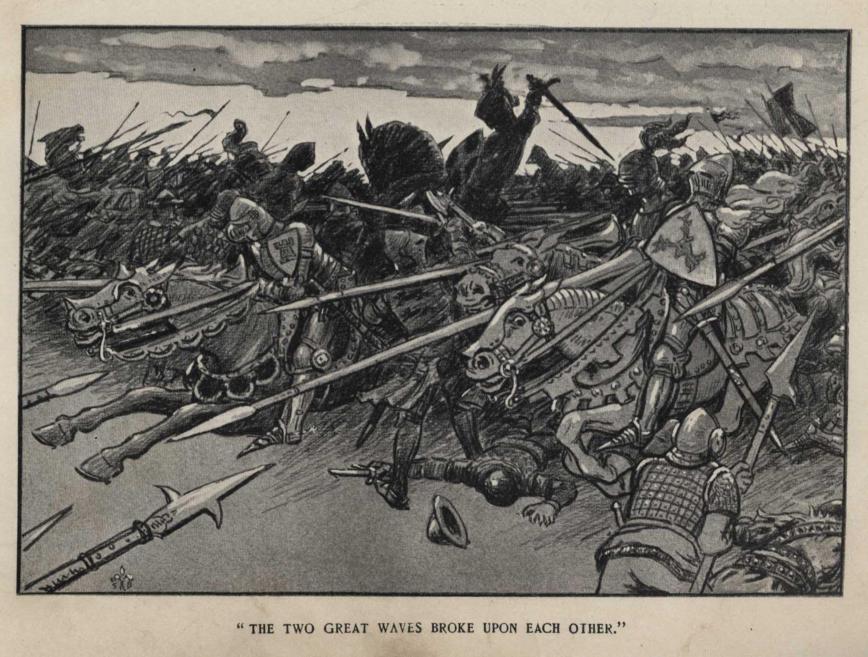
"The two great waves broke upon each other"
"In all his long reign, King Arthur had never fought such a battle as this before. There were thousands of men on each side and they were all men who had learned to fight in King Arthur's own battles and tournaments. They were men who had learned from him to fight and to fight and to go on fighting and never to stop till they had won. With men like that on both sides there was only one way that the battle could end. The battle went on all day. Slowly the knights on each side grew fewer and fewer and all who saw them knew that the fight would go on till there was none at all on one side or the other. Arthur's men were faithful to him to their last breath, and Mordred's men felt that they should be ruined if they were beaten. Once Arthur saw one of his old knights surrounded by enemies, and the old knight's son was close beside the King. The King and those around him had as much fighting as they could do, but Arthur said to the young knight: 'Do you not see your father there in danger? Why do you not go to help him?'
"And the young knight answered: 'My lord, my father told me this morning to stay beside you all day and to let nothing draw me away from you. My father is a good knight and he must fight for himself.' And the old knight was killed, and afterward the son was killed, too.
"When the evening came there were few left to fight. It may be that some had run away, but the most were dead or wounded. King Arthur stood with only two of his knights beside him. They were Sir Lucan and Sir Bedivere. The King looked all about him and saw only one other man near. And that was Mordred. The King spoke under his breath: 'The end is come, I fear, for all of us, but before I die that man there shall die, who has brought this end to all of us.'
"Sir Lucan and Sir Bedivere tried to hold him back. 'My lord,' said Sir Bedivere, 'do not try to fight any more with him to-day, or he may kill you. Remember what Gawain said to you in your dream. Mordred has no friends left now. Leave him for to-night, and to-morrow we can do justice upon him.'
"'No,' said the King, 'that traitor shall not live any longer, and I will kill him myself.'
"Arthur had his sword Excalibur in his hand. He rushed upon Mordred with it and struck him one blow upon the head, and Mordred fell down dead. But Arthur had been so eager against Mordred that he had not thought to defend himself. Mordred had struck too at the same time and had struck well and Arthur had a great wound on his head. Lucan and Bedivere went to him and he tried to stand, but he could not. 'You must help me,' he said, 'to some place of shelter; I cannot help myself any more.'
"They tried to lift him up, but Lucan, who had been wounded in the battle, suddenly fell down beside the King and died. Then Arthur said: 'Bedivere, you are the last one left to me and there is only a little more that you can do. Take my sword Excalibur and go up this hill here before us. At the top of it there is a lake. Throw my sword into the lake, as far out into the middle of it as you can, and then come back and tell me what you see.'
"Bedivere took the sword and climbed the hill and came to this very spot where we are standing. But on the way he looked at the sword and at the jewels in the hilt and he thought: 'It would be wrong to throw away this beautiful sword. I will hide it here, instead of throwing it into the lake. Then, if the King is cured of his wound, he will be glad to have his sword again, and if he dies, someone else can have it.'
"So he hid the sword among the reeds that grew by the side of the lake and went back to the King. 'Did you throw my sword into the lake?' the King asked.
"'Yes, my lord,' said Bedivere.
"'And what did you see or hear?' said the King.
"'Nothing,' said Bedivere, 'but the water and the wind.'
"'Then you did not throw it in,' the King answered. 'Go back now and throw it in, as I told you, and come back and tell me what you see.'
"Then Bedivere went up the hill again to the lake and took the sword out from where he had hidden it. He held it up in the moonlight and saw the shining of the rich jewels and the gleam of the long blade and again he thought: 'It would be a sin to lose such a wonderful thing as this. The King is wounded and weak and he is wandering in his mind, or else he would not tell me to do it. I will tell him again that I have thrown it in.'
"He hid the sword again and went back to the King, and the King said: 'Did you throw my sword into the lake?'
"'Yes, my lord,' said Bedivere, 'I threw it in.'
"'And what did you see or hear?' said Arthur.
"'I saw nothing but the water,' said Bedivere, 'and I heard nothing but the wind and the waves.'
"'Oh, Bedivere,' said Arthur, 'you are the last of my knights and you will not obey me. Go now once more and throw my sword as far as you can out into the lake. And if you do not obey me this time, when you come again, wounded as I am, I will rise up and kill you, if I can, with my hands.'
"Then Bedivere went as fast as he could up the hill again and found the sword and took it and swung it above his head and threw it as far as he could out over the lake. He watched it as it whirled through the air, and when it was near the water he saw an arm, covered with white silk, come up out of the water. The hand caught the sword as it fell and brandished it three times in a circle, and then the hand and the arm went down under the water, and Bedivere went back and told the King. 'And now, Bedivere,' said Arthur, 'help me to go to the lake too.'
"But the King could not stand at all, so Bedivere took him on his back and carried him up the hill to the side of the lake. And there they saw a boat lying close to the shore. It was filled with women, all dressed in black, and three, who stood in the midst of them, were queens and wore crowns. 'Put me in the boat,' said Arthur, and Bedivere carried him to the boat and the three queens received him, and all the women in the boat wept when they saw him. The three queens laid him down and one of them took his head in her lap and said: 'My dear brother, why did you wait so long? You should have come here to us as soon as you had this wound.'
"And this woman was King Arthur's sister, Queen Morgan-le-Fay. I don't know when or why she had ceased to be his enemy and had become his friend, but she was his friend now and she did all that she could to help him and to cure his wound.
"Then Bedivere saw that the boat was moving from the shore, and he cried: 'My lord—my King—where shall I go and what shall I do without you? Let me go with you where you go and die with you, if you are to die.'
"But Arthur answered: 'Do not be grieved for me, Bedivere, but go your own way. Perhaps you may hear of me again, but now I can do no more for you or for my people. I am going to the Valley of Avalon, to be cured of my wound, and some time, perhaps, when my wound is well, I shall come again.'
"Then the boat moved farther and farther away along the lake. The King did not speak again, but Bedivere could hear Queen Morgan-le-Fay speaking softly to him, and he could hear the other women weeping. Only for a little while he could hear them, and then he strained his eyes to see the boat as long as he could. But the light was dim and soon the dark shape of the boat mixed with the dark shadows and was lost.
"And so King Arthur floated away to Avalon. You know that Avalon was Glastonbury, and you do not see, perhaps, how any boat could go from this mountain lake, all shut in by the land, out to the sea and inland again to that island with the marsh around it. You must think of the magic of Queen Morgan-le-Fay. Where she wanted her boat to go I am sure that water-ways would open of themselves to let her pass. A ship with her upon it would go as fast and as far as she would have it go. And then, one of the old stories says, they had a pilot who knew all the seas and all the stars of the heavens.