THE KNIGHTS OF THE ROUND TABLE (continued 3)
Reading edition
"But where is the old abbey?" I asked. "Are there not some ruins of that left?"
We were outside the church now and were looking about at the fields and the trees. "Oh, no," the vicar said, "there is nothing left of the abbey now. It was very near where that large house is now. That is the house of Sir Edmund Antrobus. We can come nearer and look at it, if you like." So we went nearer and looked at it, and it was a handsome house, and then we went and stood on a little bridge across the Avon. It was a shady place and the water was clear, so that we could see the trout swimming in it, and we looked down the river under a green arch of trees that grew on the sides of the stream and sent their branches to meet above it. "I should like you to remember this place," I said, "because Queen Guinevere lived here for a long time. It is not time yet for me to tell you how or why, but I will tell you when the time comes, and till then I want you to remember how the place looks. Remember these fields and this river and these trees. I don't know, of course, whether they looked the same then, but they may have been not so very different. So think of Queen Guinevere sometimes standing on a bridge, just as we are now, or on the bank of the river, and looking down into just such clear water and up at just such cool, green, spreading trees. Remember that she lived over there where Sir Edmund Antrobus lives now, and that she walked many a morning, it is likely, across these very fields, to a church that stood where the church is now. That is all. Remember it till we come to the story about it."
By the time we came out to the road the driver was waiting for us and wondering what we had found to keep us so long. We got into the carriage and went on again, and nothing happened till we got to Stonehenge. Now I know that you don't want me to describe Stonehenge to you. If you want to know a great deal more than you do about it, you can find it in a good many big and learned books. What I wish I could do would be to make you see it, and I cannot do that. It is not much to tell about, but it is a wonderful thing to see. It seems to me to mean so much, standing there, so lonely, in the middle of Salisbury Plain—that great circle of half-smoothed stones—grand, sad, silent, older than history—a solid, real, noble thing, left to us from a time out of which we have little else but fairy tales. It was a huge circle of stones once, square pillars set on end and big blocks laid across them. Now many of them are lying on the ground, where they fell so long ago that some of them are half buried in it. Some way off from the circle is another tall stone, that they say the devil once threw at a monk. He was such a good man that the devil could not hurt him, but it struck his foot and took the print of his heel, and the print is there now, to prove the story. In the morning of the day of the summer when the sun goes highest in the sky, people come here to see it rise. I have never been here then, but they say that on that morning, if you stand over across the circle and look through one of the great stone gateways, you will see the sun rise exactly over the point of this stone that the devil threw at the monk.
"I am sorry," I said, "that I cannot tell you the history of Stonehenge, but I can tell you the story of it, if you care to hear it."
To be sure Helen cared to hear it.
"We shall have to go back, then," I said, "to a time long before King Arthur was born. Lud was the King of England. It was for him that London was named. Perhaps the two names do not sound very much alike to you, but you know names will get a good deal twisted, the best you can do. Lud had a brother named Levelys, who had gone over to France and married a princess and had become King of France. And about that time King Lud and his people began to have a great deal of trouble. There were three things that troubled them especially. The first was a race of people called the Coranians. I don't know where these Coranians came from or what they did to make themselves so troublesome, but there is no doubt that, for some reason or other, they did not get on well with Lud's people. And the worst of it was that there seemed to be no way to get rid of them. The reason was that they had such good ears. For they could hear anything that was said anywhere on the island, no matter how softly it was spoken, if the wind was the right way. And so no plan against them could ever be talked over without their finding out all about it.
"And the second trouble was a noise, a horrible scream, that was heard in every house in England on the eve of every May Day. It was so loud and so fearful that it frightened people half to death, and it went through them like a knife, and it chilled their blood and filled them with horror, and some of them went mad because of it.
"And the third trouble was that the King never could keep anything to eat in the house. No matter how much provision there was at night, it was all gone the next morning, and nobody could find out what became of it.
"Now, it occurred to King Lud that his brother Levelys was a very wise man, and that it would be worth while to go to France and see him and ask him if he could tell what ought to be done about all these troubles. So he got ready a fleet, very quietly, so that the Coranians should know as little as possible about it, and sailed toward France. And when his brother heard that he was coming he got ready a fleet too, and sailed from France to meet him. When they met they were very glad to see each other, and they got ready to talk about King Lud's troubles. Levelys was so wise that he knew just what Lud had come for, without being told, so he tried to find a way for them to talk without the Coranians hearing them. And he had a horn made of brass, and he thought that if they talked through that they could not be heard even by such ears as the Coranians had.
"But when they began to talk through it they found that whatever either of them said into it nothing would come out but angry and hostile words. Then Levelys knew that a demon had got into the horn. So he poured wine through the horn and drove the demon out. Then they found that they could hear through the horn much better. Levelys talked through the horn and told Lud that he would give him some insects that would kill the Coranians. He must put them in water and then he must call all the people of the island together and scatter the water over them. It would kill all the Coranians, he said, and it would not harm Lud's own people.
"As for the second trouble, that of the dreadful noise, Levelys said that it was caused by two dragons, that were fighting. 'When you go home,' he said, 'you must measure your island and find the exact middle of it. There you must dig a pit, and in the pit you must put a cauldron of the best mead, and you must cover the top of the cauldron with satin. Then you must watch till you see the two dragons flying in the air and fighting together. After a time they will grow weary with fighting and they will drop down upon the satin and sink into the cauldron. Then they will drink all the mead that there is in it and go to sleep. After that you must fold the covering of satin around them and bury them in the strongest place that you have.
"'And the third trouble,' Levelys went on, 'the disappearing of all your food, is caused by a great enchanter, who comes and carries it away. And the reason that nobody who watches ever sees him is that he casts spells over all of them and makes them sleep. But you yourself must watch, and you must have a cauldron filled with cold water beside you, and when you feel like sleeping you must get into the cauldron and the cold water will keep you awake.'
"When he had heard all this Lud went home. And the first thing that he did was to call all the people together, as his brother had told him. Then he sprinkled the water with the insects in it over all the people and it killed all the Coranians and did no harm to his own people.
"Then he measured the island and found that the very middle of it was in Oxford. You can measure it yourself, on the map, if you want to find out whether the middle of it is really in Oxford. I don't say that it is, only that that was what Lud found. But I suppose he must have been right about it, for the rest of the experiment worked perfectly. That is to say, he dug the pit and put the cauldron in the pit and the mead in the cauldron, and the satin over the cauldron, and waited to see the fight of the dragons. And the dragons came and fought and fell down into the cauldron and drank up the mead and slept, and Lud covered them with the satin and buried them in Snowdon, which is a great mountain in Wales. I am sorry that we cannot go to Snowdon at present, for I know that it must be worth seeing.
"And finally Lud made such a great feast that there was sure to be a good deal of it left, and then he sat up to see what would become of it. He put on his armor and sat down and waited, and by and by he began to hear such sweet music that he could scarcely help going to sleep. But he got into the cauldron of cold water which he had ready, and that kept him awake. And at last there came a great man, dressed all in armor and carrying a big basket. He began to put the food into the basket and Lud began to wonder how he could do it, for it seemed to him that there was a great deal more of it than the basket could ever hold. But the man put it all in and then started to go away with it. Then Lud stopped him and made him fight with him. And Lud beat him and would not grant him mercy till he promised to be Lud's servant and to restore the value of all that he had ever taken from him.
"Now we come to the second part of the story. To get to it we have to come down a good many years, to the time when Merlin, the great magician and wise man of King Arthur's court, was a boy. We almost always think of him as an old man, with white hair and a long, white beard. But he was a boy once, just like anybody else. And a wonderful thing about it was that he knew just as much more than anybody else in the world when he was a boy as he did when he was an old man.
"There was a King of England named Vortigern. He had no right to be King of England, but he was. King Constantine had died not long ago, and had left three sons. They were Constans, Pendragon, and Uther. Vortigern, being very powerful at that time, had had Constans made King and he himself had become his chief adviser. Then he had contrived to get Constans killed and had been crowned as King himself. Pendragon and Uther were too young then to rule, and those who had the care of them had fled with them to France, because they knew that Vortigern would kill them too, if they stayed in England. And in France the princes lived and grew up to be young men.
"While they were doing that, Vortigern was having a good deal of trouble in trying to govern the kingdom that did not belong to him. He did it so badly that the people turned against him, and he had many enemies from abroad besides. At last he called his wise men together and they told him that there was nothing left for him to do but to build the strongest tower he could, in the safest place he could, and then stay in it and try to keep himself from his enemies.
"So Vortigern hunted all over the island to find the best place to build his tower, and he decided that the best place was Snowdon. But when his workmen began to build there was more trouble. No matter how much they built in a day, it all fell down in the night, and the next day they had to begin all over again. When that had gone on for awhile Vortigern called his wise men together again and asked them what was the matter.
"The wise men did not know in the least, but they tried to look wiser than they had ever looked before in their lives, and they said that in a few days they would find out. Then they got together, away from the King, and talked it all over and tried to make up their minds why the King's tower would not stand. I don't know all the absurd ways that they had of thinking that they found out things, but the one that they believed in the most was studying the stars. So they studied the stars as hard as ever they could, but not a thing could they find out from them about the King's tower and why it would not stand. But they were dreadfully scared by something else that they thought they saw in the stars. This was that every one of them would finally be brought to his death by a child who never had a father. Then one of them, who was a little brighter than the others, said: 'If we cannot do anything for the King, perhaps we can do something for ourselves. Let us try to kill this child who never had a father, before he kills us. Let us tell the King that we have found out from the stars that his tower will stand, if he mixes the mortar with the blood of a child who never had a father. Then he will find the child and kill him and we shall be safe."
"They all thought that this was a good plan, so they went and told the King that he must find a child who never had a father and mix his blood into the mortar. So the King sent out messengers in every direction to hunt for a child who never had a father. As I told you at first, Merlin was a child then, and perhaps you remember that I told you a long time ago that nobody ever knew who Merlin's father was, unless, as some people said, he was the son of a devil. Well, one day two of Vortigern's messengers came to the town where Merlin lived, and Merlin and some other children were playing in the street.
"Just as the messengers came along Merlin struck one of his playmates. The boy cried out and asked Merlin how he dared to strike him, when he was the son of a great man and when Merlin never had any father. When the messengers heard that, of course they were interested at once. They asked about Merlin and they found that the story was indeed that this boy never had any father, so they told him that the King wanted him and that he must come with them. 'I am ready to go with you,' Merlin said, 'and I am not afraid, though I know that the King means to kill me. You could never have found me if I had not been willing that you should. I knew that you were looking for me and I struck the other boy so that he would say just what he did, to tell you that I was the child that the King wanted. I shall not let the King kill me and I shall tell him what makes his tower fall down.'
"Then the messengers went back to the King and took Merlin with them. When he came before the King Merlin said: 'My lord, you mean to kill me because your wise men have told you that my blood will make your tower stand. But they know nothing about it. Call them and let me question them and prove to you that they know nothing about it.'
"So the King called his wise men and Merlin said to them: 'What is under the place where the King wants to build his tower?'
"The wise men studied and whispered together and tried to look wiser than ever, but at last they had to say that they did not know what was under the place. 'Then I will tell you,' said Merlin; 'there is water under it; my lord, have your workmen dig down and see.
"So the workmen were set to digging and after awhile they came to the water. 'Now what is under that?' said Merlin to the wise men.
"And again they could not tell. 'There are two great stones under it,' said Merlin; 'draw the water off and see.'
"So they drew off the water and there were the stones, just as Merlin said. 'Now,' said Merlin to the wise men, 'tell the King what is under these stones.'
"And the wise men, who were getting pretty well scared by this time, could not tell. 'There are two dragons under the stones,' said Merlin; 'one of them is red and the other is white; when the stones are lifted they will fight and the red dragon will kill the white one.'
"The wise men had not another word to say and the King told the workmen to take up the stones. They took them up and, surely enough, there were the dragons. And, just as Merlin had said, they began to fight. People were fond of fights in those days and there surely never was a better one of its kind than this. But everybody who saw it felt that it could be seen better a little way off. They were a good deal relieved when Merlin told them that the dragons would not hurt any of them and would only kill each other. And no doubt it was a fine fight to look at. The dragons were horrible creatures, with snaky bodies and wings like bats and long, sharp teeth and claws. And they flew above the heads of the people and struck at each other with their claws and twisted about each other and tore with their teeth and breathed fire out of their mouths, and roared and shrieked till the air shook. And at last the red dragon killed the white one, and then he fell down to the ground, and in a little while he died too.
"'Now,' said Merlin, 'you can build your tower and it will stand. But what is to be done,' he went on, 'with these men who tried to make you kill me? Is it not fair, my lord, that you should give them to me and let me do whatever I like with them?'
"'That is fair,' said the King; 'take them and do with them what you like.'
"Of course the wise men were all begging Merlin for mercy now, and telling him that all they did was only because the stars had told them that he was to cause their death. 'That is true,' said Merlin; 'I know that you really thought that you saw that in the stars, but I know too that it was only because an evil spirit was deceiving you. He is a spirit who hates me and he made you see what you saw in the stars in the hope of destroying me. So it was not so much your fault, and I forgive you.'
"After that Vortigern built his tower and it stood. But he was not happy or safe in it long. The sons of the old King Constantine, Pendragon and Uther, who had been taken to France, were grown up by this time and they came over to England with an army, to get back from Vortigern the kingdom which belonged to them. To make a short story of it, they captured Vortigern's strong tower and killed him, and then Pendragon was King of England. But the country was not peaceful yet. The Saxons, who had come many times before, came still and tried to conquer the Britons. Then Merlin foretold that there would be a great battle on Salisbury Plain. There, he said, Pendragon and Uther and their army would fight with the Saxons and would beat them, but one of the brothers would be killed. He would not say which one, but he said that the one who lived must take his brother's name, besides his own, and be King of England, and he must build a monument to his brother on Salisbury Plain that should last forever.
"So the great battle was fought on Salisbury Plain, all around where we are now, and the Saxons were beaten. But when it was over, they found that many of the Britons had been killed, and that the King, Pendragon, was among them. So his brother Uther was made King and took his name and was called Uther Pendragon. Then the new King sent for Merlin and said to him: 'How shall I build the monument to my brother on Salisbury Plain, so that it shall last forever?'
"And Merlin answered: 'Send to Ireland and get the Giants' Dance, and set it up for a monument to your brother.'
"'What is the Giants' Dance?' the King asked.
"'It is a circle of great stones,' Merlin answered. 'The giants brought them long ago from Africa and set them up in Ireland.'
"'And how shall I bring them here?' the King asked.
"'Send ships and men to get them,' Merlin answered, 'and I will go to show them how.'
"So the ships were got ready and Merlin crossed over with the men into Ireland. He knew the place to go, and there stood the Giants' Dance, a great circle of upright stones, with other great stones lying across the tops of them. 'Now see if you can take them down,' said Merlin. And they tried. They brought timbers and ropes and made levers and pulled and pushed and did everything that they could think of. And they could no more move even one of the stones than they could move the mountain that they stood on. 'Now rest a little while,' said Merlin.
"Then Merlin, all alone, walked about the stones and in and out among them, and he seemed to be saying something or singing something, but nobody could understand what it was. 'Try again to move them,' he said.
"They tried again and this time it was as easy as if the stones had been bags filled with air. They put them on board the ships and they sailed back to England, and Merlin set them up, just as they had been in Ireland, here on Salisbury Plain, where Pendragon had been killed. And afterward, when Uther Pendragon died, he was buried here at Stonehenge, too.
"That is all of the story and here is Stonehenge to prove that it is true. If anybody cares to say that this story is not true, let him tell me how else these stones came here. Let him try to tell me how else they could come here. Merlin told King Uther Pendragon that he would build a monument that should stand forever. Forever is a long time. Many of the stones have fallen now, you see, but still many of them stand, and it is not for us to say that Merlin was wrong and that this monument will not be here always. All that we can know is that the stones, fallen or standing, are here where Merlin put them, that they still show us the place where the battle was and where Pendragon fell, and that the sun, on the longest day of the summer, still rises over the one stone away down there and looks through the gate that Merlin built, into the wonderful, old, mysterious, magic circle, where the two kings, Pendragon and Uther, are buried. And after all, I think that I would rather not know any more about Stonehenge than that."
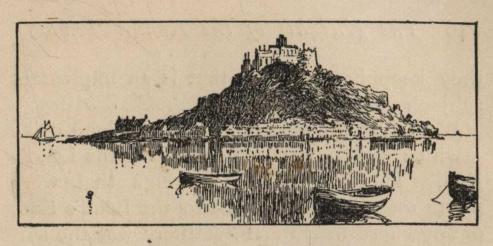
St. Michael's Mount
CHAPTER VIII
ON THE EDGE OF LYONNESSE
We had meant, when Helen's mother should come from Paris, to go back to Glastonbury and begin our journey again where we had left off. But when she came we thought better of it. We decided that, since we were going to the Southwest of England again, we might as well go all the way and see the Land's End. Then, we thought, we could go to Glastonbury just as well on the way back.
So it happened that when Helen's mother was with us again, we took the longest railway ride that we had taken yet, and at the end of it we found ourselves in Penzance. Penzance is the place where the pirates were, you know. We had always supposed that that was a made-up story and that there never were really any pirates of Penzance. But we found that the pirates were there still. Only now they do not scuttle ships any more, if they ever did; they keep hotels. But that is an unpleasant subject.
We set off the next morning for a long drive—which was to be partly a walk—to the Land's End. There were many things that were worth seeing before we got to the Land's End, or anywhere near it. First there was the harbor of Penzance, one of the prettiest that I ever looked out upon. And over on the other side of it, stately and beautiful against the summer morning sky, stood St. Michael's Mount. St. Michael's Mount is a cone-shaped hill, rising high out of the water, with a castle on the top of it. It is one of those things that are so picturesque that they surprise you when you see them in a real scene, because they look too perfect to belong outside a painted picture.
"And who do you suppose used to live on the top of that hill?" I said. "Why, the old giant Cormoran, the one whom Jack the Giant-Killer knocked on the head with his pickaxe, the very first giant whom he killed. Of course I should not think of telling you that story, at your time of life; I only tell you that there is the place. But I might tell you about another giant, and let you try to straighten out his story, if you like, better than I can. Over across the channel from here, in France, there is another St. Michael's Mount. I have never seen it, but the picture of it looks as much like this one as if it were its own brother. I think that I have told you before that the people of old days used to think that high hills belonged somehow to St. Michael. Well, over there on the other St. Michael's Mount lived another giant with whom King Arthur himself once had a little tussle. The giant's name was Ryence, and he had a mantle trimmed with kings' beards. You remember something, perhaps, that I told you once about a King named Ryence, who had a mantle trimmed with kings' beards. It is rather curious that there should be two of them.
"It was when King Arthur went over to France on his way to fight the Emperor of Rome that he heard of this giant. He was a terror to the whole country, for he killed hundreds of people and spoiled crops, and his favorite food was little boys. I don't know why he liked little boys so much better than little girls, but I suppose he knew more about which were the better to eat than I do.
"When Arthur heard about the giant he took Sir Kay and Sir Bedivere with him and went to the foot of the hill. There he told them to wait for him, and went up the hill alone. He found the giant sitting before a fire cooking a man for his supper. Arthur got close to him and wounded him with his sword before the giant knew that he was there. Then he sprang up and caught hold of Arthur, and they both fell and rolled over and over each other clear to the bottom of the hill, and Arthur managed to give the giant two or three more wounds on the way. Kay and Bedivere ran to see if the King was killed, and they found that he was scarcely hurt at all and that the giant was dead.
"I don't say that there is anything so very remarkable about that. It is just a plain sort of every-day giant story. But here are the strange points, I think. Here were two hills looking wonderfully alike and with the same name, and a giant lived and was killed on each of them. And here were two giants, both named Ryence, for King Ryence was a giant, too, and they both had mantles trimmed with kings' beards, and Arthur killed one and beat the other. It looks to me as if two stories, at least, had got a little mixed, or else one story twisted in two. How does it look to you?"
There is no reason, that I can see, why I should try to tell you all about the way from Penzance to the Land's End. It will not do you much good to know that it was grand and beautiful, as long as you were not there to see its grandeur and its beauty. We stopped at St. Buryan, and a very old woman showed us the church. It is a curious old place, and it has some fine carvings. But the old woman, who showed us everything and explained it to us, could not understand what there was about it that we found interesting. She had been showing this church to people, she said, for more than fifty years, and she had never been able to make out yet why they wanted to see it.
Then we went on to see the Logan Rock, and got a guide to find it for us. We could never have found it for ourselves, because it is so mixed up with so many other rocks. It is a huge rocking stone. It weighs I don't know how many tons, but a strong man can move it a little, if he knows just how and where to take hold of it and push. The guide rocked it for us, and he said that we did it ourselves when we tried, but I think he flattered us. He helped us to climb on the top of it—not an easy thing to do at all—and then he rocked it with us sitting on it. As he led the way back he took us through a narrow passage between two great rocks and told us that we must each of us make a wish as we passed through and never tell what it was, and then it would come true. "But we don't need to ask what the young ladies wish," he said, "they all wish the same thing." We wondered how many years he had been making that same joke over and over again. No doubt he must have got some pretty tips by it, when there were young women and young men both in the party.
We were going to walk from here to the Land's End, five miles, for it was one of the places where we had been told that we must walk, so as to see the scenery. We had already told the driver to go on to the Land's End and wait there for us. The guide showed us how to go and offered to go with us, but we thought that we did not need him. "You won't be able to see the Scillys to-day," he said. "Sometimes you can see them from the Land's End, but it isn't clear enough to-day. But you can be sure of a fine day to-morrow. When it is clear enough to see the Scillys it almost always rains the next day."
So we felt cheered at missing a sight that we had hoped to see, and went on our way. All the way the walk was up headlands and down ravines, with many grand and beautiful pictures—great crags and domes and pinnacles of rock and deep valleys and gorges and caves, and the sea always crashing and roaring down below us.
And when we came to the Land's End, of course that was the best of all. For there the sea seemed rougher than anywhere else, though it was not a rough day. It was no new thing for us to stand on a point of rock, with all the land behind us and nothing but boundless ocean before us. We did not need to come to the Land's End or to England for that. But there was something awful and solemn about these towers of stone that stood here to keep the sea from washing England away, and about the sea that was working at them while we looked, dashing up against them and slipping back and dashing up again, as it had been doing for thousands of years before we had come to look, and as it would do for thousands of years after we were gone. And after all these ages of work and struggle the waves seemed to be still angry, still fierce and full of wrath that the land should resist them so long. "Old rocks," they seemed to say, "you think that you are firm and steady and strong. But wait—and wait—there is much time before both of us still. Stand against us as you will; we shall still clash and beat upon you, and at last, in spite of all your firmness, we shall wear and wash you away, and we shall cover you sometime as we covered old Lyonnesse."
Lyonnesse! That, after all, I believe, is the wonderful thing to think of at the Land's End. "Yes, now," I said, "we are looking straight out over Lyonnesse—Tristram's country, the country that is lost. This is where it began, and it stretched away out there where there is nothing now but ocean, away out to the Scilly Islands, which we are not to see to-day. For thirty miles old Lyonnesse reached out from here, and even now, they say, for all that way, the bottom of the ocean lies at an even depth, and not like the bottom in other places. And they say, too, that when the water had covered Lyonnesse for so long that people had almost forgotten that there ever was any land there, the fishermen used to think of it again, because they sometimes drew up their hooks with pieces of doors and windows caught upon them. And nothing more than these ever came back of a country that had its towns and its fields and its forests and its people, which were all lost under the water together.
"And I remember an old book which says that more than Lyonnesse was taken away from Cornwall by the sea. For the old book says that St. Michael's Mount, which we saw this morning, used to have another name, that meant 'the rock in the wood.' And from this it was thought that St. Michael's Mount stood in a forest once, and not in the sea, as it does now. And the book, which was written about three hundred years ago, says that even then, when the tides were low around St. Michael's Mount, the stumps and roots of great trees were sometimes seen half buried in the sand."
Perhaps this is all nothing but old fable, but the land of Cornwall and the sea of Cornwall look as if it were true. How could these terrible waves and tempests tear and beat and surge upon this country, even with its walls of rock, without taking something away? You can laugh at the old wives' tales—if it is your way to laugh at such things—it is not ours—while you are at home, but when you stand at the Land's End and look out to sea, if you have a bit of the love of a story in you, you must and you will believe in Lyonnesse.
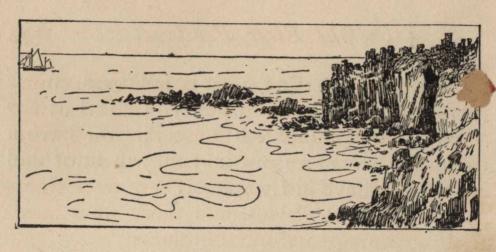
The Land's End
CHAPTER IX
THE SIEGE PERILOUS
It does not matter just where we were when we told and heard these next few stories. Neither do I need to use quotation marks all through them. You will understand that we did tell them and hear them somewhere. They belong to no place. When King Arthur's knights set out from Camelot to seek the Holy Grail everything seemed at once to grow mysterious and marvellous and magical. Place and time were unknown and almost unthought of. Knights rode about without knowing or caring where they went. Sometimes they found more wonderful adventures than had ever been thought of before, and sometimes they rode for days and saw no house and no living thing. Friends met friends and did not know them; fathers fought with sons, and brothers with brothers. New knights won glory and knights who were old and tried were put to shame. Common men became prophets, and so prophets became common. The worst of men gave counsel to the best of knights, and the knights could scarcely tell whether the things that they were told to do were the best and the wisest or the most foolish and the worst. There were signs and omens and visions, and there were hard trials of courage and of faithfulness.
There are a hundred stories of what was seen and said and done. They are all different, and among them all much seems confused and dim and uncertain. But everywhere and through everything is seen, like a clear flash of fleeting flame, one perfect knight, the strongest, noblest, greatest knight who ever came to Arthur's court, the one best knight of all the world. Others wander and stray and are tempted and overcome and disheartened, and then there is a gleam of a fire-colored armor, and there is a swift stroke of a spear that never missed its aim, the wicked are overthrown, the helpless are rescued, and the knight has passed on toward his goal of the Holy Grail.
It all began on the night before the feast of Pentecost, when so many strange things happened. The King and the Queen and the knights were in the great hall at Camelot, and a woman, whom no one knew, rode into the hall on horseback. She dismounted and came before the King and said: "My lord, tell me which is Sir Lancelot."
"That is Sir Lancelot," said the King, pointing to where he sat.
"Sir Lancelot," she said, "I am sent to you by King Pelles. He asks you to come with me to an abbey in a forest not far from here."
"And what am I to do there?" Lancelot asked.
"I am not to tell you that," she said; "I am only to bring you to the abbey."
"I will go with you, then," said Lancelot, "if it is to please King Pelles."
"Lancelot," said the Queen, "to-morrow is the feast of Pentecost; shall you not be with us then?"
"Madame," said the woman, "he shall be back here by dinner-time to-morrow."
So Lancelot put on his armor and rode with the woman till they came to the abbey in the forest. There, when he was unarmed, some nuns came to him, leading a young man. "Sir Lancelot," one of them said, "this young squire is the grandson of King Pelles. He is strong and brave and noble. He has learned much and it is time now for him to be made a knight. He asks you, and so does King Pelles and so do we, that you will make him a knight."
Then Lancelot looked at the young man. He was scarcely more than a boy in his years but he was tall and strong. Lancelot thought that he had never seen so beautiful a face besides its beauty there was courage in it, and freedom and hope and all the rich flush and glow of a bright, new manhood. And a strange feeling came to Lancelot as he looked, and a voice seemed to be saying in his ears: "He has come! He has come!" Lancelot could not have told what it meant. He only felt that there was something in this young man that made him different from any other he had ever seen, something without a name, by which he knew that he was greater and finer and truer than the rest. "To-night, then," said Lancelot, "let him watch his arms in your chapel, and to-morrow I will make him a knight."
And so it was done. The young man watched his arms in the chapel while the others slept, and in the morning Lancelot made him a knight. Then Lancelot begged the new knight to come to the court with him, but he answered: "No, it is not time for me to go to the court, but I shall be there with you soon."
"So Lancelot rode back to Camelot alone. And then began the most wonderful day of all King Arthur's reign. When Lancelot had come and all the knights were sitting in the hall a squire ran in and went to the King and said: 'My lord, I have just come up from the river, and down there a great stone is floating on the water and there is a sword sticking in it.'
"That is a wonderful thing, truly," said the King; "we will go and see it."
So the King and the Queen and all the knights left the hall and went down to the river. And there, truly enough, was the stone, floating on the river, and there was the sword sticking in it, as the squire had said. And the King saw letters on the stone and he came near and read them: "No one shall ever draw this sword out of this stone except the one to whom it belongs, the best knight of the world."
"Surely," said the King, "I think that the best knights of the world are in my court; who will try to draw this sword?" and he looked toward Lancelot.
"I do not think," said Lancelot, "that the sword is mine, and I will not try to draw it."
But many of the other knights tried to draw the sword and could not, and the King looked at Lancelot again and said: "Will you not try to take this sword? Surely there is no better knight in the world than you."
"No," said Lancelot, "it is not for me. Remember, my lord, all the wonderful things that Merlin told long ago. The best knight of the world is not among us yet, but I believe that he is coming soon. Let us all go back to the hall, my lord, and keep our feast and wait for him."
And back they went to the hall, and they were scarcely in their places when there came another wonder. An old man came into the hall, leading a young man by the hand. They saw that he was an old man only by his figure and by his step and by the end of a white beard which they could see. For he wore a long, white robe, and a hood hung low down over his face, so that they could not see it. The young man was dressed all in flame-colored armor, and he had no shield or sword, but an empty scabbard hung by his side. They came and stood close to the throne and closer to the Siege Perilous. Bors sat near them, and it seemed to him that he knew, just as it had seemed to him once before, long ago, at the Castle of Carbonek, that this old man was Joseph of Arimathæa, who would have died hundreds of years ago, but that the power of the Holy Grail kept him alive. And he knew, too, that the young man was the beautiful child with the deep eyes and the bright, sweet face and the hair like gold, whom he had seen at the Castle of Carbonek. Percivale sat next to Bors, and it seemed to him too that he knew the old man, though how he could not tell. Next to Bors on the other side was Lancelot, and what he knew was that the young man was the one whom he had made a knight that morning at the abbey.
"King Arthur," said the old man, "I have brought you a new knight, Sir Galahad. You have waited for him long, for you were told of him before he was born, and his place at your Round Table was waiting for him before you yourself were born."
"He is welcome here," said the King, "and you are welcome too." But almost before he had spoken the old man was gone from the hall and the young knight in the flame-colored armor stood before him alone. Yes, there at last he stood, Galahad, whose name had been spoken with wonder or with hope or with doubt so many times. Only the best knight of the world, Merlin had said, should sit in the Siege Perilous, and the best knight of the world should be Galahad. How many times Arthur had looked at that seat and wondered why his best knight, Lancelot, could not sit there, and what the knight could be like who should be better than Lancelot. And now here he stood—Galahad.
But there was something else for the best knight of the world to do. The knights who filled the hall were not thinking then of the Siege Perilous. They were thinking of the stone floating on the river, and the sword sticking in it. The King saw them whispering together and pointing that way and he said to the young man: "If you are indeed that Galahad whom we have waited for so long, you are more welcome than any other who has come here since Lancelot, my best knight till now, the son of my old friend King Ban. It you are that true Galahad who was promised, then you will be the best of all my knights—better than Lancelot. Will you come and prove to us whether you are so?"
Then the King took the young man's hand and led him down to the river and all the rest followed them to see. And the King said: "Try if you can draw that sword, for none of my other knights can draw it."
"See, my lord," said the young man, "I have brought no sword, only this empty scabbard, for I knew that I should find my sword here." And he took hold of the sword that stuck in the stone and drew it out and put it in his scabbard.
There was no doubt of it now; the knight whom they had waited for had come. Yet the King's face was sad as he led the way back to the hall, for it seemed to him that now there could be little to wait for and the days of the Round Table would not be many more. But other thoughts came to him a moment later, when the new knight knelt before him to take the oath that would make him a knight of the Round Table. For then, just for an instant, it seemed to him that the time had gone back to the beginning of his reign. There was a look in the young man's eyes that brought back the day when Lancelot had knelt before him like this and had sworn this oath and when he had believed that Lancelot would surely be the one perfect knight. Yes, it was the same clear light that he had seen for an instant that day in Lancelot's eyes, the glow of something great and wonderful, he knew not what. But there was more in the face of this new knight. There was something which told Arthur that, though he swore that in all things he would be true and loyal to God and to the King, yet, without the oath, he could never have a thought that would not be true and loyal.
And the King scarcely knew whether it was great joy or great sorrow that made him almost tremble before this boy. And when he took his hand again they all saw that his face was white as he turned toward the seat that was next the throne. And there at last in that Siege Perilous were the letters, more of fire than of gold, as they seemed: "This is the seat of Galahad."
Those who could see whispered to those who could not and the word ran down the hall and then in an instant everyone was still. After all these years of waiting, after the wonders and the prophecies, would any one, even Galahad, dare to sit in that seat? They had feared that seat and had seen it empty so long that they could not believe it, and they all stood up in their places and strained their eyes and held their breaths in wonder and dread. And of all who were there Galahad alone had no fear and no dread. Only for an instant he stood there, with the eyes of all the rest upon him and his own upon the King's, and then he sat in the Siege Perilous.
Every seat at the Round Table was filled. For the first time since Merlin made that table for Uther Pendragon there were a hundred and fifty knights around it and no seat was empty. Then of a sudden the hall grew dark. Thick clouds seemed to have come over the sun and they heard a great wind outside. Then there was thunder that shook the castle and almost deafened them. It was over in a moment and through an upper window there shone one broad beam of sunlight. It slanted down from the top of the hall to near where Galahad sat, and still the rest of the hall was dark. And then came the strangest thing of all. They saw a soft, red glow of light, through the darkness of the hall, and it moved toward the place where the sunlight fell. They could not see what it was clearly, for it had a covering of white silk, and the red glow shone through this and filled the room. And the thing that shone was in the form of a goblet. It moved, as if someone were carrying it, but they could not see anyone. It moved till it came where the sun shone upon it, and then the hall was bright and the knights could see one another. And it seemed to each of them that the others looked greater and stronger and more beautiful than he had ever seen them look before. They knew, all of them, that this that they almost saw, but could not see, was the Holy Grail. It passed on again, away from the sunlight and across the hall, and the red glow was gone. The sunlight was gone too, and then the old light came slowly back and they all saw that the table had been covered with food.
At first they were all so full of wonder at the sight that none of them could speak. Then Gawain, who sat on King Arthur's left, rose and held up the cross-shaped hilt of his sword. "My lord," he said, "we know that it was the Holy Grail that passed before us just now. But we did not see it. So now I make this vow, my lord, that I will leave this court and seek the Holy Grail, that I may see it more openly than we have all seen it to-day. I will seek it for a year and a day, if I do not find it sooner, and if I have not found it then I will come back, believing that God does not wish that I should see it."
Then the knight who was next to Gawain held up the cross-shaped hilt of his sword, as Gawain had done, and made the same vow, that he would seek the Holy Grail for a year and a day, unless he found it sooner. And so it went around the table, and they all made the vow, and last of all Lancelot and Bors and Percivale and Galahad.
And Arthur had listened to them all and had spoken no word, but his face was pale and troubled. For he knew that if his knights went away upon this quest many of them would not come back, and he should never see all the places at the Round Table full again, as he saw them now. And when they had all made the vow he said in a low voice to Gawain: "When will you leave us to go upon this quest?"
"At once, my lord," said Gawain; "to-morrow."
"Not so soon as that," said the King. "Let me see all my knights together for one more day. We will have a tournament to-morrow. You shall all meet before me once more in one fine field of combat and then you may go."
And the knights all saw how sad the King was at their leaving him, and they were all glad to do as he wished. But the King had another reason for the tournament that was to be the next day. He did want to see all his knights together for one last time, but there was more than that. For here on his right, in the Siege Perilous, sat Galahad. He was the best knight of all the world, or he could not sit in that seat. Arthur knew—he could not tell how, but he knew—that when Galahad left the court to seek the Holy Grail he would never come back. The best knight of the Round Table, the best knight who had ever been in his court, would go away forever, and he had never seen him in one knightly combat and would never know how he could fight, how he could ride, or how he bore his arms. And this was the reason, more than the other, why Arthur wished to see one great tournament of all his knights.
So in the morning the meadow at Camelot was thronged again with the people who came out to see the tournament, all the more eager because they had heard of the wonders of the day before and of Galahad, and because they knew that he would be there in the field. The King sat in the highest place, with the Queen beside him, and it was with sad faces, though they were proud too, that they looked down upon their knights striving together in the tournament. They could scarcely have told afterward what any other knight did, for it seemed to them all that day that they saw only one knight. Wherever they looked they saw those flame-colored arms of Galahad flashing up and down the field. His horse never faltered, his spear never failed, his arm never grew weary. He bore no shield, but every spear that touched his armor was shattered, and when he pointed his own spear at any other knight and charged against him that knight went down. But the King and the Queen saw that, while the others were all falling before him, he never came near to Lancelot or to Bors or to Percivale. He would not joust with them and so they all three did nobly in the tournament too. And the King was so filled with the wonder of all that he saw Galahad do that when it was over he could scarcely speak to him. But he held his hand and looked long at him and said, in a voice that sounded strange and uncertain: "Galahad, I have seen the best that a knight can do."
That was their last night all together in the great hall at Camelot. After it came a sad morning. The knights were ready early and the King was ready to see them go, though he could scarcely take the hand of each and say good-by, so great was his grief at their going. The knights all mounted together and rode through the streets of Camelot, between the lines of people who had come out of their houses to see them go, and so out through the gate and away from the city. And the King and the Queen stood on a tower of the castle to watch them as long as they could. At first they could pick out here an armor and there a banner and know that this was Galahad, this Lancelot, and that Gawain. But when they were farther off they could not do this any more; they could only see the big, bright spot upon the road where the morning sunlight struck upon the armors, and then their eyes were tired with looking and something came across them so that for a moment they could not see at all. The bright spot on the road grew smaller and smaller. It flashed and twinkled and shivered. Was it a cloud of dust that rose now behind the knights and hid the glimmer of their arms, or was there something in the King's eyes again so that he could not see it? Once more he saw the far-off flash, fainter now, and yet again, and then the dust rose and there was no more to see. And so the noble fellowship of the Round Table passed away from King Arthur and out of his sight like a setting star.
[Illustration: "The bright spot on the road grew smaller and smaller" (missing from book)]
"A pasture where a hundred and fifty bulls were feeding"
CHAPTER X
GAWAIN
All that day the knights of the Round Table rode together, and in the evening they came to a city where they all lodged for the night. The next morning they parted and rode different ways. In the days and the weeks and the months that followed some of them had many and strange adventures and some of them had but few. I could not possibly tell you, or even remember for myself, all the wonderful things that happened to all of them, but I can tell you a part of the things that happened to a part of them.
Gawain rode for a long time alone, till at last, at an abbey where he stopped to spend the night, he found his brother Gareth and his cousin Uwain. The next day they went on their way together, and as they rode so they met seven knights, who called to them to stop and to tell who they were.
"We are knights of King Arthur's court," they answered, "and we are seeking for the Holy Grail."
"Then it is well that we have met you," said one of the seven knights. "We are from the Castle of Maidens. A knight of King Arthur's court drove us out of our castle and we have sworn to kill all of King Arthur's knights whom we meet. We will begin with you."
Then all seven of them put their spears in rest and charged against Gawain and Uwain and Gareth. But the three knights of the Round Table fought so well that they soon beat their seven enemies and wounded them and drove them away. The three knights parted then and rode different ways. And in the evening Gawain came to the cell of a hermit and asked him to let him stay for the night. They talked together and Gawain told the hermit who he was and that he was seeking the Holy Grail. The hermit knew, as everybody knew, all that Arthur's famous knights had done, and he said: "It is useless for you, Sir Gawain, to seek the Holy Grail. You will never find it. It shows itself only to the purest and the best. You have not been good enough and sound enough and true enough in your life ever to see the Holy Grail. Ah, Gawain, Gawain, do not think that you did such a great thing to-day, you and your two fellows, when you beat those seven knights from the Castle of Maidens. For one knight alone had beaten them all only a little while before. They had taken the Castle of Maidens from the old lord who owned it, and they had killed him and had held the castle for a long time. They were tyrants and murderers, and Galahad came and drove them all out and gave the castle to the daughter of its old lord. Galahad did it alone, and now you three are proud because you beat the seven cowards. Knights like Galahad will see the Holy Grail, not knights like you, Gawain."
In the morning the hermit told Gawain that if he hoped ever to come near the Holy Grail he ought to do some penance for all the evils of his life. But Gawain answered: "No; we knights make long journeys and we fight dangerous battles. Our lives are hard enough without doing any other penance, and I will do no other." So he rode on his way.
And after that for weeks and months Gawain rode by lonely ways and through deep woods and over barren hills, and he met with no adventure and scarcely with a living man. Then he met another knight of the Round Table, Sir Ector. He was not the old Sir Ector, Arthur's foster father, but another, the brother of Lancelot. "I am tired of this quest of the Holy Grail," said Gawain. "I have ridden for months and I have found no adventure, and it seems to me that all the people of the country are dead."
"It is so with me," said Ector. "I used to find adventures enough, wherever I went, but there are no more of them now."
The two went on together for a time and everything seemed waste and deserted, as it had seemed to each of them before. They came at last to a chapel that stood by the road. It looked as sad and as deserted as the rest, and it was falling into ruin, but they left their horses and went into it and sat down to rest. And while they sat there they both fell asleep, and Gawain had a strange dream. It seemed to him that he saw a pasture where a hundred and fifty bulls were feeding. They were all black but three, and those were white. And while he looked they all went away, and afterward some of them came back, but many did not come back. Only one of the white ones came, and the black ones all looked lean and weak.
When he awoke he told Ector of his dream, and said: "It seems so strange to me that I believe it has some meaning, and if we can find some wise and holy man I shall tell it to him and ask him what it means."
And as they rode on they met a young squire and Gawain asked him if he knew of any man such as he wished to find. "Nacien, the hermit," said the squire, "is a wise and holy man. He was a knight of King Arthur's many years ago, and they say that he was one of the best of them. His cell is not far from here."
He showed them the way, and when they found the hermit Gawain told him his dream and asked him what it meant. And the hermit answered: "The pasture that you saw was the Round Table and the bulls were the knights of the Round Table. They left the pasture, just as the knights went away to seek the Holy Grail. The three that were white were three knights who are so true and pure that they will see the Holy Grail at last, but only one of them will come back. And the other knights, the black bulls, will never see the Holy Grail, because of the evil in their lives. Many of them will not come back, but some will come, and they will be weary and worn with the quest."
Then Gawain said: "If what you say is true we shall never find the Holy Grail, for I fear that we must be counted among those who have too much evil in their lives."
"Gawain," the hermit answered, "there are a hundred knights of the Round Table as good as you, who will never see the Holy Grail."
And Gawain and Ector rode on till they came to a castle where there was a tournament. The knights of the castle were against a great crowd of other knights, and Gawain and Ector joined in the tournament against the knights of the castle. And Gawain and Ector fought so well that it was plain that their side was winning the day. Then of a sudden they saw a new knight among those of the castle. They had not seen how he came or from where. He carried a white shield, with a red cross upon it, and the rest of his arms were of the color of fire. Gawain charged against him first. His spear was broken against the white shield, but the other knight used no spear. He only raised his sword and struck Gawain so that he cut through his helmet and wounded his head and threw him from his horse. Ector drew Gawain out of the field and took off his helmet, and the knight with the white shield charged against more of the knights who were against those of the castle. And everywhere he overthrew them till the word was given that the knights of the castle had won the day. Then he went away again as he had come, and no one knew where.
The tournament was over and Gawain was taken into the castle and laid upon a bed. "Ector," he said, "do you know who the knight was who wounded me?"
"Yes," said Ector, "I know him. There is only one who could do such things as I saw him do. It was Galahad. His arms were like Galahad's too, only when we saw him last he had no shield."
"Ector," said Gawain, "it is Galahad who will find the Holy Grail. We are not like him, and we cannot do the things that he can do. We have gone far enough in this quest. I shall seek the Holy Grail no more."
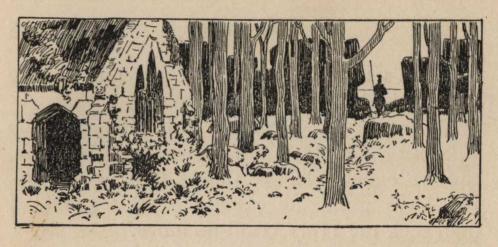
"Through woods where there were scarcely any paths to follow"
CHAPTER XI
LANCELOT
When the knights of the Round Table parted, Lancelot, like the rest, rode for a time alone. Many times before now Lancelot had sought adventures by himself. For many years he had wandered over England and he thought that he knew the country well. But now, before he had ridden far, he was in places that seemed strange to him, and soon he could not tell at all where he was. He crossed rivers and rode over hills and plains and through woods where there were scarcely any paths to follow. He saw fewer people than he had been used to see, and many of the houses that he passed were deserted and ruined. Often wild beasts crossed his track and he had to fight with them. At night he slept where he could, sometimes in a ruined house or chapel, sometimes on the ground, with his horse tied to a tree near him.
And when he slept he had strange dreams. Often in these dreams he thought that the Holy Grail came near him. He saw the rosy light shine through the white covering, for that covering of silk was always over it, but he could never come close to it. He saw others who were wounded or sick come to it and touch it and go away again strong and well, but he had no strength to move or to speak. It came near to him and passed away and he lay before it helpless.
When he awoke he would ride on, over more of the hills and plains and rivers, fight again with the wild beasts and lie down to sleep again as he had done before. Sometimes he came to a hermit's cell. Then he stayed all night with the hermit and talked with him of the court, of the knights, of his long journey, and of the Holy Grail. Sometimes one of the hermits would say to him: "The Holy Grail is not for such men as you to see. You have been counted long the best of knights, in your strength and your deeds, yet there has been evil in your life, too, and the Holy Grail will not show itself to you in the way that it will to others."
Then Lancelot would ride on his way feeling sad. He would remember the knight in the flame-colored arms, who had done better in that last tournament that they had than he had ever done. He would remember how that knight had sat in the Siege Perilous; how his own seat for all these years had been three places off from the Siege Perilous, and how those two other knights, Percivale and Bors, had sat nearer to it than he. And he would think: "This quest is for such knights as those; it is not for me."
Then some other wise man would say to him: "Lancelot, the Holy Grail will show itself to few, but you shall do better in this quest than many others." And then he rode on his way again with new hope, though he did not know of what, and with new heart.
One evening he was riding after the sun had set, and he was thinking that he must soon find a place to stay for the night. Then he came into a wood and all at once it was darker around him than it had been out on the open plain. And before him, then, he saw dimly the form of a knight coming toward him on a horse. "Sir Knight," he said, "I have ridden in strange paths for many days and I have met no knight, and I have almost felt that I was forgetting knightly ways. Will you try one joust with me?"
The knight did not answer, but he put his spear in the rest, and Lancelot did so too. They spurred their horses and rode together with a crash and Lancelot's spear struck full upon the shield of the other knight and was broken into splinters. But the other spear held, and it struck Lancelot's shield and threw him off his horse and he lay upon the ground. And so the great Lancelot, the glory of King Arthur's court, was overthrown by the first knight whom he met. The other knight was off his horse in an instant and Lancelot was on his feet. He drew his sword half out and then stayed his hand and let the blade slide back again into the sheath. He bowed his head before the other, who stood before him, and said: "I know you, Sir Knight. For these many years I have jousted with all the best knights of the world, and I know the stroke that every one of them can give. Tristram could never strike any blow like that of yours, or Gawain or Palamides or Percivale or Bors or Gareth. I have never felt it before, but I know that there is no other such certain spear in the world as this of yours, Galahad! Galahad!"
And the other answered: "I know you, too, for I have heard of you so long and of your knightly deeds. It is as if I had learned all that I know of knighthood from you. And it was you, too, who made me a knight, and I feel toward you, for all these things, as if you were my father, Lancelot! Lancelot!"
Then Lancelot said: "Galahad, I feel that it is such knights as you who will see the Holy Grail, and I feel that it would be better for me to be with you. May I go with you now, wherever you go, and try to find the Holy Grail with you?"
"No, Lancelot," Galahad answered, "no one can go with me yet, but I will tell you this: since we all parted I have talked with many good and wise men, and they have told me many things. Of all who are seeking the Holy Grail only three will see it openly, but of all the rest who seek it you will be nearer to it than any other."
Then Galahad mounted his horse again and rode away through the wood, and it seemed to Lancelot that a pale light shone back upon him for a moment from the flame-colored armor, and then he was gone. And as soon as Lancelot was alone a little breeze rustled the tops of the trees above him. They made only a low, sighing sound at first, and then it grew louder and clearer, and then it seemed to Lancelot that it grew into a voice, and he thought that the voice said: "Lancelot, go to the sea and go into the ship that you find there."
Then the voice and the rustling of the trees and the wind all died away, and Lancelot mounted and rode on through the wood. And he had scarcely started when he came out of the wood and saw the sea before him. Far out he could see great waves, with white crests that flashed in the moonlight, but close to him there was a little bay, with a rocky shore, and a ship lay close to the rocks, so that he could step on board.
Lancelot could see no one on the ship and it had no sail, but as soon as he was on board it left the rock and the bay and carried him out to sea. Then a feeling of strange rest and happiness came over him. He never knew how long he was in the ship or whether he slept there. But when he next saw anything clearly it was still night and the moon was still shining. The water was calm and there was land all around. The ship came to the shore and stopped, and before him Lancelot saw the gate of a castle.
He left the ship and went toward the gate, and there he saw two great lions guarding it. He drew his sword and kept on toward them, and when he was near the gate something struck his sword out of his hand. Yet he felt, he could not tell why, that there was no danger from the lions, and he went on through the gate. The lions sprang at him as he passed, but they did not touch him, and he went into the castle. He saw no people, but he went on from room to room, through open doors, till at last he came to one that was shut.
He tried to open the door, but he could not, and then he heard music on the other side of it. It was like the singing of a great choir, and the singing or something else seemed to tell Lancelot that the Holy Grail was in that room where he could not go, and he knelt down before the door and waited. Then the door opened of itself and a great light shone out and he could hear the music more clearly. He looked into the chamber and in the middle of it he saw a table of gold and silver, inlaid in beautiful shapes, and on the table was the Holy Grail, still with that white covering of silk. Yet it seemed to Lancelot that the rosy glow from the Holy Grail that shone through the silk was brighter and clearer than it had been when he had seen it in the hall at Camelot, and brighter than it had ever seemed to him in his dreams. An old man stood beside the table and Lancelot knew that he was the same who had led Galahad into the hall that day when he had sat in the Siege Perilous.
Then, while Lancelot looked, the old man lifted up the Holy Grail, and at that Lancelot started up and came into the chamber to get nearer to it. But suddenly it seemed to him that a blast of fire struck him in the face. The burning air seemed all about him and through him and it took away his breath and his strength and he fell to the floor. Then he felt no more pain and he did not know where he was, but he felt hands that took him up and carried him away and put him in a bed.
The people of the Castle found that he was not dead and they took care of him, and it was twenty-four days before he awoke. Then he looked about him and asked them where he was. "Who are you?" they asked him.
"I am Lancelot of the Lake," he answered, "and I am seeking the Holy Grail."
"This is the Castle of Carbonek," they said, "and King Pelles, the keeper of the Grail, lives here. You have done well and nobly, Sir Lancelot, and now you must go back to King Arthur, for you will never see more of the Holy Grail than you have seen here."
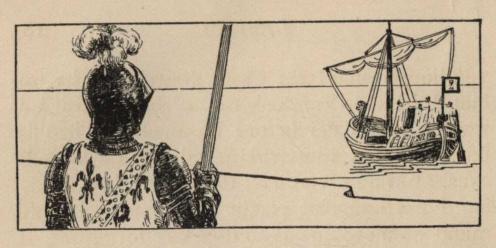
"He saw the water before him and a ship"
CHAPTER XII
BORS
Bors left his fellows of the Round Table and rode all day alone. Toward evening he met a hermit. These Grail-seeking knights were always meeting hermits. The country seems to have been full of them. And this one asked Bors to come to his cell and rest there for the night. He had nothing to give to Bors to eat and drink except bread and water, and while they were making their supper of these the hermit asked the knight to tell him who he was and on what journey he was bound.
So Bors told him how the Holy Grail had come into the hall at Camelot, but covered, so that no one could see it. And he told him how all the knights had vowed that they would seek for the Grail and try to see it, how they had all left Camelot together, and how they had parted now, and were all riding different ways. Then the hermit said: "Sir Bors, do you know that this Holy Grail will not be found by any knight who is not brave and worthy in his deeds and pure and true in his life? Do you know that it will not show itself except to those who seek for it faithfully, thinking of nothing else, except such good and noble things as they can do, and never forgetting it because of any pleasure or of any gain?"
And Bors answered: "Yes, I know it."
"Then, Sir Bors," said the hermit, "will you promise me one thing, to help you to find the Holy Grail?"
"What shall I promise you?" said Bors.
"Promise me," said the hermit, "that you will eat nothing but bread and that you will drink nothing but water, till you see the Holy Grail."
"Is it right," said Bors, "for me to promise this? How do you know that I shall ever see the Holy Grail?"
"I know," the hermit answered, "that it is such knights as you who will see it, if they seek it in the right way."
"Then I will promise," said Bors.
In the morning Bors left the hermit and went on his way. And after a time he saw two knights coming toward him, leading a third knight as a prisoner. They had him bound upon a horse and they were beating him with thorns. And when they came nearer Bors saw that the knight who was a prisoner was his brother Lionel. Then, just as he was riding forward to help his brother, he saw, on the other side of him, a woman, and some robbers pursuing her. Bors stopped and for an instant did not know what to do. For, as a good knight, he ought to help the woman, yet he feared that if he did that his brother would be killed or led away where he could not help him.
Yet it was only for a moment that Bors doubted. Then he remembered that his brother was a knight and that he should be ready always to suffer whatever came to him, and that the woman needed him more. So he turned against the robbers and fought with them and drove them away. When he had done that some knights came up who were the woman's friends, and they thanked him for saving her and begged him to come with them to the castle of her father, who was a great lord and lived near by. But Bors said that he must hasten now to help his brother, and he rode the way that he had seen his brother and the other two knights go.
He rode for a long time and saw nothing of them, and then he met a man dressed like a priest, riding on a black horse. "Knight," said the man, "where are you riding so fast?"
"I am trying," he said, "to find my brother, Sir Lionel, for I saw two knights leading him away as a prisoner, and I must help him."
"You need not go any farther," said the man, "and you must be brave to bear what I have to tell you. Your brother is dead. The knights whom you saw have killed him. Come with me now and I will bring you to a castle near here, where you can stay for the night, and longer if you will."
So Bors rode with him, and as they went along he asked him if he was a priest. He said that he was, and then Bors asked him if he had done right to help the woman instead of his brother. "No," the priest answered, "you did wrong. Your brother has been killed because of what you did, and that woman was nothing to you."
Then Bors was sadder than before, and he said no more till they came to the castle to which the priest was leading him. There a woman, young and beautiful, the lady of the castle, came down to meet him, followed by many others, all young and beautiful too. They welcomed him and led him to the hall, where a feast was spread on the table, and they begged him to eat and drink, and then to stay with them and join in their games and their dances and their feasts. But Bors answered: "I am one of the knights who are seeking the Holy Grail and I must not turn away from my quest for any pleasures, and I have promised to eat nothing but bread and to drink nothing but water till I see the Holy Grail."
"The Holy Grail?" said the priest. "Why are you seeking it? Do you know why, or shall I tell you? It is because you know that few will find it. It is because you wish for the glory of being thought better than other men. Is this a good or a noble wish? I tell you it is a proud and wicked one. Forget it and stay here with us and be happy and be like other men."
And the lady of the castle said: "Sir Bors, I knew that you were coming here and it was for you that I made this feast. Stay here with us now or I shall kill myself, and my death will be by your fault, as your brother's was. Say that you will stay with us, or I will go up to the top of the castle tower and throw myself down."
And again Bors did not know what he ought to do. He could not forget that the hermit had told him that he must not think of pleasures while he was seeking the Holy Grail, and he could not forget that he had promised to eat nothing but bread and drink nothing but water till he should see it. And, as he cast down his eyes in thinking, he saw the cross-shaped hilt of his sword. And, as if he suddenly knew that that could help him, he caught it and held it up before him and before them all.
And as he held it up he heard a great cry among the women, and the priest screamed as if an arrow had struck him. And then, too, Bors heard a great wind sweep over the castle. It was only for an instant, and in that instant there was a crash of thunder and a blinding flash of lightning. The next instant the castle and the priest and the women were all gone. Bors was standing alone on a broad plain, holding up the cross-shaped hilt of his sword. The only living thing near him was his own horse. A cold wind was sweeping over the plain. In the west there was a dull, red glow of sunset and above it there was one pale star.
Bors mounted his horse and rode away to find a place to stay for the night. When he had ridden some way he heard a bell and came to an abbey. He knocked at the gate and a monk came and opened it. When the monk had let him in, Bors asked him if there was any wise man here who could tell him the meaning of all the adventures that he had had. "Our abbot is a wise man," the monk answered. "Perhaps he can tell you."
So he led Bors to the abbot and Bors told him everything that had befallen him since he left the knights of the Round Table. "And it has been so strange," he said, "that I do not know whether all that I have done has been right or wrong."
"You have done right, Sir Bors," the abbot answered. "It was right for you to leave your brother and save the woman from the robbers. Your brother is a man and a knight and he must take whatever adventure comes to him. It was your duty to help the woman who needed you, before you tried to help another knight, even though he was your brother. And your brother is not dead. Gawain met him and rescued him. The man in the dress of a priest, who told you that he was dead, was not a priest. He was a wicked enchanter. He told you that you had done wrong and he took you to the castle where the feasting was, to make you forget the Holy Grail. But you were too faithful to your promise and too firm for him, and I am sure, Sir Bors, that you will be one of those who will see the Holy Grail."
Bors went on his way again in the morning and soon he met a man who told him that there was to be a tournament at a castle not far off. So Bors went toward the castle, for he thought that at the tournament he might find his brother or some of his other friends of the Round Table. And as he came near the castle he saw his brother sitting beside the road, and his horse standing near. Bors had not felt so glad since he left Camelot to seek the Holy Grail as he did now to see his brother alive and well. He got off his horse and went toward him, but Lionel only started up angrily and got on his horse and made ready his spear. "Bors," he cried, "you ran away from me to help some strange woman, and you would have let my enemies kill me. It was the unkindest thing that ever one brother did to another. Now get on your horse and defend yourself or I shall kill you where you stand."
But Bors would not move. He begged his brother not to do so wicked a thing as to murder him or to make him fight with him, but Lionel would not listen. When he saw that Bors would not defend himself he drove his horse against him and tried to throw him down and ride over him. But Bors caught the horse's bridle, and then Lionel dismounted and drew his sword and came against him. Then there was nothing for Bors to do but to draw his own sword and defend himself. But as he lifted his sword he heard, or it seemed to him that he heard, a strange voice, that rang in his ears and said: "Bors, do not strike your brother, for if you do you will kill him."
And then all at once they could not see each other, for there was a cloud between them, all of fire, as it seemed, and it scorched their faces and dazzled their eyes. And Bors heard the voice again, saying: "Bors, leave this place and go to the sea, for Percivale is there in a ship waiting for you."
So Bors turned away and took his horse and rode for a long way, and then he saw the water before him and a ship, all covered with canopies of white silk, lying beside the shore. And he went on board the ship, and as soon as he was there it left the shore and went swiftly out into the sea.
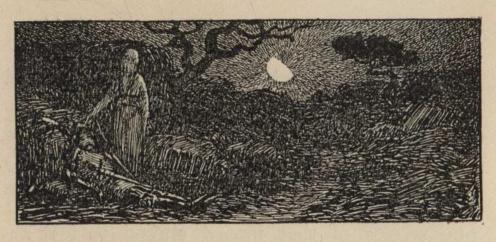
"'Knight,' she said, 'what are you doing here?'"
CHAPTER XIII
PERCIVALE
This was the adventure that Percivale had. When he had parted from his fellows and was riding alone he met a company of twenty knights. They stood across his path and asked him who he was and whence he came. "I am Sir Percivale," he answered, "and I come from the court of King Arthur."
"Then we will kill you," they cried, "for we are enemies of King Arthur and of all his knights."
Then they dropped the points of their spears and rushed upon him, and he struck down the first that came with his spear. But half a dozen of the others came upon him all at once, and some of the rest killed his horse, so that he was thrown down and was helpless among them. Then, when he thought that his last moment was surely come, he heard the sound of a horse's hoofs and then a shout, and then he saw the flash of a bright, flame-colored armor coming toward him. In an instant the knight who wore it was among them, and he had struck down some of them with his spear, and then he had drawn his sword and he was laying about him with it. No one who felt one stroke of that sword stayed to feel another. Some fell and could not rise, and others turned and fled, and soon there was none left to do any harm to Percivale. Then the knight in the flame-colored arms went away too, as fast as his horse could go, and all that Percivale saw of him was a last glimmer of his armor among the trees.
Percivale knew that this was Galahad, and he wished that he could follow him and go with him on his quest of the Holy Grail. But he had no horse and Galahad was out of sight, and he could do no more than go as fast as he could on foot the way that Galahad had gone. And so he went on, not hoping to overtake Galahad, and scarcely knowing what he did, till night came on and it grew so dark that he could not see his way, and he was so weary and so faint that he felt that he could go no farther. Then he sank down, just where he was, upon the ground, and slept.
When he awoke it was midnight. The moon was shining, and by the dim light he saw a girl standing beside him. It was she who had awakened him. "Knight," she said, "what are you doing here? Have you nothing better to do than to lie asleep beside the road? Where is your horse?"
"My horse was killed," he answered, "by some knights who fell upon me and nearly killed me too. Then I came so far without him and grew so weary that I sank down and slept here where you have found me."
"I will give you a horse," the girl said, "if you will take him from me."
"There is nothing that I need," said Percivale, "so much as a horse, and if you can find me one I shall be grateful to you."
The girl went away and soon she came back leading a great, black horse, with rich trappings, and she told Percivale to take him. The instant that Percivale was in the saddle the horse was away like the wind. Percivale could not stop him or turn him. He went where he liked, and Percivale was sure that in all his life he had never ridden so fast. No, nor a tenth part as fast, for sometimes, as this mad horse carried him along, he saw places that he knew, and within an hour he saw some that he knew were a day's journey apart. And all at once he heard a dull roar and saw the ocean before him. The horse was going straight into it, as it seemed, and when Percivale saw that, he drew his sword and held it by the blade and struck the horse's neck with the cross-shaped hilt. Then the horse gave a great leap and threw Percivale off his back. He fell on the very edge of the water and the horse plunged into it. And where he disappeared there sprang up a great flame, bright blue, and it went out and left a thick, black smoke behind it. The wind blew the smoke away, and there was nothing more to see but the great waves rolling toward the shore and dashing against the rocks.