THE KNIGHTS OF THE ROUND TABLE (continued 2)
Reading edition
"'Yes, yes,' Kay shouted, 'go after him, boy, and avenge your father and avenge the Queen and bring back her golden goblet! And when you have killed him you can have his horse and his armor, and then you will look fit to be made a knight.'
"'I will do what you say,' the boy answered, and he turned his horse and rode out of the hall again. When he came to the meadow the red knight was there, riding up and down. 'Boy,' he said, 'do you know if anyone is coming from the hall to take this gold cup from me?'
"'I have come from the hall,' Percivale answered, 'to take that gold cup from you.'
"'Go back and tell the King,' said the red knight, 'to send a man, a knight, to take it. And tell him that I will not wait much longer.'
"'I mean to take it from you myself,' said Percivale again, 'so be ready for me.'
"Then Percivale made his poor old horse go as fast as it could, and he came against the red knight with his pointed pole. The knight tried to strike the pole aside with his spear, but Percivale hit him fairly with it and knocked him off his horse. And in falling he managed somehow to break his neck.
"All that had passed in the hall since the red knight had appeared there had passed so quickly that the King and the knights had scarcely had time to know what was going on at all till it was all over. But when Percivale had gone to find the red knight, Uwain, King Arthur's nephew, said: 'Kay, it was not right for you to send such a boy as that after a knight who is no doubt a hard fighter. The knight will kill him, and then a double disgrace will fall upon the court, that of letting the boy be killed and that of sending no good man to avenge the insult to the Queen. Now I will go and see if I am in time to save the boy and punish the knight.'
"So Uwain went to the meadow and there he found Percivale trying to take off the dead knight's armor. He could not do it, because he knew nothing about armor and did not know how it was fastened. So Uwain showed him how to take it off and then how to dress himself in it. 'And now,' said Uwain, 'come to King Arthur and I know that he will gladly make you a knight, for you have shown that you are worthy to be one.'
"'No, 'said Percivale, 'I will not go back now. But tell me, what is the name of the tall man who told me to follow this knight?'
"'He is Sir Kay,' Uwain answered, 'King Arthur's seneschal.'
"Then Percivale said: 'Take this gold cup back to the Queen and tell her that I have avenged the insult to her. Tell King Arthur that wherever I go I will be his servant and will try to do him what honor I can, but tell Sir Kay that I will never come back to King Arthur's court till I have met him and punished him for striking the dwarf who greeted me when I came into the hall. My mother told me to fight for the poor and the weak, and I am sure that dwarf is weak and I ought to fight for him.'
"When Uwain went back to the hall with these messages Kay laughed, but I am not sure that he felt quite comfortable. He had had bad luck before in making fun of young men who turned out well in spite of their simple looks. Perhaps you may like to know how the dwarf knew who Percivale was. It was very simple. He used to live in Percivale's father's house, and he knew him because he was so much like his father.
"And Percivale was riding away from the court and did not know or care where he was going. But after awhile he met a knight who asked him whence he came. 'I come from the court of King Arthur,' he answered.
"And the knight said: 'I am the enemy of King Arthur and of all his men, and when I meet any of them I kill them, if I can, and so I will kill you now, if I can.'
"So they took their places and charged against each other with their spears. Percivale had a real spear now. And Percivale threw the knight off his horse and he begged for mercy. 'You shall have mercy,' Percivale said, 'if you will go to the court of King Arthur and tell him that Percivale sent you and that Percivale will never come to his court again till he has punished Sir Kay for striking the dwarf.'
"The knight did as Percivale bade him, and the story says that within a week he overcame sixteen knights and made every one of them go to the court and tell King Arthur that Percivale had sent him and that Percivale would never come back till he had met Sir Kay and punished him for striking the dwarf. Now you can imagine that, when these knights came into the hall, two or three of them a day, and brought always this same message, Kay kept getting more and more uncomfortable. Every new one who came proved over again what a tough fighter Percivale was and every one of them told the King and the court that Percivale was waiting for a chance to fight with Kay. And then the other knights began to blame Kay for making such a fine young man leave the court. For it was clear, they said, that he would some time be one of the best knights among them all. At last King Arthur said that he himself, with some of his best knights, would go to search for Percivale. And Kay, who was really no coward, went with them.
"And Percivale kept on his way. And one evening, when it was time for him to find a place to stay for the night, he saw a great castle before him. He knocked on the gate and a young man with a thin, pale face put his head through an opening in the battlement and looked at him. Then the young man came and opened the gate for Percivale and led him to the hall. There were eighteen young men there, all thin and with pale faces, like the first. They took off Percivale's armor and they all sat down together. Then five young women came into the hall, and Percivale thought that one of them, who was the lady of the castle, was the most beautiful he had ever seen. Mind, I don't say that I think so; I say that Percivale thought so. For, as one of the beautiful, wonderful books that tells this story says, 'whiter was her skin than the bloom of crystal, and her hair and her two eyebrows were blacker than jet, and on her cheeks were two red spots, redder than whatever is reddest.' She was dressed in satin, but it was old and faded and worn.
"Afterwards two nuns came into the hall. One of them carried a flask of wine and the other had six loaves of bread. 'Lady,' said one of the nuns, 'there is not so much bread and wine left in our convent as we have brought you here.' Then they all sat at a table, and Percivale saw that the lady of the castle was giving more of the bread and the wine to him than to any of the others. So he took all the bread and wine and divided them equally among all who were at the table. And when it was time they led Percivale to his chamber.
"And the rest still sat in the hall. Then one of the young men said to the lady of the castle: 'Sister, go to this young man and tell him that you will be his wife, if he will rescue you and the rest of us from our enemies.'
"'I cannot do that,' she answered. 'He may not want me for his wife; if he did he would ask me.'
"'Sister,' said the young man again, 'we have no more food and we cannot hold the castle any longer. This is the only hope we have. You must do this or we will leave you, and your enemies may do what they like with you and your castle.'
"So she left them and went to the door of Percivale's chamber and opened it. It was dark and he was asleep, but he heard her weeping and awoke. 'Who are you,' he asked, 'and why are you weeping? Can I help you?'
"'My lord,' she answered, 'if you do not help me nothing can ever help me. I am the lady of the castle. My father owned this castle and all the lands around it. There was a wicked knight, named Sir Mordred, who wanted me to be his wife, but I would not, and so, after my father died and left me the castle and the lands, Sir Mordred made war upon me. I had not men enough to fight with him, and so he has taken everything I had except this castle. But this castle is so strong that the few men whom you have seen were able to hold it as long as we had food. They are my foster brothers. Mordred and his men always watch the castle to see that no one goes out from it to bring food, and so at last all that we had was gone. Then the nuns, who are permitted to go wherever they like, brought us food, but now they have no more. And Mordred watches us so closely that he will know that we have no more food, and he will come against us at once and take the castle, unless you can help us. So the young men told me that I must come to you and tell you that I would be your wife if you would save us, for there was no other way. Forgive me, Sir Knight, for doing what I must do, and help me and my brothers, if you can.'
"Then Percivale answered: 'I know that you do not say this because you want to be my wife, and so I will not ask it of you. Marry whomever you will. To-morrow, if this Sir Mordred comes, I will do my best to help you.'
"And so we have come to Mordred. I am almost sorry that I have to tell you about him, but I should have to tell you, some time, and it may as well be now. Mordred was the brother of Gawain, and so he was King Arthur's nephew. He was a knight of the Round Table, and he was the wickedest and most treacherous man who was ever in Arthur's court. When people tell you that they do not like King Arthur because he was too good—and somebody is sure to tell you that some time—ask them what they think of his letting such a creature as Mordred be a knight of his Round Table. Still, I suppose Arthur did not know how bad Mordred was. Good people are often slow to believe that there are any bad people, and Arthur was so.
"Well, in the morning, surely enough, there were Mordred's men all around the castle. There were tents set up and knights were riding up and down on horses, and banners were flying, and it all looked as if they had come to fight against a city, instead of against five women and eighteen starved young men. Breakfast did not take long that morning, because there was nothing in the castle to eat. So, as soon as he was up, Percivale put on his armor and called for his horse and rode out of the castle. He came near to some of the knights who were riding about and seemed to be so ready to fight, and called out that he wanted to see Sir Mordred and to talk with him.
"When Sir Mordred came, Percivale said to him: 'I challenge you alone, Sir Mordred to fight with me alone for the right of the lady of this castle. If you beat me you shall keep all that you have taken from her and you shall have the castle too. If I beat you she shall keep the castle and you shall give her back all that she had before. Do you agree to this?'
"And Mordred said: 'I agree.'
"It was a short battle. They charged against each other once, and Mordred's spear was broken against Percivale's shield, but Percivale's spear went through Mordred's shield and through his shoulder. Mordred could not fight any more after that, so he promised to give back to the lady of the castle all the lands and everything else that he had taken from her, if Percivale would not kill him. Percivale made him promise, too, that his men should take to the castle that very day enough food and drink for a hundred men and their horses. Then he sent Mordred himself to Camelot, to say to the King and the court that Percivale would never come back there till he had punished Sir Kay for striking the dwarf. But when Mordred got to Camelot the King and Kay and a good many of the other knights had gone to hunt for Percivale, and there were not many left to hear the message.
"Then Percivale took his leave of the people of the castle and rode on his way. He rode all day, and in the evening he came to the cell of a hermit, who made him welcome, and he stayed with him all night. In the morning he left the cell to go on his way, but just in front of the door he saw something that made him stop to look at it. There had been a fall of snow in the night, and a little way from the hermit's cell a hawk had killed a wild fowl and the snow was stained with its blood. Something had frightened the hawk away and now a raven had lighted on the snow near the wild fowl. It was this that made Percivale stop to look, for the blackness of the raven and the whiteness of the snow and the red of the blood made him think of the black hair of the lady of the castle where he had stayed, and of her white skin, and of the red in her cheeks. This must have been a pleasant thought, for Percivale stood there thinking it and gazing at the blood on the snow for a long time.
"Now it happened that King Arthur's tent had been pitched for the night near this very place. And Arthur came out of his tent and saw some one leaning on a spear and looking upon the ground. And he told one of his young men to go and see who it was. So the young man rode to where Percivale stood and said: 'Who are you, and what are you doing here?'
"But Percivale was thinking so much of the raven and the snow and the blood and the lady of the castle that he gave no answer, and then the young man thrust at him with his spear. Then Percivale turned and struck the young man with his own spear and knocked him off his horse, and he went back to tell the King how he had fared. And Kay said: 'I will go and make him tell me who he is.'
"So Kay came and said and did very much as the young man had done, and Percivale knocked him off his horse too, and in the fall he broke his arm. Kay's horse galloped back alone to where the King and the knights were and Kay had to walk back. 'Now, I will go,' said Gawain. 'It is likely, Kay, that you spoke to him rudely, for you do speak rudely sometimes. The knight may be deep in some thoughts in which he does not like to be disturbed, but I will try to bring him back.'
[Illustration: "Kay's horse galloped back alone" (missing from book)]
"It used to be said that Gawain could speak so well that nobody could ever refuse him anything that he asked. He went to Percivale and stood still beside him for a moment and then said to him: 'If I thought that it would be pleasant to you to hear it, I would give you a message from King Arthur. He wishes that you would come to his tent. Two others have come here before me to speak to you.'
"'Yes,' said Percivale, 'and they spoke to me rudely and attacked me. And it annoyed me, because I was looking at the snow and the raven and the blood, and I was thinking of the face and the hair and the cheeks of the lady whom I fought for yesterday. But tell me, is Sir Kay with King Arthur?'
"'Yes,' said Gawain, 'and he was the second of the men who came to speak to you, and the fall from his horse that you gave him broke his arm.'
"'Ah, then I am glad,' said Percivale, 'for now I have punished him for striking the dwarf.'
"'For striking the dwarf?' Gawain repeated, 'then you are Percivale! This is good news! Come back with me to the King, for he and all of us have left Camelot to seek for you.'
"'Yes,' Percivale answered, 'I can come back with you now, for I have met Sir Kay and have punished him for striking the dwarf.'
"So Gawain led Percivale back to the King, and Arthur and his knights welcomed him as one of the best among them all. Then they all went back to Camelot together, and as soon as they were there King Arthur made Percivale a knight. And he said to him, when he had touched his shoulders with his sword: 'Rise, Sir Percivale, and may God make you a good knight. I know that He will, Sir Percivale, for no young man who has ever come to my court has done so soon such noble things as you have done. For before you were a knight at all you fought many battles for right and justice, and you are worthy to be called God's own knight. And you are worthy, too, to be a knight of the Round Table. Kneel again, Sir Percivale, and take the oath of the Round Table.'
"Then Percivale knelt before the King again and the King said to him: 'Do you swear that you will help the King to guard his people and to keep peace and justice in his land; that you will be faithful to your fellows; that you will do right to poor and rich alike? Do you swear that in all things you will be true and loyal to God and to the King?'
"And Percivale answered: 'I swear it.'
"The King took Percivale's hand and turned toward the Round Table. All the knights looked eagerly to see where his place would be, for they thought: 'No man of us has ever done such deeds as his while he was still so young, and who knows but he may be that best knight of all the world, who is to sit in the Siege Perilous?'
"The King thought of that too, and he paused beside the Siege Perilous, to see if there were any letters in it, but there were not. But in the next seat to it, where no one had ever sat since Arthur had been King, he saw new letters of gold, and the letters said: 'This is the seat of Percivale, God's knight.'"
The Tower of London
CHAPTER IV
THE QUEEN'S ROBING-ROOM
When we got back to the hotel at Glastonbury that night there was a surprise awaiting us. Helen's mother had a letter and she said: "We are going to London by the first train to-morrow morning, and then we are going straight to Paris."
Now you must know that before we started on this journey Helen's mother had said that she did not care in the least where we went, except that we must go to Paris. So it was agreed between us that she should be allowed to go to Paris just whenever she pleased and that I should arrange everything else just as I pleased. And so, when she said that we were going to Paris at once, she made exactly the one announcement that she had a perfect right to make, without asking me anything about it at all. Still, just at first, I was not at all pleased.
I said that of course we should do just as she liked about it, still we had thought that we were to have plenty of time in Glastonbury, and so we had not gone to see the ruins of the abbey yet, and it seemed a pity to have to leave Glastonbury without seeing them. Helen knew nothing about the ruins of the abbey, but she agreed with me. That made no difference to Helen's mother. She had a letter from somebody whom she knew, who was in Paris. That somebody was to be there only for a week, and she must be there at the same time. We really had no right to object, and so I gave up objecting and tried to think of the best way out of it. "Couldn't we come back here again afterwards?" Helen suggested.
Now the notion of going to a little place like Glastonbury, so far off the usual lines of travel, twice in the same journey, is one that would never come into the head of any ordinary traveller. But Helen is not an ordinary traveller. And when I came to think of it I could not see the slightest reason in the world why we should not come back to Glastonbury after we had been to Paris. I looked at Helen's mother and said: "May we?"
"You know very well," she said, "that you can go and come wherever you like, as long as you let me go to Paris."
Here was another notion. "As long as I let you go to Paris," I repeated. "That is just what I will do. What do you want of me in Paris? All the time that you are there you women will be running about the city, seeing things that I don't care about and doing things that I don't care about, such as shopping, and I should only be in the way. You would get on better without me, and so why should I go to Paris at all? I will go to London with you to-morrow, and then I will wait there for you till you come back."
Helen's mother liked my plan so much that I almost felt hurt. "I don't see," she said, "how you could be of the least use in Paris. You will have a much better time in London, and I shall have you off my mind, and can do just what I like."
This almost took my breath away, but, as the plan was my own, of course I had to pretend that I liked it. I said that there were several things in London that I wanted to see again, and I wanted to look up two or three places not far from London that had stories about them. I was afraid I should not have time to go to them if I went to Paris too. When I said that Helen began to take an interest, as I had thought that perhaps she might. "Are there more stories in London?" she asked.
"If you and I," I said, "were to stay in London and find a story every day, we should not live long enough to find half of them."
"Oh!" said Helen.
"Now do you think?" I said, "when you come to think of it a second time, that you really need Helen in Paris any more than you do me? When she is a little older she will want to go there just as much as you do now, and then she can go. But now, don't you think that you should like to have her off your mind as well as me, and don't you think that she could do a good deal toward cheering me up there in London, while you are gone?"
Helen looked at her mother to see what she was going to say. She said nothing at all, but she looked at Helen in a way that meant that she might do just as she pleased about it, and Helen said: "If you don't mind very much, I think I will stay in London."
Helen's mother did not mind very much, so I said: "Very well, then; this is what we will do. We will go all the way to Dover with you, and then we will come back to London and have as good a time as we can, till you come back from having the best time that ever was in the world, in Paris. And when you are with us again we will come back here to Glastonbury and go to some other good places."
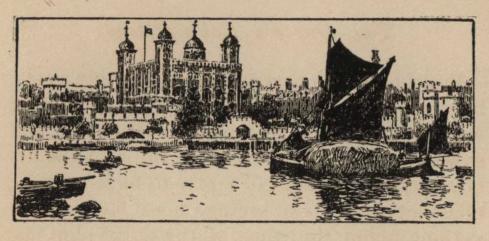
Nobody could make the least objection to that. And so the next day but one Helen and I found that we were left quite to ourselves in London. We found plenty of things to amuse us. We went to see the Tower of London, as Americans do. We found the old armor and weapons that were there most interesting, and Helen made a discovery. "Did King Arthur's knights wear armors like those?" she asked.
"Yes," I said, "about like those."
"With all those chains and iron things?"
"Yes, to be sure."
"Then I know what became of the green lace girdles that Gawain and the rest of them had."
"Very well; what did become of them?"
"Why, don't you see? They all wore out. They wouldn't last a week, if they put them round their waists, with all those iron things on."
There was really no need of any better explanation than this, and so I gave up ever finding any.
"There is one curious little thing about this Tower," I said, "that is not in most of the books about it. It was here, you know, long before King Arthur's time. One of the old kings was called Bran the Blessed. And once he told his men that when he was dead they must cut off his head and bury it under the White Tower, in London, with the face toward France, and that as long as it stayed there England could never be harmed by any foe from abroad. Now I have never heard of any White Tower in London, except this big square one in the middle of the Tower of London, so that I have no doubt that it was here that the head of Bran the Blessed was buried, with the face toward France, to guard England from her foreign foes. But when Arthur came to be King he had the head dug up, for he said that it would be better for England to be guarded by the strength and the courage of Englishmen than by magic. You can look around you at the England of to-day and judge for yourself whether Arthur was right."
I had heard that there were pictures of some of the King Arthur stories in the Queen's robing-room, at the Palace of Westminster, and of course we wanted to see them. Now anybody who looks moderately respectable can walk through the Palace of Westminster any Saturday. The trouble is that the policemen who are posted in the rooms will not let you stay in any one of them long enough to do more than take a glance at it and pass on to the next room. Of course this would not do for us, when there were pictures of King Arthur to be looked at. But we were very lucky. We knew somebody who knew somebody who knew somebody else, and I rather think that this last somebody was the secretary of the Lord Great Chamberlain. At any rate, there were some letters written about us, and we were told to go to the Palace of Westminster and ask for the inspector of police. So we went there when Saturday came around and saw the inspector and told him that we were the ones whom the letters had been written about. He was very glad to see us and he introduced us to somebody else. Once more I think that it was the secretary of the Lord Great Chamberlain, but I am not sure. Whoever he was, he was most polite, and when we told him what friends of King Arthur's we were he ordered the policemen on duty to let us stay in the Queen's robing-room as long as we liked.
Having all the time we wanted, we did not hurry, but stood for a few minutes at the windows, looking out across the Thames. "It was somewhere over there," I said, "not very far on the other side of the river, that there used to live one of the wickedest knights that were ever in King Arthur's court. His name was Meliagraunce. I don't know what made him so wicked, but I suppose he was so to start with. It occurred to him once that there could be no better way for him to make trouble than by stealing the Queen and carrying her off to his castle, over there across the Thames. King Arthur was holding his court just here at Westminster then, for it seems that there was a palace here as long ago as that.
"Meliagraunce had to watch a long time for his chance, for there were usually a good many people about the Queen, and Lancelot was likely to be among them, and somehow, wicked as he was, he did not care about doing anything to harm the Queen while Lancelot was with her. But one day he heard that the Queen was going maying, with some knights and ladies, and that Lancelot was not going. That, he thought, would be just his chance. Now, as the Queen did not mean to go far from Westminster, there was no thought of any danger. So the knights who rode with her wore swords at their sides, as they did almost everywhere, but they carried no spears or shields, and they wore no armor. There were only ten of them, with ten ladies and a few squires and pages. But Meliagraunce got ready twenty knights, fully armed, and a hundred archers on foot.
"Westminster and the country about it looked very different then from what they do now. Now there is nothing but city for miles around, but then there were fields, and a little farther off there were woods. So the Queen and her knights and ladies rode to the woods and gathered flowers and green branches, and decked themselves and their horses with them and started back toward Westminster. Then Meliagraunce and his armed men fell upon them. The Queen's knights fought for her as well as they could, but they were so few and so poorly armed that they were no match for their enemies. In a little while they were all of them wounded, and the Queen saw that they would all be killed if the fight went on. So she called to Meliagraunce and begged him to stop the fight and promised that she would go with him to his castle, if he would let all her knights go too, for they were wounded and she must have them with her, so that she could take care of them.
"Meliagraunce agreed to this and they all set off toward his castle. But on the way the Queen whispered to a page who was on a swift horse, and told him to ride back to Westminster and tell Lancelot that she was a prisoner in the castle of Meliagraunce. So the page watched till nobody was looking, and then turned his horse suddenly and rode back. Of course Meliagraunce and his men saw in a moment what he was doing and what it was for, and they shot at him with arrows, but they missed him and he was soon beyond their reach.
"Now Meliagraunce and all those who were with him had to go slowly, because of the wounded knights, but the page who went to tell Lancelot rode fast. And when Lancelot heard what the page had to tell he rode fast too, so that he came to the castle of Meliagraunce not long after the others arrived there. And as soon as Meliagraunce heard that Lancelot had come he began to see what a silly thing he had done and to wish that he were well out of it. So he went to the Queen and begged her not to let Lancelot kill him. If she would promise that, he said, they would all go back to Westminster the next morning. So the Queen sent for Lancelot and told him that it would be better to do as Meliagraunce had said, for Meliagraunce was a knight of King Arthur's and it would be better that it should not be known what he had done as it would have to be if Lancelot fought with him and killed him. And of course Lancelot said that it should be as the Queen wished.
"But Meliagraunce had still other mischief in his mind. Now that he had found that he must send the Queen back to Westminster, he decided that he would charge her with treason to the King. That was as easy a charge to make against her as any, and it was as easy a way to harm her as any, since that was what he wanted to do. You know anybody could charge anybody else with anything, as long as he was ready to fight and risk his life to prove it. of course it did not take a minute for Lancelot to say that the charge that Meliagraunce made was a lie and that he would fight with him to prove that the Queen was not a traitor to the King, whenever and wherever Meliagraunce liked. And Meliagraunce said that it should be eight days from that day, at Westminster, before King Arthur.
"Now you may be sure that Meliagraunce would never have said a word against the Queen if he had thought that he should really have to fight with Lancelot about it. But he had still another trick to play, which he thought was a good one. He pretended to be very friendly with Lancelot and asked him if he should like to see his castle. Then he led him about from room to room and at last he led him over a trap door. It gave way and Lancelot fell down into a dungeon and struck on a heap of straw. And there Meliagraunce meant to keep him till after the time for the fight. And so, as he expected, it would all be decided his way, because Lancelot would not be there to defend the Queen, or, at the worst, he would have to fight with some knight who was not so good as Lancelot.
"I suppose I ought to tell you just here that King Arthur himself could not fight for the Queen in such a case as this, because he had to sit and be the judge in all such fights. And Arthur always did justice to rich and poor and to great and small alike, and he would do the same justice, or he would try to, to the one whom he loved best of all the world as to the meanest man or woman who could be brought before him.
"When the rest were ready to go back to Westminster they were surprised, of course, that Lancelot was not with them. But they did not think that it was so very strange, for Lancelot often went away suddenly in search of adventures and told nobody that he was going. So they went back and told the King that Meliagraunce had charged the Queen with treason and that Lancelot was to defend her. And the King was not alarmed at all, for he knew that the Queen could not be guilty of such a thing, and he felt sure that Lancelot would be at hand when the time came to prove it.
"But the King felt more sure of Lancelot than Lancelot felt of himself, for all that week he was in prison. And on the eighth day Meliagraunce came to Westminster ready for the fight and called upon the King to give judgment against the Queen, because Lancelot was not there to defend her. Then Arthur said that he was sure that Lancelot must be dead or sick or else in prison, for he never failed to keep his promise before, and he asked if there was any other knight who would fight in his place to defend the Queen. Then a knight of the Round Table said that he was sure, too, that it was as the King had said and he would fight for the Queen instead of Lancelot.
"But Meliagraunce, as clever people sometimes do, had made a mistake. He did not know, perhaps, that there was a woman in his castle who was in love with Lancelot. But there were a good many such women scattered over England and he ought to have been careful about it. On the very morning when the battle was to be she came to Lancelot and told him that she would let him out of his prison if he would give her one kiss. Lancelot thought that this was not a large price to pay and he paid it. Then the woman let him out and found his armor for him and helped him to get a horse from the stable and he set off, as fast as he could go, for Westminster. And he arrived just as the knight who had promised to fight for him had taken his place ready to begin the battle.
"Lancelot rode straight up before the King and told him how Meliagraunce had trapped him and kept him in prison, and then he took the place of the other knight and was ready for the fight. Nobody had any doubt how the fight would go. Everybody felt that the right would win and that the right meant Lancelot. The King felt so sure of it that he had the Queen come and sit in her place beside him, though she was accused of treason. The heralds gave the signal, the knights charged together, and Meliagraunce was thrown from his horse. Lancelot dismounted then and they fought with swords, but it was only a few moments before Meliagraunce was disarmed and helpless and begging for mercy.
"Then Lancelot had a hard question to decide. In any ordinary fight it would be unknightly to refuse mercy to any knight who asked it, but Lancelot felt that such a cowardly, lying wretch as this had no right to live and that he had no right to let him live. He thought for a moment and then he said: 'Meliagraunce, take up your sword and let us go on with this fight to the end.'
"'I will not fight any more,' said Meliagraunce; 'you have beaten me and I ask your mercy, and you must give it, as you are a knight of the Round Table.'
"'Meliagraunce,' said Lancelot, 'I will take off my helmet and all the armor that I can from the left side of my body, and my left hand shall be tied behind me, and then I will fight with you.'
"Then Meliagraunce ran toward the King. 'My lord,' he cried, 'have you heard what he has said? I call upon you to make him keep his promise and fight me with his head and his left side uncovered.'
"'Meliagraunce,' said Lancelot, 'come back! I am not a liar, like you, and I need no one to make me keep my promises, even to traitors and cowards.'
"Then Lancelot's armor was taken off his left side, as much of it as could be, and his helmet was taken off. And his left hand was tied behind him, so that he could not use his shield. And in this way he stood ready for the fight again. Meliagraunce aimed a blow at his head, but Lancelot caught it with his sword and put it aside. Then he struck one great stroke and split Meliagraunce's helmet and laid him dead on the field. And everybody felt that the Round Table was better by the loss of Meliagraunce than it would be by the gain of three good knights. And now I think that it is about time for us to look at these pictures that we came to see."
The pictures were painted on the walls of two sides of the room. On the third side was a throne, with a canopy over it, and on the fourth side were the windows. The artist had painted scenes from the stories of King Arthur and he had made them represent the virtues that he thought ought to belong to a good knight. One of his pictures he called "Mercy," and it showed Sir Gawain kneeling before Queen Guinevere and swearing always to be merciful and never to be against ladies. The one next to this was "Hospitality," and in it King Arthur was receiving Sir Tristram as a knight of the Round Table. Another picture was "Courtesy," and there Tristram was playing his harp to Isolt. For "Religion" there was "The Vision of Sir Galahad and his Company." Then there was one of "Generosity," with King Arthur thrown from his horse in battle and his life spared by Lancelot. "That seems a strange picture to you, no doubt," I said, "but some time I will tell you the story that it belongs to, and then it will not seem so strange."
All around under these pictures and on the side of the room where the throne was, there were carvings: "Arthur Delivered unto Merlin," "Arthur Crowned King," "How Arthur Gate His Sword Excalibur," "King Arthur Wedded to Guinevere," and many more.
"But of all these pictures," I said, "the one that reminds me of a story that I want to tell you just now is this one of 'The Admission of Sir Tristram to the Fellowship of the Round Table.' Tristram had been known as the best knight of the world, next to Lancelot, for a long time before he was a knight of the Round Table. King Arthur had long wished that Tristram might be one of his knights, and Lancelot had heard so much about him that he wanted to know him and to be his friend. So at last Lancelot and some of the other knights set out to hunt for Tristram and to try to bring him to the court.
"You remember that Tristram was in love with Isolt, the Princess of Ireland. There was another knight, Sir Palamides, who was in love with her too. I must tell you about this Palamides, for there never was a knight who belonged more to that dear, silly old time or fitted into it better than he did. He was a good and strong and brave knight, but Isolt did not care two straws for him and never would, and he knew it. But do you suppose that made any difference to him? Not a bit. He made it half of his business to love her year after year, though he knew that it would never do him or anybody else any good. It never came into his head that there were just as good fish in the sea as ever came out of it. No, all he cared for was to sit on the shore of the sea, never trying to catch or even thinking of any other good fish, but only wishing and wishing that he might catch the one that he knew he never could. It was just like a good knight of those days.
"I said that he made it half of his business to love Isolt. The other half of his business was to hunt the questing beast. It was called the questing beast because of the questing or barking noise that came out of it. It was a wonderful animal altogether. It had a body like a leopard in front and like a lion behind, but its head was like a serpent's and its feet were like those of a deer. And it did not make this barking noise with its mouth, but the noise was inside the beast, and it was not like the barking of one dog, but of sixty dogs. I don't know why Palamides hunted it or what he was going to do with it if he ever caught it, but this again was just like a knight of those days.
"Now Palamides used often to feel very unfriendly toward Tristram, because Tristram loved Isolt. By nature I believe that he was a good fellow, but he was hot-tempered, and, like other hot-tempered people, he sometimes did things that he was afterward sorry for. And so, when he met Tristram, he often felt angry and wanted to fight with him. And Tristram beat him usually, but not always, for Palamides was such a good knight that he could give Tristram, or even Lancelot, a pretty hard battle. Then Palamides would be Tristram's friend for awhile, and then he would think more about Isolt and would grow to be his enemy again, and so would be ready for another fight.
"And once Tristram and Palamides had set a time and a place to fight together and settle everything between them. But when the day came Palamides was held in prison by some enemy and could not come. But Tristram was at the place, and as he waited he saw a knight riding toward him, with a closed helmet and a covered shield. Of course he thought that this was Palamides, ready for the fight, so he put his spear in rest and faced him, and the other knight, seeing him do that, got ready to defend himself. Now this other knight was Lancelot, and when the two had been fighting for a few minutes each began to wonder who the other could be. Tristram knew very well that he was fighting with a better knight than Palamides, and Lancelot knew that he had never fought with so good a knight before.
"And after a long time it came into their heads to stop fighting for a moment and ask each other who they were. And when each had told the other his name they saw what a mistake they had made in fighting at all. It was then that Lancelot made Tristram come to the court with him, and it was then that King Arthur welcomed him and gave him his seat at the Round Table, as the picture shows.
"And now, after all this bother, we have come to the story. Tristram had not been long a knight of the Round Table when King Arthur made a great tournament in his honor. It was at the Castle of Lonazep. I don't know just where that was, but it was somewhere up in the other end of England. As Tristram was on his way to the tournament he met Palamides, and they fought, as usual. And Tristram won, as usual, and then Palamides begged him to let him ride to the tournament with him and fight for him and do him service.
"So they rode together till they came to the River Humber, and there they saw a boat, all covered with canopies of purple silk, coming up the stream. It came to the shore close to them and lay there still. Then Tristram and Palamides went down into the boat and saw a strange sight. In the middle of it was a couch, all covered with silk and cloth of gold, and on the couch lay a dead knight, armed all but his head. As Tristram stood gazing and wondering at this he saw that there was a letter in the dead knight's hand. He took the letter and opened and read it, and this is what it said: 'To the knights of King Arthur: I who bring this letter was Hermance, King of the Red City. I was killed by two traitors, for my lands and my crown. Now I pray that some one of King Arthur's knights will avenge my death and will take my city and my castles and my crown for his reward.'
"Then Palamides said: 'Sir Tristram, you must be at this tournament, for King Arthur has made it in your honor, and he and many others will wish to see you here. So let me go to avenge the death of this King, and whatever I do shall be done for you and in your name.'
"'You are right,' said Tristram, 'and you may go, but come back, if you can, for the tournament.'
"'If I live,' said Palamides, 'and the work that I find to do will let me, I will be with you again at the tournament.'
"Then Tristram went ashore from the boat and Palamides stayed in it, and the men turned the boat and it went away down the river. The men in the boat knew why Palamides stayed in it. He did not speak to them and they did not speak to him. He knew that they would take him where he ought to go, so he stood at the prow and watched the fields that they passed and the woods and the river, and waited to see and to know who these traitors were whom he must punish and what sort of task it was to be to avenge this dead King. And after a time the boat came to where the river widened out toward the sea, and the men steered it toward a castle that stood on the shore. Then they gave Palamides a horn and told him to blow it. And the people of the castle knew the sound of the horn, and when they heard it they came down to where the boat had landed and welcomed Palamides and led him up into the hall. There the lord of the castle met him and made him sit at the table and they brought him food and wine. And Palamides saw that the lord of the castle and all the others in it were dressed in black, and after he had eaten and drunk he asked why this was.
"'It is for the death of our King,' the lord of the castle answered. 'He was Hermance, the King of the Red City, and no truer king ever lived. He had two foster sons, whom he had brought up since they were children. He loved them as if they had been his own sons, but they were false and wicked. He meant when he died to give them everything he had, but they could not wait. So they watched their chance, and one day, when he had been hunting and had stopped to drink at a spring, they came behind him and stabbed him in the back. There, beside the spring, I found him, not yet dead. He made me put him in a boat and he made me write a letter and put it in his hand before he died. The boatmen were told to go up the Humber toward Lonazep, where all King Arthur's knights were soon to be, and the letter asked that some one of them would come to avenge the death of our good King. And you, Sir Knight—since you have come in this boat—I suppose that you have read this letter and have come to help us.'
"'One of the best knights of the world, Sir Tristram, read that letter,' Palamides said, 'and I have come for him and in his name to avenge the death of your King. So tell me where I shall find these men.'
"'You must take your boat again,' said the lord, 'and go to the Delectable Isle. There is the Red City, and there you will find these two brothers, Helius and Helake. Go and conquer them and we shall pray for you and wait to hear what you have done.'
"Then Palamides went back to his boat, and just as he came to it he met a knight who said: 'Sir Knight, tell me who you are and where you are going.'
"'By what right,' said Palamides, 'do you command me so?'
"'If you are going to the Red City,' said the knight, 'to avenge the death of King Hermance, turn back and go no farther. It is for me, not for you, to avenge him. I am the brother of King Hermance.'
"'That may be true,' Palamides answered, 'but when the letter was taken out of the dead King's hand we did not know that there was any knight to avenge him. I promised then that I would do it, and I must do it now or I shall be false to my promise.'
"'That is true,' said the other knight, 'but now let us try a few strokes together, to see which of us is the better knight, and then that one shall avenge the King my brother.'
"So they drew their swords and struck a few strokes, and then the brother of the King said: 'You are the better; the adventure is yours. But I will go to the Red City too, so that I can fight with these traitors if they kill you.
"'Come with me, then,' said Palamides, 'but if they kill me go to my lord, Sir Tristram, and tell him of it, and I am sure that he or Sir Lancelot will come to avenge me and the King your brother.'
"So they both went on in the boat till they came to the Delectable Isle and the Red City. And there all the people welcomed them, for they all loved their King who was dead and hated the traitors who had killed him. And they sent messengers to the brothers to tell them that one of King Arthur's knights had come to fight with them, to avenge King Hermance. And the brothers sent back word that they would be ready for the fight the next morning.
"In the morning Palamides was ready in the lists and the people of the city came to see the battle. And when they saw what a bold and strong-looking man Palamides was they began to hope that they should be free of their tyrants and have another King as good as Hermance. Then the brothers came and took their places at the other end of the lists, and when the people looked at them they began to fear again that the one knight from King Arthur's court could never beat them.
"It was Helake who came first against Palamides, and Palamides ran him through with his spear at the first charge and he fell dead upon the field. But the battle with Helius was not so easy. At the first charge Palamides was thrown from his saddle, and as he lay on the ground, before he could get up, Helius tried to drive his horse over him, to crush him. But Palamides sprang up and caught the bridle and cried: 'Come down and fight me fairly on foot or I will kill your horse and make you do it.'
"Then Helius got off his horse and they began to fight again with their swords. It was a fight for life and death, and it was a hard one. It lasted for a long time, with no rest, and Helius seemed never to lose any ground or any strength, but Palamides grew weaker and fainter and he was forced back and back across the field. The people saw it and a low, sad murmur ran through the crowd. And Palamides heard it, and for an instant he glanced away from his enemy and saw the anxious faces of the people and the tears in the eyes of some and the fear in the looks of many. Then he said to himself: 'Palamides, you are a knight of the Round Table. Will you let the news go back to King Arthur that you were beaten in a fight by a traitor and a murderer? And you are here for Tristram. Will you lose his battle for him?'
"And with that thought he gathered all his strength and struck Helius three great blows with his sword, one upon the other, and with the third he cut through his helmet and laid him dead upon the field with his brother.
"Then a great shout went up from all the people and some of them ran away to tell those who had not seen the fight how it had gone, and they built bonfires and set all the bells of the city ringing, and others crowded around the knight and cheered and shouted: 'Long live King Palamides!'
"But when they would let him speak to them Palamides said: 'You must not call me so; all that I have done was for my lord, Sir Tristram. If he could have come he would have fought this battle better than I. If you have any new king it is he, and now I must go back to him. But I leave here this good knight, the brother of your old King Hermance, and he shall rule you till Sir Tristram sends to tell you what else to do.'
"Then Palamides went on board his boat again and it took him away toward the Humber and toward Lonazep to find Sir Tristram."
The Round Table at Winchester
CHAPTER V
"CAMELOT, THAT IS IN ENGLISH WINCHESTER"
Even while we were at Camelford, and again while we were at Cadbury Castle, I had not forgotten the words of my favorite book, "Camelot, that is in English Winchester." If we were talking about hard history, I suppose that I should have to say that, if there ever was a real Camelot at all, it was probably that pleasant hill-top that we had seen in Somerset. Yet, when a story-teller whom I love as much as I do good old Sir Thomas says that Winchester was Camelot, it shall be Camelot for me, at least while I am there. So we went down from London to see if this third Camelot pleased us as much as the two that we had seen.
First we walked about the streets and aimed at nothing in particular. That is a good thing to do on the first day when you are in a strange city. "If I were to try to tell you," I said, "all the interesting and useful and delightful things that there are to tell about Winchester, I should have to go first and learn the most of them for myself. And then you would get tired of listening to them, for there would be enough of them to make a book as big as a dictionary. We are supposing, you know, while we stay, that King Arthur lived here, and, whether he did or not, other kings of England lived here more or less for I don't know how many hundred years. King Alfred lived here and King Canute lived here and William the Conqueror built a castle here, on the very spot, we will let ourselves believe, where King Arthur's castle stood."
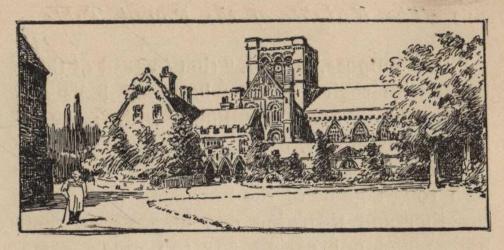
If the first thing to be done in a town newly visited is to walk about the streets, the second is to go to the cathedral, if there is one. So the next thing that we did was to go to Winchester Cathedral. It is not much to look at from the outside, though it is pretty enough, with the trees and grass around it. It has only the lowest of towers. It had a higher one once, but when King William Rufus was killed, they buried him in the cathedral and seven years afterward the tower fell down. They thought that it must be because they had buried such a wicked man in the church. But I think that there are kings as bad as William Rufus buried under some English towers that have not fallen down. There are kings and kings, good and bad, lying here in this cathedral. Canute is here, and it was here that he brought his crown and put it up over the cross, after he had found, down yonder at Southampton, that he could not rule the waves, as England has since been supposed to do. To be fair to the cathedral, I ought to say that, though it is unpromising outside, it is surely very beautiful inside. After that I think I do not need to say anything more about it at all, because there are so many people who can tell you about this cathedral and others so much better than I can.
We left it and walked up the street to find the castle. I think I forgot to say at the proper place that the whole town of Winchester that day was in a state of breathless excitement about a cricket match. The boys of Winchester College were playing against the boys from Eton, and pretty nearly everybody in town had gone to see the game. When we got to the castle, the man who ought to have been there to show it to us had gone to see the cricket match, like the rest. But his wife, who was a very pleasant elderly lady, said that she would show it to us.
They hold court in the castle still. Not the sort of court that King Arthur used to hold, but courts of justice for the County of Hants. The old woman took us into one room after another and told us about the trials that had taken place in them. We pretended to be greatly interested, but we were not a bit. But by and by she took us to a place where we were interested. It was the great hall of the castle. I should feel sorry for anybody who was not interested in the great hall of Winchester Castle. It belonged to the old castle that William the Conqueror built, where more kings and queens lived or were born or died or did other fascinating things than I should dare to try to remember. And this was the hall of Parliament for almost four hundred years. "And we may as well believe," I said, "that now we are standing in King Arthur's hall. If Winchester was Camelot there is no reason to suppose that his castle was not on this very spot, and there is no reason to suppose, either, that the great hall was not on this very spot. Henry VII. believed it, when his son was born here and he named him Arthur."
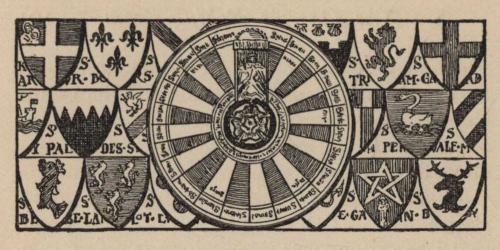
It is a beautiful room as it stands to-day. It is long and wide and high. It has fine arches and cluster columns and windows of stained glass. But what we gazed at most hung high up on the wall at the west end of the hall. The old woman told us that it was King Arthur's Round Table. Well, there was no doubt that it was round, and she said that there was no doubt that it had been a table once, because there were places at the back of it to fasten legs. We found a picture of the back of it afterwards in a book about Winchester, and it showed that she was right. The table is eighteen feet across, if you insist on my being exact. The table is painted in quite an elaborate style. There is a big rose in the middle of it, and then there is a border, and in the border are the words: "This is the round table of King Arthur and his twenty-four Knights." This did not make us believe in the table any the more, because we knew very well that twenty-four knights would not make any show at all in King Arthur's hall. Above the rose, as the table hangs now, and with his feet resting on it, is a picture of King Arthur himself. The rest of the table, except the outer edge, is painted with broad stripes of dark and light, which run from the border around the rose to the larger border of the whole table. The old woman asked us to notice that the names of the knights were around the edge of the table.
We tried to make out the names and we did make out some of them. There were Lancelot and Lionel and Tristram and Gareth and Bedivere and Palamides and Bors and Kay and Mordred and others that we could not read. The old woman said that there were some of them that nobody had ever been able to read, and we were not so proud as to try to read what we were told that nobody could. It was King Henry VIII. who had this table painted in such a gorgeous way, and it seemed to us that the picture of King Arthur did not look quite unlike Henry. No, we could not quite believe in the table after all. King Arthur's Round Table had places, as we knew, for a hundred and fifty knights, and this had places for only twenty-four. Still we could not help being uncommonly interested in anything that had even been called King Arthur's Round Table for four hundred years at the very least, and probably for six hundred.
"You see," said the old woman, "the three pictures on the windows over the Round Table are King Arthur and King Alfred and King Canute, a Briton and a Saxon and a Dane."
We looked up at the three kings on the stained glass windows, and it was then that I made a dreadful mistake. It came into my mind that it would be a good plan to show off to this good lady who had so kindly shown us the hall, how much we knew about these three kings. Pride does sometimes go before a fall. "Helen," I said, "tell this lady something about King Arthur, just to show her how much we have learned."
"I don't want to tell about him," Helen answered, "I would rather you would tell a story about him."
"But I am not going to tell any story now," I said, "I want you to tell one—any one you like, just to show that you can do it."
"But I don't want to show that I can do it."
"Helen, if you do not tell us something about King Arthur at once, I will not tell you another story for a week."
And then what did this horrible child do but stand there and recite:
"When good King Arthur ruled this land
He was a goodly King;
He stole three pecks of barley meal
To make a bag-pudding.
A bag-pudding the king did make,
And stuffed it well with plums;
And in it put great lumps of fat,
As big as my two thumbs.
The King and Queen did eat thereof,
And noblemen beside;
And what they could not eat that night,
The Queen next morning fried."
I tried to look as sorrowful as I could. "You know very well," I said, "that that is not true at all. That was written by some enemy of King Arthur. There are plenty of good things that you know and might have told us; and so, to punish you for telling that, you shall tell us now about King Canute and his courtiers."
Now Helen did not like this any more than she liked telling about King Arthur, but she must have seen how very determined I looked, and she gave a little gasp and said: "King Canute's courtiers told him that he was the greatest King in the world, and that the sea would obey him if he told it to do anything. So he had his chair put on the sand and he ordered the tide not to come up and wet him, and it did come up and wet him. And he told his courtiers not to flatter him any more, and he never smiled again."
"You get worse every minute," I said. "You know very well that it was not Canute who never smiled again, and for telling that story wrong you shall tell us now about King Alfred and the cakes."
By this time Helen saw that it was getting serious and that it would not do any good to make any more mistakes, so she said: "King Alfred was hiding from his enemies, and he was in the house of a cowherd. And the cowherd's wife was baking some cakes, and King Alfred was sitting by the fire. And the cakes burned and he was so busy mending his bows and arrows that he didn't know it, so the cowherd's wife said: 'Can't you look at the cakes and not let them burn? You'll be ready to eat them fast enough when the time comes.' And she didn't know that he was the King."
"I can't say," I said, "that you have told that quite as well as you might, but it will do. And now, who was it that never smiled again?
"Henry I."
"And why?"
"Because his son William was drowned when the White Ship was lost."
"Very well. The first class in English history could sit down, if there was anything to sit on."
The old woman was quite speechless with astonishment by this time. I don't suppose anybody had ever come into this hall and tried to tell her so many things about the kings who used to live in Winchester before. We thanked her for her trouble and said good-by, and she just managed to get back enough of her senses to say that we were welcome and to bid us good-by in turn. "And now," I said, "suppose we do what everybody else in town is doing and go and see the cricket match."
Winchester Cathedral
CHAPTER VI
THE BOAT ON THE RIVER
Neither Helen nor I knew enough about cricket to tell a wicket-keeper from a maiden over. But, whether we understood what was going on or not, the Winchester cricket-field that day was a pretty sight. The grass all over it was fresh and green, and around it were crowds of gayly dressed people, watching the game and talking and laughing and enjoying the warm, soft air and the bright sunshine. For a little while we walked around the edge of the field and looked at the people and the boys who were playing, running about and doing such absurd things as the players of a game you do not understand always do. Then we found a quiet place across the field from where the most of the people were, and there we sat down on the grass to rest and to try to make something out of the game. But that was hopeless, and we soon gave it up.
"Just suppose," I said, "that instead of these boys, with their harmless bats and balls and wickets, this field was filled with armored knights on horses, with long spears and great swords. Suppose that they were playing their own rough game of the tournament, charging together and throwing one another off their horses and not caring any too much, sometimes, whether they killed one another or not. Suppose that the people from the town had all come out to see the tournament, just as they have come out to-day to see the game of cricket, and that we had come, too, just as we really have. And suppose that King Arthur was sitting over there in his high seat to judge the knights. If we can suppose all this, I think that wee shall see pretty clearly how one of King Arthur's tournaments looked when Winchester was Camelot. There is a story, very pretty and very sad, about a tournament that was held at this very Camelot, and for all I know it may have been on this very field.
"The court was at Westminster just then but the King had given out that this tournament was to be at Camelot, so, when the time came, he and his knights set out to ride here. The Queen was sick and said that she would not come with them, and Lancelot said that a wound that he had was not yet well and so he would stay behind too and would not fight in this tournament. Now, although Lancelot was usually honest, I am sorry to say that just now he was saying what was not quite true. The truth was that Lancelot wanted to be at the tournament without King Arthur or any of the knights knowing that he was there. He had won in so many tournaments and all the knights knew so well that he was sure to win if he fought, that none of them liked to fight against him, and tournaments where Lancelot was had come to be rather one-sided affairs. So he thought that he would wait till the others were gone and then come to Camelot by himself, in armor that they did not know and carrying some strange shield, and join in the tournament and fight with whom he pleased.
"It was early morning when the others went away. Lancelot waited till noon, so that he should not overtake them on the way, and then he mounted his horse and rode toward Camelot. Late in the day he came to a place called Astolat. There was a castle, and Lancelot thought it best to stay there for the night. The lord of the castle was an old knight, Sir Bernard of Astolat. He welcomed Lancelot and asked him who he was, but Lancelot said: 'If you will pardon me, I do not wish to tell my name. I am going to the tournament at Camelot, to try what I can do against the knights who will be there, and I do not wish that any of them shall know who I am.'
"When it was time for supper Lancelot sat at the table with Sir Bernard and his two sons, and Sir Bernard's daughter served them. Her name was Elaine. And wherever Elaine went and whatever she did, she was always looking at Lancelot. It seemed to her that there was something about him that was wonderful and new. She thought that she had never seen a man who looked so noble, and, as he talked with her father, she thought that she had never heard a man who spoke so well. They lived a quiet life there at Astolat, and this knight was telling her father about the court and about battles and tournaments. He told things that were strange to her about many of the knights, and she listened to hear him say something about himself, but he did not say anything. 'Still,' she thought, 'when I look at him I know that he is the best of them all.' And she knew so little about knights that this was really a very good guess for her to make.
"But Lancelot scarcely saw Elaine at all. He knew that she was there, of course, and he knew that she was young and beautiful, and he knew that she was serving them, as they sat there. But Lancelot had seen many young girls serving at many tables—yes, and a good many of them had fallen in love with him, too, before this one, with or without his knowing it. And Lancelot asked the old man: 'Have you any plain shield here that you could lend to me for this tournament? I have told you that I do not want to be known at Camelot, but every knight would know my shield, if I should carry my own.' And when she heard that, Elaine thought: 'He is some famous knight, I knew he was!'
"And the old man answered: 'Here are my two sons, Torre and Lavaine; they are both new knights and their shields are plain and blank. It may be that Lavaine will like to go and see this tournament, but Torre cannot go, for he has a wound that is not well yet. You can have his shield.'
"'And may I leave my own shield here,' said Lancelot, 'till I come back?'
"'Surely,' said the old man, 'Elaine will take good care of it for you.'
"And when she heard that, Elaine blushed from her forehead down to her throat, and she stood still and gazed at Lancelot, and he looked up at her and said: 'If she will do that for me I shall be very grateful.'
"Lavaine had been listening to all that Lancelot said, almost as much as his sister, and now he said: 'Father, if this knight will let me, might I not ride with him to the tournament and see the knights, and perhaps try a joust with one of them?'
"'No, no," said his father, 'it would trouble the knight too much to have such a boy with him.'
"'It would not trouble me at all,' said Lancelot; 'let him come. He shall see everything, and if he wants to joust I will advise him and help him all I can. It would be a poor return for your kindness to me to do less than that.'
"Then Elaine, although she scarcely dared to speak to Lancelot, said: 'Sir Knight, if I am to keep your shield, could you not wear some token of mine at the tournament?'
"'My child,' said Lancelot, 'I have never done that for any lady, and it is against my rule.' And then he thought again: 'All my friends know that I never wear a token of any lady, and, if I do it now, it will be all the harder for them to know me.' So he said: 'Very well, then, I will wear something for you; what is it?'
"And Elaine blushed again with happiness, and she went away and brought him a sleeve of red silk, all embroidered over with pearls. And Lancelot bound it on his helmet. Then they all went to bed, and in the morning Lancelot and Lavaine rode away from Astolat together and came here to Camelot. And Elaine took Lancelot's shield to her own chamber, and from the tower of the castle she watched Lancelot and her brother till they were out of sight.
"I don't see why I should tell you about the tournament. I have told you about such things so many times that you know how the knights fought, and I am sure you do not care to hear it again. But I will tell you that Lancelot came to the tournament and nobody knew him, that he did better than any other knight there, that Lavaine did well, too, for so new a knight, and that Lancelot at last got a dreadful wound.
"Then he called to Lavaine to follow him and they rode away. Lancelot could scarcely sit on his horse, but they rode a little way from Camelot to a place that Lancelot knew, where a hermit lived. The hermit had been a knight of the Round Table long ago, and when he saw Lancelot he knew him, and he took him into his cell and took off his armor and dressed his wound and did all that he could to help him. And Lancelot was there with the hermit for a long time, and Lavaine stayed with him.
"Now when the tournament was over the King and all the knights wondered what had become of the knight who had worn the red sleeve, with the pearls, on his helmet. He had done better than any of them and the King wanted to find him, so that he could give him the prize. Some of the knights had seen that he was wounded, but none of them had seen which way he went. Then Gawain said that he would hunt for him, but he rode all around Camelot and could not find him, and then he went back to the King' and told him that he feared that the knight who wore the red sleeve was dead.
"So they all went back to Westminster. And at night Gawain came to Astolat and to the castle of old Sir Bernard. And as soon as he and his son and his daughter heard that Gawain had come from the tournament at Camelot, they asked him to tell them all about it and what had been done there and who had won the prize. 'The prize was won,' he said, 'by a knight whom nobody knew, and he carried a plain shield and wore a red sleeve, with pearls, on his helmet. I never saw a knight joust better, but he went away before the tournament was over and afterwards he could not be found.'
"Elaine was trembling with happiness that her knight had proved the best of them all. 'We know him,' she cried; 'he was here with us; it was my sleeve that he wore, and he is the knight that I love. I knew that he was the best of knights!'
"'You know him?' said Gawain. 'Then tell me who he was, so that I may tell the King.'
"Then Elaine told him that she did not know his name, and she told him all that she did know about him, how he had come there and how he had promised to wear her sleeve, and how he had taken her brother's shield and had left his own with her.
"'Will you let me see his shield, then?' Gawain asked. 'I know so many shields that I might tell who he was by that.'
"So Elaine brought the shield and showed it to Gawain, and said: 'do you know the knight by this?'
"'Yes, yes,' said Gawain, 'indeed, indeed, I know him; I have known him for many years, and he is the best knight of the world. He is Sir Lancelot of the Lake.'
"And when she heard this, Elaine could not say anything, but could only stand before Gawain, blushing and trembling again, that the great Sir Lancelot had worn her token at the tournament.
"'But I fear,' said Gawain, 'that we must all be sad for this, for the knight who wore that red sleeve with the pearls got a dreadful wound, and now he may be dead or dying.'
"Then Elaine begged her father to let her go to find Lancelot. And he saw that she loved him so much that it would be better for her to go and try to find him and help him, if he needed her, than to stay at home and fret about him, not knowing whether he was alive or dead. And so Elaine left Astolat to seek for Lancelot. She went first toward Camelot, and before she reached the city she met her brother, Lavaine. He did not see her at first, but she called to him, and she was in such haste that she would not wait to tell him how their father was, or why she had come, but asked him at once where Sir Lancelot was.
"'How do you know,' he said, 'that he is Sir Lancelot?'
"'It was Sir Gawain that told us,' she answered; 'he came to Astolat and saw his shield and knew it. Where is he?'
"'In a hermitage, not far from here.'
"'Then he is not dead?'
"'No,' said Lavaine, 'he was wounded and almost killed, but the hermit is a skilful man and knows what to do with wounds, and he hopes that he will live.'
"'Take me to him, then,' said Elaine.
"So Lavaine led her to the hermit's cell. And when she saw Lancelot lying there, with his face thin and white, his eyes large and dark, and all his strength gone from him, she ran to him and fell upon her knees beside his bed and hid her face in the pillow, and for a few moments she could not see or speak or move. Then she rose and looked at him again and put her hand on his forehead, and then she went and spoke to the hermit and at last she came and sat down beside Lancelot. And after that she scarcely left the cell till he was well, and in all the weary days that passed no one ever saw her tremble or shed a tear, and she never slept when Lancelot needed her, but she was always there to nurse him and care for him and help the hermit to cure him, and if he ever smiled at her or called her by her name or reached out his hand and touched hers she was happy.
"But Gawain had gone back to the court and had told the King and all the rest that the knight who wore the red sleeve was Lancelot. And then Bors had set off to find him too. And Lancelot knew that Bors would come to find him and he told Lavaine to watch for him in the town, and so he was soon brought to the cell. And when he and Lancelot had talked for a little while and Lancelot had asked him about the King and the Queen and all who were at court, Bors said: 'Is this girl whom I see about you the one whom they call Elaine of Astolat?'
"'Yes,' said Lancelot, 'and I cannot make her go away. I tell her that she keeps herself here too close, but she will not rest or leave me.'
"'Why should she leave you?' said Bors. 'She loves you, they say, and here she proves it; why can you not love her too?'
"'No,' Lancelot answered, 'I wish that it could be, but it never can. I shall be grateful to her always, she has done so much for me, and I shall always be her knight, but I can do no more.'
"'It is for you alone to say,' said Bors, 'but I am sorry for her and for you too.'
"They had spoken low, but Elaine was near and she could not help hearing a part of what they said. When Bors stole a glance at her he saw that her face was white, but there were no tears in her eyes, and when there was anything for her to do for Lancelot she did it just as before, and, just as before, she never wanted to sleep or to be away from him.
"So Lancelot grew slowly stronger, and after a long time he could sit upon a horse again, and at last the hermit told him that he needed no more of his care. Then it was agreed that Lancelot and Bors and Elaine and Lavaine should ride together to Astolat. There Lancelot was to rest and get his shield, which was still there, and then go on with Bors and Lavaine to Westminster. So they came to Astolat and spent the night, and in the morning Lancelot, Bors, and Lavaine were ready to ride on their way. Then Lancelot said to Elaine: 'You have done more for me than I can ever repay. I shall never forget you and always and everywhere that I go I shall be your knight, and anything that I can ever do for you I will do gladly.' And Elaine knew that Lancelot could never do the one thing that she wished him to do for her—to love her.
"And after they were gone her father saw that she grew paler and thinner, day by day. Her father and her brother Torre tried to amuse her and cheer her and make her think less of Lancelot, but she thought of him all day, and when she slept she dreamed of him. She did not sleep much. Every morning, before the sun rose, she was up and was looking out from the tower. Sometimes she looked away toward London, where Lancelot was, or where she thought that he was, and sometimes she would look away toward Camelot, where she had been with him. But at last she could not get up to look out from her tower any more. She could not leave her bed, but she lay there awake all day and much of the night; she talked with her father or her brother a little, and for the rest of the time she thought and dreamed of Lancelot. And one day she told her father that she knew that she should live for only a little while more. 'And now,' she said, 'you must write a letter, just as I shall tell you. And when I am dead, dress me the best you can and lay me on a couch and put this letter in my hand. Then put the couch, and me upon it, into a boat, and let the boat be rowed down the river to Westminster, where Lancelot and the King and the Queen are.'
"All this she made her father promise to do. Then she told him what to write for her in the letter, and a little while after that she died. And her father did all that he had promised.
"One day King Arthur and Queen Guinevere and Sir Lancelot stood at a window of the palace at Westminster, looking out upon the Thames. And there they saw a little boat, all covered over with black and purple silk, and with only one man to row it. And the boat came straight on till it touched the shore near the palace. 'It is a strange-looking boat,' said the King; 'let us go down and see what it is.'
"So they all went down and looked into the boat, and there they saw the dead Elaine, lying on a couch covered with silk and cloth of gold. Then the Queen saw the letter in her hand and took it and opened it and saw that it was to Lancelot. But when she gave it to him Lancelot gave it to the King and asked him to read it. And the letter said? 'To the best knight of the world, Sir Lancelot of the Lake: I who bring you this letter was Elaine of Astolat. I have died, Sir Lancelot, because you could not love me. Now I beg that you will pray for my soul and will bury me as I ought to be buried.'
"When the King had read this letter none of them spoke at first. Then the Queen said: 'Lancelot, could you not do her some little kindness, to make her sorrow less, so that she might live?'
"'She would have nothing but my love,' said Lancelot. 'I could not give her that if I would, for true love, such as she should have had, must come of itself, and cannot be compelled.'
"So the next day Elaine was buried as if she had been a queen, and Lancelot and the King and the Queen and the knights of the Round Table were there to see it done. And the boat that had brought her down the river went back up the river toward Astolat."
Stonehenge
CHAPTER VII
THE GIANTS' DANCE
Instead of going from Winchester straight back to London, we took a little run across to Salisbury. It was not so much that we wanted to see Salisbury, though it is a pretty place and has a fine cathedral, but I wanted to go to Stonehenge. To look at Stonehenge, I think, brings one nearer to the history and the legend of ancient Britain than anything else that I have ever seen. And if Stonehenge were nothing at all it would still be worth going to, for the ride to it from Salisbury is one of the prettiest in all England. There is no such remarkable scenery, perhaps, as is to be found in many another place, but on that day when we rode out there the fields were fairly blazing with flowers, red and yellow and purple, and the little gardens were almost too full of them to hold them all without spilling. It was just a free, open, country ride, with everything around looking peaceful and sweet and beautiful and happy.
And when you take that ride, if you trust to a driver who knows the way and where you ought to go, he will bring you soon to Old Sarum. It is a hill, with a thick double wall of earth and a ditch around it, and it was a Roman town once. Perhaps it was a British town or stronghold before that. It reminded us a little of Cadbury Castle, but it is a good deal bigger. It had a cathedral in it once, but for some reason or other the people began to get tired of living in it and moved down and made the town of Salisbury, and there a new cathedral was built, and Old Sarum came to be nothing at all any more but a great hilltop, with its walls and its ditch around it.
From Old Sarum we went on to Amesbury. I told the driver that I wanted to stay there for a little while. I think he meant to make a little stay, whether I had mentioned it or not, for he got ready to do it with less explanation than it usually takes to get a driver to do anything he is not used to. He stopped at the little hotel and gave the horse a drink, and we gave him enough to get something to drink for himself. Then we walked on toward the church and told him to follow us in a little while.
We had walked about in the churchyard for only a minute when we saw a man coming toward us. He proved to be the vicar, who had seen us and was coming to show us the church. He did show it to us and told us a great many interesting things about it which I cannot remember well enough to repeat them here. But I do remember that it was so old that I decided that there must have been a church here in King Arthur's time, and that perhaps some part of this very one was standing then.