Special Note.
Reading edition
The reader’s attention is called to paragraph 3 on the following page of the text (p. 47).
Apart from the Councils spoken of in this and the former paragraphs there were others formed at a later date. These were more properly variations and were as follows:
Trozo: Popular Council Maypagasa with four sections, Dapitan, Silang̃anan, Dimasagaran, and Dimas-Alang.
Palomar: Popular Council Pinkian with two sections.
Tondo: Council Katagalugan with the sections Katutuhanan, Kabuhayan, Pagtibayan, Kaling̃aan and Bagong-sinag under the presidency of Alejandro Santiago, Braulio Rivera, Hilarion Cruz, Cipriano Pacheco, Nicolás Rivera and Deogracias Fajardo.
Conception and Dilao (Paco): the Council Mahaganti presided over by Rafael Gutiérrez; and the sections Panday and Ilog, with a delegation in Ermita.
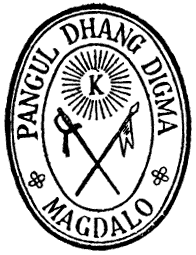
One of the seals of Aguinaldo.

Lancet with which the incisions of the Pacto de Sangre were made.
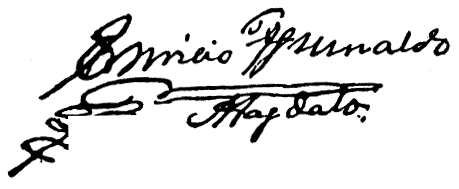
Signature of Aguinaldo.
In Bacoor was a Popular Council presided over by Genaro Valdes with three sections Dimagpatantan (not to leave in peace), Ditutugutan (not to rest till the end is reached), and Pananginginigan (formidable).
As the common belief was that this paper was published in Japan, as would appear from the paper itself, General Blanco decided to send a special delegate to Japan to investigate the matter of its impression, its publishers, authors, etc., that steps might be taken to put a stop to its impression or at least that a check be put on its entry and circulation into the Philippines. Don Alfredo Villeta was chosen; but on account of some hitch in the arrangements, he never started on his errand. Some say that the paper did not reach its second number, but it is certain that it did not reach its third.
The heading was as under:
Kalayaan
Issued at the end of each month.
1st year. Yokohama. January 1896. No. 1.
Price of subscription, 3 months 1 peso; in advance. Articles must be signed by their authors. If purchased will cost 2 reales per number.
The headings of the principal articles were as follows:
To the Compatriots.
Manifesto; by Dimas-Alang (José Rizal.)
What the indian ought to know and understand; by Agapito Bagumbayan.
This latter article is a mirror in which the purpose of the paper is reflected; it reads remarkably like a composition of Pedro Paterno, the visionary who claims for the peoples of the Archipelago a glorious pre-Spanish history and civilization. The following citations from the article will give some idea of the whole publication.
“The Spaniards,” says the writer, “have perverted us with their bad customs and have destroyed and obliged us to forget the noble and beautiful customs of our country.”
Noble and beautiful customs: Compulsory defloration of young girls, as a result of the belief that a girl who died a virgin could not enter heaven! Could anything be more noble and beautiful?
Kalayaan purported to be and was always considered as the soul of the defunct Solidaridad (see note 24). It was printed in the Tagalog dialect and died, as it was born and had lived—in shame.
Whilst in the fields of Balintauac distribution was made of bolos and ten revolvers, the latter stolen from the Maestranza of Manila. On Tuesday evening preparations were made to meet the attack of the Spanish troops which had been sent out in persecution of the rebels, and the first conflict took place. Valenzuela also stated that the greater part of the people who formed the rebel forces were drawn, catechised and initiated all in a moment by the fanatic Laong, who was practically the active chief of the revolt, and who directed in person the attack upon the Chinese stores.
About 5 pm. on the 29th five hundred men under a “leader of Pasig” appeared on the scene at the waterworks. They at once took possession of the building and of the persons of the workmen. Their first intention was to stop the machinery so that no one need be left in charge thereof when orders should be received for a start for Manila. The engineer however, reminded the chief that if such a thing was done their brethren in Manila would die of thirst. This excuse carried the day and the chief decided to leave some workmen there under the condition that the engineer and others who wore moustaches should shave, and that all should dress like indians, and that the engineer’s wife should dress like a native woman and prepare food for his men. The party finally set out on their way. They tried to avoid an encounter with the troops composed of artillery and infantry, 65 men in all, stationed at the powder works. In avoiding this handful of defenders they fell afoul of other troops which gave them a good sharp reception.
As to those who, repenting, desired to return to a legal status, it is difficult to form an opinion, on account of the contrary evidence adduced in connection therewith. Isabelo de los Reyes already cited, in a futile attempt to justify the acts of the Katipuneros, claims that some of the chiefs opposed the plan of the armed resistance as contained in the propositions of Bonifacio, claiming that it would be a great and useless sacrifice, to say nothing of the imprudence of such an act, to launch forth against an armed force without possessing better arms than a few bolos and lances. He claims that Bonifacio listened to the advice and was on the point of acting upon it, but was compelled to take the step he did in declaring the revolt, by the attitude of his 500 followers. The authority for this statement was Pedro Nicodemus, who was the commander of the said group, a man who was as ignorant as he was blood-thirsty.
Further on Isabelo states that “in the famous reunion of Balintauac, in the solemn moment of the breaking forth of the revolt (August, 26th 1896) Andrés Bonifacio as president of the Supreme Council of the Katipunan, explained that the plot had been discovered, and that in order to save those who were compromised and who had not up to that time been arrested, it was necessary to launch forth to the fight, although the arms with which they should fight had not yet arrived from Japan.”
Granted however the character of Bonifacio, his aims and the methods he adopted to carry out his ideas, such an excuse as that of Reyes argue but little in pro of the good judgement or better said the good faith of its author. Bonifacio was anxious for the first blow of the revolt to be struck that he might not lose the confidence of those who had intrusted him with the undertaking and who had been fooled into the idea that the Katipunan forces were so powerful that nothing could resist their onward course once they had been started on their way. And to suppose that Bonifacio was to be so easily influenced by a few petty chiefs is to show a complete ignorance of the character of the hero of the Katipunan. If the opposition of the said petty chiefs really occurred it was probably inspired more by fear of the consequences than by the true spirit of repentance, for if the cruelties and abuses said to have been committed by the Spaniards were the cause of the revolt, what need was there of such a repentance?
The prestige enjoyed by Bonifacio among the katipuneros was natural enough, in as much as he was the father of the Katipunan, the illegitimate offspring of filipino freemasonry, itself a legitimate child of the Spanish family of universal freemasonry.
As we have seen, the intention of the Katipuneros was the annihilation of the Spaniards, irrespective of class or condition. The parish priest being the strongest support of the administration was the target for the bitterest treatment at the hands of the rebels.
Among the number of those parish priests murdered by the Tagalog rebels were P. Toribio Moreno; Recolet, parish priest of Silang; P. Toribio Mateo, Recolet and parish priest of Perez Dasmariñas; and the lay brothers: fray Luis Garbayo and Julian Umbon, these latter were murdered in San Francisco de Malabon. Upon the Estate of Imus, then property of the Recolet Corporation, now in the possession of a large London Syndicate, were most brutally murdered the following Recolets:
P. José Ma. Learte, ex-Provincial and parish priest of Imus, P. Simeon Marin, ex-Definitor and parish priest of Maragondon, P. Agipito Echegoyen, parish priest of Amadeo, P. Faustino Lizasoain, parish priest of Bailen, and the lay-brothers:
Roman Caballero, Jorge Zueco del Rosario, Damaso Goñi, Bernardo Angos, Victoriano López.
It is affirmed by eye-witnesses that these victims to Tagalog fanaticism were saturated with petroleum and burned alive.
Padre David Veras, Dominican, was another of the many victims of the Katipuneros. He was the parish priest of the pueblo of Hermosa in the province of Bataan. When the insurgents attacked the pueblo they captured P. David, and after cutting off both his hands, dragged him to the most distant of the ten barrios of that pueblo, and there hacked him to death with bolos and hatchets mutilating his body in a horrible manner, and throwing the corpse on to a dung heap.
In the early dawn of the 25th of December 1896, in Morong province of Bataan, Padre Domingo Cabrejas, Recolet, was murdered at the altar while offering up the holy sacrifice of the Mass, his blood staining the sacred linen and the steps of the altar. The katipunero murderers hurriedly hid the body in the church and fled.
Padre José Sanjuan, also Recolet and parish priest of Bagac was another victim. To name all those who suffered barbarous treatment at the merciful hands of the insurgents would be a well-nigh impossible task. Recalling the acts of those fanaticised sectarians, one might almost recall the barbarities and brutalities of the diabolical Nero. Certainly the ancient Chinese and Japanese were scarcely more excessive in their treatment of the unfortunate missionaries they tortured in their attempt to stamp out the christian faith; and even the Chinese boxers of our days could have taken lessons from the disciples of Filipino freemasonry. Many, many are the unfortunate missionaries whose blood cries to heaven for vengeance and this vengeance of the God of Justice will one day fall upon this people. Even in our own days we cannot shut our eyes to the fact of the existence of the well marked track of the hand of Divine Justice as it passes here and there throughout the land, calling now upon this one, now upon that, to pay his debt even to the last farthing. The track of the finger of God has been remarkably distinct in this archipelago and many are the cases in which that finger moving slowly and silently along has pointed out the unfruitful tree which the scythe of death shall cut down.
“For I the Lord thy God am a jealous God; visiting the sins of the fathers upon the children until the third and fourth generation.”
The hand of Providence surely has manifested itself of late in this archipelago, here protecting the one from a cruel torture, there permitting the sacrifice of a martyr to the faith or a martyr to duty and honor, and the integrity of the Spanish nation. Here giving one over to a just punishment, there pointing out another as an object for Divine vengeance.
Is proof needed perhaps that the finger of the avenging hand of Divine justice has left its well-marked path in the Philippines? Then we have a notable case before us. A few months ago, a steamer, the Rio de Janeiro, left the Orient bound for the port of San Francisco, Cal. Within sight of the city, almost within sight of the crowds who stood upon the wharf in expectation of the ship’s arrival, the good vessel, by the will of God who rules over all things, went to the bottom, carrying with her, among other passengers, a man who was morally and physically responsible for the greater part of the barbarities practiced upon the long suffering Spanish prisoners, Religious, Civil and Military, at the hands of the Tagalog revolutionists. With that man disappeared from the land of the living his whole family, together with state and private papers of unknown value. How often before in the past history of the world has the God of Justice obliterated whole families and even whole nations!
This net already woven was set, and it needed but the given signal for its string to be tightly drawn and the unsuspecting prey would immediately fall into its folds, to be redeemed only by a barbarous, cruel death. But providence is merciful as well as just, and in her own time opened up a way of escape for the coveted prize of the katipunero savages. This opening was no other than Teodoro Patiño, himself a member of the diabolical society, the plot of which he was to reveal.
Patiño was one of the many compositors in the printing establishment of the Diario de Manila. He was an indian of but little importance both as regards his abilities as a workman or as a katipunero: he was one of the thousands of unknowns from which have sprung so many of those sadly famous ignorantes and others of our own days. But he was destined to act an important part in the society to which he belonged: a part however not in the programme of proceedings drawn up by the society.
A discussion took place one day as to the subscription the said Patiño should pay into the common funds of the society, and heated words passed between him and his companions on the subject. From words they came to blows; and as Patiño was one against many he came out of the tussle second best, having received a good sound thrashing for daring to differ from the majority. To satisfy his injured feelings he looked around him for some one from whom he could expect sympathy, and he bethought himself of his sister who was a pupil of the College of Mandaloya, under the care of the Augustinian Nuns. To his sister he repaired and to her he told his tale of woe, making mention at the same time of a certain society to which he and his assailants belonged.
The sister startled by what her brother related, questioned him closely, as only a woman can question when she wishes to get to the bottom of anything. Having been a pupil of the Augustinian Nuns for a considerable time and preserving in her heart sentiments of gratitude little known among the peoples of the Archipelago, she was much hurt to hear of the plans mapped out by the Katipunan for the brutal destruction of those who had always been so good and kind to her and her brother. And before Patiño could tell all his tale, his sister had bidden him good-bye and gone off in search of the Mother Superior of the College, to whom she immediately told all she knew of the affair. The two women trembling with fear for the safety of the lives of so many hundreds of innocent victims, hurriedly sought the presence of the Rev. Padre Mariano Gil, Augustinian, and parish priest of Tondo. This Rev. Father, realizing the enormity of the Katipunan plot, advised them to send Patiño to him without delay.
Patiño presented himself at the convento and underwent a close examination at the hands of Padre Mariano. At first little progress was made, as Patiño feared both the anger of the authorities and that of his fellow katipuneros, who would doubtless take revenge upon him according to the laws of the society, for his tale-telling. And in spite of the fact that he tried at every turn to avoid telling the naked truth, and to escape here and there by professions of ignorance, he eventually manifested to P. Mariano Gil all he knew of the society, of its plans and of its resources. After a long and tedious conversation, the patriotic Augustinian was gratified with the knowledge of where to lay his hands upon hidden documents etc., which would throw much light upon the purposes of the society of cut-throats. P. Gil immediately set to work to disclose the hidden secrets.
“Without losing a moment,” writes P. Mariano Gil, to a friend who had asked of him the true story of what took place on that memorable occasion, “I sent notice to the Lieut. of the Veterana of this sub-division, D. José Cortés, to whom in the presence of the denouncer, Patiño, I communicated the most necessary data, giving him at the same time the names of all those persons in the printing establishment who were compromised, commencing with the two who signed the receipts, Policarpo Tarla and Braulio Rivera, indicating to him the manner of procedure for the detention of all those complicated.
. . . . . . . . . . . . . . . . . . . . .
... “I decided, confiding in God, to go alone to the printing establishment, at a time when none of the workmen should be present.”
The writer goes on to explain how he made known his mission to D. Ramón Montes and two other Spaniards who, astonished at the news, aided in the search for the documents, stones etc. After a half hour’s search the lithographic stone was discovered, and like a tiger springing upon its prey, the zealous son of St. Augustine pounced upon it, as though he feared that the very roof of the building should fall in upon it and bury it beneath its rubbish out of reach of his hands. A proof was taken from the said stone, of the Katipunero receipts, and P. Gil immediately set off in the direction of the Veterana of Tondo where he met Patiño, who recognized the receipt as authentic, and two hours later the Patriotic Augustinian saw his efforts crowned with the confession of guilt of the delinquents, the two previously named, figuring at the head of the list. Having performed this, P. Gil humbly wended his way back to his parochial dwelling, satisfied to have been an instrument of divine Providence for the unravelling of one of the most bloodthirsty plots ever invented by the perverse mind of embruted mankind.
At midnight was discovered in the locker of Policarpo Tarla, in the same place, a dagger, the regulations of the Katipunan and several documents having connection with the said society, all of which, together with the famous lithographic stone, were handed over by Sr. Montes to the Veterana.
On the following day P. Gil discovered in the house of one of his parishioners a dagger identical to the one mentioned, also several receipts in Tagalog with the key of the symbolic language in which they were printed.
“This”, affirms P. Gil, “is the truth of the discovery.”
There can be little doubt that Patiño was directly inspired more by the thrashing he received than by providence, although it is not possible to deny that the thrashing and the consequent divulging of the secrets of the Katipunan were providential. And as regards to his repentance, I doubt judging from the character of the average indian, whether he really felt repentant till the enormity of the crime to which he was an abettor was brought home to him by P. Mariano Gil. Be that as it may. The ways of Providence are hidden from us and we can seldom see, with our human eyes, more than the actions of the human reason. Yet the truth remains, that whether directly or indirectly inspired by providence it was Patiño’s action which saved Spain “from an unending series of bitter experiences.”
“P. Gil was born in Carreon de los Condes (Palencia) on the 2nd of July 1849. Whilst still young he entered the Augustinian College of Valladolid. His studies concluded, he passed to the Philippines where he filled the duties of parish priest in several Tagalog pueblos. Till recently he has been holding the position of parish priest of Tondo, a suburb of Manila. He was fortunate enough to discover the plot of the insurrection on the 19th of August last, denouncing it at an opportune moment. The Spaniards gathered in manifestation to the palace of the Governor General; Sr. Blanco did not condescend to receive them and they therefore went at once to pay their respects to P. Gil and the Archbishop, both of whom congratulated them for their patriotic attitude. A newspaper of Manila, El Español, published the picture of the parish priest of Tondo; but scarcely had the first copies of the paper appeared on the street, than General Blanco ordered their suppression, commanding that a new edition be printed omitting the said picture and the laudatory phrases which the El Español had dedicated to the eminent Augustinian, from this time a note-worthy patriot to whom the public did a justice which General Blanco either did not know how, or did not wish to do him.”
“His character is gruff; he asks nothing, he demands; he does not beseech, he asks; and what he demands and asks is just and lawful, because it bears in its essence the benefit of mankind, aiding the unfortunate, warding off their dangers, delivering them from the attacks which envy and vengeance might deal out to pacific and humble people. He is inflexible with the reprobate and disloyal, magnanimous with those who have been deceived; proud with the haughty and humble with the weak, and in his generous life has wiped away many tears, distributed much bread to the poor, and many times proportioned assistance to the needy that they should not fall into want.”
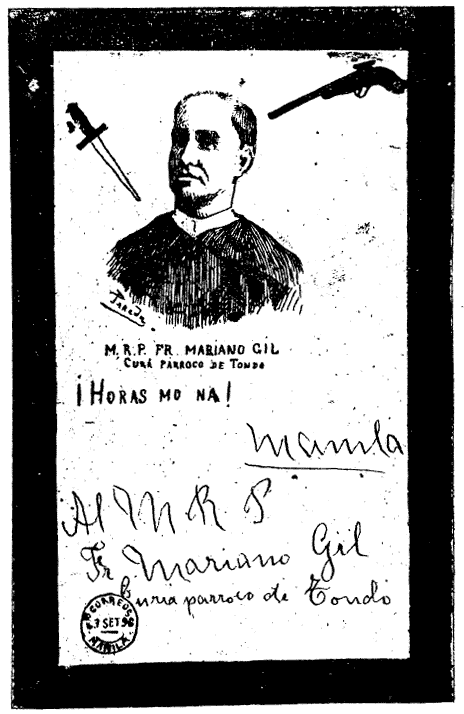
The good work done in the discovery of the diabolical plot of the Katipunan, has very naturally been the object of a great amount of bitter criticism at the hands of the separatist element, which has never pardoned the valiant Augustinian for springing their carefully laid traps. He was denounced in the lodge rooms of Filipino freemasonry, from one of which was despatched a letter directed to him and bearing his picture, as will be seen in the accompanying illustration. His discovery was depreciated and belittled, and made to appear a farce. His patriotism was called into question and his very life was placed in imminent danger.
However the torrents of lies that have poured forth against him have not, and can not obliterate the truth.
The second execution took place in Cavite, thirteen rebels being shot. These were Francisco Osorio, Maximo Inocencio, Luis Aguado, Victoriano Luciano, Hugo Pérez, José Lallana, Antonio San Agustin, Agapito Conchu, Feliciano Cabuco, Mariano Gregorio, Eugenio Cabezas and two constables of the public prison of the province. These constables had pressed into their traitorous service a number of the muchachos of the prison. Francisco Osorio was a very wealthy Chinese half-caste. He had been honored by Spain with several honors, among them the Grand Cross of Carlos III. He was very intimate with the authorities in Cavite. His father, a wealthy Chinee, and his cousin, a doctor, both denounced him at the moment of his execution.
“After the reading of the sentence,” says an eye-witness, “in front of the square which we formed, he commenced to cry, asking pardon of the General and of all Spaniards; he affirmed that he was a Spaniard and that he would never conspire again against the country in which he had been educated, and he cursed the freemasons who in Madrid had initiated him into the hatred of religion and the fatherland. The doctor his cousin, turning to him, said: Silence Osorio! don’t cry so; what will the Spaniards benefit from your repentance; but the miserable fellow paid no attention to him, and asked to be allowed to kiss the Spanish flag before he died. This permission was not granted.”
Maximo Inocencio was the proprietor of a large store and was a contractor to the Arsenal. He had been previously arrested for implication in the revolt in Cavite in 1872. At that time he escaped but was afterwards pardoned; the signal rocket was to be fired from his storehouse in Cavite.
Luis Aguado was also a contractor for the Arsenal.
Victoriano Luciano, a chemist, was a wealthy half-caste who had not lived long in Cavite.
Hugo Pérez, was an indio. He was the venerable of the masonic lodge. In his house were discovered two large photographs in which the majority of the thirteen persons executed were photographed in the form of a triangle; a book with a triangle and other masonic insignia on its front page, and four important letters of anti-Spanish masonic propaganda.
Lallana was a tailor, and some say a peninsular Spaniard. For a while he was chief of police of Cavite and had been a corporal of Marines.
Antonio San Agustin was an indian, a petty merchant and a man who could scarcely bear the sight of a Spaniard.
Agapito Conchu was a master of a primary school, and a half-caste. He had once been detained in the time of Despujols but granted his liberty. Apart from his school, he gave lessons to some of the children of the Spanish families of the town, including the daughter of the Governor of Cavite.
These executions were followed by that of a member of the Guardia Civil, Mariano Magno, in Nueva Ecija. Magno had always been noted for his lack of obedience to his superiors, his hatred of discipline and ill-feeling in general towards Spaniards. Fifteen others were shot in Iligan on the 28th of October of the same year. Many others suffered the like penalty in different parts of the Archipelago.
He entered the office of the notary Numeriano Adriano to practice law, and whilst there employed, was drawn by Adriano into the net of masonry, joining the lodge Balagtas which was one of those founded from the overflow of the original Filipino lodge Nilad. Adriano was the venerable of the said lodge. When the Liga Filipina was formed and had gotten well into working order Mabini was named a councillor of the superior Council (see page 28). According to the testimony of Moises Salvador (see page 296) Mabini was also secretary of the Association of Compromisarios.
Once more free, Mabini left Manila for his own pueblo of Tanauan where he lived quietly till Aguinaldo was brought over in 1898 by Admiral Dewey to serve as a bush-beater to the American forces. Mabini was thereupon carried from Tanauan to Cavite where he joined the faithless Magdalo.
In Cavite he drew up a project of a constitutional law for the Philippines. In the first page of this he affirmed that the precepts of the Ten Commandments were an invention of the friars! And yet Mabini was the Filipino Solomon. He instructed the people that they ought not to believe in the said decalogue or practice what it commanded, but that they should only practice the precepts of the Verdadero Decálogo which he prepared and gave to the public as their spiritual guide.
Mabini very soon became radical and decidedly anti-American in his ideas, and succeeded in attaining such moral ascendancy over Aguinaldo that the latter ceased to be the leader of the people and the true dictator of the Filipino republic, becoming a toy in the hands of a man who could twist and turn him here and there at his will.
Mabini refused to take the oath of allegiance and was, on the 7th of January 1901 deported under General Order No. 4 to the island of Guam, as one of the persons “whose acts clearly demonstrate them to be favorers or sympathizers with the insurrection.”
Others called for the Spanish constitution with its consequences: the liberty of the press and the liberty of associations. Liberty of the press was ever an unknown quantity in the Philippines. The idea of the liberty of the press is very beautiful when its liberties are not abused; it was the abuse of what little liberty the press enjoyed, in the latter days of Spanish rule, that induced the authorities to impose such a close censure upon it as they did. Whatever may be said in its favor, press censorship and such sedition laws as we enjoy to-day in this nondescript piece of the world’s surface, are more proper of absolute monarchies than of territory of the U. S. of America, although in our particular case we might as well be under the despotic, ever deteriorating rule of Aguinaldo, as that of a body of men whose intentions however good and sincere they may be, fall short, when put into practice, of the proverbial ingenuity in governing, of the famous Sancho Panza in his island of Barataria. Freedom of the press is at times a blessing, and at others a curse. From 1888 to 1896 it would have been more of the latter than of the former; for giving such a liberty to the separatists who asked it, would be arming the enemy with the best arms.
As to liberty of associations. People in the Temperance world often ask themselves, does prohibition prohibit? Some make themselves believe that it does; but practice has shown what common sense tells each and every one of us, that it does not; for if a man (and I do not wish to be so ungallant as to exclude the ladies) cannot get what he wants legally, he as a rule sees that he gets it somehow. And so with the Filipinos who, denied the liberty of association, defied the authorities and held their gatherings in secret and secluded places.
All these various political ideas were decidedly advanced in as much as they had relation to a people in no way prepared to receive them. No father would put a loaded revolver or an open razor into the hands of his child; but those were the very things the separatists were howling for.