Notes. (continued 2)
Reading edition
No country has ever done for her colonial children what Spain did for the Filipinos during the three centuries she held control over the Archipelago; and yet how far are the people from the state of culture of the Japanese! Well might the leaders of the people look to Japan as a model!
“Antonio Salazar (fol. 1,118–1,129) stated that “of the junta of compromisarios there formed part: Cortés, Español and Ramos, who were then in Japan petitioning that Empire to aid them with arms, ships and money....”
Isabelo de los Reyes, in telling the Governor General, Primo de Rivera, what he affirmed to be the truth of the situation in 1897, stated that “the Filipino burguesses had nominated a commission composed of Doroteo Cortés, Ambrosio Rianzares Bautista, José A. Ramos and Marcelo H. del Pilar, the latter of whom died in Barcelona whilst on his way to Japan. This commission had for its object the securing of the protection of that empire; Cortés, as president, gathered funds to sustain Ramos and Isabelo Artacho Vicos, who were his agents in that country.”
On another occasion this same individual testified (fols. 1,118–1,129) that “the Compromisarios agreed to employ the sum (of money gathered for another purpose) for the purpose of aiding the stealing away of the person of Rizal from Dapitan, for which purpose they sent it (the money) to Timoteo Paez, at Singapore that he might engage a steamer which should go to Dapitan; and as they could not realize the undertaking, they sent the money to José Baza who lived in Hong-Kong, and Baza sent the money to Sandakan (in Borneo) so that a ship might be engaged there for the purpose.
On the 13th of January 1895, the Gr∴ Pres∴ of the Gr∴ Cons∴ Reg∴, bro∴ Musa, gr∴ 18, wrote to the lodge Modestia, as follows:
“A∴ L∴ G∴ D∴ G∴ A∴ D∴ U∴
A la Resp∴ Log∴ Modestia No. 199.
S∴ F∴ U∴
Ven∴ Maes∴ Pres∴
“Together with this notice we have received another that the said bro∴ lacks absolutely the resources for such a long voyage ... etc.”
. . . . . . . . . . . . . . . . . . . . .
“In virtue of this, I write to you that, bearing in mind what I have explained, you may arrange to be collected from the members, the pecuniary aid they wish and are able to contribute for the meritorious work in question.”
. . . . . . . . . . . . . . . . . . . . .
The Gr∴ Pres∴, Muza.
José Dison Matanza testified (fols. 1,132–1,138) that “the Secret Camara of the Katipunan gathered together and decided upon another plan, which was, as Bonifacio told the witness, to embark a large number of people as passengers on a ship which was to go to Dapitan; and these when they were upon the high seas, were to surprise the crew and take possession of the ship; they should then steal away Rizal from Dapitan and take him wherever they could.”
“According to what is said, Ramos interviewed, on several occasions, Prince Konoy, General Yamagata and the Count of Tokogana, who was then a minister. These gentlemen, it seems, were sympathizers with the idea of our independence under the protectorate of Japan, as in Korea, and that they proposed, as a means of gaining it, the fomentation of Japanese immigration in the Philippines, and that when once this was attained, the seeking of a conflict with Spain.”
Further on he states that: “Some days before the insurrection broke out, Isabelo Artacho brought me a letter from José A. Ramos, in which he gave me an account of the efforts they were exerting to influence the leading politicians of Japan, to the end that they should aid us to secure our independence. Artacho told me verbally the details and that he knew that the liberal party of Japan, which then was the opposition, sympathized with the idea, and proposed as a means of attaining it, the seeking of a cause of conflict with Spain, introducing Japanese emigrants to that end.”
The work of propaganda carried on by certain Filipinos cannot be called into question; but what is very uncertain is whether or not the Japanese extended the wished and hoped for assistance. To be received in interview, and to be heard with attention, are two very different things. A father listens to the idle prattle of his child, but the childish words leave no other impression on his mind than their cuteness merits at the time. This is probably what occurred between Cortes and Ramos and the so-called “official” element of Japan.
José Dizón Matanza questioned on the same subject, affirmed (fols. 1,132–1,138) that he was invited to the “Bazar Japonés,” to salute and welcome the commander of the cruiser (Kongo).... When he arrived they gave him iced water.... About an hour afterwards there arrived an officer of the ship who said he was the doctor, and soon after the commander arrived; all saluted him.... On the evening of the same day Bonifacio, Valenzuela and the witness went to Nagtajan to the house where lived the Japanese who kept the Bazar.... Bonifacio told them they had a letter to give them. Three or four days later on, Valenzuela presented himself at the house of the witness with a letter in Tagalo which read more or less as follows: (here follows what the witness remembered of the letter.) Bonifacio signed it as president of the Supreme Council of the Katipunan, Jacinto as secretary, Valenzuela as Fiscal and the witness with the name of José Talin.... After the departure of the Commander, the witness enquired of Bonifacio what result the letter had obtained, Andrés replying that the Commander had taken a copy of it, returning the original, because the persons signing it were not representative; but that the said officer was very pleased with the pictures given in the name of the Katipunan, and with the melons and mangoes sent from Cavite.”
Isabelo de los Reyes affirms that: “When the Japanese cruiser Kongo visited the port of Manila in May 1896, the Supreme Council of the Katipunan went to salute its commander in the upstairs of the Bazar Japonés, situated in the plaza del Padre Moraga, and handed him a manuscript setting forth their desire for the aid and assistance of Japan towards the gaining of independence for the Philippines. They also offered him a picture and some native fruits.”
“The commander received them well and even regaled them with iced drinks and coffee, but did not dare to accept the document, limiting himself to the taking of a copy of it and promising to transmit their desires to the Emperor; he also invited them to make a voyage to his country. Nothing has since been heard of the commander.”
So much for the testimony given concerning the Kongo and its commander.
Information I have obtained from Japanese semi-official sources on this point, shows that the Kongo steamed into Manila bay in 1896 in the same manner as it did recently, on a non-official visit. As was customary, the Japanese Commander and other officers visited the Japanese Bazaar in Plaza Moraga as well as other Japanese business houses. The Bazar Japonés was a center to which friends and acquaintances gathered to salute the visiting officers. Upstairs were prepared iced drinks, etc. for those who cared to take them. Bonifacio and others, uninvited, walked in and presented themselves and their petition and offerings. The latter the commander accepted; the petition he did not accept: in this he showed good sense. As to the supposed copy which he promised to take, evidence goes to show that it was not taken, but that the said commander merely made a few notes of it on a scrap of paper. The proprietors of the Bazar ridicule the idea that the commander favored the petition or received the so-called commission with pleasure; their opinion is that to which any investigator of the affair would come, that the Commander was a gentleman and did not wish to hurt the feelings, by his refusal, of even such ignorantes as those who at that time forced themselves upon him.
As long as he held supreme influence Rizal was satisfied; but as the separatist element was becoming weary at the long absence of its “Moses” and had begun to worship the “calf” (not a golden one, by the way) “Moses” got angry and threw down, in disgust, the “tables of the law.”
Reyes, in his oft-quoted “Memoria” to the then Gov. General, Primo de Rivera, in a mad attempt to prove that the insurrection was owing to the “friars” and that they attempted to invent the Katipunan plot to cover up their treason, says:
“Above all, the friars committed the criminal and suicidal infamy of calumniously including in the Katipunan the millionaire and aristocratic element, and the middle classes, the fact being that they had nothing in common with the plebeian association which they not only despised for its low condition, but which the few who knew of its existence must have hated, if not for egotism, for the socialistic tendencies of the said group.”
Such assertions scarcely deserve comment, for from beginning to end, the proceedings against the separatists were in the hands of the civil authorities, the members of the Religious Orders having no influence whatever in the matter, although it was they who, by their watchfulness over the interests of the country had detected symptoms which they, as true patriots, made known to the civil authorities. True it is also that a friar, Padre Mariano Gil, made known, at a critical moment, the plot of the diabolical society, in time to prevent the bloodthirsty fiends rising in a night and cutting the throats of those who had been their benefactors; but the “friar” was never a secret service agent of the Government. What he did was what every patriotic Spaniard would have done under the circumstances. It was the civil authorities who, upon the discovery of the plot, caused the arrest of those complicated, and who tried and passed judgement upon the guilty. If millionaires and others were counted among the members of the Katipunan it was because they were guilty of the same treason as the katipuneros and not because they were “included” by the “friar”.
“... Association which they not only despised for its low condition, but which the few who knew of its existence must have hated, if not for egotism, for the socialistic tendencies of the said group.”
So says Isabelo de los Reyes, the founder of the late Filipino Democratic Party, and the Workman’s Democratic Union, the most socialist movement in the history of the Philippines. So much for the Liberty, Equality and Fraternity which they all professed.
The writer goes on to show that the three main things needed for the Revolution were 1st: an active propaganda of separatist ideas; 2nd: funds to cover expenses and to purchase arms, and 3rd: a considerable number of persons ready to take up arms in the field. The first two of these main things were to be attended to by the Liga and the third by the Katipunan.
“In the greatest utility in attaining the ultimate end of the initiators and directors of the conspiracy, must be sought the distinction between the Liga and the Katipunan, and the difference which the one or the other society enjoyed.”
“In all other things, both societies, or both organisms of the same society, co-exist, and display their activity jointly, the campaign of the Katipunan or that of the Liga being the most active; according as the necessities with which the one or the other were preferentially encharged to satisfy the final triumph of the revolt, might be of the greatest urgency or immediate utility.”
The fact is that the Liga and the Katipunan were the distinct foundations of two personal enemies, both of whom wished to hold for himself the position of supreme chief of the movement. (See note 70).
D. Manuel Luengo, Civil Governor of Manila, in a report to the Minister of Foreign affairs, speaking on the subject of the Katipunan, says:
“To carry to a head their fearful and criminal idea, they found it necessary to recruit many people of all classes and from all the provinces, seeking a useful means to facilitate the conjuration. And the indian being by reason of his ignorance and his barbarianism, like all peoples of his kind, easily fanaticised, they set to work to fanaticise the masses, these hordes of childish people, these ignorant laborers; and they fanaticised them by means of the pacto-de-sangre, making them swear war to the death to Spaniards, practicing an incision in the left arm, and with the blood which flowed from the wound made them sign their frightful oath.”
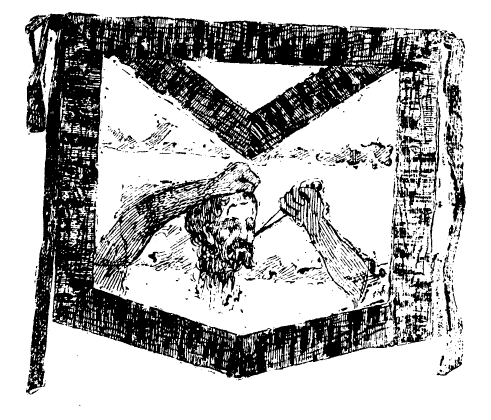
José Dizon y Matanza (fols. 1,129–1,131) testified that “on the same day in which General Despujols ordered the publication in the Gaceta of the deportation of Rizal, there gathered in a house in calle Ilaya, Bonifacio, Arellano, Valentin Diaz, Teodoro Plata, Dina and the witness; and they agreed to form a society to be known as the Katipunan, the object and ends of which were to be filibusterism, or, in other words, the liberty of the country from Spanish rule; the six persons present immediately proceeded to perform upon themselves the incision of the pacto-de-sangre, signing with their own blood a blank paper, placing after the signature, the symbolic name each chose for himself. They then drew up the programme of the Society. This programme was composed of 6 articles, viz.: 1st: to constitute a secret society known as the Katipunan; 2nd: that the organization was to be by triangles, to the end that no more than three members should know one another; 3rd: that the initiated should pay one real entrance fee, and a half real as a monthly subscription; 4th: that as the number of the members increased they should found one or more balang̃ay in each district; 5th: to try to gather funds to carry out the purposes of the society; 6th: that when the opportunity occurred they should reform these articles.
They also agreed upon the form of oath which should be taken by the initiated, which was to promise to shed even the last drop of blood for the liberty of the Philippines.
The Katipunan was founded upon masonic usage adapted to the character of the association. Its formation was one of triangles, each new Katipunero being bound to attract to the association, two others to occupy the opposite angles. This formation was eventually changed on account of the extent to which the society extended, its management becoming very difficult. The particular triangles were broken up and the association formed in three degrees. The first degree was composed of the recently initiated members. These each possessed a mask and some form of arm, either fire-arm or bolo, the cost of which was borne by the member possessing it. The members who enjoyed the second degree also possessed masks and wore as a regalia a ribbon to which was attached a medal bearing a letter (equivalent to K) of the old-time form of script of the pre-Spanish filipino; also a sword and banner crossed.
The third degree members possessed red masks, the color being distinctive of the degree, in the same way as the color of the second degree was green, and that of first, black. These colors were symbolic: green signified hope, and red, war. Black was but a general color common to bandits all the world over. The masks of the third degree bore a triangle with three K’s in the upper part, in the ancient Filipino script, and at the base the letters Z∴ Ll∴ B∴ (see at commencement of book). The inferior inscription signified “sons of the people.”
Each degree had its pass words and the members only knew those of their own degree.
This was the latter form of the Katipunan in which it differed somewhat from the Liga.
Pilar’s plan was revolutionary; Bonifacio’s truly anarchistic.
Among the “chosen people” who testified before the Schurman Commission were two of the three native members of the present U. S. Commission, Tavera and Legarda. Both of these, among many other statements which will not hold water, had something to say on the subject of the Katipunan.
Legarda stated that: (see Report of the Philippine Commission, 1900; vol. II page 377.)
Tavera gave his opinion as follows: (see same Report, page 399. Vol II).
As the reader can easily see for himself there is considerable difference between the statements of these two persons; a comparison of these with the real facts of the case will show how easy it is for a certain element to distort truth when it serves its purpose. I have quoted these two “chosen” people, not that their statements may go down to posterity as history (which has been distorted sufficiently), but because both Tavera and Legarda formed part of Aguinaldo’s mock government—the Filipino Commune; and therefore both of them had plenty of occasion to know the real facts of the case, facts they evidently desired, for some reason, to distort.
It was this hatred for things Spanish that gave rise to the bitterness demonstrated against the Religious Orders. The friar was a Spaniard, the most Spanish, as a general rule, of all the Spaniards in the Archipelago, and as such became the principal target.
(See page 148).
“Malolos, Jan. 9, 1899—Instructions to the Brave Soldiers of Sandtahan of Manila.
Gifts as Covers for Attack.
“Art. 2. All of the chiefs and Filipino brothers should be ready and courageous for the combat, and should take advantage of the opportunity to study well the situation of the American outposts and headquarters, observing especially secret places where they can approach and surprise the enemy.
“Art. 3. The chief of those who go to attack the barracks should send in first, four men with a good present for the American commander. Immediately after will follow four others, who will make a pretense of looking for the same officer for some reason and a larger group shall be concealed in the corners or houses in order to aid the other groups at the first signal. This wherever it is possible at the moment of attack.
To Murder in Woman’s Disguise.
“Art. 4. They should not, prior to the attack, look at the Americans in a threatening manner. On the contrary, the attack on the barracks by the Sandtahan should be a complete surprise and with decision and courage. One should go alone in advance in order to kill the sentinel. In order to deceive the sentinel this one should dress as a woman, and must take great care that the sentinel is not able to discharge his piece, thus calling the attention of those in the barracks. This will enable his companions who are approaching to assist in the general attack.
“Art. 5. At the moment of the attack the Sandtahan should not attempt to secure rifles from their dead enemies, but shall pursue, slashing right and left with bolos until the Americans surrender, and after there remains no enemy who can injure, they may take the rifles in one hand and the ammunition in the other.
Firebrands from the Housetops
“Art. 6. The officers shall take care that on the top of the houses along the streets where the American forces shall pass there shall be placed four to six men, who shall be prepared with stones, timbers, red hot iron, heavy furniture, as well as boiling water, oil and molasses, rags soaked in coal-oil ready to be lit and thrown down, and any other hard and heavy objects that they can throw on the passing American troops. At the same time in the lower parts of the houses will be concealed the Sandtahan, who will attack immediately.
“Great care should be taken not to throw glass in the streets, as the greater part of our soldiers go barefooted. On these houses there will, if possible, be arranged in addition to the objects to be thrown down, a number of the Sandtahan, in order to cover a retreat or to follow up a rout of the enemy’s column, so that we may be sure of the destruction of all the opposing forces.
Women to Prepare “Bombs”
“Art. 9. In addition to the instructions given in paragraph 6, there shall be in the houses vessels filled with boiling water, tallow, molasses and other liquids, which shall be thrown as bombs on the Americans who pass in front of their houses, or they can make use of syringes or tubes of bamboo. In these houses shall be the Sandtahan, who shall hurl the liquids that shall be passed to them by women and children.
“Art. 10. In place of bolos or daggers if they do not possess the same, the Sandtahan can provide themselves with lances and arrows with long sharp heads, and these should be shot with great force in order that they may penetrate well into the bodies of the enemy. And they should be so made that in withdrawal from the body the head will remain in the flesh.
. . . . . . . . . . . . . . . . . . . . .
”Emilio Aguinaldo”
The following official notice posted up in Sta. Cruz, Laguna, is another interesting example of the extent to which this race hatred spread:
Notice.
The traitor Honorato Quisunbin, who in an evil moment denied his country, died yesterday.
To-day, one no less a traitor and renegade to his mother country, has also died. He who has been the cause of so many husband-less wives and fatherless children, has received a punishment for his crimes which will prevent him from repeating them.
We will allot to-morrow, for the punishment of the remainder if they do not change their conduct, but continue to follow the steps of the above mentioned. For this reason, beloved compatriots now that you have witnessed the punishment given to those who have left the path marked by our authority which our government conferred on us although we are unworthy of it, but as we have been appointed, we have forcibly to obey all the decrees published, for the crimes which are punishable by death and which are as follows:
1st. All those who have any public or private communication with the enemy and serve them as guides;
2nd. All those who attack and rob in a band;
3rd. Violation or abuse;
4th. Incendiarism;
5th. All those who receive any position or employment in the service of the enemy.
(Signed) The Compatriots.
This race hatred is illustrated very clearly in the definition of the Katipunan given by Romualdo Teodoro de J., when he said that its aim was to kill all Spaniards and take possession of the islands. No particular hatred was shown to any class; it was all Spaniards of all classes and conditions who were to be assassinated. It is also clearly depicted in the Act of Session of the Katipunan Sur already quoted (See page 81; also foot-note page 80).
In November 1895 the assembly of the Katipunan was composed of ten individuals of the Supreme Council, and the presidents of the popular sections who were entitled to assist in virtue of holding some office therein.
In January of the following year of 1896, after the annual election, the assembly was composed as follows:
President Andrés Bonifacio.
Secretary Emilio Jacinto.
Treasurer Vicente Molina.

Pantaleón Torres.
Hermenegildo Reyes.
Councillors Francisco Carreón.
José Trinidad.
Balbino Florentino.
Aguedo del Rosario.
Fiscal Pio Valenzuela.
Among the papers and documents belonging to the Katipunan Sur, seized by the Spanish authorities, is the following:
“Commissioned for the purchase of arms:
D. Gabino Tantoko

D. Juan
D. Antonio
D. Ezequiel
D. Epifanio Ramos.
D. Victoriano Luis for the distinct armories of Manila.”
In a letter of the Secretary to the President D. Agustin Tantoko (a native priest; see page 79):
“I believe we can obtain the dynamite by bribing some of the harbor employees.”
This letter has a foot-note which says: “When you have read this, destroy it.”
Numeriano Adriano testified (fols. 1,309–1,312) that Andrés Bonifacio had collected 10,000 pesos for the purchase, in Japan, of 4,000 rifles with abundant ammunition.
He also stated that the arms had been purchased and were to be landed near by the mountains of San Mateo and in the Batanes islands, from whence they would be brought to Manila.
That “Andrés Bonifacio went to San Mateo with men to receive and arrange arms, whilst Deodato Arellano and Timoteo Paez were encharged to send people to Batanes to the same end.”
Also that “It is said that many of the insurgents in the province of Cavite bear arms of different systems, and he supposed that they must have been acquired by the rich and wealthy persons of that province, such as Francisco Osario and others, who knowing perhaps of the existence of the Liga of Manila, its form and object, had formed their own also, in the said province, in order to unite to that of Manila and make common cause therewith.”
Domingo Franco declared (fols. 1,381–1,382), in answer to a question during his trial, as to what he knew in reference to the purchase of arms and ammunition, that “all he knew was that arms and ammunition had been purchased, because at the end of 1895, or the beginning of 1896, he saw Francisco L. Rojas in his office in Calle Jolo, and the said Rojas told him that he had received a quantity of arms and ammunition.” He stated moreover, that he did not know the make or number, nor where they had been landed.
Tomas Prieto of Nueva Caceres mentioned the receipt of 50 arms from Bato. He also stated that Mariano Melgarejo, according to references from Macario Valentin, received a load of arms in eleven cases from Pasacao.”
Juan Castañeda declared that “the Japanese offered to land here 100,000 rifles with their ammunition, the expense of which should be paid in a fixed number of years.”
Numeriano Adriano also affirmed that it had been decided to purchase arms in Japan and that one of the islands of the Archipelago should be given to Japan in exchange for its aid.
Domingo Abella affirmed that he had visited Francisco Rojas in his office for the purpose of finding out if the arms which the tailor Luis Villareal had ordered for the society, had arrived; and that although Francisco Rojas did not belong to the society, he was encharged to portion out the arms and commissioned to bring them to Manila. Francisco told him that he could not provide him with any as they were all sold.
“Undoubtedly it (the Katipunan) possessed large sums of money, only the most insignificant part of which, according to report, was discovered in the possession of Pio Valenzuela, preserved in gold and amounting, we believe, to less than 30,000 pesos. These resources could not cover the extraordinary expenses of the propaganda, that of the Commissioners sent to Japan to treat with that power on the question of a protectorate, and that of the coming war expenses which were without doubt, very considerable.
“The Indian is not so selfish or so patriotic that he would, without immediate advantage to himself permit himself the extravagance of abandoning the sedentary life he usually leads, to launch out into the field of adventures of doubtful result. Those who from the headquarters of the revolution directed those torpid masses must have realised this, and to make sure of the exit, caused money to be distributed to all the affiliated and to their families, giving them at the same time rice in abundance.
. . . . . . . . . . . . . . . . . . . . .
“This money set aside for distribution in San Juan del Monte, in Pasig and in the pueblos on the banks of the river, must have come from a well stocked treasury....”
. . . . . . . . . . . . . . . . . . . . .
A little further on, the author gives a very broad hint as to one probable source of funds when he asks the question, where is the million and a half pesos which constitute the default in the public treasury of Manila?
“It would be a curious coincidence,” says the author, “if part of this amount perhaps the greater part should have served as funds from which the expenses of the revolution and the war were paid.”
The initiated previously instructed by his god-father, or by the person who catechised him, was to reply that, at the time of the arrival of the Spaniards, the Filipinos living on the coasts enjoyed a certain amount of civilization, since they already had cannons and silk dresses, that they enjoyed political liberty, sustained diplomatic (sic) relations and commerce with the neighboring countries of Asia; had their own religion and writing; in a word, lived happy with their independence. A certain amount of civilization may be. Let us see what that certain amount was:
“Barely clothed, and more often naked, revelling day and night in drunkenness, given to the practice of infanticide, holding virginity as a dishonor, having among them people who practiced defloration as a profession, ignorant of the value and uses of money, making use of men, women and children to pay debts, in continual warfare with one another and enslaving their prisoners, practicing wholesale murder of slaves on the death of a chief or important personage, adoring and sacrificing to rocks, trees, crocodiles and idols of wood; lacking religion, but having in its stead most bestial and absurd superstitions; without temples, monuments or even literature, although they possessed a species of written language. The only human ideas they possessed were adopted from the Chinese, Japanese and Borneo Mohammedans whom they imitated after the manner of apes. This, historians tell us, was the condition of this people 340 years ago! when the missionaries planted the Cross on Philippine soil, and brought to the benighted natives the gospel.” So much for the certain amount of civilization.
Cannons and silk dresses: of a kind; as to the cannons, where did they all come from? Bought from or exchanged with the Borneo moros probably. As to these and the silk dresses, the savages of the south-sea islands enjoyed the use of such things and enjoyed them with better knowledge of how to use them! They enjoyed political liberty; let us see what Morga the historian who speaks most glowingly of the ancient civilization of the Filipino peoples, has to say on this point.
He says: “In all these islands the people had neither kings nor lords to dominate them as in other kingdoms and provinces. But in each island were many chiefs from among the same natives, some greater than others each one with his subjects, by groups and families, who obeyed and respected them. Sometimes these chiefs were at peace with one another and some times at war.... The superiority which these chiefs had over the people of their group was such that they held them as subjects, with power to treat them well or ill, disposing of their persons, children and estates at their will, without resistance or the necessity of giving account to anyone, and for very slight offences they killed and wounded them and made slaves of them; and if it happened that one of the chiefs were bathing in the river and a native passed in front of him or looked upon him with want of respect, and for other similar things, they made slaves of them for ever.” This is a good and practical kind of political liberty, just the kind of liberty the country would enjoy if in the hands of the leaders of the Federal Party, so anxious for liberties for themselves and coercion for those who do not agree with their way of thinking.
Diplomatic relations and commerce with the neighboring countries of Asia: As to the diplomatic relations the mere idea of such a thing is preposterous. If we are to concede the use of diplomatic relations to the ancient Tagalog people, then we must consider as diplomatic relations such customs as the passing of the “peace pipe” practiced by the indian of the United States, and the giving and accepting of young women for sensual convenience practiced in many of the islands of the Pacific up to the present day. As to their foreign commerce let us listen once more to Morga. “Their contracts and negotiations were as a rule illicit, each one considering the best way to come off successful in his business.”
Their own religion: For a religious system they worshiped their ancestors and performed human sacrifices. The Spaniards found in these islands less than a million inhabitants, who were divided into innumerable tribes governed by rulers who had no more title of sovereignty than that they were enabled to impose upon the people by brute force and untold cruelties. The inhabitants formed a jumble of inferior races some more or less pure in blood, others intermixed; people speaking many dialects. They all lacked religion, in the proper sense of the word; they lacked morals, in fact they were wanting in everything that raises man above the level of the brute creation.
As to their own writing, certain it is that they possessed a crude and very inefficient manner of writing, but what is very remarkable is, that in spite of their possessing a system of script, not a single piece of their literary work has yet been discovered nor even a written tradition. This goes to prove that either the Filipinos were at that time too deep in the savage ages to realise the importance of writing, or that the form of script was useless for practical purposes.
The master of ceremonies warned him that he was taking a very important and very solemn step, and he was recommended to retire if he did not feel courage enough to continue since he would uselessly expose his life. If the initiated insisted in continuing with the mysteries of the initiation he was presented to the reunion of the brethren to be tried by the proofs assigned, which were very similar to those adopted in universal masonry, but surrounded with more paganism, if that be possible. He was blindfolded and made to discharge a revolver against an imaginary enemy, a person he was made to believe really was present and awaiting there the executionary bullet which should make him pay the penalty of a treason. If he passed through the proofs successfully he was introduced into the hall of oaths and there with his own blood, drawn by means of an incision made in the left arm between the shoulder and the elbow, he signed the oath.
It is well nigh impossible to imagine to what the liberty of the Tagalog people would mean if it were put into practice. If the South American states which are recognized as independent, are unable to govern themselves in spite of the political superiority of the people inhabiting them over the peoples of this archipelago, without an unending series of revolutions, what might we expect from the Philippines? Give the country independence with one of the native “commissioners” as president of the republic and how long do you suppose it would be before Pedro Paterno at the head of some 5 or 6,000 men would march into Manila to depose the president and proclaim himself Emperor Pedro I? And before the new Emperor could install himself in Malacañan he would have at his heels a thousand and one petty chiefs, princes, kings and perhaps even a few ambitious queens!
It is over a half a century ago since the South American Republics became independent, and at that time the rest of the world cared but little for the consequences of such a step. But this indifference of the nations can never exist here in the Orient at the commencement of this XX Century. It would never suit the rest of the world to see independence declared in the Philippines and especially if that independence left the reins of government in the hands of the Tagalog people.
The question of the expulsion from the country or the destruction of the Spaniards has been spoken of under several notes; the idea was, doubtless, a semi-savage interpretation of the preachings and teachings spread abroad by the Bible societies in all parts and especially in Spanish countries. And this becomes the more probable when we call to mind what the El Imparcial of the 26th of August 1896 published concerning this identical point. Speaking of the state of the country in general as a result of the insurrection, it says:
“The minister of Foreign affairs received a telegram yesterday from General Blanco manifesting that more arrests had been made....
. . . . . . . . . . . . . . . . . . . . .
The conjuration had ramifications in various parts of the Archipelago, and in it figured not only masonic societies but also Bible societies....
. . . . . . . . . . . . . . . . . . . . .
The propaganda of filibusterism is encharged to the colporteurs of evangelical books, who wander all over the Archipelago selling protestant publications.”
K. K. K. N. M. A. N. B.
Section....
I declare that on account of my entrance into the K. K. K. of the A. N. B. I have sworn a solemn oath in my native pueblo and in the presence of a superior of the Junta of the Katipunan, to do away with everything that is possible and even with that which is to me most near and dear and appreciated in this life, and to defend the cause to victory or to death. And in truth of this I swear also to be obedient in everything and to follow in the fight wherever I am led.
And in proof of what I have said I place my true name with the blood of my veins at the foot of this declaration.”
The Council of Ministers of the Supreme popular Council was as follows:
President Andrés Bonifacio.
War Teodoro Plata.
State Emilio Jacinto.
Interior Aguedo del Rosario.
Justice Birecio Pantas.
Finance Enrique Pacheco.
Another case he mentioned was that of a meeting held on the birthday of Bonifacio 30th of November 1895.
The Katipunan moreover had its own festivals. This is how Valenzuela describes them:
He was at one time president of the Katipunan (see p. 44) but being a man little suited to carry out to a successful issue the set plans of the society, Bonifacio determined to remove him, by what Sr. Diaz terms a coup-d’etat, but more properly called an underhand trick. Bonifacio, at that time treasurer, forced a conflict on the subject of the financial conditions of the society, being denounced as an exploiter for his pains. The quarrel was settled by an election, Bonifacio by his unholy influence carrying all before him.
It was during the presidency of Baza that the Katipunan society for women was founded, “the object of which was mutual succor (!). The institution serving at the same time to dissimulate the meetings of the male Katipuneros. Whilst the latter were holding their sessions in a retired room, the women were in the salon with some young men dancing, singing or eating. The presidentess of this society of mutual succorers was Mariana Dizon.
To secure admission it was necessary to be a daughter or sister of one of the male members. Mariana Dizon later on married José Turiano Santiago, and as a result, the female Katipunan, as an organization was broken up, the late members however continuing to shield as before, the labors of the Katipunan reunions.
Valenzuela himself spoke of this trip to Dapitan (see note 16, p. 133) as follows:—
“In the month of May of that year 1896, a reunion was held in Pasig and there it was agreed to send a commission to Japan ... and it was agreed also to commence the armed rebellion, settling the manner in which it should be carried out, but it was decided that, previous to taking action it would be wise to consult with Rizal, the witness being chosen as emissary. The schoolmaster of Cavite Viejo, by name Santos, proposed that a blind man named Raymundo Mata should accompany Valenzuela that Rizal might cure him. The witness embarked on the S. S. Venus at the end of May, meeting on board, one of Rizal’s sisters, and his (Rizal’s) querida, an American or English woman named Josefina; and arriving at Dapitan, the witness went ashore with the two women and a servant that accompanied them, making their way to the house of Rizal, etc., etc.”
According to a statement of Isabelo de los Reyes, “Rizal, as has been clearly proved at the trials (of traitors) advised them to wait another two years, as they lacked arms.”
I wonder if Rizal foresaw the war to break out two years later between Spain and the United States! His intense desire to go to Cuba would give one that idea.
The date of the arrival of the arms, according as appeared from evidence given during the trial of Francisco L. Roxas, was to have been the 31st of December 1896. Lorenzo de la Paz, however, stated that it was the 1st of September of the said year. Others claimed it to be the 13th of September or the 30th of November. As may be easily seen, there was no lack of disagreement among the chiefs of the revolt, and perhaps, as far as the majority were concerned, still more exploitation.
Valenzuela was in fact one of the chief movers of the rebellion; this was confessed by Domingo Franco, the late president of the then defunct Liga Filipina. “The rebellion,” says he, “was produced by a foolish child, whose name it would dirty the tongue to pronounce, because after being the author of all (this however is somewhat inexact) has given himself up to the authorities to denounce those he has succeeded in misleading.”
During his trial in the Bilibid prison, before Col. Francisco Olive y García on the 2nd of September 1896, he gave some of the most interesting and reliable information that has yet been gathered concerning the interior workings and doings of the Katipunan.
Speaking of this giving up of himself of Valenzuela, Sr. José M. del Castillo y Jimenez says: “The forty-eight hours conceded by the proclamation of the Governor Blanco were about to close when there reached the palace of Sta. Potenciana, worn out, bathed in perspiration, and almost in a period of agony, Pio Valenzuela, an important person of revolution he being in such a condition that it was necessary to assist him previous to his passing into the presence of Gov. Blanco. When he had come to himself and was in a condition to make an explicit and ample confession he had two hours conference with the Governor, giving information of as such as he knew.”
. . . . . . . . . . . . . . . . . . . . .
“Valenzuela and Rosario were of great utility in clarifying the facts and especially in the explanation of the cipher documents discovered in the house of Villaruel and others.”
. . . . . . . . . . . . . . . . . . . . .
. . . . . . . . . . . . . . . . . . . . .