Chapter VI · (continued 4)
Reading edition
H. L. P.
The allusion to the danger of Rome appears to relate to the insurrection in Piedmont, where the King was driven to abdicate on March 13. Later on other revolts broke out in Naples and Palermo. In France plots were being hatched against the life of the Duc de Bordeaux (afterwards Comte de Chambord), posthumous son of the Duc de Berry, and grandson of Charles X.
The Memoirs of Anastatius, an autobiography of a Greek renegade, was a novel by Thomas Hope, and was considered his masterpiece. It appeared in 1819.
Penzance, 5 Mar. 1821, Monday.
... This is a short letter, but I am on the eve of a long journey, and the kind friends here require many visits, and notes, and thanks, and so forth: and some of them have lent me Kenilworth, so that must be galloped through. Forgive me therefore, and accept my positive answer by securing me this good lad, who I like the better for his name, Sam. I had once a Footman so called, who could not, and would not be spoiled. He is dead, and poor Hodgkins too, that said he was going to take places for me, with his last breath. He was Sam at the first. I shall be glad to see them both, and remain meanwhile dear Mrs. Pennington's and her good husband's ever obliged and faithful
H. L. P.
Mrs. Piozzi evidently left Penzance in the course of the week. On Saturday she was at Exeter, and after sitting up writing letters till the small hours of the morning, retired to rest, using a light chair to climb up into the bed, which was a high one. But the chair slipped, and gave her a violent blow on the leg, causing a severe bruise and a slight wound. However, she attended the cathedral service next day, though she could hardly kneel, and in due course reached Clifton; taking up her quarters at 10 Sion Row till Mrs. Rudd should be ready to receive her at the Crescent. The accident caused some alarm to her friends, but according to Mrs. Pennington's account, the wound healed rapidly and no evil consequences ensued. But internal troubles followed which neither physicians nor surgeons could overcome. The few short notes which follow, mostly undated, were written during her illness, of which no one for some time anticipated a fatal termination.
Sion Row, No. 10,
Tuesday, 10 Apr. 1821.
Addressed—
Mrs. Pennington, Dowry Square
With 1000 Coms—Sickly ones—from a Taker of Castor Oyl.
(She encloses a letter from Conway).
I got a letter from Mr. Roberts, the Curate of Dymerchion, begging me to make the Parish the present of a Bier, to carry the dead Poor. So I finished my Epistle to Salusbury, which you saw, with letting him know the request; and "tell Roberts," said I, "the favour is immediately granted"; for this is a debt I cannot, surely, be blamed for; and if I am, dear Salusbury must at last be contented to consider me as his unaccountable, no less than his Affecte Aunt,
H. L. P.
Sion Row, No. 10,
Thursday, 11 Apr. 1821.
'Tis I shall be made happy, dear Mrs. Pennington. Our kind and skilful Dickson is just gone. He only waited till things were in the state they should be, I perceive; and to day he brought the tall man again, who performed the operation, and praised my courageous endurance. This for your own kind heart's private information. Mine is completely satisfied of their skill and management.
A thousand respectful compliments await Mr. Davenport, love to Mr. Pennington, threats of ruin at Cards to Mrs. Bellhatchet, and humble service to Miss Wren.
All that was done yesterday and to-day, (rough usage on the whole,) has raised, not lowered the spirits of your ever obliged and faithful
H. L. P.
Undated, on a Visiting Card.
I have been to the Crescent by the Surgeon's permission, and now comes the Doctor to insist upon my eating. I must obey you all, or I should deserve to be neglected by every living creature; and so far as I can, I will obey you.
Poor dear Dr. Dickson! he is as low spirited as myself, he has been among the Lunatics.
On miniature notepaper.
Dated Tuesday.
Very little better, dearest Friend, but certainly not worse, and though unmoved by all the new things swallow'd,—dying for a Paper. Can you direct James where to find one? Shame and Bessy have struggled all night, and the first gets the better. She cannot go to dear Mrs. Pennington without me to help her,—to words, I suppose.
Mrs. Pennington to Mrs. Brown
3 Jun. 1821.
... I knew you would feel for my loss, an irreparable one to me, for if twenty years ago I could find nothing to replace it, I am not likely, in the winter of life, and more particularly after two years of almost daily intercourse, which, by the endearing restoration of more than former kindness and confidence, doubled its value....
At present I can think of nothing, talk of nothing, nor dream of anything but my lost friend....
My best comfort is that I attended my beloved friend to the last moment. For three days and nights I never quitted her bedside, where, at my summons, I had the satisfaction to see her attended by her three charming daughters, and more charming women I know not. Oh! what a sum of happiness did she throw from her, through the misapprehensions, etc., which separated her from them! But in this respect Retrospection is both useless and painful. She was absolutely lost from inanition! She either could not eat enough to support nature, or had brought herself to it from a mistaken system; till, on a slight disorder, a sudden prostration of strength took place, and nothing could be done! She had her wish, however, which was never to live to support the mere dregs of life; and would have made, I think, rather an impatient invalid, under the suppression, or deprivation, of those uncommon powers which rendered her the delight of every one that came near her, to the last. I hope you saw my character of her in the Papers. I should not have had the temerity to have attempted it, but at the earnest request of her daughters, who feared it might be attempted by some one who did not know her as well, and might not have written so much to their satisfaction. It has answered the purpose by silencing all other scribblers on the subject, and met with much more general praise and approbation than it deserves....
Mrs. Pennington to Maria Brown
23 Jun. 1821.
... It is a new thing to me, dearest Maria, to feel reluctance in addressing you. But such is the effect of a late melancholy event, that I shrink from all exertion. It has impressed a languor on my spirits more fatal than grief, and more distressing than positive pain. It was a blow for which I could not be prepared, if indeed we are ever prepared for the loss of those we love; as only ten days before, she had dined with us in a party of ten or twelve persons, and was, as usual, the delight and soul of the company. And the sudden reverse appears to me, even now, at times, more like a frightful dream than a fact! I actually detect myself expecting to see or hear from her, until the sad reality forces itself upon me, and convinces me that time does not lessen those regrets, that time only more clearly and strongly discovers to us the value of what we have lost....
If twenty years ago I could find no substitute, I am less likely when two years of almost daily association, with, as it should seem, increased affection and renewed confidence, gave additional interest to our connexion. While the apparent, but deceptive vigour of her corporal powers, held out a promise of many years of future enjoyment. I firmly believe she fell a victim to the extreme abstemiousness of her habits; actually sunk under inanition! Attacked by a slight disease, there was no reaction in the system. She suffered little and died easy. So far she had her wish, which was always to escape the tedium and imbecility of invalidism, and to preserve her faculties unimpaired while life remained. I had the mournful satisfaction of ministering to her last hours, and of seeing her close those brilliant eyes in the presence of her children; their tears I trust embalmed, and their affectionate attention soothed her last moments. But from better acquaintance with these ladies a new source of regret has opened upon me: that through some strange misconstruction of circumstances, and perversion of mind, my beloved friend should have lost such a sum of happiness, as, but for some most mistaken conclusions, these daughters (the most charming women I have almost ever met with,) could not fail to have imparted. But Retrospection is useless as painful, and it is best to draw an indulgent veil over the imperfections of poor human nature on all sides. They remained at Clifton a week, during which time I was almost constantly with them. It was only from me, they said, that they could gain any accurate idea of their departed Mother's habits and connexions. They were never weary of the interesting subject, and unbounded in their acknowledgments to me for affording them, by timely information, an opportunity of performing their last duty to their parent. I have had the kindest and most flattering letters from them since their return to Town, with an elegant remembrance, from each sister, of my dear deceased friend. It was at their earnest request I had the temerity to give to the Public the last tribute I could pay, which probably you have seen, as it was copied into all the London Papers, and has had much more praise than it deserved. That it answered the end proposed, by silencing certain writers, who, these Ladies were apprehensive, might have given "the Celebrated Mrs. Piozzi's Character" in a manner less agreeable to their feelings, is indeed highly satisfactory to me; and their warm approbation the best recompense and sweetest incense I could receive....
The Obituary Notice, by Mrs. Pennington, mentioned above, ran as follows:
Death of Mrs. Piozzi.—Died at Clifton on Wednesday night, the 2d of May, in the 82d year of her age, after a few days' illness, Hester Lynch Piozzi, the once celebrated Mrs. Thrale, descended both on the paternal and maternal side from the ancient and respectable families of the Salisburys and Cottons, baronets in North Wales, but still more distinguished as the intimate friend and associate of Doctor Johnson, Burke, Sir Joshua Reynolds, Garrick, Goldsmith, Murphy, and most of those literary constellations who formed the Augustan galaxy of the last century. The world has long known in what estimation her society was held in that circle where these illustrious men, with Mrs. Montague, Mrs. Carter, Vesey, Boscawen, and many others, formed a coterie never surpassed in talent and acquirement, in this or any other country. The vivacity of this lamented lady's mind was a never-failing source of pleasure to all who had the good fortune to enjoy her society, while the brilliancy of her wit, tempered by invariable good-humour and general benevolence, delighted all who approached her, and offended none. Her manners were highly polished and graceful—her erudition, the result of a regularly classical education, under the learned Dr. Collyer, was much more profound than those who only conversed with her superficially were likely to discover; for, wisely considering the line usually prescribed in such pursuits to her sex, she made no display of scholarship, yet was always ready to give her testimony when properly called out; indeed, on those occasions, it was impossible altogether to conceal the rich and rare acquirements in various sciences which she possessed. Her writings are many of them before the public, and if some incline to condemn a colloquial style, which perhaps she was too fond of indulging, all must admire the power of genius and splendour of talent she displayed. She was particularly happy in jeux d'esprits, numbers of which lie scattered amongst her friends, and we hope will be collected. Her Three Warnings have long been enshrined, and held in universal admiration as a specimen of the precocity of her talents; on graver subjects, those who knew her best will say she most excelled. Her religion was pure, free from all wild speculative notions—her faith was built on the Scriptures—that rock of our salvation, the continual perusal of which was her delight. She knew "in whom she trusted," and in the fullest conviction of those sacred truths, she closed a various life, declaring to a friend, who watched over her last moments, that she quitted the world in the fear and trust of God, the love of her Saviour, and in peace and charity with her neighbours and with all mankind. Her fine mental faculties remained wholly unimpaired; her memory was uncommonly retentive on all subjects;—enriched by apt quotations, in which she was most happy, and her letters and conversation to the last had the same racy spirit that made her the animating principle and ornament of the distinguished society she moved in, at a more early period of her life. Those who have to regret the loss of such a friend and companion, though continued to them beyond the usual date of human existence, will feel persuaded that as this admirable Lady was unique in the acquirements and combinations that formed her character, so are they sure that they shall never "look upon her like again."
Mrs. Pennington reverts to the same topic in a letter written to Miss Brown on December 3, 1821, in which she regrets that time, and care, and various other circumstances have dulled her powers to render her correspondence interesting and amusing.
"My dear, lost Friend possessed that talent in a wonderful degree. Her letters, however frequent, never ran into commonplace, but were always novel, and had the peculiar tact of always supplying matter for a reply. Never was there a mind of such varied resource as hers! The more I think of it, the more I am astonished that it was not even more appreciated and valued. Because I am persuaded, as Dr. Carrick said, when she lay, an inanimate corpse, before our eyes, that 'the world had nothing to compare with her. She had left no equal.' And that having again found her, she is lost to me for ever, is a subject of regret that no time, during the short remainder of my pilgrimage, will ever lessen. Her advanced age was no preparation to me, because wholly exempt from all those infirmities which usually attend that stage of our existence, and prepare others, if not ourselves, to look to the end. Appearing to have as much the advantage of me in vigour of constitution as in intellect, I looked forward to a few years of cordial and rational enjoyment, and really expected we should have run our race on nearly equal terms, happy to think it would be together. The change was so sudden, that at times I can scarcely persuade myself it is not a dream! and the disappointment so severe it seems to have annihilated all capacity for enjoyment or pleasure in anything...."
Among the friends to whom Mrs. Pennington wrote an account of Mrs. Piozzi's death, was Helen Williams, who replied in a letter dated October 28, 1822: "I read with warm interest all you wrote of the last scene of Mrs. Piozzi, and above all, your article, which is admirable; full of judgment as well as feeling, neither saying too little nor too much, in short, worthy of your pen: but I think you are too indulgent in respect of her daughters. I never could be satisfied with people who testify their tenderness to their friends only when they are at the last gasp. Above all, in the sacred relation which exists between a parent and a child, I think reconciliation and pardon should precede the act of dying: and Mrs. Piozzi being eighty years of age, her daughters must have known there was no time to lose, even before you summoned them to receive her last breath. They had reason to be offended at her second marriage, but life is too short for eternal resentments. Why do you not become her biographer? I am sure no one would write her memoirs half so well as yourself. I shall always love her memory, tho' she never forgave me for coming to France, and severed me from her affections because we differed in politics. If she could have known all I have suffered amid the convulsions of States, her good-natured heart would have been more disposed to pity than condemn."
Soon after the loss of her friend, Mrs. Pennington came into collision with her executors, Sir John Salusbury and Sir James Fellowes. By her will, dated March 29, 1816, she had left everything to Sir John, except legacies of £100 each to her maid Bessy, her old steward Leak, and his son, and one of £200 to Sir James. But outside the formal bequests of her will, she had intended that certain articles should be given as memorials to Conway and Mrs. Pennington. The former was to have her watch, and an annotated copy of Malone's Shakespeare, and the latter the silver teapot and stand which she habitually used, and which is referred to in Mrs. Pennington's letter of 17th January 1820, quoted above. What became of the watch does not appear, but letters in Mr. Broadley's collection show that Conway got his Shakespeare from Sir John, who may have been the more inclined to regard his claim with favour if, as is stated, Conway had just returned the £100 which Mrs. Piozzi had given him just before her death. Mrs. Pennington could offer no such inducement to favourable consideration, and perhaps her remark at the Bath Fête, that her claims to Mrs. Piozzi's friendship were of longer standing than his own, had not been forgotten or forgiven. It appears from Mr. Broadley's letters that she had applied in the first instance to Sir James Fellowes, urging her right to the teapot in somewhat strong terms, on the ground that her friend had actually given it to her, though it had not been handed over, and that she could produce witnesses to that effect, whose testimony would be accepted in any Court. Sir James no doubt referred her to his co-executor, to whom she next applied, though in a more humble strain, asking for it not as a right, but as a favour; reminding him that she had a larger collection of dear Mrs. Piozzi's letters than any other correspondent, and was in fuller possession of her opinions on all subjects, private, public, and literary, possibly than any other person in the Kingdom, which she should carefully preserve. This, she hints, would be practically indispensable to any intending biographer. But Sir John was not to be tempted or cajoled, and returned only three curt lines, declining to discuss the matter at all; while he told Sir James that he should hand over any future letter on the subject to be dealt with by his lawyer. So neither her long friendship nor her loving care for his aunt were deemed worthy of even this not very extravagant recognition.
Her relations with the daughters were far more cordial. In the summer of 1824 she paid a visit to London, where, she tells Miss Brown, "I experienced much kindness, and more attention than I had any right to expect; chiefly indeed from my late dear lamented Friend's three charming daughters, who seemed as if they never could do enough to prove the sense they entertained of my true friendship to their mother. In Town they assisted me to see everything that time and circumstances would permit; and I spent ten delightful days at Miss Thrale's beautiful Villa in Kent, surrounded by Nobleman's Seats, which we visited in our daily morning drives. Knowle Park, the residence of the Duchess of Dorset, is the finest specimen, I believe, of Baronial grandeur in the Kingdom; and the Park (fourteen miles in extent) they say has the noblest Timber of any in England. She kindly carried me to Tunbridge, where we spent two days very agreeably, and we parted with (I am persuaded) mutually increased esteem, and sensible regret."
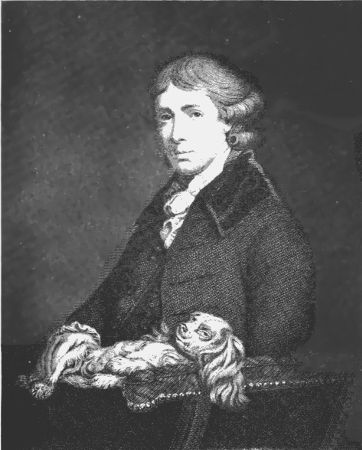
THOMAS SEDGWICK WHALLEY, D.D.
By J. Brown after Sir Joshua Reynolds
From a print in the Collection of A. M. Broadley, Esq.
The following winter Mr. Whalley (as appears from his published Letters) spent in her house. Writing to him in October with regard to his proposed visit, she tells him that she has for some time given up public and private parties. Pennington is tolerably well, "but we are both fallen into the sere and yellow leaf. I do not find my mind get older in proportion to my body. I have as keen a relish for intellectual enjoyments as ever I had. My spirits are rising in anticipation" of the visit and conversations to which she was looking forward with great pleasure. Her subsequent letters to Maria Brown are full of laments for the loss of such intellectual enjoyments, owing to the continual growth of Bristol, and the gradual decay of the Hot Wells as a health resort. The last of them was written in April 1827, when she had just had a severe illness, and on 1st August she died, aged seventy-five years, as stated on her mourning ring.
It is somewhat remarkable that neither her children, who showed so much attention to their mother's oldest friend, nor her heir, who handsomely acknowledged on paper his obligations to his aunt, cared to perpetuate Mrs. Piozzi's memory by any kind of monument. Perhaps they thought it needed no such artificial aid. It was reserved for the present century, and for a descendant of her other executor, to erect a simple white marble slab in Tremeirchion (formerly Dymerchion) Church, with the following inscription:
NEAR THIS PLACE ARE INTERRED THE REMAINS OF
HESTER LYNCH PIOZZI,
"DOCTOR JOHNSON'S MRS. THRALE."
BORN 1741. DIED 1821.
WITTY, VIVACIOUS AND CHARMING, IN AN AGE OF GENIUS
SHE EVER HELD A FOREMOST PLACE.
THIS TABLET IS ERECTED BY ORLANDO BUTLER FELLOWES,
GRANDSON OF SIR JAMES FELLOWES, THE INTIMATE FRIEND
OF MRS. PIOZZI, AND HER EXECUTOR,
ASSISTED BY SUBSCRIPTIONS,
28TH APRIL, 1909.