Chapter II · (continued 2)
Reading edition
This is, I think, my most rational letter yet.... Sally Siddons is my darling daughter, and so affectionate. Farewell; beg dear Mr. Whalley's prayers for me, and write to Chester to yours gratefully,
H. L. P.
Sat. 6 Oct. 1792.
My dearest, truest, kindest Miss Weston's sympathizing letter makes a nice contrast to cruel Doctor Haygarth's, this moment received,—wherein he bids me not relax my caution, for that diseases of these kinds are peculiarly insidious;—says Miss Thrale ought to be watched with the most sedulous attention, &c., and brought to him, if able to move, next Monday, to Chester,—where however he despairs again of finding us any comfortable accommodations.
How can dear Sir Lucas Pepys love a man so unlike himself?—and how can a creature who witness'd my anguish suspect, or pretend to suspect, my care of a child whose welfare precludes every other thought and consideration?
Well! Cecilia has no sweats, no febrile heat, no chills, no pain in the breast at all. She sleeps uninteruptedly seven hours at a time, and coughs only now and then, as we say, but it certainly is not cured. This morning we try her with an airing, but I'm forced to send my letter away, because our Posts come and go very slowly, as you see. Sally Siddons scolds me for crying over Haygarth's letter, because she says she sees Cecy mend every moment.
The remaining page and a half is filled up by Sally, who enlarges on this text in great detail, and with much common sense. She seems to have converted Mrs. Piozzi to her opinion, for the next letter, instead of being written at Chester, is dated from Guy's Cliffe, near Warwick, then the seat of the Greatheeds. Mrs. Piozzi had become intimate with Bertie Greatheed at Florence, and wrote the Epilogue for his blank-verse tragedy, The Regent, which was performed at Drury Lane in 1788. It was not a great success, in spite of the acting of John Kemble and Mrs. Siddons. Here the object, though not the nature, of Mrs. Piozzi's anxiety suffered a change; for Sally had a bad attack of the spasmodic asthma from which she suffered all her life, and of which she eventually died.
Guy's Cliffe, Sunday 14 Oct. 1792.
Never, my dearest Miss Weston, never try to oppose the immediate dictates of Heaven. I was miserable, yes miserable at coming to this sweet hospitable house, because I wanted to be at home with Cecilia, to see and embrace my kind, my true friend—and to endeavour at sleep in my own bed—for from every other it has long been flown. On the road hither however, for we came softly, not to hurry poor Cecy, only 44 miles o' day, Sally Siddons was taken illish. I hop'd it was the Influenza, for cold she could not have catch'd, and I have kept her at all possible distance from my own girl ever since she threw up blood at Denbigh. Here however was she seized yesterday with such a paroxysm of Asthma, cough, spasm, every thing, as you nor I ever saw her attack'd by.... But as God never leaves one deserted, here most providentially was found Mr. Rich'd Greatheed, who you know practised physick many years in the West Indies; and under his care we are now existing, not living. He is very charming, and so is his dear sister, who desires her love to you, and all possible happiness. I told her my infinite obligations to your generous friendship, and she says how good, and clever, and how much admired you always were. Sally in her bed begs to be remembered to you, who have so often watched her bedside. She has reason to adore Mrs. Greatheed though, who ransacks the country for relief to the dear creature, and we expect her mother every instant to add to our agony.
Meantime Cecilia remains just the same as when Haygarth pronounced her well; but she is not well, no nor ill neither.... Well, her sisters had the best of my flesh and of my purse; poor Cecilia can but pick the skeleton of either, and she is welcome to that. I knew from the Lloyds that Drummond was acquainted with all; he doubtless attributes her illness to disappointed love of him. I knew it from them, but they did not tell me so, mind: oh, had I never known anything of Drummond but what I had been told, my information had been very shallow, sure.
Adieu! if no new affliction arises we shall be at Streatham Park on Thursday night, 18, and you shall see what yet remains of your poor
H. L. Piozzi.
Mrs. Siddons was no stranger at Guy's Cliffe. More than twenty years before, when her parents were trying to break off her engagement to William Siddons, she had lived there for two years, nominally as lady's-maid, though it is said that her chief employment was to read poetry to the then master of the house, Mr. Samuel Greatheed. After her marriage in 1773 she often stayed there as a friend of the family.
Streatham Park. Wensday, 7 Nov. 1792.
I am truly delighted, dearest friend, with your charming pacquet....
We are all in the right to love Mr. Pennington, 'tis for all our credit to love him, and will be ever so to yours. Never were so many knowing ones taken in at once as would be if he proved worthless. You will follow him soon, and the moment we have half a crown in hand we will follow you. Let mine be the first letter sign'd P. S. P. Siddons says you must say nothing from her, but you may tell Mr. Whalley from me, that I think her as yet neither well nor happy, soon to be so however, as we all hope; that's enough, she will always do right, we are sure of her principles, unbending as her best admirer said they were.
So you are a widow when this reaches you, and your true love is gone away. What mistakes he will be guilty of till you come, I am thinking; for he, poor soul! dreams only of his Sophia. May your Mother end her days peaceably under his protection and your care, and quite forget she ever had any other son! 'Tis best.
My Master will call some day, if he can, that is. Mr. Ray has given him tickets for Lord Mayor's Feast, so he is to see London's Glory,—in good time; he has seen the Apparitions, which he greatly approves.
Helena Williams should not be sick now all goes her own way; Is this a time, brave Caius, to wear a Kerchief? &c.,[8] as Brutus says. I will write to her some of these days....
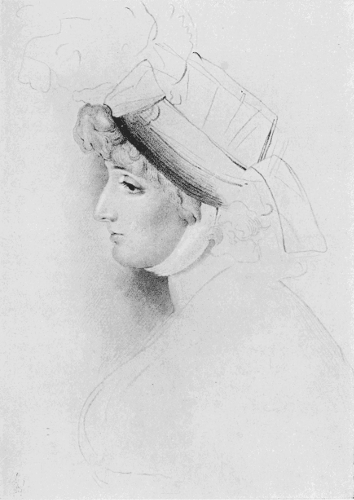
MRS. SIDDONS
By R. J. Lane after Sir Thos. Lawrence
In France the Prussians had been driven back, the National Convention had abolished Royalty, proclaimed the Republic, and were now preparing to try the King, though it is not likely that the last item of news had yet reached Mrs. Piozzi. The Republic at once took up the offensive, and its troops occupied Savoy and Nice, which no doubt gave rise to the expectation of an attack on Rome, as mentioned in the next letter.
Streatham Park, Wensday 21.
My dear Miss Weston's kind letter came safe to my hand, 'tis the last I shall read with that signature. Do pray tell me whether your Brother knows how matters go, and when he found it out. Does good Mamma set out at the same time you do? Yes, I dare say. Give my truest regards to charming Mr. Whalley, and your real cousin, his amiable Lady, and tell my Harriet Lee how I expect her, and long to see her, and tell all my tales of sorrow and of joy about poor Cecilia, whose kind and wise Physician came here out of pure good will two days ago, and signed a good Bill of Health for all the family,—honest Jacob included; and said moreover that sweet Siddons would recover in due time, and that time not distant. He is one of us her adorers....
How happy Mr. Pennington must be in Mrs. Tryon's admiration of his Sophia's fine qualities. These are the bright moments, the lucid spots of life, which those who never marry never see. Mr. Whalley's is really a lucky house, I seldom have seen it without a courting scene upon the foreground. Tell him, (if you can remember,) that his democratic friend, Count Andriani, asked for him the other day, tho' I perfectly recollect his turning quite pale with passion while they disputed about politics. Meantime the French are expected hourly at Rome, and at Loretto, to pay their troops with the rich spoils of Palaces and Churches. Some Italian noblemen dined here last week, and actually wept with reflexions upon past terror and apprehended injuries. Excellenza Pisani in particular, at whose throat, and at those of his little girls, ten and eleven years old, they held knives and pikes for the space of four hours, surrounding his coach as he came away, and loading him with the bitterest curses; adding Rogue and Rascal, etc., till his daughters' Gouvernante, in perpetual fits, seem'd wholly dead from fright, and his Steward came out in a spotted fever with the agony. I never heard anything so dreadful. Little Lady Caterina says she thought they would kill Papa every minute. Remember that Pisani is one of the first families in Europe, and that his person ought to have been sacred as Ambassador from one of the first Republics in it.
Poor Marquis Spinola has the same tale to tell; but he had lived twenty years in France, and acquired kindness enough for the Nation to be sorry for them. Well! we will now think of nothing but private happiness, and rejoice that 'tis still within our reach. May you, my kind friend, long remain a proof and pattern of it, prays your truly affectionate and obliged
H. L. Piozzi.