Chapter VI · (continued 3)
Reading edition
Ay, Ay, I see where I shall pass the Winter months escaping frosts, and keeping clear of expences, in a climate better than Paris, the Latitude very little higher. But if you open your lips—Adieu!...
Dear—— says his health was never so perfect, and he uses horse exercise, and sends love to his Friends,—and is a good Boy. I used to bid my children when at distance, only write three words,—safe, well, and happy: his letter is just like theirs.
You are tired, are you not, of the silly talk concerning the Queen and the Radicals. They are like the Statues in the Arabian Nights, who clatter their armour to fright those who go up the hill: but if you walk steadily forward it ends in nothing.
We have an Italian Rope Dancer coming, Diavol Antonio, as they call him. Our shows have been like those in a Magic Lanthorn; so the Devil comes at last to end the whole ado.
Fryday May 5th, 1820.
... We will see a great deal of each other when Clifton becomes my place of residence for six pretty weeks. After them—old Ocean. Can aught else compleatly wash away all recollection of Bath Parties? That fair assemblage of glaring lights, empty heads, aking hearts, and false faces?
Who is it says the conversation of a true friend brightens the eyes? I have enjoy'd two chearful hours talk with our best speaker, best actor, best companion,—Conway. You seem to express yourself as if half sorry you loved him so much. I am only sorry that I can't love him ten times more....
Here is lovely weather for frisking up and down, and my empty pockets will not overload the carriage; altho' the whole family of emigrants will be packed in, and on, and upon, my Post chaise and four....
Salusbury sent me a whimpering letter, and has already got his £100, which Heaven knows I owed, and much more, to the estate of Messrs. Callan and Booth, Lodging House keepers. But if I can get five Guineas o' week for No. 8, during absence, I shall bring matters round in due time: because, as Clarissa says in the Rambler, 'tis well known to all the Beau-Monde that nobody ever dies.
In her next letter Mrs. Piozzi makes arrangements for the accommodation of herself and her household, consisting of her man James, her attendant Bessy, and two other maids at Clifton.
Tuesday, 16 May 1820.
... I can't stir till 10th of June.... I like to be under Mrs. Rudd's roof, and mean to sleep under it next Saturday three weeks, the Pretender's birthday, when old Tories in Wales wore white Roses, the 10th day of June. Sunday's dinner I hope to eat with Mr. and Mrs. Pennington, at their hospitable board, and we will talk of anything and everything but la Partenza, which cannot be before the same day of July, as till then I have ne'er a groat. If life is lent me I will be rich that time twelve-month; and if it is not lent me, I shall want no money.
Meanwhile I expect no letters from our favourite Friend. I have written to him tho', and told him that you and I were his Hephestion and Parmenio; and if he does not laugh at his Blue Ladies, we are surely well off.
Do you remember Charles Shephard, I wonder? and how we petted him? and Piozzi trusted him with all his affairs, and bid me do so; and so I did. The envious and jealous people however, after my husband's death, (people of our mutual acquaintance,) blew coals up between him and me, and parted us with acrimony on his side, mental resentment, very strong, on mine. I express'd none however; only said, "God forgive and prosper you, farewell." Many reports would have been made afterwards concerning his distresses, which I regularly turned a deaf ear to; and for these last 10 years never heard his name, and scarcely ever pronounced it. Last Fryday brought me a beautiful letter from him, dated West India, congratulating me on the gay supper given last January, assuring me of his continued regard, and bidding me direct back to the Hon. C. S. etc. because he is a Privy Councillor, Chief Justice, and Lord knows what besides.
That he retains his confidence in me plainly appears from the tender enquiries he makes after his favourite Lady; of whose attachment to him, and his to her, no one ever knew but myself. So I have lived long enough to have old friends restored, and to have made one new one. I hope dear Conway and he will be acquainted when he comes home rich and—no, not happy, but able to spite the spiters. If I am removed before then, you will remain and introduce them to each other. It will be a mutual pleasure, and you will talk of H. L. P., and Sir John will have my letters to make money of, and give him some compensation for my extravagance in the year 1820.
Callan and Booth, the people I take my house from, have heavy claims on me now; so I have let it to Mr. Iveson for a twelve-month, and mean to be smooth as Oyl'd Silk by July 1821....
There is much for you to do as my Sentimental Executrix, so we will hear of no departure but mine for Marasion, just by Penzance....
George Hammersley has just left me and taken my Banker's Book to Pallmall to be regulated; and gives me great credit for my care and exactness in my Money Matters: bidding me make no scruple with regard to their House, etc., very good-naturedly indeed. But as I told him I never yet overdrew my Banker, and will not (unless something serious happens,) begin to do so in the year 1820. One twelve month's short-biting will set all smooth, and you shall see a merry face once more on the shoulders of yours and dear Mr. Pennington's affectionate,
H. L. P.
A few days afterwards Mrs. Piozzi was much agitated, on Conway's account, by the news of the collapse of the stage of the Birmingham theatre, where it appears he was going to act; but it turned out that it was not during a performance, and the only injury done was to one of the workmen.
Bath, Tuesday 23 May 1820.
... I shall sleep at your Crescent House, Mrs. Rudd's, as we agreed long ago on Saturday night, 10 June, if it pleases God, and go to your Bristol Cathedral on Sunday morning: dine in Dowry Square, chat with you all the evening, and pass a comfortable night,—altho' the Queen is coming near enough to put every one in a heat; if perhaps she may forbear to light up a fire in our Nation for purpose of roasting her own chicken to her own mind.
Public and private villainies on the increase, as Dr. Randolph used to tell us long ago. He did recommend Charles Shephard's father for the education of young Salusbury, and the son recommended himself by his useful talents to dear Piozzi; by his brilliant ones to me. I am happy to find he will be rich and prosperous; happy he scarcely can be from the nature of his attachment; but 'tis happy to feel attachment at all, for when that's over, all's over....
... At a wedding breakfast we were invited to yesterday Dr. Wilkinson harangued in praise of Marazion, and our friend Mr. Gifford said that when he was a young Officer, he treated his brothers of the Corps with a dinner; two dishes of fish, one ham, three chickens, a pigeon pye, and a plum pudding;—the cost, 14 shillings....
Meanwhile Sir Wm. Hotham says the Levee was a Bear Garden. Miss Knight's letter to Mrs. Lutwyche says it was full of Grocers, Silk Dyers, and Upholsterers. And I say it was a Levy-en-Masse.
The Bath people must get substitutes for H. L. P. and W. A. C. as they can. I fancy young Roscius will be the man, the woman is yet to be looked for.
Admiral Sir William Hotham, one of Nelson's officers, was made a K.C.B. in 1815, and became one of the Gentlemen in Waiting to the King.
The young Roscius (William Henry West Betty), whose acting at the age of twelve created such a furore, and whose popularity for a time eclipsed that of Mrs. Siddons, had already appeared at Bath in 1812. He retired from the stage in 1824 and died in 1874.
Bath, Tuesday Night,
6 June, 1820.
... Mr. Ward has taken leave, and all the Ladies wept. Such was the croud, I am told, that James my man could not get in to any place he could stand upon.
The Londoners will have as good food for starers as Mr. Ward can give the Bath folks. Queen Caroline is said to be arrived, and is to inhabit Wanstead House. The rumours and reports are indeed innumerable....
Meanwhile my heart is heavy with affliction at losing an old, tried, and true friend, Archdeacon Thomas. Poor man! and poor Mrs. Thomas! for whom my heart bleeds. He was buried in the Abbey, where he was walking with Dr. Harington, his father-in-law, some few years ago. "Let us look," said they, "for a place where we may lie." "Ay, Thomas, so we will, for
These ancient walls, with many a mouldering bust, But shew how well Bath Waters lay the dust."
repeated the ever-ready Doctor.
How long, dear Mrs. Pennington, am I to live? How many valuable companions am I to lose? These gentlemen were among the very pleasing ones I have known.... Thank God Salusbury and Conway—dear Lads—are young, and likely to last me out. But when they do not write my foolish heart is fluttering for their safety,—naughty children as they are in neglecting to send me a letter. I have heard but once from Brynbella since my £100 went there....
Mrs. Dimond told [Miss Williams] that Bath would have a sad loss of Mrs. Piozzi; but the Queen will put everything but herself out of everybody's head. The weather is wonderfully dull; so is my letter....
Henry Harington, M.D., Physician to the Duke of York, was a talented musician, and founder of the Bath Philharmonic Society. A letter quoted by Hayward describes him in 1815 as "listening with delight to his own charming compositions. The last Catch and Glee are said to be the best he ever wrote." The incident mentioned above took place the same year. There is a curious little note about him in Mrs. Piozzi's Commonplace Book. "Dr. Harrington, who was then 88 years old, never took any air or exercise that he could possibly avoid, going constantly to his patients in a Sedan; and held a handkerchief before his face to keep the air away."
Another note, dated June 7, 1820, runs as follows: "Am I, H. L. P., sorry to leave Bath? No, but I should be half sorry to think I never should return, which it is most probable I never shall; my age so far advanced. Well, God's will, not mine, be done."
Penzance, Tuesday 25 Jul. 1821.
[clearly a slip for 1820.]
My dearest Mrs. Pennington will be pleased to hear that we arrived safely at Penzance last night.... All we are told about the place seems true.... We shall get a good house, with a sea view ... upon the Regent's Terrace, paying £16 o' month, thro' the whole ten, from 1st of August next to 1st of June 1821....
Our dear Conway's name at length appears in the Morning Post, summoning his troops to meet in the Green Room of the new Theatre, Birmingham. If Mrs. Rudd does not know it, do her the honour to call with the information.
I wish the ship was come with our Cook, and our books, and our luggage. A Mr. Paul shew'd me 4 fine Red Mullets he had just paid a penny each for, this very morning: yet the Inn gave us a stale Soal yesterday, and will charge a shilling at least for it. But Honesty is a shrub harder to raise than Myrtle, which grows here in open air sure enough, and the people are so fond of it that they plant the beautiful Bay out of their sight as much as possible, preferring green trees to blue waves completely.
St. Michael's Mount is a disappointing object, at least to me; and as to the country we came thro', nothing ever looked so poverty-stricken, except the very roughest part of North Wales in rough days, before they had begun enclosing. Goats browsing wild about the rocks, as in some districts of Snowdonia, serve the peasants as good substitutes for cattle, who could not pick a living so as to enable them to give milk for the innumerable children that crowd the cottages. Yet Mrs. Hill complains that they grow saucy, and refuse Barley Bread now, which used to be their regular sustenance. I have not, however, seen a beggar, and the shops are splendid, while the streets are odious,—too filthy, too mean to be endured. Bangor and Beaumaris would be ashamed of them. I might have had a good house for two Guineas o' week, but could not away with the situation, coming from Clifton Hill. Peat stacks at every turn shew what fires they use here in the winter, but till last January snow had not been seen for many years, and it lasted but one day. The tide here is like that in the Mediterranean, just visible the Ebb and Flow; tho' full moon to-day, no rise appears to my eyes that are unused to a land-locked bay, and which, (foolishly enough), expected an open Ocean, such as the Sussex coast exhibits. But old Neptune here puts on a quiet aspect, resembling that he wears at Weymouth or at Tenby. No mud however offends the Bathers, and no Machine assists them.
I saw the Holmes, and pretty Mendip Lodge, as we came along, and fancied I could discern Weston super Mare, whose Sea View Place is just such a row of houses as Regent's Terrace; only we have here such magnificent gardens, and one good house in the middle of the row, looking down with true contempt on the mouse-holes each side it:—and that Mansion I am in chase of, only suspecting that, before we knew it was to be had, I entangled myself in a mouse-hole.
The women here are beautiful. The Lady of Mousetrap Hall, with whom I have entangled myself, has eyes like Garrick's, teeth like Salusbury's, complexion like your own, but cruel as lovely. I fear she will not let me off; and in her house I should regret the ample space of your house, or mine at Weston super Mare.
I have half a mind not to let this go till I have finally settled this great affair. Great indeed just now, for as Goldsmith said
"These little things are great to little men."[33]
And on this 26th—I shall sit, fret, and dine In a chair-lumber'd closet, just eight feet by nine.
For I feel myself after all condemned to the Mousehole for three months certain; £2, 15s. 0d. per week, with a view of the sea, and then (if we live to see November), Mr. Paul's comfortable Mansion at next door.
Penzance, Wed. 3 August, 1820.
Charming Mrs. Pennington's beautiful letter was indeed most welcome, tho' it does put me a little more out of humour with my run-away frolic than I was before it arrived....
Now for Penzance and its Parties. Mrs. Hill made a splendid one, for me I rather think, and my black satten gown (for no other is yet arrived,) was my best garment. Bessy lent me a cap of hers, and my youthful looks were duly appreciated—my whist-playing applauded. We had two tables, one for shillings, one for sixpences; a profusion of exquisite refreshments, and music in another room. Oh! if I escape all temptations to sensuality, I shall live to see dear Mr. and Mrs. Pennington again, and the Hot Wells, and Clifton Terrace, where I shall surely jump for very joy. But these Red Mullets and Dorees for two pence o' piece will certainly destroy some of us. Poor Bessy has been seriously, I might say dangerously ill, from indulging in a Crab; it made James sick too; all the family half-killed,—for the small price of a groat the fish, and a Pound to the Dr.... a real Physician, thank God, and not a country 'Pothecary....
The people know not how to be civil enough, and if my stomach will reconcile itself to the clouted cream, I shall come home as fat as the pigs of the country, and such pork did I never see. Our own garden affords potatoes for us all, and onions etc., besides the flower plot, perfuming the very air around with carnations of every hue, Myrtles of every form, and exotic shrubs with Linnean names innumerable. The appearance of our Mansion, pleasure ground, and kitchen garden, reminds me of Kingsmead Terrace, Bath; but James says the houses here are by no means so spacious as that where your compassion carried you when our incomparable Conway was so ill. I hope he has proved himself irresistible, and what must the heart be over which he cannot, if he pleases—triumph?... Oh! if I possessed an unappropriated £100 in the world, I would go see him act once again, that I would.... I am glad Mrs. Rudd's heart seems lighter than when we left her; the Rogue has never written to me, no, not a scrap; but she had an earlier pretension to his regard, I think it is scarce a truer.
Meanwhile Sophia Hoare has written me a more good-humour'd letter than usual, and I am so delighted! Maternal love is the only good thing mankind can not throw away. It springs fresh with the least drop of water flung upon it. She wishes her illustrious Neighbour out of Town I see, and says wisely that her present residence being so near the Barracks is unfortunate, because the soldiers' wives and children are among her every night's applauders. The Hoares are used to be violent opposers of the Ministry, but Democrates like to have their property held sacred, as well as you or I; and firing houses will make no sport to the Bankers, I trow.
So now pray accept these not elaborate verses: they will amuse Mr. Pennington's gout.
Around their Queen Here are seen, Sharp'ning every sting, Bees,—alarming By their swarming People, Peers, and King. But in their tricks, Should they fix On our property; They must learn To discern That when they sting, they die.
Surely such Cakes, Jellies, etc., as they use here for refreshments, all new and warm, were never seen at Bath or London, so various, so profuse. I never touch them, certainly, but never was so tempted. No Confectioner's shop visible in the place, all made at home.
With regard to rain, we live in a cloud of soft mist, rain, if you please to call it so; certainly a perpetual damp, warm moisture. Lady Jane James said, you know, that she never put on a dry chemise at St. Michael's Mount, and truly did she speak; but nobody ever told me that the sea here is as tame as the country is wild. Wild without sublimity, coarse externally, like other Misers; its riches all concealed underground. I saw Hay carried last night, two months after the environs of Clifton. But I have wrong'd old Neptune; he can roar, I hear him now, thank Heaven. Oh! how much more delightful is the music he now makes than that of the pretty Ladies of the parties, to the rude ears of dearest Mrs. Pennington's everlastingly obliged and faithful
H. L. P.
Aug 3. Fateful month! but no clothes, no books, no Cook, no Conway's portrait yet for poor H. L. P.
Cook, books, and clothes were still in the Port of Bristol, as Mrs. Pennington writes on the 29th, waiting, as it appeared, for the captain to make up his freight; and might then be expected to take from four days to a fortnight—according to the wind—to make Penzance.
The renewed enthusiasm for Queen Caroline was aroused by the anticipation of the Bill of Pains and Penalties, intended to dissolve the marriage, which was brought in on August 14, but proved so unpopular, both in and out of Parliament, that it had to be dropped.
On August 10 Mrs. Pennington is able to announce that the Happy Return had actually sailed, with Mrs. Piozzi's belongings, five days before. Conway had been to see his mother, and had called on herself, rather, she thinks, from civility than from choice. "There was a polite distance assumed, evidently for the purpose of repressing enquiry.... I am persuaded we trouble ourselves much more about his concerns than he either wishes or likes." She gathered, however, that he had secured some sort of recognition from his father. She alludes to the letter of "lovely Mrs. Hoare," whom "I always liked ... because I thought her more personally like you than any of the Ladies."
Penzance, Sunday August 13, 1820.
Come! oh come! dear Mrs. Pennington, I see you half long to be here, and what a relief, what a comfort, would your society afford to your starving H. L. P.? Here is no heat, no dust, no cold: I daresay it is a very negative place, but I must not have you tell tales out of School. Miss Trevenan may justly disapprove my censure on the no picturesque of her native county: and if you read her my letters so, I must grow cautious, à la Conway. I have heard from him, thank God! The rogue told me nothing tho', except how charming you and I were, what admirable letters we wrote, etc. "Yea, and all that did I know before,"[34] as Juliet says. Quere, whether he has anything to tell; unless it be that he has at length calmed his own noble and too-feeling mind, by conduct which himself approves.
But at the same moment with your kind letter comes our long-expected ship. Cook says they have been to Wales; Swansea in Glamorganshire!
The day you receive this one whole month will have elapsed since I left the full moon shining in her brightness on Clifton Terrace. Never have my eyes seen her since. No, nor a starry night. Yet here is sun enough, and the sea so beautifully blue and clear, you would be delighted with it, as one is with a tame Lyon. Will you come?...
Much, meantime, and of much more importance, is crazing all the brain-pans of poor Europe. The revolt at Rome strikes me as very surprising. The same people who defended their Sovereign as long as they could, poor creatures! against French aggression, now fly in the face of his not only Innocent, but innocuous successor: no mortal can guess why. Ay, ay, you used to laugh when I mounted my turnep cart and preached the end of the world. But you don't like witnessing the convulsions that precede it, and which increase in violence visibly every day. Poor Ithaca! whence Ulysses was detained, you know, by the gardens of Alcinous, has been shattered completely to pieces by an earthquake, under the name of St. Mauro; and Inspruck, where I spent a few days, has seen the destruction of her Golden House.
Our Queen Bee, of whom the Radicals have laid hold, will be the instrument of concussion in our Country; and we drones shall suffer, while the stingers go on torturing each other into madness. The Naturalists, Pennant, Linnæus, etc., have long observed that all the Hymenoptera have stings. Yet I suppose that will not deter the hopers from marriage....
Mr. Mangin's Intercepted Letter was a little Pamphlet, censuring some Authors, Actors, etc., commending others; and I got two kind lines, before we were at all acquainted,—so that brought on Library conversation, and he offered his services about the Name-Book;—took it to London for me, where it was rejected, not through any neglect on his part: and I felt myself much obliged by his attentions, and rejoiced in his good fortune when he married....
No particulars are forthcoming respecting the "Name Book," but it was evidently a work on Etymology, written some years before, which was to have been called Lyford Redivivus, for which she was unable to find a publisher. A letter in Mr. Broadley's collection indicates that it was finished about 1816, when she writes to Sir James Fellowes, "I wish Mr. Jenkins had taken the Name Book."
Penzance, Saturday Night,
26 Aug. 1820.
Dear, kind Mrs. Pennington, I love you for wishing that you could come, and you ought to love me for agreeing in the notion that to come would be very foolish. One can hardly save the expences of such a journey by cheap fish, when the water 'tis boyl'd in must, every drop, be paid for. And what an ideot was James not to pay the carriage of the Turbot! When I miss'd it in the weekly account I could have cuff'd him.
The heats are equable, not strong or starvy; but little can be said in praise of the weather. Rain, almost incessant, keeps one at home, and to get at this lovely sea, such stinks must be encounter'd as I never knew but at Rome or Naples. Poor, dear Italy! I did love it however, and hear with unaffected sorrow of the pangs that are tearing it to pieces. In France fire-brands seem the instruments of punishment from on high. In England one female suffices. If nothing can be done without more help, my Paper says that Buonaparte is to be let loose, and that Prince Esterhazy's business here was to solicit his liberation. Hissing the Duke of Wellington is a prelude, a pretty overture to such an Opera. Opera means piece of work, you know. It makes me more willing to quit the world certainly, when I see it rolling downhill so. But the whole of it must be discover'd before it is destroy'd, and the little ship William, a trading vessel from Blythe in Northumberland, has in effect found at last the great Southern Continent, so long supposed to exist, so completely forgotten of late years....
Did you ever read my verses, which this discovery made by the William confirms? "No," is the answer, Well then, here they are, making part of a long poem composed 35 years ago.
Where slowly turns the Southern Pole, And distant Constellations roll, A sea-girt Continent lies hurl'd, And keeps the balance of the World. But felter'd fogs, and hoary frost Defend th' inhospitable coast, Which, veil'd from sight, eludes the Pilot's care, And leaves him fix'd in ice, a statue of despair.
I hear no more of Salusbury. I never could get him to care about these matters: and after all, does not he act as all parents wish their children to act, soberly and quietly, keeping a steady eye to his interest in this world; not, I hope and trust, forgetful of the next. One must love the creatures for their valuable, or delight in them for their shining qualities, no matter whether they love me or no, and in their way they do love me. Sir James Fellowes has written kindly and good-humouredly, and my heart has entirely made all up with his. Nothing, as you say, ail'd him but jealousy; and I hold that to be what foolish Merlin, the mechanic, called a desagreable compliment....
Miss Willoughby has written from St. Anne's Hill. She says Lord Erskine wishes the illustrious Lady, who causes so much talk, was in the Liturgy and out of the Country. After what past at Ephesus, I see not why one should wish any such thing; but the aggregate of understanding she is tried by will decide rightly, I doubt not....
Well, God mend all; and give us a merry meeting on our Happy Return....
The populace had been exasperated with Wellington over the Peterloo incident, and he was just now sharing the unpopularity of the Ministry, of which he was a member, on account of the Bill of Pains and Penalties designed to effect the Queen's divorce. The exclusion of her name from the Church Services had been one of the first objects of the King on his accession.
Miss Willoughby, who soon afterwards followed Mrs. Piozzi to Penzance, appears to have been a daughter of Charles James Fox.
15 Sep. 1820.
I hope my dear Mrs. Pennington is beginning again to look for an empty letter. Empty it must be of all but good will, badly express'd, for we are still-life people here, who see and hear very little, and reflect less upon what is seen and heard. I think every day more and more with our old Master Shakespear, that "there is a tide in the affairs of men, which, taken at the flood, leads on to fortune."[35] Caroline of Brunswick has surely miss'd her tide. A commotion might have been raised the first week: I now begin to doubt its possibility on her account. Rebellion however is in, as boys say of Cricket and Kite-flying, and any excuse serves in any country. When what is called a Spirit of Liberty seizes the swarthy inhabitants of Morocco, how should their old enemies, the Portuguese, escape? "When Afric recovers, Mundus will end," says an old proverb. And as dear Mrs. Pennington says, "no matter how soon, it should be either ended or mended." The eclipse however did nothing towards its destruction. I saw it here beautifully, but there was little apparent obscuration, tho' the Thermometer sunk two degrees. We shall have an elegant Eclipse of the Moon on our Equinoctial day, the 22d of September: and our tides become even now a little stronger in their flux and reflux. Like other quiet temper'd people, their anger, I understand is dreadful....
Doctor Randolph's state of health grieves me, and the loss of Mr. Bayntom; on whom so many, (and those wise people too,) depended with a very firm reliance. I always wonder at such partiality. It has been my lot to love three or four Medical Men very sincerely, and like them in earnest for companions and friends, but would not give much of preference to any. And 'tis well that such is my humour, in a place where we send to the Tallow chandler's if we want drugs: no Apothecary or Chymist residing near happy Penzance. Fowls we buy in the feathers—and James says every shop in the Town sells Barley to feed them with. There are no more Poulterers than Milliners yet everybody is genteelly drest, and I warrant our Michælmas goose will be good, and cost us scarce half a crown, giblets and plumage. I should like to write you a letter with my own quill....
Well! now I will go work at your Fly; but even that is nonsense, for I cannot frame it, nor line it, nor put it in a box. There are no frames, no boxes, no linings, at Penzance. I cannot make it worth your acceptance; and who dreams of my living till the spring, and bringing it with me to Clifton, when I shall be going on to 82 years old? I must finish, and leave it in charge with Bessy, to save from the hands of my Executors; as I will do by Conway's portrait....
The Harvest here is beautiful and plenteous:—
"Far as the circling eye can range around Unbounded, tossing in a flood of corn,"
as Thomson says. Industry is a rough power surely, but a kind one; working that you and I may sit idle, ploughing that H. L. P. may have leisure to work Butterflies, and weaving that pretty Mrs. Balhechet may look lovely in her various dresses.
Charles Shephard has written to me again. He likes the correspondence I suppose, for we are 4000 miles asunder. By dint of industry however, he will come home rich; and seeing 500 people richer than himself, will find he has exchanged honour and distinction for Coffee-house chat and Drawing-room small talk,—the food his fancy now is longing for, but which will grow insipid in six months; and reflection will then inform him that to talk of Rum and Sugar has more spirit and sweetness than to talk of nothing. He begs me to write, not newspaper occurrences, he says, but stuff out of my own head, as they say at Eton School:—the head of an old Haggard, 81 years old!!! But he is consorting with those who never heard tell about the gardens of Alcinous. Some one sung a Ballad in which Lethe was mentioned, not a soul in the company guess'd what was meant, till some very clever fellow found it was a river, running between Leith and Edinburgh....
In Morocco, under Soliman, the Christian slaves were being liberated, and piracy suppressed. In Portugal, after the flight of John VI to Brazil, the government had been in the hands of a Regency, which included Marshal Beresford, who organised the army, but used its power despotically. During a visit he paid to Rio in 1820, insurrections took place at Lisbon and Oporto, the English Officers were expelled, and a Constituent Assembly formed.
The Eclipse of Sep. 7, 1820, was an annular one, well seen over the N. of Europe. Mangin relates how a similar one occurred in Mrs. Piozzi's girlhood, and an astronomical friend told her she might live to see another at 80.
On Sep. 21 Mrs. Pennington writes, much disgusted at the revelations of the Queen's trial, and apprehensive of their effect on public morals. "Not a Boarding School Miss, nor a Parish Girl, that can make out the words, but we see studying these detestable pages, and devouring their contents as they would a new Novel.... The worst part of the business is the little respect, and less approbation, felt even by well disposed and moderate persons for a certain Great Individual. The vices of debauchery offend and disgust more (with many who are not altogether disinclined to the practice,) than the downright wickedness arising from the ambition and tyranny of the worst Monarchs that ever reigned; and prove that the moral virtues are of more value than anything. Our late K—g lost 13 Provinces, and supported a war which was unpopular with a great part of his subjects, and which has ruined the Nation; yet he was loved for his moral excellence, and his memory is revered."
She deprecates precipitancy in the matter of the Butterfly, and suggests that any Carpenter, with 4 strips of wood, might make a rough, but efficient, substitute for the Tambour Frame which she thought Mrs. Piozzi could not procure.
Penzance, Tuesday, Sep. 26, 1820.
In life's last scenes, what prodigies surprize! Fears of the brave, and follies of the wise! Sam. Johnson.
Poor dear Dr. Randolph! Ay, and poor dear Mr. Chappelow too! The post which brought your letter—charming friend!—brought one from his nephew, son to Soame Jenyns, saying his uncle was dead, and had left my letters carefully tied up, which he would send to Bath immediately. I wrote and beg'd him send the packet to you, where I shall find it safe if I live till May-day; and if not, you will give it to Sir John or Sir James, my Executors. He had lost his head long before he lost his life, I find. Awful reflection! For a pleasant head it was, and a world of pleasant stories were hatched in it. Would not Mr. Pennington be sorry for such a loss to his true servant H. L. P.? I am very sure he would; and vexations at 81 years old cannot contribute much towards holding it in its place....
Of the discovery made by the "William," I think very seriously. It is the last place that has lain concealed, and when the Gospel has been preached there,—Christ does not say obeyed,—"then shall the end come." Distress of nations with perplexity was never, no never so apparent: tho' Dorset Fellowes writes me word that they say not a syllable of their own conspiracy at Paris.... You are right about the tryal ending in smoke. I daresay it will: but the people, falsely called people in power, are afraid of its ending in fire, like myself, and will therefore be glad to compound. It was never a thing of their seeking, and the French are all for la belle Caroline, of course; and threaten their English visitants with the speedy appearance of Monsieur le Baron Bergami. Meanwhile the fashionable joke is to say a noble Marquis, much talked of in London, is like a comb, all back and teeth. Yes, says another wag,—a Horn comb.
My fret about your Fly was for a frame, a picture frame, to hang it up in your boudoir. The only merit in my work is that it is all done upon the hand; I do not know how to use a Tambour. The drawing it is ill executed from represented the Blue-eyed Paris from Chandernagore; a Butterfly of much dignity, according to Linnæus, but you must accept it cover'd with faults. Lady Williams of Bodylwyddan had the Ulysses worked reasonably well,—a dozen years ago,—and Mrs. Rudd has a Moth....
I never heard Miss Stephens sing, and what is much stranger, never heard the famous Mrs. Sheridan. But I have heard old Dr. Burney say she sung "Return, O God of Hosts" better than anybody except Mrs. Cibber the Actress, whose manner of delivering that air was absolute perfection. Miss Sharpe says the Kembles are well and happy at Lausanne.... I hear the Twisses are returned to Bath, meaning Mr. and Mrs. Twiss; the Girls are out, like good girls, getting their living.... Horace has got into Parliament safe and snug.
Poor Mrs. Rudd! I hope she will keep her houses full, and find me a lodging in some of them next Spring, before the 10th of June, that I may bustle and be busy; and get my little things, (as Ladies call everything,) from No. 8 Gay Street to No. 36 Royal Terrace, Clifton. But how hopeless and silly all this is at 81 years old, and dear Chappelow dead of superannuation, six years younger than myself, in whom hope of living six months would be proof of superannuated folly. We must do as well as we can, and wish we could do better. He was as temperate as I am.... But when sickness comes in consequence of drinking some stuff that pretended to be smuggled wine, and was a mess made with sea water in an Alehouse; why then I do despair of ever again seeing any place or people that are dear to your poor
H. L. P.
Mr. Ray has long left Streatham and its neighbourhood. His mother died of cold in a rough winter some years ago. She would go and sort her apples in a loft; where being seized with a shivering fit, she was brought down,—only to expire,—at 92 years old.
Soame Jenyns, who, according to the Dictionary of National Biography, left no issue by either of his wives, was the author of the epitaph on Johnson containing the lines—
Boswell and Thrale, retailers of his wit, Will tell you how he wrote, and talk'd, and cough'd, and spit.
The French conspiracy here alluded to was the plot hatched for the murder of the Duc de Berri, son of the Comte d'Artois.
Bartolomeo Bergami, who just now loomed large through the cloud of scandal which surrounded the Queen's trial, was originally engaged by her as a courier, when she retired to the Continent in 1813. His handsome person so commended him to his royal mistress that she speedily promoted him to be her equerry and chamberlain, and treated him as an intimate friend. Through her influence he was made a Baron of Sicily, a Knight of Malta, and several other orders, including one of her own devising, under the patronage of "Saint Caroline": while a number of his relatives were provided with posts in her train.
Catherine Stephens was at this date the leading soprano at Covent Garden, and afterwards sang at Drury Lane, and in the chief concerts and festivals. In 1838 she married the fifth Earl of Essex, then over eighty years of age, and died in 1882. Though she had not a finished style, she sang airs like "Angels ever bright and fair" with much pathos and devotional feeling.
The Mrs. Sheridan here spoken of was the dramatist's first wife, Eliza Ann Linley, who died 1792. Though she was the finest singer of her day, her dislike to appearing in public had much to do with her run-away match with Sheridan.
Of Dr. Burney she writes in her Commonplace Book that he "died at last, I am told, at 89 years old, and in full possession of his faculties. They were extremely good ones. He thought himself my friend once, I believe, whilst he thought the world was so. When the stream turned against the poor straw, he helped its progress with his stick and made his daughter do it with her fingers. The stream however grew too strong, and forced the little straw forward in spite of them."
Mrs. Pennington sends a closely-written foolscap sheet dated October 1, largely taken up with the Queen's trial, a propos of which she says: "We received a comical anecdote in a letter from Town. They say it was a common trick for the little rascally boys, if they could get hold of a stranger in the mob, to offer to shew them the Queen for sixpence! On receiving it they would shout out; on which Her Majesty would immediately appear, and smile and curtesy graciously: and the boy would then add, "I'll have her out again presently!"
Penzance, Sunday Oct. 15, 1820.
A propos to Kingly residence the best joke is that since Her Majesty has possessed herself of all the John Bulls, her husband ran to Cowes by way of retaliation. It would seem by the Papers now, I think, that the Tryal draws near to a conclusion. If any poor Italian should be put in the Pillory, as menaced, he never, no never, would come out alive. When Mr. Thrale and I lived in Southwark, I pass'd a poor creature in that situation, upon St. Margaret's Hill, and could eat no dinner for thinking of his sufferings and danger. "Madam," exclaimed Dr. Johnson, "give yourself no concern about him. My life for it, he is drunk by now." The hapless Lombards have no such resource, and the man I saw died before night. But Miss Willoughby tells of another joke. One says the Queen must be fatigued to death sitting in this room so, without refreshment. "No Sir," is the reply, "the Queen's not nice; she can take a chop at the King's Head";—an Alehouse in the neighbourhood.
What you observe concerning public and private virtues may be true now in 1820; in 1760 I remember, when Wilkes's moral character was objected to by the Loyalists, the Liberty Boys cried, "What care we whether he be vicious, or the man he insults be virtuous? We look to public, not to private character." In consequence of these opinions the Town was deluged with verses, of which I can call to mind one stanza in praise of the then popular Hero.
'Tis thus that we are told, The Ægyptians of old Ador'd their still fouler Ichneumon, Who alone durst engage The fell Crocodile's rage, With courage exceeding the human.
I forget whether the crocodile stood for King George III, or my Lord Mansfield. They equally resembled him, I believe; but 'tis plain men thought little of Jack Wilkes's vartue.
Your Butterfly, which was finished yesterday, is not less fixed in his flights than popular opinion. When Cardinal de Retz was followed up and down by an admiring mob, "Is not this fine?" said a flatterer, "to see your Eminence possess'd of so many friends and followers" "Let anybody ring a dinner-bell," said he, "and see how many would be left me then."
Meanwhile the storm continues very grand indeed, but something very like very dreadful. This bay looks so calm too! But sweetest wines make the sourest vinegar, and no anger is so fierce or fatal as that of gentle natures irritated to frenzy. I begin to wish it was over; as I did travelling among the Alps, which at first enraptur'd, but the third day wearied my very heart. Effect of the true sublime....
[P.M. Nov. 2, 1820.]
This will be a dull letter, dear Mrs. Pennington; I have been very ill, ill in good earnest, the pulse 92. There is a fever in the Town, and Sophy, my stout-looking housemaid, lies cover'd with blisters now....
Let us talk of the storm, it is more entertaining, and tho' death seems, by the describers, to be most dreadful under the form of white breakers, it comes cleanlier, and less to my personal disliking, so, than accompanied with gallipots and all the tribe of sick-bed sorrows; for which, and the talk concerning them, my aversion was ever great....
I continue to do what I came hither to perform, eat cheap fish, and pay old debts. Mr. Pennington will laugh, so will Dr. Randolph, if you tell them Tully's Offices are come to the last chapter, and that I shall write FINIS to that book, if I live the next month through.
Am I, d'ye think, to see the end of 1820? If I am, those who say people of letters are never people of figures, shall find themselves mistaken in H. L. P. Had I dreamed of losing £6000 at a stroke so, I would have been more prudent.
Conway was a good boy to send Partridge and pretty words to dear Clifton: he sends me no such nice things, knowing that my regard is not a ceremonious one. Marcella's speech to her lovers in Don Quixote, when they tax her with ingratitude, has the best common sense I ever read. "You love me," said she, "because I am young and beautiful and attractive by talents and graces. When you are so too I will requite your love, but no gratitude is due for that attention which you all confess to be involuntary. Get you gone, and plague me no more. Should I want your assistance when grown old and ugly, would you give me any? No, I warrant. Then I have nothing to thank you for."[36] ...
Dorset [Fellowes] has been surprisingly kind to me ... for after all, "Age is dark and unlovely, it is like the glimmering light of the Morn, when she shines thro' broken clouds: the blast of the North is on the plain, and the Traveller shrinks on his journey." Well! the people at Penzance do endure the dregs of the Piozzi very good naturedly; and Miss Willoughby grows much a favourite with them all.
What is to be seen at Penzance however, is a storm. The billows most majestic, and the sea spray tossing, foaming, as if to remind me of Brighthelmstone. For there alone does the salt water throw its particles into the air, so as to be carried 9 miles over the Downs to Lewes; where I have been warned to strip the Peaches of their downy coat, because they would taste of the last tempest. The shipwrecks here are shocking, and very frequent. This is no land of felicity to any but starvelings. Bessy buys five such fine Soles as I have partaken of at your table for one shilling, and they feed the family. We had a Turbot larger than that I sent to you for half a crown, a while ago. Miss Willoughby and I dined on the fins. But I scarce believe all fish is wholesome food, the town is full of Typhus now....
My heart tells me that H. L. P. has made her last journey; but 'tis no matter, and will be no loss.
A new book called Nicholle's Reflexions, or Recollections, will amuse you. His opinions of the late King run parallel with yours. But I, who remember caricatures of Charlotte toasting the muffin, and George the third reaching the Tea-kettle, can never be made believe that modern Reformers sigh for moral Princes. How did Louis 16ze please the people with his morality? Calling his present Majesty Nero, is to me comical. Carleton House may indeed be termed Nerot's Hôtel, because the Master of it is kept, like the people of a bagnio, in hot water. And it seems that's the true London joke. Adieu....
The £6000, as appears from subsequent letters, had been given to Sir John Salusbury.
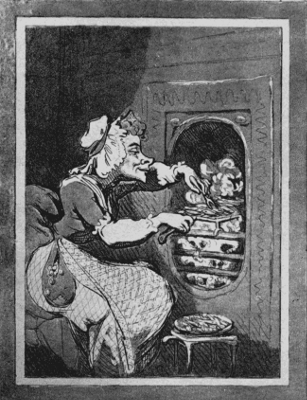
"FRYING SPRATS" (Q. CHARLOTTE)
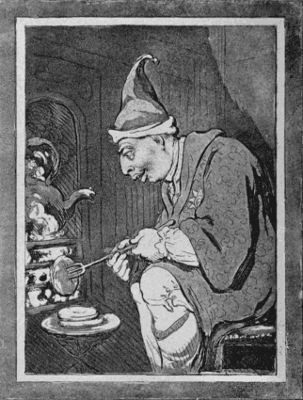
"TOASTING MUFFINS" (K. GEO. III)
From a caricature by Gillray, 1791. From the Collection of A. M. Broadley, Esq.]
The joke about "Tully's Offices" evidently relates to her paying off the expenses of her birthday fête. The supper was provided by a celebrated Bath pastrycook named Tully, and the jest originated with Mrs. Piozzi, who, addressing her guests, bade them do justice to "Tully's Offices," the name by which Cicero De Officiis was commonly known in the eighteenth century.
On November 17 Mrs. Pennington, who has herself been ill, writes in great agitation about the Typhus, entreating Mrs. Piozzi, if she will not return to Clifton, to fly to Torquay. The Randolphs report it to be a terrestrial Paradise;—the scenery exquisitely beautiful, the air pure, mild, and dry, the town clean and neat, the living cheap, (the best possible meat 6d. per lb.,) and no lack of good society. Mrs. Randolph considered that Mrs. Piozzi might keep a carriage and live there elegantly within £1000 per annum.
Of the caricatures she remarks that "they were no proofs of the people not loving George the 3rd as a good man, a good husband, and good father, but merely the result of that spirit of persiflage to which the people of this country are said to be so much addicted. The simultaneous expressions of joy which you and I witnessed in the Streets and Theatres of the Metropolis on his recovery, could only have been the effects of genuine love and affection. It is in the failure of these virtues that the present K—g has lost the warm hearts of so many worthy subjects."
Penzance, Sunday, 12 Nov. 1820.
I am very sorry, dear Mrs. Pennington, that I said anything about this odious Fever; it will perhaps hurt the place, and in no wise benefit me.... We are surely in the hands of the same God at Penzance as at Torquay; and when he calls, go we must.
I cannot leave my habitation, which I have taken for a term, and must abide in till the term is over, nor will I go back without having done what I came hither to do. My friends are but too, too solicitous. They have all heard of this nonsensical story, and every day brings me letters full of pathetic, and I believe, sincere admonitions.... I wish you would all be more moderate in your kindnesses. My establishment is not a little Cloke-bag to put on my shoulder, and carry away from one place to another.... Be quiet, dear Friend, so I say to Miss Williams and Conway, who are half wild, God bless them!—and their loss would be nothing to what they fancy it. Yet 'tis all I can do to keep them from my door.
The world is all unhappy. This vexatious affair of the Queen has been a Tryal to everybody. I wish to know how the Bishops of Salisbury, Bangor, and St. Asaph give their votes. Lord Liverpool's observations are the best. If there was nothing wrong between the Lady and the Courier, what was there? Conversation was difficult, and talents there were none.
No letter has come from Brynbella this long time, but I know from Miss Williams there is nothing wrong there; meaning as to health and happiness. As to pelf I will be more prudent in future; indeed the danger is over when the money is all gone....
Bessy and I are engaged far differently from trimming hats for parties. Housework, and nursing, and crying, and clinging about Dr. Forbes and Mr. Moyle, an intelligent Surgeon, is all we have been doing a long time.... I do believe there is always Fever of this sort in these low situations, and when we do move, if it be not to Dymerchion's burying ground, it shall be to the lofty Crescent at Clifton. Torquay may do for some of those future years dear Mrs. Pennington talks of....
If you like to tell Mrs Rudd I still hope to come early in spring, do tell her so. Her son is a good child, and will ever be an honour and a comfort to her and to your really obliged and troublesome
H. L. Piozzi.
Her anxiety had not been all on account of Sophy the housemaid. Her attendant Bessy was the mother of a small boy named Angelo, a great pet of Mrs. Piozzi's, who accompanied them, and whom the Fever had brought to death's door, but who was now beginning to mend. She herself had only had a feverish cold.
The Bill of Pains and Penalties, reluctantly introduced by Lord Liverpool, then Prime Minister, though it passed the third reading, was abandoned by the Government on November 10, and the next letter gives a lively picture of the demonstrations which ensued.
Penzance, Nov. 15, 1820.
I feel terribly afraid, dear Mrs. Pennington, that my state of anxiety when I wrote last, betrayed my pen into some impatience of expression; ... and the interest Dr. and Mrs. Randolph were obliging enough to take in my concerns, deserved more thanks and compliments than I had, at that moment, leisure to pay.... The weather is changed, and the Fever quenched, ... and H. L. Piozzi become less a nuisance to her active Friends....
This town may defy any place of its size, or twice its size, for a burst of real feeling displayed in honour of the late event. All the ships in the harbour have flags flying during day time, lamps blazing thro' most of the long night. "Queen Caroline for ever" round every head in ribbons, while Laurel, Myrtle, every blooming shrub, decorates the houses that would not wish to be pulled down. And no bustle you and I witnessed in 1788, could in any degree equal the spread of influence shown on this occasion by Britons in love with morality, from Scarborough to Penzance. Popularity may be outlived indeed, as her uncle learned I trust, when shot at twice in one day, and nearly torne to pieces on another; when Cecil Forester, passing by accident, called up the Guards, and saved George the third's life, in his own Park, from the fury of a Mob, joined in deliberate design to murder him. I was in Wales, but could not doubt a fact so well attested. The State Coach, in which he had ridden that morning, was demolished, and he nearly dragged from his own private carriage. My wonder is he escaped so often, and died in his bed at last.
Our Horse's Mother, (Mr. Pennington remembers the story,) sent to me to bid me not to be frighted into illuminating my house. The Peuple Souverain say "Light your windows, or we will break them." My answer is the same to both. "We will do as our neighbours do."
16th. Wish'd morning's come. The windows unbroken. The gay fellows from Newlyn and Mousehole, (who increased our mob,) all gone home to bed, after drinking "The Queen and Count Bergami for ever," till they could scarcely reel to their wretched habitations. But St. Michael's Mount was the beautiful sight to see. Lamps in a pyramidal form to the top, where Tar Barrels were placed, and gave a glowing light to the whole scene, resembling the Bay of Naples.
Well! the wife of George the second was just dead when my poor eyes and ears opened on talk and show. She was a writing and reading woman, who respected herself, and half ador'd her husband. She died detested of the people, and derided by the wits. Our next was Charlotte of Mecklenburg. "Poor ugly Pug!" cried the populace, who crowded about her Chair, as she went to the Theatres on her first arrival. Poor Pug indeed! when the mob met her suddenly a few years after, at St. James's Gate, with a bier and mourning apparatus; "Young Allen's body" written on it. "Young Allen, murder'd by your husband's soldiers." The Queen fainted, miscarried, and lived thirty years, when she died. The people swung a Cat about the Palace, and sung "Old Tabby's departed." This Lady is a favourite; but sure the others were not hated on account of their immorality. I never heard a fault but avarice laid to their charge, and that has been disproved....
Oh! these are pretty times in which to be caring for a lengthen'd stay: but I have not that folly to answer for. May you, dearest Mrs. Pennington, be as willing to lay down the burden of life, when the Angel of release comes to cut the last thread it hangs by, as is your truly sincere and faithful
H. L. P.
November 16, 1820, is the last date in her Commonplace Book which she notes was begun at Brynbella 1809, thrown aside for some years, begun again at Streatham 1814, and continued at Bath 1815.
In 1794, a year of great scarcity, as the King went to open Parliament on October 29, his carriage was surrounded by a mob crying "Bread," and "Down with George!" and stones were thrown through the window. A somewhat similar attack was made on the Queen's carriage in 1796, when she herself was hit by a stone.
In a letter dated November 17, Mrs. Pennington replies. "In an early stage of our acquaintance, speaking of you to Mr. Greatheed, I recollect his exclaiming, 'Oh! if you like her so much now, what will you do when you see her miserable? She is so comical then, that she is quite too charming.' And comical you are, sure enough, my dearest Mrs. Piozzi! You scare one with ugly words, and then are half-angry that one is frightened. At above 200 miles distance, was it possible to hear of 'Fever and Typhus' in the town, and even in your house, and not be alarmed?" ...
"All the Bishops voted for the Bill, (with the exception of the Archbishop of York and the Bishop of Tuam,) tho' they divided on the divorce clause.... And all (with the above exceptions,) declared their perfect conviction that her Majesty was guilty, to the full extent of the charges." ...
"You remember, I daresay, Mr. Dennam's concluding sentence, in his address to the Lords, conjuring them to imitate the beneficent spirit of the Saviour, and to say to her, 'Go, and sin no more.' A blunder certainly, if he had taken the proper inference into account, worthy of Paddy himself, from a man advocating her innocence. The following lines are, I think, neat enough on the subject.
Go, Caroline, we thee implore, And sin, (if it be possible,) no more. But if that effort be too great, For God's sake, go—at any rate."
Penzance, Fryday 24 Nov. 1820.
· · · · · · ·
The oldest friend I have in N. Wales, poor dear Mr. Lloyd of Pontriffeth, is dying; and my earliest playfellow and cousin, Tom Cotton, is dead. We never met, of course, since my second marriage, and he was saucy. But I am sorry, for he will be saucy no more. So if my death prevents me from returning to No. 36, you must not wonder, tho' I will not say you must not cry.... Conway writes the kindest of letters: but Newton is tardy in his payments, and I am as low-spirited as a cat.
It would however have made me laugh to see Miss Hudson illuminating her windows, and it does not make me weep to observe that the Brynbella people never write. Tom Cotton's death is a bad thing for Salusbury, his life is in all our leases. Mr. Thrale had a proper notion of that man's longævity. He lived 77 years. Lady Keith and I are the other two. Dearest Piozzi enjoyed the estate and improved it, and never had a life to renew,—never cost him a penny. Those who do right get a little reward for it, even here; and now that my heart feels itself on the brink of eternity, how daily and nightly do I thank God and my parents that in my gayest hours I never did forget it....
Lieutenant Parry's voyage might supply much food for thought and chat. He has surrounded the Pole, and found the seas more open than was expected. I do not understand that we are brought nearer to America, but we are near enough to them for the love they bear us. 'Tis pity he lost sight of the red snow, and the savages who took our ships for animated creatures, fancying, like the Mexicans in Dryden's "Indian Emperor," that
They turned their sides, and to each other spoke, We saw their words break forth in fire and smoke, etc.
It was so pretty to see his fine ideas realised.
Miss Willoughby and your most humble servant have been at a Penzance Ball, the first, (as we were told,) illuminated by Wax Candles; and the Ladies led our admiration to the lustres. They had better have led it to their own beauty, for we had seen lighter rooms often, seldom such pretty women; and all like one another....
I will live, if I can, but every day counts now, aye, and every pulse too, and 'twere a folly not to feel it. Were a soldier to sleep sound in a besieged town, Mr. Pennington would count him lethargic. But he that sleeps during the attack, can only be compared to that man or woman who does not prepare for death at 81 years old, but just tries to keep him out of sight....
It is not because I think better of Mortal Man than you do, dear friend; worse probably of men and morals, having seen more. But then I am contented with less, and ever thankful when things and people are no worse, surrounded with temptations as the poor creatures are, and filled with snares, holes, gins, rotten planks, etc., as we all find the bridge that carries us from this world to the other. Fools flapping their umbrellas in our faces all the way, hiding the light from us at every step, and triumphing in slips made by their neighbours, whilst tottering along themselves, scarce able to stand or go. Do not be sorry that I have arrived at more than three-quarters over, but pity those that have many arches to pass, with broken battlements on either side, enough to giddy their brains. Salusbury's path seems clearest of difficulties, but he is in danger of drowsiness; Conway's walk is above all men's dangerous. And neither of them, poor dears! have, in their early stages, experienced the advantage of an authorised hand to lead or guide them. Yet you will see them both—good fellows in their way—whether they love me enough or not, I'm sure you will. Conway certainly, I believe both, do think better than she deserves of theirs and your
H. L. P.
... I am sitting without a fire, it is so warm and damp, and soft an atmosphere, we are all relaxed to rags. No sunshine.
Thomas Cotton was the fourth of the six sons of Mrs. Piozzi's maternal uncle, Sir Lynch Salusbury Cotton, Bart., and almost the only one of that large family to whom she ever alludes.
Lieutenant Parry had commanded the Brig Alexander in the expedition of Captain Ross to the Polar regions in 1818. In 1819 he sailed in command of the Hecla to discover the N.W. passage, and reached Melville Island. He returned in the autumn of this year, landing at Peterhead on October 30, and posted to town. His despatches reached the Admiralty on November 4, and he was shortly afterwards promoted to the rank of Commander.
The latter part of the letter is of course based on Steele's "Vision of Mirza," published in the Spectator, No. 159.
Penzance, Thursday, 30 Nov. 1820.
... This morning, all agree, is to exhibit a new procession through the streets of the Metropolis, which, with its consequences, may justly fill thinking people with alarm. How much benefit can result from invective meanwhile, I see not. Insult is harder to forgive than injury, and for the best reason, it does the insulter no good. A man may fill his purse by robbing me, while he who flings dirt sometimes forgets that there's a pebble lodg'd within, which cuts so sharp as to excite lasting hatred; and all for what? Reformation never yet was effected by scurrility. And if the Fourth Estate of the Nation, as some Member of Parliament called the newspapers, were less violent on both sides, it would be better. Irritating an already much offended and dangerous enemy is, surely, not prudent. Better get rid of such a one without submission, but without harsh language.
If then we fail, the world will only find Rage has no bounds in slighted womankind. Dryden.
When the Orientals go out Tyger hunting, they try to finish, not to wound the creature. But I am wearied with conjecture, and must wait the result as I can....
No new book has reached us but the Abbot, an odd novel enough, but to me a dull one. The Edgeworths have always humour, and often some good information.
Jeffrey Crayon's Sketch Book is pretty enough. How oddly the things come round! There was just such an out-of-the-way writer entertained the Town about 66 or 67 years ago. He called his book Sketches, and assumed the name himself of Lancelot Temple. But 'tis strange how names are left behind, when the books are forgotten that first used them. John Bull is in every mouth, and every Pamphlet, yet people do not seem to know who first called Old England by that very appropriate appellation. Mr. Pennington, I dare say, well recollects that it was Dean Swift: when, to reconcile the Nation to Harley's Peace of Utrecht, and the loss of their Bonfires for Marlboro's victories, he and Arbuthnot planned a little work called Law is a bottomless Pit; in which he represents Great Britain as engaged in a litigious quarrel with Lewis Baboon, by which name he designates Louis Quatorze, and shows how we were cheated by our Allies, Nic: Frog for Holland, my Lord Strut, for the Emperor of Germany, and so on. Of all this rubbish, composed of wit and malice and mummery, little now sticks in any but such memories as mine; remembering old stuff better than new....
The invention of the phrase "Fourth Estate" is attributed to Burke, who, referring to the Reporters' Gallery, said, "Yonder sits the Fourth Estate, more powerful than them all."
Mrs. Piozzi was not much interested by Scott's earlier productions. Mangin notes that she thought Rob Roy a dull book; but adds that "no one could be more ready than she to applaud the unknown author as a man of Genius." Her admiration was excited mainly by his poetry, on which the Commonplace Book contains some verses which end as follows:
So may posterity bestow the praises which to thee we owe, And never be the Lay forgot of our Last Minstrel, Walter Scott.
Geoffrey Crayon was the pseudonym used by Washington Irving, when he published his Sketch Book in 1820. Lancelot Temple was the nom de plume of John Armstrong, whose Sketches or Essays on Various Subjects appeared in 1758. Wilkes is said to have assisted in their production.
The procession to St. Paul's on November 30 to celebrate the Queen's acquittal, passed off without any serious disturbance. No escort of troops was permitted, but she was received as usual by the city authorities, who accompanied her to the cathedral.
[Dec. 14, 1820.]
My dear Mrs. Pennington says her letters are mere commentaries upon mine. What text shall I find next to excite her eloquent flattery? Lord Kirkwall's death is what most readily presents itself to a woman just twice his age, who little dreamed of living to lament him. Poor dear K! My heart is very heavy at the thought. And when recollection, or retrospection places him before my mind's eye, it is with a pint of curious Constantia wine under his coat, or shooting dress, to please dear Piozzi in his last illness. So kind! Well! sure the people will have done dying some day! Never was sight so wearied as my own is by reading Newspaper lists.
Mrs. Mostyn writes chearfully. Living abroad loosens all old attachments, and gives no opportunity of forming new ones. 'Tis the true mode of keeping the mind free; but then I mean roving from place to place, not being shut in an angle of the world, of which, as a Turk once said, the only merit is that Suspicion herself could not throw any light into corners.
Tell me sometimes about the weather—in the world. Here it is mild, soft, and just now silent; stormy enough at times, but never clear. 'Tis the anger of a puzzle-headed fellow, which elicits no spark of brilliant fire; and the inhabitants of Penzance speak of lightning as a most unusual phenomenon.
I have the comfort to hear my fair daughters praised, even in this odd place. They patronized some poor families, when such philanthropy was less common than now, and are remember'd with grateful tenderness. Such recollections are among the Hot-house plants which bloom in the open air of Penzance. Rough winds break, and heavy snows chill the remembrance of what is merely ornamental, producing, like Oak and Ash, no lasting utility....
I can really bear a good fire with difficulty, but the smoke is scarcely lessen'd by endurance of the cold. The houses here are so constructed that, except in one particular wind, we live smother'd. Coals are however not cheaper than elsewhere; meat and fish bear no price, but we pay for every drop of water—salt or fresh—because it must be carried. The place is replete with objects of curiosity nevertheless, and Lady Keith gained immortal fame here, by descending 35 ladders, of 35 steps each, into a tin mine. Not the most extraordinary of all the tin mines, for there is one under the sea: a submarine residence of many wretched mortals, who seldom see light, (save such as their patron Sir Humphry Davy supplies them with,) but often hear old Ocean roaring over their heads. A wonderful situation surely! and clear of worldly contamination. They are innocent of all that we are saying and doing.
Meanwhile I am glad you have been amused by Matthews. Even I, who naturally hate buffoonery, was much diverted by his story of the Yellow Soap, which dear Sir George Gibbes never wearied himself with repeating. My heart tells me that Matthews has a brother, who wrote a Pamphlet called the Nutcracker, meant as a sort of mathematical puzzle; that he planned the new fine Bedlam Hospital, just off Westminster Bridge, and requested a particular apartment for himself, conscious of his own infirmity; that he actually resides there, much respected and visited by the great Mechanics, who do nothing without consulting him. The Comic Actor calls him cousin, but the relationship is nearer....
Sir Humphry Davy, who was born at Penzance, invented his safety lamp in 1815, and was created a Baronet in 1818. He had just been elected President of the Royal Society.
Charles Matthews the actor was now giving his "At Homes." The Sketch Mrs. Pennington saw was probably that entitled Country Cousins, produced in 1820.
John, Viscount Kirkwall, born 1778, was the only son of the Countess of Orkney, who was still living.
On December 23 Mrs. Pennington writes: "As you say, the Abbot is indeed a very dull book. I begin to question whether a well-known point in History can be a good foundation for a Novel. There can be little interest where the event is more than anticipated, and if extraneous characters and circumstances are too freely introduced, we quarrel with them, as interfering with the truth.
"There is some pretty writing in the first volume of the Sketches, but the second falls off lamentably, and is downright stuff....
"You will be shocked on seeing, in the Bath papers, the entire destruction of the Kingston Rooms by fire!!! No one seems to know by what means. Those very rooms in which, near to the same time last year, you made above six hundred people so happy! Everybody, I believe, but me and Conway, who you certainly desired should have been most so: but he was wretched, and infected me with his misery, so perversely does everything go in this world."
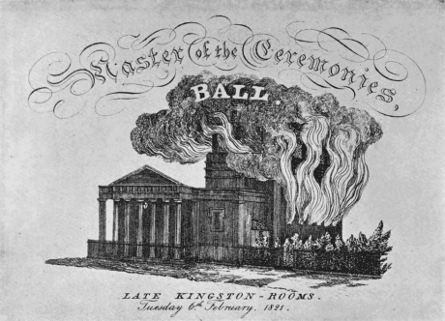
Master of the Ceremonies,
BALL
LATE KINGSTON-ROOMS.
Tuesday 6th February 1821.
THE BURNING OF THE KINGSTON ROOMS
From a ball ticket, 1821, in the Collection of A. M. Broadley, Esq.
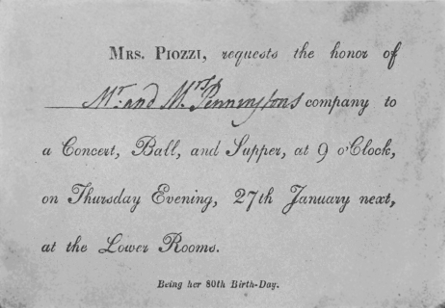
Mrs. Piozzi, requests the honor of Mr. and Mrs. Penningtons company to a Concert, Ball, and Supper, at 9 o'Clock, on Thursday Evening, 27th January next, at the Lower Rooms.
Being her 80th Birth-Day.
TICKET FOR MRS. PIOZZI'S FÊTE
Penzance, 27 Dec. 1820.
· · · · · · ·
Well! at 82 years old, and my 81st Birthday is hard at hand, one is easily convinced of money's importance to felicity. No suicide, or comparatively none, is committed but for lack of pelf. Yet money, if people are stuffed with it, like a Fillet of Veal, does not keep them alive. Do you remember a comely Mrs. Taylor, who had married an old man, and possessed herself of his riches to an immense amount? She sent dear Conway £5 for a Benefit Ticket, tho' being just left a widow she could not go to the Play. She is dead: a woman about 40 years old, I suppose, apparently strong and healthy.
This is stranger, though not so dreadful, as the fire, of which your kind letter gave me the first account. I suppose it was occasion'd by some of these new devices to snuff candles by conjuration, or fill your teapots by steam. They cook their dinners by stratagem, and assassinate those whose talents lighten the cares of life, best illuminated by genius, like that of unfortunate Naldi, charming creature as he was!!—and to die such a death! My heart bleeds for his handsome wife and pretty daughter,—highly accomplished both; and left to starve on the remembrance of his unrivalled powers.
Cruel reflexion! But all reflexion is cruel, and so we run to get rid of it. My own conscience however congratulates me that I had discharged Upham's long Bill; so if he had suffer'd it would not have been by my fault or folly. I have not lived on fish in a foggy atmosphere and smoky house for nothing, when comforts like those come smiling to my heart....
Miss Willoughby is in the highest favour here. She plays Country Dances, Waltzes, etc. for the boys and girls to dance, after winning their money—or that of their parents—at sixpenny whist; and she makes riddles and charades to amuse us all, and is very entertaining.
Adieu! Here is no room to tell of a shipwreck and a Parrot, with two other two-legged creatures, saved out of thirty eight, coming from Surinam. Wretched Sailors! now begging their way to London, with only what they sold the bird for in their pockets....
Guiseppe Naldi, who had distinguished himself in Italy and London as an Actor, Singer, and Musician, had lately met his death in Paris, by the explosion of a newly invented Cooking Kettle, which he had been invited to inspect at the house of a friend.
On January 8, 1821, Mrs. Pennington writes to report an unexpected visit from Conway, on his way to take up another engagement at Bath, in spite of the ill-treatment he considered he had received from the Management of the Theatre before he left. But he had not fared much better, pecuniarily, at Birmingham, where he had been a leading Actor and Stage Manager for four months, but was only given £106 as his share of his own Benefit. "Detestable Mechanics! I hope he will waste no more such powers on them." This short interview, however, served to re-instate him in Mrs. Pennington's favour, and she writes of him with all her old enthusiasm. "Anything so noble! so manly! so graceful! so handsome as his figure at this time I really never saw."
Penzance, Cornwall Saturday, 13 Jan. 1821.
· · · · · · ·
'Tis a cordial to hear about Conway. My heart entertains no fears for his reception among old acquaintance, and I can't cry because his Benefit brought only £106. The people in London get very little. Mrs. Hoare says she saw excellent acting to completely empty benches: I forget at which Theatre. Indeed my mind has been so taken up by a new attack upon my property, that I have thought on nothing else. A Mr. Kenrick, of whose name or situation in life I am totally ignorant, writes to ask me very peremptorily what I did with the stock of some Mr. Giffard, who died he tells me, before Mr. Thrale did!! Lord! what should I do with the man's money? His name is new to me now, but he says it stands joined with that of my first husband, to whom I am executrix. No sum is specified, but 'tis probably a large one; and I am a bad Lawyer, and easily alarmed. I was so bad a self-carer, that when the death of my four Coadjutors left me alone to manage the Trust Money as I pleased, I begged of my Lord and Lady Keith to name those that should be substituted in their places; and I think, but have forgotten, whether Mr. Hoare, Sophia's husband, is one. Surely they should bear me out harmless, but God knows whether they will or no; and you know I have parted with my patrimony and my savings to Sir John Salusbury, who always complains for want of money, and I daresay justly enough. Mr. Thrale's estate is doubtless chargeable with any mistakes of this sort; but I should hope the Widow's jointure is guarded from such attacks. Nevertheless my spirits are flutter'd and affected, and I am as hoarse with nervousness as if I had caught twenty colds....
Miss Willoughby dined with me yesterday. She says Coriolanus is an unfavourable character for Actors to appear in just now, when insulting language to our Peuple Souverain will perhaps be treated as it was in Rome. I shall be happier when I see the Newspaper, and learn how our Friend has been received; but do not fright Mrs. Rudd about it, perhaps she may get good intelligence before the common Prints of the Day come out. If the Play should be disapproved, every kind, good-natured acquaintance will inform her....
How is poor dear Mr. Pennington? Better, I'm sure, and always kind to me. I used the word Joynture improperly; tell him so: £800 pr. ann. was appointed me by Marriage Settlement, in return for Ten Thousand Pounds I brought with me to Southwark. The rest was hard worked for, and left me by Will, in consideration of my Welsh estate, enjoyed by Mr. Thrale for 9 years, and offer'd him for ever had he wanted it. That money may be liable for ought I know, but I hope not....
Thursday, 1 Feb. 1821.
I like the Tailpiece best, dear Mrs. Pennington, and feel deeper interest in Macready's Acting than in Lord Castlereagh's. For as Dr. Randolph said to our sweet Siddons once, coming out of Laura Chapel, "All are Actors": and I am most contented to hear the Oppositionists are likely to be hissed.
But I want you to tell me a truth before we leave Penzance, a truth of a very different taste. Will it be worth our while (says Bessy,) to send half a doz: hams by the "Happy Return," for which we must give seven pence halfpenny a Pound here?... The Fish would be worth carrying to begin Lent with at the Pope's Court; but fish won't carry. Our oysters are better than those Vitellius sent to Sandwich for; and such Cod, Mullet, and Flat fish of all denominations no tongue can enumerate. Our Crocuses, Primroses, and Honeysuckle leaves, all bursting now every day, are lovely likewise;—but what wretched pens to describe them with!
You are a comical Lady in your fears lest Miss Willoughby should make me a Radical. Salusbury seems, by his letters, to have fears lest she should be hovering over my death-bed, to his disadvantage. I hope to hold fast both life and loyalty one little while longer, and cannot believe she will help hurry either of them away. Poor Miss Willoughby! were it not for her I should not have known Milton from Shakespear by this time: for to no other creature here are those names familiar.
God forgive me! but talking on the subject reminds me of the days when H. L. P. was young, perhaps agreeable, and supposed to have interest among the grave and gay. When I was solicited on behalf of a decayed Gentlewoman, such as H. L. P. may one day become, for aught I know, whose friends wish'd to get her into a then famous refuge for distressed females, Lady Dacre's Workhouse, or rather Almshouse, I tried, and succeeded; but beginning to harangue my Protégée upon the neatness of her new establishment, the decent society she would be introduced to, etc., "Ah! Madam," said she, "but will there be any one there who ever frequented the Opera? For I love musick so, I can talk of nothing but Mingotti." Such a companion in my retirement has been to me Miss Willoughby.
I think the attack upon my property, made with no gentle strokes, will at length be parried, so as to fall on none of us. The dividends remained unclaimed for 25 years, and were often advertised before Mr. Thrale's daughters ever enquired about them. Mrs. Hoare, your namesake, kind Sophia, has written to me very good-naturedly; says it is impossible I should have to refund money I never received; that my name alone was lent for them to receive it; and that my letter to the Claimant was the comicallest thing in the world. But my Correspondent saw no joke in it, and sent it for their perusal to Mr. Merrik Hoare.
Well! sure if I do write funny letters from Penzance, I must borrow the salt from the Sea Tang that they manure their Strawberry Beds with, in this place. Apropos, how do those agreeable Brownes do, that I met once in Dowry Square? I loved Maria for her non-affectation about reading before Conway or Piozzi. She took her book up and began so prettily, and so sensibly, where another Miss would have mimp'd. I valued her.
No Bath news but what the Papers tell. London is in expectation of a new Miss O'Neill of consummate beauty, to draw the world off from The Wilson; whose style of singing—Sophy Hoare says—is like that of Billington. Dear Siddons holds her own I hear. Welcome intelligence! when every day takes some old acquaintance off the Stage of Life, leaving sad, and solitary, and desolate your poor
H. L. P.
Mary Anne Lane made a brilliant début at Drury Lane in 1821, as Mandane in Artaxerxes, but going to Italy for further study, she overtaxed her voice, which never entirely recovered its tone. Regina Mingotti, née Valentini, sang with great success in Italy, Germany, France, Spain, and England. She came to London in 1755.
Penzance, February 10, 1821.
Thanks, dearest Mrs. Pennington, for your kind letter, speaking the words of truth and soberness. We will send Hams and Bacon by the Happy Return, most certainly. The Butter here is poyson, whether in pot or pan.
All you can say of poor dear Miss Willoughby is true to a tittle. Sir John is very ill-natured in detesting everybody who contributes to my comfort, and I hope not quite correct in supposing that neither you, nor she, nor Conway would endure my company an hour but for interest. Sophia Hoare's civilities will make him very angry indeed when he hears me say I delight in them: but he deserves such sort of vexation.
So you see Horace Twiss is the man at last, who, when Public Virtue finds herself sick and squeamish, holds the successful smelling bottle to her nose. And are they not all Actors on both sides? Surely they are. That Titmouse began his literary career by criticising and ridiculing H. L. P. in Magazines, Reviews, etc.; and afterwards begged my pardon at a party Mrs. Siddons gave one night at Westbourne. We shook hands and drank each other's health, and I wished him the success his audacity deserved.
This world is made for the bold, daring man, Who strikes at all, and catches what he can. Virtue is nice to take what's not her own, And while she long debates, the glittering prize is gone.
So sung Johnny Dryden, whose family had every claim to match even with a Howard. Addison was Secretary of State, and if his wife was insolent, he needed not to have cared. Would Mr. Canning care? But times have changed.
But there is a passage in the Bath Paper that interests, and ought to interest me much more than Marriages or Merriment. A woman dying in the act of supplication to Almighty God; past 80 years old, found dead at her prayers! I used to say that no death ever pleased me, but here is one at last with which my heart would be content indeed. Why did she not take me with her? If however the next month carries me to Clifton, and treats me with a sight of true friends, I shall think leaving me behind was merciful, and feel replete with gratitude. Conway has written to me very kindly....
If I should live to see a Jeweller's Shop once again, I would evince my gratitude to Sophy Hoare. What she wants is out of my power,—children to enjoy hers and her husband's fortune. Salusbury has got a new Baby—William Edward—I like the name, but have made no offer of Gossiping. Dear Mrs. Pennington is too sharp a discoverer in the Terra Incognita of human hearts. Mahomet says there is a black Bean in that of every one; and that the Angel of Death plucks it in our last agonies. I am trying to loosen mine before the dreadful day arrives, that it may hurt me less at final parting. Poor dear old Cookey! whom I have so much reason to love! Cannot Doctors Dixon or Carrick warm her up again? It is not wholly for interest however that I wish her well. She is going my road, and my heart hopes she will feel it not very rough....
Penzance, Sunday 25 Feb. 1821.
My last letter to dear Mrs. Pennington should be a pretty one, but it will only be dull; replete with Kitchen-griefs, and thanks to Heaven that they are my worst afflictions. Mr. Kenrick's insults have brought me civil letters from Lord and Lady Keith, kind ones from Mr. and Mrs. Hoare, and all will end—in nothing, as they hope, and as I firmly believe. Pray do not suffer your good husband, (so much younger than myself,) to grow old. He and I mean to keep on this many a day, and we will not shew teeth when biting is over with us.
Now for the Kitchen-griefs. James has behaved monstrously ill, "beaten the Maids a row,"[37] like the fierce fellow in Shakespear, and forced reproofs even from my acquaintance by his out-door conduct. This has been going on a long while, but I forbore to speak to you about it, till it suited me to say—do, dear Mrs. Pennington, get me a Footman. Not a fellow to wear his own clothes; I must have a Livery Servant, who will walk before the Chair, and ride behind the Coach, and be an old-fashioned, tho' not ill-looking servant. My little Plate, so small in quantity, is easily clean'd, but clean it must be. For I will not live in a state of disgust when I have a decent mansion over my head, and James was too dirty and slovenly, even for a wretched smoky closet like that I inhabit at Penzance: he is a sad fellow....
& now
Let me tell you the sights that we have seen. I always like them better than the tales that we have heard; and to-day the tales are truly melancholy. Lord Combermere has lost his only child, a son; so his honours and titles are gone, and the estate will fall, I suppose, to Willoughby Cotton, son of the Admiral, my Uncle's second boy. He had nine. This young fellow was a Colonel in what Regiment I know not, and married Lady Augusta Coventry, who brings Babies every year:—but these are not the sights I meant to tell you of.
On last Wednesday then, a memorable day, Mr. George Daubuz John undertook to show us the Land's End, and we did stand upon the last English stone, jutting out from the Cliffs, 300 feet high, into the Atlantick Ocean, which lay in wild expanse before us, tempting our eyes towards the land Columbus first explor'd, Hispaniola. Dinner at a mean house, affording only Eggs and Bacon, gave us spirits to go, not forward, for we could go no further, but sideways to a tin and copper mine under the sea. Aye! 112 fathom from the strange spot of earth we stood on, in a direct line downwards, where no fewer than three score human beings toil for my Lord Falmouth in a submarine dungeon, listening at leisure moments, if they have any, to the still more justly to be pitied Mariner, who is so liable to be wrecked among those horrid rocks, proverbial over all the kingdom,—Cornish rocks! ruinous to approach, as difficult to avoid. The men go up and down in buckets, with two lighted candles each, into a close path, long and intricate. And should their lights go out before their arrival in the open space where their companions work, there they must remain till the hour of relieving one wretched set by another comes to set them free. Billows meanwhile roaring over their heads, upon a stormy day most dreadful, threatening to burst the not very thick partition of solidity that divides them from the light of heaven, bestowed on all but Miners. This place is called Botalloch, whence we drove home our half-broken carriage but not even half-broken bones; having refreshed at the house on which is written "First Inn in England," on one side the Board, and "Last Inn in England" on the other. By "us" and "we" I mean Miss Willoughby and H. L. P., but we took our two Maids, Bell and Hickford, on the Dicky, and James rode. Four horses were not too many for such an exploit, tho' one of them was a Waterloo warrior....
We will go to Conway's Benefit certainly, if I get home time enough: Miss Willoughby will wish herself of the party most truly. But for her I should have pass'd many a dreary hour....
With regard to Lord Combermere's son, Mrs. Piozzi's information was evidently mistaken. Field-Marshal Sir Stapleton Cotton, Bart., G.C.B., Commander-in-Chief in India, grandson of her uncle, Sir Lynch Cotton, Bart., was created Viscount Combermere in 1814. He married thrice, and by his second wife had two daughters and a son, Wellington Henry, born 1818. The latter did not die in 1821, but succeeded to the title, and was grandfather of the present Viscount. His cousin, General Sir Willoughby Cotton, G.C.B., was Colonel of the 32nd Regiment of Foot.
Sunday, 4 March 1821.
I swear I think my dear Mrs. Pennington is one of the very best subjects the King has in his dominions, which contain very strange and contradictory people and things. Battling now about the tenets of Romanism, when Rome is itself in danger of almost immediate destruction from those who know no other tenets but hers. Well! you know I was always mounting a Turnep Cart to predict the end of the world, (not, I hope, forgetting my own all the time). It will vex me, in the last stage of life, to see the death and downfall of the Bourbons, but so it must be, without doubt, if they can live till I get safe to Clifton. Dubious enough, poor Souls! for the plot thickens apace, and Sovereigns have hourly more reason to fear the loss of all that's dear to them. Authority melted from their grasp long ago, and influence is sliding down the hill, of course.
Mr. Pennington must try keep up his spirits. So must we all, but mine often prove false ones, as when I took Geneva for Brandy; but the people here are such knaves!...
The day of our arrival how can I certify? My hope is to see you sometime on Tuesday 13; but Lord! I was so ill on Fryday night I hardly felt anything like certainty of ever seeing myself out of Penzance alive. Never mind that tho'; and say nothing about it; for the people make such an ado I dare not confess that anything ails me, like other old women. It is really troublesome to excess.
We have got Kenilworth among us, everybody admiring and even extolling it. Your strange book has a rival, Mr. Pascoe says, in Anastatius, but I have seen neither. Clifton will be nearer both to books and men. Dr. Randolph must be careful of his highly valued life. No one respects his abilities, or would regret the loss of them more sincerely than H. L. Piozzi, whose comfort it is, that she is likely soon to escape the truly uneasy sensation of outliving friends and enemies, and standing alone upon the Stage of Life, till hiss'd off for being able to furnish no further amusement. After having been at home on the Boards, like Matthews the Buffoon, so many silly years. Bear me however witness, that [I am] all but weary, and only kept from confessing myself so because I think it wrong. What however must this world be that even a Frenchman should leap into Vesuvius to get rid on't; and he did not get rid on't as he expected; the very Mountain vomited him back, and reproached his unrepented suicide.... Everybody seems to approve my sitting down at Clifton, as neither in the blaze of Society nor the obscurity of Solitude. We will make out the close of the Game as chearfully as we can; and if you ask me to dinner on Wednesday the 14th, a refusal need not be apprehended from your poor